David Losa de Areia Afonso
Fish Scales as Model for
Osteogenic Cells Culture
11
Da
vid Losa de Ar
eia Afonso
F
ish Scales as Model for Os
Dissertação de Mestrado
Ciclo de Estudos Integrados Conducentes ao Grau de
Mestre em Engenharia Biomédica
Área de Especialização em Biomateriais, Reabilitação e
Biomecânica
Trabalho realizado sob a orientação do
Professor Doutor Rui Luís Reis
David Losa de Areia Afonso
Fish Scales as Model for
Osteogenic Cells Culture
Nome: David Losa de Areia Afonso
Endereço electrónico: [email protected] Telefone: +351 968 683 153 Número do Bilhete de Identidade: 13392338
Título dissertação: Fish Scales as Model for Osteogenic Cells Culture Ano de conclusão: 2011
Orientador: Professor Doutor Rui L. Reis
Designação do Mestrado: Ciclo de Estudos Integrados Conducentes ao Grau de Mestre em Engenharia Biomédica
Área de Especialização: Biomateriais, Reabilitação e Biomecânica Escola de Engenharia
Departamento de Polímeros
É AUTORIZADA A REPRODUÇÃO PARCIAL DESTA TESE/TRABALHO, APENAS PARA EFEITOS DE INVESTIGAÇÃO, MEDIANTE DECLARAÇÃO ESCRITA DO INTERESSADO, QUE A TAL SE COMPROMETE.
Guimarães, ____/____/________
Acknowledgements
I would like to acknowledge to all that somehow have contributed for the development of my work along this year and welfare, especially to:
-
My parents, José Afonso and Margarida Afonso, for their support andadvisement during my whole life. Also my brothers, other members of my family (including Elisa), as well as my friends that were crucial in my growth as a person.
-
Professor Rui L. Reis for the opportunity of developing my work in a place of excellence such as 3B‟s.-
Professor Antonella Motta, who was my tutor and pathfinder, guiding me inorder to achieve our objectives for this Project.
-
Dra. Joana Moreira-Silva, Dr Tiago H. Silva and Dra. Alexandra P. Marques for their help, availability, support and guidance during the time i worked in 3B‟s.-
Professor Claudio Migliaresi for receiving and supporting me during my ERASMUS period in a laboratory with extremely good conditions to work.-
Professor João Mano for his advisement and for giving me the opportunity to study abroad.-
Dr. Fábio Zomer Volpato, who was many times my teacher, helping me tolearn how to work and know my way around a laboratory.
-
My colleagues / friends of Biomedical Engineering for the best 5 years of my life where we shared so many stories that I will never forget.-
All the researchers and workers both from the 3B´s and BIOtech, who were always ready to help me in all kinds of situations, especially: Lara Reys and Rogério Pirraco.Abstract
Considering the fish scales composition of hydroxyapatite and type I collagen fibrils, the organized and regular pattern of the scales, and also their capability to provide a form of armor plating to protect fish from injury and disease transmission, its potential biomedical application might be striking. In this work, fish scales of the specie Lates Calcarifer, also known as White Seabass, were studied, in particular by the assessment of their potential as model for osteogenic cells culture.
For this purpose the fish scales were collected in a market in Thailand. The scales characterization, especially concerning their pattern, was done by observations in SEM and Confocal Microscope. Results showed that the overall scales pattern is formed by parallel concentric lines and is highly composed of collagen. An in vitro biological analysis of the scales when used as films to support cell (osteoblasts) proliferation was also done. In order to infer about the scales patterning potential on the proliferation of cells, fibroin films with the same pattern of the fish scales were produced, as well as and films without any pattern. To assess cell viability and cell proliferation, a technique denominated Alamar Blue was performed, being the cell proliferation higher on the scales, comparing with the fibroin films. Cell adhesion morphology, cytoskeleton architecture and alignment were evaluated by observations in the SEM and Confocal Microscope. The osteoblasts presented an orientation according to the fish scales pattern alignment and acquired an elongated and narrow shape. The DNA quantification and ALP test allowed drawing conclusions about the cell activity. The cells on the fibroin samples did not show any ALP activity during the 14 days of proliferation, although the ones on the scales already showed some activity after 14 days of the cells seeding.
An in vitro biological analysis of the fish scales using human adipose-derived stem cells (hASCs) was executed, in the presence or absence of osteogenic differentiation factors. The stem cells behavior was very similar to the osteoblasts, presenting a strait and elongated shape aligned with the pattern axis.
Results suggest that the fish scales composition and topography are responsible for a good cell proliferation and induce modifications in cell organization and morphology.
Resumo
Tendo em conta a composição das escamas de peixe em hidroxiapatite e fibras de colagénio do tipo I, o padrão organizado e regular das escamas, e também a sua capacidade de proporcionar uma forma de blindagem para proteger o peixe de lesões e transmissão de doenças, a sua aplicação biomédica poderá ser espantosa. Neste trabalho foram estudadas escamas de peixe da espécie Lates Calcarifer, referente ao Robalo Asiático, em particular a avaliação do seu potencial como modelos para cultura de células osteogénicas.
Para este efeito, as escamas de peixe foram trazidas de um mercado na Tailândia. A caracterização das escamas, tendo predominantemente em conta o seu padrão, foi feita através de observações no SEM e Microscópio Confocal. Os resultados mostraram que o padrão global das escamas é constituído por linhas concêntricas paralelas e altamente composto por colagénio. Uma análise biológica in vitro das escamas quando usadas como scaffolds para suporte de proliferação celular (osteoblastos) também foi realizada. A fim de inferir acerca do potencial das escamas na proliferação dessas células foram também produzidos filmes de fibroína com o mesmo padrão das escamas e filmes sem qualquer padrão. Para avaliar a viabilidade e proliferação celular foi realizada uma técnica denominada “Alamar Blue”, tendo sido a proliferação celular maior nas escamas comparando com os filmes de fibroína. A morfologia de adesão celular, arquitectura do citoesqueleto e alinhamento foram avaliados por observações no SEM e Microscópio Confocal. Os osteoblastos apresentaram uma orientação de acordo com o alinhamento do padrão das escamas e adquiriram uma forma alongada e estreita. A quantificação de DNA e teste de ALP permitiram tirar conclusões acerca da actividade celular. As células nas amostras de fibroína não mostraram qualquer actividade celular durante os 14 dias de proliferação, contudo nas escamas mostraram já alguma actividade 14 dias depois do início da cultura das células.
Uma nova análise in vitro das escamas foi feita com células estaminais do tecido adiposo, na presença e ausência de factores de diferenciação osteogénica. O comportamento das células estaminais foi semelhante ao dos osteoblastos, apresentando uma forma estreita e alongada e alinhadas com o eixo do padrão.
Os resultados sugerem que a composição e topografia das escamas são responsáveis por boa proliferação celular e por induzirem modificações na morfologia e organização celular.
Table of contents
Acknowledgements ... i
Abstract ... iii
Resumo ... v
Table of contents ... vii
Abbreviations ... xi
List of Figures ... xiii
List of Tables ... xv
General Introduction ... 1
1| Motivation and outline ... 3
2| Bone morphology, problems and therapeutic approaches ... 4
3| Fish Scales: Morphology and Potential ... 6
4| Scaffolds Preparation with Natural Polymeric Materials ... 9
4.1. Fibroin ... 9
4.2. Collagen ... 10
5| Cell Types ... 11
5.1. Osteoblasts ... 11
5.2. Adipose-derived Stem Cells ... 12
6| Concluding Remarks ... 12
References ... 14
Materials and Methods ... 19
1| Fish Scales Preparation ... 21
3| Fibroin Films ... 22
3.1. Fibroin Production ... 22
3.2. Construction of fibroin samples with the fish scales pattern (F1) ... 22
3.3. Construction of the fibroin samples without pattern (F2) ... 24
4| Collagen films ... 25
4.1. Extraction of collagen from fish scales ... 25
4.2. Construction of shark collagen films with scales patterning ... 26
5| In vitro Biological tests ... 27
5.1. Cells culture and seeding ... 27
5.2. AlamarBlue Assay ... 28
5.3. Confocal Laser Microscope (CLM) Analysis ... 29
5.4. Scanning Electron Microscope (SEM) Analysis ... 30
5.5. Alkaline Phosphatase (ALP) activity quantification ... 30
5.6. Macro BCA Protein Assay... 31
5.7. DNA measurement ... 32
5.8. Fluorescence Microscopy Analysis ... 32
References ... 33
Fish Scales as Model for Osteogenic Cells Culture ... 35
Abstract ... 37
1| Introduction ... 38
2| Materials and Methods ... 41
2.1. Fish scales preparation ... 41
2.2. Fish scales characterization ... 42
2.2.1. Morphology ... 42
2.2.2. Collagen Imaging ... 42
2.3. Fibroin films ... 42
2.3.2. Construction of fibroin films without pattern (F2) ... 43
2.4. In vitro Biological tests ... 44
2.4.1. Cells culture and seeding ... 44
2.4.2. AlamarBlue Assay ... 44
2.4.3. Confocal Laser Microscope (CLM) analysis ... 45
2.4.4. Scanning Electron Microscope (SEM) analysis... 45
2.4.5. Alkaline Phosphatase (ALP) activity quantification ... 46
2.4.6. DNA measurement ... 46
2.4.7. Fluorescence Microscopy Analysis ... 46
3| Results and Discussion ... 47
3.1. Fish scales topography ... 47
3.2. Osteoblast Behavior ... 48
3.3. Stem cells (hASCs) Behavior ... 53
4| Conclusion ... 55
References ... 57
General Discussion and Future Work ... 61
General Discussion and Future Work ... 63
References ... 65
Abbreviations
AALP - Alkaline Phosphatase
B
BSE – Bovine Spongiform Encephalopathy BCA - Bicinchoninic Acid
BMSC – Bone Mesenchymal Stem Cells
D
DSC - Differential Scanning Calorimetry DNA – Deoxyribonucleic Acid
DAPI - 4'-6-Diamidino-2-phenylindole
E
EDTA - Ethylenediamine tetraacetic acid ECM – Extracellular Matrix
F
FMD - Foot and Mouth Disease
H
hASCs – Human Adipose derived Stem Cells HAp - Hidroxyapatite
M
MDSC - Modulate Differential Scanning Calorimetry
MEM – Minimum Essential Medium
P
PEG – Polyethylene Glycol PDLLA – Polylactic Acid
PBS – Phosphate Buffered Saline
S
SEM – Scanning Electron Microscope
T
TSE - Transmissible Spongiform Encephalopathy
List of Figures
Chapter I. General Introduction
Figure 1.1 - Anatomy and microanatomy of bone (adapted from Ralston, Stuart H. Structure and metabolism of bone. Medicine. 2005).
Figure 1.2 - The hierarchical structure of a fish scale: a) fish; b) staggered multiple scales; c) an individual scale; d) cross-section of a scale; e) cross-ply collagen structure; f) collagen fibrils (adapted from Zhu, D., et al. Structure and Mechanical Performance of a „„Modern‟‟ Fish Scale. Advanced Engineering Materials. 2011).
Chapter II. Materials and Methods
Figure 2.1 - Plate where the scales were glued and covered with silicon to form the molds with scales patterning.
Figure 2.2 - a), b) - Silicon mold with the negative of the fish scales pattern in the bottom of each well.
Figure 2.3 - a), b), c) - Pattern of the negatives existent in the bottom of each well of the silicon mold.
Figure 2.4 - Fibroin samples with a pattern similar to the fish scales.
Figure 2.5 - a), b), c) - Fibroin sample pattern observed in the Optical Microscope. Figure 2.6 - Fibroin sample without any pattern.
Chapter III. Fish Scales as Model for Osteogenic Cells Culture Figure 3.1 - Fish scales from group 1 observed in the SEM.
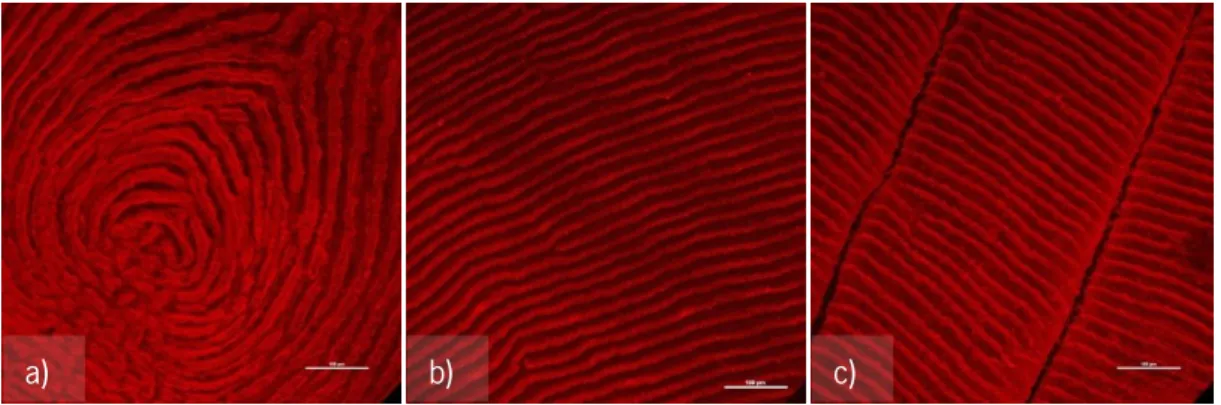
Figure 3.2 - Fish scale observed in the Confocal Microscope with Direct Red 80 staining for collagen identification: a) center, b) side and c) top areas of the scale.
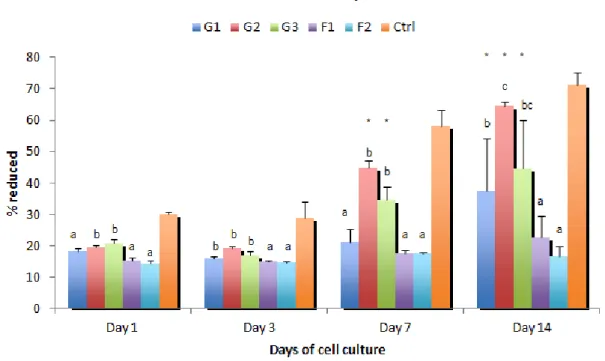
Figure 3.3 - Percentage of reduced Alamar Blue for each group in the different days of control. Values are mean±STDEV, bars with like characters are not significantly different (P>0.05). Abbreviations: G1 – untreated fish scales; G2 – fish scales after a treatment for unnecessary proteins removal from the surface; G3 – fish scales after demineralization and collagen
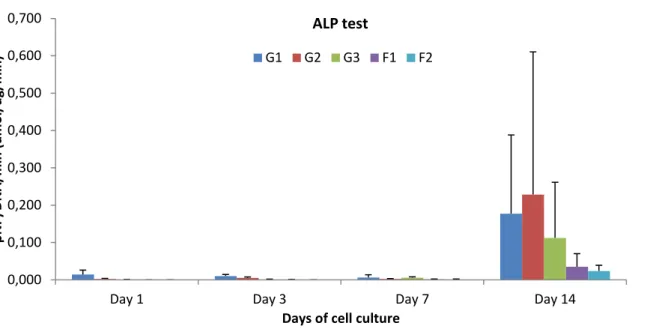
Figure 3.4 - Quantity of pNP enzyme produced per DNA µg per minute for each group of samples on different days of control. Abbreviations: G1 – untreated fish scales; G2 – fish scales after a treatment for unnecessary proteins removal from the surface; G3 – fish scales after demineralization and collagen extraction; F1 – fibroin films with the fish scales surface pattern; F2 – fibroin films without pattern.
Figure 3.5 - Results of the Confocal Microscope observation after stainings with DAPI and Phalloidin Rhodamine. The subscripts indicate the type of sample and the time period after the cellular seeding. The scale bar is 100 µm.
Figure 3.6 - Results of the SEM observation. The subscripts indicate the type of sample and the time period after the cell seeding.
Figure 3.7 – Samples of F2 after: a) 1 day; b) 7 days. Along time cells spread without any specific orientation.
Figure 3.8 - Results of the observation in a Reflected/Transmitted Light Microscope after stainings with DAPI and Phalloidin Rhodamine. The subscripts indicate the type of culture medium used and the time period after the cellular seeding. The scale bar is 50 µm.
List of Tables
Chapter II. Materials and Methods
Table 1.1 - Solutions execution for the nine test tubes in order to build the standard curve for ALP test (osteoblasts).
Table 2.2 - Solutions execution for the nine test tubes in order to build the standard curve for ALP test (stem cells).
Table 2.3 - Solutions execution for the nine test tubes in order to build the standard curve for BCA assay.
CHAPTER I.
1| Motivation and outline
“Biomimetics” is a recent definition but in fact the humankind was inspired by Nature since the beginning of civilization. Creatures and plants possess tools and skills that are attractive to mimic. Mimicking nature cannot be a goal in itself, once this would hardly represent progress. The goal is to learn its principles, extract the general physic-chemical processes of the object/principle to be mimicked, and thereafter transfer it to a synthetic process or new material [1]. Fish scales study is relevant in order to extract some principles for appliance in different areas, being the biomedicine a potential environment for this praxis considering the fish scales composition, structure and functions.
There are many bone diseases that can affect and condition at many levels people‟s lives. The traditional existent treatments are not, in many cases, an effective response for these problems, mainly because the bone ability to recover and regenerate is limited. Therefore the search for alternative and more complex methods for the treatment of bone diseases is a field where many developments can be achieved as a response to improve many people‟s life quality. Bone tissue engineering is a developing field, being an attractive approach with great potential for repairing bone defects since it is based in the body‟s natural biological response combined with engineering principles.
Tissue engineering is a rich and challenging area to be explored. To achieve great progress many small/big steps still have to be undertaken, and the testing of many hypotheses to be made. The fish scales study fits in this context, with great potential, as it will be mentioned later.
The aims of this project were the characterization of fish scales of Lates Calcarifer more concerning their pattern, and the study of the scales as scaffolds with the assessment of the cells behavior such as proliferation, adhesion, alignment and activity. The cells used for this study were both osteoblasts and, in a later phase, human adipose derived stem cells (hASCs). A first study using osteoblasts involved the utilization of 3 groups of fish scales, differing in the treatments they were submitted to, and fibroin films with the same surface pattern found in the scales, following a biomimetic approach, and without any pattern. In the study of the role of the fish scales pattern over hASCs, collagen films with the scales pattern were also prepared, and the cells behavior in the presence and absence of osteogenic differentiation factors were compared.
2| Bone morphology, problems and therapeutic approaches
Bone can be regarded as a composite material composed by cells, organic and inorganic matrices, and an extracellular matrix (ECM). Bone cells can be further subdivided in osteoblasts (the bone forming cells), osteocytes (the main cells of fully formed bone), and osteoclasts (the multinucleated giant cells responsible for bone resorption). The organic matrix (approximately 35% of the dry weight of bone) is mainly constituted of type I collagen (approximately 90%). Collagen is organized in fibers in which mineralized tissue is deposited [2] [3]. The inorganic matrix (approximately 60%-70% of the dry weight of bone) provides minerals for homeostasis, such as Ca, O, Na and Mg, and it consists of hydroxyapatite (HAp). This family of materials also contains other members, like dentin (material that constitutes the inner layers of teeth) and cementum (thin layer that binds the roots of teeth to the jaw) [4] [5] [6]. The ECM is composed by non-collagenous proteins, which are responsible for providing the linking structure and function of cells with soluble signaling factors, thus affecting cell anchorage, proliferation and expression [7] [8] [9].Typically, the adult skeleton contains 80% cortical (compact) bone and 20% trabecular bone. Cortical bone is hard and dense and makes up the shaft surrounding the marrow cavity of long bones as well as the outer shell of some other bones. Cortical bone is only 10% porous, allowing room for only a small number of cells and blood vessels. The structural unit of cortical bone is a cylindrically shaped osteon, which is composed of concentric layers of bone called lamellae. Blood vessels run through Haversian canals located at the center of each osteon while nutrient diffusion is further aided by canaliculi, or microscale canals within bone. Osteons are aligned in the longitudinal direction of bone and, therefore, cortical bone is anisotropic [2] [3] [4] [5] [6] [7].
Bone tissue is responsible for assuring functional properties, such as mechanical support and protection of the organs, and a site of attachment for muscles used in locomotion, as well as physiological activities, such as responsiveness to metabolic needs [4] [10]. It also acts as a deposit for phosphate and calcium in the preservation of normal mineral homeostasis [6].
Figure 1,1 - Anatomy and microanatomy of bone (adapted from Ralston, Stuart H. Structure and metabolism of bone. Medicine. 2005)
Bone is continuously remodeled during the lifespan of most vertebrates, including man. Bone remodeling is the result of the balance between the activities of two different cell populations, the osteoclasts and the osteoblasts that are responsible for bone resorption and deposition, respectively. Bone lesions and defects occur in an ample variety of clinical situations, and their reconstruction to provide mechanical and functional integrity is an essential step in the patient‟s rehabilitation. The potential of bone to regenerate spontaneously many bone lesions, such as fractures, allow the healing with conventional conservative therapy or surgery. Nevertheless, bone diseases are many and quite different. Current available options for treatment of orthopedic diseases include grafts and synthetic materials, with their respective advantages and drawbacks. In the treatment of some bone diseases, biomaterials play an important role and constitute an outstanding improvement in the quality of life of a large amount of patients, who would otherwise be confined to their most basic activities and limited to a painful life. Such diseases include skeletal loss due to trauma or removal of tumors, fractures and joint malfunctioning, as well as a wide spectrum of specific bone diseases [5] [7] [11] [12] .
The deployment of bone tissue engineering has made it an attractive forthcoming with great potential for repairing bone defects resulted from trauma, surgical resection and congenital deformity corrections. Bone tissue engineering provides a promising alternative strategy of healing severe bone injuries by using the body‟s natural biological response to tissue damage in
conjunction with engineering principles. Osteogenic cells, biomaterial scaffolds, and growth factors are the ground base of the many bone tissue engineering strategies applied to achieve repair and restoration of damaged tissue. An ideal biomaterial scaffold will offer mechanical support in an injured site and simultaneously deliver growth factors and cells into the defect to encourage tissue growth. Besides that, this biomaterial should degrade in a controlled manner without causing a significant inflammatory response in order to restore damaged bone structurally and functionally [7] [10] [13] [14] [15] [16].
3| Fish Scales: Morphology and Potential
This study focuses on the fish scales of a species denominated Lates Calcarifer, which is one of the nine Lates species of the family Centropomidae [17]. The normal maximum size of these fish is about 120 cm but they can grow up to 180 cm [18].
Like many other structural biological materials, the fish scales structure displays a characteristic hierarchical structure, built over several distinct length scales (Figure 1.2) [19].
Figure 1.2 - The hierarchical structure of a fish scale: a) fish; b) staggered multiple scales; c) an individual scale; d) cross-section of a scale; e) cross-ply collagen structure; f) collagen fibrils (adapted from Zhu, D., et al.
At the macroscopic level, the scales are staggered together and cover most of the body of the fish, providing a form of armor plating to protect the fish from injury and disease transmission, and they also assist in swimming by reducing water friction and resistance [20].
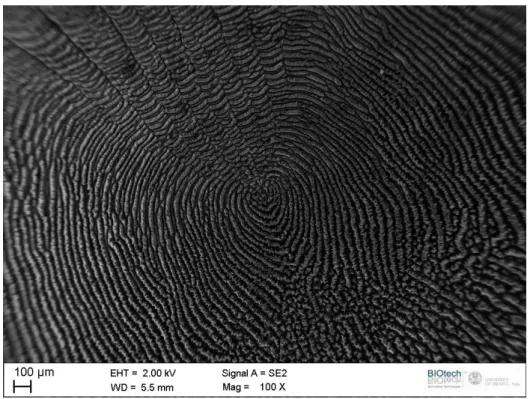
The fish scales are composed of extracellular matrix, mainly type I collagen fibers and calcium-deficient hydroxyapatite (HAp), which together form a highly ordered three-dimensional structure. Each scale consists of two distinct regions: an osseous layer and a fibrillary plate mainly composed of collagen [21]. Then, fish scales are composed by HAp and type I collagen fibrils with a plywood structure of aligned fibril sheets. This fibrils alignment is similar to those of bones, tendons and corneas in the human body [22] [23]. Zhu et al. (2011) [19] studied the mechanical properties of fish scales and concluded that these are high performance natural protective systems considering the importance of the structure and architecture of the scales in “amplifying” the properties of their components.
Although the main sources of type I collagen are bovine or porcine dermis, outbreak of different transmissible diseases in pigs and cattle, restrict the use of collagens and allied products from these sources [24] [25] [26]. The collagen from the fish scales is unlikely to be associated with infections such as BSE, TSE and FMD [27] [28]. Collagen isolated from fish scales is already being studied for biomedical and pharmaceutical applications owing to its cell attachment capabilities, excellent biocompatibility, biodegradability and weak antigenicity [29]. Therefore, type I collagen derived from fish scales attracted much interest as an alternative collagen source for artificial substitutes and several authors already extracted collagen from fish scales and characterized it. Nagai et al. (2004) [25] reported that fish scale collagens were heterotrimers with chain composition of (α1)2 and α2 and the denaturation temperature was lower than land animal collagen. Pati et al. (2010) [21] isolated collagen from Rohu and Catla and this collagen had a denaturation temperature of 36.5ºC, which is promising as an advantage for biomedical application due to its closeness to mammalian collagen.
Fish scales from different species present variations in size, shape and arrangement. The general classification includes: placoid, cosmoid, ganoid, and elasmoid (cycloid and ctenoid). These elasmoid scales are more evolved scales when compared with the other types being thinner and more flexible, which improved the swimming capability, present greater hydrodynamic properties and a more resistant protective layer [19]. In this study we have investigated scales of the elasmoid cycloid type, which are a bit like tree trunks, because, as they
The scales pattern allows also the establishment of a correspondence to events occurred in the life of a fish [30]. A cycloid scale is formed of a rigid surface layer consisting of calcium-based salts and a fibrous inner layer mainly made of collagen. Two different calcifying mechanisms function for a growing scale in the fibrillary plate and the osseous layer. Calcification in the osseous layer happens by nucleation of crystals with generation of larger patches, and in the fibrillary plate by uniform growth of crystals along the calcifying front [21].
Cells in tissues are arranged in distinct patterns; the orientation and the position of the cells with respect to each other are established by the tissue type. The study of the ability to control the placement of cells in an organized micro-pattern, such like the existent in the fish scales, on a substrate has become increasingly important for tissue engineering applications, which require that cells can be specifically placed to generate organized structures, such as a neural network for example [31] [32]. Also the ability to constrain the spreading to a specific cell-surface contact area has been shown to dramatically affect cellular development. Mechanical compliance of the cell-adhering substrates can also substantially affect the cells response and development [33]. Cells were reported to elongate in the direction of the micrometer-size grooves existent in the pattern and migrate as guided by these grooves, being this phenomenon denominated as contact guidance [34]. The disintegration and formation of fibrous cellular components is also influenced by surface topography. There is evidence that cell shape can control cell growth, gene expression, secretion of proteinases and ECM metabolism. Micro-patterned tissue engineered constructions are expected to better preserve cell morphology, differentiation and functionality for long periods of time. The micro-topography provides directional growth for cells and also can create tissue architecture at cellular and subcellular level in a reproducible manner [35].
Fish scales study is important in order to extract some principles for application in other fields, being the biomedicine a potential field for this application considering the fish scales composition, structure and functions. Another attractive reason to study the fish scales is the abundance and prosperity of its source and the fact that they are directed to low-added value ends. Marine capture fisheries mean over 50% of total world fish production and more than 70% of this production has been utilized for processing. As a result, every year considerable amounts of total catch are discarded as processing leftovers, consisting more than 30% of this waste of skin, scale and bone, which are rich in collagen and have received increasing attention as collagen sources. Recent estimates revealed that discards from the world‟s fisheries exceed 20
million tons, meaning 25% of the total production of marine capture fisheries. Therefore, there is a great potential in marine bioprocess industry to convert and utilize more of these products as valuable ones [36] [37] [38].
4| Scaffolds Preparation with Natural Polymeric Materials
The main strategy of bone tissue engineering implicates the utilization of artificial extracellular matrixes as scaffolds in combination with specific types of cells under stimulation of growth factors in order to restore damaged bone both structurally and functionally. Biocompatibility and mechanical properties with suitable biodegradability are mandatory characteristics to be incorporated in these scaffolds. Matrices occurring naturally have advantages because of their relevant biocompatibility properties [7] [10] [13] [14] [39]. In this study fibroin and collagen films were prepared to be used as cell proliferation supports.4.1. Fibroin
Silks are fibrous proteins commonly produced by insects and spiders. They exhibit a unique and useful conjunction of properties such as being degradable and lightweight with excellent mechanical and thermal properties. In nature, silks are used, for example, as materials for web construction and prey capture (spider webs), and reproduction enclosures (cocoons) where the silkworms are included. These features are also related to the current use of silks as sutures, nevertheless they are being gradually replaced by synthetic polymers. Silk consists of two different proteins: fibroin and sericin. Fibroin is the protein responsible for the filaments of silkworm silk and it can be regenerated in various ways depending on the application. Recently, researchers have investigated silk proteins, mainly silk fibroin, as one potential candidate material for biomedical applications, because it has several distinctive biological properties such as: significant biocompatibility, good oxygen and water vapor permeability, biodegradability, praiseworthy mechanical strength in the wet state, resistance against enzymatic cleavage, drug permeability and minimal inflammatory reaction [40] [41]. Beyond their traditional use as sutures, silk fibroin has been exploited as a biomaterial for cell culture and tissue engineering in vitro and in vivo since the mid-90s. In early studies, silk films obtained from native silkworm fibroin collected from glands of Bombyx mori domestic silkworms and Antheraea pernyi wild
silkworms were found to support the attachment and proliferation of fibroblasts. Later reports showed that regenerated silk films prepared by dissolution of silkworm cocoon fibers in 9–9.5 M LiBr supported the attachment and growth of human and animal cell lines. These studies provided clues to the use of regenerated silk fibroin as a scaffold or matrix biomaterial for cell culture and tissue engineering [40] [42] [43].
Numerous studies have already explored regenerated silk fibroin-based biomaterials in various forms, including films, membranes, mats, nets, hydrogels, and porous sponges for biomedical applications. The in vivo behavior of biomaterials prepared from silk fibroin solutions has not been completely demonstrated, despite the fact that the biocompatibility and degradation of silk sutures, which are prepared from native silk fibers, have been well established. Previous studies showed that two-dimensional silk fibroin films have good biocompatibility. Recent progress in processing techniques has yielded three-dimensional porous silk fibroin scaffolds with control of morphological and structural features [40] [42] [43].
4.2. Collagen
Collagen is the most abundant insoluble fibrous protein in the extracellular matrix and in the connective tissue. In fact, it is the major protein in vertebrates and in the animal kingdom, and constitutes about 25% of vertebrate total proteins and approximately 30% of all protein in the human body. There are at least 16 types of collagen, but 80-90% of the collagen in the human body consists of types I, II, and III. These collagen molecules pack together forming long thin fibrils with similar structure. In contrast, type IV forms a two-dimensional reticulum. Other types of collagen can associate with fibril-type collagens, link between each other or link with other matrix components. Firstly it was thought that collagens were secreted by fibroblasts in connective tissue, but is now known that numerous epithelial cells produce certain types of collagen. The various collagens existent and the structures they form have the same purpose: to help tissues resist stretching [44].
The collagen fundamental structural unit is a long (300 nm), thin (1.5 nm of diameter) protein that consists of three coiled subunits: two α1 chains and one α2. Each chain consists precisely of 1050 amino acids wounded around one another in a typical right-handed triple helix [45] [46].
Type I collagen fibrils have a immense tensile strength, which means that such fibrils can be highly stretched without being broken. These fibrils, approximately 50 nm in diameter and several micrometers long, are packed side-by-side in parallel bundles, denominated collagen fibers, which can be found for example in tendons, where they connect muscles with bones and have to withstand high tension [44] [47].
In tissue engineering, collagen is being used for development of scaffolds either alone or in combination with other biomaterials for skin replacement, as artificial blood vessel, heart valve, bone graft, cartilage and ligament replacement among others. The utilization of collagen in pharmaceutical applications includes production of wound dressings, vitreous implants and as carriers for drug delivery. The applications of collagen in drug delivery systems are quite diverse such as collagen shields in ophthalmology, sponges for burns/wounds, mini-pellets and tablets for protein delivery, gel formulation in combination with liposomes for sustained drug delivery, as controlling material for transdermal delivery, and nanoparticles for gene delivery. In addition, collagen is used as surgical sutures and as haemostatic agent [29] [48] [49] .
There are many attractive characteristics that make the collagen type I a popular ECM of connective tissue. Some examples are: biocompatible, osteocompatible, fibrous, adhesive, cohesive, nonfriable, suturable, highly porous, can be combined with other materials, etc. The main limitation is the inexistence of inherent rigidity [39] [50]. To optimize this mechanical property and modify the biodegrading rate, an effective method commonly used is the cross-linking of the collagen or the addition of ceramics, such as hydroxyapatite [51].
5| Cell Types
As previously referred, in bone tissue engineering, cells play a fundamental role for the bone regeneration. For that reason, the utilization of cells with the ability and potential for osteogenesis is mandatory.
5.1. Osteoblasts
Osteoblasts are cells of mesenchymal origin responsible for synthesis and mineralization of bone during both bone formation and bone remodeling. They form a closely packed sheet on the bone‟s surface, from which cellular processes extend through the developing bone. The
goals for scaffolds in bone tissue engineering include suitable chemistry, morphology and structure in order to promote cell adhesion for osteoblasts, their further migration, and synthesis of extracellular matrix and mineralization [52] [53] [3].
The osteoblasts form organic, non-mineralized bone matrix and are involved in complex interactions with a variety of factors, mediators and cell types [54]. Mature osteoblasts are highly polarized, and present a prominent Golgi apparatus which is typical of highly secretory cells. The main secretory product of osteoblasts is type I collagen [55].
5.2. Adipose-derived Stem Cells
Tissue engineering and regenerative medicine are multidisciplinary sciences evolved in parallel with recent biotechnological advances. It combines biomaterials, growth factors, and stem cells to repair failing organs. Stem cells are characterized by their capability to self-renew and their ability to differentiate along multiple lineage pathways. Among the several types, human subcutaneous adipose tissue emerges as a source of adult or somatic stem cells [56].
Due to the increased incidence of obesity all over the world, subcutaneous adipose tissue is abundant and readily accessible. For example, approximately 400,000 liposuction surgeries are performed in the United States of America every year. These procedures can yield from 100mL to 3L of lipoaspirate tissue. This resultant material is routinely discarded [57].
Recent developments in the field of stem cells suggested that hASCs can be induced into adipogenic, osteogenic, chondrogenic, and myogenic lineages under appropriate conditions. hASCs are easy to obtain, have relatively lower donor site morbidity and a higher yield at harvest, and can expand more rapidly in vitro compared with BMSCs for example, which are now commonly used as seed cells for bone repair and regeneration. In addition, hASCs have multipotency which is independent of serum source and quality. Thus, hASCs might be a novel and very promising alternative cell source for bone tissue engineering [13].
6| Concluding Remarks
Bone diseases are variable and can affect people in different levels. The existent treatments are, in many cases, not enough for good recovery of the patient. There is still much
room for development of more effective treatment strategies and bone tissue engineering can provide promising alternatives for more efficient treatments.
Bone tissue engineering has a long path to be explored and the definition of the best strategies to achieve better results is still not clear. Therefore, attempts to find different alternatives are important, being the study of the effect of fish scales pattern on osteoblasts and stem cells the testing of hypothesis that can extend the knowledge of cells behavior when submitted to different environments.
Fish scales present interesting characteristics attractive for their study as cellular supports, such as being highly composed of collagen and hidroxyapatite and presenting a very organized structure.
References
1. Antonietti, Markus and Fratzl, Peter. Biomimetic Principles in Polymer and Material Science. Macromolecular Chemistry and Physics. 211, 2010.
2. Weiner, S. and Wagner, H. D. The Material Bone: Structure--Mechanical Function Relations. Annual Review of Materials Science. 1998, Vol. 28.
3. Toai, T., et al. In vitro culture and differentiation of osteoblasts from human umbilical cord blood. Cell Tissue Bank. 2010, Vol. 11.
4. Rho, J., Spearing, L. and Zioupos, P. Mechanical properties and the hierarchical structure of bone. Medical Engineering & Physics. 1998, Vol. 20.
5. Wang, X., et al. The role of collagen in determining bone mechanical properties. Journal of Orthopaedic Research. 2001, Vol. 19.
6. Ralston, Stuart H. Structure and metabolism of bone. Medicine. 2005.
7. Mistry, A. and Mikos, A. Tissue Engineering Strategies for Bone Regeneration. Chemistry and Materials Science. 2005, Vol. 94.
8. Schaeren, S., et al. Effect of bone sialoprotein coating of ceramic and synthetic polymer materials on in vitro osteogenic cell differentiation and in vivo bone formation. Wiley InterScience. 2009.
9. Chavassieux, P., Seeman, E. and Delmas, P. Insights into Material and Structural Basis of Bone Fragility from Diseases Associated with Fractures: How Determinants of the Biomechanical Properties of Bone Are Compromised by Disease. Endocrine Reviews. 2007, Vol. 28.
10. Peel, N. Bone remodelling and disorders of bone metabolism. Surgery. 27, 2008.
11. Patel, Z., et al. Dual delivery of an angiogenic and an osteogenic growth factor for bone regeneration in a critical size defect model. Bone. 2008, Vol. 43.
12. MacLean, C., et al. Systematic Review: Comparative Effectiveness of Treatments to Prevent Fractures in Men and Women with Low Bone Density or Osteoporosis. Annals of Internal Medicine. 2008, Vol. 148.
13. Qihai, Liu, et al. A comparative study of proliferation and osteogenic differentiation of adipose-derived stem cells on akermanite and b-TCP ceramics. Biomaterials. 29, 2008.
14. Finkemeier, Cristopher G. Bone-Grafting and Bone-Graft Substitutes. The Journal of Bone and Joint Surgery. 2002.
15. Cancedda, R., et al. Tissue engineering and cell therapy of cartilage and bone. Matrix Biology. 2003, Vol. 22.
16. Schindeler, A., et al. Bone remodeling during fracture repair: The cellular picture. Seminars in Cell & Developmental Biology. 2008, Vol. 19.
17. Lin, G., et al. The Complete Mitochondrial Genome Sequence and Characterization of Single-Nucleotide Polymorphisms in the Control Region of the Asian Seabass (Lates calcarifer). Marine Biotechnology. 2005, Vol. 8.
18. Pusey, Brad, Kennard, Mark J. and Arthington, Angela H. Freshwater fishes of north-eastern Australia. Australia : Csiro Publishing, 2004.
19. Zhu, D., et al. Structure and Mechanical Performance of a „„Modern‟‟ Fish Scale. Advanced Engineering Materials. 2011.
20. Bone, Quentin and Moore, Richard H. Biology of Fishes. s.l. : Taylor & Francis Group, 2008.
21. Pati, Falguni, Adhikari, Basudam and Dhara, Santanu. Isolation and characterization of fish scale collagen of higher thermal stability. Bioresource Technology. 101, 2010.
22. Chen, S., et al. Microstructures and rheological properties of tilapia fish-scale collagen hydrogels with aligned fibrils fabricated under magnetic fields. Acta Biomaterialia. 2010.
23. Chen, Song, et al. In vitro formation and thermal transition of novel hybrid fibrils from type I fish scale collagen and type I porcine collagen. Science and Technology of Advanced Materials. 2010.
24. Peng, Yong Y., et al. Evaluation of the immunogenicity and cell compatibility of avian collagen for biomedical applications. Wiley Interscience. 2009.
25. Nagai, Takeshi, Izumi, Masami and Ishii, Masahide. Fish scale collagen. Preparation and partial characterization. International Journal of Food Science and Technology. 39, 2004. 26. Duan, R., et al. Properties of collagen from skin, scale and bone of carp (Cyprinus carpio). Food Chemistry. 2009, Vol. 112.
27. Bama, P., et al. Extraction of Collagen from Cat Fis (Tachysurus Maculatus) by Pepsin Digestion and Preparation and Characterization of Collagen Chitosan Sheet. International Journal of Pharmacy and Pharmaceutical Sciences. 2010, Vol. 2, 4.
28. Liu, H., Li, D. and Guo, S. Studies on collagen from the skin of channel catfish (Ictalurus punctaus). Food Chemistry. 2007, Vol. 101.
29. Fish Collagen: A Potential Material for Biomedical. Pati, Falguni, Dhara, Santanu and
Adhikari, Basudam. Kharagpur : s.n., 2010. Proceedings of the 2010 IEEE Students'
Technology Symposium.
30. Discrete model of fish scale incremental pattern: a formalization of the 2D anisotropic structure. Journal of Marine Science. 61, 2004.
31. Chen, Christopher, et al. Micropatterned Surfaces for Control of Cell Shape, Position, and Function. Biotechnology. 1998, Vol. 14.
32. Curtis, Adam and Wilkinson, Chris. Topographical control of cells. Biomaterials. 1997, Vol. 18.
33. Falconnet, Didier, et al. Surface engineering approaches to micropattern surfaces for cell-based assays. Biomaterials. 2006, Vol. 27.
34. Alves, Natália M., et al. Controlling Cell Behavior Through the Design of Polymer Surfaces. Small. 6, 2010, Vol. 20, Polymer Surfaces, pp. 2208-2220.
35. Ber, S., Kose, G. T. and Hasirci, V. Bone tissue engineering on patterned collagen films: an in vitro study. Biomaterials. 2005, Vol. 26.
36. Kim, Se-Kwon and Mendis, Eresha. Bioactive compounds from marine processing byproducts – A review. Food Research International. 2005, Vol. 39.
37. Nagai, T. and Suzuki, N. Isolation of collagen from fish waste material - skin, bone and fins. Food Chemistry. 1999, Vol. 68.
38. Arvanitoyannis, I. and Kassaveti, A. Fish industry waste: treatments, environmental impacts, current and potential uses. International Journal of Food Science and Technology. 2008, Vol. 43.
39. Glowacki, Julie and Mizuno, Shuichi. Collagen Scaffolds for Tissue Engineering. Biopolymers. 2007, Vol. 89.
40. Min, Byung-Moo, et al. Electrospinning of silk fibroin nanofibers and its effect on the adhesion and spreading of normal human keratinocytes and fibroblasts in vitro. Biomaterials. 2004, Vol. 25.
41. Minoura, Norihiko, et al. Attachment and growth of fibrolast cells on silk fibroin. Biochemical and Biophysical Research Communications. 1995, Vol. 208.
42. Wang, Yongzhong, et al. In vivo degradation of three-dimensional silk fibroin scaffolds. Biomaterials. 2008, Vol. 29.
43. Ung-Jin, Kim, et al. Three-dimensional aqueous-derived biomaterial scaffolds from silk fibroin. Biomaterials. 2005, Vol. 26.
44. Lodish, H., et al. Molecular Cell Biology. New York : W. H. Freeman and Company, 2000. 45. Brinckman, J., Notbohm, H. and Muller, O. K. Collagen: primer in structure, processing, and assembly. New York : Springer, 2005.
46. Kirkwood, John Edward. Liquid crystalline collagen: Matrices for oriented cell growth. s.l. : ProQuest LLC, 2008.
47. Fratzl, Peter. Collagen: structure and mechanics. Germany : Springer, 2008.
48. Ogawa, Masahiro, et al. Biochemical properties of bone and scale collagens isolated from the subtropical fish black drum (Pogonia cromis) and sheepshead seabream (Archosargus probatocephalus). Food Chemistry. 88, 2004.
49. Lin, Yung Kai and Liu, Deng Cheng. Comparison of physical–chemical properties of type I collagen from different species. Food chemistry. 99, 2006.
50. Ikoma, T., et al. Physical properties of type I collagen extracted from fish scales of Pagrus major and Oreochromis niloticas. Biological Macromolecules. 2003, Vol. 32.
51. Ma, L., et al. Collagen/chitosan porous scaffolds with improved biostability for skin tissue engineering. Biomaterials. 2003, Vol. 24.
52. Venugopal, L., et al. Biocomposite nanofibres and osteoblasts for bone tissue engineering. Nanothecnology. 2008, Vol. 18.
53. Hyeon, Kim, et al. Bone tissue engineering with premineralized silk scaffolds. Bone. 2008, Vol. 42.
54. Jayakumar, P. and Silvio, L. Di. Osteoblasts in bone tissue engineering. Journal of Engineering in Medicine. 2010, Vol. 224.
55. Hollinger, J., et al. Bone Tissue Engineering. s.l. : CRC Press, 2005.
56. Gimble, Jeffrey, Katz, Adam and Bunnell, Bruce. Adipose-Derived Stem Cells for Regenerative Medicine. Circulation Research. 2007.
57. Izadpanah, R., et al. Biologic Properties of Mesenchymal Stem Cells Derived From Bone Marrow and Adipose Tissue. Journal of Cellular Biochemistry. 2006.
CHAPTER II.
1| Fish Scales Preparation
The fish scales to be studied were collected from a market in Thailand. The studied fish specie was Lates Calcarifer, being the common name White Seabass.
The scales preparation procedures were adapted from Ikoma T. et al [26] and Pati F. et al [5]. In brief, the scales were immersed in distilled water and conserved at 4ºC. A group of scales was stored in an antibacterial solution of sodium azide 1%wt for further investigation of this group of untreated fish scales (G1). The remaining scales were washed twice in 10%wt of NaCl solution, to remove unnecessary proteins on the surface, for 48h. Afterwards, one part of these scales was washed with distilled water forming a second group (G2), and the remaining scales were submitted to a process of demineralization and extraction of the soluble collagen, in order to achieve the third group of scales (G3). For the demineralization, it was used a solution of 0.5 mol/L of EDTA, to immerse the fish scales for 48h. Then the extraction of soluble collagen was done by the immersion of the scales in a solution of 0.5 mol/L of Tris, HCl buffered at pH 7.5, for 48h. Scales were finally washed with distilled water and kept in it until further use.
2| Fish Scales Characterization
2.1. Morphology
The scales of the 3 groups were observed in the Optical Microscope (Axiotech, Zeiss) and in the SEM (Supra 40, Zeiss) in order to analyze the surface patterns. They were also observed in the Polarized Microscope and in the Confocal Laser Microscope (Eclipse, Ti-E, Nikon).
2.2. Collagen Imaging
Confocal Laser Microscope (Eclipse, Ti-E, Nikon) was used to evaluate collagen architecture on different group samples, and Direct Red 80 [27] was used as unspecific stain for collagen, typically used for detection in tissue histological section. Samples were stained for 60 minutes in an aqueous solution of 0.1% of Sirius Red F3BA (Sigma Aldrich) saturated with picric acid, pH 2. After that, samples were washed for 2 minutes in 0.01M HCl, rinsed in ethanol 70%, and dehydrated with ethanol gradients, 70, 90, and 2x100%.
3| Fibroin Films
3.1. Fibroin Production
In addition to G1, G2 and G3 groups, two more groups were created. Fibroin films with the same patterning as the scales (F1), and fibroin films without patterning (F2), in order to allow drawing conclusions about the pattern role in the cellular behavior.
In order to mimic the fish scales pattern, the material selected was the fibroin. To prepare the fibroin needed, the process was divided in two steps: degumming and dissolution.
Degumming
Bombyx mori cocoons (kindly provided by Socio Lario, Cassina Rizzardi, Como, Italy) were degummed for 1.5 hours in a bath of boiling water containing 1.1 g/l Na2CO3 (10 g of silk in 1L of solution), then for 1.5 hours in another bath of boiling water containing 0.4 g/l Na2CO3. After the two baths cocoons were rinsed thoroughly with distilled warm water to remove salts and dried in air.
Dissolution
Fibroin-water solutions were prepared by dissolving the fibroin obtained in the previous step in 9.3 M LiBr (Fluka Chemical) aqueous solution (1g/10ml) at 65°C for 2 hours, followed by dialysis against distilled water with a 3500 Da MWCO membrane (Slyde-A-Lyzer, Pierce) in order to eliminate salts.
The concentration of the resultant fibroin solution was measured by UV-VIS spectrophotometer (Nanodrop). The solution was then diluted to a concentration of 2.5% w/v. The pH of the solution was 5.
3.2. Construction of fibroin samples with the fish scales pattern (F1)
The first step of this process was the creation of silicon molds with the fish scales pattern. This was achieved using a plate with nine prominent cylinders with a glued fish scale with the pattern turned up on the top of each cylinder, as shown in figure 2.1.
Figure 2.1 - Plate where the scales were glued and covered with silicon to form the molds with scale patterning
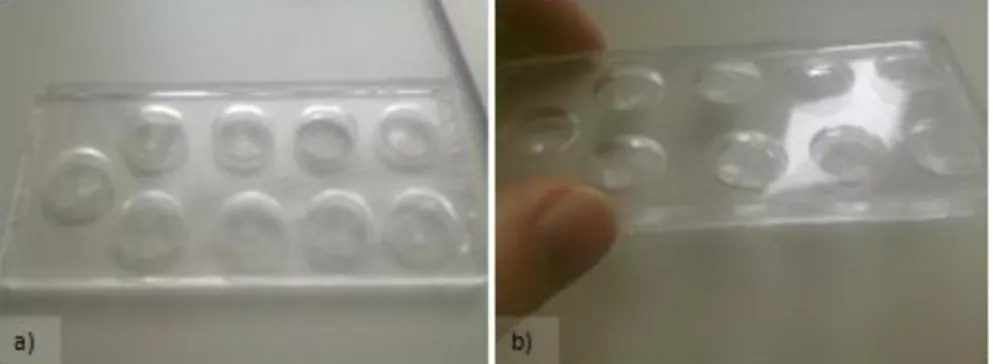
The plate was filled with a silicon solution (Sylgard Silicone Elastomer kit 184) and the air bubbles were removed with the aid of a dissector. Then the plate was transferred to an oven at 65ºC during 24h. The resultant molds contained negatives of fish scales patterns. The result of this process is shown in figure 2.2, as the bottom of each of its wells transducers the negative of the fish scales pattern.
Figure 2.2 - a), b) - Silicon mold with the negative of the fish scales pattern in the bottom of each well
Figure 2.3 refers to the pattern seen in one of the resultant negatives using the Optical Microscope (Axiotech, Zeiss), being similar to the fish scales pattern, as it will be shown further ahead.
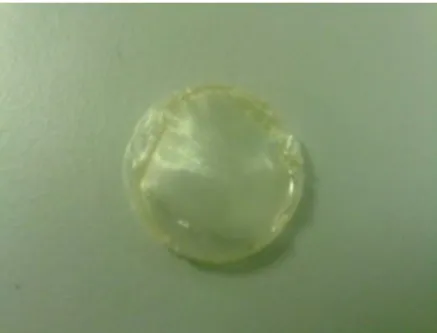
To achieve the copy of the pattern of the fish scales, the wells containing the negatives were filled with the fibroin solution and left drying for 3 days at room temperature. From each well, a sample of fibroin like the one shown in figure 2.4 was produced.
Figure 2.4 - Fibroin sample with a pattern similar to the fish scales
Figure 2.5 shows the pattern of one of the resultant samples of fibroin observed using the Optical Microscope, similar to the fish scales, as shown.
Figure 2.5 - a), b), c) - Fibroin sample pattern observed in the Optical Microscope
In order to stabilize the fibroin samples, these were immersed in an aqueous solution of methanol 80% for 20 minutes, and then washed with distilled water. This procedure was shown not to affect the pattern.
3.3. Construction of the fibroin samples without pattern (F2)
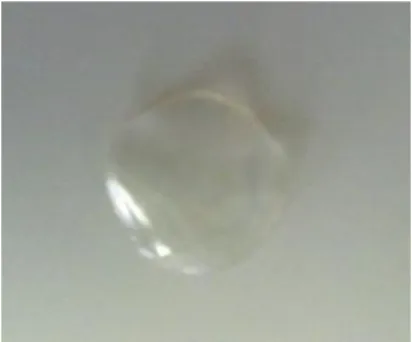
Fibroin films were prepared by casting aqueous solutions with 2.5% w/v of total protein content on polyethylene plates at room temperature for 2 days. After that, the film was cut in circles with controlled diameter. All resulting films were stabilized using the same procedure as the samples with the scale pattern.
Figure 2.6 - Fibroin sample without any pattern
4| Collagen films
4.1. Extraction of collagen from fish scales
In a first phase the idea was to construct collagen films with collagen directly extracted from fish scales. Fish scales were collected from the company Ramirez. These scales were from the fish kind Sardina pilchardus, being the common name Sardine.
The scales were preserved in the freezer at -80ºC till their utilization. At this time they were washed several times with water and then completely dried with the aid of a liophilizer in order to measure their weight. The Sardine fish scales were treated with 10 % NaCl solution during 48h to remove unnecessary proteins. Then, they were demineralized by immersion in 0.5 mol/L EDTA solution during 48h. To extract the collagen from the scales, these were immersed in 0,5mol/L Tris-HCl solution, buffered at pH 7.5, at 4 ºC, during 48 hours. The resultant suspension was centrifuged at 4ºC and 10,000 x g for 20 minutes to separate the collagen. The resultant residue of this process was dissolved in 0,01M HCl solution. After 48 hours, the collagen was precipitated from the acid solution by increasing solution pH to 7 by addition of NaOH solution. The acid soluble collagen was then separated by filtration and washed with distilled water. The collagen was further purified by dissolution in 0.5M acetic acid, dialized against 0.1M acetic acid during 2 days.
For the quantification of the collagen existent in the solution after the dialysis was executed a method named as SIRCOL. Firstly was labeled a set of microcentrifuge eppendorfs. Then was prepared a standard curve, being the blanks constituted of 100µL of acetic acid 0,1M and the collagen standards (5, 10, 20, 30, 40µg) and making 100µL by adding acetic acid 0,1M
and finally vortexing these mixtures. The test samples were done in duplicate having each sample 100µL too. To each eppendorf created was added 1mL of Sircol Dye reagent. The eppendorfs were placed in a mechanical shaker for 30 minutes for the binding of the Sircol dye with soluble collagen. The eppendorfs were transferred to a micro centrifuge and spin at 13.000g for 10 minutes. The unbound dye solution was removed by carefully inverting and draining the tubes. Remaining droplets were removed by gently taping the inverted eppendorf. To each eppendorf was added 1mL of the Alkali reagent and the bound dye was released into solution using a vortex. After dissolution, the samples absorbance was measured using the Spectrophotometer set to a wavelength of 540nm. This data was collected and used to infer about the collagen existent by comparing the obtained values for the samples with the obtained standard curve. The yield of collagen extracted was very low, being about 0.01% on dry weight basis.
As an attempt to raise the efficiency of the process of collagen extraction, to the previous procedure were changed some parameters. This time, the whole procedure was executed at a temperature of 4ºC; the scales while immersed in the solutions for unnecessary proteins removal, demineralization and collagen extraction were submitted to constant agitation; the suspensions centrifugation was done at 20,000 x g for 1 hour; and the dialysis was done against 0,5M acetic acid instead of 0,1M. This attempt succeeded with a raise in the yield of collagen extracted, being this time of about 0.2% on dry weight basis. Although this method was still very inefficient, even after executing this procedure five times the collagen collected was still in a very low quantity for the application it was needed – the production of collagen films.
After this, the encountered way was to produce the collagen films with already available collagen and with still fish origins, being the solution the production of the films based on shark skin collagen.
4.2. Construction of shark collagen films with scales patterning
The shark skin collagen used was kindly provided by Ricardo I. Perez-Martin and Carmen G. Sotelo (CSIC, Inst Invest Marinas, Vigo 36208, Galicia, Spain). For the production of the films the collagen concentration used was 4% dissolved in acetic acid 0,5M. For the formation of stable films was then needed the cross-linking of collagen. For the cross-linking the first tries were with EDC and NHS but these were somehow frustrated because the results were always a gelatin, being unstable films. The solution found was the utilization of Genipin for the cross-linking. For
that, Genipin was added to the collagen solution in order to be in a concentration of 10mM. Then, while stirring, the solution was inserted in a mineral oil bath at 37ºC and controlled while was getting more and more viscous and changing to a darker color. After about 3h of this process the solution was already darker and more viscous and was transferred to proper recipients.
The shark skin collagen films with the fish scales pattern were achieved with the utilization of silicon molds with wells with the scales pattern which were constructed with a similar method as the one described in section 2.1.2. Each well of these molds was filled with 1mL of the collagen solution prepared and after 3 days were formed stable dry collagen films with the fish scales pattern.
5| In vitro Biological tests
The experiment in vitro described below was preceded by a simpler in vitro experiment. This experiment studied the cellular behavior (osteoblasts) when seeded on the fish scales from the 3 groups for 5 days. Promising results were achieved by the execution of the Alamar Blue tests, Confocal Microscope and SEM analysis.
5.1. Cells culture and seeding
Before the in vitro tests, the scales (G1, G2, G3) and fibroin films (F1, F2) were immersed in ethanol 70% at 4ºC respectively for 24 hours and 2 hours and washed with sterile distilled water.
Osteoblasts of MG63 cell line were cultured in Minimum Essential Medium (MEM) (Invitrogen), 10% Fetal Calf Serum, 1% Sodium Piruvate, 100 mM Euroclone, 2% L-glutamine 100 mM Euroclone, Non Essential Aminoacids Gibco, and 1% of Antibiotic / Antimicotic. Cells were cultured in an atmosphere of 37ºC and 5% CO2. After the cells have reached confluence, they were detached by the removal of the medium, the washing of the flask with PBS and the addition of trypsin. The cell concentration was 1,0x10⁵ cells/ml. To execute this protocol, 37 samples from each group (G1, G2, G3, F1 and F2) were used. After 1 day, 4 samples of each group were removed from the experiment to be analyzed (2 by SEM and 2 by Confocal Microscope), and another 4 samples from each group were removed for the ALP test. The same was done after 3,
7 and 14 days, when the experiment was concluded. It is important to mention that the samples for the Alamar Blue test were always the same. This means that 5 samples from each group were used during the whole experiment, since this procedure does not damage the cells. The in vitro experiment had the duration of 14 days: day 0 was considered the day of seeding; on day 1 all the samples were switched to different well plates in order to remove all the cells not attached to the samples from the equation, as well as it was the first day of control; day 3 was the second day of control; on day 5, a change of the medium was done; day 7 was the third day of control; on days 9 and 11, a change of medium was done; and finally day 14 was the last day of control. On the days of control, the Alamar Blue test was performed and the samples to be controlled in that day were submitted to a protocol of fixation.
The potential of fish scales to support the osteogenic differentiation of human adipose derived stem cells (hASCs) was studied. Scales from Lates calcarifer were submitted to a treatment for removal of unnecessary proteins on their surface by immersion in NaCl (Panreac) 10%wt during 48h, equivalent to the already mentioned for the G2 samples. All the scales were cut in circles with 10mm of diameter and immersed in ethanol 70% during 2 hours for sterilization. After this, scales were washed with sterile PBS. Cells were cultured in basal culture medium (α-MEM plus 10% FBS and 1% of A/B) and standard osteogenic medium (α-MEM plus 10% FBS and 1% of A/B, and supplemented with 10 mM beta-glycerophosphate, 50 g/mL of ascorbic acid and 10-8M of dexamethasone). hASCs at passage 2 were seeded at a density of 2000 cells/cm2. The quantity of medium immersing each sample was of 1ml. Tissue culture polystyrene coverslips (TCPs) were used as controls. Cultures were maintained for 1, 3, 10, 21 and 30 days.
5.2. AlamarBlue Assay
AlamarBlue assay kit (Biosource International Inc., USA) was used to assess metabolic activity at the end of each experimental time point of the studies with MG63. This technique is a quantitative process providing a linear measurement over time, being safe and nontoxic for the cells. It is designed to measure the proliferation of various human and animal cell lines quantitatively. A higher proliferation causes a larger absorbance value as well as a larger percentage of reduced alamarBlue. The assay was performed according to the manufacturer‟s instructions [4].
In brief, the seeded samples were incubated for 4 hours at 37°C with fresh culture medium (with reduced serum) supplemented with alamarBlue diluted according to manufacturer‟s data sheet (simply adding the alamarBlue reagent as 10% of the sample volume). A total of 3 replicates were used for each sample and each replicate was split into 4 wells for the final reading. The references were taken from wells with unseeded samples incubated with the alamarBlue solution, wells with only culture medium, and wells with only cells. Absorbance was measured at 570 nm and 620 nm with a photometric microplate reader (Multiskan EX, ThermoLabsystems, Finland) and the percentage of reduced alamarBlue was calculated. The whole procedure was executed in the absence of light.
The calculations to get the percentage of reduced alamarBlue (being this percentage directly proportional to the quantity of cells existent) were:
-
Subtract the absorbance values of medium only from the absorbance values of Alamar Blue.-
Calling AOLW = absorbance of form at lower wavelength, and AOHW = absorbance of oxidized form at higher wavelength, correction factor:R0 = AOLW / AOHW.
-
To calculate the percentage of reduced Alamar Blue in a specific well: %Reduced = ALW – (AHW x R0) x 100, being ALW the absorbance at 570nm and AHW the absorbance at 620nm.Statistical Analysis
Statistical Analysis was performed for the AlamarBlue assay results which are presented as means ± STDEV (Standard Deviation of the Mean). Friedman Test (non- parametric test equivalent to One Way Repeated Measurements ANOVA) was performed for each group analyzed along time. One Way ANOVA on Ranks followed by Tukey Test was performed for each time point for group comparison (SigmaStat 3.0, SPSS, Chicago, IL, USA).
5.3. Confocal Laser Microscope (CLM) Analysis
Evaluation of cell attachment, distribution, and morphology on fish scales (G1, G2 and G3) and fibroin films (F1 and F2) seeded with MG63 was performed by confocal laser microscopy (Nikon Eclipse, Ti-E) after Phalloidin Rhodamine (Biosource International, Invitrogen) and DAPI (Sigma Aldrich) staining according to the manufacturer‟s protocol. Fixation with a
formaldehyde solution (4% formaldehyde in PBS solution) and permeabilization with TritonX 100 (0.2% TritonX in PBS solution) were performed before staining.
5.4. Scanning Electron Microscope (SEM) Analysis
Morphological observations were performed with scanning electron microscopy (Supra 40 Zeiss), operating mode: high vacuum, secondary electron detector) on fish scales (G1, G2 and G3) and fibroin films (F1 and F2) seeded with MG63. At each time point, films were fixed with gluteraldehyde solution (2,5% gluteraldehyde in cacodylic buffer solution, 0,1 M) to preserve biological structures. Samples dehydration was performed by soaking in a series of aqueous ethanol solutions at increasing concentrations from 30% - 100% and drying in air at room temperature. Before SEM imaging, all samples were sputter coated with gold (SEM Coating Unit PS3, Assing S.p.A., Rome, Italy).
5.5. Alkaline Phosphatase (ALP) activity quantification
Alkaline Phosphatase (ALP) is the biochemical marker of osteoblastic bone formation most frequently used. The activity of ALP is evaluated using p-nitrophenol assay. Para-nitrophenyl phosphate, which is colorless, is hydrolysed by alkaline phosphatase at 37ºC to form free paranitrophenol, which is colored yellow. The reaction is stopped by addition of NaOH and the absorbance read at 405 nm.
Osteoblastic activity on fish scales (G1, G2 and G3) and fibroin fims (F1 and F2) was monitored measuring Alkaline phosphatase activity (ALP) based on the conversion of p-nitrophenyl phosphate to p-nitrophenol. Firstly, solutions were added in nine test tubes (Sample Diluent, Buffer Solution and p-Nitrophenol Standard) in order to build a standard curve, as shown in table 2.1. Tube # 1 2 3 4 5 6 7 8 9 Sample Diluent (µL) 250 250 250 250 250 250 250 250 250 Buffer Solution (µL) 250 245 240 230 220 210 200 190 180 pNP Standard (µL) 0 5 10 20 30 40 50 60 70 Concentration (µmol/mL) 0 1 2 4 6 8 10 12 14
Table 2.1 - Solutions execution for the nine test tubes in order to build the standard curve for ALP test (osteoblasts)
All the tubes were vortexed and then 100µl from each standard tube were transferred to a 96-well plate. After this, the same quantity of NaOH solution was added to all the standard