Repositório ISCTE-IUL
Deposited in Repositório ISCTE-IUL: 2020-04-07Deposited version: Post-print
Peer-review status of attached file: Peer-reviewed
Citation for published item:
Gulamhussen, M. A. (2012). FDI in investment banking. Thunderbird International Business Review. 54 (6), 921-934
Further information on publisher's website: 10.1002/tie.21512
Publisher's copyright statement:
This is the peer reviewed version of the following article: Gulamhussen, M. A. (2012). FDI in investment banking. Thunderbird International Business Review. 54 (6), 921-934, which has been published in final form at https://dx.doi.org/10.1002/tie.21512. This article may be used for non-commercial purposes in accordance with the Publisher's Terms and Conditions for self-archiving.
Use policy
Creative Commons CC BY 4.0
The full-text may be used and/or reproduced, and given to third parties in any format or medium, without prior permission or charge, for personal research or study, educational, or not-for-profit purposes provided that:
• a full bibliographic reference is made to the original source • a link is made to the metadata record in the Repository • the full-text is not changed in any way
The full-text must not be sold in any format or medium without the formal permission of the copyright holders.
TIBR-09-193.R2 FDI in investment banking* Mohamed Azzim Gulamhussen**
BIO
Mohamed Azzim Gulamhussen is Associate Professor of International Financial Management
and Director of the Business Research Unit at the Instituto Universitário de Lisboa. His work has
been published in the Journal of Multinational Financial Management, Journal of International
Financial Management and Accounting, the International Journal of Accounting, International
Business Review and Management International Review among other journals. Before his current
position, he was a Fulbright Fellow in residence at the Center for European Studies at Harvard
University.
Mohamed Azzim Gulamhussen
E-mail address: [email protected]
Business Research Unit
Instituto Universitário de Lisboa
Av. Forças Armadas, 2W13-15
Lisboa, 1649-026
Portugal
PH : +351210464137
FX : +351210464175
Executive Summary
The determinants of FDI in investment banking are tested using unique data obtained from 43 semi-structured interviews with senior managers of multinational banks. Consistent with internalization theory, the decision to service new customers is positively and significantly related to FDI. In line with internalization theory and the sequential entry framework, the perceived risk of doing business abroad is negatively and significantly related to FDI. Lock-in is positively and significantly related to FDI. Very few managers consider it important to follow domestic customers, which does not emerge as significantly related to FDI. Qualitative information facilitated the interpretation of multiple empirical estimations. JEL classification: F21; G20.
Keywords: FDI, Financial Institutions.
* I acknowledge generous support from the ICMA (Reading University) and participation of managers in the study. The paper also benefitted from helpful comments and suggestions made by Raj Aggarwal, Peter Buckley, Mark Casson, Andrew Clare, Jean-François Hennart, Geoffrey Jones, Brian Scott-Quinn and the two anonymous reviewers. The usual caveat applies.
** Mohamed Azzim Gulamhussen, Business Research Unit, Instituto Universitário de Lisboa, Av. Forças Armadas 2W13-15, Lisboa Portugal. Phone +351-21-0464-137 Fax +351-210464-175 E-mail address: [email protected]
FDI in investment banking INTRODCUTION
Multinational banks own and control operations in overseas markets (Aliber, 1976). They differ from manufacturing firms in the intensity of information embedded in their products and their internationalization (Boddewyn, Halbrich & Perry, 1986). Unlike manufacturing firms, banks specialize in gathering, processing and using information about their customers and the products and markets in which they operate. The exchange of this information in external markets can fail because it can be lost, biased, copied or inappropriately priced. Unlike manufacturing firms, the high cost of transacting information-intensive products also deters banks from entering into contractual arrangements such as licensing, franchising and joint ventures. Thus, banks appropriate greater rent by internalizing their cross-border operations through wholly-owned FDI (Jones, 1992). Banks also participate in syndicates for the placement of securities but these are temporary arrangements and frequently subject to acute information asymmetries between partners (Casson, 1990).
Research on FDI in the industry focuses mainly on retail operations. Internalization theory (Buckley & Casson, 1976; Hennart, 1982) is used as the theoretical basis for explaining why banks follow their customers abroad (see for example Grubel, 1977; Tschoegl, 1987).1 Empirical investigations answer two
main questions: why (see for example Khoury, 1979) and where do retail banks undertake FDI? (see for example Sabi, 1988). The literature has also debated which theoretical framework best explains FDI in banking: internalization theory (Casson, 1990; Esperança, 1993) or the eclectic paradigm (Gray & Gray, 1981; Cho, 1986). Of these two perspectives, internalization theory is considered to be internally consistent, appropriate, and applicable to the analysis of banking FDI (Williams, 1997).
Internalization theory determines that the pattern of FDI in investment banking will differ from that of retail banking. Casson (1990) identifies several dimensions in which retail and investment banking may differ. Retail banks focus mainly on deposit-taking and lending, their customers include private
1 Focarelli & Pozzolo (2005), Goldberg & Saunders (1981a, b), Ursacki & Vertinsky (1992) and Yamori (1998) among others find a statistically significant relation between banking FDI and trade, and manufacturing FDI, proxies for the follow the home customer hypothesis.
individuals, immigrants, tourists and subsidiaries of multinational firms in urban centers, and their competitive advantage stems from private information on domestic customers. Investment banks focus mainly on the marketing of newly-issued debt and their customers include large institutional investors and fund managers as well as subsidiaries of large multinationals; their competitive advantages stem mainly from personal contact and direct sales although services to local operations of large multinationals may also include those based on private information gathered in the domestic market or commercial banking unit. The different operations also differ in their propensity to undertake FDI: retail banks may face higher regulatory and competitive barriers to entering new markets with the latter resulting from incumbents occupying prime sites; on the other hand, it may take investment banks a significant time to build local relationships with investors and fund managers.
FDI in investment banking has received virtually no attention in the empirical literature (Hennart, 1994). This is explained in part by the inability to assemble detailed data on the foreign activity of these banks. Many banks are universal and secondary data sets often conflate retail and investment banking. There is one exception however: Quinn (1990) shows differing patterns of U.S. FDI in investment and retail banking.
FDI is also studied from the sequential entry framework perspective. This framework identifies the need to increase commitment to foreign markets in a progressive mannerto reduce the liability of foreignness (Johanson & Vahlne, 1977). In internalization theory, staged entry embeds a non-contractual option to expand from culturally similar to culturally distant markets (Casson, 1994). Along a similar line of reasoning, initial small FDI embeds the options to expand, contract or abandon the market in light of knowledge acquired through presence in the overseas market (Buckley, Casson & Gulamhussen, 2002); initial large FDI embeds growth options but locks firms into overseas markets (Casson, 2000). This theory predicts that firms entering overseas markets will maximize the sum of transactions cost savings from internalization and the option-value from the flexibility to alter decisions in light of arrival of new information through passage of time or presence in the overseas market.
This study uses primary data on FDI in the investment banking units of 43 banks gathered through unique semi-structured interviews with managers from five countries as the empirical setting. Secondary data is also used in the empirical estimations to complement primary data. The findings reveal that the determinants of FDI in investment banking are consistent with internalization theory and the motivation to follow domestic customers is considered less relevant by managers, as amply supported in the retail banking literature. Banks that set up investment banking units sought new customers, perceived low business risk and committed to the market at the outset. The specificity of the investment banking industry has to be considered when applying the theory and understanding its dynamics.
HYPOTHESES
The study follows internalization theory to test four hypotheses. Two hypotheses (H1-H2) relate transactions cost savings to FDI and two hypotheses (H3-H4) relate option effects to FDI. These four hypotheses are developed in this section. Parent-bank and home and host country controls are discussed in the next section.
According to internalization theory (Buckley & Casson, 1976; Hennart, 1982), banks possess two types of intermediate product that are difficult to transact via market mechanisms: customer relationship specific information (H1) and intangible technical, market-making and managerial expertise (H2).
The application of internalization theory to financial services shows that banks acquire significant information on customer requirements and their profile in the domestic market. This type of information is equally likely to be developed within both retail and investment banks and is an essential intermediate input for tailoring financial products and services. The gathering, processing and usage of this information require time and meticulous planning (see also Qian & Delios, 2008). It can be exploited at low marginal cost if exchanged within the internal market of the bank but can be lost, biased, copied or inappropriately priced if exchanged in external markets (see also Hennart, 1994). Consequently, when customers expand internationally, banks are driven to build a local presence through FDI in order internalize the transaction of information within the internal market. This internalization lowers the uncertainty of international expansion and reduces the cost of doing business in unfamiliar environments whilst providing a
competitive advantage over local competitors (Rugman, 1981). Hence, there will be a positive relation between the decision to follow domestic customers and FDI.
Hypothesis 1: The decision to follow domestic customers abroad will be positively related to FDI. According to internalization theory, banks develop not only the other aforementioned customer-specific information in their day-to-day activity but also intangible technical, market-making and managerial expertise that can be used to service new customers at a low marginal cost and high marginal benefit equivalent to the size of the market (Campayne, 1992; Qian & Delios, 2008). For example, banks with expertise in tailoring value-added financial products can offer an assorted set of services in portfolio management, derivatives and several related services; banks with a diverse customer base are able to offer expertise in the marketing of newly-issued securities; and banks with expertise in managing an international network of offices are better able to recognize market trends and are therefore in a better position to offer research to customers (Ursacki and Vertinsky, 1992). These intangibles are product or market specific but their value can be enhanced if used with customer-specific information (Rugman & Verbeke, 2003).
Intangible expertise also requires meticulous planning and takes time to acquire, develop and exploit besides suffering from the same problems of exchange in external markets. As long as benefits of internalization exceed the costs, it is viable to extend the application of intangible expertise to new markets and customers (see also Qian & Delios, 2008). Hence, there will be a positive relation between the decision to seek new customers and FDI.
Hypothesis 2: The decision to service new customers will be positively related to FDI.
In internalization theory and the sequential entry framework, entry hinges on the subjective beliefs of firms on the unfolding of uncertain business conditions. Firms that perceive low risk of doing business abroad (confident beliefs) will undertake FDI whereas firms that perceive high risk of doing business abroad (conservative beliefs) will eventually enter into alternative contractual arrangements to mitigate the risks associated with wholly-owned FDI (Buckley & Casson, 1998).
Investment banks often conduct business in markets characterized by uncertain business conditions (Liaw, 1997). In addition to the variability of business conditions, they also have to deal with the lack of knowledge associated with local business practices, societal and cultural aspects of the host country which give rise to liability of foreignness (Johanson & Vahlne, 1977).
Some of the aforementioned risks are common to manufacturing and some service firms. Unlike these firms however, banks rarely use licensing, franchising or joint venture arrangements to mitigate risks associated with providing services to new and unknown customers and reducing the liability of foreignness. Retail banks often rely on their client specific information and knowledge to provide services to home-based firms, immigrants and tourists. Investment banks rely more on services provided to local customers (although some of their services may be provided to cater for the needs of subsidiaries of home-based multinationals). The risks associated with doing business abroad are heightened in the case of investment banks (although this may also be true of retail banks under certain circumstances). Thus banks with confident beliefs about the unfolding of local business conditions will undertake large FDI.
Hypothesis 3: The perceived risk of doing business abroad will be negatively related to FDI.
Internalization theory determines the exact conditions under which firms choose contractual forms such as licensing, franchising and joints ventures as alternatives to wholly-owned FDI. The alternative contractual modes provide more flexibility than wholly-owned FDI which requires sinking significant costs that firms may not be able to recoup when divesting from the foreign market. Capital expenditures in tangible assets such as machinery may be recoverable. This machinery may have second-hand value or may even be relocated to produce goods in another country within the internal market of the multinational firm. However, expenditure on intangible assets such as advertising and other similar assets may not be recoverable (Sutton, 1991).
The main costs of establishing investment banking units in overseas markets include expenditure on advertising to gain local reputation, hiring and training staff, and building local contacts and networks. The other costs include office rent and equipment lease that can be terminated in extreme cases through the payment of penalties. However, the main expenditures are often irrecoverable because banks cannot
recoup these when leaving the market, locking them into a particular course of action and making them continue investing in their existing asset base long after it is economically feasible and providing commitment value (Schelling, 1960). Thus FDI in investment banking will be positively related to irreversibility.
Hypothesis 4: The irreversibility of the decision will be positively related to FDI. DATA AND METHOD
The interviews and the sample
The data set of this study was constructed using semi-structured interviews, annual reports of parent- banks, and the Fitch IBCA database to improve the reliability of the results (Jones & Khanna, 2006). The sample is part of a population of investment banks affiliated with the International Capital Markets Association (ICMA). It has 129 members in the U.K. Of these, 49 agreed that either the Chief Executive for Europe or a Managing Director who took part in the actual overseas entry decision would participate in the study. Due to missing information, the sample consists of 43 banks representing a third of the total population; this is very similar to Ursacki & Vertinsky’s (1992) sample of 37 foreign banks that undertook FDI in Japan and 5 independent variables. Graham & Harvey (2001) consider a response rate of over 10% to be very good in a survey of this nature.
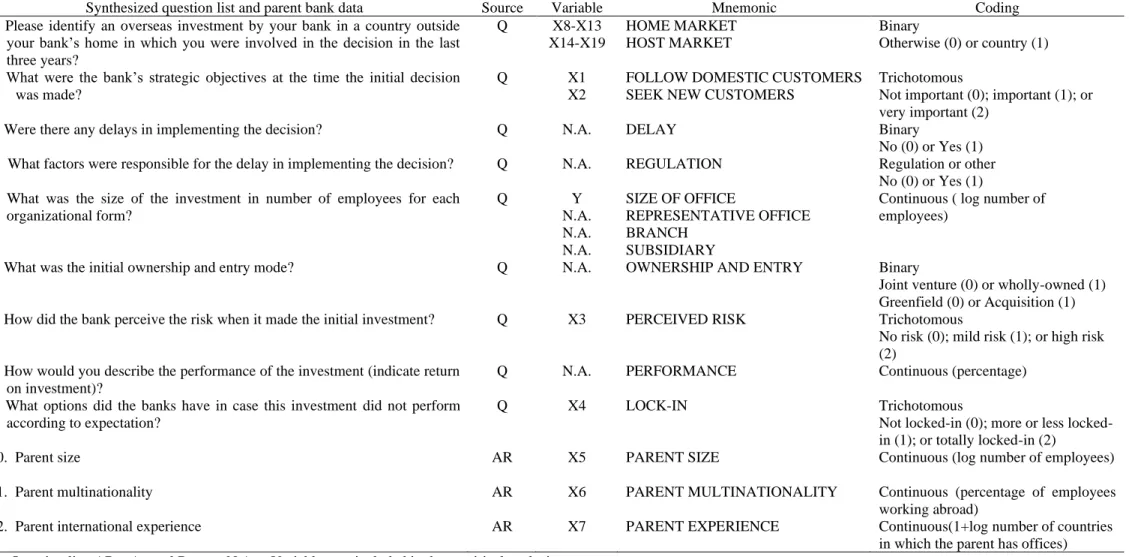
Managers were invited to discuss a list of questions mailed to them which are summarized in Table 1. These questions and the coding procedure were considered appropriate following a pilot study. The questions were carefully designed so as to avoid misinterpretations. The interviews were followed up in many cases with telephone calls to the manager or the head of the corporate communications department. Managers would not have participated in the study if they had intended to be untruthful.
INSERT TABLE 1 ABOUT HERE
Dependent variable
The dependent variable, size of FDI (Y), is measured as the number of staff employed by the foreign office. The responses show that the number of employees varies from 2 to 302. Ursacki & Vertinsky (1992) also use this measure as an estimate of the size of FDI of foreign banks operating in Japan and
Korea. As the value added by foreign banking units is likely to be related to its size, it is preferable to measure the size of FDI in terms of employees. Alternatively the size of FDI in a foreign market could be measured by the volume of assets but this would understate the investment banking activity.
INSERT TABLE 1 AND 2 ABOUT HERE
Independent variables
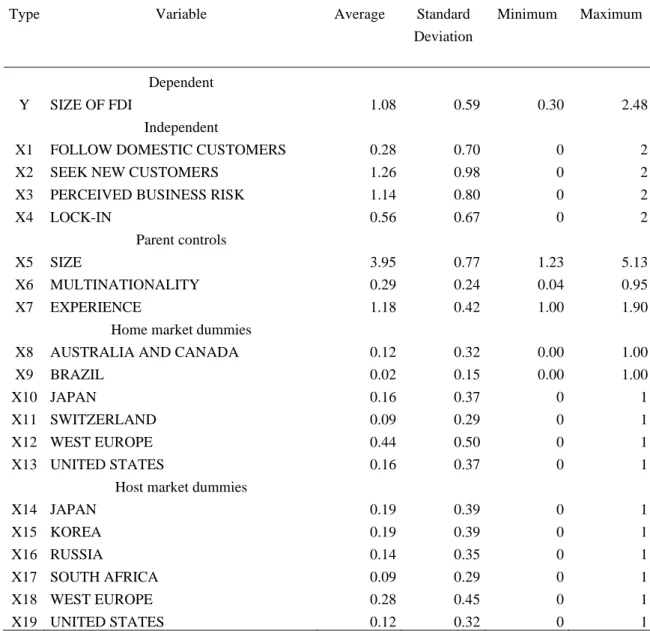
Table 2 summarizes the descriptive statistics of the 19 independent variables (X1-X19). Only 6% of the managers considered the strategy to FOLLOW DOMESTIC CUSTOMERS (X1) as very important compared to 27% who emphasized that the strategy to SEEK NEW CUSTOMERS (X2) was very important. Customer-following is more frequent and assumes greater importance in service industries than manufacturing; in the case of banking, it is more relevant in retail operations. Tests of the follow-the-customer hypothesis invariably confirm a positive relation between levels of non-bank FDI and international trade, and banking FDI. Managers consider pursuing new customers as more important in the case of investment banks. 2
The responses to the question on PERCEIVED BUSINESS RISK (X3) show that it is an important element in FDI: 26% of the banks in the sample perceived low risk; 35% of the banks perceived medium risk; and 49% of the banks perceived high risk. The responses to the question on LOCK-IN (X4) show that 54% of the banks undertook reversible FDI; 37% more or less reversible; and 9% undertook totally irreversible FDI.
Parent-level controls
The study uses three controls; SIZE, MULTINATIONALITY and EXPERIENCE of the parent bank (see also Ball &Tschoegl, 1982). There should be a strong incentive for large banks to invest in foreign markets given that they are better able to cope with the added costs and risks of doing business abroad. Large banks should also have more resources available to invest in sizeable operations in foreign markets.
2 The metrics used in this study are consistent with Beugelsdijk, Hennart, Slangen & Smeets (2010) who consider FDI stocks as biased measures of MNE activity in host countries.
As a result, there should be a positive relation between the size of the parent bank and FDI in investment banking units. In this sample, SIZE of parent banks (X5) varies from 17 to 134,896 employees.
Banks must possess the necessary technical, market-making and managerial expertise to offer products and services to local customers. The extent of a parent’s workforce dedicated to the provision of services in foreign markets indicates its ability to provide world-class banking services. Banks with more expertise in providing services in international markets will be more willing to undertake large FDI than banks without such expertise. Thus MULTINATIONALITY (X6), the percentage of employees working abroad, should be positively related to FDI. In the sample, this percentage varies from 0.04% to 95%.
The more countries in which a parent operates, the more likely it is to have learned to do business abroad efficiently. Thus, there should be a positive relation between international experience and FDI in investment banking units. In this sample, PARENT EXPERIENCE (X7) varies from 1 to 79 countries.
Country controls
In the sample, 12% of the banks are from Australia and Canada (X8), 2% from Brazil (X9), 16% from Japan (X10), 9% from Switzerland (X11), 44% from Western Europe (X12), and 16% from the U.S. (X13). Banks from Australia and Canada are grouped to avoid loss of degrees of freedom. Approximately 19% of banks invested in JAPAN (X14) and KOREA (X15), 14% in RUSSIA (X16), 9% in SOUTH AFRICA (X17), 28% in WEST EUROPE (X18), and 12% in the U.S. (X19). Dummies were created to capture home and host country effects. An alternative would be to collect aggregate data on home and host countries. As in Ursacki & Vertinsky (1992), the small sample size does not permit this route. In an extension of this research, it would be desirable to control for home and host market effects by collecting specific country level data.
Additional evidence from interviews
Managers in the sample discussed only wholly-owned and greenfield FDI. Only one bank in the sample had to delay investment for regulatory reasons. They preferred not to discuss performance as they considered that their investments had not yet matured. The performance of the foreign office can be particularly important as a guide to future expansion decisions in the local market and in integrating the
host country perspective in the FDI decision. Future work should incorporate this local perspective in the FDI decision.
In this sample, 19% of the operations are representative offices, 28% branches, and 53% subsidiaries. The small sample size made it impossible to test the choice of scale conditional on the organizational form. Such a test could be implemented by estimating the relationship through three-stage least squares or seemingly unrelated regressions. For the sample in hand, this would lead to a considerable loss in the degrees of freedom in estimations; however, it would be of interest to understand the distinct motivations and option effects in terms of the type of entry, be it a representative office, branch, agency or subsidiary. Future research may be related to how different entry types are influenced by varying motivations and option effects.
Finally, 23% of the banks in the sample had divested altogether from the market; 14% contracted; 26% expanded; and 37% neither contracted nor expanded FDI (managers again noted that it was too early to expand or contract). These responses point to the importance of equating reversibility in the FDI decision. The sample in hand is too small to test the influence of parent, local operation and home and host country determinants of entry and exit. Future research may be related to the factors that permit survival and prompt withdrawal from overseas markets.
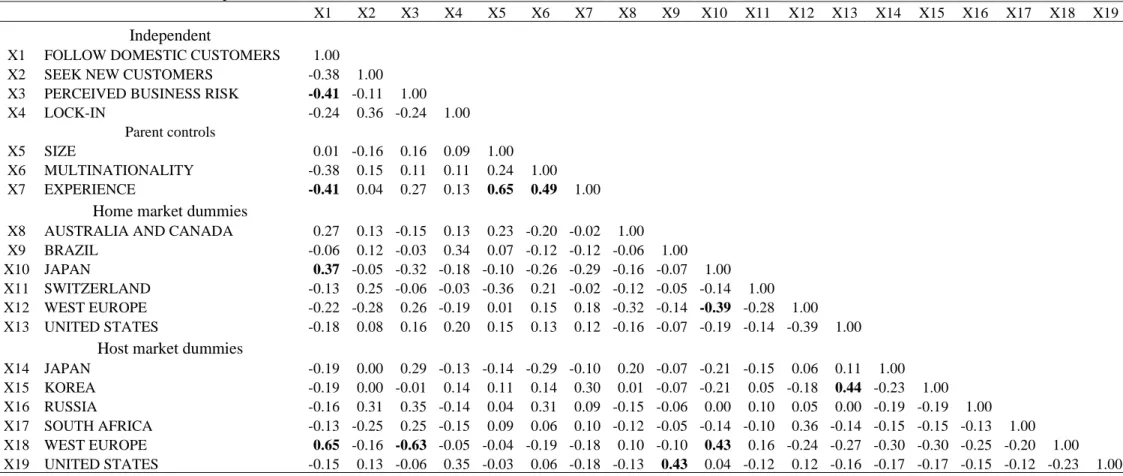
INSERT TABLE 3 ABOUT HERE
Modeling procedure
The correlations between independent variables (Table 3) did not show linear dependence. The model is stated as
SIZE OF OFFICE = a + b1 (FOLLOW DOMESTIC CUSTOMERS) + b2 (SEEK NEW CUSTOMERS) - b3 (PERCEIVED BUSINESS RISK) + b4 (LOCK-IN) + b5 (PARENT SIZE) + b6
(PARENT MULTINATIONALITY) + b7 (PARENT EXPERIENCE)
where the sign of each coefficient represents the direction of the effect of each factor. The relation between these variables and FDI were estimated first through OLS regression using White’s (1980)
standard errors. The 2-SLS and binary logistic regressions were also used to assess the robustness of findings.
Non-response issues
Two experiments were conducted to investigate potential non-response bias. First, answers from early and late respondents were compared using chi-square tests (Table 4). According to Wallace & Mellor (1988), late respondents can be regarded as part of the non-response group. Chi-square statistics show that early and late respondents differ in PARENT SIZE (X5) in the variables used in this study. The difference between banks from JAPAN (X10) and banks investing in WESTERN EUROPE (X18) is also statistically significant at the 10% level. Thus, late respondents cannot be regarded as non-respondents.
INSERT TABLE 4 ABOUT HERE
Second, the characteristics of respondents and non-respondents were also compared (not shown here for the sake of brevity). The sample can be considered representative of the population if the characteristics of the two groups match (Moore & Reichert, 1983). To compare the characteristics of respondents and non-respondents, 25 accounting ratios were extracted from the Fitch IBCA database and chi-square statistics were computed. These statistics showed that the two groups differ in only 4 ratios (two ratios relating to the net charges off to average gross loans and net income before loan loss provision, one relating to the dividend payout and another to the recurring earning power), indicating that the results can be generalized to the population.
RESULTS
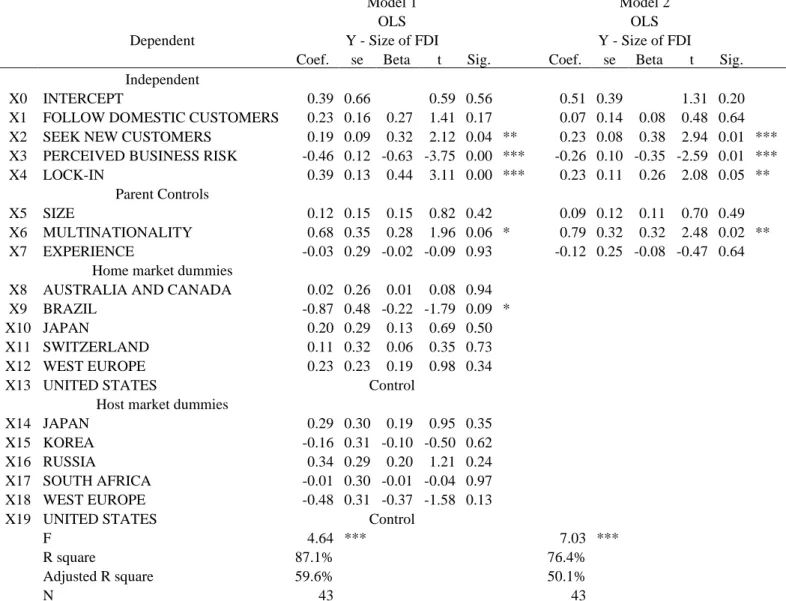
Table 5 summarizes the results of two estimations. Model 1 includes parent and home and host country controls. The regression is significant at the 1% level and the coefficients explain 59.6% of the variation in the FDI (Y). Similar firm-level regression in Ursacki & Vertinsky (1992) explains 38% of the variation in the size of FDI.
H1 predicts a positive relation between FOLLOW DOMESTIC CUSTOMERS (X1) and FDI. The estimated coefficient on FOLLOW DOMESTIC CUSTOMERS (X1) is positive but not statistically significant at a meaningful level suggesting that other strategies may be more relevant in investment
banking. H2 predicts a positive relation between the strategy to SEEK NEW CUSTOMERS (X2) and FDI. The estimated coefficient on this variable is positive and statistically significant at the 1% level suggesting a pronounced effect of this orientation in investment banking. H3 predicts a negative relation between PERCEIVED BUSINESS RISK (X3) and FDI. The coefficient on this variable is negative and statistically significant at the 1% level. Banks that held confident beliefs about the unfolding of business conditions undertook large FDI. H4 predicted a positive relation between LOCK-IN (X4) and FDI. The positive and significant coefficient at the 1% level is consistent with this hypothesis. Banks that intended to get locked to the market undertook large FDI.
Of the parent-level controls, SIZE (X5) and MULTINATIONALITY (X6) are positively related to FDI. Only the coefficient on the latter variable is significant at the 10% level. EXPERIENCE (X7) is negatively related to FDI, but again the coefficient is not significant at a statistically meaningful level. These findings suggest that more internationalized banks are also the ones that undertake FDI.
Home and host country dummies are not significantly related to FDI (except the dummy for BRAZIL (X9) which is significant at the 10% level). Since most home and host country dummies are not significant, a model without home and host country controls was also estimated. Model 2, without country controls, shows that the results are consistent with Model 1. This regression is also significant at the 1% level and the coefficients explain 50.1% of the variation in the FDI.
The standardized coefficient estimate on FOLLOW DOMESTIC CUSTOMERS (X1) is smaller than that of SEEK NEW CUSTOMERS (X2) indicating greater potential of the latter strategic orientation in explaining FDI in investment banking (0.27<0.32 in Model 1 and 0.08<0.38 in Model 2). The estimates on PERCEIVED BUSINESS RISK (X3) and LOCK-IN (X4) are -0.63 and 0.44 in Model 1 and -0.35 and 0.26 in Model 2 indicating the aptitude of the variables in explaining FDI. The standardized coefficient estimates on SIZE (X5), MULTINATIONALITY (X6) and EXPERIENCE (X7) are 0.15, 0.28 and -0.02 in Model 1 and 0.11, 0.32 and -0.08 in Model 2 indicating that MULTINATIONALITY (X6) is better able to explain FDI in investment banking due to the greater importance of technical, market-making and managerial expertise in this industry.
INSERT TABLE 5 ABOUT HERE ROBUSTNESS
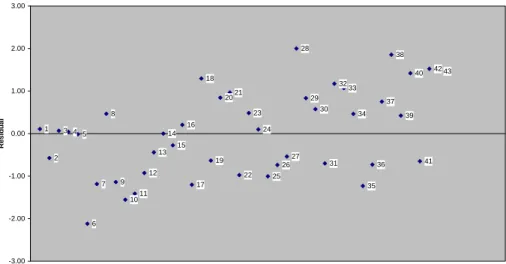
The robustness of the results was assessed in several ways. First, the potential presence of influential variables was investigated. Table 7 shows the zero-order, part and partial correlations, and variance inflation factors. No influential variables were found in these correlations and the variance inflation factors also revealed that the variables are not linearly dependent. Second, studentized residuals were plotted to inspect whether any banks in the sample made abnormal FDI. Note in Figure 1 that residuals showed that no particular bank was making abnormal FDI in terms of size. In other words, the model does not produce large errors in the cross-sectional variation in the FDI. Third, a histogram of the standardized residuals was plotted to inspect the appropriateness of estimating an OLS. The distribution of these residuals is symmetric, suggesting that the OLS estimates are not biased. Finally, the Dfbetas of each variable showed that no particular observation had the potential to individually influence the results.
INSERT TABLE 6 AND FIGURE 1 ABOUT HERE
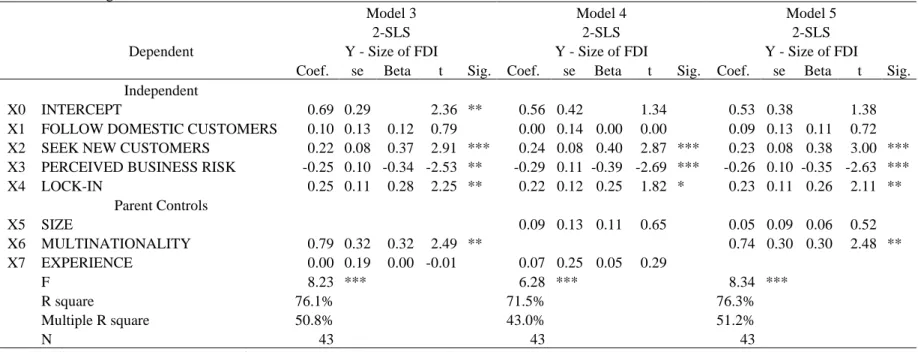
The potential direction of causality of certain independent variables can be questioned in this study. That is, is it LOCK-IN (X4) that influences FDI or does the causation run the other way? To assess the potential for reverse causality, an appropriate instrument had to be identified and parent bank controls proved to be the natural candidate. Specifically, SIZE (X5), MULTINATIONALITY (X6), and EXPERIENCE (X7) were used to estimate 2-SLS regressions. The results are reported in Table 7. As can be observed from the estimations (3, 4 and 5), there are no changes in the original signs or magnitude of the OLS estimates. The standardized coefficient estimates on FOLLOW DOMESTIC CUSTOMERS (X1) remain smaller than those of SEEK NEW CUSTOMERS (X2) in all models. The standardized coefficient estimates on MULTINATIONALITY (X6) remain higher than those of SIZE (X5) and EXPERIENCE (X7). An OLS model regressing all factors on LOCK-IN was also estimated. In this estimation, none of the coefficients on the variables proved significantly related to lock-in except for FDI and thus it was concluded that the original estimates do not suffer from reverse causality bias.
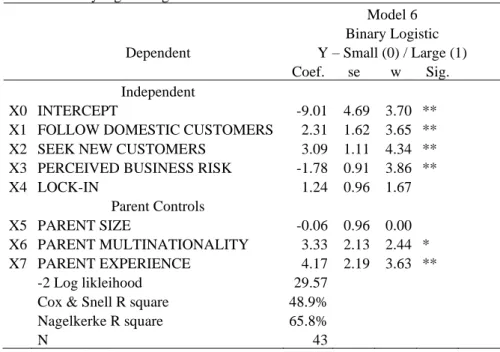
To assess the sensitivity to the method of estimation, a dummy variable was created ascribing 1 if the size of FDI was above the average and 0 otherwise, and a binary logistic model was estimated. The result of this estimation is shown as Model 6 in Table 8. Similar to the linear regressions, the analysis gives coefficient estimates, their estimated standard errors and tests statistics for the null that each coefficient is equal to 0 which is calculated by dividing each coefficient by its standard error and squaring the result.
The signs of the coefficients on the variables and their levels of significance are consistent with the results of previous estimations. All variables show the expected signs and are significant at the 5% level of confidence with the exception of the coefficient on the variable LOCK-IN (X4) whose level of significance drops to 20%. The coefficient on MULTINATIONALITY (X6) is positively related to FDI at the 10% level of significance as in the OLS regression and the coefficient on EXPERIENCE (X7) now appears positively related to FDI at the 5% level of significance. FOLLOW DOMESTIC CUSTOMERS (X1) and SEEK NEW CUSTOMERS (X2) were also constrained to be the same and a Chow-type test for binary variables was conducted. The log-likelihood with FOLLOW DOMESTIC CUSTOMERS (X1) was computed to be 29.556, and the log-likelihood without FOLLOW DOMESTIC CUSTOMERS (X1) was computed to be 35.429. The likelihood ratio of 11.75 is less than the 90 percent critical value from the chi-squared distribution of 10.64 leading to the rejection of the hypothesis that the two variables are the same.
INSERT TABLE 8 ABOUT HERE SUMMARY AND CONCLUSIONS
Internalization theory is used to assess FDI in investment banking. The contentions supporting the reduction of transactions costs are used to formulate hypotheses on the decisions to follow domestic customers and to seek new customers. In addition, the contentions supporting the maximization of option-value are used to formulate the hypotheses relating to the influence of perceived risk of doing business and the reversibility of the decision. The hypotheses are tested using unique unit level data gathered through semi-structured interviews with senior managers, annual reports, and the Fitch IBCA database. The results illustrate which factors influence FDI in investment banking.
Few of the respondents see the strategy of following domestic customers as important and a larger number consider the strategy of seeking new customers as very important. The empirical findings reveal a positive and statistically significant relation between seeking new customers and FDI. Internalization benefits emerging from the possession of intangible expertise appear to be of significant relevance in the international expansion into investment banking. The findings also show that banks held confident beliefs about the unfolding of local business conditions when undertaking FDI and locked themselves to the market. These results are consistent with the internalization theory and the sequential entry framework. The interviews with managers enabled a sounder interpretation of the empirical findings. Multiple methodologies and robustness tests do not reveal biases in the findings.
The study does not suggest that FDI in investment banking is conceptually distinct from the FDI in retail banking. However, it does suggest that the orientation of these banks in foreign markets may differ in the initial stages of entry: retail banks use information gathered in the domestic markets to follow their customers whereas investment banks use intangible technical, market-making and managerial expertise to service new customers. Like retail banks, investment banks do not use alternative contractual modes when entering foreign markets preferring wholly-owned FDI. Both banking approaches differ from manufacturing firms that can generally use licensing, franchising and joint venture arrangements to conduct their overseas business (Boddewyn, Halbrich & Perry, 1986).
This study answers the calls for new applications of internalization theory at a general level (Buckley and Casson, 2009) and for the empirical examination of FDI in investment banking at a more specific level (Casson, 1990; Hennart, 1994). In this sense, it has just scratched the surface of a complex phenomenon by identifying broad unit-level transaction costs savings and option-value related factors that influence FDI in investment banking.
Bank managers can use the insights of this paper to benchmark the recent overseas location and strategic orientation of investment banking units of multinational banks around the world. The empirical findings show that banks locked themselves to the market at the outset. Locking operations into the
foreign markets may provide growth options but doing so without retaining tactical flexibility can condition their long-term survival.
The next logical step would be to conduct further research into the dynamics of FDI in this industry which has not yet received as much attention as it deserves and is currently at the core of the debate surrounding the institutionalization of a new financial order.
References
Aliber, R. Z. (1976). Toward a theory of international banking. Economic Review, Spring, 5-8.
Ball, C. A. & Tschoegl, A. (1982). The decision to establish a foreign bank branch or subsidiary: An application of binary classification procedures. Journal of Financial and Quantitative Analysis. 17(3), 411-424.
Boddewyn, J. J., Halbrich, M. B., & Perry, A. C. (1986). Service multinationals: conceptualization, measurement and theory. Journal of International Business Studies, 17(3), 41-57.
Beugelsdijk, S., Hennart, J-F., Slangen, A., & Smeets, R. (2010). Why FDI stocks are a biased measure of host country MNE activity. Journal of International Business Studies, 41(9), 1444-1459.
Buckley, P. J. & Casson, M. C. (1976). The future of the multinational enterprise. London: Macmillan.
Buckley, P. J. & Casson, M. C. (1998). Models of the multinational enterprise. Journal of International Business Studies, 29(1), 21-44.
Buckley, P. J. & Casson, M. C. (2009). The internalisation theory of the multinational enterprise: A review of the progress of research agenda after 30 years. Journal of International Business Studies, 40 (9), 1563-1580.
Buckley, P. J., Casson, M. C., & Gulamhussen, M. A. (2002). Internationalisation – Real options, knowledge management and the Uppsala approach. In Virpi Havila, Mats Forsgren and Hakan Hakansson (Eds.), Critical perspectives on internationalisation (pp. 229-261). Oxford: Pergamon.
Casson, M. C. (1990). Evolution of multinational banks: A theoretical perspective. In G. Jones (Ed.), Banks as multinationals (pp. 1-31). New York: Routledge (The Economic Theory of Multinational Banking: An Internalisation Approach. University of Reading Working Paper No. 133).
Casson, M. C. (1994). Internationalization as a learning process: a model of corporate growth and geographical diversification. In V.N. Balasubramanyam and D. Sapsford (Eds.), Economics of International Investment (pp. 14-46). Aldershot: Edward Elgar.
Casson, M. C. (2000). The economics of international business: A new research agenda. Cheltenham: Edward Elgar.
Campayne, P. (1992). The impact of multinational banks on international financial centres. In M. C. Casson (Ed.), International business and global integration empirical studies (pp. 121-161). London: Macmillan Press.
Cho, K. R. (1986). Determinants of multinational banks. Management International Review, 26(1), 10-23.
Esperança, J. P. (1993). Foreign direct investment decisions by service multinationals. Ph.D. Dissertation, European University Institute, Florence, Italy.
Focarelli, D., & Pozzolo, A. F. (2005). Where do banks expand abroad? An empirical analysis, Journal of Business, 78(6), 2435-2463.
Gray, J. M. & Gray, H. P. (1981). The multinational bank: A financial multinational corporation? Journal of Banking and Finance, 5(1), 33-63.
Grubel, H. G. (1977). A theory of multinational banking. Banca Nazionale del Lavoro Quarterly Review, December, 349-63.
Goldberg, L. & Saunders, A. (1981a). The determinants of foreign banking activity in the United States. Journal of Banking and Finance, 5 (1), 17-32.
Goldberg, L. & Saunders, A. (1981b). The growth of organisational forms of foreign banks in the US. Journal of Money, Credit and Banking, 13 (3), 365-74.
Graham, J. & Harvey, C. (2001). The theory and practice of corporate finance: Evidence from the field. Journal of Financial Economics, 60 (2-3), 187-243.
Hennart, J-F. (1994). International Capital Transfers: A transaction cost framework. Business History, 36(1), 51-70.
Hennart, J-F. (1982). A theory of the multinational enterprise. Ann Arbor: University of Michigan Press.
Johanson, J. & Vahlne, J-E. (1977). The internationalization process of the firm: A model of knowledge development and increasing foreign market commitments. Journal of International Business Studies, 21-(4), 769-791.
Jones, G. (1992). Multinational and international banking. Aldershot: Edward Elgar Reference Collection.
Jones, G. & Khanna, T. (2006). Bringing history (back) into international business. Journal of International Business Studies, 37(4), 453-468.
Khoury, S. J. (1979). International banking: A special look at foreign banks in the US. Journal of International Business Studies, 10(3), 36-52.
Liaw, K. T. (1999). The business of investment banking. New York: John Wiley & Sons, Inc.
Moore, J. S. & Reichert, A. K. (1983). An analysis of financial management techniques currently employed by large U.S. corporations. Journal of Business Finance and Accounting, 10(4), 623-645.
Qian, L. & Delios, A. (2008). Internalization and experience: Japanese banks’ international expansion. Journal of International Business Studies, 39(2), 231-248.
Quinn, B. S. (1990). US investment banks as multinationals. In G. Jones (Ed.), Banks as multinationals (pp. 268-293). London: Routledge Publishing.
Sabi, M. (1988). An application of the theory of foreign direct investment to multinational banking in LDCs. Journal of International Business Studies, 49(3), 433-447.
Rugman, A. M. (1981). Inside multinationals. London: Croom Helm.
Rugman, A. M. & Verbeke, A. (2003). Extending the theory of the multinational enterprise: Internalization and strategic management perspectives. Journal of International Business Studies, 34 (2), 125-137.
Sutton, J. (1991). Sunk costs and market structure: price competition, advertising and the evolution of concentration. Cambridge, MA: MIT Press.
Tschoegl, A. E. (1987). International retail banking as a strategy: an assessment, Journal of International Business Studies, 19(2), 67-88.
Ursacki, T. & Vertinsky, I. (1992). Choice of entry, timing and scale by foreign banks in Japan and Korea. Journal of Banking and Finance, 16(2), 405-421.
Wallace, R. & Mellor, C. (1988). Non-response bias in mail accounting surveys: A pedagogical note. British Accounting Review, 20(2), 131-139.
White, H. (1980). A heterosckedasticity consistent covariance matrix and a direct test for heterosckedasticity. Econometrica, 48(4), 817-38.
Williams, B. (1997). Positive theories of multinational banking: Eclectic theory versus internalization theory. Journal of Economic Surveys, 11(1), 71-100.
Yamori, N. (1998). A note on the location choice of multinational banks: The case of Japanese financial institutions. Journal of Banking and Finance, 22 (1), 109-120.
Table 1 Variables from the question list
Synthesized question list and parent bank data Source Variable Mnemonic Coding
1. Please identify an overseas investment by your bank in a country outside your bank’s home in which you were involved in the decision in the last three years? Q X8-X13 X14-X19 HOME MARKET HOST MARKET Binary Otherwise (0) or country (1) 2. What were the bank’s strategic objectives at the time the initial decision
was made?
Q X1
X2
FOLLOW DOMESTIC CUSTOMERS SEEK NEW CUSTOMERS
Trichotomous
Not important (0); important (1); or very important (2)
3. Were there any delays in implementing the decision? Q N.A. DELAY Binary
No (0) or Yes (1)
4. What factors were responsible for the delay in implementing the decision? Q N.A. REGULATION Regulation or other
No (0) or Yes (1) 5. What was the size of the investment in number of employees for each
organizational form? Q Y N.A. N.A. N.A. SIZE OF OFFICE REPRESENTATIVE OFFICE BRANCH SUBSIDIARY
Continuous ( log number of employees)
6. What was the initial ownership and entry mode? Q N.A. OWNERSHIP AND ENTRY Binary
Joint venture (0) or wholly-owned (1) Greenfield (0) or Acquisition (1)
7. How did the bank perceive the risk when it made the initial investment? Q X3 PERCEIVED RISK Trichotomous
No risk (0); mild risk (1); or high risk (2)
8. How would you describe the performance of the investment (indicate return on investment)?
Q N.A. PERFORMANCE Continuous (percentage)
9. What options did the banks have in case this investment did not perform according to expectation?
Q X4 LOCK-IN Trichotomous
Not in (0); more or less locked-in (1); or totally locked-locked-in (2)
10. Parent size AR X5 PARENT SIZE Continuous (log number of employees)
11. Parent multinationality AR X6 PARENT MULTINATIONALITY Continuous (percentage of employees
working abroad)
12. Parent international experience AR X7 PARENT EXPERIENCE Continuous(1+log number of countries
in which the parent has offices) Q – Question list; AR – Annual Report; N.A. – Variables not included in the empirical analysis.
Table 2 Descriptive statistics of variables in the data set
Type Variable Average Standard Minimum Maximum
Deviation
Dependent
Y SIZE OF FDI 1.08 0.59 0.30 2.48
Independent
X1 FOLLOW DOMESTIC CUSTOMERS 0.28 0.70 0 2
X2 SEEK NEW CUSTOMERS 1.26 0.98 0 2
X3 PERCEIVED BUSINESS RISK 1.14 0.80 0 2
X4 LOCK-IN 0.56 0.67 0 2
Parent controls
X5 SIZE 3.95 0.77 1.23 5.13
X6 MULTINATIONALITY 0.29 0.24 0.04 0.95
X7 EXPERIENCE 1.18 0.42 1.00 1.90
Home market dummies
X8 AUSTRALIA AND CANADA 0.12 0.32 0.00 1.00
X9 BRAZIL 0.02 0.15 0.00 1.00
X10 JAPAN 0.16 0.37 0 1
X11 SWITZERLAND 0.09 0.29 0 1
X12 WEST EUROPE 0.44 0.50 0 1
X13 UNITED STATES 0.16 0.37 0 1
Host market dummies
X14 JAPAN 0.19 0.39 0 1 X15 KOREA 0.19 0.39 0 1 X16 RUSSIA 0.14 0.35 0 1 X17 SOUTH AFRICA 0.09 0.29 0 1 X18 WEST EUROPE 0.28 0.45 0 1 X19 UNITED STATES 0.12 0.32 0 1
Table 3 Correlations between independent variables
X1 X2 X3 X4 X5 X6 X7 X8 X9 X10 X11 X12 X13 X14 X15 X16 X17 X18 X19
Independent
X1 FOLLOW DOMESTIC CUSTOMERS 1.00
X2 SEEK NEW CUSTOMERS -0.38 1.00
X3 PERCEIVED BUSINESS RISK -0.41 -0.11 1.00
X4 LOCK-IN -0.24 0.36 -0.24 1.00
Parent controls
X5 SIZE 0.01 -0.16 0.16 0.09 1.00
X6 MULTINATIONALITY -0.38 0.15 0.11 0.11 0.24 1.00
X7 EXPERIENCE -0.41 0.04 0.27 0.13 0.65 0.49 1.00
Home market dummies
X8 AUSTRALIA AND CANADA 0.27 0.13 -0.15 0.13 0.23 -0.20 -0.02 1.00
X9 BRAZIL -0.06 0.12 -0.03 0.34 0.07 -0.12 -0.12 -0.06 1.00
X10 JAPAN 0.37 -0.05 -0.32 -0.18 -0.10 -0.26 -0.29 -0.16 -0.07 1.00
X11 SWITZERLAND -0.13 0.25 -0.06 -0.03 -0.36 0.21 -0.02 -0.12 -0.05 -0.14 1.00
X12 WEST EUROPE -0.22 -0.28 0.26 -0.19 0.01 0.15 0.18 -0.32 -0.14 -0.39 -0.28 1.00
X13 UNITED STATES -0.18 0.08 0.16 0.20 0.15 0.13 0.12 -0.16 -0.07 -0.19 -0.14 -0.39 1.00
Host market dummies
X14 JAPAN -0.19 0.00 0.29 -0.13 -0.14 -0.29 -0.10 0.20 -0.07 -0.21 -0.15 0.06 0.11 1.00 X15 KOREA -0.19 0.00 -0.01 0.14 0.11 0.14 0.30 0.01 -0.07 -0.21 0.05 -0.18 0.44 -0.23 1.00 X16 RUSSIA -0.16 0.31 0.35 -0.14 0.04 0.31 0.09 -0.15 -0.06 0.00 0.10 0.05 0.00 -0.19 -0.19 1.00 X17 SOUTH AFRICA -0.13 -0.25 0.25 -0.15 0.09 0.06 0.10 -0.12 -0.05 -0.14 -0.10 0.36 -0.14 -0.15 -0.15 -0.13 1.00 X18 WEST EUROPE 0.65 -0.16 -0.63 -0.05 -0.04 -0.19 -0.18 0.10 -0.10 0.43 0.16 -0.24 -0.27 -0.30 -0.30 -0.25 -0.20 1.00 X19 UNITED STATES -0.15 0.13 -0.06 0.35 -0.03 0.06 -0.18 -0.13 0.43 0.04 -0.12 0.12 -0.16 -0.17 -0.17 -0.15 -0.12 -0.23 1.00
Table 4 Chi-square test results for early and late respondents
Variable Chi-square Sig.
Independent
X1 FOLLOW DOMESTIC CUSTOMERS 0.48
X2 SEEK NEW CUSTOMERS 0.12
X3 PERCEIVED BUSINESS RISK 2.51
X4 LOCK-IN 0.02
Parent controls
X5 SIZE 3.52 *
X6 MULTINATIONALITY 0.12
X7 EXPERIENCE 1.90
Home market dummies
X8 AUSTRALIA AND CANADA 2.49
X9 BRAZIL 0.87
X10 JAPAN 3.41 *
X11 SWITZERLAND 0.80
X12 WEST EUROPE 0.01
X13 UNITED STATES 2.04
Host market dummies
X14 JAPAN 0.99 X15 KOREA 0.99 X16 RUSSIA 1.11 X17 SOUTH AFRICA 0.02 X18 WEST EUROPE 3.02 * X19 UNITED STATES 1.56
Table 5 Regression results
Model 1 Model 2
OLS OLS
Dependent Y - Size of FDI Y - Size of FDI
Coef. se Beta t Sig. Coef. se Beta t Sig.
Independent
X0 INTERCEPT 0.39 0.66 0.59 0.56 0.51 0.39 1.31 0.20
X1 FOLLOW DOMESTIC CUSTOMERS 0.23 0.16 0.27 1.41 0.17 0.07 0.14 0.08 0.48 0.64
X2 SEEK NEW CUSTOMERS 0.19 0.09 0.32 2.12 0.04 ** 0.23 0.08 0.38 2.94 0.01 ***
X3 PERCEIVED BUSINESS RISK -0.46 0.12 -0.63 -3.75 0.00 *** -0.26 0.10 -0.35 -2.59 0.01 ***
X4 LOCK-IN 0.39 0.13 0.44 3.11 0.00 *** 0.23 0.11 0.26 2.08 0.05 **
Parent Controls
X5 SIZE 0.12 0.15 0.15 0.82 0.42 0.09 0.12 0.11 0.70 0.49
X6 MULTINATIONALITY 0.68 0.35 0.28 1.96 0.06 * 0.79 0.32 0.32 2.48 0.02 **
X7 EXPERIENCE -0.03 0.29 -0.02 -0.09 0.93 -0.12 0.25 -0.08 -0.47 0.64
Home market dummies
X8 AUSTRALIA AND CANADA 0.02 0.26 0.01 0.08 0.94
X9 BRAZIL -0.87 0.48 -0.22 -1.79 0.09 *
X10 JAPAN 0.20 0.29 0.13 0.69 0.50
X11 SWITZERLAND 0.11 0.32 0.06 0.35 0.73
X12 WEST EUROPE 0.23 0.23 0.19 0.98 0.34
X13 UNITED STATES Control
Host market dummies
X14 JAPAN 0.29 0.30 0.19 0.95 0.35
X15 KOREA -0.16 0.31 -0.10 -0.50 0.62
X16 RUSSIA 0.34 0.29 0.20 1.21 0.24
X17 SOUTH AFRICA -0.01 0.30 -0.01 -0.04 0.97
X18 WEST EUROPE -0.48 0.31 -0.37 -1.58 0.13
X19 UNITED STATES Control
F 4.64 *** 7.03 ***
R square 87.1% 76.4%
Adjusted R square 59.6% 50.1%
N 43 43
Table 6 Zero, part and partial coefficients and variance inflation factors (VIF)
Type Variable Zero Part Partial VIF
Independent
X1 FOLLOW DOMESTIC CUSTOMERS -0.07 0.27 0.14 3.79
X2 SEEK NEW CUSTOMERS 0.51 0.39 0.21 2.32
X3 PERCEIVED BUSINESS RISK -0.46 -0.60 -0.37 2.95
X4 LOCK-IN 0.50 0.53 0.31 2.06
Parent controls
X5 SIZE 0.04 0.16 0.08 3.74
X6 MULTINATIONALITY 0.33 0.36 0.19 2.08
X7 EXPERIENCE 0.07 -0.02 -0.01 4.46
Home market dummies
X8 AUSTRALIA AND CANADA 0.16 0.02 0.01 2.10
X9 BRAZIL -0.08 -0.34 -0.18 1.62
X10 JAPAN 0.00 0.14 0.07 3.44
X11 SWITZERLAND -0.01 0.07 0.03 2.71
X12 WEST EUROPE -0.08 0.19 0.10 4.02
X13 UNITED STATES Control
Host market dummies
X14 JAPAN -0.11 0.19 0.09 4.30
X15 KOREA -0.06 -0.10 -0.05 4.52
X16 RUSSIA 0.17 0.24 0.12 2.98
X17 SOUTH AFRICA -0.22 -0.01 0.00 2.33
X18 WEST EUROPE 0.03 -0.30 -0.16 5.71
Figure 1 Studentized Residuals 1 2 3 4 5 6 7 8 9 1011 12 13 14 15 16 17 18 19 2021 22 23 24 25 26 27 28 29 30 31 3233 34 35 36 37 38 39 40 41 42 43 -3.00 -2.00 -1.00 0.00 1.00 2.00 3.00 Observation Resi d u al
Table 7 2-SLS Regression results
Model 3 Model 4 Model 5
2-SLS 2-SLS 2-SLS
Dependent Y - Size of FDI Y - Size of FDI Y - Size of FDI
Coef. se Beta t Sig. Coef. se Beta t Sig. Coef. se Beta t Sig.
Independent
X0 INTERCEPT 0.69 0.29 2.36 ** 0.56 0.42 1.34 0.53 0.38 1.38
X1 FOLLOW DOMESTIC CUSTOMERS 0.10 0.13 0.12 0.79 0.00 0.14 0.00 0.00 0.09 0.13 0.11 0.72
X2 SEEK NEW CUSTOMERS 0.22 0.08 0.37 2.91 *** 0.24 0.08 0.40 2.87 *** 0.23 0.08 0.38 3.00 ***
X3 PERCEIVED BUSINESS RISK -0.25 0.10 -0.34 -2.53 ** -0.29 0.11 -0.39 -2.69 *** -0.26 0.10 -0.35 -2.63 ***
X4 LOCK-IN 0.25 0.11 0.28 2.25 ** 0.22 0.12 0.25 1.82 * 0.23 0.11 0.26 2.11 ** Parent Controls X5 SIZE 0.09 0.13 0.11 0.65 0.05 0.09 0.06 0.52 X6 MULTINATIONALITY 0.79 0.32 0.32 2.49 ** 0.74 0.30 0.30 2.48 ** X7 EXPERIENCE 0.00 0.19 0.00 -0.01 0.07 0.25 0.05 0.29 F 8.23 *** 6.28 *** 8.34 *** R square 76.1% 71.5% 76.3% Multiple R square 50.8% 43.0% 51.2% N 43 43 43
Table 8 Binary logistic regression Model 6
Binary Logistic
Dependent Y – Small (0) / Large (1)
Coef. se w Sig.
Independent
X0 INTERCEPT -9.01 4.69 3.70 **
X1 FOLLOW DOMESTIC CUSTOMERS 2.31 1.62 3.65 **
X2 SEEK NEW CUSTOMERS 3.09 1.11 4.34 **
X3 PERCEIVED BUSINESS RISK -1.78 0.91 3.86 **
X4 LOCK-IN 1.24 0.96 1.67 Parent Controls X5 PARENT SIZE -0.06 0.96 0.00 X6 PARENT MULTINATIONALITY 3.33 2.13 2.44 * X7 PARENT EXPERIENCE 4.17 2.19 3.63 ** -2 Log likleihood 29.57
Cox & Snell R square 48.9%
Nagelkerke R square 65.8%