Editor in Chief
Alfonso Vargas-Sánchez, University of Huelva, Spain
Associate Editor
Mirko Perano, Reald University College, Albania Books Review Editor
Brendan Paddison, York St. John University, United Kingdom Secretariat
Elena García de Soto, University of Huelva, Spain Cinta Borrero-Domínguez, University of Huelva, Spain Style reviewer and text editor
Anestis Fotiadis, I-SHOU University, Taiwan, Province of China
Editorial Board
José Manuel Alcaraz, Murdoch University, Australia
Mario Castellanos-Verdugo, University of Seville, Spain José Antonio Fraiz-Brea, University of Vigo, Spain
José Manuel Hernández-Mogollón, University of Extremadura, Spain
Tzung-Chen Huan, National Chiayi University, Taiwan, Province of China
Shaul Krakover, Ben Gurion University, Israel
Jean Pierre Levy-Mangin, University of Quebec, Canada Tomás López-Guzmán, University of Córdoba, Spain Yasuo Ohe, Chiba University, Japón
María de los Ángeles Plaza-Mejía, University of Huelva, Spain Nuria Porras-Bueno, University of Huelva, Spain
João Albino Silva, Algarve University, Portugal
Advisory Board (Spanish Members)
Juan Manuel Berbel-Pineda, Pablo de Olavide University, Spain César Camisón-Zornoza, Uniersity of Valencia, Spain
Enrique Claver-Cortés, University of Alicante, Spain María Teresa Fernández-Alles, University of Cádiz, Spain José Luis Galán-González, University of Seville, Spain Félix Grande-Torraleja, University of Jaén, Spain
Antonio Leal-Millán, University of Seville, Spain Inmaculada Martín-Rojo, University of Málaga, Spain
Madrid, Spain
Sandra Sanchez-Cañizares, University of Cordoba, Spain Josep Francesc Valls-Giménez, ESADE, Spain
Advisory Board (Other European
Members)
Tindara Abbate, University of Messina, Italy Paulo Aguas, University of Algarve, Portugal Carlos Costa, Aveiro University, Portugal Dianne Dredge, Aalborg University, Denmark
Salvatore Esposito de Falco, University of Rome “La Sapienza", Italy
Sheila Flanagan, Dublín Institute of Technology, Ireland Tania Gorcheva, Tsenov Academy of Economics, Bulgaria Tadeja Jere Jakulin, University of Primorska, Slovenia Metin Kozak, Mugla University, Turkey
Álvaro Matias, Lusiada University, Portugal Alfonso Morvillo, National Research Council, Italy
Alexandru Nedelea, Stefan cel Mare University of Suceava, Romania
Claudio Nigro, University of Foggia, Italy
Angelo Presenza, University "G. D'Annunzio" of Chieti-Pescara, Italy
Kanes Rajah, Royal Agricultural University, United Kingdom
Advisory Board (Members from the rest
of the world)
John Allee, American University of Sharjah, United Arab Emirates
Nestor Pedro Braidot, National University of La Plata, Argentina
Roberto Elias Canese, Columbia University, Rector, Paraguay
Luca Casali, Queensland University of Technology, Australia Nimit Chowdhary, Indian Institute of Tourism and Travel Management, India
Steven Chung-chi Wu, National Pingtung University of Science and Technology, Taiwán
Dianne Dredge, Southern Cross University, Australia Daniel Fesenmaier, Temple University, United States
Babu George, Alaska Pacific University, United States Dogan Gursoy, Washington State University, United States Jafar Jafari, University of Wisconsin-Stout, United States Sanggun Lee, Pai Chai University, Korea Republic of Albert Yeh Shangpao, I-SHOU University, Taiwán Pauline Sheldon, University of Hawaii, United States Germán A. Sierra-Anaya, University of Cartagena de Indias, Rector, Colombia
MOTIVATION AND TOURISTS’ LOYALTY IN
PERFORMING ARTS FESTIVALS: THE MEDIATOR
ROLE OF QUALITY AND SATISFACTION
Daniela Amorim
Polytechnic Institute of Leiria (Portugal)
[email protected]
José Luís Jiménez-Caballero
University of Seville (Spain)
[email protected]
Paulo Almeida
Polytechnic Institute of Leiria (Portugal)
[email protected]
ABSTRACT
Festival tourism has been growing considerably over the years, acquiring a prominent position and with strong popularity in society. Festivals and/or events promote a cultural exchange at international, national and local levels, with the opportunity for cultural sharing, from history and tradition, culinary and drinks, music and dance, involving all publics (organization, services, artists, participants and local inhabitants). Festivals are recognized as an effective strategy for host destinations promoting economic, social and cultural development. The present study aims to test the mediator role of quality and satisfaction in the relationship between the motivation in
the choice of performing arts festivals and the loyalty of the tourists. The sample consisted of 532 respondents, collected at two performing arts festivals: Andanças festival (Portugal) and La Sierra festival (Spain). The results of the study show that tourists motivated to attend performing arts festivals, tend to perceive the festival as having quality, and are satisfied with the service, which in turn tend to revisit and recommend the festival. The study discusses the implications of the obtained results. It also presents limitations and suggests future studies.
KEYWORDS
Tourism; Performing Arts Festivals; Motivation; Quality; Satisfaction; Loyalty.
ECONLIT KEYS Z31; Z32; C30
1. INTRODUCTION
In recent years, there has been growing interest in tourism, such as the contribution of tourist regions and places to the economic growth and local development (Jiménez & Martín, 2004). Besides that, culture has also been playing a crucial role in the services economy, contributing significantly to the continued and rapid growth of tourism worldwide (Cooper, Fletcher, Fyall, Gilbert & Wanhill, 2008). Therefore, culture has been considered a fundamental pillar in the tourist activity, being designated by cultural tourism. Richards (1997) defines cultural tourism as the "movements of persons to specific cultural attractions, such as heritage sites, artistic and cultural manifestations, arts and drama outside their normal place of residence" (p. 24). According to the Organization for Economic Co-operation and Development report (OECD, 2009), the cultural tourism market is fundamental on a global scale, accounting approximately 40% of the international tourism market. Thus, cultural tourism can be considered the main strength of regions, in which the community presents to tourists their origins through history, culture, habits and customs (Timothy, 2011). In this context, the use of performative arts, such as music, dance, and theatre, is essential in the tourism development (Hughes, 2000).
Guerreiro, Mendes and Henriques (2014) consider cultural tourism as a promising market segment, with a potential to grow superior to other niches. Tourists are motivated to travel according to their tastes and interests, which can be found in
various aspects of cultural tourism, namely heritage tourism, art tourism, ethnic tourism, literary tourism, gastronomic tourism, indigenous tourism, archaeological tourism, musical tourism, cinematographic tourism, festival tourism, historical tourism, military tourism, dark tourism, war tourism, among others. All of these tourist branches allow new visions and possibilities for different areas promote the appearance of new tourist models, the reuse and revitalization of existing tourist territories, as well as new tourist offers available to tourists (Carvalho, 2017).
Festival tourism has increased significantly over the years, gaining considerable popularity and a prominent position in the development of tourism and society. The festivals have a historical trajectory throughout humankind, from prehistoric times, fundamental in the presentation and conservation of the various traditions transmitted from generation to generation (Carvalho, 2017; Quinn, 2009; Stankova & Vassenska, 2015; Ziakas, 2013). Several authors (Getz, 2007; Grappi & Montanari, 2011; Huang, Li & Cai, 2010; Kotler, Haider & Rein, 1993) consider that festivals and special events are strategic elements that contribute to regional development, which have a strong contribution in economy, increasing the tourist flow and the number of tourists. Also, Stankova and Vassenska (2015) mention the importance of festivals and/or events in cultural promotion, whether internationally, nationally or even locally. Festivals promote the sharing of the cultural identity of the regions, from history and tradition, cooking and drinks, music and dance, involving all public in this interaction (organization, services, artists, participants and locals). Local festivals are considered a way to boost sustainable tourism, and represent and facilitate the learning on cultural identity, ethnic origins and local customs (Lee, Lee, & Choi, 2011; Yoon, Lee, & Lee, 2010). Regardless of their geographic location, events promote the creation and maintenance of social groups or subcultures that share the same tastes, and play, at this level, an important role in society (Laing, 2018). Ziakas (2013) emphasizes that it is essential to create and maintain a set of festivals and/or events that can appeal to different audiences, trying to meet different tastes, needs and requirements.
In Portugal and Spain, many regions have become part of many tourist’s itinerary because they host cultural events of performing arts, such as music and dance
festivals. In Portugal, several festivals, such as Andanças, Marés Vivas, Optimus Alive, Sudoeste, Rock in Rio, Short Film Festival, Animation Film Festival, have contributed to the promotion of a number of regions (Carvalho, 2017; Lopes & Leitão, 2013). Likewise, in Spain, several festivals have also been featured in the promotion of various regions, including the San Sebastian International Film Festival, the Ibero-American Theatre Festival of Cadiz, the Granada International Music and Dance Festival; Ibero-American Film Festival of Huelva, International Festival of Classical Theatre of Mérida, among others.
Several studies about festivals (Baker & Crompton, 2000; McDowall, 2011; Son & Lee, 2011; Stankova & Vassenska, 2015; Wan & Chan, 2013; Wong, Wu & Cheng, 2014; Wu & Ai, 2016; Wu, Wong & Cheng, 2014; Yoon et al., 2010), showed that festival participants’ experience is commonly assessed through perceived quality and satisfaction, factors that may influence future behavioural intentions (revisit intention and intention to recommend). In addition, since motivation is the basis of the desire to experience something, motivation can be considered as one of the fundamental elements of the entire tourism process, the starting point of the entire touristic and experiential journey of the individual.
Thus, in order to better understand the relationship between the factors that are relevant to tourist loyalty, this study aims to examine the mediating role of quality and satisfaction of the participants in the relationship between the motivation to choose a performing arts festival and tourist loyalty. Therefore, two traditional dance and music festivals were selected, namely the Andanças Festival in Portugal and the La Sierra International Festival in Spain. This cross-sectional study was carried out administering self-report questionnaires to participants of both performing arts festivals. We found that tourists motivated to participate in this type of festival leads to higher perception of the festival as having quality, which in turn leads to higher levels of satisfaction and to be loyal to the festival.
2. LITERATURE REVIEW AND CONCEPTUAL MODEL
Motivation has been conceptualized as a psychological mechanism that regulates the direction, intensity and persistence of behaviour (Deci, 1992). One of the most well-known theories about motivation was developed by Maslow (1970). Maslow's pyramid comprises five hierarchical needs, at the base of the pyramid there are the physiological needs, followed by safety needs, love and belongingness needs, esteem needs and at the top of the pyramid the self-actualization needs. Maslow (1970) argues that the higher-level needs are only met when those at the next lower level are satisfied.
Puertas (2004) emphasizes that it is from the third level that the individual has the necessary conditions to practice tourism, in order to reach the needs of esteem and self-actualization. This author considers that the tourist is a multi-motivational being, exemplifying that a landscaped motivation can be accompanied by a motivation related to accessibility and by another one of economic character.
Cooper et al. (2008) consider that the motivation strengths that lead tourists to decide to visit an attraction are one of the basic elements in the tourist consumer decision process. Likewise, Gutiérrez and Bosque (2005) argues that there is a set of attributes of the tourist destination, which originate a motivational power, leading the person to the traveling desire. Since the choice of tourism product depends on the tourist consumer motivation (Woodside & Dubelaar, 2002) it is essential to take into account the evolution of tourist motivations (Puertas, 2004).
Crompton (1979) identified seven socio-psychological motives that led people to travel, namely: mundane environment escape, self-relaxation exploration and evaluation, prestige, regression, enhancement of kinship relationships, facilitation of social interaction, novelty and education. Puertas (2004) highlights a study carried out in the late 1970s in the main European outbound tourism countries, which analysed seventy-two different motivations, grouped into twelve groups: climate, landscape, human relations, environmental change, relaxation, culture and monuments, receiving quality, animation and entertainment, accessibility, economic, sports, and others. They also verified that the major travel motivation percentages were: climate (47.35%), landscape (40.08%), human relations (34.85%), environmental change
(29.76%) and relaxation (27.44%), meeting some of the motivations highlighted by Crompton (1979).
Almeida and Araújo (2017) argue that in tourism the motivation to travel is always present in the choice and action of the individual. The motivations associated with tourism are seen as the set of psychological needs or forces that predetermine the individual to participate in a tourism activity. Tourist motivation is thus based on intrinsic forces that influence the person to carry out a specific tourist activity.
Currently, we are facing a more demanding tourist, who intends to be more active, and with the need to undertake new and different experiences. On the other hand, the motivational process assumes that the individual understands what will satisfy his need, being the basis for the consumer motivation to perform a given activity (Henriques, 2003). This way, the tourist chooses a tourist destination not only because it does depend on his personal value system and his personality (Mathieson & Wall, 1996), but also because it responds to his needs for new experiences.
With regard to festival tourism, Kitterlin & Yoo (2014) emphasize that it is crucial that the managers of this type of events understand the participants' motivations, in order to facilitate an effective festival planning and an appropriate marketing strategy to launch the festival.
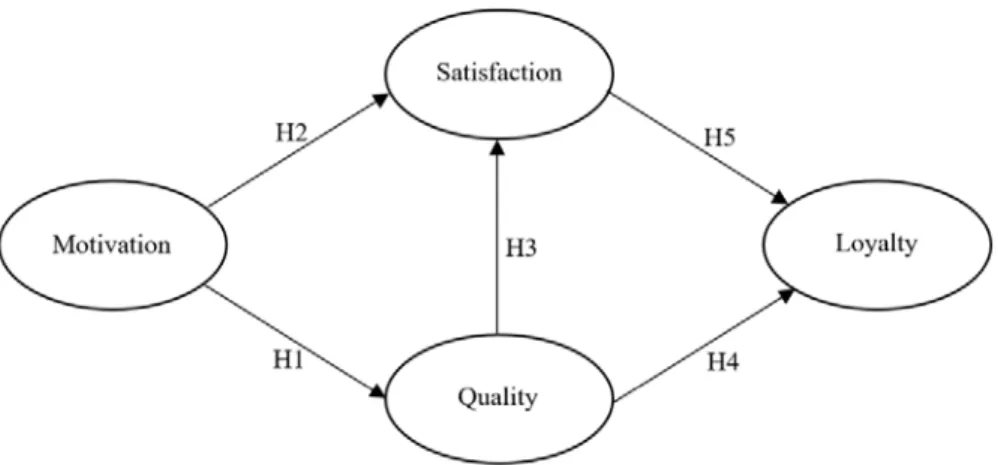
To our knowledge, there are no studies that examine the effect of the motivation to choose performing arts festivals on the perceived quality, satisfaction and loyalty of the tourist. We hypothesize that the motivation to choose a performing arts festival can increase the festival quality perception as well as increase tourist satisfaction. Thus, the following hypotheses are proposed:
Hypothesis 1: The motivation of the festival choice positively influences the tourist's perception of the quality of the festival.
Hypothesis 2: The motivation of the festival choice positively influences the tourist's satisfaction in the festival.
2.2) QUALITY
The quality of a service can be conceptualized as a set of intrinsic and extrinsic elements that, individually or in combination, contribute to consumers' perception of quality (Grönroos, 2009). According to Zabkar, Brenčič & Dmitrovi (2010), the perceived quality of the tourist destination is evaluated in terms of tourist destination as a general construct, and in terms of tourist offers of the destination as a formative construct. According to several authors (Lee, Lee & Yon, 2009; Song, Lee, Kim, Bendle & Shin, 2014; Wu et al., 2014), perceived quality refers to the superiority or excellence of a product or service that is perceived by consumers. That is, quality indicates the performance of a product or service (Wu et al., 2014; Yoon et al., 2010). Also, Chiou & Droge (2006) characterize service quality as a form of cognitive component that normally precedes emotional responses, leading to behavioural intention. However, several studies have shown that festival quality is a multidimensional construct. Yoon et al. (2010) developed a study where they recognized five important dimensions of the festival quality to define the festival value, namely: information service, program, memories, food, and facilities. Son & Lee (2011) identified three quality factors in a festival context that have a direct and positive effect on the participant's future intentions of recommendation and revisiting, namely: general characteristics, comfort and socialization. However, it was verified that the factor related to general characteristics presented greater impact on the intention to return. This study meets Cole & Illum (2006) study, which also analysed a direct relationship between festival quality and the intention to revisit. Wan & Chan (2013) mentioned that the quality of the festival included the location and accessibility, food, local facilities, environment (physical space), ambience (set of circumstances and general mood of those present), service, entertainment, time (scheduling and timetable) and festival dimension. Wu et al. (2014) found that festival quality was based on interaction quality, physical environment quality, final result quality and access quality.
In the Aaker (1991) model of brand equity, perceived quality is one of the five categories of assets associated to a brand. According to Aaker (1991), in addition to the classic functions that the brand presents in both the distinction of competition and the identification of the product, intangible characteristics such as values, feelings,
ideas or affections have also been valued, influencing the consumer behaviour. Aaker (1991) argues that the brand contributes to the quality of the product and/or service, which in turn will lead to customer loyalty.
Crompton and Love (1995) proposed the first conceptualization on quality measurement of the festival, considering two types of quality: performance (opportunity) and experience. Performance quality can be defined as the quality of the service attributes, which are under the control of the supplier. Whereas the quality experience is related to both the attributes provided by the supplier and the attributes brought by the visitor to the situation.
Calantone & Maznanec (1991) point out that the success of the tourism industry is based on the quality of service offered to customers. Cole & Scott (2004) indicated that tourism experience is cumulative, as performance quality leads to quality experience. This contributes to the satisfaction and intention to revisit. In addition, the experience quality has a mediating effect between the performance quality ratio and overall satisfaction. Considering this, tourism managers should highlight the dimensions of quality, which will greatly benefit the tourists in their experience and the visit to the tourist attractions.
Zeithaml, Berry and Parasuraman (1996) report that service quality has a positive effect on loyalty. Also, Bloemer, Ruyter & Wetzels (1999) found that in four service industries (supermarkets, fast food restaurants, entertainment and health services) all service quality dimensions affected the four service loyalty dimensions namely purchase intention, word-of-mouth communication, price sensitivity and complaints. In the festival context, the participants first evaluate the performance quality, and from this evaluation, the participants perceive the experience quality (Cole & Illum, 2006). Dabholkar, Shepherd & Thorpe (2000) have suggested that the relationship between quality and loyalty is less than the one between satisfaction and loyalty.
Literature has suggested that perceived quality is an antecedent of satisfaction, since quality is a necessary condition for the consumer to be satisfied (Boulding, Kalra, Staelin & Zeithaml, 1993; Heung & Cheng, 2000; Kozak & Rimmington, 2000; Lee, Graefe & Burns, 2004; Parasuraman, Zeithaml & Berry, 1988, 1991; Taylor & Baker, 1994; Zeithaml et al., 1996). Moreover, service quality perception is likely to
play an important role in behaviour, such as future behavioural intentions (Chen & Tsai, 2007).
In this way, the following hypotheses were outlined:
Hypothesis 3: The festival quality positively influences tourist's satisfaction. Hypothesis 4: The festival quality positively influences tourist's loyalty.
2.3) SATISFACTION
Satisfaction concerns the tourist overall evaluation of all their experiences (Kim, Kim, & Goh, 2011; Lee & Back, 2008; Mason & Paggiaro, 2012; McDowall, 2011). Mason & Paggiaro (2012) consider that consumption experience satisfaction can be a partially affective and partially cognitive evaluation.
According to Parasuraman et al. (1988), satisfaction is related to expectations, which are interpreted as predictions. In this way, tourists are satisfied when the comparison of their previous expectations and post-trip experiences results in pleasant feelings, whereas they have unpleasant feelings when they are not satisfied (Chang, Gibson & Sission, 2013; Chen & Chen, 2010, Chi & Qu, 2008; Grappi & Montanari, 2011; Lee & Back, 2008; Mason & Paggiaro, 2012; Song et al., 2014). Boshoff and Gray (2004) highlight that satisfaction consists mainly in the perceptions of the consumer about the attributes of the product or service, and different consumers will express different levels of satisfaction for the same experience or service. Moscardó (1996, 1999) also considers that the key factor for the tourist satisfaction is their expectation regarding the services received and also their knowledge during the visit to the chosen destination.
Concerning festival tourism (specifically arts), Kruger and Petzer (2008) consider that festival managers should take into account that each participant is different. Therefore, it is fundamental that festival managers offer services and experiences meeting the different market segments that participate in festivals, as this will have an impact on the participants' satisfaction.
Satisfaction is a good indicator of the intention to revisit (Petrick & Backman, 2002). The tourists' satisfaction may also lead to the intention of revisiting or making
beneficial comments about the destination to other visitors (Chi & Qu, 2008). However, dissatisfied tourists may express damaging comments about a destination and affect its credibility in the marketplace (Reisinger & Turner, 2003). If a product or service confirms the customer's initial expectations, this will result in a high level of satisfaction, but if the product or service goes beyond expectations then the customer will be very satisfied and may tend to repeat the experience (Kotler, 2000). This is the main goal, not only that customers are satisfied, but that they feel the need to return, thus contributing, to their loyalty.
Therefore, the following hypothesis was proposed:
Hypothesis 5: The tourist´s satisfaction on the festival positively influences the tourist's loyalty.
2.4) LOYALTY
According to several authors (Bigné, Sánchez & Sánchez, 2001; Cai, Wu & Bai, 2003; Chen & Gursoy, 2001; Niininen, Szivas & Rileye, 2004; Petrick, 2004), the intention to return to a destination and to recommend the visit to other people are both indicators of loyalty.
Consumer´s loyalty is often recognized as a strategic objective for businesses (Oliver, 1999). Petrick & Sirakaya (2004) consider that consumer loyalty is clearly a critical aspect for business since it is more desirable and less expensive to retain existing customers than to attract new customers. Hence, loyalty becomes a key strategic component for a company. To maintain clients, organizations should seek to satisfy them, but a more ambitious goal should be to establish a long-lasting relationship (Bigné et al., 2001).
Yang, Gu & Cen (2011) indicate that consumers have a certain attitude towards a product or service, which is based on the assessments of previous experiences. Thereby consumers decide to be loyal to or leave behind the product or service. The loyalty process includes four stages: a) a product or service is preferred because consumers believe that their characteristics are superior to others (cognitive loyalty); b) after using the product or service, based on satisfaction, there is an emotional
connection between consumers and the product or service (attitudinal loyalty); c) after this connection, consumers are more likely to remain committed to the product or service, although external factors and marketing promotions of other products or services may arise; d) and, after these stages, consumers express an intention to repurchase the same product or service (conative loyalty). Finally, the implementation of these stages results in a behavioural loyalty, that is, in favourable behavioural intentions in the future (Lee, 2014; Song et al., 2014; Wong et al., 2014; Yang et al., 2011).
Yüksel, Yüksel & Bilim (2010) found that, in tourism, affective loyalty has a stronger effect on conative loyalty than on cognitive loyalty. These results have clear implications for managers. For example, believing that a destination has a better performance compared to other destinations can increase the intentions of conative loyalty. However, this increase is expected to be less than that of affective loyalty. Destination authorities are advised to invest in the affective components of a destination, such as the destination's ability to induce positive affect, as this seems to result in a greater probability of becoming the customer's first choice at a future opportunity.
Tourism experience quality can increase the interest and the involvement of the tourists, leading to satisfaction, which in turn can contribute to tourist loyalty (Anderson & Sullivan, 1993; Chen & Chen, 2010; Fornell, 1992; Fornell, Johnson, Anderson, Cha & Bryant, 1996; Murray & Howat, 2002; Oliver, 1999). As far as festivals are concerned, building loyalty among participants is one of the main ways to achieve success (Lee, 2014; Wu et al., 2014). Thus, event planners should analyse and assess the performance of the event to improve participants' satisfaction and make them want to revisit the same event year after year and recommend the event, thus attracting more and new customers (Baker & Crompton, 2000; Cole & Illum, 2006; Lee, Lee, Lee & Babin, 2008; Yoon et al., 2010).
2.5) MEDIATING HYPOTHESES
The motivation of the tourist choice is a rather important factor for the success of the festivals, since it is closely related to other models of consumer behaviour, such as the attitudes, perceptions, and images that the tourist has about a certain tourist destination, influencing decisions on the choice of travels (Cooper et al., 2008). Also, several studies have shown that service quality indirectly influences loyalty through other variables such as satisfaction (Gotlieb, Grewal & Brown, 1994; Oliver, 1999; Parasuraman et al., 1988; Patterson & Spreng, 1997; Roest & Pieters, 1997; Rust & Zahorik, 1993; Taylor & Baker, 1994).
Several researchers (Baker & Crompton 2000; Chen & Chen, 2010; Cole & IIIum, 2006; Cole & Scott, 2004; Crompton & Love, 1995; Wu et al., 2014; Wong et al., 2014; Yoon et al., 2010) sought to understand how to improve the quality and service of festivals so that participants gain satisfactory experiences and reduce their change intentions, given that if a festival maintains a high level of quality there will be a greater chance of more satisfied participants. That is, visitors with favourable perceptions of the quality of the destination will probably perceive their experiences positively, which in turn will lead to higher levels of satisfaction, intention to revisit, and intention of spreading by word of mouth. In addition, Cronin & Taylor (1992) evaluated the impact of quality and satisfaction on behavioural intentions, indicating that satisfaction had a stronger and more consistent effect on purchase intentions than service quality.
Taking into account the literature review, we hypothesized that participants motivated to participate in performing arts festivals perceive the festival as having higher quality, which will lead to higher levels of satisfaction, and consequently to the participant´s loyalty.
Thus, the following hypotheses were proposed:
Hypothesis 6: The choice motivation influences loyalty through quality. Hypothesis 7: The choice motivation influences loyalty through satisfaction.
Hypothesis 8: The choice motivation influences loyalty, through quality and satisfaction.
The conceptual model that demonstrates the relationship between motivation, quality, satisfaction, and loyalty is presented in Fig. 1.
Fig. 1. Proposed conceptual model. Source: Authors.
3. RESEARCH CONTEXT AND METHODOLOGY
3.1) SAMPLE AND DATA COLLECTION
The participants of the present study were tourists who participated in a performing arts festival. The data were collected in Andanças Festival, held in Castelo de Vide, Alentejo, Portugal, and La Sierra International Festival, held in Fregenal de La Sierra in Badajoz, Spain. The data collection was carried out in August 2017 and the respondents were randomly approached in the festival space, being the assessment instrument applied to the participants who became available to collaborate in the study.
The primary essence of the concept of these festivals is the promotion of traditional dances and songs, both nationally and internationally, and both offer the possibility of their participants to experience the diverse range of dances, promoted through the provision of workshops and shows. These two festivals were selected based on the similarity of the concept and also on the fact that both promote cultural tourism and creative tourism. Cultural tourism is present in cultural heritage promotion of the places that host the festivals, and creative tourism is evidenced in the opportunity that the participant/tourist of each festival has to learn and experience a range of dances and music from all over the world promoted in the festivals, through workshops.
3.2) MEASURES
The measurement instrument used was constructed based on a literature review and on the consultation of experts in the tourism area (Almeida A., 2010; Almeida P., 2010; Gutiérrez, 2005; Quintero, 2015).
The questionnaire consists of three parts: the first part concerns sociodemographic data; the second part refers to the festival attendance frequency data; the third part refers to the essential characteristics of the festival, such as the motivation of choosing the festival, the quality, and satisfaction of the service provided at the festival and tourist's loyalty. The scale of measurement used in the third part of the questionnaire was a Likert scale of 1 to 7 points, varying from not very important/strongly disagree (1) to very important/completely agree (7).
Taking into account several theoretical models about motivation (Albayraka & Caberb, 2018; Kitterlin & Yoo, 2014; Yi, Fu, Jin & Okumus, 2018), were chosen eight items to assess participants' motivation to experience the activities provided by the type of festival under study. The items used to measure motivation included [What motivated you to choose this festival?] By the concept of the festival; Opportunity to know and experience a diverse range of promoted workshops; For the knowledge that I acquire and live in the place where the festival is held. Cronbach's alpha obtained in this study for motivation was .91.
To assess quality, 17 items used in other quality studies were selected (Son & Lee, 2011; Wan & Chan, 2013; Wu & Ai, 2016; Wu et al., 2014; Yoon et al.; 2010), such as: The physical facilities of the venue where the festival is held are in good condition; Participants are treated in a cordial and friendly manner; The articulation between the festival and the location where it takes place, as far as the restoration is concerned, is suitable. Cronbach's alpha obtained in this study for quality was .92.
To develop satisfaction items, a number of authors were considered (Albayraka & Caberb, 2018; Son & Lee, 2011; Wan & Chan, 2013; Wu & Ai, 2016; Wu et al., 2014; Yoon et al.; 2010). The service satisfaction was evaluated by 11 items, among them, The festival satisfies my needs; The feeling of well-being in the festival was very
pleasant; I felt very satisfied with the traditional music and dance workshops in which I participated in this festival. Cronbach's alpha obtained in this study for satisfaction was .94.
Based on Kitterlin & Yoo (2014), Son & Lee (2011), Wan & Chan (2013), Wu e Ai (2016), Wu et al. (2014), Yoon et al. (2010), and Yi et al. (2018), we used six items used to measure loyalty, including, I will speak well of the service of the festival to other people; Next times I intend to return to participate in this festival; I will continue to participate in this festival even if prices increase. Cronbach's alpha obtained in this study for loyalty was .87.
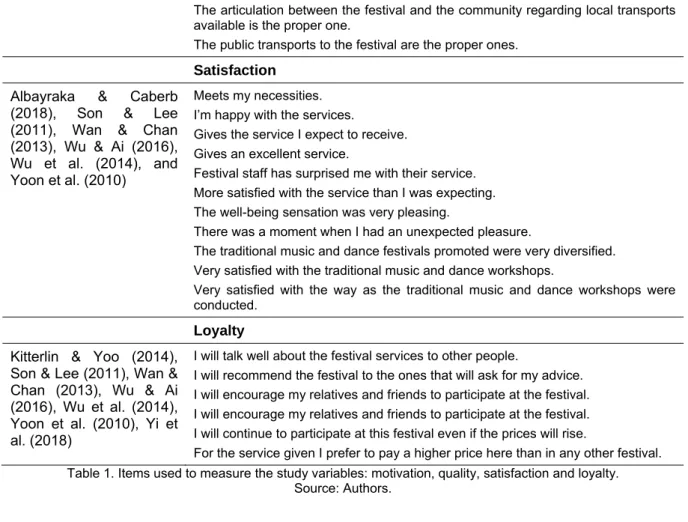
Table 1 shows the items used to evaluate the study variables: motivation, quality, satisfaction and loyalty.
Theoretical models Motivation
Albayraka & Caberb (2018), Kitterlin & Yoo (2014), Yi et al. (2018)
For the concept of the festival.
Know and experience a diversified number of workshops available. Experiencing different traditional dances on a national level. Knowing different traditional dances on an international level. Experiencing different traditional music on a national level. Experiencing different traditional music on an international level. For the interaction given with other people.
Knowledge obtained and experience at the community. Quality
Son & Lee (2011), Wan & Chan (2013), Wu & Ai (2016), Wu et al. (2014), and Yoon et al. (2010)
Quality: Tangibility, security, e empathy
The physical structures of the place are in well shape. The festival staff has a clean and neat appearance. The festival staff is ready to help the participants. The staff behaviour inspires confidence.
The festival attends the participants’ complaints and compensates its faults. The participants are treated in a cordial and tender way.
The service offered by the festival staff shows safety. The festival offers a calm and relaxing environment. Quality: Responsibility e reliability
Information about the localization of the festival are the proper ones. Accessibility and signalization are the proper ones.
Accommodations are the proper ones. Feeding places are the proper ones.
The timetables of the workshops are the proper ones and they are accomplished. The articulation between the festival and the community regarding feeding is the proper one.
Table 1. Items used to measure the study variables: motivation, quality, satisfaction and loyalty. Source: Authors.
3.3) DATA ANALYSIS
Pearson correlation coefficients were calculated to explore the correlations between the study variables.
To test the conceptual model, we performed a structural equation modelling (SEM), a statistical technique that analyse the structural relationships between the manifest and latent variables under study. The software used for SEM was AMOS (v.24, SPPS, IBM Company, Chicago, IL).
The model aims to test the mediating effect of satisfaction and quality on the relationship between motivation (exogenous variable) and loyalty (outcome variable). That is, satisfaction and quality are mediating variables, since they help to explain how or why an independent variable influences a result (indirect effect). The direct effect is the variable exogenous path to the outcome, when the mediators are controlled. The total effect is the sum of the direct and indirect effects of the
the proper one.
The articulation between the festival and the community regarding local transports available is the proper one.
The public transports to the festival are the proper ones. Satisfaction
Albayraka & Caberb (2018), Son & Lee (2011), Wan & Chan (2013), Wu & Ai (2016), Wu et al. (2014), and Yoon et al. (2010)
Meets my necessities. I’m happy with the services.
Gives the service I expect to receive. Gives an excellent service.
Festival staff has surprised me with their service. More satisfied with the service than I was expecting. The well-being sensation was very pleasing.
There was a moment when I had an unexpected pleasure.
The traditional music and dance festivals promoted were very diversified. Very satisfied with the traditional music and dance workshops.
Very satisfied with the way as the traditional music and dance workshops were conducted.
Loyalty Kitterlin & Yoo (2014),
Son & Lee (2011), Wan & Chan (2013), Wu & Ai (2016), Wu et al. (2014), Yoon et al. (2010), Yi et al. (2018)
I will talk well about the festival services to other people.
I will recommend the festival to the ones that will ask for my advice. I will encourage my relatives and friends to participate at the festival. I will encourage my relatives and friends to participate at the festival. I will continue to participate at this festival even if the prices will rise.
exogenous variable on the outcome. The significance of the direct, indirect and total effects was evaluated through the bootstrapping method, a non-parametric resembling technique that allows establishing confidence intervals.
The influence of each of the independent variables on the dependent variable is estimated by the regression coefficients (B - non-standardized, β - standardized). The significance of the regression coefficients was evaluated after the estimation of the parameters by the Maximum Likelihood method. To analyse the amount of variance in an endogenous variable explained by the model, we used the coefficient of determination (R2). The normality of the variables was evaluated by the uni-and multivariate asymmetry (sk) and kurtosis (ku) coefficients. Severe violations of normality were considered when |sk| <3 and |ku| <7-10 (Kline, 2005). No variables showed values of asymmetry and kurtosis indicators of severe violations to the normal distribution.
Fit indices used to evaluate the model fit were: χ2/df, Comparative Fit Index (CFI), The Root Mean Square Error of Approximation (RMSEA) (Bentler & Bonett, 1980; Kline, 2011; McDonald, 1989). The fit of the model is considered good if χ2/df is less
than 2-3. For the CFI and TLI indexes, values ≥ 0.9 are indicative of a good fit. For the RMSEA index, the lower the value, the better the fit. Arbuckle (2008) reports that RMSEA values higher than 0.10 are considered inappropriate, values between 0.08 and 0.10 are poor, values between 0.05 and 0.08 are good and values below 0.05 are very good.
4. RESULTS
4.1) SAMPLE PROFILE
The sample consisted of 532 participants, 297 of whom were collected at the
Andanças festival, and 235 at the La Sierra International Festival. The majority (61%)
of the participants were female, while 39% were male. Regarding age, 59.9% were 30 years old, 33.7% aged between 30 and 50 years old and 6.4% had more than 50 years old. With regard to educational qualifications, 35.4% of the participants
attended elementary/secondary/training courses, 44.2% had a bachelors/licentiate degree and 20.4% had a masters/doctorate degree.
Concerning the frequency of participants in the festivals, 70.1% referred that have participated in previous editions of the festival and that on average have participated 10 times. Regarding the number of traditional music and dance workshops, 24.7% of the participants did not participate in any, 33.4% participated between 1 to 5 workshops and 42% participated in more than 5 workshops.
4.2) THEORETICAL MODEL TESTING
4.2.1. CORRELATIONS
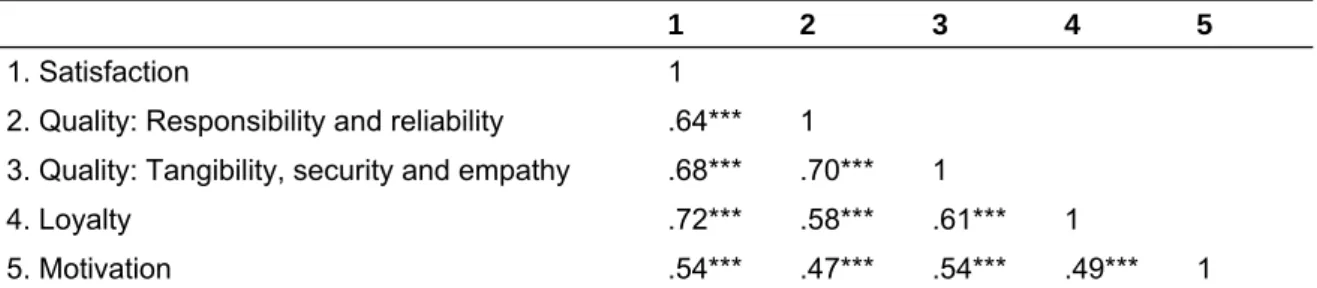
Pearson correlations were performed to analyse the degree of association between the study variables (Table 2). Positive, significant and moderate-to-high correlations among the five variables were found.
1 2 3 4 5
1. Satisfaction 1
2. Quality: Responsibility and reliability .64*** 1
3. Quality: Tangibility, security and empathy .68*** .70*** 1
4. Loyalty .72*** .58*** .61*** 1
5. Motivation .54*** .47*** .54*** .49*** 1
Table 2. Pearson correlations between the variables under study. Note. *** p <.001
Source: Authors.
4.2.2. MEDIATION MODEL
The hypothesized model tested the mediating effect of satisfaction and quality on the relationship between motivation and loyalty. This initial model presented a poor fit [χ2 (812) = 3832.862; χ2/df = 4.720; CFI = 0.813; RMSEA = 0.084 (90% CI =
0.081-0.086), p <.001]. Analysing the trajectories, we found that the Motivation-> Satisfaction trajectory (B = 0.034; SE = 0.065; β = 0.027; p = .959) was not statistically significant and was removed and the model recalculated.
In the adjusted model, all causal trajectories considered were statistically significant and presented an acceptable fit [χ2 (813) = 3832.864; χ2/gl = 4.7145; CFI =
0.813; RMSEA = 0.084 (90% CI = 0.081-0.086), p <.001]. The final model accounted for 67% of the variance in festival participants' loyalty (Fig. 2). The effect of the variable motivation on loyalty has an indirect effect of .48 (p = .010), 95% CI = 0.367 to 0.584, mediated by quality (motivation-> quality-> loyalty), with an effect of .28, and also by satisfaction (motivation-> quality-> satisfaction-> loyalty), with an effect of .20. Motivation has a direct effect on quality (β = 0.61, p = .010), 95% CI = 0.488 to 0.714, and an indirect effect on satisfaction mediated by quality (β = 0.52, p = .010), 95% CI = 0.411 to 0.625. Quality has a direct effect (β = 0.46, p = .010) and a satisfaction-mediated effect of .33 (p = .018), 95% CI = 0.145 to 0.532, with respect to loyalty, both effects being statistically significant.
Fig. 2. Mediation model between motivation and loyalty of the festival's participants.
In the model are represented the standardized estimates of the regression coefficients and the R2 of each
endogenous variable. Source: Authors.
5. DISCUSSION AND IMPLICATIONS
5.1) DISCUSSION AND THEORETICAL IMPLICATIONS
Local events, and in particular festivals, offer a range of experiences that allow cultural participation and communication with various individuals. It has been found in the literature (Barbieri & Mahoney, 2010; Carvalho, 2017; Stankova & Vassenska, 2015) that traveling to participate in arts festivals is one of the most important objectives for cultural tourists. Also, several studies pointed out that tourists' loyalty promotes the success of the festival (Lee, 2014; Wu et al., 2014; Yang et al., 2011) and, ultimately, contributes to the tourism development of the region, as well as the increase of the local and regional economy. The festivals studied in this research,
namely the Andanças Festival in Portugal, and the La Sierra International Festival in Spain, are examples of festivals that enable the development of local communities.
The present study aimed to explore the mediating role of satisfaction and quality in the relationship between the motivation to choose the festival of performing arts and the loyalty of the tourist. For this, eight hypotheses have been formulated to empirically test the relationships between these constructs.
In Hypothesis 1, we assume that if the individual is motivated to participate in a performing arts festival, he tends to perceive the festival as having more quality. Through the obtained results, it was verified that the hypothesis 1 was confirmed. It seems that the more Andanças and La Sierra participants chose these festivals for their concept -both with an opportunity to experience different traditional dances and music and to interact with other people-, the more perceive the festival as having a higher quality.
In Hypothesis 2, we conjectured that if the individual is motivated to participate in a performing arts festival, he tends to feel satisfied with the festival. We found that the participant's motivation in choosing a performing arts festival does not have a direct effect on satisfaction. However, we have observed an indirect effect between the choice´s motivation of the festival in the satisfaction, through the quality perceived by the tourist. That is, the motivation of the choice of the performing arts festival alone does not lead to greater satisfaction on the part of the tourist. The perception of the tourist about the quality of the festival has thus a mediating role in the relationship between motivation and satisfaction. Therefore, it is verified that if the tourist is motivated to participate in a festival of performing arts, he will only be satisfied with the festival if he perceives that the festival has quality. Thus, the motivation of choosing a performing arts festival will lead to a greater perception of quality by the tourist and consequently will lead to greater satisfaction.
Thus, Hypothesis 3, which infers that a greater perception of the tourist about the festival quality would lead to greater satisfaction, was confirmed. In addition, literature has been consensual showing the relationship between quality and satisfaction, that is, quality perceived by the individual as a antecedent of satisfaction (Baker & Crompton, 2000; Boulding et al., 1993; Chen & Chen, 2010; Chen & Tsai, 2007;
Heung & Cheng, 2000; Kozak & Rimmington, 2000; Lee et al. 2004; Parasuraman et al., 1988, 1991; Taylor & Baker, 1994; Zeithaml et al., 1996).
Taking into account that quality can be assessed as a general judgment by the consumer regarding service excellence, and satisfaction as an affective state that is an emotional reaction to a product or service (Grönroos, 2009; Mason & Paggiaro, 2012), it makes sense that quality is then a precursor of satisfaction.
In Hypotheses 4 and 5, it was hypothesized that the quality of the festival and the satisfaction of the festival, respectively, lead to the tourist's loyalty. Both hypotheses were confirmed in our study. Several authors have been showing the positive effect of service quality on tourist loyalty (Anderson & Sullivan, 1993; Fornell et al., 1996; Bloemer et al., 1999; Chen & Chen, 2010; Fornell, 1992; Murray & Howat, 2002; Oliver, 1999; Zeithaml et al., 1996). Thus, a good performance of the services will lead to a high-quality perception by the tourist, which will consequently positively influence the tourist's behaviour and future intentions (Parasuraman et al., 1985; Parasuraman et al., 1988). These data show that participants in the studied festivals are faithful, an essential factor for their success (Lee, 2014, Wu et al., 2014; Yang et al., 2011). In addition, it has been found that quality, not only directly influences loyalty, it also has an indirect effect through satisfaction. Several early studies have also shown the direct effect of quality on loyalty (Boulding et al., 1993, Parasuraman et al., 1991; Taylor & Baker, 1994; Zeithaml et al., 1996), as also the indirect effect of quality in loyalty in which satisfaction has a mediating role (Gotlieb et al., 1994; Patterson & Spreng, 1997; Roest & Pieters, 1997; Taylor & Baker, 1994). In addition, Chiou & Droge (2006) conceptualize service quality as a more cognitive component that normally precedes emotional responses and eventually leads to behavioural intention, that is, to recommend and return to the destination.
The results obtained are also consistent with other investigations that have shown that satisfaction influences the intention to revisit (Petrick & Backman, 2002) and the intention to recommend (Chen & Chen, 2010), aspects that are significantly relevant to the success of the festivals being studied.
Finally, Hypotheses 6, 7 and 8 proposed that quality, satisfaction, and quality and satisfaction, respectively, mediated the relationship between the choice motivation of
performing arts festivals and tourists' loyalty. The analysis of the indirect effects of the choice motivation in loyalty showed that the choice motivation leads to a greater perception of the quality of the festival, which in turn leads to greater satisfaction with the festival that makes people come back and recommend the festival (confirmation of Hypothesis 8). However, this relationship does not necessarily have to go through satisfaction. That is, the choice motivation makes the participants perceive the festival as having more quality, which in itself, leads to greater loyalty on the part of the tourist (confirmation of Hypothesis 6). However, when we test the mediating effect only of satisfaction on the relation between tourist's motivation and loyalty, we find that satisfaction, without considering the perception of the festival quality, does not mediate this relation (non-confirmation of Hypothesis 7). This seems to indicate that the perceived quality of the festival has an important mediating role in the tourist’s loyalty in this type of festival.
Through the analysis of the various hypotheses formulated, we found that motivation of tourists leads to higher perception of the festival as having quality, which in turn leads to higher levels of satisfaction and to be loyal to the festival (to revisit and recommend).
This study can be important in the festival tourism context, specifically for managers of performing arts festivals. It’s important that these managers identify and understand the tourists’ motivations, to improve the quality of the festival. Also, it’s important to realize that these participants are only satisfied with the festival if they first perceive the festival as having quality. So, managers should reinforce the services offered to participants, the environment of the festival should be calm and relaxing, the staff should be helpful, confident, and kind, and festival and local community should be in good articulation. The more these features are present, the more participants tend to feel satisfied with the festival, meaning that tourists recognize that the services of the festival met their expectations and necessities, that the traditional dances and music were good and that the festival induced pleasant feelings. This, in turn, lead to tourist loyalty, that is, intention to revisit and to recommend the festival to others.
5.2) LIMITATIONS AND FUTURE RESEARCH
The present study presents some limitations, highlighting the fact that the study was carried out only in two performing arts festivals, so the results cannot be extrapolated to festivals in other regions. Another limitation to be pointed out is related to the non-random sampling, which means that our sample was defined taking into account the availability of each participant and it may not be representative of the population of each festival.
Concerning future studies, it will be interesting to see if participants who choose events of performing arts instead of other type of event present differences in the motivation of the choice of event, quality, satisfaction, and loyalty. And, the inclusion of one more variable to the theoretical model that this work introduces, as for example the image or the expectations of potential tourists, that allied to the quality and satisfaction can also help to perceive how loyalty is influenced, either at the level of the intention to revisit and/or recommend the event and/or destination.
References
Aaker, D.A. Managing brand equity. New York: The Free Press, 1991.
Albayraka, T.; Caberb, M. Examining the relationship between tourist motivation and satisfaction by two competing methods. Tourism Management, Vol. 69, 2018, pp. 201-213.
Almeida, A. El deleite del consumidor como antecedente de la fidelidad: análisis de la
calidad de servicio de spas en hoteles de cinco estrellas en Portugal [The consumer
delight as antecedent of loyalty: analysis of the service quality of spas in five-star hotels in Portugal]. Unpublished doctoral dissertation. University of Extremadura, Spain, 2010.
Almeida, P. La imagen de un destino yurístico como antecedente de la decisión de
visita: Análisis comparativo entre los destinos [The tourist destination image as
antecedent of the visit decision: Comparative analysis between destinations]. Unpublished doctoral dissertation. University of Extremadura, Spain, 2010.
Almeida, P.; Araújo S. Introdução à Gestão de Animação Turística [Introduction to Touristic Recreation Management] (2th Edition). Lisboa: Editora LIDEL, Edições Técnicas, Lda., 2017.
Anderson, E.W.; Sullivan, M.W. The antecedents and consequences of customer satisfaction for firms. Marketing Science, Vol. 12, 1993, pp. 125-143.
Arbuckle, J.L. AMOS 17.0 User’s Guide. Chicago, IL: SPSS, 2008.
Baker, D.A.; Crompton, J.L. Quality, satisfaction and behavioral intentions. Annals of
Tourism Research, Vol. 27, No 3, 2000, pp. 785-804.
Barbieri, C.; Mahoney, E. Cultural tourism behaviour and preferences among the live-performing arts audience: An application of the univorous–omnivorous framework.
International Journal of Tourism Research, Vol. 12, 2010, pp. 481-496.
Bentler, P.M.; Bonett, D.G. Significance tests and goodness of fit in the analysis of covariance structures. Psychological Bulletin, Vol. 88, No 3, 1980, pp. 588-606.
Bigné, J.; Sánchez, M.; Sánchez, J. Tourism image, evaluation variables and after purchase behaviour: Interrelationship. Tourism Management, Vol. 22, No 6, 2001, pp. 607-616.
Bloemer, J.; de Ruyter, K.; Wetzels, M. Linking perceived service quality and service loyalty: A multi-dimensional perspective. European Journal of Marketing, Vol. 33, 1999, pp. 1082-1106.
Boshoff, C.; Gray, B. The relationships between service quality, customer satisfaction and buying intentions in the private hospital industry. South African Journal of
Business Management, Vol. 35, No 4, 2004, pp. 27-37.
Boulding, W.; Kalra, A.; Staelin, R.; Zeithaml, V. A dynamic process model of service quality: From expectations to behavioral intentions. Journal of Marketing Research, Vol. 30, No 1, 1993, pp. 7-27.
Cai, L.A.; Wu, B.; Bai, B. Destination image and loyalty. Cognizant Communication
Corporation, Vol. 7, 2003, pp. 153-162.
Calantone, R.J.; Mazanec, J.A. Marketing management and tourism. Annals of
Tourism Research, Vol. 18, No 1, 1991, pp. 101‐119.
Carvalho, G. Turismo Cultural. In: F. Silva, & J. Umbelino, (Coord.), Planeamento e
Desenvolvimento Turístico, Lisboa: Lidel – Edições Técnicas, 2017, pp.349-363.
Chang, S.; Gibson, H.; Sission, L. The loyalty process of residents and tourists in the festival context. Current Issues in Tourism, Vol. 17, No 9, 2013, pp. 783-799.
Chen, C.F.; Tsai, D. How destination image and evaluative factors affect behavioral intentions? Tourism Management, Vol. 28, 2007, pp. 1115-1122.
Chen, C.F.; Chen, F.S. Experience quality, perceived value, satisfaction and behavioral intentions for heritage tourists. Tourism Management, Vol. 31, 2010, pp. 29-35.
Chen, J.; Gursoy, D. An investigation of tourists’ destination loyalty and preferences.
International Journal of Contemporary Hospitality Management, Vol. 13, 2001, pp.
Chi, C.G.Q.; Qu, H. Examining the structural relationships of destination image, tourist satisfaction and destination loyalty: An integrated approach. Tourism
Management, Vol. 29, 2008, pp. 624-636.
Chiou, J.S.; Droge, C. Service quality, trust, specific asset investment and expertise: Direct versus indirect effects in a satisfaction and loyalty framework. Journal of the
Academy of Marketing Science, Vol. 34, No 4, 2006, pp. 1-15.
Cole, S.T.; Illum, S.F. Examining the mediating role of festival visitors’ satisfaction in the relationship between service quality and behavioral intentions. Journal of Vacation
Marketing, Vol. 12, No 2, 2006, pp. 160-173.
Cole, S.T.; Scott, D. Examining the Mediating Role of Experience Quality in a Model of Tourist Experiences. Journal of Travel & Tourism Marketing, Vol. 16, No 1, 2004, pp. 79-90.
Cooper, C.; Fletcher, J.; Fyall, A.; Gilbert, D.; Wanhill, S. Tourism: Principles and
Practice, Pearson Education (4th Edition), Harlow: Pearson Education Limited, 2008.
Crompton, J.L. An Assessment of the Image of Mexico as a Vacation Destination and the Influence of Geographical Location upon the Image. Journal of Travel Research, Vol. 18, No 4, 1979, pp.18-23.
Crompton, J.L.; Love, L.L. The predictive validity of alternative approaches to evaluating quality of a festival. Journal of Travel Research, Vol. 34, No 1, 1995, pp. 11-24.
Cronin, J.J.; Taylor, S.A. Measuring service quality: A reexamination and extension.
Dabholkar, P.A.; Shepherd, C.D.; Thorpe, D.I. A comprehensive frame- work for service quality: an investigation of critical conceptual and measurement issues through a longitudinal study. Journal of Retailing, Vol. 76, No 2, 2000, pp. 139-173. Deci, E.L. The relation of interest to the motivation of behaviour: A self-determination theory perspective. In: K.A. Renninger; S. Hidi; A. Krapp (Eds.). The role of interest in
learning and development. Hillsdale, NJ, US: Lawrence Erlbaum Associates, Inc.
1992, pp. 43-70.
Festivals of Spain. Available at: https://www.spainculture.pt/festivais-em-espanha/
[accessed 2 August 2018].
Fornell, C. A national customer satisfaction barometer: The Swedish experience. The
Journal of Marketing, Vol. 56, 1992, pp. 6-21.
Fornell, C.; Johnson, M.D.; Anderson, E.W.; Cha, J.; Bryant, B.E. The American customer satisfaction index: Nature, purpose, and findings. Journal of Marketing, 1996, Vol. 60, pp. 7-18.
Getz, D. Event studies: Theory, research and policy for planned events. Oxford, UK: Elsevier, 2007.
Gotlieb, J.B.; Grewal, D.; Brown, S.W. Consumer satisfaction and perceived quality: Complementary or divergent constructs? Journal of Applied Psychology, Vol. 79, No 6, 1994, pp. 875-885.
Grappi, S.; Montanari, F. The role of social identification and hedonism in affecting tourist re-patronizing behaviours: The case of an Italian festival. Tourism
Grönroos, C. Marketing: gerenciamento e serviços [Marketing: Management and services]. (3ª ed). Rio de Janeiro: Elsevier, 2009.
Guerreiro, M.; Mendes, J.; Henriques, C. Turismo cultural em análise: Contributos metodológicos para a inventariação de recursos turísticos de base cultural [Cultural tourism in Analysis: methodological contributions to the inventoriing of cultural-based tourist resources]. In: M. Santos; P. Águas; F. Serra; J. Santos (Eds.). Perspetivas
Contemporâneas em Turismo, TMS Conference Series, Universidade do Algarve,
2014, pp. 427-442.
Gutiérrez, H.; Bosque I. Los factores estimulo y personales como determinantes de la formación de la imagen de marca de los destinos turísticos: un estudio aplicado a los turistas que visitan un destino vocacional [The stimulus and personal factors as determinants of the formation of the brand image of tourist destinations: a study applied to tourists visiting a vocational destination]. Cuadernos de Economía y
Dirección de la Empresa, Vol. 43, 2005, pp. 37-63.
Henriques, C. Turismo cidade e cultura. Planeamento e gestão sustentável [City Tourism and culture. Sustainable and planning management]. Lisboa: Edições Sílabo, Lda, 2003.
Heung, V.C.S.; Cheng, E. Assessing tourists’ satisfaction with shopping in the Hong Kong special administration region of China. Journal of Travel Research, Vol. 38, No 4, 2000, pp. 396-404.
Huang, J.Z.; Li, M.; Cai, L.A. A model of community-based festival image.
International Journal of Hospitality Management, Vol. 29, No 2, 2010, pp. 254-260.
Jiménez, E.U.; Martín, R.H. (Coord.) Analisis y tendencias del turismo [Analysis and trends of tourism]. Madrid: Pirámide, 2004.
Keller, K.L. Strategic Brand Management. New Jersey: Prentice-Hall, 1998.
Kim, Y.H.; Kim, M.; Goh, B.K. An examination of food tourist's behavior: using the modified theory of reasoned action. Tourism Management, Vol. 32, 2011, pp. 1159-1165.
Kitterlin, M; Yoo, M. Festival motivation and loyalty factors As motivações dos festivais e os fatores de lealdade. Tourism & Management Studies, Vol. 10, No 1, 2014, pp. 119-126.
Kline, R.B. Principles and practice of structural equation modeling. New York: Guilford Press, 2011.
Kotler, P. Marketing management. International Edition (10th ed). New Jersey: Prentice-Hall, 2000.
Kotler, P.; Haider, D. H.; Rein I. Marketing places: Attracting investment, industry, and
tourism to cities, states, and nations. The Free Press, 1993.
Kozak, M.; Rimmington, M. Tourist satisfaction with Mallorca (Spain) as an offseason holiday destination. Journal of Travel Research, Vol. 38, No 3, 2000, pp. 260-269. Kruger, S.; Petzer, D. Measuring tourists’ satisfaction with quality of life issues at an arts festival. Acta Commercii 2008. Vol. 8, No 1, 2008, pp. 113-127.
Laing, J. Festival and event tourism research: Current and future perspectives.
Lee, J. Visitors' emotional responses to the festival environment. Journal of Travel &
Tourism Marketing, Vol. 31, No 1, 2014, pp. 114-131.
Lee, J.; Graefe, A.; Burns, R. Service quality, satisfaction, and behavioral intention among forest visitors. Journal of Travel & Tourism Marketing, Vol. 17, No 1, 2004, pp. 73-82.
Lee, J.S.; Back, K.J. Attendee-based brand equity. Tourism Management, Vol. 29, 2008, pp. 331-344.
Lee, J.S.; Lee, C.K.; Choi, Y. Examining the role of emotional and functional values in festival evaluation. Journal of Travel Research, Vol. 50, No 6, 2011, pp. 685-696. Lee, J.S.; Lee, C.K.; Yoon, Y. Investigating differences in antecedents to value between first-time and repeat festival-goers. Journal of Travel & Tourism Marketing, Vol. 26, No 7, 2009, pp. 688-702.
Lee, T.S.; Hsu, F.Y. Examining how attending motivation and satisfaction affects the loyalty for attendees at Aboriginal festivals. International Journal of Tourism
Research, Vol. 15, No 1, 2013, pp. 18-34.
Lee, Y.K.; Lee, C.K.; Lee, S.K.; Babin, B.J. Festivalscapes and patrons' emotions, satisfaction, and loyalty. Journal of Business Research, Vol. 61, 2008, pp. 56-64. Lopes, J.; Leitão M. Animação, Património e Território: a Animação Artística ao
Serviço da Comunidade [Animation, Heritage and territory: the artistic animation at
the service of the community]. Unpublished master dissertation. Higher Institute of Education of Castelo Branco, Portugal, 2013.
Maslow, A.H. Motivation and Personality (2th Edition). New York: Harper & Row, 1970.
Mason, M.C.; Paggiaro, A. Investigating the role of festivalscape in culinary tourism: The case of food and wine events. Tourism Management, Vol. 33, No 6, 2016, pp. 1329-1336.
Mathieson, A.; Wall, G. Tourism: Economic, physical and social impacts. New York: Logman & Scientific Technical, 1996.
McDonald, R.P. An index of goodness-of-fit based on noncentrality. Journal of
Classification, Vol. 6, 1989, pp. 97-103.
McDowall, S. The festival in my hometown: The relationships among performance quality, satisfaction, and behavioral intentions. International Journal of Hospitality &
Tourism Administration, Vol. 12, No 4, 2011, pp. 269-288.
Moscardó, G. Making visitors mindful: Principles for creating quality sustainable visitor
experiences through effective communication. Champaign, IL: Sagamore Publishing,
1999.
Moscardó, G. Mindful visitors: heritage and tourism. Annals of Tourism Research, Vol. 23, No 2, 1996, pp. 376-397.
Murray, D.; Howat, G. The relationships among service quality, value, satisfaction, and future intentions of customers at an Australian sports and leisure centre. Sport
Management Review, Vol. 5, 2002, pp. 25-43.
Niininen, O.; Szivas, E.; Riley, M. Destination loyalty and repeat behavior: An application of optimum stimulation measurement. International Journal of Tourism
OECD (2009). The impact of culture on tourism. Available at:
http://www.mlit.go.jp/kankocho/naratourismstatisticsweek/statistical/pdf/2009_The_Im pact.pdf [accessed 27 March 2016].
Oliver, R.L. Whence consumer loyalty? Journal of Marketing, Vol. 63, No 4, 1999, pp. 33-44.
Parasuraman, A.; Berry, L.L.; Zeithaml, V.A. Refinement and reassessment of the SERVQUAL scale. Journal of Retailing, Vol. 67, 1991, pp. 420-450.
Parasuraman, A.; Zeithaml, V.A.; Berry, L.L. A conceptual model of service quality and its implications for future research. Journal of Marketing, Vol. 49, No 4, 1985, pp. 41-50.
Parasuraman, A.; Zeithaml, V.A.; Berry, L.L. Servqual: A multiple-item scale for measuring consumer perceptions of service quality. Journal of Marketing, Vol. 64, No 1, 1988, pp.12-40.
Patterson, P.G.; Spreng, R.A. Modelling the relationship between perceived value, satisfaction and repurchase intentions in a business-to-business, services context: An empirical examination. The International Journal of Service Industry Management, Vol. 8, No 5, 1997, pp. 414-434.
Petrick, J.F. Are loyal visitors desired visitors? Tourism Management, Vol. 25, No 4, 2004, pp. 463-470.
Petrick, J.F.; Backman, S.J. An examination of the construct of perceived value for the prediction of golf travelers' intentions to revisit. Journal of Travel Research, Vol. 41, No 1, 2002, pp. 38-45.
Petrick, J.F.; Sirakaya, E. Segmenting cruisers by loyalty. Annals of Tourism
Research, Vol. 31, No 2, 2004, pp. 472-475.
Puertas, X. Animación en el âmbito turístico [Animation in the tourist area]. Ciclos formativos. FP Grado Superior Hostelaría y Turismo. Madrid: Editorial Sintesis, 2004. Quinn, B. Festivals, events, and tourism. In T. Jamal; M. Robinson (Eds). The SAGE
Handbook of Tourism Studies. London: Sage, 2009, pp. 483-503.
Quintero, A. Desarrollo de un modelo estructural para la medición de la satisfacción
en el turismo cultural [Development of a structural model for the measurement of the
satisfaction in the cultural tourism]. (Unpublished doctoral dissertation). University of Sevilla, Spain, 2015.
Reisinger, Y.; Turner, L.W. Cross-cultural behaviour in tourism: Concepts and
analysis. Oxford: Butterworth-Heinemann, 2003.
Richards, G. Cultural tourism in Europe. Wallingford: CAB International, 1997.
Roest, H.; Pieters, R. The nomological net of perceived service quality. The
International Journal of Service Industry Management, Vol. 8, No 4, 1997, pp.
336-351.
Rust, R.; Zahorik, A. Customer satisfaction, customer retention and marketing share.
Journal of Retailing, Vol. 69, No 2, 1993, pp. 145-156.
Son, S.M.; Lee, K.M. Assessing the influences of festival quality and satisfaction on visitor behavioral intentions. Event Management, Vol. 15, No 3, 2011, pp. 293-303. Song, H.J; Lee, C.K; Kim, M.; Bendle, L.J.; Shin, C.Y. Investigating Relationships Among Festival Quality, Satisfaction, Trust, and Support: The Case of an Oriental
Medicine Festival. Journal of Travel & Tourism Marketing, Vol. 31, 2014, pp. 211– 228.
Stankova, M.; Vassenska I. Raising cultural awareness of local traditions through festival tourism. Tourism & Management Studies, Vol. 11, No 1, 2015, pp. 120-127. Taylor, S.A.; Baker, T.L. An assessment of the relationship between service quality and customer satisfaction in the formation of consumers’ purchase intentions. Journal
of Retailing, Vol. 70, No 2, 1994, pp. 163-178.
Timothy, D. Cultural heritage and tourism – An introduction: Aspects of tourism texts. Bristol: Channel View Publications, 2011.
UNESCO (2006). Towards sustainable strategies for creative tourism: Discussion
report of the planning meeting for 2008 International Conference on Creative Tourism. Available at:
http://portal.unesco.org/culture/en/files/34633/11848588553oct2006_meeting_report. pdf/oct2006_meeting_report.pdf [accessed 27 February 2016].
Wan, Y.K.P.; Chan, S.H.J. Factors that affect the levels of tourists’ satisfaction and loyalty towards food festivals: A case study of Macau. International Journal of
Tourism Research, Vol. 15, No 3, 2013, pp. 226–240.
Wong, J.; Wu, H.C.; Cheng, C.C. An empirical analysis of synthesizing the effects of festival quality, emotion, festival image and festival satisfaction on festival loyalty: A case study of Macau food festival. International Journal of Tourism Research, Vol. 17, No 6, 2014, pp. 521-536.
Woodside, A.; Dubelaar, C. A general theory of tourism consumption systems: A conceptual framework and an empirical exploration. Journal of Travel Research, Vol. 41, No 2, 2002, pp. 120-132.