Vˆania Moutinho
1, Pavel Brazdil
1 aand Jo˜ao Cordeiro
1,2 b1LIAAD, INESC TEC – Institute for Systems and Computer Engineering, Technology and Science,
Rua Dr. Roberto Frias, 4200, Porto, Portugal
2HULTIG – Centre of Human Language Technology and Bioinformatics, Universidade da Beira Interior,
Rua Marquˆes d’ ´Avila e Bolama, 6200, Covilh˜a, Portugal
Keywords: Text Mining, Temporal Analysis, Clustering of News, Evolution of Occurrence, Time-wise Differences. Abstract: With the advent of social media, the boundaries of mainstream journalism and social networks are becoming
blurred. User-generated content is increasing, and hence, journalists dedicate considerable time searching platforms such as Facebook and Twitter to announce, spread, and monitor news and crowd check informa-tion. Many studies have looked at social networks as news sources, but the relationship and interconnections between this type of platform and news media have not been thoroughly investigated. In this work, we have studied a series of news articles and examined a set of related comments on a social network during a period of six months. Specifically, a sample of articles from generalist Portuguese news sources published on the first semester of 2016 was clustered, and the resulting clusters were then associated with tweets of Portuguese users with the recourse to a similarity measure. Focusing on a subset of clusters, we have performed a tem-poral analysis by examining the evolution of the two types of documents (articles and tweets) and the timing of when they appeared. It appears that for some stories, namely Brexit and the European Football Cup, the publishing of news articles intensifies on key dates (event-oriented), while the discussion on social media is more balanced throughout the months leading up to those events.
1
INTRODUCTION
The advent of social media is gradually changing the way information is disseminated and, moreover, pos-sibly shifting the roles of news makers and news re-cipients. According to (Kaplan and Haenlein, 2010), social media is the set of applications based on the Internet where user generated content (UGC) is cre-ated, modified and exchanged in a collaborative and participatory way.
Journalism and social media have become more intricately interconnected. Traditionally, people re-sort to mainstream media to know what is happen-ing in the world. However, this dynamic has been changing in recent years, at least for some news top-ics. This is due to the fact that a great proportion of the world population has access to platforms which broadcast real time events. According to data from statista1(2019), 57.54% are active internet users, and 45.38% are active social media users. Consequently,
a https://orcid.org/0000-0002-4720-0486 b https://orcid.org/0000-0003-0466-1618 1http://www.statista.com
the beginning of the process of news generation and dissemination has in some cases changed the way journalism is done. It has been recognized in vari-ous studies (Newman, 2009; DVJ Insights and ING The Netherlands, 2015) that journalists spend a con-siderable amount of their time scouting social media for interesting topics to write about, relying on these platforms as more or less reliable sources.
It is therefore relevant to study how events or news come about on these two types of platforms — news articles and social posts. Of particular interest is the issue of how and when they arise, disseminate, gain strength and die. The main objective of our work is to focus on the timing of their generation and the inten-sity with which they occur in both media and exploit text mining techniques for this aim.
In this preliminary study, we are especially inter-ested in comparing press publication moments with the community discussion moments, in social media, for different kinds of topics: longstanding, entity-oriented, and event-oriented. What are the new tem-poral trends? Are events first discussed in social me-dia, becoming later main-stream meme-dia, or still in the other way around? Understanding these temporal
dy-500
Moutinho, V., Brazdil, P. and Cordeiro, J.
Association and Temporality between News and Tweets. DOI: 10.5220/0008362105000507
as a substitute of (rather than complementary platform to) traditional news sources (e.g. (Sankaranarayanan et al., 2009; Zhao et al., 2011; Phuvipadawat and Mu-rata, 2010)). The main reason for this is perhaps the realization that some news break first on Twitter. For example, (Hu et al., 2012) have shown that the cap-ture and death of Osama Bin Laden was made public on Twitter at least 20 minutes sooner than on major U.S. television channels. The authors argue that this may happen due to the role of a particular set of influ-ential users, namely journalists and politicians, whose credibility instantly leads to an immediate reaction on social networks.
Sankaranarayanan et al. (Sankaranarayanan et al., 2009) built a tool called TwitterStand with the goal of collecting and diffusing breaking news quicker than conventional news media. This system performs on-line clustering on filtered tweets from a set of manu-ally selected seeders — users that usumanu-ally post news. In addition, it performs periodic checks to avoid frag-mentation and ensure minimal duplication of clusters. Also, it takes advantage of information in the content of the tweet and/or the user’s profile to associate top-ics to geographic locations. The authors believe that if tweets belonging to a certain cluster mostly come from one location or a set of close locations, then the topic of that cluster is likely to pertain to that geo-graphical area.
Zhao et al. (Zhao et al., 2011) used a corpus of news articles from the journal New York Times (NYT) and tweets from users in Edinburgh, gath-ered from November 11, 2009 to February 1, 2010, to investigate how similar the topics in Twitter and a traditional news source are. Their results showed some differences regarding the most frequent cate-gories and types of topics: Twitter users tweet mainly about family and life, a category not covered by the NYT; arts is a topic similarly frequent on both Twit-ter and the NYT; world is much more frequent on the NYT; lastly, while longstanding topics have an equally strong presence, the same does not happen for entity-oriented and event-oriented topics, with
Twit-tionships makes Twitter a fast information diffusion network. In fact, this propagation may in some cases not depend entirely on the first user’s network: (Kwak et al., 2010) have found that if a message is retweeted, it quickly reaches an average of 1,000 users, regard-less of the number of followers of the first user. This is what the authors call “the emergence of collective in-telligence”, in the sense that individuals decide what information is good enough to spread and once that decision is made, it almost instantly reaches a mas-sive audience.
None of the above works studied the issue of tem-porality between news items and Twitter posts. This motivated us to pursue this issue and report our find-ings in this article.
3
METHODOLOGY
The methodology used here is illustrated in Fig. 1. It involves four main stages, from data gathering to association and temporality analysis.
First, tweets and news are collected from news sources and social media. Then, the news items are clustered into groups of similar news. Afterwards, tweets about the same news are associated with the corresponding news clusters. Finally, the association between news and tweets are examined, both regard-ing the subject and temporality. The most relevant parts of this process are detailed in the following sub-sections.
3.1
Description of the Collected Data
The same story or event can be published in many different articles and shared or commented in many tweets. Therefore, a set of Portuguese news arti-cles and tweets, from the first semester of 2016, was selected from the POPmine plat-form, developed in SAPO Labs, a large database of news articles and so-cial media content, automatically crawled from the
Figure 1: The four main stages of our methodology.
Web (Saleiro et al., 2015).
To fulfill our research objectives, we targeted our data collection on a sample of news stories containing some degree of discussion on Twitter. This sample comprises news stories directly referenced in Twitter, through specific URL pointing to that story, as well as those without any direct link. We are assuming that if a tweet contains a link to a news article, then that tweet is about the same story, naturally meaning that in terms of temporal order the story came out first on mainstream news media. But in this study, we also aim to measure the likelihood of the inverted tempo-ral order, a new phenomenon with the emergence of social media. That is, estimating the number of events and stories that break out first on social media, be-coming mainstream media later.
Thus, the final sample of data contains 6,074 news articles and 11,328 tweets, from the same period (the first semester of 2016), eventually associated with those news articles. These were selected from an orig-inal set of near 600 thousand elements, observing the following three criteria:
• We have observed a prevalence of sports topics in the news articles from the considered period. In order to obtain a wider range of topics we have decided to focus only on generalist news sources. • Despite using document vectorization with TF-IDF and cosine similarity, we noticed that longer articles are more likely to be grouped together, as they contain more features, promoting thus doc-ument similarity. After several clustering trials, we have decided to only admit documents hav-ing a length in the range of 100 to 3,349 charac-ters. The upper bound of 3,349 enables the exclu-sion of upper outlier documents in terms of doc-ument length. The lower bound of 100 charac-ters is used to exclude rather short and
uninfor-mative articles, such as the following examples: “Dados s˜ao relativos `a zona euro e `a Uni˜ao Eu-ropeia em geral.”;“Veja na ´ıntegra o debate en-tre os trˆes candidatos presidenciais, transmitido na SIC Not´ıcias.”. It also prevents some articles that may not have been fully or correctly collected from entering the sample.
• The final criterion for selecting the articles was to include both articles that were shared on Twit-ter and also articles that were not shared. Hence, 50% of the final sample is comprised of online news articles whose URL was shared in at least one tweet and 50% of online news articles whose URL was not found in any of the tweets. There were 3,037 online news articles with a link to at least one tweet. The other 50% was randomly as-sembled, resulting in a final sample of 6,074 arti-cles.
Most of the original 19.4 million Portuguese tweets from the first semester of 2016 were discarded, as they report more on personal, family and life sub-jects, and so irrelevant for our study, as they are not associated with any new stories. The selection of tweets potentially relevant for our study was done as follows. First, 5,664 tweets were selected based on the presence of an URL to one of the previously se-lected news articles. Secondly, an equal number of tweets without any URL were also selected, follow-ing a process that was both random and con-trolled. First, 250 thousand tweets with more than 20 charac-ters were randomly chosen. Then, only those contain-ing at least one keyword from the clusters (see Section 3.2) of previously selected news, were kept (approxi-mately 50%). Final-ly, a random subsample of these was selected. The decision of this selection process was therefore a compromise between the processing resources available and the identification of
promis-Portuguese language.
3.2
News Clustering and Labeling
To obtain groups of similar stories clustering tech-niques were applied to the selected sample of online news articles. We have identified similar news arti-cles and tweets and characterized each group with a number of keywords.
In terms of clustering, the hybrid buckshot method (Cutting et al., 1992) was used, which combines hi-erarchical clustering with k-means. The initial cen-ters for the k-means clustering are chosen by first run-ning the hierarchical clustering on a sample of√k· N news articles, where N represents the number of ar-ticles, and k the number of centroids. The ideal k value was chosen based on the representation of the aggregation indices of the hierarchical clustering and the representation of the explained inertia, which can be expressed as a ratio B/T. The term B represents between-class dispersion, and is measured as the sum of squared distances of the cluster centers (centroids) to the center of gravity g. The term T represents the total dispersion of the data, and is measured as the sum of squared distances of every observation to the center of gravity g: B=1 n k
∑
h=1 nhd(gh, g)2 T= 1 n n∑
i=1 d(Ii, g)2 (1)The explained inertia (B/T) naturally increases with the number of clusters. The goal is to find the value of k for which this value starts to marginally decrease (the elbow method) (Bholowalia and Kumar, 2014). In our case this was around k=50. The clusters iden-tified exhibit non-uniform distribution of documents, some with large numbers and others with only a few.
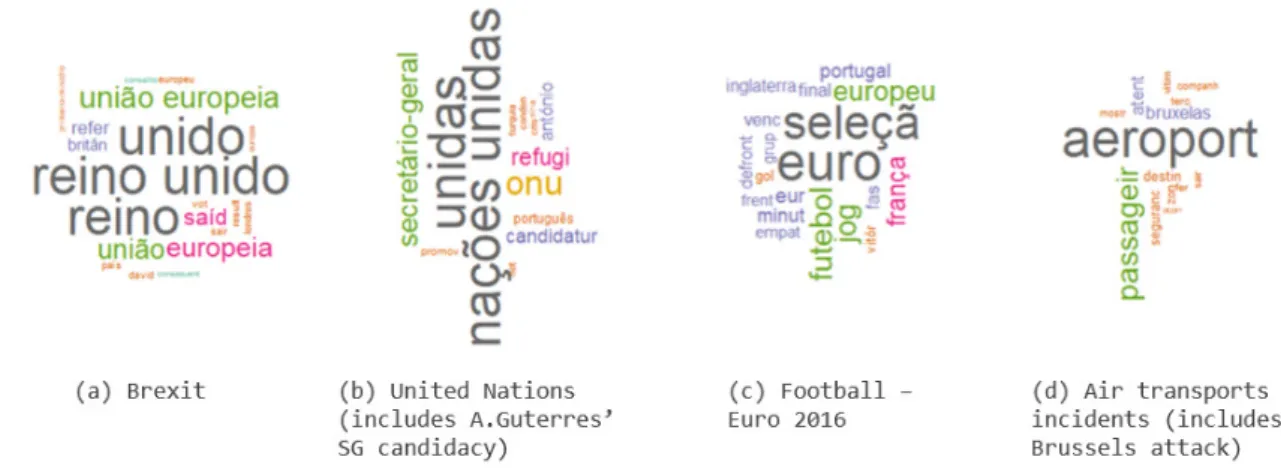
The groups of news articles were labeled using the most significant terms as keywords. The num-ber of keywords varies according to the cluster size, so that larger clusters were represented by a larger
(United Nations) and Secret´ario-Geral (Secretary-General) are often very indicative of the cluster’s main subject.
In this work we have selected a subset of four clus-ters for further analysis, based on their size, the topic addressed and the number of associated tweets. They were the Brexit, European Football Cup and Air trans-ports incidentspresented above, and also a cluster on Politics.
3.3
Assigning Tweets to Clusters
In order to analyse when a certain text or group of similar texts appear in social networks in comparison to its press release, there is a need to assign social me-dia posts to a particular group of similar texts. In this case, we used a collection of tweets posted during the same period as the online news articles and assigned them to the appropriate clusters of articles.
Tweets were assigned to the clusters of news arti-cles using the cosine similarity measure between each tweet and the cluster centroids, computed using fea-ture vectors with normalized TF-IDF values. For each tweet, the five closest cluster centroids were identi-fied, and the cluster that was most similar to the tweet in question was chosen. The sample of tweets is larger than the sample of articles, and the mean ratio is 1.8 tweets per article. For the clusters under observa-tion, the ratio is larger than the mean ratio (from 2.1 for cluster Brexit, to 3.9 for cluster Air Transport in-cidents), with the exception of cluster Politics (0.8). This is some evidence that the chosen clusters have a place in the social network discussion.
3.3.1 Assignment
As all the data used in this study are unlabeled, re-sults cannot be directly evaluated. We addressed this issue by including tweets with links to clustered news articles. It can be assumed that if a tweet shares a spe-cific news article, it should belong to the same clus-ter. So, we consider the cluster as the real class of
Figure 2: Keyword clouds for four news clusters.
the tweet and compare it with the results of the as-signment based on similarity to cluster centroids. Ac-curacy, precision, recall and F1 measures were used to evaluate these results. In addition, we borrowed the concept of precision at n (P@n) from the infor-mation retrieval field (Sch¨utze et al., 2008). In this study, we made the following adaptation: each obser-vation leads to n predictions, based on the distance to the closest news centroids. If the true class of a tweet is in the n-topmost predictions, it is considered as a true positive. The P@n is therefore the percentage of observations whose true class is present in the top n predictions.
We present the values for P@n, for n up to five (see Table 1). In this case, P@5 is 43.3%, which means that, for 43.3% of the assigned tweets with link to a news article, the correct cluster was in the top five predictions.
Regarding the detailed analysis of our subset of clus-ters, Brexit has the highest precision value (43.2%) (see Table 2). However, the value of F1 is higher for Air transport incidents(39.7%), Football - Euro 2016 (37.0%), and Brexit is in third place (34.7%). These performance values point to the clusters that are prob-ably the most reliable for the temporality analysis dis-cussed in the next section.
Table 1: Global evaluation of tweets assignment to clusters.
Measure Value P@n Value Accuracy 12.7% P@1 14.2% MAV Precision 13.8% P@2 21.5% MAV Recall 33.4% P@3 29.2% MAV F1 14.7% P@4 36.1% P@5 43.3%
Table 2: Performance of the selected subset of clusters.
Cluster Precision Recall F1 Air trans. inc. 27.4% 72.2% 39.7% Foot. Euro 2016 27.4% 57.0% 37.0% Brexit 43.2% 28.9% 34.7% Politics 29.7% 1.2% 2.3%
4
TEMPORAL ANALYSIS
The main goal of this work was to identify similar stories or events and analyze when they come about on the news and social media. Given the rise of user generated content and the current trend of journalists scouting social media for crowd checking and news monitoring (DVJ Insights and ING The Netherlands, 2015), the hypothesis is that these two environments are interconnected. In this section we present the timeline for all documents in each cluster, in order to gain insights into the evolution of news generation and sharing/commenting on Twitter in Portugal.
For this analysis we focused both on tweets that do not have any link to a news article, as well as on news articles that were not shared on Twitter. This prevents a possible bias towards the hypothesis that, for a given cluster, the discussion on Twitter occurred after its publication by the press.
Fig. 3 presents the temporal evolution of tweets and articles for the four clusters under observation. We recall that Football - Euro 2016, Brexit and Air transport incidents (includes Brussels attack) were the clusters with the best F1 scores on the evaluation of tweets assignment, and that Politics is the largest cluster, albeit with a lower performance evaluation (see Table 2).
It is possible to observe that clusters Football - Euro 2016and Brexit have peaks in the number of articles
Figure 3: Evolution of the number of elements.
and tweets at the expected moment: the European Football Cup started on the 10th of June (week 24) and the Brexit Referendum took place on the 23rd of June (week 26). Naturally, both of these events were subject to discussion in the previous months, as the National team prepared for the competition and de-bates concerning Brexit and its consequences inten-sified. Tweets assigned to Football - Euro 2016 al-ways surpassed the number of published articles on a weekly basis, with a global ratio of six tweets to one news article. This highlights the importance of this event (Euro 2016) and topic (football) on the Por-tuguese discussions on Twitter. These time series show a correlation of 0.84, which may indicate that football is referred to with the same intensity in the news and on Twitter. A smoother trend of tweets sur-passing the number of articles is noticed for Brexit, with the exception of week 26, when the referendum occurred, where the number of assigned tweets is ap-proximately 50% lower than the clustered news arti-cles.
Air transport incidents(includes Brussels attack) is the smallest cluster under observation, albeit having scored the highest F1 value. It shows a small rise at week 13, which was when the bombings in Brussels Airport and Maalbeck metro station happened. We re-mark, nevertheless, that if we included shared articles and tweets with link to them in this analysis, the rise at week 13 would be significantly larger (18 tweets and 10 articles versus an average of 0.2 and 1.6 in the weeks prior to this event).
Politics, the largest cluster of articles and news,
shows a rather smooth evolution in the number of el-ements, especially on the tweets side. It shows that for the kind of study further partitioning of this clus-ter would be desirable in order to identify patclus-terns in texts possibly different from the ones revealed. This is the cluster with the lowest ratio of assigned tweets to articles, which may also be a sign that for this topic, the keywords generated at the articles level may not be sufficiently discriminative at the tweets level. The evaluation measures did, indeed, reveal a large pro-portion of false negatives for this class. Another pos-sible line of interpretation is that Portuguese Twitter users do not, in fact, talk as much about politics when compared to its importance to the press.
4.1
Time-wise Differences
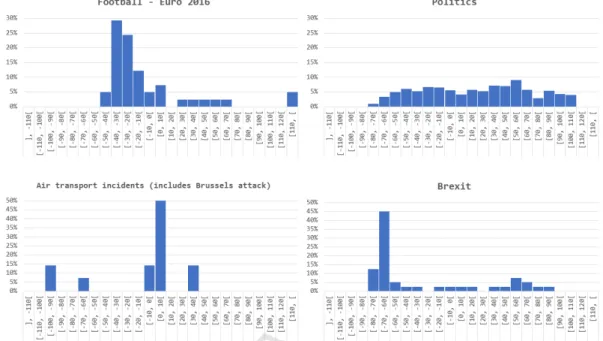
One way of analyzing the temporality between news and tweets is to consider the time difference of ev-ery article in a cluster to its median tweet. The me-dian tweet is the tweet with meme-dian time in the cor-responding cluster. This brings out a question of how the press publication timings compare to the moment when the public discussion is at its highest. The time difference is computed as a lag variable, that, if posi-tive, indicates that the article is older than the median tweet, and the opposite if negative. If the distribution of this variable is skewed to the right, the stories of that cluster have a tendency to be first published by the press; if skewed to the left, the social media dis-cussion happens sooner than the news. Fig. 4 shows the representation of the distribution of this lag
vari-Figure 4: Days difference between articles and the median tweet.
able for the considered subset of clusters.
It can be observed that the majority of the articles be-longing to the cluster Football - Euro 2016 were pub-lished after the median date of the tweets assigned to this cluster (a negative days difference). Portuguese Twitter users seem, therefore, to anticipate the discus-sion of the national team participation in the compe-tition in comparison to what happened in the news. A similar conclusion can be drawn for Brexit: the height of discussion of Portuguese users of the staying or leaving of the UK from the European Union happened on Twitter about two months before it happened in the press.
These observations lead to the following conclu-sion: while the news on Football - Euro 2016 and Brexitwere more event-oriented, with peaks of arti-cles at specific points or short periods of time (e.g.: the start of the football competition on the 10th of June; the referendum date announcement in Febru-ary and the referendum itself on the 23rd of June), exchange of tweets has happened more evenly dis-tributed during the period under study.
The Politics cluster does not present any specific pattern. The Air transport incidents cluster shows some signs that the press published articles about the incidents first — in total there were nine articles pub-lished before the median tweet (positive days dif-ference) and five articles published after the median tweet (negative days difference).
We also did this temporality analysis for the whole dataset, i.e., including shared articles and tweets with
links to them. Conclusions for the selected clusters have not changed.
5
CONCLUSIONS
This work aimed at providing some insights into the temporal relationship of texts that appear both as news articles and in social networks in Portugal. The strat-egy was to investigate what were the main themes published and how they behaved in terms of the num-ber of articles and social media posts during a reason-ably long period.
To that end, a sample of online news articles from generalist news sources was subject to text clus-tering techniques, and 50 groups of similar articles were identified. These were subsequently labelled with keywords. The groups included articles on foot-ball related events and teams, terrorist attacks and other international incidents, elections, accidents, in-vestigations, political parties, ministerial actions, eco-nomic/financial reports and weather warnings, among others.
Then, to associate tweets with the groups of news articles, we used a sample of tweets and assigned them to the clusters using a similarity measure. This assignment was evaluated using tweets with a news article URL. The fact that tweets contain very few terms makes this task rather difficult. Also, as the number of classes is large, we cannot expect a very high accuracy. The default accuracy for 50 classes
the most frequent articles were published towards the end of the period under observation. A similar pat-tern was observed for Brexit. This indicates that, for some texts, the press is more event-oriented, contrast-ing with the more permanent focus of Twitter users. The analysis Air transport incidents, which included Brussels bombings, revealed that the press had a more prominent role in the news diffusion, while comments in social media appeared afterwards. Regarding the cluster Politics, no pattern was identified. Perhaps, with a more refined level of partitioning certain tim-ing patterns would be more easily identified.
Regarding future work, we believe that the results could be improved by adopting ontologies that would enable to compute semantic distances between arti-cles and tweets. Besides, tweets could also be ex-panded with the use of synonyms or through word embeddings (Mikolov et al., 2013). This would en-hance the matching process of tweets to the lexicon obtained from the articles.
ACKNOWLEDGMENT
This work has been supported by the project Centro-01-0145-FEDER-000019 - C4 – Cloud Computing Competences Centre” cofinanced, through the Sup-port System for Scientific and Technological Re-search - Integrated SR&TD Programs, by the Portugal 2020 Program (PT 2020), in the framework of the Re-gional Operational Program of the Center (CENTRO 2020) and by the European Union through the Euro-pean Regional Development Fund (ERDF).
REFERENCES
Bholowalia, P. and Kumar, A. (2014). EBK-means: A clus-tering technique based on elbow method and k-means in WSN. International Journal of Computer Applica-tions, 105(9):17–24.
Kwak, H., Lee, C., Park, H., and Moon, S. (2010). What is Twitter, a Social Network or a News Media? In WWW ’10 Proceedings of the 19th International Conference on World Wide Web, pages 591–600, Raleigh, North Carolina, USA. ACM.
Mikolov, T., Sutskever, I., Chen, K., Corrado, G. S., and Dean, J. (2013). Distributed representations of words and phrases and their compositionality. In Advances in neural information processing systems, pages 3111– 3119.
Newman, N. (2009). The rise of social media and its impact on mainstream journalism. Technical Report Septem-ber, Reuters Institute for the Study of Journalism, De-partment of Politics and International Relations, Uni-versity of Oxford.
Phuvipadawat, S. and Murata, T. (2010). Breaking news de-tection and tracking in Twitter. In Proceedings - 2010 IEEE/WIC/ACM International Conference on Web In-telligence and Intelligent Agent Technology - Work-shops, WI-IAT 2010, pages 120–123, Toronto, ON, Canada. IEEE.
Rocha, C., Jorge, A., Sionara, R., Brito, P., Pimenta, C., and Rezende, S. (2016). PAMPO: using pattern matching and pos-tagging for effective Named Entities recogni-tion in Portuguese. arXiv preprint arXiv:1612.09535., pages 1–17.
Saleiro, P., Amir, S., Silva, M., and Soares, C. (2015). POPmine: Tracking Political Opinion on the Web. In 2015 IEEE International Conference on Computer and Information Technology; Ubiquitous Computing and Communications; Dependable, Autonomic and Secure Computing; Pervasive Intelligence and Com-puting (CIT/IUCC/DASC/PICOM), pages 1521–1526, Liverpool, UK. IEEE.
Sankaranarayanan, J., Samet, H., Teitler, B. E., Lieberman, M. D., and Sperling, J. (2009). TwitterStand: News in Tweets. In Proceedings of the 17th ACM SIGSPATIAL International Conference on Advances in Geographic Information Systems - GIS ’09, pages 42–51, Seattle, Washington, USA. ACM.
Sch¨utze, H., Manning, C. D., and Raghavan, P. (2008). Evaluation in information retrieval, volume 39. Cam-bridge University Press, New York, USA, 1st edition. Zhao, W. X., Jiang, J., Weng, J., He, J., Lim, E.-p., Yan, H., and Li, X. (2011). Comparing Twitter and Tradi-tional Media using Topic Models. In Proceedings of the 33rd European conference on Advances in infor-mation retrieval (ECIR’11), pages 338–349. Springer, Berlin, Heidelberg.