EU COUNTRIES Sofia Gaspar
Lisbon University Institute (ISCTE-IUL), CIES-IUL, Lisbon, Portugal
Introduction: love and free movement within the European Union
The European integration process has indisputably contributed to the change that has taken place in the social, economic and political structure of all EU member states. Since the signing of the Maastricht Treaty in 1992, the citizens of any mem-ber country have been entitled to free movement within the European social area, with the legal right to move to or reside anywhere within the EU, and legal protec-tion from social discriminaprotec-tion based on country of origin, gender or ethnicity. In recent decades, intra-EU mobility, along with a wave of migration in the globalized world and the rise of mass tourism, has significantly contributed to the social and cultural intermixing of different national groups and to changes in the composition of migrant populations across Europe.
One of the consequences of the political opportunities provided by European social integration is the emergence of a social space, where individual patterns of migration compete with traditional models of labour market flows, mainly from economically disadvantaged southern societies to prosperous northern nations. Nonetheless, and contrary to this classical trend, an extended form of mobility is now apparent, whereby mobile EU citizens come from all social classes and have different educational levels and work skills (Verwiebe and Eder, 2006). Traditional migration movements can still be identified but, simultaneously, a group of young and skilled professional movers take intra-European mobility as an opportunity to acquire economic, social and cultural capital that helps them to gain social distinc-tion and reinforce their social status (Favell, 2008; King, 2002a; Scott, 2006).
In addition, different motivation patterns structure migration flows from the home to the host countries. This means that each EU country has its own eco-nomic, social, cultural, political and historical singularities that attract different groups of citizens. Drawing on the data presented by Santacreu Fernández et al. (2009), some great European states (Germany, Britain and France) continue to be an important source of work-driven opportunities for southern European movers (Italian and Spanish). In parallel, Spain stands out as the country where quality of life rationales (a good climate, natural beauty and a lower cost living) are more pronounced as determining influences on mobile EU citizens, particu-larly those from Britain and Germany. Britain is identified as the prime country where “study reasons” are indicated by French and Spanish movers (see King and Ruiz-Gelices, 2003); whereas Italy seems to be the country that most attracts EU citizens for “love/family reasons”.
Data from the same study shows that when asked the paramount reason for crossing national boundaries, mobile EU citizens respond, in first place, “love
motives” (29.2%), followed by “work opportunities” (25.2%), “quality of life” (24%) and “study” (7%) (Santacreu Fernández et al., 2009). This result contrasts sharply with the main driving force behind intra-European migration up until the 1970s (work and economic reasons), revealing that non-economic rationales (love, quality of life, study) have grown in importance since then. The sentimen-tal sphere has thus assumed a pre-eminent role in moving decisions — particu-larly intra-European love, which has been identified as an important social trigger for moving and one of the main forces behind a permanent or temporary stay in a foreign culture (King, 2002a; Gaspar, 2009). Santacreu Fernández et al. (2009) have also highlighted the fact that when a partner’s nationality is exam-ined among those respondents indicating “love” as the foremost motivation to cross frontiers, 61.6% report having moved in order to join a partner of different nationality, whilst 36.2% do so to follow a same-nationality country. This data re-veals the emergence of a new type of EU mover, i.e. one who leaves his or her country of origin to start a family with a partner from the residence society, con-tradicting the classical view that love migrations mainly occur in family reunifi-cation processes among same-nationality partners (Santacreu Fernández et al., 2009; see also Scott, 2006; Scott and Cartledge, 2009).
However, despite the undoubted centrality of “love” in explaining social practices in general (Torres, 1987) and migration patterns in particular (King, 2002a; Mai and King, 2009), research on affective and emotional liaisons is un-der-developed within the social sciences. But, clearly, this individual and per-sonal factor, which has hitherto been one of the chief structuring pull factors for geographical mobility within the EU context, should figure prominently on fur-ther agendas of migration studies. The data suggests that, whefur-ther as a cause or a consequence of cross-national migration, affective reasons have certainly con-tributed to the formation of numerous European bi-national families. This sub-ject has been surprisingly absent from social science literature, with the exception of a few isolated efforts (Braun and Recchi, 2008; Gaspar, 2008; 2009; 2011; Santacreu Fernández and Francés García, 2008; Scott, 2006; Scott and Cartledge, 2009). Bi-national unions thus demand closer investigation of the singularities that they, as families, may reveal, particularly in relation to the different EU mem-ber states. The idea that Europe is being shaped through conjugal and family processes that are experienced and negotiated by these partnerships on a daily basis, within a wider and hybrid transcultural space, should be taken seriously by researchers focussing on the consequences of European social integration. Bi-national EU marriages represent a new form of affective liaisons developed by civil society, which, alongside legal and instrumental political measures, are un-questionably playing a significant role in defining the idea of Europe.
Drawing on ideas outlined in a previous article focusing on different types of EU cross-national couples living in Spain and Italy (Gaspar, 2011), the aim of this paper is to expand this comparative analysis to three other European countries: France, Germany and Great Britain. As found by Gaspar (2011), a threefold typology has emerged, with retired bi-national couples primarily moving to Spain, love bi-national couples to Italy, and a new profile — Eurostars bi-national couples
— established in both countries, particularly Italy. In the light of these results, this article attempts to clarify whether individuals belonging to a bi-national marriage are constrained by “specialized migration trends” linked to the five host countries or if they are deciding to move independently of country-specific migration pro-files. Accordingly, the following section describes the data and the methodological techniques that guided the preparation of the survey, after which an analysis and discussion of the empirical data is conducted. As we shall see in this section, the findings obtained for the five EU countries present a somewhat different pattern of cross-national partnerships compared to the earlier results (cf. Gaspar, 2011). The final part of the article summarizes the principal issues outlined previously and re-flects upon the implications these unions have on EU migration and social integra-tion processes across the five EU member states.
Data and methodology
The data used in this paper is drawn from cross-national research on intra-EU mi-grants as part of the Pioneur project, Pioneers of European Integration “from be-low”: Mobility and the Emergence of European Identity among National and Foreign Citizens in the EU, funded by the European Commission through the Fifth Framework Programme between 2003 and 2006. The data originated by the project — the European Internal Movers Social Survey (EIMSS) — includes information from samples of migrants in France, Germany, Great Britain, Italy and Spain who had to fulfil certain selection requirements: having migrated between 1974 and 2003, aged 18 or older at time of migration and still living in the receiving country when the research was conducted. In each country, around 250 telephone inter-views were carried out with migrants belonging to the other four countries. Re-spondents were told to answer to a questionnaire which included original items, and some others from the European Social Survey (ESS) and the Eurobarometer (EB), with topics centred on socio-demographic data, family origin, migration tra-jectory, European and national identity, quality of life, social integration and politi-cal and media practices.1
From the original dataset (n = 4902), a smaller sample was sifted out accord-ing to whether or not each respondent had a partner of a different nationality. This tech-nique was developed in order to achieve the theoretical objectives previously defined. A total of 1995 migrants (40.7%) were thus extracted, exclusively repre-senting respondents who had a relationship with a partner of a different national-ity to their own.
To identify the existence of different patterns of bi-national couples across the five EU countries included in the sample, a descriptive and multivariate analysis was developed with different qualitative indicators: sex, age, education, country of residence, nationality, partner’s citizenship, migration motives, year of migration
and number of children within the couple. After a descriptive analysis of the re-sults, a multiple correspondence analysis (MCA) was conducted, and after each, a cluster analysis computed to define a typology of EU bi-national couples.
Results
In this section the findings obtained through the empirical analysis will be pre-sented under two main headings: firstly, descriptive analysis, conducted to charac-terise the most relevant features of the EU migrants’ sample; secondly, the main privileged associations emerging from the MCA are analysed, thus allowing the typology of the EU bi-national unions provided by the clustering to be character-ized at a later stage.
Descriptive analysis
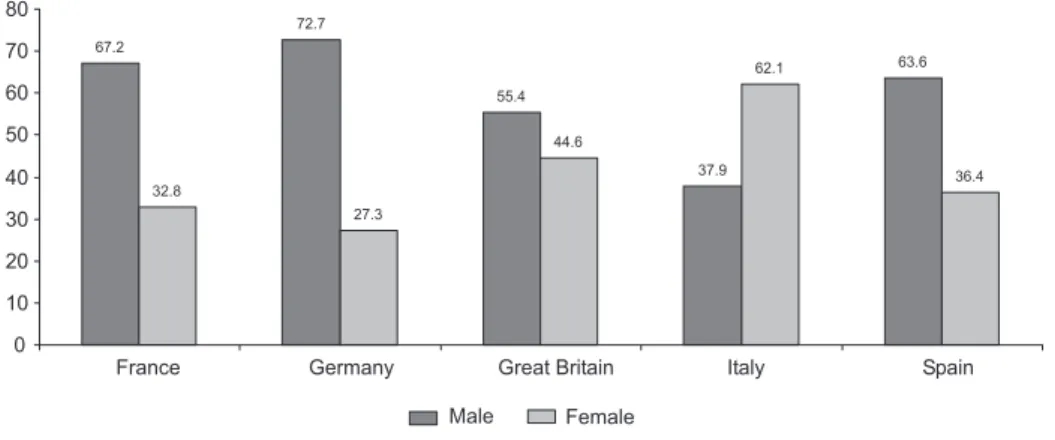
Adescriptive examination of the socio-demographic features of the respondents in a bi-national marriage provides a clear portrait of this group of migrants. The sam-ple was relatively balanced regarding gender distribution, even though men were slightly better represented than women (57.7% and 42.3% respectively). The em-pirical evidence available for geographical and national context indicates a somewhat unbalanced number of EU migrants living across the five countries. Accordingly, data on residence country shows that Spain has the fewest respondents (13.6%), and Italy (24.8%) and Great Britain (24%) the most, with Germany (20.2%) and France (17.4%) in between. In line with previous studies (Braun and Arsene, 2009; Braun and Recchi, 2008), these findings indicate that Italy and Great Britain have the most bi-national couples and Spain the fewest. A key trend is displayed on figure 1, where an analysis between country of residence and gender is performed.
As shown by the graph, in all countries except in Italy there are more migrant men than women. If we take a close look at the figures, we find that in France, there are 67.2% migrant men compared with 32.8% women; in Germany, 72.7% men and 27.3% women; in Great Britain, 55.4% and 44.6%; in Italy 37.9%, and 62.1%; and fi-nally in Spain, 63.6% men and 36.4% women. Apart from Britain, which has a more balanced share of EU migrants from both sexes, Germany, France and Spain stand out as receiving country mainly for men, contrary to Italy, which hosts more women than the other EU states.
However, and in contrast with the residence country, the findings obtained for the variable nationality (country of origin) demonstrate that the French are those with the highest proportion of cross-national partnerships (23.3%), followed by Spanish (21%), Italians (20.5%), Germans (18.8%) and British (16.5%). Looking at partner’s
citi-zenship we can observe that, among the interviewees, 22.6% are married to Italian
partners, 19.7% to Britons, 18.2% to Germans, 14.8% to French, 11.4% to other non-EU nationalities, 8.7% to Spaniards and only 4.6% to partners from other EU states. These findings are consistent with those in the original EIMSS dataset, in which the Italians most often marry someone holding one of the other nationalities
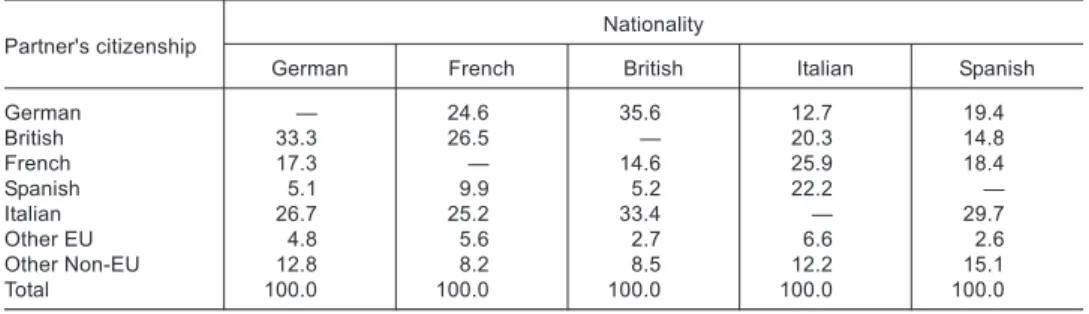
and the Spanish least often (Braun and Arsene, 2009; Braun and Recchi, 2008). More specifically, table 1 shows the distribution of nationality by partner’s citizenship.
A brief analysis of table 1 suggests that, among the respondents, German citi-zens get married to Britons (33.3%) and Italians (26.7%) most of all; the French to Britons (26.5%), Italians (25.2%) and Germans (24.6%); the British to Germans (35.6%) and Italians (33.4%); the Italians to French citizens (25.9%), Spaniards (22.2%) and Britons (20.3%); and the Spanish to Italians (29.7%), Germans (19.4%) and French citizens (18.4%) (see also Braun and Recchi, 2008).
The information on the motives for migration to the host country demonstrates that “migration to live with partner” has the highest score (38.4%), followed by “migration for work” (21.5%), “quality of life migration” (15.3%), “migration for education” (10.6%), “migration to live with family” (6.4%),2and “other reasons” (7.8%).3The year of migration was classified by Braun and Arsene (2009: 36-37) in three waves of migration — 1974-1983, 1984-1993 and 1994-2003. Though the re-sults show a balance in migration flows across these three periods, the trend to-wards moving to a foreign EU state seems to have increased slightly over time: 1974-1983 (32.4%), 1984-1993 (33.2%) and 1994-2003 (34.4%).
Furthermore, respondents have ages between 27 and 91 years (mean = 52.2 years),4and a fairly high educational level: most (53.9%) hold tertiary education
67.2 72.7 55.4 37.9 63.6 32.8 27.3 44.6 62.1 36.4 0 10 20 30 40 50 60 70 80
France Germany Great Britain Italy Spain Male Female
Figure 1 Country of residence by gender (%) Source: EIMSS dataset (2005), N = 1995
2 The content of “migration to live with partner” and “migration to live with family” has to be dif-ferentiated, since the first indicator includes individuals who had migrated to join a partner, and the second, those who had moved to live with the origin family (parents or other relatives) (see Santacreu Fernández et al., 2009: 57).
3 This last category includes various migration motives like “travelling”, “born in this country”, “to live with friends”, “other family and personal reasons”, “like foreign country”, “accident” and “childhood dream”.
4 As the nature of the variables to be included in a MCA has to be nominal, this variable has been recoded into four age groups — 27-40 years, 41-51 years, 52-64 years, and 65+ years.
qualifications, 36.6% secondary education and only 9.5% primary education.5 Re-garding EU migrants’ occupation, the majority are working (77.5%), whereas a smaller number are retirees (11%), do housework (5.4%), are unemployed (4.6%) or studying (1.4%). In order to analyse the gender differences regarding occupation, a crosstab analysis was performed: the results show that women represent 93.3% of the total interviewees doing housework, 59.9% of the unemployed, 30.7% of the re-tired, 57.1% of those studying, and only 38.6% of those working (c2(4) = 146.144, p = 0.000, V Cramer = 0.274). Lastly, when asked, nearly two thirds (70.9%) of the EU
migrants asserted that they have children in comparison with one third (29.1%) who said that does not have them.
The general trend from the bi-national couples’sample indicates that the re-sults are pretty much in line to those found on the initial EIMSS dataset (see Braun and Arsene, 2009; Santacreu Fernández et al., 2009). Individuals living an EU bi-national relationship tend to come from a highly educated socio-educational background, had primarily moved for “love motives”, and are equally repre-sented in all age groups. Italy and Great Britain are the countries where EU cou-ples can most easily be found, the French are those who reveal the highest rates of intermarriage, and Italian partners are the most popular among the remaining nationalities.
Multivariate analysis
Amultiple correspondence analysis (MCA) using a number of variables — partner’s citizenship, migration motives, year of migration, age, occupational situation, chil-dren’s education, country of residence and nationality — was performed. Two main dimensions appeared as structuring axes in the space of bi-national unions within the five EU countries. However, as shown in table in appendix by the discrimination
Partner's citizenship Nationality
German French British Italian Spanish
German — 24.6 35.6 12.7 19.4 British 33.3 26.5 — 20.3 14.8 French 17.3 — 14.6 25.9 18.4 Spanish 5.1 9.9 5.2 22.2 — Italian 26.7 25.2 33.4 — 29.7 Other EU 4.8 5.6 2.7 6.6 2.6 Other Non-EU 12.8 8.2 8.5 12.2 15.1 Total 100.0 100.0 100.0 100.0 100.0
Source: EIMSS dataset (2005), N = 1995.
Table 1 Nationality by partner’s citizenship (%)
SOCIOLOGIA, PROBLEMAS E PRÁTICAS, n.º 70, 2012, pp. 71-89. DOI: 10.7458/SPP2012701211
5 In order to simplify the analytical comparability of this variable across the five EU states, it has been recoded into three educational stages: primary (6 years’ education), secondary (12 years’ education) and tertiary (university).
and contribution values (see appendix) a rather complex portrait appears when all indicators are interrelated. Three variables stand out in between and make an impor-tant contribution to both dimensions: “age”, “partner’s citizenship” and “country of residence”. On the other hand, the variables that most structure dimension 1 relate to “migration motives”, “working situation” and “nationality”, thus pointing to a rela-tionship between the “geographical and professional context”. In contrast, the indi-cators that stand out as structuring dimension 2 are “year of migration”, “education” and “children”, indicating a relationship between items related to the “geographical and socio-demographic context”.
The analysis on the centroid coordinates shows a different pattern between the two dimensions. Accordingly, in dimension 1 it is highly apparent that the cate-gories “German partner”, “Italian partner”, “other partner-nationalities”, “Ger-many”, “Great Britain”, “Italy”, “German”, “British”, “Spanish”, “migration for work”, “migration for education”, “migration to live with partner”, “other rea-sons”, “paid work”, “studying”, “unemployed”, and “from 27 to 64 years” stand in opposition to “British partner”, “French partner”, “Spanish partner”, “other EU state partner”, “France”, “Spain”, “French”, “Italian”, “quality of life migration”, “migration to live with family”, “retired”, “housework”, and “65+ years”. This pat-tern of opposition points to (1) a distinction between individuals who are in an active work situation in their life cycle, and (2) those who are already retired and at a later stage in life. In parallel, there is also an opposition between (1) the “geographical living place” (Germany, Great Britain and Italy, in opposition to France and Spain), and (2) the “migration motives” associated with intra-EU mobility (migration for work, education, to live with partner, and other reasons, in opposition to migration for quality of life purposes and to live with the family).
In dimension 2 the opposition must be noted between the categories “Great Britain”, “France”, “British partner”, “French partner”, “other EU state partners”, “other nationality partners”, “1994-2003”, ”don’t have children”, “tertiary educa-tion”, and “27-51 years” and those referring to “Germany”, “Italy”, “Spain”, “Ger-man partner”, “Spanish partner”, “Italian partner”, “1974-83”, ”1984-93”, “with children”, “primary school”, “secondary school”, “52-64 years” and “65+ years”. These findings suggest a differentiation between (1) individuals who are younger and well educated and have migrated recently to France or Great Britain, and (2) those who are older and less educated and moved in the first two periods to the other three host countries. Ajoint analysis of dimension 1 and 2 enables a mapping of topological configuration of EU bi-national couples and detection of specific patterns between the variables. As figure 2 shows, three configurations can be identified from the articulation of these two dimensions.
As we can see in the 1stquadrant (top right), there is a privileged association between Spain, Spanish partner, retired, 65+ years, and migration to live with family. There is also a relative proximity with some of the neighbouring categories in the 4thquadrant (bottom right): quality of life migration, Italian, and other EU state partner. It suggests that we are dealing with an older group of EU bi-national partnerships, whose members chose Spain as the place to spend their retirement, probably due to the fact that one of the partners is a Spanish native.
Another privileged association exists between the categories of the 2nd quad-rant (top left), relating to German partner, Italian partner, Italy, Germany, British, migration to live with partner, other reasons, unemployed, 1984-1993 and 52-64 years. These categories also exhibit a close association with some of the categories in the 1stquadrant (top right) — 1974-1983, children, primary school and secondary school — and some in the 3rdquadrant (bottom left) — paid work, migration for work and 41-51 years. Moreover, the two categories that are posited on the axis of dimension 2 — housework, French — and the one on the axis of dimension 1 — Spanish — also have a privileged association with this profile. Altogether, this con-stellation of indicators points to a middle-aged group living in Germany or Italy, married to Italian or German partners, who mainly migrated to these EU countries in the first and second periods, not only for reasons of love (“to live with partner”) but also a variety of other motives.
The last privileged association to be found lies in the 3rdquadrant (bottom left) between the categories tertiary education, don’t have children, Great Britain, 27-40 years, migration for education, migration for work and 41-51 years. These in-dicators are also closely associated with some of the categories in the 4thquadrant (bottom right) — France and French partner. In addition, four categories lying on the axis of dimension 2 — German, British partner, partner of another nationality, 1994-2003 — and two others on the axis of dimension 1 — Spanish and paid work
MR Di m en si on 1 1994-2003 1984-1993 1974-1983 Housework Retired Unemployed Studying Paid work Others Other EU partner Italian partner Spanish Partner French partner British partner German partner Spanish Italian English French German Other reasons Migration to live partner
Migration live family
Quality life migration
Migration for education Migration for work Tertiary education Secondary school Primary school Spain Italy Great Britain Germany France Traditional migrants’ bi-national couples
Retired bi-national couples Eurostars bi-national
couples
Don't have children
Children +65 years 52-64 years 41-51 years 27-40 years Dimension 2 Year migration Working situation Partner's citizenship Nationality Migration motives Education Country of residence Cluster Children Age
Figure 2 Topological configuration in the space of EU bi-national partnerships Source: EIMSS dataset (2005), N = 1995.
— also have a privileged association with this group of categories. It is worth noting that the category “studying”, though positioned at a certain distance, may also be associated with this group. Despite the apparent heterogeneity of this pro-file in comparison to the others, it seems to indicate the existence of bi-national rela-tionships of young and highly educated German and Spanish individuals, mainly living in Great Britain, though also in France, who moved there for work or study in the decade 1994-2003.
After this procedure, cluster analysis was conducted taking the two dimensions of the MCAas a reference point; and subsequently, another MCAwas run using a sup-plementary projection of the variable resulting from the clustering. Figure 2 shows a key trend of the three social types, exhibiting a clear pattern between the topological and typological configurations of bi-national partnerships across the five EU coun-tries.6As the graph displays, the social types are posited almost at the centre of the
Eurostars Retired Love
Country of residence France 26.6 14.7 9.6 Germany 12.1 1.1 36.3 Great Britain 48.4 9.9 6.0 Italy 10.5 3.4 47.8 Spain 2.5 70.8 0.2 Total 100.0 100.0 100.0 Nationality German 27.3 17.8 10.8 French 21.9 23.8 24.3 British 5.2 11.3 29.8 Italian 21.9 45.6 8.4 Spanish 23.6 1.4 26.6 Total 100.0 100.0 100.0 Partner's citizenship German 8.4 3.1 34.3 British 36.8 13.6 5.5 French 21.3 14.2 8.8 Spanish 1.5 45.6 0.0 Italian 7.9 2.3 45.7 Other EU 5.0 11.3 1.2 Other 19.1 9.9 4.5 Total 100.0 100.0 100.0 Migration motives Work 26.8 10.0 21.2 Education 20.5 4.0 3.9 Quality of life 12.9 37.9 8.1
To live with family 2.3 18.5 5.3 To live with partner 31.4 21.9 52.0
Other reasons 4.8 4.6 5.9
Miscellaneous reasons 1.2 3.1 3.6
Total 100.0 100.0 100.0
Source: EIMSS dataset (2005), N = 1995
Table 2 Clusters by geographical context (%)
6 This three-group typology was first confirmed by a hierarchical cluster analysis (Ward’s method and furthest neighbour), and after which a k-means cluster analysis was computed as to optimize the partition into three groups (see Carvalho, 2008).
sub-clouds for each of the three configurations of the bi-national couples resulting from the previous MCA.
As already defined by Gaspar (2011), clusters were named Eurostars bi-national
couples (type 1), retired bi-national couples (type 2) and love migrant bi-national couples
(type 3). Tables 2 and 3 display how the three clusters are characterized by the input variables.
As we can see from the tables, Eurostars bi-national couples includes 812 individuals (40.7%), who can be found in Great Britain in particular (48.4%), though also in France (26.6%). They mainly originate from all countries except Great Britain and have native partners from the later host countries (British — 36.8% — and French — 21.3%). The dominant reason to migrate to the residence country was not only love (31.4%) but also work (26.8%) and education (20.5%), with more than half of the respondents moving between 1994 and 2003 (55.9%). Although nearly half of them are aged 41-51 years (46.6%), it is in this age group that the youngest group is most strongly represented (32.4%). This is probably why more than three quarters of them are working (89.1%) and around two-thirds have a university degree (71.9%). Finally, this profile also tends to have far fewer children in comparison to the other groups (53.8% as opposed to over 80%).
Clusters
Eurostars Retired Love Year of migration 1974-1983 12.7 34.6 50.8 1984-1993 31.4 29.2 36.6 1994-2003 55.9 36.3 12.6 Total 100.0 100.0 100.0 Age 27-40 years 32.4 5.1 3.4 41-51 years 46.6 15.6 36.4 52-64 years 17.0 23.5 51.8 65+ years 3.9 55.8 8.4 Total 100.0 100.0 100.0 Occupational situation Paid work 89.1 40.2 82.3 Studying 3.4 0.3 0.0 Unemployed 3.0 3.2 6.7 Retired 0.8 50.0 4.3 Housework 3.7 6.3 6.7 Total 100.0 100.0 100.0 Education Primary 1.6 12.4 15.9 Secondary 26.4 48.0 41.7 Tertiary 71.9 39.6 42.4 Total 100.0 100.0 100.0
Children Have childrenDon't have children 53.846.2 81.118.9 83.516.5
Total 100.0 100.0 100.0
Source: EIMSS dataset (2005), N = 1995
Table 3 Clusters by socio-demographic context (%)
The retired bi-national couples, representing 353 individuals (17.7%), have
dif-ferent characteristics from the Eurostars. Almost three quarters (70.8%) live in Spain, while they mostly originate from Italy (45.6%) and France (23.8%). Nearly half of the respondents have a Spanish partner (45.6%), and their principal motive for migrating was to improve life quality (37.9%), though a significant proportion was also driven by the desire to live with their partner (21.9%) or family (18.5%). They have migrated during the three periods considered above, though the pro-portion of movements in the last decade has been higher (36.3%). More than half are over 65 years of age (55.8%), which obviously corresponds to their occupational status of retirees (50%). Their qualification levels are fairly high, with nearly half of them having completed secondary school (48%) and another important proportion tertiary education (39.6%). Finally, as expected, around 81.1% have children.
Ultimately, the love migrant bi-national couples’ profile is represented by 830 in-dividuals (41.6%), who mainly live in Germany (36.3%) and Italy (47.8%), are British (29.8%), Spanish (26.6%) or French (24.3%), and have Italian (45.7%) or German partners (34.3%). Their main migration motive was to live with their partner (52%), though migration for work (21.2%) was also a consistent reason to leave their home countries. Half of them (50.8%) migrated during the first period (1974-1983) and the same proportion belongs to the 52-64 age group (51.8%). The vast majority are currently working (82.3%) and their qualification levels are also consistently high (42.4% have a tertiary education and 41.7% have completed secondary school). As with the retired bi-national couples, the vast majority (83.5%) have children.
Discussion
In the context of geographical mobility of bi-national partnerships, the data pro-vided by the EIMSS survey shows that their movements follow country-specific
mi-gration processes and are, therefore, adjusted to broader European mobility trends
as defined earlier on this paper. This implies that host countries are chosen for the reasons that attract people to move to those locations — study, work, love or retirement.
Therefore, and according to our data, the socio-demographic profile of the respondents belonging to Eurostars bi-national couples is associated with a particu-lar type of mobile citizen — Eurostars (Favell, 2008) —, for whom EU social integra-tion creates the legal and geographical facilities to move freely within the EU zone. Eurostars are a group of highly skilled citizens from middle-class back-grounds who wish to pursue strategies of self-realisation linked to education (King and Ruiz-Gelices, 2003), professional career trajectories (Favell, 2008; Kennedy, 2010), alternative lifestyles (Scott, 2006) or love (Gaspar, 2008; Trundle, 2009), in order to develop their individualized life-projects through migration. Like the evidence in the EIMSS sample, Eurostars include individuals who mi-grated at a relatively early stage in their life (mid 20’s to 40’s) after the mid-1990s, and have a profession adjusted to their high qualifications. Involvement in a bi-national relationship may well have been the catalyst for their mobility — “love
reason to migrate” — or the consequence — “study and work reasons” — for their move. Despite the fact this migrants’ profile had already been identified previ-ously with data from Spain and Italy (Gaspar, 2011), a major difference becomes now clear in what respect to the geographical map of the destination country. As shown in an earlier paper (Gaspar, 2011), Eurostars bi-national couples were mainly French, English or German citizens of both sexes living in Italy with Italian part-ners. However, the empirical evidence here expanded, contradicts the previous findings, revealing that when the five countries are taken together these migrants are mainly settled in more urbanized countries like Great Britain and France, where economic dynamism and multicultural environments have been already shown to be a stimulus for upward career paths and an immersion into a highly cosmopolitan environment (Favell, 2008; Scott, 2006). Great Britain and France are two countries particularly attractive for skilled migrants in introducing them-selves into social, economic and cultural networks capable of providing the dis-tinctive sorts of capital necessary to progress in their elite career path. If Great Britain is a privileged place to international study, and London, in particular, one of the central hubs of transnational corporations and enterprises, cities like Paris, in France, are a destination choice not only to an important number of cultural and lifestyles migrants, but also to high-skilled specialists involved in corporate labour markets.
Having said this, another type of bi-national couples emerging from the data of our sample are the retired bi-national couples. This group can be included in a migra-tion profile that has accompanied the rise in mass tourism since the 1960s —
retire-ment migration — in which they seek a better quality of life (warmer climate, health
reasons, lower cost of living); this is, for the older population of retirees, the main rea-son for crossing boundaries (Casado-Díaz et al., 2004; King et al., 1998; Williams et al., 2000). The socio-demographic profile of retired migrants’ bi-national couples found here is consistent with that already established by Gaspar (2011). Led by the search of an improvement of life quality, the vast majority of a group of 65 years old retirees coming from Italy, France and Germany, and mainly holding secondary edu-cation, choose Spain to live in.
Despite the fact that Mediterranean and the southern and eastern coasts of the Iberian Peninsula are the preferred areas for middle-aged adults from affluent European nations, comparative studies stress that “retirement migration flows” are a rather complex and heterogeneous phenomenon since different places attract different contingents of migrants according to their socio-economic and transna-tional characteristics (Casado-Díaz et al., 2004; Gustafson, 2008; King et al., 1998; Williams et al., 2000). While in line with these results, the profile of retired bi-national couples from the EIMSS sample reveals certain singularities. Firstly, and as we have seen above, Spain leads as the chosen country for retirement by el-derly couples: generally nationals from Italy or France, and Spanish natives. Sec-ondly, contrary to the results found elsewhere (Casado-Díaz, 2006), their education level is higher in comparison to other retired migrants. Thirdly, a hypothesis sug-gested by various authors (Casado-Díaz et al., 2004: 375; Recchi and Favell, 2009: 12), is that retired couples “hide” a broader trend of “traditional-return migration
patterns”. As such, previous research by Casado-Díaz et al. (2004) highlighted the fact that, alongside the search for a better life, family-oriented motivations among dual-nationality couples could also be a pull factor in the decision to migrate for re-tirees settled in Italy and Malta. An examination of the EIMSS data may well give this last hypothesis some theoretical consistency: it is likely that marriages be-tween Spanish and French or German citizens could have taken place during la-bour migration flows from Spain to those countries in the 1960s and 1970s. Then later, in retirement, the decision to return to Spain was part of a family lifestyle pro-ject already preceded by a long-established connection between both places over the years. In order to assess the plausibility of this movement, further investigation needs to examine in more detail these couples’ migration motives.
The last type of EU bi-national union — love migrant bi-national couples — rep-resents, as mentioned beforehand, a trend of citizens primarily driven by affective rationales (Gaspar, 2008, 2011; King, 2002a; Scott and Cartledge, 2009; Trundle, 2009). In this group of migrants, “love” has been the dominant cause for moving to a foreign EU country. According to the evidence obtained from the five EU coun-tries, love migrant bi-national couples are European citizens who chiefly moved be-tween 1974 and 1983 to Italy and Germany, mostly driven by the wish to live with an Italian or German partner. By the time the survey was carried out, the vast ma-jority of these respondents were fairly highly qualified, in work, and at a stage of their lives when they were solidly established in the receiving society. Nonethe-less, these results are only partially consistent with those found by Gaspar (2011), because they not only place these migrants’ in Italy but also in Germany. Surpris-ingly, however, these two EU countries have rather different migratory histories: Italy has turned, since the 1970s, from an emigration to an immigration country, at-tracting a “polycentric population” coming from several nationalities and pulled by various motivations (King, 2002b). Germany, on the other hand, has been known since the second half of the 20thcentury as an appealing country for guest workers or low-skilled labour recruitment, even though this last assumption has been recently challenged by research focussing on intra-EU migrants (Verwiebe and Eder, 2006; Verwiebe, 2008), which revealed that mobile Europeans nowadays represent a diverse and mostly middle-class phenomenon in this country.
Notwithstanding the fact that both countries have been identified as privi-leged destinations for those who are pulled by affective liaisons, if we look at the mi-grants’ gender composition in one country and the other, we find a different pattern. In fact, migrant groups are frequently unbalanced regarding sex ratio, and only during the last decade has the number of females started to balance those of males. As such, and as described earlier on this paper, whereas EU migrants in Italy are mainly women, in Germany they are mostly men. This trend has already been supported by Trundle (2009) in Italy, who has maintained that since the 1960s, well-educated middle class Western women had chosen Italy as a place to study or work, attracted by its climate and cultural attractiveness. After knowing and mar-rying an Italian partner, these “cultural migrants” finally settled down in the coun-try (see also King and Andall, 1999). In contrast with a migrants’ feminization pattern present in Italy, the EIMSS data for Germany exhibits a reverse trend, as the
EU citizens who migrated in this country are mostly men in partnership with a German female. These results show a clear convergence with those found by Klein (2001) with regard to guest workers from southern European countries like Italy and Spain, as German females showed a higher number of bi-national marriages with these foreign citizens when compared to German males. The bi-national choice of the partner within the marriage market is then structured according to the different surplus of sex ratio composition within the two EU countries.
Conclusion
In recent decades, the map of internal migration of the EU has been altered since free movement between member states has been institutionalized. New migrants, new migrations and new trends have released new motives to cross national bor-ders and venture to a new life in a foreign state. Within this context, love migration seems to have been a structural constant since the 1970s. Yet this topic has been practically ignored by social scientists, who have only begun to sketch a broader agenda for migration research in the last decade (see King, 2002a). One of the most enlightening phenomena supported by recent data (Santacreu Fernández et al., 2009) is the fact that most love migrants declare that they moved to join a diffe-rent-nationality partner in another country. Bi-national unions are therefore a social reality that seems to be shaping EU integration processes, and its conjugal and institutional dynamics should be taken into account in further migration and family debates.
Drawing from a previous study using data from Spain and Italy (Gaspar, 2011), the aim of this paper was to expand research on this subject to three different EU countries: Germany, Great Britain and France. The hypothesis that EU bi-national couples exhibit different socio-demographic patterns in these member states has been tested and supported, using an original dataset of EU movers (EIMSS). As found elsewhere (Gaspar, 2011), the findings revealed a threefold typology of affecti-ve unions, which were linked to country-specific dynamics inscribed in broader migra-tion processes (Casado-Díaz et al., 2004; Casado-Díaz, 2006; Favell, 2008; King and Ruiz-Gelices, 2003; Santacreu Fernández et al., 2009; Trundle, 2009).
However, as the present study extended its empirical field to additional EU countries, a slightly different geographical picture emerged when considering the destination country chosen by bi-national couples. In contrast with the data obtained previously (Gaspar, 2011), Eurostars bi-national unions are mainly settled in Great Bri-tain and France, two countries attracting a highly qualified and younger social group, moved by study or work rationales to these localities. On the other hand, love
migrant bi-national partnerships tend to be attracted not only to Italy, as shown earlier
by Gaspar (2011), but also to Germany. Although this last country has traditionally attracted individuals moved by labour opportunities, recent research (Verwiebe and Eder, 2006; Verwiebe, 2008) attests that the composition of migrants in this country now extends to a heterogeneous EU middle-class population. However, a key diffe-rence between love migrants in Italy and Germany is that migrants’structure on the
first is basically constituted by women, and on the second by men. The last type of bi-national partnerships — retired migrants bi-national couples — in line with previous results (Gaspar, 2011), normally moves to Spain, a country which receives a retired population originally from Italy, France and Germany, attracted by the quality of life and who may be masking a more complex phenomenon of “traditional-return in-tra-mobility processes”. Additional studies need to go into more depth on these issues in order to clarify the distinctive features of these social types.
In short, if love represents one of the most powerful driving forces for mobi-lity, further research on migration and family issues should continue to evaluate not only its structuring role in intra-EU mobility but also the time-spans involved, considering the social and political consequences on future European integration.
Acknowledgements
I am particularly grateful to Ettore Recchi and Óscar Santacreu Fernández for pro-viding me with access to the EIMSS database. I am especially thankful to David Ca-irns for English revision. I am also indebted to Anália Torres for her continuous encouragement and critical insights into my work, and Madalena Ramos for her great help with the data analysis.
Appendix
Discrimination and contribution values
Indicators Dimension 1 Dimension 2
Discrimination Contribution (%) Discrimination Contribution (%) Partner citizenship 0.554* 20.9 0.418* 17.9 Migration motives Year of migration 0.262 *0.006* 9.90.0 0.1830.364** 15.67.8 Age 0.381* 14.4 0.349* 14.9 Occupation 0.389* 14.7 0.9* 3.8 Children 0.022* 0.2 0.204 * 8.7 Education 0.055* 0.5 0.185 * 7.9 Country of residence 0.707* 26.7 0.379* 16.2 Nationality 0.267 * 10.1 0.170* 7.3 Inertia 0.294 0.260 % explained variance 8.2 7.2
*Figures below the Inertia value.
Figures in bold indicate which variable is most important for defining each dimension. Figures in italics indicate that discrimination values are slightly equal for both dimensions. Source: EIMSS dataset (2005), N = 1995
References
Braun, Michael, and Camelia Arsene (2009), “The demographics of movers and stayers in the European Union”, in Ettore Recchi, and Adrian Favell (eds.), Pioneers of European Integration. Citizenship and Mobility in the EU, Cheltenham, Edward Elgar. Braun, Michael, and Ettore Recchi (2008), “Interethnic partnerships of Western
Europeans: between preferences and opportunities”, OBETS, Revista de Ciencias Sociales, 1, pp. 73-89, online at
http://rua.ua.es/dspace/bitstream/10045/7957/1/OBETS_01_04.pdf (assess 2012/10/23).
Carvalho, Helena (2008), Análise Multivariada de Dados Qualitativos. Utilização da Análise de Correspondências Múltiplas com o SPSS, Lisboa, Edições Sílabo.
Casado-Díaz, María Angeles (2006), “Retiring to Spain: an analysis of differences among North European nationals”, Journal of Ethnic and Migration Studies, 32 (8), pp. 1321-1339. Casado-Díaz, María Angeles, Claudia Kaiser, and Anthony M. Warnes (2004), “Northern
European retired residents in nine southern European areas: characteristics, motivations and adjustment”, Ageing and Society, 24, pp. 353-381.
Favell, Adrian (2008), Eurostars and Eurocities. Free Movement and Mobility in an Integrating Europe, Oxford, Blackwell.
Gaspar, Sofia (2008), “Towards a definition of European intra-marriage as a new social phenomenon”, CIES e-Working Paper, 48, CIES-IUL, Lisbon, 23 pp., online at http://www.cies.iscte.pt/destaques/documents/CIES-WP46_Gaspar_.pdf (assess 2012/10/23).
Gaspar, Sofia (2009), “Integración y satisfacción social en parejas mixtas intraeuropeas”, Sociedad y Discurso, 16, pp. 68-101, online at http://vbn.aau.dk/files/62703294/ SyD16_gaspar.pdf (assess 2012/09/10).
Gaspar, Sofia (2011), “Comparing EU bi-national partnerships in Spain and Italy”, Sociologia Online, 2, pp. 101-119, online at http://revista.aps.pt/
cms/files/artigos_pdf/ART4dc28e96f0538.pdf (assess 2012/10/23).
Gustafson, Per (2008), “Transnationalism in retirement migration: the case of North European retirees in Spain”, Ethnic and Racial Studies, 31 (3), pp. 451-475.
Kennedy, Paul (2010), “Mobility, flexible lifestyles and cosmopolitanism: EU postgraduates in Manchester”, Journal of Ethnic and Migration Studies, 36 (3), pp. 465-482.
King, Russell (2002a), “Towards a new map of European migration”, International Journal of Population Geography, 8, pp. 89-106.
King, Russell (2002b), “Tracking immigration into Italy: ten years of the Immigrazione Dossier Statistico”, Journal of Ethnic and Migration Studies, 28 (1), pp. 173-180. King, Russell, and Enric Ruiz-Gelices (2003), “International student migration and the
European ‘year abroad’: effects on European identity and subsequent migration behaviour”, International Journal of Population Geography, 9, pp. 229-252.
King, Russell, and Jacqueline Andall (1999), “The geography and economic sociology of recent immigration to Italy”, Modern Italy, 4 (2), pp. 135-158.
King, Russell, Anthony M. Warnes, and Allan M. Williams (1998), “International retirement migration in Europe”, International Journal of Population Geography, 4, pp. 91-111.
Klein, Thomas (2001), “Intermarriages between Germans and foreigners in Germany”, Journal of Comparative Family Studies, 32 (3), pp. 325-46.
Mai, Nicola, and Russell King (2009), “Love, sexuality and migration: mapping the issue(s)”, Mobilities, 4 (3), pp. 295-307.
Recchi, Ettore, and Adrian Favell (2009), “Pioneers of European integration: an introduction”, in Ettore Recchi, and Adrian Favell (eds.), Pioneers of European Integration. Citizenship and Mobility within the EU, Cheltenham and Northampton, MA, Edward Elgar Publishing, pp. 1-25.
Santacreu Fernández, Óscar Antonio, and Francisco José Francés García (2008), “Parejas mixtas de europeos en España: integración, satisfacción y expectativas de futuro”, OBETS, Revista de Ciencias Sociales, 1, pp. 7-20.
Santacreu Fernández, Óscar Antonio, Emiliana Baldoni, and María Carmen Albert (2009), “Deciding to move: migrating projects in an integrating Europe”, in Ettore Recchi, and Adrian Favell (eds.), Pioneers of European Integration. Citizenship and Mobility in the EU, Cheltenham, Edward Elgar Publishing.
Scott, Sam (2006), “The social morphology of skilled migration: the case of the British middle class in Paris”, Journal of Ethnic and Migration Studies, 32 (7), pp. 1105-1129. Scott, Sam, and Kim H. Cartledge (2009), “Migrant assimilation in Europe: a
transnational family affair”, International Migration Review, 43 (1), pp. 60-89. Torres, Anália (1987), “Amores e desamores: para uma análise sociológica das relações
afectivas”, Sociologia, Problemas e Práticas, 3, pp. 21-33.
Trundle, Catherine (2009), “Romance tourists, foreign wives or retirement migrants? Cross-cultural marriage in Florence, Italy”, in Michaela Benson, and Karen O’Reilly (eds.), Lifestyle Migration. Expectations, Aspirations and Experiences, London, Ashgate.
Verwiebe, Roland (2008), “Migration to Germany: is a middle class emerging among intra-European migrants?”, Migration Letters, 5 (1), pp. 1-19.
Verwiebe, Roland, and Klaus Eder (2006), “The positioning of transnationally mobile Europeans in the German labour market”, European Societies, 8 (1), pp. 141-167. Williams, Allan M., Russell King, Anthony Warnes, and Guy Patterson (2000), “Tourism
and international retirement migration: new forms of an old relationship in southern Europe”, Tourism Geographies, 21 (1), pp. 28-49.
Sofia Gaspar. Instituto Universitário de Lisboa (ISCTE-IUL), CIES-IUL. E-mail: [email protected]
Resumo/abstract/résumé/resumen
Padrões de casais binacionais em cinco países europeus
Ao longo dos últimos anos, os casais binacionais europeus aumentaram como conse-quência das políticas de mobilidade promovidas pela União Europeia. O objetivo des-te artigo é desenvolver uma análise andes-teriormendes-te efetuada a casais binacionais em
Espanha e Itália (Gaspar, 2011) a outros três países da UE — França, Grã-Bretanha e Alemanha. Os resultados obtidos revelam a presença de uma tipologia tripartida de casais binacionais, apenas corroborando parcialmente os padrões encontrados previa-mente. À luz destes dados, o artigo explora como esta tipologia deverá ser contextuali-zada dentro de fluxos migratórios mais amplos em cada um destes países.
Palavras-chave casais binacionais, migração por amor, mobilidade intra-europeia.
Patterns of bi-national couples across five EU countries
In the past few years, European bi-national couples had been on rise motivated by EU´s mobility policies among its citizens. The aim of this paper is to expand upon a previous analysis of bi-national couples in Spain and Italy (Gaspar, 2011) to another three EU countries — France, Great Britain and Germany. The results revealed the presence of a threefold typology of bi-national couples, partially endorsing some of the patterns found beforehand. In the light of this evidence, the remainder of the article moves towards an understanding of how this typology has to be contextualized within broader specialized migration flows to these countries. Keywords bi-national couples, love migration, EU intra-mobility.
Typologie des couples binationaux dans cinq pays d’Europe
Au long des dernières années, les couples binationaux européens ont augmenté en conséquence des politiques de mobilité mises en œuvre par l’Union européenne. Cet article a pour objectif d’élargir l’étude menée précédemment sur les couples bi-nationaux en Espagne et en Italie (Gaspar, 2011) à trois autres pays de l’UE — Fran-ce, Grande-Bretagne et Allemagne. Les résultats obtenus révèlent la présence d’une typologie tripartite de couples binationaux, ne corroborant que partielle-ment les standards relevés précédempartielle-ment. À la lumière de ces données, l’article cherche à savoir comment cette typologie devra être resituée dans le contexte de flux migratoires plus amples dans chacun de ces pays.
Mots-clés couples binationaux, migration pour amour, mobilité intra-européenne
Patrones de parejas binacionales en cinco países europeos
Alo largo de los últimos años, las parejas binacionales europeas aumentaron como consecuencia de las políticas de movilidad promovidas por la Unión Europea. El objetivo de este artículo es desarrollar un análisis que anteriormente fue realizado a parejas binacionales en España e Italia (Gaspar, 2011) a otros tres países de la UE – Francia, Gran-Bretaña y Alemania. Los resultados obtenidos revelan la presencia
de una tipología tripartita de parejas binacionales, apenas corroborando parcial-mente los patrones encontrados previaparcial-mente. A la luz de estos datos, el artículo ex-plora como esta tipología deberá ser contextualizada dentro de flujos migratorios más amplios en cada uno de estos países.