M
ASTER
FINANCE
M
ASTER
´
S
F
INAL
W
ORK
DISSERTATION
N
ARCISSISTIC LEADERS AND THEIR EFFECT ON
C
OMPANY
P
ERFORMANCE
:
A
STUDY OF THE
P
ORTUGUESE CASE
A
NA
T
ERESA DAS
N
EVES
F
ILIPE
M
ASTER
FINANCE
M
ASTER
´
S
F
INAL
W
ORK
DISSERTATION
N
ARCISSISTIC
L
EADERS AND THEIR EFFECT ON
C
OMPANY
P
ERFORMANCE
:
A
STUDY OF THE
P
ORTUGUESE
C
ASE
A
NA
T
ERESA DAS
N
EVES
F
ILIPE
S
UPERVISION:
P
ROFESSORM
ARIAJ
OÃOC
OELHOG
UEDESAbstract
Narcissists are individuals with excessive self-admiration that always like to be recognized
by others and are constantly seeking attention and distinction. CEOs that possess this
personality trait have grandiose tendencies and are likely to take riskier actions, while
receiving a higher compensation for their work. Due to the great influence of CEOs, it is
important, both for academic and hiring purposes, to study how their traits affect the
companies they work for. However, authors have yet to reach an agreement regarding the
effect of CEO narcissism on company and, mostly, on company performance. Using a
sample of CEOs of Portuguese registered companies, data was collected based on a
questionnaire held online. To assess the relationship between narcissism and performance,
performance was measured using a subjective and self-perception measure. The results
show that narcissism is positively related to performance, confirming that narcissists give
their work a high evaluation. These findings may suggest an advantage of hiring narcissistic
CEOs but the use of objective measures of performance might be needed in order to reach
more accurate results.
Keywords: Narcissism; Company Performance; Portuguese Companies; Narcissistic
Acknowledgements
I have spent two wonderful years in ISEG. I have learned a lot, made great friends
and exceeded my own expectations. I have proved myself that there are no obstacles that
cannot be overcome. This dissertation represents a big accomplishment for me. I am very
proud of how it has turned out and I would like to share this moment with the people that
have helped me get here.
I would like to thank Professor Maria João Guedes for introducing me to the
fascinating world of Corporate Governance. Without her teaching, her orientation and
patience, this work would not have been possible.
I would also like to extend my gratitude to Professor Clara Raposo for believing
that a law student could also be a Master in Finance; to Informa D&B for the contacts
provided, essential to the collection of data; to the professionals that helped test the
questionnaire and for giving valuable feedback; to Professor Olinda Vaz for revising the
English language and to my family and friends that have always supported me and with
whom I have shared this journey.
Lastly, but first in my heart, I want to thank and dedicate this work to my parents
and sister. Without you I would not be where I am today. Thank you for everything you
Table of Contents
Abstract………. iii
Acknowledgements …. ……….iv Table of Contents………...…v
List of Tables…………..………...………...vii
List of Annex………...viii
Abbreviations………...ix
1. Introduction………..……1
2. Literature Review……….2
2.1. Personality Disorders……….2
2.2. Narcissism………..3
2.3. The role of the company CEO………...6
2.4. CEO Narcissism……….7
2.5. Firm Performance and Narcissism……….9
3. Data Description and Methodology……….10
3.1. Data Description………10
3.2. Measures and Scales………..12
3.3 Variables……….15
4. Results………..18
4.1. Descriptive Statistics……….18
4.2. T-tests………20
4.3. Linear Regression Models………23
5.1. Final Conclusions………26
5.2. Limitations and Future Research……….28
6. References………...30
List of Tables
Table I – Variables of the model………15
Table II – Descriptive Statistics of Company Performance and Narcissism…………...19
Table III – Descriptive Statistics of independent variables………..…..20
Table IV – Recoded Variables………...…20
Table V – t-tests……….21
List of Annex
Annex I – Sample Description……….…..39
Annex II –Additional Descriptive Statistics……….41
Abbreviations
APA – American Psychiatric Association
CEO – Chief Executive Officer
CSR – Corporate Social Responsibility
HSNS - Hypersensitive Narcissism Scale
NGS - Narcissistic Grandiosity Scale
NPD – Narcissistic Personality Disorder
NPI – Narcissistic Personality Inventory
PNI - Pathological Narcissism Inventory
SCID - Structured Clinical Interview
SES – Socio-economic Status
SME – Small or Medium Enterprise
1. Introduction
The actions and decisions of top-level managers are highly influenced by their
personalities and past experiences (Carpenter et al., 2004; Finkelstein & Hambrick, 1996).
This is true, in particular, for the Chief Executive Officer (CEO), the leader of the
company. For that reason, past research has focused on the CEO, his features and how they
may affect the functioning of the company (Finkelstein & Boyd, 1998; Sanders, 2001). The
characteristics of the CEO have been studied in order to determine, not only how they may
influence the CEO’s decision making but also his co-workers and the company.
Narcissism, as a personality trait, is very easily perceived by others and is often
viewed more as a disorder rather than an independent dimension of personality (American
Psychiatric Association, 2013). Thus, it is associated with something bad and becomes a
sensitive and difficult topic to approach (Chatterjee & Hambrick, 2007). Additionally,
narcissism is often mixed up with other similar, although distinct, concepts. As a result, the
existing research regarding narcissism and, in particular, CEO narcissism is not abundant
and has yet to reach an agreement regarding this personality trait. (Chatterjee & Hambrick,
2007; Ham et al., 2014). This lack of information regarding CEO narcissism is even more
noticeable in Portugal where there are no studies on this subject. Nevertheless, the
discussion of who to hire and how to be a good leader for the future is more and more
present in companies, universities and society.
The idea for this dissertation arises from these circumstances and the main objective
is to help reach an agreement or at least contribute to the continuation of this topic by
investigating the relationship between CEO narcissism and company performance in
The dissertation is divided in five chapters, starting with the Introduction. Chapter 2
contains the Literature Review that introduces the issue in study and presents the proposed
hypothesis; chapter 3 describes the Data and Methodology used; chapter 4 presents and
analyses the obtained Results and chapter 5 contains the conclusions and limitations of the
study, as well as suggestions for future investigation on this subject.
2. Literature Review
2.1 Personality Disorders
Personality is, according to the American Psychiatric Association (2013) , the way a
person thinks, feels and behaves that differentiates her or him from others and can be
influenced by experiences, environment (surroundings or life situations, for example) or
inherited characteristics. When personality departs from the expectations of society, the
individual is said to have a personality disorder, which can start manifesting itself between
late adolescence and early adulthood, causing distress or problems with attitudes that are
usually inflexible and last over time if not treated. This pattern is expressed in at least two
of the following areas: way of thinking about oneself and others, way of responding
emotionally, way of relating to other people and way of controlling one’s behavior. The
APA distinguishes between ten different personality disorders that are grouped in three
clusters (Cluster A: odd or eccentric behavior; Cluster B: dramatic, emotional or erratic
behavior; Cluster C: anxious or fearful behavior). Along with Antisocial, Borderline and
Histrionic disorders, the Narcissistic Personality Disorder (NPD) is grouped into Cluster B
lack empathy for others, easily taking advantage of them, and have a great sense of
self-importance and entitlement.
2.2 Narcissism
The term narcissism comes from the Greek myth of Narcissus that falls in love with
his own reflection in the water and, unable to leave it, perishes. The word in itself is
associated with self-love and admiration. As a psychological concept, narcissism was
introduced into literature by Ellis (1898) and later had a major influence in Freud’s work
(1914, 1957).
The main characteristics of narcissistic individuals include excessive attention to
themselves and value of their worth, overvaluation of accomplishments and obsession with
power, while also constantly claiming for attention and recognition from others. They are
prone to mood swings and like to perform bolder and riskier actions, in a constant search
for grandiosity and admiration. When in group, these individuals tend to dominate the
processes of decision making and are not willing to receive feedback or to come to a
compromise with others, up to the point where they can go to any extreme in order to get
their way, disregarding the well-being of others and showing high levels of hostility and
aggression towards them (Raskin & Hall, 1981; Emmons, 1987; Wink, 1991; John &
Robins, 1994; Rhodewalt & Morf, 1995; Wallace & Baumeister, 2002; Judge et al., 2006;
Lakey et al., 2008; Nevicka et al., 2011; Tamborski et al., 2012). Narcissists are very
confident about themselves and their capacities, ranking their own performance and skills
above others’ (John & Robbins, 1994; Campbell et al., 2004) as well as their creativity,
creativity level (Gonçalo et al., 2010). These characteristics are common to all narcissists
but it is possible to distinguish two types of narcissism, depending on self-perception and
the way emotions are experienced: grandiose and vulnerable narcissism. Vulnerable
narcissists are more sensitive, more prone to mood swings and have a greater fear of
rejection or abandonment, while grandiose narcissists are more confident and vindictive
against those who fail to acknowledge their superiority and have a much higher self-esteem
(Dickinson & Pincus, 2003; Miller et al., 2011).
As of 2016, narcissism is estimated to affect 6.2% of the general population in the
United States of America, being most likely observed in males than in females (Bressert,
2016). However, despite being labeled as a personality disorder (APA, 2013), research has
already shown that narcissism is an independent and stable personality dimension and not
just a disorder (Raskin & Hall, 1979; Emmons, 1984, 1987; Raskin & Terry, 1988).
The degree of narcissism of each individual can be determined through the use of
several measures or scales. The choice of which one to use depends on factors like time
available, as there are shorter and longer measures, and the desired measurement goal, for
instance, the aim can be to measure narcissism in a clinical context (where it is better to use
the Structured Clinical Interview (SCID) developed by Spitzer et al. (1987)), measure only
grandiose narcissism (Narcissistic Personality Inventory by Raskin and Terry (1988) or the
Narcissistic Grandiosity Scale (NGS) by Rosenthal et al. (2007)) or only vulnerable
narcissism (Hypersensitive Narcissism Scale (HSNS) by Hendin & Cheek (1997)), or
capture both types in a single scale (Pathological Narcissism Inventory (PNI) by Pincus et
al. (2009)) or even use Dark Triad Measures that assess psychopathy and Machiavellianism
these options, the most common is to measure grandiose narcissism through the use of a
self-report questionnaire and the most prominent measure is the Narcissistic Personality
Inventory (NPI). Originally created by Raskin & Hall (1979), the NPI consisted of 54 pairs
of statements, one narcissistic and one non-narcissistic phrase (I have a natural talent for
influencing people/I am not good at influencing people; I prefer to blend in with the
crowd/I like to be the center of attention; I would do almost anything on a dare/I tend to be
a fairly cautious person, for example). Newer and shorter versions of this measure have
successively been created by several authors. Raskin and Terry (1988) developed the
NPI-40 that has remained the most famous and commonly used measure by non-clinics so far. It
perceives narcissism as a multidimensional personality trait and points out seven
components: authority, self-sufficiency, entitlement, superiority, exhibitionism, vanity and
exploitativeness. Emmons (1984) analyzed these components and fitted them into a
corresponding four factor scale that replicates the multidimensionality of the narcissistic
personality. Those four factors are exploitativeness/entitlement, leadership/authority,
superiority/arrogance and self-absorption/self-admiration.
Narcissism can easily be linked and confused with other personality related
concepts, so it is important to make some distinctions. The constructs most commonly
associated with narcissism are overconfidence and self-esteem.
Narcissism and overconfidence
Overconfidence is not a personality trait, instead it is a tendency to inflate or to be
too confident in the occurrence of a certain event. For example, for financial purposes it can
also be referred to as wishful thinking or unrealistic optimism and indicates the propensity
observed in individuals with certain personality traits, such as narcissists that tend to be
overconfident. The two concepts are positively correlated but are not mutually dependent
(Campbell et al., 2004). Individuals that are overconfident are effectively more creative
than others, while narcissists convince others of their higher creativity but fail to deliver
more creative results. On the other hand, narcissistic individuals are bigger risk takers and
are more focused on short term outcomes.
Narcissism and Self-esteem
Self-esteem is different from confidence; it refers to the individual’s evaluation of
his or her own worth as well as self-acceptance, liking and respect (Chatterjee & Hambrick,
2007). It can be compared to narcissism in what concerns self-admiration and the two are
positively correlated (Emmons, 1984) despite being independent concepts. Narcissists have
a “fragile self-esteem”, focusing on their self-view, being vulnerable to critics and
constantly claiming for attention (Raskin et al., 1991; Kernis & Sun, 1994; Kernis, 2005).
These elements are not common to self-esteem, which is, according to Hogan & Kaiser
(2005), part of the “bright side” of personality and considered a positive trait. Narcissism,
on the other hand, is part of the “dark side” of personality due to the grandiose tendencies it
implies. Pulver (1970) differentiates between “good” and “bad” narcissism where “good”
narcissism applies to non-defensive self-esteem and “bad” narcissism applies to a defensive
pride employed against bad self-assessments.
2.3. The role of the company CEO
Management and leadership play a key role in the progress of the company.
establishing the direction of its activity. Due to their very significant role, inevitably, the
personality of these individuals ends up being reflected in the company and in its results
(Carpenter et al, 2004). So it is frequent to find in literature studies of the characteristics of
executives and how they influence the company or if there is a pattern consistent to their
features that conduces to better or worse results. The majority of these studies focus on the
person of the CEO who plays both the role of manager and leader of the company.
As part of the top management team, CEOs play an important role in defining the
philosophy of the company and its objectives (Finkelstein & Hambrick, 1996). They
influence the decisions made within the company as well as the strategy and performance
(Hambrick & Manson, 1984; Schneideer et al., 1995; Boal & Hooijberg, 2001; Schein,
2010). The personality of the CEO may affect decisions in wide domains, such as
investment decisions (Ben-David et al., 2007; Hirshleifer et al., 2012), decisions regarding
acquisitions (Malmendier & Tate, 2008), sensitivity to cash flows and earnings
(Malmendier & Tate, 2005a; Malmendier & Tate, 2005b; Hilary & Hsu, 2011), confidence
regarding future performance (Libby & Rennekamp, 2012) and accounting fraud (Schrand
& Zechman, 2012). Outside the company the CEO mirrors the reputation of the firm and
affects which information is communicated to stakeholders and the way that
communication is done (Amernic & Craig, 2010; Vera & Crossan, 2004; Brennan &
Conroy, 2013; Dikolli et al., 2014).
2.4 CEO Narcissism
Narcissistic CEOs have, according to Campbell et al. (2004), quite inflated
likely to affect, within the company, not only those closer to them and that work with them
directly but all stakeholders in general. These CEOs are prone to show tendencies of
grandiosity in the strategies they follow and their staffing preferences include more
submissive people. When compared to non-narcissistic CEOs, they were found to receive
higher compensation, to be more controlling and aggressive in conducing strategies, less
likely to be innovative (Nevicka et al., 2011; Ham et al., 2014), more likely to avoid taxes
(Olsen & Stekelberg, 2014) and have a shorter tenure (Ham et al., 2014).
Other main characteristics of narcissistic CEOs referred by the literature are related
to the distinction between “bright side” and “dark side” of personality. The effect of a CEO
with high self-esteem in the company is different from the effect of a narcissistic CEO
(Conger, 1990; Hayward & Hambrick, 1997). The first is pointed as a beneficial and
positive trait. According to Resick et al. (2009) CEOs with high self-esteem will have a
more optimistic perspective while publicizing information regarding the company,
providing more details regarding Corporate Social Responsibility (CSR), willing to accept
the responsibility for bad outcomes and being less likely to show attributional bias. On the
other hand, narcissism in top executives is perceived as negative for the company. CEOs
with this personality trait will likely disclose less information regarding the firm and CSR
and provide fewer explanations, while the information provided may even be altered to
improve the image of the company and its CEO to the outside (Amernic & Craig, 2010);
they are also more likely to display attributional bias (Brown, 1997) and refuse bad
outcomes, ruling out their responsibility in them, while crediting themselves only for
All these features seem to suggest only disadvantages associated with hiring a
narcissistic CEO. Nevertheless, some authors call narcissists “visionaries” (Deutschman,
2005, page 44) and praise their upside as “enormous” (Maccoby, 2003, xiv) and they are
still being hired by companies, although mostly by older and lower growth firms (Ham et
al, 2014). That can be explained by some of the scarce advantages that seem to come from
hiring a more narcissistic CEO. For instance, these CEOs can easily cause a good
impression with the board of directors (Nevicka et al., 2011)and, even though results show
that in practice they are not more competent, they manage to give their co-workers an
impression of being more capable. They initiate a higher number of negotiations
concerning acquisitions, direct them faster and, when in the position of the target, are more
likely to obtain a higher premium even if, in the end, these deals are less likely to be
finalized (Aktas et al., 2012).
2.5 Company Performance and Narcissism
Company performance is a broad and multidimensional concept (Cameron, 1978;
Venkatraman & Ramanujan, 1986). Richard et al. (2009) identify three dimensions of
performance for different types of company outcomes. The first concerns financial
performance and includes the firm’s profits, return on assets and investments. The second
concerns product market performance, where items like sales and market share can be
fitted. The third is shareholder return, assessed by total shareholder return or economic
value added, for instance. When referring to and measuring company performance it is
Due to the particular characteristics of narcissistic CEOs, it is possible that these
individuals may have a significant impact on how well the company performs. The relation
between performance and narcissism may be crucial when hiring a CEO. However, it has
not been exhaustively explored by past research yet (Chatterjee & Hambrick, 2007) and the
existing findings do not agree on the effect CEO narcissism has on performance. Chatterjee
& Hambrick (2007) show that narcissism in CEOs is positively correlated with
performance volatility but conclude that, overall, it does not translate in a better or worse
performance. Ham et al. (2014), on the other hand, find a negative correlation between
narcissism and performance, measured by return on assets. These authors find that
narcissistic CEOs are prone to irregular investments and tend to overinvest, causing
constraint and compromising sales growth. Both studies seem to agree in what regards the
tendency of these CEOs to gamble and take bigger risks with their investments, an attitude
that is consistent with the constant need to get more attention and show greatness.
Confronted with the lack of agreement in literature, it is difficult to pick a side and
pose a hypothesis. However, and in an effort to be coherent with the general negative
tendencies that seem to be associated with narcissism, it seems to be more likely that such a
characteristic will lower firm performance. Thus, the general proposed hypothesis is:
H1: Highly narcissistic CEOs will deliver lower firm performance.
3. Data Description and Methodology
3.1. Data Description
For this study, data was obtained using an online questionnaire sent via e-mail using
CEO or a member of the top management team of the company. The questionnaire was the
chosen method to collect the data since it is fast, low cost and easy to use and, at the same
time, ensures the anonymity of the respondents. Its main disadvantages are the possibility
of the e-mail being easily ignored and discarded, which frequently leads to low response
rates (Hoonakker & Carayon, 2009). With the objective of ensuring the full comprehension
of all questions, the questionnaire was tested by management professionals before its final
version was sent. The contact of all registered Portuguese companies was requested to
Informa D&B and 15,000 e-mail addresses were provided and sent. To achieve a higher
number of responses the questionnaire was sent again, three and six weeks after the first
mailing, but only to the respondents that had not completed it yet. 1193 e-mails were
returned undelivered and a total of 1766 responses were obtained. However, the
questionnaires where the respondent was unemployed or did not occupy a management
position were excluded. After filtering, 1105 responses were considered, which represents a
response rate of approximately 7.37%.
The obtained sample was analyzed and the variables to study were defined. The
choice of what variables to use was done, following previous literature, based on how each
could influence CEOs’ actions, company strategy and, most important to this study, the
way relationship between CEO narcissism and company performance. A complete
description of the sample is available in Annex I. Out of the 1105 individuals that form the
sample 67.5% are male, 75.5% are married and 34.1% are between 41 and 50 years old,
being that the most represented age group. 77.4% of respondents do not smoke, 58.2%
exercise regularly, 38.8% have an undergraduate degree and the most frequent level of
companies the respondents work for belong to the private sector and 45.2% have 20 years
or more of activity. 55.7% of the companies have 10 employees or less, 50.6% are not a
family business, 85.9% are not part of a business group and 58.3% do not have sales in the
foreign market.
3.2. Measures and Scales
The objective of this study is to study the presence of narcissism as a personality
trait of CEOs of Portuguese companies and investigate the relation between CEO
narcissism and company performance. For that it is necessary to measure narcissism and
company performance, as well as socio-economic status, sense of control, authority and
occupational and socio-demographic variables.
Narcissism
Narcissism was measured using the NPI-16 scale, developed and validated by Ames
et al. (2006) and derived from the NPI-40 scale. Since the subject of the study were the
companies’ CEOs, who usually have busy schedules and limited time available, a shorter
scale was preferred. The main advantage of this scale is its shorter dimension, making it
easier to fill and less time consuming. Additionally, the results from the use of the NPI-16
scale are still credible, since its authors proved a high correlation with the results obtained
when using the original NPI-40 scale. The scale consists of 16 pairs of statements, each pair
containing one statement consistent with narcissistic behavior and another with a
non-narcissistic behavior. Respondents were asked to pick, for each pair, the statement that best
described their way of being, thinking and acting. The narcissistic statement of the pair was
scored with one point and the non-narcissistic with zero. The final NPI-16 score is achieved
narcissistic the individual is. The Cronbach’s alpha coefficient of the scale is 0.73, meaning
the measure has good reliability (DeVellis, 1991).
Company Performance
Company performance can be assessed through the use of objective or subjective
measures. Objective measures of performance are collected directly from the company’s
reports while subjective measures are collected via interview or survey. This study used the
subjective measure since all data was collected via questionnaire and the identity of the
companies was kept anonymous. Wiklund & Shepherd (2003) developed the performance
scale used. This scale has the advantage of taking into account the several dimensions of
performance and allowing comparisons between competitive firms. Respondents were
asked to evaluate the performance of their company compared to their main competitors
and over the last three years in ten fields of performance (sales growth, revenue growth,
growth in the number of employees, net profit margin, product/service innovation, process
innovation, adoption of new technology, product/service quality, product/service variety
and customer satisfaction). The scale ranged from 1 to 5, where 1 was ‘much lower’ and 5
was ‘much higher’. The overall performance was obtained by the sum of all 10 answers
(Naldi et al., 2007). The Cronbach’s alpha coefficient is 0.87, showing the reliability of the
measure is very good (DeVellis, 1991).
Socio-economic Status
Socio-economic status (SES) is the class or position a person or group of people
occupy in society and is determined as a combination of education, income and occupation,
subjective SES in the form of a ladder that represents the position of the individual in
society.
In this study, respondents were given three ladders with 10 rungs (where “1” would
stand for people that are lower in society, that have less education, less money and the
worst jobs and “10” would stand for those with better jobs, more money and education that,
overall, are said to be better placed in society). The three ladders represented community,
job and country and the respondents were asked to choose the rung that would represent
their position in each context. The final SES score for each individual is obtained by
averaging the three results. The reliability of this measure is very good, as shown by the
Cronbach’s alpha coefficient which is 0.85 (DeVellis, 1991).
Sense of Control
Power is defined by Anderson et al. (2012, page. 315) as an “individual’s ability to
influence another person or other people” and can only be perceived while in relation to
others, although it also has a great effect on the individual himself depending on his
perception of the power he exerts on others. Respondents’ sense of power, or control, was
measured using the Personal Sense of Power Scale, constructed by the same authors, where
the accordance with eight sentences, (such as “I can get the others to do what I want”, “My
wishes do not carry much weight” and “My ideas and opinions are often ignored”)
regarding the individuals’ relationships in general, was indicated by using a Likert (1932)
scale ranging from 1, strongly disagree, to 7, strongly agree. The final Sense of Control
(SOC) score for each individual was computed after reverse coding the items that needed so
power and influence over others. The Cronbach’s alpha coefficient is 0.77, according to
which the measure shows good reliability (DeVellis, 1991).
Authority
Authority is a form of power that allows its holder to make decisions or give orders,
while controlling others. The scale used to measure authority and autonomy was provided
by Sherman et al. (2012) and consists of 4 items to be rated from 1, much less than others
in my organization, to 7, much more than others in my organization (“I can punish or
reward subordinates”, “I can promote or demote subordinates”, “I am expected to motivate
my subordinates” and “I supervise subordinates and evaluate or correct their work as
necessary”). Only respondents that in a previous item of the questionnaire indicated that
they were in charge of managing other people in their work place answered this question as
a way of distinguishing the leaders, those in charge of managing others (Sherman et al.,
2012). The final authority score was obtained by the sum of the answers to all four items.
The measure shows very good reliability, as confirmed by its Cronbach’s alpha coefficient
of 0.89 (DeVellis, 1991).
3.3 Variables
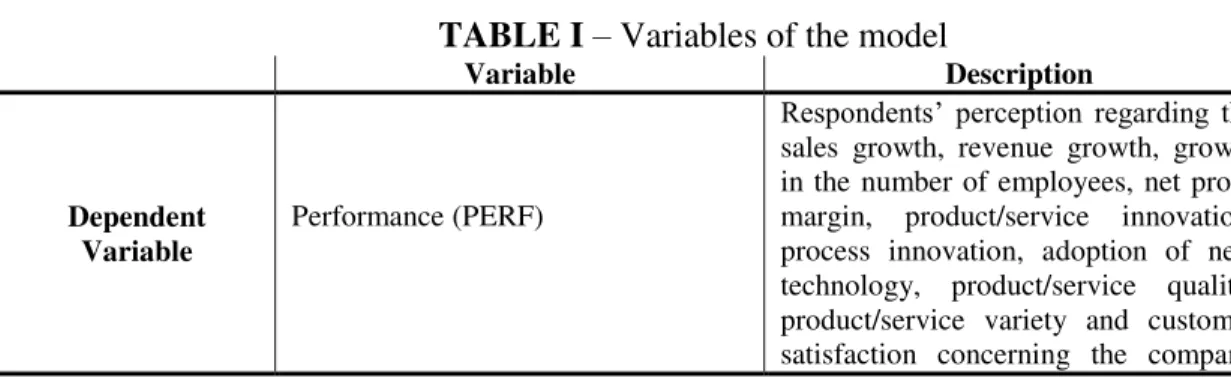
According to the obtained results the following variables were defined (Table I).
TABLE I– Variables of the model
Variable Description
Dependent Variable
Performance (PERF)
Respondents’ perception regarding the
they work for, over the last 3 years and compared to competitor companies. Company overall performance given by the sum of all items.
Independent Variables
Individual related Variables
Narcissism (NPI16) Narcissism score given by the NPI-16 scale.
Hierarchical Position (HPOS)
1 if first-level management; 2 if middle-level management; 3 if top-level management.
Professional Experience (EXP)
1 if up to 5 years; 2 if between 6 and 10 years; 3 if 11 - 15 years; 4if 16 – 20 years; 5 if 21 – 25 years; 6 if 26 – 30 years; 7 if 31 – 35 years; 8 if 36 – 40 years; 9 if more than 40 years.
Weekly working Hours (WWH)
1 if up to 30 hours per week; 2 if 31 – 35 hours; 3 if 36 – 40 hours; 4 if 41 – 45 hours; 5 if 46 hours or more. Exercise (EXE) 0 if does not exercise; 1 if does
exercise
Smoker (SMO) 0 if does not smoke; 1 if smokes
Age (AGE)
1 if up to 19 years old; 2 if 20 – 29 years old; 3 if 30 – 39 years old; 4 if 40
– 49 years old; 5 if 50 – 59 years old; 6 if 60 – 69 years old; 7 if 70 years old or older.
Gender (GEN) 0 if female; 1 if male
Education level (EDU)
1 if up to high school; 2 if undergraduate degree; 3 if master’s degree; 4 if post-graduation; 5 if PhD
Income (INC)
1 if 0-14,999€; 2 if 15,000-29,999€; 3 if 30,000-44,999€; 4 if 45,000
-59,999€; 5 if 60,000-74,999€; 6 if 75,000-89,999€; 7 if 90,000-104,999€; 8 if 105,000€ or more
Company related Variables
Age (CAGE) 1 if 1 year or less; 2 if 1-5 years; 3 if 6-19 years; 4 if 20 years or more
Number of Employees (NEMPL) 1 if 10 or less; 2 if 11-50; 3 if 51-250; 4 if 251 or more employees.
Sector (SECT) 1 if private sector; 2 if public sector; 3 if non-profit sector
Family Business (FAM) 0 if company is not a family business; 1 if is a family business
Has sales in the foreign market (FMRKT)
0 if does not have sales in the foreign market, 1 if has sales in the foreign market
T-tests were performed for independent samples using the IBM SPSS Statistics
software. The objective was to test the equality of means for groups of the variables shown
in Table I and check if the levels of narcissism change.
To investigate the relationship between CEO narcissism and company performance
according to the phrased hypothesis, a multiple linear regression analysis with the robust
option was tested for four models, using the same variables and the STATA statistic
software. The models are presented in equations 1 to 4. Performance is the dependent
variable and the narcissism score given by the NPI-16 scale is the main independent
variable in all four models. Equation 1 concerns only the relation between performance and
narcissism, equation 2 adds as control variables the ones related to the individual
(hierarchical position, professional experience, number of weekly working hours, exercise,
smoking, income, education level, age and gender), equation 3 adds as control variables,
instead, the ones related to the company (company age, number of employees, sector, being
a family business, being part of a business group and having foreign sales) and equation 4
adds both control variables related to the company and the individual. α represents the
constant, β the coefficients to estimate andε is the error term.
4. Results
4.1. Descriptive Statistics
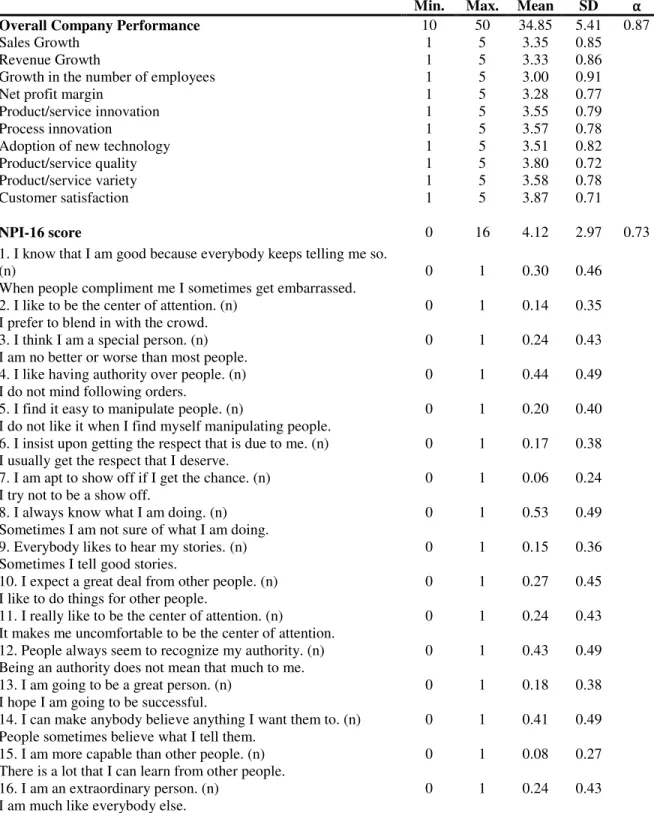
Table II shows the descriptive statistics regarding company performance, the
dependent variable, and narcissism, the main independent variable. For narcissism, each
row displays one of the 16 pairs of statements and the final row represents the final NPI-16
score. It is possible to observe that all dimensions of performance display a positive result,
with a mean of or above 3, meaning that performance in each field is on average
somewhere between similar and better when comparing with competitive companies. The
dimension that displays a lower performance score is growth in the number of employees,
with a mean of 3, and the dimension with a higher performance score is customer
satisfaction, with a mean of 3.87. Overall company performance is on average 34.85. It
should be noted that, since data was collected via a self-reporting questionnaire and this is
perceived performance, the more narcissistic the respondent, the more likely he will
perceive his performance to be better than others, which could explain these very positive
results. Regarding narcissism, the pair of sentences with higher score is I always know what
I am doing/Sometimes I am not sure of what I am doing with a mean of 0.53 and the pair I
am apt to show off if I get the chance/I try not to be a show off has the lower mean of 0.06.
Table II – Descriptive statistics of Company Performance and Narcissism
Min. Max. Mean SD α Overall Company Performance 10 50 34.85 5.41 0.87
Sales Growth 1 5 3.35 0.85
Revenue Growth 1 5 3.33 0.86 Growth in the number of employees 1 5 3.00 0.91 Net profit margin 1 5 3.28 0.77 Product/service innovation 1 5 3.55 0.79 Process innovation 1 5 3.57 0.78 Adoption of new technology 1 5 3.51 0.82 Product/service quality 1 5 3.80 0.72 Product/service variety 1 5 3.58 0.78 Customer satisfaction 1 5 3.87 0.71
NPI-16 score 0 16 4.12 2.97 0.73 1. I know that I am good because everybody keeps telling me so.
(n)
When people compliment me I sometimes get embarrassed.
0 1 0.30 0.46
2. I like to be the center of attention. (n) I prefer to blend in with the crowd.
0 1 0.14 0.35
3. I think I am a special person. (n) I am no better or worse than most people.
0 1 0.24 0.43
4. I like having authority over people. (n) I do not mind following orders.
0 1 0.44 0.49
5. I find it easy to manipulate people. (n)
I do not like it when I find myself manipulating people.
0 1 0.20 0.40
6. I insist upon getting the respect that is due to me. (n) I usually get the respect that I deserve.
0 1 0.17 0.38
7. I am apt to show off if I get the chance. (n) I try not to be a show off.
0 1 0.06 0.24
8. I always know what I am doing. (n) Sometimes I am not sure of what I am doing.
0 1 0.53 0.49
9. Everybody likes to hear my stories. (n) Sometimes I tell good stories.
0 1 0.15 0.36
10. I expect a great deal from other people. (n) I like to do things for other people.
0 1 0.27 0.45
11. I really like to be the center of attention. (n)
It makes me uncomfortable to be the center of attention.
0 1 0.24 0.43
12. People always seem to recognize my authority. (n) Being an authority does not mean that much to me.
0 1 0.43 0.49
13. I am going to be a great person. (n) I hope I am going to be successful.
0 1 0.18 0.38
14. I can make anybody believe anything I want them to. (n) People sometimes believe what I tell them.
0 1 0.41 0.49
15. I am more capable than other people. (n) There is a lot that I can learn from other people.
0 1 0.08 0.27
16. I am an extraordinary person. (n) I am much like everybody else.
0 1 0.24 0.43
Performance and narcissism are positively and significantly correlated. The Pearson
correlation between the two variables is 0.191, for 1% significance level.
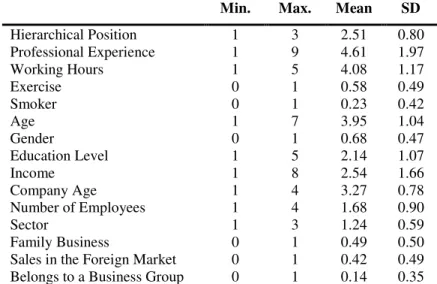
The descriptive statistics of the remaining independent variables are shown in table III.
Table III – Descriptive statistics of independent variables
Min. Max. Mean SD
Hierarchical Position 1 3 2.51 0.80 Professional Experience 1 9 4.61 1.97 Working Hours 1 5 4.08 1.17 Exercise 0 1 0.58 0.49 Smoker 0 1 0.23 0.42
Age 1 7 3.95 1.04
Gender 0 1 0.68 0.47 Education Level 1 5 2.14 1.07 Income 1 8 2.54 1.66 Company Age 1 4 3.27 0.78 Number of Employees 1 4 1.68 0.90 Sector 1 3 1.24 0.59 Family Business 0 1 0.49 0.50 Sales in the Foreign Market 0 1 0.42 0.49 Belongs to a Business Group 0 1 0.14 0.35
Note: N = 1105; Min. is the minimum; Max. is the maximum; SD is standard deviation
To perform the t-tests and regression, the variables Hierarchical Position, Professional Experience, Weekly Working Hours, Age, Income and Number of Company Employees were recoded to better estimate the models (Table IV shows the recoded variables).
Table IV – Recoded Variables
Variable Description
Hierarchical Position (HPOS) 1 if lower-level manager; 2 if top-level manager. Professional Experience (EXP) 1 if up to 20 years; 2 if more than 20 years.
Weekly working Hours (WWH) 1 if up to 40 hours per week; 2 if more than 40 hours. Age (AGE) 1 if up to 40 years old; 2 if more than 40 years old.
Education level (EDU) 1 if up to undergraduate degree; 2 if above undergraduate degree.
Income (INC) 1 if less than 30,000€; 2 if 30,000€ or more.
4.2. T-tests
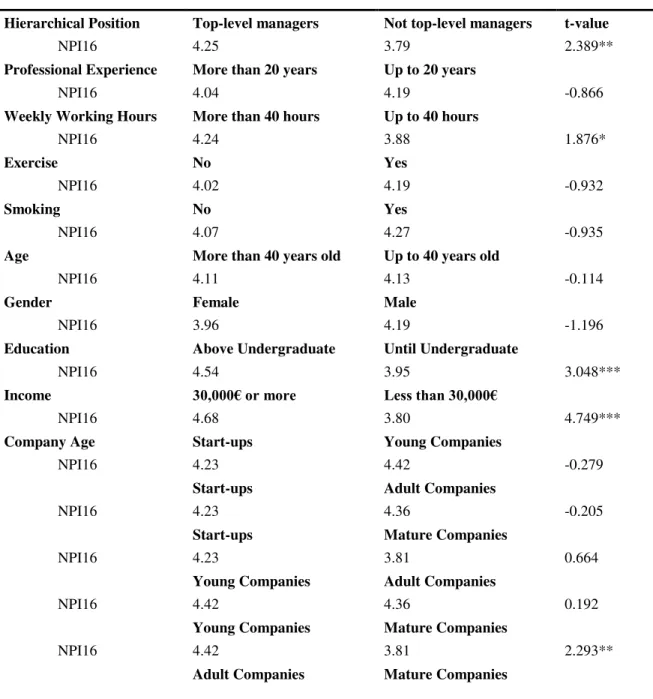
The t-tests compared means of groups of variables in order to determine if there
were significant differences in the level of narcissism. Table V shows the mean and t-value
for the different variables. The null hypothesis is the equality of means between the groups
of variables.
Table V – t-tests
Hierarchical Position Top-level managers Not top-level managers t-value
NPI16 4.25 3.79 2.389**
Professional Experience More than 20 years Up to 20 years
NPI16 4.04 4.19 -0.866
Weekly Working Hours More than 40 hours Up to 40 hours
NPI16 4.24 3.88 1.876*
Exercise No Yes
NPI16 4.02 4.19 -0.932
Smoking No Yes
NPI16 4.07 4.27 -0.935
Age More than 40 years old Up to 40 years old
NPI16 4.11 4.13 -0.114
Gender Female Male
NPI16 3.96 4.19 -1.196
Education Above Undergraduate Until Undergraduate
NPI16 4.54 3.95 3.048***
Income 30,000€ or more Less than 30,000€
NPI16 4.68 3.80 4.749***
Company Age Start-ups Young Companies
NPI16 4.23 4.42 -0.279
Start-ups Adult Companies
NPI16 4.23 4.36 -0.205
Start-ups Mature Companies
NPI16 4.23 3.81 0.664
Young Companies Adult Companies
NPI16 4.42 4.36 0.192
Young Companies Mature Companies
NPI16 4.42 3.81 2.293**
NPI16 4.36 3.81 2.830***
Number Employees Large Companies SME
NPI16 4.25 4.11 0.372
Sector Private Public
NPI16 4.23 3.42 2.714*
Private Non-profit
NPI16 4.23 3.53 2.439**
Public Non-profit
NPI16 3.42 3.53 -0.273
Family Business No Yes
NPI16 4.08 4.15 -0.380
Part of Business Group No Yes
NPI16 4.07 4.42 -1.359
Foreign Sales No Yes
NPI16 3.95 4.35 -2.189**
Company Performance Higher Lower
NPI16 4.54 3.61 5.274***
Note: *, ** and *** indicate significance levels of 10%, 5% and 1%, respectively.
The null hypothesis is rejected for the variables hierarchical position, weekly
working hours, education level, income level, having sales in the foreign market and
company performance. The same happens concerning company age but only when
regarding mature companies and company sector regarding only the private sector. For
these variables the difference of means is statistically significant, implying differences in
the levels of narcissism. The results regarding income support the literature that indicates
more narcissistic CEOs receive a higher compensation (Ham et al., 2014). There are some
surprising results, for example, there is a significant difference between the level of
narcissism and the education level groups. Regarding company performance, there is also a
Additionally, some t-tests were performed on some of the other variables obtained
in the questionnaire (Annex III). For sense of control, socio-economic status and authority
the null hypothesis is also rejected and the difference in means is statistically significant.
4.3. Linear Regression Models
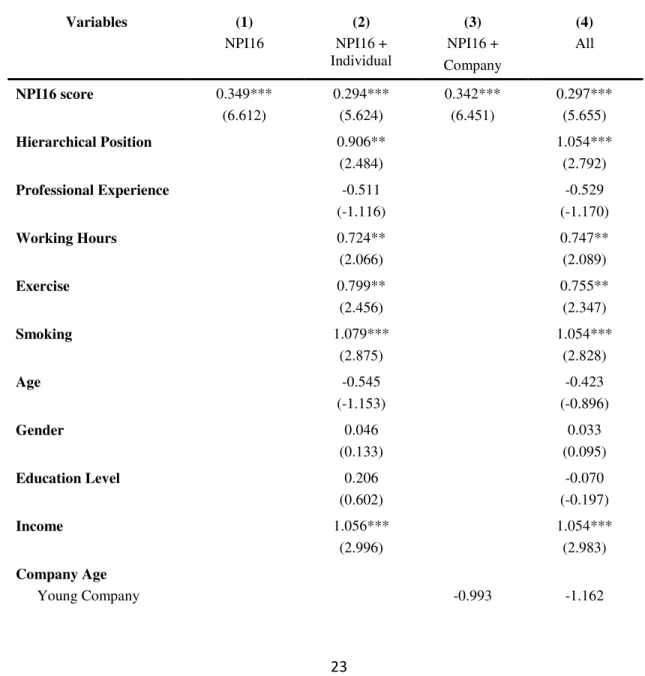
Table VI shows the results of the linear regressions, with company performance as
the only dependent variable. Each column shows the results for the corresponding equation.
Table VI – Linear Regression Model Results
Variables (1)
NPI16 (2) NPI16 + Individual (3) NPI16 + Company (4) All
NPI16 score 0.349*** (6.612) 0.294*** (5.624) 0.342*** (6.451) 0.297*** (5.655)
Hierarchical Position 0.906** (2.484)
1.054*** (2.792)
Professional Experience -0.511 (-1.116)
-0.529 (-1.170)
Working Hours 0.724** (2.066)
0.747** (2.089)
Exercise 0.799** (2.456)
0.755** (2.347)
Smoking 1.079*** (2.875)
1.054*** (2.828)
Age -0.545
(-1.153)
-0.423 (-0.896)
Gender 0.046 (0.133)
0.033 (0.095)
Education Level 0.206 (0.602)
-0.070 (-0.197)
Income 1.056*** (2.996)
1.054*** (2.983)
Company Age
(-0.908) (-0.972)
Adult Company -2.345**
(-2.215)
-2.257* (-1.932)
Mature Company -2.366** (-2.252)
-2.242* (-1.920)
Number of Employees 0.560 (0.896)
0.452 (0.701)
Sector
Public Sector 0.442
(0.620)
0.824 (1.130)
Non-Profit Sector 1.409** (2.203)
1.915*** (2.929)
Family Business -0.432 (-1.247)
-0.259 (-0.770)
Foreign Sales 0.816** (2.322)
0.744** (2.085)
Business Group 0.137 (0.272)
0.117 (0.235)
Constant 33.415*** (122.397) 30.091*** (28.953) 34.662*** (28.031) 31.163*** (19.017)
Observations 1,105 1,105 1,105 1,105
R-squared 0.037 0.074 0.060 0.096
Prob>F 0.000 0.000 0.000 0.000
Note: Columns 1 to 4 show the results of the four equations tested. Performance is the dependent variable in all models. In equation 1, narcissism is the only explanatory variable, in equation 2 the dependent variables are narcissism and all the individual related variables (hierarchical position, professional experience, number of weekly working hours, exercise, smoking, income, education level, age and gender), in equation 3 the dependent variables are narcissism and all the company related variables (company age, number of employees, sector, being a family business, being part of a business group and having foreign sales) and equation 4 considers, besides narcissism, both individual and company related variables as dependent variables. α represents the constant, β the coefficients to estimate and ε is the error term. Robust t-statistics in parenthesis.
*, ** and *** indicate significance levels of 10%, 5% and 1% respectively.
In all estimated regressions, narcissism shows a positive association with company
performance. The values of the estimated narcissism coefficient range from 0.294 to 0.349
in the four equations. The highest value is obtained in equation 1, when narcissism is the
only independent variable. This is not probably a very reliable value since narcissism is not
coefficient is given in equation 3, where the control variables are only the company related
variables. Besides narcissism, in regression 3, company sector and having foreign sales are
also positively associated with performance. Company age, when concerning adult and
mature companies, is negatively associated with performance. The lowest value is obtained
in equation 2, where narcissism is linked to the individual. Some of the individual related
variables, like hierarchical position, weekly working hours, exercise, smoking and income
are also positively associated with performance. Equation 4, which joins individual related
and company related variables as controls, has the coefficient for narcissism with the
second lowest value. Hierarchical position, weekly working hours, exercising, smoking,
income, company sector and foreign sales are once again positively related to performance
and company age is negatively associated. These results point to the likelihood of CEO
characteristics affecting the impact of narcissism on performance more than company
characteristics. This would explain the lower values present in equations 2 and 4 that use
individual related variables. Still, in all four regressions, the relation between narcissism
and company performance is always positive and significant, for a 1% level. The proposed
hypothesis is, then, rejected.
The fact that income is positively associated with performance may provide further
support to the prospect of more narcissism implying better performance, since previous
literature shows that more narcissistic CEOs demand a higher compensation (Ham et al.,
2014). However, the results contradict the tendency in literature to label narcissism as a bad
personality trait (Hogan & Kaiser, 2005); CEO narcissism appears to make company
performance increase. It may be one example of the perks of hiring a narcissistic CEO
other authors associate with these CEOs (Chatterjee & Hambrick, 2007) but that might not
translate in a continual higher performance. Additionally, it is important to remember that
the measure of performance used is a self-perceived one and narcissistic individuals are
likely to rate their performance above others’ (Campbell et al., 2004). Taking this into
account, the obtained positive relation between narcissism and self-reported performance
could be anticipated. But these results should be interpreted with some caution. It is
possible that if using an objective measure of performance, the results might not be the
same.
This study points to a different reality in what concerns the relation between
narcissism and company performance and the obtained results confirm the tendency of
narcissists to give a high rating to their performance. Other studies about the effect of
narcissistic CEOs on the company use signature size or other unobtrusive measures as the
measure of narcissism (Chatterjee & Hambrick, 2007; Ham et al., 2014; Ham et al., 2015).
This study marks a difference by using the NPI, a self-reporting measure of narcissism, and
innovates by introducing this topic into Portuguese companies, constituting a starting point
for further research on this matter.
5. Conclusions
5.1. Final Conclusions
CEOs’ decisions and actions reflect a great deal of themselves and their
personalities. From the composition of the team they work with, to the way they
communicate and what kind of information they release within the company and to the
CEOs act. Despite being an independent personality trait, narcissism is mostly perceived as
a disorder and part of the dark side of personality. This bad reputation causes it to be a
sensitive and hard to approach topic and so studies about it are not too abundant. Still, it is
one of the features that stands out more in a person and is more noticed by others. Also, in
the business world, narcissistic CEOs are still being hired to lead and be the face of the
company to the world, enjoying a higher compensation than non-narcissistic ones. Thus,
the importance and interest in studying these executives and their effect on company
performance. More studies concerning narcissism may help fight the preconceived ideas
surrounding it and also provide academics and companies with better information regarding
its effect.
Following the literature review and using a linear regression model to study the
possible relation with company performance, 16 variables were studied: 10 individual
related variables (narcissism, hierarchical position, professional experience, weekly
working hours, exercising, smoking, education level, income, age and gender) and 6
company related (company age, number of employees, sector of activity, being part of a
family business, having sales in the foreign market and being part of a business group).
Narcissism was measured using the NPI-16 scale created by Ames et al. (2005) and
company performance using the self-reporting scale created by Wiklund & Shepherd
(2003). Data for both was collected through a questionnaire held online; the link was sent
via an e-mail directed to CEOs to a set of companies whose contact was given by Informa
D&B.
Results show that differences in the individual’s hierarchical position, working
regarding the company, for age, sector and sales in the foreign market. From these variables
only income shows a result which is consistent with the studied literature (Ham et al., 2014)
and education level is the most surprising one to relate with higher levels of narcissism.
Regarding the relationship between company performance and narcissism, results point to
the two variables being positively associated and lead to the rejection of the phrased
hypothesis. On one hand, this result could be expected since literature has not reached an
agreement yet, regarding the effect of CEO narcissism on performance but, on the other
hand, this trait is associated with the dark side of personality (Hogan & Kaiser, 2005)
which makes it a rather unexpected result. From the other variables present in the model,
hierarchical position, weekly working hours, income, exercising and having sales in the
foreign market were also found to be positively associated and company age negatively
associated with company performance.
5.2. Limitations and Future Research
Some limitations of this study are connected to the method used for collecting data,
the questionnaire. The low response rate of the questionnaire (7.37%) and the fact that,
despite having requested it to be answered only by CEOs, it is not possible to ensure that it
was not done by people in other positions within the company, are the most noticeable. The
performance scale used can also be pointed as a limitation to the study, since it was a
self-reporting and self-perception scale. This may be the cause for such high values of
performance, since narcissistic individuals are likely to perceive their performance as better
than others and fail to admit bad results. So results should be interpreted carefully.
constitute a limitation, since companies are less willing to provide such detailed
information and the confidentiality factor would be lost. These could be interesting points
for future research to try to overcome. In this dissertation the industry of the company was
not discriminated, it could also be interesting to study the levels of narcissism and
performance by industry in the Portuguese case (following the work done by Chatterjee &
6. References
Adler, N. E., Epel, E. S., Castellazzo, G. & Ickovics, J. R. (2000). Relationship of
subjective and objective social status with psychological and physiological functioning:
Preliminary data in healthy white women. Health Psychology, 19, 586-592.
Aktas, N., De Bodt, E., Bollaert, H. & Roll, R. (2012). CEO narcissism and the
takeover process: From private initiation to deal completion. AFA 2012 Chicago Meetings
Paper.
American Psychiatric Association. (2013). Diagnostic and Statistical Manual of
Mental Disorders (DSM-5®). American Psychiatric Pub.
Amernic, J. H. & Craig, R. J. (2010). Accounting as a facilitator of extreme
narcissism. Journal of Business Ethics, 96(1), 79-93.
Ames, D. R., Rose, P. & Anderson, C. P. (2006). The NPI-16 as a short measure of
narcissism. Journal of Research in Personality, 40(4), 440-450.
Anderson, C., John, O. P. & Keltner, D. (2012). The personal sense of power.
Journal of Personality, 80, 313-344.
Armor, D., (2002). A 15-item short version of the NPI. Unpublished manuscript.
Barry, C. T., Frick, P. J. & Killian, A. L. (2003). The relation of narcissism and
self-esteem to conduct problems in children: A preliminary investigation. Journal of Clinical
Child and Adolescent Psychology, 32(1), 139-152.
Ben-David, I., Graham, J. R. & Harvey, C. R. (2007). Managerial Overconfidence
and Corporate Policies (No. w13711). National Bureau of Economic Research.
Boal, K. B. & Hooijberg, R. (2001). Strategic leadership research: Moving on. The
Brennan, N. M. & Conroy, J. P. (2013). Executive hubris: the case of a bank
CEO. Accounting, Auditing & Accountability Journal, 26(2), 172-195.
Bressert, S. (2016). Narcissistic Personality Disorder Symptoms. Psych Central.
Retrieved on September 2, 2016, from
http://psychcentral.com/disorders/narcissistic-personality-disorder-symptoms/
Brown, A. D. (1997). Narcissism, identity, and legitimacy. Academy of
Management Review, 22(3), 643-686.
Cai, H., Kwan, V. S. & Sedikides, C. (2012). A sociocultural approach to
narcissism: The case of modern China. European Journal of Personality, 26(5), 529-535.
Cameron, K. (1978). Measuring organizational effectiveness in institutions of
higher education. Administrative Science Quarterly, 604-632.
Campbell, W. K., Goodie, A. S. & Foster, J. D. (2004). Narcissism, confidence, and
risk attitude. Journal of Behavioral Decision Making, 17(4), 297-311.
Carpenter, M. A., Geletkanycz, M. A. & Sanders, W. G. (2004). Upper echelons
research revisited: Antecedents, elements, and consequences of top management team
composition. Journal of Management, 30(6), 749-778.
Chatterjee, A. & Hambrick, D. C. (2007). It's all about me: Narcissistic chief
executive officers and their effects on company strategy and performance. Administrative
Science Quarterly, 52(3), 351-386.
Conger, J. A. (1990). The dark side of leadership. Organizational Dynamics,19(2),
44-55.
DeVellis, R. F. (1991). Scale Development: Theory and Applications. Newbury
Park, CA: Sage Publications.
Dickinson, K. A. & Pincus, A. L. (2003). Interpersonal analysis of grandiose and
vulnerable narcissism. Journal of Personality Disorders, 17(3), 188.
Dikolli, S. S., Keusch, T., Mayew, W. J. & Steffen, T. D. (2014). Using Shareholder
Letters to Measure CEO Integrity. Available at SSRN 2131476.
DuBrin, A. (2011). Essentials of Management. Nelson Education.
Ellis, H. (1898). Auto-Erotism. Alienist and Neurologist.
Emmons, R. A. (1984). Factor analysis and construct validity of the narcissistic
personality inventory\. Journal of Personality Assessment, 48(3), 291-300.
Emmons, R. A. (1987). Narcissism: Theory and Measurement. Journal of
Personality and Social Psychology, 52, 11-17
Finkelstein, S. & Boyd, B. K. (1998). How much does the CEO matter? The role of
managerial discretion in the setting of CEO compensation. Academy of Management
Journal, 41(2), 179-199.
Finkelstein, S. & Hambrick, D. C. (1996). Strategic Leadership: Top Executives
and Their Effects on Organizations. South-Western Pub.
Freud, S. (1916). The history of the psychoanalytic movement. The Psychoanalytic
Review (1913-1957), 3, 406.
Goldstein, H. W. & Smith, D. B. (1995). The ASA Framework: An Update.
Goncalo, J. A., Flynn, F. J. & Kim, S. H. (2010). Are two narcissists better than
one? The link between narcissism, perceived creativity, and creative
performance. Personality and Social Psychology Bulletin, 36(11), 1484-1495.
Ham, C. C., Lang, M. H., Seybert, N. & Wang, S. (2015). CFO Narcissism and
Financial Reporting Quality. Robert H. Smith School Research Paper No. RHS,2581157.
Ham, C. C., Seybert, N. & Wang, S. (2014). Narcissism is a bad sign: CEO
signature size, investment, and performance. UNC Kenan-Flagler Research Paper,
(2013-1).
Hambrick, D. C. & Mason, P. A. (1984). Upper echelons: The organization as a
reflection of its top managers. Academy of Management Review, 9(2), 193-206.
Hayward, M. L. & Hambrick, D. C. (1997). Explaining the premiums paid for large
acquisitions: Evidence of CEO hubris. Administrative Science Quarterly, 103-127.
Hendin, H. M. & Cheek, J. M. (1997). Assessing hypersensitive narcissism: A
reexamination of Murray's Narcism Scale. Journal of Research in Personality,31(4),
588-599.
Hilary, G. & Hsu, C. (2011). Endogenous overconfidence in managerial
forecasts. Journal of Accounting and Economics, 51(3), 300-313.
Hirshleifer, D., Low, A. & Teoh, S. H. (2012). Are overconfident CEOs better
innovators?. The Journal of Finance, 67(4), 1457-1498.
Hogan, R. & Kaiser, R. B. (2005). What we know about leadership. Review of
Hoonakker, P. & Carayon, P. (2009). Questionnaire Survey Nonresponse: A
Comparison of Postal Mail and Internet Surveys. International Journal of
Human-Computer Interaction 25 (5), 348-373.
John, O. P. & Robins, R. W. (1994). Accuracy and bias in self-perception:
individual differences in self-enhancement and the role of narcissism. Journal of
Personality and Social Psychology, 66(1), 206.
Judge, T. A., LePine, J. A. & Rich, B. L. (2006). Loving yourself abundantly:
relationship of the narcissistic personality to self-and other perceptions of workplace
deviance, leadership, and task and contextual performance. Journal of Applied
Psychology, 91(4), 762.
Kernis, M. H. (2005). Measuring self‐esteem in context: The importance of stability
of self‐esteem in psychological functioning. Journal of Personality,73(6), 1569-1605.
Kernis, M. H. & Sun, C. R. (1994). Narcissism and reactions to interpersonal
feedback. Journal of Research in Personality, 28(1), 4-13.
Lakey, C. E., Rose, P., Campbell, W. K. & Goodie, A. S. (2008). Probing the link
between narcissism and gambling: the mediating role of judgment and decision‐making
biases. Journal of Behavioral Decision Making, 21(2), 113-137.
Lenzenweger, M. F., Lane, M. C., Loranger, A. W. & Kessler, R. C. (2007).
DSM-IV personality disorders in the National Comorbidity Survey Replication. Biological
Libby, R. & Rennekamp, K. (2012). Self‐serving attribution bias, overconfidence,
and the issuance of management forecasts. Journal of Accounting Research, 50(1),
197-231.
Likert, R. (1932). A technique for the measurement of attitudes. Archives of
Psychology 22 (140), 1-55.
Maccoby, M. (2003). The Productive Narcissist: The Promise and Peril of
Visionary Leadership. Broadway Books.
Malmendier, U. & Tate, G. (2005a). CEO overconfidence and corporate
investment. The Journal of Finance, 60(6), 2661-2700.
Malmendier, U. & Tate, G. (2005b). Does overconfidence affect corporate
investment? CEO overconfidence measures revisited. European Financial
Management, 11(5), 649-659.
Malmendier, U. & Tate, G. (2008). Who makes acquisitions? CEO overconfidence
and the market's reaction. Journal of Financial Economics,89(1), 20-43.
Maxwell, J. C. (1993). Developing the Leader Within You. Thomas Nelson Inc.
Miller, J. D., Hoffman, B. J., Gaughan, E. T., Gentile, B., Maples, J. & Keith
Campbell, W. (2011). Grandiose and vulnerable narcissism: A nomological network
analysis. Journal of Personality, 79(5), 1013-1042.
Murray, A. (2010). The Wall Street Journal Essential Guide to Management:
Lasting Lessons from the Best Leadership Minds of our Time. Harper Collins.
Naldi, L., Nordqvist, M., Sjöberg, K. & Wiklund, J. (2007). Entrepreneurial
orientation, risk taking, and performance in family firms. Family Business Review, 20(1),