Finite element investigation on the behaviour of structural steel beams
subjected to standard & parametric fire
1
A. KADA,
1B. LAMRI,
1N. BENLAKEHAL,
2L.M.R. MESQUITA,
3*A. BOUCHAIR
1LSGR Structures, Geotechnics & Risks Laboratory, Hassiba Benbouali University of Chlef, Faculty of Civil Engineering &Architecture, BP 151, Chlef 02000, [email protected], [email protected], [email protected]
1 Polytechnic Institute of Bragança, Campus Sta Apolónia Apartado 1134, 5300-857 Bragança, Portugal, [email protected] *CNRS, UMR 6602, 3Institut Pascal, BP 10448, 63000 Clermont Ferrand, France, [email protected]
Abstract
This paper intends to present an investigation of the behaviour of steel beams under high temperatures rise due to fire using finite elements simulations with ANSYS software. Cases of study for solid as well as open web beams are considered and take into account uniform and transient temperature rise, material and geometric non-linear behaviour. Input fire scenarios are standard temperature-time curve ISO834 and parametric compartment fire model based upon Eurocode EN 1991-1-2. For the latter a comparison is made using the experimental results from BRE-Cardington tests data. Thermal and mechanical analysis is done using the effect of temperature dependent material properties and the Eurocode recommendations in estimating reduction mechanical steel properties. Three types of cellular beams are studied and the number of cells is shown to be critical for their behaviour under fire conditions. Results are related to temperature profiles in steel beam cross-sections, variation of displacements with respect to temperature change and critical temperatures.
Keywords: Finite element, ISO834 fire, parametric fire, solid beam, open web beam, cellular beam. Résumé
Cet article présente une recherche sur le comportement des poutres en acier sous hautes températures dues à l’incendie en utilisant des simulations par éléments finis avec le logiciel ANSYS. Des cas d'étude pour les poutres à âme pleine aussi bien que les poutres à âme ouvertes sont considérés et tiennent compte de la température d'échauffement uniforme et transitoire, du comportement non linéaire matériel et géométrique. Les entrées en données des scénarios de feu sont la courbe standard ISO834 de température-temps et le modèle paramétrique du feu de compartiment basé sur l’Eurocode EN 1991-1-2. Pour ce dernier, une comparaison est faite en utilisant les résultats expérimentaux à partir des essais de BRE-Cardington. Les analyses thermique et mécanique sont faites en utilisant l'effet de la température sur les propriétés matérielles et les recommandations de l'Eurocode en estimant la dégradation des propriétés mécaniques de l’acier. Trois types de poutres cellulaires ont été étudiés et le nombre de cellules s'avère critique pour leur comportement sous incendie. Des résultats sont liés aux profils de température dans des sections de poutres en acier, à la variation des déplacements en tenant compte du changement de température et aux températures critiques.
Mots-clés : Élément fini, Feu ISO834, Feu paramétrique, poutre à ame pleine, poutre à ouverture d’âme , poutre cellulaire.
1.Introduction
It is well known that steel among all materials, suffers a great reduction of yield stress and Young’s modulus, under the effect of high temperatures [1,2]. Remarkable progress has been made during the last decade, in understanding the parameters which influence the development of building fires, and also the behaviour of fire exposed structural materials and structures [3-5]. In particular, for steel
structures, this progress has resulted in detailed rules for the design and calculation of structural steel beam behaviour and load bearing capacity in fire [3, 6]. The failure of steel beam is reached when its strength is exceeded at one or more particular points termed plastic hinges, depending on the way it is supported [5, 6]. Extensive research has been carried out in recent years on the numerical simulation using finite element method (FEM) [3-7] as an alternative to the original plastic hinge analysis method. Moreover, when dealing with open cross-section castellated and cellular beams significant phenomenon of collapse
Nature & Technologie
Nature & Technologie
Soumis le : 15 Mars 2015Forme révisée acceptée le : 14 Mai 2015 Email de l'auteur correspondant
under ambient temperatures [11-14]. Under fire conditions, studies were solid beams dedicated [5, 6] and other projects considering heated cellular beams cases seeking for a good understanding their performance as isolated members or in redundant structures[9]. However there is a need still for research work based on FE analysis to study steel beams under such conditions. In this paper 3- node quadrature finite element “BEAM189” , shell finite element as 4-node SHELL131 four thermal analysis and 4-node structural SHELL181models are used for solid beam and open web cellular beam under uniform and transient temperature effect respectively. The primal model uses available real fire Cardington compartment test results [9-11] for lateral displacement data and compared with results from ISO 834 and parametric fire curves.
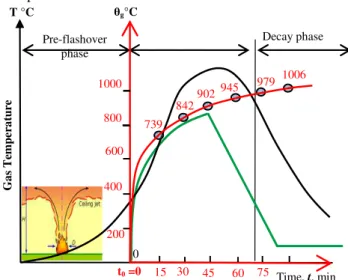
Fig. 1. Fire curves – 3 phases real fire vs ISO 834 & compartment fire model
2.Fire curves
The ISO 834 standard fire curve [1], represents a single phase ever rising gas temperature θ in o
C
, at time t inminutes. Unlike the standard fire curve, a natural fire curve is characterized by 3 phases: a pre-flashover phase, a fully developed phase and a decay phase (Fig.1). Most structural damage occurs during the fully developed fire phase and only the fully developed fire phase and the decaying phase are taken into account. The reference time t0, figure 1, is regarded as the origin of the temperature-time coordinate system, corresponding to the point of flashover.
3.Eurocode parametric compartment fire models
The parametric fire modelling requires [8,10] three parameters qtd, O and b namely, the design fire load density, the opening factor that accounts for the openings in the vertical walls and the parameter which accounts for thermal properties of the enclosure respectively to deduce Eurocode parametric temperature-time curves [1, 8].
3.1.Input data for BRE-Cardington compartment fire tests
The following is a case of study from the BRE’s-Cardington fire tests on eight storeys steel-framed building, (33m) steel framed construction with five bays (5x9m=45m) by three bays (6+9+6=21m) in plan [8-9]. Table 1 summarises Test3 data for parametric fire curve model.
Table 1: Data compartment fires Area
enclosure
“At”
Floor Area
“Af”
Area of vert. Enclosure “A v” Opening factor “O” Height “H”
Aver. height of openings
“heq”
Material Enclosure
295 m2 76 m2 7 m2 0.031m1/2 4.0 m 1.8m ρ :1900 kg/m
3 C :840J/kgK
λ: 1.0 W/mK
The design value of the fire load is calculated based on the characteristic value of 805 MJ/m2 and the equation as defined in the annex A EN 1991-1-2 [1], which gives a calculated design value of the fire load qfd of 483 MJ/m2.
3.2.Parametric fire curves of Cardington fire tests and steel beams temperature profiles
Parametric fire recommended in EN 1991-1-2 [1], is used to simulate both compartment tests 3 and 6 and equations in the heating and cooling phases.
) 472 . 0 204 . 0 324 . 0 1 ( 1325
20 0.2(0.506.) 1.7(0.506.) 19(0.506.) ) ( t t t HOT
g e e e
− − − − − − + = θ ) 405 . 0 506 . 0 ( 625 813 )
(COOL = − t−
g
θ
(1)
Plots of fire compartment curves together with ISO standard fire are shown in figure 2.
3.3.FE Modelling of Cardington beams under uniform temperatures
The response of structural steel members under fire conditions is governed by mechanical, thermal properties and deformations [2, 3]. A 6m span primary beam 356x171x51 UB with steel materials S275 taken as a provision for high strength requirement. The temperature profiles for beam-section in the compartment fire are shown in figure 2. The uniformly distributed fire design load Pfi,d is calculated with a load factor η=0.6.
45 60
θg°C
Time, t, min Decay phase Pre-flashover phase T °C G a s T em p er a tu re 1000 800 600 400 200 739
842 902
945 979 1006
t0 =0 0
0 , 2 ,
.
.
8
M y y pl d
fi
f
W
l
P
γ
η
=
(2)
Fig. 2. Parametric fire curve vs. ISO834
Fig. 3. Finite Element BEAM189 model
The BEAM189 element is adopted for analysing the solid Cardington beam. It is based on Timoshenko beam
theory which includes shear-deformation effects. The element is a quadratic three-node beam element in 3-D and can accommodate for body load temperatures and allow for nonlinear large displacement analyses.
The critical temperature θa,cr at time t for a uniform temperature distribution in a member is determined for any degree of utilization µ0 at time t=0 [2]:
482 1 833 . 3 0 967 . 0
1 ln
19 . 39
, = − +
µ θ
cr
a
(°C) (3)
With µ0=k1.k2.η ; k1=0.7 and k2=1 adaptation factors, for non-uniform temperature on the section and along the beam respectively.
4.FE Thermo-mechanical analysis of steel beams with
open-web cross section
4.1.Heat transfer into parent solid and cellular beams
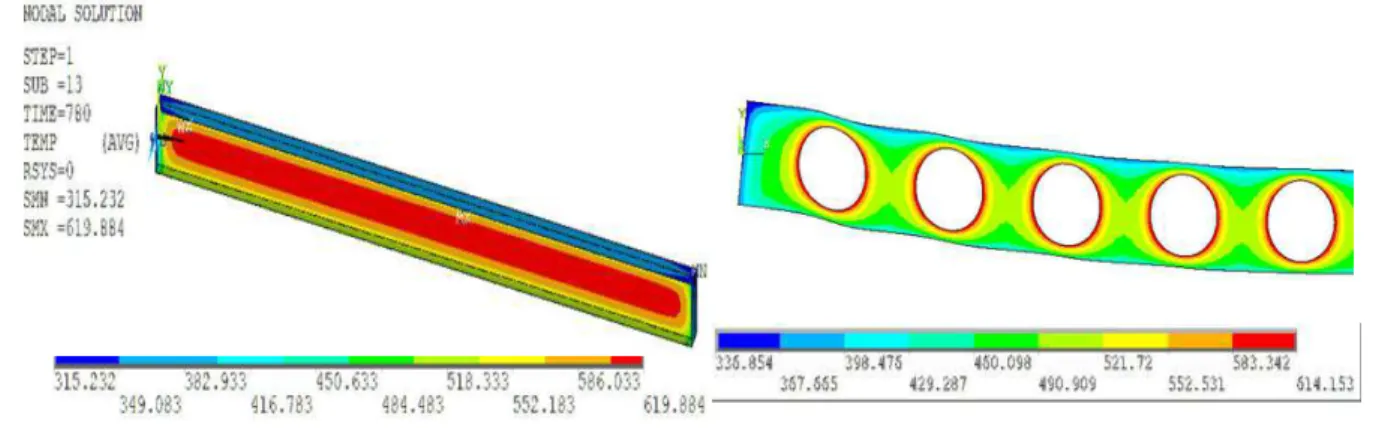
In this part of study, steel beams are exposed on three sides assuming that top flange will support a concrete slab and temperature in a steel member isn’t evenly distributed within the across section. Finite element heat transfer simulations yield non-uniform temperatures since the web and bottom flange have greater exposed perimeter. A parent solid beam IPE500 and three types of cellular beams BEAMCELL1, BEAMCELL2 and BEAMCELL3 with diameter cells of 38 cm and number of cells 10, 12 and 16 respectively are studied. Thermal SHELL131 four nodes finite element is used for the simulations and accounts for radiation with the emissivity coefficient εr of 0.7 and convection αc being 4 W/m2K and 25 W/m2K for room and fire temperatures respectively [3].
Fig. 4. Contour temperatures in parent Solid Beam IPE500 and BEAMCELL1 (b) Cross-section finite elements
(a) BEAM189 Geometry
θcritical
620°C
Compartment - -Beam Section 356x171x51 UB TEST3 -Compartment
- -Beam Section 305x165x40 UB
ISO 834 GasTemperature
Steel Section
4.2.Mechanical behaviour of cellular beams
The steel beams are S355, 7m span simply supported and all applied critical loads are uniformly distributed and
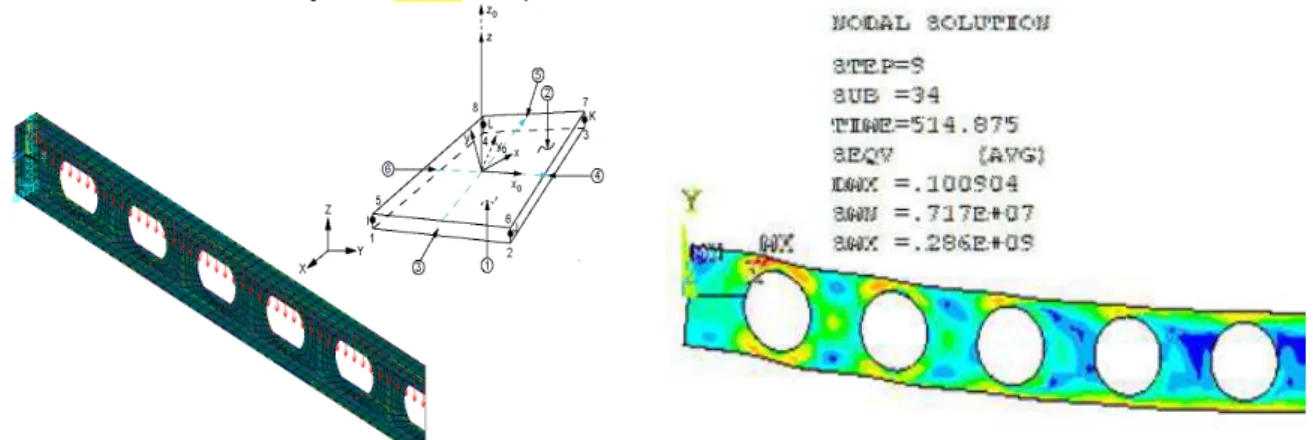
load coefficient ηfi of 0.6. Structural 4-node SHELL181 finite element model Figure5 is generated throughout the different beams with nonlinear material and large displacement behaviour considered in the analyses.
Fig. 5. BEAMCELL1 structural F.E. model and Virendeel mechanism
5.Results and discussion
For the case of parametric compartment fire analysis results are presented comparison is made with ISO curve and Cardington fire model curves as well as variations of steel, figure 2. Figure6 shows that parametric model is a better fit to the prediction of the structural response of the steel beam.
Table 2: Cardington Solid-Beam temperatures
A maximum vertical displacement of 55 cm is reached for a critical temperature 698°C, table2.
Ksh[Am/V] (m-1) 135.8 Θg/Θa max
(°C)
EC3 813/803 Cardington
(Experimental) 1010/852
Θcrit (°C) Parametric ISO834 620 698
timecrit /timemax[min] 20/48 Fig. 6. Mid-Span Vertical displacements.
M
id
-s
p
a
n
v
er
ti
ca
l
d
is
p
la
ce
m
en
t
(m
)
Time (Min)
ISO 834
Parametric Fire θcr=698°C
Cardington
A
B C
EC3
Fig. 7. Parent Solid-Beam:Temperature profiles
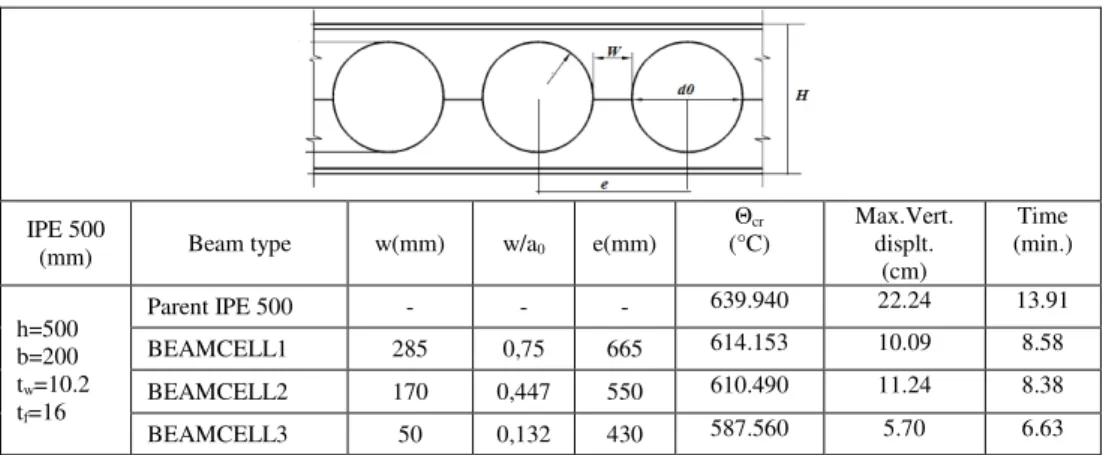
Results from thermo-mechanical analyses of cellular beams, in the form of critical temperatures and times are summarised in table 3.
Table 3: Cellular beams structural fire analysis results
For all three cases of cellular beams the main failure mode is a Vierendeel collapse mechanism in which plastic hinges form at the section touching the four re-entrant corners of the cells.
The fundamental assumption that is the relationship between the shear stress and bending stress being expressed in terms of the Von Mises’s yield criterion is clearly justified figure 5 .The higher the number of cells the smaller is the critical temperature and hence low fire resistance for the smallest value of w/a0, table 3. Variations of vertical displacements are shown in figure 8 with maximum values presented in table 3.
6.Conclusion
The present paper investigates the structural behaviour of steel solid and open cross-section beams under standard and natural fires using finite elements simulations. The study shows that Eurocode parametric fire models established for the case of Cardington solid beam gives good description for both the heating and the cooling phase. The Eurocode parametric fire model yields a better estimate to the vertical displacement compared to ISO 834.
For the purpose of a better understanding of the behaviour of open cross-section steel beams under fire conditions, numerical finite element modelling helped to work out major design parameters. These are namely, critical load, critical temperature, maximum displacement and type of failure mechanisms encountered during the structural beam response under fire. For the cellular beam cases of study the simulations captured the most important mode that is Vierendeel mode where shear forces are high. Finite element analyses of open-web steel section showed
great complications as the trend behaviour of the beam lead in some cases to premature terminations which may be caused by some instability.
References
[1] EN 1991-1-2:2002 Eurocode 1: Actions on structures – Part 1 2: General actions. Actions on structures exposed to fire
[2] EN 1993-1-2:2005 Eurocode 3. Design of steel structures. General rules. Structural fire design
[3] Saab HA, Nethercot DA. Modelling of steel frame behaviour under fire conditions. Eng Struct 1991; 13:371–82.
[4] N. Benlakehal, A. Kada, B. LAMRI, B. Achour, Protection des structures métalliques sous l’effet d’incendie : Application du transfert de chaleur dans les profilés selon l’Eurocode 3, ALGERIE Equipement, Revue Technique de l’Ecole Nationale Supérieure des Travaux Publics, N°47 Mai 2010.
[5] Abdelhak KADA, Belkacem LAMRI, Nourredine BENLAKEHAL, Belkacem ACHOUR, Abdelhamid Bouchaïr, Analyse non-linéaire de poutres métalliques PRS de longues travées sous l’effet de hautes températures dues à l’incendie, Revue Nature & Technologie, A-Sciences fondamentales et Ingénierie, N°8, Janvier 2013, pp. 27-34 [6] Mesquita L.M.R. , P.A.G. Piloto, M.A.P. Vaz, P.M.M. Vila Real,
Experimental and numerical research on the critical temperature of laterally unrestrained steel I beams, Journal of constructional Steel Research 61 (2005) 1435–1446
[7] Fonseca Elza M. M, Vila Real Paulo M. M, Finite Element Modelling of Thermo-Elastoplastic behaviour of hot-rolled steel profiles submitted to fire, métodos numéricos en ingeniería, SEMNI, pp 1-15, España (1999)
[8] A. Kada, B. LAMRI, N. Benlakehal, BOUCHAIR Abdelhamid, MESQUITA Luis M.R., On the Behaviour of Structural Steel Beams under Natural Compartment Fire, 6ieme Symposium International sur la construction en zone sismique (SICZS’2013) Chlef 9 et 10 Octobre 2013.
[9] Kirby B. R, The behaviour of a multi-storey steel framed building subjected to fire attack, Experimental data, Cardington Fire Test (1998) -British Steel Report.
[10] Zhongcheng Ma, Pentti Makelainen, Parametric temperature-time curves of medium compartment fires for structural design, Fire Safety Journal 34 (2000) 361-375
[11] EC3 – ENV 1993 – Amendement A2 - Annexe N: Ouvertures dans les âmes de poutres – Document CEN/TC 250/SC3/N477E - Mars IPE 500
(mm) Beam type w(mm) w/a0 e(mm)
Θcr (°C)
Max.Vert. displt.
(cm)
Time (min.)
h=500 b=200 tw=10.2 tf=16
Parent IPE 500 - - - 639.940 22.24 13.91
BEAMCELL1 285 0,75 665 614.153 10.09 8.58
[12] Kerdal D. & Nethercot D. A., 1984, Failure modes for castellated beams, Journal of Constructional Steel Research, 4, pp. 295–315. [13] Chung K.F., Liu TCH, Ko ACH, 2001, Investigation on Vierendeel
Mechanism in Steel beams with Circular Web Openings, Journal of Constructional Steel Research, 57, 467-490
[14] Bitar D., Demarco T. & Martin P. O., 2005, Steel and non-composite cellular beams novel approach for design based on experimental
Coimbra.
[15] O.Vassart, A.Bouchair, J.-P.Muzeau, A.Nadjai, Analytical model for the web post buckling in cellular beams under fire, Proc. SIF2008, pp.813-823