WO R K I N G PA P E R S E R I E S
N O 7 1 1 / J A N UA RY 2 0 0 7
WHAT “HIDES”
BEHIND SOVEREIGN
DEBT RATINGS?
In 2007 all ECB publications feature a motif taken from the
€20 banknote.
WO R K I N G PA P E R S E R I E S
N O 7 1 1 / J A N U A RY 2 0 0 7
This paper can be downloaded without charge from http://www.ecb.int or from the Social Science Research Network electronic library at http://ssrn.com/abstract_id=954705.
WHAT “HIDES” BEHIND
SOVEREIGN DEBT RATINGS?
1by António Afonso
2, Pedro Gomes
3and Philipp Rother
4© European Central Bank, 2007
Address Kaiserstrasse 29
60311 Frankfurt am Main, Germany
Postal address Postfach 16 03 19
60066 Frankfurt am Main, Germany
Telephone +49 69 1344 0
Internet http://www.ecb.int
Fax
+49 69 1344 6000
Telex 411 144 ecb d
All rights reserved.
Any reproduction, publication and reprint in the form of a different publication, whether printed or produced electronically, in whole or in part, is permitted only with the explicit written authorisation of the ECB or the author(s).
The views expressed in this paper do not necessarily reflect those of the European Central Bank.
CONTENTS
Abstract 4
Non-technical summary 5
1. Introduction 7
2. Rating systems and literature 8
2.1. Overview of rating systems 8
2.2. Literature review 9
3. Methodology 11
3.1. Explanatory variables 11
3.2. Linear regression framework 13
3.3. Ordered response framework 15
4. Empirical analysis 16
4.1. Data 16
4.2. Linear panel results 18
4.2.1. Full sample 18
4.2.2. Differentiation across
sub-periods 20
4.2.3. Differentiation across
ratings levels 21
4.3. Ordered probit results 23
4.4. Prediction analysis 24
4.5. Examples of specific country analysis 27
5 Conclusion 29
References 32
Tables and figures 34
Appendix 1 Data sources 59
Appendix 2 Countries and years in most
extensive rating sample 60
Appendix 3 A logistic transformation 61
Abstract
In this paper we study the determinants of sovereign debt credit ratings using rating notations from the three main international rating agencies, for the period 1995-2005. We employ panel estimation and random effects ordered probit approaches to assess the explanatory power of several macroeconomic and public governance variables. Our results point to a good performance of the estimated models, across agencies and across the time dimension, as well as a good overall prediction power. Relevant explanatory variables for a country's credit rating are: GDP per capita, GDP growth, government debt, government effectiveness indicators, external debt, external reserves, and default history.
JEL: C23; C25; E44; F30; F34; G15; H63
Non-technical summary
Sovereign credit ratings are a condensed assessment of a government’s ability and
willingness to repay its public debt both in principal and in interests on time. In this,
they are forward-looking qualitative measures of the probability of default put forward
by rating agencies. This paper studies the determinants of sovereign debt credit ratings
of the three main international rating agencies: Standard and Poor’s, Moody’s and Fitch
Ratings. We build an extensive ratings database, with sovereign foreign currency
ratings, attributed by the three agencies, as well as the credit rating outlook, for a panel
of 130 countries from 1970 to 2005.
In the first part of the paper we explain the main econometric approaches to the study of
the determinants of credit ratings focussing on specification of the functional form and
the estimation methodology. There are two major strands of empirical work in the
literature: on the one hand, OLS analysis on a numerical representation of the ratings,
which allows for a straightforward generalization to panel data by doing fixed or
random effects estimation; on the other hand, ordered response models. We discuss in
some detail the main advantages and caveat of the several approaches and suggest an
original specification and a more robust estimation procedure. Our specification allows
for an important distinction between short and long-run impact of the explanatory
variables on the credit rating.
In terms of the regressors, we divide them in four main blocks: macroeconomic
performance (per capita GDP, unemployment rate, inflation rate, real GDP growth),
government performance block (government debt, fiscal balance and government
effectiveness), external balance (external debt, foreign reserves and current account
balance) and other explanatory variables (default history, European Union and regional
dummies).
The main finding is that GDP per capita, real GDP growth, government debt,
government effectiveness, external debt and external reserves, sovereign default
indicator as well as being a member of European Union, are the most important
determinants of the sovereign debt ratings. We find that the government related
The large sample allows for a sub-period analysis and for a differentiated analysis of
high and low ratings. While the results are roughly stable across agencies, time periods
and ratings levels, some additional interesting results emerge. For instance, for the low
rating levels, external debt and external reserves are more relevant. On the other hand,
for the early sub-period, 1996-2000, the current account balance was more important,
while external reserves were possibly somewhat more important in the later period,
2001-2005 (for Moody’s and S&P). Moreover, after the Asian crisis, it seems there was
a decline in the relevance of the current account variable in the specifications for
Moody’s and S&P.
In the last part of the paper we analyse some specific country cases. We find that, for
instance, Spain’s rating upgrades since 1998 were mainly due to its good
macroeconomic performance, while Portugal’s deterioration of its creditworthiness
during the same period can be mainly attributed to poor government performance.
Additionally new European Union member countries benefited not only from their good
macroeconomic performance, but also from a credibility effect of joining the European
1. Introduction
Sovereign credit ratings are a condensed assessment of a government’s ability and
willingness to repay its public debt both in principal and in interests on time. In this,
they are forward-looking qualitative measures of the probability of default put forward
by rating agencies. Naturally, one should try to understand the determinants of credit
ratings, given their relevance for international financial markets, economic agents and
governments. Indeed, sovereign credit ratings are important in three ways. First,
sovereign ratings are a key determinant of the interest rates a country faces in the
international financial market and therefore of its borrowing costs. Second, the
sovereign rating may have a constraining impact on the ratings assigned to domestic
banks or companies. Third, some institutional investors have lower bounds for the risk
they can assume in their investments and they will choose their bond portfolio
composition taking into account the credit risk perceived via the rating notations. For
instance, the European Central Bank when conducting open market operations can only
take as collateral bonds that have at least a single A attributed by at least one of the
major rating agencies.
In this paper we perform an empirical analysis of foreign currency sovereign debt
ratings, using rating data from the three main international rating agencies: Fitch
Ratings, Moody’s, and Standard & Poor’s. We have compiled a comprehensive data set
on sovereign debt ratings, macroeconomic data, and qualitative variables for a wide
range of countries starting in 1990. Regarding the empirical modelling strategy, we
follow the two main strands in the literature. We make use of linear regression methods
on a linear transformation of the ratings and we also estimate our specifications under
an ordered probit response framework.
Our main contribution to the existing literature is the innovation of the estimation
method used and the functional form specification, and the large dataset employed.
Under the linear framework, we argue that random effects estimation will be inadequate
due to the correlation between the country specific error and the regressors, but also that
its alternative, fixed effects estimation will not be very informative. We salvage the
random effects approach by means of modelling the country specific error, which in
time-invariant regressors. This setting will allow us to make the constructive distinction
between immediate and long-run effects of a variable on the sovereign rating.
Moreover, we also use a limited dependent variable framework by estimating the
augmented-model using ordered probit and random effects ordered probit specifications.
The latter is the best procedure for panel data as it considers the existence of an
additional normally distributed cross-section error. This approach allows both to
determine the cut-off points throughout the rating scale as well as to test whether a
linear quantitative transformation of the ratings is actually more appropriate than a
possible non-linear transformation. Furthermore, we perform robustness check by
allowing for a sub-period analysis and for a differentiated high and low rating analysis.
We find that in particular six core variables have a consistent impact on sovereign
ratings. These are the level of GDP per capita, real GDP growth, the public debt level
and government effectiveness, as well as the level of external debt and external
reserves. A dummy reflecting past sovereign defaults is also found significant as well
as, in some cases, the fiscal balance and a dummy for European Union countries. It is
noteworthy that fiscal variables turn out to be more important than found in the previous
literature.
The paper is organised as follows. In Section Two we give an overview of the rating
systems and review the relevant related literature. Section Three explains our
methodological choices, specifically regarding the econometric approaches employed.
In Section Four we describe the dataset and report on the empirical analysis, notably in
terms of the estimation and prediction results. Section Five summarises the paper’s
main findings.
2. Rating systems and literature
2.1. Overview of rating systems
We use sovereign credit ratings by the three main international rating agencies,
Moody’s, Standard & Poor’s (S&P) and Fitch Ratings. Although these agencies do not
use the same qualitative codes, in general, there is a correspondence between each
rating in descending order form AAA to CCC-, while Moody’s system goes from Aaa
to Caa3.
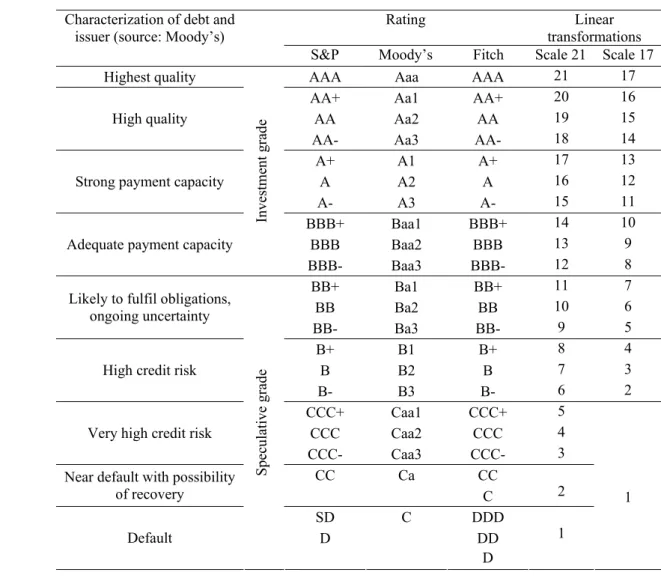
[Insert Table 1 here]
2.2. Literature review
Sovereign ratings are assessments of the relative likelihood of default. The rating
agencies assess the risk of default by analysing a wide range of elements from solvency
factors that affect the capacity to repay the debt, but also socio-political factors that
might affect the willingness to pay of the borrower. For example, S&P determines the
rating by evaluating the country’s performance in each of the following areas: political
risk, income and economic structure, economic growth and prospects, fiscal flexibility,
general government debt burden, off-shore and contingent liabilities, monetary
flexibility, external liquidity, public-sector external debt burden and private sector
external debt burden.
Given that the rating materializes out of the analysis of a vast amount of data, it would
be useful to find a reduced set of variables capable of explaining a country’s rating. A
first study on the determinants of sovereign ratings by Cantor and Packer (1996)
concluded that the ratings can be largely explained by a small set of variables namely:
per capita income, GDP growth, inflation, external debt, level of economic
development, and default history. Further studies incorporated more variables.
Macroeconomic performance variables like the unemployment rate or the
investment-to-GDP ratio. In papers focussing on the study of currency crises several external
indicators such as foreign reserves, current account balance, exports or terms of trade
seem to play an important role. Moreover, indicators of how the government conducts
its fiscal policy, budget balance and government debt can also be relevant, as well as
variables that assess political risk, like corruption or social indexes. Table 2 summarises
some of the relevant related studies and findings.
Regarding the econometric approach, there are two major strands in the literature. The
first uses linear regression methods on a numerical representation of the ratings. The
early study by Cantor and Packer (1996), applies OLS regressions to a linear
representation of the ratings, on a cross section of 45 countries. This methodology was
also pursued by Afonso (2003), Alexe et al. (2003) and Butler and Fauver (2006). Using
OLS analysis on a numerical representation of the ratings is quite simple and allows for
a straightforward generalization to panel data by doing fixed or random effects
estimation (Monfort and Mulder, 2000; Eliasson, 2002 and Canuto et al., 2004).
Although estimating the determinants of ratings using these approaches has in general a
good fit and a good predictive power it faces some critiques. As ratings are a qualitative
ordinal measure, using traditional estimation techniques on a linear representation of the
ratings is not the most adequate framework of estimation. First, it implies the
assumption that the difference between two rating categories is equal for any two
adjacent categories, which would need to be tested. Furthermore, even if this
assumption was true, because of the presence of elements in the top and bottom
category, the estimates are biased, even in big samples. Nevertheless, Eliasson (2002)
argues that given the existence of many categories one can treat the rating variable as
continuous and to overcome the criticism of the assumption of an even distance between
steps, it is possible to use different quantitative transformations. For instance, Reisen
and Maltzan (1999) apply a logistic transformation of the ratings and Afonso (2003)
applies both a logistic and an exponential transformation of the ratings. In that case, the
differences between categories are not constant, but are still imposed a priori.
The other strand of the literature uses ordered response models. Because the ratings are
a qualitative ordinal measure, the established wisdom advises the use of ordered probit
estimation. This method will itself determine the size of the differences between each
category. For example, this procedure was used by Hu et al. (2002),
Bissoondoyal-Bheenick (2005) and Bissoondoyal-Bissoondoyal-Bheenick et al. (2005). Although this should be
considered the preferred estimation procedure it is not entirely satisfying. The crucial
point is that the ordered probit asymptotic properties do not generalise for a small
sample, so if we estimate the determinants of the ratings using a cross-section of
countries, we would have too few observations. It is therefore imperative to try to
be careful. Indeed, the generalization of ordered probit to panel data is not completely
straightforward, due to the existence of a country specific effect. Furthermore, within
this framework, the need to have many observations makes it harder to perform
robustness analysis by, for instance, partitioning the sample. In Section Three we will
address these questions when explaining our modelling strategy.
3. Methodology
Using a linear scale we grouped the ratings in 17 categories, by putting together in the
same bucket the few observations below B-. Indeed, if we used a specific number for
each existing rating notch, for instance 21 categories, it might be hard to efficiently
estimate the threshold points between CCC+ and CCC, CCC and CCC- and so on, given
that the bottom rating categories have very few observations. Table 1 above also shows
the relation established between the qualitative and the possible linear scales. Moreover,
and as we will see latter in the paper, a linear transformation is quite adherent to the
data. Nevertheless, we also report in Appendix 3 estimation results using a logistic
transformation.
3.1. Explanatory variables
Building on the evidence provided by the existing literature, we identify a set of main
macroeconomic and qualitative variables that may determine sovereign ratings.
GDP per capita – positive impact on rating: more developed economies are expected to
have more stable institutions to prevent government over-borrowing and to be less
vulnerable to exogenous shocks.
Real GDP growth – positive impact: higher real growth strengthens the government’s
ability to repay outstanding obligations.
Inflation – uncertain impact: on the one hand, it reduces the real stock of outstanding
government debt in domestic currency, leaving overall more resources for the coverage
of foreign debt obligations. On the other hand, it is symptomatic of problems at the
Unemployment – negative impact: a country with lower unemployment tends to have
more flexible labour markets making it less vulnerable to changes in the economic
environment. In addition, lower unemployment reduces the fiscal burden of
unemployment and social benefits while broadening the base for labour taxation.
Government debt – negative impact: a higher stock of outstanding government debt
implies a higher interest burden and should correspond to a higher risk of default.
Fiscal balance – positive impact: large fiscal deficits absorb domestic savings and also
suggest macroeconomic disequilibria, negatively affecting the rating level. Persistent
deficits may signal problems with the institutional environment for policy makers.
Government effectiveness – positive impact: high quality of public service delivery and
competence of bureaucracy should impinge positively of the ability to service debt
obligations. (We initially used all six World Bank Governance Indicators: voice and
accountability, political stability, regulatory quality, rule of law, control of corruption
and government effectiveness, but only this last one turned up as significant).
External debt – negative impact: the higher the overall economy’s external
indebtedness, the higher becomes the risk for additional fiscal burdens, either directly
due to a sell-off of foreign government debt or indirectly due to the need to support
over-indebted domestic borrowers.
Foreign reserves – positive impact: higher (official) foreign reserves should shield the
government from having to default on its foreign currency obligations.
Current account balance – uncertain impact: a higher current account deficit could
signal an economy’s tendency to over-consume, undermining long-term sustainability.
Alternatively, it could reflect rapid accumulation of fixed investment, which should lead
to higher growth and improved sustainability over the medium term.
Default history – negative impact: past sovereign defaults may indicate a great
by a dummy variable indicating the past occurrence of a default and by a variable
measuring the number of years since the last default. This variable measures the
recovery of credibility after a default and can be expected to influence positively the
rating score.
3.2. Linear regression framework
A possible starting point for our linear panel model would follow Monfort and Mulder
(2000), Eliasson (2002) or Canuto, Santos and Porto (2004), generalizing a cross section
specification to panel data,
it it i i it
R =βX +λZ +a +µ , (1)
where we have: R – quantitative variable, obtained by a linear or by a non-linear
transformation; Xit is a vector containing time varying variables that includes the
time-varying explanatory variables described above and Zi is a vector of time invariant
variables that include regional dummies.
In (1) the index i (i=1,…,N) denotes the country, the index t (t=1,…,T) indicates the
period and ai stands for the individual effects for each country i (that can either be
modelled as a error term or as N dummies to be estimated). Additionally, it is assumed
that the disturbances µit are independent across countries and across time.
There are three ways to estimate this equation: pooled OLS, fixed effects or random
effects estimation. In normal conditions all estimators are consistent and the ranking of
the three methods in terms of efficiency is clear: a random effects approach is preferable
to the fixed effects, which is preferable to pooled OLS. The question one should ask is
whether the normal conditions are fulfilled. What we mean by normal conditions is
whether or not the country specific error is uncorrelated with the regressors E(ai| Xit,
Zi)=0. If this is the case one should opt for the random effects estimation, while if this
condition does not hold, both the pooled OLS and the random effects estimation give
In our case, it seems more natural that the country specific effect is correlated with the
regressors.1 Given this scenario one should be tempted to say that the “fixed effects
estimation” is the best strategy, but that has a problem. Because there is not much
variation of a countries rating over time, the country dummies included in the regression
will capture the country’s average rating, while all the other variables will only capture
movements in the ratings across time. This means that, although statistically correct, a
regression by fixed effects would be seriously striped of meaning.
There are two ways of rescuing a random effects approach under correlation between
the country specific error and the regressors. One is to do the Hausman-Taylor IV
estimation but for that we would have to come up with possible instruments that are not
correlated with ai, which does not seem an easy task. In this paper we will opt for a
different approach that consists on modelling the error term ai. This approach, described
in Wooldridge (2002), is usually applied when estimating non-linear models, as IV
estimation proves to be a Herculean task but, as we shall see, the application to our case
is quite successful. The idea is to give an explicit expression for the correlation between
the error and the regressors, stating that the expected value of the country specific error
is a linear combination of time-averages of the regressorsXi. This follows Hajivassiliou
and Ioannides (2006) and Hajivassiliou (2006).
( i| it, )i i
E a X Z = ηX . (2)
If we modify our initial equation (1), with ai =ηXt+εi we get
i
X
it it i i it
R =βX +λZ +η +ε +µ , (3)
whereεi is an error term by definition uncorrelated with the regressors. In practical
terms, we eliminate the problem by including a time-average of the explanatory
variables as additional time-invariant regressors. We can rewrite (3) as:
1
( X ) (i )Xi
it it i i it
R =β X − + η β+ +λZ +ε +µ . (4)
This expression is quite intuitive.δ η β= + can be interpreted as a long-term effect (e. g.
if a country has a permanent high inflation what is the respective effect on the rating),
while β is a short-term effect (e. g. if a country manages to reduce inflation this year by
one point what would be the effect in the rating). This intuitive distinction is useful for
policy purposes as it can tell what a country can do to improve its rating in the short to
medium-term. We will estimate equation (4) by random effects, but we also estimate the
OLS and fixed effects versions. The way we modelled the error term can be considered
successful if the coefficients of Xi are significant and if the Hausman test indicates no
correlation between the regressors and the new error term.
3.3. Ordered response framework
Alternatively we estimate the determinants of sovereign debt ratings in a limited
dependent variable framework. As we mentioned before, the ordered probit is a natural
approach for this type of problem, because the rating is a discrete variable and reflects
an order in terms of probability of default. The setting is the following. Each rating
agency makes a continuous evaluation of a country’s credit-worthiness, embodied in an
unobserved latent variable R*. This latent variable has a linear form and depends on the
same set of variables as before,
* ( X ) X
i i
it it i i it
R =β X − +δ +λZ +ε +µ . (5)
Because there is a limited number of rating categories, the rating agencies will have
several cut-off points that draw up the boundaries of each rating category. The final
rating will then be given by
* 16 *
16 15
*
15 14
* 1
( )
( 1)
( 2)
( 1)
it
it
it it
it
AAA Aaa if R c
AA Aa if c R c
R AA Aa if c R c
CCC Caa if c R
⎧ >
⎪
+ > >
⎪⎪
=⎨ > >
⎪ ⎪
⎪< + >
⎩
M
The parameters of equation (5) and (6), notably β, δ, λ and the cut-off points c1 to c16 are
estimated using maximum likelihood. Since we are working in a panel data setting, the
generalization of ordered probit is not straightforward, because instead of having one
error term, we now have two. Wooldridge (2002) describes two approaches to estimate
this model. One “quick and dirty” possibility is to assume we only have one error term
that is serially correlated within countries. Under that assumption one can do the normal
ordered probit estimation but a robust variance-covariance matrix estimator is needed to
account for the serial correlation. The second possibility is the random effects ordered
probit model, which considers both errors εi and µit to be normally distributed, and the
maximization of the log-likelihood is done accordingly. This second approach should be
considered the best one, but it has as a drawback the quite cumbersome calculations
involved. In STATA this procedure was created by Rabe-Hesketh et al. (2000) and
substantially improved by Frechette (2001a, 2001b), and we will use such procedures in
our calculations.
4. Empirical analysis
4.1. Data
We build a ratings database with sovereign foreign currency rating attributed by the
three above-mentioned main rating agencies. For the rating notations we covered a
period from 1970 to 2005. The rating of a particular year is the rating that was attributed
at 31st of December of that year. In 2005 there are 130 countries with a rating, though
only 78 have a rating attributed by all three agencies (see Appendix 2 for rating
coverage description).2
In Figure 1 we can see the evolution of the number of countries rated by each agency
and it is possible to notice a significant increase in mid 1990’s of the number of
countries with rating, especially from S&P and Moody’s.
[Insert Figure 1 here]
2
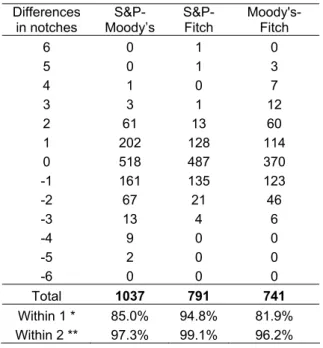
In general the ratings attributed by the three agencies are quite similar. As shown in
Table 3 around 50 per cent of all observations have the same pair-wise rating. It is also
interesting to notice that S&P and Fitch have much closer ratings, and Moody’s is more
divergent with a significant number of observations having a distance of two notches
vis-à-vis the other two agencies. This might indicate, for instance, that Moody’s and
S&P give different weights to different indicators or simply reflects the uncertainty in
measuring the default risk.
[Insert Table 3 here]
For the present study we limited the sample to 1995-2005 because of data availability of
explanatory variables. The variables inflation, unemployment, GDP growth, fiscal
balance and current account entered as a 3 years average, reflecting the agencies’
approach to take out the effect of the business cycle when deciding on a sovereign
rating. The external debt variable was taken from the World Bank and is only available
for non-industrial countries, so for industrial countries it was attributed the value 0,
which is equivalent to having a multiplicative dummy. As for the dummy variable for
European Union, we consider that the rating agencies anticipated the EU accession.
Thus we tested the contemporaneous variable as well as up to three leads. We find that
for Moody’s and S&P the variable enters with two leads, while for Fitch we find no
anticipation of EU accession. (See Appendix 1 for a full list of variables used in the
estimations as well as their specification and data sources.)
Regarding the estimation procedure, starting out with the broadest possible set of
variables, we sequentially dropped those that did not reveal any explicative power
(export growth, investment, trade openness, domestic credit growth, interest payments
4.2. Linear panel results
4.2.1. Full sample
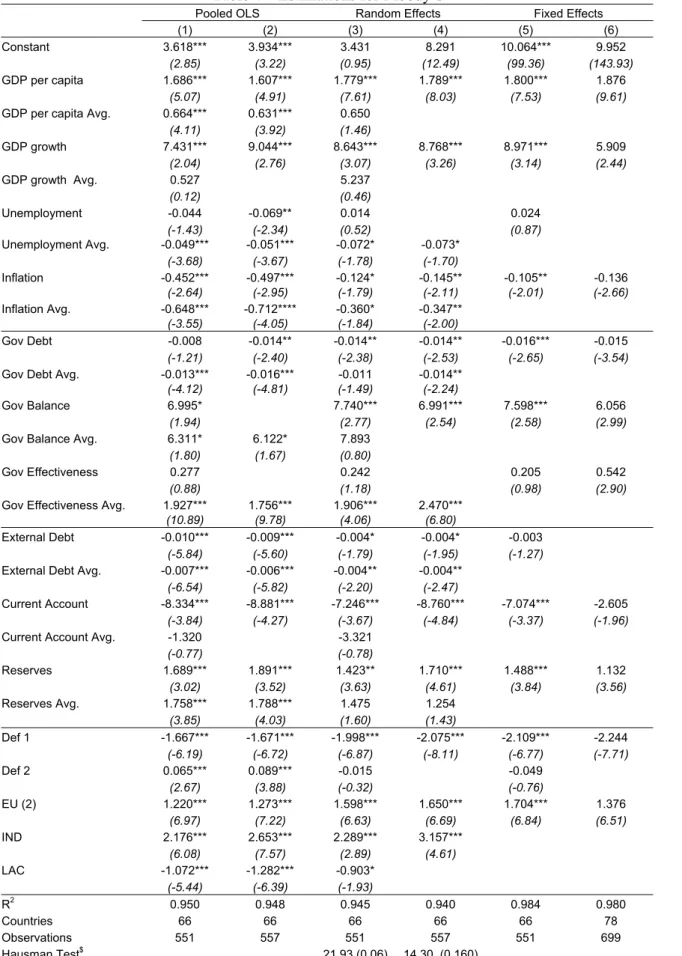
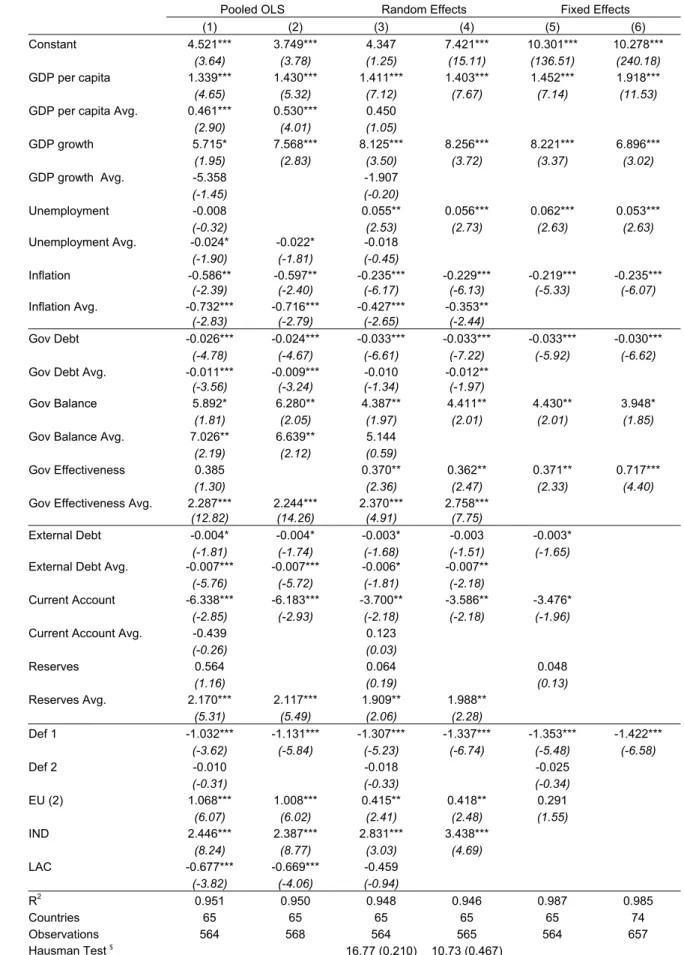
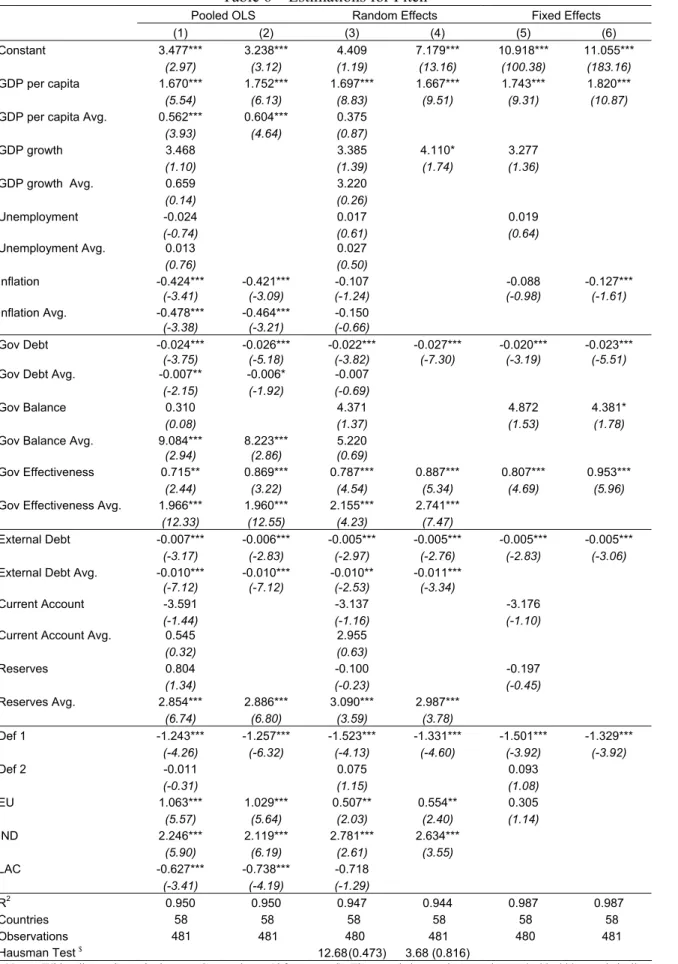
The results generated by the panel regressions point to broadly similar regression
models across the three rating agencies (see Tables 4, 5 and 6). In view of the analytical
considerations above the discussion will focus on the random effects estimations. This
is supported by the Hausmann tests reported at the end of each table pointing to the
acceptability of the random effects approach. Nevertheless, we also report the pooled
OLS and the fixed effects results for completeness and comparison purposes.
[Insert Tables 4, 5 and 6 here]
We report the results of two models for each of the rating agencies, the unrestricted and
the restricted model. While the unrestricted model incorporates all variables discussed
above, the restricted model contains only the variables which were found to have a
statistically significant impact. Although the sequence of excluding individual variables
in moving from the unrestricted to the restricted regression can have an impact on the
final specfication, the restricted models presented in the tables are quite robust to
alternative exclusion procedures. As can be seen from the statistics reported at the end
of each table, the explanatory power of the models is very high with R-square values
around 95 per cent and it remains almost constant moving from the unrestricted to the
restricted versions, while the number of observations increases marginally. In addition,
the variables found to be significant in the unrestricted model generally remain
significant with the same sign in the restricted version.
The restricted models reveal a homogenous set of explanatory variables across agencies.
On the real side, GDP per capita and GDP growth rates turn out significant for all three
companies. In the fiscal area, this applies to the government debt ratio as a difference
from the average and to the government effectiveness indicator. On the external side,
the average external debt ratio and the average level of reserves are found to be
significant across agencies. Default, EU and industrial country dummies are also
significant for all agencies. Moreover, the size of the coefficients is of the same order of
real income drive up the rating, government and external debt have a negative impact
and government effectiveness and higher external reserves have a positive impact.
Beyond this set of core variables, the agencies appear to employ a limited number of
additional variables. For Fitch the analysis finds the smallest set of additional variables,
comprising government effectiveness as a deviation from the average and foreign
currency reserves also as the short-run deviation. By contrast, the analysis finds more
significant explanatory variables for Moody’s and Standard and Poor’s, with a large
degree of homogeneity between these two agencies. In particular, on the real side
inflation is found to have a significantly negative impact. In the fiscal area, the average
debt level exerts an additional negative impact on the ratings level, whereas the fiscal
balance has a strong positive impact. With regard to the external sector, the current
account balance has a negative impact.
The findings regarding the current account effect may appear surprising as it suggests
that countries with high current account surpluses would tend to be rated lower than
otherwise equal countries without such surpluses. However, this result is quite recurrent
in the literature (Monfort and Mulder, 2000 or Eliasson, 2002). A possible explanation
is that a current account deficit could in fact serve as an indicator for the willingness of
foreigners to cover the current account gap through loans and foreign investment. In this
situation, a higher current account deficit would be associated with either higher
credit-worthiness or good economic prospects of the economy and consequently a higher
sovereign rating.
Finally, the impact of the unemployment variables appears not entirely clear cut. While
the average level of unemployment is found to have a significant negative impact on the
rating by Moody’s, the short-run deviation from the average enters positively and
significantly in the S&P model. Structural reforms that raise unemployment in the short
run but improve fiscal sustainability in the long run could provide an explanation for
this latter finding, but further research would be necessary to validate this hypothesis.
One can also assess how successfull and important our specification is. First, most of
did not include them we would be mispecifying the model.3 Second, the models pass the
Hausman test, which sugested that the problem was entirely corrected. Furthermore, if
we look at the fixed effects estimation we can see how poor it is. Notice the estimated
constant and its significance. In general the constant captures the middle rating, while
the estimated country dummies (ommited here), which vary from -7 to 7 notches,
capture each country’s average rating. All the other variables only capture small
movements from the rating in relation to its average4.
4.2.2. Differentiation across sub-periods
The separation of the overall sample into two sub-periods allows to assess broadly the
robustness of the empirical models and provides additional insight into possible changes
in the rating determinants. In particular, cutting the sample period in 2000 could reveal
any changes in the sovereign ratings methodology in response to the Asian crisis which
was perceived by market participants as revealing previously underestimated risks to
sovereign sustainability. Additionally, this also divides the full sample in two rather
similar sized sub-samples.
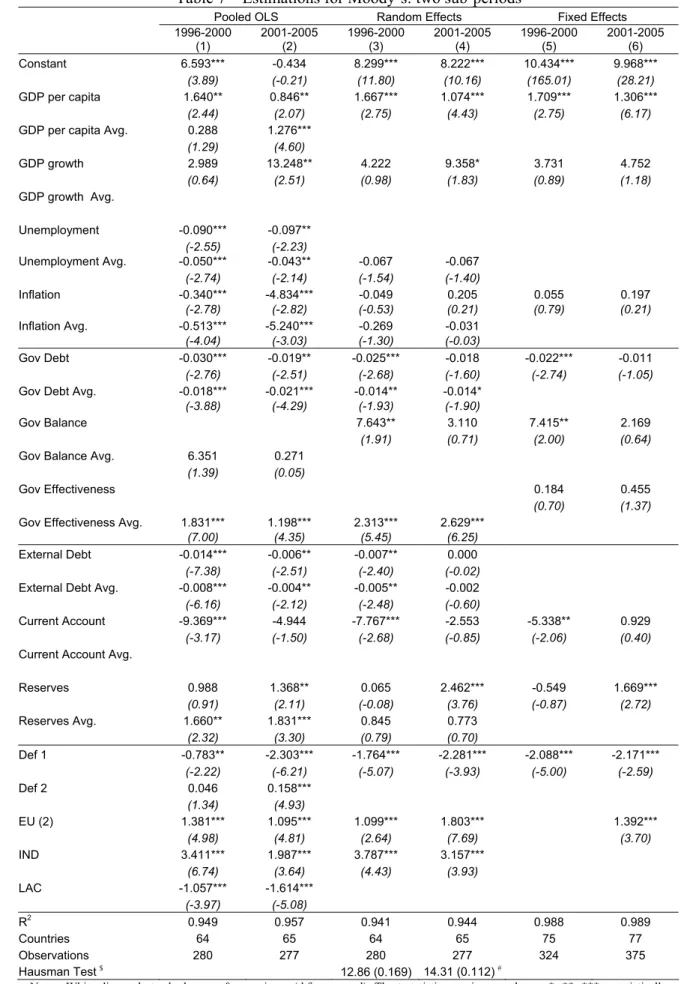
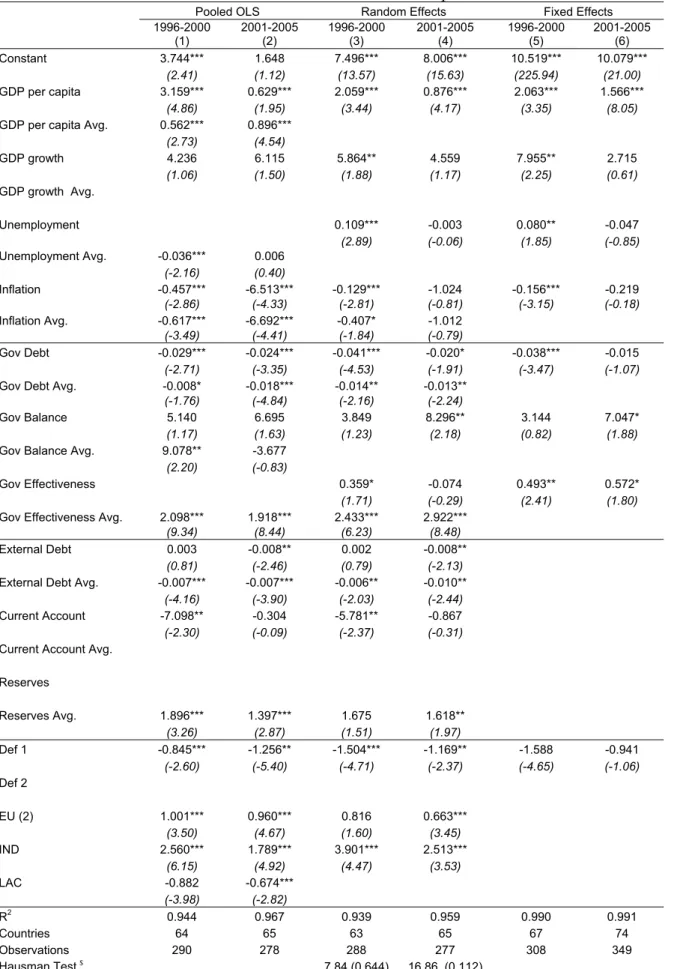
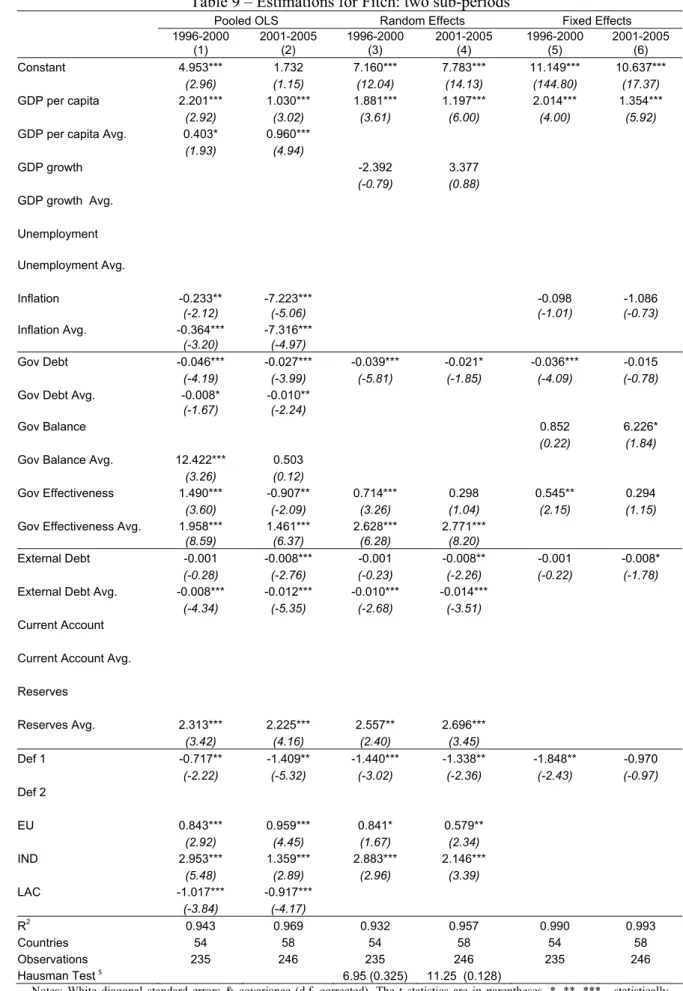
The models for the sub-periods are generally in line with those for the full estimation
period, although the significance levels of the individual coefficients are reduced (see
Tables 7–9). The lower significance levels reflect the reduction in the respective sample
sizes in half, which makes the coefficient estimates less certain. Taking this into
account, signs and orders of magnitude of the coefficient estimates from the full-period
models are mostly confirmed for the sub-periods. In particular, the core variables
identified above enter the models for the sub-periods with the correct sign and generally
significantly with a comparable order of magnitude.
[Insert Tables 7, 8 and 9 here]
Regarding the possible impact of the Asian crisis on ratings approaches, the stability of
the ratings models suggests that there was no fundamental change in methodologies. A
3 This is in fact the cause why without including time-averages the models would not pass the Hausman
test.
4
change that may point to some adaptation of ratings methods in response to the Asian
events is the decline in importance of the current account variable for Moody’s and
S&P, both with regard to the value of the estimated coefficient as well as its
significance level. The change may suggest that the function of the current account as
an indicator for foreigners’ willingness to cover the current account gap has declined.
Finally, for Moody’s the increase in value and significance of the coefficient on external
reserves may point to a higher importance attached to this variable after the Asian crisis.
Taken together with the reduced importance of the current account, this could suggest a
move towards a broader view on foreign financial relationships, which includes capital
flows in addition to the current account movements.
Looking at the individual agencies, for Fitch coefficient values remain remarkably
stable over the sub-periods. An exception is the negative (though insignificant) value for
GDP growth in the early sub-sample. For S&P, sign reversals between sub-periods
occur for the explanatory variables unemployment, government effectiveness and
external debt, but there are no significant coefficient estimates with opposing signs. For
Moody’s, the models point to a sign reversal for the insignificant estimate of the
coefficient on inflation.
4.2.3. Differentiation across ratings levels
As a further test of the robustness of the results derived above, the sample was split into
two groups according to the ratings level: regressions were run separately for high-rated
countries with grades BBB+ and below and those above this grade. The choice of the
threshold reflects practical considerations. While market participants generally divide
bond issuers into investment-grade and non-investment grade at the threshold of BBB-,
this threshold would result in a relatively small number of observations for low ratings
making inference problematic. From the estimation of the ratigns above BBB+, we
removed the variable external debt because there were too few observations of
non-industrial countries.
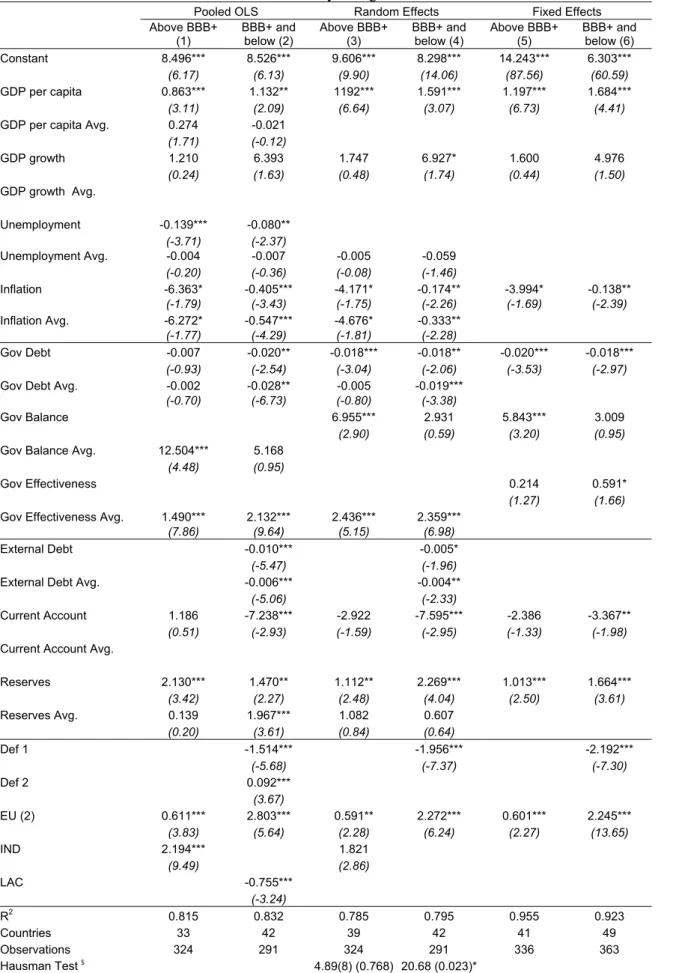
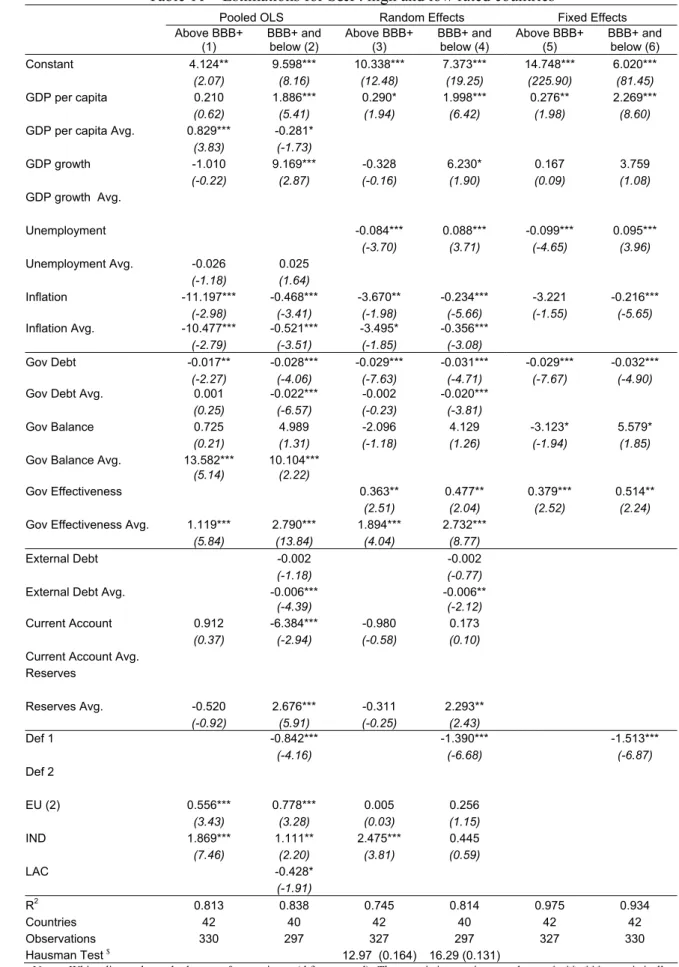
The results for the separate regressions according to ratings levels confirm the overall
results from the full sample (see Tables 10–12). Looking at the random effects
agencies in the full sample also show up consistently with the correct sign in the
individual regression models for high and low ratings. Most of the coefficients are
statistically significant. Notably, the importance of average external reserves appears to
rise for low ratings in the models for Fitch and S&P. In the cases of statistical
significance external reserves always have a positive impact on the ratings.
[Insert Tables 10, 11 and 12 here]
The explanatory power of the individual regressions is somewhat lower than that found
for the full sample as well as for the sub-periods. This reflects the fact that splitting the
sample in this way reduces the number of rating categories for each estimation, so that,
with a discrete dependent variable, estimated rating errors become relatively larger.
Beyond the core variables, the results for Moody’s and S&P suggest a significant
difference in the importance of inflation for high and low ratings, respectively. For both
agencies the (significant) coefficient on inflation as an average and the deviation from it
is much higher for high ratings than for low ratings. (For Fitch, this finding is supported
by the pooled OLS and the fixed effects estimations, but not for the random effects
specification.) This suggests that for high rated countries inflation has a much more
important impact on the rating. A possible explanation is that for this set of countries
price level stability may be taken as an indicator for sound economic and in particular
monetary policies which support the long-run sustainability of government finances.
Turning to differences across agencies, the results point to a relatively high level of
consistency in the approach to high and low ratings for Fitch and Moody’s. For these
two agencies signs and (mostly) significance levels of coefficient are generally
consistent for high and low ratings. A somewhat higher degree of variation in this
regard can be observed for S&P where the sign of the estimated impact of some
variables switches between high and low ratings, although in most instances the
comparison involves statistically insignificant coefficients. Additionally, one notices
4.3. Ordered probit results
In view of the discussion of econometric issues above, ordered probit models should
give additional insight into the determinants of sovereign ratings. In particular, this
method allows to relax the rigid assumption on the shape of the ratings schedule.
Instead it generates estimates of the threshold values between rating notches allowing an
assessment of the shape of the ratings curve. Given the data requirements, the method
was only applied to the full sample, which appears appropriate in view of the overall
robustness of the empirical results to the use of sub-samples.
The results from the ordered probit estimation validate the findings highlighted above
(see Tables 13 and 14, respectively for the ordered probit robust standard errors and the
random effects ordered probit). The core variables identified in the linear regressions
also show up with the correct sign in the ordered probit approach. In addition, the
ordered probit models suggest the significance of somewhat more explanatory variables,
namely inflation and the current account, which were significant only in some
specifications in the linear approach. At the same time, in the area of external variables,
reserves do not show up significantly for Moody’s and Fitch in the restricted
specifications, both for the ordered probit and for the random effects ordered probit.
Finally, for the current account variable, the restricted specification for Moody’s shows
a negative sign for deviations from the long-term average, but a positive sign for the
average, and similar sign switches appear also in some instances for the other agencies.
This result goes some way in reconciling the counter intuitive result of the negative
effect of current account on sovereign ratings, with the conventional wisdom.
[Insert Tables 13 and 14 here]
The estimated threshold coefficients reported in the second part of the tables suggest
that the linear specification assumed for the panel regression above is appropriate. The
plot of the results of the random effects ordered probit (see Figure 2), shows that for all
three agencies the thresholds between rating notches are broadly equally distributed
across the ratings range. In other words, the distance for a country to move e.g. from B–
to B is roughly equal to that for moving from AA to AA+. Nevertheless, the
model of Moody’s, the test does not reject the null hypothesis of equal distances
between thresholds, but the significance level is close to 10 per cent. Indeed the
estimated thresholds point to a relatively large jump between the ratings for BBB– and
BBB. This suggests that countries close to the non-investment grade rating are given a
wider range before they actually cross that threshold. For Fitch, the hypothesis of equal
distances is strongly rejected as the thresholds for higher ratings are further apart than
those of the lower ratings. In this case the kink lies at the A rating.
[Insert Figure 2 here]
Finally, for S&P, different distances are found throughout the ratings scale. Looking at
Figure 2, it appears that for lower ratings the relative distance between thresholds of
S&P coincides with that of Moody’s. However, above the investment grade limit, the
distances between thresholds at first decline and then increase, resulting in a slightly
curved ratings schedule that makes the transition to the highest grades most difficult.
4.4. Prediction analysis
Our prediction analysis will focus on two elements: the prediction for the rating of each
individual observation in the sample, as well as the prediction of movements in the
ratings through time.
Prediction with the pooled OLS model was done by rounding the fitted value (which is
continuous) to the closest integer between 1 and 17. For the random effects estimations
we can have two predictions, with or without the country specific effect, εi, and we can
write the corresponding estimated versions of (4) as:
ˆ ˆ ˆ
ˆ ( X )i Xi ˆ
it it i i
R =β X − +δ +λZ +ε , (7a)
ˆ( X )i ˆXi ˆ
it it i
R% =β X − +δ +λZ . (7b)
We can then estimate each country specific effect by taking the time average of the
additional information that comes out of the estimation. In other words, we generate
in-sample and out-of-in-sample prediction. After the fitted value is computed it is then also
rounded to the closest integer between 1 and 17. The prediction with both ordered probit
and the random effects ordered probit was done by fitting the value of the latent
variable, setting the error term to zero, and then match it up to the cut points do
determine the predicted rating. Table 15 presents an overall summary of the prediction
errors, for the three agencies and for the several methods using the respective restricted
specifications.
[Insert Table 15 here]
The first conclusion is that the random effects model including the estimated country
effect is the method with the best fit. On average for the three agencies, it correctly
predicts 70 per cent of all observations and more than 95 per cent of the predicted
ratings lie within one notch (99 per cent within two notches). This is not surprising, the
country errors capture factors like political risk, geopolitical uncertainty and social
tensions that are likely to systematically affect the ratings, therefore, such term acts like
a correction for these factors.
This additional information cropping up from the random effects estimation with the
country specific effect can be very useful if we want to work with countries that belong
to our sample. But if we want to make out of sample predictions we will not have this
information. In that case, only the random effects estimation excluding the country error
is comparable to the OLS specification, to the ordered probit and to the random effects
ordered probit. We can see that in general both ordered probit and random effects
ordered probit have a better fit than the pooled OLS and random effects for all three
agencies, though not as clearly for Fitch. Overall, the simple ordered probit seems the
best method as far as prediction in levels is concerned as it predicts correctly around 45
per cent of all observations and more then 80 per cent within one notch.
Another interesting aspect to notice is that the OLS and the random effects
specifications are biased downward, while the ordered probit and random effects
ordered probit ones are slightly biased upward. The explanation for this turns out to be
rating for every category using the four estimation methods. We can see that both the
OLS and the random effects specifications tend to under predict actual AAA’s (Aaa)
while both ordered probit models and random effects ordered probit tend to over predict
the actual rating in the top categories, attributing many AAA’s (Aaa) to countries with
actual lower rating. In the bottom end of the rating scale the opposite happens, OLS and
random effects have a propensity to overestimate ratings that are bellow CCC+ (Caa1),
on the other hand, both ordered probit prediction errors are quite balanced.
[Insert Figures 3, 4 and 5 here]
Those figures provide some additional insights. For Moody’s, ordered probit performs
well in the bottom ratings while random effects ordered probit is better for top ratings.
Also notice that all four models have difficulty explaining the rating A3. Out of 21
observations the maximum correctly predicted is 2 (with OLS) with a substantial
number of predictions lying outside 1 notch.
For S&P the ordered probit outperforms all other models in the middle and bottom
categories. For Fitch, one should mention that the number of observations used for the
random effects ordered probit is higher than the other models (because of the
non-inclusion of one of the variables), which makes comparison harder. One element we
need to highlight is the fact that there is only one observation in the category A+, which
is the possible cause for the identification of the jump in both limited dependent
variable estimations, mentioned before in section 4.4. For completeness, Figure 6
reports the map of predicted ratings using the random effects estimation including
country specific errors.
[Insert Figure 6 here]
Let’s now turn to how the models perform in predicting changes in ratings. Table 16
presents the total number of sample upgrades (downgrades), the predicted number of
upgrades (downgrades) and the number of upgrades (downgrades) that where correctly
predicted by the several models.
Roughly the models correctly predict between one third and one half of both upgrades
and downgrades. In our opinion this is quite satisfactory given that the empirical
approach used here necessarily neglects two sources of information that are known to
enter the decision of the rating agencies. First, in contrast to the backward-looking
models presented above, rating agencies base their decision to a considerable extent on
projected economic developments. Thus, a full empirical model of the agencies’
approach would need to incorporate the agencies’ expectations regarding the relevant
explanatory variables. However, as the agencies generally do not publish their
projections, any such modelling attempt would remain highly tentative. Still, the
observation that many of the actual rating changes are predicted by the models with a
lag of one or two years appears to support the relevance of this point. Second, ratings
agencies also generally make a clear point that they cover qualitative variables in
addition to quantitative data in the ratings process. While the relative importance of the
qualitative and quantitative factors that enter the ratings decision is uncertain (and might
well vary across countries), rating agencies’ public statements indicate that such factors
can play an important role.5 In the models above, by contrast, the only variable
reflecting such considerations is the government effectiveness indicator and it thus
appears likely that in these models the impact of qualitative factors is under-represented.
The most noticeable difference between the models is not the number of corrected
predicted changes but the total number of predicted changes. In fact, the ordered probit
and random effects ordered probit predict significantly more changes than the OLS and
random effects counterparts. For instance, for S&P, while both OLS and random effects
predict around 79 upgrades and 50 downgrades, the ordered probit model predicts 102
upgrades and 64 downgrades.
4.5. Examples of specific country analysis
In terms of the magnitude of the coefficients, the comparison between the ordered probit
and random effects ordered probit is not straightforward because the estimated distances
between the categories are different. But in general, once this is accounted for, by
5
standardising the coefficients in relation to the average jump, they are both in line with
the linear panel results. An improvement of 2 percentage points in the budget deficit, a
reduction of 5 percentage points in public debt, or a higher GDP growth by 3 percentage
points, all have the same relative impact on the ratings between 0.1 and 0.2 notches. An
increase of 10 per cent in GDP per capita would improve the rating by 0.15 to 0.25
notches. As we mentioned, a reduction of the unemployment only affects the rating if
this reduction is sustainable. If that is the case, a reduction of 4 percentage points
increases the rating by 0.2 to 0.35 notches. The effect of inflation is quite small, a
reduction of 20 percentage points on inflation increases the rating by 0.05 to 0.1
notches. These values are too small to be noteworthy for industrial countries, but if one
does the same calculation with the value estimated for high rated countries a reduction
of 4 percentage points in inflation would increase the rating by 0.15 notches.
Now that we have an idea of the estimated impact of the variables we can do some
specific country analysis. As an example, in Table 17 we show the rating for some
European countries and some emerging markets both in 1998 and 2005. Then, we use
the estimated short-run coefficients of the random effects ordered probit together with
the values for the relevant variables. Afterwards, we divide the overall prediction
change in the rating for each agency into the contributions of the different blocks of
explanatory variables: macroeconomic performance, government and fiscal
performance, external elements and European Union6. The upper and lower bound
presented are computed by adding and subtracting one standard deviation to the point
estimate of the coefficients.
[Insert Table 17 here]
Let’s compare, for instance, Portugal and Spain. In 1998 they both had an AA (Aa2)
rating but in 2005 while Spain had been upgraded to AAA (Aaa) by all agencies,
Portugal had been downgraded by S&P. If we analyse the contributions of the main key
variables we see that, for Portugal the positive contribution of the macroeconomic
performance was overshadowed by the negative government developments. For such
6 As an exception, we used the long-run coefficient of unemployment instead of the short-run coefficient.
government performance contributed the worsening of the budget deficit since 2000, the
upward trend in government debt and the worsening in the World Bank governance
effectiveness indicator. As for Spain, the good macroeconomic performance was the
main cause of the upgrade, specially the reduction of structural unemployment since the
mid nineties and the increase of GDP per capita due to the persistent high growth.
Another example can be seen with the new European Union member states Slovakia,
the Czech Republic, Hungary, Slovenia and Poland, which have in general been
upgraded by the three agencies, in some cases more than two notches. The good
macroeconomic performance, especially in Slovakia and the Czech Republic, plays a
major role, but there was also an important credibility effect of joining the European
Union, mostly visible for Moody’s. It is in fact for Moody’s that we observe the
strongest upgrades. For Poland, the effect of the macro performance might be
undervalued. One of the key elements was the sharp reduction of inflation of more then
12 percentage points, but, as we mentioned before, the effect of inflation for high rated
countries is under assessed in the main estimations. If we consider such information,
one would have an estimated additional impact of almost half a notch.
As a final example for the emerging economies, we report the results for five countries
that have, in general also been upgraded: Brazil, Mexico, Malaysia, Thailand and South
Africa. We should briefly highlight that for Brazil the main positive contribution came
from the external area specially the reduction of external debt and the increase in
foreign reserves. This effect is particular to Fitch. For Malaysia and Thailand the main
contribution came from the macro side, while for Mexico and South Africa the
contributions are more balanced.
5. Conclusion
In this paper we studied the determinants of global sovereign debt ratings using ratings
from the three main international rating agencies, for the period 1995-2005. Overall, our
results point to a good performance of the estimated models, across agencies and across
Regarding the methodological approach, we used both a linear framework and an
ordered probit approach. We modelled the country specific error using a random effects
approach, which in practical terms implied adding time-averages of the explanatory
variables as additional time-invariant regressors. This setting allowed us to distinguish
between immediate and long-run effects of a variable on the sovereign rating level.
Moreover, we also used a limited dependent variable framework by means of an ordered
probit and random effects ordered probit specifications. The latter is the best procedure
for panel data as it considers the existence of an additional normally distributed
cross-section error term. This approach allowed both to determine the cut-off points
throughout the rating scale as well as assessing whether a linear quantitative
transformation of the ratings is actually more appropriate than a possible non-linear
transformation.
Our main findings in the panel random effects framework allowed us to detect a set of
core variables that are relevant for the determination of the ratings: per capita GDP;
GDP real growth rate; government debt; government effectiveness; external debt and
external reserves; sovereign default indicators. Moreover, the importance of fiscal
variables appears stronger than in the previous existing literature.7
The ordered probit analysis confirmed the overall estimation results from the linear
panel regressions. Interestingly, there is some evidence for different approaches of the
agencies with regard to the distance between ratings thresholds. For instance, for
Moody’s the estimated thresholds point to a relatively large jump between the ratings
for BBB– and BBB. This suggests that countries close to the non-investment grade
rating are given a wider range before they actually cross that threshold. For Fitch, the
hypothesis of equal distances is strongly rejected as the thresholds for higher ratings are
further apart than those of the lower ratings. In this case the kink lies at the A rating. On
the other hand, no clear switching pattern emerges for S&P.
The panel sample we used is quite comprehensive, which allowed for a sub-period
analysis and for a differentiated high and low rating analysis. While the results are
7 We performed additional analysis from some different perspectives. For instance, we used the
roughly stable across agencies, time periods and ratings levels, some additional
interesting results emerge. For instance, for the low rating levels, external debt and
external reserves are more relevant. On the other hand, for the early sub-period,
1996-2000, the current account balance was more important, while external reserves were
possibly somewhat more important in the later period, 2001-2005 (for Moody’s and
S&P). Moreover, after the Asian crisis, it seems there was a decline in the relevance of
the current account variable in the specifications for Moody’s and S&P.
Another relevant outcome ot the analysis ist that low ratings levels are more affected by
external debt and external reserves while inflation plays a bigger role for high rating
levels. On the other hand, the specifications for the Fitch ratings seem to be most
consistent over time and ratings categories. There was more variation for S&P and
Moody’s in the middle of the rating scales, which possibly points to a more quantitative
model-based approach for Fitch.
Finally, regarding the prediction analysis, the random effects model including the
estimated country effect turns out to be the method with the best fit. On average for the
three agencies, such specification correctly predicted 70 per cent of all observations and
more than 95 per cent of the predicted ratings lay within one notch. Moreover, the
models also correctly predicted between one third and one half of respectively upgrades
and downgrades. This is quite satisfactory for two reasons: first, the rating agencies also
have a forward looking behaviour that is absent from our models and second, other
qualitative factors not captured in our variables may play an important role.
Looking forward, further studies could investigate how to capture agencies’
expectations in empirical models as well as their views on qualitative variables.
Moreover, in our modelling approach we only use the government effectiveness
indicator in order to asses the impact of qualitative factors on the rating determination.
Therefore, other qualitative information could also be tentatively assessed as for
References
Afonso, A. (2003). Understanding the determinants of sovereign debt ratings: evidence
for the two leading agencies. Journal of Economics and Finance, 27 (1), 56-74.
Alexe, S.; Hammer, P.; Kogan, A. and Lejeune, M. (2003). A non-recursive regression model for country risk rating. Rutcor Research Report 9, Rutgers Center for Operational Research, March.
Bissoondoyal-Bheenick, E. (2005). An analysis of the determinants of sovereign ratings. Global Finance Journal, 15 (3), 251-280.
Bissoondoyal-Bheenick, E.; Brooks, R. and Yip, A. (2005). Determinants of sovereign ratings: A comparison of case-based reasoning and ordered probit approaches. Monash Econometrics and Business Statistics Working Papers 9/05, Monash University, Department of Econometrics and Business Statistics, May.
Borio, C. and Packer, F. (2004). Assessing new perspectives on country risk. BIS
Quarterly Review, BIS, December, 47-65.
Butler, A. and Fauver. L. (2006). Institutional Environment and Sovereign Credit
Ratings. Financial Management (forthcoming).
Cantor R. and Packer, F. (1996). Determinants and impact of sovereign credit ratings.
Economic Policy Review, 2, 37-53. Federal Reserve Bank of New York.
Canuto, O.; Santos, P. and Porto, P. (2004). Macroeconomics and Sovereign Risk Ratings, Januray, mimeo.
Eliasson, A. (2002). Sovereign credit ratings. Working Papers 02-1, Deutsche Bank.
Fitch Ratings (2006). Fitch sovereign ratings transition and default study.
Frechette, G. (2001a). sg158: Random-effects ordered probit, Stata Technical Bulletin
59, 23-27. Reprinted in Stata Technical Bulletin Reprints 10, 261-266.
Frechette, G. (2001b). sg158.1: Update to random-effects ordered probit, Stata
Technical Bulletin 61, 12. Reprinted in Stata Technical Bulletin Reprints 10, 266-267.
Hajivassiliou, V. (2006). A Modified Random Effects Estimator for Panel Data Models
with Correlated Regressors, mimeo.
Hajivassiliou, V. and Ioannides, Y. (2006). Unemployment and Liquidity Constraints.
Journal of Applied Econometrics (forthcoming).
Jaimovich, D. and Panizza, U. (2006). Public Debt around the World: A New Dataset of Central Government Debt. Working Papers 1019, Inter-American Development Bank, Research Department.
Monfort, B. and Mulder, C. (2000). Using credit ratings for capital requirements on lending to emerging market economies - possible impact of a new Basel accord. IMF Working Papers 00/69.
Moody’s (2006). Default and Recovery Rates of Sovereign Bond Issuers 1983-2005.
(available at http://www.moodys.com).
Standard & Poor’s (2004). Sovereign Defaults Set to Fall Again in 2005. (available at
http://www2.standardandpoors.com).
Standard & Poor’s (2006). 2005 Transition Data for Rated Sovereigns. (available at
http://www2.standardandpoors.com).
Rabe-Hesketh, S.; Pickles, A. and Taylor, C. (2000). sg120: Generalized linear latent
and mixed models. Stata Technical Bulletin 53, 47-57. Reprinted in Stata Technical
Bulletin Reprints 9, 293-307.
Reisen, H. and Maltzan, J. (1999). Boom and Burst and Sovereign Ratings. International Finance, 2 (2), 273-293.
Rother, P. C. (2005). The EU Premium: Ratings Strengthened for Countries Moving Toward EMU Convergence, Moody’s Special Comment, Moody’s Investors Service, August.
Wooldridge, J. (2002). Econometric Analysis of Cross Section and Panel Data. MIT
Tables and figures
Table 1 – S&P, Moody’s and Fitch rating systems and linear transformations
Rating Linear transformations
Characterization of debt and issuer (source: Moody’s)
S&P Moody’s Fitch Scale 21 Scale 17
Highest quality AAA Aaa AAA 21 17
AA+ Aa1 AA+ 20 16 AA Aa2 AA 19 15 High quality
AA- Aa3 AA- 18 14 A+ A1 A+ 17 13 A A2 A 16 12 Strong payment capacity
A- A3 A- 15 11 BBB+ Baa1 BBB+ 14 10 BBB Baa2 BBB 13 9 Adequate payment capacity
In
vest
me
nt
g
ra
d
e
BBB- Baa3 BBB- 12 8 BB+ Ba1 BB+ 11 7 BB Ba2 BB 10 6 Likely to fulfil obligations,
ongoing uncertainty
BB- Ba3 BB- 9 5 B+ B1 B+ 8 4 B B2 B 7 3 High credit risk
B- B3 B- 6 2 CCC+ Caa1 CCC+ 5
CCC Caa2 CCC 4 Very high credit risk
CCC- Caa3 CCC- 3 CC Ca CC Near default with possibility
of recovery C 2
SD C DDD D DD Default
Spec
ulative grade
D
1