*Correspondence: J. O. Ayorinde. Department of Pharmaceutics and Industrial Pharmacy, Faculty of Pharmacy, University of Ibadan, Ibadan 20005, Nigeria. E-mail: [email protected]
A
vol. 47, n. 4, oct./dec., 2011
Influence of binder type and process parameters on the
compression properties and microbial survival in diclofenac tablet
formulations
John Oluwasogo Ayorinde*, Oludele Adelanwa Itiola, Oluwatoyin Adepeju Odeku,
Michael Ayodele Odeniyi
Department of Pharmaceutics and Industrial Pharmacy, University of Ibadan, Nigeria
The inluence of binder type and process parameters on the compression properties and microbial survival in diclofenac tablet formulations were studied using a novel gum from Albizia zygia. Tablets were produced from diclofenac formulations containing corn starch, lactose and dicalcium phosphate. Formulations were analyzed using the Heckel and Kawakita plots. Determination of microbial viability in the formulations was done on the compressed tablets of both contaminated and uncontaminated tablets prepared from formulations. Direct compression imparted a higher plasticity on the materials than the wet granulation method. Tablets produced by wet granulation presented with a higher crushing strength than those produced by the direct compression method. Signiicantly higher microbial survival (p< 0.05) was obtained in formulations prepared by direct compression. The percent survival of Bacillus subtilis
spores decreased with increase in binder concentration. The study showed that Albizia gum is capable of imparting higher plasticity on materials and exhibited a higher reduction of microbial contaminant in the formulations. The direct compression method produced tablets of reduced viability of microbial contaminant.
Uniterms: Tablets/production. Tablets/microbial analysis. Direct compression/tablets production. Wet granulation/tablets production. Tablets/microbial contamination. Microbial survival/in tablets. Albizia
gum/use/tablets production.
A inluência do tipo de ligante e os parâmetros do processo de propriedades de compressão e sobrevivência microbiana em comprimidos de diclofenaco foram estudados utilizando uma nova goma de Albizia zygia. Os comprimidos foram produzidos a partir de formulações de diclofenaco contendo amido de milho, lactose e fosfato bicálcico. As formulações foram analisadas usando os gráicos de Heckel e Kawakita. A determinação da viabilidade microbiana nas formulações foi feita nos comprimidos contaminados e não contaminados preparados a partir de formulações. A compressão direta confere maior plasticidade dos materiais do que o método de granulação úmida. Comprimidos produzidos por granulação úmida apresentaram maior força de esmagamento do que aqueles produzidos pelo método de compressão direta. Observou-se sobrevivência signiicativamente maior (p<0,05) em formulações preparadas por compressão direta. A sobrevivência percentual dos esporos de Bacillus subtilis diminuiu com o aumento da concentração do agregante. O estudo mostrou que a goma de Albizia é capaz de conferir maior plasticidade aos materiais e apresentou maior redução da contaminação microbiana nas formulações. O método de compressão direta produziu comprimidos com viabilidade reduzida de contaminantes microbianos.
Unitermos: Comprimidos/produção. Comprimidos/análise microbiológica. Comprimidos/contaminação
INTRODUCTION
Direct compression is highly eficient, less labori -ous, and increasingly becoming more popular than both compression granulation and wet granulation methods in the manufacturing of tablets. However, few drug powders can be tabletted by the direct compression method, while most drugs need the incorporation of other substances referred to as tablet excipients in order to achieve sat-isfactory properties such as strength, disintegration and dissolution times. One such excipient is the binding agent. Examples of binders include gelatin, polyvinylpyrrolidone
(PVP), the cellulose derivatives (such as carboxyl meth
-ylcellulose) and pregelatinized starches. Binding agents
employed in formulations are known to undergo a high degree of plastic deformation during compression and are forced into interparticulate spaces, where they increase the area of contact between the particles and form strong
solid bonds (Itiola, Pilpel, 1991). The process of formation
of these solid bonds is capable of exerting a lethal effect
on microbial contaminants during tabletting (Ayorinde, Itiola, 2010).
Manufacturing processes have been known to pro-duce a drop of about 70% in the viable count compared to the original raw materials of pharmaceutical products. The granulation step prior to tabletting often employs elevated
temperatures (10-80 °C) for prolonged periods of time, and
is known to destroy the vegetative forms of microorganism
(Fry, Greaves, 1995). The shear stress manifested during
compression depends largely on the principal mode of consolidation of the formulation, which can be either by
fragmentation or plastic low, with plastic low having been
shown to be a highly effective mechanism for microbial
kill even at low compression pressures (Blair et al., 1991).
More than 15 different mathematical descriptions of
the compaction process have been computed in the litera-ture, and several of these, including those of Heckel and Kawakita and Ludde, have been validated for pharmaceu-tical systems. In the present work, Heckel and Kawakita plots have been used to study the compressional behaviour of diclofenac with three different excipients. Also, the ef-fects of different processing methods and binders on both the compressional properties and microbial survival in tablets have been studied.
Albizia gum is a gummy exudate from the trunk of the Albizia zygia tree (family Leguminosae). The tree is a
well known tree in Africa and has wide distribution from Senegal in West Africa to east Africa, with no variation
in term of quality of gum produced (World Agroforestry, 2011). Albizia gum has superior binding properties than gelatin in tablet formulations (Odeku, 2005). Hence, this
study seeks to investigate the effect of Albizia gum on sur-vival of microbial contaminant and compare the mechani-cal properties of diclofenac tablets containing Albizia gum with those containing gelatin as binding agents.
Diclofenac, an important non-steroidal anti inlam
-matory drug (NSAID), was chosen in the present study due
its poor compressibility. The formulation requires a binder, among other excipients, to form tablets of satisfactory mechanical strength. Bacillus subtilis, a spore-forming bacterium, was chosen as the microbial contaminant due to its resistance to destruction by both physical and chemi-cal agents.
MATERIALS AND METHODS
The materials used in this work were diclofenac
(Unique Chemicals, Gujarat, India), corn starch, dical
-cium phosphate (DCP) and lactose (Sam Pharmaceuti
-cals, Ilorin, Nigeria), Gelatin BP (Hopkins and Williams, Chadwell Health, Essex, UK), Bacillus subtilis spores
(Laboratory stock culture, Department of Veterinary Microbiology and Parasitology, University of Ibadan),
Nutrient agar pH 6.0, Nutrient broth pH 6.8, Sabouraud
dextrose agar pH 5.6, MacConkey broth (Department of Pharmaceutical Microbiology, University of Ibadan.), and Albizia gum (from Albizia zygia tree, Botanical gardens,
University of Ibadan).
Collection and Purification of Albizia zygia gum
The trunk of Albizia zygia tree was incised and the exudate was allowed to harden, after which it was collected from the tree. The hardened exudate was dried in a hot air oven at 40 oC until brittle, and then crushed to powder, using
a mortar and pestle. The powder was further size-reduced
by passing through an Osterizer blender (Model 857, Wil
-lamette Industries, Bowling Green, Kentucky, USA). The
powdered gum was hydrated in double-strength chloroform water for 5 days with intermittent stirring. The resultant mu-cilage was strained through a clean calico cloth to remove extraneous materials. The gum was then precipitated from
solution with 95% v/v ethanol. The precipitated gum was iltered, washed with diethyl ether and then dried in hot air
oven at 40°C (Odeniyi and Jaiyeoba, 2009).
Preparation of inoculum
An overnight culture (18 h) was prepared from Ba-cillus subtilis spores (Laboratory stock culture obtained
from Department of Veterinary Microbiology and Parasi
culture was placed in 9 mL of sterile distilled water and 2
mL of the culture was placed in sterile glass mortars and allowed to dry at 37°C for 48 h.
Preparation of powder formulations
The binary mixtures of diclofenac and the excipients were prepared by mixing diclofenac and each of the
ex-cipient powders in the ratio of 1:1 (Sujja-areevath et al.,
1996). The formulations formed were: diclofenac formu
-lation containing corn starch (DCS), diclofenac formula
-tion containing lactose (DL) and diclofenac formula-tion containing dicalcium phosphate (DDCP). Each batch
was mixed for 5 min in a Kenwood planetary mixer. The powder mixtures were then stored in airtight containers and labelled appropriately. The formulation components and process parameters are given in Table I.
Contamination of materials
Quantities (10 g) of the prepared diclofenac formula -tions were gently mixed in the Bacillus subtilis -contami-nated glass mortars by the method of increasing quantities
(Plumpton et al., 1986) to give an even dispersion of the
contaminating organism within the individual samples.
Viable counts of microbial contaminants were carried out
on the contaminated and uncontaminated materials.
Preparation of granules
Batches (250 g each) of diclofenac formulations
containing diclofenac (50% w/w) + corn starch (50% w/w) (DCS), diclofenac (50% w/w) + lactose (50% w/w) (DL), and diclofenac (50% w/w) + DCP (50% w/w) (DDCP)
were used.
Each formulation batch was dry-mixed for 5 min in a Kenwood planetary mixer and then moistened with either 30 mL of distilled water or appropriate quantities of mucilages and solutions of Albizia zygia gum and
gelatin respectively, to give 1% or 4% w/w of the gum and gelatin in the inal granule formulation. Massing was
continued for 5 min and the wet masses were granulated
by passing them manually through a number 12 mesh sieve (1400 μm). The granules produced were dried in a hot air oven for 18 h at 50 °C and thereafter re-sieved through a number 16 mesh sieve (100 μm). The granules were stored
in airtight containers.
Preparation of tablets
Quantities (500 mg) of the powder and granule for -mulations of contaminated and uncontaminated diclofenac
formulations were compressed for 1 min into tablets with pre-determined loads, using a Carver hydraulic hand press (Model C, Carver Inc, Menomonee Falls, Wisconsin, USA), using a 12.5 mm die and lat-faced punches. Before
each compression, the die and punches were lubricated with a 2% w/v dispersion of magnesium stearate in ether. After compression, tablets were stored in airtight contain-ers for 24 h to allow for elastic recovery and hardening and to prevent falsely low yield values. The weights and
di-mensions of the tablets were determined to within ± 1 mg
TABLE I - Formulation components and process parameters for diclofenac tablets
Formulation Components Binder Compression Process
DCSdc 50% Diclofenac + 50% Corn starch None Direct compression
DLdc 50% Diclofenac + 50% Lactose None Direct compression
DDCPdc 50% Diclofenac + 50% Dicalcium phosphate None Direct compression
DCSg 50% Diclofenac + 50% Corn starch Gelatin
1% w/w and 4% w/w Wet granulation
DLg 50% Diclofenac + 50% Lactose Gelatin
1% w/w and 4% w/w Wet granulation DDCPgg 50% Diclofenac + 50% Dicalcium phosphate Gelatin
1% w/w and 4% w/w Wet granulation DCSg 50% Diclofenac + 50% Corn starch Albizia gum
1% w/w and 4% w/w Wet granulation
DLg 50% Diclofenac + 50% Lactose Albizia gum
1% w/w and 4% w/w Wet granulation DDCPg 50% Diclofenac + 50% Dicalcium phosphate Albizia gum
and 0.01 mm respectively. The relative densities (D) of
the tablets were calculated using the following equation:
D = W/Vt.ρs (1)
where W = weight of tablet; D = relative density of the
tablet; Vt = volume of the tablet, and ρs = Particle density
of the material
Analysis of compressional properties
The compressional properties of diclofenac with the three different excipients were studied using Heckel and Kawakita equations.
Determination of viability
Viable counts were carried out on the compressed
tablets of both contaminated and uncontaminated tablets prepared from powder and granule formulations. These were compared with the viable counts of uncompressed contaminated materials.
Approximately 1-g quantities of contaminated (or uncontaminated) tablets were disintegrated in 9 mL of
sterile distilled water. The resultant suspension was
seri-ally diluted and 1 mL volume of the 1-in-100 dilution was transferred immediately into 10 mL melted and cooled
nutrient agar. Using pour-plate method, the content of the nutrient agar bottle was transferred into the sterile Petri dish. The agar was allowed to set and then incubated
at 37 °C for 24 h. Survival, estimated as the mean of
quadruplicate determinations, was expressed for the con-taminated tablets as a percentage relative to uncompressed control contaminated materials.
Tensile strength tests
The tensile strength of tablets was determined at
room temperature by diametrical compression (Fell, Newton, 1970) using a tablet hardness tester, 400060, Model:EHHO1 (DBK Instrument, Mumbai, India). All
measurements were made in quadruplicate.
RESULTS AND DISCUSSION
Compressional properties
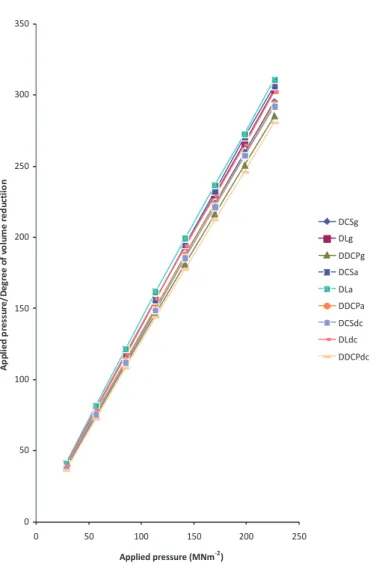
Representative Heckel and Kawakita plots for
diclofenac formulations are shown in Fig. 1 and Fig. 2 respectively. High linearity with correlation coeficients of generally greater than 0.95 was obtained at the second
phase of the plots, which generally commenced at the
ap-plied pressure of 113.230 MNm-2 for diclofenac
formula-tions. Such high linearity is often experienced with com-paratively soft materials that undergo plastic deformation while retaining different degrees of porosity depending on the initial packing arrangement in the die.
The mean yield pressure (Py), and the measure of
the total amount of plastic deformation (Pk) occurring
during compression, both of which are inverse plasticity parameters were derived from the Heckel and Kawakita plots respectively and were used in comparing the com-pressional properties of the formulations. The values for these parameters are presented in Table II.
The mode of consolidation of diclofenac formu-lations was found to be dependent on the nature of the excipient present in the formulation. Formulations
con-taining corn starch (DCS) deformed mainly by plastic low, while formulations containing a fracturing excipient, DCP (DDCP), consolidated by fragmentation. Formula
TABLE II - Values of relative density of tablets at compression pressure of 113.23MNm-2 (D), P
y and Pk for diclofenac formulations
Formulation Compression Method Binder/Concentration D Py Pk
DCS
DCS Direct compressionWet granulation
None None
Gelatin, 1% Gelatin, 4% Albizia gum, 1%
Albizia gum, 4%
0.853 0.855 0.858 0.867 0.863 0.874
32.258
105.263 103.093
83.333
78.125 64.103
0.205
0.217
0.208
0.165 0.187
0.082 DL
DL
Direct compression Wet granulation
None None
Gelatin, 1% Gelatin, 4% Albizia gum, 1%
Albizia gum, 4%
0.853 0.868
0.871 0.879
0.876 0.885
90.090 112.359 108.696 95.238
82.644
71.429
0.319
0.328 0.276
0.215 0.214 0.113 DDCP
DDCP Direct compressionWet granulation
None None
Gelatin, 1% Gelatin, 4% Albizia gum, 1%
Albizia gum, 4%
0.856 0.878 0.882
0.890 0.889 0.894
92.592 312.500 294.118 158.730 217.391 163.934
0.370
0.441 0.399
0.278 0.264
0.159
FIGURE 2 - Kawakita plots for Diclofenac formulations.
tions containing lactose (DL) showed an initial curve at
the early stage of compression, the curve became linear at the later stage. This showed that DL deformed by frag-mentation at the early stage of compression, followed by plastic deformation at the later stage. These results show that the mode of consolidation of the drug, diclofenac, is largely dependent on the nature of the excipient used in the formulation.
Mean yield pressure (Py) and Pk
The yield pressure is deined as the stress at which
plastic deformation of the particles commences and can be derived from the linear part of the Heckel plot while Pk is another pressure term which represents the pressure re-quired to reduce the powder bed by 50% and is obtainable
from Kawakita plots (Adams et al., 1994). Both Py and Pk
have an inverse relationship with plasticity of materials.
DCS was found to have the least Py and Pk values.
The ranking of Py and Pk values among diclofenac
formula-tions was DDCP > DL > DCS. The difference was signii
-cant according to ANOVA (p < 0.05). This implies that the
onset of plastic deformation occurred at lowest pressure
in DCS. This suggests that corn starch as an excipient will induce faster onset and extent of plastic low in diclofenac formulations than either lactose or DCP and that corn
starch is able to increase the softness of the formulation and its ability to deform plastically under pressure more
than lactose and DCP.
is affected mainly by the molecular and crystal structure
of the material (Rasenack, Muller, 2002). Hard, brittle
materials which have greater shear strength than tensile strength tend to fragment more easily than soft materials, which have lower shear strength than tensile strength. Particles also have a critical diameter at which the
den-siication mechanism turns from fragmentation to plastic deformation when particle size decreases (Roberts, Rowe, 1996). This appears to be the case with DL in this study,
in which the formulation fragmented at the early stage of the compression and exhibited plastic deformation at the later stage.
The Py and Pk values for powder formulations
pro-duced by the direct compression method of tablet produc-tion were lower than the values for the granule
formula-tions produced by the wet granulation method (with no binder). This is probably due to fragmentation of the gran
-ules at low pressures and subsequent illing of void spaces between the particles (Itiola, Pilpel, 1991). This therefore
suggests that direct compression is capable of impart-ing more plasticity to materials than the wet granulation method in tablet production. However, as binders were incorporated into the formulations in the wet granulation method, the Py values decreased and further decreased as binder concentration increased. This is in agreement with
previous work (Alebiowu, Itiola, 2001), which reported
that onset of plastic deformation in formulation occurred at lower pressures with increase in binder content. The Py and Pk values obtained for formulations containing Albizia
gum were generally lower than those of formulations
containing gelatin as binder (P<0.05). This suggests that
Albizia gum as a binder has superior qualities over gelatin in improving the softness and plasticity of materials.
The differences between Py and Pk (Table II) values
are probably due to the fact that, while Py relates essen-tially to the onset of plastic deformation, Pk relates to the
amount of plastic deformation occurring during the com-pression process, especially with plastic deformation being
a time dependent phenomenon (Oloniyon et al.,1998).
Tensile strength (T) of tablets
Bond strength is measurable by the tensile strength (T) of tablets (Itiola, Pilpel,1991; Fry, Greaves,1995).
Tensile strength has been used in this present study to assess the mechanical properties of diclofenac tablets, in which the binding properties of gelatin and Albizia gum were compared.
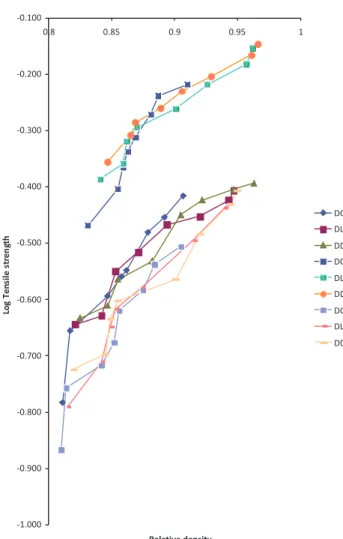
The results of the tensile strength on diclofenac tablet formulations are presented in Table III, while the representative plots of log tensile strength versus relative
density of tablets are shown in Figure 3. Correlation coef
-icients of generally greater than 0.970 were obtained in
all the formulations. This could be attributed to different types of forces that are acting between the constituent particles which include the interparticulate forces of at-traction or van der Waals’ forces, mechanical interlocking and other forces that operate between particles as they are brought into closer contact between the particles. The greater the effective surface area of contact, the greater is the degree of bonding, and, in effect, the greater the tensile strength.
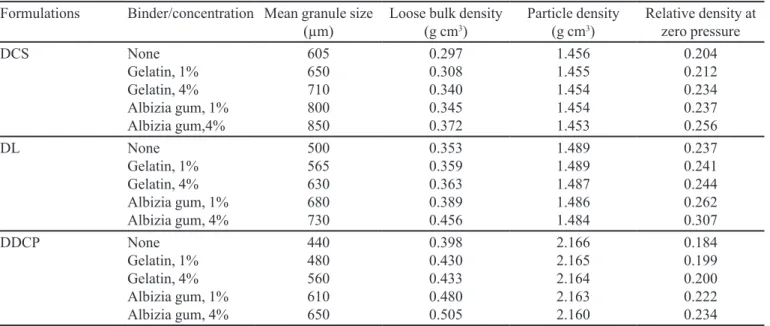
TABLE III - Granule properties of the formulations
Formulations Binder/concentration Mean granule size
(µm) Loose bulk density (g cm3)
Particle density
(g cm3)
Relative density at zero pressure
DCS None
Gelatin, 1% Gelatin, 4% Albizia gum, 1%
Albizia gum,4% 605 650 710 800 850 0.297 0.308 0.340 0.345 0.372 1.456 1.455 1.454 1.454 1.453 0.204 0.212 0.234 0.237 0.256 DL None Gelatin, 1% Gelatin, 4% Albizia gum, 1%
Albizia gum, 4%
500 565 630 680 730 0.353 0.359 0.363 0.389 0.456 1.489 1.489 1.487 1.486 1.484 0.237 0.241 0.244 0.262 0.307 DDCP None Gelatin, 1% Gelatin, 4% Albizia gum, 1%
Albizia gum, 4%
TABLE III - Values of Tensile strength (T) of diclofenac tablets at relative density of 0.900
Formulation Compression method Binder/Concentration Tensile strength, T (MN/m2)
DCS Direct compression
Wet granulation
None None
Gelatin, 1% Gelatin, 4% Albizia gum, 1%
Albizia gum, 4%
0.312 0.318
0.384
0.781
0.605
0.988
DL Direct compression
Wet granulation
None None
Gelatin, 1% Gelatin, 4% Albizia gum, 1%
Albizia gum, 4%
0.320
0.331 0.392 0.811
0.658
1.210
DDCP Direct compression
Wet granulation
None None
Gelatin, 1% Gelatin, 4% Albizia gum, 1%
Albizia gum, 4%
0.328 0.375 0.404
0.881
0.683
1.410
FIGURE 3 - Representative plots of log tensile strength versus relative density for diclofenac formulations.
DDCP generally exhibited the highest values of T among diclofenac formulations. The ranking was DDCP > DL > DCS. This result shows that formulations contain -ing fractur-ing materials produced tablets of higher tensile
strength. Correlations have been found between fracture strength and compression behaviour of particles (Fichtner, 2007). The deformability of pellets made of microcrystal -line cellulose could be related to their tensile and shear strength, and was found to be reduced for stronger pellets
(Bashaiwoldu et al., 2004).
A higher crushing strength was obtained for granules
(in tablets produced by wet granulation with no binder) than for powders of the same formulation (in tablets produced by direct compression method). This could be
explained by the variation in the granular or intra-particle porosity. The higher bulk density of the powders is an indication of reduced intra-particle porosity, which might have led to tablets of higher crushing strength.
Upon incorporation of binders, the values of T were found to be higher in tablets containing Albizia gum than those containing gelatin as binder. This could be as a result of a higher amount of plastic deformation which occurred during the compression process in the formulation contain-ing Albizia gum than those in which the binder used was gelatin. This is evidenced by low Py and Pk values obtained
in the formulations containing Albizia gum.
Tablets containing Albizia gum exhibited higher
values of T (p < 0.05) than those containing gelatin. It can
Microbial survival during tabletting
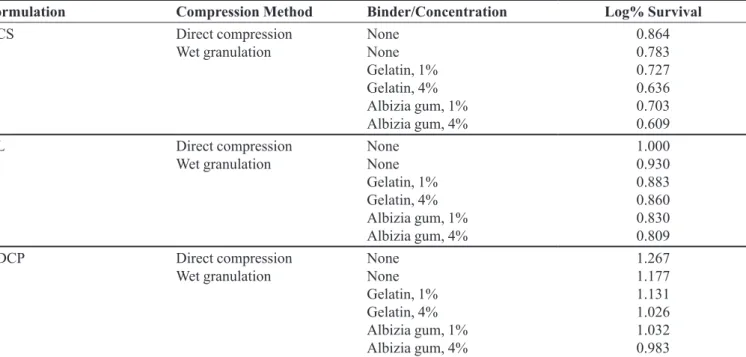
Table IV shows the values of log percent survival
with compression pressure in diclofenac formulations. Plots of log% survival of Bacillus subtilis spores in the tablets against compression pressure for diclofenac for-mulations are shown in Figure 4.
An inverse linear relationship between log%
surviv-al and compression pressure with correlation coeficient of 0.956 to 0.996 was obtained in all the formulations
with both types of binders and at all concentrations used.
These correlations were signiicant (p < 0.05). Such linear
relationship between log% survival of microorganisms and compression pressure has been reported for other
pharma-ceutical preparations in previous works (Rasenack, Muller, 2002; Roberts, Rowe, 1996; Fichtner, 2007; Bashaiwoldu
et al., 2004; Ayorinde et al., 2005).
DCS, the most plastic formulation as evidenced by
the lowest values of both Py and Pk, was found to exhibit the highest reduction in viability of the microbial con-taminant. The ranking of reduction of viability among
diclofenac formulations was DCS > DL > DDCP. At a
compression pressure of 226.46 MN/m2, DCS had a reduc
-tion of viability of 94%, DL had 90% while DDCP had
88%. Plastic deformation which was the main mechanism
of consolidation in DCS led to greater interparticulate
contact, thereby enhancing greater mechanical disruption
of the microorganisms than DL and DDCP formulations. Signiicantly (p < 0.05) higher microbial survival
was obtained in powder formulations prepared by direct compression than in granule formulations prepared using
TABLE IV - Values of Log% Survival of Bacillus subtilis Spores in Diclofenac Formulations at the Compression pressure of 226.46
MN/m2
Formulation Compression Method Binder/Concentration Log% Survival
DCS Direct compression
Wet granulation
None None
Gelatin, 1% Gelatin, 4% Albizia gum, 1%
Albizia gum, 4%
0.864 0.783 0.727 0.636 0.703
0.609
DL Direct compression
Wet granulation
None None
Gelatin, 1% Gelatin, 4% Albizia gum, 1%
Albizia gum, 4%
1.000 0.930
0.883 0.860 0.830
0.809
DDCP Direct compression
Wet granulation
None None
Gelatin, 1% Gelatin, 4% Albizia gum, 1%
Albizia gum, 4%
1.267 1.177 1.131 1.026 1.032 0.983
the wet granulation method (with no binder). To form
granules, bonds must be formed between powder particles
so that they adhere, and these bonds must be suficiently
strong to prevent breakdown of the granules to powder in subsequent handling operations. These strong interparticu-late bonds are capable of a lethal effect on microorganisms. It is known that granulation steps prior to compression
into tablets often employ temperatures in excess of 50 °C
and are therefore detrimental to microbial survival. Fry
and Greaves (1995) reported that wet granulation led to a
reduction in microbial contaminants.
The results further show that, in all the formulations, the percent survival of Bacillus subtilis spores decreased with increase in binder concentration and formulations containing Albizia gum exhibited a higher reduction of viability of the microbial contaminant than those
contain-ing gelatin. The difference was signiicant (p < 0.05). This
suggests that Albizia zygia gum is capable of reducing the survival level of microbial contaminants in the formed tablets.
CONCLUSION
The study showed that Albizia gum is capable of imparting higher plasticity and improving the softness of materials as evidenced by lower values of Py and Pk in the formulations containing Albizia gum than those contain-ing gelatin. Tablets containcontain-ing Albizia gum were found to possess higher tensile strength than those containing the synthetic binder gelatin, thus suggesting that using Albizia gum as binder in tablet formulations is capable of producing tablets of satisfactory mechanical strength. Furthermore, tablets prepared with Albizia gum showed a higher reduction of viability of Bacillus subtilis spores than those with gelatin. This therefore suggests that Albizia
gum has a greater lethal effect on microbial contaminants than gelatin.
REFERENCES
ADAMS M. J.; MULLIER, M.A.; SEVILLE, J.P.K.
Agglomerate strength measurement using a uniaxial
conined compression test. Powder Technol., v.78, p.5-13, 1994.
AKANDE O. F.; FORD, J.L.; ROWE, P.H.; RUBINSTEIN,
M.H. The effects of lag-time and dwell-time on the
compaction properties of 1:1 paracetamol/microcrystalline
cellulose tablets prepared by pre-compression and main compression. J. Pharm. Pharmacol., v.50, n.1, p.19-28,
2009.
ALEBIOWU, G.; ITIOLA, O.A. Effects of natural and
pregelatinized sorghum, plantain and corn starch binders on the compressional characteristics of a paracetamol tablet formulation. Pharm. Technol., [Suppl. Ed:Drug Delivery]
p.26-30, 2001.
AYORINDE, J.O.; ODEKU, O.A.; ITIOLA, O.A. The survival of Bacillus subtilis spores in dicalcium phosphate, lactose and corn starch, and their binary mixtures during tabletting.
Pharm. Technol., v.29, n.12, p.56-64, 2005.
AYORINDE, J.O; ITIOLA, O. A. Individual and interacting effecst of formulation variables on the tensile strength and microbial survival in diclofenac tablets. Arch. Pharm. Res., v.33, n.3, p.395-403, 2010.
BASHAIWOLDU, A.B.B.; PODCZECK, F.; NEWTON, M. A
study on the effect of drying techniques on the mechanical properties of pellets and compacted pellets. Eur. J. Pharm. Sci., v.21, n.2/3, p.119-129, 2004.
BLAIR, T.C.; BUCKTON, G.; BLOOMFIELD, S. Mechanism
of kill of microbial contaminants during tablet compression.
Int. J. Pharm., v.72, n.2, p.111-115, 1991.
CELIK, M.; DRISCOLL, C.E. An overview of the effects of
some physicochemical and mechanical characteristics of particulates on the compaction and post-compaction properties of compacts. Drug Dev. Ind. Pharm., v.19,
n.17/18, p.2119-2141, 1993.
CHESWORTH, K.A.C; SINCLAIR, A; STRETTON, R.J;
HAYES, W.P. Effect of tablet compression on the microbial count of tablet ingredients. Microbios. Lett., v.4, p.41-45,
1977.
FASSIHI, A.R; PARKER, M.S. The effects of processing factors upon the microbial content of tablets. J. Appl. Bacteriol.,
v.17, p. 17. 1977.
FELL, J. T; NEWTON, J. M. Determination of tablet strength by diametral compression test. J. Pharm. Sci., v.59, n.5,
p.688-691, 1970.
FICHTNER, F. Identiication and variation of some functionality
related characteristics of pharmaceutically relevant solid materials and their effects on product performance.
Uppsala, 2007. 92 p. [Ph.D thesis. Faculty of Pharmacy,
FRY, R.M; GREAVES, R.I.N. The survival of bacteria during
and after drying. J Hyg-Cambridge, v.49, n.2/3, p.220-246,
1995.
GEORGET, D.M.R; PARKER, R; SMITH, A.C. A study of
the effects of water content on the compaction behavior of
breakfast cereal lakes. Powder Technol., v.81, n.2, p.189-195, 1994.
HECKEL, R.W. An analysis of powder compaction behavior. Trans. Metallurgical Society, AIME., v.221, p.1001-1007, 1961.
ITIOLA, O.A; PILPEL, N. Tabletting characteristics of metronidazole formulations. Int. J. Pharm., v.31, n.1/2,
p.99-105, 1986b.
ITIOLA, O.A; PILPEL, N. Formulation effects on the mechanical properties of metronidazole tablets. J. Pharm. Pharmacol.,v.43, n.3, p.145-147, 1991.
KAWAKITA, K; HATTORI, I; KISHIGAMI, M. Characteristic
constants in Kawakita’s compression equations. J. Powder Bulk Solids Technol. v.1, p.3-8, 1977.
LUANGTANA-ANA, M.; FELL, J.T. Bonding mechanisms in
tabletting. Int. J. Pharm., v. 60, n.3, p.197-202, 1990.
NESIC, M. Consolidation mechanism of ethyl cellulose system
and iron sulphate-ethyl cellulose system. Acta Pharm. Jugosl. v.37, p.175-182, 1987.
ODEKU, O.A; ITIOLA, O.A; ODELOLA, H. A. Evaluation of destructive effects of khaya gum on bacillus subtilis
spores during tabletting. Phytother. Res., v.13, n.4,
p.296-299, 1999.
ODENIYI, M.A; JAIYEOBA, K.T. Optimization of ascorbic
acid tablet formulations containing hydrophilic polymers.
Farmacia, v.57, n.2, p.157-166, 2009.
PARKER, M.S. The Preservation of oral dosage forms. Int. J. Pharm. Technol. Prod. Mfr., v.5, p.20-24, 1985.
PLUMPTON, E.J.; GILBERT, P.; FELL, J.T. Effects of spatial
distribution of contaminating microorganisms within tablet formulation on subsequent inactivation through compaction. Int. J. Pharm., v.30, n.2/3, p.237-240, 1986.
RASENACK, N.; MULLER, B.W. Crystal habit and tabletting
behaviour. Int. J. Pharm., v.244, n.1/2, p.45-57, 2002.
REES, J.E.; RUE, P.J. Time dependent deformation of some direct compression excipients. J. Pharm. Pharmacol., v.30,
n.10, p.601-607, 1978.
ROBERTS, R.J.; ROWE, R.C. The effects of relationship
between punch velocity and particle size on the compaction behavior of materials with varying deformation mechanisms.
J. Pharm. Pharmacol., v.38, n.8, p.566-571, 1986.
ROBERTS, R.J; ROWE, R.C. Brittle /ductile behaviour in
pharmaceutical materials used in tabletting. Int. J. Pharm., v.36, n.2/3, p.205-209, 1996.
SUJJA-AREEVATH, J; MUNDAY, D.L; COX, P.J; KHAN,
K.A. Release characteristics of diclofenac sodium from encapsulated natural gum mini-matrix formulations. Int. J. Pharm, v.139, n.1/2, p.53-62, 1996.
TYLER, V.E.; BRADY, L.R.; ROBERTS, J.E. (Eds.). Pharmacognosy. 12.ed. Philadelphia: Lea and Febiger, 1983. p.338-367.
WALLHAUSER, K.H. Microbiological aspects on the subject
of oral dosage forms. Pharm. Ind. v.39, p.491-497, 1977.
WORLD AGROFORESTRY. Albizia zygia. <www.
w o r l d a g r o f o r e s t r y. o r g / t r e e d b 2 / s p e c i e s p r o f i l e .
php?Spid=1749>. Accessed on: 28 aug. 2011.
Received for publication on 16th June 2011