Bioethics and care of women vicims of sexual
violence: a review of literature
Paula Peixoto Messias Barreto 1, Juciara de Santana Silva 2, Edite Lago da Silva Sena 3, Rita Narriman Silva de Oliveira Boery 4, Sérgio Donha Yarid 5
Abstract
This aricle aims to perform a review of literature regarding care of women vicims of sexual violence through a search in indexed journals in the Virtual Health Library and Scopus databases, including publicaions since 2003. Data collecion was conducted in May 2013 using the keywords “violência sexual” [“sexual violence”], “assistência” [“assistance”], “serviços de saúde da mulher” [“women’s health services”], “aborto” [“aborion”] and “gravidez” [“pregnancy”]. Fiteen publicaions were retrieved, and the results were grouped into two the
-maic categories: bioethical issues related to women’s access to care services, and bioethical aspects present in treatment. The discussion was based in risk and protecion bioethics, showing that the government must ensure universal access for the vicims of sexual violence, and that health care professionals should be bio
-ethically prepared for such care.
Keywords: Bioethics. Sexual violence. Women’s health services.
Resumo
Bioéica e atendimento a mulheres víimas de violência sexual: revisão de literatura
Buscando efetuar revisão de literatura sobre atendimento a mulheres víimas de violência sexual, realizou-se busca em periódicos indexados nas bases de dados da Biblioteca Virtual de Saúde e Scopus, considerando publicações a parir do ano de 2003. A coleta de dados foi realizada em maio de 2013, uilizando descritores “violência sexual” [“sexual violence”], “assistência” [“assistance”], “serviços de saúde da mulher” [“women’s health services”], “aborto” [“aborion”] e “gravidez” [“pregnancy”]. Foram recuperados quinze arigos, e os
resultados foram agrupados em categorias temáicas: aspectos bioéicos relacionados ao acesso de mulheres a serviços de atendimento, e aspectos bioéicos presentes no atendimento. A discussão ocorreu à luz da bio
-éica do risco e proteção, evidenciando que o Estado deve garanir a universalidade do acesso às víimas de violência sexual e os proissionais de saúde devem estar bioeicamente preparados para esse atendimento.
Palavras-chave: Bioéica. Violência sexual. Serviços de saúde da mulher.
Resumen
Bioéica y asistencia a mujeres vícimas de violencia sexual: revisión de literatura
Procurando realizar una revisión de la literatura sobre la asistencia a mujeres vícimas de violencia sexual, se realizó una búsqueda en revistas indexadas en las bases de datos de la Biblioteca Virtual de Salud y en Scopus, teniendo en cuenta las publicaciones realizadas a parir del año 2003. La recolección de datos tuvo lugar en mayo de 2013, uilizando descriptores como “violencia sexual” [“sexual violence”], “asistencia”
[“as-sistance”], “servicios de salud de la mujer” [“women’s health services”], “aborto” [“aborion”] y “embarazo”
[“pregnancy”]. Se recuperaron quince arículos y los resultados fueron agrupados en categorías temáicas: aspectos bioéicos relacionados al acceso de mujeres a servicios de protección, evidenciando que el Estado debe garanizar la universalidad del acceso a las vícimas de violencia sexual y que los profesionales de salud deben estar bioéicamente preparados para brindar esta asistencia.
Palabras clave: Bioéica. Violencia sexual. Servicios de salud para mujeres.
1. Mestre [email protected] 2. Mestre [email protected] 3. Doutora [email protected] 4. Pós-Doutora [email protected] 5. Doutor [email protected] – Universidade Estadual do Sudoeste da Bahia (Uesb), Jequié/BA, Brasil.
Correspondência
Paula Peixoto Messias Barreto – Universidade Estadual do Sudoeste da Bahia (Uesb). Rua José Moreira Sobrinho, s/n CEP 45206-190. Jequié/BA, Brasil.
Declaram não haver conlito de interesse.
R
esear
ch articles
Sexual violence is global, widespread problem,
with signiicant consequences for the physical and psychological health integrity of its vicims. Howev
-er, in many places around the world, the services
available do not meet the needs of people who go
through such situaions 1. Sexual violence against
women can be understood as any sexual act or atempt without consent, by using coercion or inim
-idaion, including physical coercion, serious threat, use of weapons, and psychological pressure 2.Such violence is not something new for human history,
and it has been part of a socio-historical context of
gender interrelaions that inluence women to po
-siion themselves as inferior beings in the scale of metaphysical perfecion, which creates an array of asymmetric relaions between men and women in our society, where women are sill vicims of preju
-dice and discriminaion 3.
Violence against women has been reaching
alarming proporions worldwide. The Relatório
sobre o Desenvolvimento Mundial (World Develop
-mentReport) 4 has shown that women aged between
15 and 44 lose more years of healthy life due to rape and domesic violence than to diseases, such as breast and cervical cancer, heart disease, AIDS, respiratory diseases, childbirth related problems, car accidents, or wars. According to data provided
by the Sistema de Informação de Agravos de Noi
-icação (Sinan) 5 do Ministério da Saúde (Ministry of Health’s Noiiable Disease Surveillance System, 720,076 cases of sexual violence throughout Brazil were reported between 2009 and 2014, of which 481,105 vicims were women.
It is clear that this type of violence against
women is a serious public health concern that
re-quires speciic, difereniated professional and Governmental Atenion 6. Even though it is dii -cult to esimate the impact caused by all types of violence on health systems and their efects on economic producivity around the world, evidence shows that vicims of domesic and sexual violence usually present long-term health issues; which gen
-erate signiicantly higher treatment costs. These vicims will need frequent emergency care through -out their lives as compared to those who never
endured such abuses 7.
Faced with this problem, the Ministério da Saúde (Ministry of Health) launched, in 1998, a mile
-stone in care regulaions enitled “Prevenion and treatment of injuries resuling from sexual violence
against women and adolescents”, which consisted of a technical standard that aimed to promote
ap-propriate care to vicims of sexual violence, reissued
in 2005 8.Violence against women then became an
interlocutory mandatory reporing, substaniated by Law 10.778/2003 9, and regulated by Ordinance
2.406/2004 10. Later on, the Naional Agreement
on How to Prevent Violence Against Women 11
was launched to prevent and address all forms of
violence against women; and the Políica Nacional de Enfrentamento à Violência contra as Mulheres (Naional Policy of Violence against Women) 12 was
published to ensure assistance and rights to women exposed to violence.
Yet, most health professionals assigned to
provide vicims of sexual violence with proper care oten prove not to have the training required 1. Such
scenario requires, among other things, qualiied and humanized care able to minimize sufering, a stronger health care network, and skilled pro
-fessionals 12; mostly because the consequences
of sexual violence involve physical, psychological, and social aspects that must be prioriized in terms of the formulaion and implementaion of public
health policies, considering the bioethical dilemmas
involved in the event 13,especially from a risk and
protecion bioethics perspecive.
Originated in Lain America, this bioethics wave focus on the vulnerability inherent to spe
-ciic layers of the populaion, sill aware of the inequaliies that hurt the social structure of poorly developed countries. Thus, it is designed to cater to the speciic needs of those suscepible to violence, or to protect those in need 14. With the mulidimen
-sionality of the problem in mind, we’ve decided to conduct an integraive literature review. Our guiding tool was to quesion which bioethical issues are, in
fact, present in studies that include health care to
women vicims of sexual violence. As a result, we’ve established as the main objecive of this study to quesion, according to risk and protecion bioethics, the conclusive results provided by studies on health care for women vicims of sexual violence.
This kind of study will bring several contri
-buions to the current knowledge available on the subject, especially to risk and protecion bioeth -ics, which will encourage discussions throughout the academic and the health care environment,
leading to a broader access of women vicims of sexual violence to specialized services, as well as the improvement of such services. This exchange
of knowledge and informaion will expand the per
-cepion of concerned professionals, enabling them to plan and implement powerful acions speciically aimed towards the needs of the vicims.
R
esear
ch articles
Method
The content of the present study is an inte
-graive review of the data collected between April
and May of 2013. The research on periodic publi
-caions was made possible through The Biblioteca Virtual de Saúde (Virtual Health Library) - BVS and
Scopus. Descritores em Ciências da Saúde (Health
Sciences Descriptors - DeCS) were combined, and included: “sexual violence” AND “assistance”, “sexual violence” AND “women’s health services”,
“sexual violence” AND “aborion”, “sexual violence”
AND “pregnancy”.
The criteria for inclusion covered scieniic aricles freely available online, published between January, 2003 to May, 2013, including health care to women vicims of sexual violence in Brazil. Works, as well as forums, theses, dissertaions, and monographs on the subject that have not met
the established criteria were excluded from this
research. The search interval aimed to idenify is -sues related to bioethics in long periods of health
care, including the possibility of gathering a greater
number of studies focused on hospital care and/or
assistance to women exposed to sexual violence,
including changes or current characterisics of health care.
The comprehensive analysis of the aricles
researched revealed two themes that represent
the access women vicims of sexual violence have to speciic services, and the care provided by those services; which led to further bioethical discussion on risk and protecion.
Results and discussion
The iniial research revealed 285 aricles, 49 resuling from BVS access, and 236 from Scopus. Af
-ter analysis based on established cri-teria, 15 aricles were included in the corpus-based research. The se
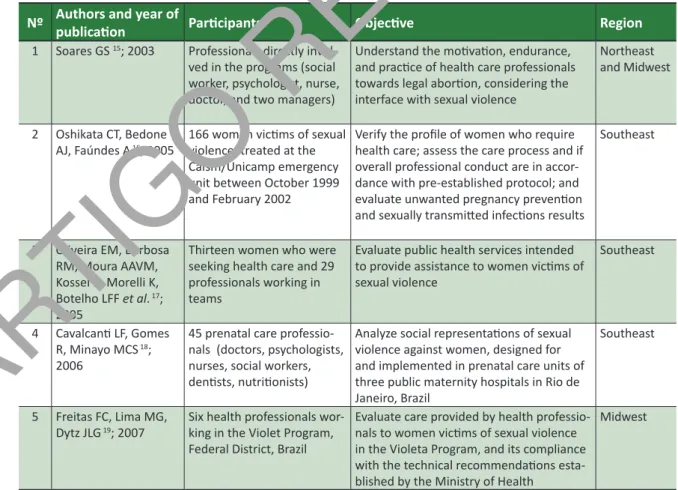
-lected studies were summarized in Table 1, where authors, paricipant proile, research objecives, and Brazilian regions where the research was conduct
-ed were introduc-ed; follow-ed by discussions on the
two themes derived from the comprehensive analy
-sis of the material.
Table 1. Data, objecives, and region pertaining selected aricles (Jequié/BA, 2014)
Nº Authors and year of
publicaion Paricipants Objecive Region
1 Soares GS 15; 2003 Professionals directly invol
-ved in the programs (social
worker, psychologist, nurse,
doctor, and two managers)
Understand the moivaion, endurance, and pracice of health care professionals towards legal aborion, considering the
interface with sexual violence
Northeast
and Midwest
2 Oshikata CT, Bedone
AJ, Faúndes A 16; 2005
166 women vicims of sexual
violence, treated at the
Caism/Unicamp emergency unit between October 1999 and February 2002
Verify the proile of women who require health care; assess the care process and if
overall professional conduct are in
accor-dance with pre-established protocol; and evaluate unwanted pregnancy prevenion and sexually transmited infecions results
Southeast
3 Oliveira EM, Barbosa
RM, Moura AAVM, Kossel K, Morelli K, Botelho LFF et al. 17; 2005
Thirteen women who were seeking health care and 29 professionals working in
teams
Evaluate public health services intended to provide assistance to women vicims of
sexual violence
Southeast
4 Cavalcani LF, Gomes
R, Minayo MCS 18; 2006
45 prenatal care professio
-nals (doctors, psychologists, nurses, social workers, denists, nutriionists)
Analyze social representaions of sexual
violence against women, designed for and implemented in prenatal care units of
three public maternity hospitals in Rio de Janeiro, Brazil
Southeast
5 Freitas FC, Lima MG,
Dytz JLG 19; 2007
Six health professionals
wor-king in the Violet Program, Federal District, Brazil
Evaluate care provided by health professio
-nals to women vicims of sexual violence in the Violeta Program, and its compliance with the technical recommendaions esta
-blished by the Ministry of Health
Midwest
R
esear
ch articles
Nº Authors and year of
publicaion Paricipants Objecive Region
6 Higa R, Reis MJ, Lopes
MHBM 20; 2003
–
Describe nursing care provided at Caism/ Unicamp to women who sufered sexual violence and opted for legal interrupion of pregnancy resuling from rape.
Southeast
7 Faria AL, Araújo CAA,
Bapista VH 21; 2008
–
Report experiences to the Grupo de Atendimento à Víima de Violência Sexual [Group of Assistance to Vicims of Sexual Violence] – Gavvis.
Southeast
8 Garcia MV, Ribeiro LA, Jorge MT, Pereira GR, Resende AP 22; 2008
Secondary data including
aggression against women,
18 years or older, in Uberlândia/MG.
Characterize epidemiological and clinical aspects of physical, sexual, psychological,
and verbal violence against women in
Uberlândia, Minas Gerais, Brazil.
Southeast
9 Higa R, Mondaca
ADCA, Reis MR, Lopes MHBM 23; 2008
–
Describe the Nursing Protocol adopted by the Assistance to Women Vicims of Sexual Violence at Caism/Unicamp already
revised, including immidiate and late care,
outpaient follow-up, and acions related to the legal terminaion of pregnancy resuling from rape.
Southeast
10 Monteiro CFS, Morais SCRV, Ferreira MTA, Carvalho RXC, Canuto MAO, Moreira ICCC 24; 2008
Sixty-one and nurses working in materniies throughout Teresina/PI.
Search on nurse’s knowledge about the Serviço de Atenção às Mulheres Víimas de Violência [Service for Sexual Women Vicims of Sexual Violence] – (Samvvis).
Northeast
11 Ramos CRA, Medicci VPG, Puccia MIR 25;
2009
Secondary data collected
through medical records
analysis of women treated by the public health service of Santo André/SP, between 2005 and 2006.
Outline the sociodemographic proile of women vicims of sexual violence treated
at the reference service located in the
city of Santo André; analyze compliance to technical standards established by the Ministry of Health; idenify the occurrence characterisics of sexual violence and interval between assaults; hospital and/or outpaient care.
Southeast
12 Aquino NMR, Sun SY, Oliveira EM, Marins MG, Silva JF, Matar R 26; 2009
One hundred and seventy-nine women over 14 years old, 14-28 weeks pregnant.
Esimate the prevalence of a history of sex
-ual violence and its associaion with health percepion amongst pregnant women.
Southeast
13 Reis MJ, Lopes MHBM, Higa R, Turato ER, Chvatal VLS, Bedone AJ 27; 2010
Six nurses (including ive
women) responsible for
im-mediate care followed by a sexual violence incident.
Learn about the experiences of nurses who care for women who have experienced
sexual violence.
Southeast
14 Reis MJ, Lopes MHBM, Higa R, Bedone AJ 28; 2010
Secondary data collected
through hospital records
analysis of women who have experienced sexual violence.
Characterize the nursing care provided by
the nurse to women who have experienced sexual violence at the Women’s Hospital,
Caism/Unicamp.
Southeast
15 Oshikata CT, Bedone AJ, Papa MSF, Santos GB, Pinheiro CD, Kalies AH 29; 2011
Six hundred and forty-two
women who experienced sexual violence treated at
Caism between January 2000 and December 2006.
Analyze some characterisics of women who have sufered sexual violence, espe
-cially during outpaient follow-up care.
Southeast
Table 1. Data, objecives, and region pertaining selected aricles (Jequié/BA, 2014)
R
esear
ch articles
The evaluaion of the number of included stud
-ies published per year has shown that there was one publicaion per year in 2003, 2006, and 2011; two publicaions in 2005, 2007, 2009, and 2010; and four in 2008, the most number of studies published over a twelve-month period. The ideniicaion of periodic publicaions, such as the Caderno de Saúde Pública (Reports in Public Health) and the Revista de Saúde Pública (Public Health Magazine) reveals a large number of publicaions; the irst included ive,
and the second has included three of the studies
analyzed, most of them developed in the country’s Southeast region, especially in the state of São Paulo.
Thirteen of the iteen studies included were
conducted in hospital referral services intended to
care for vicims of sexual violence. Most of them suggested the existence of mulidisciplinary teams composed of doctors, psychologists, social workers, and nurses. Regarding ethical aspects, in compli
-ance with Resoluion 466/2012 30 of the Conselho
Nacional de Saúde (Naional Health Council), which
involves human related research, we have
conclud-ed that the Comitê de Éica em Pesquisa (Research Ethics Commitee) approved all studies. In seven of
them, data was collected through semi-structured
interviews; however, one “no” menioned the im
-plementaion of free and informed consent.
Bioethical issues and access to care services
Issues related to the access of women vicims of sexual violence to specialized services were pre
-sented in seven of the studies analyzed 16-19,21,25,29.
Access issues take even greater proporions when
less privileged groups with fewer resources are
in-deed more exposed to violence 29, and services are
sill unable to reach the most disadvantaged layer of the populaion 16,which proves that only a small
porion of society has access to health care 29.
When a human being sufers from a disabili
-ty – weakness, illness, physical disabiliies – he or
she is no longer vulnerable and becomes
“perma-nently injured”, requiring therapeuic protecive acions 14,31. The consequences of sexual violence
involve physical, psychological, and social aspects 13,
causing a tremendous impact on the sexual and
reproducive health, not to menion devastaing, oten irreversible, mental health issues, which also afect the vicim’s social reintegraion 21.Thus, from
a risk and protecion bioethics perspecive, women who have sufered from sexual violence are consid
-ered permanently injured, and not just vulnerable or suscepible, which proves that access to special
-ized, proper care services is essenial.
The lack of knowledge of women regarding the existence of specialized services able to provide care to vicims of sexual violence, as well as the right they have to access them 17,19,in addiion to the deicien
-cies these services present within the health care
service network, and how misinformed health care professionals are about such services 17, were issues
also highlighted in this review. Sexual violence is one
of the least reported and recorded incidents
through-out the world 22,26. The authors surveyed admit the need to expand and decentralize care, sill concen
-trated in large urban areas 17,with more investment in
the health care network, and improvement of profes
-sional specializaion 25, the coordinaion of specialized services and the reciprocity between municipaliies 16.
It was concluded that the disclosure of informaion is imperaive to women 25,to the various segments of society 17,29, and to health care professionals 29.
In terms of protecion bioethics, it is the State’s mission to protect all members of society 14.
Based on this assumpion, the State is responsible for establishing prevenive and confroning acions against sexual violence, by expanding, qualifying, and integraing the health care network speciical
-ly for this purpose, also ensuring comprehensive, humanized care and skilled service, observing the
precepts of bioethics, and considering the segments
exposed to vulnerable situaions.
From a feminist bioethics perspecive, re
-straining this type of gender violence and the care for its vicims sill require the elaboraion of relec
-ions and muli-sectoral, interdisciplinary ac-ions capable of inluencing [directly] gender structure,
[working on] cultural norms and values that have been established unequally by social reality (...)
be-tween men and women 32, which demonstrates the complexity of the problem and the urgent need for the creaion and strengthening of discussion spaces within the muli-sectoral context, in order to beter
expose the issue and generate appropriate
respons-es to explicit demands.
The study also revealed that women are seeking specialized services less oten. Preliminary assis
-tance is provided by: health care services 16,17,21,29,
and police 16,21,29. In the irst case, understanding and
recognizing the violence inlicted becomes a dilem
-ma, as acceping the credibility of the complaint and avoiding medicalizing the events observed are oten recurring pracices 17.
In the case of law enforcement response, the
studies reveal that the police do not always provide the right assistance 17, which leads many women not
register their complaint 29.
R
esear
ch articles
Injury inlicted upon individuals, groups, or social segments, such as the female porion of the populaion, is paricularly relevant to the protecion of ethics 14. Protecion can be understood as an ef
-fecive pracice to assist the needy, and it is related
to the main role of ethics in this context, which
pre-cisely cares for those who need the most protecion: the permanently injured 31.Thus, assistance related
issues imposed by law enforcement and the health care service deserve a much closer look, so that the protecion principle is observed and vicims are treated respecfully.
Bioethical aspects and the assistance provided to vicims exposed to sexual violence
Issues related to insuicient vocaional train
-ing and/or professional health educaion on “sexual
violence” have been highlighted in four of the
stud-ies analyzed 17,23,24,27. Several authors admit that a
coherent set of knowledge is necessary to enable health care professionals to assist women vicims of sexual violence 19,23; and adding this subject to un
-dergraduate health programs is imperaive 17,19.
Recognizing that sexual violence is a major health concern and a serious violaion against women’s rights has required immediate response from services and vocaional training insituions over the recent years 33. As a result, it is vital that future professionals are able to provide soluions to upcoming challenges faced by
the health care services intended to care for this
seg-ment of the populaion. In order to accomplish these objecives, it is urgent to incorporate ethics into the daily rouine of health care professionals, both as a
support factor and molder of individual character, and as an element indispensable to the health care and
in-tegrity of fellow human beings 34.
The training of professionals and future pro
-fessionals in sexual violence aims to face subjecive quesions nestled in the situaion, and the need for professional preparaion in the case of absence of authoritaive subjects. In addiion, professionals
must obtain proper training on how to develop the
ability to withstand sufering, distress, and discom
-fort, as they are constantly exposed to individuals
who have experienced sexual violence, something
that deinitely changes the daily rouine of the pro
-fessionals, especially women 35.
Amongst the problems related to the care of women vicims of sexual violence, the studies high
-lighted four that are shown to be the most frequent: 1) double gynecological examinaion – conduct
-ed at the hospital and at the Insitute of Forensic
Medicine – which reinforces the violence inlicted 17;
2) several medicaions that the vicim is required to take 16; 3) diiculty to conduct aborion due to the
lack of adequate assistance, which can also lead the vicim to opt for a clandesine procedure, exposing her to physical and psychological risks 17; 4) those
who provide direct assistance oten lack adequate and speciic professional training, which consists of a diferent kind aggression 27.
When it comes to ethics, we oten idealize so
-ciety as just and fair, an environment where human dignity must be respected. In various areas of health
care, compliance with ethical principles associated
with daily professional pracices means that moral and cultural values must be observed. Therefore, the care of women who have sufered from any kind of sexual violence must be conducted in order to preserve the dignity of the human being, which requires vigilant applicaion of ethical principles 34.
The studies 19,28 included in this revision
pres-ent relecions on inadequate professional postures, inluenced by personal beliefs and values. They also
suggest that professional training programs must
include, in addiion to technical subjects, courses related to the subjecivity inherent in the context 28,
emphasizing the relevance of technical and emo
-ional preparaion of the profess-ional 19.
Therefore, it is necessary to engage profes
-sionals into a self-criicism process and encourage them to understand that their concepions and
professional conducts are associated with an
ide-ology able to afect the lives of the individuals they care for; and the unpreparedness of teams can cause dissaisfacion, promoing socio-cultural prejudice against women paients who have suf
-fered sexual violence 32.
Regarding the care of pregnancy resuling from sexual violence and its interrupion, studies re
-port that health care professionals oten encounter diiculies when dealing with legal aborion 29. Assis
-tance is provided based on the idea that aborion is a crime, without any reference to reproducive rights or to social issues that derive from clandesinely issues 15. Some professionals retain a biased ai
-tude towards the problem and openly express their discriminaion against colleagues who conduct ter
-minaion of pregnancy in compliance with the law 17.
It is necessary to menion that the Código Penal Brasileiro (Brazilian Penal Code) classiies aborion as a crime against life, punishable by law, classifying cases of pregnancy resuling from rape, among other speciic situaions, as excepions 36.
R
esear
ch articles
Even before this prerogaive, the interpretaion of
studies leads to the conclusion that bioethical,
eth-ical, and moral dilemmas nestled in the situaion tend to greatly inluence health care professionals.
A study that included health care professionals dealing with legal aborion services in Brazil re
-vealed that these professionals oten demonstrate a distrusful aitude towards the narraives of women seeking legal aborion, subjecing them to further invesigaion and forensic services intended to prove the veracity of the complaint; which com
-pletely goes against the very same public policies
that determine the narraive of the vicim as sui
-cient enough for them to obtain righful access to legal aborion through health services in Brazil 37.
The selected studies conclude that, in order to reverse this situaion, there is a need for con
-inuous educaion acions, psychological support, respect towards internal conlicts and the beliefs/
moral values of the professionals involved in health
care, giving them the right to choose to paricipate in this process or not, which aims to provide quality, safe, respecful services 20. Discussing the assistance
to vicims of sexual violence extensively poses a challenge to the health sector; and dealing with
it, while ensuring the women’s right to health and
autonomy over their bodies, is a task that certainly requires coninuous professional efort, which not only requires partnerships with diferent sectors of society 38,but also joint and efecive acion.
Final consideraions
The integraive literature review has demon -strated that various aspects inherent to the care
of women vicims of sexual violence by hospital services deserve further discussion, especially if bioethical arguments and, in this context, risk and
protecion bioethics are considered. The analyzed studies revealed that access to specialized care ser
-vices is sill diicult and potenially problemaic, due to the lack of cohesive, homogeneous care. It was
also observed that the care for women exposed to
sexual violence, and especially the service provided to those who opt for the terminaion of pregnancy resuling from violence, are considered controver
-sial situaions that health care professionals ind diicult to deal with.
The analysis of the studies in the light of risk and protecion bioethics have shown that the chal
-lenges faced by the context studied must be dealt with efecive public policies that guarantee access to specialized services, and ensure training of health
care professionals that includes deeper bioethical
re-lecion in order to enable them to provide service that is decent, friendly, free of prejudice and discrim
-inaion. In addiion to these aspects directly related to the care of vicims of sexual violence, it is im
-portant to emphasize that the Brazilian government must promote civic educaion on human, sexual, and reproducive rights, aiming to deinitely suppress
violence against women in domesic and public en
-vironments, ensuring civil rights to a segment that
consitutes the majority of the country’s populaion. Considering the importance of the topic herein discussed, its various pariculariies, and the myriad of aspects that can and must be beter understood,
we suggest that further studies are conducted in the light of bioethics, focusing on the care provided
by health professionals to women vicims of sexual violence, including legal interrupion of pregnancy. Such studies are extremely necessary, considering
that violence against women is a persistent
phenom-enon inherent to Brazilian society, sadly illustrated by recent cases of gang rape reported by naional and internaional media 39-41.
Referências
1. World Health Organizaion. Sexual violence: strengthening the health sector response. [Internet]. Genebra; 2013 [acesso 19 jul 2013]. Disponível: htp://bit.ly/1TScJUi
2. World Health Organizaion. World report on violence and health. [Internet]. Genebra; 2002 [acesso 19 jul 2012]. Disponível: htp://bit.ly/1U1738w
3. Silva, SG. Preconceito e discriminação: as bases da violência contra a mulher. Psicol Cienc Prof. 2010;30(3):556-71.
4. Banco Mundial. Relatório sobre o desenvolvimento mundial 1993: invesindo em saúde: indicadores de desenvolvimento mundial. Rio de Janeiro: Fundação Getúlio Vargas; 1993. 5. Brasil. Ministério da Saúde. Violência domésica, sexual e/ou outras violências. Brasília; 2016
[acesso 14 maio 2016]. Disponível: htp://bit.ly/20WwQ2n
6. Silva CD, Gomes VLO, Acosta DF, Barlem ELD, Fonseca AD. Epidemiologia da violência contra a mulher: caracterísicas do agressor e do ato violento. Rev Enferm UFPE on line. [Internet]. 2013 [acesso 2 maio 2013];7(1):8-14. Disponível: htp://bit.ly/1sQJPYo
R
esear
ch articles
7. Dahlberg LL, Krug EG. Violência: um problema global de saúde pública. Ciênc Saúde Coleiva. 2006;11:1163-78.
8. Brasil. Ministério da Saúde. Prevenção e tratamento dos agravos resultantes da violência sexual contra mulheres e adolescentes: norma técnica. 2ª ed. atual. e ampl. Brasília: Ministério da Saúde; 2005.
9. Brasil. Presidência da República. Lei nº 10.778, de 24 de novembro de 2003. Estabelece a noiicação compulsória, no território nacional, do caso de violência contra a mulher que for atendida em serviços de saúde públicos ou privados. [Internet]. Diário Oicial da União. Brasília; 25 nov 2003 [acesso 19 jul 2012]. Disponível: htp://bit.ly/25DMExG
10. Brasil. Ministério da Saúde. Portaria nº 2.406, de 5 de novembro de 2004. Insitui serviço de noiicação compulsória de violência contra a mulher, e aprova instrumento e luxo para noiicação. Diário Oicial da União. Brasília; 5 nov 2004.
11. Brasil. Presidência da República. Pacto nacional pelo enfrentamento à violência contra a mulher. Brasília: Secretaria Especial de Políicas para as Mulheres; 2007.
12. Brasil. Presidência da República. Políicanacional de enfrentamento à violência contra as mulheres. Brasília: Secretaria de Políicas para as Mulheres; 2011.
13. Barbosa LNF, Dantas FG, Silva MAB, Silva JJ. Sobre éica e violência sexual: recortes de um caso atendido fora dos serviços especializados. Rev SBPH. 2010;13(2):299-317.
14. Kotow M. Bioéica de proteção: considerações sobre o contexto laino-americano. In: Schramm FR, Rego S, Braz M, Palácio M, organizadores. Bioéica, risco e proteção. Rio de Janeiro: UFRJ, Fiocruz; 2005. p. 29-44.
15. Soares GS. Proissionais de saúde frente ao aborto legal no Brasil: desaios, conlitos e signiicados. Cad Saúde Pública. 2003;19(2 Suppl):399-406.
16. Oshikata CT, Bedone AJ, Faúndes A. Atendimento de emergência a mulheres que sofreram violência sexual: caracterísicas das mulheres e resultados até seis meses pós-agressão. Cad Saúde Pública. 2005;21(1):192-9.
17. Oliveira EM, Barbosa RM, Moura AAVM, Kossel K, Morelli K, Botelho LFF et al. Atendimento às mulheres víimas de violência sexual: um estudo qualitaivo. Rev Saúde Pública. 2005;39(3):376-82. 18. Cavalcani LF, Gomes R, Minayo MCS. Representações sociais de proissionais de saúde sobre
violência sexual contra a mulher: estudo em três maternidades públicas municipais do Rio de Janeiro, Brasil. Cad Saúde Pública. 2006;22(1):31-9.
19. Freitas FC, Lima MG, Dytz JLG. Atendimento à mulher víima de violência sexual no Programa Violeta, no Distrito Federal. Comun Ciênc Saúde. 2007;18(3):185-95.
20. Higa R, Reis MJ, Lopes MHBM. Interrupção legal da gestação decorrente de estupro: assistência de enfermagem às mulheres atendidas num serviço público da cidade de Campinas/SP. Ciênc Cuid Saúde. 2007:6(3):372-6.
21. Faria AL, Araújo CAA, Bapista VH. Assistência à víima de violência sexual: a experiência da Universidade de Taubaté.Rev Eletrônica Enferm. 2008;10(4):1138-43.
22. Garcia MV, Ribeiro LA, Jorge MT, Pereira GR, Resende AP. Caracterização dos casos de violência contra a mulher atendidos em três serviços na cidade de Uberlândia, Minas Gerais, Brasil. Cad Saúde Pública. 2008;24(11):2551-63.
23. Higa R,Mondaca ADCA, Reis MJ, Lopes MHBM. Atendimento à mulher víima de violência sexual: protocolo de assistência de enfermagem. Rev Esc Enferm USP. 2008;42(2):377-82.
24. Monteiro CFS, Morais SCRV, Ferreira MTA, Carvalho RXC, Canuto MAO, Moreira ICCC. Conhecimento dos enfermeiros sobre o Serviço de Atenção às Mulheres Víimas de Violência Sexual. Rev Bras Enferm. 2008;61(4):454-8.
25. Ramos CRA, Medicci VPG, Puccia MIR. Mulheres viimadas sexualmente: peril sociodemográico e análise do atendimento em um centro de referência. Rev Inst Ciênc Saúde.2009;27(1):22-7. 26. Aquino NMR, Sun SY, Oliveira EM, Marins MG, Silva JF, Matar R. Violência sexual e associação com
a percepção individual de saúde entre mulheres gestantes. Rev Saúde Pública. 2009;43(6):954-60. 27. Reis MJ, Lopes MHBM, Higa R, Turato ER, Chvatal VLS, Bedone AJ. Vivências de enfermeiros na
assistência à mulher víima de violência sexual. Rev Saúde Pública. 2010;44(2):325-31.
28. Reis MJ, Lopes MHBM, Higa R, Bedone AJ. Atendimento de enfermagem às mulheres que sofrem violência sexual. Rev Laino-Am Enferm. 2010;18(4):[9 telas].
29. Oshikata CT, Bedone AJ, Papa MSF, Santos GB, Pinheiro CD, Kalies AH. Caracterísicas das mulheres violentadas sexualmente e da adesão ao seguimento ambulatorial: tendências observadas ao longo dos anos em um serviço de referência em Campinas, São Paulo, Brasil. Cad Saúde Pública. 2011;27(4):701-13.
30. Brasil. Conselho Nacional de Saúde. Resolução nº 466, de 12 de dezembro de 2012. Aprova as diretrizes e normas regulamentadoras de pesquisas envolvendo seres humanos. [Internet]. Diário Oicial da União. Brasília; 13 jun 2012 [acesso 22 mar 2013]. Disponível: htp://bit.ly/1mTMIS3 31. Schramm FR. Bioéica da proteção: ferramenta válida para enfrentar problemas morais na era da
globalização. Rev. bioét. (Impr.). 2008;16(1):11-23.
32. Bandeira L, Almeida TMC. Desaios das políicas e ações em saúde diante da violência contra as mulheres. SER Social. 2008;10(22):183-212.
33. Matar R, Abrahão AR, Andalat Neto J, Colas OR, Schroeder I, Machado SJR et al. Assistência muliproissional à víima de violência sexual: a experiência da Universidade Federal de São Paulo. Cad Saúde Pública. 2007;23(2):459-64.
R
esear
ch articles
34. Schuh CM, Albuquerque IM. A éica na formação dos proissionais da saúde: algumas relexões. Rev. Bioét. (Impr.). [Internet]. 2009 [acesso 19 jul 2012];17(1):55-60. Disponível: htp://bit.ly/1RSAOCN 35. Costa LF, Ribeiro MA, Penso MA, Almeida TMC. O desaio da supervisão e pesquisa-ação em casos
de abuso sexual: os professores e suas questões. Paidéia. 2008;18(40):355-70. 36. Bitencourt CR. Código penal comentado. 3ª ed. São Paulo: Saraiva; 2005.
37. Diniz D, Dios VC , Mastrella M, Madeiro AP. A verdade do estupro nos serviços de aborto legal no Brasil. Rev. bioét. (Impr.). 2014;22(2):291-8.
38. Villela WV, Lago T. Conquistas e desaios no atendimento das mulheres que sofreram violência sexual. Cad Saúde Pública. 2007;23(2):471-5.
39. Frazão F. Estupro, espancamento e morte: a tarde de horror no Piauí. Revista Veja. 2015 [acesso 3 jun 2016]. Disponível: htp://abr.ai/1toSQYZ
40. Globo. Caso de estupro de menina ocorrido em 2015, no Rio, ainda não foi julgado. 2016 [acesso 3 jun 2016]. Disponível: htp://glo.bo/1sET3XZ
41. Rossi M. O que já se sabe sobre o estupro coleivo no Rio de Janeiro: a polícia levantou sete suspeitos e dois deles estão deidos. A víima deixou o Rio. El País. São Paulo; 2016 [acesso 3 jun 2016]. Disponível: htp://bit.ly/1UsP633
Paricipaing of the authors
Paula Peixoto Messias Barreto, Edite Lago da Silva Sena, and Juciara de Santana Silva have designed the methodology of the study, raised and systemaize data, and prepared the manuscript. Rita Narriman Silva de Oliveira Boery and Sérgio Donha Yarid have contributed to the elaboraion of the manuscript.
Recebido: 4.8.2015 Revisado: 11.4.2016 Aprovado: 30.5.2016