Cortisol Patterns? Findings from the Whitehall II Study
Jing Liao*, Eric J. Brunner, Meena Kumari
Department of Epidemiology and Public Health, University College London, London, United Kingdom
Abstract
Objective:The evidence on whether there is work stress related dysregulation of the hypothalamic-pituitary-adrenal axis is equivocal. This study assessed the relation between work stress and diurnal cortisol rhythm in a large-scale occupational cohort, the Whitehall II study.
Methods:Work stress was assessed in two ways, using the job-demand-control (JDC) and the effort-reward-imbalance (ERI) models. Salivary cortisol samples were collected six times over a normal day in 2002–2004. The cortisol awakening response (CAR) and diurnal cortisol decline (slope) were calculated.
Results:In this large occupational cohort (N = 2,126, mean age 57.1), modest differences in cortisol patterns were found for ERI models only, showing lower reward (b=20.001, P-value = 0.04) and higher ERI (b= 0.002, P-value = 0.05) were related to a flatter slope in cortisol across the day. Meanwhile, moderate gender interactions were observed regarding CAR and JDC model.
Conclusions:We conclude that the associations of work stress with cortisol are modest, with associations apparent for ERI model rather than JDC model.
Citation:Liao J, Brunner EJ, Kumari M (2013) Is There an Association between Work Stress and Diurnal Cortisol Patterns? Findings from the Whitehall II Study. PLoS ONE 8(12): e81020. doi:10.1371/journal.pone.0081020
Editor:Henrik Oster, University of Lu¨beck, Germany
ReceivedJune 19, 2013;AcceptedOctober 15, 2013;PublishedDecember 3, 2013
Copyright:ß2013 Liao et al. This is an open-access article distributed under the terms of the Creative Commons Attribution License, which permits unrestricted use, distribution, and reproduction in any medium, provided the original author and source are credited.
Funding:The Whitehall II study was supported by grants from the Medical Research Council; Economic and Social Research Council; British Heart Foundation; Health and Safety Executive; Department of Health; National Heart Lung and Blood Institute (HL36310), US, NIH; National Institute on Aging (AG13196), US, NIH; Agency for Health Care Policy Research (HS06516); and the John D and Catherine T MacArthur Foundation Research Networks on Successful Midlife Development and Socioeconomic Status and Health. Meena Kumari is partially supported by the Economic and Social Research Council International Centre for Life Course Studies in Society and Health (RES-596-28-0001). The funders had no role in study design and analysis, decision to publish, or preparation of the manuscript.
Competing Interests:The authors have no conflicts of interests to declare.
* E-mail: [email protected]
Introduction
Work stress has been established as a risk factor for a range of health impairments, particularly cardiovascular disease [1], metabolic syndrome [2,3] and Type 2 diabetes mellitus [4,5]. Two dominant work stress models have been widely employed in these analyses: the job demand control (JDC) model [6] and the effort-reward imbalance (ERI) model [7]. The JDC model postulates a combination of lower control (less skill utilization and lower decision authority) and higher work demand (more quantitative work load and conflicting demands) will trigger job strain; whereas the ERI model emphasizes social reciprocity, such that a sustained unfair trade-off between effort (cost) and reward (gain) will elicit negative emotions and further lead to adverse long-term health consequences. Similarities exist between these two models as both of them tap psychosocial disequilibrium [8] and highly correlated items are adopted in respective scales [9]. Nevertheless, there are distinctive conceptual and methodological differences as the JDC model refers to the structural characteristics of the psychosocial environment at work, emphasizing the power structure, labour division and workplace democracy [10]; in contrast, the ERI model takes personal coping strategy into
account and highlights perceptions of reciprocity, embodied by wage, esteem and job security [11,12].
showing a positive association between job strain and cortisol levels was more pronounced in women [13,15,17]; while over-commitment and ERI were only related to elevated cortisol among men [24,27].
Inconsistent findings of prior studies could be ascribed to small study sample sizes [26], incomplete information on work stress [27], non-adherence to cortisol sampling protocol (particularly the accuracy of collection time), lack of consistency in modelling cortisol parameters [29,30] and confounding adjustments [15,17,30]. The present study seeks to address these issues by investigating the relation between work stress and diurnal salivary cortisol in a large occupational cohort. We employ the comple-mentary JDC and ERI models, examine cortisol patterns throughout the day and adjust for a variety of covariates. The primary aim of the study was to understand the nature of the relationships between work stress models and indices of diurnal cortisol patterns. A secondary aim was to analyse the gender-specific cortisol pattern by work stress models.
Methods
Ethic Statement
Ethical approval for the Whitehall II study was obtained from the University College London Medical School Committees on the Ethics of Human Research. All participants are asked to give written informed consent at each phase.
Study population
Established in 1985, the Whitehall II study is an on-going cohort with 10,308 participants (66% male, aged 35–55) recruited from 20 London based civil service departments. After the baseline clinical health check-up, further self-administered questionnaire data were collected in follow-up phases administered approxi-mately every two years while repeated clinical examinations were only carried out in odd phases [31]. By Phase 7 (2002–2004) the number of participants was 6,967, half of which were still working (n = 3,413). As the recruitment for the saliva collection was initiated partway through Phase 7, only 65.8% of those working participants (n = 2,246) had information on salivary cortisol. The present analysis focused on participants who were still working in Phase 7, with information on work stress and diurnal cortisol secretion (n = 2,126).
Measurements of work-stress
The JDC model was assessed by the Job Strain Questionnaire [32]. The questionnaire consisted of three basic components: job demand (4 items, Cronbach’s a= 0.67), job control (15 items, Cronbach’s a= 0.84) and social support at work (6 items, Cronbach’s a= 0.79). A four-point scale from ‘‘often’’ to ‘‘never/almost never’’ were used to answer all these items. Responses were combined into summary scales, where higher scores indicate higher control, demand or support. We used both binary and continuous measurements for job strain. Binary job strain was defined as participants reported both high score on demand (above the median score) and low score on control (below the median score). A continuous scale of job strain was calculated by subtracting control score from demand score. The binary job strain was used to describe participants’ characteristics at baseline, and the continuous one was used in regression analysis to prevent any information reduction due to artificial categorizing.
The English version of ERI questionnaires were constructed from the 23 validated Likert scaled items [12], which contained extrinsic and intrinsic dimensions of the full ERI model. For the extrinsic part, effort and reward each was rated on a five-point
scale: 4 items for effort (Cronbach’sa= 0.80) and 8 items for the reward (Cronbach’sa= 0.87). A ratio of ERI was calculated by the formula effort/reward*c [12], where ‘c’ is a correction factor weighting the different numbers of items in numerator and denominator (4/8). ERI.1.0 reflects disproportionate effort, whereas a value from 0 to 1 indicates favourable balance. The continuous ERI ratio was logarithm transformed to produce proportional scaling above and below the balance point ‘‘1’’ [33].
Cortisol collection and analysis
The protocol of saliva sampling used in the Whitehall II study has been reported previously [34]. Salivettes (Sarstedt, Leicester, UK) were used to collect participants’ saliva samples. Participants were instructed to collect 6 samples across the day, at awakening, 30 minutes after waking, 2.5 hours after waking, 8 hours after waking, 12 hours after waking and bedtime. Time of sampling was recorded simultaneously. Participants were required to take samples immediately after awakening. Caffeine and acidic drinks in the first 30 minutes, brushing teeth or eating or drinking 15 minutes before a sample collection were not allowed. Saliva samples were centrifuged at 3000 rpm for 5 minutes. The clear supernatant was assayed via chemiluminescence detection (CLIA; IBL-Hamburg, Hamburg, Germany) to measure the salivary cortisol levels. The lower concentration limit of this assay was 0.44 nmol/l; intra- and inter-assay coefficients of variance were
,8%. Any sample.50 nmol/l was repeated.
Assessment of covariates
Data on gender, age and ethnicity were collected by question-naires. Waking up time was available from the logbook on the day of sample collection. Time since waking, which shows the time difference between waking and taking first sample was categorized into 5-minute intervals. Social position, assessed by civil service employment grade, was used in this analysis as a potential confounder, given previous studies have described associations with diurnal cortisol patterns [17,35]. Three categories, adminis-trative (highest employment grade), professional (medium employ-ment grade) and clerical (lowest employemploy-ment grade), were determined by current civil service employment grade if partic-ipants were still working in the civil service or according to the last job grade if participants had left civil service. Body mass index (BMI-kg/m2) was categorized using cut-points:,21, 21,31 and
31+, given a nonlinear association of BMI with diurnal cortisol slope [36].
Statistical analysis
1. Data reduction for cortisol assessment. Approximately 1% of cortisol values that were three standard deviations above the mean were removed (n = 43), which may be influenced by altered pH-values or blood contamination [29]. Additionally, participants reporting either eating, drinking, exercising or brushing their teeth before the first sample (n = 41) were excluded from the analysis. Data were analysed for difference between weekday/weekend collections. Since no statistically significant differences were observed, data were combined for further analysis. Because of a strong positive skew still existed following removal of outliers, cortisol data were logarithm transformed for analysis.
The methodology used to calculate the slope in cortisol across the day has been previously reported [38]. In short, the slope was derived from regressing cortisol concentration of five samples over the day excluding the second sample, as CAR and slope might be modulated by different neurobiological systems [39]. A multilevel regression model was employed to predict the log cortisol, taking measurement occasion as a level one identifier, person as a level two identifier and sample time as the independent covariate. For each person, the slope was estimated as the overall negative slope plus the level-two slope residual. A more rapid cortisol decline over the day was represented by more negative slope value, whereas flatter diurnal rhythms were indicated as slope values close to zero.
3. Analytic strategy. Participant characteristics and cortisol profile were analysed according to work stress categories using regression analysis for continuous variables and Chi-square test for categorical variables. Linear regression models with CAR or slope as the outcome were employed to assess the association with work stress, adjusted for age, gender, ethnicity, time of waking and time since waking. One at a time, the diurnal cortisol parameters were used as dependent variables and each component of work stress models as independent variables. Since continuous scales were used, results were reported by per standard deviation change in each independent variable. Gender effects were analysed by adding interaction term between gender and work stress. Additional adjustments for employment grade and BMI were run by using multivariable adjusted linear regression models. The data were analysed using STATA version 11.
Results
Descriptive results
In Phase 7 half (49.2%) of participants were still working (n = 3,413), 50.8% were not working due to retirement or sickness. Compared with people who were still working, those retired or not working were more likely to be female, older and worked in lower employment grades. The final number of participants for this analysis was 2,126, of whom 481 were female (22.6%). They were more likely to be male, younger and had higher employment grade in comparison with those who were still working in Phase 7 but not included in this analysis (Table 1).
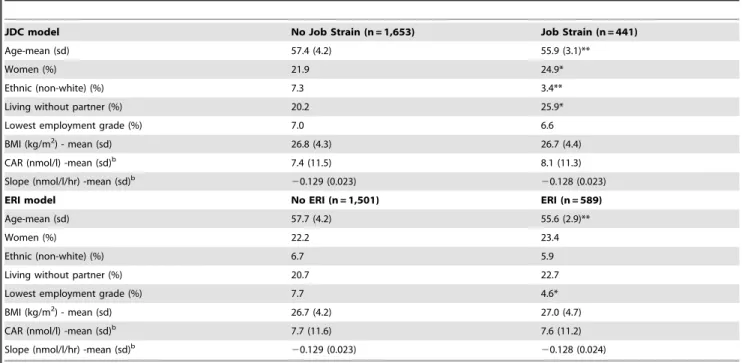
Table 2 shows the characteristics of participants with measures of cortisol secretion stratified by job strain and ERI. In our study sample, the prevalence of job strain was 21% and the prevalence of ERI was 28%. Participants reporting job strain or ERI were younger. Those who reported job strain were less likely to be ethnic minority groups and live with a partner. On the other hand, participants working in higher employment grades were more likely to report ERI. As regards the diurnal cortisol profile, all
parameters of cortisol secretion were comparable between either job strain or ERI categories.
Correlation of work stress measures
The correlation matrix of work stress measures is summarized in Table 3. Demand and effort, support and reward were moderately correlated confirming those measures tapping similar aspects of work stress. Job strain is composed of demand and reward and ERI is composed of effort and reward. Demand had a stronger correlation with job strain than control; the ERI score was highly driven by the effort score. Overall, the directions of those associations confirmed the theoretical assumptions underlying those work stress models, and indicated distinct aspects of work environment may be captured by different dimension of work stress models.
Relation between work stress and salivary cortisol indices
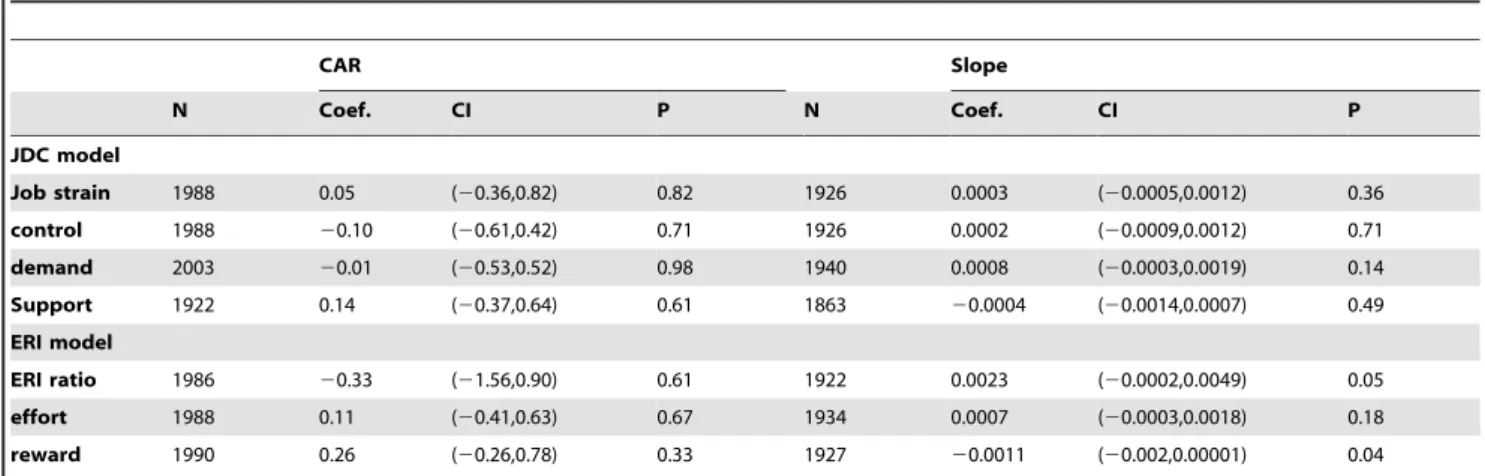
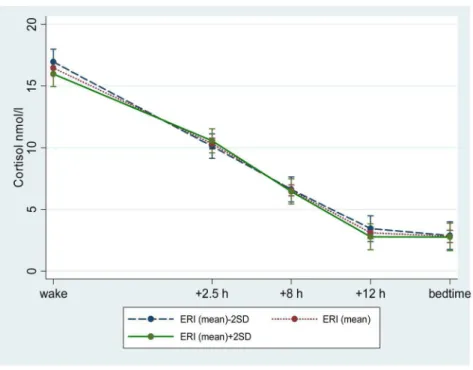
The linear regression is presented in all participants adjusted for gender (Table 4) and gender stratified (Table 5). In all participants, marginally significant associations were only found between slope and the ERI model (Table 4). Lower reward and higher ERI were associated with a shallower slope in cortisol across the day. A shallow slope can be due to depressed morning levels or raised evening levels of cortisol or a combination of both. We therefore assessed the associations with log transformed morning and evening cortisol in relation to work stress. No associations of reward and ERI with morning or evening cortisol were significant, although trends consistent with depressed morning levels and raised evening levels in cortisol were observed (Figure 1). Gender stratified results from linear regression are presented in Table 5. The interaction terms were borderline significant between gender and demand, support and job strain in relation to CAR; while none of the gender interaction terms were significant in cortisol and ERI models. In women, a smaller CAR was associated with higher demand, lower support and higher job strain. A reversed pattern showed in men although not significant (Figure 2).
To test the consistency of those relationships, we further adjusted for potential confounding factors. The associations between slope and two components of the ERI model (reward and effort-reward imbalance) remained unchanged after control-ling for employment grade. Additional adjustment for BMI had little influence.
Discussion
This study examined two dominant work stress models and their association with two parameters of the diurnal salivary cortisol pattern. Our results show modest to weak associations between
Table 1.Participant Characteristics at Whitehall II Phase 7 (2002–2004).
Participants who attended Phase7(n = 6,967)
Participants still working in Phase7 (n = 3,413)
Participants included in this analysis (n = 2,126)
Male (%) 70.2 75.5 77.4
Mean age (SD) 61.2 (6.0) 57.5 (4.3) 57.1 (4.0)
Ethnic (non-white) (%) 8.2 7.2 6.6
Not married/cohabiting (%) 24.6 21.0 21.6
Lowest employment grade (%) 10.8 8.0 7.0
Body mass index (kg/m2) (SD) 26.8 (4.4) 26.8 (4.3) 26.8 (4.3)
SD: standard deviation.
work stress and diurnal cortisol, namely lower reward and higher ERI were related to a flatter diurnal decline. The results also suggest potential gender-specific associations between JDC model and CAR.
The finding of a flatter diurnal cortisol decline was associated with lower reward and higher ERI, is in accordance with some [14,21,22,27] but not all [23,24]. Our study is considerably larger than previous studies and describes a modest association of work stress with slope in cortisol. The small effect size of this association may explain the lack of consistent findings apparent in the literature, which is mainly composed of small convenience samples and subject to publication bias [1].
We failed to find any significant association in terms of CAR. This is in contrast to the conclusion made in the Chida and Steptoe review (2009). In this review, 22 studies examined work stress and CAR, which included 4 studies that examined the JDC
and/or ERI model [13,23,27,28]. In comparison to our study these studies were small (pooled sample size: 637), but had the advantage that participants were younger. The absent association of work stress and CAR may be owing to a low prevalence of work stress in current study. The prevalence of job strain was 21%, within the low range of 10%–40% reported by Siegrist [7]. This low prevalence may be due to early retirement of those had experienced work stress, and therefore were not included in the analysis. Further, remaining participants were more likely from higher employment grades with more control power. Given the relatively low reliability of the demand measure, the effect of job demand may be underestimated, which in turn may result in an underestimated job strain driven by high control score. Moreover, the participants in the current study were in the pre-retirement phase of their working life, and this may be a stage in the lifecourse when stressors associated with home life are more pertinent than work stress per se [40–42].
The moderate associations apparent in our study are difficult to explain and may relate to the cross-sectional nature of the analysis and the age of our participants. According to the stress response theory, only those prolonged stressful conditions which involve uncontrollable, social-evaluative and unpredictable elements can significantly affect the magnitude of cortisol response and time to recovery [43,44]. Therefore routine work-related stressors with low perceived level of pressure may not be severe enough to evoke a detectable disturbance in cortisol secretion considering the breadth of inter-individual differences [45–47]. On the other hand, our results may indicate HPA axis responsiveness had been adapted to chronic stress in this group of older participants, such that there was a lower rather than higher stress response [7,48]. Evidence shows that an impaired feedback regulation of the HPA axis may underlie the flatter diurnal cortisol patters [49,50], which were associated with fatigue [38] and increased risk of al-cause
Table 2.Participant characteristics with data available for work stress and cortisol secretion at Whitehall II Phase 7 (2002–2004)#.
JDC model No Job Strain (n = 1,653) Job Strain (n = 441)
Age-mean (sd) 57.4 (4.2) 55.9 (3.1)**
Women (%) 21.9 24.9*
Ethnic (non-white) (%) 7.3 3.4**
Living without partner (%) 20.2 25.9*
Lowest employment grade (%) 7.0 6.6
BMI (kg/m2) - mean (sd) 26.8 (4.3) 26.7 (4.4)
CAR (nmol/l) -mean (sd)b 7.4 (11.5) 8.1 (11.3)
Slope (nmol/l/hr) -mean (sd)b
20.129 (0.023) 20.128 (0.023)
ERI model No ERI (n = 1,501) ERI (n = 589)
Age-mean (sd) 57.7 (4.2) 55.6 (2.9)**
Women (%) 22.2 23.4
Ethnic (non-white) (%) 6.7 5.9
Living without partner (%) 20.7 22.7
Lowest employment grade (%) 7.7 4.6*
BMI (kg/m2) - mean (sd) 26.7 (4.2) 27.0 (4.7)
CAR (nmol/l) -mean (sd)b 7.7 (11.6) 7.6 (11.2)
Slope (nmol/l/hr) -mean (sd)b
20.129 (0.023) 20.128 (0.024)
#Within the 2,126 participants included in current analysis, 2,094 and 2,090 had complete data for job strain and ERI measures, respectively. CAR, cortisol awakening response; Slope, cortisol decline across the day.
bCortisol data adjusted for age, gender, ethnicity. * P,0.05, ** P,0.01.
doi:10.1371/journal.pone.0081020.t002
Table 3.Correlation matrix for the work stress measures
within participants included in analysis.
control demand support job strain effort reward
demand 0.20*
support 0.23*
20.17*
job strain20.47* 0.75*
20.32*
effort 0.08** 0.68*
20.18* 0.56*
reward 0.28*
20.29* 0.49*
20.44*
20.37*
ERI ratio 20.05** 0.66*
20.31* 0.57* 0.94*
20.61*
The spearman rank correlation coefficient (P) are reported *p,0.001, ** p,0.05
mortality [51]. However, it was not possible to examine chronic work stress in the analyses as work stress has not been measured in the same way across phases of data collection in the study.
It is possible there is a gender-specific cortisol stress response: ERI appears to be a risk factor in men only [24,27], whereas JDC appears more relevant to women [13,15,17]. Our results contribute to evidence on the JDC model, suggesting women may be more sensitive to job strain with regards to CAR. However, as women only constitute 22.6% of the sample, there is limited power to detect gender differences. Given the high correlation between demand and job strain models, those few marginally significant gender interaction terms should be inter-preted with caution.
Strengths and limitations
The main strength and limitations of our study needed to be discussed. The accurate measures of the main variables strength-ened the confidence of our findings. The data on work stress are detailed and comprehensive since the Whitehall II study was established to examine the associations of psychosocial work environment and adverse health consequences. Diurnal cortisol data were collected repeatedly throughout a weekday on a large scale. Besides a high response rate (90.1%), indicators also showed that participants correctly followed the instructions and took salivary samples accordingly (95.5% participants had complete data for 6 samples).
The weaknesses of the current analysis are, first, at Phase 7, 49.2% participants were retired and retirees were more likely to
Table 4.Measures of work stress and cortisol secretion measures in all participants at Whitehall II Phase 7, adjusted for age,
gender, ethnicity, time of waking and time since waking.
CAR Slope
N Coef. CI P N Coef. CI P
JDC model
Job strain 1988 0.05 (20.36,0.82) 0.82 1926 0.0003 (20.0005,0.0012) 0.36
control 1988 20.10 (20.61,0.42) 0.71 1926 0.0002 (20.0009,0.0012) 0.71
demand 2003 20.01 (20.53,0.52) 0.98 1940 0.0008 (20.0003,0.0019) 0.14
Support 1922 0.14 (20.37,0.64) 0.61 1863 20.0004 (20.0014,0.0007) 0.49
ERI model
ERI ratio 1986 20.33 (21.56,0.90) 0.61 1922 0.0023 (20.0002,0.0049) 0.05
effort 1988 0.11 (20.41,0.63) 0.67 1934 0.0007 (20.0003,0.0018) 0.18
reward 1990 0.26 (20.26,0.78) 0.33 1927 20.0011 (20.002,0.00001) 0.04
CAR, cortisol awakening response; Slope, cortisol decline over the day
Data were presented by 1-Standard Deviation increase of each dimension of JDC/ERI models. Job strain was calculated by subtracting control score from demand score; ERI ratio was calculated by the formulaeffort/reward*0.5and logarithm transformed.
doi:10.1371/journal.pone.0081020.t004
Table 5.Gender-specific associations between measures of work stress and cortisol secretion measures at Whitehall II Phase 7,
adjusted for age, ethnicity, time of waking and time since waking.
CAR Slope
Men Women P* Men Women P*
Coef. P Coef. P Coef. P Coef. P
JDC model
Job strain 0.24 0.29 20.75 0.06 0.03 0.0002 0.65 0.0007 0.34 0.55
control 20.14 0.64 0.04 0.94 0.77 0.0002 0.78 0.0003 0.77 0.91
demand 0.28 0.35 21.01 0.06 0.03 0.0006 0.30 0.0014 0.21 0.53
Support 20.14 0.63 1.02 0.05 0.05 20.0002 0.38 0.0002 0.87 0.57
ERI Model
ERI ratio 0.22 0.76 21.78 0.13 0.14 0.0032 0.03 0.0002 0.95 0.27
effort 0.39 0.21 20.64 0.19 0.08 0.0013 0.05 20.0007 0.49 0.10
reward 0.19 0.57 0.49 0.33 0.58 20.0012 0.11 20.0018 0.26 0.88
CAR, cortisol awakening response; Slope, cortisol decline over the day *: P-value for gender and work stress measurement interaction.
Data were presented by 1-Standard Deviation increase of each dimension of JDC/ERI models. Job strain was calculated by subtracting control score from demand score; ERI ratio was calculated by the formulaeffort/reward*0.5and logarithm transformed.
Figure 1. Diurnal cortisol decline by Effort-Reward-Imbalance (ERI) status.Figure 1. Diurnal cortisol decline (adjusted means including 95% CI) by ERI status, adjusted for age, gender, ethnicity, time of waking and time since waking. ERI: effort-reward-imbalance ratio; SD: standard deviation. doi:10.1371/journal.pone.0081020.g001
Figure 2. Salivary cortisol levels at waking and 30-min-later by job-demand in women and men. Figure 2. Salivary cortisol levels (adjusted means including 95% CI) at waking and 30-min later by job demand status in women and men, adjusted for age, gender, ethnicity, time of waking and time since waking. SD: standard deviation.
come from lower employment grades, potentially depleting the sample of working men and women with high perceptions of work stress. Further, given the pre-retirement feature of our partici-pants, the association of work stress and cortisol secretion may be underestimated. Second, since the study sample is comprised of white-collar civil servants, the results may not generalise to manual occupations. Nevertheless, the cohort covers a wide occupational spectrum with salary difference more than 10-fold between the top and bottom of the socioeconomic hierarchy. Third, we used a cross-sectional design in order to detect the concurrent biological stress effect; however, this means that the causal direction of the associations observed is unclear. Fourth, as salivary cortisol samples were only collected on a single day, the intra-individual variation could bias the CAR to situational predictors [52]. However, we speculate that this should serve to increase our risk of finding an association of the CAR with concurrently assessed work stress. Last, as a male-dominated cohort, the power to detect gender interactions is low.
In conclusion, this study analysed two complementary work stress models and their associations with diurnal cortisol patterns
with regards to gender. Results suggest little evidence of a strong association between work stress and diurnal cortisol in this ageing occupational cohort, such that only the ERI model was moderately related to cortisol diurnal decline. Further studies are needed to confirm potential gender-specific effects of work stress models.
Acknowledgments
We thank all participating civil service departments and their welfare, personnel, and establishment officers; the Occupational Health and Safety Agency; the Council of Civil Service Unions; all participating civil servants in the Whitehall II study; and all members of the Whitehall II study team.
Author Contributions
Conceived and designed the experiments: JL. Wrote the paper: JL. Provided input on analytical strategy and comments on drafts of the manuscript: EJB. Provided analytical support and commented on drafts of the paper: MK.
References
1. Kivima¨ki M, Nyberg ST, Batty GD, Fransson EI, Heikkila¨ K, et al. (2012) Job strain as a risk factor for coronary heart disease: a collaborative meta-analysis of individual participant data. The Lancet.
2. Chandola T, Brunner E, Marmot M (2006) Chronic stress at work and the metabolic syndrome: prospective study. Bmj 332: 521–525.
3. Gimeno D, Taba´k A´ G, Ferrie JE, Shipley MJ, De Vogli R, et al. (2010) Justice at work and metabolic syndrome: the Whitehall II study. Occupational and environmental medicine 67: 256–262.
4. Heraclides AM, Chandola T, Witte DR, Brunner EJ (2011) Work Stress, Obesity and the Risk of Type 2 Diabetes: Gender-Specific Bidirectional Effect in the Whitehall II Study. Obesity(Silver Spring).
5. Kumari M, Head J, Marmot M (2004) Prospective study of social and other risk factors for incidence of type 2 diabetes in the Whitehall II study. Arch Intern Med 164: 1873–1880.
6. Karasek Jr RA (1979) Job demands, job decision latitude, and mental strain: Implications for job redesign. Administrative science quarterly: 285–308. 7. Siegrist J (1996) Adverse health effects of high-effort/low-reward conditions.
Journal of Occupational Health Psychology 1: 27.
8. Harma M, Kompier MAJ, Vahtera J (2006) Work-related stress and health-risks, mechanisms and countermeasures. Scandinavian Journal of Work Environment and Health 32: 413.
9. Bosma H, Peter R, Siegrist J, Marmot M (1998) Two alternative job stress models and the risk of coronary heart disease. American Journal of Public Health 88: 68.
10. Elovainio M, Ferrie JE, Singh-Manoux A, Gimeno D, De Vogli R, et al. (2009) Cumulative exposure to high-strain and active jobs as predictors of cognitive function: the Whitehall II study. Occupational and environmental medicine 66: 32–37.
11. Van Vegchel N, De Jonge J, Bosma H, Schaufeli W (2005) Reviewing the effort-reward imbalance model: drawing up the balance of 45 empirical studies. Social Science & Medicine 60: 1117–1131.
12. Siegrist J, Starke D, Chandola T, Godin I, Marmot M, et al. (2004) The measurement of effort-reward imbalance at work: European comparisons. Social Science & Medicine 58: 1483–1499.
13. Alderling M, Theorell T, De La Torre B, Lundberg I (2006) The demand control model and circadian saliva cortisol variations in a Swedish population based sample (The PART study). BMC Public Health 6: 288.
14. Maina G, Bovenzi M, Palmas A, Larese Filon F (2009) Associations between two job stress models and measures of salivary cortisol. International archives of occupational and environmental health 82: 1141–1150.
15. Maina G, Palmas A, Bovenzi M, Filon FL (2009) Salivary cortisol and psychosocial hazards at work. American journal of industrial medicine 52: 251– 260.
16. Steptoe A, Cropley M, Griffith J, Kirschbaum C (2000) Job strain and anger expression predict early morning elevations in salivary cortisol. Psychosomatic Medicine 62: 286–292.
17. Kunz-Ebrecht SR, Kirschbaum C, Steptoe A (2004) Work stress, socioeconomic status and neuroendocrine activation over the working day. Social Science & Medicine 58: 1523–1530.
18. Steptoe A, Wardle J, Lipsey Z, Mills R, Oliver G, et al. (1998) A longitudinal study of work load and variations in psychological well-being, cortisol, smoking, and alcohol consumption. Annals of Behavioral Medicine 20: 84–91.
19. Dahlgren A, Kecklund G, Akerstedt T (2005) Different levels of work-related stress and the effects on sleep, fatigue and cortisol. Scandinavian Journal of Work Environment and Health 31: 277.
20. Fujiwara K, Tsukishima E, Kasai S, Masuchi A, Tsutsumi A, et al. (2004) Urinary catecholamines and salivary cortisol on workdays and days off in relation to job strain among female health care providers. Scandinavian journal of work, environment & health 30: 129–138.
21. Bellingrath S, Kudielka BM (2008) Effort-reward-imbalance and overcommit-ment are associated with hypothalamus-pituitary-adrenal (HPA) axis responses to acute psychosocial stress in healthy working schoolteachers. Psychoneur-oendocrinology 33: 1335–1343.
22. Bellingrath S, Weigl T, Kudielka BM (2008) Cortisol dysregulation in school teachers in relation to burnout, vital exhaustion, and effort-reward-imbalance. Biological psychology 78: 104–113.
23. Harris A, Ursin H, Murison R, Eriksen HR (2007) Coffee, stress and cortisol in nursing staff. Psychoneuroendocrinology 32: 322–330.
24. Steptoe A, Siegrist J, Kirschbaum C, Marmot M (2004) Effort—reward imbalance, overcommitment, and measures of cortisol and blood pressure over the working day. Psychosomatic Medicine 66: 323–329.
25. Chida Y, Steptoe A (2009) Cortisol awakening response and psychosocial factors: a systematic review and meta-analysis. Biol Psychol 80: 265–278. 26. Chandola T, Heraclides A, Kumari M (2010) Psychophysiological biomarkers of
workplace stressors. Neurosci Biobehav Rev 35: 51–57.
27. Eller NH, Netterstrøm B, Hansen A˚ M (2006) Psychosocial factors at home and at work and levels of salivary cortisol. Biological psychology 73: 280–287. 28. Sjo¨gren E, Leanderson P, Kristenson M (2006) Diurnal saliva cortisol levels and
relations to psychosocial factors in a population sample of middle-aged Swedish men and women. International Journal of Behavioral Medicine 13: 193–200. 29. Kunz-Ebrecht SR, Kirschbaum C, Marmot M, Steptoe A (2004) Differences in
cortisol awakening response on work days and weekends in women and men from the Whitehall II cohort. Psychoneuroendocrinology 29: 516–528. 30. Hjortskov N, Garde AH, Ørbæk P, Hansen A˚ M (2004) Evaluation of salivary
cortisol as a biomarker of self-reported mental stress in field studies. Stress and health 20: 91–98.
31. Marmot M, Brunner E (2005) Cohort profile: the Whitehall II study. International journal of epidemiology 34: 251–256.
32. Bosma H, Marmot MG, Hemingway H, Nicholson AC, Brunner E, et al. (1997) Low job control and risk of coronary heart disease in Whitehall II (prospective cohort) study. Bmj 314: 558.
33. Pikhart H, Bobak M, Pajak A, Malyutina S, Kubinova R, et al. (2004) Psychosocial factors at work and depression in three countries of Central and Eastern Europe. Social Science & Medicine 58: 1475–1482.
34. Badrick E, Kirschbaum C, Kumari M (2007) The relationship between smoking status and cortisol secretion. Journal of Clinical Endocrinology & Metabolism 92: 819–824.
35. Kumari M, Badrick E, Chandola T, Adler NE, Epel E, et al. (2010) Measures of social position and cortisol secretion in an aging population: findings from the Whitehall II study. Psychosomatic Medicine 72: 27–34.
37. Kudielka BM, Schommer NC, Hellhammer DH, Kirschbaum C (2004) Acute HPA axis responses, heart rate, and mood changes to psychosocial stress (TSST) in humans at different times of day. Psychoneuroendocrinology 29: 983–992. 38. Kumari M, Badrick E, Chandola T, Adam EK, Stafford M, et al. (2009) Cortisol
secretion and fatigue: Associations in a community based cohort. Psychoneur-oendocrinology 34: 1476–1485.
39. Clow A, Thorn L, Evans P, Hucklebridge F (2004) The awakening cortisol response: methodological issues and significance. Stress: The International Journal on the Biology of Stress 7: 29–37.
40. Hyde M, Ferrie J, Higgs P, Mein G, Nazroo J (2004) The effects of pre-retirement factors and pre-retirement route on circumstances in pre-retirement: findings from the Whitehall II study. Ageing and Society 24: 279–296.
41. Sutinen R, Kivima¨ki M, Elovainio M, Forma P (2005) Associations between stress at work and attitudes towards retirement in hospital physicians. Work & Stress 19: 177–185.
42. Kubicek B, Korunka C, Hoonakker P, Raymo JM (2010) Work and family characteristics as predictors of early retirement in married men and women. Research on aging 32: 467–498.
43. Dickerson SS, Kemeny ME (2004) Acute stressors and cortisol responses: a theoretical integration and synthesis of laboratory research. Psychological bulletin 130: 355.
44. Kudielka BM, Kirschbaum C (2005) Sex differences in HPA axis responses to stress: a review. Biological psychology 69: 113–132.
45. Kajantie E, Phillips DIW (2006) The effects of sex and hormonal status on the physiological response to acute psychosocial stress. Psychoneuroendocrinology 31: 151–178.
46. Hanson EKS, Maas CJM, Meijman TF, Godaert GLR (2000) Cortisol secretion throughout the day, perceptions of the work environment, and negative affect. Annals of Behavioral Medicine 22: 316–324.
47. Karp A, Ka˚reholt I, Qiu C, Bellander T, Winblad B, et al. (2004) Relation of education and occupation-based socioeconomic status to incident Alzheimer’s disease. American journal of epidemiology 159: 175–183.
48. Heim C, Ehlert U, Hellhammer DH (2000) The potential role of hypocorti-solism in the pathophysiology of stress-related bodily disorders. Psychoneur-oendocrinology 25: 1–35.
49. Spiegel D, Giese-Davis J, Taylor CB, Kraemer H (2006) Stress sensitivity in metastatic breast cancer: analysis of hypothalamic-pituitary-adrenal axis function. Psychoneuroendocrinology 31: 1231–1244.
50. Gunnar MR, Vazquez DM (2001) Low cortisol and a flattening of expected daytime rhythm: Potential indices of risk in human development. Development and Psychopathology 13: 515–538.
51. Kumari M, Shipley M, Stafford M, Kivimaki M (2011) Association of diurnal patterns in salivary cortisol with all-cause and cardiovascular mortality: findings from the Whitehall II study. Journal of Clinical Endocrinology & Metabolism 96: 1478–1485.