Trends in the use of
antidepressants among older
adults: Bambuí Project
Tendências no uso de
antidepressivos entre idosos mais
velhos: Projeto Bambuí
I Núcleo de Estudos em Saúde Pública e
Envelhecimento. Centro de Pesquisas René Rachou. Fundação Oswaldo Cruz. Belo Horizonte, MG, Brasil
II Departamento de Enfermagem Aplicada.
Escola de Enfermagem. Universidade Federal de Minas Gerais. Belo Horizonte, MG, Brasil
Correspondence:
Antônio Ignácio de Loyola Filho Fundação Oswaldo Cruz
Av. Augusto de Lima, 1715 Sala 608 30190-002 Belo Horizonte, MG, Brasil E-mail: [email protected] Received: 2/23/2014 Approved: 7/28/2014
Article available from: www.scielo.br/rsp
ABSTRACT
OBJECTIVE: To analyze the trends and factors associated with the antidepressant use among older adults.
METHODS: This population-based study evaluated older adults in
1997 (n = 351, baseline) and the survivors at the 15th follow-up year
(n = 462, in 2012) among the aging cohort of Bambuí. The prevalence of antidepressant use was estimated, and the most commonly used antidepressants
each year were identiied. Prevalence ratios with 95% conidence intervals were estimated using Poisson regression with robust variance to investigate
differences in the prevalence of use between 1997 and 2012.
RESULTS: The overall consumption of antidepressants (PR = 2.87, 95%CI 1.94;4.25) and of selective serotonin reuptake inhibitors (PR = 7.50, 95%CI 3.74;15.02) was signiicantly higher in 2012. However, no signiicant
difference was observed in the use of tricyclic antidepressants between
the two cohorts (PR = 0.89, 95%CI 0.49;1.62). In the 2012 cohort,
antidepressant use was associated with females, increased age, increased income (≥ 4 minimum wages), self-assessment of health as reasonable, and attending ≥ 5 medical consultations in the last 12 months.
CONCLUSIONS: The increased consumption of antidepressants in the
period due to increased use of selective serotonin reuptake inhibitors
was consistent with results observed in international studies of different population groups and contexts. The positive correlation observed between antidepressant use and family income may be a warning of possible inequalities in access to mental health services.
DESCRIPTORS: Aged. Antidepressive Agents, therapeutic use. Drug Utilization, trends. Socioeconomic Factors. Pharmacoepidemiology.
Antônio Ignácio de Loyola FilhoI,II
Érico Castro-CostaI
Josélia Oliveira Araújo FirmoI
Antidepressants (AD) are considered the treatment of choice in acute manifestations of moderate to severe depression for improvement or complete remission
of symptoms.9 AD are also used in the management
of other health problems, including anxiety disorders and chronic pain.15
International population-based studies have identiied
growth in AD use, both in the general adult popula-tion2,17 and among older adults.8,12 This growth is due
to greater use of selective serotonin reuptake inhibitors,
which are gradually replacing tricyclic AD as the most
commonly used chemical subgroup.2,13,17
To date, only one Brazilian study20 has evaluated the
trends in AD consumption among different population
groups. It was conducted in a mid-sized city in Southern
Brazil, and it evaluated the use of psychotropic drugs in the adult population aged ≥ 15 years between 1994 and
RESUMO
OBJETIVO: Analisar a tendência e os fatores associados ao uso de antidepressivos por idosos mais velhos.
MÉTODOS:Estudo de base populacional com idosos integrantes da linha base (n = 351, em 1997) e dos sobreviventes no 15º seguimento (n = 462, em 2012) da coorte idosa de Bambuí. Estimou-se a prevalência do consumo de
antidepressivos e foram identiicados os antidepressivos mais consumidos em cada ano. Razões de prevalência com intervalos de coniança de 95% foram estimadas por meio da regressão de Poisson, com variância robusta, na investigação de diferenças de prevalência no uso do medicamento entre
os dois anos.
RESULTADOS: O consumo global de antidepressivo (RP = 2,87; IC95% 1,94;4,25) e do grupo dos inibidores seletivos da recaptura da serotonina (RP = 7,50; IC95% 3,74;15,02) foi signiicativamente maior em 2012. Entretanto, não foi observada diferença signiicativa no consumo de antidepressivos tricíclicos entre as duas coortes (RP = 0,89; IC95% 0,49;1,62).
Na coorte recente (2012), o uso de antidepressivos mostrou-se associado ao
sexo feminino, à idade e à renda (≥ 4 salários mínimos) mais elevadas, à
autoavaliação da saúde como razoável e à realização de cinco ou mais consultas médicas nos últimos 12 meses.
CONCLUSÕES:O crescimento do consumo de antidepressivos no período, devido ao aumento no uso dos inibidores seletivos da recaptura da serotonina, mostrou-se consistente com o observado em estudos internacionais, com
diferentes populações e contextos. A associação positiva observada em relação à renda alerta para possível desigualdade no acesso aos serviços de saúde mental.
DESCRITORES: Idoso. Antidepressivos, uso terapêutico. Uso de Medicamentos, tendências. Fatores Socioeconômicos. Farmacoepidemiologia.
INTRODUCTION
2003. The authors reported a signiicant increase from 8.4% to 31.6% in AD use. However, this difference was
not adjusted for sample characteristics that could be associated with the consumption of AD. Other Brazilian studies have investigated AD use at the population level
in terms of prevalence and associated factors. However,
they evaluated the overall adult population.6,10,19
The presence of chronic comorbidities is a common condition among older adults, and depression is among the chronic diseases that often affects this population.5
Older adults are the main consumers of AD6,20,23 and
consumption among older adults is higher than that in their younger counterparts.3 Considering the rapid
METHODS
This study is a substudy of the Bambuí Project, a longi -tudinal study investigating the incidence and predictors of health outcomes among older adults in a community living situation. Details of the methodology used have been presented in a previous publication.16
The aforementioned study16 was conducted in the city
of Bambuí, located in Southwestern state of Minas
Gerais, with 15,000 inhabitants in 1997, when the base-line cohort was evaluated by a census of older adults
living in the city. In the present study, the older adults
considered eligible to participate were aged between
75 and 89 years who were among the baseline of the 1997 cohort (born between 1908 and 1922), herein des -ignated the 1997 cohort, and the survivors of this same cohort in 2012, herein designated the 2012 cohort, in the same age group (born between 1923 and 1937).
The dependent variable was AD use reported by par-ticipants in interviews when the drug label and medi-cal prescription were also examined. The medications
were identiied and their active principles were classi
-ied according to the Anatomical Therapeutic Chemical Indexa (ATC).
The medications listed in ATC under code N06A were considered AD. In addition, AD were classiied accord
-ing to their chemical subgroup (ATC level 4) and chemi
-cal substance (ATC level 5).
The independent variables included sociodemographic characteristics, health conditions, and descriptors of the
use of health care services. Sociodemographic character -istics included sex, age, education (none, 1-3, and ≥ 4 full years), marital status (married/consensual union, widowed, divorced/single), family income (< 2.0, 2.0-3.9, and ≥ 4.0 minimum wage equivalents), and living status (liv-ing alone, not liv(liv-ing alone). The minimum wage was
equivalent to US$120.00 in 1997 and US$333.00 in
2012. The health conditions investigated included the presence of common mental disorders (depression and anxiety), self-assessment of health, number of chronic diseases, and functional disability. The common mental disorders were evaluated using the 12-item version of
the General Health Questionnaire (GHQ-12),11 and
indi-viduals with scores ≥ 5 points were considered positive.
Self-assessment of health was based on the answer to
the question: “How would you rate your health?” (very
good/good; reasonable; poor). The chronic health con
-ditions evaluated were hypertension, diabetes, Chagas disease, heart attack, and stroke, and they were measured
on the basis of the patients’ medical diagnostic reports. With regard to functional capacity, older adults were considered functionally disabled if they experienced
dificulty or were unable to perform at least one of the
following basic activities of daily living without help:
getting out of bed, eating, walking from one room to another, and bathing. Hospitalization history, number
of medical consultations over the past 12 months, and health insurance coverage were the descriptor variables related to the use of health care services.
Data were collected in the homes using questionnaires
administered by the interviewers. Interviewers were
recruited from the community, had education superior to 11 years, and were trained by the research team, ensuring consistency in applying the instruments and collecting the data in 1997 and 2012.
The prevalence of AD use (overall and by chemical sub-group) was calculated separately for each birth cohort by dividing the number of older adults reporting AD consumption by the total number of cohort members.
In the evaluation of the chemical subgroups and most
commonly used active ingredients, the medication was considered the unit of analysis. Therefore, the ratios were calculated by dividing the total number of AD in each chemical subgroup or active principle by the total number of AD reported. The chemical subgroups
consid-ered were selective serotonin reuptake inhibitors (SSRI), tricyclic AD (TCA), and monoamine oxidase inhibitors (MAOI). The Chi-square test was used to compare the
two birth cohorts in relation to the variables evaluated. The factors associated with AD use (global) in each birth
cohort were evaluated using Poisson regression with
robust variance to estimate the prevalence ratios and
95% conidence intervals. The inclusion of a covari
-ate in the statistical model was not inluenced by the
results of the univariate analyses. The same analytical strategy was used to test the hypothesis of association between the year of the cohort and AD use (overall and
by chemical subgroup). However, to determine the dif -ferences in the prevalence of use between the 1997 and the 2012 cohorts, only the variables independently asso-ciated with AD use in at least one of the cohorts were
included in the multivariate model. In all analytical steps, a signiicance level of 5% was used. Data analysis was performed using Stata® version 10 statistical software
(Stata Corp., College Station, USA).
The Bambuí Project was approved by the Research Ethics Committee of the René Rachou Research Center (Opinion 346,329 – CAAE 01082212.7.0000.5091).
All participants from both cohorts signed a free and informed consent form.
RESULTS
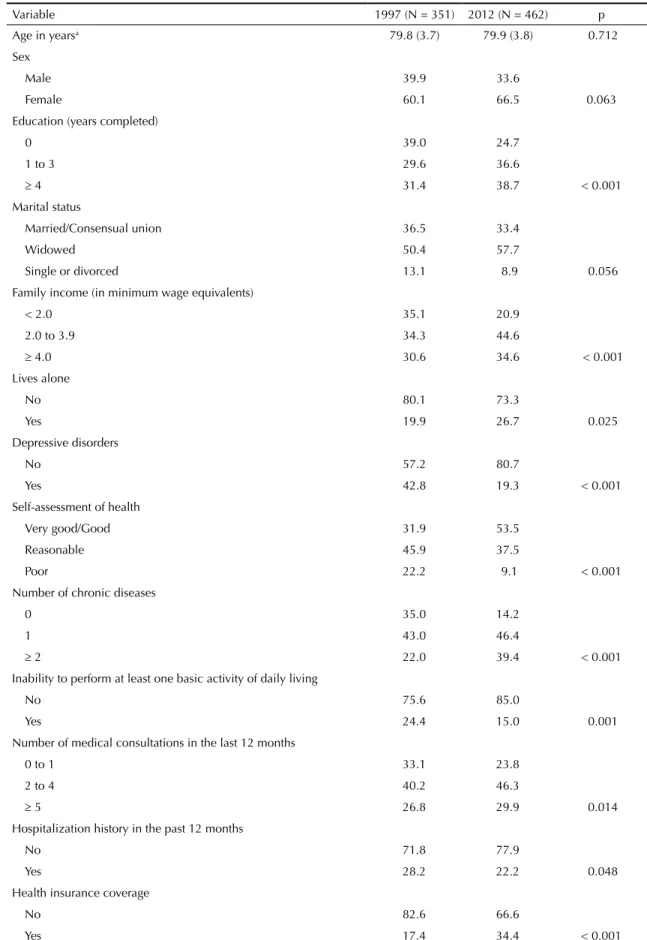
The 1997 cohort (n = 351) and the 2012 cohort
(n = 462) were similar in age (means of 79.8 and 79.9 years,
a World Health Organization. Collaborating Centre for Drug Statistics Methodology. ATC/DDD Index 2013. Geneva; 2013. Available from:
respectively), sex (60.1% and 66.5% were females, respectively), and marital status (50.4% and 57.7%
were widowed, respectively). When compared with the 1997 cohort, the 2012 cohort had higher education and income (p < 0.001 for both variables), lower preva-lence of depressive disorders, less disability for at least one basic activity of daily living, better self-assessment of health (p < 0.001), better health insurance coverage (p < 0.001), and higher frequency of medical consulta-tions in the past 12 months (p = 0.014), although mem-bers of this cohort were hospitalized less during in the
same period (p = 0.048). The complete characterization
of the two cohorts can be observed in Table 1.
AD use increased from 8.3% in 1997 to 23.6% in 2012,
and this trend was observed in both sexes and in all
age groups. In both cohorts, consumption was higher
among females and increased with age, except among the older male adults of the 1997 cohort, whose con-sumption was stable across the age groups (Figure).
With regards to the pharmacological classes, changes in the consumption pattern were observed between the
two cohorts; the consumption of TCA prevailed in the 1997 cohort, accounting for 69.0% of total AD con
-sumption, whereas the consumption of SSRI prevailed in the 2012 cohort, accounting for 68.1% of total AD consumption. The use of MAOI was observed only in
the 1997 cohort and the use of other AD (code N06AX)
was restricted to the 2012 cohort. However, in both
cohorts, the consumption of these chemical groups was
lower than that of TCA and SSRI. Citalopram was the
most frequently used active ingredient, corresponding to
31.1% of total consumption in the 2012 cohort, whereas
no active ingredient predominated in the 1997 cohort (data not shown).
In the 2012 cohort, the following factors were posi -tively associated (p < 0.05) with AD use after uni-variate analysis: female sex, age, and family income (among the sociodemographic characteristics), pres-ence of depressive disorders, self-assessment of health as poor (among the health conditions), having two or more medical consultations, and type of health insur-ance coverage (among the characteristics pertaining to the use of health care services). The following vari-ables were positively associated with AD use after multivariate analysis: female sex, family income ≥ 4 minimum wage equivalents, self-assessment of health
as reasonable, andhaving ive or more medical con
-sultations in the last 12 months (Table 2). In the 1997 cohort, having ive or more medical consultations was
the only variable positively associated with AD use
using both univariate and multivariate analyses (OR = 4.41, 95%CI 1.21;16.1) (data not shown).
Table 3 shows the results of univariate and multivariate analyses for the association between birth cohorts and AD use (overall and for the two most commonly used
chemical subgroups). Even after adjusting for sex, age, family income, self-assessment of health, and number of medical consultations, the overall consumption of AD
and SSRI was signiicantly higher in the 2012 cohort. However, no signiicant difference was observed in the consumption of TCA between the two cohorts. Considering that AD use differed between older males
and females, a trend analysis was conducted to evaluate
medication use stratiied by sex. However, the results
obtained within each stratum did not differ from those observed in the total population.
DISCUSSION
This study identiied a signiicant increase in AD use
between 1997 and 2012, primarily due to increased
con-sumption of SSRI. In both cohorts and in all age groups, consumption of AD was higher among females. In the
2012 cohort, in addition to females, increased age and income, self-assessment of health as reasonable, and
attending ive or more medical consultations in the past
12 months were positively associated with AD use.
Between 1997 and 2012, the consumption of AD by older
adults from Bambuí signiicantly increased approximately
three fold, regardless of the characteristics associated with their use in this cohort. Growth in the consump-tion of AD has also been observed in higher-income countries among the general adult2,17 and older adult
population.4,8,12,13 A Brazilian population-based study
showed a signiicant increase in AD use from 8.4% to 31.6% but included not only the older groups but all
residents aged ≥ 15 years.20
Previous studies have elucidated the reasons for the
growing AD use, and these reasons are not mutually exclusive. The most obvious reason is the increased prevalence of depression in the older population.1 In
fact, in addition to improved diagnosis of depressive disorders by healthcare professionals,2,20 depression
in the inal stage of life is a common event among
older adults owing to the presence of chronic dis-eases, impaired functional capacity, loneliness, and
decreased social support network.1,13 Another cause
would be extended drug treatment for depression, particularly among those with a history of multiple depressive episodes. This has also been observed in international studies, whether based on primary data14,21,22 or on databases of consultations and
medi-cal prescriptions.18 A third cause is growing accep-tance among healthcare professionals and patients of
the new generation of AD such as SSRI, which have
fewer side effects and are better tolerated and safer
than TCA and MAOI (older class), particularly in
overdose situations.14 The fact that depressive older
Table 1. Comparison of the profile of the 1997 cohort (baseline) and survivors (2012 cohort) in Bambuí, state of Minas Gerais, Southeastern Brazil.
Variable 1997 (N = 351) 2012 (N = 462) p
Age in yearsa 79.8 (3.7) 79.9 (3.8) 0.712
Sex
Male 39.9 33.6
Female 60.1 66.5 0.063
Education (years completed)
0 39.0 24.7
1 to 3 29.6 36.6
≥ 4 31.4 38.7 < 0.001
Marital status
Married/Consensual union 36.5 33.4
Widowed 50.4 57.7
Single or divorced 13.1 8.9 0.056
Family income (in minimum wage equivalents)
< 2.0 35.1 20.9
2.0 to 3.9 34.3 44.6
≥ 4.0 30.6 34.6 < 0.001
Lives alone
No 80.1 73.3
Yes 19.9 26.7 0.025
Depressive disorders
No 57.2 80.7
Yes 42.8 19.3 < 0.001
Self-assessment of health
Very good/Good 31.9 53.5
Reasonable 45.9 37.5
Poor 22.2 9.1 < 0.001
Number of chronic diseases
0 35.0 14.2
1 43.0 46.4
≥ 2 22.0 39.4 < 0.001
Inability to perform at least one basic activity of daily living
No 75.6 85.0
Yes 24.4 15.0 0.001
Number of medical consultations in the last 12 months
0 to 1 33.1 23.8
2 to 4 40.2 46.3
≥ 5 26.8 29.9 0.014
Hospitalization history in the past 12 months
No 71.8 77.9
Yes 28.2 22.2 0.048
Health insurance coverage
No 82.6 66.6
Yes 17.4 34.4 < 0.001
In line with the results of international population-based
studies,2,17,25 the increased consumption of AD in Bambuí
was primarily due to the increased use of SSRI, consid
-ering that the consumption of TCA was similar between the two cohorts. The prevalence of SSRI among AD
used by the 2012 cohort is consistent with that observed in Brazil6,19 and other countries.22 This result indicates
the possibility that among the older people of Bambuí, increased consumption of AD results from greater
accep-tance of SSRI by professionals and patients. After the
appearance of this chemical subgroup, general practi-tioners have more frequently prescribed AD, a practice that used to be restricted to psychiatrists.17 It is note
-worthy that only 1.0% of the population consulted a
psychiatrist. Furthermore, a negative correlation was observed between the increased prevalence of AD con-sumption and depression in the 2012 cohort. This may be due to adequate treatment among older adults in the 2012 cohort, resulting in improvement or remission of depressive symptoms and consequently a negative
rat-ing for the GHQ-12. This may also be a consequence
of AD use in the management of other health problems, such as anxiety disorders and other chronic diseases.4
The identiication of independent factors associated with AD use was largely conined to the 2012 cohort. In the 1997 cohort, the only characteristic associated
with AD use after multiple adjustments was the num-ber of medical consultations.
The consumption of AD was higher among females.
International12,14,17,25 and Brazilian studies6,10,19 have shown
an association between females and AD use. Some authors
argue that the higher consumption of AD among females is due to the increased prevalence of depressive disor-ders in this group.6,10,17 However, in the present study,
the association between females and AD use remained
signiicant regardless ofthe presence of depressive dis-orders. Grunenbaum12 (2008) draws attention to the pos
-sibility of feminization of depression, because females
identify psychiatric conditions and pursue treatment
for these disorders more intensely than males. In this study, the consumption of AD did not signiicantly dif -fer between males and females presenting with
depres-sive disorders, but was signiicantly different among
those without depressive disorders (data not shown). This result could indicate that, in Bambuí, older females use AD to treathealth problems other than depression, such as anxiety disorders, sleep disturbances, physical
problems, and even social problems caused by the difi -culties experienced in daily life.25 Alternatively, females
may adhere to the pharmacological treatment of depres-sion more often than males.
Other sociodemographic characteristics associated with AD use were increased age and higher income. A posi-tive association between age and AD use was observed in other older groups.13,25 General practitioners have
reported depression at the end of life as a spectrum that
includes loneliness, lack of social network, and impaired
functionality.13 As for the positive association between
income and AD use, increased access to medications could be due to greater ability to bear health costs among those with better socioeconomic status.10 In Bambuí, the
prevalence of depressive disorders was higher among the lower income strata (data not shown), which raises concerns about possible inequalities in mental health care in this population segment due to its limited access to mental health care services.6
In the case of descriptive variables related to health
conditions and use of health care services, only the
self-assessment of health (in the irst case) and the num -ber of medical consultations (in the second) were asso-ciated with AD use after adjusting for other covariables. The positive association between consumption of AD and worse self-assessment of health (even restricted to assessment as “reasonable”) is consistent with results observed among older Australian adults25 and indicates
the importance of subjective assessment of health in determining AD use. The positive association between consumption of AD and the number of medical consul-tations is related to the need for a prescription from a medical professional in order to obtain the drug.
One limitation of this study is the inability to assess the appropriate AD use with regard to drug indication and
dos-age, owing to the lack of use of a gold standard method
for diagnosing depression as well as the unavailability of data on duration of use/dosage for medications and access
to psychotherapy. The GHQ-1211 screening tool used to
evaluate common mental disorders in the study popula-tion showed the same accuracy as the 30-item Geriatric
Depression Scale (GDS-30) in diagnosing depressive
symptoms.7 However, the GHQ-12 only veriies the pres
-ence of symptoms of depression and does not deine clini
-cal diagnosis. Moreover, the cutoff value used to classify
the participants as positive did not allow differentiation
Figure. Antidepressant use by sex and age among individuals aged 75-89 years. Bambuí, MG, Southeastern Brazil, 1997 and 2012.
50.0
Female 1997 Female 2012
Male 1997 Male 2012 45.0
40.0 35.0 30.0 25.0 20.0 15.0 10.0
75-79 80-84
Age
85-89 5.0
Table 2. Results of univariate and multivariate analyses of factors associated with antidepressant use among individuals aged 75-89 years. Bambuí, MG, Southeastern Brazil, 2012.
Characteristics % PRraw 95%CI PRadjusted 95%CI
Age 80.7 (4.0)a 1.06 1.01;1.10 1.05 1.01;1.09
Sex
Male 14.8 1.00 1.00
Female 28.0 1.89 1.24;2.87 1.77 1.11;2.82
Education (years completed)
None 19.3 1.00 1.00
1 to 3 29.4 1.29 0.81;2.04 1.43 0.87;2.35
≥ 4 25.1 1.30 0.83;2.05 1.33 0.78;2.26
Marital status
Married/Consensual union 19.5 1.00 1.00
Widowed 26.7 1.37 0.94;2.00 1.02 0.66;1.58
Single or divorced 19.5 2.00 0.50;2.02 1.02 0.53;1.97
Family income (in minimum wages)
< 2.0 18.2 1.00 1.00
2.0 to 3.9 20.0 1.07 0.65;1.76 1.40 0.82;2.39
≥ 4.0 30.2 1.61 1.00;2.60 1.93 1.08;3.45
Lives alone
No 23.0 1.00 1.00
Yes 23.8 1.03 0.71;1.50 1.33 0.82;2.13
Depressive disorders
No 20.9 1.00 1.00
Yes 34.8 1.67 1.18;2.36 1.26 0.86;1.86
Self-assessment of health
Very good/Good 18.2 1.00 1.00
Reasonable 29.5 1.62 1.14;2.30 1.62 1.13;2.32
Poor 31.0 1.70 1.01;2.87 1.50 0.83;2.70
Number of chronic diseases
None 24.6 1.00 1.00
1 24.1 0.98 0.60;1.59 0.80 0.50;1.26
≥ 2 23.3 0.95 0.57;1.57 0.74 0.45;1.22
Inability to perform at least one basic activity of daily living
No 22.1 1.00 1.00
Yes 31.9 1.45 0.98;2.14 1.01 0.65;1.59
Number of medical consultations
0 to 1 12.7 1.00 1.00
2 to 4 23.8 1.87 1.09;3.23 1.61 0.92;2.82
≥ 5 31.9 2.51 1.45;4.33 2.10 1.16;3.81
Hospitalization history
No 22.0 1.00 1.00
Yes 27.7 1.26 0.87;1.83 1.07 0.69;1.64
Health insurance coverage
No 20.0 1.00 1.00
Yes 31.4 1.57 1.13;2.17 1.37 0.95;1.97
Raw and adjusted PR (for all variables described in the table) estimated using Poisson regression model with robust variance.
between mild or severe symptoms. For the irst case, psy
-chotherapy is indicated, whereas drug therapy is the irst
choice in cases of severe depression.9 Another limitation is
the impossibility of verifying whether AD was prescribed by a psychiatrist. The present results cannot be general-ized to other older groups, particularly those attending
geriatric day hospitals or nursing homes. However, the
study has advantages, particularly when compared with studies on drug dispensing or those based on
prescrip-tions because it uses data on drug use. In addition, the
accuracy of the measurements was ensured by the
veri-ication of druglabel and prescription. The population-based strategy adopted, the minimum loss of informa-tion on the medicainforma-tions used by the eligible participants, and uniform procedures for data collection between the cohorts ensured the reliability and internal validity of the
study. Furthermore, to the best of our knowledge, this is
the irst Brazilian population-based study that evaluated
the trends in AD consumption among older adults.
In summary, the increased consumption of AD and the
predominance of new generation drugs were consistent
with indings observed in international studies of different
populations and experimental designs. The positive associa-tion observed between AD consumpassocia-tion and income may indicate potential inequalities in accessing mental health services. Further studies employing different methodolo-gies and designs (e.g., qualitative and longitudinal
epide-miological studies) are necessary to deepen knowledge
concerning AD use among older people. Furthermore, it can support interventions that will improve access to pharmaceutical care services with coverage and quality that are adequate for managing health problems of psy-chological origin in this population segment.
Table 3. Antidepressant use among older adults aged 75-89 years. Bambuí, MG, Southeastern Brazil, 1997 and 2012.
Antidepressant use 1997 2012 PRraw 95%CI PRadjusteda 95%CI
Global (%) 8.3 23.6 2.86 1.94;4.20 2.87 1.94;4.25
Tricyclic compounds (%) 5.7 5.6 0.99 0.56;1.74 0.89 0.49;1.62
Selective serotonin reuptake inhibitors (%)
2.3 17.3 7.60 3.62;15.05 7.50 3.74;15.02
Estimation of PR using Poisson regression with robust variance.
a Adjusted for sex, age, family income, self-rated health assessment, and number of medical consultations.
1. Atlantis E, Sullivan T, Sartorius N, Almeida OP. Changes in the prevalence of psychological distress and use of antidepressants or anti-anxiety medications associated with comorbid chronic diseases in the adult Australian population, 2001-2008.
Aust N Z J Psychiatry. 2012;46(5):445-56. DOI:10.1177/0004867411433218
2. Barbui C, Campomori A, D’Avanzo B, Negri E, Garattini S. Antidepressant drug use in Italy since the introduction of SSRIs: national trends, regional differences and impact
on suicide rates. Soc Psychiatry Psychiatr Epidemiol.
1999;34(3):152-6. DOI:10.1007/s001270050127
3. Barbui C, Broglio E, Laia AC, D’Agostino S, Enrico F, Ferraro L, et al. Cross-sectional Database Analysis of Antidepressant Prescribing in Italy.
J Clin Psychopharmacol. 2003;23(1):31-4. DOI:10.1097/00004714-200302000-00006
4. Blazer DG, Hybels CF, Fillenbaum GG, Pieper CF. Predictors of antidepressant use among older adults:
have they changed over time? Am J Psychiatry.
2005;162(4):705-10. DOI:10.1176/appi.ajp.162.4.705
5. Boing AF, Melo GR, Boing AC, Moretti-Pires RO, Peres KG, Peres MA. Associação entre depressão e doenças crônicas: um estudo populacional.
Rev Saude Publica. 2012;46(4):617-23. DOI:10.1590/S0034-89102012005000044
6. Brunoni AR, Nunes MA, Figueiredo R, Barreto SM, Fonseca MJM, Lotufo PA, et al. Patterns of benzodiazepine and antidepressant use among
middle-aged adults: the Brazilian longitudinal study of adult
health (ELSA-Brasil). J Affect Disord. 2013;151(1):71-7.
DOI:10.1016/j.jad.2013.05.054
7. Costa E, Barreto SM, Uchoa E, Firmo JOA, Lima-Costa MF, Prince M. Is the GDS-30 better than the GHQ-12 for screening depression in elderly people in the community? The Bambuí Health Aging Study
(BHAS). Int Psychogeriatr. 2006;18(3):493-503.
DOI:10.1017/S1041610205002954
8. Desplenter F, Caenen C, Meelberghs J, Hartikainen S, Sulkava R, Bell JS. Change in psychotropic drug use among community-dwelling people aged 75 years and older in Finland: repeated cross-sectional population
studies. Int Psychogeriatr. 2011;23(8):1278-84.
DOI:10.1017/S1041610211000718
9. Fleck MP, Berlim MT, Lafer B, Sougey EB, Del Porto JA, Brasil MA, et al. Revisão das diretrizes da Associação Médica Brasileira para o tratamento da depressão (Versão
integral). Rev Bras Psiquiatr. 2009;31Suppl 1:7-17.
DOI:10.1590/S1516-44462009000500003
10. Garcias CMM, Pinheiro RT, Garcias GL, Horta BL, Brum CB. Prevalence of antidepressant use and associated factors among adults in Pelotas, Rio Grande do Sul State,
Brazil, 2006. Cad Saude Publica. 2008;24(7):1565-71.
DOI:10.1590/S0102-311X2008000700011
11. Goldberg DP, Hillier VF. A scaled version of the
General Health Questionnaire. Psychol Med.
1979;9(1):139-45. DOI:10.1017/S0033291700021644
12. Grunenbaum MF, Oquendo MA, Manly JJ. Depressive symptoms and antidepressant use in a random community sample of ethnically diverse, urban
elder persons. J Affect Disord. 2008;105(1-3):273-7.
DOI:10.1016/j.jad.2007.04.022
13. Hansen DG, Rosholm JU, Gichangi A, Vach W. Increased use of antidepressants at the end of life: population-based study among people aged 65
years and above. Age Ageing. 2007;36(4):449-54.
DOI:10.1093/ageing/afm056
14. Harris T, Carey IM, Shah SM, DeWilde S, Cook DG. Antidepressant prescribing in older primary care patients in community and care home settings
in England and Wales. J Am Med Dir Assoc.
2012;13(1):41-7. DOI:10.1016/j.jamda.2010.09.005
15. Lieberman JA. History of the Use of Antidepressants in
Primary Care. J Clin Psychiatry. 2003;5 Suppl 7:6-10.
16. Lima-Costa MF, Firmo JOA, Uchoa E. The Bambuí Cohort Study of Aging: methodology and health profile of participants at baseline.
Cad Saude Publica. 2011;27Suppl 3:327-35. DOI:10.1590/S0102-311X2011001500002
17. Middleton N, Gunnell D, Whitley E, Dorling D, Frankel F. Secular trends in antidepressant prescribing in the
UK, 1975-1998. J Public Health Med. 2001;3(4):262-7.
DOI:10.1093/pubmed/23.4.262
18. Moore M, Yuen HM, Dunn N, Mullee MA, Maskell J, Kendrick T. Explaining the rise in antidepressant prescribing: a descriptive study using the general
practice research database. BMJ. 2009;339:b3999.
DOI:10.1136/bmj.b3999
19. Quintana MI, Andreoli SB, Moreira FG, Ribeiro WS, Feijo MM, Bressan RA, et al. Epidemiology of
psychotropic drug use in Rio de Janeiro, Brazil: gaps in
mental illness treatments. PLoS ONE. 2013;8(5):e62270.
DOI:10.1371/journal.pone.0062270
20. Rodrigues MAP, Facchini LA, Lima MS. Modificações nos padrões de consumo de psicofármacos em localidade
do Sul do Brasil. Rev Saude Publica. 2006;40(1):107-14.
DOI:10.1590/S0034-89102006000100017
21. Sihvo S, Wahlbeck K, McCallum A, Sevon T, Arffman M, Haukka J, et al. Increase in the duration of antidepressant treatment from 1994 to 2003: a nationwide population-based study from Finland.
Pharmacoepidemiol Drug Saf. 2010;19(11):1186-93. DOI:10.1002/pds.2017
22. Soudry A, Dufouil C, Ritchie K, Dartigues JF, Tzourio C, Alpérovitch A. Factors associated with antidepressant use in depressed and non-depressed
community-dwelling elderly: the three-city study. Int J Geriatr
Psychiatry. 2008;23(3):324-30. DOI:10.1002/gps.1890
23. Ufer M, Meyer SM, Junge O, Selke G, Volz HP, Hedderich J, et al. Patterns and prevalence of antidepressant drug use in the German state of Baden-Wuerttemberg: a prescription-based analysis.
Pharmacoepidemiol Drug Saf. 2007;16(10):1153-60. DOI:10.1002/pds.1405
24. Unützer J, Katon W, Callahan CM, Williams Jr JW, Hunkeler E, Harpole L, et al. Depressed treatment in an sample of 1,801 depressed old adults in
primary care. J Am Geriatr Soc. 2003;51(4):505-14.
DOI:10.1046/j.1532-5415.2003.51159.x
25. Zhang Y, Chow V, Vitry AI, Ryan P, Roughead EE, Caughey GE, et al. Antidepressant use and depressive symptomatology among older people from the Australian
Longitudinal Study of Ageing. Int Psychogeriatr.
2010;22(3):437-44. DOI:10.1017/S1041610209991554
Research supported by the Fundação Amparo à Pesquisa de Minas Gerais (FAPEMIG – Case APQ-00526-1), the Centro Nacional
de Desenvolvimento Científico e Tecnológico (CNPq – Case 482721/2011-1), and the National Postdoctoral Program in Health (SUS 101/2009 – research grant to Castro-Costa E). Firmo JOA and Peixoto SV are recipients of CNPq productivity scholarships. Presented at the “IX Brazilian Congress of Epidemiology” (EPIVIX), Vitória, Espírito Santo, in 2014.