Public Health and Public Policies: similar but
different fields
Saúde Pública e Políticas Públicas: campos próximos, porém
distantes
Vanessa Elias de Oliveira
ABC Federal University. São Bernardo do Campo, SP, Brazil. E-mail: [email protected]
880
Abstract
This article deals with the issue of how studies on public policies can contribute to understand institu-tions, actors and processes related to public health policies. It is grounded on the fact that many studies tend to describe and/or analyze public health poli-cies. However, few use the theoretical tools of public
policy analysis, which is a broad ield of knowledge
already widespread in Brazil. In this regard, this paper aims to encourage the interdisciplinary
de-bate between these ields – public health and public policy –, which are understood as conceptually and
empirically complementary, but still distant from the national literature on public health. The article
briely reviews the “public policies cycle” literature and points out that it was insuficiently considered
by national health policy studies. This was demons-trated through the analysis of articles published in the Saúde e Sociedade journal between 2005 and 2015 (627 articles were analyzed). The article ends with a discussion about the paths and challenges for
a rapprochement between the two ields.
Resumo
Este artigo trabalha com as contribuições que o campo das políticas públicas pode trazer para o entendimento das instituições, atores e processos envolvendo a saúde pública. Fundamenta-se no fato de que muitos dos trabalhos sobre políticas públicas em saúde tendem a descrevê-las e/ou analisá-las, mas poucos se utilizam do ferramental próprio das análises de políticas públicas, campo amplo de conhecimento já bastante disseminado no Brasil. Neste sentido, o artigo visa estimular o debate
in-terdisciplinar entre os dois campos – saúde pública e políticas públicas ¬–, entendendo-os como comple -mentares conceitual e empiricamente, mas ainda distantes nas análises da literatura nacional sobre saúde pública. O artigo propõe, a partir de uma breve
revisão sobre o conceito de “ciclo de políticas públi
-cas”, que este e sua bibliograia foram incorporados de maneira insuiciente aos estudos sobre políticas de saúde, o que icou demonstrado pela análise dos
artigos publicados na revista Saúde e Sociedade
entre os anos 2005 e 2015 (627 artigos analisados).
Conclui-se apontando caminhos e desaios para a
aproximação entre os dois campos.
Palavras-chave: Políticas Públicas; Saúde Pública; Interdisciplinaridade.
Introduction
The objective of this article is to analyze the po-tential contribution of public policies to understand the institutions, actors and processes related to pub-lic health. Although it seems to be unpretentious, it is grounded on the fact that many papers on health public policies tend to describe and/or analyze them, but few use the proper instruments of public
policies analysis. This is a comprehensive ield of knowledge widespread among us. In this sense, this
article aims to foster the interdisciplinary debate
between two ields, namely public health and public
policies, considering them conceptually and empiri-cally attached and complementary one another, but still distant from the national literature’s analyses on public health.
It is worth mentioning that one of the pioneer authors in public policies analyses, Harold Lasswell, clearly advocated that these analyses, besides fo-cusing on the solutions of problems in a normative
framework, should also be multidisciplinary (Lass -well, 1951 apud Howlett; Ramesh, 2003). The con-cept of multidisciplinarity has changed over time. However, as Howlett e Ramesh (2003) state, there is a clear point: public policies analysts should master
at least two ields: concepts and understandings of
political sciences (comprising public policies) and
those related to the speciic public policy ield in study – here, health policy. And this is exactly the purpose of this paper: strengthen the links between both ields not only to expand interdisciplinarity,
but mainly to increase the accuracy of the health public policies analyses. Therefore, it is worth re-inforcing Madel Luz’s (2009) argument in favor of interdisciplinarity:
reduce this huge complexity [of the collective
health area] to a single paradigm – be it in disci -plinary terms or in terms of forms of expressing
its production – means to reduce the ield to one
single dimension, shortening it, impoverishing it (Our translation, Luz, 2009, p. 304).
Moreover, this paper defends the argument that
-faces with social sciences, giving rise that what is
today known as “social sciences in health”. However,
this interface is more frequent with sociology and anthropology, and less frequent with political
sci-ence. The scientiic production of this last is little
used as theoretical ground to the analysis of health public policies. This is clearly observed in the sur-vey of recent production of the Saúde e Sociedade journal, which is reviewed here to analyze the
at-tachment and deat-tachment of both ields.
To that, this article starts by briely reviewing
one of the main instruments of public policies to
analyze these, i.e., the concept of “political policies cycle”. After introducing it, the paper works on pub -lic health topics under this view, showing how
stud-ies in the ield of public health could be improved
in that light. Finally, it ends by showing paths and
challenges to the rapprochement of both ields.
Public Health and public policies:
similar but different fields
One of the objects proposed by the Saúde e Socie-dade journal is clearly that of “valuing the theoret -ical-methodological focus of human and social sci-ences, including several approaches: sociological; anthropological; historical; political science’s; so-cial psychology’s; philosophic, political economy’s,
etc.” (Ianni; Nakamura, 2016, p. 8). Bearing that in
mind, the paper will analyze the responsiveness (or absence) of the theoretical-methodological
fo-cus known as “public policies ield”. The articles
published on that journal consider public policies as part of political science. The importance of this analysis rests on the gains generated to studies on
speciic public polices – here, health – when these in -corporate the public policies analysis instruments, as aforementioned (Lasswell, 1956). In addition, the analysis of the articles published by that journal in the last ten years (2005-2015) shows that, although many articles approach specific public policies (such as health systems management, policies focusing on elderly, youth or children, on human resources in health, among others) very few expand the theoretical horizons to other instruments that could be useful to explain such processes, rather
than just describing and/or analyzing these based
on the endogenous production in the ield of health.
First, however, it is worth mentioning that the
main journals in the ield of public health frequently publish “studies that speciically enter social and human sciences”, as stated by Minayo (2013). The
Saúde e Sociedade journal is among those publish-ing more articles of this nature (59.7% in 10 months), second only to Interface (62.4%). Therefore, one can-not say there is can-not much room for human and social sciences in this area. On the other hand, it does not mean that public policies have gained the due room. Under this assumption, this paper discusses how the public policies analysis instruments could be incorporated to other studies about health policies.
It is interesting to note that volume 22, number 1 of the journal, in 2013, published a dossier about the interface between social sciences and collective health, with articles by three important references to this debate: Amélia Cohn, Maria Cecília de Souza Minayo and Regina Marsiglia. The overall refer-ence to political scirefer-ence is present in the three articles that, however, do not include specific references to public policies, which are somewhat neglected. Moreover, as aforementioned, the
pres-ence of political scipres-ence is much weaker than that of sociology or anthropology when we talk about “social sciences in health”. In other words, the
dialogue between health and sociology and anthro-pology is much more frequent than that between health and political science. This explains the
poor presence of the ield of public policies in the
analyses of health policies and programs.
This absence does not lessen the importance of the balanced view of the authors regarding the
interaction of both ields. Rather, it clearly demon
-strates the weak presence of the public policies ield,
despite its core role to the research axes mentioned
by them as “health policies and health services orga
-nization” or “human resources in health” (Marsiglia,
2013). Other examples would be the questioning
about “new conigurations between the public and the private dimensions of social life”, and if would be possible to ‘keep on conceiving and formulat -ing health programs and policies in a staunch and
indigenous people, adolescent, elderly, etc.” (Cohn,
2013, p. 19), among others.
This gap can be explained by the hard inter-disciplinary dialogues. First of all, because of the institutional structure of universities, based on departments, which reinforces the disciplinary logic. Secondly, because professional associations, conferences and journals also adhere to this logic, reinforcing disciplinarity (Brewer, 1999 apud Faria, 2013).
Beyond the corporate issues, Brewer (1999 apud
Faria, 2013) points out some discouragements to the
interdisciplinary work, which deserve attention in
the debate promoted by this paper:
• different cultures and roadmaps involved in the
interdisciplinary work;
• different methods and/or objectives that guide the surveys both in and within subjects, as well as the
differences of languages and “jargons”;
• personal challenges related to building trust and
respect for peers among those working in different ields and subjects;
• institutional obstacles related to funding and other
incentives given to interdisciplinary work against
the disciplinary one.
Minayo et al. (2003) reinforce some of these arguments when they state that:
The coordination between different fields of
knowledge is only possible if it passes through
translations of the different logics and criteria of
scientiicity, of a hermeneutic of the modus ope-randi of each methodology, and of the architecture of concepts presented by each reference theory. Without such meta-dialogue, the followers of
dif-ferent scientiic traditions will be restricted to the
unfruitful debate about the limits of this or that concept and its operationalization, or are restricted
to overlapping methods (Our translation, Minayo et al., 2003, p. 104).
Faria (2013) adds two more issues: earlier social-ization of researchers in the canon of disciplinar-ity (which could be explained by the structure of departments adopted by universities) and the fact that peer review is also a review based on
discipli-narity. Focusing speciically on the Brazilian case,
the author points out other factors. Here, it is worth highlighting the shortage of lines of funding in
Bra-zil speciically devoted to interdisciplinary surveys,
despite the priority attached to interinstitutional
work (Faria, 2013, p. 14).
These dificulties help understanding the hard
interdisciplinary dialogue. However, these fail in
explaining the presence of some ields of study of
social sciences and the absence of others when we
talk about public health, in the broader sense, or
about social sciences in health.
A factor that could help us understanding the
weak presence of policy sciences in public health
is that, in opposition to what happens with other academic practices, it is an analytical perspective
oriented to speciic social and political issues, also aiming at intervention, making the approach a
multidisciplinary one, clearly oriented by values. Putting it in another way, and once again quoting
Brewer, “problems determine theory and methods,
and not the opposite, clearly contrasting with the
investigation based on disciplinarity” (1999 apud
Faria, 2013, p. 17). This hypothesis, which this paper does not intend to accept or reject, is based on the
fact that this “order reversal” is not always well as -similated by disciplinary surveys, thus reinforcing the rejection to inter or multidisciplinary analyses1.
Without going into the causes that led to the de-tachment between public health and public policies, now we will focus on the analysis of articles published on the Saúde e Sociedade journal between 2005 and
1 Here we should resume the difference between multi, inter and transdisciplinarity, as explained by Faria (2013): Multidisciplinarity
“happens when the solution of a given problem requires adding information from more than one science or ield of knowledge, with no
concern about interconnecting the disciplines, or without changing or improving these in the process. [...] In interdisciplinarity, two or more disciplines interact in the same investigation, with interchange and integration, and concepts and theories employed are jointly rethought and methodologies are shared by different disciplines. [...] In transdisciplinarity, considered to be a higher stage of interaction between disciplines, cooperation between different areas is so huge that they can be hardly set apart, what could lead to the creation of
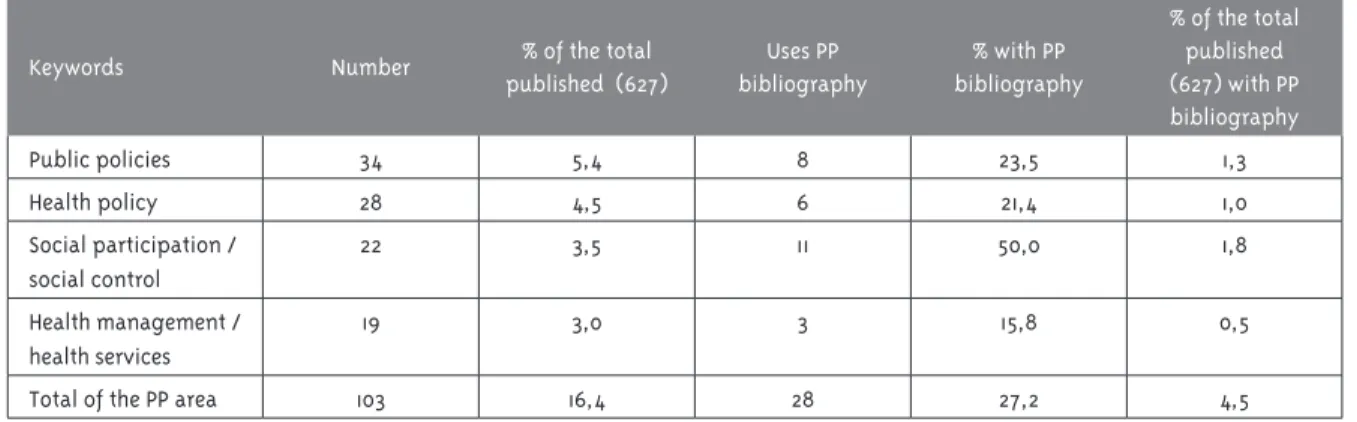
Data show that only one fourth of the works with keywords related to the ield of public policies
effectively appropriate the theoretical instruments of the area. Added to that, less than 5% of the total articles use these instruments, although handling with analysis of public health programs and experi-ences, even when not using the selected descriptors. These data deserve attention, mainly from interdisciplinary researchers dealing with public policies, mainly because, as Secchi (2010) warned:
The body of theory, analytical tools and vocabulary of public policies are proving to be useful to those
who study or make decisions in policies on health,
education, security, housing, national defense, transportation, sanitation, environment, public
management, development, assistance, culture, and many others.
[...] Regardless the intervention sector, public policies are designed in institutional contexts that share some traits, political actors behave similarly, and contents of public policies can be analytically reduced to few comprehensive categories. Where public problems exist, the ield of public policies provides inputs to analysis and decision-making (Free translation, Secchi, 2010, p. XIV, emphasis added).
Therefore, it is not about a corporative defense of the area, but about showing a gap and, then, try-ing to point out paths for studies in public health to appropriate it. To that, the next section presents
Keywords Number % of the total published (627)
Uses PP bibliography
% with PP bibliography
% of the total published (627) with PP bibliography
Public policies 34 5,4 8 23,5 1,3
Health policy 28 4,5 6 21,4 1,0
Social participation / social control
22 3,5 11 50,0 1,8
Health management / health services
19 3,0 3 15,8 0,5
Total of the PP area 103 16,4 28 27,2 4,5
PP: Public Policies
2015. All articles published on the “Artigos” section
were analyzed, disregarding those in the sections
“Tema em Debate”, “Editorial”, “Editorial Especial”, “Dossiê” or “Relato de Experiência”. Altogether, 627 articles were reviewed regarding keywords, abstracts
and reference bibliography. Articles were tabulated
and classiied according to the two main keywords,
selected from the abstract and from the analysis of the article’s object of study, or from the intended
dialogue in the pertinent ield of knowledge.
The article database showed that, of the 627
articles, 34 presented the term “public policy” as keyword (5.4% of the total) and 28 presented the term “health policy” (4.5% of the total). Other terms
related to the ield of public policies also worthy of attention are “social participation” or “social control” (22 articles, 3.5% of the total) and “health management” or “health service management” (19
articles, 3% of the total). In total, there are 103 ar-ticles in a universe of 627, corresponding to 16.4% of the reviewed articles.
Figures are not expressive, and this paper does not intend to speculate why. However, what really draws attention is not the number of articles ap-proaching public policies-related topics, but the fact that, among these, very few appropriate the
theoretical referential of this ield of knowledge.
Data presented in Table 1 evidences this:
the main concepts in the ield of public policies and
some possibilities of appropriation by the public
health-related topics and problems, as a draft “re
-search agenda” to the area.
Public policies analysis and health
policy: bringing fields together
The term ‘policy analysis’ was introduced by Lasswell still in the 1930s, establishing dialogue between social scientists and government (Souza, 2006). However, it was not before the Second World War that it started to be systematically studied.
The needs for iscal adjustment and reform of so
-cial programs, from the 1970s and 1980s onwards, which aimed to understand “government in action”,
reinforced policy analysis.
It is not focused on the governmental structure or on what governments should do, but on what governments effectively do.
In this sense, Harold Lasswell, one of its
“founding fathers”2, tried to “integrate the study
of political theory and political practices without
falling into the sterility of formal, legalist studies”
(Howlett; Ramesh, 2003, p. 3). As studies developed, they left aside the normative trait, as proposed by Lasswell, and started evaluating policies in terms
of eficiency or eficacy, and on to which extent
governments effectively drive their efforts towards achieving the established goals.
Other deinitions for public policies arose from the ield development. Dye (1972, p. 2) deines it as “any action governments decide to perform or not perform”. Although quite inaccurate, because it
could comprise far-reaching policies and purchase
of ofice supplies by the government, as pointed out
by Howlett and Ramesh (2003), this decision draws attention to an important aspect to public policies analyses: action and non-action are also a political decision. Bachrach and Baratz (1963) had already
elaborated this concept in their seminal work “Deci
-sions and nondeci-sions: an analytical framework”.
On the other hand, the deinition approaches gov -ernmental action, excluding non-state actors.
William Jenkins reines the deinition, approach -ing public policy as a process:
a set of interrelated decisions taken by a political
actor or group of actors concerning the selection of goals and the means of achieving them within
a speciic situation where those decisions should,
in principle, be within the power of those actors
to achieve (Jenkins, 1978 apud Howlett; Ramesh,
2003, p. 6).
It means that the author also adds the fact that decisions by political actors are subject to the in-stitutional capacities made available to them to effectively achieve the objectives. Public policies
are deined by these political actors. Therefore,
public policy is not restricted to decisions by governmental actors, but also comprises respon-sive decisions, i.e., in line with the surrounding institutional environment. Finally, it is not about an action of actors with endless possibilities, but delimited by the context.
Lastly3, James Anderson deines public policy
introducing a core element, object of several further studies: perception an existing problem that de-serves attention and action by actors. In his words,
it is “purposive course of action that an actor or
group consistently follow in dealing with a problem
or focus of concern” (Anderson, 1984 apud Howlett;
Ramesh, 2003, p. 7).
From these deinitions we can infer several ques -tions related to public policies analyses, as follows: (i) the public policy actors (either governmental or non-governmental), their decisions and nonde-cisions; (ii) the objectives of public policies and institutional means to reach them; (iii) problems
that drew the decision-making actor’s attention and are transformed – and how – into topics of public
policies; (iv) the processes of implementation and evaluation of the policy to improve it.
2 Term used by Celina Souza (2006) in an intensive review of literature on Public Policies.
3 The author decided for presenting the three deinitions object of study by Howlett and Ramesh (2003) that satisfactorily illustrate the
These questions clearly show that describing public policies is an important step towards under-standing it, but is far from accounting for the
differ-ent aspects involved in deinition, implemdiffer-entation
or evaluation. Public policies deal with a complex set of actors, decisions and results. To understand
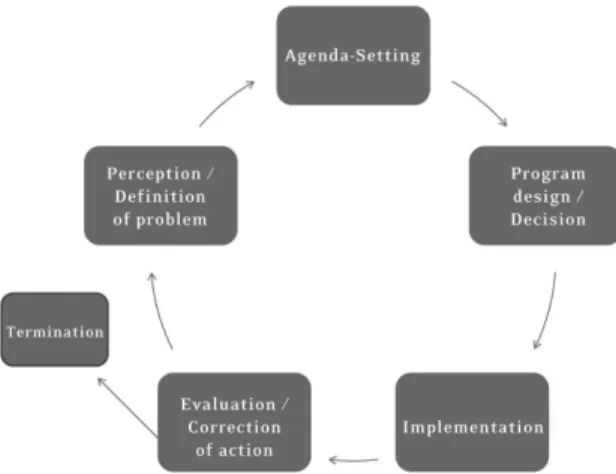
the different aspects that make up this patchwork, the idea of “public policies cycle” was developed in the ield of public policies. This cycle aims at
understanding the different stages involving the
policy making process4.
The public policies cycle is a theoretical
simpli-ication to understand a quite complex reality. It is
a theoretical-methodological resource rather than
a theory itself. It involves the following ive stages5: agenda setting; policy formulation; decision-mak -ing process; implementation; and, evaluation. As
proposed by Frey, it can be deined as follows:
The different phases correspond to a sequence of elements of the political-administrative process, and can be investigated regarding the
constella-tions of power, political and social networks, and
political-administrative practices in each phase (Free translation, Frey, 2000, p. 226).
As Oliveira (2013) highlighted, the irst three phases pooled in what is known as “decision-mak
-ing process” are more intensively studied by the
Brazilian political science. The phases approach studies on the Executive/Legislative relation in the approval of bills and constitutional
amend-ments; the Judiciary Power’s inluence on policies designed by the remainder powers or stakeholders;
and, political pressures on governmental programs, among others.
For processes of decision-making and public
policies formulation, following are the high-lights in the Brazilian discussions on public
policies: “punctuated equilibrium model” of True, Baumgartner and Jones (1999); the “garbage can model” of Cohen, March and Olsen (1972); the “multiple lows model” of John Kingdon (1995); and the “advocacy coalitions model” of Sabatier and Jenkins-Smith (1999), analyzed in detail by
Frey (2000), Souza (2006) and Capella (2007).
Likewise, the “path dependency model” gained visibility in the ield of public policies. The most
widely disseminated explanation for this process is that presented by Paul Pierson (2000), according to which past decisions determine and restrict the possibilities of future paths, hindering actors from
taking alternative courses of action.
In the ield of public health, some topics on agen -da setting, public policies formulation and
decision-making processes have also been explored6. The irst
and most evident one is that of institutionalization
and/or consolidation of the Brazilian Uniied Health
System (SUS or Sistema Único de Saúde) in Brazil. Some topics are worth of highlight regarding the SUS institutionalization process, actors and are-nas in which they interact: the role played by the Brazilian Health Council (Conselho Nacional de Saúde) and inter-managerial commissions in the institutionalization of SUS (for example, Côrtes, 2009); decision about the adoption of a public and universal health system, with the private sector par-ticipation (for example, Menicucci, 2006); decisions about investments in health (for example, Santos et al., 2015); coalitions of political parties involved in the process of approving the SUS (for example, Pereira, 1996); or legislative production in health
4 Rita Barradas Barata’s work (2013) is a rare example of work in the ield of collective health dealing with the idea of “public policies cycle”, analyzing the epidemiology and its contribution to the formulation, implementation and evaluation of health public policies. 5 Some authors works with a simpler division - three phases - and others with a more detailed division of the process - seven phases. These
are methodological differences, and all of these keep the solution of dividing this process as a way to better understand the actors and
institutions involved in different moments of long path run between incorporating a problem into the governmental agenda and its implementation and further evaluation.
6 To illustrate the topics mentioned in each phase of the public policies cycle, the author searched the related terms at SciELO database.
She analyzed the articles and use of analytical models in the ield of public policies, like happened in the irst section of this article. In this section, however, the author was not limited to works on the Saúde e Sociedade journal, but also sought examples in all journals listed on the SciELO database matching the terms (in Portuguese) “formulation” and “health policy” (37 articles), “decision-making process” and “health policy” (one article), “agenda” and “health policy” (27 articles), and “actors” and “health policy” (40 articles). The
and the resulting process of development and con-solidation of the SUS (for example, Baptista, 2010).
A second set of works approaches the ideas and interests involved in the decision-making processes,
analyzing the interaction between public and
pri-vate actors in the process of deining public policies (for example, Coelho, 1998); analyses about the “in -stitutional arrangements resulting from relations
between political actors” (for example, Gershman;
Santos, 2006) or about disputes between concepts
and scientiic knowledge in the policy formulation
processes (for example, Souza; Contandriopoulos, 2004). Others regard decisions by governments
and speciic programs and policies in the SUS, like
the different governmental options regarding the adoption of public policies models; decisions by governments or managerial councils about public health management at federal (for example, Meni-cucci, 2011), state (for example, Lima et al., 2015)
or municipal (for example, Kleba, Zampirom and
Comerlatto, 2015) levels.
The phases of governmental programs’ imple-mentation and evaluation, although not much studied in the national context, as observed by Faria (2005), are considered important variables for governments to succeed in the execution of their
public policies. Implementation can irstly serve
as a barrier to properly or improperly formulated policies: if poorly formulated, these cannot even be implemented or, if implemented, results will be unsatisfactory. On the other hand, if soundly for-mulated but with implementation problems, they do not reach the intended objectives.
According to Sabatier (1997 apud Oliveira, 2013), the analyses on public policies implementation could be pooled in three sets:
a. The ones that understand it as a “top-down”
process, i.e., designed by the senior pubic bureau-crats and transmitted to the remainder levels of
the bureaucratic hierarchy – like in Sabatier and Mazmanian (1979) or in Hogwood and Gunn (1997);
b. Those that understand it as a process that, al-though designed at central level, is implemented
“bottom-up”, as says Hjern and Porter (1997), i.e., by the network of actors involved in providing
public policies and by the so-called ‘street level
bureaucracy’ – a term coined by Lipsky (1983). To
this approach, public policies are (re)designed by the implementing actors throughout the imple-mentation process. That is when they change and assign new meanings to the policies designed at
central level, signiicantly changing their original conigurations into policies it into the
target-audience’s needs, and based on existing practices in the implementing bureaucracy itself;
c. In addition, there are the mixed model analyses, as proposed by Sabatier (1997 apud Oliveira, 2013). Ac-cording to this model the different levels of public bureaucracy interact, shaping policies according to the needs of the high level bureaucracy and the street level bureaucracy. The author proposes the following to integrate both approaches:
(1) the identiication of the network of public and private actors involved, pooling them by “systems of belief”; (2) how legal and socioeconomic factors
affect the actors’ behavior; (3) implementation time elapsed, since the policy objectives can change over time; (4) changes occurred in the policy consider-ing that some aspects change more than others (Free translation, Sabatier, 1997 apud Oliveira, 2013, p.24).
The analyses on public policies implementation typically emphasize the role of governmental and non-governmental actors engaged in this process. Therefore, more than analyzing institutions and their rules, the analyses on implementation
de-mand looking carefully into the work of each public
policy actor throughout the process. Therefore,
many works about this phase of the public policies
cycle use the qualitative survey in methodological terms.
When we analyze the processes of health
pub-lic popub-licies implementation, we think about how
other policy-formulating and implementing
ac-tors interact in a process that feeds back and has
direct impacts on the results of the implemented
Costa; Neves, 2013), or interaction between health professionals and the State (e.g., Dowbor, 2009) are emblematic. Others deal with the programs implementation process per se (e.g., Lima et al., 2015) or implementation of reform processes (e.g.,
Menicucci, 2006), or with the link between plan -ning and implementation and its results (e.g.,
Vilasbôas; Paim, 2008).
Finally, evaluation should point out issues of existing public policy found only after
implementa-tion, as well as the successful results. For the irst,
when problems exist, the evaluation indicates (or should indicate) possibilities of correcting it and the paths to properly enforce the policy to reach the intended results and, therefore, the govern-ment success in that area and/or policy (Oliveira, 2013). In addition, it may point out the need for full reformulation of the policy, suppressing the actions underway. According to Faria (2005), in a more
ac-curate deinition of the term, evaluation can be con -sidered as: (1) activity oriented to measure results of a course of action that is ending; (2) instruments to provide elements to design new interventions / improve ongoing policies and programs; (3) part of rendering of accounts and liability of state agents, i.e., part of accountability.
One should bear in mind that in the 1970s and
1980s the evaluation of social programs was a use -ful instrument to assist governments in the State reform processes. Therefore, it assisted the decision about what should be reformulated, abolished or what deserved continuity. Moreover, it challenged not only if government performance was adequate, but also if governmental institutions should remain responsible for the policies they executed up to then (Caiden; Caiden, 2001). In this sense, as Derlien (2001) states, evaluation was considered to be a mechanism to justify budget reallocation and not necessarily to improve policies.
For health policy, most of the works8 analyze
the results of governmental policies and programs.
Some examples are the works on basic care evalu
-ation (Tanaka, 2011), evalu-ation of environmental
policies (Assis et al., 2012; Fernandes et al., 2012), etc. A second group evaluates health services management and its different models (e.g., Luedy; Mendes; Ribeiro Júnior, 2012), human resources management (e.g., Pierantoni; Vianna, 2003), evaluation of expenses or users’ evaluation (Sala et al., 2011).
Generally speaking, the works aim to evaluate
the efficiency, efficacy and/or effectiveness of
health policies, linking the proposed objectives
of policies and programs and the results achieved,
checking to which extent these met the objectives
and established goals. However, as observed in the remainder stages of the health public poli-cies cycle, few were supported by the theories of public policies evaluation to analyze the programs and policies object of study. Usually, they do not analyze results based on a theoretical discussion
bound to the ield of public policies and to the
evaluation stage.
To some extent, this is partially due to the dif-ficulties faced to perform evaluation processes
(shortage of personnel and resources; dificulty to
measure some activities such as children well-being;
acknowledgement of the relevance of evaluation
processes) and to use the evaluation results (Caiden;
Caiden, 2001; Faria, 2005). Despite such dificul -ties, evaluations are crucial to close the cycle. They should imply the cycle’s abolishment or improve-ment. In this last, it should point out the need for policy reformulation. When it does not happen, it opens two possibilities: or policies move on with the
identiied problems, or are extinguished, starting
new policies that are redesigned with more or less elements of the prior policy.
7 To gather examples of works approaching the implementation of health public policies, searches were made on SciELO database using the terms (in Portuguese) “implementation” and “health policy” (59 articles), “actors” and “health policy” (40 articles), “implementation” and “public policies” and “health” (36 articles. The search procedure was the same as that explained before.
Diagrammatically we would have:
Figure 1 – Public Policies Cycle
Source: Oliveira (2013), with acknowledgement to Klaus Frey for the image.
However, Oliveira (2013) calls attention to an im-portant aspect regarding analyses based on the idea
of “public policies cycle”. According to the author,
identify what is a reformulated public policy and
what is a new public policy is a hard task that de -mands careful analysis of the elements that gave
rise to a given policy, observing if these – or part of these – are present or not in the “new policy”. There -fore, we believe this process should not be analyzed
as cyclical, but as made up by phases, the “phases
of the public policies process”. Usually, these are not enclosed in a circular process, taking place in
a non-linear way, sometimes concomitantly, with no clear pre-established temporal sequence, in a process where actors interact and can participate in more than one phase (Free translation, Oliveira, 2013, p. 33).
Another aspect that deserves attention is the issue of interconnection between phases and the participating actors. Some public policies present
strong links between the different phases. Some are more prone to “sharing actors”, i.e., to demand
or facilitate the participation of some actors in different phases of the public policies process (agenda setting, policy formulation,
decision-making process, implementation and evaluation).
These could be divided into governmental and non-governmental actors (Kingdon, 1984 apud Vianna,
1996): the first are members of the Executive (elected and senior management bureaucrats, as well as the bureaucratic staff in charge of imple-mentation, regardless if they are approved by contest or appointed), of the Legislative (elected representatives and staff members) and of the Justice system (Judiciary, Public Prosecutor’s
Ofice and Police). The second ones, in turn, are
Chart 1 – Actors participating in the public policies process phases
Actors Description Phases on which they work
Governmental Senior government staff (president,
governors, ministers and State secretaries, the Executive power senior management)
– Agenda setting – Policy formulation
– Decision-making process (in some cases, depending on the Legislative Power work)
Civil servants admitted through public contest
– Implementation – Evaluation
Elected politicians – Agenda setting
– Policy formulation (through submission and passing of bills) – Decision-making process – Policy follow-up / evaluation
(through Information Requirements, for example)
Members of the Justice system (Judiciary power, Prosecutor’s Office and Police)
– Implementation (blocking illegal / unconstitutional laws or demanding the implementation of policies not enforced by the Executive power)
Non-governmental Pressure groups – Agenda setting9
– Policy monitoring (non-institutional evaluation)
Academics, researchers – Evaluation
– Elaboration of alternatives (post-evaluation and pre-reformulation of the policy)
Media – Agenda setting (informing
governments about problems) – Policy monitoring (non-institutional
evaluation)
Political parties and public opinion – Agenda setting
– Policy monitoring (non-institutional evaluation)
Source: Oliveira (2013), with changes.
9 To Kingdon (1984 apud Howlett; Ramesh, 2003) more than by setting agendas, the pressure groups participate in the process of blocking
undesirable proposals, playing little effective role in the agenda setting per se.
However, we should restate that the idea of
“cycle” is nothing but a methodological construct to
facilitate the analysis of the public policies process. Therefore, dividing the cycle into stages or phases is a decision of the researcher. Some divide it into a larger number of stages (for example, Lasswell, 1956; Brewer, 1974), while others divide it in only three stages: formulation, implementation and evaluation. The main criticism to the model lays on
the fact that it spreads the idea that decision-makers
work in a linear and systematic way. However, this is not true most of the times (Sabatier; Jenkins-Smith, 1999). In addition, it makes us believe that the dif -ferent public policies processes are independent from each other. But that is not this way. The results achieved in the implementation of a policy usually
inluence the design of other simultaneous or fur -ther policies. Finally, many times the process is not started by the perception of an issue and inclusion
formulation precedes the agenda setting. This is
what Kingdon (1984 apud Howlett e Ramesh, 2003) called “solutions seeking for problems”.
A common and valid point in analyses based on the public policies cycle is the perception of this process’ complexity comprising different phases
– that usually overlap in practice –, actors and in
-stitutional arenas where conlicts and agreements take place. Understanding this complexity and the causal mechanisms that make it up is the core objec -tive of public policies, whose analytical instruments should be used to understand the policy processes in a wide range of areas, as stated by Lasswell (1956).
Final considerations
This article aimed to promote dialogue between
the ields of public health and public policies, mainly
due to the evident (potential) attachment of both, but
(actual) detachment found in scientiic productions.
To that, it analyzed 625 articles published on the
Saúde e Sociedade journal between 2005 and 2015, in an effort to map those approaching public policy
and using the ield’s theoretical referential. This is
clearly just one of the possibilities of assessing the
interaction between the ields, and is far from being
the fullest one. Nonetheless, this mapping seems to
be satisfactory to a irst attempt of analysis of
state-of-the-arts interdisciplinary production in question.
In the ield of public health there are many works
analyzing health public policies, and the interaction between public health and social sciences, as previ-ously emphasized. However, the brief bibliography
review presented in the irst section showed how works on health public policies could make more intensive and better use of theories in the ield of
public policies, including from the perspective of
public policies cycle which remains weakly incorpo
-rated to the ield of public health. The second section
presented few examples of incorporation of public policies analyses to discuss and understand health
policies. These were performed based on keywords
for the main phases of public policies cycle (agenda,
decision-making and formulation processes; imple -mentation and evaluation). Far beyond being just a methodology, this approach enables
understand-ing the different actors, and the institutions and arenas where they interact. That means to say that
understanding a policy as a whole – considering its complexity, as well – implies acknowledging the
different paths and processes through which actors, institutions and arenas interact.
All public health topics quoted as examples, sparse voices in the universe of studies on health policy in Brazil, and many others about agenda setting, public policies formulation and
decision-making processes could take advantage of the
public policies analyses. Although being minority,
these works showed a rapprochement between the ields that tend to be gradually expanded. That is so because the ield of public policies is gaining room
in Brazil, acquiring theoretical density and, thus,
inluencing sector-speciic studies (Arretche, 2003;
Souza, 2003). In this sense, distance between the
ields tends to be shortened, expanding interdisci
-plinary dialogue and beneiting both.
Finally, this work did not absolutely intend to elu
-cidate the weakness of works previously published, but to show the lack of closer dialogue, despite the widely known dificulty posed to the interdisciplin -ary dialogue. Such dialogue assumes the mastering
not only of one ield of scientiic knowledge, with its
narratives, methods and theoretical tools of analysis,
but of two ields, making dialogue more complex and, therefore, less likely. This is not an easy task.
As stated by Minayo et al. (2013, p. 104), one must
be conident in both areas to build interdisciplinar -ity. Reinforcing this dialogue by building
theoreti-cal bridges oriented to improve social reality – an
interdisciplinary science that is socially engaged and committed to the improvement of health public
policies – is a worthwhile effort.
References
ARRETCHE, M. Dossiê agenda de pesquisas em políticas públicas. Revista Brasileira de Ciências Sociais, São Paulo, v. 18, n. 51, p. 7-10, 2003.
ASSIS, M. P. et al. Avaliação de políticas
BACHRACH, P.; BARATZ, M. S. Decisions and nondecisions: an analytical framework. The American Political Science Review, Cambridge, v. 57, n. 3, p. 632-642, 1963.
BAPTISTA, T. W. F. Análise da produção legislativa em saúde no Congresso Nacional brasileiro (1990-2006). Cadernos de Saúde Pública, Rio de Janeiro, v. 26, n. 1, p. 97-109, 2010.
BARATA, R. B. Epidemiologia e políticas públicas.
Revista Brasileira de Epidemiologia, São Paulo, v. 16, n. 1, p. 3-17, 2013.
BREWER, G. The policy sciences emerge: to
nurture and structure a discipline. Policy Sciences, Amsterdam, v. 5, n. 3, p. 239-244, 1974.
CAIDEN, G. E.; CAIDEN, N. Enfoques y
lineamiento, la medición y la evaluación del desempeño en programas del sector público.
Revista do Serviço Público, Brasília, DF, v. 52, n. 1,
p. 78-103, 2001.
CAPELLA, A. C. Perspectivas teóricas sobre o processo de formulação de políticas públicas.
In: HOCHMAN, G.; ARRETCHE, M.; MARQUES,
E. Políticas públicas no Brasil. Rio de Janeiro:
Fiocruz, 2007. p. 87-124.
COELHO, V. S. Interesses e instituições na política de saúde. Revis t a Bras ileira de Ciências Sociais,
São Paulo, v. 13, n. 37, p. 115-128, 1998.
COHEN, M.; MARCH, J.; OLSEN, J. A garbage can model of organizational choice. Administrative Science Quarterly, New York, v. 17, n. 1, p. 1-25,
1972.
COHN, A. Ciências Sociais e Saúde Pública/ Coletiva: a produção de conhecimento na sua interface. Saúde e Sociedade, São Paulo, v. 22, n. 1, p. 15-20, 2013.
CÔRTES, S. V. Sistema Único de Saúde: espaços decisórios e a arena política de saúde. Cadernos de Saúde Pública, Rio de Janeiro, v. 25, n. 7, p. 1626-1633, 2009.
COSTA, L. A.; NEVES, J. A. B. Burocracia e inserção social: um estudo sobre o Ministério da Saúde na
gestão do Sistema Único de Saúde (SUS). Saúde e Sociedade, São Paulo, v. 22, n. 4, p. 1117-1131, 2013.
DERLIEN, H. U. Una comparación internacional en la evaluación de las políticas públicas. Revista do Serviço Público, Brasília, DF, v. 52, n. 1, p. 105-123, 2001.
DOWBOR, M. Da inlexão pré-constitucional
ao SUS municipalizado. Lua Nova: Revista de Cultura e Política, São Paulo, n. 78, p. 158-222,
2009.
DYE, T. R. Understanding public policy. Englewood Cliffs: Prentice-Hall, 1972.
FARIA, C. A. P. A política da avaliação das políticas públicas. Revista Brasileira de Ciências Sociais, São Paulo, v. 20, n. 59, p. 97-109, 2005.
FARIA, C. A. P. A multidisciplinaridade no
estudo das políticas públicas. In: MARQUES, E.;
FARIA, C. A. P. A Política Pública como Campo Multidisciplinar. São Paulo: Unesp; Rio de Janeiro: Fiocruz, 2013. p. 11-21.
FERNANDES, V. et al. Metodologia de avaliação estratégica de processo de gestão ambiental municipal. Saúde e Sociedade, São Paulo, v. 21, p.
128-143, 2012. Suplemento 3.
FREY, K. Políticas públicas: um debate conceitual e relexões referentes à prática da análise de
políticas públicas no Brasil. Planejamento e Políticas Públicas, Brasília, DF, n. 21, p. 211-259, 2000.
GERSHMAN, S.; SANTOS, M. A. B. O Sistema Único
de Saúde como desdobramento das políticas de saúde do século XX. Revista Brasileira de Ciências Sociais, São Paulo, v. 21, n. 61, p. 177-190, 2006.
HJERN, B.; PORTER, D. Implementation structure: a new unit of administrative analysis. In: HILL, M. The policy process: a reader. Hertfordshire:
Harvester Wheatsheaf, 1997. p. 313-348. HOGWOOD, B. W.; GUNN, L. A. Why perfect
implementation is unattainable? In: HILL, M. The policy process: a reader. Hertfordshire: Harvester
HOWLETT, M.; RAMESH, M. Studying public policy: policy cycles and policy subsystems. 2. ed. Toronto: Oxford University Press, 2003.
IANNI, A.; NAKAMURA, E. 25 anos de Saúde e
Sociedade: qual o lugar das ciências sociais e humanas no campo da saúde pública/coletiva no Brasil? Saúde e Sociedade, São Paulo, v. 25, n. 1, p.
7-8, 2016. Editorial Especial.
KINGDON, J. Agendas, alternatives, and public policies. Boston: Little Brown, 1995.
KLEBA, M. E.; ZAMPIROM, K.; COMERLATTO,
D. Processo decisório e impacto na gestão de
políticas públicas: desaios de um Conselho
Municipal de Saúde. Saúde e Sociedade, São Paulo, v. 24, n. 2, p. 556-567, 2015.
LASSWELL, H. The decision process: seven
categories of functional analysis. College Park:
University of Maryland Press, 1956.
LIMA, L. D. et al. Interdependência federativa na política de saúde: a implementação das Unidades de Pronto Atendimento no estado do Rio de Janeiro, Brasil. Ciência e Saúde Coletiva, Rio de Janeiro, v. 20, n. 2, p. 595-606, 2015.
LIPSKY, M. Street level bureaucracy: dilemmas of the individual in the public service. Russell Sage
Foundation, 1983.
LOTTA, G. S. Saberes locais, mediação e cidadania:
o caso dos agentes comunitários de saúde. Saúde e Sociedade, São Paulo, v. 21, p. 210-222, 2012. Suplemento 1.
LUEDY, A.; MENDES, V. L. P. S.; RIBEIRO JÚNIOR,
H. Gestão pública por resultados: contrato
de gestão como indutor de melhorias em um hospital universitário. Organizações & Sociedade, Salvador, v. 19, n. 63, p. 641-659, 2012.
LUZ, M. Complexidade do campo da
Saúde Coletiva: multidisciplinaridade,
interdisciplinaridade e transdisciplinaridade de saberes e práticas: análise sócio-histórica de uma trajetória paradigmática. Saúde e Sociedade, São
Paulo, v. 18, n. 2, p. 304-311, 2009.
MARSIGLIA, R. M. G. Temas emergentes em
ciências sociais e saúde pública/coletiva: a
produção do conhecimento na sua interface.
Saúde e Sociedade, São Paulo, v. 22, n. 1, p. 32-43, 2013.
MENICUCCI, T. Implementação da reforma sanitária: a formação de uma política. Saúde e Sociedade, São Paulo, v. 15, n. 2, p. 72-87, 2006. MENICUCCI, T. A Política de Saúde no Governo
Lula. Saúde e Sociedade, São Paulo, v. 20, n. 2, p. 522-532, 2011.
MINAYO, M. C. S. A produção de conhecimentos na interface entre as ciências sociais e humanas e a saúde coletiva. Saúde e Sociedade, São Paulo, v. 22, n. 1, p. 21-31, 2013.
MINAYO, M. C. S. et al. Possibilidades e
diiculdades nas relações entre ciências sociais e
epidemiologia. Ciência & Saúde Coletiva, Rio de
Janeiro, v. 8, n. 1, p. 97-107, 2003.
OLIVEIRA, V. E. As fases do processo de políticas públicas. In: MARCHETTI, V. (Org.). Políticas públicas em debate. São Bernardo do Campo: UFABC, 2013. p. 15-37.
PEREIRA, C. A política pública como Caixa de Pandora: organização de interesses, processo decisório e efeitos perversos na Reforma Sanitária
brasileira, 1985-1989. Dados – Revista de Ciências Sociais, Rio de Janeiro, v. 39, n. 3, 1996.
PIERANTONI, C. R.; VIANNA, A. L. Avaliação de processo na implementação de políticas públicas:
a implantação do Sistema de Informação e Gestão de Recursos Humanos em Saúde (SIG-RHS) no
contexto das reformas setoriais. Physis: Revista de Saúde Coletiva, Rio de Janeiro, v. 13, n. 1, p. 59-92, 2003.
PIERSON, P. Increasing returns, path dependence, and the study of politics. The American Political Science Review, Cambridge, v. 94, n. 2, p. 251-267, 2000.
SABATIER, P.; JENKINS-SMITH, H. The advocacy coalition framework: an assessment.
In: SABATIER, P. A. (Ed.) Theories of the policy process. Boulder: Westview Press, 1999. p. 117-166.
SABATIER, P.; MAZMANIAN, D. The
of analysis. Davis: Institute of Governmental
Affairs: University of California, 1979.
SALA, A. et al. Integralidade e Atenção Primária
à Saúde: avaliação na perspectiva dos usuários
de unidades de saúde do município de São Paulo.
Saúde e Sociedade, São Paulo, v. 20, n. 4, p.
948-960, 2011.
SANTOS, F. de A. et al. A deinição de prioridade
de investimento em saúde: uma análise da participação dos atores na tomada de decisão.
Physis: Revista de Saúde Coletiva, Rio de Janeiro, v. 25, n. 4, p. 1079-1094, 2015.
SECCHI, L. Políticas públicas: conceitos, esquemas de análise, casos práticos. São Paulo: Cengage Learning, 2010.
SOUZA, C. Estado do campo da pesquisa em
políticas públicas. Revista Brasileira de Ciências Sociais, São Paulo, v. 18, n. 51, p. 15-20, 2003. SOUZA, C. Políticas públicas: uma revisão da
literatura. Sociologias, Porto Alegre, v. 8, n. 16, p.
20-45, 2006.
SOUZA, L. E. P. F. de; CONTANDRIOPOULOS, A.
P. O uso de pesquisas na formulação de políticas de saúde: obstáculos e estratégias. Cadernos de Saúde Pública, Rio de Janeiro, v. 20, n. 2, p. 546-554, 2004.
TANAKA, O. Y. Avaliação da atenção básica em
saúde: uma nova proposta. Saúde e Sociedade, São Paulo, v. 20, n. 4, p. 927-934, 2011.
TRUE, J. L.; BAUMGARTNER, F. R.; JONES, B.
D. Punctuated equilibrium theory: explaining
stability and change in American policymaking.
In: SABATIER, P. A. Theories of the policy process. Oxford: Westview Press, 1999. p. 97-116.
VIANNA, A. L. Abordagens metodológicas em políticas públicas. Revista de Administração Pública, Rio de Janeiro, v. 30, n. 2, p. 5-43, 1996.
VILASBÔAS, A. L. Q.; PAIM, J. Práticas de
planejamento e implementação de políticas no âmbito municipal. Cadernos de Saúde Pública, Rio
de Janeiro, v. 24, n. 6, p. 1239-1250, 2008.
Acknowledgment
The author would like to thank the priceless contribution of Ma-theus Nunes de Freitas to the elaboration of the database part of this article.