Linking high-risk preventive strategy to
biomedical-industry market: implications for
public health
1
Ligando a estratégia preventiva de alto-risco ao mercado da
indústria biomédica: implicações para a saúde pública
Abstract
This paper takes Geoffrey Rose’s concepts on pre-ventive strategy as the basis for theoretical frame-work to critically analyse the current approach to disease prevention. Rose’s “continuum of risk and severity” has widened the scope for preventive actions and underpins two approaches: high-risk strategy (HRS) and population strategy (PS). Both of them produce paradoxes: HRS, despite having a
good harm-beneit ratio, offers little impact on pub -lic health; PS has greater impact on pub-lic health,
but offers minimal beneit at individual level. We
argue that HRS is being misapplied by reducing cut-off points for preventive interventions to impact
morbimortality attributed to speciic diseases. This
tends to medicalize prevention, producing more disease related phenomena through screening tech-niques, and inducing individual affective reactions, which require action in the present to secure better future health. This context has paved the way for speculative preventive medicine, which perceives health as a commodity but ignores its implications for public health services.
Keywords:Disease Prevention; Public Health;
Quater-nary Prevention; Medicalization; Commodiication;
Evidence-Based Medicine.
Correspondence
Armando Henrique Norman
Rua Evaristo da Veiga, 16, Cinelândia. Rio de Janeiro, RJ, Brasil. CEP 20031-040.
Armando Henrique Norman
Secretaria Municipal de Saúde do Rio de Janeiro. Rio de Janeiro, RJ, Brasil.
E-mail: [email protected]
David J. Hunter
Durham University. Durham, United Kingdom. E-mail: [email protected]
Andrew J. Russell
Durham University. Durham, United Kingdom. E-mail: [email protected]
638
Resumo
Este artigo aborda os conceitos de Geoffrey Rose sobre estratégia preventiva como base para aná-lise teórico-crítica da abordagem atual para a prevenção de doenças. A proposta de Rose de um “continuum de risco e severidade” ampliou as
possibilidades das ações preventivas ao classiicar
duas abordagens: a estratégia de alto risco (EAR) e a estratégia populacional (EP). Ambas produzem paradoxos: a EAR, apesar de apresentar boa rela-ção dano-benefício, oferece pouco impacto para a saúde pública; a EP tem maior impacto sobre a saúde pública, mas oferece benefícios mínimos em nível individual. Argumentamos que a EAR tem sido mal utilizada ao reduzir pontos de corte para intervenções preventivas para impactar a
morbimortalidade atribuída a doenças especíicas.
Isso tende a medicalizar a prevenção, produzindo mais fenômenos relacionados à doença por meio de técnicas de rastreamento, induzindo reações afetivas individuais que exigem ação no presente para garantir melhor saúde no futuro. Tal contex-to abre caminho para a prática de uma medicina preventiva especulativa, que percebe a saúde como mercadoria, mas ignora suas implicações para os serviços de saúde pública.
Palavras-chave: Prevenção de Doenças; Saúde Pública; Prevenção Quaternária; Medicalização; Mercantilização; Medicina Baseada em Evidências.
Introduction
Evidence-Based Medicine (EBM) has been introduced as main paradigm for learning and practicing medicine in accordance to the best
avail-able scientiic evidence in order to improve qual -ity standards in clinical care (Harrison; Moran;
Wood, 2002). In fact, EBM has been a watershed in
medicine by improving overall quality and safety of
patients’ clinical care. Furthermore, if applied com
-prehensively, EBM could integrate ‘basic scientiic
principles, the subtleties of clinical judgment, and the patient’s clinical and personal idiosyncrasies’
(Greenhalgh; Howick; Maskrey, 2014). In addition,
it has become policymakers’ main instrument for assessing effectiveness of biomedical technolo-gies and treatments. Nevertheless, according to Harrison (1998), EBM has also been used as a
method for rationing healthcare’s inite budget. Firstly, it frees politicians from dificult rationing
decisions by seeming to offer a ‘neutral’ objective approach in decision-making processes on current and new biomedical technological innovations.
Secondly, it provides the public with a scientiic ex -planation about policymakers’ rationing decisions. Thirdly, its hierarchical framework for assessing available medical knowledge has strengthened the medical authority (e.g. medical experts and researchers) while simultaneously reducing that
of clinicians. Finally, it allows the production of
clinical guidelines that doctors are obliged to adopt
(Harrison; Moran; Wood, 2002). Thus, EBM can also
be recognized as ‘an indeterminate and malleable range of techniques and practices united not by particular kinds of methodological rigour, but by the pursuit of a new approach to medical
knowl-edge and authority’ (Lambert, 2006, p. 2639).In the UK context, this approach has led to the develop-ment of a robust clinical governance structure that paved the way for implementing the largest pay-for-performance scheme in the world: the Quality
and Outcomes Framework (QOF) (Norman; Russell; Merli, 2016).
Therefore, EBM is not value free and research-ers’ agendas have been tempered by
pharmaceu-tical industries (Kelly et al., 2015). For example,
as the gold standard of evidence, create distor-tions arising from one or more of the following: manipulation of drug-dose response in both study arms (intervention and control); selectively enrolling patients most likely to respond to the intervention; adopting proxy outcomes; and failing
to publish negative research indings, which can overestimate the beneits of intervention, thereby
making it harder to replicate their outcomes in general population (Greenhalgh; Howick; Maskrey,
2014). As a result of this criticism, ‘the EBM brand
has been misappropriated and distorted by vested
interests’ (Greenhalgh; Howick; Maskrey, 2014, p. g3725).In particular, drug and medical devices industries increasingly set the research agenda.
They deine what counts as disease and pre-disease
“risk states”.
This context has fuelled the current debate on overdiagnosis and overtreatment, raising awareness and concerns about the role of preven-tive medicine.Overdiagnosis has been defined as diagnosis of conditions “that will never cause symptoms or death” often as a “consequence of the enthusiasm of early diagnosis”. (Malhotra et al.,
2015, p. h2308). These asymptomatic patients have
been transformed into sick individuals and exposed to a range of psychological and physical side-effects
without the prospect of beneit because they have been overtreated (Tesser; Norman, 2016). Thus, an
increased body of evidence shows that some cur-rent preventive medicine activities may either lead to harm or suggest uncertainties surrounding its
beneits (Welch; Fisher, 2017). Although prevention
is portrayed as better than cure,the trend is to exag-gerate certainty instead of taking a more balanced
and honest approach to scientiic indings and their limitations (Rose, 1992).
This article elaborates on Geoffrey Rose’s
(1992) seminal book, The Strategy of Preventive Medicine. We frame the discussion in six sections.
The first one revisits the definition of disease
as a ‘quantiiable entity’. Section two presents
Rose´s approach to prevention: high-risk strategy (HRS) and population strategy (PS). Section three addresses their embedded paradoxes. In section four, we contend that the trends in prevention have centred on the misapplication of HRS by
gradually reducing cut-off points for preventive interventions as means for addressing major disease outcomes. Based on two examples from an ethnographic study (Norman; Russell; Merli,
2016) of the QOF scheme, our inal section high -lights the advantage of prioritising HRS over PS
to pharmaceutical industries. We argue that HRS
has become mainstream in prevention because
it its a neoliberal economic approach to viewing
health as a commodity.
Continuum of risk and severity
The fundamental misunderstanding of Rose’s concept of preventive medicine refers to the con-tinuum of risk and severity. This has helped blur the division between normal and pathological
(Tesser; Norman, 2016). For Rose, the diagnos -tic criteria with their nosological entities (i.e.
the international classiication of diseases) are
constructs for decision-making processes which doctors traditionally framed as disease diagnosis
(Rose, 1992).The diagnostic process is, in fact, a tool that helps doctors decide whether or not to intervene upon the human body, i.e. it sets a clear cut-off point for intervention. It falls to profes-sional judgement to decide whether a phenomenon is pathological and, if so, if the pathology warrants an intervention.
Rose challenged the limitations of such binary thinking and suggested that clinicians should
think beyond pathological/non-pathological
dualism, recognising the uncertain character of physiological processes. Hence, doctors should not just be concerned about whether a patient has, or does not have, a disease such as dementia, but how much of a disease a person has. Dementia, for example, may present across a whole spectrum of severity in the population from asymptomatic, oligo-symptomatic to frankly manifested. The consequences of this line of thought resulted in
redeining disease as a ‘quantiiable entity’. The quantiication of disease allowed the expansion
of medical interventions to individuals within the population who would previously have been regarded as healthy, since potentially everyone
High-risk strategy and population
strategy
Rose’s work demonstrates that the normal/patho
-logical divide offers little beneit for population as
a whole. Moving towards a continuum of risk and severity construct, he conceptualised two possible preventive medicine strategies: High-Risk Strategy (HRS) and Population Strategy (PS). HRS aims to separate a problematic minority (or the pathological ones) to be targeted through preventive measures from the rest of the population considered ‘normal’.
For instance, patients with underlying Coronary
Heart Disease (CHD), such as angina, have a high-risk
cardiovascular proile and should receive statins to
reduce the likelihood of cardiovascular mortality. In
contrast, PS aims to inluence or to reduce the risk in
population as a whole through public health initia-tives. The anti-smoking campaign constitutes a good example of PS, where a raft of policy measures such as raising public awareness, higher taxation, banning
smoking in public places and, more recently, in cars have had a major impact on tobacco consumption, contributing to a marked reduction in tobacco related
diseases (Pell et al., 2008).
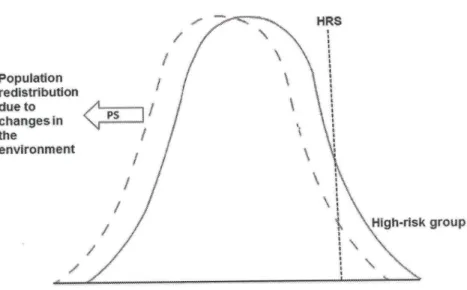
HRS and PS were seen as complementary strate-gies, but with the latter being more radical and effec-tive than the former. Rose saw the population as an organic whole with changes in its entire distribution being more effective in reducing the overall burden of disease than targeting individual diseases. The PS approach aims to restore or facilitate biologi-cal homeostasis by creating a safer environment through removal of potential sources of ill-health. Therefore, changing social context into a healthier, fairer and less unequal environment has greater
impact on human health (Wilkinson; Pickett, 2010). Figure 1 shows the left movement of whole risk
factor distribution in a given population. PS is a powerful preventive intervention as it affects not only the high-risk, but also moderate to low risk individuals in the population.
Figure 1 – Population strategy as powerful preventive option
Rose’s preventive medicine paradox
Preventive medicine strategy is characterised by Rose as a double-edged sword and gives rise to the preventive paradox both for HRS and PS. The para-dox of PS is described as ‘a preventive measure that
brings large beneits to the community offers little
to each individual participant’(Rose, 1992, p. 12),
since each participant possesses low susceptibility
to disease. For instance, in the case of restriction
of salt content in processed foods, most of low to
to this intervention, although individually they are
unlikely to beneit from it.
Nevertheless, HRS offers globally little impact on the population since high-risk groups represent a relatively small section of society. Thus, the second paradox: ‘the large number of people at a small risk may give rise to more cases of disease than the small
number who are at a high-risk’ (Rose, 2001, p. 431).
Rose illustrates this paradox with the case of Down’s
syndrome: 40-years-old or older women carry much greater risk proile for having a baby with Down’s
syndrome, but they contribute only 13% to the total
burden of the disease. Women who are low risk (below 30 years of age) produce half of the cases of Down
syndrome because they form by far the greatest
pro-portion of live births in the population (Rose, 2001).
However, the HRS concept is easily accommo-dated in medicine because it makes sense to both patients and health professionals. Its selective character discourages interference with those considered as ‘normal’ resulting in positive
harm-to-beneit ratio and improved cost-effectiveness (Rose, 1992). These factors have contributed to the spread
of HRS across primary care services.
Solving the paradox: reducing
the cut-off points for biomedical
interventions
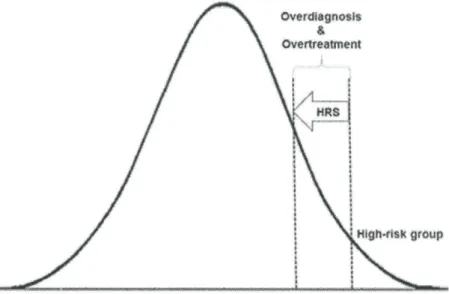
The low impact of HRS on population health should have limited its utility as main preventive strategy, but ‘experts’ in public health have solved the paradox to which it gives rise by gradually lower-ing the threshold for intervention in healthy people.
Figure2 shows the reduction of a cut-off point for deining a preventive intervention. This transforms
numerous asymptomatic people into sick, requir-ing more medical interventions and follow-ups. Thus, HRS leads inevitably to overdiagnosis and
overtreatment as most individuals will not beneit
from medical interventions.
The overemphasis on HRS has the effect of embracing more and more moderate to low-risk
patients, backed by statistical igures, which boost
the magnitude of the intervention, but distort the original ethos of public health (Starfield et al.,
2008). The understanding of diseases as quantii -able entities has facilitated researchers to gradu-ally transform risk factors into diseases (Tesser;
Norman, 2016)but more importantly, have allowed them mathematically reduce the cut-off threshold for interventions based on relative risk reduction in RCT. This can convey the notion of ‘maximising
beneit’ for a given intervention despite low baseline
susceptibility. Table 1 shows that the use of Relative Risk Reduction (RRR) numbers overestimates the
beneit since it continues unchanged (20%) despite
the decrease in baseline mortality risk or suscepti-bility (Rembold, 1998). This increases the Number Needed to Treat (NNT) which is anchored in absolute risk reduction, i.e. the baseline susceptibility.
The expansion of HRS to impact overall
popula-tion outcomes for a speciic condipopula-tion (e.g. statins for
reducing cardiovascular mortality) predictably in-cludes more healthy people with moderate to low-risk
proiles. Thus, the harm-beneit pendulum inevitably
swings towards the harm end outcome spectrum by spreading fear in the population and taking away
people’s sense of self-security (Heath, 2011).
Rather than applying population measures to ad-dress macro determinants of health, which can have
a powerful impact on speciic disease morbidity and
mortality indicators, the default position in health promotion has been to individualise and capitalize on prevention. This phenomenon has been termed ‘life-style drift’, namely, ‘the tendency for policy to start off recognising the need for action on upstream so-cial determinants of health inequalities only to drift downstream to focus largely on individual lifestyle
factors’ (Popay; Whitehead; Hunter, 2010, p. 148).
‘Lifestyle drift’ reverses the PS approach, thus causing harm to many healthy people in the name of a better future population health. In other words, public health experts are aiming for population effect through targeting the individual, instead of acting principally at a ‘whole of society’ and ‘whole-of-government’ level to impact on the major
determi-nants of health (WHO, 2013). This tension in policy
Table 1 – Relative Risk Reduction: a powerful number
for conveying beneit
Mortality Risk Risk reduction
Control (%)
Treatment (%)
Relative (%)
Absolute (%) NNT*
5 4 20 1 100
0.5 0.4 20 0.1 1,000
0.05 0.04 20 0.01 10,000
Source: Rembold, 1998 *NNT Number Needed to Treat.
Policies designed to reduce income disparities and confront vested interests of the global corporate sector, whose activities contribute to high levels of obesity, alcohol misuse and other lifestyle related conditions, through tougher regulation and taxa-tion, are neglected in favour of those which leave these structural and commercial interests essential-ly untouched. Although public health built its
repu-tation on the willingness of many of its key igures,
like Rudolf Virchow, to challenge the prevailing political consensus and power imbalance in society, it has in more recent times been reluctant to engage with the political determinants of inequalities in income, power and resources (Collins; McCartney;
Figure 2 – High-risk strategy: reducing cut-off points for preventive interventions as a source for overdiagnosis and overtreatment
Garnham, 2016).The policy solutions offered are therefore failing to target those actors and actions responsible for the health gap and widening social
gradient in health (Marmot, 2015).
Reducing cut-off points in
timeframe: bringing future into
present
HRS as a preventive approach pushes health staff to apply ‘simulations or probabilistic anticipa-tions’ about patients’ future health condition based on accumulated past statistical and epidemiological
data (Adams; Murphy; Clarke, 2009). These data
underpin a range of devices for calculating
stan-dardised individuals’ disease risk proile, which
requires interventions in the present in order to
improve their future health proile. Thus, tempo -ral dimension of care is transformed to produce an objectivity that claims truth about patients’
fate (Adams; Murphy; Clarke, 2009). This sort of
speculative preventive medicine ‘must inevitably decontextualize and efface the reality of everyday
individuals’ risk. For instance, a 20% risk predic -tion implies that over ten years in a cohort of ‘same
cases’, 20% will have a major cardiovascular event
such as Myocardial Infarction (MI) or death due to cardiovascular disease. Mathematically, patients
have an 80% chance of not having had an event in 10 years’ time. This means that most people will be
alive helping to build a background against which
the beneits will abound since doctors cannot see the
population effects by treating individual cases. This
scenario tends to overestimate the beneit.
Moreover, if taking statins offers a possibility of,
say, a 40% reduction in cardiovascular disease at the population level, this infers that 60% of those tak -ing statins will still develop Coronary Heart Disease
(CHD) major events. Finally, amongst individuals
participating in this preemptive measure, the
pro-tective increment to the baseline is insigniicant:
before intervention the chances of not having a
CHD event was 80% but after adhering to statins
for ten years the chances of not having an adverse effect due to CHD has only increased to 88%. It is undeniable that 8% reduction at a population level would represent a big achievement, but the
means used for reaching these igures need to be reassessed. To quote Heath (2010, p. 93): ‘however,
worthy the end, turning humanity into simply the means to achieve it is to undermine what it is to be human in a very fundamental way’. Rose’s concept that population intervention offers little for each individual participant is reinforced and becomes even clearer once this is done through an HRS ap-proach, no matter how much experts play with the
numbers to ensure statistically signiicant results (Abramson et al., 2013).
High-risk strategy: advantage for
the pharmaceutical industry
The current preventive strategy adopts
‘techno-logical ix’ in the hope of giving individual protec -tion despite the adverse socioeconomic context.
Rose (1992, p. 48) has pointed out important weak -nesses of HRS: ‘prevention becomes medicalized’; ‘success is only palliative and temporary’ which means that it needs constant maintenance of ser-vices by not addressing the diseases’ root cause (i.e. All numbers addressed in prevention are
an-chored in population rather than individual level. Therefore, health professionals should make this clear to their patients by asserting that they aim to achieve an effect at population level (at least, this is the hope of policymakers). The ‘success’ of the intervention depends much more on capitation and compliance of patients with similar risk levels rather than the treatment of an individual isolated case. By adopting HRS as a population intervention, it produces uncertainty about who individually will
beneit from it. For any particular person, treatment means that he/she must enrol in what is effectively
an unbranded ‘clinical trial’ in order to achieve the
desired population beneit through a sum of indi -vidualised interventions. The patients are pooled in a sea of uncertainty, which is seldom discussed in depth with them.
Usually, clinicians have dificulties in predicting
the effect of a preventive intervention for an indi-vidual, since population studies have anonymised the asymptomatic person in front of them. This anonymity cannot be easily overcome by taking a patient-centred approach – even using information techniques for conveying probability. Additionally, clinicians’ misinterpretation of statistics (e.g. use of relative risks instead of absolute risk), and, in some cases, not balancing against potential harms
can convey unrealistic beneits of an intervention (Malhotra et al., 2015). For instance, clinicians
often tend to speak to their patients in terms of ‘Mr “X” your chances are…’, but forget that EBM operates at very abstract mathematical realm of population-based study trials which know nothing about Mr “X”, making it quite impossible in the case of preventive measure to transfer results to that person in particular. Thus, over time clinicians have undergone an acculturation process through train-ing programmes, whereby this predictive reasontrain-ing has become normalised as best practice backed by, and incentivised to conform to pay-for-performance
schemes, within which QOF stands as an example (Malhotra et al., 2015; Norman; Russell; Merli, 2016).
This predictive reasoning manifests itself through templates employed to inform individuals of their future cardiovascular outcomes, like the
socioeconomic health determinants); ‘it is limited by poor ability to predict the future of individuals’. In other words, HRS creates uncertainties for the individuals receiving preventive intervention since
patients are pooled in a risk-beneit population in -tervention (discussed further below). Although Rose warned of the weakness of HRS, for pharmaceutical industries its weakness has become their strength.
Prevention becomes medicalized
The adoption of HRS fosters medicalization of preventive activities. This is ‘music to the ears’ of
drug companies. What has been witnessed during
the last forty years is a tendency to resignify the us-age of existing drugs by reducing cut-off points for prescribing them and hence labelling more people as
sick (Lenzer, 2013), as well as by establishing
hard-to-reach targets for cholesterol, diabetes (Hb1Ac), blood pressure, obesity and the like (Montori; Isley;
Guyatt, 2007). This approach has been systemati
-cally applied with the introduction of QOF.
The QOF as a pay-for-performance scheme
consists of a point-based system that rewards UK general practice for achieving certain standards on pre-agreed clinical disease criteria. The aim has been to improve the quality of clinical care in general prac-tice by setting an evidence-based clinical governance framework.The QOF 2013/2014 contract year offered 900 points and was organised into four domains:
Clinical, Public Health, Quality and Productivity, and
Patient Experience (Norman; Russell; Merli, 2016).
In some QOF clinical indicators policymakers have manipulated cut-off points for intervention and/or
the range of points achievement of target-disease as
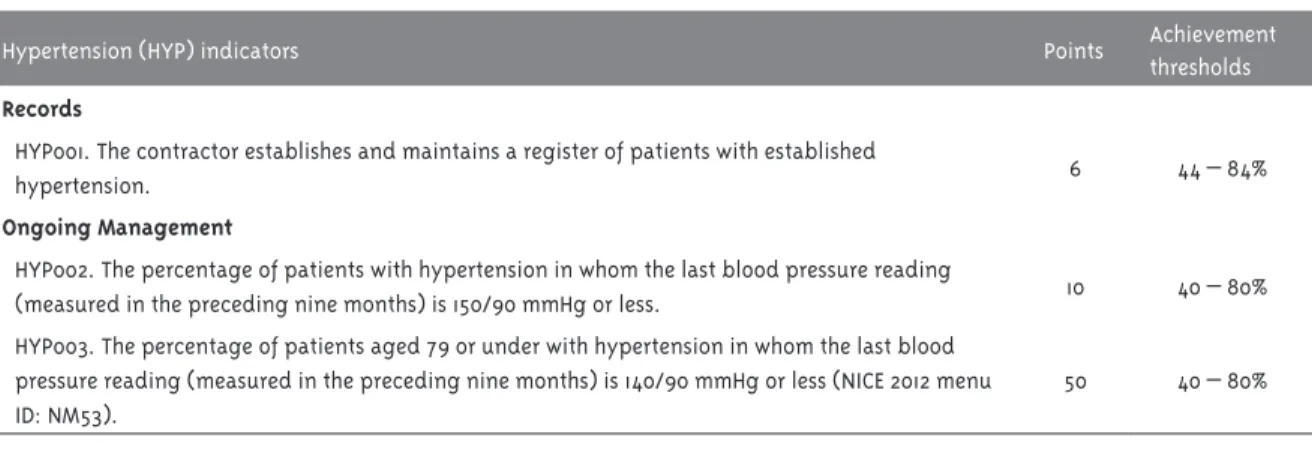
mean of optimising treatment (Doran et al., 2014). In the QOF 2013/2014 contract this strategy was clearly used in regard to hypertension: QOF has tightened the hypertension target by placing ifty points (i.e. more money) to a ‘newly’ introduced QOF hyperten
-sion indicator HYP003 (requiring the blood pressure to be below 140/90) against ten points for HYP002 (requiring blood pressure to be below 150/90 – Table 2).This led to the inclusion of more patients under a tight blood pressure control.
By incentivizing reduced cut-off points, the QOF signiicantly increases the number of target people
needing medical intervention, since it works at the population level or practices’ catchment area. This process increases the number of laboratory tests, follow ups, and drugs being prescribed to reach a lower blood pressure threshold target within a cohort of hypertensive patients.
The QOF indicators for diabetes are another
example of how policymakers have played with cut-off points and the upper-end threshold of a disease management quality standard. One of the criteria for a good diabetes control is through monitoring the level of haemoglobin A1c (HbA1c). Table 3
illus-trates the luctuation in HbA1c targeting and the
increase in quality standards by expanding the up-per range for maximum points. This leads to more patients on tighter diabetes control regimens and increase in medication usage.
Table 2 – QOF hypertension indicator targets, points and range of achievement, 2013/2014
Hypertension (HYP) indicators Points Achievement
thresholds
Records
HYP001. The contractor establishes and maintains a register of patients with established
hypertension. 6 44 – 84%
Ongoing Management
HYP002. The percentage of patients with hypertension in whom the last blood pressure reading
(measured in the preceding nine months) is 150/90 mmHg or less. 10 40 – 80% HYP003. The percentage of patients aged 79 or under with hypertension in whom the last blood
pressure reading (measured in the preceding nine months) is 140/90 mmHg or less (NICE 2012 menu ID: NM53).
50 40 – 80%
Table 3 – Diabetes level of HbA1c in the previous ifteen months* organised by points’ allocation (P), range of achievement (R), and QOF contract year
QOF year 2004/2005 2006/2007 2009/2010 2011/2012 2013/2014
HbA1c target
mmol/mol (%) P R (%) P R (%) P R (%) P R (%) P R (%)
≤53 / (7.0) 17 40 – 50
≤
59 / (7.5) 16 25 – 50 17 40 – 50 - - 17 40 – 50 17 35 – 75
≤
64 / (8.0) - - - - 8 40 – 70 8 40 – 70 8 43 – 83
≤
75 / (9.0) - - - - 10 40 – 90 10 40 – 90 10 52 – 92
≤
86 / (10.0) 11 25 -85 11 40 – 90
-Source: Norman, 2015
* QOF 2013/14 reduced the length to reach the target to 12 months.
Table 3 shows that in 2009/2010 QOF introduced
three tiers for HbA1c levels, placing more points
on lower cut-off points (≤53/7.0%=17 points) induc -ing practitioners to be more aggressive in treat-ing
their diabetic patients. In 2013/2014 QOF contract
year expanded the upper limits in all three tiers.
Once more policy-makers have allocated more QOF points to lower bands of HbA1c: 17 QOF points to HbA1c ≤59mmol/mol and eight QOF points to HbA1c ≤64mmol/mol. This meant that most diabetic pa -tients had their levels of HbA1c geared towards the bottom end of HbA1c range, potentially increasing the use of medication and side effects (e.g. hypo-glycaemia with hospitalisation). Nonetheless, the
beneit of such intervention remains controversial
as diabetes tight control (HbA1c below 6%)
in-creases patients’ mortality rate (Currie et al., 2010).
Ironically, during the last decade, the UK has
expe-rienced a 60% rise in diabetes cases, accounting for ‘10% of the NHS drugs bill’ as ‘nearly £869m was
spent on drugs, including insulin and metformin,
marking a sharp rise from the £514m being spent a decade ago’ (Gallagher, 2015).
The adoption of HRS inevitably increases the consumption of biotechnologies and drugs (expand-ing the use of exist(expand-ing drugs which do not require further research cost for the pharmaceutical indus-try), but simultaneously drains public health
re-sources. Most QOF domains focus on individualised
preventive actions via consumption of biotechnolo-gies and drugs. Polypharmacy has become the norm
since the introduction of QOF: from 2004 to 2011
‘prescriptions for statins doubled, for angiotensin converting enzyme inhibitors (for blood pressure control) and diabetic drugs nearly doubled, for
anti-depressants rose 60%, and for steroid inhalers rose 30%’ (Spence, 2013, p. f1498). Despite this increase
in medication usage, cardiovascular mortality has
not diminished during the QOF’s ten years of exis
-tence (Kontopantelis et al., 2015).
Success is only palliative and temporary
HRS is considered a palliative rather than a radi-cal strategy as it does not address the underlining problems of disease causation. Thus, when imple-mented it requires constant maintenance. Looked at closely, HRS implies screening the population, which is a sieving process whereby asymptomatic
people will be classiied and targeted for preventive
intervention. This process inevitably produces a snowball effect by generating new entities: posi-tive results, pseudo-posiposi-tive results (the source of overdiagnosis), false-positives, false-negatives, and borderline diseases (e.g. glucose intolerance, subclinical hyperthyroidism, cervical
intraepithe-lial neoplasia [CIN, 1,2,3] etc.) multiplying health
activities (and consequently the costs) in the name
of optimising health (Rafle; Gray, 2007). This again
risks and speciic preventive measures to be con -sumed, as well as by improving doctor-patient ef-fective ‘therapeutic’ alliances through powerful
dis-courses of EBM (Lambert, 2006) distilled into a set of inancially incentivized scientiic-bureaucratic rules (Harrison; Moran; Wood, 2002) embedded in
pay-for-performance schemes to which clinicians
have to conform (Norman; Russell; Merli, 2016).
Poor ability to predict individuals’ future
HRS lacks predictive power upon individuals’ future health. The current preventive medical model derives from individuals’ uncertainty about the benefit of medical interventions. Based on large population studies or their meta-analyses, the model assumes that what holds for the sample (population trial) also holds for the whole
popula-tion (inductive probabilistic/empiricist reasoning)
just because individuals carry some biometrical
re-semblance (Harrison, 1998; Whitehead, 1967). This
reinforces the concept of a socioeconomic decon-textualized, collective and universal body that can be standardised for biomedical interventions (Lock;
Nguyen, 2010). However, individual patients (and
their doctors alike) tend to have a realist, determin-istic reasoning tradition (Harrison, 1998) because they experience in their bodies the interventions and effects of medical practice.
The probabilistic reason based on empirical studies generates fetishized numerical concepts such as the NNT: the number of people needed to receive the intervention, during a certain period of
time (ive or ten years) to prevent one event (e.g. mor -tality due to myocardial infarction). Suppose that
the NNT is 100, meaning that 100 people should be treated during ten years to prevent one MI. From the patient’s perspective, he/she believes they are the chosen one amongst 100, because each of them expe -riences the effects of preemptive medical treatment
(deterministic/realistic reasoning). This context of
indeterminacy helps create the paradox of popular-ity: ‘the greater overdiagnosis and overtreatment, the more people there are who believe they owe their
health or even their lives’ (Rafle; Gray, 2007, p. 68)
to medical interventions, contributing to strength-ening medicalization process.
Table 1 illustrates that the inclusion of moderate to low-risk increases NNT, amplifying harms due
to reduced prospects of beneit, while expanding
the market for ‘preventive’ medications. Take for
example NICE guidelines (United Kingdom, 2014)
for lipid disorders: if the person being assessed
by QRISK2® calculator has a 10% or greater risk of
having a cardiovascular event, like one MI in ten years, clinicians are authorised to offer statin as a preventive measure. This group of people has been converted into a ‘high-risk’ group purely through
population health modelling (Bauer, 2013) conigur -ing an example of primary prevention, since they do not have clinically established CHD.
The proliferation of risk device predictors (i.e. clinical decision-support software, or web-based self-tests) within which individuals have to adjust themselves ‘to routinized likelihoods, hedged bets and probable outcomes’, have strengthened a speculative preventive model of practicing medicine
(Adams; Murphy; Clarke, 2009, p. 247). Several elec -tronic templates are employed to inform individuals of their future adverse outcomes. These include
cardiovascular risk assessment (QRISK2® tem
-plate), the 10-year prediction of absolute fracture risk (FRAX2 template) or even the use of isolated
biomarkers such as HbA1c to predict micro-vascular complications. In the UK, general practice can use three different CVD risk-assessment scores
(Framingham, Joint British Society 2 (JBS2), and QRISK®2). Nevertheless, the two irst devices are known to overestimate the risk ‘by up to ifty per
cent in most contemporary northern European populations, particularly for people living in more
afluent areas and underestimate risk in higher
risk populations, such as people who are the most
socially deprived’ (United Kingdom, 2013, p. 156).
Thus, despite the aspiration of precise and individu-alised type of preventive medicine, reality shows otherwise, since these forecasting tools vary in their
external validity (Bayer; Galea, 2015).
The prospect of extending a preventive individu-alised intervention to those with low to moderate risk has turned this type of preventive measure questionable, regardless of how the numbers are constructed to create sound ‘evidence’ (Abramson
strategy to disease prevention has been adopted,
because it also produces ‘certain economic proit, a certain political utility […] supported by global mechanisms and, inally, by the entire system of the State’ (Foucault, 2003, p. 33). In this context,
the state has become the animator of the biomedi-cal sector economy by strengthening the market of biomedical technologies and pharmaceutical
industries (Rose, 2006).
Final Remarks
This article has critically analysed what Geoffrey Rose refers to as ‘additive’ preventive activities via
high-risk strategy, i.e., the prescription of artiicial
substances (usually a drug) to an individual patient to prevent unwanted outcomes. Nevertheless, HRS can be safely used when reducing individual’s ex-posure to potential health hazards, i.e. restoring body’s ‘normal’ physiological condition as in the reduction of tobacco and excessive alcohol con-sumption, processed food intake and food pesticide usage, and sedentarism. These lifestyle measures ‘can be presumed to be generally safe, and they can therefore be accepted on the basis of a reasonable
presumption of beneit’ (Rose, 1992, p. 94). They
are also theoretically consistent and validated by
the available evidence and scientiic knowledge.
However, we understand that policymakers should
concentrate efforts in population risk/mortality
burden intervention policies to improve health more generally rather than focusing on ‘the overestima-tions of the utility of individual risk factors in
causing ill health in populations’ (Starield et al., 2008, p. 583).
Finally, awareness of sophisticated biases and
vested interests in biomedical research is
build-ing momentum within the scientiic community. The Choosing Wisely movement (Malhotra et al., 2015) and the recent “The Evidence-Based Medicine
Manifesto for Better Healthcare” are setting an agenda for a real EBM that favours a more compre-hensive and holistic view of clinician-patient rela-tionship and reduction of ‘questionable research
practices, bias, and conlicts of interests’ (Heneghan et al., 2017). By shedding light on the misapplication
of HRS as a mainstream preventive approach to
the masses we echo and reafirm the same voices. The introduction of a technological ix via HRS to
tackle the burden of disease in a population is a primary source of overdiagnosis, and consequently overtreatment, since most healthy people who are being labelled and treated will not succumb to the fateful outcome awaiting them. This
medicaliza-tion process is morally and technically unjustiied (Heath, 2010) and the public and health profession -als need to be aware of the underlying issues which have led to this state of affairs.
References
ABRAMSON, J. D. et al. Should people at low risk
of cardiovascular disease take a statin? British Medical Journal, London, v. 347, p. f6123, out. 2013.
ADAMS, V.; MURPHY, M.; CLARKE, A. E. Anticipation: technoscience, life, affect, temporality. Subjectivity, London, v. 28, n. 1, p. 246-265, 2009.
BAUER, S. Modelling population health:
relections on the performativity of
epidemiological techniques in the age of genomics. Medical Anthropology Quarterly,
Arlington, v. 27, n. 4, p. 510-530, 2013.
BAYER, R.; GALEA, S. Public health in the precision-medicine era. The New England Journal of Medicine, Waltham, v. 373, n. 6, p. 499-501, 2015.
COLLINS, C.; MCCARTNEY, G.; GARNHAM, L. Neoliberalism and health inequalities. In: SMITH, K. E.; BAMBRA, C.; HILL, S. E. (Ed.). Health inequalities: critical perspectives. Oxford: Oxford
University Press, 2016. p. 124-137.
CURRIE, C. J. et al. Survival as a function of HbA1c in people with type 2 diabetes: a retrospective
cohort study. The Lancet, London, v. 375, n. 9713, p. 481-489, 2010.
DORAN, T. et al. Setting performance targets in pay for performance programmes: what can we
learn from QOF? British Medical Journal, London,
v. 348, p. g1595, mar. 2014.
FOUCAULT, M. Society must be defended: lectures
Picador, 2003. (Série Lectures at the Collège de France, 3).
GALLAGHER, J. Diabetes cases soar by 60% in
past decade. BBC News website, London, 17 ago. 2015. Disponível em: <http://bbc.in/1gOGDq8>. Acesso em 23 ago. 2017.
GREENHALGH, T.; HOWICK, J.; MASKREY, N.
Evidence based medicine: a movement in crisis?
British Medical Journal, London, v. 348, p. g3725, jun. 2014.
HARRISON, S. The politics of evidence-based medicine in the United Kingdom. Policy & Politics,
Bristol, v. 26, n. 1, p. 15-31, 1998.
HARRISON, S.; MORAN, M.; WOOD, B. Policy
emergence and policy convergence: the case of
“scientiic-bureaucratic medicine” in the United
States and United Kingdom. The British Journal of Politics and International Relations, London, v. 4, n. 1, p. 1-24, 2002.
HEATH, I. Person-centered prevention and health promotion. International Journal of Integrated Care, London, v. 10, n. 5, p. 92-93, 2010.
HEATH, I. The politics of fear. British Medical Journal, London, v. 342, p. d1273, mar. 2011.
HENEGHAN, C. et al. Evidence based medicine manifesto for better healthcare. British Medical Journal, London; v. 357, p. j2973, jun. 2017.
KELLY, M. P. et al. The importance of values in evidence-based medicine. BMC Medical Ethics,
London, v. 16, n. 1, p. 69, 2015.
KONTOPANTELIS, E. et al. Investigating the relationship between quality of primary care and premature mortality in England: a spatial whole-population study. British Medical Journal,
London, v. 350, p. h904, mar. 2015.
LAMBERT, H. Accounting for EBM: notions of evidence in medicine. Social Science & Medicine,
Boston, v. 62, n. 11, p. 2633-2645, 2006.
LENZER, J. Majority of panelists on controversial
new cholesterol guideline have current or recent ties to drug manufacturers. British Medical Journal, London, v. 347, p. f6989, nov. 2013.
LOCK, M.; NGUYEN, V-K. An anthropology of biomedicine. Oxford: Wiley-Blackwell, 2010. MALHOTRA, A. et al. Choosing Wisely in the UK:
The Academy of Medical Royal Colleges’ initiative to reduce the harms of too much medicine. British Medical Journal, London, v. 350, p. h2308, maio 2015.
MARMOT, M. The health gap: the challenge of an
unequal world. London: Bloomsbury, 2015. MONTORI, V. V.; ISLEY, W. L.; GUYATT, G. H. Waking up from the dream of preventing diabetes
with drugs. British Medical Journal, London,
v. 334, p. 882, abr. 2007.
NORMAN, A. H. The quality and outcomes framework as a biomedical technology:
consequences for UK general practice. 2015. Tese
(Doutorado em Antropologia) – Department of
Anthropology, Durham University, Durham, 2015. NORMAN, A. H.; RUSSELL, A. J.; MERLI, C.
The quality and outcomes framework: body
commodiication in UK general practice. Social Science & Medicine, Boston, v. 170, p. 77-86, dez. 2016.
PELL, J. P. et al. Smoke-free legislation and
hospitalizations for acute coronary syndrome.
The New England Journal of Medicine, Waltham, v. 359, p. 482-491, jul. 2008.
POPAY, J.; WHITEHEAD, M.; HUNTER, D. J.
Injustice is killing people on a large scale – but what is to be done about it? Journal of Public Health, Oxford, v. 32, n. 2, p. 148-149, 2010.
RAFFLE, A. E.; GRAY, J. A. M. Screening evidence and practice. Oxford: Oxford University Press, 2007.
REMBOLD, C. M. Number needed to screen: development of a statistic for disease screening.
British Medical Journal, London, v. 317, p. 307-312,
ago. 1998.
ROSE, G. The strategy of preventive medicine.
Oxford: Oxford University Press, 1992.
ROSE, G. Sick individuals and sick populations.
International Journal of Epidemiology, Oxford,
ROSE, N. The politics of life itself: biomedicine,
power, and subjectivity in the twenty-irst century. Princeton, NJ: Princeton University Press, 2006. SPENCE, D. Kill the QOF. British Medical Journal,
London, v. 346, p. f1498, mar. 2013.
STARFIELD, B. et al. The concept of prevention: a
good idea gone astray? Journal of Epidemiology & Community Health, London, v. 62, n. 7, p. 580-583, 2008.
TESSER, C. D.; NORMAN, A. H. Differentiating clinical care from disease prevention: a
prerequisite for practicing quaternary prevention.
Cadernos de Saúde Pública, Rio de Janeiro, v. 32, n. 10, p. 1-14, 2016.
UNITED KINGDOM. British Medical Association. National Health Service Employers. National Health Service Commissioning Board. Quality and outcomes framework guidance for the GMS contract
2013/14. London: Department of Health, 2013.
Authors’ contribution
Norman composed the irst version. Hunter and Russell made very important contributions to the irst version, participating in the discussion. Norman and Hunter wrote the inal version of the article, and Russel revised the manuscript. All the authors contributed with critical revisions of content.
Received: 11/27/2016 Approved: 07/06/2017
UNITED KINGDOM. National Institute for Health and Clinical Excellence. Lipid modiication: cardiovascular risk assessment and the
modiication of blood lipids for the primary and
secondary prevention of cardiovascular disease.
London: NICE, 2014.
WELCH, H. G.; FISHER, E. S. Income and cancer
overdiagnosis – when too much care is harmful.
The New England Journal of Medicine, Waltham, v. 376, n. 23, p. 2208-2209, 2017.
WHITEHEAD, A. N. Science and the modern world.
New York: The Free Press, 1967.
WHO – WORLD HEALTH ORGANIZATION. Health 2020: a European policy framework and strategy
for the 21st century. Copenhagen: WHO, 2013. WILKINSON, R. G.; PICKETT, K. The spirit level: why equality is better for everyone. London: