RESUMO
Este estudo descriivo, de natureza quan -itaiva, visou: ideniicar o tempo médio de assistência de enfermagem despendido e requerido pelos Recém-Nascidos (RN) internados na Unidade Neonatal do Hos -pital Universitário da Universidade de São Paulo; calcular o custo do tempo médio de assistência de enfermagem despendido e requerido por RN; veriicar o montante i -nanceiro da adequação do quadro de pro -issionais de enfermagem requerido para assisir os RN. O tempo médio de assistên -cia despendido pela equipe de enferma -gem e requerido pelos RN foi calculado por meio de equações disponíveis na literatura e aplicação do Nursing Aciviies Score. O custo do tempo médio de assistência e do montante inanceiro da adequação do qua -dro de proissionais foi calculado com base no custo/hora dos enfermeiros e dos técni -cos de enfermagem. O impacto inanceiro da adequação quanitaiva de proissionais de enfermagem correspondeu a um acrés -cimo de 30% no custo do quadro existente.
DESCRITORES
Unidades de Terapia Intensiva Neonatal Enfermagem
Carga de trabalho Economia da enfermagem Custos hospitalares
Cost of nursing staffing adequacy
in a neonatal unit
O
riginal
a
r
ticle
ABSTRACT
The objecives of this descripive, quan -itaive study were: to idenify the mean nursing care ime provided and required by newborns (NB) hospitalized at the Neo -natal Unit of the University of São Paulo University Hospital; to calculate the cost of the mean nursing care ime provided and required, by NB; to assess the cost of the nursing staing adequacy required to as -sist the NB. The mean nursing care imes, provided by the nursing staf and required by NBs, were calculated using equaions available in the literature and by applying the Nursing Aciviies Score. The costs of the mean nursing care imes and to make nursing staing adequate were calculated based on the hourly cost of nurses and nursing technicians. The inancial impact of nursing staing adequacy accounted for a 30% increase over the cost of the current situaion.
DESCRIPTORS
Intensive Care Units, Neonatal Nursing
Workload Economics, nursing Hospital costs
RESUMEN
Este estudio descripivo cuanitaivo objei -vó ideniicar el iempo promedio de aten -ción de enfermería dispensado y requeri -do por Recién Naci-dos (RN) interna-dos en Unidad Neonatal de Hospital Universitario de Universidad de São Paulo; calcular costo de iempo promedio de atención de en -fermería dispensado y requerido por RN, veriicar monto inanciero de adecuación del cuadro de profesionales de enfermería requerido para atender a RN. Los iempos promedio de atención dispensados por el equipo y requeridos por los RN fueron calculados mediante ecuaciones disponi -bles en literatura y aplicación del Nursing Aciviies Score. El costo de iempos pro -medio de atención y monto inanciero de adecuación del cuadro de profesionales se calculó con base en costo/hora de enfer -meros y técnicos de enfermería. El impacto inanciero de adecuación cuanitaiva de profesionales de enfermería correspondió a un incremento de 30% sobre el costo del cuadro existente.
DESCRIPTORES
Unidades de Terapia Intensiva Neonatal Enfermería
Carga de trabajo
Economía de la enfermería Costos de hospital
Fernanda Maria Togeiro Fugulin1, Antonio Fernandes Costa Lima2, Valéria Castilho3, Luciana Bochembuzio4,
Janaína Anchieta Costa5, Liliana Castro6, Natália Célia Lima Silva7, Raquel Rapone Gaidzinski8 CUSTO DA ADEQUAÇÃO QUANTITATIVA DE PROFISSIONAIS DE ENFERMAGEM
EM UNIDADE NEONATAL
COSTO DE ADECUACIÓN CUANTITATIVA DE PROFESIONALES DE ENFERMERÍA EN UNIDAD NEONATAL
1Associate Professor, Department of Professional Guidance, School of Nursing, University of São Paulo. São Paulo, SP, Brazil. [email protected] 2Doctor
Professor, Department of Professional Guidance, School of Nursing, University of São Paulo. São Paulo, SP, Brazil. São Paulo, SP, Brazil. [email protected]
3Associate Professor, Department of Professional Guidance, School of Nursing, University of São Paulo. São Paulo, SP, Brazil. [email protected] 4Ph.D. in
Nursing, Nurse at the Neonatal Unit of the University of São Paulo University Hospital. São Paulo, SP, Brazil. [email protected] 5Doctoral student of the
Graduate Study Program in Nursing Management, University of São Paulo. São Paulo, SP, Brazil. [email protected] 6Doctoral student of the Graduate Study
Program in Nursing Management, University of São Paulo. São Paulo, SP, Brazil. CAPES fellow. [email protected] 7Nursing undergraduate, School of
Nursing, University of São Paulo. São Paulo, SP, Brazil. CNPq fellow. [email protected] 8Full Professor, Department of Professional Guidance,
...the inadequacy, both in numbers and
quality of personnel, directly inluences the care provided to patients and the health
of the nursing staff, increasing the risk of emotional exhaustion,
stress, work dissatisfaction and burnout, subsequently showing in the rates of absence and turnover.
INTRODUCTION
The technological advances and changes in the modern world impose transformaions in the assets and services producion systems that go beyond geographical, poliical, ideological, economic, social and cultural limits, and de -mand the use of new management strategies that allow for quality achievement, maintenance and improvement to maintain coninuous organizaional development (1).
Within this context, the health organizaions also need to search for new management ways to allow for their survival, facing the great challenge of combining the ei -cient use of available resources and a beter service provi -sion for the populaion.
However, the lack of investments associated with the poor human resources policies in many health insituions has led to the deterioraion of the working condiions with a negaive impact on producivity and the services performed, and consequently, in the results
of the services provided to the paients (2). In pracice, it is observed that many problems encountered are not solved, most of them resuling mainly from the econom -ic measures and management strategies adopted (3).
Due to limited budgets, the main mea -sures adopted by the managers fall within the quanitaive and / or qualitaive limita -ion of nursing workers, leading to a high workload that makes it diicult to organize and execute health care processes as well as promote any measure that favors safety of the users and care providers (4).
The ideniicaion of the workload is con -sidered key to determine the quanitaive and qualitaive assessment of nursing staf
-ing. In order to idenify it, it is necessary to measure the ime spent by the nursing staf when taking direct and in -direct care of the paients (5).
Therefore, the present study, performed(6) with the objecive to assess the workload of a nursing team at a teaching hospital, ideniied a gap in the staf of the units researched, suggesing work overload which undoubtedly can risk the safety of paients and the nursing staf.
In an internaional context, the development of re -searches that show the direct relaionship between the conformity of the nursing staf and the care outcomes, mainly related to the safety of paients and nursing staf, have been published by the professional associaions in quesion in order to show the importance of adequacy of the professional staf.
These studies show that the inadequacy, both in num -bers and quality of personnel, directly inluences the care
provided to paients and the health of the nursing staf, increasing the risk of emoional exhausion, stress, work dissaisfacion and burnout, subsequently showing in the rates of absence and turnover(7).
Due to this reality, the producion of knowledge is nec -essary to subsidize the understanding of the implicaions resuling from a low staf number and the search for new alternaives and possibiliies to transform the manage -ment processes in use at health insituions, mainly the ones related to cost management.
OBJECTIVES
• To idenify the average ime spent on nursing care with the Newborns (Recém-Nascidos - RN) in the Neonatal Unit in the University Hospital at the São Paulo University (HU-USP);
• To calculate the cost of the average nursing ime spent and required per RN, in this Unit; • To verify the inancial amount to adapt the nursing staf required to assist RNs at the Neonatal Unit.
METHOD
This is a descripive quanitaive re -search, performed at the Neonatal Unit of the University Hospital of the São Paulo Uni -versity (HU-USP), ater the approval by the Research Ethics Commitee of the Insitu -ion (register number 681/06).
The Neonatal Unit counts with 24 beds to admit the RNs. In order to assist the chil -dren born in the insituion, there are 19 beds for children from the Obstetric Center, the Rooming-in Units or from the Neonatal Intensive Care. The other ive beds are reserved for ex -ternal RNs, coming from the Children’s Emergency Unit or Ambulatory or Neonatal Intensive Care from other health insituions(8).
The objecives of this Unit include: to provide nursing care in a personalized way; provide favorable condiions so that the parents can have an adequate bond with their children; to favor and encourage parents to learn how to take care of their children; foster, support and encourage breasfeeding; encourage and allow the mothers to stay during the irst 24 hours; introduce the pracice of kan -garoo care and ofer condiions for the development of learning and research in the neonatal unit(8).
The most frequent causes for hospital admission are: early respiratory discomfort; metabolic disturbances, mainly hypoglycemia and hyperbilirubinemia; congenital
In relaion to the level of dependency of nursing care, the RNs are classiied according to the proposal(9), in the semi-intensive care category: RNs subject to the instability of vital funcions, with no imminent threat to life but with the risk of a sudden deterioraion of their clinical status which require nursing and medical care, in a permanent and specialized way.
The populaion in this study encompassed the RNs hospitalized in the Unit, regardless of the diagnosic, who had either clinical or surgical treatment, and remained in hospital for a period of at least 24 hours.
The size of the sample was calculated staisically based on the following criteria:
• the populaion was considered normally distributed; • the acceptable conidence interval was 95% (Zc=1.96); • the accepted percentage error (e%), between the av -erage sample and the av-erage populaion shall be equal to or lower than 5%;
• the occupancy rate percentage of the Unit (To%) was measured according to the historical averages, i.e 50.7%;
• the Neonatal Unit has 24 beds.
The calculaion to determine the size of the sample showed the need to assess all the RNs hospitalized over a minimum period of 14 days.
The average care ime spent with the paients was cal -culated with the use of an equaion menioned in the lit -erature (10), from the nursing staf exising in the Unit:
where:
hk = average care ime (in hours), per RN, as per profes -sional category k;
qk= average daily amount of workers of the profes -sional category k;
t = working hours of the professionals;
= average daily amount of RNs.
The average care ime required by the RNs was esi -mated applying the Nursing Aciviies Score (NAS)(11).
NAS is a tool to measure the nursing workload in In -tensive care units (UTI), which translates into the amount of ime spent to assist the paient. It is considered a reli -able, valid and stable indicator(12), and has proven to be adequate to measure the workload of the nursing team in the neonatal area because it covers the work processes and the nursing aciviies performed with the RNs.
NAS measures the ime spent on the nursing aciviies to take care of the paient and its total score, obtained
from the scores of each one of the 23 items of the tool, and shows the amount of ime used to assist a paient 24 hours and can reach the maximum value of 176.8%. There -fore, a score of 100% shows the need of a nurse (or nursing professional) per duty-shit to assist the paient (11).
NAS was applied to all RNs hospitalized in the Neona -tal Unit in the period from November 6 to December 6 2006 by the researchers, through the clinical assessment of the needs and when necessary, illed out with the infor -maion reported by the nursing team.
In order to calculate the daily number of professionals of the nursing team requested to assist the RNs hospital -ized in the unit, the following equaion was used:
In which:
= sum of the NAS of each patient.
The average care ime required by the RNs, according to the average NAS scoring, was calculated according to the equaion (13):
where:
= sum of NAS of each paient i, from i=1 to i=T;
T
= amount of paients shown in the period;
24/100 = raio corresponding to 24 hours per 100 NAS points.
From the ideniicaion of the average care ime spent and requested by the RNs in the Neonatal Unit, it was pos -sible to calculate the direct labor cost (DLC).
DLC relates to the personnel who work directly on a product or service provided, as long as it is possible to measure the ime spent and the ideniicaion of who per -formed the task (14).
The cost of DLC, per professional category, per hour worked, i.e. the cost per hour worked was calculated be -tween the composiion of the monthly salary (CMS) of each category (consising of the average salary amount of the category plus graiicaions, ive-year bonus, health al
-n
t
q
h
kk
⋅
n
100
6
24
∑
1⋅
n
I
i
NAS
Q
24
100
⋅
NAS
h
= average vaue of NAS from a sample of T paients;
T
i
NAS
NAS
T
i1
)
(
∑
T ii
NAS
1
)
(
1
∑
=
n
I
i
lowances and social contribuions) and the monthly labor contract period.
In order to calculate the average salary of the category (ASC), the average salary corresponding to the iniial level of the USP career employees was used (S1 for nurses and T1 for nurse technicians), as per the table made available on the website www.usp.br/drh, related to the month of May 2011.
The monthly number of working hours, for the purpose of costs, was 144 hours for nurses and nurse technicians.
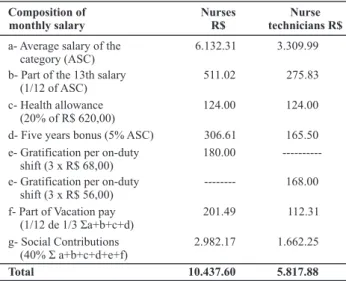
The composiion of the monthly salary included (CMS):
a) Average Salary of the category (ASC);
b) Part of the 13th salary, i.e. 1/12 ASC;
c) Health allowance corresponding to 20% of the mini -mum salary;
d) Five-year bonus, which corresponds to 5% ASC;
e) Graiicaion per on-duty shit corresponding to a monetary increase over salary when the employee works at nights, holidays and weekends which happens, on aver -age, three imes a month;
f) Part of vacaion pay, i.e. 1/12 of 1/3 of the CMS (Σ a+b+c+d+e)
g) Social contribuions, 40% of the total CMS (Σ a+b+c+d+e+f), as it is a public hospital.
RESULTS
Forty-eight (48) RNs hospitalized in the Neonatal Unit were part of this study during the data collecion period. NAS was applied 301 imes at the Neonatal Unit, over 30 days.
The average nursing staing during this study period was ive nurses and 16 nurse technicians, totaling 21 nurs -ing professionals, 24 hours, to assist on average 10 (95% IC= 8.74 to 11.26) RNs.
The average care ime spent with the RNs correspond -ed to 12.6 hours, of which 76% (9.6 hours) were spent by nurse technicians and 24% (3 hours) by nurses, as shown in Table 1.
The workload required by the RN, projected with the applicaion of NAS during the period studied correspond -ed to 668.6% (95% IC=587.2% to 750%); the average NAS scoring per RN was 66.9% (95% IC=65.6% to 68.2%) which in health care hours is equivalent to 16.1 hours of care, per RN, in 24 hours. Of these hours, 24% (3.9) shall be ex -ecuted by nurses and 76% (12.2) by nurse technicians, as seen in Table 2.
Based on the workload (668.6%) the nursing staing required for the daily care of the RNs was calculated: 27 (95% IC=23.4 to 30.0) professionals.
In order to calculate the cost of these hours, the DLC unit cost for the nurses and assistants was calculated, from the CMS of the categories, and the calculaions are shown in Table 1.
Period Morning Afternoon Night 1 Night 2 TOTAL
C a t e g o r y H o u r s U n i t C o s t R $
T o t a l C o s t R $
H o u r s
N u r s e 1.0 72.48 72.48 0.8 72.48 57.98 0.6 72.48 43.48 0.6 72.48 43.48 3.0 72.48 217.44
Technician 2.4 40.40 96.96 2.6 40.40 105.04 2.3 40.40 92.92 2.3 40.40 92.92 9.6 40.40 387.84
Total 169.44 1 63.02 136.40 136.40 12.6 605.28
Unit Cost R$
Total Cost R$
Hours Unit Cost R$
Total Cost R$
Hours Unit Cost R$
Total Cost R$
Hours Unit Cost R$
Total Cost R$
1.3 72.48 94.22 1.0 72.48 72.48 0.8 72.48 57.98 0.8 72.48 57.98 3.9 72.48
3.2 40.40 129.28 3.2 40.40 129.28 2.9 40.40 117.16 2.9 40.40 117.16 12.2 40.40
223.50 201.76 175.14 175.14 16.1
Nurse Technician Total
282.67 492.88 775.55
Period Morning Afternoon Night 1 Night 2 TOTAL
Category Hours
Unit Cost R$
Total Cost R$
Hours Unit Cost R$
Total Cost R$
Hours Unit Cost R$
Total Cost R$
Hours Unit Cost R$
Total Cost R$
Hours Unit Cost R$
Total Cost R$
Table 1- Cost of hour of care provided, per RN in 24 hours, according to the professional category and distribution of the work shifts, São Paulo – 2011
Table 2- Cost of hour of care required with the application of NAS, per RN, in 24 hours, according to the professional category and
distribution of the work shifts, São Paulo – 2011
The DLC unit cost amount corresponded to: - nurses – 10,437.60/144 hours = R$ 72.48/ hour; - nurse technicians – 5,817.88/144 hours = R$ 40.40/ hour.
These amounts were used to calculate the hours of care provided by the exising professional staf (Table 1)
and required by the RNs, as per the table projected via the applicaion of NAS (Table 2).
The average cost of the hours of care required by the applicaion of NAS, per RN in 24 hours, according to the professional category was R$ 282.67 for the nurses and R$ 492.88 for the assistants, with a total of R$ 775.55.
According to NAS, a RN needs, on average, 3.9 nurse/ hours per day, increasing 0.9 nurse/ hours and 12.2 nurse technician/ hours, increasing 2.6 hours of this professional.
The inancial impact on the cost of the nurse/hour required over the exising one is R$ 65.23, which corresponds to an increase by 30%. In relaion to the nurse technicians, the increase is of R$105.04, corresponding to 27%.
The total increase of the cost of hours of care per pa -ient was R$ 170.27 (28%).
As previously menioned, from the workload mea -sured by NAS, the nursing staing required for the daily care of the RNs was 27 (95% IC= 23.4 to 30.0) profession -als. This increase would demand the addiion of six pro -fessionals, being two nurses in the morning, two in the aternoon and one per each night shit.
In order to calculate the increase in the cost of staf, there was the need to calculate the cost of the average nursing staing in the neonatal unit in the period studied, which is shown in Table 4.
The monthly cost of the increase in the average nurs -ing sta-ing required, accord-ing to the applicaion of NAS is shown in Table 5.
Comparing Tables 4 and 5, it is observed that the in -crease in the monthly cost of the required staf with the applicaion of NAS would be R$ 44,146.72, which corre -sponds to an increase by 30% over the inancial amount of the exising staf.
DISCUSSION
The results of the study show the need to have an ad -equate nursing staing in the Neonatal Unit. As it repre -sents an increase in operaional costs, this adequacy de -mands speciic knowledge, abiliies and skills to subsidize the preparaion of the jusiicaions to negoiate the pro -fessional staf with the insituion managers.
However, nurses have found several diiculies to jus -ify the needs of quanitaive and qualitaive adequacy of nursing staing, both to improve care quality and to meet the new demands made by the health insituion manag -ers, mainly as a result of the growing need to raionalize the costs and increase services ofered(6).
Therefore, the professionals in quesion need to devel -op knowledge that will help them make decisions related to the allocaion of human resources, indicated as one of the elements that generate higher costs for the health or -ganizaions.
However, the producion of knowledge on health costs and nursing is an emergency, and studies in this area are scarce, especially related to the Brazilian reality (15), what makes the comparaive analysis of the results obtained in the present invesigaion unfeasible.
The search for knowledge related to cost management and its applicaion in the care and management pracice demands a change of the health professionals, mainly in what is related to the value of the inancial aspects of health care and the understanding that the objecive to manage the economic aspects of health care is based on the opimizaion of resources, guarantee of access and equity for the users and maintenance of the quality of service(16).
Therefore, apart from determining the quanity and quality of professionals needed to reach the desired care
Table 3 – Table showing the calculation of the monthly salary
composition of nurses and nurse technicians, São Paulo –2011 Composition of
monthly salary
Nurses R$
Nurse technicians R$
a- Average salary of the category (ASC)
6.132.31 3.309.99
b- Part of the 13th salary (1/12 of ASC)
511.02 275.83
c- Health allowance (20% of R$ 620,00)
124.00 124.00
d- Five years bonus (5% ASC) 306.61 165.50 e- Gratification per on-duty
shift (3 x R$ 68,00)
180.00
---e- Gratification per on-duty shift (3 x R$ 56,00)
--- 168.00
f- Part of Vacation pay (1/12 de 1/3 a+b+c+d)Σ
201.49 112.31
g- Social Contributions (40%Σa+b+c+d+e+f)
2.982.17 1.662.25
Total 10.437.60 5.817.88
Table 4- Distribution of the monthly cost of the average existing
nursing staff, São Paulo − 2011
Category Quantity Unit Cost R$
Total Cost R$
Nurse 5 10.437.60 52.188.00
Assistant 16 5.817.88 93.086.08
Total 21 145.274.08
Table 5 – Distribution of the monthly cost of the average nursing
stafing required, São Paulo − 2011
Category Quantity Unit Cost R$
Total Cost R$
Nurse 7 10.437.60 73.063,20
Assistant 20 5.817.88 116.357,60
standard, the nurses also need to analyze the inancial im -pact of these resources in the result of care aciviies de -veloped by the nursing team, remembering that although the economic aspects are important, they should not be more so than the technical, human, ethical and social as -pects in the decision-making process.
In this context, we verify that the issues related to the adequacy of the nursing professional staf become relevant and are being invesigated in order to produce technical and scieniic evidence that foster awareness of the meaning of a staf that meets, not only the needs of paients and of the health insituions, but the safety of paients and of the nursing team professionals (17).
A research (18) performed via a systemaic literature review considered that the size of the nursing staf has a deiniive and measurable impact on the care results, such as: adverse events, permanence period, paient mortality, and nurse turnover.
An invesigaion performed with paients hospitalized in 799 hospitals in the Unites States related the number of nursing hours with the quality of the services provided, and concluded that the higher number of hours of care provided by the nurses is associated with the reducion of the mortality rate and the adverse event rate, as well as a reducion in the mortality rate as a result of these events (19).
Another study carried out in England showed that in hospitals with a higher number of paients per nurse, the mortality rates were 26% higher than in the ones that had a smaller rate of paients per nurse (20).
From the inancial point of view, the researchers(21) concluded that when an increase in the number of nurses in the hospitals occurred, there was also a signiicant in -crease in the operaional costs, but with no proit reduc -ion. On the other hand, in the hospitals where there was a higher number of assistants than nurses, high operaion -al costs were ideniied, followed by lower proit.
The study of systemaic review of the literature(22) shows that the concern with the safety of the paients
and the quality of the care has prompted researches on the pracice and the cost x efeciveness raio of interven -ions and health care, including the distribuion of human resources.
The evidences that show the relaionship between the ime of nursing care and the quality of service can con -tribute to prove the impact of the nursing hours on the results and on the safety of the paients, subsidizing the budgetary negoiaion of the professional staf with the managers of the health insituions to add value and qual -ity of services (17).
CONCLUSION
This study has enabled us to idenify the average nurs -ing care ime spent and required by the RNs hospital -ized in the Neonatal Unit at the HU-USP, showing a gap between the care ime spent with the RNs and the care ime they require. The professional staf required was 29% higher than the exising professional team in the unit, sug -gesing work overload of the nursing team.
The average cost of the hours provided per RN, in 24 hours was R$ 141.33 for the nurses and R$ 254.40 for the nurse technicians, corresponding to a total of R$395.73.
The average cost of the required hours of care with the applicaion of NAS in 24 hours according to the pro -fessional category was R$ 183.72 for the nurses and R$ 323.30 for the assistants, with a total of R$ 507.02, cor -responding to an increase of 28%.
The increase in the monthly cost of the required staf by NAS would be R$ 28,833.58, which corresponds to an increase by 30% over the inancial amount of the exising staf.
The analysis of the available literature studies shows that, although the adequacy of the nursing professional staf leads to higher operaional costs, it can contribute to reduce the expenses deriving from the negaive results of the care provided to the paients as a result of the insuf -icient quanity and/or quality of the professionals.
REFERENCES
1. Bochembuzio L. Avaliação do instrumento Nursing Aciviies Score (NAS) em neonatologia [tese doutorado]. São Paulo: Es -cola de Enfermagem, Universidade de São Paulo; 2007.
2. Internaional Council of Nurses (ICN). Posiive pracice environ -ments [Internet]. Geneva; 2007 [cited 2010 Mar 15]. Avaiable from: htp://www.icn.ch/images/stories/documents/publica -ions/fact_sheets/9d_FS-Posiive_Pracice_Environments.pdf
3. Fugulin FMT. Parâmetros oiciais para o dimensionamento de proissionais de enfermagem em insituições hospitalares: análise da resolução COFEN nº 293/04 [tese livre-docência] São Paulo: Escola de Enfermagem, Universidade de São Paulo; 2010.
5. Canadian Nurses Associaion (CAN). Measuring nurses’ work -load [Internet]. Otawa; 2003 [cited 2011 July 1º]. Available from: htp://www.cna-nurses.ca/CNA/documents/pdf/publi -caions/NN_NursesWorkloadmarch2003_e.pdf
6. Fugulin FMT. Dimensionamento de pessoal de enfermagem: avaliação do quadro de pessoal de enfermagem das unidades de internação de um hospital de ensino [tese doutorado]. São Paulo: Escola de Enfermagem, Universidade de São Paulo; 2002.
7. Internaional Council of Nurses (ICN). Dotações seguras salvam vidas: instrumentos de informação e acção. Edição portuguesa [Internet]. Lisboa: Ordem dos Enfermeiros; 2006 [citado 2011 jul. 2]. Disponível em: htp://www.ordemenfermeiros.pt/even -tos/Documents/II%20Congresso%202006/IICong_kitDIE.pdf
8. Spir EG, Minami A, Lopes MCSO, Abreu MGB, Nepomuceno LMR, Bochembuzio L, et al. O sistema de assistência de en -fermagem materno-infanil - Unidade Neonatal. In: Gaidz -inski RR, Soares AVN, Lima AFC, Guierrez BAO, Cruz DALM, Rogensk MNB, et al. Diagnósico de enfermagem na práica clínica. Porto Alegre: Artmed; 2008. p. 229-42.
9. Fugulin FMT, Silva SHS, Shimizu HE, Campos FPF. Implantação do sistema de classiicação de pacientes na Unidade de Clíni -ca Médi-ca do Hospital Universitário da USP. Rev Med HU-USP. 1994;4(1/2):63-8.
10. Gaidzinski RR. Dimensionamento de pessoal de enfermagem em insituições hospitalares [tese livre-docência]. São Paulo: Escola de Enfermagem, Universidade de São Paulo; 1998.
11. Miranda DR, Rijk AD, Schaufeli W, Iapichino G. Nursing ac -iviies score. Crit Care Med. 2003;31(2):374-82.
12. Queijo AF, Padilha KG. Instrumento de medida de carga de trabalho de enfermagem em Unidade de Terapia Intensi -va: Nursing Aciviies Score (NAS). Rev Paul Enferm. 2004; 23(2):114-22.
13. Gaidzinski RR, Fugulin FMT. Dimensionamento de pessoal de enfermagem em Unidade de Terapia Intensiva. In: Leite MMJ, organizadora. Programa de Atualização em Enferma -gem: saúde do adulto (PROENF) – Ciclo 3 – Módulo 3. Porto Alegre: Artmed/Panamericana; 2008. p. 65-96.
14. Marins E. Contabilidade de custos. São Paulo: Atlas; 2006.
15. Casilho V. Gerenciamento de custos: análise de pesquisas produzidas por enfermeiras [tese livre-docência]. São Paulo: Escola de Enfermagem, Universidade de São Paulo; 2008.
16. Casilho V, Fugulin FMT, Gaidzinski RR. Gerenciamento de custos nos serviços de enfermagem. In: Kurcgant P, coorde -nadora. Gerenciamento em enfermagem. 2ª ed. Rio de Ja -neiro: Guanabara Koogan; 2010. p. 121-35.
17. Garcia PC. Tempo de assistência de enfermagem em UTI e indicadores de qualidade assistencial: análise correlacional [dissertação]. São Paulo: Escola de Enfermagem, Universi -dade de São Paulo; 2011.
18. Curin LL. An integrated analysis of nurse staing and relat -ed variables: efects on paients outcomes. Online J Issues Nurs. 2003;8(3):5.
19. Needleman J, Buerhaus P, Matkes S, Zelevinsky K. Nurse-staing levels and quality of care in hospitals. N Engl J Med. 2002;346(22):1715-22.
20. Raferty AM, Clarke SP, Coles J, Ball J, James P, McKee M, et al. Outcomes of variaion in hospital nurse staing in Eng -land hospitals: cross-secional analysis of survey data and discharge records. J Nurs Stud. 2007;44(2):175-82.
21. McCue B, Mark BA, Harless DW. Nurse staing, quality and inancial performance. J Health Care Finance. 2003;29(4):54-76.