Nursing interventions for stroke patients:
an integrative literature review
C
RITICAL
R
EVIEW
INTERVENÇÕES DE ENFERMAGEM AOS PACIENTES COM ACIDENTE VASCULAR ENCEFÁLICO: UMA REVISÃO INTEGRATIVA DE LITERATURA
INTERVENCIONES DE ENFERMERÍA EN PACIENTES CON ACCIDENTE VASCULAR ENCEFÁLICO: UNA REVISIÓN INTEGRADORA DE LA LITERATURA
1 Ph.D. in Nursing. Universidade Regional do Cariri, Fortaleza, CE, Brazil. [email protected] 2 Ph.D. student in Nursing, Universidade Federal do Ceará. CNPq
grantee. Fortaleza, CE, Brazil. [email protected] 3 Ph.D. in Nursing. Escola Cearense de Oncologia, Fortaleza, CE, Brazil. [email protected] 4 Ph.D. in Nursing. Faculty, Nursing Program, Universidade Federal do Ceará. CNPq grantee. [email protected] 5 Ph.D. in Nursing. Faculty,
Nursing Program, Universidade Federal do Ceará. CNPq grantee. Fortaleza, CE, Brazil. [email protected] 6 Ph.D. in Nursing. Faculty, Graduate Nursing
Program, Universidade Federal do Ceará. CNPq grantee. Fortaleza, CE, Brazil. [email protected] 7 Ph.D. in Nursing. Faculty, Nursing
RESUMO
O objei vo do estudo foi analisar o conhe-cimento sobre as intervenções de enfer-magem aos pacientes hospitalizados por acidente vascular encefálico. Realizou-se uma revisão integrai va da literatura a pari r de acesso on-line a cinco bases de dados, no mês de setembro de 2009. Ui lizou-se os descritores Cuidados de Enfermagem e Acidente Cerebral Vascular nas línguas por-tuguesa, inglesa e espanhola. Foram encon-trados 223 ari gos e selecionados 12. Iden-ifi cou-se nos ari gos um maior número de intervenções de enfermagem assistenciais, seguidas das educacionais, gerenciais e de pesquisa. As do domínio assistencial estão mais relacionadas aos aspectos biológicos dos pacientes. Em relação às educai vas, os ari gos apontam o papel fundamental do enfermeiro, bem como dos familiares e dos cuidadores. A principal intervenção geren-cial foi a coordenação dos cuidados. Quanto às intervenções de pesquisa foi idenifi cada apenas uma descrita como o desenvolvi-mento e aprimoradesenvolvi-mento da prái ca de cui-dados por meio de evidências clínicas.
DESCRITORES Acidente cerebral vascular Cuidados de enfermagem Revisão
ABSTRACT
The objeci ve of this study was to analyze the knowledge on nursing interveni ons for hospitalized stroke pai ents. An inte-grai ve literature review was performed by accessing fi ve online databases, in Sep-tember 2009. The descriptors used in the search were nursing care and stoke, in Por-tuguese, English and Spanish. A total 223 ari cles were found, and 12 were selected. It was found in the ari cles that there was a greater number of clinical nursing inter-veni ons, followed by educai onal, mana-gerial and research interveni ons. Clinical interveni ons are more related to the bio-logical aspects of pai ents. As to the edu-cai onal interveni ons, the ari cles point at the fundamental role of nurses, as well as that of relai ves and caregivers. The main managerial interveni on was the co-ordinai on of health care. As for research interveni ons, only one was idenifi ed and described as the development and im-provement of health care praci ce through clinical evidence.
DESCRIPTORS Stroke
Nursing care Review
RESUMEN
El estudio objei vó analizar el conocimien-to sobre las intervenciones de enfermería efectuadas a pacientes hospitalizados por accidente vascular encefálico. Se realizó una revisión integradora de literatura a pari r del acceso online a cinco bases de datos, en sei embre de 2009. Se ui lizaron los descrip-tores Cuidados de Enfermería y Accidente Cerebral Vascular en portugués, inglés y español. Se encontraron 223 arí culos, de los que se seleccionaron 12. Se idenifi có en ellos un mayor número de intervenciones asistenciales de enfermería, seguidas de las educai vas, gerenciales y de invesi gación. Las del dominio asistencial i enen mayor relación con aspectos biológicos de los pa-cientes. En las educai vas, los arí culos des-criben el papel fundamental del enfermero y de los familiares y cuidadores. La principal intervención gerencial fue la coordinación de cuidados. En cuanto a las intervenciones de invesi gación, se idenifi có apenas una, descripta como el desarrollo y mejoramien-to de la práci ca de cuidados mediante evi-dencias clínicas.
DESCRIPTORES Accidente cerebrovascular Atención de enfermería Revisión
Tahissa Frota Cavalcante1, Rafaella Pessoa Moreira2, Nirla Gomes Guedes3, Thelma Leite de Araujo4,
1487
Nursing interventions for stroke patients: an integrative literature review
Cavalcante TF, Moreira RP, Guedes NG, Araújo TL, Lopes MVO, Damasceno MMC, Lima FET
Rev Esc Enferm USP 2011; 45(6):1486-90 www.ee.usp.br/reeusp/ INTRODUCTION
Stroke stands out as the main cause of mortality in Brazil, which makes it a severe public health program(1-2).
Besides the epidemiological importance of strokes around the world and in Brazil, this disease entails a wide range of neurological defi cits, depending on the injury locai on, the size of the inadequate perfusion area and the quani ty of the collateral blood fl ow(3).
Dysfunci ons like anxiety, depression, sleep and sexual disorders, motor, sensory, cognii ve and communicai on disorders are prevalent alterai ons in stroke pai ents. This situai on makes them dependent on nursing interven-i ons(4). According to the Nursing Interveni ons Classifi
-cai on, an interveni on is a treatment, based on clinical judgment and knowledge, the nurse performs to improve pai ent outcomes(5).
Stroke pai ents require intensive care at some moment during hospitalizai on, mainly at the emergency unit. No re-liable evidence and recommendai ons exist yet, however, to intervene in all problems these pai ents manifest(6). In
addi-i on, diffi culi es exist to deliver care to people with muli ple care needs. It is highlighted that, the larger the number of pai ent needs are aff ected, the greater the urgency to plan care, as the systemizai on of aci ons aims for the organiza-i on, eff eci veness and validity of care delivery(7).
These considerai ons support the interest in an integra-i ve review of scienifi c produci on related to knowledge on nursing interveni ons delivered to stroke pai ents. In that con-text, evidence-based praci ce encourages the use of research results in health care, which reinforces the importance of this review, which will provide a synthesis of the set of nursing in-terveni ons for hospitalized stroke pai ents and will facilitate the construci on and defi nii on of care protocols.
Moreover, the integrai ve literature review as the re-search method will permit summarizing the state of knowl-edge on the theme, besides appoini ng knowledge gaps that need to be completed through new studies, and fa-cilitai ng decision making on interveni ons that can result in more eff eci ve care, especially for stroke pai ents(8-9).
In view of the range of dysfunci ons stroke pai ents present, the following quesi on emerged: What interven-i ons have nurses used in the hospital context to take care of adult and elderly stroke pai ents?
Considering the above and with a view to contribut-ing and addcontribut-ing up eff orts to improve nursing care for the clients under analysis, this study was proposed to analyze knowledge on nursing interveni ons for stroke pai ents in the hospital environment.
METHOD
To reach the objeci ve, the integrai ve review method was chosen, as it joins and summarizes research results on a specifi c theme, in a systemai c and organized way, con-tribui ng to deepen knowledge on the research theme(8).
To elaborate this review, the following phases were accomplished: idenifi cai on of the research quesi on and study aim, literature search, data assessment, data analy-sis and presentai on(9).
To select the ari cles, on-line access to fi ve databases was used: LILACS (Lai n American Health Sciences Litera-ture), MEDLINE (Nai onal Library of Medicine and Nai on-al Insi tutes of Health), CINAHL (Cumulai ve Index to Nurs-ing and Allied Health Literature), SCOPUS and COCHRANE. The search in diff erent databases aimed to broaden the research context and minimize possible biases.
The search was developed in September 2009, using the descriptors taken from the BVS Portal DECS (Health Sciences Descriptors) and Nai onal Library MeSH (Medical Subject Headings): Cuidados de Enfermagem and Aciden-te Cerebral Vascular in Portuguese, English and Spanish. In the databases SCOPUS and COCHRANE, non-controlled descriptors were used.
The following inclusion criteria were set: full ari cles elec-tronically available; papers available in Portuguese, English or Spanish; full research ari cles on nursing care, in the hospital environment, to stroke pai ents over 18 years of age, which answered the guiding research quesi on (Table 1).
Table 1 – Distribution of identifi ed and selected papers
Articles/Base LILACS MEDLINE CINAHL SCOPUS COCHRANE Total
Identified 4 13 28 134 44 223 Excluded 4 13 26 124 44 211
Selected 0 0 2 10 0 12
It is highlighted that those papers that were not inii ally available in the databases during the data colleci on period were sought on the journal portal of the Coordinai on for the Improvement of Higher Educai on Personnel (CAPES), in line with recommendai ons(10). If papers could not
di-rectly be sought in the fi ve databases used in the study, the CAPES portal was also considered as a data source.
For the analysis and further synthesis of those papers that complied with the inclusion criteria, an adapted form was used(11), which was completed for each paper in the
The nursing interveni ons were grouped in four cat-egories: care, management, educai on and research(12).
Those interveni ons meni oned in at least three papers were presented in tables, analyzed for contents and dis-cussed descripi vely.
RESULTS AND DISCUSSION
Concerning the characterisi cs of the 12 papers se-lected, 11 were published at er the years 2000, six in North American and fi ve in European countries. The stud-ies were classifi ed according to evidence levels(13): Level I:
evidence originates in systemai c review or meta-analysis of all relevant controlled randomized clinical trials or clini-cal guidelines based on systemai c reviews of randomized controlled clinical trials; Level II: evidence deriving from at least one well-designed randomized controlled clinical trial; Level III: evidence obtained from well-designed clini-cal trials without randomizai on; Level IV: evidence origi-nai ng in well-designed cohort and case-control studies; Level V: evidence from systemai c reviews of descripi ve and qualitai ve studies; Level VI: evidence from a single descripi ve or qualitai ve study; Level VII: evidence from expert opinions and/or expert commit ee reports.
Thus, the selected studies were classifi ed as follows in terms of evidence level: four were classifi ed as level VI (14-17), three as level III(18-20), three as level VII(21-23), one as level
IV(24) and one as level II(25).
A larger number of care interveni ons was idenifi ed, followed by educai onal and management interveni ons. It is highlighted that only one research interveni on was found, described as the development and improvement of care praci ce for stroke pai ents through clinical evidence(17).
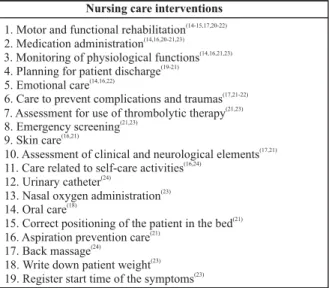
Table 2 presents nursing interveni ons in the care category.
Motor and funci onal rehabilitai on is a technical strate-gy the hospital nursing team uses for pai ent recovery. Early mobilizai on at er the start of bed confi nement is consid-ered extremely relevant to prevent joint contractures and atrophies(14,21). Besides motor rehabilitai on, one study
ap-points that funci onal rehabilitai on helps pai ents to inte-grate newly-learned aci vii es of daily living and technical skills to perform these aci vii es, helping pai ents to fi nd new ways to perform them and guarantee their safety(22).
Drug administrai on was the nursing interveni on nurses most frequently reminded with regard to stroke pa-i ents(16), and it was meni oned as an important source of
support in aci ve disease treatment because it enhances wellbeing(14). Among the administered drugs, the
throm-bolyi c drug recombinant i ssue plasminogen aci vator (r-TPA) stands out, which should be administered within 60 minutes at er the pai ent’s hospital admission(21,23). The
nurse is responsible for pai ent screening for thrombolyi c therapy use, medicai on administrai on, coni nuous moni-toring for complicai on preveni on and forwarding to the medical service if necessary(21).
The American Heart Association, Council on Cardio-vascular Nursing and Stroke Council recommend the following for thrombolytic treatment: neurological as-sessment and vital signs, except for temperature, every 15 minutes during r-TPA infusion, every 30 minutes dur-ing the next six hours and every 60 minutes durdur-ing the subsequent 16 hours; temperature measurement every four hours; forwarding to the medical service in case of alterations in vital signs; offering oxygen through nasal cannula, two to three liters per minute if oxygen satura-tion levels decrease below 92%; monitoring for hemor-rhagic complications; cardiac monitoring for 72 hours and bed rest(21).
The nurses emphasize that pai ents at neurocrii cal care units need physiological funci on monitoring (14).
Ini-i al pai ent assessment at the emergency unit is nurses’ re-sponsibility, who should focus the assessment on airways circulai on, breathing and vital signs every 30 minutes and neurological invesi gai on. Therefore, nurses should be able to recognize the neurological symptoms suggesi ng a stroke and rapidly analyze the start of the symptoms. One of the neurological test methods, pari cularly to as-sess thrombolyi cs use, is the stroke scale by the Nai onal Insi tutes of Health (NHSS)(21).
Besides emergency and hospitalizai on care, authors meni on that adequate hospital discharge planning can enhance the qualitai ve improvement of coni nuous care and communicai on between hospital and the pai ent’s
home(19-20), as about 70% of stroke survivors demand
fam-ily members’ care at home(21).
Discharge planning aci vii es include: involving family members and caregivers in post-stroke needs assessment and treatment planning; encourage relai ves and
caregiv-Nursing care interventions
1. Motor and functional rehabilitation(14-15,17,20-22)
2. Medication administration(14,16,20-21,23)
3. Monitoring of physiological functions(14,16,21,23)
4. Planning for patient discharge(19-21)
5. Emotional care(14,16,22)
6. Care to prevent complications and traumas(17,21-22)
7. Assessment for use of thrombolytic therapy(21,23)
8. Emergency screening(21,23)
9. Skin care(16,21)
10. Assessment of clinical and neurological elements(17,21)
11. Care related to self-care activities(16,24)
12. Urinary catheter(24)
13. Nasal oxygen administration(23)
14. Oral care(18)
15. Correct positioning of the patient in the bed(21)
16. Aspiration prevention care(21)
17. Back massage(24)
18. Write down patient weight(23)
19. Register start time of the symptoms(23)
Table 2 – Nursing care interventions for stroke patients –
1489
Nursing interventions for stroke patients: an integrative literature review
Cavalcante TF, Moreira RP, Guedes NG, Araújo TL, Lopes MVO, Damasceno MMC, Lima FET
Rev Esc Enferm USP 2011; 45(6):1486-90 www.ee.usp.br/reeusp/ ers to pari cipate in rehabilitai on sessions and care
de-livery with a view to funci onal aci vii es; post-discharge monitoring, including secondary preveni on, rehabilita-i on, social support and home care; enhance relai ves and caregivers’ educai on with regard to the illness(19,21).
Another interveni on idenifi ed in the papers was the emoi onal support nurses should provide as muli profes-sional team members, focusing on the establishment of a trust relai on with pai ents and their relai ves with a view to enhancing the development of coping and adaptai on strategies(22). It is highlighted that this emoi onal support
helps pai ents to overcome the fear of sequelae, compli-cai ons and consequences of the stroke(14).
As for interveni ons related with complicai on and trau-ma preveni on, nurses should enhance the maintenance of the normal funci on, preveni ng complicai ons and trau-mas, assessing pai ents’ basic needs and guaranteeing the pai ent’s best condii on to benefi t from rehabilitai on(22).
Among traumas, falls are the most common injury causes in stroke pai ents, more frequently causing hip fracture(21).
This picture has been associated with a bad progno-sis and acknowledged as a consequence of hemiplegia. In this context, nurses should put in praci ce a complica-i on and trauma preveni on program and educate other team members and relai ves about risks and preveni on measures(21).
As nursing team leaders, nurses develop management aci vii es. Besides coordinai ng the nursing team, in the muli disciplinary team, their funci on is to assess pai ent and family members’ needs, provide the resources need-ed to put in praci ce pai ent care and facilitate care transi-i ons, seeking results that evidence high-quality care(17,21).
A research at two specialized stroke units in Canada raised important management aspects for high-quality nursing care delivery, including: support in the organiza-i on of a model neurology service; work team organiza-i on, contribui ng with muli disciplinary care; pai ent defense; clinical leadership to maintain and develop a general workplace culture that supports high-quality nurs-ing work; clinical supervision and development analysis(17).
CONCLUSION
In the selected ari cles, a larger number of clinical nursing interveni ons were selected, followed by edu-cai onal, management and research interveni ons. Care interveni ons are more related with pai ents’ biological aspects, such as physiological funci on assessment, drug administrai on and motor and funci onal rehabilitai on. As for evidence level, the majority was classifi ed as level VI, followed by levels III and VII.
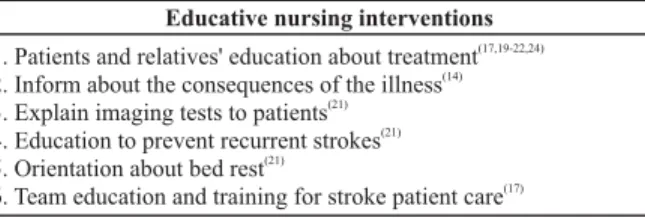
Concerning educai ve nursing interveni ons for stroke pai ents, the papers appoint nurses’ fundamental role to develop these interveni ons, as well as the educai ve fo-cus for relai ves and caregivers.
The main management nursing interveni on was care coordinai on for stroke pai ents, which includes clinical leadership, pai ent defense and care service organizai on with a view to reaching a sai sfactory quality level.
These study results can support the elaborai on of clinical protocols by nurses who are directly or indirectly involved in care delivery for stroke pai ents in the hospi-talizai on phase. They can also serve as a guide for under-graduate, graduate and clinical nursing training.
In view of the lack of Brazilian studies on this theme, nursing research on nursing care for stroke pai ents is needed to support evidence-based nursing praci ce. Table 3 – Educational nursing interventions for stroke patients –
Fortaleza – 2009
Educative nursing interventions
1. Patients and relatives' education about treatment 2. Inform about the consequences of the illness 3. Explain imaging tests to patients
4. Education to prevent recurrent strokes 5. Orientation about bed rest
6. Team education and training for stroke patient care
(17,19-22,24) (14) (21)
(21) (21)
(17)
Many papers discuss nurses’ importance in pai ent and family educai on about the treatment and related complicai ons.
Nurses play an important role in enhancing stroke pa-i ents and their families’ understanding about the course of the disease, possibilii es for improvement and recovery, limitai ons, besides providing informai on about the disease, treatment, rehabilitai on and expectai ons for the future(22).
In the organizai onal context of nursing care at stroke units, authors emphasize the value of family-centered educai onal nursing interveni ons, pari cularly knowledge about the system and family relai ons with a view to an eff eci ve rehabilitai on plan(17).
Table 4 – Management nursing interventions for stroke patients – Fortaleza – 2009
Management nursing interventions
1. Care coordination
2. Organization, assessment and coordination of treatment needed at home
3. Patient transfer to other hospital sectors
(16-17,21)
(19)
REFERENCES
1. Curioni C, Cunha CB, Veras RP, André C. The decline in mortal-ity from circulatory diseases in Brazil. Pan Am J Public Health 2009;25(1):9-15.
2. Lotufo PA. Stroke in Brazil: a neglected disease. São Paulo Med. J 2005; 123(1):3-4.
3. André C. AVC Agudo. In: André C. Manual de AVC. Rio de Ja-neiro: Revinter; 2006. p. 37-51.
4. Falcão IV, Carvalho EMF, Berreto KML, Lessa FJD, Leite VMM. Acidente vascular cerebral precoce: implicações para adultos em idade produi va atendidos pelo Sistema Único de Saúde. Rev Bras Saúde Matern Inf 2004; 4(1):95-102.
5. McCloskey J, Bulecheck GM. Classifi cação das Intervenções de Enfermagem (NIC). Porto Alegre: Artmed; 2008.
6. Alegría MA, Araúz A, Azcanio G, Escamilla JM, Flores F, Ruiz JL, et al. Medidas generales y cuidados intensivos del EVC agudo. Rev Invest Clín. 2002;54(3):262-5.
7. Amante LN, Rosset o AP, Schneider DG. Nursing care system-ai zai on at the Intensive Care Unit (ICU) based on Wanda Horta’s theory. Rev Esc Enferm USP [Internet]. 2009 [cited 2009 Sept 25];43(1):54-64. Available from: ht p://www.scielo. br/pdf/reeusp/v43n1/en_07.pdf
8. Mendes KDS, Silveira RCCP, Galvão CM. Revisão
integra-i va: método de pesquisa para a incorporação de evidên-cias na saúde e na enfermagem. Texto Contexto Enferm. 2008;17(4):758-64.
9. Whit emore R, Knafl K. The integrai ve review: updated meth-odology. J Adv Nurs. 2005;52(5):546-53.
10. Pompeo DA, Rossi LA, Galvão CM. Revisão integrai va: etapa inicial do processo de validação de diagnósi cos de enferma-gem. Acta Paul Enferm. 2009;22(4):434-8.
11. Ursi ES. Prevenção de lesões de pele no perioperatório: re-visão integrai va da literatura. [dissertação]. Ribeirão Preto: Escola de Enfermagem de Ribeirão Preto, Universidade de São Paulo; 2005.
12. Craven RF, Hirnle CJ. Fundamentos de enfermagem: saúde e função humana. 4ª ed. Rio de Janeiro: Guanabara Koogan; 2006.
13. Melnyk BM, Fineout-Overholt E. Evidence-based praci ce in nursing & healthcare: a guide to best praci ce. Philadelphia: Lippincot Williams& Wilkins; 2005. Making the case for evi-dence-based praci ce; p. 3-24.
14. Hedlund M, Ronne-Engstron E, Ekselius L, Carlsson M. From monitoring physiological funci ons to using psychological strategies: nurse’s view of caring for the aneurismal subarach-noid haemorrhage pai ent. J Clin Nurs. 2008;17(3):403-11. 15. Arias M, Smith LN. Early mobilizai on of acute stroke
pa-i ents. J Clin Nurs. 2007;16(2):282-8.
16. Mit mann N, Seung SJ, Pisterzi LF, Isogai PK, Michaels D. Nursing workload associated with hospital pai ent care. Dis Manage Health Outcomes. 2008;16(1):53-61.
17. Burton CR, Fisher A, Green TL. The organizai onal context of nursing care in stroke units: a case study approach. Int J Nurs Stud. 2009;46(1):86-95.
18. Fields LB. Oral care interveni on to reduce incidence of veni lator-associated pneumonia in the neurologic intensive care unit. J Neurosci Nurs. 2008;40(5):291-8.
19. Arts SEJ, Francke AL, Hut en JBF. Liaison nursing for stroke pai ents: results of a Dutch evaluai on study. J Adv Nurs. 2000;32(2):292-300.
20. Kavanagh D, Connolly P, Cohen J. Promoi ng evidence-based praci ce: implemeni ng the American Stroke Associai on’s acute stroke program. J Nurs Care Qual. 2006;21(2):135-42.
21. Summers D, Leonard A, Wentworth D, Saver JL, Simpson J, Spilker JA, et al. Comprehensive overview of nursing and in-terdisciplinary care of to the acute ischemic stroke pai ent. Stroke. 2009;40(8):2911-44.
22. Marit K. The role of nursing in the rehabilitai on of acute stroke pai ents: toward a unifi ed theorei cal perspeci ve. Adv Nurs Sci. 1997;19(4):55-64.
23. Bazarnick L, Napolitano P, Capodanno J, Graf D, River T. Facilitai ng treatment in pai ents with stroke or chest pain through a dedicated ED chest pain/stroke unit. J Emerg Nurs. 2002;28(4):304-9.
24. Kwan J, Hand P, Dennis M, Sandercock P. Eff ects of introduc-ing an integrated care pathway in an acute stroke unit. Age Ageing. 2004;33(4):362-7.