BAR, Rio de Janeiro, v. 14, n. 4, art. 5, e170032, 2017
http://dx.doi.org/10.1590/1807-7692bar2017170032
Productivity Antecedents of Brazilian Courts of Justice: Evidence
from Justiça em Números
Alamir Costa Louro1 Washington Romão Santos1 Helio Zanquetto Filho1
Universidade Federal do Espírito Santo1
Abstract
Public sector managers and researchers have emphasized the importance of performance measurement.
Nevertheless, few theoretical and empirical studies are found in Brazilian Judiciary Courts’ literature. In order to
empirically identify which variables (IT investments, own or outsourced human capital) are more relevant for improving productivity, the current research proposes a model using secondary data extracted from the Justiça em Números (Justice in Numbers) report, using structural equation modeling for the analysis. The results suggest that: (a) all variables are relevant for improving productivity in Brazilian Courts, confirming our first three theoretical hypotheses; and (b) own human capital has a greater impact on productivity than outsourced, confirming the fourth. For those who are responsible for reforms, this finding indicates that IT is not the most important investment. However a question remains: Seen as a cure for almost all problems in the public sector, is it possible to improve performance without hard IT investments? For future research there are some additional questions: Why is own human capital more relevant than outsourced? Which variables should be included in the model for improving the general significance? The answers can help improve Brazilian court productivity.
Introduction
In the last few decades, the government has given greater importance to management using statistical data as a fundamental tool in its reforms (Moynihan & Hawes, 2012). For Brazilian judiciary organizations in particular, the adoption of indicators has often been encouraged by the National Justice Council (Conselho Nacional de Justiça [CNJ]) in the context of its audit reports, which seek to compile data on expenditures, investments, amount of human capital, and information related to judicial processes (CNJ, 2016). In fact, the CNJ resolutions are a fundamental component of these public reforms. Regarding judiciary organizational productivity, a relationship has been commonly assumed between statistical data and improved decision-making and accountability (Oliveira, 2012).
The present paper considers the theoretical bias of the New Public Administration and its orientation towards decision-making based on indicators and outsourcing practices, which is particularly true in the context of Courts of Justice, mainly when taking into account the criticisms of the refractory behavior towards changes in Brazilian judiciary organizations. Such organizations are also traditionally criticized for the inoperability and anachronism of their services, as portrayed by Sadek (2004) in pointing out that this is neither a current observation nor something common only in Brazil. One explanation for these criticisms is the lack of planning of public organizations in general, which has been an important issue for at least five decades. Article six of Decree-Law no. 200 (Decreto-Lei n. 200, 1967) advocates planning as a fundamental national public administration principle, suggesting observation of the efficiency and effectiveness in organizational resource allocation. This Decree-Law is a forerunner of the government management reform that began in the mid-1990s (Bresser-Pereira, 2009), and is relative to New Public Administration reforms. This same author affirms that new management frameworks initially used in private organizations were adaptedto the reality of national public administration, aiming to reduce expenses and improve services.
In literature inspired by New Public Administration, however, what is widely adopted either a normative stance - indicating the best practicesof possible reforms - or a descriptive stance - presenting the characteristics of some specific reforms (Bresser-Pereira, 2009). With regards to this, the national judiciary is no exception. Currently, as a consequence of research about reforms specifically based on CNJ resolutions, little systematic evidence has been produced on outsourcing and IT investments. Conversely, the present research has produced some empirical evidence on such topics as the association between own and outsourced human capital, IT investments, and productivity in Brazilian Courts of Justice.
In response to the gap in empirical research on the judiciary, and with the same view of Sadek and Oliveira (2012) who call for more research based on statistical indicators in these organizations, the present work adopts a quantitative approach and investigates the possible determinants of national judiciary productivity. More specifically, this paper’s objective is to propose and empirically test a model based on public data of the Justiça em Números CNJ’s report using the most primary antecedent for judicial performance: its own and outsourced human capital. Moreover, the motivation of the study to encompass IT Investments is twofold. On the one hand, the public sector underwent significant managerial reforms, and IT Investments represent great expectations for improving the productivity of the national judiciary (Gomes & Guimarães, 2013). On the other hand, CNJ highlighted these investments as an important part – 25.1% – of the total expenditures of the national judiciary (CNJ, 2016).
According to a bibliographical review of national journals, with Qualis B3 ranking or higher, and corroborating the previous work carried out by Akutsu and Guimarães (2012), judiciary management is considered poorly explored, especially regarding IT investments and outsourcing. This paper aims to increase existing knowledge about IT investment and productivity in order to provide useful indications for these courts’ top managers and the legislators of judiciary reforms.
Theoretical Review
Productivity is a multifaceted concept and little explored in the literature on the Brazilian judicial system, due to the difficulty or scarcity of data for analysis. In addition, efficiency and productivity literature focuses on DEA, data envelopment analysis, which takes the basis of a court as a benchmark and makes comparisons across other courts. Although pertinent, the objectives of the research would not be adequate, considering the present focus on the relationship between some latent variables like IT investments and court productivity, as well as distinguishing between own and outsourced human capital.
In order to understand judiciary productivity, it is necessary to know the impact of IT Investments, as well as own and outsourced human capital. This session will present the concepts that will support model structuring to analyze the results from research. This will take place by contextualizing the relationship between judiciary productivity and IT investments and the amount of outsourced and own human capital that is characterized as effective servants, judges, and commissioners.
For an introduction and history on statistical data in the judiciary, we suggest the work of Sadek and Oliveira (2012). Academic papers that address empirical data on the national judiciary have advanced little in analysis, and have given more focus to providing a description of the national scenario (Gomes & Guimarães, 2013; Nogueira, Oliveira, Vasconcelos, & Oliveira, 2012; Oliveira, 2012), or analyzing state courts (Gomes, Guimarães, & Akutsu, 2017). Emphasis should be given to Gomes and Guimarães (2013), who published a bibliometric article on judiciary performance focusing on specific roles judges have, an approach that the present work seeks to overcome. In addition, international literature offers a few empirical works (Beenstock & Haitovsky, 2004; Dimitrova-Grajzl, Grajzl, Sustersic, & Zajc, 2012; Gomes et al., 2017; Ippoliti, Melcarne, & Ramello, 2015; Mitsopoulos & Pelagidis, 2007); however, they provide evidence that is still rather limited, usually circumscribed to economic variables, and sometimes with inconclusive results.
IT Investments
According to Galliers and Leidner (2003), as IT increased its capacity to generate and store information cheaply, its use quickly spread in organizations. Today, with the advent of data warehouses and business intelligence tools and concepts, different hierarchical levels of management can use indicators as a tool for decision-making. The large volume of data produced and processed by the organizations shows the need for storing and analyzing this data to gather better information that allows better decision making. In the context of the judiciary, Peyrache and Zago (2016) studied the inefficiency in Italian courts and identified that technological innovations could increase the efficiency level in the courts.
this controversy, the present paper launches a partial result that will be studied in the future using other constructs related to IT investment, such as business process automation (Trkman, 2010) and IT corporate governance (Mohamed, 2012).
Amount of Outsourced and Own Human Capital
Human Capital refers to knowledge that is intrinsic to people and which is related to their capacities, skills, experiences, creativity, and innovation (Cassol, Gonçalo, & Ruas, 2016). The digital revolution has influenced the way humanity relates to the world and how people access services. Digital services offer ways for people to modify existing processes and adjust data to the needs of society. The electronic judicial process was implemented with the objective of speeding up the services offered by the judiciary. The CNJ aims to computerize the judiciary as a way to respond to the demands of society more productively. However, computerization is the result of dialogue and consensus among legal operators, which may explain the resistance in some IT investments like electronic judicial process. As long as there is not sufficient artificial intelligence to process the actions in the national judiciary, there will be dependence on human capital to carry out the tasks. This human capital is detailed in specific indicators of the Justiça em Números report as employees, judges, commissioners, and outsourced staff. Therefore, in principle, the work of everyone can directly affect the Courts of Justice performance.
The idea that there are different productivities due to different human groups may be related to the level of commitment each group has to the organization (Carson, Carson, & Bedeian, 1995). The results of Gomes and Guimarães (2013) allude to the importance of human capital in the productivity and speed of the courts. These and other works give more detail regarding the participation of the judges, while not dealing with differences in productivity between outsourced and own human capital. However, outsourcing is a common practice, and papers such as Girth (2014) indicate that 70% of public managers are not satisfied with the performance of outsourced staff, although they do not justify this dissatisfaction. The present work seeks to start filling the gap of literature on the judiciary, further scrutinizing the profiles of human capital.
Productivity
Performance is a multidimensional concept, whose attributes change throughout time, as well as among stakeholders and organizations (Matitz & Bulgacov, 2011). Information regarding performance is used by the organizations in order to direct their planning, develop strategies, defend themselves from possible threats, as well as help reach organizational results. Neely, Gregory, and Platts (1995) emphasize that performance supplies the manager with possibilities to measure the organization’s actions, such as its productivity capacity, efficiency level, process effectiveness and sales results. Therefore there are several types of performance that are measured in different ways. Due to this perception, i.e., the difficulty to use precise indicators, one can infer significant complexity in the public organization scenario and this is not different in the judiciary.
Causal Relationship Between IT Investments and Productivity
Insights into the causal paths linking IT investments and organizational productivity are studied extensively in other types of organizations, such as hospitals (Caldeira, Serrano, Quaresma, Pedron, & Romão, 2012), iron and steel, land and space transport, and banks (Sircar, Turnbow, & Bordoloi, 2000). Therefore, there are studies in the private area on IT investment and productivity that support the existence of a relationship among these constructs, although it is pointed out as an “eternal question” by Trkman (2010, p. 131). In the context of the judiciary, the results found in studies such as the work of Gomes and Guimarães (2013) affirm that there is no empirical evidence on the effect of IT on productivity and court speed. In this context, Sousa (2015) also points out that this hypothesis has not been confirmed for the scope of labor justice. Based on this discussion, we state the following initial hypothesis:
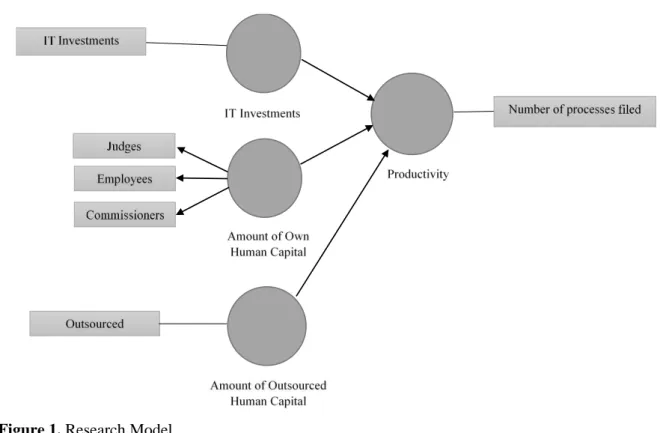
H1. IT investments have a direct and positive effect on the productivity of State Courts of Justice.
Causal Relationship Between Amount of Human Capital and Productivity
According to behavioral psychology (Blau, 1985; Carson et al., 1995), some constructs may explain different results of human capital in relation to productivity in organizations, focusing mainly on affectivity constructs, such as motivation with career, career commitment, organizational commitment, job satisfaction and satisfaction with promotion. These constructs are not the concern as in the present work, which is to find out what is the human capital profile, whether it is own and/or outsourced that result in greater productivity in the judiciary scenario.
Nogueira, Oliveira, Vasconcelos and Oliveira (2012) affirm that there has been an increase in national court productivity, but there is no consensus about what their most important antecedents are. Research on productivity in the judiciary examined the role of judges and their relationship with productivity (Mitsopoulos & Pelagidis, 2007; Sousa, 2015). This last work considers other factors such
as judges’ age and workload, and exposes the complexity of the relationship between the number of
judges and the productivity. It is possible that by adding new judges, the workload decreases for existing ones, thereby reducing productivity. Similar views were expressed by Fochezatto (2013). It is understood that the pressure caused by the increase in judges’ workload impacts performance (Dimitrova-Grajzl et al., 2012), and the workload is explained as the number of processes not ended in relation to the number of judges. Mitsopoulos and Pelagidis (2007) point out the lack of management as the main factor that negatively impacts productivity in judiciary, despite other options, such as the amount of human capital and any kind of investments.
In the context of knowledge-based organizations, such as judiciary organizations, Mehralian, Reza, Akhavan, and Rajabzadeh (2013) argue that human capital has become a critical factor for long-term productivity and performance. Based on this finding, the present study differentiated own and outsourced human capital, the latter related to contracts with a limited period, which normally do not exceed four years. Therefore, we propose a second hypothesis:
H2. The amount of own human capital (judges, employees, and commissioners) has a positive
and direct effect on the productivity of State Courts of Justice.
latter related to contracts with a limited period, which normally do not exceed four years. Therefore, we propose our third hypothesis:
H3. The amount of outsourced human capital has a positive and direct effect on the productivity
of the State Courts of Justice.
Productivity does not present general measures that can be adopted by all courts. Yeung and Azevedo (2011) use the workload to evaluate court productivity in order to understand variations in each state. Some research advances in comparative analysis point to features of more and less efficient courts, major sources of efficiency or inefficiency, or suggestions for improvement to achieve a certain level of efficiency. Peyrache and Zago (2016) analyzed the efficiency of Italian courts of law in 2003-2008, pointing out that technical inefficiency is about 40% of total inefficiency, court size is 25% and inefficiency of re-allocation is about 35%, suggesting that the adoption of best practices can increase efficiency. Although some research focuses only on the productivity of judges (Deyneli, 2012; Schneider, 2005) and the present study differentiates between own and outsourced human capital. These works discuss performance differences related to educational level, age, experience, and wages.
Almklov and Antonsen (2014) offer insight into the complex influences related to the reliability of outsourced work, and the literature that questioned the market oriented organizational models of New Public Administration reforms. Just as in a mathematical hypothesis, that is, without conceptual support, we also propose that:
H4. The amount of own human capital has a positive and direct effect on productivity greater
than the amount of outsourced human capital.
These hypotheses emerge as the hypothetical model presented in Figure 1:
Methodological Procedure
Data and measurements
In order to test the hypotheses, we used secondary data, without additional treatments, from the Justiça em Números CNJ report, made available on the Brazilian website (CNJ, 2016), totaling (n = 189) records from 27 states that provided information for seven years, from 2009 to 2015. Data were lost in three registers for the variable dinf1, about IT investments representing only 1.6% of the population, which according to Hair, Black, Babin, Anderson, and Tatham (2009) can be classified as lost and non-skippable data, understood as random. Because they represent less than 10% of the sample, the substitution was chosen by the respective means.
Table 1 shows the descriptive statistics, where the codes referenced by the Justiça em Números report and the variables that appear in the measurement model in Figure 2 are also shown.
Table 1
Descriptive Statistics
N Minimum Maximum Mean Std. Deviation
Skewness Kurtosis
Statistic Statistic Statistic Statistic Statistic Statistic Std. Error
Statistic Std. Error
dinf1 – IT Investments
189 70750 275096046 14257746.54 33777891.400 5.560 .177 34.654 .352
mag – Judges 189 31 2566 418.93 477.485 3.087 .177 10.758 .352
tbaix – Number of processes filed
189 31113 5937348 697290.42 1052595.298 3.165 .177 10.835 .352
tfauxc – Outsourced
189 0 5542 341.31 767.027 4.278 .177 21.482 .352
cc –
Commissioners
189 167 12905 1326.30 2066.746 4.505 .177 20.626 .352
serv - Employees
189 677 46291 6423.95 8480.788 3.599 .177 13,748 .352
Note. the total number of the sample is 189, but 9 outliers were identified, the calculations were made without the presence of
outliers. Source: Prepared by the authors.
To analyze the presence of outliers, according to Hair et al. (2009), the Mahalanobis D² distance was calculated by means of a linear regression, taking the dependent variable Number of Processes
filed, and using the other five independent variables and then measuring using the SPSS function
CDF.CHISQ. This returns the probability of one value to use a Chi-Square distribution with a certain degree of freedom, in this case five. A p-value of less than 0.001 was obtained, eliminating the data of the Rio de Janeiro Court of Justice (Tribunal de Justiça do Estado do Rio de Janeiro [TJRJ]) for the years 2009 and 2010, and the São Paulo Court of Justice (Tribunal de Justiça do Estado de São Paulo - TJSP) from all seven years that were considered outliers, thus leaving us 180 records.
Results Analysis
added to the fact that the model has three latent variables, and therefore several interrelated dependency relations led to the use of SEM. In this context, SmartPLS software (version 3.2.4) was chosen, which provides the statistical method of the Partial Least Squares (PLS), which requires relatively few records, the minimum being indicated by Hair, Hult, Ringle, and Sarstedt (2017) as 10 times the highest number of arrows pointing to any latent variable. In this case 30 registers is enough. The PLS algorithm was executed with the default values following the guidelines of Hair et al. (2017), resulting in Figure 2.
Figure 2. PLS Algorithm Results Source: Prepared by the authors.
The only construct with more than one variable was built as reflexive, because of its characteristics. The results of the measurement model regarding the validity and reliability of this construct are shown in Table 2, presenting Cronbach’s alpha and composite reliability, greater than 0.7 and AVE, greater than 0.5. The external loads of convergent validity are greater than 0.7.
Table 2
Reflexive Measurement Model
Cronbach’s Alpha Composite
Reliability
Average Variance Extracted (AVE)
Amount of Own Human Capital 0.895 0.934 0.826
Note. Source: Prepared by the authors.
Table 3
Fornell-Larcker Criterion
Amount of Outsourced Human
Capital
Amount of Own Human
Capital
IT
Investments Productivity
Amount of Outsourced Human
Capital 1.000
Amount of Own Human Capital 0.656 0.909
IT Investments 0.363 0.622 1.000
Productivity 0.786 0.833 0.584 1.000
Note. Source: Prepared by the authors.
Still, according to Hair et al. (2017), the first step of the structural model is to evaluate collinearity using the VIF indicator, using as a parameter less than 5, with the highest result being 2.496. On the second step, coefficients are evaluated using the Bootstrapping procedure with 5000 subsamples with the option no sign changes.Table 4 shows that all coefficients are significant (p-value < 0.05) with
productivity.
Table 4
Bootstrapping Path Coefficients
Original
Sample (O)
Standard Deviation (STDEV)
T Statistics
(|O/STDEV|) P Values
Amount of Outsourced Human
Capital -> Productivity 0.431 0.075 5.741 0.000
Amount of Own Human Capital ->
Productivity 0.465 0.066 7.077 0.000
IT Investments -> Productivity 0.138 0.070 1.965 0.049
Note. Source: Prepared by the authors.
The third step is to evaluate the determination coefficient that measures the model predictive accuracy. The result was 0.807, with an adjusted value of 0.803, which is considered substantial by Hair, Ringle, and Sarstedt (2011). In step four, it seeks to measure the size of the effect f² that evaluates if any omitted constructs generate substantive impact on the endogenous constructs, the result is that IT
investment has a small effect on the endogenous construct productivity.
Table 5
Omitted Constructs
f Square Productivity
Amount of Outsourced Human Capital 0.543
Amount of Own Human Capital 0.448
IT Investments 0.060
In the fifth step, the predictive relevance is evaluated using the Blindfolding algorithm with default configuration, omission distance equal to seven, result in a Q² that represents great relevance, greater than the 0.35 parameter of Hair et al. (2011), as demonstrated in Table 6.
Table 6
Blindfolding
SSO SSE Q² (=1-SSE/SSO)
Amount of Outsourced Human Capital 180.000 180.000
Amount of Own Human Capital 540.000 540.000
IT Investments 180.000 180.000
Productivity 180.000 35.531 0.803
Note. Source: Prepared by the authors.
Another test was to analyze the graphs of the IT investment construct as a moderating effect on the relationships between own and outsourced human capital and productivity (Figure 3).
Figure 3. Moderator Effect Test of IT Investment and Productivity for Both Exogenous Constructs Source: Prepared by the authors.
Figure 4. Moderator Effect Test of IT Investment and Outsourced Human Capital Source: Prepared by the authors.
Figure 5. Moderator Effect Test of IT Investment and Own Human Capital Source: Prepared by the authors.
productivity effect (H3). The difference between the means was statistically significant, according to results presented in Table 7.
Table 7
Independent Sampling Test
Levene’s Test
for Quality of Variance
t-test for Equality of Means
F Sig. t df Sig. (2-tailed)
Own X Outsourced Equal variances
assumed .167 .682 114.933 9998 0.000
Equal variances
not assumed .682 114.933 9997.781 0.000
Note. Source: Prepared by the authors.
SEM analysis resulted in the confirmation of all four hypothesis, as synthesized in Table 8.
Table 8
Research Hypothesis
Hypothesis Description Results
H1 IT investments have a direct and positive effect on the productivity of State Courts of Justice.
Confirmed
H2 The amount of own human capital (judges, employees, and commissioners) has a positive and direct effect on the productivity of State Courts of Justice.
Confirmed
H3 The amount of outsourced human capital has a positive and direct effect on the productivity of the State Courts of Justice
Confirmed
H1 The amount of own human capital has a positive and direct effect on productivity greater than the amount of outsourced human capital.
Confirmed
Note. Source: Prepared by the authors.
Conclusions
The results contribute to the scarce empirical literature on the productivity of courts in Brazil, especially with the analysis of the Justiça em Números report that was released in 2004, but only in 2012 with the current level of detail. Public sector performance surveys are often taking a descriptive or normative stance, normally without a strong and clear reference to theories. Existing empirical evidence on the productivity antecedents of judiciary is still rather limited and often inconclusive. In this sense an incremental approach may be interesting for construction of parsimonious models involving new constructs, or even removing constructs that do not influence their measurements.
existing literature, the present work makes advances in relation to IT investments and human capital issues. Among other empirical contributions, by knowing the impact of the variables, it is possible to direct reforms of these courts.
In the New Public Administration context, the work of Moynihan and Hawes (2012) examines the use of performance information as a behavioral measure in administrative reforms. These authors assume that if performance information is used, then decision-making processes are better. In this direction, they urge public managers to seek a greater knowledge of causal relationships that affect judicial productivity. These authors also affirm the importance of the involvement of the various stakeholders in the performance measurement process, so several constructs need to be evaluated in future research.
Consistent with the call of the national literature for more research using statistical indicators in the judiciary scenario, the contribution of this paper was taking a step to fill the literature gap. Discussing what are the antecedent constructs of state court productivity and investigating direct links to performance, we concluded that all constructs included in the theoretical model (own human capital, outsourced human capital, IT investments) impact Brazilian Courts’ productivity. In addition, although the results have taken data from all state courts, further studies are needed to identify whether there is heterogeneity between these courts depending on their geographic location and size. A prominent work in this direction is Gomes, Guimarães, and Akutsu, (2017) about São Paulo’s state court
With respect to the first hypothesis about the impact of IT investments on productivity, it is understood that its confirmation is consistent with an updated literature review (Aalst, La Rosa, & Santoro, 2016) and even with classics (Hammer, 1990) from the area of business process automation, whose constructs could not be operationalized using only the data from the Justiça em Números report. These works point to IT investments as an enabling factor for the improvement of organizational processes and these, in turn, as sources of improvement of organizational performance.
The rejection of IT investment moderation tests in causal relationship between the two constructs of human capital and productivity can be explained by the content validity of the used construct that concerns the amounts of money invested in IT. Such investment is used for all sorts of acquisitions that IT may be involved with, such as end-user hardware, information security assets, application servers, database servers, application software, network assets - not just investments in information systems that are effectively embedded in the daily routines of human capital that can influence their productivity. Constructs related to the use of information systems, or level of automation of business processes, will be in future works.
Regarding the importance of own human capital and outsourced human capital for productivity, both H2 and H3 were confirmed, and this leads to the possibility of an evaluation of the use of a general construct called human capital that would cover all profiles.
Regarding the H4 Hypothesis, a more careful analysis is needed despite it being confirmed. The confirmation can conclude a difference in the size of the effect of one against the other (H2> H3). However, it is not possible to infer that H3 can be neglected because both human capital profiles have a great correlation with productivity in the context of State Courts of Justice for the years studied (2009 to 2015). Table 5 shows an important finding of the effect of f ² related to the size of the causality relation in the case of omission of other constructs, arriving at the conclusion that both human capital profiles can be considered important for explaining productivity in the judiciary. Future research is encouraged to test these causal relationships using other statistical methods, as well as the need to better understand the apparent dissatisfaction with outsourced human capital pointed out by Girth (2014).
outsourced human capital in simple quantitative terms can be studied, but it is necessary to stress as a limitation of this research the lack of involvement of the different levels of spending of these human capital profiles. Already from the point of view of legislators, such as the CNJ, this study provides a significant indication of the need for greater understanding and possible containment of IT investments currently being carried out. The failures in the implantation of Electronic Judicial System may be a subject for future research, taking into account that the CNJ’s IT investments may be misdirected, possibly bypassing those systems that are identified as a critical innovation for the productivity of the national judiciary (Sousa & Guimarães, 2015).
The focus of the work on performance using only the number of processes filed represents another limitation of the present study, it is understood that several other assignments of human capital and IT investments could be measured, such as the level of transparency and accountability, quality of service to citizens, etc. A future research could include these variables using a survey of the various judiciary stakeholders; e.g., citizens, OAB, defenders, prosecutors, public prosecutors, etc. Despite these limitations, this study represents a start for future papers with a determination coefficient (R²) of 0.803. For future research, we recommended developing and validating a data collection instrument referencing the variables and constructs of the model of Figure 1 with improved validity and reliability. Some of the limitations of the model may be corrected from tests in surveys with an expanded sample of data, supported in a standardized instrument, whose results may indicate, after the statistical analysis, the variables most adequate to represent the observed reality; that is, those that better allow for empirically measuring an expanded productivity construct or those variables which impact this construct. In addition, qualitative studies are suggested so that other aspects of the productivity of the judicial units and magistrates can be explored.
References
Aalst, W. M. P. van der, La Rosa, M., & Santoro, F. M. (2016). Business process management don’t forget to improve the process! Business & Information Systems Engineering, 58(1), 1-6. https://doi.org/10.1007/s12599-015-0409-x
Akutsu, L., & Guimarães, T. D. A. (2012). Dimensões da governança judicial e sua aplicação ao sistema judicial brasileiro. Revista Direito GV, 8(1), 183-202. https://doi.org/10.1590/S1808-24322012000100008
Almklov, P. G., & Antonsen, S. (2014). Making work invisible: New public management and operational work in critical infrastructure sectors. Public Administration, 92(2), 477-492. https://doi.org/10.1111/padm.12069
Beenstock, M., & Haitovsky, Y. (2004). Does the appointment of judges increase the output of the judiciary? International Review of Law and Economics, 24(3), 351-369. https://doi.org/10.1016/j.irle.2004.10.006
Blau, G. G. (1985). The measurement and prediction of career commitment. Journal of Occupational Psychology, 58(4), 277-288. https://doi.org/10.1111/j.2044-8325.1985.tb00201.x
Bresser-Pereira, L. C. (2009). Os primeiros passos da reforma gerencial do estado de 1995. Revista Eletrônica sobre a Reforma do Estado, (16), 1-36. Retrieved from http://www.direitodoestado.com.br/artigo/luiz-carlos-bresser-pereira/os-primeiros-passos-da-reforma-gerencial-do-estado-de-1995
International Journal of Information Management, 33(2), 300-307. https://doi.org/10.1016/j.ijinfomgt.2012.11.011
Caldeira, M., Serrano, A., Quaresma, R., Pedron, C., & Romão, M. (2012). Information and communication technology adoption for business benefits: A case analysis of an integrated paperless system. International Journal of Information Management, 32(2), 196-202. https://doi.org/10.1016/j.ijinfomgt.2011.12.005
Carson, K. D., Carson, P. P., & Bedeian, A. G. (1995). Development and construct-validation of a career entrenchment measure. Journal of Occupational and Organizational Psychology, 68(4), 301-320. https://doi.org/10.1111/j.2044-8325.1995.tb00589.x
Cassol, A., Gonçalo, C. R., & Ruas, R. L. (2016). Redefining the relationship between intellectual capital and innovation: The mediating role of absorptive capacity. Brazilian Administration Review, 13(4), e150067. Retrieved from http://www.scielo.br/pdf/bar/v13n4/1807-7692-bar-13-04-e150067.pdf. https://doi.org/10.1590/1807-7692bar2016150067
Conselho Nacional de Justiça. (2016). Justiça em números 2016 (ano-base 2015). Retrieved November
27, 2016, from
http://www.cnj.jus.br/files/conteudo/arquivo/2016/10/b8f46be3dbbff344931a933579915488.pdf Decreto-Lei n. 200, de 25 de fevereiro de 1967. (1967). Dispõe sôbre a organização da Administração Federal, estabelece diretrizes para a Reforma Administrativa e dá outras providências. São Paulo: Atlas.
Deyneli, F. (2012). Analysis of relationship between efficiency of justice services and salaries of judges with two-stage DEA method. European Journal of Law and Economics, 34(3), 477-493. https://doi.org/10.1007/s10657-011-9258-3
Dimitrova-Grajzl, V., Grajzl, P., Sustersic, J., & Zajc, K. (2012). Court output, judicial staffing, and the demand for court services: Evidence from Slovenian courts of first instance. International Review of Law and Economics, 32(1), 19-29. https://doi.org/10.1016/j.irle.2011.12.006
Fochezatto, A. (2013). Gestão pública no poder judiciário: Análise da eficiência relativa dos tribunais estaduais usando o método DEA. Economic Analysis of Law Review, 4(2), 377-390. http://dx.doi.org/10.18836/2178-0587/ealr.v4n2p377-390
Galliers, R., & Leidner, D. E. (2003). Strategic information management: Challenges and strategies in managing information systems. Oxford: Butterworth-Heinemann.
Girth, A. M. (2014). Strengthening contract management capacity to ensure accountability. Journal of Public Administration, 24(3), 795-799. https://doi.org/10.1093/jopart/mut055
Gomes, A. O., & Guimarães, T. A. (2013). Desempenho no Judiciário. Conceituação, estado da arte e agenda de pesquisa. Revista de Administração Pública, 47(2), 379-401. https://doi.org/10.1590/s0034-76122013000200005
Gomes, A. O., Guimarães, T. A., & Akutsu, L. (2017). Court caseload management: The role of judges and administrative assistants. Revista de Administração Contemporânea, 21(5), 648-665. Retrieved form http://www.scielo.br/pdf/rac/v21n5/1415-6555-rac-21-05-00648.pdf. http://dx.doi.org/10.1590/1982-7849rac2017160179
Hair, J. F., Black, W. C., Babin, B. J., Anderson, R. E., & Tatham, R. L. (2009). Analise multivariada de dados (6a ed.). Porto Alegre: Bookman.
Hair, J. F., Ringle, C. M., & Sarstedt, M. (2011). PLS-SEM: Indeed a silver bullet. Journal of Marketing Theory and Practice, 19(2), 139-152. https://doi.org/10.2753/MTP1069-6679190202
Hammer, M. (1990, July/August). Reengineering work: Don’t automate, obliterate. Harvard Business Review, 104-112. Retrieved from https://hbr.org/1990/07/reengineering-work-dont-automate-obliterate
Heeley, M. B., & Jacobson, R. (2008). The recency of technological inputs and financial performance. Strategic Management Journal, 29(7), 723-744. https://doi.org/10.1002/smj.682
Ippoliti, R., Melcarne, A., & Ramello, G. B. (2015). Judicial efficiency and entrepreneurs’ expectations on the reliability of European legal systems. European Journal of Law and Economics, 40(1), 75-94. https://doi.org/10.1007/s10657-014-9456-x
Matitz, Q. R. S., & Bulgacov, S. (2011). O conceito desempenho em estudos organizacionais e estratégia: Um modelo de análise multidimensional. Revista de Administração Contemporânea, 15(4), 580-607. https://doi.org/10.1590/S1415-65552011000400003
Mehralian, G., Reza, H., Akhavan, P., & Rajabzadeh, A. (2013). Prioritization of intellectual capital indicators in knowledge-based industries: Evidence from pharmaceutical industry. International Journal of Information Management, 33(1), 209-216. https://doi.org/10.1016/j.ijinfomgt.2012.10.002
Mitsopoulos, M., & Pelagidis, T. (2007). Does staffing affect the time to dispose cases in Greek courts? International Review of Law and Economics, 27(2), 219-244. https://doi.org/10.1016/j.irle.2007.06.001
Mohamed, N. (2012). A conceptual framework for information technology governance effectiveness in private organizations. Information Management & Computer Security, 20(2), 88-106. https://doi.org/10.1108/09685221211235616
Moynihan, D. P., & Hawes, D. P. (2012). Responsiveness to reform values: The influence of the environment on performance information use. Public Administration Review, 72(S1), 95-105. https://doi.org/10.111/j.1540-6210.2012.02653.x.Responsiveness
Neely, A. D., Gregory, M. J., & Platts, K. W. (1995). Performance measurement system design: A literature review and research agenda. International Journal of Operations & Production Management, 15(4), 80-116. https://doi.org/10.1108/01443579510083622
Nogueira, J. M. M., Oliveira, K. M. M. de, Vasconcelos, A. P. de, & Oliveira, L. G. L. (2012). Estudo exploratório da eficiência dos Tribunais de Justiça estaduais brasileiros usando a análise envoltória de dados (DEA). Revista de Administração Pública, 46(5), 1317-1340. https://doi.org/10.1590/s0034-76122012000500007
Oliveira, F. L. de. (Org.). (2012). Justiça em foco: Estudos empíricos. Rio de Janeiro: Editora FGV. Peyrache, A., & Zago, A. (2016). Large courts, small justice!: The inefficiency and the optimal structure
of the Italian justice sector. Omega, 64, 42-56. https://doi.org/10.1016/j.omega.2015.11.002 Sadek, M. (2004). Poder Judiciário: Perspectivas de reforma. Opinião Pública, 10(1), 1-62.
https://dx.doi.org/10.1590/S0104-62762004000100002
Sadek, M. T., & Oliveira, F. L. (2012). Estudos, pesquisas e dados em Justiça. In F. L. de.Oliveira (Org.), Justiça em foco: Estudos empíricos (pp. 15-61). Rio de Janeiro: Editora FGV.
Sircar, S., Turnbow, J. L., & Bordoloi, B. (2000). A framework for assessing the relationship between information technology investments and firm performance. Journal of Management Information System, 16(4), 69-97. https://doi.org/10.1080/07421222.2000.11518266
Sousa, M. de M. (2015). Inovação, recursos e desempenho em tribunais do trabalho (Tese de doutorado). Universidade de Brasília, Brasília, DF, Brasil. Retrieved from http://repositorio.unb.br/handle/10482/18790
Sousa, M. de M., & Guimarães, T. A. (2015). The adoption of innovations in Brazilian labor courts from the perspective of judges and court managers. Revista de Administração, 52(1), 103-113. https://doi.org/10.1016/j.rausp.2016.09.008
Trkman, P. (2010). The critical success factors of business process management. International Journal of Information Management, 30(2), 125-134. https://doi.org/10.1016/j.ijinfomgt.2009.07.003
Yeung, L. L., & Azevedo, P. F. (2011). Measuring efficiency of Brazilian courts with data envelopment analysis (DEA). IMA Journal of Management Mathematics, 22(4), 343-356. https://doi.org/10.1093/imaman/dpr002
Authors’ Profiles
Alamir Costa Louro
Av. Fernando Ferrari, 514, Goiabeiras, 29075-910, Vitória, ES, Brazil. E-mail address: [email protected]. http://orcid.org/0000-0002-9947-6353
Washington Romão Santos
Av. Fernando Ferrari, 514, Goiabeiras, 29075-910, Vitória, ES, Brazil. E-mail address: [email protected]. http://orcid.org/0000-0002-6476-6318
Helio Zanquetto Filho