ISSN 0100-879X
BIOMEDICAL SCIENCES
AND
CLINICAL INVESTIGATION
www.bjournal.com.br
www.bjournal.com.br
Volume 44 (8) 729-813 August 2011
Braz J Med Biol Res, August 2011, Volume 44(8) 748-753
doi: 10.1590/S0100-879X2011007500080
Modulation of murine blastocyst hatching
in vitro
by glutamine and
tryptophan
W. Castro, J.C. Bueno Sánchez, C. Piedrahita-Ochoa and A.P. Cadavid J.
Institutional Sponsors
The Brazilian Journal of Medical and Biological Research is partially financed by
Faculdade de Medicina de Ribeirão Preto Campus
Ribeirão Preto
Ex plor e H igh - Pe r for m a n ce M S Or bit r a p Te ch n ology I n Pr ot e om ics & M e t a bolom ics
Modulation of murine blastocyst hatching
in vitro
by glutamine and tryptophan
W. Castro, J.C. Bueno Sánchez, C. Piedrahita-Ochoa and A.P. Cadavid J.
Grupo Reproducción, Sede de Investigación Universitaria, Universidad de Antioquia, Medellín, Colombia
Abstract
Enrichment of culture media with amino acids improves embryo development. However, little is known about the specific action of each amino acid during embryogenesis. The present study was undertaken to examine the effect of L-glutamine (Gln) and tryptophan (Trp) on mouse embryo hatching, expansion and viability in vitro. Blastocysts were collected from 6- to 8-week-old female BALB/c mice (N = 30) and cultured in M2 medium containing either 0.125, 0.25 or 0.5 mM Trp, 1 mM Gln, or M2 alone. Gln significantly increased(100%; P < 0.05) blastocyst hatching at 24 h compared to M2 alone or Trp; moreover, Trp inhibited blastocyst hatching when compared to M2 alone (P < 0.05) at 72 h. In contrast, the percentage of embryos reaching the state of expanded blastocyst at 48 h was significantly higher in medium with 1 mM Gln (66.6%; P < 0.05) or with 0.125 mM Trp (61.1%; P < 0.05). Unexpectedly, Trp increased the percentage of degenerated blastocysts after 48 h (67.7%; P < 0.05), while Gln pre-served blastocyst viability. These results suggest that Gln may enhance blastocyst hatching, expansion and viability in vitro.
Key words: Embryo development; Murineblastocyst; Hatching; Glutamine; Tryptophan
Introduction
Correspondence: W. Castro, Grupo Reproducción, Sede de Investigación Universitaria, Universidad de Antioquia, Calle 62 #52-59, Torre 2, Laboratorio 534, Medellín, Colombia. Fax: +574-210-6470. E-mail: [email protected]
Received October 28, 2010. Accepted June 10, 2011. Available online June 24, 2011. Published August 19, 2011.
Prior to implantation, blastocyst hatching from the zona pellucida (ZP) must occur for the attachment of the blastocyst to the endometrial epithelium and penetration towards the endometrium. Typically, hatching involves blastocyst expansion that causes thinning of the ZP and the synthesis of trypsin-like proteinases by cells of the trophoectoderm. This subsequently induces rupture of the ZP at different sites (1).
The use of amino acids has been the subject of several studies aimed at designing an appropriate culture medium whose composition would improve embryo development in vitro. Poor-quality embryos result from suboptimal in vitro
culture conditions, and under these circumstances only a small proportion of embryos reach the hatched blastocyst
stage. Even if culture conditions are sufficient, failure to
hatch may be due to the hardening of the ZP and other intrinsic factors (2). For this reason, it was suggested that supplementation of the culture medium with amino acids might improve blastocyst formation. Nevertheless, no studies have been conducted to determine the action
of specificamino acids on hatching embryos and the use of L-glutamine (Gln) as a supplement for the culture of embryos is controversial. Rezk et al. (3) demonstrated that Gln increases the number of embryos that reach the
blas-tocyst stage. However, according to Devreker and Hardy (4), addition of Gln to the culture decreases the number of cells of the trophoectoderm and the inner cell mass (ICM). Other studies have reported that Gln supplementation in the culture medium has no effect (5,6). Although this con-troversy remains, we hypothesized that Gln may improve blastocyst hatching in vitro, and we established an artificial
model to test whether a single amino acid would affect embryo development.
L-tryptophan (Trp) is emerging as an important amino acid for the development of the blastocyst. The absence of Trp in the medium forembryos grown in vitro had a signifi -cant impact on processes such as hatching, adhesion to a collagen matrix and embryo outgrowth (7). Tryptophan is a large heterocyclicamino acid essential for metabolism, as well as a substrate for protein synthesis and a precursor of niacin, kynurenine, and quinolinic acid (8).
Currently, there is insufficient evidence regarding the effect of Gln and Trp on blastocyst hatching. For this reason, we carried outa detailed examination of the effect of these two amino acids on blastocyst hatching,
Blastocyst hatching is modulated by Gln and Trp 749
Material and Methods
Reagents
M2 medium, hemin, mineral oil, Trp, and Gln were purchased from Sigma (USA), HAM F12 medium was a product ofGIBCO-Invitrogen (USA), and equine chorionic gonadotrophin (eCG) and human chorionic gonadotrophin (hCG) from Intervet (Netherlands).
Animals
Virgin 6- to 8-week-old female BALB/c mice (N = 30) were housed in a standard animal care facility in rooms with a controlled light (12 h light:12 h dark) and controlled temperature (22° to 24°C). Food and water were available
ad libitum. Superovulation was induced by intraperitoneal injection of 5 IU eCG, followed by 5 IU hCG 48 h later. The females were then bred overnight with BALB/c males (N = 10) of proven fertility and checked for the presence of vaginal plugs the next morning. Mating was assumedto haveoccurred at midnight, which was taken as time zero. The current study was approved by the Animal Research Committee of the University of Antioquia (approval No. 18, January 28, 2005), Medellín, Colombia, and conducted according to the Guidelines
for the Care and Use of Laboratory Animals of the University of Antioquia.
Blastocyst collection and culture
Mice were sacrificed
using a CO2 chamber and
the uterine cornua were immediately isolated (one every 5 min) 3.5 days post-coitus (96-98 h after hCG injection). The uterine cor-nua were handled under the dissecting microscope with surgical tweezers. A 12-inch needle with a 1-mL syringe was introduced into the lumen of the uterus and blastocysts inside the
uter-ine cornua were flushed out
into Petri dishes (Falcon, USA) with 3 mL HAM F12 medium. The Petri dishes were incubated for 30 min to allow the blastocysts to sediment. The blastocysts were then washed twice in 20-µL droplets of pre-warmed M2 medium. The embryos were cultured
in groups of 3 embryos per well in 96-well dishes (Nunc, USA) in 150 µL M2 medium and overlaid with 50 µL min-eral oil. Embryos were stimulated either with M2 medium containing 0.125, 0.25, or 0.5 mM Trp plus 0.2% hemin, or M2 medium supplemented with 1 mM Gln, or M2 medium alone as control. These concentrations of Trp and Gln are optimal for in vitro culture of mouse embryos (3,9). The effect of Gln and Trp on embryo development was com-pared to that of M2 medium alone. Each experiment was performed in triplicate and observations were made every 24 h for 72 h. The blastocysts (N = 262) were divided as follows: M2 alone (N = 60), 0.125 mM Trp (N = 27), 0.25 mM Trp (N = 96), 0.5 mM Trp (N = 28), and 1 mM Gln (N = 51), respectively.
Assessment of blastocyst morphology
Embryo morphology was determined after 24, 48, and 72 h of culture using an inverted phase-contrast microscope
(magnification: 10 and 40X). Embryo morphology was clas
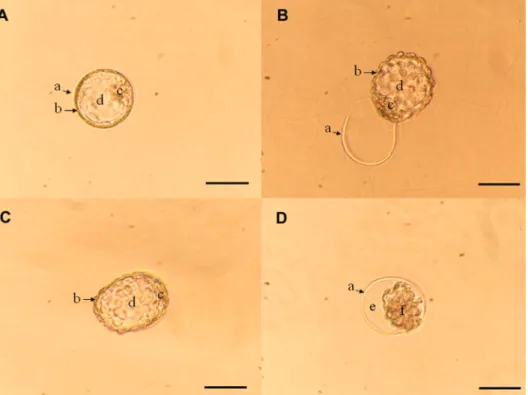
-sified according to the following criteria: Blastocyst (Figure
1A): embryos with an intact ZP, a flat trophoectoderm, a
protuberant ICM, and an expanded blastocele; hatched blastocyst (Figure 1B): embryos that protruded partially or
Figure 1. Murine blastocyst development. A, Blastocyst: embryos with an intact zona pellucida (ZP; a), a flat trophoectoderm (b), a protuberant inner cell mass (c), and an expanded blastocele (d).
B, Hatched blastocyst: embryos that protruded partially or completely from the ZP. C, Expanded
blastocyst: hatched blastocysts with an increase in diameter compared to the blastocyst or hatched
completely from the ZP; expanded blastocyst (Figure 1C): hatched blastocysts with an increase in diameter compared to the blastocyst or hatched blastocyst stages; degenerated blastocyst (Figure 1D): either unexpanded embryos with a space between the trophoectoderm and the ZP, or embryos with cell fragmentation.
Statistical analysis
The experiments were performed three times in triplicate, and the results are reported as the mean ± SEM of each experiment. One-way ANOVA with the Tukey multiple comparison post-test was used to
com-pare the different stimuli. P ≤ 0.05 was considered to be significant.
Results
Hatched blastocysts
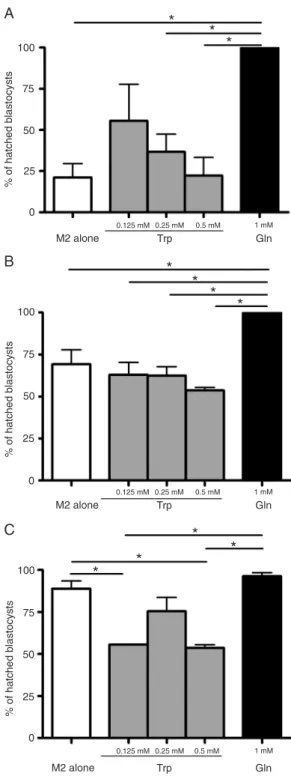
The percentage of hatching at 24 h in the group of
blastocysts stimulated with Gln (100%) was significantly
higher than M2 medium alone (21.1 ± 8.4%), 0.25 mM Trp (36.7 ± 10.7%) or 0.5 mM Trp (22.2 ± 11.1%; P < 0.05; Figure 2A). In the group of embryos stimulated with 0.125 or 0.25 mM Trp, the percentage of hatching was higher than in M2 alone (Figure 2A). At 48 h of culture, the percentage of hatching in the groups stimulated with Trp was higher compared to the hatching at 24 h (Figure 2B). The blastocysts maintained without amino acids or with 0.25 mM Trp gradually reached their highest percent-age of hatching at 72 h (Figure 2C), whereas blastocysts cultured with Gln reached their highest percentage of hatching at 24 h (Figure 2A). After 48 h, blastocyst hatching was lower in the groups cultured with 0.125 and 0.5 mM Trp as compared to the result observed in the groups of blastocysts maintained in M2 alone or supplemented with 0.25 mM Trp (Figure 2C).
Expanded blastocysts
Blastocyst expansion was observed after 48 h of culture
and was significantly higher in the group of blastocysts
cultured with Gln (66.6 ± 0.2%), compared to either M2 alone (9.7 ± 7.9%), 0.25 mM Trp (19.1 ± 6.1%) or 0.5 mM Trp (7 ± 3.5%; P < 0.05; Figure 3A). Moreover, the
percent-age of expanded blastocysts was significantly higher in the
presence of 0.125 mM Trp (61.1 ± 16.0%) compared to M2 alone or to 0.5 mM Trp (P < 0.05; Figure 3A), and was similar to the group stimulated with Gln (Figure 3A). After 72 h of culture, the expansion of the blastocysts increased to 96.2 ± 2.1% in the group of blastocysts stimulated with Gln compared to expansion at 48 h (Figure 3B). No
statisti-cally significant differences were observed in the groups
stimulated with Trp compared to M2 alone (Figure 3B). These results show that treatment with Gln or 0.125 mM Trp after hatching could be useful to increase the rate of expanded blastocysts.
Blastocyst hatching is modulated by Gln and Trp 751
Degenerated blastocysts
The percentage of degenerated blastocysts was de-termined after 48 h of culture. The lowest percentage of degenerated blastocysts was observed in groups cultured with Gln (0%), M2 alone (2.7 ± 2.7%) and 0.25 mM Trp (6.1 ± 1.4%; Figure 4A). Unexpectedly, the highest percentage of degenerated blastocysts was obtained in groups of blastocysts stimulated with 0.5 or 0.125 mM Trp compared to M2 alone or Gln (Figure 4A). After 72 h of culture, the percentage of degenerated blastocysts increased to 16.1 ± 6.2% with 0.25 mM Trp, to 67.7 ± 6.5% with 0.5 mM Trp and it increased drastically in the group stimulated with 0.125 mM Trp, reaching 48.1 ± 19.5% (Figure 4B). After 96 h of
culture the percentage increased in all groups except the group with Gln (data not shown). Overall, blastocyst viability was preserved until 72 h in the groups cultured with M2 alone, 0.25 mM Trp, or Gln (Figure 4). On the other hand, 0.125 and 0.5 mM Trp had a detrimental effect on embryo viability beyond 48 h of culture.
Discussion
In addition to rupture of the ZP by the expanding blastocyst or proteases, blastocyst hatching also requires dynamic changes in the cytoskeleton (1). These cytoskeletal changes occur during hatching because the trophoectoderm
Figure 3. Effect of Trp and Gln on blastocyst expansion. The figureshows the percentage (means ± SEM) of expanded blas-tocysts at 48 and 72 h of incubationin M2 medium alone (open bar), or medium plus 0.125 mM Trp, 0.25 mM Trp, 0.5 mM Trp (gray bars), or 1 mM Gln (black bar). The expansion of the blas-tocysts cultured in the medium containing 1 mM Gln or 0.125 mM Trp was significantly higher than in the other conditions at 48 h (A); expansion of the blastocysts at 72 h was highest in the me-dium containing 1 mM Gln (B). *P < 0.05 (one-way ANOVA).
References
1. Niimura S, Fujii M. A morphological study of blastocyst hatching in the mouse and rat. J Reprod Dev 1997; 43: 295-302.
2. De Vos A, Van Steirteghem A. Zona hardening, zona drill-ing and assisted hatchdrill-ing: new achievements in assisted reproduction. Cells Tissues Organs 2000; 166: 220-227. 3. Rezk Y, Huff C, Rizk B. Effect of glutamine on
preimplan-tation mouse embryo development in vitro. Am J Obstet
Gynecol 2004; 190: 1450-1454.
4. Devreker F, Hardy K. Effects of glutamine and taurine on pre-implantation development and cleavage of mouse embryos
in vitro. Biol Reprod 1997; 57: 921-928.
5. Du ZF, Wales RG. Some effects of genotype and composi-tion of the culture medium on the development of mouse zygotes in vitro. Reprod Fertil Dev 1993; 5: 405-415. 6. Summers MC, Biggers JD. Chemically defined media and
the culture of mammalian preimplantation embryos: his-torical perspective and current issues. Hum Reprod Update
2003; 9: 557-582.
7. Spindle AI, Pedersen RA. Hatching, attachment, and
out-growth of mouse blastocysts in vitro: fixed nitrogen require -ments. J Exp Zool 1973; 186: 305-318.
8. Tatsumi K, Higuchi T, Fujiwara H, Nakayama T, Egawa H, Itoh K, et al. Induction of tryptophan 2,3-dioxygenase in the mouse endometrium during implantation. Biochem Biophys
Res Commun 2000; 274: 166-170.
9. Lane M, Hooper K, Gardner DK. Effect of essential amino acids on mouse embryo viability and ammonium production.
J Assist Reprod Genet 2001; 18: 519-525.
10. Newsholme P, Procopio J, Lima MM, Pithon-Curi TC, Curi R. Glutamine and glutamate - their central role in cell metabo-lism and function. Cell Biochem Funct 2003; 21: 1-9. 11. Biggers JD, McGinnis LK, Lawitts JA. Enhanced effect of
glycyl-L-glutamine on mouse preimplantation embryos in
vitro. Reprod Biomed Online 2004; 9: 59-69.
12. Summers MC, McGinnis LK, Lawitts JA, Biggers JD. Mouse embryo development following IVF in media containing ei-ther L-glutamine or glycyl-L-glutamine. Hum Reprod 2005; 20: 1364-1371.
13. Van Winkle LJ, Tesch JK, Shah A, Campione AL. System
protrudes through a narrow hole in the ZP, which allows the entire blastocyst to escape from the ZP. This process may imply complex signaling mechanisms orchestrated by amino acids, growth factors and cytokines. In this study, we show that Gln may positively modulate blastocyst protrusion from the ZP, inducing 100% hatching after 24 h. Gln is involved in different cell signaling pathways, suggesting that it has the potential to determine distinct cell fates, including growth, differentiation and death (10).
In order to characterize other possible actions of Gln and Trp, we determined blastocyst viability and observed that Gln, but not Trp, prevented blastocyst degeneration at all times; whereas Trp had a detrimental effect at 48 h that was maintained until 72 h of culture. This result is
consistent with previous studies showing the influence of
Gln on mouse embryo development in vitro (11,12). For this reason, we propose that Gln has a protective effect on embryo development in vitro.
When the embryos were cultured in M2 medium with Trp, we observed an increase in the percentage of degen-erated blastocysts at 72 h. However, we could not explain
why 0.25 mM Trp did not have a defined detrimental effect
as was observed with 0.125 and 0.5 mM Trp. Although the experiments were performed three times in triplicate, we always observed the same pattern of viability with 0.25 mM Trp. Moreover, the low dispersion of the data did not indicate variations between experiments. Further experi-ments are required to explain why 0.25 mM Trp had this unexpected effect.
Initially, we hypothesized that Trp would play an impor-tant role during embryo development. Indeed, 0.125 mM Trp promoted blastocyst expansion after 48 h. Van Winkle et al. (13) have described in detail the B0,+ system, an
amino acid transporter in murine embryos that regulates the entry of Trp, leucine, isoleucine, and phenylalanine into the blastocysts. It is clear from our results that 0.125 mM Trp
promotes blastocyst expansion during the first 48 h, whereas
higher Trp concentrations have no effect. This fundamental
action of Trp at low concentrations might reflect certain
requirements of the embryo, such as its expansion under physiological conditions in vivo during the preimplantation period. It is possible that such a phenomenon occurs, based
on the findings of Harris et al. (14) and Hugentobler et al.
(15) who observed that Trp, methionine and asparagine were present at low concentrations in murine (14) and bovine (15) reproductive tracts compared to other amino acids. Thus, we conclude that 0.125 mM Trp has a positive effect on the percentage of expanded blastocysts just after hatching, but a detrimental effect prior to hatching.
We showed in this study that Gln induces blastocyst hatching and preserves embryo viability. Furthermore, both Gln and 0.125 mM Trp regulate blastocyst expansion. Therefore, we suggest that supplementation of the culture medium with Gln is useful to improve embryo development
in vitro.
Acknowledgments
Blastocyst hatching is modulated by Gln and Trp 753
B0,+ amino acid transport regulates the penetration stage of blastocyst implantation with possible long-term developmen-tal consequences through adulthood. Hum Reprod Update
2006; 12: 145-157.
14. Harris SE, Gopichandran N, Picton HM, Leese HJ, Orsi NM. Nutrient concentrations in murine follicular fluid and
the female reproductive tract. Theriogenology 2005; 64: 992-1006.