The general public’s perceptions and use
of antimicrobials in Trinidad and Tobago
Neeta Parimi,
1Lexley M. Pinto Pereira,
2and Parimi Prabhakar
3Objective. To determine the general public’s perceptions and use of antibiotics in Trinidad and Tobago, a two-island republic in the Caribbean.
Methods. This prospective study surveyed 824 randomly selected households listed in the telephone directory, from November 1998 to January 1999. Through telephone interviews we determined knowledge about antibiotics and beliefs concerning their safety and efficacy. We studied the influence of age, gender, education, and having private health insurance on know-ledge, self-medication, storing medication at home for emergency use (“hoarding”), and asking a private doctor to prescribe antibiotics (“demand prescribing”).
Results. For the 824 telephone calls that the interviewers completed, 753 of the households agreed to participate (91.4% response rate). Of those 753 participants, 699 of them (93%) knew the term “antibiotic,” 29% (206/699) said it was a drug for bacterial infections, and 25% (170/690) had asked a doctor for an antibiotic prescription. Penicillin was correctly identified as an antibiotic across age, gender, and education categories, but 36% of respondents inco-rrectly said Benadryl (diphenhydramine), a common over-the-counter cough and cold formu-lation, was an antibiotic. Gender was not significantly associated with knowledge of antibiotic safety, with self-medication, or with hoarding antibiotics. On the other hand, completion of ter-tiary (university) education was significantly associated with correct knowledge of the safety of antibiotics and whether or not they could cure all infections. Of the various antimicrobials, beta-lactams were the ones that survey respondents had used most frequently in the preceding year, and 20% of antibiotics users had used multiple antibiotics in that period. In comparison to persons with private health insurance, more individuals without private health insurance said that antibiotics are safe and do not have side effects, and more of them also incorrectly ca-lled aspirin and Benadryl antibiotics.
Conclusions. In Trinidad and Tobago, inappropriate use of antimicrobials results from self-medication, over-the-counter availability at the community pharmacy, prescribing on de-mand, and lack of regulatory control. In order to contain antibiotic abuse, both the Drug Ins-pectorate of the Ministry of Health and the Pharmacy Board should exert stricter control on the dispensing of antibiotics at private pharmacies. Further, education of the general public and of health care professionals on antibiotic misuse and appropriate use must be instituted, along with community-based surveillance of antimicrobial resistance trends.
Antimicrobials, health education, professional education, self-medication, Carib-bean.
ABSTRACT
Key words
Bacterial resistance to multiple anti-biotics is a growing global problem, due in large measure to extensive and inappropriate usage of antibiotics (1, 2). That resistance occurs in hospitals
1 Bishop Anstey High School, Port-of-Spain,
Tri-nidad and Tobago.
2 University of the West Indies, Faculty of Medical
Sciences, Department of Paraclinical Sciences, St. Augustine, Trinidad and Tobago. Send correspon-dence to: Lexley M. Pinto Pereira, Faculty of
Medi-cal Sciences, University of the West Indies, St. Au-gustine, Trinidad, West Indies; e-mail: lexleyp@ hotmail.com
3 Caribbean Epidemiology Center (Pan American
and their intensive care units and in-creasingly in the community setting as well.
Antibiotic resistance may be more widespread in lesser-developed coun-tries, where there are fewer controls on the use of antimicrobial drugs (3) and where the higher incidence of infec-tious disease in the population fuels the demands for the drugs (4). In developing countries such major
com-munity pathogens as Neisseria
gonorr-hoea, Streptococcus pneumoniae, Salmo-nella typhi, and Shigella spp. have already demonstrated their resistance to the first-line, less-expensive broad-spectrum antimicrobials (5–8). Gram-negative pathogens that cause hospi-tal-acquired infections have developed resistance to extended-spectrum beta-lactam antimicrobials, which until re-cently demonstrated high cure rates for these infections (9, 10).
In the English-speaking Caribbean, infections due to resistant pathogens are frequent in hospitals and also occur in the family practice setting. The re-ported rates of penicillin-resistant pneumococci and chloramphenicol-resistant Haemophilus influenzae in the English- and Dutch-speaking Carib-bean are low, but high rates of resis-tance to ampicillin, co-trimoxazole, and gentamicin by common gram-negative pathogens that cause urinary tract in-fections have been reported (11).
Various factors contribute to this re-sistance problem in developing coun-tries around the world (3). These in-clude indiscriminate and widespread use of antimicrobials for community-acquired infections, self-medication, incomplete treatment courses, and the unregulated use of antibacterial drugs. Antibiotic use without physician con-sultation occurs not only in develo-ping nations but also in the United Sta-tes of America (12). In the United Kingdom, concerns have been raised regarding deregulation and shifting antimicrobials for topical or oral use from the “prescription-only medicine” status (to be dispensed only on a phy-sician’s prescription) to the “pharmacy medicine” category (pharmacists can dispense without a prescription) (13).
This study was undertaken to exa-mine how the public at large in Trini-dad and Tobago perceives and uses antibiotics. Trinidad and Tobago is a two-island Caribbean republic of 1.3 million people. It is located just off the coast of Venezuela, and it is the se-cond-largest country in the English-speaking Caribbean. Divided into 8 counties, Trinidad has some 96% of the country’s population, with 46% of those persons living in urban areas (Tobago is classified as a ward). Trini-dad and Tobago has a literacy rate above 90%, and at least 75% of the country’s adult population has com-pleted secondary school.
Medical care in Trinidad and To-bago is available free through public sector health care facilities. At these centers, patients can consult specialist physicians, undergo recommended in-vestigations and procedures, and re-ceive prescribed medication from the country’s restricted drug list, all at no cost. Other than these centers, there are no free pharmacies. At these public centers, however, patients often en-counter long waiting periods and find that drugs are available erratically or not at all. To receive expeditious ad-vice and treatment, many patients con-sult a private doctor at their own ex-pense, and that cost may be covered by private health insurance. Patients can also go to a private pharmacy and directly approach the pharmacist for advice and treatment. Talking to the pharmacist has the advantage of avoi-ding doctor consultation fees, and much of the population utilizes this approach.
The country’s Food and Drugs Act classifies antibiotics as controlled drugs, to be dispensed only with a prescription. An anomaly in the law is its strict application only to those drugs defined by the term “antibio-tics” per se and not to all antimicro-bials; therefore, agents such as co-tri-moxazole and the quinolones, which do not fall under this regulation, are available without prescription. Ne-vertheless, it is widely known that an-timicrobial agents can be obtained at pharmacies without a prescription, and pharmacists simply dispense
these drugs as over-the-counter medi-cations in response to requests from customers.
Prior to this study, no data had been available on the general public’s per-ceptions and use of antibiotics in the English-speaking Caribbean.
METHODS
Study design
We conducted a cross-sectional population-based study in Trinidad and Tobago by interviewing study subjects over the telephone. We calcu-lated a sample size of 800 households with a working telephone, based on 80% power to detect a difference of at least 3% in perception and use of anti-biotics, given an alpha of 0.05. As we did not know in advance what the te-lephone-survey participation rate would be for answered calls nor the number of busy or unanswered calls, we selected 1 600 households at ran-dom from the listed 167 272 house-holds in the telephone directory of the Telecommunication Services of Trin-idad and Tobago. It is estimated that about 90% of households in the country have telephones and that about 15% of those customers have an unlisted telephone number.
Interview
Six interviewers were trained to conduct structured interviews over the telephone. Prior to interviewing mem-bers of the general public, the intervie-wers practiced administering the questionnaire, to be certain that they were conveying identical meanings for the questions. The interviewers rehe-arsed with each other and also with some adult friends and relatives, both face-to-face and on the telephone. Based on that pilot-testing experience, the survey instrument was modified.
when they were ill. The objective of the study and its format were explai-ned to participants at the start of the interview. When persons refused to participate in the study, the intervie-wer asked if there was any specific re-ason for not complying, and recorded any reason that was given. Respon-dents who said they knew the term “antibiotic” were asked to explain their understanding of it, and those who had not heard the term were offe-red the following explanation: “Anti-biotics are drugs that are prescribed for the treatment of diseases caused by germs.”
Respondents were asked to identify antibiotics from a presented list of common drugs and also to answer questions on antibiotic safety, curative properties, possible common infec-tious conditions among household members, and any relevant action taken in those situations. Information was also obtained, for both adult and child patients, concerning storage of antibiotics at home for emergency use (“hoarding”); consulting a private sec-tor physician for a fee; “prescribing on demand” for antibiotics, that is, with a doctor providing a prescription in response to a request from a patient; and self-medication. If antibiotics were consumed, participants were asked if they complied with all recommended instructions, and whether they shared these drugs with other family mem-bers or with friends.
In instances where individuals did not answer questions, the questions were repeated in order to prompt an answer. If the persons still failed to ans-wer, that was classed as “no response.”
Data analysis
Data were entered and analyzed using the Epi Info version 6.04 soft-ware program (Centers for Disease Control and Prevention, Atlanta, Ge-orgia, United States). The chi-square test (Mantel-Haenszel test and Fisher’s exact test) was used to compare cate-gorical variables. Student ttest analy-sis was used to compare the means of continuous data. Analyses for the
li-near trend in proportions were done by chi-square for trend using the STATCALC function in the Epi Info software.
RESULTS
Out of 950 calls that the interviewers made, they received a busy signal or no answer in 126 of the cases, resulting in a sample of 824 respondents. Of those 824 persons, 753 agreed to parti-cipate, for a 91.4% response rate. Alt-hough the 753 was 5.9% less than the original projected sample size of 800, an analysis showed that the small defi-cit did not alter the power of the study. The main reasons that persons gave for declining to participate were a lack of interest in the interview or being too busy to answer the questions. In the eight counties of Trinidad and in the ward of Tobago the respondent parti-cipation rates ranged from 78% to 100%.
Table 1 shows the demographic cha-racteristics of the survey respondents. All the demographic data were not available for all 753 survey
par-ticipants; participants for whom parti-cular data were not available are omit-ted from the respective descriptions shown in Table 1.
Among the survey participants there was a higher female than male representation, 67% vs. 33%. The age of the respondents ranged from 18 to 85 years, with 21% being ≥51 years of age. Of the survey participants for whom the respective demographic information was available, 49% (325/ 667) had salaried employee status and 56% (385/683) had completed second-ary education.
Knowledge and use of antibiotics
Of the 753 persons participating in the study, 699 of them (93%) had heard of the term “antibiotic.” Of those 699 persons, 193 respondents (28%) provided a nonspecific descrip-tion such as “something the doctor tells you to buy,” leaving a total of 506 persons who offered a more-specific explanation for the term antibiotic. Out of those 506, 455 persons provided a definition of the term, which we TABLE 1. Demographic characteristics of survey respondents in study of the ge-neral public’s perceptions and use of antibiotics, Trinidad and Tobago, 1998–1999a
Characteristic No. %
Gender
Male 248 33
Female 495 67
Age (years)
18–30 199 27
31–40 235 32
41–50 137 19
≥51 156 21
Refused 12 2
Highest educational level completed
Primary school 137 20
Secondary school 385 56
Tertiary institution 161 24
Employment status
Employed for wages 325 49
Self-employed 98 15
Housewife 121 18
Retired or unemployed 123 18
Private health insurance
Have private health insurance 202 28
No private health insurance 532 72
aThe total number of participants was 824; 753 of them (91.4%) agreed to participate in the survey; the figures
grouped into the following categories: a drug for bacterial infections (206 res-ponses), just a drug (138), a drug pres-cribed by the doctor (58), a drug for virus/cold (31), and a drug for pain, fever, or stimulating antibodies (22).
The knowledge and use of antibio-tics was analyzed using the number of participants who had heard of the term “antibiotics,” which was 699. Below we first present information on the overall knowledge and use of anti-biotics; later we will present similar in-formation for the various demograp-hic subgroups of the respondents who had heard of the term “antibiotics” and who provided an answer to the respective question.
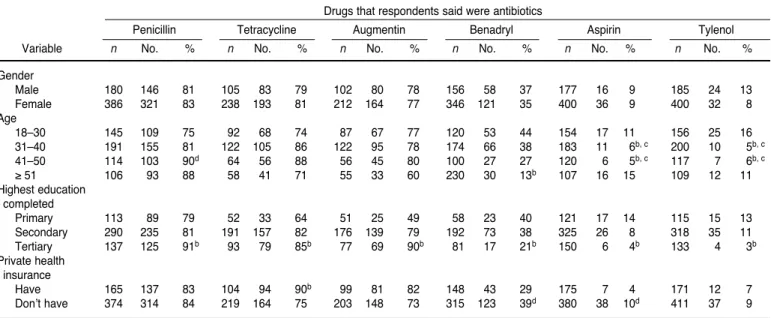
Knowledge was assessed based on the list of common drugs that the te-lephone interviewers presented to the participants. Penicillin was correctly identified as an antibiotic by 83% of the respondents, while 80% could co-rrectly identify tetracycline, and 78% could do that for Augmentin (amoxici-llin/clavulanic acid). Ten percent of the respondents incorrectly said that
Tylenol (paracetamol, acetaminophen) was an antibiotic, and 9% did that for aspirin, 36% made that mistake for Benadryl (diphenhydramine), a com-mon over-the-counter cough and cold formulation.
Of the participants answering the question, 24% of them said they belie-ved that antibiotics could cure all in-fections. Fifteen percent of responding participants felt all antibiotics are safe, and only 12% of respondents said that antibiotics were free from side effects. Twenty-one percent of responding participants said that they hoarded an-tibiotics, storing them at home for emergency purposes.
Based on recall, 31% of households (220 of 699) said they had used an anti-biotic during the past year, and 20% of those people (44 of 220) had used more than one antibiotic in that period. The beta-lactams were the most frequently used antibiotics, and amoxicillin was consumed by 37% (81 of 220) of users. The penicillins were used more fre-quently than the cephalosporins, 7% (15 of 220) vs. 4% (8 of 220),
respecti-vely. Among the cephalosporins, only Ceclor (cephalothin) and Zinnat (cefu-roxime) had been used.
Out of the 699 respondents, 136 of them (19%) reported they self-medica-ted with antibiotics obtained from pri-vate pharmacies, without a doctor’s prescription. Out of 690 persons, 170 of them (25%) admitted to demanding a prescription, that is, asking a doctor to provide a prescription even if the physician felt the antibiotic was unne-cessary. Although 74% (520 of 699) of the people said they did not share an-tibiotics with family and/or friends, 17% (122 of 699) refused to answer this question.
Table 2 and Table 3 provide details on antibiotic knowledge and use for the various demographic groupings included in the survey. The numbers of respondents shown in those two tables differ from the demographic groupings shown in Table 1 because some respondents did not answer all the questions on knowledge or use and/or because information for those who did answer was not available on
TABLE 2. Demographic variables associated with antibiotic identification in study of the general public’s perceptions and use of antibio-tics, Trinidad and Tobago, 1998–1999a
Drugs that respondents said were antibiotics
Penicillin Tetracycline Augmentin Benadryl Aspirin Tylenol
Variable n No. % n No. % n No. % n No. % n No. % n No. %
Gender
Male 180 146 81 105 83 79 102 80 78 156 58 37 177 16 9 185 24 13
Female 386 321 83 238 193 81 212 164 77 346 121 35 400 36 9 400 32 8
Age
18–30 145 109 75 92 68 74 87 67 77 120 53 44 154 17 11 156 25 16
31–40 191 155 81 122 105 86 122 95 78 174 66 38 183 11 6b, c 200 10 5b, c
41–50 114 103 90d 64 56 88 56 45 80 100 27 27 120 6 5b, c 117 7 6b, c
≥51 106 93 88 58 41 71 55 33 60 230 30 13b 107 16 15 109 12 11
Highest education completed
Primary 113 89 79 52 33 64 51 25 49 58 23 40 121 17 14 115 15 13
Secondary 290 235 81 191 157 82 176 139 79 192 73 38 325 26 8 318 35 11
Tertiary 137 125 91b 93 79 85b 77 69 90b 81 17 21b 150 6 4b 133 4 3b
Private health insurance
Have 165 137 83 104 94 90b 99 81 82 148 43 29 175 7 4 171 12 7
Don’t have 374 314 84 219 164 75 203 148 73 315 123 39d 380 38 10d 411 37 9
aThis table shows the demographic variables for the respondents who said that the respective drug was an antibiotic. The total numbers of persons in the various groups differ from the ones
in Table 1 since the respondents who refused to answer or who did not know were excluded in this analysis.
bChi-square test, 0.01< P< 0.05.
gender, age, education, or insurance status. Those respondents for whom data were not available were excluded from the analysis.
Table 2 shows the demographic cha-racteristics of respondents who said— correctly or incorrectly—that the drugs from the list that the interviewer provided were antibiotics. Signifi-cantly more respondents between 41 and 50 years old correctly identified penicillin as an antibiotic. Also, while a significantly higher proportion of the persons in the oldest age group (≥51) correctly said Benadryl was not an an-tibiotic, this oldest age group was so-mewhat more likely than those 31– 50 years old to incorrectly classify aspirin and Tylenol as antibiotics. Subjects with tertiary education were more li-kely to correctly identify the antibio-tics from among the various drugs presented in the list. In comparison to persons who had private health insu-rance, a significantly higher propor-tion of subjects without such insurance
wrongly classified Benadryl and aspi-rin as antibiotics. Significantly more respondents with private health insu-rance accurately classified tetracycline as an antibiotic as compared with those who did not have the benefit of private health insurance.
Table 3 shows demographic details on respondents answering questions concerning knowledge and use of anti-biotics. Gender was not significantly associated with knowledge of their sa-fety, with self-medication, or with ho-arding antibiotics. Tertiary education was significantly associated with co-rrect knowledge of antibiotics regar-ding their safety, their ability to cure infections, and their having no side ef-fects. Relatively more people without health insurance said antibiotics are free of side effects, as compared with persons who had health insurance.
Education was not a predictor of ho-arding (Table 3). However, age was significantly associated with sto-ring antibiotics at home, with older
persons being less likely to keep anti-biotics at home for emergency purpo-ses. Self-medication was less likely to be undertaken by those with a secon-dary or tertiary education. Signifi-cantly more individuals without he-alth insurance said they do self-medicate with antibiotics.
DISCUSSION
This is the first cross-sectional pop-ulation-based study in the English-speaking Caribbean that has attempted to identify and examine perceptions and use of antibiotics in the general population. Just under one-third of the households surveyed said they had consumed antibiotics in the preceding year. Our findings concerning which antibiotics were used were similar to the results from several other coun-tries (8, 14, 15), where antibiotics were frequently used for fever, cough, up-per respiratory tract infections (URTIs), TABLE 3. Sociodemographic variables associated with antibiotic knowledge, self-medication, and hoarding in study of the general public’s perceptions and use of antibiotics, Trinidad and Tobago, 1998–1999a
Cures all infectionb Safec No side effectsd Self-medicatese Hoardsf
Factor n No. % n No. % n No. % n No. % n No. %
Gender
Male 196 45 23 200 30 15 200 24 12 195 39 20 183 44 24
Female 424 106 25 429 64 15 417 50 12 436 96 22 420 84 20
Highest education completed
Primary 127 42 33 126 26 21 126 29 23 126 34 27 124 26 21
Secondary 320 80 25 320 48 15 308 37 12 323 71 22g 308 74 24
Tertiary 150 18 12g 156 14 9h 133 4 3h 147 25 17g 147 28 19
Age (yrs.)
18–30 165 38 23 164 23 14 167 15 9 167 45 27 163 49 30
31–40 204 51 25 206 33 16 200 20 10 200 44 22 204 45 22
41–50 125 25 20 125 15 12 123 16 13 121 23 19 121 17 14h
≥51 124 36 29 122 22 18 118 13 11 124 21 17h 121 17 14h
Private health insurance
Have 185 37 20 177 23 13 187 15 8 187 30 16 184 35 19
Don’t have 422 114 27 412 66 16h 407 57 14h 422 97 23h 400 88 22
aThe demographic variables are presented and analyzed for those respondents who answered “Yes” to the respective statement. Respondents who refused to answer or who gave no answer
were excluded in this analysis. Thus, the totals in the respective groups (e.g., gender) differ from those in Table 1.
bCures all infections = respondents said that antibiotics cure all infections. cSafe = respondents said that antibiotics are safe.
dNo side effects = respondents said that antibiotics are free from side effects.
e Self-medicates = respondents said that they self-medicate, using antibiotics obtained from a private pharmacy without a doctor’s prescription. f Hoards = respondents said they store antibiotics at home for emergency use.
and gastrointestinal infections. While some of those studies also reported se-xually transmitted diseases (STDs) as a frequent reason for self-medication, none of the households we questioned volunteered STDs as a reason for self-treatment. We attribute this finding to broad public awareness in Trinidad and Tobago of the need for prompt and correct STD treatment and of pos-sible disease complications. The country has had a vigorous public education campaign, which can be cre-dited with the pattern of early patient presentation at the country’s major STD clinic, where treatment is free.
We found that tertiary education was associated with correct know-ledge and use of antibiotics. Similarly, in Kerala, a state in India that has that country’s highest literacy level, anti-biotic self-medication was least com-mon acom-mong higher-income, more-educated persons and also among those who had private medical insu-rance (16). Private health insuinsu-rance re-quires a physician to sign that he or she has indeed prescribed the medica-tion, and this procedure may likely have discouraged self-medication.
In Trinidad and Tobago, the ex-pense and time needed for a consulta-tion with a private physician could have prompted the purchase of anti-biotics without a prescription. Other authors have expressed similar con-cerns, including with patients in the United States failing to consult with a doctor before using “leftover” antibio-tics that they had (12). The public can be encouraged to misuse antibiotics th-rough inappropriate prescribing by clinicians who try to avoid the cost of laboratory investigation, try to expe-dite speedy recovery by treating sus-pected bacterial infections, and try to assure patients that they are receiving potent medication.
We found it interesting that 17% of the persons in our study refused to answer whether they shared antibio-tics with family members or friends. In addition, there was a noticeable num-ber of participants who refused to ans-wer some of the other survey ques-tions. Given that other researchers (17) have found that patients are reluctant
to confess they have taken antibiotics before seeking medical attention, it is highly probable that the proportions that we and other investigators have found for antibiotic use and for self-medication are underestimates.
Self-medication with antibiotics can result from previous indiscriminate physician prescribing, particularly for respiratory tract infections. We have earlier reported that respiratory tract infection was the most frequent reason for antibiotic prescriptions by phy-sicians in the English- and Dutch-spe-aking Caribbean (18). The same illness is responsible for antibiotic misuse worldwide (19).
In this study of Trinidad and To-bago, 25% of survey participants felt comfortable asking their doctor for a prescription (demand prescribing). This suggests that clinicians must take a share of responsibility for antibiotic misuse by the public.
In Trinidad and Tobago and elsew-here around the world, the purchase of antibiotics without physician consulta-tion clearly points to the public not being adequately informed about inappropriate use of these medica-tions. The Pharmacy Division of the Ministry of Health and the Pharmacy Board of Trinidad and Tobago enforce strict regulations whose violation invi-tes punitive action. In spite of that, one in five of our respondents stated they obtained antibiotics as over-the-coun-ter medications at private pharmacies, without a doctor’s prescription. The respondents self-medicated for such things as cough, cold, and sore throat, all of which can be self-limiting with the appropriate medical and suppor-tive care. Other researchers have re-ported that antibiotics can be obtained on demand from hospitals and phar-macies as well as from medically un-trained vendors who sell these drugs in the marketplace or at roadside stalls, in regions that include Africa (14), Asia (20, 21), and Latin America (22).
From this situation, three key areas of concern emerge. One is the need for more stringent regulations, along with the establishment of surveillance sys-tems to provide information on trends
in bacterial resistance, which is es-sential for clinical practice. A second concern is continuous education for pharmacists and doctors on the conse-quences of inappropriate antibiotic use in the community. A third worry is the manner in which lay persons use antibiotics on their own initiative, sug-gesting education of the public is an important task in discouraging un-necessary use of antibiotics. These is-sues, along with enhanced pharmacy advice, better susceptibility data, and improved safety monitoring, have been discussed by the Working Party of the British Society for Antimicrobial Chemotherapy (13).
We took steps to avoid bias in co-llecting the data for our Trinidad and Tobago study. These measures inclu-ded pilot-testing the evaluation instru-ment and training the interviewers to standardize their questioning. Howe-ver, the study does have its limita-tions. For example, responses were de-pendent on patient recall and on the participants’ complete understanding of the meanings conveyed in the ques-tions. Since we used a telephone sur-vey, the opportunity for detailed ex-planation was limited and reliance was placed on what the respondent understood. About 10% percent of the households in Trinidad and Tobago do not have telephone service, and some 15% of the Telecommunication Services customers have unlisted te-lephone numbers. The study excluded those two groups, who might have responded differently to the survey questions. In spite of these various li-mitations, we believe our results do provide a true reflection of how the ge-neral population of Trinidad and To-bago perceives and uses antibiotics.
the industrialized world, in the deve-loping world education is the prime strategy to halt the continuing misuse of antibiotics, and this education needs to be targeted at consumers and all other relevant groups. The recommen-dations that the World Health Organi-zation makes for drug use (23) should be adapted into country-specific anti-biotic protocols to address the escala-ting spread of antibiotic resistance in developing countries.
Though supposedly prescription-only medications, antimicrobials in re-ality thrive in the open, unregulated market, making their audit and survei-llance integral to solving the misuse problem. The misuse of antibiotics is a complex societal and health issue, for which doctors and pharmacists, unski-lled practitioners, and the public must all take responsibility. Okeke and co-lleagues (24) have discussed these in-fluences on inappropriate antibiotic use, which result in selective pressure favoring the emergence of resistant bacterial strains. These researchers also identify strategies to combat the problem of antibiotic resistance, parti-cularly in developing tropical coun-tries. Trinidad and Tobago, like other
developing countries, does have unre-gulated antibiotic use and misuse, in-cluding overuse. Hart and Kariuki (3) have suggested such countries chart the progress and impact of bacterial resistance by improving access to diagnostic laboratories, improving surveillance of emergent bacterial re-sistance, improving regulation of anti-biotic use, and instituting educational interventions for the public and for physicians and other health workers. Surveillance programs to examine an-tibiotic resistance in the community as well as policies to contain the emer-gence and spread of bacterial resis-tance should receive the urgent atten-tion of the health authorities in Trinidad and Tobago and also the wider Caribbean region. We re-commend communication efforts for health organizations, physicians, con-sumers, and pharmacists to improve their understanding of microorga-nisms, antimicrobial therapy, and anti-microbial resistance (25). Educating the medical profession on judicious prescribing is as vital as consumer education in addressing the inap-propriate use of antimicrobials (3, 25). Disseminating evidenced-based data
from national surveillance programs on the benefits of “no treatment” or “watchful waiting” will assist consu-mers in making informed choices on their treatment options. This could be done, for example, via posters and pamphlets in community health cen-ters and through regular public service announcements and other mass-media efforts. Continuing education pro-grams for health care professionals could also promote behavior change. These various measures should be evaluated on an ongoing basis and then modified and improved so as to contribute as much as possible to hal-ting the burden of growing antibacte-rial resistance in Trinidad and Tobago.
Acknowledgements.We thank Mrs.
Taylor, Mrs. V. Akal, and Mrs. W. Gar-cia of Bishop Anstey High School for their cooperation with and support for the study. The data collectors conduc-ting the interviews were: A. Gomez, C. Caruth, N. Wynter-Roach, M. Sue-Winnifred, M. Lee, and L. Franklin. We also acknowledge the assistance of the Telecommunication Services of Trinidad and Tobago.
1. Williams RJ, Heymann DL. Containment of antibiotic resistance. Science 1998;279:1153– 1155.
2. Levy SB. Antimicrobial resistance: bacteria on the defence. BMJ 1998;317:612–613.
3. Hart CA, Kariuki S. Antimicrobial resistance in developing countries. BMJ 1998;317:647–650. 4. Kunin CM. Resistance to antimicrobial drugs: a worldwide calamity. Ann Intern Med 1993; 118:557–561.
5. Brown S, Warnnissorn T, Biddle J, Panika-butra K, Traisupa A. Antimicrobial resistance of Neisseria gonorrhoeain Bangkok: is single drug treatment passe? Lancet 1982;2(8312): 1366–1368.
6. Appelbaum PC, Bhamjee A, Scragg JN, Hallet AF, Bowen AJ, Cooper RC. Streptococcus pneu-moniaeresistant to penicillin and chloramphe-nicol. Lancet 1977;2(8046):995–997.
7. Sack RB, Rahman M, Yunus M, Khan EH. Antimicrobial resistance in organisms caus-ing diarrheal disease. Clin Infect Dis 1997;24 Suppl 1:S102–105.
8. Bennish ML, Salam MA, Hossain MA, Myaux J, Khan EH, Chakraborty J, et al.
Antimicro-bial resistance of Shigellaisolates in Bangla-desh, 1983–1990: increasing frequency of strains multiply resistance to ampicillin, tri-methoprim-sulfamethoxazole, and nalidixic acid. Clin Infect Dis 1992;14:1055–1060. 9. Jones RN. Global aspects of antimicrobial
sistance among key bacterial pathogens: re-sults from the 1997–1999 SENTRY Antimicro-bial Program. Diagn MicroAntimicro-bial Infect Dis 1998; 32 Suppl 2:81–167.
10. Jones RN, Pfaller MA. Bacterial resistance: a worldwide problem. Diagn Microbial Infect Dis 1998;31:379–388.
11. Prabhakar P, Caribbean Antimicrobial Survei-llance Group. Antimicrobial resistance in the Caribbean. West Indian Med J 2000;49 (Suppl 2):62.
12. Richman PB, Garra G, Eskin B, Nashed AH, Cody R. Oral antibiotic use without consul-ting a physician: a survey of ED patients. Am J Emerg Med 2001;19(1):57–60.
13. Reeves DS, Finch RG, Bax RP, Davey PG, Li Wan Po A, Lingam G, et al. Self-medication of antibacterials without prescription (also ca-lled ‘over-the-counter’ use). A report of a
Working Party of the British Society for Anti-microbial Chemotherapy. J Antimicrob Che-mother 1999;44(2):163–177.
14. Obaseiki-Ebor EE, Akerele JO, Ebea PO. A survey of antibiotic outpatient prescribing and antibiotic self-medication. J Antimicrob Chemother 1987;20(5):759–763.
15. Sturm AW, van der Pol R, Smits AJ, van He-llemondt FM, Mouton SW, Jamil B, et al. Over-the-counter availability of antimicrobial agents, self-medication and patterns of resis-tance in Karachi, Pakistan. J Antimicrob Che-mother 1997;39(4):543–547.
16. Saradamma RD, Higginbotham N, Nichter M. Social factors influencing the acquisition of antibiotics without prescription in Kerala State, South India. Soc Sci Med 2000;50(6): 891–903.
17. Catalano M, Almiron MA, Romeo AM, Ca-ruso E, Murtagh P, Harisiadi J. Comparison between parental report and results of micro-biologic agar assay for presence of antibiotic in urine of Argentinian children with acute lower respiratory tract infection. Rev Infect Dis 1990;12 Suppl 8:S998–1000.
18. Pinto Pereira LM, Prabhakar P. A survey on antibiotic prescribing practices of physicians in the Caribbean. Caribbean Med J 1999; 61(S1):19–20.
19. Gonzales R, Sande M. What will it take to stop physicians from prescribing antibiotics in acute bronchitis? Lancet 1995;345(8951):665– 666.
20. Dua V, Kunin CM, White LV. The use of anti-microbial drugs in Nagpur, India. A window on medical care in a developing country. Soc Sci Med 1994;38:17–24.
21. Lansang MA, Lucas-Aquino R, Tupasi TE, Mina VS, Salazar LS, Joban N, et al. Purchase
of antibiotics without prescription in Manila, the Philippines. Inappropriate choices and doses. J Clin Epidemiol 1990;43:61–67. 22. Wolff MJ. Use and misuse of antibiotics in
Latin America. Clin Infect Dis 1993;17 Suppl 1:S346–S351.
23. Couper MR. Strategies for the rational use of antimicrobials. Clin Infect Dis 1997;24 Suppl 1:S154–S156.
24. Okeke IN, Lamikanra A, Edelman R. Socio-economic and behavioral factors leading to acquired bacterial resistance to antibiotics in developing countries. Emerg Infect Dis 1999; 5(1):18–22.
25. Belongia EA, Schwartz B. Strategies for pro-moting judicious use of antibiotics by doctors and patients. BMJ 1998;317:668–671
Manuscript received 6 September 2001. Revised version accepted for publication on 22 February 2002.
Objetivo. Investigar las percepciones del público general y el uso de antimicrobia-nos en Trinidad y Tabago, una república caribeña formada por dos islas.
Métodos. En este estudio prospectivo se encuestaron, entre noviembre de 1998 y enero de 1999, 824 domicilios seleccionados aleatoriamente que figuraban en la lista telefónica. En las entrevistas, realizadas por teléfono, se investigaron los conocimien-tos sobre los antimicrobianos y las creencias de los entrevistados acerca de su eficacia y seguridad. Se estudió la influencia de la edad, del sexo, de la educación y del hecho de disponer de seguro de salud privado sobre los conocimientos, la automedicación, el almacenamiento de medicamentos en casa para utilizarlos en caso de urgencia (“acumulación”) y la petición de prescripción de antimicrobianos a médicos privados (“demanda de prescripción”).
Resultados. De los 824 contactos telefónicos realizados por los entrevistadores, en 753 (91,4%) se obtuvo una respuesta favorable a la participación en la encuesta. De estos 753 participantes, 699 (93%) conocían el término “antibióticos”, 29% (206/699) dijeron que se trataba de fármacos para las infecciones bacterianas, y 25% (170/690) le habían pedido al médico prescripciones de antibióticos. La penicilina fue identifi-cada correctamente como un antibiótico por personas de diferentes edades, sexos y ni-veles educacionales, pero el 36% de los entrevistados dijeron que el Benadryl (difen-hidramina), un fármaco muy utilizado en el resfriado y que no necesita receta médica, era un antibiótico. El sexo no se asoció de forma significativa a los conocimientos sobre la seguridad de los antibióticos, a la automedicación ni a la “acumulación” de antibióticos. Por otra parte, el haber completado estudios universitarios se asoció de forma significativa a un buen conocimiento de la seguridad de los antibióticos y del hecho de que no curan todas las infecciones. Los beta-lactámicos fueron los antimi-crobianos que los encuestados habían usado con mayor frecuencia el año anterior, pe-ríodo durante el cual el 20% de ellos habían usado múltiples antibióticos. En compa-ración con las personas que disponían de seguro de salud privado, las que no lo tenían afirmaron con más frecuencia que los antibióticos son seguros y no tienen efec-tos colaterales y que la aspirina y el Benadryl son antibióticos.
Conclusiones. En Trinidad y Tobago, el uso inapropiado de los antimicrobianos se debe a la automedicación, a la posibilidad de adquirirlos en las farmacias sin necesi-dad de receta médica, a la “demanda de prescripción” y a la ausencia de normas de control. Con el fin de reducir el abuso de antibióticos, la Inspección de Medicamentos del Ministerio de Salud y el Consejo de Farmacéuticos deben ejercer un control más estricto sobre la dispensación de antibióticos en las farmacias privadas. Además, se debe informar mejor al público en general y a los profesionales sanitarios acerca del uso de los antibióticos e instaurar un sistema basado en la comunidad para vigilar las tendencias de la resistencia a los antimicrobianos.
RESUMEN