Article
J. Braz. Chem. Soc., Vol. 22, No. 8, 1511-1518, 2011. Printed in Brazil - ©2011 Sociedade Brasileira de Química
0103 - 5053 $6.00+0.00
A
*e-mail: [email protected], [email protected]
Chemotaxonomical Aspects of Lower Cretaceous Amber from Recôncavo Basin, Brazil
Ricardo Pereira,*,a Ismar S. Carvalho,b Antonio Carlos S. Fernandesc and Débora A. Azevedo*,a
aInstituto de Química, Universidade Federal do Rio de Janeiro, 21941-909 Rio de Janeiro-RJ, Brazil
bInstituto de Geociências, Universidade Federal do Rio de Janeiro, 21910-200 Rio de Janeiro-RJ, Brazil
cDepartamento de Geologia e Paleontologia, Museu Nacional, Universidade Federal do Rio de Janeiro,
Quinta da Boa Vista, s/n, 20940-040 Rio de Janeiro-RJ, Brazil
A composição química de amostras de âmbar provenientes da Bacia do Recôncavo (Salvador, Bahia), datadas do Cretáceo Inferior, foi determinada por meio de CG-EM para caracterização das suas possíveis fontes botânicas. Os principais compostos identiicados foram diterpenoides, tais como abietano, deidroabietano, tetraidroreteno, deidroabietol, ácido deidroabiético, ferruginol e sugiol. Outras classes de diterpenoides ou triterpenos não foram detectados. A composição dos extratos e os dados quimiotaxonômicos permitiram relacionar as amostras com coníferas das famílias Podocarpaceae ou Cheirolepidiaceae devido à detecção do ferruginol, um biomarcador especíico para estas famílias. Desta forma, os dados concernentes aos âmbares da Bacia do Recôncavo forneceram informações quanto à presença de uma lora resinífera na Formação Maracangalha, quando da deposição de seus sedimentos durante o Cretáceo Inferior.
The chemical composition of Lower Cretaceous amber samples from Recôncavo Basin (Salvador, Bahia) was performed by GC-MS to characterize possible botanical sources. The compounds identified were hydrocarbonic and polar diterpenoids, such as abietane, dehydroabietane, tetrahydroretene, dehydroabietol, dehydroabietic acid, ferruginol and sugiol. Other diterpenoid classes were not detected as well as triterpenoids. The composition of the extracts and chemosystematic data allows relating the samples to conifers of Podocarpaceae or Cheirolepidiaceae families due to detection of ferruginol, a speciic biomarker to these families. The data concerning Cretaceous amber in the Recôncavo Basin provided information concerning the presence of a resinous lora in the Maracangalha Formation sediments during the Lower Cretaceous.
Keywords:cretaceous amber, chemotaxonomy, diterpenoids, conifers, Recôncavo Basin
Introduction
Amber is the fossil form of plant resins occurring in terrestrial sediments throughout the geologic record since the Carboniferous1 and is relatively frequent in Cenozoic
sediments. They are common sedimentary constituents in many areas and occur in large quantity in some deposits (e.g., around the Baltic region and in the Dominican
Republic).2 The Cretaceous amber occurrences have
been studied in several localities. Although the earliest Cretaceous amber-bearing deposits are localized in the Levantine amber belt (Jordan, Lebanon and Israel), the most numerous occurrences are from Northern hemisphere, mainly in USA (Atlantic Coastal Plain), Canada and
Europe.3 Amber deposits from Upper Cretaceous were
reported to USA, Canada, Russia and Myanmar (Burma) and samples of this age is not known in the South hemisphere.4 Regarding speciically Lower Cretaceous,
signiicant amber deposits occur in England, Spain, France, Middle Eastern (Levantine amber belt), Africa and Brazil.
Spectroscopic techniques have been applied to the structural and molecular elucidation of amber samples, such as solid state Fourier transform infrared (FT-IR), solid state 13C nuclear magnetic resonance (13C NMR),
gas chromatography-mass spectrometry (GC-MS) and pyrolysis-gas chromatography-mass spectrometry
(Py-GC-MS).3-9 Among these techniques Py-GC-MS
terpenoids are common resin constituents and can be used as chemotaxonomic markers to elucidated the botanical origin of ambers, as well determining information related to diagenetic alterations.3,9
Analysis of Lower Cretaceous amber from southern England (Isle of Wight - Barremian) by Py-GC-MS indicates a terpene composition dominated by abietane and labdane-type diterpenes, in according to some species of the family Pinaceae.5 However, the authors
could not exclude a possible botanical source linked to Cheirolepidiaceae, considering the presence of a large amount of micro and macrofossils from the mentioned family in the sediments where the amber samples were collected.5 Later, other authors have also proposed this
family as a possible botanical source for amber samples based in paleontological evidences.8,9
Unfortunately, there were no geochemical evidences that could associate specific terpenoid classes to the Cheirolepidiaceae family. Recently, based on chemistry and pollen evidence, Menor-Salván et al.7 proposed new
chemotaxonomical data about the paleobotanical origin of spanish ambers from Lower Cretaceous sediments of the Basque-Cantabrian Basin. The terpenoid composition of the studied amber samples and the possibility of obtaining molecular data from Frenelopsis leaves (Cheirolepidiaceae family, extinct since the end of Cretaceous period) associated with the fossil resins analyzed in the mentioned paper indicated a paleobotanical origin related to the Cheirolepidiaceae family. The work demonstrated that phenolic terpenoids of abietane class are chemotaxonomic markers to this extinct family.
Amber occurrences in cretaceous sediments from the South hemisphere are restricted to Africa and Brazil essentially. The african ambers are from Valanginian of the Kirkwood Formation (South Africa) with possible connection to Araucariaceae, Podocarpaceae or Cheirolepidiaceae families.8 Amber samples in Brazil were
obtained in Lower Cretaceous sediments from Amazonas, Araripe and Recôncavo basins.9,10 GC-MS information
regarding the chemical composition of samples collected in these basins is complex, including some mono and sesquiterpenes, abietanes and norabietanes, labdanes, pimaranes, isopimaranes, kauranes and phyllocladanes. The geochemical data of Brazilian ambers pointed to several possible botanical origins, such as Cupressaceae, Araucariaceae or Podocarpaceae families.9,10 For the
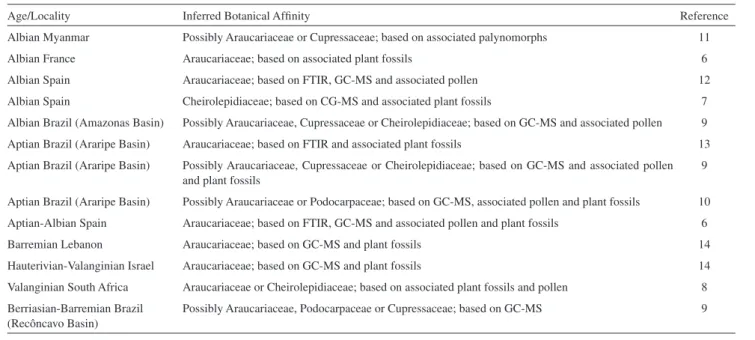
Recôncavo ambers, considering the presence of kauranes and phyllocladanes, almost certainly the biological afinity is Araucariaceae or Podocarpaceae families.9 The Table 1
summarizes some of the worldwide amber occurrences in Lower Cretaceous sediments, showing the proposed botanical afinities.
In the present paper, the extracts of three new Brazilian amber samples from Recôncavo Basin were analyzed using GC-MS and their chemical composition characterized aiming the evaluation of possible botanical origins. The results obtained were compared with that reported before to other samples of the same stratum9 and other brazilian
ambers with analogous biomarker composition.10 This work
provides new data concerning the molecular composition of Brazilian fossil resins, mainly the Recôncavo ambers, based in new information reported about chemotaxonomic aspects
Table 1. Inferred botanical afinities of some Lower Cretaceous amber deposits
Age/Locality Inferred Botanical Afinity Reference
Albian Myanmar Possibly Araucariaceae or Cupressaceae; based on associated palynomorphs 11
Albian France Araucariaceae; based on associated plant fossils 6
Albian Spain Araucariaceae; based on FTIR, GC-MS and associated pollen 12
Albian Spain Cheirolepidiaceae; based on CG-MS and associated plant fossils 7
Albian Brazil (Amazonas Basin) Possibly Araucariaceae, Cupressaceae or Cheirolepidiaceae; based on GC-MS and associated pollen 9
Aptian Brazil (Araripe Basin) Araucariaceae; based on FTIR and associated plant fossils 13
Aptian Brazil (Araripe Basin) Possibly Araucariaceae, Cupressaceae or Cheirolepidiaceae; based on GC-MS and associated pollen and plant fossils
9
Aptian Brazil (Araripe Basin) Possibly Araucariaceae or Podocarpaceae; based on GC-MS, associated pollen and plant fossils 10
Aptian-Albian Spain Araucariaceae; based on FTIR, GC-MS and associated pollen and plant fossils 6
Barremian Lebanon Araucariaceae; based on GC-MS and plant fossils 14
Hauterivian-Valanginian Israel Araucariaceae; based on GC-MS and plant fossils 14
Valanginian South Africa Araucariaceae or Cheirolepidiaceae; based on associated plant fossils and pollen 8
Berriasian-Barremian Brazil (Recôncavo Basin)
of coniferophytes.7 In this way, the research about Brazilian
Cretaceous amber has a great importance to increase the knowledge regarding the chemical composition of fossil resins in deposits from the South hemisphere, particularly South America.
Experimental
Geological setting and sampling
Three amber samples (Figure 1) were collected on Ilha dos Frades (Frades Island) at Recôncavo Basin, Maracangalha Formation (Caruaçu Member), Salvador, state of Bahia, Brazil. The depositional environment consists in lacustrine sandstones of Lower Cretaceous age
(Neocomian, between 130 and 145 million years ago).15
All samples were taken as angular or subspherical clasts with around 1.0 cm in diameter and color from yellow to reddish brown. The Recôncavo amber clasts were found associated with carbonized plant fragments.
The Maracangalha Formation belongs to the rift phase of the Recôncavo Basin, northeastern Brazil. It was deposited during the irst fragmentation stages of the Gondwana supercontinent in the Early Cretaceous and consists of light to dark-greenish shales and sandstones of Early Cretaceous age (Rio da Serra and Aratu local
stages). The deposits of Maracangalha Formation have been interpreted as related to subaqueous gravity lows and mass movements in the context of a lacustrine environment developed during the rift process of Neocomian times. They are interpreted as progradation of deltaic fronts triggered by slumps and slides movements due turbidity currents related to a great tectonic instability.15,16
Extraction, derivatization and GC-MS analyses
The powdered samples (50 mg) were sonicated and extracted three times with 5 mL of CH2Cl2:CH3OH (1:1;
v:v) in each extraction. The combined extracts were evaporated with a rotary evaporator, transferred prior to drying to a vial and the residual solvent was removed under N2. Aliquots of the total extract were derivatized using
reaction with N,O-bis(trimethylsilyl)triluoroacetamide (BSTFA) for 30 min at 60 ºC. GC-MS analyses of the underivatized and derivatized extracts of the three samples were performed on an Agilent Technologies 5890 gas chromatograph coupled to a 5973 mass selective detector. Separation was achieved with a DB5 fused silica column
(30 m × 0.25 mm i.d. × 0.25 µm ilm thickness). The GC
oven operating conditions were 60-300 ºC (held 10 min) at 6 ºC min-1. Helium was used as carrier gas and samples
were injected in splitless mode with injector temperature at 290 ºC. The mass spectrometer was operated in the full scan mode from m/z 50-500 and with electron impact ionization (70 eV). Individual compounds were identiied by comparison of mass spectra with those of standards, and with literature17,20,22,24 and electronic library data (NIST
Mass Spectral Database). Relative retention times and interpretation of MS fragmentation patterns were used.
Results and Discussion
Molecular composition of the extracts
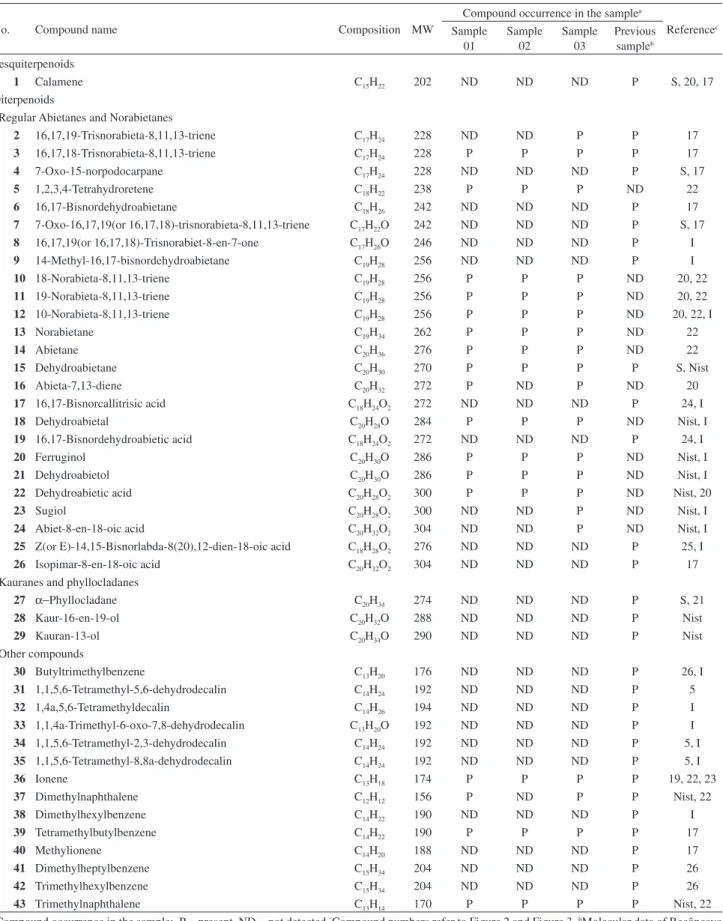
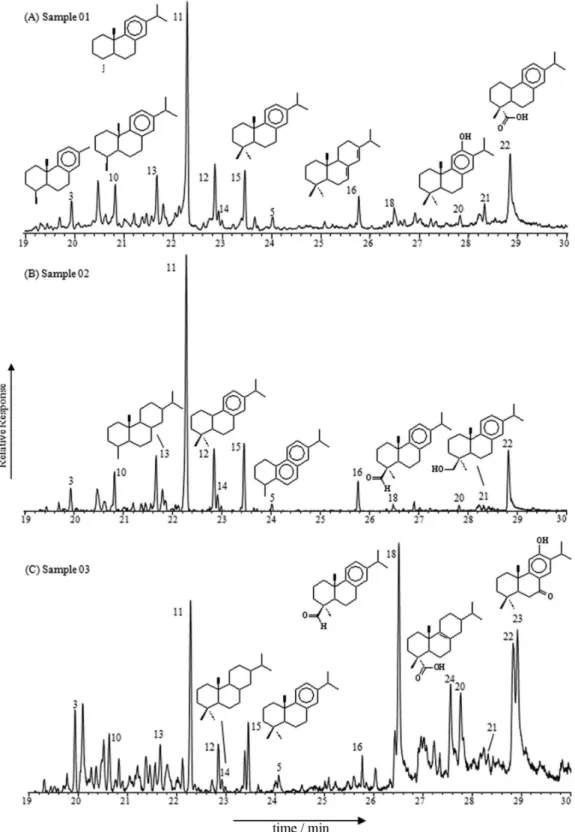
The total extracts of the amber samples contain mainly diterpenoids and irrelevant amounts of alkylnaphthalenes and alkylhydronaphthalenes. The most important diterpenoids detected are from regular abietane skeletons, and additionally some polar abietanes and norabietanes. The compounds identiied in the extracts are given in Table 2, along with their occurrence in the samples studied here and in the Recôncavo amber reported previously.9 Enlarged
section of the total ion chromatograms (19-30 min) are presented in Figure 2. Chemical structures of compounds detected in Recôncavo ambers are given in Figure 3.
Regular and phenolic/keto-phenolic abietanes, as well some norabietanes, are the only diterpenoids in the fossil
Table 2. Compounds identiied in total extracts of Recôncavo ambers
No. Compound name Composition MW
Compound occurrence in the samplea
Referencec
Sample 01
Sample 02
Sample 03
Previous sampleb
Sesquiterpenoids
1 Calamene C15H22 202 ND ND ND P S, 20, 17
Diterpenoids
Regular Abietanes and Norabietanes
2 16,17,19-Trisnorabieta-8,11,13-triene C17H24 228 ND ND P P 17
3 16,17,18-Trisnorabieta-8,11,13-triene C17H24 228 P P P P 17
4 7-Oxo-15-norpodocarpane C17H24 228 ND ND ND P S, 17
5 1,2,3,4-Tetrahydroretene C18H22 238 P P P ND 22
6 16,17-Bisnordehydroabietane C18H26 242 ND ND ND P 17
7 7-Oxo-16,17,19(or 16,17,18)-trisnorabieta-8,11,13-triene C17H22O 242 ND ND ND P S, 17
8 16,17,19(or 16,17,18)-Trisnorabiet-8-en-7-one C17H26O 246 ND ND ND P I
9 14-Methyl-16,17-bisnordehydroabietane C19H28 256 ND ND ND P I
10 18-Norabieta-8,11,13-triene C19H28 256 P P P ND 20, 22
11 19-Norabieta-8,11,13-triene C19H28 256 P P P ND 20, 22
12 10-Norabieta-8,11,13-triene C19H28 256 P P P ND 20, 22, I
13 Norabietane C19H34 262 P P P ND 22
14 Abietane C20H36 276 P P P ND 22
15 Dehydroabietane C20H30 270 P P P P S, Nist
16 Abieta-7,13-diene C20H32 272 P ND P ND 20
17 16,17-Bisnorcallitrisic acid C18H24O2 272 ND ND ND P 24, I
18 Dehydroabietal C20H28O 284 P P P ND Nist, I
19 16,17-Bisnordehydroabietic acid C18H24O2 272 ND ND ND P 24, I
20 Ferruginol C20H30O 286 P P P ND Nist, I
21 Dehydroabietol C20H30O 286 P P P ND Nist, I
22 Dehydroabietic acid C20H28O2 300 P P P ND Nist, 20
23 Sugiol C20H28O2 300 ND ND P ND Nist, I
24 Abiet-8-en-18-oic acid C20H32O2 304 ND ND P ND Nist, I
25 Z(or E)-14,15-Bisnorlabda-8(20),12-dien-18-oic acid C18H28O2 276 ND ND ND P 25, I
26 Isopimar-8-en-18-oic acid C20H32O2 304 ND ND ND P 17
Kauranes and phyllocladanes
27 α−Phyllocladane C20H34 274 ND ND ND P S, 21
28 Kaur-16-en-19-ol C20H32O 288 ND ND ND P Nist
29 Kauran-13-ol C20H34O 290 ND ND ND P Nist
Other compounds
30 Butyltrimethylbenzene C13H20 176 ND ND ND P 26, I
31 1,1,5,6-Tetramethyl-5,6-dehydrodecalin C14H24 192 ND ND ND P 5
32 1,4a,5,6-Tetramethyldecalin C14H26 194 ND ND ND P I
33 1,1,4a-Trimethyl-6-oxo-7,8-dehydrodecalin C13H20O 192 ND ND ND P I
34 1,1,5,6-Tetramethyl-2,3-dehydrodecalin C14H24 192 ND ND ND P 5, I
35 1,1,5,6-Tetramethyl-8,8a-dehydrodecalin C14H24 192 ND ND ND P 5, I
36 Ionene C13H18 174 P P P P 19, 22, 23
37 Dimethylnaphthalene C12H12 156 P ND P P Nist, 22
38 Dimethylhexylbenzene C14H22 190 ND ND ND P I
39 Tetramethylbutylbenzene C14H22 190 P P P P 17
40 Methylionene C14H20 188 ND ND ND P 17
41 Dimethylheptylbenzene C15H34 204 ND ND ND P 26
42 Trimethylhexylbenzene C15H34 204 ND ND ND P 26
43 Trimethylnaphthalene C13H14 170 P P P P Nist, 22
aCompound occurrence in the sample: P = present, ND = not detected. Compound numbers refer to Figure 2 and Figure 3. bMolecular data of Recôncavo
amber described in our previous paper.8cComparison of mass spectra with standard (S), electronic libraries (Nist2005), literature data and interpretation (I)
Figure 2. GC-MS of the Recôncavo Basin amber extracts, showing enlarged section of the total ion current trace (19-30 min): (A) sample 01; (B) sample 02; (C) sample 03. Peak numbers refer to Table 2 and Figure 3.
resin extracts analyzed. Hydrocarbons are exempliied by 16,17,18-trisnorabieta-8,11,13-triene (3,numbers refer to Table 2, Figure 2 and Figure 3), 1,2,3,4-tetrahydroretene (5), 18-norabieta-8,11,13-triene (10), norabietane (13), abietane (14), dehydroabietane (15), and abieta-7,13-diene (16) in all
Figure 3. Chemical structures of identiied compounds in Recôncavo ambers.
such as ferruginol (20) and sugiol (23, only in the sample 3). Mass spectra from ferruginol and sugiol are given in the Supplementary Information. The samples are very similar showing GC-MS data almost identical. In the sample 3, it was observed high concentration of ferruginol and sugiol. Nevertheless, callitrisates, labdanes, pimaranes, isopimaranes, kauranes and phyllocladanes were not detected in the samples under study, even in derivatized extracts. Accordingly, the analyses of the three samples resulted in nearly identical compounds distribution, indicating that these ambers are all derived from the same, or similar, botanical source.
A small amount of alkylnaphthalenes and alkyl-hydro naphthalenes represented by ionene (36),
dimethyl-naphthalene (37), tetramethylbutylbenzene (39) and trimethylnaphthalene (43) were also detected in the extracts. Such compounds do not have chemotaxonomic value, being non-specific biomarkers17 and were not
predominant. Volatile compounds of low molecular weight such as monoterpenoids or sesquiterpenoids were not observed in the extracts. In the same way, triterpenoids were not detected in any sample.
Some aspects regarding differences between the molecular data of the new Recôncavo ambers analyzed in this paper and the Recôncavo sample reported previously are described above. These aspects are probably related to botanical origins and chemical modiications of the resins during diagenesis. (i) Monoterpenes and sesquiterpenes were not detected. Monoterpenes are rapidly lost on exposure of samples to organic solvents in the preparation used for the biomarker analysis. The data reported in the previous study9 pointed to the detection of only one
sesquiterpene, the calamenene (1) - a sesquiterpenoid of the cadinane class. Volatile components such as mono- and sesquiterpenes are gradually lost to the atmosphere when the resins are exudated.18 When these compounds are
detected in amber they are occluded within the polymeric structure of the resins. (ii) The amber reported previously9
have a complex terpenoid composition, based on abietanes (mainly norabietanes), traces of labdanes and isopimaranes, and phyllocladanes and kauranes. The samples reported here are unlike, having a terpenoid composition constituted by regular abietanes, ferruginol (a phenolic abietane) and sugiol (a ketophenol), and lack of other diterpenoid classes. (iii) Several alkylbenzenes, alkylnaphthalenes and alkyltetralins were detected in the previous Recôncavo sample.9 In the current study, these compounds were not
detected, except for small quantities of alkylnaphthalenes and alkylhydronaphthalenes.
Chemosystematic implications, possible botanical origins and the paleobotanical meaning of Recôncavo amber occurrences
The diterpenoid pattern of the fossil resins analyzed in this work have a comparatively easy interpretation in contrast with the molecular composition of Brazilian amber samples previously reported, particularly another
amber sample from Recôncavo Basin.9 According Pereira
et al.,9 the composition of such sample is based on
abietanes, for example 16,17-bisnorcallitrisic acid (17) and 16,17-bisnordehydroabietic acid (19), kauranes and phyllocladanes exempliied by α-phyllocladane (27),
Podocarpaceae families as the possible botanical origins of the sample.9
The regular abietanes detected in the new Recôncavo amber samples, such as acids, alcohols and hydrocarbons, are widely distributed in all conifer families (e.g., Araucariaceae, Podocarpaceae, Cupressaceae and Pinaceae) except Phyllocladaceae. Phenolic abietanes such as ferruginol, on the other hand, have been described in Cupressaceae and Podocarpaceae families, while resins from Pinaceae usually have predominant abietanoic acids.19 However, as already pointed out, Menór-Salvan
and co-workers demonstrated that phenolic abietanes (particularly ferruginol) are Cheirolepidiaceae family biomarkers,7 an important new data with reference to
chemotaxonomic aspects of coniferophytes. According to this work, the co-occurrence of ferruginol between Basque-Cantabrian amber sample and fossil tissue of Frenelopsis suggests that this amber could be derived from Frenelopsis (Cheirolepidiaceae).
The no detection of callitrisates, kauranes and phyllocladanes in the extracts excludes a botanical origin linked to Cupressaceae or Araucariaceae. Therefore, it is conclusive that the presence of ferruginol in the samples is a strong indication of Podocarpaceae or Cheirolepidiaceae affinities. So, these two families are plausible to an association with the Brazilian ambers analyzed here.
Actually, many of the previous works that related phenolic abietanes only to Cupressaceae and Podocarpaceae must be reviewed, because it has been demonstrated that such compounds are also chemotaxonomic markers for Cheirolepidiaceae family. For example, abietanes such as ferruginol, hinokione and hinokiol were detected by Pereira and co-workers10 in other two Brazilian amber
samples from Araripe Basin. However, considering the geochemical data presented by Menór-Salvan et al.,7 the
Cheirolepidiaceae family is another possible source for the cited Araripe ambers.
The sediments from Maracangalha Formation do not enclose plant macrofossils such as leaves or wood fossilized. Consequently, the presence of fossil resins in this stratum has an important signiicance to the knowledge about the Cretaceous paleolora of the Recôncavo Basin in Brazil. Considering the chemical results found in the samples analyzed with well known chemotaxonomic markers, Podocarpaceae or Cheirolepidiaceae families are important botanical groups representatives of a resinous paleolora in Maracangalha Formation. Moreover, researches about Brazilian Cretaceous amber have an important meaning to increase the knowledge concerning the chemical composition of fossil resins in Lower Cretaceous occurrences from the South Hemisphere. There are prior
studies reporting that the amber occurrences from this period are associated to Araucariaceae or Cheirolepidiaceae sources, such as deposits in Spain, Africa and Middle Eastern.6,7,8,14 In this way, prior reports concerning ambers
from South America,9,10,13 as well as the samples described
here can enhance the understanding about the Cretaceous worldwide distribution of plant resins and the molecular composition of their fossil resins.
Conclusions
The extracts of three Cretaceous fossil resins from Recôncavo Basin (Maracangalha Formation, Brazil) contain terpenoids, alkylnaphthalenes and alkylhydronaphthalenes. Terpenoids are present as aromatic, saturated or unsaturated derivatives and also as polar compounds of abietane skeleton. Important diterpenoids were abietane, dehydroabietane, 1,2,3,4-tetrahydroretene, abieta-7,13-diene, abiet-8-en-18-oic acid, dehydroabietol, dehydroabietic acid, ferruginol and sugiol. On the other hand, mono-, sesqui- and triterpenoids were not identiied, as well as diterpenoids from other structural classes such as kauranes, phyllocladanes, pimaranes, isopimaranes and labdanes. The terpenoid composition and the detection of ferruginol are consistent with conifers, mainly Podocarpaceae or Cheirolepidiaceae families. In addition, the presence of fossil resins in sediments from the Lower Cretaceous Maracangalha Formation allows information concerning the existence of a resinous paleolora during the deposition of its sediments.
Supplementary Information
Supplementary data are available free of charge at http://jbcs.sbq.org.br as PDF ile.
Acknowledgments
R. Pereira acknowledges the doctoral fellowship from CNPq. The authors thank Dr. Leonardo Borghi (IGEO/ UFRJ) for help in collecting samples. Dr. Tânia Lindner Dutra (UNISINOS) and Dr. Raphael Salles Ferreira Silva (LAGOA/UFRJ) for contributions and suggestions. Financial support from CAPES, CNPq, FAPERJ and FUJB is thankfully acknowledged. I. S. Carvalho, A. C. S. Fernandes and D. A. Azevedo are CNPq Senior research scholars.
References
1. Bray, P. S.; Anderson, K. B.; Science2009, 326, 132. 2. Anderson, K. B.; Geochem. Trans. 2001, 3. doi: 10.1039/
3. Langenheim, J. H.; Plant Resins: Chemistry, Evolution, Ecology and Ethnobotany, 1st ed., Timber Press: Portland, 2003.
4. Martinez-Delclòs, X.; Briggs, D. E. G.; Peñalver, E.; Palaeogeogr., Palaeoclimat., Palaeoecol. 2004, 203, 19. 5. Bray, P. S.; Anderson, K. B.; Geochem. Trans. 2008, 9. 6. Alonso, J.; Arillo, A.; Barrón, E.; Corral, J. C.; Grimalt, J.;
López, J. F.; López, R.; Martinez-Delclòs, X.; Ortuno, V.; Peñalver, E.; Trincão, P. R.; J. Paleontol.2000, 74, 158. 7. Menor-Salván, C.; Najarro, M.; Velasco, F.; Rosales, I.; Tornos,
F.; Simoneit, B. R. T.; Org. Geochem.2010, 41, 1089. 8. Gomez, B.; Bamford, M.; Martínez-Delclòs, X.; C. R. Palevol.
2002, 1, 83.
9. Pereira, R.; Carvalho, I. S.; Simoneit, B. R. T.; Azevedo, D. A.; Org. Geochem. 2009, 40, 863.
10. Pereira, R.; Carvalho, I. S.; Fernandes, A. C. S.; Azevedo, D. A.; Quim. Nova2009, 32, 1528.
11. Cruickshank, R. D.; Ko, K.; J. Asian Earth Sci.2003, 21, 441. 12. Martinez-Delclòs, X.; Arillo, A.; Peñalver, E.; Barrón, E.;
Soriano, C.; López, R.; Bernárdez, E.; Corral, C.; Ortuño, V. M.; C. R. Palevol.2007, 6, 135.
13. Martill, D. M.; Robert, F. L.; Andrade, J. A. F. G; Cardoso, A. H.; Palaeontology 2005, 48, 1399.
14. Nissembaum, A.; Horowitz, A.; J. Afr. Earth Sci.1992, 14, 295. 15. Silva, O. B.; Caixeta, J. M.; Milhomem, P. S.; Kosin, M. D.;
Boletim de Geociências da Petrobras 2007, 15, 423.
16. Figueiredo, A. M. F.; Braga, J. A. E.; Zabalaga, J. C.; Oliveira, J. J.; Aguiar, G. A.; Silva, O. B.; Mato, L. F.; Daniel, L. M. F.; Magnavita, L. P.; Bruhn, C. H. L. In Interior Rift Basins; Lamdon S. M., ed., AAPG: Tulsa, 1994, Memoir 59, p. 157.. 17. Otto, A.; Simoneit, B. R. T.; Wilde, V.; Kunzmann, L.;
Püttmann, W.; Rev. Palaeobot. Palynol.2002, 120, 203. 18. Cunningham, A.; Gay, A. D.; Oehlschlager, A. C.; Langenheim,
J. H.; Phytochemistry1983, 22, 965. 19. Otto, A.; Wilde, V.; Bot. Rev.2001, 67, 141.
20. Simoneit, B. R. T.; Mazurek, M. A.; Atmos. Environ.1982, 16, 2139.
21. Mills, J. S.; White, R.; Gough, L. J.; Chem. Geol.1984, 47, 15. 22. Philp, R. P.; Fossil Fuel Biomarkers-Applications and Spectra,
1st ed..; Elsevier: Amsterdam, 1985.
23. Czechowski, F.; Simoneit, B. R. T.; Sachanbinski, M.; Chojcan, J.; Wotowiec, S.; Appl. Geochem.1996, 11, 811. 24. Cox, R. E.; Yamamoto, S.; Otto, A.; Simoneit, B. R. T.; Biochem.
Syst. Ecol.2007, 35, 342.
25. Otto, A.; Simoneit, B. R. T.; Org. Geochem.2002, 33, 1241. 26. Gallegos, E. J.; Anal. Chem.1973, 45, 1399.
Supplementary Information
S
I
J. Braz. Chem. Soc., Vol. 22, No. 8, S1, 2011. Printed in Brazil - ©2011 Sociedade Brasileira de Química 0103 - 5053 $6.00+0.00
*e-mail: [email protected], [email protected]
Chemotaxonomical Aspects of Lower Cretaceous Amber from Recôncavo Basin, Brazil
Ricardo Pereira,*,a Ismar S. Carvalho,b Antonio Carlos S. Fernandesc and Débora A. Azevedo*,a
aInstituto de Química, Universidade Federal do Rio de Janeiro, 21941-909 Rio de Janeiro-RJ, Brazil bInstituto de Geociências, Universidade Federal do Rio de Janeiro, 21910-200 Rio de Janeiro-RJ, Brazil
cDepartamento de Geologia e Paleontologia, Museu Nacional, Universidade Federal do Rio de Janeiro,
Quinta da Boa Vista, s/n, 20940-040 Rio de Janeiro-RJ, Brazil
Figure S1. Mass spectrum of ferruginol.