Nortriptyline blood levels and clinical outcome:
meta-analysis of published studies
Níveis sangüíneos de nortriptilina e resposta clínica: metanálise dos
estudos publicados
Mônica G Ribeiro, Eduardo LA Pereira, Rogério Santos-Jesus, Eduardo P Sena, Kátia Petribú and Irismar R Oliveira
Departamento de Psiquiatria da Universidade Federal da Bahia, Brasil
Recebido em 10/4/2000. Aceito em 17/4/2000. Fonte de financiamento inexistente.
Conflito de interesses inexistente.
Introduction: An optimum range has been suggested for nortriptyline blood levels, above or below which patients respond poorly or do not respond at all to treatment.
Methods: A meta-analysis of published studies was performed to verify the existence of an optimal blood concentration range or therapeutic window in nortriptyline-treated depression patients. A MEDLINE search through the years 1970-1999 was carried out to identify original papers and review articles. Data concerning blood levels and percentage improvement were obtained concerning all included pacients. Univariate and multivariate analyses were performed for data comparison. Possible confounding variables, such as pre-treatment, setting (in or outpatients), and duration of treatment were also evaluated.
Results: From the 22 published studies found, only six of them with patients’ individual data were included. We found an optimal range for nortriptyline concentrations (OR= 2.25, 95% CI = 1.15 to 4.39, p= 0.02).
Conclusions: There may be a biphasic relationship of efficacy to plasma concentrations of nortriptyline, with a therapeutic window between 46 to 236 ng/ml.
Nortriptyline. Meta-analysis. Blood levels. Depression.
Introdução: Sugere-se a existência de uma faixa de concentração ótima para os níveis sangüíneos da nortriptilina, acima e abaixo da qual os pacientes não respondem ao tratamento ou o fazem pobremente.
Métodos: Realizamos metanálise dos estudos publicados com o propósito de verificar a existência de uma faixa de concentração sangüínea ótima (janela terapêutica) para os pacientes deprimidos tratados com nortriptilina. A busca através do MEDLINE envolvendo os anos de 1970 a 1999 foi realizada com o objetivo de identificar artigos originais e de revisão. Dados sobre níveis sangüíneos e percentagem de melhora foram obtidos. Foram realizadas análises uni e multivariadas para a comparação dos dados. Avaliamos possíveis variáveis de confusão como: período de pré-tratamento, ambiente (hospitalar ou ambulatorial) e duração do tratamento.
Resultados: Dos 22 estudos publicados que foram identificados, apenas seis que forneceram os dados individu-ais dos pacientes foram incluídos. Encontramos uma faixa de concentração ótima para a nortriptilina (OR = 2,25, IC 95% = 1,15 a 4,39, p = 0,02).
Conclusões: É possível que exista uma associação de tipo bifásico entre as concentrações de nortriptilina e a resposta clínica, com uma janela terapêutica entre 46 e 236 ng/ml.
Nortriptilina. Metanálise. Níveis sanguíneos. Depressão.
Abstract
Keywords
Resumo
Descritores
Introduction
Since the original report by Asberg et al1 suggesting an
optimum range for nortriptyline (NT) blood levels, above or below which patients responded poorly or did not respond to the treatment — therapeutic window (TW) —, many
In order to further investigate this problem, we decided to undertake a meta-analysis relating nortriptyline blood level and clinical outcome studies. Meta-analysis is a review method developed to quantitatively integrate results of independent research. It is useful in increasing statistical power for major endpoints and subgroup analyses; helps to resolve uncertainty when reports disagree; and answers questions not posed at the start of the individual trials.2 The aim of this overview was
to investigate the existence of a TW in the blood concentrations of nortriptyline-treated depressed patients.
Methods
Literature review
We have adopted the following procedures for review: (i) A MEDLINE search on CD-ROM of studies investigating
nortriptyline blood levels and clinical relationship throughout the period 1970-1999. The expressions used for the search were “nortriptyline”, “blood levels”, “plas-ma levels” and “serum levels”;
(ii) A search of any additional studies indicated in the references of the articles found by means of procedure (i). Whenever there were two or more publications involving the same patients, the most recent was retained, unless it failed to provide individual data.
Studies inclusion criteria
The studies included in this meta-analyis were those providing patients’ individual data in tables or graphs and which aimed to investigate the relationship between blood concentrations and clinical outcome in nortriptyline-treated depressed patients. The studies were required to utilise a fixed-dose regimen or concentration range and to provide percentage improvement of depressed symptoms or the possibility of estimating this. We previously decided that the duration of active treatment should be no longer than eight weeks. Since studies on blood levels and clinical outcome relationship vary widely in their duration, we decided to deal with this problem by (i) performing a sensitivity analysis by repeating the statistical calculations after exclusion of studies of shorter duration and (ii) including duration of the treatment as a possible confounding variable in the multivariate analyses.
Studies exclusion criteria
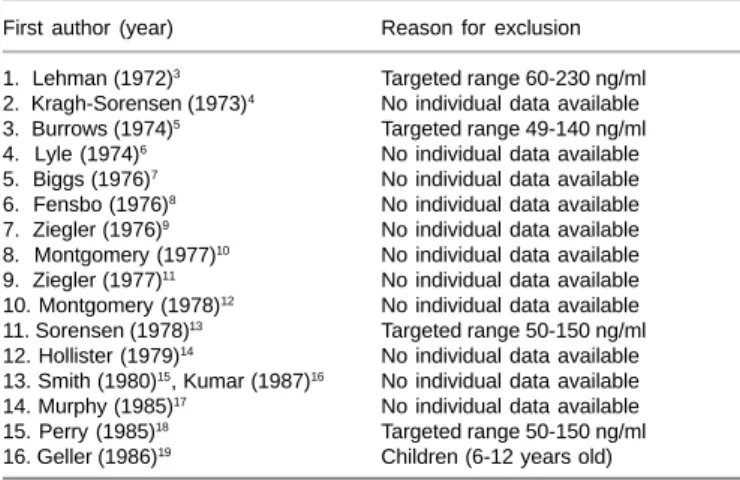
As it is essential to study a population of patients that can, in fact, respond to the drug-treatment, studies including depressed patients refractory to previous treatments were not accepted in this meta-analysis. We also excluded studies not providing patients’ individual data and those not using a fixed-dose regimen. Some studies were designed to place patients’ blood levels within a specific range, usually 50-150 ng/ml. Since, in such situations, there are no patients outside the chosen range, the hypothesis of a TW cannot be tested and these studies were discarded. We also excluded studies of children. Studies not included and the reasons for their non-inclusion are presented in Table 1.3-19
Therapeutic response evaluation
In each original study, therapeutic response was assessed by means of well established depression rating scales (Table 2).1,20-24
Response to treatment was considered to be a 50% improvement or more. As patients’ individual data were available in the included papers, such response criteria were not necessarily the same as were used by the authors of the original papers.
Quality scoring
Quality of the studies was assessed by means of a score method especially designed to systematically evaluate the quality of clinical pharmacokinetic studies on the relationship between antipsychotic blood levels and their clinical effects,25
Table 2 - Summary of the six studies included in this meta-analysis.
First author Sample size Diagnostic criteria Assessment Dose Duration Therapeutic
(year) (in/out) (Type of depression) of psycho- (mg/day) Window
pathology Pre-treat Treatment (ng/ml)
(days) (weeks)
1. Asberg (1971)1 29 (in) “Endogenous depression” Cronholm-Ottosson 25-75 4-7 2 50-139
2. Burrows (1972)20 32 (in) Primary depressive illness HRSD 150 7 4-6*
-3. Burrows (1974)21 80 (in) Primary depressive illness HRSD 75-250 7 4
-4. Kragh-Sorensen (1976)22 24 (in) “Endogenous depression” Cronholm-Ottosson 75 7 6 50-150
5. Burrows (1977)23 22 (in) Primary depressive illness HRSD 150 7 5
-6. Hollister (1980)24 20 (out) “Endogenous depression” HRSD 100 - 6
-* Week 4 was considered for analysis, as data from only 19 patients were available in week 6. HRSD = Hamilton Rating Scale for Depression; in/out = inpatient / outpatient.
Table 1 - Papers not included in this meta-analysis and reasons for exclusion
First author (year) Reason for exclusion
1. Lehman (1972)3 Targeted range 60-230 ng/ml
2. Kragh-Sorensen (1973)4 No individual data available
3. Burrows (1974)5 Targeted range 49-140 ng/ml
4. Lyle (1974)6 No individual data available
5. Biggs (1976)7 No individual data available
6. Fensbo (1976)8 No individual data available
7. Ziegler (1976)9 No individual data available
8. Montgomery (1977)10 No individual data available
9. Ziegler (1977)11 No individual data available
10. Montgomery (1978)12 No individual data available
11. Sorensen (1978)13 Targeted range 50-150 ng/ml
12. Hollister (1979)14 No individual data available
13. Smith (1980)15, Kumar (1987)16 No individual data available
14. Murphy (1985)17 No individual data available
15. Perry (1985)18 Targeted range 50-150 ng/ml
here adapted to antidepressants. We used only twelve of the thirty-one original items. The questionnaire was completed independently by two of us (RSJ and EPS). We considered the mean of both as the final score for each study.
Data collection
Data were extracted independently by two of us (RSJ and IRO) from tables and one graph among the selected papers. Disagreements were resolved by consensus. In the case of the graph, this was scanned and coordinates obtained by means of the software Photofinish. Coordinates were then translated into percentage improvement and drug concentrations expressed as ng/ml.26
Statistical analysis
In order to test the existence of a narrow therapeutic range or TW, we used the receiver operating characteristics (ROC) cur-ve as the primary statistical tool.27 After identifying the lower
and upper limits of efficacy – the points of maximum sensitivity – random-effects DerSimonian-Laird odds ratios and their 95% confidence intervals were used to pool results of the independent studies by means of the software Arcus. A Q test of homogeneity or “combinability” for the odds ratios was calculated, indicating that pooling was viable among the selected studies (p> 0.05). Data were broken down from the six included studies into 2x2 contingency tables, presenting the proportion of patients who responded inside the therapeutic window as compared with those who responded outside it. We also measured the absolute risk reduction (difference in event rates between the control and treatment groups). The number
needed to treat (or to harm), i.e. the number of patients who
had to be treated in order to prevent one event, was calculated as the reciprocal of the absolute risk reduction.28,29
The number of studies (with null results) needed to overturn the conclusions (fail-safe n) when a significant result was found was also assessed. The fail-safe n was proposed to address the problem posed by unpublished non significant results residing in the “file drawers” of the researchers conducting the studies. It estimates how many studies with null results must be in the file drawers to overturn the results of the combined significant test.30
After the univariate analyses, we used the multivariate logistic regression procedure,31 defining independent variables as the
therapeutic concentration ranges obtained by means of the ROC curves, controlling for quality of studies, and duration of the treatment. The outcome variable was defined as at least a 50% improvement of symptoms. Multivariate analyses were performed by means of the SPSS statistical program.
Results
Twenty-two published nortriptyline primary studies up to October 1999 were retrieved, involving the investigation of blood levels and therapeutic response in depression. Among these studies, 10 did not demonstrate any association between nortriptyline blood levels and clinical outcome. Of the remaining 12 studies, 11 indicated the presence of a TW, whereas only 1 was able to show a linear or sigmoid relationship. However, 6
out of the existing studies satisfied the inclusion criteria and were used in this meta-analysis. Of the six included studies, only 2 suggested the existence of a TW (Table 3).
Data collected from the only study providing its results in the form of a graph21, obtained by two of us (IRO and RSJ), were
reliable, as established by intraclass correlation coefficient (R = 1.00).32 Qualitative evaluation of the six studies, done
independently by two of us (RSJ and EPS), produced a high intraclass correlation coefficient (R = 0.94).
Table 3 and Figure 1 present the individual (involving each study) and global (involving all included studies) analyses concerning the TW 46-236 ng/ml for nortriptyline levels, calculated by means of the ROC curves27 (OR = 2.25, 95% CI = 1.15 to 4.39,
p = 0.02). The fail-safe n was rather small (n= 3); therefore such results should be viewed with caution. Sensitivity analysis by the exclusion of the study by Asberg et al,1 which had a shorter
duration (2 weeks), provided the same result (OR = 2.25, 95% CI = 1.12 to 4.53, p = 0.02). Sensitivity analysis was repeated by excluding the study by Hollister et al24 because of its lower quality
score (< 0.60) (OR = 2.17, 95% CI = 1.08 to 4.35, p = 0.03). Such analyses did not demonstrate any change in the results.
Analyses involving all the concentration ranges for nortriptyline suggested in the literature, including all patients (n = 207), were performed. The summary statistics are shown in Table 4. The window suggested by our data indicated the highest probability of response to treatment when blood levels were inside rather than outside it. Figure 2 indicates that 52% of patients inside the proposed TW responded to treatment, as compared to only 22% of those below and 37% of those above it.
The multivariate logistic regression analysis confirmed the 46-236 ng/ml therapeutic window for nortriptyline blood levels (OR = 2.51, p = 0.006), controlling for quality of the studies (OR = 1.32, p = 0.04) and duration of treatment (OR = 2.34, p = 0.13).
Discussion
The existence of a TW has been suggested by some authors for nortriptyline-treated depressed patients. However there is no consensus among the studies, the majority demonstrating no association between blood levels of the drug and clinical
Table 3 - Blood levels of nortriptyline and clinical response: analysis of the hypothesis of the therapeutic window in the range 46-236 ng/ml, using data from the 6 included studies.
Clinical response
Author Inside TW Outside TW
(year) n Yes No Yes No ARR OR p NNT
(%) (%) (%) (%) 95% CI 95% CI
1. Asberg (1971)1 29 11 15 0* 3 0,42 2,20 0,63
(42) (58) (0) (100) 0.16 - 63,15
2. Burrows (1972)20 32 13 12 3 4 0,09 1,44 1,00
(52) (48) (43) (57) 0.21 - 10,62
3. Burrows (1974)21 80 25 24 8 23 0,26 2,99 0,05
(52) (48) (26) (74) 1.02 - 9,01
4. Kragh-Sorensen (1976)22 24 14 7 1 2 0,34 4,00 0,53
(67) (33) (33) (67) 0.22 - 135,97
5. Burrows (1977)23 22 7 6 5 4 -0,02 0,93 1,00
(54) (46) (56) (44) 0.12 - 7,15
6. Hollister (1980)24 20 7 8 1 4 0,27 3,50 0,60
(47) (53) (20) (80) 0.24 - 104,62
Total 207 77 72 18 40 0,19 2,25 0,02 5
(52) (48) (31) (69) 0.04–0.33 1.15 – 4.39 3 to 18
Total** 178 66 57 18 37 0,21 2,25 0,02 5
(54) (46) (29) (71) 0.05–0.35 1,12 - 4,53 3 to 20
Total*** 187 70 64 17 36 0,19 2,17 0,03 5
(52) (48) (32) (68) 0.03 - 0.33 1,08 - 4,35 3 to 32
*This value (0) was replaced with 1 to make calculation of the odds ratio possible. **After exclusion of the study by Asberg et al.1 (two-week duration).
***After exclusion of the study by Hollister et al.24 (quality score < 0.60).
Q (“combinability” for odds ratios) = 1,93; p= 0,85.
TW = Therapeutic window; ARR = absolute risk reduction; OR = odds ratio; CI = confidence interval. NNT = Number needed to treat.
Fail-safe n = 3
Table 4 - Summary of statistics concerning the different TWs suggested in the literature for nortriptyline blood levels, tested with the 207 patients from the 6 included studies.
TW Suggested by: Absolute
(ng/ml) risk OR 95% CI p
reduction
Asberg (1971)1
50-139 Biggs (1976)7 0.05 1.32 0.70 – 2.50 0.44
Ziegler (1976,1977)9,11
< 175 Kragh-Sorensen (1973)4 -0.05 0.95 0.48 – 1.87 0.99
Kragh-Sorensen (1976)22
50-150 Montgomery (1977)10 0.02 1.21 0.64 – 2.30 0.63
Sorensen (1978)13
< 200 Montgomery (1978)12 0.00 1.08 0.52 – 2.27 0.96
60-230 Lehmann (1982)3 0.11 1.48 0.78 – 2.81 0.26
> 60 Geller (1986)19 0.09 1.23 0.57 – 2.70 0.70
90-140 Smith (1980)15 0.00 0.94 0.45 – 1.97 0.99
100-200 Montgomery (1978)12 0.06 1.15 0.62 – 2.14 0.74
46-236 Present study (2000) 0.19 2.25 1.15 – 4.39 0.02
TW= therapeutic window; OR = odds ratio; CI 95% = 95% confidence interval.
response. It is possible that small sample sizes were the main cause of such negative results. In this case, meta-analysis is indicated as a statistical tool to investigate this problem because type II error is reduced.
In this meta-analysis, individual patients’ data could be
Figure 2 – Blood levels of nortriptyline and clinical outcome: analysis of the hypothesis of a “therapeutic window” in the range 46-236 ng/ml, using individual data of the 207 patients from the 6 included studies
1: n=05 (22%) 3: n=77 (52%) 5: n=13 (37%)
obtained from only 6 of the 22 retrieved studies, and this may be a source of bias. A systematic review of the available literature is probably a more appropriate approach for confirming these preliminary findings of a therapeutic window for nortriptyline in the treatment of depression. A more extensive search by requesting individual data from the authors might increase statistical power and reduce bias.
A number of methodological problems have provided differences in the results of the studies of blood levels of antidepressants vs. clinical outcome and could be the cause of clinical heterogeneity: (i) strategies of dosage; (ii) methods of analyses of blood samples; (iii) characteristics of the populations of studies and (iv) study design.33 In order to minimise such
heterogeneity, we excluded studies dealing with children, those of refractory patients and those designed to target specific plas-ma ranges. There was no statistical heterogeneity, as demonstrated by a non significant Q (“combinability) test.
The mechanism by which the antidepressant effect may decrease at higher plasma levels needs further elucidation.34
Hall and Ogren35 suggested that the direct activity on several
receptors could be part of the mechanism by which the antidepressant drugs produce adaptive changes in various transmitter systems. In their experiments nortriptyline was the most potent antidepressant drug on [3H]5-HT binding.
Nortriptyline also showed some affinity for alpha-1 and H-1 receptors. It is possible that the effects of these receptors, in increasing the concentrations of nortriptyline, might be responsible for its self-inhibiting action at high plasma levels. There has also been some evidence that hydroxy-metabolites might be involved in this self-inhibiting effect of higher concentrations of nortriptyline. Young et al36 showed that elderly
patients presenting higher plasma levels of E-10-OH-nortriptyline did not respond or responded poorly to treatment. They proposed that i) an inhibitory effect of high plasma E-10-OH-nortriptyline on efficacy might be related to its lower pharmacologic potency compared to nortriptyline; ii) a competitive mechanism involving E-10-OH-nortriptyline might contribute to the curvilinear relationship between plasma nortriptyline alone and efficacy at a single stable dose in younger patients; iii) the influence of high plasma E-10-OH-nortriptyline might further depend on the concentration of nortriptyline.
This meta-analysis was performed in order to test the existence of a TW in the treatment of depressed patients treated with nortriptyline. We observed the optimal range 46-236 ng/ml. The detected upper level was different from the one that has been most frequently referred to in the literature (150 ng/ml). However, the study by Lehman et al3 suggested an upper limit (230 ng/ml)
which is similar to ours; and Montgomery et al12 also found that
the upper limit of the nortriptyline TW was higher (200 ng/ml) than that usually seen in the literature. Interestingly, none of these studies provided individual patient data, so they could not be included in our meta-analysis. Such results might reduce the possibility of bias, implicit through the inclusion of the only six studies providing patients’ individual data. On the other hand, three of the studies included in our meta-analysis were carried out by the same team that has systematically discarded the existence of a relationship between nortriptyline blood levels and clinical outcome.20,21,23 Taken together, such information
turns our results rather conservative.
A TW of 46-236 ng/ml is rather large and more easily reached with the nortriptyline doses usually prescribed in clinical practice. In this case, routine nortiptyline blood level assessment is not essential. However, in those patients not responding to the treatment, a blood level assessment should be considered in order to check whether it is inside or outside the optimal range.
Two thirds of depressed people seen in clinical practice seem to respond to antidepressant treatment and one third do not. However, one third respond to placebo.37 Figure 2 shows that
only 46% of the nortriptyline-treated patients responded to treatment, which is rather a low response rate. This may be explained by two main factors: i) short duration of treatment (two weeks) in one study;1 ii) presence of a one-week placebo
or observation pre-treatment period in five out or the six studies,1,20-23 in order to exclude non-pharmacologic or
place-bo-responder patients.
This meta-analysis was limited by i) the inclusion only of studies published in English; ii) search restricted to MEDLINE; and iii) inclusion of individual patient data. Such limitations do not warrant generalization of the results.
In conclusion, there may be a biphasic relationship of efficacy to plasma concentrations of nortriptyline. The resulting TW seems to be 46-236 ng/ml.
References
1. Asberg M, Chronholm B, Sjoqvist F, Tuck D. Relationship between plasma level and therapeutic effect of nortriptyline. Br Med J 1971;3:331-4.
2. Sacks HS, Berrier J, Reitman D, Ancona-Berk VA, Chalmers TC. Meta-analysis of randomised controlled trials. New Eng J Med 1987;316:450-5.
3. Lehmann LS, Bowden CL, Redmond FC, Stanton, BC. Amitriptyline and nortriptyline response profiles in unipolar depressed patients. Psychopharmacol 1982;77:193-7.
4. Kragh-Sorensen P, Hansen CE, Asberg M. Plasma levels of nortriptyline in the treatment of endogenous depression. Acta Psychiat Scand 1973;49:444-56.
5. Burrows GD, Turecek LR, Davies B. A sequential trial comparing two plasma levels of nortriptyline. Aust NZ J Psychiatry 1974;8:21-3. 6. Lyle WH, Braithwaite RA, Brooks PW, Cuthill JM, Early DF, Goulding
R et al. Plasma concentrations of nortriptyline as a guide to treatment. Postgrad Med J 1974;50:282-7.
7. Biggs JT, Clayton PJ, Ziegler VE. Nortriptyline plasma levels and therapeutic response. Pharmacologist 1976;618:129.
8. Fensbo C. A clinical trial of nortriptyline and maprotiline with cardi-ovascular monitoring and serum level estimations. Ludiomil Synposium Ciba 1976;181-90.
10. Montgomery SA, Braithwaite RA, Crammer JL. Routine nortriptyline levels in treatment of depression. Br Med J 1977;3:166-7. 11. Ziegler VE, Clayton PJ, Biggs JT. A comparison study of amitriptyline
and nortriptyline with plasma levels. Arch Gen Psychiatry 1977;34:607-12.
12. Montgomery S, Braithwaite R, Dawling S. High plasma nortriptyline levels in the treatment of depression. J Clin Pharmacol Ther 1978;23:309-14.
13. Sorensen B, Kragh-Sorensen P, Larsen N, Hvidberg EF. The practical significance of nortriptyline plasma control. Psychopharmacology 1978;59: 35-9.
14. Hollister LE. Monitoring tricyclic antidepressant concentrations. JAMA 1979;241:2530-3.
15. Smith RC, Reed K, Leelavathi DE. Pharmacokinetics and the effects of nortriptyline in geriatric depressed patients. Psychopharmacol Bull 1980;16: 54-7.
16. Kumar V, Smith RC, Reed K, Leelavathi DE. Plasma levels and effects of nortriptyline in geriatric depressed patients. Acta Psychiatr Scand 1987;75:20-8.
17. Murphy GE, Simons AD, Wetzel RD. Plasma nortriptyline and clinical response in depression. J Affect Dis 1985;9:123-9.
18. Perry PJ, Browne JL, Alexander B, Pfohl BM, Dunner FJ, Sherman AD, Tsuang MT. Relationship of free nortriptyline levels to therapeutic response. Acta Psychiatr Scand 1985;72:120-5. 19. Geller B, Cooper TB, Chestnut EC, Anker JA, Schluchter MD.
Preliminary data on the relationship between nortriptyline plasma levels and response in depressed children. Am J Psychiatry 1986;143:1283-6.
20. Burrows GD, Davies B, Scoggins BA. Plasma concentration of nortriptyline and clinical response in depressive illness. Lancet 1972;23:619-23.
21. Burrows GD, Scoggins BA, Turecek LR, Davies B. Plasma nortriptyline and clinical response. Clin Pharm Ther 1974;16:639-44.
22. Kragh-Sorensen P, Hansen CE, Baastrup PC, Hvidberg EF. Self-inhibiting action of nortriptiyine’s antidepressive effect at high plas-ma levels. Psychopharplas-macology 1976;45:305-12.
23. Burrows GD, Maguire KP, Scoggins BA, Stevenson J, Davies B. Plas-ma nortriptyline and clinical response: a study using changing plasPlas-ma levels. Psychological Med 1977;7:87-91.
24. Hollister LE, Pfefferbaun A, Davis K Monitoring nortriptyline plas-ma concentrations. Am J Psychiatry 1980;137:485-6.
25. Oliveira IR, Dardennes RM, Amorim ES, Diquet B, de-Sena EP, Moreira EC et al. Is there a relationship between antipsychotic blood levels and their clinical efficacy? An analysis of studies design and methodology. Fund Clin Pharmacol 1995;9:488-502.
26. Oliveira IR. Associação entre níveis sanguíneos do haloperidol e resposta clínica: meta-análise dos estudos publicados [Tese livre-do-cência]. Salvador (BA): Faculdade de Medicina, UFBA; 1997. 27. Perry PJ, Zeilmann C, Arndt S. Tricyclic antidepressant
concentrations in plasma: an estimate of their sensitivity and specificity as a predictor of response. J Clin Psychopharmacol 1994;14:230-40.
28. Laupacis A, Sacket DL, Roberts RS. An assessment of clinically useful measures of the consequences of treatment. New Engl J Med 1988; 318:1728-33.
29. Cook RJ, Sacket DL. The number needed to treat: a clinically useful measure of treatment effect. Br Med J 1995;310:452-4.
30. Hedges LV, Olkin I. Statistical methods for meta-analysis. Orlando: Academic Press; 1985.
31. Hosmer DW, Lemeshow S. Applied Logistic Regression. New York: John Wiley & Sons; 1989.
32. Fermanian J. Mésure de l’accord entre deux juges: cas quantitatif. Rev Epidém Santé Publique 1984;32:408-13.
33. Janicak PG, Davis JM, Preskorn SH, Ayd FJJr. Pharmacokinetics. In: Janicak PG, Davis JM, Preskorn SH, Ayd FJ Jr, eds. Principles and Practice of Psychopharmacology. Baltimore: Williams & Wilkins; 1993. p. 592.
34. Oliveira IR, Diquet B, Van der Meersch V, Dardennes R, Gonidec J, Prado-Lima PA. Self-inhibiting action of nortriptyline’s anti-immobility effect at high plasma and brain levels in mice. Psychopharmacology 1990;102:553-6.
35. Hall H, Ogren SO. Effects of antidepressant drugs on different receptors in the brain. Eur J Pharmacol 1981;70:393-407.
36. Young RC, Alexopoulos GS, Shindledecker R, Dhar AK, Kutt H. Plasma 10-hydroxynortriptyline and therapeutic response in geriatric depression. Neuropsychopharmacology 1988;1:213-5.
37. Stahl SM. Essential psychopharmachology – neuroscientific basis and clinical applications. Cambridge: Cambridge University Press; 1996.
Correspondência Irismar Reis de Oliveira
Avenida Araújo Pinho, nº 124/2002 Bairro Canela CEP 40110-150 Salvador, Bahia, Brasil