Revista da
ASSOCIAÇÃO MÉDICA BRASILEIRA
w w w . r a m b . o r g . b r
Original article
Effectiveness of oxybutynin for treatment of hyperhidrosis
in overweight and obese patients
夽
Nelson Wolosker
a,b, Mariana Krutman
c,∗, Paulo Kauffman
a, Rafael Pessanha de Paula
a,
Jose Ribas M. de Campos
a, Pedro Puech-Leão
aaDivision of Vascular Surgery, Hospital das Clínicas, Medical School, Universidade de São Paulo, São Paulo, SP, Brazil bDepartment of Vascular Surgery, Hospital Israelita Albert Einstein (HIAE), São Paulo, SP, Brazil
cFellowship in Vascular and Endovascular Surgery, HIAE, São Paulo, SP, Brazil
a r t i c l e
i n f o
Article history:
Received 22 August 2012 Accepted 4 November 2012
Keywords:
Hyperhidrosis Treatment Sympathectomy Quality of life Obesity
a b s t r a c t
Objective:Until the present moment, the lack of efficient therapeutic options available for hyperhidrosis treatment in obese patients has left this population without prospect of clini-cal or quality of life (QOL) improvements. Outcomes of oxybutynin treatment for overweight and obese patients with hyperhidrosis are unknown. This study aims to investigate the results related to clinical and QOL improvements in this specific population, submitted to a 12-week protocol treatment with oxybutynin.
Methods:559 patients with palmar and axillary hyperhidrosis, routinely followed in this service, were divided into the groups, according to their body mass index (BMI) (< 25 kg/m2;
25 < BMI < 30 kg/m2, > 30 kg/m2). Improvements in QOL and in the level of hyperhidrosis
were analyzed after 12 weeks of protocol treatment with oxybutynin. These parameters were investigated using a scoring system based on a scientifically validated clinical questionnaire, applied before and after treatment.
Results:67.8% of the overweight sample group and 63% of the obese patients presented “partial” or “great” improvement in the level of hyperhidrosis. Over 65% of patients demon-strated improvement in QOL (“much better” or “slightly better”) for all three groups, with no statistical difference between them. The only adverse event associated with oxybutynin was dry mouth, observed in 63.0% of the patients.
Conclusion: Overweight and obese patients with palmar or axillary hyperhidrosis present significant improvement in QOL after treatment with oxybutynin, and the results are com-parable to those of normal weight individuals.
© 2013 Elsevier Editora Ltda. All rights reserved.
Eficácia da oxibutina no tratamento de hiperidrose em pacientes
com sobrepeso e obesos
Palavras-chave:
Hiperidrose
r e s u m o
Objetivo:A falta de alternativas terapêuticas para o tratamento de pacientes obesos com hiperidrose deixa essa populac¸ão sem perspectiva de melhorar suas condic¸ões clínicas e
夽
Study conducted at Hospital Israelita Albert Einstein and Hospital das Clínicas, Universidade de São Paulo, São Paulo, SP, Brazil.
∗ Corresponding author: Al. Campinas, 1446, apto. 63, São Paulo, SP, Brazil.
E-mail: [email protected] (M. Krutman).
Tratamento Simpatectomia Qualidade de vida Obesidade
qualidade de vida. Resultados do tratamento com oxibutinina especificamente em pacientes com sobrepeso ou obesidade são desconhecidos até o presente momento. Este estudo tem como objetivo investigar os resultados relacionados à melhora clínica e qualidade de vida dessa populac¸ão, após um protocolo de tratamento de 12 semanas com oxibutinina.
Métodos: 559 pacientes com hiperidrose palmar e axilar, foram divididos em três grupos, de acordo com seu índice de massa corporal (IMC) (< 25 kg/m2; 25 < IMC < 30 kg/m2, > 30 kg/m2).
Dados sobre evoluc¸ão na qualidade de vida e nível de hiperidrose foram avaliados com base em um questionário validado cientificamente, aplicado antes e após o tratamento com oxibutinina.
Resultados: 67.8% dos pacientes com sobrepeso e 63% dos obesos apresentaram melhora clínica “grande” ou “parcial” no nível da hiperidrose. Mais de 65% dos pacientes relataram melhora na qualidade de vida (“muito melhor” ou “um pouco melhor”) para os três gru-pos, sem diferenc¸a estatística entre eles. O único efeito colateral observado foi boca seca, presente em 63.0% da amostra.
Conclusão:Pacientes com sobrepeso e obesidade portadores de hiperidrose palmar ou axilar apresentaram melhora significativa na qualidade de vida após o tratamento com oxibutin-ina, sendo os resultados comparáveis aos de indivíduos com peso normal.
© 2013 Elsevier Editora Ltda. Todos os direitos reservados.
Introduction
Hyperhidrosis is the production of excessive sweat beyond what is required for the body’s thermoregulatory needs.1
Pal-mar (PH), plantar (PlH), and axillary hyperhidrosis (AH) are the most frequent presentations in both genders and across all age groups. Hyperhidrosis affects approximately 3% of the general population, and actively interferes with patients’ quality of life (QOL), causing issues in social, professional, and emotional spheres.2The psychological stress caused by excessive
sweat-ing is the main drive for patients to seek medical assistance, who are usually willing to undergo any possible treatment option that will improve their QOL. Until the present moment, the lack of efficient therapeutic options available for hyper-hidrosis treatment in obese patients has left this population without prospect of improvements in QOL.
Overweight and obesity, defined as body mass index (BMI) greater than 25 kg/m2and 30 kg/m2, respectively, are the main
conditions associated with more severe sweating, possibly as a result of reduced heat loss due to thicker layers of fat in subcutaneous tissues. These patients have greater diffi-culty in maintaining normal body temperature levels, and therefore produce excessive perspiration as a compensatory mechanism.3
Video-assisted thoracic sympathectomy (VATS) is currently considered the optimal technique for treatment of primary hyperhidrosis. It is a safe, effective, and minimally inva-sive method;4–7 however, it presents limited applicability
in obese patients. Increased surgical risk, technical limita-tions, and more severe levels of compensatory hyperhidrosis explain why surgical indications are greatly restricted in these individuals.8
Oxybutynin is an anticholinergic medication widely used in urology for treatment of bladder urge incontinence. Sweat glands are stimulated by acetylcholine; thus, the anticholin-ergic effect of oxybutynin is responsible for its effectiveness against excessive sweating.9 It is a safe medication, with
few absolute contraindications; the most important is closed-angle glaucoma. Potential side effects include dry mouth,
constipation, headache, nausea, and urinary retention. Few drug interactions have been reported, and when present, they involve concomitant use of cytochrome P450 metabolism-dependent medications.10,11
Recent studies have disclosed good results with the use of oxybutynin for the treatment of hyperhidrosis.12–15
Nonethe-less, a specific analysis of the effectiveness of this medication in obese patients had not been conducted. This study aimed to analyze QOL after treatment with oxybutynin in obese patients with PH and AH, and to compare the results with those of normal weight individuals.
Methods
This was a retrospective study, based on medical chart review of 559 patients treated with oxybutynin from January 2007 to December 2011. The study was approved by the ethics com-mittee of the institution.
The patients involved were divided into three groups according to their BMI. The first group was composed of 411 (73.5%) normal weight patients (BMI < 25 kg/m2), the
sec-ond consisted of 121 (21.6%) overweight patients (25< BMI < 30 kg/m2), and the third, of 27 (4.9%) obese individuals (BMI
< 30 kg/m2).
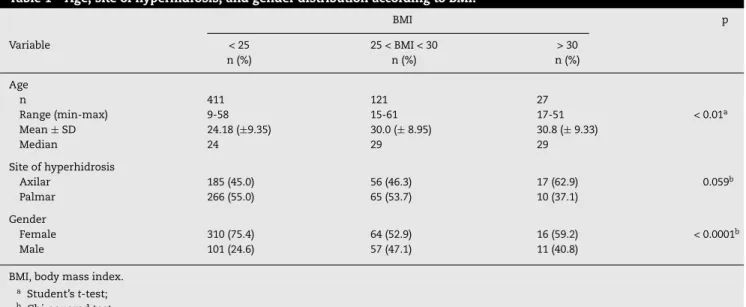
Age, gender distribution, and location of hyperhidrosis according to BMI are shown in Table 1. The lowest average age was observed in the normal weight group. PH and female gender were predominant in all weight categories.
The same medical treatment protocol was applied to all patients. During the first week, 2.5 mg of oxybutynin were administered once a day in the evening. From the eighth to the 42nd day, the patients received 2.5 mg of the medication twice a day; from the 43rd day to the end of the 12th week, 5 mg were administered twice a day. Experience has shown that a staged administration reduces the impact of anticholinergic side effects.
Table 1 – Age, site of hyperhidrosis, and gender distribution according to BMI.
BMI p
Variable < 25 25 < BMI < 30 > 30
n (%) n (%) n (%)
Age
n 411 121 27
Range (min-max) 9-58 15-61 17-51 < 0.01a
Mean±SD 24.18 (±9.35) 30.0 (±8.95) 30.8 (±9.33)
Median 24 29 29
Site of hyperhidrosis
Axilar 185 (45.0) 56 (46.3) 17 (62.9) 0.059b
Palmar 266 (55.0) 65 (53.7) 10 (37.1)
Gender
Female 310 (75.4) 64 (52.9) 16 (59.2) < 0.0001b
Male 101 (24.6) 57 (47.1) 11 (40.8)
BMI, body mass index.
a Student’st-test;
b Chi-squared test.
and the last evaluation, after the completion of 12 weeks of treatment. These evaluations were used to follow-up patients’ clinical and QOL improvement. Clinical improvement was classified using a scale ranging from 0 to 10, where 0 rep-resented no improvement, and 10 reprep-resented absence of hyperhidrosis. Clinical outcomes were ranked according to the following categories: null (from 0 to 4), partial (5 to 7), or great (8 to 10).
QOL analysis was based on a validated clinical protocol questionnaire, applied at each visit.16,17 The questionnaire
was completed according to the patient’s perception of hyper-hidrosis improvement, without examiners’ interference. The authors believe that self-evaluation is a reliable method for patient QOL analysis.
QOL before treatment was classified into five different sat-isfaction categories, calculated as the added total score from the protocol (ranging from 20 to 100). According to the sco-ring system, a greater score reflects a more significant impact and represents poorer QOL. When the total score was equal to or greater than 84, QOL was considered “very poor”. When the total score ranged from 68 to 83, QOL was considered “poor”. Scores that ranged from 52 to 67 were considered “good”. Scores from 36 to 51 indicated “very good” results, and scores from 20 to 35 were considered “excellent.
Similarly, improvement of QOL after treatment was also classified into five different levels. When the total was equal to or greater than 84, the QOL was considered to be “worse”. When the scores ranged from 68 to 83, QOL was considered to be “slightly worse”. Scores from 46 to 58 were considered “unaltered”. Scores from 33 to 45 indicated a “slight improve-ment”, and scores from 17 to 32 were considered “much better”.
The following parameters were studied in both groups: progress of PH and AH, evaluation of QOL before treatment, and improvement in QOL after treatment.
Statystical analysis
The chi-squared test was performed to verify the associa-tion between categorical variables in contingency tables, and
Student’st-test was used to compare age and study group. The significance level considered for all statistical tests was 0.05.
Results
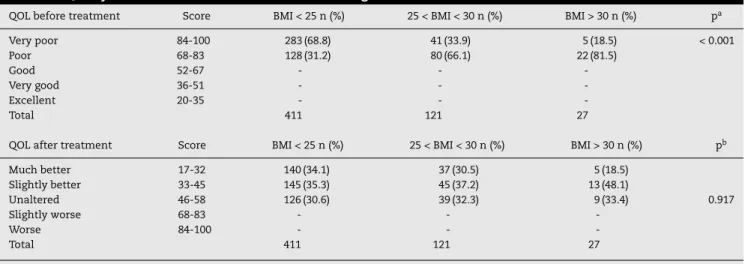
All patients enrolled in the present study classified their QOL before treatment as “poor” or “very poor”, as demonstrated in Table 2. According to the present results, obese patients con-sidered themselves less affected by hyperhidrosis than normal or overweight individuals.
Approximately 69% of the normal BMI group classified their QOL before treatment as “very poor”, whereas over 80% of obese individuals ranked their QOL as simply “poor”. The questionnaire was re-applied after the proposed period of treatment; over 65% of patients demonstrated improvement in QOL (“much better” or “slightly better”) for all three groups, with no statistical difference between them (Table 2).
Table 3 shows clinical improvement in hyperhidrosis, according to a subjective evaluation based on the patient’s per-ception of his/her own symptoms. Over 60% of the patients in all groups presented partial or great improvement in the level of sweating.
The only adverse event associated with oxybutynin was dry mouth, observed in 255 cases (63.0%); however, none required discontinuation of treatment, since in most cases the symp-tom was classified as “light” and therefore tolerable.
Discussion
Obesity is a condition with increasing incidence and preva-lence in many parts of the world, and results from an interaction of the environment, associated with genetic predisposition and overall human behavior.15 Overweight
patients present increased risk of several diseases including hypertension, osteoarthritis, diabetes, certain cancers, as well as psychological disorders.18,19 Concomitant hyperhidrosis
Table 2 – Quality of life before and after treatment according to BMI.
QOL before treatment Score BMI < 25 n (%) 25 < BMI < 30 n (%) BMI > 30 n (%) pa
Very poor 84-100 283 (68.8) 41 (33.9) 5 (18.5) < 0.001
Poor 68-83 128 (31.2) 80 (66.1) 22 (81.5)
Good 52-67 - -
-Very good 36-51 - -
-Excellent 20-35 - -
-Total 411 121 27
QOL after treatment Score BMI < 25 n (%) 25 < BMI < 30 n (%) BMI > 30 n (%) pb
Much better 17-32 140 (34.1) 37 (30.5) 5 (18.5)
Slightly better 33-45 145 (35.3) 45 (37.2) 13 (48.1)
Unaltered 46-58 126 (30.6) 39 (32.3) 9 (33.4) 0.917
Slightly worse 68-83 - -
-Worse 84-100 - -
-Total 411 121 27
a Chi-squared test;
b Chi-squared test comparing “unaltered” with “much better” and “slightly better”.
significant need for a definitive treatment of hyperhidrosis in this specific population.
BMI is an estimation of body fat based on the ratio of a patient’s height to weight. Despite its limitations, it is one of the most commonly used anthropometric measures to assess total body adiposity, due to its simplicity, acceptable accuracy, and inexpensiveness.20 BMI measurements are extensively
used in epidemiological studies, and are recommended as a screening tool in the initial clinical assessment of obesity.12
The Centers for Disease Control and Prevention defined BMI classification as follows: 1) underweight: BMI < 18.5 kg/m2;
2) normal or acceptable weight: BMI 18.5–24.9 kg/m2; 3)
over-weight: BMI 25–29.9 kg/m2; 4) obese: BMI > 30 kg/m2.21For the
purpose of the present study, the relevant BMI cutoff is 25, since surgical procedures are limited in patients with BMI above this level.8
Unspecific questionnaires for QOL assessment do not allow for a precise analysis of patients with hyperhidrosis, since rel-evant information for this disorder is not ordinarily addressed. The QOL questionnaire used in this study has been validated and used in several published documents.13,14 Its questions
focus on influence of hyperhidrosis in different daily life situ-ations, involving social, emotional, and professional activities. The higher predominance of hyperhidrosis observed in the female gender is consistent with previous studies, and can be explained by the greater concern that this condition imposes to women, leading them to seek medical assistance more often.22
The group with BMI < 25 km/m2showed a predominance
of “very poor” QOL classification, higher than that observed in the other two groups. Therefore, a direct relationship between level of obesity and QOL before treatment was not clearly established in these study patients.
Improvements in hyperhidrosis after treatment were sim-ilar in all three groups, suggesting that overweight and obese patients benefit similarly to normal weight patients. This may be explained by the fact that QOL in patients with hyperhidrosis depends not only on the intensity of sweat-ing, but also on how well the patient adapts to his/her situation.5 Normal weight individuals suffering with
hyper-hidrosis may perceive their condition as greater in severity. Excess weight patients may endure other more important worries, and therefore may give less importance to hyper-hidrosis.
Reports on safety and adverse events regarding oxybutynin are based on the knowledge for treatment of urological blad-der conditions.23 Anticholinergic side effects are the most
frequent, and can occur in over 70% of patients using over 15 mg/day. The dose administered to the present patients was rather low (10 mg/day) in comparison to what is commonly used for urological purposes (15 mg/day), and this may explain the low incidence of side effects observed in this study. Dry mouth is usually benign and decreases with time of use of medication. In this study there were no reported cases of treatment interruption or discontinuation due to side effects. However, more severe and persistent side-effects can occur,
Table 3 – Improvement in hyperhidrosis after treatment.
Treatment result Score BMI < 25
n (%)
25 < BMI < 30 n (%)
BMI > 30 n (%)
p*
No improvement 0-4 115 (28.0) 39 (32.2) 10 (37.0) 0.444
Partial improvement 5-7 141 (34.3) 35 (28.9) 8 (29.6)
Great improvement 8-10 155 (37.7) 47 (38.9) 9 (33.4)
Total 411 121 27
especially with higher doses, and may be a limiting factor for long-term use of this medication.24
Conclusion
Overweight and obese patients with PH or AH reported a sig-nificant reduction in sweating and improvement in QOL after treatment with oxybutynin; the results are comparable to nor-mal weight individuals. The use of oxybutynin in low doses should be considered as a simple and efficient therapeutic alternative to improve the QOL of these patients. Further stud-ies are required to analyze the long-term use and safety of this medication.
Conflict of interest
All authors declare to have no conflict of interest.
r e f e r e n c e s
1. Cerfolio RJ, De Campos JR, Bryant AS, Connery CP, Miller DL, DeCamp M, et al. The Society of Thoracic Surgeons expert consensus for the surgical treatment of hyperhidrosis. Annals of Thoracic Surgery. 2011;5:1642–8.
2. Strutton DR, Kowalski JW, Glaser DA, Stang PE. US prevalence of hyperhidrosis and impact on individuals with axillary hyperhidrosis: results from a national survey. Journal of the American Academy of Dermatology. 2004;51:241–8. 3. Lacerf JM, Reitz C, De Chasteigner. Evaluation of discomfort
and complications in a population of 18,102 overweight or obese patients. Presse Medicale. 2002;15:689–95.
4. Munia MA, Wolosker N, Kaufmann P, Campos JR, Puech-Leão P. Sustained benefit lasting one year from T4 instead of T3-T4 sympathectomy for isolated axillary hyperhidrosis. Clinics. 2008;63:771–4.
5. Wolosker N, Yazbek G, Ishy A, de Campos JR, Kauffman P, Puech-Leão P. Is sympathectomy at T4 level better than at T3 level for treating palmar hyperhidrosis? Journal of
Laparoendoscopic and Advanced Surgical Techniques Part A. 2008;18:102–6.
6. Yazbek G, Wolosker N, Kauffman P, de Campos JR, Puech-Leão P, Jatene FB. Twenty months of evolution following
sympathectomy on patients with palmar hyperhidrosis: sympathectomy at the T3 level is better than at the T2 level. Clinics. 2009;64:743–9.
7. Alric P, Branchereau P, Berthet JP. Video-assisted thoracoscopic sympathectomy for palmar hyperhidrosis: results in 102 cases. Annals of Vascular Surgery. 2002;16:708–13.
8. Campos JM, Wolosker N, Takeda F. The body mass index and level of ressection. Predicitve factor for compensatory
sweating after sympathectomy. Clinical Autonomic Research. 2005;15:116–20.
9. Mijnhout GS, Kloosterman H, Simsek S. Oxybutynin: dry days for patients with hyperhidrosis. Netherlands Journal of Medicine. 2006;64:326–8.
10. Vander T, Odi H, Bluvstein V. Carbamazepine toxicity following oxybutynin and dantrolene administration: a case report. Spinal Cord. 2005;43:252–5.
11. Lukkari E, Taavitsainen P, Juhakoski A. cytochrome P450 specificity of metabolism and interactions of oxybutynin in human liver microsomes. Pharmacol Toxicol. 1998;82:161–6. 12. Wolosker N, Campos JR. An alternative to treat palmar
hyperhidrosis: use of oxybutinin. Clinical Autonomic Research. 2011;6:389–93.
13. Wolosker N, Campos JR, Kauffman P, Munia MA, Neves S, Jatene FB, et al. The use of oxybutynin for treating facial hyperhidrosis. Anais Brasileiros de Dermatologia. 2011;3:451–6.
14. Wolosker N, Campos JR, Kauffman P, Neves S, Munia MA, Biscegli Jatene F, et al. The use of oxybutynin for treating axillary hyperhidrosis. Annals of Vascular Surgery. 2011;8:1057–62.
15. Wolosker N, de Campos JR, Kauffman P, Neves S, Yazbek G, Jatene FB, et al. An alternative to treat palmar hyperhidrosis: use of oxybutynin. Clinical Autonomic Research.
2011;6:389–93.
16. Amir M, Arish A, Weinstein Y. Impairement in quality of life among patients seeking surgery for hyperhidrosis (excessive sweating): preliminary results. Israel Journal of Psychiatry and Related Sciences. 2000;1:25–31.
17. Campos JRM, Kauffman P, Werebe E. Quality of life before and after thoracic sympathectomy: report on 378 operated patients. Annals of Thoracic Surgery. 2003;76:886–91. 18. Cornier MA, Després JP. Assessing adiposity: a scientific
statement from the american heart association. Circulation. 2001;124:1996–2019.
19. Nguyen D, El-Serag H. The epidemiology of obesity. Gastroenterology Clinics of North America. 2010;39:1–7. 20. Gallagher D, Visser M. How useful is body mass index for
comparison of body fatness across age, sex and ethnic groups. American Journal of Epidemiology. 1996;143:228–39. 21. Centers for Disease Control and Prevention. Body mass index.
[cited 2010 may 26]. Available from: http://www.cdc.gov/ healthyweight/assessing/bmi/index.html
22. Wolosker N, Munia MA, Kauffman P, Campos JR, Yazbek G, Puech-Leão P. Is gender a predictive factor for satisfaction among patients undergoing sympathectomy to treat palmar hyperhidrosis? Clinics. 2010;6:583–6.
23. Kaplan SA, Roehrborn CG, Abrams P, Chapple CR, Bavendam T, Guan Z. Antimuscarinics for treatment of storage lower urinary tract symptoms in men: a systematic review. International Journal of Clinical Practice. 2011;4:487–507. 24. Maillard H, Fenot M, Bara C. Therapeutic value of