www.eerp.usp.br/rlae
Corresponding Author: Joseba Xabier Huitzi-Egilegor
Departamento de Enfermería II. Escuela de Enfermería de Donostia-San Sebastián Universidad del País Vasco – Euskal Herriko Unibertsitatea
Paseo Doctor Beguiristain, 105 20014 Donostia-San Sebastián, España E-mail: [email protected]
Use of the nursing process at public and private centers in a
health area
Joseba Xabier Huitzi-Egilegor
1Maria Isabel Elorza-Puyadena
1Jose Maria Urkia-Etxabe
2Jaime Zubero-Linaza
3Xabier Zupiria-Gorostidi
1Aim: to analyze whether the nursing process method is used at public and private centers
in the health area Gipuzkoa (Basque Country) and, if yes, to analyze in the framework of
which model and how it is used. Method: cross-sectional study, based on the analysis of
the nursing records used at the 158 centers studied. Results: the nursing process is applied
at 98% of the centers. It is applied at all public and 18 out of 21 private centers. Virginia
Henderson’s model is the most used to apply it, and most centers use nursing diagnoses,
the NIC-NOC terminology and standardized care plans. Conclusion: the use of the nursing
process is widespread in Gipuzkoa, with greater use at public than at private centers.
Descriptors: Nursing Process; Nursing Diagnosis; Nursing Care; Models, Nursing.
1 PhD, Full Professor, Departamento de Enfermería II, Escuela de Enfermería de Donostia-San Sebastián, Universidad del País Vasco
- Euskal Herriko Unibertsitatea, Spain.
2 PhD, Full Professor, Departamento de Física Teórica e Historia de la Ciencia, Universidad del País Vasco - Euskal Herriko Unibertsitatea,
Spain.
3 PhD, Assistant Professor, Departamento de Enfermería II, Escuela de Enfermería de Donostia-San Sebastián, Universidad del País
Uso do processo de enfermagem nos serviços públicos e privados de um distrito de saúde
Objetivo: analisar se a metodologia do processo de enfermagem é utilizada nos
serviços públicos e privados do distrito de saúde de Gipuzkoa (País Basco) e, caso
seja, analisar sob qual modelo de enfermagem e de que maneira é utilizada. Método:
estudo transversal, baseado na análise dos registros de enfermagem usados pelos 158
serviços estudados. Resultados: o processo de enfermagem aplica-se em 98% dos
serviços estudados. É aplicado em todos os serviços públicos e em 18 dos 21 serviços
privados. O modelo de Virginia Henderson é o mais utilizado para aplicá-lo, e o uso dos
diagnósticos de enfermagem, da terminologia NOC-NIC e dos protocolos de cuidados
padronizados é majoritário. Conclusão: conclui-se que o uso do processo de enfermagem
está disseminado em Gipuzkoa, e que seu uso é maior nos serviços públicos do que nos
privados.
Descritores: Processos de Enfermagem; Diagnóstico de Enfermagem; Cuidados de
Enfermagem; Modelos de Enfermagem.
Uso del proceso de enfermería en los centros públicos y privados de un área de salud
Objetivo: analizar si la metodología del proceso de enfermería se utiliza en los centros
públicos y privados del área de salud de Gipuzkoa (País Vasco) y, en caso de utilizarse,
analizar bajo qué modelo enfermero y de qué manera se utiliza. Método: estudio
transversal, basado en el análisis de los registros de enfermería que utilizan los 158
centros estudiados. Resultados: el proceso de enfermería se aplica en el 98% de los
centros estudiados. Se aplica en todos los centros públicos y en 18 de los 21 centros
privados. El modelo de Virginia Henderson es el más utilizado para aplicarlo, y el uso de
los diagnósticos enfermeros, de la terminología NOC-NIC y de los planes de cuidados
estandarizados es mayoritario. Conclusión: se concluye que el uso del proceso de
enfermería está extendido en Gipuzkoa, y su uso es mayor en los centros públicos que
en los privados.
Descriptores: Procesos de Enfermería; Diagnóstico de Enfermería; Atención de
Enfermería; Modelos de Enfermería.
Introduction
The nursing process is the work method nursing
uses in care delivery(1). It consists of ive phases:
assessment, diagnosis, planning, implementation and
inally evaluation.
Its creation dates back to the 1950-1960, in the
United States and Canada. At that time, the idea started
to gain force that, beyond isolated actions, nursing
activities are part of a process(2).
During the initial years, it was mainly discussed and
developed in the teaching area. In the 1970’s, its use
was extended to clinical practice (professional practice),
and the laws regulating health professionals’ practice in
the United States and Canada started to acknowledge
that the use of the nursing process is one of the
responsibilities of the nursing profession(3).
Today, according to different reviews(4-5), the
nursing process method is used at health centers all
over the world.
In Spain, studies show that the use of the nursing
process starts to expand in the 1990’s(6-8) and that,
nowadays, it is widespread(9). There are few studies,
Health system and area Centers No. of nursing prof. No. of nursing prof. at services that apply the NP
Public health system 137 2103 1543
Primary care 116 514 411
Specialized care 5 1523 1066
Hospital No. 1 1 1072 750
Hospital No. 2 1 110 77
Hospital No. 3 1 111 78
Hospital No. 4 1 143 100
Hospital No. 5 1 87 61
Mental health 15 54 54
Psychiatry service at Hospital No. 1 1 22 22
Outpatient care centers 14 32 32
application. Among studies that do, one Spanish study
should be highlighted(10), in which the establishment of
the nursing process was analyzed at primary health care
centers in Spain.
The aim in this research is to study whether this
method is used at public and private health centers
in Gipuzkoa (Basque Country). If yes, the intent is to
analyze in the framework of which nursing model and
how it is used. The results will provide knowledge on the
way nursing works in Gipuzkoa.
Method
A cross-sectional study was developed
(January-December 2009), based on the analyzed of nursing
records used at public and private centers in the health
area Gipuzkoa, one of the three health areas in Basque
Country.
In total, 158 centers were studied: 137 public (all
public centers) and 21 private (all centers employing ten
or more nursing professionals). At these 158 centers,
2667 nursing professionals are active (2103 at public
and 564 at private centers), corresponding to about
90% of all professionals working in clinical practice in
Gipuzkoa.
The criterion to determine whether the nursing
process is applied or not at a given center is the existence
of nursing records corresponding to the assessment
phase of the nursing process, as subsequent phases are
based on the irst(1,11). Therefore, if nursing assessment
records are present, it is considered that the nursing
process is applied; if not, it is not.
On the other hand, the criterion to determine
that the nursing process is applied in the framework
of a speciic nursing model was to observe that, in the
elaboration of the nursing assessment records, the
guidelines of that model are followed.
Authorization from the management at the centers
involved was obtained before getting access to the
nursing records. The centers’ anonymity was preserved
in the publication of data.
The Research Ethics Committee at Universidad del
País Vasco – Euskal Herriko Unibertsitatea (UPV-EHU)
started to function in 2010. As data for this study were
collected in 2009, getting ethical clearance from that
committee was not possible.
Data were subject to quantitative analysis, using
descriptive statistics.
Results
In 155 out of 158 centers under analysis, the
nursing process is applied. Hence, the nursing process is
applied at 98% of the centers studied. It is applied at all
public and 18 out of 21 private centers.
Nevertheless, at many of the centers where we
considered that the nursing process is applied, its use has
not been extended to all services. To give an example,
at public specialized care centers, it is used at most
services (traumatology, cardiology, nephrology, general
surgery…), but not at the intensive care unit, operating
rooms, recovery, emergency, radiology, delivery and
neonatal services. In another example, at public primary
care centers, it is used in nursing consultations, irst
aid and home care, but not in midwifery and pediatric
consultations nor in the emergency service.
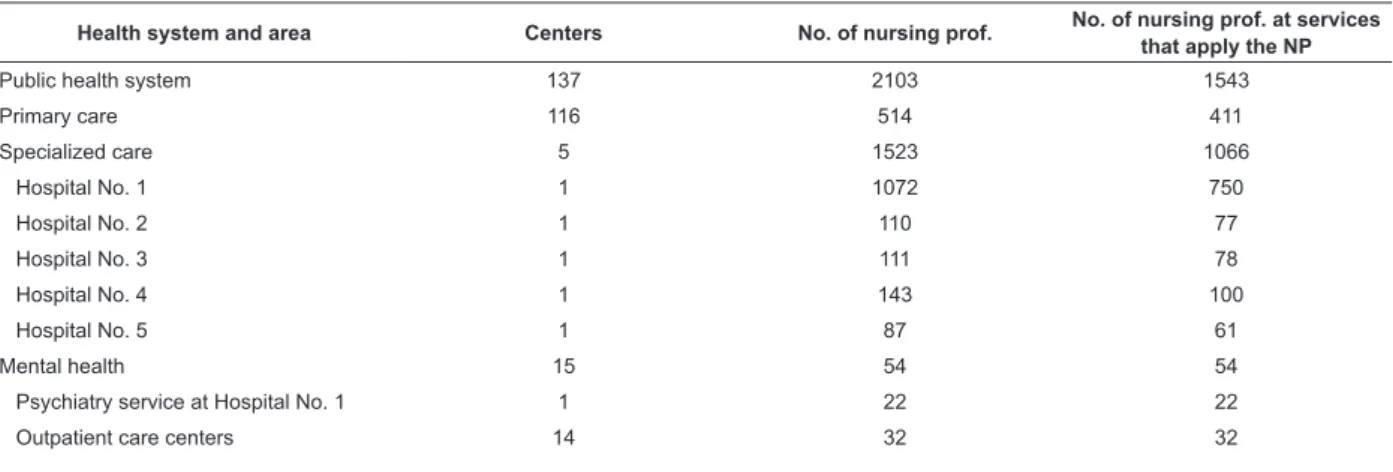
In Table 1, it is shown what centers were studied,
the number of nursing professionals working at the
centers and at the services where the nursing process
is applied.
Table 1 – Centers studied, number of nursing professionals working at the centers and at the services where the
nursing process (NP) is applied
Rev. Latino-Am. Enfermagem 2012 Sept.-Oct.;20(5):903-8.
Table 1 - (continuation)
Health system and area Centers No. of nursing prof. No. of nursing prof. at services that apply the NP
Gerontology-geriatrics 1 12 12
Private health system 21 564 214
Specialized care 6 410 60
Hospital No. 1 1 35 0
Hospital No. 2 1 85 0
Hospital No. 3 1 40 25
Hospital No. 4 1 50 25
Hospital No. 5 1 165 0
Hospital No. 6 1 35 10
Mental health 4 69 69
Hospital No. 1 1 25 25
Hospital No. 2 1 22 22
Hospital No. 3 1 12 12
Hospital No. 4 1 10 10
Gerontology-geriatrics 11 85 85
Geriatric center No. 1 8 55 55
Geriatric center No. 2 1 10 10
Geriatric center No. 3 1 10 10
Geriatric center No. 4 1 10 10
According to the igures in Table 1, the number of
nursing professionals working at the services where the
nursing process is applied represents 66% of nursing
professionals working at the centers under analysis.
They represent 73% of professionals at public and 38%
at private centers.
Concerning the nursing model used to apply the
nursing process, out of 155 centers, Virginia Henderson’s
model(12) is applied at 133 (86%); Marjory Gordon’s
conceptual structure(13) at 17 (11%); and the RAI-NH
2.0 (Resident Assessment Instrument Nursing Home
2.0)(14) at one. At the remaining four centers, the nursing
process is applied without the support of any model or
conceptual structure, and records are elaborated at the
criterion of nursing professionals working at each center.
As for the nursing diagnoses, these are used at 148
(95%) out of 155 centers applying the nursing process.
In quantitative terms, professionals working at services
where nursing diagnoses are used represent 61% of
nursing professionals working at the centers studied. In
all cases, the NANDA-I(15) criteria are used to reach the
diagnoses.
What the NIC-NOC terminology is concerned(16-17),
it is used at 124 (80%) out of 155 centers applying the
nursing process. In numbers, professionals working
at services where the NIC-NOC terminology is used
represent 57% of nursing professionals working at the
centers studied.
Other relevant results are related to the use of
standardized care plans and the computerization of the
nursing process. Standardized care plans are used at 127 (82%) of the 155 centers that apply the nursing
process, and 142 (92%) out of 155 centers have computerized the records of data related to the nursing
process.
Discussion
The results related to the number of centers
applying the nursing process are in accordance with the reviews found(4-5). These reviews state that the nursing
process is widespread among centers all over the world. Our study reveals that this is also the case at almost all
centers in Gipuzkoa.
In comparison with related studies, the igures
obtained in our research are higher than in another Spanish study, which indicates that 43% of health
centers apply the nursing process in primary health care(10).
On the other hand, it is noteworthy that the use of
the nursing process is more widespread at public than at private centers. One reason can be that, in Spain,
the public health system has received more human and material resources than the private system(18). The more
resources are available, the easier it becomes to put in practice new work methods.
When considering the data per activity area, in mental health and gerontology-geriatrics, the nursing
process is applied at all centers and services (both public
to the length of the patient’s stay in each area. Mental
health and gerontology-geriatrics patients are medium
or long-term patients, which grants nurses a greater
margin to act and apply the nursing process. In primary and specialized care, on the other hand, many patients
are short-term, making it dificult for the nurse to apply
the nursing process.
The results related to the nursing model used
to apply the nursing process show that, in Gipuzkoa, Virginia Henderson’s model(12) is the most used to apply
the nursing process. In addition, considering that neither
Marjory Gordon’s(13) conceptual structure nor the RAI-NH
2.0 structure (Resident Assessment Instrument Nursing Home 2.0)(14) are nursing models, but assessment
structure(13-14), we could say that Virginia Henderson’s is
the only nursing model used in Gipuzkoa.
This is in line with other studies developed in
Spain(10,19), showing that Henderson’s model is the most
used. Also, this is in accordance with global practices,
as different authors conclude that Henderson’s model
is one of the best known and used models globally(20-21).
Anyway, the igures obtained in our study are higher than indings in other similar studies. In a study
developed in Canada, only 25.5% of the centers use a
nursing model to apply the nursing process(22). In a study
developed in Spain, it is afirmed that, in primary care,
35% of the centers use a nursing model(10). In the latter,
Virginia Henderson’s(12) is the most frequent model.
Except two, all centers using Marjory Gordon’s
conceptual structure(13) belong to the mental health
sector. This can be due to the fact that the school in Basque Country that offers the specialization program in
mental health nursing has elected this structured.
As for the results related to the use of the nursing
diagnoses, in all cases, the NANDA-I criteria were used
to elaborate these. That is in line with the international reality, as observed in a review(4). On the other hand,
these results on the use of diagnoses cannot be compared
with others as, although some studies afirm that the
use of nursing diagnoses is widespread in Spain(8,10) and
around the world(3), no numerical data are provided on
their use.
Findings on the number of centers that have
computerized the nursing process is positive as, according to one study(23), computerization enhances
information quality, interprofessional communication
and nursing activity measures.
Besides analyzing in the framework of what nursing
model and how it is used, future studies could look at the coherence in the completion of nursing process records,
which has already been done in other places(4,24-26).
Conclusions
These study results offer concrete numerical data
on the application of the nursing process and show
that, like in the rest of the world, the use of the nursing
process is widespread in Gipuzkoa, with higher levels at
public than at private centers.
As for the nursing model used, this study reveals
that, in Gipuzkoa, Virginia Henderson’s model is the
most used nursing model to apply the nursing process.
Finally, this research reveals that the nursing
diagnoses, the NOC-NIC terminology and standardized
care plans are a reality at most centers.
References
1. Alfaro-Lefevre R. Applying nursing process: promoting
collaborative care. Philadelphia: Lippincott; 2002.
2. De la Cuesta C. The Nursing Process: from development
to implementation. J Adv Nurs. 1983;8:365-71.
3. Lavin MA, Meyer G, Carlson JH. A review of the use of
nursing diagnosis in U.S. Nurse Practice Acts. Nurs Diag.
1999;10(2):57-64.
4. Müller-Staub M, Lavin MA, Needham I, Van Achterberg
T. Nursing diagnoses, interventions and outcomes –
application and impact on nursing practice: systematic
review. J Adv Nurs. 2006;56(5):514-31.
5. Lunney M. Critical thinking and accuracy of nurses
diagnosis. Int J Nurs Terminol Classif. 2003;14(3):96-107.
6. García-Carpintero J, Piñón M. ¿Por qué no siempre
funciona el PAE? Rol Enferm. 1994;195:63-6.
7. Martín E, García F, Asenjo A. Diagnósticos de
enfermería. Estrategias de implantación. Rol Enferm.
1997;225:57-63.
8. Cuesta A, Luis MT, González P, Germán C, Coscollá
E, Benavent MA, Palomino PA, Sales R, Guirao JA. El
diagnóstico de enfermería en España, ¿una realidad
apreciable?. Index Enferm (edición digital) 1995;
[acesso 21 maio 2011];12-13. Disponivel em: http://
www.index-f.com/index-enfermeria/12-13/1423.php.
9. González MA. Normalización de la práctica enfermera
como contribución a la salud, la calidad asistencial y la
seguridad clínica de las personas (tesis doctoral). Madrid:
Consejo General de Colegios Oficiales de Enfermería de
España; 2006.
10. Izquierdo JM, Pérez MB, Ramírez FJ, Serrano I, Torres
MD, Conde G. Implantación del proceso enfermero. Rol
Enferm. 2002;25(7-8):488-93.
11. Giménez AM, Serrano P. Imprecisiones del proceso
diagnóstico enfermero. Metas Enferm. dic 2008/ene
Rev. Latino-Am. Enfermagem 2012 Sept.-Oct.;20(5):903-8.
12. De Henderson VA. The nature of nursing: Reflections
after 25 years. New York: National League for Nursing
Press; 1991.
13. Gordon M. Nursing diagnosis: process and
application. 3 ed. St. Louis: Mosby; 1994.
14. Morris JN, Hawes C, Fries BE, Phillips CD, Mor V,
Katz S, Murphy K, Drugovich ML, Friedlob AS. Designing
the national resident assessment instrument for nursing
homes. The Gerontologist. 1990;30(3):293-307.
15. NANDA-International. Nursing diagnoses. Definitions
and classification 2012-2014. Oxford: Wiley-Blackwell;
2012.
16. Moorhead S, Johnson M, Maas ML, Swanson E.
Nursing outcomes classification (NOC). 5 ed. St. Louis:
Elsevier Health Sciences; 2012.
17. Bulechek GM, Butcher HK, Dochterman JM, Wagner
C. Nursing interventions classification (NIC). 6 ed. St.
Louis: Elsevier Health Sciences; 2012.
18. De Manuel E, De Oleaga JI. Sistemas de salud en
los países desarrollados. In: Martín Zurro A, Cano Pérez
JF, editors. Atención Primaria. Conceptos, organización y
práctica clínica. 5 ed. Madrid: Elsevier; 2003. p. 16-46.
19. Catalina MR. Las bases de la enfermería actual.
Educare. 2007;21:41.
20. Marriner A, Raile M. Nursing theorists and their
work. 6.ed. New York: Mosby/Elservier; 2006.
21. Luis MT, Navarro MV, Fernández C. De la teoría a
la práctica: el pensamiento de Virginia Henderson en el
Siglo XXI. 3 ed. Barcelona: Masson; 2005.
22. Simpson J, Taylor D. Reality check. Do conceptual
models of nursing work today?. Can Nurse. 2002
Feb;98(2):24-6.
23. Urquhart C, Currell R, Grant MJ, Hardiker NR.
Nursing record systems: effects on nursing practice and
healthcare outcomes. Cochrane Database of Systematic
Reviews 2009; [acesso 22 set 2011]; Issue 1. Art.
No.: CD002099. DOI: 10.1002/14651858.CD002099.
pub2. Disponivel em:http://onlinelibrary.wiley.com/
doi/10.1002/14651858.CD002099.pub2/pdf/abstract
24. García R, Martínez E, Amal R, Cañada A. Trabajar con
método científico. Rol Enferm. ene 2004;27(1):15-8.
25. Frómeta M, Alba M, Momblanch D, Hernández I.
Modo de actuación en proceso de enfermería. Rev
Cubana Enferm. 2000;16(2):101-5.
26. Pokorski S, Moraes MA, Chiarelli R, Rabelo E.
Nursing process: from literature to practice: what are
we actually doing? Rev. Latino-Am. Enfermagem. 2009
May-June;17(3):302-7.
Received: Dec. 14th 2011