www.reumatologia.com.br
REVISTA BRASILEIRA DE
REUMATOLOGIA
* Corresponding author.
E-mail: [email protected] (S. Balsamo)
0482-5004/$ - see front matter. © 2013 Elsevier Editora Ltda. All rights reserved.
Original article
Resistance training versus weight-bearing aquatic exercise:
a cross-sectional analysis of bone mineral density in
postmenopausal women
Sandor Balsamo
a,b,c,*, Licia Maria Henrique da Mota
a, Frederico Santos de Santana
a,b,c,
Dahan da Cunha Nascimento
c,d, Lídia Mara Aguiar Bezerra
e, Denise Osti Coscrato Balsamo
c,
João Lindolfo Cunha Borges
f, Ana Patrícia de Paula
g, Martim Bottaro
ea Postgraduate Program in Medical Sciences, Medical School, Universidade de Brasília (UnB), Brasília, DF, Brazil b Department of Physical Education, Centro Universitário Euro-Americano (UNIEURO), Brasília, DF, Brazil c Research group of strength training and Health (GEPEEFS), Brasília, DF, Brazil
d Postgraduate Program in Physical Education, School of Physical Education, Universidade Católica de Brasília (UCB), Brasília, DF, Brazil e School of Physical Education, Universidade de Brasília (UnB), Brasília, DF, Brazil
f Department of Medicine, Universidade Católica de Brasília (UCB), Brasília, DF, Brazil
g Postgraduate Program in Sciences for Health, Health Sciences Teaching and Research Foundation, Secretary of State of Health (FEPECS/
SESDF), Ministry of Health, Brasilia, DF, Brazil
a r t i c l e i n f o
Article history:
Received on 7 January 2012 Accepted on 13 December 2012
Keywords:
Strength training
Aquatic weight-bearing exercises Bone density
Postmenopause
a b s t r a c t
Introduction: Many studies have shown that resistance training has a positive effect on bone mineral density (BMD). However, few studies have compared the BMD of individuals undergo-ing resistance trainundergo-ing and those trainundergo-ing aquatic weight-bearundergo-ing exercises.
Objective: To compare, in a cross-sectional study, the BMD of postmenopausal women undergo-ing resistance trainundergo-ing and postmenopausal women trainundergo-ing aquatic weight-bearundergo-ing exercises.
Methods: The sample comprised 63 women divided into the following three groups: resistance training (STRENGTH: n = 15; 51.4 ± 2.7 years); aquatic weight-bearing exercises (WATER: n = 22; 54.5 ± 3.3 years); and non-trained controls (CONTROL: n = 26; 52.0 ± 3.3 years). All volun-teers were on hormone replacement therapy for at least one year. The STRENGTH and WATER groups were training for at least one year prior to study beginning (mean years of training – STRENGTH: 4.5 ± 2.0; WATER: 4.2 ± 2.2).
Results: The STRENGTH group had higher BMD of total body, femoral neck, lumbar spine L2-L4 as compared with the CONTROL group (all P < 0.05). The WATER group had higher BMD of total body, total hip, lumbar spine L2-L4 as compared with the CONTROL group (all P < 0.05). However, no difference was observed between the STRENGTH and WATER groups regarding the sites assessed.
Conclusions: Those i ndings suggest that not only the resistance training, but also aquatic weight-bearing exercises might be a non-pharmacological strategy to prevent BMD loss in postmenopausal women.
Treinamento de força versus hidroginástica: uma análise transversal comparativa da densidade mineral óssea em mulheres na pós-menopausa
Palavras-chave:
Treinamento de força Hidroginástica Densidade óssea Pós-menopausa
r e s u m o
Introdução: Há um grande número de estudos mostrando que o treinamento de força tem um efeito positivo sobre a densidade mineral óssea (DMO). Porém, existem poucos estudos comparando a DMO entre praticantes de hidroginástica e treinamento de força.
Objetivo: Comparar, em uma análise transversal, a DMO de mulheres praticantes de treina-mento de força com mulheres praticantes de hidroginástica, na pós-menopausa.
Métodos: A amostra foi composta de 63 mulheres, divididas em três grupos: treinamento de força (FORÇA: n = 15; 51,4 ± 2,7 anos), hidroginástica (HIDRO: n = 22; 54,5 ± 3,3 anos) e con-troles não treinadas (CONTROLE: n = 26; 52,0 ± 3,3 anos). Todas as voluntárias estavam em terapia de reposição hormonal há no mínimo um ano. Os grupos FORÇA e HIDRO treinavam há pelo menos um ano antes do início do estudo (média de anos de treinamento – FORÇA: 4,5 ± 2,0; HIDRO: 4,2 ± 2,2).
Resultados: O grupo FORÇA apresentou maior DMO de corpo total, colo femoral e coluna lombar L2-L4 quando comparado ao grupo-controle (todos P < 0,05). O grupo HIDRO apre-sentou maior DMO no corpo total, quadril total e coluna lombar L2-L4 quando comparado ao grupo-controle (todos P < 0,05). Entretanto, não foram observadas diferenças entre os grupos FORÇA e HIDRO em nenhum dos sítios avaliados.
Conclusões: Estes achados sugerem que não apenas o treinamento de força, mas também a hidroginástica podem ser estratégias não farmacológicas para prevenção da perda de DMO em mulheres na pós-menopausa.
© 2013 Elsevier Editora Ltda. Todos os direitos reservados.
Introduction
There is growing evidence that exercise contributes to the pre-vention and treatment of osteoporosis due to the osteogenic effect of mechanical stimulus on bone tissue.1-3 It has been
suggested that activities that require heavy loading with few repetitions, resulting in high strain rates, may be optimal for increasing bone mineral density (BMD).4 Cross-sectional
stud-ies have shown that resistance-trained individuals showed more BMD than inactive5,6. Some experts recommendations,7
prospective8 or meta-analysis9 studies have shown increases
or maintenance of BMD on those individuals.
On the other hand, water weight bearing exercises has been associated with improve in neuromuscular and functional i t-ness10 and cardiometabolic health,11 and also is highly
recom-mended for old people with disability, because of security.10,12
Although, in the last 20 years, only a few studies have investi-gated BMD and water weight bearing exercises.13-16
Neverthe-less, the literature is not clear whether there is an association between water weight bearing exercises and BMD. Most stud-ies have yielded conl icting results ranging from worsening14
to improve bone health.15 Additionally, to date, no studies have
compared, in a cross-sectional analysis, BMD in postmeno-pausal women resistance-trained versus postmenopostmeno-pausal women who are practicing aquatic weight bearing exercise, which is a novel approach.
The purpose of this study was to compare BMD in post-menopausal women resistance-trained with postpost-menopausal women aquatic-trained with weight bearing exercises, and both with untrained controls. It was hypothesized that post-menopausal women aquatic-trained with weight bearing
ex-ercises would have similar BMD as postmenopausal women resistance-trained, and they would have higher BMD than un-trained controls.
Materials and methods
Subjects
The research project was approved by the Research Ethics Com-mittee of the Universidade Católica de Brasília (UCB) according to the institutional policies and the Declaration of Helsinki.17
All the participants were from Brasília and were recruited by means of electronic mail and leal ets and posters distributed in the city of Brasília. During the study, a single blinded rheu-matologist analyzed the medical records and conducted the structured interviews with 95 women. The volunteers were composed by three groups: resistance-trained (STRENGTH), aquatic-trained with weight bearing exercises (WATER) and untrained controls (CONTROL).
Inclusion criteria
type of exercise do you practice regularly during one week?; 2) How often do you do this exercise during one week?; and 3) Which is the average duration in minutes of a single session of physical exercises?
Exclusion criteria
All the participants with the following characteristics were excluded: a) using drugs or treatment that affects bone me-tabolism, except for calcium supplementation and HRT; b) smoking; c) with the body mass index (BMI) < 18 kg/m2 and
> 30 kg/m2 (obesity); d) have any disease that affects the bone
metabolism or strength (hypothyroidism/i bromyalgia/rheu-matoid arthritis).
The resistance-trained and aquatic-trained with weight bearing exercises group
The STRENGTH group had traditional resistance training at least three nonconsecutive days per week with supervision with a physical education teacher, each session lasting ap-proximately 60 minutes, and the program consisted in a zone of 10 to 15 repetitions each exercise (included leg press, knee extension, knee l exion, seated bench press, seated row/lat pull down, biceps curls and core exercise). The WATER group had classes through at least three nonconsecutive days per week (one hour each session) with a physical education teacher certii ed by the Aquatic Exercise Association (AEA). The goal was to reach a heart rate of 60%–80% of maximum during the session, being exercised the major muscle groups with move-ments of pushing and pulling, jumping and displacemove-ments. We could not control exactly how many training sessions the trained groups (STRENGTH/WATER) did in last year(s).
Procedures
Participants eligible for the study attended to the laboratory at the same time (8 am to 12 pm). Participants had to attend the following procedures prior to the laboratory visits: avoid practicing intense activities, caffeine use or alcohol deriva-tives 24 hours before the test, and have their last meal (in-cluding water) at least two hours before the test. All the tests were evaluated by a single blinded examiner.
Anthropometric measurements
For height, weight, BMI, individuals were asked to remove shoes and any weight that might interfere in the measure-ments. For measuring the height, the individual should be barefoot with heels and trunk against the wall, head in the Frankfurt plane. The subject’s body weight in minimal cloth-ing was measured to the nearest 100 g with a precision scale weight (Filizola ID-1500, Brazil), and height was measured to the nearest 5 mm with a wall-mounted stadiometer (Sanny Standard ES 2030, Brazil).
Bone densitometry
The BMD of the total body, lumbar spine L2-L4, femur neck, total hip and forearm – 33% radius, ultradistal radius, and
total radius were measured using a dual-energy X-ray ab-sorptiometry (DPX-L; Lunar Radiation Corporation, Madison, Wisconsin, U.S.A) and the scan were analyzed using software version 3.6. Before the tests, the devices were calibrated ac-cording to manufacturers recommendations and the same examiner performed all examinations.
Statistical analysis
Values are presented as mean and standard error. We used a model analysis of covariance (ANCOVA) by a factor, with the measure of BMD as the dependent variable and measures of age, total muscle mass, fat mass and body fat percentage as covariates. The Bonferroni correction was used to adjust the pre-specii ed comparisons and it was considered, in the anal-ysis, a signii cance level of 5%. Coeficient of variation (CV) was used to calculate within-participant variation (CV% = [SD/mean] x 100). To identify the differences among groups of the percentage of voluntaries with osteoporosis, osteopenia and normal scores, according ISCD (2005), the Kruskal-Wallis test was applied using the Mann-Whitney test with Bonfer-roni correction, considering in this test a signii cance level of P < 0.012. Data were analyzed using SAS for Windows.
Results
Sample: Sixty-three healthy postmenopausal women were eligible for the study [32 excluded: hypothyroidism (n = 4); i bromyalgia (n = 3); BMI < 18 kg/m2 (n = 3) and > 30 kg/m2
(n = 14); smoking (n = 4); drugs or treatment that affects bone metabolism (n = 4). Fifteen in the STRENGTH group, 22 in the WATER group and 26 in the CONTROL group. Ninety percent of the STRENGTH and WATER group had been training regu-larly in the past year of the study in Young Men Christian As-sociations (YMCA).
Main characteristics of the three groups (STRENGTH; WATER; CONTROL) are presented in Table 1. There were no signii cant differences between groups for BMI, HRT (the dose of estrogen varied, e.g., 0.3–2.5 mg in all groups), and years of menopause. And the training time (years) of STRENGTH and WATER groups were not different (P > 0.05). However, the WATER group was older then the STRENGTH and CONTROL groups.
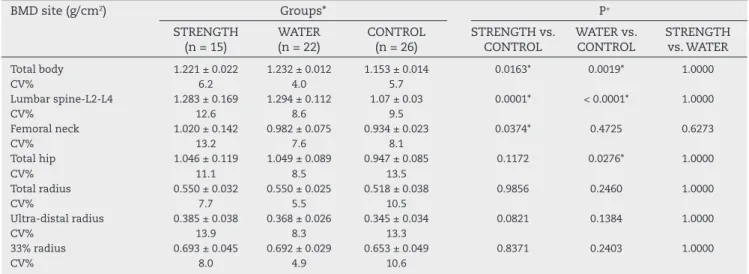
The results of dependent variable BMD in the STRENGTH group was signii cantly higher compared to the CONTROL in total body (5.73%), in the sites lumbar spine, L2-L4 (16.40%) and femoral neck (8.73%), all P < 0.05. However no signii cant difference was found in the other sites (total hip, total radius, ultra-distal radius and 33% radius). The WATER group also showed a signii cantly higher BMD compared to CONTROL group in total body (6.50%) and in the sites lumbar spine, L2-L4 (17.69%) and total hip (9.52%), all P < 0.05. However no sig-nii cant difference was found in the other sites (femoral neck, total radius, ultra-distal radius and 33% radius) (Table 2).
The groups STRENGTH and WATER did not differ regarding the total body BMD and also in all the tested sites (lumbar spine L2-L4; femoral neck; total hip; total radius; ultra-distal radius; 33% radius) (P > 0.05) (Table 2).
group compared with the STRENGTH group (P < 0.05). For other variables, no signii cant difference was detected (all P > 0.05). More details of the percentage of voluntaries with osteoporo-sis, osteopenia and normal are presented in the Table 3.
Discussion
This study aimed to compare the DMO of postmenopaus-al women for at least one year, training for a period of at least one year, and in use of HRT therapy. We compare a STRENGTH group that were resistance-trained with WA-TER group that were weight-bearing-exercise-trained, and both with untrained controls. It was hypothesized that postmenopausal women aquatic-trained with weight bear-ing exercises would have similar BMD as postmenopausal women resistance-trained, and they would have higher BMD than untrained controls. Our hypotheses were coni rmed
data from no signii cant difference between WATER group and STRENGTH group in total body BMD and in any of the evaluated sites. Also the present study coni rms the initial hypothesis that, compared to CONTROL group, WATER pre-sented a higher BMD in lumbar spine L2-L4, total hip sites and in total body. Furthermore, the STRENGTH group pre-sented higher BMD in lumbar spine L2-L4, femoral neck and total body compared with CONTROL group. Additionally the CONTROL group presented signii cant higher percentage of participants with osteopenia in lumbar spine L2-L4 T-score compared with the STRENGTH group.
The present study methodology exclusion criteria pro-vide minimal bias and/or potential confounders aspects that could inl uence in the results of BMD, such as with all par-ticipants, were all postmenopausal, and physical character-istics such BMI, body composition, weight, height and clini-cal conditions, were all similar with HRT. Also, no participant was smoker or had concurrent disease that affects BMD. In addition the STRENGTH and the WATER group were for at least one year trained prior to the study. In addition our new approach revealed that those postmenopausal women who practiced aquatic weight-bearing exercises had similar BMD to that of women who did resistance-trained. The current study is unique in that it is not an intervention study. This is a relevant information because in a cross sectional analysis we can compare different sports and modalities. Moreover, osteogenic responses are associated with specii c and inten-sity loading,4,8 but not with low intensity and/or short time
of intervention.8 Previous studies with WATER exercise had
investigated short time of intervention to bone modulation15
with low intensity14 and with osteopenic women;14 rather, we
compare the total body BMD and BMD in different sites in postmenopausal women STRENGTH group with postmeno-pausal women WATER group, and both with a CONTROL group which was evaluated to data.
Table 2 – Bone mineral density values for resistance-trained group (STRENGTH), aquatic-trained with weight bearing exercises group (WATER) and untrained controls group (CONTROL).
BMD site (g/cm2) Groups* P+
STRENGTH (n = 15)
WATER (n = 22)
CONTROL (n = 26)
STRENGTH vs. CONTROL
WATER vs. CONTROL
STRENGTH vs. WATER
Total body 1.221 ± 0.022 1.232 ± 0.012 1.153 ± 0.014 0.0163* 0.0019* 1.0000
CV% 6.2 4.0 5.7
Lumbar spine-L2-L4 1.283 ± 0.169 1.294 ± 0.112 1.07 ± 0.03 0.0001* < 0.0001* 1.0000
CV% 12.6 8.6 9.5
Femoral neck 1.020 ± 0.142 0.982 ± 0.075 0.934 ± 0.023 0.0374* 0.4725 0.6273
CV% 13.2 7.6 8.1
Total hip 1.046 ± 0.119 1.049 ± 0.089 0.947 ± 0.085 0.1172 0.0276* 1.0000
CV% 11.1 8.5 13.5
Total radius 0.550 ± 0.032 0.550 ± 0.025 0.518 ± 0.038 0.9856 0.2460 1.0000
CV% 7.7 5.5 10.5
Ultra-distal radius 0.385 ± 0.038 0.368 ± 0.026 0.345 ± 0.034 0.0821 0.1384 1.0000
CV% 13.9 8.3 13.3
33% radius 0.693 ± 0.045 0.692 ± 0.029 0.653 ± 0.049 0.8371 0.2403 1.0000
CV% 8.0 4.9 10.6
Values are mean plus or minus ± standard error. + P for comparisons between groups were calculated using ANCOVA (with age, total muscle
mass, fat mass and percentage body fat as covariates). Correction of Bonferroni was used to adjust the pre-specii ed comparisons. * P < 0.05 compared to CONTROL.
CV%, coefi cient of variation percentage (CV% = [SD/O mean] x 100).
Table 1 – Characteristics of resistance-trained group (STRENGTH), aquatic-trained weight bearing exercises group (WATER) and untrained controls group (CONTROL) (mean ± SD).
Variables STRENGTH (n = 15)
WATER (n = 22)
CONTROL (n = 26)
Age (years) 51.4 ± 2.7 54.5 ± 3.3* 52.0 ± 3.4
BMI (kg/m2) 24.0 ± 2.7 24.7 ± 2.7 24.0 ± 3.4
Menopause time (years)
3.3 ± 2.6 5.1 ± 2.5 3.5 ± 2.8
HRT (years) 3.0 ± 1.7 3.8 ± 2.5 4.0 ± 2.8
Training time (years) 4.5 ± 2.0 4.2 ± 2.2 —
*P < 0.05 signii cantly higher than STRENGTH group and CONTROL group.
Some prospective studies had similar results when STRENGTH group was compared with CONTROL group in the total body BMD18 and in the sites total hip sites,7
femo-ral neck8 and also Kelley et al.9 meta-analysis in the spine
L2-L4. Most of these studies involved high intensity proto-cols, what explains the efi ciency of the stimulus on bone progenitor cells. It is possible that, in the present study, no signii cant difference was found between STRENGTH group and WATER group because both methods of training were sufi cient positive to stimulate the BMD. Moreover, in radius sites our results were different of meta-analysis of Kelley et al.,9 although, similar of Bassey et al.19 It seems that this site
requires a more intense stimulus to improve osteogenic re-sponses.4
This is the i rst study to report that the WATER group had a higher total body BMD compared with the CONTROL group. Also, presented higher BMD in spine and total hip when compared with the CONTROL group. Our results are in agreement with those by Tsukahara et al.16 and Rotstein
et al,.15 who demonstrated that the water group also had
similar BMD in spine and total hip compared to the controls. Furthermore, Littrell and Snow (a published conference communication abstract) reported that in a short time study (six months) of aquatic training only preserved BMD in post-menopausal women in all sites, showing that this type of training was useful to maintain bone mass while BMD in the CONTROL group decreased.20
The results of this study agree with the experimental study of Bravo et al.,14 which showed no signii cant
differ-ence in femoral neck BMD of osteopenic women after one year of an aquatic physical activity similar to WATER. Ad-ditionally, Rotstein et al.15 found no signii cant difference
in femoral neck BMD after only seven months of training in healthy postmenopausal women. It is important to remem-ber that DXA provides a static measurement of BMD and, therefore, does not rel ects metabolic activity. To this effect, Ay and Yurtkur13,21 studied bone anabolic (IGF-1 and
calci-tonin) and catabolic (parathormone, PTH) hormone activity
and analyzed BMD using an ultrasound test in postmeno-pausal women after an aquatic training program. The results showed increased levels of calcitonin and IGF-1, improve-ment of the ultrasonography values and decrease of PTH in the experimental group while the opposite happened to the CONTROL group. Thus, it can be stated that aquatic training affects bone metabolism positively.
This is the primary study to analyze forearm radius on the WATER group compared with the CONTROL-group. These results suggest that this strategy of exercise provides little stimulus to the forearm region and perhaps wrist l ex-ion, extension and hand grip exercises are not effective to improve BMD in these sites.
Regarding the BMD in all evaluated sites, there were no signii cant differences between STRENGTH group and WA-TER group. Recently, Tolomio et al.12 did not present signii
-cant differences in femoral neck among postmenopausal women with osteoporosis. The experimental protocol con-sisted of combined land and water exercise program. With resistance training and water weight bearing exercises, were performed combined in two sessions per week, for 11 months.
Most studies associate BMD with resistance exercise due to its specii c and localized effect on body mass.4,5 However,
in the present study, in spite of being signii cantly older than the STRENGTH group (three years), the evaluated sites did not present higher values in STRENGTH group in compari-son to WATER group.
The present study has limitations. Its design was not experimental since researchers do not allocated the par-ticipants in groups. Parpar-ticipants had chosen to exercise (STRENGTH/WATER) or not and then were observed by the investigators. The intervention was not pre-dei ned by the researchers. Consider to include in limitations/pitfalls sec-tion the effect of previous physical activities, especially dur-ing the bone mass acquisition period (up to reach peak bone mass). In conclusion, the i ndings reported herein provide novel evidence that weight-bearing water exercise produces
Table 3 – Percentage of voluntaries with osteoporosis, osteopenia and normal scores according to ISCD, 2005. International Society for Clinical Densitometry. The ISCDs ofi cial positions (updated 2005). Washington: ISCD, 2005.
Variable (T-score) STRENGTH, n(%) WATER, n(%) CONTROL, n(%)
T score: lumbar spine L2-L4 Normal 15 (100) 21 (95) 14 (54)
Osteopenia 0 (0) 1 (5) 9 (35)*
Osteoporosis 0 (0) 0 (0) 3 (11)
T score: femur neck Normal 14 (95) 22 (100) 21 (81)
Osteopenia 1 (5) 0 (0) 4 (15)
Osteoporosis 0 (0) 0 (0) 1 (4)
T score: total hip Normal 14 (95) 22 (100) 19 (73)
Osteopenia 1 (5) 0 (0) 6 (23)
Osteoporosis 0 (0) 0 (0) 1 (4)
T score: ultra-distal radius Normal 13 (87) 17 (77) 14 (54)
Osteopenia 2 (13) 5 (23) 7 (27)
Osteoporosis 0 (0) 0 (0) 5 (19)
T score: 33% radius Normal 13 (87) 20 (91) 15 (58)
Osteopenia 2 (13) 2 (9) 10 (38)
Osteoporosis 0 (0) 0 (0) 1 (4)
T score: total radius Normal 13 (87) 21 (95) 19 (73)
Osteopenia 2(13) 1 (5) 6 (23)
Osteoporosis 0 (0) 0 (0) 1 (4)
a strain stimulus for muscle development and provides contin-uous limb movement against water resistance. These results have important practical implications, suggesting that not only resistance training, but also weight-bearing water exercises could be a nonpharmacological strategy for prevention of BMD loss in postmenopausal women. This information is also im-portant for professionals involved with healthcare and physi-cal exercise, as water exercise is very popular in health centers and tends to pose little risk, but further research is required to provide supporting evidence for this exercise modality.
Conl icts of interest
The authors declare no conl icts of interest.
R E F E R E N C E S
1. Chodzko-Zajko WJ, Proctor DN,
Fiatarone Singh MA, Minson CT, Nigg CR, Salem GJ, et al. American College of Sports Medicine position stand. Exercise and physical activity for older adults. Med Sci Sports Exerc. 2009;41(7):1510-30.
2. Pereira RM, Carvalho JF,
Paula AP, Zerbini C, Domiciano DS, Gonçalves H, et al. Guidelines for the prevention and treatment of glucocorticoid-induced osteoporosis. Rev Bras Reumatol. 2012;52(4):580-93.
3. Gualano B, Pinto AL, Perondi MB,
Roschel H, Sallum AM, Hayashi AP, et al. Therapeutic effects of exercise training in patients with pediatric rheumatic diseases. Rev Bras Reumatol. 2011;51(5):490-6.
4. Kerr D, Morton A, Dick I, Prince R. Exercise effects on bone mass in postmenopausal women are site-specii c and load-dependent. J Bone Miner Res. 1996;11(2):218-25.
5. Dinc H, Savci G, Demirci A, Sadikoglu MY, Tuncel E, Yavuz H. Quantitative computed tomography for
measuring bone mineral density in athletes. Calcif Tissue Int. 1996;58(6):398-401.
6. Karlsson MK, Johnell O, Obrant KJ. Bone mineral density in weight lifters. Calcif Tissue Int. 1993;52(3):212-15.
7. Nelson ME, Rejeski WJ, Blair SN, Duncan PW, Judge JO, King AC, et al. Physical activity and public health in older adults: recommendation from the American College of Sports Medicine and the American Heart Association. Circulation. 2007;116(9):1094-105.
8. Vincent KR, Braith RW. Resistance exercise and bone turnover in elderly men and women. Med Sci Sports Exerc. 2002;34(1):17-23.
9. Kelley GA, Kelley KS, Tran ZV. Resistance training and bone mineral density in women: a meta-analysis of controlled trials. Am J Phys Med Rehabil. 2001;80(1):65-77.
10. Tsourlou T, Benik A, Dipla K, Zafeiridis A, Kellis S. The effects of a twenty-four-week aquatic training program on muscular strength performance in healthy elderly women. J Strength Cond Res. 2006;20(4):811-18.
11. Meredith-Jones K, Waters D, Legge M, Jones L. Upright water-based exercise to improve cardiovascular and metabolic health: a qualitative review. Complement Ther Med. 2011;19(2):93-103. 12. Tolomio S, Lalli A, Travain G, Zaccaria M. Effects of a combined weight-bearing and non-weight-bearing (warm water) exercise program on bone mass and quality in postmenopausal women with low bone-mineral density. Clin Ter. 2009;160(2):105-9. 13. Ay A, Yurtkuran M. Evaluation of hormonal response and ultrasonic changes in the heel bone by aquatic exercise in sedentary postmenopausal women. Am J Phys Med Rehabil. 2003;82(12):942-9.
14. Bravo G, Gauthier P, Roy PM, Payette H, Gaulin P. A weight-bearing, water-based exercise program for osteopenic women: its impact on bone, functional i tness, and well-being. Arch Phys Med Rehabil. 1997;78(12):1375-80.
15. Rotstein A, Harush M, Vaisman N. The effect of a water exercise program on bone density of postmenopausal women. J Sports Med Phys Fitness. 2008;48(3):352-59.
16. Tsukahara N, Toda A, Goto J, Ezawa I. Cross-sectional and longitudinal studies on the effect of water exercise in controlling bone loss in Japanese postmenopausal women. J Nutr Sci Vitaminol (Tokyo). 1994;40(1):37-47.
17. Gandevia B, Tovell A. Declaration of Helsinki. Med J Aust. 1964;2:320-1.
18. Notelovitz M, Martin D, Tesar R, Khan FY, Probart C, Fields C, et al. Estrogen therapy and variable-resistance weight training increase bone mineral in surgically menopausal women. J Bone Miner Res. 1991;6(6):583-90.
19. Bassey EJ, Ramsdale SJ. Weight-bearing exercise and ground reaction forces: a 12-month randomized controlled trial of effects on bone mineral density in healthy postmenopausal women. Bone. 1995;16(4):469-76.
20. Littrell TR, Snow CM. Bone Density and Physical Function in Postmenopausal Women after a 12-month Water Exercise Intervention. Abstract conference of Med Sci Sports Exerc. 2004;5:289-90.