Brazilian Journal of Physics, vol. 29, no. 3, September, 1999 489
Integrated Oscillator Strength for the Ar8
+
Formation from the Neutral Atom by Electron Impact
D. P. Almeida and L. A. Geronimo
Departamento de Fsica Universidade Federal de Santa Catarina
88.040-970 - Florianopolis, SC, Brazil
Received 25 March, 1999. Revised version received on 29 April, 1999
By tting the Bethe formula to experimental data available in the literature, we determined the integrated oscillator strength for the Ar8+formation by electronic collision on neutral Argon. The
results are compared with a previous empirical calculation and with a set of experimentally obtained multiple ionisation data.
I Introduction
The multiple ionisation reaction is a typical many-body problem. This is a class of processes where the Born approximation cannot be directly applied. However, semi-empirical expressions, usually based on the Bethe formula, have been used to describe the multiple ionisa-tion reacionisa-tion by electron impact within acceptable ac-curacy [1-3]. Considering the nature of the Coulomb in-teraction, the understanding of the mechanism relevant for multiple ionisation by electron impact promises im-portant insight into electron correlation problem. This electronic correlation may reveal information about the structure of atoms and the dynamics of the collision mechanism.
Multiple ionisation cross sections (MICS) of atoms can be an appropriate tool to estimate optically al-lowed transition data [4]. The dependence of the cross section on the impact velocity shows distinct regions, where the Born approximation may or may not be sup-ported, which are usually associated to two mechanism, optically allowed and optically forbidden processes. In most cases, both mechanisms are found to be of com-parable magnitude in the asymptotic regime. There-fore, neither mechanism alone can explain the observed energy dependence. Hence, combining amplitudes for both processes may give a better description of the cross section behaviour as a function of the impact energy. MICS may result from two distinct processes:
inner-shell ionisation with subsequent secondary electronic ejection, and outer-shell ionisation with simultaneous emission of n electrons. It is very complicated to detect all the products of the reaction in coincidence, in or-der to identify unequivocally the reaction channel. Up to date, only (e,2e) and (e,3e) experiments are possi-ble [5], where two or three emerging electrons can be collected after the collision. Therefore, the photoioni-sation data can be helpful to investigate the multiple ionisation channels by electron impact.
490 D. P. Almeida and L. A. Geronimo the dierent reaction channels that contributed to the
measured IOS, it can be compared with the photoioni-sation cross section for ejection of a particular electron and the probability of formation of the nal charged state n.
In the present work, we used the experimental data published in reference [10]. These data were acquired over the incident energy range from 1700 to 3000eV, under a single collision regime, with an uncertainty of about 18%. The static gas target technique was em-ployed [11]. The nal charged state of the target was identied using the time-of-ight spectrometry tech-nique. The multiple ionisation cross section for Ar8+, presented by Almeida and co-workers [10], does not have enough experimental points, above the maximum region, for an accurate Fano-plot [12] (plot of the prod-uct E
8+ against logE) of the asymptotic cross section portion. Nevertheless, the Bethe formula may be di-rectly tted to the experimental points, leading a rea-sonable prediction of the integrated oscillator strength (IOS) for the process.
II Results and discussion
The multiple ionisation reaction is given by
e ,+
Ar!Ar 8++ 9
e ,
: (1)
The MICS can be estimated in good agreement by the Bethe formula [13] as a function of the incident energy. This expression derives from an ab initio quantum-mechanical theory where the terms are directly iden-tied.
The cross section is given by
n= 4
a 2 0
R E
M 2 8+ln
E R
+
8+
R E
+C 8+
: (2) wherea
0 is the rst Bohr radius of the hydrogen atom (0.529 Angstrom),R is the Rydberg energy (13.6eV), M2
8+ is the integrated oscillator strength,
8+ is a low energy correction and C8+ stands for high order terms associated with optically forbidden transitions.
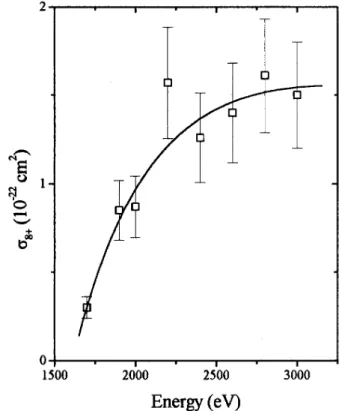
In order to determine the IOS, it was assumed that the multiple ionisation cross section could be repre-sented by equation (2) in the observed energy range. The MICS has been tted through a least-squares
method. The resulting t is shown in Fig. 1 along with the original data.
Figure 1. Fitting procedure of the electron-impact ionisa-tion cross secionisa-tion 8+as a function of the incident energy. Experimental data from reference [10].
Since the term M2
8+ appears explicitly in equation 2 this value can be directly estimated. The result is M
2 8+= (1
:50:3)10
,6. The total uncertainties in the present value arise from the statistical accuracy of the experimental data and the tting procedure described above added quadratically.
Brazilian Journal of Physics, vol. 29, no. 3, September, 1999 491 n higher than 5. The empirical formula [14], based on
such a small number of experimental measurements as input and with only four adjustable parameters, can-not describe accurately the absolute values of IOS for high n where the indirect processes may have relevant contributions. M2
8+determined in this paper, shows to be in good accordance with the previous experimental data set. It must be stressed that these experimental values of M2
8+ presented in Fig. 2 cover six orders of magnitude.
Figure 2. Integrated Oscillator Strength (M 2
n) of multiple
ionised Argon as a function of the target nal charged state:
present result; data from reference [4]; * data from
reference [10];data from reference [11]; + data from
ref-erence [15]; | empirical model from refref-erence [14].
III Conclusions
The purpose of this work was to estimate the integrated oscillator strength from experimental data for multiple ionisation reaction of a neutral atom by electron im-pact. The determined IOS gives a good agreement with the expected behaviour of experimental data available in the literature. The prediction from the empirical ex-pression is about a factor ten higher than the present value.
Although low degree multiple ionisation data by electron impact have been exhaustively measured and analysed, much less are available for n > 4. To the
author's knowledge this is the rst estimation of IOS for 8-fold ionisation of Argon by electron collision. The M2
8+ presented here, even with its large uncertainty, seems to provide a reliable guide to discuss the origin of the ejected electrons during the collision.
Acknowledgements
This work has been supported in part by Conselho Nacional de Desenvolvimento Cientco e Tecnologico (CNPq).
References
1. H. Deutsch and T.D. Mark, Int. J. Mass Spec-trom. and Ion Process79 (1987) R1. See also, H. Deutsch, K. Becker, P. Scheier and T. D. Mark, \Calculated Cross Sections for Double and Triple Ionisation of Atoms by Electron Impact". XIX International Conference on the Physics of Elec-tronic and Atomic Collisions, contributed paper page 509, Canada 1995.
2. W. V. Fisher, V. Y. Ralchenco, Y. Maron, A. Goldgirsh and D. Fisher, J. Phys. B 28, 3027 (1995).
3. V. P. Shevelko and H. Tawara, J. Phys. B 28, L589 (1995).
4. M. J. Van der Wiel, Th. M. El-Sherbini and L. Vriens, Physica42, 411 (1969).
5. A. Lahamam-Bennani, J. Phys. B 24, 2401 (1992). A. Lahamam- Bennani, H. Ehrhardt, C. Dupre and A. Duguet, J. Phys. B At. Mol. Opt. Phys. 24, 3645 (1992).
6. G. R. Wright and M. J. Van der Wiel, J. Phys. B At. Mol. Opt. Phys. 9, 1319 (1976).
7. E. J. McGuire, Phys. Rev. A 3, 267 (1971). 8. L. Vriens, Physica31, 385 (1965).
9. Y. K. Kim and M. Inokuti, Phys. Rev. 175, 176 (1968).
10. D.P. Almeida, K.H. Becker and H. Deutsch, Int. J. Mass Spectrom and Ion Proc. 163, 39 (1997). 11. D.P. Almeida, A.C. Fontes, I. S. Mattos and
C.L.F. Godinho, J. Electron Spectrosc. Relat. Phenom. 67, 503 (1994).
12. M. Inokuti, Rev. Mod. Phys. 43, 297 (1971). 13. ibiden. See also M. Inokuti, Y. Itikawa and J. E.
Turner, Rev. Mod. Phys. 50, 23 (1978).