http://dx.doi.org/10.1590/S1984-46702013000500004
Chiroptera is the second largest order of mammals (KALKO 1998). In tropical forests, this group accounts for nearly 40 to 50% of the total mastofauna, thus strongly affecting richness and diversity patterns (ESTRADA & COATES-ESTRADA 2001). More-over, bats occupy a variety of trophic niches, including frugivore, nectarivore, carnivore, sanguivore, piscivors, and insectivore species (FLEMINGet al. 1972). Due to their consider-able feeding plasticity, this group interacts with a broad spec-trum of organisms (BERNARD & FENTON 2007), playing a fundamental role in the maintenance of ecological processes (KALKO 1998, BERNARD 2001, FALCÃOet al. 2003).
Because of the great ecological importance of bat assem-blages, several studies have been conducted focusing on their structure (FLEMINGet al. 1972, AGUIRRE 2002, ESBÉRARD 2003, BER -NARD & FENTON 2007), particularly with the goal of understand-ing the factors that allow for the coexistence of such a diverse fauna (HEITHAUSet al. 1975, REIS 1984, PEDRO & TADDEI 1997, BER
-NARD 2001, LOU & YURRITA 2005 SILVAet al. 2008). Out of the factors that have been invoked in promoting diversity, verti-cal stratification in assemblage composition has gained increas-ing attention (e.g., KALKO 1998, BERNARD 2001).
Vertical stratification of assemblages has been observed in many animal groups, including invertebrates (e.g., FERMON et al. 2005, GONÇALVES & LOUZADA 2005, MARTINS & SOUZA 2005, HIRST 2007), and vertebrates (e.g., PASSAMANI 2000, PREVEDELLOet al. 2008). Among the latter, bird assemblages offer good ex-amples of vertical stratification, given that they form clusters of species that occur predominantly at the ground level, on the canopy, and at intermediate levels (e.g., PEARSON 1971, DONATELIIet al. 2007).
In the case of bats, studies on vertical stratification also demonstrate the existence of differences in richness and abun-dance among strata, both for Megachiroptera (FRANCIS 1994, ZUBAID 1994, HENRYet al. 2004, HODGKISONet al. 2004), and in
Vertical structure of an assemblage of bats (Mammalia: Chiroptera) in a
fragment of Atlantic Forest in Southern Brazil
Fernando Carvalho
1,4, Marta E. Fabián
2& João O. Menegheti
31 Programa de Pós-Graduação em Zoologia, Departamento de Zoologia, Universidade Federal do Paraná. Caixa Postal 19020, 81531-980 Curitiba, PR, Brazil.
2 Departamento de Zoologia, Instituto de Biociências, Universidade Federal do Rio Grande do Sul. Avenida Bento Gonçalves 9500, prédio 43435, 91501-970 Porto Alegre, RS, Brazil.
3 Especialista associado Sul América Programa de Wetlands International. 4 Corresponding author. E-mail: [email protected]
ABSTRACT.Few studies have focused the vertical structure of bat assemblages, and how it influences community com-position.The goal of this study was to analyze the vertical structure of an assemblage of bats in a forest fragment in southern Brazil. Bats were sampled using mist-nets placed at three heights (understory, below-canopy, and canopy). Forest strata were compared with respect to their species richness and diversity. The latter was estimated using the Shannon-Wiener index (H’), and the statistical significance of differences among strata was assessed using t tests. We used an index of Constancy (C) to determine the frequency of a given species in each vegetation stratum, such that a species was considered as “frequent” (C ⭓ 50), “less frequent” (25 ⭐ C < 50) and “occasional” (C < 25). We captured 485 bats belonging to two families and 24 species. In the understory layer, we captured 173 individuals in 13 species, which resulted in a diversity index of H’ = 1.981. In the under-canopy, 153 individuals were caught in 18 species and the resulting diversity index was H’ = 2.509. Finally, in the canopy, 159 bats were caught, in 22 species, with the resulting diversity index of H’ = 2.442. In the understory and in the canopy, only one species – Artibeus lituratus (Olfers, 1818) – was classified as “frequent.” Four species – A. lituratus, Sturnira lilium (É. Geoffroy, 1810), Anoura geoffroyi Gray, 1838, and Eptesicus diminutus Osgood, 1915 – were classified as “less frequent” in the under-canopy stratum. All other species recorded in each stratum were classified as “occasional.” The studied bat assemblage showed vertical stratification, with the higher strata harboring increased diversity. Our study shows how important it is to sample the upper levels of a forest fragment to obtain a more representative understanding of the use of space by a bat assemblage.
Microchiroptera (BERNARD 2001, LIM & ENGSTROM 2001, SAMPAIO et al. 2003, REXet al. 2008, PEREIRAet al. 2010). These differences allow some species to be classified as canopy, sub-canopy, or understory specialists (FLEMINGet al. 1972). However, this divi-sion does not imply that these species only use a single stra-tum (KALKO & HANDLEY 2001), but rather that they show preference for a given one (SAMPAIOet al. 2003).
Even though having a general knowledge of bat com-munity composition and biology is important to understand the factors that regulate communities, comparatively few stud-ies have addressed the vertical structure of tropical bat assem-blages (e.g., ALMANSAet al. 1982, FRANCIS 1994, ZUBAID 1994, KALKO & HANDLEY 2001, LIM & ENGSTROM 2001, HENRY et al. 2004, HODGKISONet al. 2004, REXet al. 2008). In part, this limitation is due to the logistic difficulties associated with sampling cano-pies (LIM & ENGSTROM 2001).
Likewise, there are few studies in Brazil that focus on the vertical stratification of bat assemblages (e.g., BERNARD 2001, KALKO & HANDLEY 2001, SAMPAIOet al. 2003, PEREIRAet al. 2010), and the available studies are restricted to the Amazon region. Studies sampling the upper strata of in the Atlantic rainforest, by contrast, have focused only on the compilation of lists of species and their occurrences, with little discussion about the vertical differences in assemblage composition (e.g., ESBÉRARD et al. 2006, FARIA 2006, LOURENÇO et al. 2010). According to LOWMAN & WITTMAN (1996), this information gap is of particu-lar concern because making inferences on ecological aspects based on sampling restricted to the understory can result in misleading generalizations and, in many cases, in underesti-mates of the true diversity and abundance of organisms.
Therefore, the goal of the present study was to analyze the differences in vertical structure of the bat assemblage present in a remnant of Atlantic rainforest in the south of the state of Santa Catarina, southern Brazil.
MATERIAL AND METHODS
This study was carried out in a fragment of forest located in the municipality of Pedras Grandes (28°29’01"S, 49°15"19"W), southern state of Santa Catarina (Fig. 1), in a nearly-7-ha area covered mostly by Dense Ombrophilous Forest (VELOSOet al.
1992). Floristically, the fragment is composed of areas in early secondary stages of regeneration, in which the canopy may reach 8 to 10 m in height, and other areas where the vegetation is in a late secondary stage and the canopy reaches from 12 to 20 m. The landscape matrix surrounding the studied fragment is com-posed of areas used in agriculture, cattle ranching, and native forest fragments. According to the classification of Köeppen, the local climate is Cfa (subtropical temperate).
Bat sampling was conducted using mist-nets in three vertical strata of the vegetation: understory GI – set of five mist nets (one of them with dimensions 14 x 2.5 m, two with 9.0 x 2.5 m and two with 7.0 x 2.5 m) placed up to 3 m above
the ground; below-canopy GII – with five mist nets (one of them with 12 x 3 m, two with 9 x 3 m, and two with 6 x 3 m), placed from 4 to 8 m above the ground; canopy GIII – set of five mist nets (one of them with 12 x 3m, two with 9 x 3m, and two with 6 x 3m), placed higher than 9 m above the ground. We elevated the mist nets using the technique de-scribed by CARVALHO & FABIÁN (2011a).
We sampled the GI from July 2005 to July 2007, one to two nights per month, for a total of 39 nights. In the case of GII and GIII, sampling took place between October 2009 and September 2010, two to three nights per month, and a total of 35 nights. In GI, GII, and GIII, the corresponding mist-nets remained open for six hours starting at sunset, and being ex-amined every 20 to 40 minutes. Despite the small difference in the number of nights sampled and the size of the mist-nets, the total sampling effort was similar in each stratum, resulting in 26,910 m2.h in the GI and 26,460 m2.h in GII and GIII. Sam-pling effort was calculated based on the prepositions of STRAUBE & BIANCONI (2002).
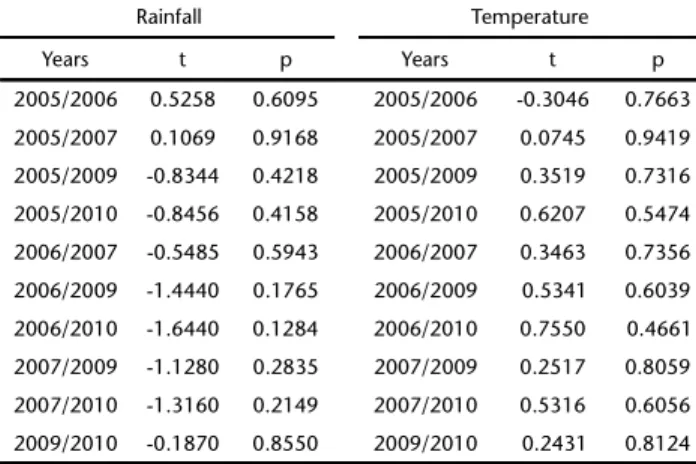
Rainfall and temperature have been documented as im-portant factors in shaping the composition of bat assemblages, affecting mainly the availability of food resources and conse-quently the abundance of species (e.g., HEITHAUSet al. 1975, FALCÃOet al. 2003, MELLOet al. 2008). According to a Student’s t test for paired samples (a = 0.05), using the software PAST (HAMMERet al. 2001), the differences between the monthly ave-rages of these variables for the two sampling periods were not
significant (Table I). Therefore, we concluded that rainfall and temperature averages were similar between sampling periods, thus justifying pooling both years into the same analysis. Cli-matic data were obtained from the Company for Agricultural Research and Rural Extension of Santa Catarina (EPAGRI).
RESULTS
We captured a total of 485 bats over the course of 74 nights (total sampling effort of 79,830 m2.h), resulting in a capture success of 0.0060 captures/m2.h. We identified two fami-lies, 15 genera and 24 species (Table II).
Table I. Comparison of average monthly temperature and rainfall during the present study using Student’s t test for paired samples.
Rainfall Temperature
Years t p Years t p
2005/2006 0.5258 0.6095 2005/2006 -0.3046 0.7663
2005/2007 0.1069 0.9168 2005/2007 0.0745 0.9419
2005/2009 -0.8344 0.4218 2005/2009 0.3519 0.7316
2005/2010 -0.8456 0.4158 2005/2010 0.6207 0.5474
2006/2007 -0.5485 0.5943 2006/2007 0.3463 0.7356
2006/2009 -1.4440 0.1765 2006/2009 0.5341 0.6039
2006/2010 -1.6440 0.1284 2006/2010 0.7550 0.4661
2007/2009 -1.1280 0.2835 2007/2009 0.2517 0.8059
2007/2010 -1.3160 0.2149 2007/2010 0.5316 0.6056
2009/2010 -0.1870 0.8550 2009/2010 0.2431 0.8124
The bats captured were placed in individual cotton bags, labeled with their collecting data (time and vertical stratum of vegetation) and taken to the field laboratory. After that, we released every individual in the same place where it had been captured. Taxonomic identification was based on TADDEIet al. (1998), BARQUEZet al. (1999), VELAZCO (2005), GARDNER (2007), and BARQUEZ & DÍAZ (2009). The specimens collected, including those unidentified, were deposited in the collection of mam-mals from the Department of Zoology, Universidade Federal do Rio Grande do Sul (UFRGS, Appendix 1). The permit to sample bats was provided by the Chico Mendes Institute for Conservation of Biodiversity, number 11528-1 SISBIO (sam-pling up to 2007) and number 22648-1 SISBIO (sam(sam-pling up to 2010).
We compared the three strata with respect to richness and diversity of bat assemblages. Species diversity in each stra-tum was estimated using the Shannon-Wiener index (H’). A Student’s test (a = 0.05) was used to test for differences in H’ among strata. Species accumulation curves were constructed for each stratum based on the rarefaction method. For both calculations we used the software PAST (HAMMERet al. 2001).
We determined the frequency of species in each stratum using the index of Constancy (C) proposed by SILVEIRA-NETOet al. (1976), which takes into consideration the number of nights that the taxa were recorded in relation to the total number of samples. Based on the interval of variation of this Index, spe-cies were classified as “frequent” (C ⭓ 50), “less frequent” (25
⭐ C < 50), and “occasional” (C < 25).
Table II. Distribution of bat captures among the three vegetation strata sampled in a forest fragment in southern Brazil. (GI) Understory, (GII) below-canopy, (GIII) canopy, (N) total number of captures.
Taxa Sampled strata N
GI GII GIII
Phyllostomidae
Carolliinae
Carolliaperspicillata (Linnaeus, 1758) 29 8 1 38
Desmodontinae
Desmodusrotundus (É. Geoffroy, 1810) 6 3 2 11
Diphyllaecaudata Spix, 1823 – – 1 1
Glossophaginae
Anouracaudifer (É. Geoffroy, 1818) 10 6 5 21
Anourageoffroyi Gray, 1838 6 20 16 42
Glossophagasoricina (Pallas, 1766) – – 2 2
Phyllostominae
Chrotopterusauritus (Peters, 1856) – 1 – 1
Mimonbennettii(Gray, 1838) 6 1 1 8
Stenodermatinae
Artibeusfimbriatus Gray, 1838 2 14 18 34
Artibeuslituratus(Olfers, 1818) 68 27 37 132
Artibeusobscurus (Schinz, 1821) 5 7 10 22
Platyrrhinusrecifinus (Thomas, 1901) – – 1 1
Pygodermabilabiatum (Wagner, 1843) 0 6 5 11
Sturniralilium (É. Geoffroy, 1810) 18 23 29 70
Sturniratildaede la Torre, 1959 – 1 – 1
Vampyressapusilla (Wagner, 1843) – – 1 1
Vespertilionidae
Myotinae
Myotisdinellii Thomas, 1902 – – 1 1
Myotisnigricans (Schinz, 1821) 11 2 3 16
MyotisripariusHandley, 1960 1 7 4 12
Myotisruber (É. Geoffroy, 1806) 9 7 6 22
Vespertilioninae
Eptesicusbrasiliensis (Desmarest, 1819) – 1 1 2
Eptesicusdiminutus Osgood, 1915 2 13 10 25
Eptesicusfurinalis (d'Orbigny, 1847) – 6 4 10
Lasiurusblossevillii (Lesson, 1826) – – 1 1
Number of captures 173 153 159 485
In the understory, we captured 173 bats (35.67% of all samples) in 13 species. None was found exclusively in this stra-tum and its diversity index was H’ = 1.981. In the below-canopy, we captured 153 bats (31.55% of all samples) in 18 species. The diversity index was H’ = 2.509. Chrotopterus auritus (W. Peters, 1856) and Sturnira tildae de la Torre, 1959 were only captured in this stratum, although only one individual of each species was captured. In the canopy, we captured 159 bats (32.78% of all samples) of 22 species. The diversity index was H’ = 2.442.
Diphylla ecaudata Spix, 1823, Platyrrhinus recifinus (O. Thomas, 1901), Vampyressa pusilla (J.A. Wagner, 1843), Glossophaga soricina
(Pallas, 1766), Myotis dinellii Thomas, 1902 and Lasiurus blossevillii
(Lesson, 1826) were only captured in the canopy. However, with the exception of G. soricina, all remaining species were repre-sented by a single individual.
The understory had significantly lower diversity than the below-canopy (t = -5.007, p < 0.0001) and the canopy (t = 3.7799, p = 0.0001), whereas no significant differences were detected between below-canopy and the canopy (t = 0.7508, p = 0.45337). The differences observed in terms of richness and diver-sity among the strata are also reflected in richness estimates. The understory accumulation curve showed a strong tendency to an asymptote. This pattern was different from that observed for the other strata, in which accumulation curves showed no tendency to asymptotic behavior (Fig. 2).
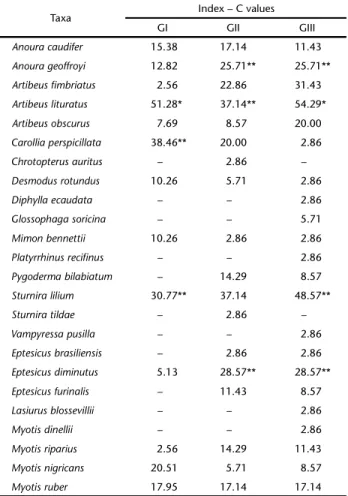
categorized as “frequent” in the canopy (A. lituratus), whereas four species were classified as “less frequent” (Artibeus fimbriatus
Gray 1838, S. lilium, A. geoffroyi,and Eptesicus diminutus Osgood, 1915). The occurrence of other species in each stratum was classified as “occasional” (Table III).
Based on the index of Constancy (C), we identified one species classified as “frequent” (Artibeus lituratus (Olfers, 1818)) in the understory, and two other species were considered as “less frequent” (Sturnira lilium (É. Geoffroy, 1810)and Carollia perspicillata (Linnaeus, 1758)). We only categorized three spe-cies as “less frequent” in the below-canopy (A. lituratus, S. lilium
and Anoura geoffroyi Gray, 1838). Finally, only one species was
Figure 2. Accumulative curves of species based on the rarefaction method for sampling performed at the level of the understory, be-low-canopy and canopy remnant of Atlantic Forest in southern Brazil.
Table III. Index of Constancy (C) proposed by SILVEIRA-NETOet al. (1976) of taxa sampled in each vegetation strata of a forest fragment in southern Brazil. (GI) Understory, (GII) below-canopy, (GIII) canopy.
Taxa Index – C values GI GII GIII
Anoura caudifer 15.38 17.14 11.43
Anoura geoffroyi 12.82 25.71** 25.71**
Artibeus fimbriatus 2.56 22.86 31.43
Artibeus lituratus 51.28* 37.14** 54.29*
Artibeus obscurus 7.69 8.57 20.00
Carollia perspicillata 38.46** 20.00 2.86
Chrotopterus auritus – 2.86 –
Desmodus rotundus 10.26 5.71 2.86
Diphylla ecaudata – – 2.86
Glossophaga soricina – – 5.71
Mimon bennettii 10.26 2.86 2.86
Platyrrhinus recifinus – – 2.86
Pygoderma bilabiatum – 14.29 8.57
Sturnira lilium 30.77** 37.14 48.57**
Sturnira tildae – 2.86 –
Vampyressa pusilla – – 2.86
Eptesicus brasiliensis – 2.86 2.86
Eptesicus diminutus 5.13 28.57** 28.57**
Eptesicus furinalis – 11.43 8.57
Lasiurus blossevillii – – 2.86
Myotis dinellii – – 2.86
Myotis riparius 2.56 14.29 11.43
Myotis nigricans 20.51 5.71 8.57
Myotis ruber 17.95 17.14 17.14
* = Frequent species (C ⭓ 50); ** = Less frequent species (25 ⭐ C < 50).
DISCUSSION
HENRYet al. 2004, PEREIRAet al. 2010). The maintenance of this pattern in the Atlantic rainforest environment, where the up-per strata are so close to the lower ones (ca. 15-20 m) when compared to the Amazon rainforest (ca. 35-40 m), can be in-terpreted as an indication that it is common among bat as-semblages.
The presence of this vertical structure has also a general implication for studies on bad diversity, given that most of them aim to sample the lower strata (SCULTORIet al. 2008). Specifically for the forest fragment sampled in this study, if only data from the understory was considered, 54.1% of the total richness of the area would be sampled, thus underestimating local richness in nearly 46%. BERGALLOet al. (2003) underscored the need to use different methods to obtain complete inventories of bat fau-nas. In the specific case of studies using only mist nets, sam-pling different strata seems to contribute to more complete surveys (SIMONS & VOSS 1998, SAMPAIOet al. 2003), thus demon-strating the importance of sampling different strata, as pointed out by LOWMAN & WITTMAN (1996) and KALKO & HANDLEY (2001).
Based on the constancy index of SILVEIRA-NETOet al. (1976) (C), it was possible to identify species that are more frequent in specific strata. This suggests a more common use of these environments. In general, the differential use of strata is asso-ciated with aspects of the bat’s diet, foraging mode, vegetation structure, and shelter usage (BONACCORSO 1979, KALKO & HANDLEY 2001, PEREIRAet al. 2010, JUNGet al. 2012). At least for species considered as constant and/or accessory, these factors seem to explain the variation observed in the present study.
Artibeus lituratuswas classified as a constant and/or ac-cessory species in all three strata, indicating the broad use of space by this species. Artibeus lituratus mostly feeds on fruits that are available in the canopy, particularly Ficus and Cecropia
(e.g., GALLETI & MORELLATO 1994, PASSOSet al. 2003). KALKO (1998) pointed out that species of Artibeus frequently use lower strata as transit areas between diurnal shelters and feeding sites. As a consequence, the use of upper strata as foraging sites and lower strata as transit areas can explain the data observed in the present study, as well as corroborate the results of LIM & ENGSTROM (2001), who consider A. lituratus as being a generalist species with respect to stratum use.
Sturnira lilium was classified as less frequent species in all three forest strata, also indicating a broad use of the vertical space. This species feeds preferentially on fruits of shorter trees (e.g., PASSOSet al. 2003, MELLOet al. 2008), which are available particularly in the understory, but it also feeds on fruits avail-able in the upper strata, such as the fruits of the Billbergia,
Ficus, and Cecropia (FABIÁNet al. 2008, CARVALHOet al. 2009a). With respect to shelters, S. lilium uses preferentially leaves of tall trees (EVELYN & STILES 2003), which correspond to the canopy. The preferential consumption of food items from the lower strata and the use of the diurnal shelters available in the upper strata corroborate the hypothesis that this species is a general-ist with respect to the use of strata.
Carollia perspicillata was categorized as constant only in the understory, confirming other studies that place this spe-cies as a preferential occupant of the lower stratum (e.g., BONACCORSO 1978, BERNARD 2001, KALKO & HANDLEY 2001). Carollia perspicillata and S. lilium also feed preferentially on fruits of shorter trees (e.g., MELLOet al. 2004), and prefer shelters lo-cated at the lower strata (HEITHAUS & FLEMING 1978, CLOUTIER & THOMAS 1992). Thus, the use of both feeding resources and shel-ters in the lower strata can explain the spatial distribution of this species.
Eptesicus diminutus was categorized as constant in the sub-canopy and the sub-canopy, which also indicates that it uses the upper strata more frequently. This finding is consistent with the foraging mode and diet of this species, which is a flying insectivore (BIANCONI & PEDRO 2007). Moreover, the fewer cap-ture events of E. diminutus at the sub-canopy when compared with the upper strata, as recorded in the present study, is in agreement with data obtained in surveys carried out exclusively at the ground level in other studies (e.g., ESBÉRARD 2003, FALCÃO et al. 2003, CARVALHOet al. 2009b), which report this species as infrequent. Of all species classified in the present study as rare in all three sampled strata, most are restricted to the sub-canopy and canopy, belonging particularly to the subfamily Stenodermatinae. Members of this subfamily preferentially occupy the upper strata (PEREIRAet al. 2010), being classified as “canopy frugivores” (FLEMINGet al. 1972, BONACCORSO 1978). According to DUMONT (2005), representatives of this group are adapted to consume Ficus spp. fruits, which are present in high abundance in the area of the present study.
In the case of vespertilionid species, the highest richness was observed in the upper strata (canopy and sub-canopy, N = 8 spp.) when compared to the understory (N = 4 spp.). A simi-lar pattern was observed by SAMPAIOet al. (2003), who also ob-served a larger number of insectivore species in the canopy. Species of Vespertilionidae are usually not well sampled in stud-ies with mist nets set up at the ground level in locations throughout Brazil (e.g., SIPINSKI & REIS 1995, BERNARD & FENTON 2007, ESBÉRARD 2003, REISet al. 2003, BORDIGNON 2006, DIAS & PERACCHI 2008), which is commonly explained by tthe fact that these bats are more likely to detect the nets (PEDRO & TADDEI 1997). However, the data obtained in the present study dem-onstrate that, in addition to net detection, the frequent use of the upper strata might also explain the low representation of the family in surveys carried out at the ground level.
address-ing aspects related to the vertical structure of assemblages pro-vide a better understanding of the diversity in a given region, given that they yield more complete surveys.
ACKNOWLEDGMENTS
We thank CAPES for the Master’s scholarship provided to F. Carvalho between 2009-2010, and CNPQ for the doctoral scholarships provided to F. Carvalho. We also thank A. Karolina S. Souza, Poliana B. Peres, Rodrigo Á. Mendonça, Rildo V. Gonçalves and Flávia V. Fonceca for assistance during field work.
LITERATURE CITED
AGUIRRE, L.F. 2002. Structure of a neotropical savanna bat community. Journal of Mammalogy 83 (3): 775-784. ALMANSA, J.C.; L.M.A. MARTINEZ & C.I. ULARGUI. 1982. Uso del
espacio y movimientos en una comunidad de quiropteros neotropicales. Historia Natural2 (21): 177-190.
BARQUEZ, R. M. & M.M. DÍAZ. 2009. Los murciélagos de Argen-tina: Clave de Identificación. Tucumán, 1+80p.
BARQUEZ, R.M.; M.A. MARES & J.K. BRAUN. 1999. Bats of Argenti-na. Special Publications Museum of Texas Tech University 42: 1-275.
BERGALLO, G.H.; CE.L. ESBÉRARD; M.A.R. MELLO; V. LINS; R. MANGOLIN; G.S.S. MELO & M. BAPTISTA. 2003. Bat Species Richness in Atlantic Forest: What Is the Minimum Sampling Effort? Biotropica35 (2): 278-288.
BERNARD, E. 2001. Vertical stratification of bat communities in primary forests of Central Amazon, Brazil. Journal of Tro-pical Ecology17: 115-126.
BERNARD, E. & M.B. FENTON. 2007. Bats in a fragmented landscape: Species composition, diversity and habitat interactions in savannas of Santarém, Central Amazonia, Brazil. Biological Conservation34: 332-343.
BIANCONI, G. & W.A. PEDRO. 2007. Família Vespertilionidae, p. 167-195. In:N.R. REIS; A.L. PERACCHI; W.A. PEDRO & I.P. LIMA (Eds). Morcegos do Brasil. Londrina, Universidade Estadu-al de Londrina, 253p.
BONACCORSO, F.J. 1979. Foraging and Reproductive Ecology in a Panamanian Bat Community. Bulletin of the Florida State Museum. Biological Sciences24 (4): 359-408.
BORDIGNON, M.O. 2006. Diversidade de morcegos (Mammalia, Chiroptera) do Complexo Aporé-Sucuriú, Mato Grosso do Sul, Brasil. Revista Brasileira de Zoologia 23 (4): 1002-1009. CARVALHO, F. & M.E. FABIÁN. 2011a. Método de elevação de redes de neblina em dosséis florestais para amostragem de mor-cegos (Mammalia; Chiroptera). Chiroptera Neotropical17 (1): 795-802.
CARVALHO, F. & M.E. FABIÁN. 2011b. Mammalia, Chiroptera, Phyllostomidae, Platyrrhinus recifinus (O. Thomas, 1901): first record in the state of Santa Catarina, Southern Brazil. Check-List7 (2): 139-141.
CARVALHO, F., M.E. FABIÁN & R.A. MENDONÇA 2009a. Nota sobre o consumo de frutos de Billbergia zebrina (Bromeliaceae) por
Sturnira lilium (Chiroptera: Phyllostomidae) no sul do Bra-sil. Chiroptera Neotropical15 (2): 482-486.
CARVALHO, F.; J.J. ZOCCHE & R.A. MENDONÇA. 2009b. Morcegos (Mammalia, Chiroptera) em restinga no município de Jaguaruna, sul de Santa Catarina, Brasil. Revista Biotemas 22 (3): 193-201.
CLOUTIER, D. & D.W. THOMAS. 1992. Carollia perspicillata. Mamma-lian Species417: 1-9.
DIAS, D. & A.L. PERACCHI. 2008. Quirópteros da Reserva Biológi-ca do Tinguá, estado do Rio de Janeiro, sudeste do Brasil (Mammalia: Chiroptera). Revista Brasilera de Zoologia 25 (3): 333-369.
DONATELLI, R.J.; C.D. FERREIRA; A.C. DALBETO & S.R. POSSO. 2007. Análise comparativa da assembléia de aves em dois rema-nescentes florestais no interior do Estado de São Paulo, Bra-sil. Revista Brasileira de Zoologia 24 (2): 362-375. DUMONT, E.R. 2005. Bats and Fruit: na ecomorphological
approach, p. 398-429. In: T.H. KUNZ & M.B. Fenton (Eds). Bats Ecology. Chicago, University Press.
ESBÉRARD, C.E.L. 2003. Diversidade de morcegos em área de Mata Atlântica regenerada no sudeste do Brasil. Revista Brasilei-ra de Zoociências5 (2): 189-204.
ESBÉRARD, C.E.L.; T. JORDÃO-NOGUEIRA; J.L. LUZ; G.G.S. MELO; R. MANGOLIN; N. JUCÁ; D.S.L. RAÍCES; M.C. ENRICI & H. BERGALLO. 2006. Morcegos da Ilha Grande, Angra dos Reis, RJ, Sudeste do Brasil. Revista Brasileira de Zoociências 8 (2): 147-153. ESTRADA, A. & R. COATES-ESTRADA. 2001. Bat species richness in live fences and corridors of residual rain forest vegetation at Los Tuxtlas, Mexico. Ecography 24: 94-102.
EVELYN, M.J. & D.A. STILES. 2003. Roosting Requirements of Two Frugivorous Bats (Sturnira lilium and Arbiteus intermedius) in Fragmented Neotropical Forest. Biotropica 35 (3): 405-418. FABIÁN, M.E., A.M. RUI & J.L. WAECHTER. 2008. Plantas utilizadas como alimento por morcegos (Chiroptera, Phyllostomidae), no Brasil, p. 51-70. In: N.R. REIS; A.L. PERACCHI & G.A.S.D. SANTOS (Eds) Ecologia de morcegos. Londrina, Technical Books Editora, 148p.
FALCÃO, C.F.; F.V. REBELO & A.S. TALAMONI. 2003. Structure of a bat assemblage (Mammalia, Chiroptera) in Serra do Caraça Reserve, South-East Brazil. Revista Brasileira de Zoologia 20 (2): 347-350.
FARIA, D. 2006. Phyllostomid bats of a fragmented landscape in the north-eastern Atlantic forest, Brazil. Journal of Tropi-cal Ecology22: 531-542.
FERMON, H.; M. WALTERT; R.I. VANE-WRIGHT & M. MÜHLENBERG. 2005. Forest use and vertical stratification in fruit-feeding butterflies of Sulawesi, Indonesia: impacts for conservation. Biodiversity and Conservation14: 333-350.
FRANCIS, C.M. 1994. Vertical stratification of fruit bats in lowland rain forests of Malaysia. Journal of Tropical Ecology10: 523-530.
GALETTI, M. & L.P.C. MORELLATO. 1994. Diet of the large fruit-eating Artibeus lituratus in a forest fragment in Brazil. Mammalia 58 (4): 661-665.
GARDNER, A.L. 2007. Mammals of South America. Chicago, University Press, 669p.
GONÇALVES, T.T. & J.N.C. LOUZADA. 2005. Estratificação vertical de coleópteros carpófilos (Insecta: Coleoptera) em fragmen-tos florestais do sul do Estado de Minas Gerais, Brasil. Ecología Austral15: 101-110.
HAMMER, O., D.A.T. HARPER & P.D. RYAN. 2001. Past: Palaeontological Statistc Software package for education and data analysis. Palaeontologia Electronica4 (1): 1-9.
HAYES, J.P. & J.C. GRUVER. 2000. Vertical stratification of bat activity in an Old-Growth Forest in Western, Washington. Northwest Science74 (2): 102-108.
HEITHAUS, E.R. & T.H. FLEMING. 1978. Foraging Movements of a Frugivorous Bat, Carollia perspicillata (Phyllostomatidae). Ecological Monographs48 (2): 127-143.
HEITHAUS, E.R.; T.H. FLEMING & P.A. OPLER. 1975. Foraging Patterns and Resource Utilization in Seven Species of Bats in a Seasonal Tropical Forest. Ecology 56 (4): 841-854. HE N RY, M.; A. GA U T I E R-HION & M. COLY N. 2004. Species
composition, abundance and vertical stratification of a bat community (Megachiroptera: Pteropodidae) in a West African rain forest. Journal of Tropical Ecology20: 21-29. HIRST, A.J. 2007. Vertical stratification of mobile epiphytal arthropod assemblages between the canopy and understorey of subtidal macroalgae. Marine Biology150: 427-441. HODGKISON, R., S.T. BALDING, A. ZUBAID & T.H. KUNZ. 2004. Habitat
structure, wing morphology, and the vertical stratification of Malaysian fruit bats (Megachiroptera: Pteropodidae). Journal of Tropical Ecology20: 667-673.
JUNG, K.; S. KAISER; S. BÖHM; J. NIESCHULZE & E.K.V. KALKO. 2012. Moving in three dimensions: effects of structural complexity on occurrence and activity of insectivorous bats in managed forest stands. Journal of Applied Ecology 49: 523-531. KALKO, E.K.V. 1998. Organisation and diversity of tropical bats
communities through space and time. Zoology111: 281-297.
KALKO, E.K.V. & C.O. HANDLEY. 2001. Neotropical bats in the canopy: diversity, community structure, and implications for conservation. Plant Ecology153: 319-333.
LIM, B.K. & M.D. ENGSTROM. 2001. Bat community structure at Iwokrama Forest, Guyana. Journal of Tropical Ecology 17: 647-665.
LOU, S. & C.L. YURRITA. 2005. Análisis de nicho alimentario en la comunidad de murciélagos frugívoros de Yaxhá, Petén, Guatemala. Acta Zoológica Mexicana 21 (1): 83-94. LOURENÇO, E.C.; L.M. COSTA & C.E.L. ESBÉRARD. 2010. Bat diversity
of Ilha da Marambaia, Southern Rio de Janeiro State, Brazil
(Chiroptera, Mammalia). Brazilian Journal of Biology70 (3): 511-519.
LOWMAN, M.D. & P.K. WITTMAN. 1996. Forest canopies: Methods, Hypotheses, and Future Directions. The Annual Review of Ecology, Evolution, and Systematics27: 55-81.
MARTINS, C.F. & A.K.P. SOUZA. 2005. Estratificação vertical de abelhas Euglossina (Hymenoptera, Apide) em uma área de Mata Atlântica, Paraíba, Brasil. Revista Brasileira de Zoo-logia22 (4): 913-918.
MELLO, M.A.R.; G.M. SCHITTINI; P. SELIG & H.G. BERGALLO. 2004. A test of the effects of climate and fruiting of Piper species (Piperaceae) on reproductive patterns of the bat Carollia perspicillata (Phyllostomidae). Acta Chiropterologica6 (2): 309-318.
MELLO, M.A.R.; E.K.V. KALKO & W.R. SILVA. 2008. Diet and abun-dance of the bat Sturnira lilium (Chiroptera) in a brazilian montaneAtlantic Forest. Journal of Mammalogy89 (2): 485-492.
PASSAMANI, M. 2000. Análise da comunidade de marsupiais de Santa Tereza, Espírito Santo. Boletim do Museu de Biolo-gia Mello Leitão 11 (12): 215-228.
PASSOS, F.C.; W.R. SILVA; W.A. PEDRO & R.M. BONIN. 2003. Frugivoria em morcegos (Mammalia, Chiroptera) no Par-que Estadual Intervales, sudeste do Brasil. Revista Brasilei-ra de Zoologia20 (3): 511-517.
PASSOS, F.C.; J.M.D. MIRANDA; I.P. BERNARDI; N.Y. KAKU-OLIVEIRA & L.C. MUNSTER. 2010. Morcegos da Região Sul do Brasil: aná-lise comparativa da riqueza de espécies, novos registros e atualizações nomenclaturais (Mammalia, Chiroptera). Iheringia100 (1): 25-34.
PEARSON, D.L. 1971. Vertical stratification of birds in a tropical dry forest. The Condor 73: 46-55.
PEDRO, W.A. & V.A. TADDEI. 1997. Taxonomic assemblage of bats from Panga Reserve, southeastern Brazil: abundance patterns and trophic relations in the Phyllostomidae (Chiroptera). Boletin do Museu de Biologia Mello Leitão 6: 3-21. PEREIRA, M.J.R.; J.T. MARQUES & J.M. PALMEIRIM. 2010. Vertical
stratification of bat assemblages in flooded and unflooded Amazonian forests. Current Zoology56 (4): 469-478. PREVEDELLO, J.A.; A.F. MENDONÇA & M.V. VIEIRA. 2008. Uso do
es-paço por pequenos mamíferos: uma análise dos estudos re-alizados no Brasil. Oecologia Brasiliensis 12 (4): 610-625. REIS, N.R. 1984. Estrutura de comunidade de morcegos na re-gião de Manaus, Amazonas. Revista Brasileira Biologia 44 (3): 247-254.
REIS, N.R.; M.L.S. BARBIERI; I.P. LIMA & A.L. PERACCHI. 2003. O que é melhor para manter a riqueza de espécies de morcegos (Mammalia; Chiroptera): um fragmento florestal grande ou vários fragmentos de pequeno tamanho? Revista Brasilei-ra de Zoologia 20 (2): 225-230.
SAMPAIO, E.M., E.K.V. KALKO, E. BERNARD, B. RODRIGUÉZ-HERRERA & C.O. HANDLEY. 2003. A Biodiversity Assessment of Bats (Chiroptera) in a Tropical Lowland Rainforest of Central Amazonia, Including Methodological and Conservation Considerations. Studies on Neotropical Fauna and Environment 38 (1): 17-31.
SCULTORI, C.; S. VON MATTER & A.L. PERACCHI. 2008. Métodos de amostragem de morcegos em sub-dossel e dossel florestal, com ênfase em redes de neblina, p. 17-32. In: N.R. REIS; A.L. PERACCHI & G.A.S.D. SANTOS (Eds) Ecologia de morcegos. Londrina, Technical Books Editora, 148p.
SILVA, A.G.; O.GAONA & R.A. MEDELLÍN. 2008. Diet and trophic structure in a community of fruit-eating bats in lacandon forest, México. Journal of Mammalogy 89 (1): 43-49. SILVEIRA-NETO, S.O.; D. NAKANO & N.A.V. NOVA. 1976. Manual de
ecologia dos insetos. Piracicaba, Ceres, 419p.
SIMONS, N.B. & R.S. VOSS. 1998. The mammals of Paracou, French Guiana: A neotropical lowland rainforest fauna. Part 1: bats. Bulletin American Museum Natural History 237: 1-219. SIPINSKI, E.A.B. & N.R. REIS. 1995. Dados ecológicos dos
quirópteros da Reserva Volta Velha, Itapoá, Santa Catarina, Brasil. Revista Brasileira Zoologia 12 (3): 519-528. STRAUBE, F.C. & G.V. BIANCONI. 2002. Sobre a grandeza e a
unida-de utilizada para estimar esforço unida-de captura com utilização de redes-de-neblina. Chiroptera Neotropical 8 (1-2): 150-153.
TADDEI, V.A.; C.A. NOBILE & E. MORIELLE-VERSUTE. 1998. Distribui-ção geográfica e análise morfométrica comparativa em
Artibeus obscurus (Schinz, 1821) e A. fimbriatus Gray 1838 (Mammalia: Chiroptera: Phyllostomidae). Ensaios e Ciên-cia 2 (2): 71-127.
VELAZCO, P.M. 2005. Morphological Phylogeny of the Bat Genus
Platyrrhinus Saussure, 1860 (Chiroptera: Phyllostomidae) with the Description of Four New Species. Fieldiana 105: 1-54. VELOSO, H.P.; L.C. OLIVEIRA-FILHO A.; M.S.F. VAZ; M.P.M. LIMA; R.
MARQUETE & J.E.M. BRAZAO. 1992. Manual técnico da vege-tação brasileira. Rio de Janeiro, Fundação Instituto Brasi-leiro de Geografia e Estatística, 92p.
ZUBAID, A. 1994. Vertical stratification of pteropodid bats in a Malaysian lowland rainforest. Mammalia58: 309-311.
Appendix I. List of specimens, collected in remnant of Atlantic Forest in southern Brazil, and respective deposit number in the Collection of Mammals from the Department of Zoology, Universidade Federal do Rio Grande do Sul (UFRGS)
Anoura caudifer: 1059; Anoura geoffroyi: 1072, 1167; Artibeus fimbriatus: 1163, 1046, 1161, 1141, 1142, 1145, 1146, 1147, 1151, 1154, 1156, 1158, 1219, 1220, 1222, 1225, 1301; Artibeus lituratus: 1035, 1037, 1143, 1144, 1148, 1150, 1153, 1155, 1157, 1159, 1160, 1162,1218, 1221, 1300; Artibeus obscurus: 1030, 1047, 1149, 1223, 1224; Carollia perspicillata: 1057, 1298; Chrotopterus auritus: 1298; Diphylla ecaudata: 1165; Eptesicus brasiliensis: 1185, 1171; Eptesicus diminutus: 1092, 1120, 1182, 1204, 1232;
Eptesicus furinalis: 1170, 1174, 1175, 1178, 1205, 1207; Glossophaga soricina: 1169; Lasiurus blossevillii: 1188; Mimon bennettii: 1056; Myotis dinellii: 1196; Myotis nigricans: 1105,1121, 1122, 1123,1124, 1125, 1127, 1128, 1177, 1195, 1231, 1234; Myotis riparius: 1115, 1173, 1179, 1180, 1190, 1192, 1198, 1233, 1238, 1239; Myotis ruber: 1111, 1172, 1181, 1186, 1189; Platyrrhinus recifinus: 1230; Pygoderma bilabiatum: 1164; Sturnira lilium: 1055, 1166; Sturnira tildae: 1296, 1297; Vampyressa pusilla: 1168.