ORIGINAL
RES
EAR
CH
Correspondence to: Lorenna Ellen Alves Lima – Rua Dr. Altivo da Costa Araújo, 325 – São João – CEP: 64280-000 – Campo Maior (PI), Brasil – E-mail: [email protected] Presentation: Oct. 2013 – Accepted for publication: July 2014 – Financing source: none – Conflict of interests: nothing to declare – Approval’s report at the Ethics Committee n. 0295/2011 (CEP/UFPI). International Registration (Clinical Trials) n. NCT01897311.
ABSTRACT | The current study aim was evaluate the
anal-gesic effect of TENS modulation for high (100 Hz) and low (4 Hz) frequency in post-cesarean pain. 34 postpartum women were randomly divided into three treatment groups: 100 Hz (G100), 4 Hz (G4) and Placebo (GP) (appliance off). Pain intensity was assessed by the NRS (Numeric Rating Scale) before, immediately after application of TENS, and every 20 minutes until an hour after the eletroanalgesia session. We used the Friedman test and Mann-Whitney U test (p<0.05) for statistical analysis. The results showed significant reduc-tion of NRS in G100 only relative to pretreatment condireduc-tion (p<0.05). At intervals after treatment, the G100 had a signifi-cant reduction of pain during all intervals (p<0.05). The G4 has significantly decreased only in intervals of 40’ and 60’, and the GP, only in the range of 60’ (p<0.05). Modulation of TENS for high pulse rate showed greater analgesic effect than the low frequency TENS in post-cesarean mothers.
Keywords | Cesarean Section; Postpartum Period; Transcutaneous Electric Nerve Stimulation.
RESUMO | O objetivo do estudo foi avaliar o efeito anal-gésico da modulação da TENS em alta (100 Hz) e baixa (4 Hz) frequência na dor pós-cesárea. Participaram 34 puérperas, aleatoriamente divididas em três grupos de tratamento: 100 Hz (G100), 4 Hz (G4) e Placebo (GP) (aparelho desligado). A intensidade da dor foi ava-liada pela NRS (Escala de Categoria Numérica) antes,
High and low frequency transcutaneous electrical
nerve stimulation in post-cesarean pain intensity
Estimulação elétrica nervosa transcutânea de alta e baixa frequência na intensidade
da dor pós-cesárea
Estimulación nerviosa eléctrica transcutánea, de alta y baja frecuencia en la
intensidad del dolor después de la cesárea
Lorenna Ellen Alves Lima1, Ali Sandra de Oliveira Lima1, Cinara Macedo Rocha1, Gabrielly Fontenele dos Santos1,
Amanda Júlia Ramos Bezerra2, Fuad Ahmad Hazime2, Janaina Mayer de Oliveira Nunes2
Study conducted at the Santa Casa de Misericórdia and Hospital Estadual Dirceu Arcoverde (HEDA) – Parnaíba (PI), Brazil.
1State Health Secretary of Piau (SESAPI) – Parnaíba (PI), Brazil. 2Universidade Federal do Piauí (UFPI) – Parnaíba (PI), Brazil.
imediatamente após a aplicação da TENS, e a cada 20 minutos, até que completasse uma hora após a ses-são de eletroanalgesia. Foram utilizados os testes de Friedman e Mann-Whitney U (p<0,05) para a análise estatística. Os resultados demonstraram diminuição significativa da NRS somente no G100 em relação à condição pré-tratamento (p<0,05). Nos intervalos pós-tratamento, o G100 apresentou diminuição significativa da dor durante todos os intervalos (p<0,05). O G4 apre-sentou diminuição significativa somente nos intervalos de 40’ e 60’; e o GP, apenas no intervalo de 60’ (p<0,05). A modulação da TENS em alta frequência de pulso apre-sentou maior efeito analgésico do que a TENS de baixa frequência em puérperas pós-cesárea.
Descritores | Cesárea; Período Pós-Parto; Estimulação Elétrica Nervosa Transcutânea.
RESUMEN | El objetivo del estudio fue evaluar el efecto
INTRODUCTION
Childbirth is the conclusive stage of pregnancy, and it can either be vaginal or performed by surgery in the
tran-sabdominal area1. Morbidities can occur regardless of
the mode of delivery; however, these complications are signiicantly more present in cesarean sections. Among the morbidities involved in this type of childbirth, pain at the surgical incision location is common on the irst postoperative days.
he continuous post-cesarean pain is a result of the subsequent inlammatory reactions involved in this
trau-matic process2. his has a negative inluence on puerperal
women, since it makes recovery more diicult, delays early mobility and contributes so that damage is caused to her
and her initial relationship with the newborn3. Besides,
it impacts the breastfeeding process because it inhibits the oxytocin hormone and it becomes more diicult to
ind a body position to breastfeed4.
Pain has a subjective and socio-emotional dimension. Because of that, it is relevant to search for full and human-ized care to puerperal women after a cesarean section, as well as non-pharmacological conducts to handle pain
that can minimize possible risks to health5, considering
the adverse efects that can be caused by medication6.
he transcutaneous electrical nerve stimulation (TENS) is the most used non-pharmacological resource in physical therapy practice for handling pain. It is a safe and low-cost treatment, easily applied and relatively comfortable for the patient. It is indicated for immediate pain relief without causing any adverse efects, besides reducing the use of medicines and time of hospital stay. It also
pro-motes early mobility7-9.
he physiological mechanisms of TENS analgesia are not completely clear. Its impulses are known to stimulate myelinated type A ibers, which excite interneurons in the dorsal horn of the spinal cord and inhibit nociceptive impulses of A-delta and C ibers. his mechanism pro-posed by Melzack and Wall, in 1965, is classically known as the gate control theory of pain. Another mechanism is the liberation of diferent endogenous opioids, both
in high (δ type) and low (µ type) frequency applications,
which bond to receptors to block the transmission of the
nociceptive stimulus7,10.
he efectiveness of TENS has been studied in several symptomatological conditions, and its evidence seems to
depend on the characteristics of pain11, disease and
param-eters of pulse frequency modulation7. With regard to
postoperative pain, after a cesarean section, conventional TENS presented a signiicant analgesic efect even one
hour after its application5. Hollinger12 assessed 72
post-partum women who underwent cesarean sections and found that the group that used high frequency TENS at immediate puerperium had signiicant reduction in the intake of analgesic medication in the postoperative period in relation to the control group. Even though these stud-ies conirm the efectiveness of conventional TENS, little attention has been given to pulse frequency modulation. he use of high or low frequencies leads to diferent analgesic mechanisms, like the gate control theory of pain
and the liberation of opioids, respectively7,10. Since
postop-erative pain after a cesarean section has necessarily acute characteristics, it is expected that high frequency TENS can present superior analgesic efects when compared to low frequency TENS. his study aimed at assessing the analgesic efect of high (100 Hz) and low (4 Hz) fre-quency TENS modulation on pain in puerperal women after a cesarean section.
METHODOLOGY
Sample
Sample size was calculated based on previous studies, by considering a clinically important minimal diference (10%
after the initial assessment) (SD=2.2)9 in pain intensity
between pre and post-treatment conditions.
he proba-bility of type 1 (α) or type 2 (β) error was 0.05 and 0.20,
respectively. Considering possible sample loss of 15%, the inal sample size was estimated in 39 patients.
Puerperal women aged ≥18 years old were included,
with pain in the surgical incision location ≥3 in the
Mann-Whitney U (p<0,05) para la análisis estadística. Los resulta-dos demostraron diminución significativa de la NRS solamente
en el G100 en relación a la condición pretratamiento (p<0,05). En los intervalos post-tratamiento, el G100 presento diminución significativa del dolor durante todos los intervalos de tiempo
(p<0,05). El G4 presento diminución significativa solamente en
los intervalos de 40’ y 60’; y el GP, apenas en el intervalo de 60’ (p<0,05). La modulación de la TENS en alta frecuencia de pulso presento mayor efecto analgésico que la TENS de baja frecuen-cia en puérperas post-cesaría.
Number Rating Scale (NRS). hey were literate, time and space-oriented, and underwent spinal anesthe-sia before the surgical procedure, as well as Pfannestiel incision. hey did not present genitourinary pathology, were primiparous or multiparous. Patients with sensitiv-ity changes, demyelinating diseases, spinal cord injury, hemorrhage, infection, fever, anesthetic complications, arterial hypertension, breast intercurrences, irritation or intolerance to the application of TENS were excluded from the analysis. his study was approved by the local Ethics Committee, and all of the volunteers signed the informed consent form.
Experimental design
his is a randomized clinical trial, single-blind, placebo-controlled, conducted at Santa Casa de Misericórdia and Hospital Estadual Dirceu Arcoverde (HEDA), in the city of Parnaíba-PI. Patients were randomly distributed by a software, in blocks of three treatment groups: G100 (TENS 100 Hz; n=13); G4 (TENS 4 Hz; n=12); GP (TENS Placebo; n=9).
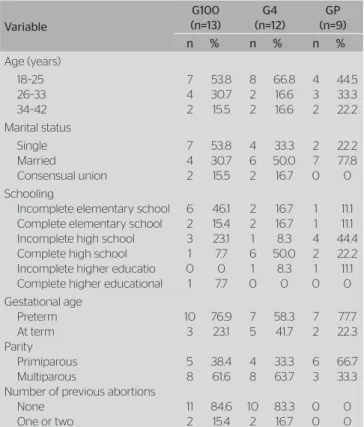
he random division and allocation, kept in opaque and numbered envelopes, were performed by a researcher who did not participate in the study. he access to the envelopes by the researcher in charge of the intervention was only allowed at the time of protocol application, after eligibility criteria were met and after the volunteer had agreed to participate in the study. he lowchart is pre-sented in Figure 1. he characteristics of the volunteers are described in Table 1.
Procedures
he initial evaluation was conducted with a minimum eight-hour interval after childbirth to prevent acute inter-ferences in post-anesthetic recovery. All of the partici-pants were enlightened about the procedures that would come afterwards. hen, sociodemographic and obstetric data were conducted by a questionnaire; data from medi-cal records were also used.
Participants were placed in dorsal decubitus posi-tion and remained at rest during the whole experiment, so that there would be no intercurrences interfering with the results. TENS was applied with the equipment TENSYS (KLD® Biosistemas, São Paulo) by two chan-nels. For each participant, four silicone rubber electrodes were used (5x3 cm) individually, accounting for 136 electrodes, which were placed in a crossed pattern, one centimeter above and one centimeter below the surgical
incision6. In order to increase skin adherence to the
elec-trical stimulus, hypoallergenic gel and bands were used. In groups G100, G4 and GP, TENS was applied with high (100 Hz) and low (4 Hz) frequencies, as well as placebo (appliance of ), respectively. Pulse duration was standardized at 100 µs, and intensity was in accordance with the sensory threshold of each patient, character-ized by severe paresthesia, comfortable, with minimum or absent muscle activity. Total time of TENS applica-tion was 30 minutes for each volunteer, and the whole protocol was conducted in a single session. In order to
Eligibility criteria (n=39)
Randomized (n=34)
Excluded (n=2) Refused to participate
in the study (n=3)
G100 Hz (n=13/13)
GP (Placebo) (n=9/13) G 4 Hz
(n=1 2/13) Analyzed (n=13) Analyzed (n=9) Analyzed (n=12)
Figure 1. Study flowchart
Variable G100 (n=13) G4 (n=12) GP (n=9)
n % n % n %
Age (years) 18–25 26–33 34–42 7 4 2 53.8 30.7 15.5 8 2 2 66.8 16.6 16.6 4 3 2 44.5 33.3 22.2 Marital status Single Married Consensual union 7 4 2 53.8 30.7 15.5 4 6 2 33.3 50.0 16.7 2 7 0 22.2 77.8 0 Schooling
Incomplete elementary school Complete elementary school Incomplete high school Complete high school Incomplete higher educatio Complete higher educational
6 2 3 1 0 1 46.1 15.4 23.1 7.7 0 7.7 2 2 1 6 1 0 16.7 16.7 8.3 50.0 8.3 0 1 1 4 2 1 0 11.1 11.1 44.4 22.2 11.1 0 Gestational age Preterm At term Parity Primiparous Multiparous
Number of previous abortions None
One or two
10 3 5 8 11 2 76.9 23.1 38.4 61.6 84.6 15.4 7 5 4 8 10 2 58.3 41.7 33.3 63.7 83.3 16.7 7 2 6 3 0 0 77.7 22.3 66.7 33.3 0 0
G100: TENS 100 Hz; G4: TENS 4 Hz; GP: Placebo
minimize the efects of sensory habituation, volunteers were asked, at regular intervals, about the sensation of paresthesia. In case of reduction, the researcher in charge increased the amplitude of the current according to the tolerance of the participants.
Pain intensity was evaluated by NRS before, imme-diately after and in 20 minute intervals (20, 40 and 60’) after the electro-stimulation period. NRS is a unidimen-sional scale to assess pain. It is easy to apply and under-stand, and level 0 means the absence of pain, while level
10 represents extreme pain5,13.
Patients who had prescription for anti-inlammatory medication or analgesics were submitted to assessment and intervention protocols after six and eight hours, respectively to minimize possible interactions between the efects of drugs and TENS. he researcher in charge of the evaluation, as well as the patients, was not famil-iar with which treatment protocol each participant was allocated in.
Data analysis
Data normality and homoscedasticity were veriied by the Shapiro-Wilk and Levene tests, respectively. A des-criptive analysis of data was conducted for sociodemo-graphic and obstetric characterization of the volunteers in order to identify intragroup diferences between pre and post-treatment values, the Friedman test was used for repeated measures. For the intergroup analysis, the NRS diference between pre and post-treatment values was calculated; afterwards, the Mann-Whitney test was used. All data were analyzed with the software
GraphPad Prism 5®, and the adopted signiicance level
was of p<0.05.
RESULTS
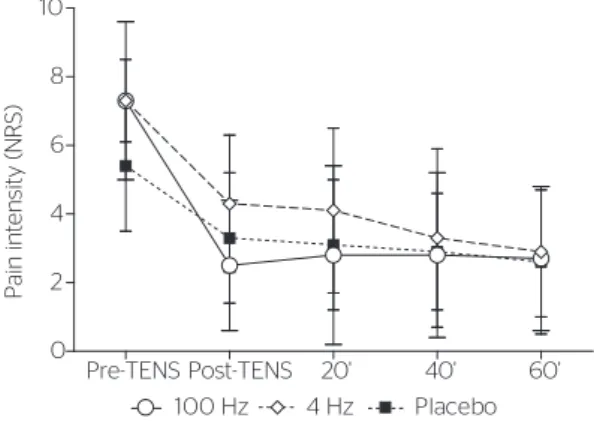
he intragroup data analysis demonstrated decreasing NRS between pre and post-treatment values for G 100 (p<0.001) (Figure 2). Intergroup results showed signi-icant NRS reduction between groups G100 – G4 and G100 – GP (p<0.05) (Figure 3). With regard to pos-t-treatment intervals, G100 presented signiicant NRS reduction during 20, 40 and 60’ intervals after the pre-treatment period (p<0.05). G4 presented signiicant reduc-tion in 40 and 60’ intervals. For the GP, this diference only occurred in the 60’ interval (Figure 4). No adverse
efects or collateral reactions were reported during and after the application of treatment protocols.
NRS: Numeric Rating Scale; TENS: Transcutaneous Electrical Nerve Stimulation
Figure 4. Pre-TENS, post immediate application of Transcutaneous Electrical Nerve Stimulation and 20, 40 and 60 minutes after Transcutaneous Electrical Nerve Stimulation pain intensity Number Rating Scale in groups 100 Hz, 4 Hz and placebo
Pre Post Pre Post Pre Post 0
1 2 3 4 5 6 7 8 9 10
100 Hz 4 Hz Placebo *
Pain intensity
(
N
R
S
)
100 Hz 4 Hz Placebo 0
25 50 75 100
Hypoalgesic effect
(
%
)
*
*
Pre-TENS Post-TENS 20' 40' 60' 0
2 4 6 8 10
100 Hz 4 Hz Placebo
Pain intensity
(N
R
S
)
*Friedman test p<0.001; NRS: Numeric Rating Scale
Figure 2. Pain intensity Number Rating Scale pre and post immediate treatment, using 100 Hz, 4 Hz and placebo Transcutaneous Electrical Nerve Stimulation
*Mann-Whitney test, p<0.050; NRS: Numeric Rating Scale
DISCUSSION
he objective of this investigation was to assess the anal-gesic efect of high (100 Hz) and low (4 Hz) frequency TENS in post-cesarean pain. he reduced NRS indi-cated lower perception of postoperative pain, diferent from the pre-treatment situation, thus showing that acute post-cesarean pain can be attenuated by conven-tion electrotherapy.
Surgical procedures cause tissue damage and gener-ate an inlammatory process, followed by the liberation
of chemical mediators and pain14. Concerning the relief of
postpartum pain, TENS has been efective15, and its
indi-cation is valid for postoperative analgesia and reduction
in the intake of medicines16, thus contributing with the
humanization of the puerperal period.
In this study, two pairs of electrodes were placed above and below the surgical incision, with the bipolar crossing technique, and in that case the current is concentrated on
the location of the pain5. his factor was relevant to obtain
good results after TENS, since the placement of electrodes
is important to stimulate Aβ ibers that go into the same
spinal segment that nociceptive ibers, which are associated
with the origin of pain16,17. In groups that received
electro-stimulation (G100 and G4), the pulse duration was
standard-ized at 100 μs, which can be observed in other studies18-20.
In our study, results obtained by NRS in G100 show signiicant pain reduction after immediate intervention.
he same was demonstrated by Melo et al.9, who assessed
15 puerperal women after a cesarean section who were submitted to high frequency (100 Hz) TENS and 15 women who received the placebo treatment (appliance of ) for 50 minutes. It was possible to observe signiicant
pain reduction only in the 100 Hz group. Smith et al.21
also analyzed 18 postpartum women, who had undergone cesarean section, divided into two groups: an
experimen-tal one, with high frequency TENS (85 Hz and 80 μs)
and a placebo. heir indings demonstrated signiicant reduction of supericial pain around the surgical suture only in the experimental group.
Pitangui et al.22 analyzed the response of high frequency
TENS (100 Hz and 75 μs) after vaginal delivery with
episiotomy and obtained positive results for the group that used electro-stimulation in the immediate treat-ment, and one hour after its application, in comparison
to the control group. Another study23 obtained a positive
response after using high frequency TENS (90 Hz; 90 μs)
for pain control during childbirth, suggesting the appli-cation of this resource in its early stages delays the need for additional analgesic techniques.
With regard to other surgical procedures, DeSantana et al.24 observed satisfactory analgesia in patients sub-mitted to inguinal herniorrhaphy who used TENS (100 Hz; 50 µs) for 60 minutes at the postoperative period. According to these authors, the analgesic efect provided by high frequency TENS is not only a result of the gate control theory of pain, but also of the activation
of the descending analgesic system (activation of type δ
opioid receptors), which would explain, in our study, the prolonged analgesia after the conclusion of TENS in 20, 40, and 60’ intervals.
In literature, there are only a few studies with low-fre-quency TENS among puerperal women who underwent cesarean sections, and that can be explained by the acute aspects of pain; because of that, high frequency TENS is more common, but in our results, in G4, there was sig-niicant pain reduction after 40 and 60’ of the application of TENS, which shows that the analgesic action in this group was not immediate, however, it lasted for a period of time. Electrical stimulation produced by low frequency TENS can work for the activation of the periventricular grey matter, which is part of the hormonal system that actives inhibitory neurons that liberate endorphin, and this
efect can last for hours after stimulation is concluded25,26.
In the 20’ after treatment, there was no signiicant pain
reduction. Maybe the concentration of opioids (type μ) in
the analyzed time intervals has not been suicient to satu-rate its receptors and block the nociceptive transmission. he results obtained by NRS in the GP showed sig-niicant pain reduction after the fourth assessment (60’), which can be explained by the formation and liberation of endorphins by the cerebral cortex due to the women’s
expectations towards the treatment2. Since puerperium is
a time when women are more vulnerable, the reduction of pain may have been caused by the attempt to care for her complaint during the assessment period, and by the alternative of solving it without damaging herself or
the newborn, thus interfering in her perception of pain27,28.
here were no diiculties to apply and understand the NRS, so it was well accepted as a unidimensional scale,
which was also observed in another study13. At the end
of the experiment, all of the participants in the placebo group were treated with 100 or 4 Hz TENS.
CONCLUSION
The analgesic effect of TENS in the postoperative period after a cesarean section depends on the para-meters of the choice. High frequency modulation, ins-tead of the low frequency one, is eicient to treat for post-cesarean pain.
REFERENCES
1. Reis SLS, Penteado CEM, Chatkin MN, Estrela MS, Porto PG, Munaretto MM. Parto normal x Parto cesáreo: análise epidemiológica em duas maternidades no sul do Brasil. Revista da AMRIGS. 2009;53(1):7-10. 2. Tribioli RA. Análise crítica atual sobre a TENS envolvendo parâmetros
de estimulação para o controle da dor [dissertação]. São Carlos: Interunidades em Bioengenharia da Universidade de São Paulo; 2003. 3. Granot M, Loweinstein L, Yarnitsky D, Tamir A, Zimmer EZ.
Postcesarean section pain prediction by preoperative experimental pain assement. Anesthesiology. 2003;98(6):1422-6.
4. Brasil. Ministério da Saúde. Coordenação Materno-Infantil. Manual de promoção do aleitamento materno: normas técnicas. Brasília: Ministério da Saúde; 1997.
5. Sousa L, Gomes FA, Pitangui ACR, Nakano AMS. Avaliação da estimulação elétrica transcutânea do nervo para alívio de dor após cesárea: ensaio clínico randomizado. Rev Bras Saúde Matern Infant. 2009;9(1):49-57.
6. Carvalho B, Riley E, Cohen SE, Gambling D, Palmer C, Hufnagle HJ,
et al., DepoSur Study Group. Single-dose, sustained-release epidural morphine in the management of postoperative pain after elective cesarean delivery: results of a multicenter randomized controlled study. Anesth Analg. 2005;100(4):1150-8.
7. Sluka KA, Walsh D. Transcutaneous electrical nerve stimulation: basic science mechanisms and clinical efectiveness. J Pain. 2003;4(3):109-21.
8. Walsh DM, Howe TE, Johnson MI, Sluka KA. Transcutaneous electrical nerve stimulation for acute pain (protocol for a cochrane review). In: The Cochrane Library; 2007.
9. Melo de Paula G, Molinero de Paula VR, Dias RO, Mattei K. Estimulação elétrica nervosa transcutânea (TENS) no pós-operatório de cesariana. Rev Bras Fisioter. 2006;10(2):219-24.
10. Melzack R, Vetere T, Finch L. Transcutaneous electrical nerve stimulation for low back pain: a comparison of tens and massage for pain and range of motion. Phys Ther. 1983;63(4):489-93.
11. Melzack R, Wall PD. Pain mechanisms: a new theory. Science. 1965;150(3699):971-9.
12. Holiinger JL. Transcutaneous electrical nerve stimulation after cesarean birth. Phys Ther. 1986;66(1):36-8.
13. Sousa L, Pitangui ACR, Gomes FA, Nakano AMS, Ferreira CHJ. Mensuração e características de dor após cesárea e sua relação com limitação de atividades. Acta Paul Enferm. 2009;22(6):741-7.
14. Milgrom LB, Brooks JA, Qi R, Bunnell K, Wuestfeld S, Beckman D. Pain levels experienced with activities after cardiac surgery. Am J Crit Care. 2004;13(2):116-25.
15. Kaplan, B, Rabinerson, D, Pardo, J, Krieser, RU, Neri, A. Transcutaneous electrical nerve stimulation (TENS) as a pain-relief device in obstetrics and gynecology. Clin Exp Obstet & Gynecol. 1997;24(3):123-6. 16. Ferreira CHJ, Beleza ACS. Abordagem fisioterapêutica na dor
pós-operatória: a eletroestimulação nervosa transcutânea (ENT). Rev Col Bras Cir. 2007;34(2):127-30.
17. Kitchen, S. Eletroterapia prática baseada em evidências. 2ª ed. Barueri: Manole; 2003. 277p.
18. Sluka KA, Deacon M, Stibal A, Strissel S, Terpstra A. Spinal blockade of opioid receptors prevents the analgesia produced by TENS in arthritic rats. J Pharmacol Exp Ther. 1999;289(2):840-6.
19. Radhakrishnan R, King EW, Dickman JK, Herold CA, Johnston NF, Spurgin ML, et al. Spinal 5-HT(2)and 5-HT(3)receptors mediate low, but not high, frequency TENS-induced antihyperalgesia in rats. Pain. 2003;105(1-2):205-13.
20. Kalra A, Urban MO, Sluka KA. Blockade of opiod receptors in rostral ventral medulla prevents antihyperalgesia produced by transcutaneous electrical nerve stimulation (TENS). J Pharmacol Exp Ther. 2001;298(1):257-63.
21. Smith CM, Guralnick MS, Gelfand MM, Jeans ME. The efects of transcutaneous electrical nerve stimulation on post-cesarean pain. Pain. 1986;27(2):181-93.
22. Pitangui AC, de Sousa L, Gomes FA, Ferreira CH, Nakano AM. High-frequency TENS in post-episiotomy pain relief in primiparous puerpere: A randomized, controlled trial. J Obstet Gynaecol Res. 2012;38(7):980-7.
23. Orange FA, Amorim MMR, Lima L. Uso da eletroestimulação transcutânea para alívio da dor durante o trabalho de parto em uma maternidade-escola: ensaio clínico controlado. Rev Bras Ginecol Obstet. 2003;25(1):45-52.
24. DeSantana JM, Santana-Filho VJ, Guerra DR, Sluka KA, Gurgel RQ, da Silva Jr WM. Hypoalgesic efect of the transcutaneous electrical nerve stimulation following inguinal herniorrhaphy: a randomized, controlled trial. J Pain. 2008;9(7):623-9.
25. Ainsworth L, Budelier K, Clinesmith M, Fiedler A, Landstrom R, Leeper BJ, et al. Transcutaneous electrical nerve stimulation (TENS) reduces chronic hyperalgesia induced by muscle inflammation. Pain. 2006;120(1-2):182-7.
26. Tribioli RA. Efeitos da estimulação elétrica na formação e liberação de opioides endógenos. Rev Unorp, São José do Rio Preto. 2012;5(12):49-61.
27. Dourado E, Fernandes TCA, Meireles JSS, Monteiro IS. Dor e efeito placebo. Revista de Cirurgia e Traumatologia Buco-Maxilo-Facial. 2004;4(3):197-203.