AR
TICLE
1 Faculdade de Saúde Pública, Universidade de São Paulo. Av. Dr Arnaldo 715, espaço editorial, prédio da Biblioteca FSP, 01246-904, São Paulo, SP, Brasil. [email protected]
2 Instituto de Saúde, Secretaria de Estado da Saúde de São Paulo.
Saúde e Sociedade Journal: partnership
and openness to new approaches
Abstract The text traces the trajectory of the
Saúde e Sociedade scientific journal, published by the School of Public Health, University of São Paulo in partnership with the Associação Paulista de Saúde Pública since 1992. It presents the con-text of the era in which the journal was created and its mission of divulging the contributions of Human and Social Sciences to Health Care, the challenges it has faced over the length of its history until today, its goals and strategies for improving scientific quality, the journal’s visibility, becoming indexed in various national and international bibliographic databases and about its interna-tionalization and sustainability, reaffirming its founding principles.
Key words Scientific publication, Social sciences, Human sciences, Public health, Intellectual pro-duction
Cleide Lavieri Martins 1 Helena Ribeiro 1
M
ar
tins CL
Context of its creation
In 1992, the year the Saúde e Sociedade jour-nal was created, the world was passing through
some critical moments. The 21st century was
ap-proaching, the limit set by the WHO for
achiev-ing Health for All, as announced in the 30th
Glob-al Assembly in 1977. The HeGlob-alth for All in the
21st Century document was complemented by
the Alma Ata Declaration in 1978, proclaiming Primary Health Care (PHC) as the strategy for achieving that goal.
In the same year the Rio de Janeiro World Summit, also known as Eco 92 or Rio 92, also took place. It approved Agenda 21, which pre-sented “sustainable development” as that which guaranteed good living conditions for the current generation, without harming future generations. Health care definitively entered the debate about world development, contextualizing econom-ic development, through the need to guarantee “wellbeing”. The discussion of rights to health as human rights was still very much present in two significant 1990s events: the International Conference on Population and Development, in Cairo (1994) and the IV World Conference on Women in Beijing (1995). These events generat-ed intense debate all over the world. It is worth noting the heated critical reflection on the bene-fits but, above all, on the risks accelerated techni-cal-scientific advance posed for life in this planet, notably in fields of a multi-disciplinary character, such as health care.
Given the complexity of the phenomena and the proposals, the essence of the debate shifted to multi-disciplinary and inter-disciplinary dia-logue from the 1970s onwards or, more specifi-cally, transdisciplinary in the 1990s. In this sce-nario, the human and social sciences were also invited to contribute to understanding and even decoding the complex problems that daily chal-lenged modern science.
In the national arena, the 1990s were tributary to advances made in the 1970s and, especially, in the 1980s, when such critical social reflections and movements gained expression, culminating in the opening up to democracy of the political system and the publishing of the new Constitu-tion in 1988. In the field of health, it stands out that, since the 1970s, the Brazilian Sanitary Re-form Movement, a significant social movement, the proposal of which was to think not only about the health care system but also about living condi-tions and the health of the population, including their rights. Many other movements joined this
one, such as the women’s movement, which con-tinues to manifest itself strongly in this country through social and health care conquests. Thus, the 1990s saw concrete attempts to regulate the functioning of the Unified Health Care System – SUS. All of these developments required a new vision of public and collective health.
In São Paulo, the State Health Secretariat (SES-SP) which had long since created a ratio-nalized, hierarchical system, sought to adapt it-self to the new structure proposed for the SUS.
In this context, two institutions proposed creating the Saúde e Sociedade journal: the School of Public Health of the University of São Paulo (SPH) and the Associação Paulista de Saúde Pública (APSP), who discerned the need for a new journal that examined the complexity of health care in-depth, in terms of global society.
The academic motivation lay within a wider picture of creating new health care journals. In the 1970s, the dynamism of the Brazilian Sani-tary Reform movement and its developments were able to be consolidated by the timely cre-ation of the Saúdeem Debate journal in 1976. In 1985, the creation of the Cadernos de Saúde Pública journal announced the importance of and the need for new scientific production and divulgation in the field of health care. This cul-minated in the 1990s, when a dozen new journals related to the area were launched.
In this editorial context, Saúde e Sociedade was launched as a journal in the areas of Hu-man and Health Care Sciences, seeking to make its characteristics and aims visible. Other three journals, launched in the 1990s, today consti-tute the SciELO collection, belonging to Human and Health Care Sciences: Revista de Saúde Co-letiva, in 1991; History, Sciences, Health – Man-guinhos,in1994; and Interface: Communication, Health, Education,in1997.Inthe 1990s, other im-portant journals in the area of collective health were created – Ciência e Saúde Coletiva, in 1996, and Revista Brasileira de Epidemiologia, in 1998, both linked to the Associação Brasileira de Saúde Coletiva (Abrasco).
Saúde e Sociedade was born of the need for journals that take into account the scientific out-put of Human and Social Sciences in Health Care (HSSHC), which had no voice. This was affirmed in the editorial of the first edition, by the dean of the SPH, sociologist Aracy Witt Spinola and Álvaro Escrivão Junior, public health physician, president of APSP.
Innovat-e C
ole
tiv
a,
20(7):2069-2080,
2015
ing, for us, means providing a space in which a new type of reflection on the problems of public/col-lective health affecting our country and the conti-nent of Latin America can flourish. Problems that are, it must be said, not always new, as in the case of the resurgence of cholera in the continent and in this country, but the model of thinking about
them must be new; therein lies the challenge1.
Cadernos Pagu and Estudos Feministas are also from this decade and have a special affilia-tion with the Human Sciences area, representing great contributions to the area of Health care taking into account that, in those days, women’s movements were gaining more expression after the Cairo (1994) and Beijing (1995) meetings. In those meetings, the concepts of sexual and repro-ductive health, as well as sexual and reprorepro-ductive
rights, emerged and, in Brazil, came to guide
public policy and enrich scientific output in the
health care field, through the gender approach2.
Saúde e Sociedade was born, then, from a commitment to produce and divulge topics on the interface of social and health care issues, in addition to, as the name implies, paying hom-age to the eminent health care sociologist Cecília Donnangelo, who published the classic work en-titled – Saúde e Sociedade – and whose work left a great legacy leading to the approach becoming known as “the social in health care”, as shown by the recent publication organized by Carvalheiro
et al. in her memory3.
The APSP’s professional motivation to cre-ate a joint publication with the SPH is explained by its origin, in 1972, strongly influenced by its founder and first president, Rodolpho dos Santos Mascarenhas, SPH lecturer and well known doc-tor, who was concerned with social aspects, from the early days, in the archives of classical disci-plines and in health care campaigns. The interac-tion between the two instituinterac-tions is no accident. During Walter Leser’s tenure in the São Paulo State Health Secretariat, he organized a medical career field to provide support to the hierarchi-cal and regionalized structure of the health care system. This access was given after they obtained qualification in SPH specialization courses. It is, then, no surprise that a significant proportion of APSP members came from these courses.
This convergence of motivations is well doc-umented in the project of creating the journal. There was a movement within the SPH to create a new journal other than the Revista de Saúde Pública, one of the oldest Brazilian journals, an alternative with appropriate conceptual instru-ments and closer to the human sciences.
A multi-disciplinary commission, headed by the sociologist, Augusta Thereza Alvaren-ga, SPH professor, drew up the proposal for the Congregation, when she found that the APSP had the same aim. On its own initiative, the SPH approved joining forces to create a journal with editorial responsibility shared between the two institutions. The proposal was approved by the School Congregation and the APSP Board, not least because of the APSP’s origins, strongly linked to the SPH in training public health per-sonnel to carry out health care activities in the State, and relevance. During this initial period, Augusta Alvarenga was the scientific editor rep-resenting the SPH, and the APSP was represented first by José da Rocha Carvalheiro, and then by Paulo Eduardo M. Elias.
Over the 24 years of its existence, the editori-als of Saúde e Sociedade journal have used differ-ent expressions to refer to the journal’s mission,
to its identity or hallmark: ‘To divulge the output
from different areas of knowledge and approach the field of public health in an interdisciplinary way’; ‘To articulate the dimensions of knowledge and of practice in the field of public/collective health’; ‘The interface between public/collective health and the social and human sciences’; ‘Creating a mural that manages to increasingly reveal the face of health as-sociated with society and vice versa’; ‘An editorial project that approaches and analyses health issues in the social field of management policies and prac-tices’; and ‘To transformactors into authors’.
The beginning is always difficult
A mixed editorial board was set up, with two sci-entific editors, one from each institution. They then faced the reality of editing a scientific jour-nal with the aim of articulating the interests of two very different institutions – one academic, the other an association of public health profes-sionals, with the aim of gathering contributions in both environments. Potential authors were invited to submit articles on predefined topics, what amounted to an oxymoron, i.e. a controlled commission, subject to the ad hoc scrutiny of the reviewers.
The struggle to become indexed was also “outside of the curve”, in the sense of it being a journal that aimed to serve the academic com-munity at the same time as that of the working environment within the health care services. To
paraphrase Mário Testa4, we could say that Saúde
in-M
ar
tins CL
terests of three powers: political, administrative and technical. Despite the journal’s uniqueness, it was indexed in Lilacs – Literatura Latino-Ameri-cana em Ciências da Saúde in 1994.
The struggle for financial support was, and still is, a ceaseless battle. Three years after the release of the publication, the difficulties began to become accentuated. Published twice a year, it was produced with resources from the School– editing, printing, mailing, office space, part-time secretarial staff, all subject to constant change. Copies were distributed to APSP associates and there were few subscribers.
The work was fairly amateur: editions were often delayed; few articles underwent a detailed selection process. Even faced with difficulties and delays, publication was never interrupted. But, under such conditions, it would be impossible to raise new resources to keep it going, not from university bodies, nor from other agencies such as Fapesp or CNPq.
First revision – Index ordie!
Around the year 2000, the journal came up against a set of challenges that provoked some significant changes.
New criteria for evaluating postgraduate courses from the Coordinator of Higher Ed-ucation Improvement - Coordenadoria de Aperfeiçoamento do Ensino Superior (CAPES) ranked journals and had, among other conse-quences, repercussions on the financing of the publications.
For the APSP, becoming indexed was of marginal concern, what was important was the chance to divulge debates and research to meet the needs of the health care services, but for the school faculty, academic scientific output was a relevant issue.
On the other hand, the APSP had few finan-cial resources to maintain the headquarters and its activities. Biannual congresses had recently resumed in São Paulo, the centre of the Board’s efforts. There was no way to bear the production costs of the journal, such as reviewing the text, editing and printing.
The journal, whose authors included some of the main researchers in São Paulo, also attracted quality work from researchers from all over the country, establishing new strategies to meet the criteria for being indexed.
The goal, established by the editorial board in 2001, was to become indexed in more
bib-liographic databases, especially in the SciELO Portal. The editorial project was revised, possi-bilities for financial support were discussed, and political support for the review sought.
The main points presented, in order to meet SciELO criteria, were to maintain publication on time and to decrease endogeny. Strategies devel-oped between 2001 and 2003, based on minor changes to the editorial commission and greater political support from the SPH and APSP board included: setting up an advisory board with re-searchers from different Brazilian states and from other countries, adapting norms; introducing an English version of the abstract; using specialists to format the articles; and increasing the number
of articles, as one of the criteria to be indexed in
the SciELO Portal for journals in the humanities areas, at the time, was to publish at least 24 arti-cles annually.
Supported by the School and the APSP boards, the journal managed to ensure ithad an office, a phone line, IT equipment and a part time secretary to do the day-to-day work of the journal. External financial support was sought to ensure and increase the flow of the journal. This support mainly came from partnership with the Ministry of Health – Secretariat of Participative Management to publish articles and encourage debate on topics of interest to the Ministry; and from the University of São Paulo Program for Supporting Scientific Publications and Journals. Other forms of raising resources, such as sub-scription and selling advertising space were not considered appropriate or possible options at that time.
It was also necessary for the journal to be-come better known among researchers in order to attract articles with approaches more consis-tent with the editorial line of the journal. Thus, a series of actions with this aim began: donating collections and volumes to libraries; making en-tire articles from the whole collection from 2002 onwards available online on the APSP site; par-ticipating in scientific events such as expositions at trade fairs, giving out copies of the magazineto participants; inviting researchers to edit manu-scripts for the Topics under Debate section; con-ducting topical seminars when new editions of the journal were published.
At the same time, letters were written to var-ious bibliographic databases introducing the journal and requesting to be indexed.
e C
ole
tiv
a,
20(7):2069-2080,
2015
but also in the following databases in the years shown:
·
Cambridge Sociological Abstracts (CSA)-intwo different databases: Sociological Abstract – 2006 and Social Services Abstract – 2006
·
SciELO – Scientific Electronic LibraryOn-Line- 2008
·
Scisearch, Journal Citation Reports/SocialSciences Edition - 2008
·
ISI –International Statistical Institute -Thomson Reuters - 2008
·
Ulrich’s International Periodical Directory- 2008
·
Latindex - 2008·
EBSCO Publishing - 2009·
Library Of Congress Cataloguing - 2010·
Scopus – 2010However, the CAPES classification attributed to the journal was still below expectations. One of the problems was that the criteria CAPES used to evaluate scientific journals in the area of Public Health were based more on characteristics of the medical and biomedical area than on those more
influenced by the human and social sciences5.
Another initiative to increase the number of articles, as well as to reinforce the field of interest in the interface between the HSSHC occurred in 2007 and consisted of requesting articles on the following topics: Gender, sexuality and identity; Violence; and Work.
It was also sought to improve the journal’s commitment to sustainability and, in 2008, it be-gan to be printed on recycled paper. Also in 2008, fruit of the effort mentioned, the journal began to be published quarterly and a new graphic
project was presented. Figure 1 shows journal covers from 1992 to the present day, reflecting the internal process, described in the editorial cited below:
Journals, like people, have lives and their lives have phases. We can say that Saúde e Sociedade journal has moved on to a new phase and not just in terms of the clothing or way it is dressed. It is moving towards the maturity appropriate in a consolidated publication in the Health Care field, intent on rising through the ranks of scientific publication, maintaining its commitment to its founding principles:
•divulgingrigorousscientiicrelection,but
of a more essay-like character;
•encouraginghealthdebateofideas,propos
-als and practice among profession-als in the field;
•makingmorespaceforareasfromthehu
-man sciences, whose contribution to the field of Public/Collective Health is essential;
• encouraging the divulgence of innovative
practices at the proposal or development stage in Health Care Services to enrich debate in the
field”6.
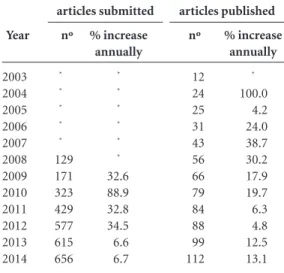
The number of articles published per year went from 12 in the 1992 to 2002 period, to 24 in 2003 and thenceforth there was an ascending curve in the articles submitted and published (Table 1). Between 2008, the year in which the journal was included in the SciELO collection,
and 2009, submissions increased by 88.9%. In
2014, 656 manuscripts were submitted and 112 were published.
Inclusion in SciELO and in the ISI, with the subsequent improvement in the Qualis Capes,
Figure 1. Coverpages of Saúde e Sociedade journal from 1992 to 2015.
M
ar
tins CL
especially in the area of public health, associat-ed with the pressure for postgraduate program coordinators to improve their production, may have contributed to this increase in manuscripts submitted.
Second revision – More Challenges
These great advances were followed by new chal-lenges: the journal’s classification as an import-ant aspect of evaluating postgraduate programs and the criteria required by the index databases lead to more challenges including increasing the impact factor and internationalizing the journal. This trend could be criticized if one consid-ers that the original aim of the Saúde e Sociedade journal should be analysed according to its suc-cess, for example, through evidence of its consol-idation as a scientifically reliable instrument for interacting with the health care services, provid-ing analyses and proposals to improve policies. However, bibliometric indices are currently being used to academically hierarchize journals. This is
questioned in diverse sectors. Garfield’s7 original
ideas used in the ISI index were destined mere-ly to study inter-disciplinarity; “It never crossed the mind of the author” to use this method of classification (hierarchizing) for authors nor for journals, let alone for education programs.
How-ever, directly or indirectly, bibliometric indices influence editorial dynamics.
Becoming indexed in SciELO, as well as in other international databases, especially in the ISI Thomson Reuters, the greater divulgence of the journal and the increasing pressure on post-graduate courses to publish brought, as men-tioned above, a significant increase in the num-ber of articles submitted, leading to less fluidity in the editing process, overload for the Editorial commission, delays in responding to authors and long delays between submission and publication.
However, the publication of some articles submitted was not justified in a journal that aimed to consolidate itself, calling for review of the editorial design.
Analysing the reasons for refusing articles from ad hoc referees and the operational im-plications resulting from the increased number of submissions lead the Editorial Board to con-duct a primary selection process as soon as the manuscript was submitted, checking whether the submitted article was appropriate for the profile of the journal and the priority of the topic, from 2010 onwards. The result of this preliminary tri-age is that around 70% of submitted articles are quickly rejected. This fact is illustrated in this ex-tract of an editorial from 2012.
A recurrent practice in Editorial Board meet-ings is to constantly review and improve the eval-uation parameters of the articles received, calling for discernment and a critical attitude towards the ever increasing number of articles received and the difficulty of timely responses to authors, at the
same time as consolidating our editorial profile8.
A survey of 2009 and 2010 reports from the peer review process indicated different problems that justified the rejection of, at that time, around half the articles submitted, with the most rele-vant criticisms being:
- content: precarious use of data collection instruments and treatment of results; concepts unarticulated with each other and with the perspective of analysis; superficiality and lack of knowledge of current thinking on the topic; poorly defined variables and concepts; impre-cise concepts and methodologies; insufficient bibliographic references to back up the results/ statements/interpretations; lack of dialogue with cited authors; lack of a critical review of the lit-erature on the topic or of the litlit-erature used; lack of mediation and theoretical perspectives; “im-pressionism”: random choice of arguments; lack of clear content and theoretically and empirical-ly inconsistent arguments; forced application of
Year 2003 2004 2005 2006 2007 2008 2009 2010 2011 2012 2013 2014 nº * * * * * 129 171 323 429 577 615 656 % increase annually * * * * * * 32.6 88.9 32.8 34.5 6.6 6.7
Table 1. Number of articles submitted and published, Saúde e Sociedade journal, 2003 to 2014.
* no information
Note: between 1992 and 2003 publication was twice yearly, between 2004 and 2007 thrice yearlyand from 2008 quarterly.
nº 12 24 25 31 43 56 66 79 84 88 99 112 % increase annually * 100.0 4.2 24.0 38.7 30.2 17.9 19.7 6.3 4.8 12.5 13.1
e C
ole
tiv
a,
20(7):2069-2080,
2015
references, without due theoretical mediation re-garding the situation analysed; lack of agreement between the authors cited and the findings of the investigation; argument with unclear objectives, concepts, base; fragile or superficial arguments, or mistaken concerning theoretical references; repetitive argumentation; extremely descriptive or poorly descriptive approach.
- text structure: lack of clarity; lack of and/ or undefined concepts, terms or objects; confus-ing and/or inappropriate writconfus-ing; ambiguous or incoherent language; lack of discussion; inade-quate conclusion, unrelated to the objectives and the results; and abstract not corresponding to the article.
- form: use of neologisms and / or buzzwords; extensive but unused bibliography; non-stan-dard quotations.
These criticisms, from peer reviewers indi-cate the weaknesses of some of the manuscripts submitted at the time, and it became essential to refuse them in order to raise the quality of the journal and increase its impact factor.
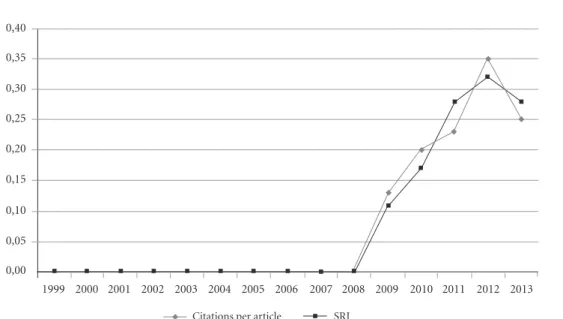
Saúde e Sociedade journal faced the problem of low citation of the articles published therein, by which its quality is weighed. Graphic 1 shows the citations received per article published in
Saúde e Sociedade journal, according to the
Sci-entific Journal Report. However, since 2009 Saúde e Sociedade journal articles have been cited in foreign journals totalling 43 citations between 2009 and 2014, from Colombia, Chile, Spain, Portugal, Argentina, Cuba and Mexico, indicat-ing the beginnindicat-ings of international participation. In the same period, there were 1,753 citations in 345 Brazilian publications, indicating that the journal’s penetration remains strongly national.
This has been a characteristic common to journals in the area of the human sciences in Brazil. However, seeking to increase citations of published articles was urgent. A limiting factor may have been the fact that most of the articles were only published in Portuguese.
To face the new challenges, in 2010, the Edi-torial Board drew up some goals: decrease time taken to evaluate and publish articles; increase the journal impact factor; strengthen the tech-nical-administrative structure; broaden sources and forms of financing; evaluate the editorial line; increase internationalization, with an En-glish version of articles of more universal interest and introduce a higher proportion of foreign au-thors. There was also, of course, interest in inte-gration and dialogue with scientists from other countries, so as to enrich Brazil’s own scientific output and global participation.
Graphic 1. SJR Indicator and citations per article.
Source: SJR March 2015.
1999 2000 2001 2002 2003 2004 2005 2006 2007 2008 2009 2010 2011 2012 2013 0,05
0,10 0,15 0,20 0,25 0,30 0,35 0,40
0,00
M
ar
tins CL
To achieve these goals, in addition to the tri-age of the articles upon submission mentioned above, the following strategies were adopted: bilingual publication of articles of potential in-ternational interest; organization of a Workshop “Producing Knowledge at the Interface between
the Social Sciences and Public/Collective Health”,
in 2012, to trigger discussion of the journal’s ed-itorial line; selecting emerging topics to produce dossiers with national and international authors; restructuring the editorial body; changing the evaluation process of the articles, with the sup-port of ad hoc associated editors to recommend peer reviewers. One of the issues triggered by the Workshop concerned editorial activity in the dif-ferent, varied and emerging areas of the interface between Health and Society, seeking to locate it as an open space sensitive to new approaches while maintaining a critical and reflexive vision.
In late 2015 and early 2015, the new Editori-al board maintained many of the previous goEditori-als, including the publication of articles in English as well as in Portuguese or Spanish, and consolidat-ing the editorial line fine tuned to the mission.
Research by Minayo5 identified that more than
59% of the articles published in Saúde e Socie-dade journal dealt with topics on the interface of the social and human sciences. This percentage could be increased, as well as articles dealing with socio-environmental issues. In order to reinforce the journal’s editorial line, recent scientific out-put and the modern agenda with more recent issues were also considered, dossiers were orga-nized, the topics of which are listed below:
·
In 2014:Geography of health in knowledgecrossover; Violence: an issueof the health and society interface; Global Health: current trends; An anthropology of the interface: public and care policies from a comparative perspective
·
In 2013:The speed of the world: migrationand social change; Work and workers’ health: signs of unsustainability in the current model of production; The long battle to finance SUS.
Other, previous special editions included:
·
Hunger, poverty and public health, in 2003·
Social security and the SUS, in 2005·
Transdisciplinarity and health care, in 2005·
The WHO Cities and Health Program, in2006
·
Inequality and health care services, in 2006·
Social and environmental determinants, in2007
·
Health and cultural diversity, in 2007·
Social exclusion, insecurity andvulnerabili-ty: including health care access?, in 2007
Reaffirming its mission, Saúde e Sociedade journal values HSSHC output, providing the reader with a set of reflections on the field itself. The APSP encouraged two Social and Human Sciences in Health Care meetings in São Paulo, the first in 2005 and the second in 2009. The theme of the latter was “the Contribution of the Social and Human Sciences in Forming Research and Teaching in Public Health” and the texts were divulged in a dossier. The texts from the Round Table “The place of the Social Sciences in Public Health: trajectory, achievements and challenges”, the central theme of the V Brazilian Congress of the Social and Human Sciences by the Asso-ciação Brasileira de Pós-graduação em Saúde Coletiva (Abrasco), which took place in the USP
in 2011,wasalso published in full. In 2013, the
dossier “Producing knowledge at the interface between the social sciences and public/collective health” was published, as the result of the above-mentioned Workshop promoted by Saúde e So-ciedade journal.
At the same time, it sought to be attentive to political debate of health care issues in the state of São Paulo, one of the APSP’s ideals, and to im-portant topics for health care services and work-ers such as, for example, in 2011, when they pub-lished a supplement on “Primary Health Care in the State of São Paulo”; and, in 2009, the sup-plement or studies included in the Prize Sergio Arouca de Gestão Participativa em Saúde.
The breadth of the themed issues was always of an inter-disciplinary nature, guaranteeing the coherence of the proposal. The diversity of topics and academic areas covered in the articles pub-lished by Saúde e Sociedade journal is reflected in the Capes evaluation system for different areas.
Classification is performed by the Capes ar-eas of evaluation, with journals falling into strata indicating quality - A1, the highest; A2; B1; B2; B3; B4; B5; C – with zero weight. The same jour-nal, classified in two or more different areas, may receive different evaluations, indicating the value attributed in each Capes area to which the con-tent belongs (Chart 1).
As expressed in the analysis of intellectual output in public health:
The social and human sciences, however, are not (and may never be) characterized by one sin-gle, hegemonic paradigm. This also has implica-tions for producing knowledge; the author in these areas needs to explain the theoretical options more extensively9.
In a study on the intercession of the social
e C
ole
tiv
a,
20(7):2069-2080,
2015
two Qualis A journals with the greatest impact in the area of Collective Health are those which publish the fewest studies that deal specifically with the social and human sciences, although they do publish them. In 20 months the author analysed, between 2011 and 2012, Cadernos de Saúde Pública published 41 articles (14.3%); and the Revista de Saúde Pública, 16 (7%).
Perhaps because of the higher proportions of studies in the area of epidemiology, the most consolidated and corporately organized of those that form the field of collective health, they show the difficulty that the Human and Social Sciences still face for their contributions and logic to be accepted in the most valued niche.
As a result of the movement to internation-alize Saúde e Sociedade journal, there was an increase in the number of articles authored by foreign researchers, a number that, in the early years, was marginal.
From 2006 onwards, fruit of a CNPq financed mission to Portugal by professors from the SPH, the Community of Portuguese Speaking Countries became closer and several Portuguese authors sub-mitted articles to the Saúde e Sociedade journal. The publication thus became known in Portugal and, spontaneously, articles from other European countries, especially Spain, began to arrive.
From 2009 onwards, the authors were given the option to publish in two languages, in English as well as Portuguese (or Spanish or French).
Un-til mid-2012, the authors who chose to publish in English as well as in Portuguese, bore the costs of translation themselves. From the latter half of that year, however, articles of international inter-est were published in two languages and the mag-azine began to pay for translation, with resources from the internationalization project, presented and included in the Journal Accreditation Com-mission linked to the University of São Paulo. Ar-ticles that the Editorial Board considered being of local interest continued being published solely in Portuguese. In 2013, the number of articles in English and Portuguese increased significantly, growing from 6 (6.8%) in 2012, to 32 (32.3%) in 2013 and 40 (35.7%) in 2014. In addition to those in bilingual format, between 2012 and 2014, seven articles were submitted in English, five by authors from other countries, marking the beginnings of the journal’s international penetration. The current goal is for all articles to be published in two languages, although this step will require greater security in financing the expenses. The University’s financial crisis meant that, in 2015, fewer resources were provided and the journal returned to requesting that authors pay for their own translation into English. This time, the authors’ responses were more positive, enabling the journal to maintain its growth in bi-lingual publication in the SciELO portal.
However, in addition to the financial costs used to justify not translating their work, some
Chart 1. Classification of Saúde e Sociedade journal in the Qualis-journals – Capes, 2015.
Strata
A1
A2
B1
B2
B3
B4
C
Area of CAPES evaluation
Urban and Regional Planning / Demographics
Interdisciplinary, Environmental Sciences. Geography, Physical Education
Interdisciplinary, Nursing, Anthropology / Archaeology, Sociology, Administration, Accountancy andTourism, History, Political Sciences and International Relations, Teaching, Engineering I and III, Agricultural Sciences I.
Collective Health, Nutrition, Psychology, Social Services, Architectureand Urbanism, Theology.
Dentistry, Economics, Medicine I and III, Education, Pharmacy, the Arts / Linguistics.
Medicine II, Applied Social Sciences I, Biological Sciences III, Mathematics / Probability and Statistics, Biodiversity.
Law
M
ar
tins CL
authors also argued the national interest of the topic dealt with and the way the topic is present-ed, without contextualization for non-Brazilian readers, that is, for a foreigner to read the text would require more than translating into En-glish, it would need to be rewritten for foreigners. Given the characteristics of Saúde e Sociedade journal, the Editorial Board also assessed that nationally relevant articles are often not cited in-ternationally. This is a discussion between editors from the areas of the human and social sciences and from public health. In a meeting for editors of SciELO journals in the humanities, promot-ed by SciELO, in June 2013, various aspects that differed between Humanities and ‘harder’ areas such as the natural sciences were discussed, – mission; focus; infrastructure; sources of financ-ing; methods of forming the editorial boards.
Improvements in quality, internationalization and the increased visibility of the journal should be positively reflected in its impact and increas-ing participation of international researchers and groups of researchers. Moreover, this means that Saúde e Sociedade journal remains an open space, sensitive to new approaches, to certain topics neglected by the mainstream journals in the health care area whilst simultaneously main-taining the space for inter-disciplinary criticism and reflection, indicating the complexity of the field of public/collective health nowadays.
Reader and author
Analysing the access history of Saúde e Sociedade journal in the SciELO portal enables us to discov-er the audience, which reads and writes for the journal. Table 2 shows the trend of increased ac-cess, from when it became indexed, in 2008, and the very significant figure of 4,407,544 accesses to articles over those seven years. These data show the phenomenal increase in readers that open ac-cess to the electronic version provides. Before be-coming indexed, the journal printed 500 copies, with two issues per year, and readers were there-fore limited in number and geographical exten-sion, as the journal was only sold and distributed in São Paulo, with the exception of certain uni-versity libraries in other regions of Brazil.
An important fact supporting the significant social penetration of the Saúde e Sociedade jour-nal, despite its still low citation rate, is its position in the Portal of Journals of the University of São Paulo. Of the 129 journals indexed in that portal, Saúde e Sociedade journal is in fifth place in the
number of PDF downloads of articles. In 2014 alone there were 265,129. It is also in the top 25 Portuguese language publications in Google Scholar, rated h5 – 18 median h 5 - 24.
A recent initiative to encourage greater di-versity and number of readers, including laymen readers, as well as to discover new ways of inter-acting with them, was to publish certain articles on the APSP Facebook page. It is still too early to gather enough material for evaluation, but the first attempts, with articles dealing with current health care issues, gained more “likes” and are reflected in SciELO access. The social networks, then, appear to be an important aspect to be ex-plored.
Analysis of the institutions to which the first authors of the articles published between 2011 and 2014 were affiliated shows that those associ-ated with universities and research institutions in the area of health care were predominant (68%), followed by authors affiliated with the health care services (13.8%) and universities and research institutions in the area of human and social sci-ences (12.8%).
One characteristic of the authorship of the studies published in the Saúde e Sociedade jour-nal is the lower number of authors compared with journals in the health care area more con-nected with medicine and epidemiology. Between 2011 and 2014, the mean number of authors per article was 2.9. One potential interpretation of this trend is that this is a more common charac-teristic of the human and social sciences, dealing with more articles that are more reflective and less about results of laboratory investigation by large groups of researchers. Thus, even when the authors are from institutions linked to the area of
Year
2008 2009 2010 2011 2012 2013 2014 total
Journal
16,634 24,917 27,552 24,206 40,632 41,753 43,504 219,198
Table 2. Nº of accesses to theSaúde e Sociedade journal in the SciELO portal between 2008 to 2014.
Source Reports of site use, SciELO, March 2015.
Abstract
16,841 20,645 22,218 18,489 24,328 24,918 16,535 143,974
Article
336,186 778,529 728,351 520,394 678,971 671,833 693,280 4,407,544
e C
ole
tiv
a,
20(7):2069-2080,
2015
health care, the approach of their scientific out-put is closer to that of the humanities. In fact,
re-search by Camargo Jr et al.9 on intellectual output
in collective health, stated that
When considering the different subareas in terms of percentage of production, it was found that 75.3% of the articles on epidemiology had three or more authors (50.3% four or more). Meanwhile, in the areas of planning and the social and human sciences these proportions were, respectively, 42.9% (26.6%) and 29.8% (13.1%)9.
In the area of Social and Human Sciences in Health Care, 69% of the articles analysed ac-cording to researcher had 1 or 2 authors and the median found was 1-3. The authors concluded, according to the epistemological reflection of the article, thatthere were significant and unavoid-able structural differences in the intellectual out-put in the different areas of public health. How-ever, a more recent article found that journals in public health showed a higher number of authors per article, over time, including those in the area of Social and Human Sciences in Health Care,
ir-respective of the editorial orientation10.
The fact that, between 2011 and 2014, only 35% (133) of the articles published in Saúde e Sociedade journal indicated having received fi-nancial support in order to conduct the research shows that the costs of the majority of those whose results were divulged were borne by the authors themselves.
Of those that received financial support, 71.8% received it from research development agencies. Others, the results of theses and disser-tations, were supported by Capes grants (15.4%) (Graphic 2).
Final and current considerations
The trajectory of the Saúde e Sociedade journal reflects the successful partnership between the SPH, USP and APSP and of the work of the au-thors and researchers forming the body of refer-ees and the editorial board of the journal.
Data presented in the body of the article in-dicate that the journal is maintaining its commit-ment to its own founding principles. However, significant challenges remain in consolidating the editorial line with high quality articles of na-tional and global interest, deserving and ensuring citation, so that the innovative and complex pro-file of approaches continues to be the hallmark of the journal.
There are, moreover, other challenges of a more administrative nature, such as financial sustainability and production flows; profession-alization of editorial management, which also implies decreasing the time between evaluating and publishing the manuscripts, guaranteeing the uniqueness of the ideas. In addition, there is the perspective of broadening the mechanisms of divulgation and communicating with read-ers through social networks and eliminating the printed version.
Graphic 2. Sources of financial support for the research of the articles published in Saúde e Sociedade journal, 2011 to 2014.
Source: SJR March 2015.
6% 7%
15% 72%
Research Development
Agencies
Capes
grant Opas, Unesco or Ministry of Health
M
ar
tins CL
References
Spinola AWP. Escrivão Jr A. Editorial. Saúde Soc. 1992; 1(1):1-2.
Pitanguy J. Cairo + 20: uma visão crítica de processos e resultados de negociações e perspectivas de futuro. In: Arilha M, Lago T, organizadores. Cairo + 20 e políticas
públicas no Brasil: consolidando e ampliando direitos.
São Paulo: Oficina Editorial; 2014. p. 9-26
Carvalheiro JR, Heimann LS, Derbli M, organizadores. O social na epidemiologia: um legado de Cecília Don-nangelo. São Paulo: Instituto de Saúde; 2014
Testa M. Pensar saúde. Porto Alegre: Editora Artes Mé-dicas; 1992.
Minayo MCS. A produção de conhecimentos na inter-face entre as ciências sociais e humanas e a saúde cole-tiva. Saúde Soc 2013; 22(1):21-31.
Editorial. Saúde Soc. 2003; 12(1):3-4.
Garfield E. How can impact factors be improved? BMJ 1996; 313(7054):411-413.
Gomes MHA. Editorial. Saúde Soc. 2012; 21(1):5-6. Camargo Júnior KR, Coeli CM, Caetano R, Maia VR. Produção intelectual em saúde coletiva: epistemologia e evidências de diferentes tradições. Rev Saude Publica 2010; 44(3):394-398.
Camargo Júnior KR, Coeli CM. Múltipla autoria: cres-cimento ou bolha inflacionária. Rev Saude Publica 2012; 46(5):894-900.
Article submitted 14/04/2015 Approved 28/04/2015
Final version submitted 30/04/2015 1.
2.
3.
4.
5.
6. 7.
8. 9.
10.
Collaborations