Factors associated with quality of life in
elderly undertaking literacy programs
Bruna Rodrigues dos Santos1, Sofia Cristina Iost Pavarini2, Allan Gustavo Brigola3,
Fabiana de Souza Orlandi2, Keika Inouye2
ABSTRACT. Increased life expectancy has led to a significant number of elderly enrolling on Youth and Adult Education programs (YAE). These individuals leave inactivity and negative aspects of aging in search of opportunities for social inclusion. Objective: To evaluate the influence of sociodemographic factors and depressive and cognitive symptoms on quality of life (QL) of elderly attending the YAE of São Carlos city in São Paulo state. Methods: A descriptive and quantitative study approved by the Research Ethics Committee of São Carlos Federal University was conducted. The sample comprised all elderly undertaking the YAE literacy program in 2012. The instruments used were the Mini-Mental State Examination (MMSE), Geriatric Depression Scale (GDS), WHOQOL-bref and WHOQOL-old, and a sociodemographic instrument. Results:
We interviewed 23 elderly, predominantly females (91.3%) in the early stages of old age (69.6%). The number of years of YAE study showed no correlation with cognition scores obtained on the MMSE or with QL domains. However, scores on the GDS had a moderate inverse relationship with total scores for the Physical (p<0.01), Sensory Functioning (p<0.05), Independence (p<0.01), Past, Present and Future Activities (p<0.05), Social Participation (p<0.01), and Intimacy (p<0.05) QV domains, and a strong inversely proportional relationship with the Social Relationships QV domain (p<0.01). Scores attained on the MMSE showed a moderate and direct relationship with total scores on the Independence QL domain (p=0.001). Conclusion: Elderly on literacy programs have average quality of life scores. Several QL domains are influenced by depression and cognitive symptoms.
Key words: cognition, depressive symptoms, quality of life, education.
FATORES ASSOCIADOS COM QUALIDADE DE VIDA DE IDOSOS EM PROCESSO DE ALFABETIZAÇÃO
RESUMO. O aumento da expectativa de vida trouxe um significativo contingente de idosos aos programas de Educação de Jovens e Adultos (EJA). Essas pessoas deixam a inatividade e os aspectos negativos do envelhecimento e buscam novas oportunidades de inclusão social. Objetivo: Avaliar a relação de fatores sociodemográficos e sintomas depressivos e cognitivos na qualidade de vida (QV) de idosos que frequentam a EJA do município de São Carlos-SP. Métodos: Pesquisa descritiva e quantitativa aprovada pelo Comitê de Ética em Pesquisa da Universidade Federal de São Carlos. A amostra foi composta por todos os idosos que estavam no processo de alfabetização na EJA, em 2012. Os instrumentos utilizados foram o Mini-exame do Estado Mental (MEEM), a Escala de Depressão Geriátrica (GDS), o WHOQOL-bref e WHOQOL-old, e um instrumento sociodemográfico. Resultados: Foram entrevistados 23 idosos, em sua maioria do sexo feminino (91,3%), nos anos iniciais da velhice (69,6%). O número de anos de estudo EJA não apresentou correlação com os escores de cognição obtidos por meio do MEEM e com os domínios de QV. No entanto, a pontuação na GDS teve relação inversa e moderada com os escores totais dos domínios de QV Físico (p<0,01), Funcionamento do Sensório (p<0,05), Autonomia (p<0,01), Atividades Passadas, Presentes e Futuras (p<0,05), Participação social (p<0,01) e Intimidade (p<0,05) e relação forte e inversamente proporcional com o domínio Relações Sociais (p<0,01). E as pontuações obtidas a partir do MEEM mostrou relação moderada e direta com os escores totais do domínio QV Autonomia (p=0,001). Conclusão: Idosos em programas de alfabetização têm uma pontuação média de qualidade de vida e alguns domínios da QV são influenciados por sintomas depressivos e cognitivos.
Palavras-chave: cognição, sintomas depressivos, qualidade de vida, educação.
Grupo de Pesquisa Saúde e Envelhecimento/ Departamento de Gerontologia/ Universidade Federal de São Carlos/ São Carlos SP/ Brazil: 1Graduanda em Geron-tologia/Departamento de Gerontologia, Universidade Federal de São Carlos, São Carlos SP, Brazil. 2Docente/Departamento de Gerontologia, Universidade Federal de São Carlos, São Carlos SP, Brazil. 3Mestrando em Enfermagem/ Departamento de Enfermagem, Universidade Federal de São Carlos, São Carlos SP, Brazil.
Keika Inouye. Universidade Federal de São Carlos – Departamento de Gerontologia – Rodovia Washington Luis, km 235 – 13565-905 São Carlos SP – Brazil. E-mail: [email protected]
Disclosure: The authors report no conflicts of interest.
INTRODUCTION
L
iteracy programs for adults help to combat prejudice against illiteracy and the elderly. hese programs now have a signiicant number of participants aged 60 years or over. According to the Census of the Brazilian Institute of Geography and Statistics (IBGE), in 2011 in São Paulo State, there were a total of 14,213 participants on classes of the Youth and Adult Education (YAE) sys-tem aged 60 years or older, with approximately 70.7% of this number taking classes from 1st to 4th grade.1With regard to age, according to IBGE igures for 2010, 42.6% of Brazilian illiterates were elderly people (approximately six million individuals), almost ten-fold the estimated 650,000 illiterate Brazilians in the 15-24 year-old age band.2
Barnes & Yafe (2011), in a systematic review of po-tentially modiiable risk factors for Alzheimer’s disease (AD), indicated that low educational level is the most prevalent risk factor for AD. Worldwide, about 19% (6.5 million) of AD cases are potentially attributable to low education level. he authors emphasize that a 10% reduction in the prevalence of low education level can potentially reduce the prevalence of AD by more than 500,000 cases worldwide while a 25% reduction could reduce the number of cases by 1.4 million globally.3
Education is one of the main ways of overcoming the challenges faced by elderly people in society today, because the learning of new knowledge and opportuni-ties enables them to attain physical and emotional well-being, while the inability to read and write remains a barrier for many.4,5
his undeniable reality of conduits and social trans-formations highlights the importance of ensuring the elderly, besides adequate conditions of health, enjoy good quality of life (QL).
hus, there is a connection between education and elderly QL, a contemporary theme that is becoming increasingly important in many aspects. According to Rocha and Bartholo (2010), “quality of life encompasses many meanings that relect knowledge, experiences and values, both individual and collective, and these mean-ings express the generation, social class and culture which they belong to”.6
he QL concept is comprehensive in terms of its multidimensional and subjective nature. Although there is no single deinition for this, the most used is the concept deined by the Quality of Life Group of the WHO, which deines QL as “the perception that the in-dividual has of their position in life in the culture, con-text and value system in which they live and in relation to their goals, expectations, standards and concerns”.7
According to the WHO, as an individual gets older their QL is largely determined by their ability to maintain au-tonomy and independence.8
Studies on QL and aging are a growing subject of research. Although many studies involve health-related QL in the elderly, it is important to emphasize that the concept is multidimensional and should also be related to education.
Cruz (2003), aiming to identify factors responsible for subjective well-being attained by elderly participants from diferent social groups, noted that individuals with higher satisfaction were those who had higher levels of education.9
A study on the quality of life of the elderly (n=257) from the University of the hird Age (U3A) in Poland, using the WHOQOL-bref for quality of life and the Ge-riatric Depression Scale (GDS) for assessment of depres-sive symptoms, found that most participants reported they were in good health and had no signs of depressive symptoms. here was inluence of the educational level of students on environmental QL, but no efect related to the variables age, sex or marital status. he relation-ship between subjectively reported diseases and/or dis-comfort with QL was evident in the physical domain.10
Given this century is considered the information age, it is necessary to understand and evaluate the link of QL levels in the population of this age group as connected with the permanent need for elderly education, social action ensuring elderly have access to knowledge, and citizenship.6 It is currently held that education forms
the basis for the full exercising of human rights and for breaking the cycle of social exclusion, making the teach-ing mode of YAE important for the elderly in this process. he aim of this study was to evaluate the relation-ship between quality of life and depressive symptoms, cognition and time that elderly have been attending YAE education programs in the city of São Carlos – São Paulo state.
METHODS
A descriptive, correlational study with a cross-sectional design was performed based on the quantitative re-search method assumptions.
All ethical guidelines were followed. he procedures for data collection were performed after approval of the Research Ethics Committee of São Carlos Federal Univer-sity - UFSCAR (No. 72055/2012). Data collection was per-formed after the participants had signed a Consent Form.
(temp-ing I – 1st to 4th grade) in YAE and who agreed to
partici-pate in the study. Of the total participants enrolled, 29 were over 60 years old, 23 of whom agreed to participate in the study. Six seniors were excluded, four because of health problems and two for absence after three at-tempts at data collection. he students were from dif-ferent public schools and regions of the city.
Date collection and analysis procedure. Data collection was performed from June to August of 2012. Individual interviews previously scheduled with elderly, at the schools where they attended in places reserved for this purpose, were conducted. Data were organized in elec-tronic databases, keyed into a spreadsheet of the Sta-tistical Program SPSS (StaSta-tistical Package for Social Sci-ence) version 19.0. Subsequently, descriptive statistical analysis was carried out with data presented in table for-mat containing frequency and measures (mean, medi-an, minimum and maximum) and dispersion (standard deviation). Correlational statistics were also performed. he Shapiro-Wilk test was used to verify the data nor-mality. Conidence and signiicance levels adopted were 95% and 5% (p≤0.05), respectively.
Instruments for data collection
Sociodemographics – he instrument used was
con-structed based on the Gerontological Evaluation Protocol of the undergraduate degree course in Gerontology at the Federal University of São Carlos,11 collecting information
on age, sex, race, income, marital status and time enrolled on the program to characterize the elderly participants.
Quality of life assessment – he WHOQOL-bref and
WHOQOL-old instruments were used, both validated by the WHO to assess QL in several domains, i.e. in-dividual perceptions in relation to the life context in which they live.
he WHOQOL-bref is a generic tool for assessing overall QL, developed in 1998 to meet the need for a tool for rapid implementation. his is the abbreviated version of the WHOQOL-100, which consists of 26 questions divided into four domains: physical, psycho-logical, social and environmental relationships. From this set, two questions are about general QL and the other 24 represent each of the 24 facets that make up the original instrument. In Brazil, the instrument was validated by Fleck et al. in 2000. he results are obtained by converting the responses into scores for the areas on a scale ranging from 0 (worst) to 100 (best), with no sin-gle value that summarizes the entire assessment, result-ing in a better or worse general state of QL.12
he WHOQOL-old emerged from the WHOQOL group seeking to develop an instrument for assessing QL in elderly, justiied by the fact that you cannot sim-ply take the same variables from WHOQOL-100 and WHOQOL-bref and apply them to the elderly popula-tion since there are particularities to be evaluated in this age group. Considering the subjective nature of QL and its multidimensional nature, the WHOQOL-old is a modular instrument for assessing QL, validated for use in the Brazilian context that should be applied together with the WHOQOL-100 or WHOQOL-bref. It consists of 24 items from the Likert scale assigned to six facets: sensory functioning, independence, past, present and future activities, social participation, death and dying, and intimacy.13
Assessment of depressive symptoms – he Geriatric
Depression Scale (GDS), 15-item version, created by Sheikh-Yesavage in 1986,14 was used. he GDS is a
re-duced version of the original questionnaire developed by Yesavage et al. in 1983 (30-item version).15 he
shorter version chosen for this study was previously val-idated for use in Brazil by Almeida and Almeida (1999). For responses, the respondent must check or state yes or no after each question.16 A result of between six and
10 points is indicative of the presence of mild depres-sive symptoms, while a score greater than or equal to 11 indicates severe depressive symptoms.
Tracking cognitive changes – We adopted the Mini-Men-tal State Examination (MMSE), an instrument used internationally, which provides information about dif-ferent cognitive dimensions. he MMSE was developed by Folstein et al. in 197517 and translated, adapted and
validated for use in Brazil by Bertolucci et al. in 1994.18
It involves diferent categories of verbal and nonver-bal responses which quantify the following cognitive aspects: temporal and spatial orientation, immediate recall, procedural memory, attention, language, and visual-constructive ability. he test consists of 12 items with a maximum score of 30 points. he cut-of score, which means the score that indicates the probable pres-ence of cognitive impairment varies according to the in-dividual’s level of education, and averages suggested by Brucki et al. (2003) were used.19
RESULTS
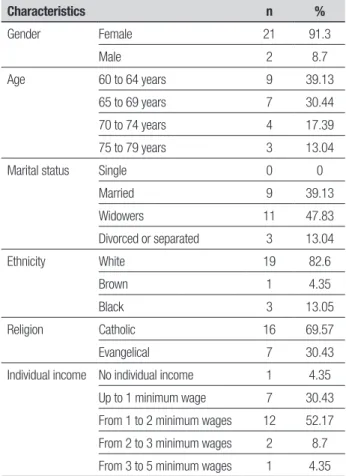
Of these, 91.3% (n=21) were females. Regarding marital status, the majority were widowed 47.83% (n=11), followed by married 39.13% (n=9).
he majority of the elderly professed the Catholic religion, 69.57% (n=16), regarded themselves of white color, 82.6% (n=19) and had an individual income of 1 to 2 minimum wages, 52.17% (n=12) (Table 1).
Regarding family composition, 21.73% (n=5) of the elderly lived only with their spouse; 26.09% (n=6) only with children, 8.7% (n=2) with spouse, children and grandchildren, 8.7% (n=2) with spouse and children, 4.35% (n=1) with children and grandchildren, and 8.7% (n=2) with other family members such as siblings, in-laws or nephews. None of the elderly reported house-hold members without blood ties. However, 21.73% (n=5) of the elderly reported living alone.
Regarding the GDS, 52.18% (n=12) of subjects had signs of depressive symptoms, with 39.13% (n=9) re-porting mild depressive symptoms and 13.05% (n=3) severe depressive symptoms.
On the cognitive evaluation, as measured by the Mini-Mental State Examination (MMSE), 13.05% (n=3), par-ticipants scored lower than the expected cut-of for schooling level, while 86.95% (n=20) had higher than ex-pected scores.
For the quality of life evaluation using the WHOQOL-bref and WHOQOL-old, the best analyzed domain was Sensory Functioning (M=76.3, ±21.7); and the worst was the Environment (M=63.4, ±15.7) (Table 2), where no single value summarized the entire assessment, resulting in only a deinition of a general state of better or worse quality of life.
Table 1. Distribution of elderly students attending youth and adult education programs according to sociodemographic variables. São Carlos, 2012.
Characteristics n %
Gender Female 21 91.3
Male 2 8.7
Age 60 to 64 years 9 39.13
65 to 69 years 7 30.44
70 to 74 years 4 17.39
75 to 79 years 3 13.04
Marital status Single 0 0
Married 9 39.13
Widowers 11 47.83
Divorced or separated 3 13.04
Ethnicity White 19 82.6
Brown 1 4.35
Black 3 13.05
Religion Catholic 16 69.57
Evangelical 7 30.43
Individual income No individual income 1 4.35 Up to 1 minimum wage 7 30.43 From 1 to 2 minimum wages 12 52.17 From 2 to 3 minimum wages 2 8.7 From 3 to 5 minimum wages 1 4.35 Source: Research data.
Variables associated with quality of life of elderly undertaking literacy programs. On the correlational analysis between age, time enrolled on the program, depressive
symp-Table 2. Distribution of results by domain area, expressed as lower value, higher value and arithmetic average, according to the bref and
WHOQOL-old. São Carlos, 2012.
Variables Description (n=23)
Lower value (minimum) Higher Value (maximum) Arithmetic average
WHOQOL-bref Physical domain 32.15 96.42 66.76 (±15.55)
Social relationships domain 20.83 95.83 62.85 (±17.4)
Psychological domain 8.33 100 65.57 (±21.8)
Environment domain 31.25 87.5 62.36 (±15.66)
WHOQOL-old Sensory functioning domain 12.5 100 76.35 (±21.73)
Autonomy domain 12.5 100 67.66 (±21.04)
Past, present and future activities domain 18.75 93.75 70.65 (±19.44)
Social participation domain 18.75 93.75 64.67 (±19.73)
Death and dying domain 0 100 63.04 (±26.1)
Intimacy domain 0 100 63.31 (±30.87)
toms, cognitive symptoms and quality of life (Spear-man Correlational Test), the variables age and years of education were not associated with any quality of life domain. However, the score on the GDS had a mod-erate inverse relationship with total scores on the do-mains QL Physical (rho= –0.653, p<0.01), Sensory Mo-tor Functioning (rho= –0.472, p<0.05), Independence (rho= –0.599, p<0.01), Past, Present and Future Activi-ties (rho= –0.454, p <0.05), Social Participation (rho= –0.567, p<0.01), and Intimacy (rho= –0.445, p<0.05), and a strong inversely proportional relationship with the Social Relationships domain (rho= –0.896, p<0.01).
he scores attained on the MMSE exhibited a mod-erate and direct relationship with the total scores on the QL Autonomy domain (r=0.654, p=0.001).
DISCUSSION
he results showed a female predominance, in the early stages of old age, i.e. from 60 to 64 years old (M=67.5, ±5.92 years old), a phenomenon also shown in the litera-ture.10,20-22 Furthermore, the high percentage of elderly
liv-ing alone is notable. Accordliv-ing to the 2010 Census, there are nearly three million seniors living alone in Brazil, rep-resenting about 14% of all Brazilians aged 60 or over.23 In
relation to the years of study of the elderly in Youth and Adult Education, time on the programs ranged from six months to 17 years. his discrepancy occurs because until students have learned how to read and/or write, they re-main at grades I and II of YAE. However, no literature data on the time spent on literacy programs for the elderly were found to serve as a comparison with our indings.
For the mood symptoms assessed by the GDS, 52.18% presented depressive symptoms signs, deined as six points or above on the scoring scale. A study that examined the prevalence of depressive symptoms among elderly participants in an Open University for the hird Age showed that, of the 184 people inter-viewed, only 17 (9.23%) participants scored more than six points on the GDS.24
he MMSE scores were correlated with the QL au-tonomy domain. Kissaki et al. (2012) investigated elder-ly University of the hird Age (U3A) students and found a signiicant positive association between education variables and cognitive test performance.25
he results also showed that elderly on literacy pro-grams had an average score of between 63.4 and 76.3 on the diferent QL domains. A study with elderly from an Open U3A found an average score of between 66.5 and 69.4 and a relationship between QL and higher education¹⁰. Years of education were not signiicantly related to any QL domain, as was expected.
An inverse relationship between depressive symp-toms and all domains of quality of life was found, except for the psychological, environmental, death and dying domains, in line with indings in the literature.
A study of Farenza et al. (2007) evaluating the quality of life in a group of elderly from Veranopolis, Rio Grande do Sul state, also found results that were inversely pro-portional, and statistically signiicant with p<0.01, on all WHOQOL-bref domains when correlated with the GDS.27
A Polish study on the quality of life of 257 elderly at a hird Age University, also using the WHOQOL-bref to evaluate quality of life and the GDS to assess depressive symptoms, observed that the occurrence of depressive symptoms negatively afected elderly quality of life on all domains studied, except for the physical domain.10
Final considerations. Although no signiicant relationship between quality of life and time of elderly participa-tion in adult educaparticipa-tion were found (as expected), we can conclude that the elderly on literacy programs have an average score of quality of life and that some qual-ity domains are inluenced by depression and cognitive symptoms.
Our results cannot be widely generalized because they only represent the elderly from a small region of Brazil who are on literacy programs. his study has some limitations such as the small number of subjects, although the percentage of elderly respondents was high compared to the total of elderly enrolled on YAE in the town (79.3%). No speciic studies on elderly illiter-ates were found in formal education, which limits com-parison of results and discussion. In summary, given the scarcity of literature, further studies on the subject are warranted, such as longitudinal studies to efectively check the relationship between length of study with quality of life. Also, it would be useful to include a con-trol group to better identify the inluence of programs on elderly quality of life.
Considering the illiteracy of the elderly population and the consequences for their quality of life, further research in this area is needed.
Support. his work was supported by a grant under schol-arship no. 2012/19108-3, São Paulo Research Founda-tion (FAPESP) and grant no. 23112.003335/2012-06 from the Pró-Reitoria de Extensão (ProEx), Universi-dade Federal de São Carlos.
Acknowledgements. he authors would like to thank the
REFERENCES
1. IBGE – Instituto Brasileiro de Geograia e Estatística. Síntese de Indica-dores Sociais: uma análise das condições de vida da população brasilei-ra. Brasilia, DF: Ministério do Planejamento, Orçamento e Gestão. 2011. 2. IBGE – Instituto Brasileiro de Geograia e Estatística. Síntese de Indica-dores Sociais: uma análise das condições de vida da população bra-sileira. Brasilia, DF: Ministério do Planejamento, Orçamento e Gestão. 2010.
3. Barnes DE, Yaffe K. The Projected Impact of Risk Factor Reduction on Alzheimer’s Disease Prevalence. Lancet Neurol 2011;10:819-828. 4. Marques DT. Educação de Jovens e Adultos: uma perspectiva de
al-fabetização com idosos. Campinas. Dissertação [Mestrado em Educa-ção]. Pontifícia Universidade Católica; 2009.
5. Unicovsky MAR. A educação como meio para vencer desaios impos-tos aos idosos. Rev Bras Enferm 2004;57:241-243.
6. Rocha FN, Bartholo MEC. Educação e Qualidade de Vida de Idosos: Uma Relexão Necessária. Rev Multidisc Human 2010;1:21-36. 7. WHOQOL Group. The development of the World Health Organization
quality of life assessment instrument (the WHOQOL). In: Orley J, Kuyken W editors. Quality of life assessment: international perspectives. Heidel-berg: Springer Verlag; 1994:41-60.
8. OMS – Organização Mundial da Saúde. Envelhecimento ativo: uma polí-tica de saúde. Brasília: Organização Pan-Americana da Saúde; 2005:60. 9. Cruz SRB. Bem-estar subjetivo em adultos e idosos. Campinas. Disser-tação [Mestrado em Psicologia]. Pontifícia Universidade Católica; 2003. 10. Zielinska-Wieczkowska H, Kedziora-Kornatowska K, Ciemnoczolowski
W. Evaluation of quality of life (QoL) of students of the University of Third Age (U3A). on the basis of socio-demographic factors and health sta-tus. Arch Gerontol Geriatr 2011;53:e198-e202.
11. Pavarini SCI, Viana AS, Ferreira AP, et al. Protocolo de avaliação ge-rontológia: módulo idoso. São Carlos: EDUFSCar, 2012. 128. (Série Apontamentos).
12. Fleck MPA, Leal OF, Louzada S, et al. Aplicação da versão em portu-guês do instrumento abreviado de qualidade de vida “WHOQOL-bref”. Rev Saúde Publica 2000;34:178-183.
13. Fleck MPA, Chachamovich E, Trentini C. Development and validation of the Portuguese version of the WHOQOL-old module. Rev Saúde Pu-blica 2006;40:785-791.
14. Sheikh JI, Yesavage JA. Geriatric Depression Scale (GDS): recent evi-dence and development of a shorter version. Clin Gerontol 1986;5: 165-173.
15. Yesavage JA, Brink TL, Rose TL, et al. Development and validation of a geriatric depression screening scale: a preliminary report. J Psychiatr Res 1983;17:37-49.
16. Almeida OP, ALMEIDA AS. Coniabilidade da versão brasileira da Esca-la de Depressão Geriátrica (GDS): versão reduzida. Arq Neuropsiquiatr 1999;57:421-426.
17. Folstein MF, Folstein SE, Mchugh PR. “Mini-Mental State”: a Practical Method for Grading the Cognitive State of Patients for the Clinician. J Psychiatr Res 1975;12:189-198.
18. Bertolucci PHF, Brucki, SMD, Campacci SR, Juliano Y. O Mini-exame do Estado Mental em uma população geral: impacto da escolaridade. Arq Neuropsiquiatr 1999;52:1-7.
19. Brucki SM, Nitrini R, Caramelli P, Bertolucci PH, Ivan H, Okamoto IH. Sugestões para o uso do Mini-Exame do Estado Mental no Brasil. Arq Neuropsiquiatr 2003; 61:777-781.
20. Lebrão ML, Laurenti R. Saúde, bem-estar e envelhecimento: o estudo Sabe no Município de São Paulo. Rev Bras Epidemiol 2005;8:127-141. 21. Mutchnik VI, Trevisan L. Carreira e Senioridade. Rev Adm Dialog 2009;
2:91-xx.
22. Nicodemo D, Godoi MP. Juventude dos anos 60-70 e envelhecimento: Estudo de casos sobre feminização e direitos de mulheres idosas. Rev Ciênc Ext 2010;6:40-53.
23. IBGE – Instituto Brasileiro de Geograia e Estatística [homepage na in-ternet]. Censo populacional brasileiro 2010 [acesso em 12 dez 2013]. Disponível em: http://www.ibge.gov.br.
24. Batistoni SST, Ordonez TN, Silva TBL, Nascimento PPP, Kissaki PT, Cachioni M. Depressive symptoms in elderly participants of an open university for elderly. Dement Neuropsychol 2011;5:85-92.
25. Kissaki PT, Lima-Silva TB, Ordonez TN, et al. O impacto da participação em Universidade Aberta à Terceira Idade no desempenho cognitivo. Rev Temat Kairós Geront 2012;15:71-87.