Bu/l Pan Am Hedth Organ 13(l), 1979.
BRAZIL’S SPECIAL SCHISTOSOMIASIS CONTROL PROGRAM:
THE MODEL ‘* ’
Paul0 de Almeida Machados
A considerable portion of the present Brazilian $ofiulation is afflicted with schistosomiasis. This articEe describes the unfold- ing of a major Government campaign against the disease. Em- ploying a wide range of health education, basic sanitation, water sup#ly, filanorbiciding, and chemotherapeutic measures, it seeks to reduce the prevalence of schistosomiasis among schoolchildren to less than 4 per cent in all zones of operation. It is hoped that this will achieve effective short-term control
over schistosomiasis throughout rural Brazil.
B@grotmd
Schistosomiasis, an endemic disease im- ported into Brazil along with African slaves, first established itself in the sugar- cane-producing Northeast, where it found a favorable environment that offered the following advantages:
l the presence of planorbid snails; l numerous bodies of water in the wet-
land and plains, where the growing of
sugarcane began;
l human carriers clustered in small
areas;
l a total lack of even minimal standards
of hygiene;
l a hot, moist climate.
In 1920, foci of schistosomiasis began to spring up outside the initially infested region. The disease was spread by unskilled workers, who migrated out of the Northeast
‘Also appearing in Portuguese in the Roletin de la Oficina Sanitaria Panamericana, 1979.
-ZThis paper is one of a series produced for a panel discussion of Brazil’s Schistosomiasis Control Program at the VI National Health Conference held on 8-15 August 1977. Reprints of this and the other papers are available through the Superintendencia de Campanhas de Safide PGblica do Ministerio da Satide (Superin- tendency of Public Health Campaigns, Ministry of Public Health-SUCAM). Esplanada dos Ministerios, Bloco 11-7”. Brasilia, D.F., Brazil.
SMinister of Health of Brazil.
to take employment being offered in other regionsof thecountry. Also, large-scaleproj- ects proliferated. These invariably em- phasized planning and engineering tech- niques, but made little provision for ade- quate health programs. The lesult was that whenever a cluster of carriers was super- imposed on a significantly dense popula- tion of planorbid snails, new foci sprang up.
By analyzing the dates on which foci were detected, the establishment of a focus can be correlated with preceding large- scale construction projects. This correla- tion has been found in Belo Horizonte, the Dote River Valley, the Paraiba River Valley, the Santos Slope, and the Central Plateau. The emergence of these foci could have been foreseen and avoided (1).
Today a considerable portion of the Brazilian population is afflicted with schistosomiasis. The strictly economic loss to Brazil from this disease has not yet been quantified: and though the most important thing is the hazard to human beings, the economic losses are far from negligible. Hence it would be useful to estimate them for purposes of justifying an allocation of resources for preventive measures.
By striking in childhood and (in the overwhelming majority of cases) making its effects felt from adolescence on, schistoso- miasis considerably diminishes the physical
34
PAHO BULLETIN lvol. 13, no. 1, 1979
capacity of individuals at their most pro- ductive age. The cost of medical care in chronic cases, and of absenteeism and low productivity, imposes a heavy financial burden. In 1965 this was estimated by Louis Oliver at approximately 800 million cruzeiros.
More detailed studies have been carried out in other countries with WHO support (Z), notably the work done in the Philip- pines by Farooq, who estimated the annual cost of schistosomiasis at 6.5 million dol- lars-more than the cost of malaria (3). The author also computed the annual cost per capita at as much as 15 dollars in Egypt, 24 dollars in Iraq, and 26 dollars in Japan. By treating infected workers in a factory, Khalid el Haddidy was able to reduce absenteeism by 37.5 per cent and defective production by 25 per cent.
Assuming Farooq’s index for Egypt is applicable in Brazil, and estimating the cases of schistosomiasis at only 10 million, the annual loss to Brazil would be 150 million dollars, a most disturbing figure.
Since the survey by Pellan and Teixeira in 1949-1952, no data have emerged by which to gauge the number of carriers with any accuracy (4). Morever, even the data of Pellon and Teixeira may I& regarded as approximate: their scant resour>$, plus the fact that they only conducted the’: urvey at
1 the municipal level, were bound ‘0,. limit the results of what was an important project carried out with scientific rigor in an admirable pioneering spirit. Our only data today are based on estimates of the total number of carriers that range from 8 million to 18 million.
Solely for resource allocation purposes, and without claiming to define prevalence, we have estimated the proportion of carriers in the neighborhood of a conserva- tive 10 per cent, which would mean ap- proximately 10 million carriers. A nation- wide survey now in progress will provide precise data.
In view of the high prevalence of schisto- somiasis in the Northeast, the large number of new foci outside the initially endemic
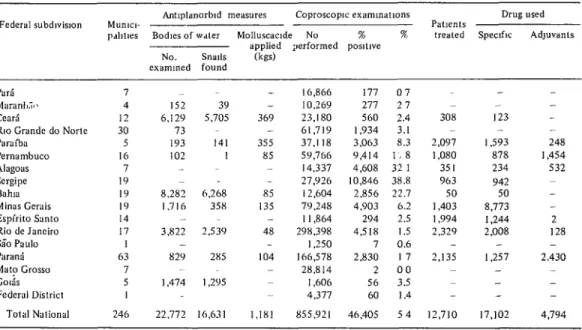
Table I. Anti-schistosomiasis activities in Brazil, 1975 Federal subdwislon Mun~c,- - Antlplanorbld measures Coproscoplc examlnatlons
pdlltles Bodies of wdler Molluscaade No w x applied ;xrformed posItwe NO. Snails Cm)
exammed found
Drug used Patients
treated Speclflc AdJuvanls
Parl
MsranL~ CCSK?
RIO Grande do Nortc Pmllxl
Pernambuco AlilgOU Sergipe Bahia Minas Cerais Espirito Santa Rio de Janeiro Sri0 Paul0 PaGins Mato Grosso colas Federal District
7 4 12 30 5 I6 7 19 IY I Y I4 I7
152 39 6,129 5,705
73 lY3 141
102 I
63 7 5
8,282 6,268 I.716 35x
- 3,822 253’)
- 82’) 285 1,474 I ,2Y5
16,866 - 10,269 369 23.180 - 61,719 355 37.1 I8 85 59,766 - 14,337 - 27,Y26 85 12,604 135 79,248 - I 1,864 48 298,398
1,250 104 166,578
- 28.8 I4 1,606 4,377 Total National 246 22,772 16,631 1.1X1 855,921
177 07 277 2 7 560 2.4 1,934 3.1 3,063 8.3 Y,414 1.8 4,608 32 1 10,846 38.8
2.856 22.7 4,903 6.2 294 2.5 4,518 I .5 7 0.6 2,830 I 7 2 00 56 3.5 60 1.4 46,405 5 4
308 2,097 1,080 351 963 50 1,403 1,994 2,329 2,135 - - 123 - I.593 248
878 1,454
234 532
942 so 8,773 - 1,244 2 2,008 128
- I.257 2.430
de Almeida Machado
l SCHISTOSOMIASIS CONTROL IN BRAZIL 35area, and the inevitability of migrations to developing areas, we think there is every reason to search for means of checking the spread of the disease.
For years the Ministry of Health has been striving continually to check the spread of schistosomiasis. The operations conducted-diagnosis, treatment, and oc- casional use of planorbicides-have failed to check the progress of the endemic dis- ease.
Considerable efforts were made in 1975. (see Table 1). However, the available drug (Etrenol), though highly effective, has many contraindications, and the special precautions required in its administration limited its large-scale use. Of the 12,710 carriers treated-a trifling figure in deal- ing with an endemic disease of such magni- tude-practically all were exposed to re- infestation and were certain to be reinfested within 12 months. Hence, it is plainly necessary to find a new schistosomiasis con- trol model that provides measures for elim- ination of the carrier state and reduces the risks of reinfestation.
Ecological Considerations
A considerable body of knowledge has already been accumulated on the taxonomy and biology of planorbid snails and schistosomes. Little, however, is known about the ecology of schistosomiasis.
Both the establishment of a new focus and the maintenance of the endemic disease are contingent on one event: the meeting up of a viable miracidium and a susceptible planorbid snail. This meeting is not a pre- destined event. The miracidium is short- lived and has a limited range of movement, which makes the encounter contingent on certain factors: environmental conditions propitious to the survival of the miraci- dium, the proximity of planorbid snails, the density of the snail population, and the number of miracidia.
It is common sense to expect some corre- lation between the number of miracidia and the density of planorbid snails, a corre- lation which determines the probability of encounters between them. But that correla- tion, subject to the influence of many factors, is not to be estimated by determi- nistic methods; rather, the indicated proce- dure is to develop a stochastic model.
It is fair to expect, however, that effec- tive treatment of all carriers at the same time will drastically reduce the number of miracidia. Hence a time will occur when the probability of planorbid infestation will drop significantly. It is certain that at that moment there will still be planor- bids, particularly in populations of Bulinus glabrata, that were previously infected and are now discharging cercariae. Because of this, concomitant action must be taken against the planorbid population; and here the planorbicide must be used at the right juncture, so that its effect will enhance the natural drop in planorbid density at the moment when the density of the miracidia drops, thus minimizing the probability of reinfestation.
It can be observed that all ecosystems throughout the world have metabolisms that are subject to annual variation (5). Planorbid populations should perforce be subject to such. variation, and should dis- play periods of maximum and minimum activity. In fact, seasonal variations in planorbid activity are known, having been recorded as early as 1955 (I). The risk of human and snail infestation should be greatest during the period of peak activity and least during that of minimum activity. By taking action against the carrier population’s schistosomes (through chemo- therapy) and against the snail population (through planorbiciding) at the right times and places, it should be theoretically pos- sible to influence the incidence and preva- lence of schistosomiasis.
36
PAHO BULLETIN lvol. 13, no. 1, 1979
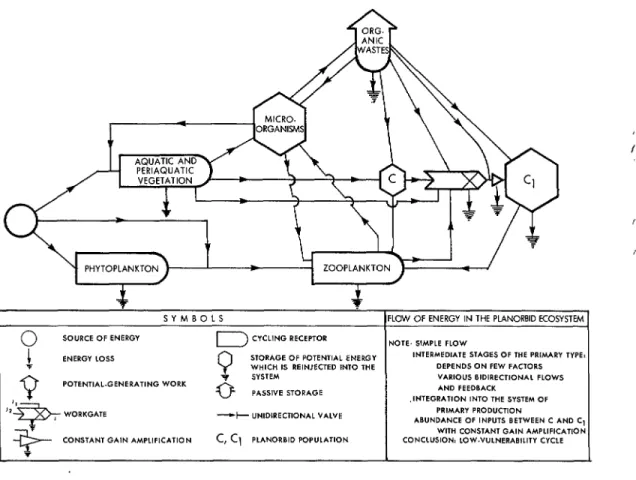
Figure 1. Energy flows in the planorbid ecosystem.
PHYTOPLANKTON ’ -- ZOOPLANKTON /
c
L c
if *
SYMBOLS FLOW OF ENERGY IN THE PLANORBID ECOSYSTEM
P
SOURCE
OF
ENERGY
I
CYCLING RECEPTOR NOTE. SIMPLE FLOWENERGY LOSS
0
STORAGE OF POTENTIAL ENERGY INTERMEDI*TE STAGES OF THE PRIMARY TYPE: WHICH IS REINJECTED INTO WE DEPENDS ON FEW FACTORS
Q
6SYSTEM
VARIOUS BIDIRECTIONAL FLOWS POTENT,AL.GENERA,ING WORKPASSIVE STORAGE AND FEEDBACK
,,I’
.INTEGRATION INTO THE SYSTEM OF
-F
, WORKGATE -+,- UNlDlRECTlONAL “ALYE ABUNDANCE OF lNP”T.5 BETWEEN C AND C, WMARY PROD”CT,ON
Sk=--
WITH CONSTANT GAIN AMPLlFlCATlON CONSTANT GAIN AMPL,F,CATION c, cl PLANORBID PCWULATION CONCLUSION: LOW-““LNERABILITY CYCLE I -
flow of energy characterized by bidirec- tional streams and many alternative path- ways (Figure 1). In our environment, and at the present state of our knowledge, the planorbid snail is regarded as invincible. We will fail to eradicate it anywhere, except at very unusual isolated breeding sites. However, we can reduce its density temporarily and on a more significant scale if we operate on the basis of accurate knowledge of the natural fluctuations in that density.
Strategy
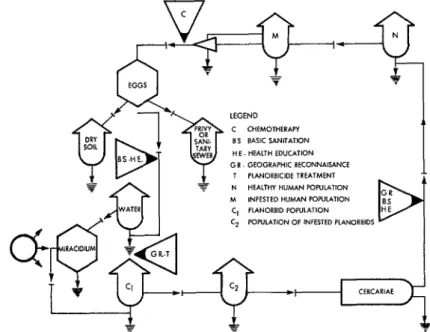
Figures 2 and 3 illustrate the energy flow of the schistosome ecosystem, identify- ing the points that are most vulnerable and
the actions that can be taken at those points.
The following procedures are practicable in Brazil:
l elimination of 90 per cent of the mira-
cidia with chemotherapy-which in repeat- ed experiments has cured 85 to 94 per cent of the carriers;
l temporary reduction of the planorbid
density to less than 1 per cent of the initial density ;
l coordination of these two actions in
time and place in order to make the most of the period of spontaneous reduction in pla- norbid density (this would be the essential step);
l basic sanitation (sanitary improve-
1
de Almeida Machado
l SCHISTOSOMIASIS CONTROL IN BRAZIL37
Figure 2. Energy flows in the schistosome ecosystem.
C,CC? FLOW
SPECIFK OR INDNIDUAL RESISTANCE LIFE SPAN OF PLANORBID “FE SPAN OF INFESTED PLANORBID CERCARU-N FLOW:
LIFE SPAN OF CERCARIA DISPERSION OF CERCAWAE EXPOSURE OF HUMAN BE1NGS
DENSITY OF C, AND Cz
S”Q,EC, TO SEASONAL YARIATIONS
L-34
ARIAEI
38 PAHO BULLETIN l
vol. 13, no. 1, 1979
installation of a toilet, shower stall, and laundering facilities);
l the provision of a potable water supply
and the building of combined drinking water, toilet, shower, and laundering fa- cilities for public use ;
l sanitary education.
determination of the zone of operations, which must be an unbroken and ecological- ly homogenous area where the disease is endemic.
Carrying out these actions in a coordi- nated manner for all or virtually all of the population can considerably reduce the in- cidence and prevalence of the disease. How- ever, none of these actions, by itself, can yield any lasting results. Only by carefully coordinating all of them can tangible effects be produced, and even then the gains can be consolidated only through constant and alert surveillance over a period of many years.
Methodology
The methodology worked out for Brazil’s New Special Schistosomiasis Control Pro- gram (PECE) is based on the foregoing eco- logical concept, combined with:
0 past experience in the planning and programming of campaigns for the control of malaria and Chagas’ disease;
l logistical experience acquired and im-
proved upon during the campaign against meningococcal meningitis carried out in Brazil in 1975, when 86 million people were
vacc’inated;
l experience acquired during the Cara-
velas Project (a go-day sanitation project that provided 100 per cent coverage at the municipal level and in two small towns).
The PECE strategy involves three succes- sive operational phases: a preparatory phase, an attack phase, and a surveillance phase.
At first, the PECE will operate in the vicinity of an existing permanent installa- tion of the Ministry of Health. As work progresses, the operational area will be extended to encompass whole municipali- ties and will spread out into the upper reaches of the hydragraphic basin involved, its advance being limited primarily by eco- logical considerations and at times by phys- ical geography, but not by state borders. Contiguity, continuity, and ecological homogeneity are thus the basic criteria for defining a zone of operations.
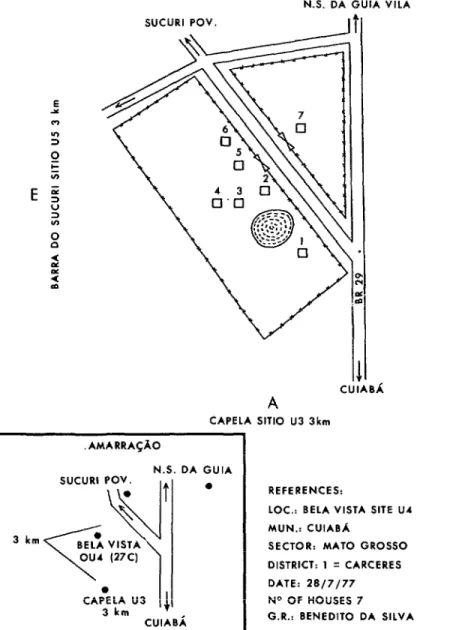
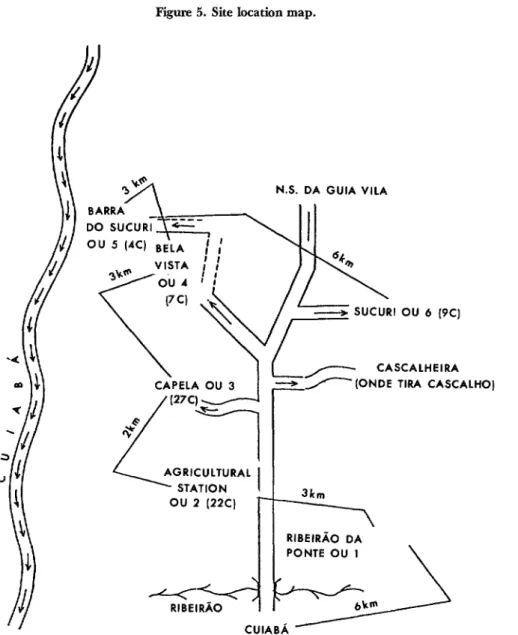
The operational headquarters of the Pub- lic Health Services Foundation (FSESP), such FSESP subunits as may prove neces- sary, and a temporary Superintendency of PubIic Health Campaigns (SUCAM) unit will be installed in the zone of operations. The FSESP operational headquarters and subunits wilI carry out the basic sanitation work and may also house the multiagency sanitary education team. It will be up to SUCAM to perform a geographic reconnais- sance of the area, to locate all dwellings on a map (Figure 4) and to collect data on the population, roads and trails, water bodies, breeding sites, and snails (Figure 5). SUCAM will also have to set up a temporary laboratory and conduct a coprologic survey of schoolchildren between the ages of 7 and 14, in addition to monitoring the surveil- lance phase.
PreParatory Phase
In carrying out the geographic reconnais- sance, SUCAM teams will identify and locate existing and potential planorbid breeding sites, identify planorbids, and determine their density and the percentage
of infested snails (by maceration). If in- I fected planorbids are found, the breeding
de Almeida Machado
. SCHISTOSOMIASIS CONTROL IN BRAZIL39
Figure 4. Site maps for geographic reconnaissance.
F
SUCURI POV. UlO 1 km
___+I SUN
N.S. DA GUIA VILA
SUCURI POV.
I1
CUlABi A
CAPELA Sill0 U3 3km
3 km
AMARRAGAO
I DA
CUIABi
GUIA a
REFERENCES:
LOC.: BELA VISTA SITE U4 MUN.: CUIABA
SECTOR: MAT0 GROSS0 DISTRICT: 1 q CARCERES
40
PAHO BULLETIN lvol. 13, no. 1. 1979
the focus will be kept temporarily under observation. On the basis of the observed frequenting of the focus by the local inhabitants and the proximity of breeding sites to foci, both breeding sites and foci will be classed in terms of their epidemiological significance.
Depending on the epidemiological sig- nificance of a breeding site, its ecological
representativeness, and the closeness of the resemblance between its behavior and that of breeding sites watched by capture stations in the same area, at least one capture station will be converted into an experiment
control station,
and the capture stations of which it is representative will be phased out. Planorbid populations will continue to be monitored every 30 days at the controlFigure 5. Site location map.
GUIA VILA N.S. DA
AGRICULTURAL
RIEEIRAO DA PONTE OU I
de Almeida Machado
l SCHISTOSOMIASIS CONTROL IN BRAZIL 41stations, following a standard procedure, until the end of the program. The number of control stations will be the smallest capable of supplying representative data for each different ecotope found in the area. Rainfall data will also be recorded in each zone of operations.
In the preparatory phase, the FSESP will carry out basic sanitation work, build water supply systems, and extend existing distri- bution networks in an effort to bring pota- ble water to the entire population. The work will be done not only in municipal centers, but also in all other towns and set- tlements of more than 400 inhabitants.
At the same time, the National Sanitary Education Division will coordinate the health education activities of the FSESP and SUCAM for purposes of (1) providing refresher training for and obtaining the participation of local teachers, (2) mobi- lizing community leaders, and (3) establish- ing health patrols made up of especially selected and trained schoolchildren. Social communications aids will be used for rapid mobilization of the community, and a methodical, persistent, and continuing health education campaign will be launched forthwith. Health education activities will be influenced by data collected through surveys of community attitudes, supersti- tions, values, and mores in each zone of operations.
In addition to using quantitative methods to evaluate health education activities, constant efforts must be made to improve methods for evaluating results by endeavor- ing to state them in mathematical terms, in order to avoid subjective assessments.
Poster contests among schoolchildren will be particularly useful as a means of encour- aging community participation, in motivat- ing schoolchildren to study the problem, for eliciting individual opinions that reveal attitudes and values, as a device for collect- ing material that can shed light on predomi- nant speech patterns and ideas, and as a resource for the improvement of health
education activities in the zone of opera- tions.
Attack Phase
The attack phase will be subject to the following conditions: The area of attack will be an entire zone of operations, with no untreated enclaves; and the time of attack will be the start of the period when the density of the planorbid population drops steadily, as determined from exami- nation of the data provided by 12 months of observation at the control station.
Prerequisites for entering into the attack phase will be adequate coverage by basic sanitation services; health education-after completing the preliminary contacts and organizing the health patrols; presence of trained meditators with established routes and stocked local supply posts; availability of medical supervision for the detection of contraindications, overseeing of dosages, attending to possible side-effects of the medication, and appropriate referral of cases that can be treated only under high-level medical supervision; presence of adequate stocks of drugs distributed at strategic spots in the zone of operations; sufficient planorbicide stocks in the zone of operations; and formal written authoriza- tion from the General Coordination Group, given in the light of information on all the above.
42 PAHO BULLETIN l vol. 13,
no. 1, 1979
The attack phase will also include the administration of oxamniquine, in a single standard dose, to all members of the popula-’ tion to be treated, within a period of not more than 10 days, once the planorbid den- sity has dropped to less than 1 per cent of the original density. The population to be treated will consist of all schoolchildren 7 to 14 years old where the survey shows a prevalence of less than 20 per cent, or the entire population where the survey shows a prevalence of more than 20 per cent. Treatment will not be administered to alco- holics, patients on psychotropic or narcotic drugs, cases on encephalopathy, uncompen- sated cases of enlarged liver and spleen, or severe cachectics.
Our current knowledge is not sufficient to warrant authorizing the administration of oxamniquine to pregnant women and epileptics. But cases of serious hepatosple- nomegaly , even if in the compensation phase, will be treated if they are assured of close medical supervision backed up by hospital facilities and adequate resources for the control of liver and kidney func- tions.
In areas subject to flooding, which dis- perses the planorbid population, chemo- therapy will be applied when the flood reaches its peak stage. Planorbicides will be applied as soon as the waters revert to their normal levels.
Surveillance Phase
Experience acquired at Touros in the state of Rio Grande do Norte has shown it possible to start the surveillance phase 180 days after the attack phase. The surveil- lance phase includes the following activ- ities:
l monthly determinations of the snail
population and the percentage of infected snails (the control stations continue in op- eration without interruption);
l monitoring of the maintenance of
basic sanitation facilities;
l conducting coproscopies of schoolchil-
dren every six months until the prevalence levels off below 4 per cent;
l treatment of new cases; and retreat-
ment of resistant cases and reinfested persons;
l continuation of health education ac-
tivities.
Structures to be used include the existing health network, a chain of health units at different levels of complexity now being set up (PIASS), the National System of Public Health Laboratories, SUCAM district of- fices and field laboratories, and FSESP regional offices.
Supervision and Evaluation
Execution of the program will be subject to ongoing supervision and evaluation at three levels: at the local level by the local SUCAM and FSESP offices, at the state level by the competent SUCAM and FSESP agencies, and at the national level by the General Coordination Group.
The General Coordination Group will be chaired by the Minister of State for Health and will have an Executive Secre- tary chosen by the Minister. Its other mem- ber will be the President of the FSESP, the Superintendent of the SUCAM, the Direc- tor of the National Health Education Divi- sion, and the Director of the Division of Schistosomiasis Control.
The General Coordination Group will meet every 30 days whenever possible, in
Brasilia or (preferably) in a zone of opera- tions. During these meetings the General Coordination Group will discuss reports
received on the work done by the executing , agencies (the FSESP, SUCAM, and the
de Almeida Machado
l SCHISTOSOMIASIS CONTROL IN BRAZIL 43difficulties encountered, and suggestions for improving the work.
The General Coordination Group will also decide when research is needed to im- prove the conduct of the Program, will identify possible executing agencies, may invite prominent specialists to participate in its meetings, will enlist the cooperation of universities and research agencies, and will have the GAPP -the Research Project Support Group in the Ministry of Health - support projects designed by third parties at the Group’s invitation.
The General Coordination Group must improve the flow of information, which must not stop short at the top but must return to the bottom-so that all those in- volved in execution will be continually informed about the progress of the pro- gram. To this end, the Executive Secretary will have a report drawn up after each meeting and will have copies made for dis- tribution at the state level for all imple- menting staff members.
Experimental Areas
Experimental areas will be chosen by the General Coordination Group. In these areas more rigorous and detailed methods for data collection, monitoring, and evalua- tion will be used-methods that are highly complex and costly, and that would be im- practical to apply throughout the program. Findings in the experimental areas will be discussed and evaluated, and may result in changes being made, including possible in- troduction of new tactics and even im- provements in strategy.
The program is not regarded as a hard and fast arrangement. It is essentially dy- namic and must evolve through a process of continual improvement. However, any changes must be approved by the General Coordination Group, the only agency with this authority.
In choosing experimental areas the cri- teria have been:
l The area must be small enough for
each inhabitant to be individually moni- tored; under present conditions, this means the area must have a population of less than 2,500.
l The community must be a stable one
not significantly affected by migrations.
l It must have well-defined ecological
conditions that are representative in some way.
l It must offer possibilities for imple-
menting one or more of the main activities of the program (chemotherapy, sanitation, planorbiciding, and health education).
In all circumstances, the experimental areas will be run with full respect for the right of the population to enjoy all the benefits that the PECE can offer, and the various measures implemented will be so conducted as to minimize the risks to the community.
The goals to be attained are as follows: In the first stage, the program must cover the schistosomiasis-infected are of Maran- hgo, Gears, Rio Grande do Norte, Parai- ba, Alagoas, and Sergipe. The projected date for the entire area to be in the surveil- lance phase is 1979. In each locality of the area prevalence should have been reduced to 4 per cent or less, using the percentage obtained in the survey of schoolchildren as a reference. If that prevalence can be sus- tained, it can be expected that the disease will be eradicated in the long run.
44
PAHO BULLETIN .vol. 13, no. 1, 1979
Ultimate eradication is unlikely, however, because of the possibility of reinfestation through carriers migrating from cities to rural areas.
Research
To be supported by the Ministry of Health, schistosomiasis research must meet the following conditions: (1) it must be pre- sented in the form of a technically sound project; (2) it must have well-defined objec- tives that mark it as original research, for funds must not be dissipated in duplicate research; (3) it must be conducted by re- searchers who are prepared to do the field work themselves and not leave it to others; (4) a performance timetable consistent with the requirements of the PECE must be pre- sented; (5) researchers must be willing to accept monitoring and periodic discussion of their work by the General Coordination Group; and (6) the research must relate to subjects of interest to the PECE.
Subjects of priority interest to the PECE are:
l Planorbid ecology, defined as the in-
teraction between the planorbid and the environment as expressed by fluctuations in the population dynamics (reproduction, migration, and relocation) of the snails.
l The ecology of schistosomiasis-inter-
actions between the environment and schis- tosome eggs, miracidia, and cercariae, expressed in terms of their survival, range of movement, and infectivity.
l Effects of chemotherapy on the adult
schistosome and description of these effects on the adult organism, particularly with regard to reproductive activity.
l Survival of the infected planorbid
under natural conditions.
l Behavior of communities in endemic
areas (before and during implementation of the PECE).
l Residual action of planorbicides. l Effects of planorbicides on aquatic
flora and fauna.
. Development of mathematical models.
l Standardization of monitoring pro-
cedures.
l Methods for diagnosing human in-
festation.
Today a considerable portion of Brazil’s population is afflicted with schistosomiasis.
This article describes the basic approach and concepts of a new antischistosomiasis program in that country.
The program seeks to simultaneously reduce the miracidia and planorbid snail populations of predefined areas through appropriately syn- chronized chemotherapy and planorbiciding work supported by health education, improve-
ment of basic sanitation, and provision of pota-
ble water. This undertaking-known as the
Special Schistosomiasis Control Program, has been divided into preparatory, attack, and surveillance phases.
The preparatory phase involves defining eco- logically homogeneous operating zones: collect- ing data on local human population, roads and trails, water bodies, snail breeding sites, and
snails: determining prevalence of human schis- tosomiasis; setting up snail monitoring facilities; and implementing basic sanitation, water sup- ply, and health education activities.
These steps are followed by the attack phase, in which suitably prepared areas are given enough planorbiciding to reduce the local planorbid snail population to less than 1 per
cent of its original level. Once this has been I accomplished, the eligible human population
receives a single standard dose of oxamniquine within a IO-day period.
de Almeida Machado
l SCHISTOSOMIASIS CONTROL IN BRAZIL45
and schoolchildren are given coproscopic exami- nations every six months to monitor levels of schistosomiasis in the human community.
Initially, schistosome-infested areas in the states of Alagoas, Cearl, Maranhio, Paralba, Rio Grande do Norte, and Sergipe are to be included in the program. Many large cities will not be included, however, because the Ministry of Health and Public Health Services Founda-
tion lack jurisdiction over water supply services and basic sanitation in these areas. It is felt at present that control of endemic schistosomiasis in rural areas is feasible in the short run through this program-but that ultimate eradi- cation is improbable because of the likelihood that migrating carriers from the cities will reintroduce the disease.
REFERENCES
(I) Almeida Machado, P., J. C. Guerra, and L. G. Sampaio Abreu. Rev Inst Adolf0 Lutz 15: 168.172, 1955.
(2) World Health Organization. Measure-
ment of the Public Health Importance of
Bilharriasis: Re$ort of a WHO Scientific
Group. WHO Technical Report Series No.
349, Geneva, 1967.
(3) Farooq, M. A possible approach to the evaluation of the economic burden imposed on a community by schistosomiasis. Ann Trap Med
Parasitol 57~323, 1963.
(4) Pellon, A. B. and I. Teixeira. 0 inqueri- to helmintologico escolar em cinco Estados das Regiiies Leste, Sul e Centro-Oeste. Divisao de Organisaeso Sanitaria, Ministry of Health, Brazil, Rio de Janeiro, 1953.
(5) Odum, H. T. Environment, Power and Society. John Wiley and Sons, New York, 1971. (6) Almeida Machado, P., and L. G. Sampaio Abreu. Rev Inst Adolf0 Lutz 15:253-240, 1955.
PAHO EXPERT ELECTED TO HEAD ENGINEERING ACADEMY
Frank A. Butrico, Chief of the Division of Environmental Health of the Pan American Health Organization, has been elected president of the American Academy of Environmental Engineers. The Academy is an organization of registered professional engineers which aims to im- prove the standards of environmental engineering and public recogni- tion of this profession by board certifying those with established com- petency.