400 PAHO BULLETIN l vol. 18; no. 4, 1984
Control Measures
The intensified measles vaccination effort that began in May 1983 was not effective in control- ling the outbreak, despite the large number of doses applied and the high rates of coverage that already existed. The number of children success- fully immunized against measles was consider- ably lower than that indicated by the December 1982 vaccination coverage figures, however, since the majority of children had received their vaccinations before reaching nine months of age, when vaccine efficacy was quite low. Moreover, the mass vaccination in May did not produce a significant increase in either vaccination cover-
age or immunity, since many of the children covered had already been vaccinated or had had measles.
In response to these findings, the Ministry of Health recommended as an immediate measure that measles vaccine be administered simultane- ously with polio vaccine during the national polio immunization day on 13 August 1983. This plan was put into effect for the whole Fed- eral District, and a total of 62,756 children nine months to four years of age (2,4 16 in Planaltina) were vaccinated at that time.
Source: Pan American Health Organization, EPINewslef-
rer 6(3):1-3, 1984, and Boletim Epidemioldgrco (Rio de Janeiro) 15(16):129-137, 1983.
AN ANALISIS OF LEPROSY INCIDENCE BY PATIENT AGE AND THE CLINICAL FORM OF THE DISEASE
Jair Ferreira,’ CXsar D. V. Bernardi,’ and Antonio Carlos Gerbase3
Descriptive studies on leprosy epidemiology have shown that the incidence of leprosy varies according to its prevalence, and that the follow- ing points are particularly worth noting:
1) In high-prevalence regions a large propor- tion of the cases occur among children and ado- lescents, whereas in low-prevalence regions the proportion of cases among children and adoles- cents is very small, with older age groups ac- counting for a relatively large share of the cases (I, 21.
2) In high-prevalence regions, paucibacillary forms (tuberculoid and indeterminate Mitsuda- positive) clearly predominate over multibacil- lary forms (dimorphous and lepromatous) and potential multibacillary forms (indeterminate Mitsuda-negative). In contrast, mutibacillary
‘Public Health PhysIcian and Leprologlst; Alternate Direc- tor, Dermatologic Health Service, Department of Health and the Environment, State of RIO Grande do Sul, Brazil.
‘Dermatologist and Leprologist; Director, Dermatologic Health Service, Rio Grande do Sul.
“Dermatologist and Leprologist; Supervisor. Der- matologic Health Service, Rio Grande do Sul.
forms predominate over paucibacillary forms in low-prevalence regions (2).
3) Regardless of the local leprosy prevalence, paucibacillary forms tend to predominate among
young patients, while the proportion of mul- tibacillary forms is greater among individuals who contracted the disease at more advanced ages (3, 4). This suggests that for purposes of epidemiologic analysis, the age of the subjects involved and the clinical form of the disease should be assessed together.
Certain other observations pertaining to the immunology and transmission of leprosy have long been accepted as true by leprologists and epidemiologists. Among these are the following:
. ABSTRACTS AND REPORTS 401
type of immunity and throughout life gives a negative response to the Mitsuda test (5).
2) Everyone is Mitsuda-negative at birth. However, the proportion of Mitsuda-positive in- dividuals increases progressively with age (6), since over time a cumulatively larger number of people come into contact with Hansen’s bacil- lus or with other mycobacteria that are capable of inducing cross-immunity (5). Thus, as Figure 1 suggests, about the only elderly people apt to be Mitsuda-negative are those who are incapable of developing cellular immunity to the disease.
3) To contract leprosy, an individual must generally have frequent, close, or prolonged contact with someone suffering from a conta- gious form of the disease (7). It appears that sporadic contact does not generally induce the disease, though such contact can probably cause subclinical infection.
This latter circumstance suggests that in order for an individual to develop the disease, he or she must be exposed to an infectious dose of bacteria containing a certain number of M. lep- rae, and there is little opportunity for this kind
Figure 1. A schematic diagram of leprosy susceptibility in a model human population, showing the rough percentages of people immune to leprosy, susceptible to paucibacillary leprosy, and susceptible to multibacillary leprosy at diierent ages. Area A shows the percentage unable to develop cellular immunity (Mitsuda-negative); area B shows the percentage able to develop celhdar immunity that has not done so (Mitsuda-negative); and
area C shows the percentage that has developed cellular immunity (Mitsuda-positive).
100
A
90 -
402 PAHO BULLETIN l vol. 18, no. 4, 1984
of exposure to occur through merely sporadic contact with a contagious subject.
It is also accepted that individuals receiving a bacillary dose sufficient to induce leprosy can react in three distinct ways. That is, individuals incapable of developing cellular immunity who come in contact with a sufficient bacillary dose will develop a multibacillary form of leprosy (see Figure 1, area A). In contrast, individuals capable of developing cellular immunity who have not yet done so (that is, who are still Mit- suda-negative) will develop a paucibacillary form of leprosy (see Figure 1, area B). Finally, individuals who have already developed cellular immunity (that is, who are Mitsuda-positive) will generally not develop the disease (see Figure
1, area C).
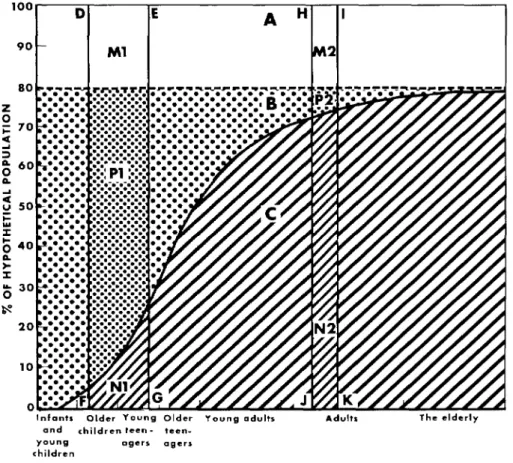
On the basis of the foregoing, we can say that the proportion of individuals at risk of contract- ing a multibacillary form of leprosy is roughly the same in any age group, since the proportion of those unable to develop cellular immunity remains constant. However, the proportion of individuals at risk of contracting a paucibacillary form diminishes with age, since the proportion of Mitsuda-positive individuals (those who have developed cellular immunity) increases with age. This explains why the proportion of pauci- bacillary forms is greater among children ynd young adults than it is among older adults.
Since the number of contagious patients (and, consequently, the “supply” of bacilli capable of causing infections) is greater in high-prevalence areas, the probability that an individual will re- ceive a bacillary dose sufficient to induce leprosy at an early age is much greater in high-preva- lence areas than in low-prevalence areas. Con- sequently, one would logically expect to find a much larger proportion of young patients in high-prevalence regions; and since paucibacil- lary forms predominate among such patients, one would also expect paucibacillary forms to predominate in such regions. Conversely, in low-prevalence areas it is less likely that people
will be exposed to an infectious dose of M. leprae early in life; and so the people contracting the disease will tend to be older, and there will tend to be a higher proportion of multibacillary forms.
Figure 2 presents a schematic diagram show- ing the typical epidemiologic patterns of leprosy in hypothetical high-prevalence and low-preva- lence regions. Rectangles DEFG and HIJK are respectively placed so as to correspond to the average ages of individuals exposed to infectious bacillary loads in the high-prevalence and low- prevalence regions; and the relative areas of the two rectangles correspond to the relative likeli- hood of being exposed to an infectious load in each of the two regions. Therefore, the place- ment and size of rectangle DEFG reflects the relatively young average age of those exposed and the relatively large numbers exposed.
Individuals in areas M, and Mz, unable to develop cellular immunity, will contract mul- tibacillary forms of the disease. Individuals in areas P, and P,, who are Mitsuda-negative at exposure but able to develop cellular immunity, will contract paucibacillary forms of the disease. And individuals in areas N, and N,, who are Mitsuda-positive at exposure, will not develop the disease despite exposure to a sufficient bacil- lary load.
l ABSTRACTS AND REPORTS 403
Figure 2. A schematic diagram of leprosy susceptibility showing typical epidemiologic patterns of the disease in high-prevalence areas, as indicated by rectangle DEFG, and
in low-prevalence areas, as indicated by rectangle HIJK (see explanation in text).
80 rWCVW.-cIPF . . . .
. . . .
:
. . . . . . . . . . . . .
; 70 . . . . . . . . . . . .
z! . . . . . . . .
g 60 P
2 v 50 F 2 i; 40
E I y 30 0 s
20
0
Infants Older Young Older Young adults Adult. The elderly and children leen - lee”-
Young agers rrgers children
References
(I) Fonte, J. Eoidemiologia. In: Brasil, Ministerio da Saude. Manual de Lepkogia. Rio de Janeiro,
1960, pp. 145161.
(2) Saikawa, K. Epidemiological phenomena dur- ing decreasing tendency rate of leprosy disease (Japa). Jpn J Lepr 50(3):99-104, 1981 and Excerpta Medicu 51(4):167, 1982.
(3) Noussitou, F. M., H. Sansarricq, and J. Wal- ter. Leprosy in Children. World Health Organization, Geneva, 1976.
(4) Shegal, V. N., V. L. Rege, and K. P. Singh.
The age of onset of leprosy. Int J Lepr 45( 1):52-S, 1977.
(5) Rotberg, A. Fator “N” de resist&ncia a lepra e relacoes corn a reatividade leprominica e tuberculini- ca; valor duvidoso do BCG na imuniza@o anti- leprosa. Rev Bras Leprul 25(2):85-106, 1957.
(6) Bechelli, L. M., and A. Rotberg. Resistencia, imunidade e alergia: Lepromino-rea@o. In: L. M. Bechelli and A. Rotberg. Comphdio de Leprologia (second edition). Rio de Janeiro, 1956, pp. 62-102.