CHAGAS’ DISEASE IN EL SALVADOR’ 1 2
Rafael A. CediIlos, M.D.3
Epidemiologic studies of Chagas’ disease in El Salvador have indicated the extent of Trypanosoma cruzi transmission in var- ious areas studied and the disease’s probable public health im- portance. Manifestations of both the acute and chronic phases of the disease appear milder than in most South American countries.
Introduction
Tiypanosoma cruzi infection patterns vary in different parts of the Americas. In some countries the extent of infection has been de- termined, while in others it is unknown.
In 1961 Romaiia (I) divided the countries of Middle and South America into three groups on the basis of what was known about infection patterns at the time. Group I consisted of coun- tries with national programs against Chagas’ dis- ease (Venezuela, Brazil, Uruguay, Chile, and Ar- gentina); Group II included countries where there was substantial information about the dis- ease (Guatemala, Panama, Ecuador, and Peru); and Group III was composed of countries and territories where the true importance of Chagas’ disease was unknown (Mexico, Belize, El Salva- dor, Honduras, Nicaragua, Costa Rica, Colom- bia,Guyana, Surinam, French Guiana, Bolivia, and Paraguay).
Despite El Salvador’s inclusion in the latter group, there was in fact considerable informa- tion about the disease in that country. The first known human case of trypanosomiasis caused by i? cruzi in El Salvador was reported by
‘Also published in Spanish in the BoZetin de la
Oficina Sanitaria Panamericana, Volume LXXVIII, No. 5 (May) 1975, pp. 430438.
2Reprints of this article may be requested from the Director, Bureau of Tropical Diseases, Center for Dis- ease Control, Atlanta, Georgia 30033, U.S.A.
3Parasitologist, Central America Research Station, Bureau of Trouical Diseases. Center for Disease Con- trol, U.S. Public Health SerGce, c/o United States km- bassy, San Salvador, El Salvador.
Segovia en 1913 (2). Since then a number of reports have supplied data on the prevalence of the disease in various parts of the country (3-13). These provide a basis for the present review, which describes the major epidemio- logic and pathologic features of Chagas’ disease in El Salvador for purposes of consolidating available information and pointing out some matters in need of more extensive study in the future.
Epidemiologic Characteristics
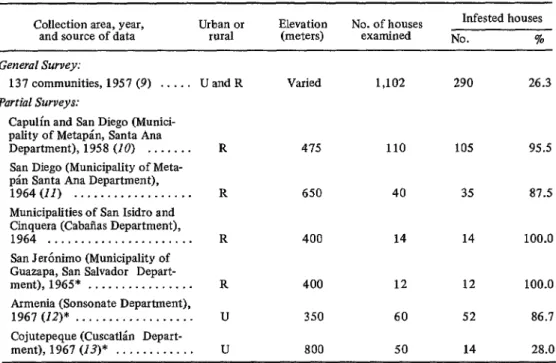
House Infestation by Trypanosome Vectors A 1957 survey of 137 Salvadorean commu- nities found 26.3 per cent of 1,102 houses exa- mined to be infested by two triatomid bugs that serve as trypanosome vectors. As sub- sequent surveys have shown, this triatomid in- festation rate can reach 100 per cent in small rural settlements where the local type of dwel- ling favors proliferation of the bugs (see Table 1). However, it is important to note that high infestation rates can occur even in semi-urban areas, respective rates of 28.0 per cent and 86.7 per cent having been found in the small cities of Armenia and Cojutepeque (12,13).
On the basis of information now available, it is believed that the vector Triatoma dimidiata predominates within thatch and adobe dwel- lings of regions 600 meters or more above sea level, while Rhodnius prol&us is common in dwellings of straw or thatch below 300 meters.
TABLE 1 -Percentage of triatomid-infested houses in various Salvadorean communities. Collection area, year, Urban or
and source of data IllId
General Survey:
137 communities, 1957 (9) . . . U and R
Partial Surveys:
Capulin and San Diego (Munici- pality of Metapin, Santa Ana
Department), 1958 (I 0) . . . R San Diego (Municipality of Meta- pan Santa Ana Department),
1964 (II) . . . R Municipalities of San Isidro and
Cinquera (Cabafias Department),
1964 . . . ..I... R San Jeronimo (Municipality of
Guazapa, San Salvador Depart-
ment), 1965* . . . R Armenia (Sonsonate Department), 1967 (12)* . . . U Cojutepeque (Cuscatlrin Depart- ment), 1967 (13)* ..,... U
*Results of statistical sample surveys.
Elevation No. of houses (meters) examined
Varied 1,102
475 110
650 40
400 14
400 12
350 60
800 50
Infested houses
No. %
290 26.3
105 95.5
35 87.5
14 100.0
12 100.0
52 86.7
14 28.0
At intermediate elevations both vector species have been found.
T. cruzi Infection of Vector Species
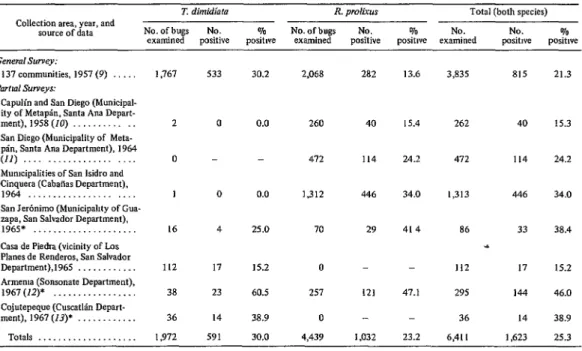
Table 2 shows the rates at which T. cruzi was observed to infect these two species in a number of Salvadorean communities. In all, 6,411 adults and nymphs were examined and 1,623 (25.3 per cent) were found infected. Combining data for the two species, observed infection rates ranged from 15.2 per cent in Casa de Piedra, a small predominantly rural set- tlement 12 km outside San Salvador, to 48.8 per cent in the vicinity of Armenia (12). It can be seen that both bug species frequently harbor the parasite, though the observed rate of infec- tion in T, dimidiata (30 per cent) was notably higher than in R. proZixus (23 per cent). The high rates of triatomid infection found in two semi-urban areas surveyed (Armenia and Coju- tepeque) was probably due to certain rural fea- tures in these areas (especially the types of
dwellings used and sociocultural practices of the inhabitants).
Another noteworthy point is that past sur- veys have found a significant proportion of R. prolixus specimens (5.6 per cent) infected by the trypanosome T. rangeli, which is not known to be pathogenic in man (see Table 3). This epidemiologic data deserves careful future study, especially since T. rangeZi was identified primarily by direct microscopic examination of each insect’s intestinal contents, stain seldom being used. This means that T. rangeli may be more common than previously reported in rural areas, especially where R. proZixus predomi- nates. When the bug specimens’ intestinal con- tents were stained after initial examination in the San Jeronimo survey, fbr example, a higher infection rate (11.4 per cent) was found. It is thus felt that precise identification of T. rangeli in future studies could help pave the way for determining the true nationwide prevalence of T. cruzi. In the past, combined T. cruzi and T. rangeli infections were reported in only 28 (0.8
Cedillas . CHAGAS’ DISEASE IN EL SALVADOR 137
TABLE I-Rates of T. cruzi infection among triatomid bugs collected at various Salvadorean localities. Collection area, year, and
source of data
T. dimidia ta R. proliws Total (both species)
No. of bugs N”. % No. of bugs NO. % NO. ND. %
examined positive pasitw examined positive positwe examined positwe pnsitwe
GeneralSurvey:
137 communities, 1957 (9)
PamIll suJ?Jeys:
Capulin and San Diego (Municipal- itv of MetauQn. Santa Ana Deuart- nient), 1958 (i0) . .: San Diego (Municipality of Meta- pin, Santa Ana Department), 1964
(II) .
Municipalities of San Isidro and Cinquera (Cabaiias Department), 1964 . . . . . . . . San Jer6nimo (Municipahty of Gua- zapa, San Salvador Department), 1965* . . . . . . . . .
1,767 533 30.2 2,068 282 13.6 3,835 815 21.3
2 0 0.0 260 40 15.4 262 40 15.3
0 - - 472 114 24.2 472 114 24.2
I 0 0.0 1,312 446 34.0 1.313 446 34.0
16 4 25.0 70 29 414 86 38.4
112 17 15.2 0
38 23 60.5 257
36 14 38.9 0
1,972 591 30.0 4,439
-
33 .a
17 15.2
121 144 46.0
14 38.9
1,032
- 112
47.1 295
- 36
23.2 6,411 1,623 25.3
Casa de Piedra(vicinity of Las Planes de Renderos. San Salvador Department),1965 . . . . . Armema (Sonsonate Department), 1967 (IL’)* . . . . . . . Cojutepeque (Cuscatldn Depart-
ment), 1967 (I3)* . . .
Totals . . . . . . .
*Results of statistIca sample surveys.
Animal Reservoirs
specimens (the bats were of the genera Arti- beus, Chylonicteris, and Desmodus). Examina- tion for T. cruzi has yielded negative results in all other animals tested-including 12 cats (Felis domesticus), 20 armadillos (Dasypus novem- cinctus), 6 murine opossums (Didelphis muri- na), 2 agoutis (Dasyprocta punctata), and 21 rats and mice (Rattus spp., MUS spp.).
There has been little study of T. cruzi preva- lence in wild and domestic animals of El Salva- dor (9). The parasite was reported in one dog out of 68 tested by examination of thick blood films. Also, a trypanosome morphologically similar to T. cruzi was found in three out of
111 bats tested by direct examination of blood
TABLE 3-Rate of T. rangeli infection among triatomid bugs collected in various Salvadorean localities.
Collection area, year,
and source of data
T. dimidiata
No. of bugs No.
examined positive positive %
R. prolixus
No. of bugs No. %
examined positive positive
General survey:
137 communities, 1957 (9)
Partizl surveys:
Municipalities of San Isidro and Cinquera (Cabfis De- partment), 1964 . . . San Jer6nimo (San Salvador Department), 1965 . . .
Totals
1,767 24 1.4 2,068 109 5.3
1 0 0.0 1,312 76 5.8
16 0 0.0 70 8 11.4
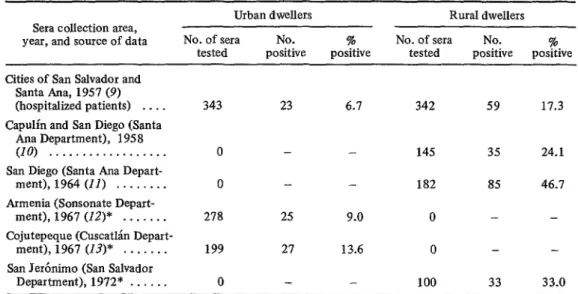
TABLE 4-Results of complement fixation tests for T. cruzi, conducted with human sera from residents of various Salvadorean communities.
Sera collection area, year, and source of data
Urban dwellers Rural dwellers
No. of sera No. % No. of sera No. %
tested positive positive tested positive positive Cities of San Salvador and
Santa Ana, 1957 (9)
(hospitalized patients) . . . . 343 23 6.1 342 59 17.3
Capulin and San Diego (Santa Ana Department), 1958
(10) . . . 0 - - 145 35 24.1
San Diego (Santa Ana Depart-
ment), 1964 (II) . . . 0 - - 182 85 46.1
Armenia (Sonsonate Depart-
ment), 1967 (12)* . . . 278 25 9.0 0 - -
Cojutepeque (Cuscatlan Depart-
ment), 1967 (13)* . . . 199 27 13.6 0 - -
San Jeronimo (San Salvador
Department), 1972* . . . 0 - 100 33 33.0
*Results of statistical sample surveys.
Infection in Humans
The highest percentages of serologically posi- tive reactions to T. cruzi have been found in adults and children from rural parts of the country (see Table 4). However, it should be pointed out that the complement fixation (CF) tests used to obtain these results were not en- tirely uniform. Until 1958 an aqueous extract of cultured T. cruzi was used for antigen, and reactions yielding hemolysis inhibition of 50 per cent or more were considered positive. Since then serologic tests have been conducted using the CF technique described by Freitas and Almeida (14).
The percentages of positive reactions ob- tained in some communities were consistent with those typically found in areas highly en- demic for Chagas’ disease. For example, the 1964 survey conducted in the rural area of San Diego, MetapGn, found that sera from 85 out of 182 persons examined (46,7 per cent) gave a positive CF reaction for T. cruzi. The rate of positive reactions was higher among adults (67.8 per cent) than among persons under age 15 (27.4 per cent). The difference between
xenodiagnosis4 yielded results that were the re- verse of these; that is, it revealed parasitemia in 55.5 per cent of those under age 15 who had given a positive or uncertain CF reaction, as opposed to only 15.9 per cent of those over that age (11). This high degree of serologic re- sponse in the rural child population suggests a high prevalence of T. cntzi in the areas studied.
Equally significant results have been re- ported from serologic surveys using Salvadorean blood banks. Of 1,000 blood donors tested at San Salvador’s Resales Hospital in 1963, 5.3 per cent yielded a positive CF response (15); and in 1970, hemagglutination testing of sera from 537 donors at the Maternity Hospital in San Salvador yielded an 8.7 per cent positive response (16). These results suggest that blood transfusions could act as a vehicle for T. cmzi transmission in El Salvador, but more detailed research will be needed to confirm this impres- sion. In any event, the findings demonstrate a need to carry out routine serologic examina- tions to investigate the presence of T. cruzi infections in blood donors.
Cedillas . CHAGAS’ DISEASE IN EL SALVADOR 139
TABLE S-Results of T. cruzi xenodiagnosis of adults and children from various Salvadorean communities.
Test area, year of test, and source of data
Urban dwellers Rural dwellers
No. No. 5% No. No. %
examined positive positive examined positive positive
San Salvador and Santa Ana, 1957 (9) (hospitalized pa- tients) . . . Capulin and San Diego (Santa
Ana Department), 1958 (10) . . . San Jer6nimo (San Salvador
Department), 1972* . . . Schoolchildren of various com- munities, 1972 (I7)* . . .
65 15 23.1 374 69 18.4
0 - 132 5 3.8
0 100 17 17.0
305 7 2.3 226 14 6.2
*Results of statistical sample surveys.
Parasitology surveys based on xenodiagnosis have indicated a higher percentage of persons with T. cruzi among rural dwellers than in the urban population (Table 5). The roughly equiv- alent results obtained from hospitalized pa- tients in rural and urban areas are presumably explained by the fact that most patients seeking hospital care in El Salvador come from rural areas. Recent xenodiagnosis of schoolchildren between 6 and 15 years of age, selected at ran- dom from various Salvadorean communities
(17), showed average rates of infection of 2.3 per cent in urban areas and 6.2 per cent in rural communities.
While these isolated statistics indicate that T. cruzi transmission in the country is probably important, there is no reliable morbidity data because notification of the disease is not com- pulsory. An average of 147 cases per year was reported in 1963-1967, and 232 cases (8.6 per 100,000 inhabitants) were reported in 1968. As Table 6 shows, the latter figure is similar to
TABLE 6-Reported cases of Chagas’ disease in the Americas, by country, 1963-1968.
Country 1963-1967 (Average No. of cases)
1967 (No. of cases)
1968
No. of cases Cases per 100,000 inhabitants Argentina . . . _ . . . _ . . . .
Bolivia . . . El Salvadora . . . Guatemala . . . Hondurasa . . . Panama . . . _
Para
v aya . . . Peru . . . .._... United StatesC . . . Uruguay . . . Venezuelaa . . .
2,239 - 147 305 . _ . 4 17 2 - 42:
3,443 2,726d 11.5
- 12 0.6
148 232 8.6
489 -
. . . 28 1.7
3 1 0.1
17 96 8.3
12 7d 0.1
- 1 0.0
- 1 0.0
461 538 8.0
Source: Pan American Health Organization, Reported Cases of Notifiable Diseases in the Americas, 1968,
Washington, DC., 1971 (Scientific Publication 223). aReporting area, 1967 and 1968.
bReporting area, 1967.
‘Chagas disease is not a notifiable disease in the United States. dProvisional data.
annual incidences reported in Argentina, Hon- duras, Paraguay, and Venezuela (18). However, the rate in El Salvador is doubtless much higher than that, since the reported cases were di- scovered only by chance-in the course of routine examination of thick-film blood pre- parations to detect malaria parasites at the labo- ratory of the National Campaign Against Ma- laria (CNAP). (In 1970 the laboratory reported
127 slides positive for T. cruzi out of 572,373 examined.) As is generally recognized, examina- tion of thick-film preparations is not an ade- quate procedure for revealing the presence of 7’. cmzi in the blood.
Data are virtually nonexistent with regard to nationwide mortality from T. cruzi infections. Four deaths were reported in El Salvador dur- ing 1968, as compared to 12 in Panama, 17 in Chile, and 406 in Venezuela (18).
Pathological Characteristics
The foregoing epidemiologic information suggests that T. cruzi infection may be a real public health problem in El Salvador. But though both acute and chronic cases of Chagas’ disease have been reported with some fre- quency, the parasite’s importance as a disease agent has not been fully evaluated. Fever and the ophthalmoglandular syndrome (Romana’s sign) have been the principal symptoms re- ported in children and young adults with acute Chagas’ disease. A predominant share of elec- trocardiogram (ECG) changes, consisting of first-degree atrioventricular block and flattening or inversion of the T-wave, as well as cardio- megaly to a lesser degree, have been reported in children (9). It is clear that these cardiac changes have appeared less frequently and have seemed less severe than those commonly ob- served in other countries. In Brazil, for exam- ple, although the severity of acute Chagas’ dis- ease varies, 50 per cent of the cases show ECG alterations (20).
In El Salvador, cardiac insufficiency was the predominant symptom observed in 20 of 3 1 pa- tients with parasitologically and serologically confirmed cases of chronic Chagasic myocardi-
in those cases were: ventricular extrasystoles (70 per cent), right-branch block (45 per cent), auricular fibrillation (22 per cent), and atrio- ventricular block (16 per cent). On the other hand, clinical and laboratory study of another group of 33 patients with positive CF tests failed to reveal any ECG changes or symptoms characteristic of the chronic phase of the dis- ease (9).
Regarding observed pathological changes, a review has been made of 4,999 autopsies per- formed at the Resales Hospital (San Salvador) from 1945 to 1966 (21). Acute Chagas’ disease was the reported cause of death in only one case, that of a 48day-old infant who entered the hospital with fever and convulsions. Nor were any parasites found in the tissues of 268 patients with myocarditis, despite the fact that 45 of these cases were classed as chronic myb- carditis, with 12 of the 45 yielding serologic reactions and showing ECG changes suggestive of T. cruzi infection. It should be mentioned, however, that these pathological studies were not directed specifically at finding the parasite. The impression exists, therefore, that the se- verity of T. cruzi infection is only moderate in El Salvador, and that the parasite does not cause significant myocardial damage there, as it does in some South American countries; but in fact there have been no longitudinal studies de- voted to finding out what proportion of those infected develop the chronic phase of the dis- ease.
Cedillas . CHAGAS’ DISEASE IN EL SALVADOR 141
SUMMARY
Several studies on Chagas’ disease in El Sal- of these tridtomids was 5.6 per cent. (4) T. vador have supplied important epidemiologic cruzi infection in humans has been more preva- information, including the following: [ 1) Rates lent among rural dwellers than among urban in- of house infestation by triatomid vectors have habitants. Xenodiagnosis positivity rates have ranged from 26.3 per cent to 100 per cent in ranged between 3.8 and 18.4 per cent of the various localities studied, higher rates being individuals examined. Positive reactions to the found in rural than in urban areas. (2) Tri- complement fixation test have ranged from aroma dimidiata and Rhodnius prolixus are the 17.3 to 46.7 per cent. (5) The acute phase of two vectors of T. cruzi in El Salvador, with T. the disease has been observed in both children
dimidiata predominating in localities at eleva- and young adults. Nevertheless, ECG and radio- tions above 600 meters and R. prolixus in those logic changes appear to be less common and below 300 meters. (3) T. cruzi infection rates milder than those reported in South American in these triatomids have ranged from 15.3 to countries. (6) Further studies are required in 48.8 per cent, the average being 25.3 per cent. order to better define the status of Chagas’ dis- The average rate found for T. rangeli infection ease in El Salvador.
REFERENCES (1) Romaila, C. Epidemiologia y distribuck geogri-
fica de la enfermedad de Chagas. Bol Of Sanit Panam 51: 390-403,1961.
(2) Segovia, J. C. Un case de tripanosomiasis. Arch Hasp Rosaks (San Salvador) 8 (10): 249-254, 1913.
(3) Segovia, J. C. Tripanosomiasis en el Salvador.
IV Congreso Mkiico Latinoamerkano (Ha- vana, Cuba), 19 pp., 1922.
(4) Reina Guerra, A. Contribucick al estudio de la tripanosomiasis en El Salvador. San Salvador, El Salvador, 29 pp., 1939.
(5) Urrutia, S.A., and T.J. Alas. Algunas conside- raciones sobre un nuevo case de tripanosomia- sis en El Salvador. Gac Med Occidente (El Sal- vador) 2: 303-309,194O.
(6) Romero, A. Consideraciones clinicas sobre dos cases de enfermedad de Chagas observados en El Salvador. Gac Med Occidente (El Salvador)
4: 859-864, 1942.
(7) Castro, R. A. Observacibn clinica de un case de enfermedad de Chagas en un niiio de 10 &OS.
Gac Med Occidente (El Salvador) 15:
869474, 1952.
(8) Garcia Montenegro, J. Enfermedad de Chagas en el hea de demostracibn sanitaria. University of El Salvador (thesis), 52 pp., 1954.
(9) Peiialver, L. M., M.I. Rodriguez, M. Bloch, and G. Sancho. Tripanosomiasis en El Salvador.
Arch ColMed (El Salvador) 18: 97-134, 1965. (10) Sinchez P., H.E. Estudio sobre tripanosomiasis en el Municipio de Metapin. University of El
Salvador (thesis), 5.5 pp., 1958.
(11) Molina S., R. Algunos aspectos epidemiolbgicos de la enfermedad de Chagas en dos comunida- des de1 Municipio de Metapa’n. University of El Salvador (thesis), 34 pp., 1964.
(12) Vkquez Amory, E. Aspectos epidemio16gicos de la Enfermedad de Cbagas en Armenia. Arch ColMed (El Salvador) 20: 161-174, 1967. (13) Moisa Parada, C.F. Aspectos epidemiol&icos de
la enfermedad de Chagas en Cojutepeque. Uni- versity of El Salvador (thesis), 31 pp., 1967. (14) Almeida, J.O., and J.L.P. Freitas. Reaqses atipi- cas em fixaq:o do complemento nos sistemas sifilis e doenca de Chagas pelo metodo quanti- tativo: Interpreta@ de titulos. Rev Bras2 BioZl3: 1-2, 1953.
(15) Trejos, A., and A. Barrios. Positive Chagas’ dis- ease complement fiiation in blood samples from Rosales Hospital, San Salvador. (Personal communication, 1962.)
(16) Hernhdez, A. Y., and R. A. Cedillos. Reactividad serol6gica para T. cruzi en donantes de sangre en el Hospital de Maternidad de San Salvador.
Arch Cal Med (El Salvador) 24 (1): l-6,1971. (17) Cedillos, R A., M. I. Rodriguez, and M. Azmitia.
Prevalencia de 7’. cruzi en escolares de El Sal- vador. (In press.)
(18) Pan American Health Organization. Reported Cases of Notifmble Diseases in the Americas,
1968. Washington, D.C., 1971. (Scientific Publication 223 .)
(19) El Salvador, Ministerio de Salud tiblica y Asis- tencia Social. Campaiia National Antipaltidica, Memo& de Labores. San Salvador, El Salva- dor, 32 pp., 1970.
(20) Laranja, F.S., E. Diaz, G. Nobrega, and A. Miran- da. Cbagas’ disease: A clinical, epidemiological and pathologic study. Cimhtion 14 (6): 1035-1060,1956.
(21) Platero, F. Enfermedad de Chagas: Aspect0 pato- 16gico. Arch Co1 Med (El Salvador) 21 (1):