Flowering and vegetative growth of olive tree
submitted to pruning and paclobutrazol application
Maria c. M. cruz*, adelson f. oliveira, Dili l. oliveira, João V. neto
Empresa de Pesquisa Agropecuária de Minas Gerais - EPAMIG, Unidade Regional do Sul de Minas -URESM, Campus da UFLA, Caixa Postal 176, Cep: 37200-000, Lavras- MG, Brazil
* Corresponding author: e-mail: [email protected]; tel (38) 3532-1211
Received: 29 March 2010; Accepted: 15 March 2011
abstract
This work focuses on the evaluation of flowering and vegetative growth of olive tree submitted to pruning and paclobutrazol application under field conditions with low temperatures during the winter. Two-years-old olive plant variety Grappolo 575, were submitted to light pruning, removing apical dominance, before treatments application. The treatments were organized in a 4×2 factorial scheme, respective to four PBZ concentrations tested: 0, 200, 400 and 800 mg L-1 of PBZ and two plants groups, with and without pruning, in randomized block with four replications. Paclobutrazol concentrations tested did not affect the olive tree flowering. The plant vegetative growth was reduced until 60 days after paclobutrazol application. Pruning resulted in stimulation of emission of vegetative shoots and reduction of flowering.
Key words: Floral induction, growth regulators, management, Olea europaea L.
resuMo
Com o objetivo de avaliar o florescimento e o crescimento vegetativo da oliveira em plantas submetidas à poda e a aplicação do paclobutrazol foi conduzido um experimento em condições de campo com ocorrência de baixas temperaturas durante inverno. Plantas da variedade Grappolo 575, com dois anos de idade, foram submetidas a uma poda leve, retirando-se a dominância apical, antes da aplicação dos tratamentos, no mês de abril de 2009. Para a distribuição dos tratamentos, adotou-se o esquema fatorial 4×2, referente às quatro concentrações de paclobutrazol testadas e dois grupos de plantas, com e sem poda, em blocos casualizados com quatro repetições. As concentrações de paclobutrazol testadas não influenciaram no florescimento da oliveira. O crescimento vegetativo foi retardado até 60 dias após a aplicação do paclobutrazol. A poda estimulou a emissão de brotações vegetativas e reduziu o florescimento.
palavras-chave: Indução floral, reguladores de crescimento, manejo, Olea europaea L.
introDuction
One alternative to olive flowering encourage in Brazilian conditions may be achieved through the vegetative growth control and thus provide higher yields. This practice can be
accomplished with the growth regulators application from
group of growth retardants. Among the existing phytoregulators
is the paclobutrazol (PBZ) which reduces the plants growth by
The gibberellins are involved in regulation of many physiological processes, including floral induction and growth regulation.
The gibberellins produced in roots appear to influence flowering by inhibiting the reproductive buds development (Goldschimidt et al., 1998). Thus, if the gibberellins are responsible for the flowering inhibition, then growth retardants that act by inhibiting the endogenous gibberellins synthesis may promote flowering (Davenport, 1990).
However, the PBZ response in flowering induction under non inductive conditions, such as the occurrence of drought stress or cold in period before flowering, can be variable due to factors pertaining to concentrations used, the absorption and the plant developmental stage at time of product application (Goldschimidt et al., 1998). In ‘Tahiti’ acid lime tree, the PBZ application increased the plants flowering submitted to low temperatures conditions of 16 ºC, but was not effective in flowering induction under conditions of 25 ºC day / night 20 °C (Cruz et al., 2008).
There are many works with the regulators growth application in other fruit species, however, the information about the effects resulting from growth regulators application in olive trees is still incipient. Floral initiation of olive tree requires the modification of buds latency conditions after floral induction. Buds located in leaves axils may have different fates, some remain dormant throughout life or until they receive an external stimulus, others have a vegetative or reproductive fate and others may simply fall (Rallo and Cuevas, 2008).
Among the management practices that may favor the buds dormancy breaking, pruning can be used; however for the olive tree, in production phase, the recommendations have been made only for specific situations. In general, light pruning can be made to remove branches poorly located close to the soil and shaded and those excessive, keeping the largest possible leaves number to prevent the sun direct action on branches and trunk of trees (García-Ortiz et al., 2008). A light pruning can promote the light entry in the crown and increase flowering. Tombesi (1984) observed the influence of light on flowers formation in olive and according to Muñoz-Cobo & Guillén (1989), intense flowering occurs in branches that are well lit.
In this context, this study evaluates the flowering and vegetative growth of olive trees according to pruning
Material anD MethoDs
The plants growth and treatments were conducted in experimental farm of Maria da Fé, located in southern Minas Gerais State, Brazil, Latitude 22° 18’50” (S) and Longitude 45° 22’ 23” (W), at 1276 meters of altitude. The soil is classified as Typic, typical of region (EMBRAPA, 2006). The climate is mesothermal, with an average temperature of 17 °C. During the experimental period, from January to September, the variations of maximum (12 °C to 20 °C) and minimum (10.8 °C to 18.8 °C) temperatures were recorded, with the occurrence of 1015 hours at temperatures below 10 °C and precipitation of 1,296.6 mm well distributed. The wo-years-old olive Olea europaea L. plants, variety Grappolo, were planted using a spacing of 6×4 m. The plants were cultivated in accordance with the culture recommendations in relation to cultural practices, fertilization and pest control.
The treatments were organized in a 4×2 factorial scheme, respective to four PBZ concentrations tested: 0, 200, 400 and 800 mg L-1 of PBZ and two plants groups, with and
without pruning, in randomized block with four replications. The plants were sprayed with the Cultar® commercial product,
soluble concentrate containing 250 g L-1 of PBZ. The volume
applied was determined by a test blank, with the water application carried in crown full extent (internal and external). Approximately 500 mL of solution per plant were used. PBZ was applied on leaves only once, in May 2009. Before the treatments application, half of plants were submitted to light pruning, removing the poorly located branches, close to soil and removal of branches at crown apex.
the length and nodes number these shoots, the vegetative shoots number and flowers issued were analyzed. The results were expressed as shoots and flowers number per 100 nodes. In order to monitore the soil moisture, analog tensiometers were installed at depth of 25 cm, region of most roots localization, with readings expressed in KPa (Figure 1).
The number of flowering and fruiting plants was also evaluated. Evaluations related to fruit set were
not quantified due to the lack of uniformity in plants, which commonly occurs in perennial fruit species in its production first year.
The data were submitted to variance and regression analysis. The models choice was based on parameters significance tests and regression coefficient, using the t test at 5% probability. The qualitative treatments were compared by mean test.
Y
soil water (K P
a)
0
-20
-40
-60
-80
-100
-120
20-May 4-Jun 19-Jun 4-Jul 19-Jul 3-Aug 18-Aug 2-Sep 17-Sep
figure 1. Soil water potential measured at 25 cm depth, in area planted with olive tree (Olea europaea L.) during the evaluation period.
results anD Discussion
The effect of PBZ on plant growth and internodes length was evaluated at 60 days after application. There was significant interaction between the PBZ concentrations and pruning for the vegetative shoots development, but no effect was observed on flowering and leaf water potential of PBZ-treated plants.
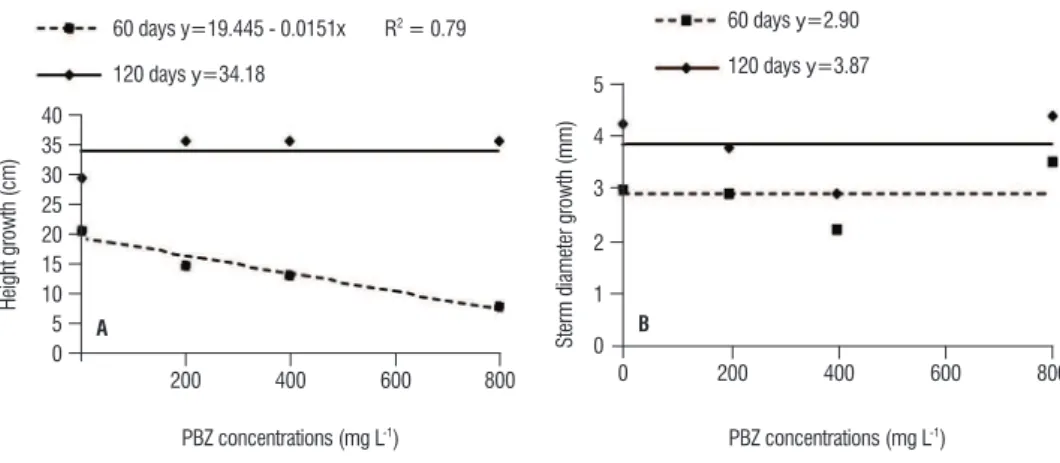
Plant height, assessed at 60 days after PBZ application, decreased by 36.8% in plants sprayed with 800 mg L-1 PBZ
compared to that of control plants. 120 days after the PBZ application no difference was observed in plant growth between the different PBZ concentrations tested (Figure 2A).
These features might have place because the PBZ exerted short term effects, likely because it was applied
at leaves, or as a result of the low concentrations tested, which could not be effective in slowing the olive tree growth for a longer period required to the characteristic non-stop vegetative growth during the winter, the most effective in Brazilian conditions.
PBZ concentrations (mg L-1) PBZ concentrations (mg L-1)
60 days y=2.90
120 days y=3.87 60 days y=19.445 - 0.0151x R2 = 0.79
120 days y=34.18
40 35 30 25 20 15 10 5 0
Height growth (cm)
Ster
m diameter growth (mm)
200 400 600 800 0 200 400 600 800
5
4
3
2
1
0
a b
figure 2.Olea europaea L. height (A) and stem diameter (B) growth, evaluated at 60 and 120 days after the paclobutrazol (PBZ) application.
Regarding the internodes length, plants pruning treated with PBZ concentration of 800 mg L-1 have shoot length 37.6%
lower than shoots that were not sprayed with PBZ and the plants without pruning and plants without pruning, reduction in internode length was 42.4% compared to control treatment. This difference observed in plants without pruning can be attributed to greater length found in plants which were sprayed
with ethephon, which have produced higher shoot (Figure 3). The shoots development with short internodes was also observed by other researchers in citrus plants in response to PBZ application (Delgado et al., 995, Okuda et al., 1996). For the olive tree, morphological changes that increase nodes number are associated to changes that precede the production phase (Rallo and Cuevas, 2008).
PBZ concentrations (mg L-1)
With pruning y=12.76 - 0.006x R2 = 0.97
Without pruning y=15.73 - 0.0099x + 0.000011x2
R2=0.97
Inter
nodes length (mm)
3 6 9 12 15 18
800 600
400 200
0 0
figure 3. Length of internodes in the shoots of olive tree (Olea europaea L.) as a function of paclobutrazol (PBZ) concentration applied to leaves. vertical bars
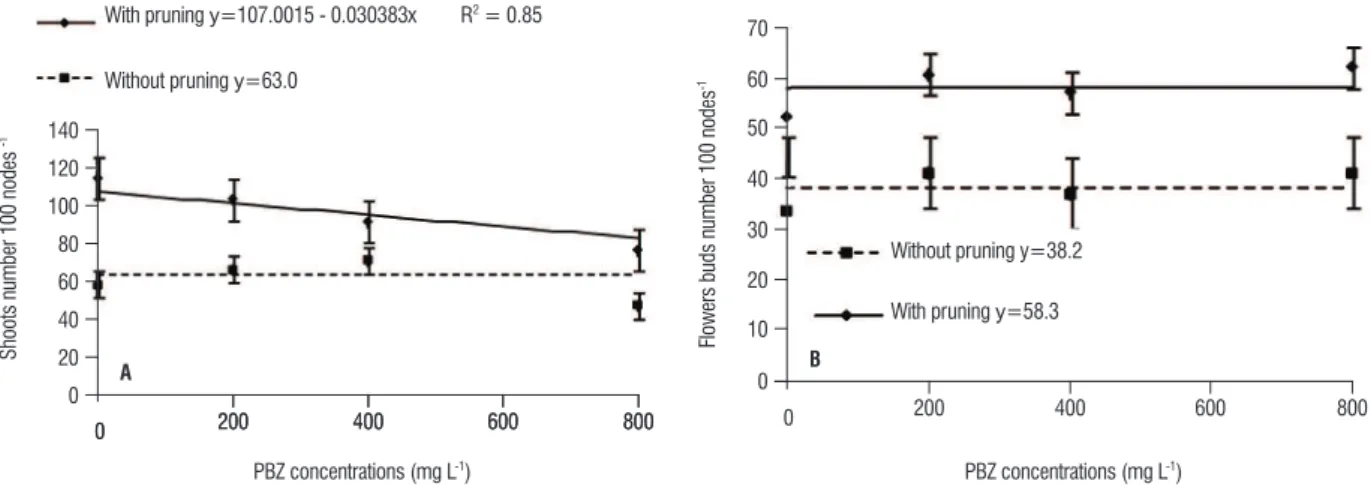
For the vegetative shoots proliferation, the PBZ application caused a reduction of 22.7% in plants submitted to pruning and sprayed with the concentration of 800 mg L-1
as compared to control treatment. no decrease was observed in plants without pruning (Figure 4A). This might occur in function of anticipation in shoots issuance from plants that were submitted to pruning, before the spring starts, when probably the PBZ was active in plants. The reduction in the shoots number in citrus plants was also observed by Mataa et al. (1998). Plants submitted to pruning exhibited a greater shoot number as compared with those not pruned (Figure 4A). This feature is possibly related to the bud dormancy break.
Some buds are initiated and some of those differentiate to produce inflorescences. According to de la Rosa et al. (2000) and Rapoport (2008), although some morphological signs may be evident earlier, floral initiation can be unequivocally recognized soon after bud burst (PS53) about two months prior to flowering (PS60) in late spring. In addition to internal controls, environmental conditions following the bud burst are important determinants of floral morphology, including number of flowers per inflorescence and the proportion of staminate flowers (Rallo et al. 1981; Rapoport and Rallo 1991).
Higher number of flower buds was observed in plants that were not submitted to pruning compared to pruned ones
(Figure 4B). This trait might be related to higher vegetative shoot development of these plants. Despite the pruning of plants, the branch number with buds capable of flower production, formed during last year spring, was not reduced significantly. Furthermore, in the following year, based on concept that plants flourish in previous year branches, the flowering is expected to increase.
For the flowering capacity, there was no difference between plants sprayed with PBZ regardless submitted or not to pruning (Figure 4B). However, this analysis could be negatively influenced by the absence of flowers observed in several plants (Table 1).
The percentage of plants that set fruit was equal to that of plants with flowers (Table 1). This was observed despite of the non-uniformity commonly found in perennial species during its first year of production, and of natural flowers abscission in olive tree, which according to Rallo and Cuevas (2008) can reach 96-99% in years of high flowering. The present weather conditions were also satisfactory to the flower pollination and fruit set, since the occurrence of high temperatures or other adverse factors could affect the pollination due to pollen and stigma susceptibility (Connor and Fereres, 2005).
Without pruning y=38.2
With pruning y=58.3
Shoots number 100 nodes
-1
Flowers buds number 100 nodes
-1
200 400 600 800
a b
With pruning y=107.0015 - 0.030383x R2 = 0.85
Without pruning y=63.0
140
120
100
80
60
40
0 10 20 30 40 50 60 70
20
0 0
PBZ concentrations (mg L-1) PBZ concentrations (mg L-1)
200 400 600 800
0 0 200 400 600 800
figure 4. number of vegetative shoots (A) and flowers (B) produced by olive tree (Olea europaea L.) as a function of paclobutrazol (PBZ) concentration applied to
table 1. Percentage of olive tree variety Grappolo 575 treated with paclobutrazol (PBZ) that exhibited flower emission and fruit set, two years after planting
.
pbz concentrations
(mg l-1)
flowering (%) fruit set (%)
with pruning without pruning with pruning without pruning
0 50 50 50 50
200 75 100 75 100
400 50 50 50 50
800 50 75 50 75
C.v (%) 44.4 49.9 44.4 49.9
Regarding to the leaf water potential, there was an increase of 70.5% at 120 days after application of PBZ, period when the plants were in full flowering, as compared to leaf water potential in plants assessed in May (Figure 5). This feature might also be influenced by the increased rainfall incidence during the period that favored the water availability in soil (Figure 1).
y= -0.834635 - 0.004909x
R2 = 0.88
Y
leaf water (MP
a)
Evaluation period (days)
0
-0.3
0 15 30 45 60 75 90 105 120
-0.6
-0.9
-1.2
figure 5. Leaf water potential in olive tree (Olea europaea L.) as a function of paclobutrazol (PBZ) concentrations applied to leaves. vertical bars represent standard deviation of the mean.
conclusions
Paclobutrazol treatments tested did not interfere with olive tree flowering. The plant vegetative growth was slowed until 60 days after paclobutrazol application. Pruning stimulated emission of vegetative shoots and reduced flowering.
scholarship and FAPEMIG ( Fundação de Amparo a Pesquisa do Estado de Minas Gerais) for financial support.
references
Connor DJ, Fereres E (2005) The Physiology of Adaptation and Yield Expression in Olive. Hort. Rev. 31:155-229.
Cruz MCM, Siqueira DL, Salomão LCC, Cecon, PR (2008) Influência do paclobutrazol e da temperatura ambiente sobre o florescimento e frutificação da limeira ácida ‘Tahiti’. Ciência Agrotec. 32(4): 1148-1153.
Davenport TL (1990) Citrus flowering. Horti. Reviews. 12:349-408.
De La Rosa R, Rallo L, Rapoport HF (2000) Olive floral bud growth and starch content during winter rest and spring budbreak. HortSci. 35: 1223-1227.
Delgado R, Rodriguez R, Casamayor R (1995) Empleo de paclobutrazol em plantas de lima persa sobre naranjo trifoliado ‘Rubdoux’ a altas densidades. Agrícola vergel. 121-125.
Empresa Brasileira De Pesquisa Agropecuária – EMBRAPA (2006) Sistema brasileiro de classificação de solos. 2.ed. Centro nacional de Pesquisa de Solos. Rio de Janeiro.
García-Ortiz A, Humanes J, Pastor M, Morales J, Fernández A (2008) Poda. In: Barranco D, Fernández-Escobar R, Rallo L. (eds), El cultivo del olivo, pp. 689-433. 6ª ed. Junta de Andaluzia: Mundi-Prensa.
Goldschmidt EE, Tamim M, Goren R (1998) Gibberellins and flowering in citrus and other fruit trees. Acta Hortic. 1(464):201-216.
Mataa M, Tominaga S, Kosaki I (1998) Relative effects of growth retardant (Paclobutrazol) and water-stress on tree growth and photosynthesis in Ponkan (Citrus reticulata Blanco). J. Japan. Soc. Hort. Sci.67: 28-34.
Muñoz-Cobo MP, Guillén JH (1989) La poda del Olivo. Madrid: Editorial Agrícola Española, S.A.
Okuda H, Kihara T, Iwagaki I (1996) Effects of paclobutrazol application to soil at the begining of maturation on sprouting, shoot growth, flowering and carbohidrate contents in roots and leaves of Satsuma mandarine. J. Hortic. Sci. 71:785-789.
Rademacher W (2000) Growth retardants: effects on gibberellin biosyntesis and other metabolic pathways. Annu. Rev. Plant Physiol. Plant Mol. Biol.
Rallo L, Cuevas J (2008) Fructificación y Producción. In: Barranco D, Fernández-Escobar R, Rallo L (eds), El cultivo del olivo, pp. 626-662. 6ª ed. Junta de Andaluzia: Mundi-Prensa.
Rapoport HF, Rallo L (1991) Postanthesis flower and fruit abscission in ‘Manzanillo’ olive. HortSci. 116: 720-723.
Rapoport HF (2008) Botanica y morfología. In: Barranco D, Fernández Escobar R, Rallo L (eds), El cultivo del olivo, pp. 34-62. Junta de Andalucía y Mundi-Prensa, Madrid.