DOI: 10.7213/urbe.06.002.SE03 ISSN 2175-3369
Licenciado sob uma Licença Creative Commons
Parcerias urbanas no desenvolvimento de baixo carbono: Oportunidades e desafi os
de uma tendência emergente na Política Climática Global
Jan Beermann
Ph.D candidate in Forschungszentrum f“r Umweltpolitik at Freie Universität Berlin, Berlin, BE - Germany, e-mail: jan. [email protected]
Abstract
This study explores the linkages between two recent trends in global climate governance. The irst trend is the growing focus on cities in the multi-level governance of climate change. Whereas international climate change negotiations often end in deadlock, many urban centers across the world are taking the lead. )ndustrialized cities from the Global North and increasingly cities from the emerging Southern economies are experimenting with innovative and ambitious programs to reduce their local carbon footprints. A second trend is the expan-ding urban North-South cooperation in the area of low-carbon development. This cooperation takes various forms, such as city twinning, transnational municipal networks and trans-local development cooperation. A key target of these initiatives is to develop joint projects and exchange knowledge to foster low-carbon development pathways. This study analyzes the conditions of success and failure in selected )ndo-German urban low-carbon partnerships with a particular focus on institutional arrangements. The paper presents evidence from three initiatives and argues that successful trans-local cooperation depends largely on the interplay between institutional forms and the development of social capital. Building on these indings, the paper discusses what lessons may be drawn from the emergence of urban North-South cooperation for the future development of global climate governance.
Keywords: Local climate governance. Knowledge transfer. North-South cooperation. Low-carbon
develop-ment. Social capital.
Resumo
The emergence of cities and trans-local partnerships in global climate governance
The study explores the linkages between two recent trends in global climate governance: the growing focus on cities in the multi-level governance of climate change and the expanding urban North-South cooperation in the area of low-carbon development.
Whereas international climate change ne-gotiations often end in deadlock, the local level and, in particular, cities have received increasing attention in the research community and among decision makers so that […] the city now looms large on the international climate change agenda.
BULKELEY; BETS)LL, , p. . Cities are
indeed crucial sites for global climate protection efforts. Already today, approximately half of the world s population lives in cities and, according
to urbanization projections, by , up to %
of mankind will live in urban centers. )t is hotly debated whether cities generate higher per capita greenhouse gas emissions G(G than rural areas and should therefore be blamed for causing climate
change SATTERT(WA)TE, ; DODMAN, ;
D(AKAL, . (owever, the urban-rural divide
is becoming increasingly blurred with cities and their surrounding rural areas being considered as metropolitan entities. )t is thus insightful to explore the joint impact of local governments, which, according to UNDP UN)TED NAT)ONS
DEVELOPMENT PROGRAMME, , are able to
in luence - % of global G(G.
Cities have core functions for implementing national climate change strategies and for experimenting with locally tailored responses to climate change mitigation and adaptation. As hubs for technological and social transformation, urban centers have immense potential to shape low-carbon development pathways KAMAL-C(AOU);
ROBERT, . Cities often even serve as irst
responders to climate change in their countries
ROSENZWE)G et al., . )n Germany, frontrunner
cities have engaged in climate protection for more
than years, and many municipalities have
adopted local emission reduction targets that meet or exceed their national government s commitments
DEUTSC(ES )NST)TUT FÜR URBAN)ST)K, .
The development of urban climate policies in the Global South is a more recent phenomenon. (owever, in emerging economies such as )ndia, China, South Africa and Latin America, the number of cities engaged in local climate action has steadily risen
over the last decade REV), ; D(AKAL, ;
AYLETT, ; CASTÁN BROTO; BULKELEY, .
Research into urban climate governance began
in the mid- s BETS)LL; BULKELEY, , and
scholarly debate has centered on the following key areas: modes of urban climate governance
BULKELEY; KERN, ; ALBER; KERN, ;
SC(ROEDER; BULKELEY, , cities as laboratories
for climate governance experimentation EVANS,
; CASTÁN BROTO; BULKELEY, , the role of
eco- and low-carbon model cities (ODSON; MARV)N,
; SC(REURS, , the importance of local
leadership and policy entrepreneurs SC(REURS, se estruturam sob diversas formas, tal como cidades irmãs, redes transnacionais de municípios e cooperação para o desenvolvimento translocal. São objetivos centrais dessas iniciativas o desenvolvimento conjunto de projetos e trocas de conhecimento com vistas a fomentar alternativas de desenvolvimento de baixo carbono. Este estudo analisa as condições de sucesso e fracasso em determinadas parcerias de baixo carbono entre Alemanha e Índia, focando particularmente nos arranjos institucionais. Com base em evidências de três iniciativas, advoga-se que uma cooperação translocal bem-sucedida depende em grande parte da relação entre os formatos institucionais e o desenvolvimento de capital social. A partir desses resultados, o artigo discute quais lições podem ser aprendidas da emergente cooperação norte-sul para o futuro desenvolvimento da governança climática global.
; CAMPBELL, ; ACUTO, and the institutional arrangement and interplay of urban climate action in multi-level governance frameworks
BULKELEY, ; BETS)LL; BULKELEY, ;
SC(REURS, ; CORFEE-MORLOT et al., ;
ANGUELOVSK); CARM)N, ; BULKELEY; BETS)LL,
. A major shortcoming of urban climate governance research continues to be its narrow focus on individual case studies on large cities from industrialized countries voiced by, among others,
BETS)LL; BULKELEY, ; ALBER; KERN, ;
ROSENZWE)G et al., . This condition re lects
the general problem of a dominance of Northern cities in urbanism research. Scholars in the ield of post-colonial studies urge that research must overcome the notion of incommensurability of cities in the Global North and South. These researchers stress the need to conduct more comparative and cosmopolitan studies, including cities from different
contexts MCFARLANE, ; ROB)NSON, .
A second trend in climate governance is the growing focus on sustainable and carbon-friendly development in cities international relations. Through city twinning and urban development cooperation, as well as new forums such as transnational municipal networks, cities are developing joint projects and exchanging knowledge to promote low-carbon development STATZ;
WO(LFA(RT, . The scope of trans-local
cooperation may only be estimated. According to a igure published by United Cities and Local
Governments , % of the world s cities
are engaged in city-to-city activities. Although such estimates remain vague, recent developments in urban cooperation may be cited. Van der Pluijm
and Melissen identify a shift towards
more professionalization and pragmatism in city-to-city exchange. The professionalization of urban cooperation goes hand-in-hand with the growing recognition of cities by national governments and the European Commission as partners in decentralized
development cooperation . Since the late s, most
European countries as well as Canada and Japan have established national institutions to guide and support cities in their development engagement
(AFTECK, ; PLATFORMA, . )n , the
European Commission introduced its irst thematic funding program for decentralized cooperation
PLATFORMA, .
)n addition to these more established forms of urban cooperation, a multiplicity of transnational municipal networks TMNs have emerged to foster local sustainable development and climate protection. These networks range from regional networks e.g., the Climate-Alliance, Energy-Cities and C)TYNET and thematically focused networks e.g., the Clean Air )nitiative and C)V)TAS to global networks covering millions of city inhabitants worldwide e.g., )CLE)-Local Governments for Sustainability, the C Cities Climate Leadership Group and the World Mayors Council on Climate Change .
Emerging theory development on trans-local climate cooperation
The emergence of TMNs has gained growing attention from the research community. )n particular, )CLE) and its Cities for Climate Protection CCP campaign have been the focus of several studies. The assessment of TMNs is mixed. These networks are highlighted as […] one of the first and most extensive examples of transnational governance […] BULKELEY;
NEWELL, , p. and, as embodying a new
mode of climate governance, being simultaneously global and local, state and non-state BETS)LL;
BULKELEY, , p. . (owever, the ability of
a TMNs to foster knowledge exchange among its members is being questioned BETS)LL; BULKELEY,
; MEDEAR)S; DOLOW)TZ, . TMNs are
also criticized for being networks of pioneers for pioneers and for having too many passive
members KERN; BULKELEY, , p. .
)n this study, trans-local cooperation describes any form of international partnership involving two or more cities from different countries. Other frequently used terms for the same phenomenon are urban partnerships, urban cooperation and city-to-city exchange. Decentralized cooperation is de ined as sub-national North-South cooperation towards sustainable development, usually led by local
governments (AFTECK, , p. . Although the term is still used in practice, in more recent literature, it has become more common to use the terms transnational city-to-city cooperation BONTENBAL; VAN L)NDERT, and municipal international cooperation
The literature on city twinning and decentralized cooperation provides insight into the challenges typical of trans-local cooperation. Several studies stress the problem of a perceived one-sided low of learning from cities of the industrialized Global North towards developing cities from the Global South and the lack of mutuality in trans-local partnerships
BONTENBAL; VAN L)NDERT, ; JO(NSON;
W)LSON, ; VAN EW)JK; BAUD, . Bontenbal
and Tjandradewi and Marcotullio
reveal the challenges associated with including local civil society in city-to-city cooperation. A pressure experienced by German cities in particular is that they are expected to provide proof of the ef iciency of their development cooperation activities. N)TSC(KE;
(ELD; W)L(ELMY, .
)n-depth knowledge about drivers, processes and impact of trans-local cooperation on climate action is still lacking. Urban learning remains a blind box
WOLMAN; PAGE, , p. . The knowledge gap
is again especially evident in relation to climate collaboration involving cities from both the Global North and South. This gap is regrettable, as post-colonial researchers argue that more research on connections between cities could help overcome the assumed incommensurability of cities from the Global North and South and lead towards more
cosmopolitan urban research ROB)NSON, .
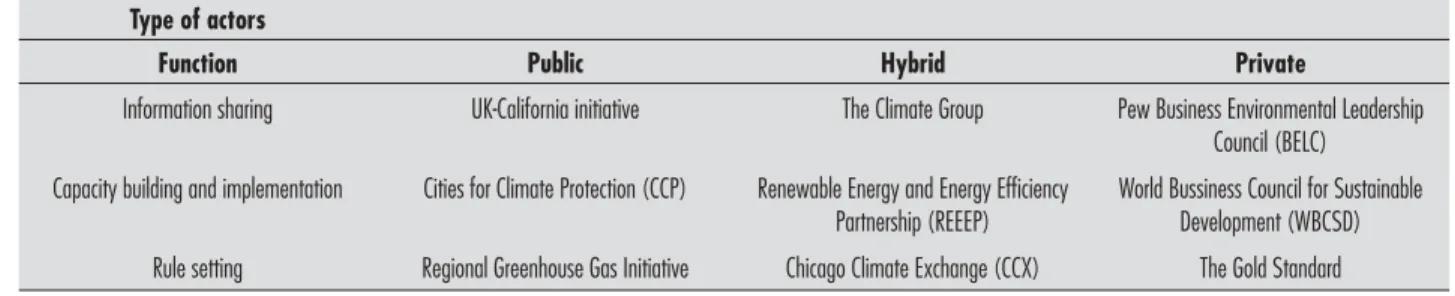
Andonova, Betsill and Bulkeley s typology
of transnational climate change governance networks see table provides a promising starting point for classifying trans-local climate cooperation a similar typology has also been developed by Bäckstrand, . With their typology, Andonova, Betsill and
Bulkeley , p. begin mapping the […]
patchwork of transnational governance networks […] . The typology distinguishes between three institutional forms of transnational governance
networks public, private and hybrid as well as three governance functions that such networks embody information sharing, capacity building/ implementation, and rule-setting .
Although the typology sheds light on the […] multiplicity and hence the differentiated governance capacity that exists beyond the formal politics of international agreements […] ANDONOVA;
BETS)LL; BULKELEY, , p. , it says little
about the impact of different institutional forms on the effectiveness of transnational governance networks. )t also does not address the linkages between transnational governance networks and their institutional state environment. With regard to trans-local partnerships, two key questions emerge: What are the bene its and shortcomings of different forms of urban climate cooperation? And how are trans-local climate partnerships effectively embedded into the multi-level state system?
The literature on this topic provides con licting responses to these questions. Tim Campbell
identi ies that globalizing cities increasingly engage in direct horizontal exchange to adopt and share innovation. (e argues that urban learning is driven primarily by private informal leadership
networks CAMPBELL, , p. and trustful
relations between business, civic and youth leaders, guaranteeing continuity in times of political leadership change. Campbell refers to the concept of social capital, which de ines trust, norms of reciprocity and networks of civic engagement as crucial prerequisites for developing well-functioning communities PUTNAM; LEONARD); NANETT),
. (olley Ralston reaches a different
conclusion in one of the irst in-depth studies of transnational cooperation at the sub-national level. Ralston analyzes sustainability partnerships between German and U.S. states and concludes that
Table 1 - Typology of transnational climate-change governance networks
Type of actors
Function Public Hybrid Private
Information sharing UK-California initiative The Climate Group Pew Business Environmental Leadership Council (BELC)
Capacity building and implementation Cities for Climate Protection (CCP) Renewable Energy and Energy Effi ciency Partnership (REEEP)
World Bussiness Council for Sustainable Development (WBCSD) Rule setting Regional Greenhouse Gas Initiative Chicago Climate Exchange (CCX) The Gold Standard
partnerships must be formally institutionalized in the state legal system to ensure long-term sustainability and reduce dependency on partnership champions.
Research question and methodology
This study compares three )ndo-German trans-local partnerships that exemplify different institutional cooperation arrangements, thereby exploring the con licting assumptions on the bene it of formally embedding partnerships in state bodies in the case of trans-local collaboration. )t addresses the following research question:
What impact does the local and multi-level embedding of partnerships in state institutions have on the effectiveness of )ndo-German urban collaboration in low-carbon development?
The three partnerships analyzed in this paper represent the distinct institutional forms highlighted
in Andonova, Betsill and Bulkeley s typology
of transnational governance networks: a private
actor partnership between Bremen and Pune in
sustainable development, a state-driven public
cooperation between Nashik and (amburg in a waste-to-energy project, and a clean energy partnership
between Nagpur and Freiburg as part of a hybrid
public-private city network.
The data is based on semi-structured expert interviews and observation conducted during several research stays in the six cities studied between
August and December as well as on
the analysis of documentation, such as project feasibility studies, project reports and secondary sources such as case studies.
Bremen-Pune: A long-standing civil society partnership
Partnership content and results
Bremen and Pune began collaborating in
environmental and social projects as early as in .
The partnership was pioneered by Bremen citizen, Gunther (illiges, who at the time was engaged in Pune as the head of the non-governmental organization NGO Terre des (ommes Germany. (illiges saw the potential to expand collaborative action between
NGOs from Pune and Bremen and helped to establish joint rural biogas projects in the Pune region. )n , (illiges was appointed head of the newly founded Department of Development Cooperation in the Bremen city administration. Together with the partnership associations Forum Städtesolidarität Bremen-Pune and Pune-Bremen City Solidarity
Forum both founded in , (illiges continued
to develop the partnership over the following years. A major cornerstone in this cooperation was the United Nations Conference on Environment and Development in Rio de Janeiro, which motivated the two cities to discuss strategies to coordinate their Local Agenda processes. Bremen and Pune signed two Memoranda of Understanding MoUs
in and and set up the )nternational
Of ice Agenda )O A in Pune to intensify
their cooperation. During the following years, the partnership focused on two main areas; the introduction of decentralized wastewater treatment systems DEWATS in Pune and the transfer of the Bremen tramway system to Pune.
Both projects were initiated by (illiges. )n the DEWATS project, he met with Dr. Dada Gujar, head of the Pune NGO Mahar ashtra Arogya Mandal, to discuss the best way to treat the wastewater of the local Ayurveda hospital. (illiges brought in the Bremen NGO, BORDA, which specializes in small-scale, eco-friendly wastewater treatment in Southeast Asia. With inancial support from the German NGO
Deutsche Arbeiterwohlfahrt, in - BORDA
installed two DEWATS facilities that fully treat the wastewater produced in the hospital. To install additional pilot facilities and to assess the scope for wider mainstreaming of the DEWATS technology in Pune, BORDA hired a consultant, G“nther Klatte,
who worked at the )O A of ice in - .
During this time, three additional DEWATS plants were installed in Pune and surrounding towns. (owever, a large-scale introduction of DEWATS as an alternative to centralized wastewater treatment failed due to a lack of interest and political will by the city administration.
manner. They convinced the German consultants Jörg Monsees from Consult Team Bremen CTB and Friedrich Steiger from BGS )ngenieurconsult )nternational, Frankfurt to join the project and assess
the project s feasibility. )n and Monsees
and Steiger, together with Mohan Sakhalkar, a local city planner working in Pune s private sector, set up the Detailed Project Report DPR . The DPR
is an extensive -page document that analyzes
the inancial, socio-economic and environmental conditions for a tramway network in Pune and proposes concrete technical options, planning steps and favorable sites. The report was funded by Pune Municipal Corporation. Despite these encouraging irst steps, the Pune tramway system has never been built. The implementation failed primarily because the Maharashtra State Government as the decision-making unit for city-level transportation rejected the proposal. The state government prefers to foster metro systems in its major cities instead of tramway networks, which are not common in )ndian cities. After the state government s rejection, local political support also waned. Vijay Mahajani, the leading advocate of the tramway transfer, passed away shortly afterwards, and since then, there has been no move to revive the project.
Institutional arrangement
The civil society city partnership between Bremen and Pune exempli ies both the bene its and weaknesses of a low level of state involvement. From the outset, the cooperation focused on civil society exchange, and the partnership has never been formalized into an of icial sister city agreement. The protagonists took this decision deliberately to bypass political institutional barriers and maintain their independence from frequently changing political leaders.
The two partnership MoUs and the establishment of the )OA were the only attempts to strengthen state involvement in the partnership. (owever, the MoUs largely remained declarations of intentions, and the impact of the )O A was low. The of ice was located outside of the municipality buildings and was not frequently visited by representatives from the city administration or the city council. The only staff was the local head of the partnership
association, Mahajani, and the DEWATS consultant, Klatte.
To summarize, both the DEWATS and tramway initiatives progressed well as long as the projects remained at a small scale. )n the installation of the pilot DEWATS plants, as well as in the joint preparation of the tramway DPR, non-state actors from both cities cooperated smoothly. These actors built upon existing social capital in the form of personal relationships and mutual trust established during prior partnership activities. (owever, as soon as state institutionalization was required for the large-scale implementation tramway and mainstreaming DEWATS of the projects, these initiatives were thwarted by lack of government support and ultimately failed. The tramway project even resulted in a loss of social capital and had an adverse impact on the entire partnership. )nterviewees from both cities highlighted the fact that failed implementation led to a loss of trust and partnership engagement. The pace of the exchange between Pune and Bremen has slowed in recent years, and efforts to renew the MoU in
proved unsuccessful.
Nashik-Hamburg: Development cooperation connecting city actors
Partnership content and results
The collaboration between Nashik Municipal Corporation NMC and (amburg s public water utility, (amburg Wasser, to construct an innovative waste-to-energy plant in Nashik represents a more formalized and predominantly public approach to
trans-local cooperation. Since , the partnership
The pilot waste-to-energy plant treats a daily metric tons of kitchen waste from local hotels and restaurants together with septic waste from municipal toilets in an eco- and climate-friendly
manner. The plant produces up to , kWh of
renewable electricity per day and limits uncontrolled
methane emissions. )n this way, a total of , tons
of CO -equivalent emissions are prevented every year. )n addition, in the co-fermentation process, all nutrients are recovered to produce a replacement for the arti icial fertilizers currently used by local
farmers AUGUST)N; G)ESE; DUBE, .
(amburg Wasser s major motivation to join the project was to demonstrate (amburg Water Cycle s technological and political feasibility. Project manager Augustin emphasized that Nashik offers a favorable local institutional arrangement for a combined waste and energy plant, as the departments in the Nashik city administration are more integrated than those in German cities. By proving the feasibility of this project in )ndia, Augustin aims to also convince German decision makers to adopt the technology. (amburg Wasser s contribution to the project is to provide the technology, prepare a feasibility study and monitor the implementation of the plant. Nashik Municipal Corporation is responsible for guaranteeing the waste collection infrastructure, providing land for the facility and inding a private plant operator. )n the preparatory phase, the G)Z facilitated several exchange visits between Nashik of icials and experts at (amburg Wasser to assess the transferability of the technology to the )ndian city context. According to the current schedule the
plant is going to be constructed in , and its
operation is planned to begin in early .
Institutional arrangement
Compared to the largely non-state partnership between Pune and Bremen, the Nashik-(amburg collaboration is much more deeply embedded in the state system. Close linkages exist with national government institutions in both Germany and )ndia. The German government development association, the G)Z, is the main driver and coordinator in the partnership. Funding for the project is provided by the )nternational Climate Change )nitiative of the German Federal Ministry of the Environment, Nature
Conservation and Nuclear Safety BMU , supporting the construction of the waste-to-energy plant with approximately one million euros. )n )ndia, the G)Z has concluded a project implementation agreement with the national Ministry of Environment and Forest. The partnership project is also well institutionalized locally in Nashik, as the waste-to-energy plant is part of the city s broader collaboration with the G)Z in the development of a comprehensive local sanitation policy.
(ow has the high degree of state insti-tutionalization and the G)Z-led top-down approach to the city partnership in luenced the waste-to-energy project s success? Simply put, it has helped the project far more than it has the partnership s overall development. A joint project that is as far-reaching as a waste-to-energy plant requires state involvement. )n contrast to the DEWATS and tramway projects between Pune and Bremen, which suffered from a lack of political support, the G)Z managed to convince )ndian and German of icials from all political levels to commit to the project. Doing so, however, was not an easy task. )n particular, gaining approval from the Nashik City Council revealed to be a major challenge—one that delayed the project s implementation schedule and resulted in confusion on the side of (amburg Wasser and the
German project funder, the BMU. (owever, in ,
the council formally adopted the project and if no further delays are encountered, the plant will be
erected in and begin operating in early .
)n addition to receiving multi-level state political support, the partnership project also bene its from state funding provided by the BMU. Without this funding, cooperation would have never been established, as Nashik and (amburg alone lack the inancial means to realize a project of such scale. )nterviewees from both cities also emphasized that they would not have the capacity to develop a transnational partnership project of such scope without help of the G)Z. They highlighted the crucial role that G)Z employees are playing in bridging the cultural, social and political differences between the German and )ndian city contexts.
exclusively through G)Z channels with no additional direct bilateral exchange. Regina Dube, head of G)Z s Urban (abitat Program in )ndia, con irmed that this is part of the project s concept, as the G)Z is accountable to the funder, the BMU, regarding the project s progress and thus must control all communication.
To develop social partnership networks between cities as the basis of long-term cooperation, the top-down approach to linking cities falls short. The G)Z-induced cooperation between (amburg and Nashik has not led to the development of social capital in the form of civic engagement, the involvement of informal leadership networks, and personal, trusting relations between city representatives, all
of which Campbell considers to be crucial
conditions for enabling horizontal city exchange. For the reasons described above, the G)Z deliberately connected the two cities in an ad hoc, controlled framework and there seems to be little scope for future cooperation between Nashik and (amburg outside the G)Z context.
Nagpur-Freiburg: City exchange via a transnational municipal network
Partnership content and results
The exchange between Nagpur and Freiburg, which falls under the city network, )CLE)—Local Governments for Sustainability, embodies a third, emerging approach to trans-local cooperation. Nagpur and Freiburg participated in the Local Renewables Model Communities Network LRMCN ,
a program instituted by )CLE) in - . The
LRMCN s objective was to develop renewable energy and energy-ef icient model cities in )ndia and later also in Brazil with the support of more advanced European partner cities. Nagpur was selected as one of three )ndian model communities and partnered with the German city of Freiburg.
Freiburg and Nagpur mainly communicated via two channels. First, )CLE) conducted case studies on existing clean energy projects for all LRMCN member cities and distributed them among the cities in the network. The case studies introduced Nagpur of icials to Freiburg s multi-sector approach towards reducing citywide G(G by % by
)CLE) - Local Governments for Sustainability, and outlined Nagpur s achievements in energy-ef icient water management to Freiburg s representatives )CLE) - Local Governments for
Sustainability, . Second, in the early stages of
the project, Nagpur and Freiburg conducted mutual exchange visits. Nagpur s Commissioner Lokesh Chandra met Freiburg s Mayor Dieter Salomon as part of a clean energy tour to Europe in September . The head of Freiburg s climate department, Klaus (oppe, then visited Nagpur and exchanged experiences with local of icials and city engineers about the bene its and barriers to transforming urban energy systems. )CLE) s plans to enable more personal exchange between Nagpur and Freiburg remained unsuccessful. The city network designed a series of workshops on city-to-city learning and invited both cities to join. (owever, due to visa problems as well as budgetary and time constraints, the Freiburg and Nagpur of icials were never able to jointly attend. As a consequence, direct exchange between the two cities remained limited to the project s early phase.
According to Nagpur of icials and )CLE) representatives, the exchange visits nonetheless had a positive impact on the project development in Nagpur. During the preparatory phase of the local energy strategy, Nagpur of icials received irsthand insights into the entire process involved in the development of a low-carbon energy system in an advanced city. This exposure strengthened the of icials motivation and belief in the bene its of such an ambitious endeavor. The reference to concrete achievements made by Freiburg and other European Resource Cities also repeatedly helped to convince local decision makers in Nagpur of the practicality of clean energy project proposals. Due to the lack of concrete joint project work and the multiplicity of factors in luencing Nagpur s program implementation, it remains dif icult to assess the direct learning effects of the exchange between Nagpur and Freiburg. What is evident, however, is that Nagpur s participation in the LRMCN network had a substantial impact, both locally and at the national level in )ndia.
the entire project, the center was staffed with a project manager, initially hired by NMC and later by )CLE) as well as city administration employees. The center served as a technology demonstration site and stakeholder meeting point. The Resource Centre also proposed and coordinated all local energy activities. As an initial step, the Resource Centre staff conducted Nagpur s irst citywide energy inventory and published its outcomes in the energy
report / which was then updated annually .
Based on the report, in the Nagpur City
Council introduced a Renewable Energy and Energy Ef iciency Policy, the irst ever clean energy policy adopted by an )ndian city. The policy set the targets of reducing municipal energy consumption by % and overall city energy consumption by at least %
by compared to levels . An action plan
was proposed, and in the following years Nagpur implemented a number of pilot projects, including installing a solar water heater in the municipal hospital, a solar power backup in the Resource Centre and solar and energy-ef icient lighting in public buildings. As a second focus area, activities to raise awareness were conducted, involving local schools, residents and city administration staff. By
completion of the LRMCN in , Nagpur had
not met its energy reduction targets. City of icials hope, however, that they will be reached over the coming years, as Nagpur is continuing its local clean energy efforts as part of the )ndian Government s Solar Cities Program.
The Solar Cities Program also indicates the in luence that Nagpur and the LRMCN had at the national level in )ndia. The LRMCN served as a model for the development of the program, which has been
introduced as part of the Government of )ndia s th
Five-Year Plan. The program supports a total )ndian cities in the preparation and implementation of local solar energy strategies. Based on Nagpur s frontrunner role in the LRMCN and the city s experiences with local energy projects and policy-making, the ministry selected Nagpur as one of only two model cities for the Solar Cities Program.
Institutional arrangement
The partnership between Nagpur and Freiburg, similar to that between Nashik-(amburg, exempli ies
an externally led, top-down approach to city cooperation. The LRMCN program was also funded by the German Government via the Ministry of )nternational Cooperation , and the city network )CLE) served as the project facilitator and moderator. Nagpur and Freiburg were brought together by )CLE), and throughout the entire partnership, the communication between the two cities remained highly dependent on )CLE). This dependence became evident in the failed attempt by Freiburg representative (oppe to maintain direct exchange between the two cities after the exchange visits. (oppe saw the potential to intensify the partnership between Freiburg and Nagpur, and he repeatedly sent emails to his peers in Nagpur, but he never received any response and eventually gave up. )n the interviews conducted, the )CLE) network coordinators said that they were not aware of (oppe s attempts. Maryke van Staden, coordinator of )CLE) s Climate & Air Team, highlighted that communication by email remains uncommon in many )ndian cities. This incident indicates that the involved city of icials were lacking in-depth knowledge about each other s communication cultures, which hindered more exchange and learning. The incident also demonstrates that intercultural competencies exemplify a form of social capital of crucial importance for sustaining trans-local partnerships.
The city network, )CLE), principally allowed more direct city exchange between Freiburg and Nagpur than did the government body, the G)Z, in the Nashik-(amburg cooperation. (owever, )CLE) focused its resources on concrete, locally tailored project and policy development rather than on systematic partnership development. This approach led to positive results in Nagpur, and the city s activities and institutional achievements in clean energy development received wider recognition in )ndia. (owever, whether Nagpur and Freiburg will resume their exchange is uncertain. )n the absence of a social capital basis between the two cities, it seems unlikely.
State institutionalization and social capital development – A city partnership trade-off?
have emerged. Both top-down induced as well as bottom-up city partnerships co-exist. The case study indings do not clearly con irm or reject either of the earlier cited studies on the importance of state institutionalization of subnational partnerships
RALSTON, versus the phasing out of
top-down learning approaches in urban development
CAMPBELL, . )n fact, both high and low
levels of embedding urban partnerships into the multi-level state system provide distinct bene its and challenges.
Small-scale, private actor-led partnership projects may bene it from low state institutionalization under the condition that enough social capital exists in the form of personal networks, mutual trust and intercultural competences developed by former partnership activities. This phenomenon is demonstrated by the Pune-Bremen cooperation that successfully managed to construct pilot DEWATS plants a collaboration between NGOs and release a feasibility study on a tramway transfer as a result of private-sector cooperation . These bottom-up initiatives, however, reached their limits when they attempted to obtain state approval for the implementation of their projects on a larger scale. Protagonists especially lacked access to policy networks both locally as well as at higher policy levels of state and central governments. )n contrast, the G)Z waste-to-energy project that brought together Nashik and (amburg was designed to be closely institutionalized into the multi-level state system right from the start. Through G)Z s long-term engagement in Nashik and )ndia, the partnership had good access to local and higher-level policy circles. Despite partial resistance from local politicians, which led to a delay in the implementation schedule, the project partners eventually managed to achieve the required approvals by the local council and the )ndian Ministry of Environment and Forest. The )CLE)-led partnership between Nagpur and Freiburg followed a middle course by focusing on local state institutionalization while bypassing dependency on higher state level approval. As a result, the partnership was able to realize citywide energy audits, pilot and awareness projects and a clean energy policy that complied with the local government mandate.
Looking at the post-project sustainability of the partnerships, the three case studies reveal tension
between the embedding of partnership projects into the state system and the development of social capital—there might even be a trade-off between the two. Whereas formal institutionalization is a prerequisite for large-scale project implementation, social capital is required to keep a partnership alive beyond a single project. The latter is illustrated by the Bremen-Pune cooperation which has been based for more than three decades on informal networks, personal relations, the development of intercultural competencies and private actor involvement. This type of partnership social capital has not evolved in the externally led collaborations between Nashik-(amburg and Nagpur-Freiburg. Without the moderation of the G)Z and )CLE), both partnerships would most likely have never come into existence, and there appears to be little scope for future cooperation. The fact that failed state institutionalization may even destroy existing partnership social capital is in turn demonstrated by the Pune-Bremen partnership, where the unsuccessful attempt to transfer the Bremen tramway system to Pune resulted in a loss of trust and engagement by the partnership s members.
The interplay between political institutions and social capital is generally under-researched
(EYDENRE)C(-BURCK, , p. - . The
identi ication of a potentially negative correlation between formal state institutionalization and social capital development in trans-local cooperation is a new perspective that requires further elaboration. Examining the history of cities international relations reveals that after World War )), social capital development was at the heart of urban exchange in Europe, […] focusing mainly on building friendship and cultural exchange, facilitating the process of reconciliation after the war. VAN EW)JK; BAUD,
, p. . As a result of decentralization,
in the s cities international relations were
increasingly institutionalized, and local governments became the major actors in trans-local partnerships
BONTENBAL, . )nstead of concentrating
on developing personal and cultural relations, trans-local cooperation shifted its focus towards local government capacity building and urban development in cities of the Global South, with Northern cities assisting their Southern counterparts
VAN EW)JK; BAUD, . The result of this
cooperation VAN DER PLU)JM; MEL)SSEN, , but it led at the same time to the perception of one-way learning and a lack of mutuality in trans-local
partnerships BONTENBAL; VAN L)NDERT, ;
JO(NSON; W)LSON, ; VAN EW)JK; BAUD, .
The indings of the three case studies presented in this paper suggest that whereas single partnership projects may strongly bene it from institutionalization, there is also a need to bring social capital development back into the focus of partnerships. This is not only a prerequisite for enabling the post-project sustainability of partnerships but may also pave the way for more equality and mutuality in partnerships. According
to Devers-Kanoglu , developing personal
relations between partnership protagonists is an enabling condition for unintended informal learning in both Northern and Southern cities, which the authors consider a pathway to overcome one-sidedness in partnerships. Giving more attention to social capital development may also be a starting point for addressing another key challenge in urban cooperation. Trans-local partnerships generally struggle with civil society involvement TJANDRADEW); MARCOTULL)O,
; BONTENBAL, . This phenomenon is
in particular a shortcoming with regard to urban climate cooperation, as non-state actors account for one third of all climate experimentation
in cities CASTÁN BROTO; BULKELEY, .
Social capital has proven to be a suitable tool to strengthen participatory governance PUTNAM;
FELDSTE)N; CO(EN, . )t may also help
trans-local partnerships to widen their focus beyond trans-local governments and tap the potential of non-state actor involvement.
Conclusion: The role of urban cooperation in global climate governance
What lessons may be drawn from the emergence of urban North-South partnerships in the context of global climate governance? On the international level, there is a clear momentum towards pursuing both horizontal city-to-city cooperation as well as more vertical integration of local climate action into national and international climate strategies.
On November , , the irst ever Cities Day
was held within of icial climate negotiations at the COP in Warsaw. UN Secretary General Ban Ki-Moon highlighted that Cities are central in tackling climate change. )CLE) - Local Governments for
Sustainability Press Release, - - . At the
same meeting, Pascal Can in, France s Minister for Development, called for the greater involvement of cities in the post-Kyoto negotiations, emphasizing that Without cities and local authorities on board,
no agreement will be possible in Paris )CLE)
- Local Governments for Sustainability, .
Kreft and Bals stress that the post-Kyoto
agreement must recognize international city and state cooperation. The authors note the need for more transparent emissions accounting for local initiatives and a better coordination of decentralized action and top-down steering of national climate strategies.
Multi-level coordination and accounting of non-nation state climate action are key challenges in contemporary climate governance, which is […] multi-layered and fragmented, characterized by a mix
of private and public authority. BÄCKSTRAND, ,
p. - . The three cases in this study demonstrate
the dif iculties and tensions arising from efforts to harmonize bottom-up initiatives with top-down coordination in trans-local North-South cooperation. All three )ndo-German partnerships illustrate that realizing and sustaining trans-local cooperation, particularly between cities from different global contexts, requires great effort, resilience and networking capacities to engage decision makers and stakeholders both locally and at higher policy levels. The case study indings also support Bäckstrand s
BÄCKSTRAND, , p. conclusion that most
[...] climate partnerships operate in the shadow of hierarchy [...] , as all three forms of urban climate cooperation depended on institutionalization into the state system to realize large-scale projects. Local and trans-local climate action alone will not be able to substitute international agreements. (owever, city initiatives offer the potential to supplement international and national climate policy by acting as laboratories for experimentation SC(REURS,
; CASTÁN BROTO; BULKELEY, . Urban
and health improvements in both industrialized and developing cities.
Equally important, trans-local North-South partnerships […] bear immense potential for irritations resulting from difference […]
DEVERS-KANOGLU, , p. and improve
the understanding of the distinct challenges and opportunities resulting from diverse global contexts with regard to climate change. Generally, protagonists in urban cooperation appear to be more ready and willing to overcome the divides of the Global North versus Global South rhetoric that have hindered the progress of international climate negotiations. Urban cooperation has already proven its ability to spearhead improved international relations and con lict resolution, such as during post-World War )) European reconciliation and in the improvement of East-West relations after the Cold War. City partnerships may therefore once again serve as a model for more constructive international climate collaboration.
References
ACUTO, M. City Leadership in Global Governance.
Global Governance: A Review of Multilateralism and International Organizations, v. , n. , p. - , .
ALBER, G.; KERN, K. Governing Climate Change in Cities: Modes of Urban Climate Governance in Multi-level Systems. )n: OECD CONFERENCE COMPET)T)VE C)T)ES
AND CL)MATE C(ANGE, , Milan. Proceedings...
Paris: OECD, . p. - .
ANDONOVA, L. B.; BETS)LL, M. M.; BULKELEY, (. Transnational climate governance. Global Environmental Politics, v. , n. , p. - , . http://dx.doi.
org/ . /glep. . . .
ANGUELOVSK), ).; CARM)N, J. Something borrowed, everything new: innovation and institutionalization
in urban climate governance. Current Opinion in
Environmental Sustainability, v. , n. , p. - ,
. http://dx.doi.org/ . /j.cosust. . .
AUGUST)N, K.; G)ESE, T.; DUBE, R. Waste to Energy for Urban )ndia through Co-fermentation of Organic Waste
and Septage. )n: )SWA WORLD CONGRESS, , (amburg.
Proceedings... (amburg: )SWA, . Available at: <http:/
www.iswa.org/uploads/tx_iswaknowledgebase/Augustin. pdf>. Accessed in: Dec .
AYLETT, A. Con lict, Collaboration and Climate Change: Participatory Democracy and Urban Environmental Struggles in Durban, South Africa. International Journal of Urban and Regional Research, v. , n. , p. - , .
http://dx.doi.org/ . /j. - . . .x
BÄCKSTRAND, K. Accountability of Networked Climate Governance. The Rise of Transnational Climate
Partnerships. Global environmental politics, v. ,
n. , p. - , . http://dx.doi.org/ . /
glep. . . .
BETS)LL, M. M.; BULKELEY, (. Cities and the Multilevel Governance of Global Climate Change. Global Governance,
v. , n. , p. - , .
BETS)LL, M. M.; BULKELEY, (. Transnational Networks and Global Environmental Governance: The Cities for
Climate Protection Program. International Studies
Quarterly, v. , n. , p. - , . http://dx.doi.
org/ . /j. - . . .x
BETS)LL, M.; BULKELEY, (. Looking Back and Thinking Ahead: A Decade of Cities and Climate Change Research.
Local Environment, v. , n. , p. - , . http://
dx.doi.org/ . /
BONTENBAL, M. Strengthening urban governance in the South through city-to-city cooperation: Towards an analytical framework. Habitat International, v. ,
n. , p. - , . http://dx.doi.org/ . /j.
habitatint. . .
BONTENBAL, M.; VAN L)NDERT, P. Bridging local institutions and civil society in Latin America: can city-to-city cooperation make a difference? Environment and Urbanization, v. , n. , p. - , . http://
dx.doi.org/ . /
BULKELEY, (. Recon iguring environmental governance: Towards a politics of scales and networks. Political Geography, v. , n. , p. - , . http://dx.doi.
org/ . /j.polgeo. . .
BULKELEY, (.; BETS)LL, M M. Revisiting the urban politics of climate change. Environmental Politics, v. , n. ,
p. - , . http://dx.doi.org/ . /
. .
Urban Studies, v. , n. , p. - , . http://
dx.doi.org/ . /
BULKELEY, (.; NEWELL, P. Governing climate change.
London; New York: Routledge, .
CAMPBELL, T. Beyond smart cities: (ow cities network,
learn and innovate. Abingdon; Oxon; New York: Earthscan, .
CASTÁN BROTO, V.; BULKELEY, (. A survey of urban
climate change experiments in cities. Global
Environmental Change, v. , n. , p. - , .
PMid: PMCid:PMC . http://dx.doi.
org/ . /j.gloenvcha. . .
CORFEE-MORLOT, J. et al. Cities, Climate Change and
Multilevel Governance. OECD Environmental Working
Papers, n. , .
DEUTSC(ES )NST)TUT FÜR URBAN)ST)K. Klimaschutz
in Kommunen: Praxisleitfaden. Deutsches )nstitut f“r
Urbanistik, . Available at: <http://www.leitfaden. kommunaler-klimaschutz.de/download.html>. Accessed
in: Dec .
DEVERS-KANOGLU, U. Municipal partnerships and learning - )nvestigating a largely unexplored relationship.
City-to-City Co-operation, v. , n. , p. - , .
D(AKAL, S. Urban energy use and carbon emissions from cities in China and policy implications. Energy Policy, v. , n. , p. - , . http://dx.doi.
org/ . /j.enpol. . .
DODMAN, D. Blaming cities for climate change? An analysis of urban greenhouse gas emissions inventories.
Environment and Urbanization, v. , n. , p. - ,
. http://dx.doi.org/ . /
EVANS, J. P. Resilience, ecology and adaptation in the experimental city. Transactions of the Institute of British Geographers, v. , n. , p. - , . http://dx.doi.
org/ . /j. - . . .x
(AFTECK, P. An introduction to decentralized cooperation: de initions, origins and conceptual mapping. Public Administration and Development, v. , p. - ,
. http://dx.doi.org/ . /pad.
(EYDENRE)C(-BURCK, K. Politische Institutionen
und Sozialkapital. Ein internationaler Vergleich der
Determinanten sozialen Kapitals. Frankfurt; Berlin; Bern;
Bruxelles; New York; Oxford; Wien: Lang, .
(ODSON, M.; MARV)N, S. Urbanism in the anthropocene: Ecological urbanism or premium ecological enclaves?
City: Analysis of Urban Trends, Culture, Theory, Policy,
Action, v. , n. , p. - , . http://dx.doi.org/
. / . .
)CLE) - Local Governments for Sustainability. Freiburg im Breisgau, Germany. Long-term strategies for climate protection in Green City Freiburg. )CLE), . Case
Study . Available at: <http://local-renewables.org/ local-practice/case-studies-descriptions>. Accessed in:
Dec .
)CLE) - Local Governments for Sustainability. Nagpur, India. Water sector audit enables efϐicient use of water and energy resources in Nagpur. )CLE), . Case Study
. Available at: <http://www.indiaenvironmentportal.
org.in/content/
/water-sector-audit-enables-ef icient-use-of-water-and-energy-resources-in-nagpur/>.
Accessed in: Dec .
)CLE) - Local Governments for Sustainability. Press Release.
ICLEI Mayors discuss with Ban Ki-Moon and ministers multi-level climate actions and support at Cities Day of COP19 in Warsaw. )CLE), nov. . Available at:
<http://hosted.verticalresponse.com/ / a c
/ / d f, Accessed in: Dec .
JO(NSON, (.; W)LSON, G. Learning and mutuality in municipal partnerships and beyond: A focus on northern partners. City-to-City Co-operation, v. , n. , p.
-, .
KAMAL-C(AOU), L.; ROBERT, A. Competitive Cities and
Climate Change. Paris: OECD Publishing, . http://
dx.doi.org/ . /
KERN, K.; BULKELEY, (. Cities, Europeanization and Multi-level Governance. Governing Climate Change
Through Transnational Municipal Networks. Journal
of Common Market Studies, . http://dx.doi.
org/ . /j. - . . .x
KREFT, S.; BALS, C. Germanwatch Hintergrundpapier:
Warschau, Lima, Paris - )m Dreisprung zum Klimaabkommen. Bonn: Ausblick auf den Klimagipfel COP in Warschau, . Available at: <http://germanwatch.
org/de/ >. Accessed in: Dec .
McFARLANE, C. The Comparative City: Knowledge,
Learning, Urbanism. International Journal of Urban
and Regional Research, v. , n. , p. - , .
MEDEAR)S, D.; DOLOW)TZ, D. P. Cross-National Urban Sustainability Learning: A Case Study on Continuous )nteraction in Green )nfrastructure Policies. )n: M)EG, (. A.; TÖPFER, K. Org. . Institutional and social innovation for sustainable urban development. Abingdon; Oxon:
Routledge, . p. - .
N)TSC(KE, U.; (ELD, U.; W)L(ELMY, S. Challenges of German city city cooperation and the way forward to a quality debate. Habitat International, v. ,
n. , p. - , . http://dx.doi.org/ . /j.
habitatint. . .
P L AT F O R M A . D e c e n t r a l i s e d D e v e l o p m e n t cooperation - European perspectives. . Available
at: <http://www.platforma-dev.eu/ iles/upload/ / decentralised-development-cooperation--european-perspectives.pdf>. Accessed in: feb. .
PUTNAM, R. D.; FELDSTE)N, L. M.; CO(EN, D. Better together. Restoring the American community. New
York: Simon & Schuster, .
PUTNAM, R. D.; LEONARD), R.; NANETT), R. Making
democracy work. Civic traditions in modern Italy.
Princeton: Princeton University Press, .
RALSTON, (. A. Subnational Partnerships For
Sustainable Development: Transatlantic Cooperation
between the United States and Germany. Northamptom:
Edward Elgar Publishing Limited, .
REV), A. Climate change risk: an adaptation and mitigation agenda for )ndian cities. Environment and Urbanization, v. , n. , p. - , . http://dx.doi.
org/ . /
ROB)NSON, J. Cities in a World of Cities: The Comparative
Gesture. International Journal of Urban and Regional
Research, v. , n. , p. - , . http://dx.doi.
org/ . /j. - . . .x
ROSENZWE)G, C. et al. Cities lead the way in climate-change
action. Nature, v. , p. - , . PMid: .
http://dx.doi.org/ . / a
SATTERT(WA)TE, D. Cities contribution to global warming: notes on the allocation of greenhouse gas emissions.
Environment and Urbanization, v. , n. , p. - ,
. http://dx.doi.org/ . /
SC(REURS, M. A. From the Bottom Up: Local and
Subnational Climate Change Politics. Journal of
Environment & Development, v. , n. , p. - ,
. http://dx.doi.org/ . /
SC(REURS, M. A. Multi-level Governance and Global
Climate Change in East Asia. Asian Economic Policy
Review, v. , n. , p. - , . http://dx.doi.
org/ . /j. - . . .x
SC(ROEDER, (.; BULKELEY, (. Global cities and the governance of climate change: what is the role of law
in cities? Fordham Urban Law Journal, v. , n. ,
p. - , .
STATZ, A.; WO(LFA(RT, C. Kommunale Partnerschaften
und Netzwerke - Ein Beitrag zu einer transnationalen
Politik der Nachhaltigkeit. Schriften zur Demokratie - Band . Berlin: (einrich Böll Stiftung, .
TJANDRADEW), B. ).; MARCOTULL)O, P. J. City-to-city networks: Asian perspectives on key elements and areas for success. Habitat International, v. , n. , p. - ,
. http://dx.doi.org/ . /j.habitatint. . .
UN)TED C)T)ES AND LOCAL GOVERNMENTS - UCLG.
Press kit. Barcelona: UCLG, .
UN)TED NAT)ONS DEVELOPMENT PROGRAMME - UNDP.
Charting A New Low-Carbon Route To Development - A
Primer on )ntegrated Climate Change Planning for Regional Governments. New York: United Nations Development
Programme, .
VAN DER PLU)JM, R.; MEL)SSEN, J. City diplomacy. The
expanding role of cities in international politics. The
(ague: Netherlands )nstitute of )nternational Relations
Clingendael , .
VAN EW)JK, E.; BAUD, ). Partnerships between Dutch municipalities and municipalities in countries of migration to the Netherlands; knowledge exchange and mutuality.
Habitat International, v. , n. , p. - , .
http://dx.doi.org/ . /j.habitatint. . .
WOLMAN, (.; PAGE, E. Policy Transfer among Local Governments: An )nformation-Theory Approach.
Governance, v. , n. , p. - , . http://dx.doi.
org/ . / - .
Recebido: / /
Received: / /
Aprovado: / /