For Review Only
The impact of the articulatory properties of phonemes on the evolution of pre-school children’s writing
Journal: Applied Psycholinguistics Manuscript ID: Oct-08-0085.R2
mstype: Original Article Specialty Area: Phonetics/Phonology
For Review Only
The impact of the articulatory properties of phonemes on the evolution of pre-school children’s writing
Abstract
Our aim was to analyse the impact of the characteristics of occlusive versus fricative phonemes used in writing programmes on the evolution of pre-school children’s writing.
The participants were 39 5-year-old grapho-perceptive children. Their intelligence, number of letters known and phonological skills were controlled. Their writing was evaluated in a pre and a post-test using words beginning with fricatives and occlusives. In-between ExpG.1 trained the associations between letters and occlusive phonemes and ExpG.2 between letters and fricative phonemes. The control group classified geometric shapes. Both experimental groups achieved better results than the control group. There were no differences between the experimental groups concerning the use of F, V, Z and P but Exp.G.1 achieved better results for B and D. The programme which lead children to think about the relationships between speech and writing under linguistically more complex conditions – i.e. which involve the mobilisation of occlusive phonemes – seem to be more effective in terms of the generalisation of phonetisation procedures, than the programme which mobilise phonemes that are easier to isolate within the acoustic flow, such as fricative phonemes.
Key words: articulatory properties of phonemes; preschool children; writing programmes 3 4 5 6 7 8 9 10 11 12 13 14 15 16 17 18 19 20 21 22 23 24 25 26 27 28 29 30 31 32 33 34 35 36 37 38 39 40 41 42 43 44 45 46 47 48 49 50 51 52 53 54 55 56 57 58 59 60
For Review Only
The impact of the articulatory properties of phonemes on the evolution of pre-school children’s writing
Introduction
The question of the processes by which children understand that letters represent sound components of words has been analysed within the framework of children’s use of written language and of the knowledge that they gradually acquire about the writing system before they begin formal education. Pre-school children often make attempts at writing (invented spellings). The frequency with which they come into contact with written texts and the quality of the contexts in which they live – particularly the ways in which adults play the part of mediators between the children and written language – determine the way in which they see the written code and evolve in their conceptions (Hiebert & Raphael, 1998).
The study of the characteristics of early writing in different languages (Alves Martins, 1993; Besse, 1996; Chauveau & Rogovas-Chauveau, 1989; Ferreiro, 1988; Ferreiro & Teberosky, 1979; Fijalkow, 1993; Pontecorvo & Orsolini, 1996; Sulzby, 1989; Tolchinsky, 1995; Varnava-Skouras, 2005) has shown that children’s hypotheses about the way in which the written code functions, evolves from an initial level where writing is not yet determined by linguistic criteria to alphabetic writing.
At a first level, when they write, children make no attempt to match the oral to the written language; they seek to respond to factors such as the need for a minimum
3 4 5 6 7 8 9 10 11 12 13 14 15 16 17 18 19 20 21 22 23 24 25 26 27 28 29 30 31 32 33 34 35 36 37 38 39 40 41 42 43 44 45 46 47 48 49 50 51 52 53 54 55 56 57 58 59 60
For Review Only
number of letters for each word and for a different combination of letters to distinguish between different words (grapho-perceptive writing). In this level children acquire several principles and concepts concerning the written code, as Clay (2000) suggests, such as the principle of directionality, or the production of words with a limited number of letters.
Later on children begin to phonetise their writing – that is to say, to analyse the oral and look for the letters that best represent the sounds they have identified
(phonetised writing). Children very often start by representing some of the sounds in the in the words before finally representing all the sounds in the words (alphabetic writing). The evolution to phonetised writing is mediated by the knowledge that children informally acquire about letter names, which helps them to detect the latter in the pronunciation of certain words (Treiman, 2004). This process is thought to favour an understanding of the alphabetic logic, inasmuch as the letters themselves serve as supports for a more systematic analysis of the sequence of the sounds in words.
In the English-language literature various authors (Adams, 1998; Treiman, 1998) have begun to attach value to early writing. They argue that invented spelling activities with pre-school children help develop phonemic awareness and make it easier for them to acquire the alphabetic principle. They have shown that invented spelling activities simultaneously develop both phonemic awareness and an understanding of the alphabetic principle, to the extent that they involve metalinguistic reflection about speech. As Bowman and Treiman (2002) say: “Spelling may encourage children to use the alphabetic principle in a way that reading does not, and may teach skills that eventually transfer to reading” (p.31).
Byrne (1997, 1998) argues that children may possess an adequate notion of the phonemic structure of oral speech without necessarily understanding the alphabetic
3 4 5 6 7 8 9 10 11 12 13 14 15 16 17 18 19 20 21 22 23 24 25 26 27 28 29 30 31 32 33 34 35 36 37 38 39 40 41 42 43 44 45 46 47 48 49 50 51 52 53 54 55 56 57 58 59 60
For Review Only
nature of written language. This understanding requires that children possess not only phonemic analysis skills, but also a concept of writing, which refers them to the representation of the phonemic structure of words. Within the overall context of this concept of writing it is the co-ordination of letters and phonemic awareness that is crucial to the discovery of the alphabetic principle.
The idea that the analytical procedures inherent in children’s attempts at writing can model and develop skills which enable them to analyse speech is sustained by Alvarado (1998) and Vernon’s (1998) work. Alvarado (1998) used an initial-phoneme deletion task applied to words that were presented both verbally and accompanied by a written support, to test children with different levels of writing. As one might, to some extent, have expected, it was the children at the alphabetic level who achieved the highest success rates – around 50% in the verbal form and 95% when the words were accompanied by a written version. Along the same lines, Vernon (1998) showed that children at a less evolved conceptual level provided less analytical answers in a word segmentation test than did their more advanced peers.
Silva and Alves Martins (2002, 2003) and Alves Martins and Silva (2006a, b) confirmed the relationship that had been found in the above mentioned studies. Using writing programmes, they managed to demonstrate the existence of an explicit causal relationship between the evolution of conceptualisations about writing and that of the performance in phonemic tasks.
These authors conducted various experimental studies in which they compared the effect of programmes designed to lead the quality of pre-school children’s writing to evolve. After writing a few words, the children were shown writing done by children who were more evolved. They were asked to analyse the word orally, think about the two forms of writing, choose one of them and justify their choice – in other words, they
3 4 5 6 7 8 9 10 11 12 13 14 15 16 17 18 19 20 21 22 23 24 25 26 27 28 29 30 31 32 33 34 35 36 37 38 39 40 41 42 43 44 45 46 47 48 49 50 51 52 53 54 55 56 57 58 59 60
For Review Only
induced the children to think about speech, print, and the relationships between them. This procedure led to both a clear evolution in the quality of the children’s writing, and progresses in their phonemic awareness.
Evolution towards phonetised writing can also be influenced by various types of linguistic factors, such as the characteristics of the phonemic sequences in the structure of a word: some words possess a phonological structure that makes it easier to mobilise letters; the articulatory properties of the initial phonemes influence the individualised perception of both the phonemes themselves and the characteristics of the letters that need to be mobilised.
Some authors, including Alves Martins and Silva (2001), Mann (1993), Quintero (1994), and Treiman and Cassar (1997), have already shown that writing conventional letters to represent sounds appears to be related to the phonological characteristics of the words in question. In fact, preschool children write down more often appropriate letters to represent the sounds they have identified, when they are dealing with words that contain phonetic sequences which represent letter names (the effect letter name).
So when children are asked to write words whose initial syllable coincides with the name of a letter with which they are familiar (e.g. pêra [perα] (pear), the letter p [pe] is mobilised more often that if we ask them to write pano [pαnu] (cloth) or parede [pαredə] (wall), in which the initial phonetic sequences do not match the name of the letter p. When children are familiar with letter names, they thus find it easier to detect those letters in the pronunciation of this type of word. This in turn facilitates the
understanding of the sound notation function that the letters play in the alphabetic code. Some studies – particularly those by Treiman (1993, 1994) – say that the effect of letter names is more accentuated for some letters than for others.
3 4 5 6 7 8 9 10 11 12 13 14 15 16 17 18 19 20 21 22 23 24 25 26 27 28 29 30 31 32 33 34 35 36 37 38 39 40 41 42 43 44 45 46 47 48 49 50 51 52 53 54 55 56 57 58 59 60
For Review Only
Young Portuguese-speaking children have been reported to produce more vowel and syllable-oriented spellings than have English speakers. Pollo, Kessler and Treiman (2005) investigated the sources of such differences and found that Portuguese words have more vowel letter names and a higher vowel/consonant ratio than English words.
According to these authors, because Portuguese speakers see more vowel letters in texts, they may write more vowel letters in their spellings, or because Portuguese speakers hear more vowel letter names in words, they may be more encouraged to use letter name spelling strategies when spelling vowel sounds than are young speakers of English.
The nature of vowel letter sound correspondences in Portuguese may also play an important role, as, in spite of the fact that the Portuguese language has 9 oral vowels and five nasal vowel and only 5 corresponding letters (a, e, i, o , u), the i and u letter names correspond to the sounds they represent and very often syllables contain open vowels a, e and o that matches letters names, which makes it easier to correctly represent the vowels than the consonants.
Vernon and Ferreiro (1999) and De Abreu and Cardoso-Martins (1998) also showed that in languages like Spanish or Portuguese from Brasil, the vowels are more often used in early spellings than the consonants because they have a salient
phonological pattern due to the stability of the relationships between the names of the vowels and the phonemes they represent.
Another aspect of the relationship between the writing of conventional letters and the sounds to which they apply is the way in which the characteristics of the letter names facilitate access to the sounds they represent. Treiman, Tincoff, Rodriguez, Mouzaki and Francis (1998) showed that in English, the sound of letters is easier to learn (more accessible) when the phoneme concerned is at the beginning of the letter
3 4 5 6 7 8 9 10 11 12 13 14 15 16 17 18 19 20 21 22 23 24 25 26 27 28 29 30 31 32 33 34 35 36 37 38 39 40 41 42 43 44 45 46 47 48 49 50 51 52 53 54 55 56 57 58 59 60
For Review Only
name (eg. [p] in the letter “p” [pi]), than when it is at the end (eg. [s] in the letter “s” [ǫsə]). This effect seems to be more important than the nature of the sounds that are represented by the letters (constrictive sounds or occlusive ones). Treiman and Kessler (2003) argue that these results reflect the greater obviousness of onsets compared to syllable codas.
The articulatory properties of the phonemes in the words that they have to write can also influence the quality of children’s writing, inasmuch as some phonemes are likely to be easier to isolate within the flow of speech than others. For example,
according to Liberman, Shankweiler, Fischer and Carter (1974), children become aware of vowels more easily than consonants and find it easier to identify fricative consonants than occlusive ones. Treiman (1998) and Byrne and Fielding-Barnsley’s (1991, 1993) work shows that it is easier to train children in relation to the phonetic identity of fricatives than to that of occlusives, because it is easier to produce these sounds in isolation. At the same time, in the written form it is easier to confuse phonemes which only differ from one another in their voicing than those which are only different in their articulation (Treiman, Broderick, Tincoff & Rodriguez, 1998). These linguistic factors undoubtedly have consequences in terms of the ease or difficulty with which pre-school children mobilise conventional letters in their attempts to spell.
This is the context in which we proposed to analyse the impact of some of these linguistic variables on the framework of programmes that seek to work on children’s writing. Our goal was to analyse the impact of the characteristics of the words that are used in writing programmes, and particularly the effect that the articulatory properties of the initial phoneme in a word (occlusive/fricative) have on the evolution of the processes involved in the phonetisation of children’s writing. We also sought to analyse
3 4 5 6 7 8 9 10 11 12 13 14 15 16 17 18 19 20 21 22 23 24 25 26 27 28 29 30 31 32 33 34 35 36 37 38 39 40 41 42 43 44 45 46 47 48 49 50 51 52 53 54 55 56 57 58 59 60
For Review Only
the extent to which there were generalisation effects on the writing of phonemes that were not worked on during the programmes.
We posed the following hypothesis: Grapho-perceptive children who underwent writing programmes that induce metalinguistic reflection about the relationships
between the initial phoneme of different words and the letters they represent will use conventional letters to spell the initial sound of the words and will generalise the phonetization procedures to grapho-phonetic correspondences that were not worked during the programmes.
And we formulated the following research questions:
Will the two writing programmes (use of occlusive versus fricative initial phonemes) produce equivalent phonetised writing in the post-test? Will children from the two groups generalise the phonetization procedures to grapho-phonetic
correspondances that were not worked on during the programmes?
Method Participants
The participants were 39 5-year-old children from three classes at a kindergarten attended by 75 5-year-olds, where they were not given any initiation into reading or writing. In those kindergaten classes there were no regular classroom
activities/instruction relating to phonological awareness or invented spelling, as it happens in many kindergartens in Portugal. The teaching of reading and writing
normally begins in the first year of elementary school. The only regular activities related to reading and writing were story reading, teaching letter names, activities where
children had to write their own names (eg. to identify their drawings, paintings, ...) .
3 4 5 6 7 8 9 10 11 12 13 14 15 16 17 18 19 20 21 22 23 24 25 26 27 28 29 30 31 32 33 34 35 36 37 38 39 40 41 42 43 44 45 46 47 48 49 50 51 52 53 54 55 56 57 58 59 60
For Review Only
None of the children knew how to read – a fact that was verified by means of individual reading tests.
Only children who were familiar with the five vowels and at least with the consonants B, D, F, P, V and Z were selected: 46 children.
Their writing was assessed by means of an initial interview where children were asked to write a set of words and to justify their writings.
Thirty nine children were selected, whose writing was grapho-perceptive or pre-syllabic.
They were randomly divided into three groups, and their age, level of intelligence, number of consonants known, and level of phonological awareness were controlled.
We carried out ANOVAs to compare their age (at the time the pre-tests took place- April), level of intelligence, number of consonants known (they knew all the vowels), and results in two phonological awareness tests. The results were: F(2,36) = 1.09; p = .346 for the age; F(2,36) = .14; p = .875 for the level of intelligence; F(2,36) = .14; p = .866 for the number of consonants; F(2,36) = .78; p = .465 for the initial syllable classification test ; F(2,36) = .01; p = .990 for the initial phoneme classification test . There were no statistically significant differences between the three groups. Table 1 shows the means and standard deviations for the three groups’ results in relation to these variables.
(Insert Table 1)
Their writing was assessed in a pre- and a post-test, in which they were asked to write 24 words beginning with B, D, F, V, P and Z.
.Between the two tests the two experimental groups took part in a writing programme designed to lead them to use conventional letters to represent the initial
3 4 5 6 7 8 9 10 11 12 13 14 15 16 17 18 19 20 21 22 23 24 25 26 27 28 29 30 31 32 33 34 35 36 37 38 39 40 41 42 43 44 45 46 47 48 49 50 51 52 53 54 55 56 57 58 59 60
For Review Only
consonant in words. Experimental group 1 wrote words with the occlusive initial phonemes [b] and [p]. Experimental group 2 wrote words whose initial phoneme was fricative ([f] and [v]). The control group underwent a set of exercises using material of the logical blocks type. The children were asked to classify geometric shapes in
accordance with criteria such as identical shape, size, or colour. Instruments and Procedures
Assessment of writing to select the participants
In order to select the children with grapho-perceptive writing , we asked all the 5-year-old children attending the kindregarten who knew the vowels and at least the 6 consonants B, D, P, F, V and Z (46 children), to spell their name and then to spell six words beginning with the above consonants, to the best of their ability. After spelling each word they were asked to read it. After spelling the different words they were asked why did they use certain letters and not others, why did they use more or less letters in some words than in others.The verbal utterings that frequently accompanied the act of spelling were recorded.
In classifying the children’s responses we used a grid that was constructed from those drawn up by Ferreiro (1988) and Alves Martins (1993).
The words we asked them to spell had different sizes from a linguistic perspective (mono, di, tri and poli-syllabic words). Some of them refered to items of different sizes (eg. Boi [boy] (ox) / Formiga [furmigα] (ant)).
These words were chosen to enable us to understand whether the reasoning that underlied the children’s writing was based on the linguistic characteristics of the words, or on the perceptual images children may have built up of what constitutes a word – strings of letters varying in their relative position, for example, or, in certain cases, on the reference items to which the words refer.
3 4 5 6 7 8 9 10 11 12 13 14 15 16 17 18 19 20 21 22 23 24 25 26 27 28 29 30 31 32 33 34 35 36 37 38 39 40 41 42 43 44 45 46 47 48 49 50 51 52 53 54 55 56 57 58 59 60
For Review Only
If the form of reasoning that governs the writing is linguistic, we can expect that the different words will be written according to the number of syllables or letters they contain and that children will justify their spellings by making reference to the
correspondences between the oral and the written language.
If a child uses non-linguistic criteria to govern his/her writing, it may be expected that he/she will write the different words using a fixed number of random letters, and a different combination of letters to distinguish beteen the different words, and that children will justify their spellings making no reference to the relations between the oral and the written language.
Thirty nine children were grapho-perceptive, or pre-syllabic. Assessment of writing in the pre- and post-tests
Each child was asked to write 24 dissyllabic words in which the syllables had a CV structure, as these syllables are the most frequent in Portuguese. According to Vigário, Martins and Frota (2006) CV, V and CVC are the most frequent syllabic patterns in the spontaneous talk of adults in European Portuguese, respectively 46%, 16% and 11%.
The Portuguese spelling system is relatively shallow, given its predictable phoneme mappings and the stable contextual rules establishing grapheme-phoneme correspondences (Rebelo, Delgado Martins, & Prudêncio, 1978). It has 6 occlusive oral consonants [p], [b], [t], [d], [k], [g] four with regular correspondences with the letters p, b, t and d (the grapho-phonetic correspondences of the other two are governed by contextual rules) and 6 fricative ones [f], [v], [s], [z], [ʃ ] and [ʒ ], the first two with regular correspondences with the letters f, and v, [z] with the letters z or s, [ʃ ]
3 4 5 6 7 8 9 10 11 12 13 14 15 16 17 18 19 20 21 22 23 24 25 26 27 28 29 30 31 32 33 34 35 36 37 38 39 40 41 42 43 44 45 46 47 48 49 50 51 52 53 54 55 56 57 58 59 60
For Review Only
with the letters x, s, z, ch and [ʒ ] with the letters j, g or s. The letters z and j always correspond to a unique phoneme.
As we wanted to compare occlusive and fricative phonemes we chosed words beginning with consonants corresponding to a single occlusive or fricative phoneme.
Twelve words begun with the consonants B, D and P (4 words for each consonant) which correspond to the occlusive phonemes [b], [d] and [p]; the other twelve words begun with the consonants F, V and Z (4 words for each consonant) which correspond to the fricative phonemes [f], [v] and [z].
The second letter of all the words was a vowel (A, I, O or U) always corresponding to the same 4 phonemes [a], [i], [o] and [u].
Alves Martins and Silva (2006b) have shown that 5-year-old children’s ability to analyse the phonemic components of words was linked to the latter’s size and
complexity. Treiman et al. (1993) also refer that preschoolers have more difficulty in isolating the initial consonant of a long word than the initial consonant of a short one. The complexity of the phonological structure of words can have the same kind of outcomes because some sequences of phonemes are more difficult to segment than others. These authors have shown that children have more difficulty in segmenting and spelling syllables of words that contain clusters.
As our aim was to analyse the way in which children represented the initial consonant of the words we controled the characteristics of the initial syllable of the different words, their length and complexity and their frequency. According to Nascimento et al. (2000) all the words were very frequent except those begun by [z] which are less frequent in Portuguese.
In the post-test children were evaluated using the dictation of the same set of words. We analysed if the children correctly represented the first consonant in the
3 4 5 6 7 8 9 10 11 12 13 14 15 16 17 18 19 20 21 22 23 24 25 26 27 28 29 30 31 32 33 34 35 36 37 38 39 40 41 42 43 44 45 46 47 48 49 50 51 52 53 54 55 56 57 58 59 60
For Review Only
different words. In order to be able to compare the number of words which each of the two groups phonetised, we allocated 1 point for each word in which the first letter was spelt correctly.
Assessment of phonological awareness
In order to assess the children’s phonological awareness they were given an initial syllable classification test and an initial phoneme classification test, which were both taken from Silva’s (2002) battery of phonological tests. We sought to take both the size of the units (syllables and phonemes) and the phonological properties of the initial phonemes in the words into account.
Each test was made up of 14 items, preceded by two training items. In these tests the children were given four words in figurative form, two of which began with the same syllable or the same phoneme, and they were asked to identify the words. The children had to categorise two target words out of four, using a syllabic or phonemic criterion.
1 point was given for each correct answer. Assessment of intelligence
The level of the children’s intelligence was assessed using the coloured version of Raven’s Progressive Matrices (Raven, Raven & Court, 1998) because it is not very dependent on verbal aspects.
Writing programmes
The writing programmes lasted for 5 sessions of around 15 minutes each, and were designed to lead the children to use conventional letters to represent the initial consonant in each word. The words used in the programmes were always different from those in the pre- and post tests. Experimental group 1 wrote words with the occlusive
3 4 5 6 7 8 9 10 11 12 13 14 15 16 17 18 19 20 21 22 23 24 25 26 27 28 29 30 31 32 33 34 35 36 37 38 39 40 41 42 43 44 45 46 47 48 49 50 51 52 53 54 55 56 57 58 59 60
For Review Only
initial phoneme ([p] or [b]); experimental group 2, words with the fricative initial phoneme ([f] or [v]).
In each session each child was asked to write a word as best he/she could, and was then shown the same word written by a hypothetical child from another class, who had used the correct initial consonant to represent the first syllable in the word. He/she was asked to think about his/her writing and that of the other child, and to try to think which was the better way to write the word and why. The child’s attention was drawn to the first letter in the word. Ten words were used in each session. In the first two words the initial syllable matched the name of the letter. In the other eight the initial letter was followed by the vowel “a”, “o”, “i” or “u”. For example, in the first session of the programme followed by experimental group 1, the children were asked to write the words Pena [penα ] (Feather) and Pera [perα ] (Pear), in which the first syllable matches the name of the letter “P”, and then the words Papa [papα] (Porridge), Pala [palα] (Awning), Povo [povu] (People), Popa [popα] (Stern), Pico [piku] (Peak), Pino [pinu] (Top), Pulo [pulu] (Jump) and Punho [puɲu.] (Fist).
All the words that were presented to the children as having been written by the hypothetical child from another school had two letters, a consonant and a vowel, the consonant representing the first phoneme of the word and the vowel the last phoneme, except for the word Voar in which the vowel represented the third phoneme.
The following example of the interaction between the researcher and a child named Luis is a good illustration of the dynamic that ocurred during the writing programme sessions:
R: Luis, try to write the word Pera. L writes ‘LOA’.
R: Try to read it, show me with your finger.
3 4 5 6 7 8 9 10 11 12 13 14 15 16 17 18 19 20 21 22 23 24 25 26 27 28 29 30 31 32 33 34 35 36 37 38 39 40 41 42 43 44 45 46 47 48 49 50 51 52 53 54 55 56 57 58 59 60
For Review Only
L: Pera (points LOA).
R: I was yesterday with a child named João from another school who wrote Pera in a different way. Do you want to see?
L: Yes.
R shows ‘PA’. L: It is different.
R: What is the first letter that João wrote? L: He wrote ‘P’ (pê).
R: And do you think that Pera begins with P? L: I don’t know.
R: Try to say the word slowly. L: Pe-ra.
R: How does the word begin?
L: Pe, Pe, with P, he has the good letter. The control group programme
We organised a set of exercises with the control group using material of the logical blocks type. The children were asked to classify geometric shapes in accordance with criteria such as identical shape, size, or colour.
The three programs involved five sessions that lasted approximately fifteen-minutes each and were individually conducted by us with the children over the course of a fortnight.
Results
In the pre-test none of the children used conventional letters to represent the initial phoneme of the 24 words. They used strings of random letters to represent the
3 4 5 6 7 8 9 10 11 12 13 14 15 16 17 18 19 20 21 22 23 24 25 26 27 28 29 30 31 32 33 34 35 36 37 38 39 40 41 42 43 44 45 46 47 48 49 50 51 52 53 54 55 56 57 58 59 60
For Review Only
different words, combining them and varying their order from word to word. As
children used more vowels than consonants in their spellings, in some words (between 1 and 6) eight children from experimental group 1 and from control group and nine children from experimental group 2 used a vowel at the beginning of the word that corresponds to the second phoneme of the word.
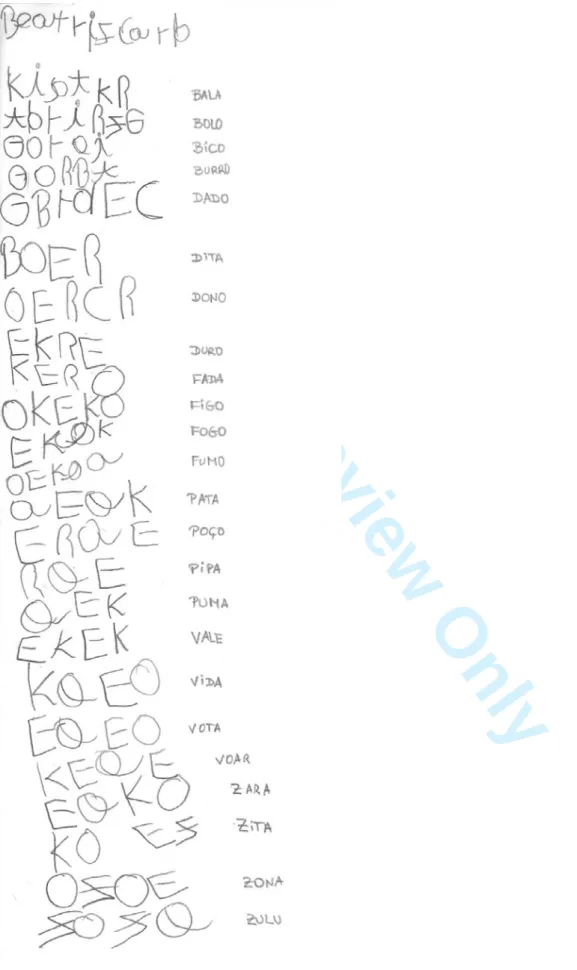
Figure 1 gives an example of grapho-perceptive writing in the pre-test from a child of experimental group 1 named Beatriz.
(Insert Figure 1)
As we can see, Beatriz used several letters to represent each of the words we asked her to write. She didn’t use any conventional letter to represent the initial sound of the words. In three words (Dono [donu], Pata [patα] and Zona [zonα]) the first letter she wrote was a vowel corresponding to the second phoneme of the word.
In the post-test all the children of both the experimental groups used
conventional letters to represent the initial sound in some or all of the words (between 8 and 24 words).
Figure 2 gives an example of the same child’s writing in the post-test. (Insert Figure 2)
As we can see, Beatriz was able to use a correct letter to represent the initial phoneme of all the words.
As regards of the control group, none of the children used conventional letters to represent the initial phoneme of the words. As it had happened in the pre-test, eight children used a vowel at the beginning of some words (between 1 and 7 words) corresponding to the second phoneme of the word.
Table 2 shows the means and standard deviations for the number of words in which the letters B, D, F, P, V and Z were used at the beginning of the word and for the
3 4 5 6 7 8 9 10 11 12 13 14 15 16 17 18 19 20 21 22 23 24 25 26 27 28 29 30 31 32 33 34 35 36 37 38 39 40 41 42 43 44 45 46 47 48 49 50 51 52 53 54 55 56 57 58 59 60
For Review Only
total number of words whose initial consonant was correctly spelled by the two experimental groups.
(Insert Table 2)
In order to assess the impact that the articulatory properties of the initial (occlusive/fricative) phoneme in words had on the evolution of the phonetisation processes involved in the children’s writing in the post-test, we carried out Mann-Whitney tests using the group as the independent variable and the number of words in which the initial phoneme was correctly written and the number of words in which the letters B, D, F, P, V and Z were used at the beginning of the word as the dependent ones.
These non-parametric tests were performed due to heterocedasticity concerning the seven dependant variables. To control experiment-wise error rate, we used the Bonferroni procedure, establishing α = 0.05/7.
The results show that there were statistically significant differences between the two groups in what concerns the total number of words in which the initial phoneme was correctly phonetised (U= 16.00 p<.000); they also show that there were no
statistically significant differences in relation to the consonants F (U = 78.00; p= .317),
V (U = 78.00; p = .317 ), Z (U = 70.50; p = .253) and P (U = 60.50; p = .144), but that there are such differences when it comes to the consonants B (U = 19.50; p < .000) and
D ( U = 18.50; p < .000).
The children in experimental group 1, who were given a writing programme that worked on the phonetisation of occlusive initial phonemes, generalised the
phonetisation processes and applied them to the fricative phonemes in a post-test situation, in which they achieved the same results as the children in experimental group 2 when they had to phonetise [f], [v] and [z]. The children in experimental group 2
3 4 5 6 7 8 9 10 11 12 13 14 15 16 17 18 19 20 21 22 23 24 25 26 27 28 29 30 31 32 33 34 35 36 37 38 39 40 41 42 43 44 45 46 47 48 49 50 51 52 53 54 55 56 57 58 59 60
For Review Only
found it more difficult to generalise the phonetisation processes in relation to occlusive phonemes, and did not do as well as the experimental group 1 children when it came to phonetising [b] and [d], although they did obtain similar results with [p].
When the children from both groups did not use a correct consonant to represent the initial phoneme of the words, what did they use?
Generally they used a correct vowel corresponding to the second phoneme of the word. Table 3 shows the means and standard deviations for the words in which a correct vowel was used instead of the correct initial consonant, by the two groups.
(Insert Table 3)
So, it seems that when children were not able to correctly spell the first phoneme they generally spelled the second one, a vowel, which in terms of the Portugueses language is easier.
Discussion
This study confirms first of all that conducting intervention programmes that work on pre-school children’s writing leads to an evolution in the children’s thinking about the characteristics of the written code. We found that the children in both experimental groups, whose writing was grapho-perceptive at the time of the pre-test, started phonetising their writing in the post-test. It would thus seem that the tasks that were put to them – to think about their writing and compare it with the phonetised writing of a hypothetical schoolmate – made it possible to initiate metalinguistic thinking processes at the level of segments of speech and print, and of the relationships between them, which in turn modelled a conceptual understanding that the code is a system for writing down sounds. This interpretation goes along the same lines as those which Treiman (2004) puts forward, when she says that “The spelling task may prompt children to use more systematic methods of deriving spelling from sounds” (p.30).
3 4 5 6 7 8 9 10 11 12 13 14 15 16 17 18 19 20 21 22 23 24 25 26 27 28 29 30 31 32 33 34 35 36 37 38 39 40 41 42 43 44 45 46 47 48 49 50 51 52 53 54 55 56 57 58 59 60
For Review Only
Given the initial-letter hypothesis, according to which the systematic mapping between the oral and the written occurs first in relation to initial letters (Bowman & Treiman, 2002), we focused in more detail on an analysis of the phonetisation of the first letter in words. Our results indicate that the number of words in which the initial phonemes were correctly phonetised in the post-test situation was greater in the case of the children in experimental group 1 – whose writing programme had used the occlusive initial phonemes [b] and [p] – than it was for those in experimental 2 – whose writing programme had used the fricative initial phonemes [f] and [v].
This advantage is due to the fact that the children in experimental group 1 generalised the phonetisation procedures that they had learnt over the course of the programme to all the phonemes they had not worked on – the fricative phonemes [f],
[v] and [z] and the occlusive [d]; whereas although the children in experimental group 2 generalised the phonetisation procedures to the fricative phoneme [z] and the
occlusive [p], they did not manage to do so for two of the occlusive phonemes ([b] and
[d]), on which they had not worked in their programme. These data, plus the fact that both groups phonetised virtually 100% of the fricative phonemes, confirms that it is easier to acquire the phonetisation of fricative phonemes than that of occlusive ones.
There is a set of data which support the idea that the properties of the words that served as the basis for the work with experimental group 1 were more complex from a linguistic analysis point of view. Various studies show that children find it easier to identify fricative consonants than occlusive ones in the oral flow of words (Byrne & Fielding-Barnsley, 1991, 1993; Liberman et al., 1974; Treiman, 1998). This conclusion is linked to the fact that the acoustic realisation of occlusives differs considerably depending on the vowels that follow them, which makes the task of identifying these particular sounds as separate units more complex (Byrne & Fielding-Barnsley, 1991,
3 4 5 6 7 8 9 10 11 12 13 14 15 16 17 18 19 20 21 22 23 24 25 26 27 28 29 30 31 32 33 34 35 36 37 38 39 40 41 42 43 44 45 46 47 48 49 50 51 52 53 54 55 56 57 58 59 60
For Review Only
1993), and it is therefore more difficult to associate them with the corresponding letters. It would thus seem to us that the fact that the children in experimental group 1 were led to think about the relationships between speech and writing under linguistically more complex conditions, made it easier for them to generalise phonetisation procedures to the writing of sounds that were not worked on in any way. The more widespread mobilisation of vowels to represent the sounds in the first syllable by the children in experimental group 2 when compared to the children in experimental group 1 corroborates also this interpretation. A study of Pollo, Kessler and Treiman (2005) where were analysed the differences in phonological spelling with Brazilian and U.S. pre-school children, indicate that the Brazilian children were three times more likely to start a word with vowel letter than the U.S children; this could be explained by the different properties of the writing system to which children have been exposed. So the the intervention programme of experimental group 1 is more effective in the sense that counteracts this natural tendency in Portuguese language and promotes successfully the phonetic identidity of consonants.
As regards the phonetisation of the phoneme [p], in which the two groups’ performance was quite similar, our results show that the children from experimental group 2 were able to generalise the phonetisation procedures they had learnt over the course of the programme with fricative phonemes to the occlusive phoneme [p]. These results are quiet unexpected since there is no evidence concerning either the frequency or the familiarity that can justify the generalization to this occlusive consonant rather than to the other occlusive consonants [b] and [d]. This issue should be investigated in future research.
The existence of a generalisation of phonetisation procedures in both groups suggests that this type of programme leads children to acquire the notion that the
3 4 5 6 7 8 9 10 11 12 13 14 15 16 17 18 19 20 21 22 23 24 25 26 27 28 29 30 31 32 33 34 35 36 37 38 39 40 41 42 43 44 45 46 47 48 49 50 51 52 53 54 55 56 57 58 59 60
For Review Only
phonemes they identify in words should be represented by letters which contain the applicable sound, and that they simultaneously acquire phonemic identification skills – that is to say, the ability to perceive phonemes as stable identities within different words – which they then apply when they analyse new words.
The Anglo-Saxon literature often discusses the acquisition of the alphabetic principle as depending on phonemic awareness and on the facilitating role that letter-sound correspondences play as a support in the process of becoming aware of phonemic entities (Byrne, 1997, 1998). For instance, Castles and Coltheard (2004) assume that letter-sound knowledge enables children to perform phonemic tasks because this allows them to manipulate phonemes by manipulating orthographic images of words. Other authors, as Hulme, Caravolas, Málkova and Brigstocke (2005) consider that the ability of phonemic manipulation can be developed in the absence of knowledge about the corresponding letters. Our results, namely those concerning the generalisation across phonemes in writing reveals the possibility of the existence of a complex interaction between the processes involved in becoming aware of the oral units in speech and the understanding of the way in which the written code works that children achieve thanks to their invented spelling activities and their reflection about the nature of the written code.
However, this understanding appears to be mediated by the difficulties which the characteristics of the phonological structure of words and the articulatory properties of the sounds that go to make them up pose the children.
We will point out two limitations of this study: the first one concern the nature of the activities developed by the control group; the second one, the way children’s knowledge of letters was evaluated. In what concerns the first point, it would be relevant, in future research, to use a control group with other linguistic training useful
3 4 5 6 7 8 9 10 11 12 13 14 15 16 17 18 19 20 21 22 23 24 25 26 27 28 29 30 31 32 33 34 35 36 37 38 39 40 41 42 43 44 45 46 47 48 49 50 51 52 53 54 55 56 57 58 59 60
For Review Only
for writing skills, rather than using a control group which only classified geometrical shapes. Regarding the second point, it would be relevant to evaluate not only the knowledge of the names of the letters but also the knowledge of their phonetic counterpart.
In conclusion, we would say that programmes which work on the level of writing and which lead children to think about the relationships between speech and writing under linguistically more complex conditions – i.e. which involve the mobilisation of occlusive phonemes – seem to be more effective in terms of the
generalisation of phonetisation procedures, than programmes which mobilise phonemes that are easier to isolate within the acoustic flow, such as fricative phonemes.
To the extent that the properties of both words and the sounds that compose them appear to mediate a child’s path to the understanding of the alphabetic principle and its application to writing tasks, it would be useful to extend this type of study to the analysis of a larger number of linguistic variables. By this we mean not only the study of different types of contrast between phonemes, but also to the cross-referencing of these variables with the frequency with which the various letters appear in written Portuguese. 3 4 5 6 7 8 9 10 11 12 13 14 15 16 17 18 19 20 21 22 23 24 25 26 27 28 29 30 31 32 33 34 35 36 37 38 39 40 41 42 43 44 45 46 47 48 49 50 51 52 53 54 55 56 57 58 59 60
For Review Only
Acknowledgments This work was supported by a FCT Grant POCI 2010.
3 4 5 6 7 8 9 10 11 12 13 14 15 16 17 18 19 20 21 22 23 24 25 26 27 28 29 30 31 32 33 34 35 36 37 38 39 40 41 42 43 44 45 46 47 48 49 50 51 52 53 54 55 56 57 58 59 60
For Review Only
References .
Adams, M. (1998). Beginning to read: Thinking and learning about print. Cambridge, MA: MIT Press.
Alvarado, M. (1998). Consciencia fonológica y escritura en ninos preescolares: la posibilidad de omitir el primer segmento. Lectura y Vida, 3, 42-50.
Alves Martins, M. (1993). Évolution des conceptualisations d'un groupe d'enfants d'âge pré-scolaire sur l'écriture portugaise. Études de Linguistique Appliquée, 91, 60-69. Alves Martins, M., & Silva, C. (2001). Letter names, phonological awareness and the
phonetization of writing. European Journal of Psychology of Education, 16, 605-617.
Alves Martins, M., & Silva, C. (2006a). The impact of invented spelling on phonemic awareness. Learning and Instruction, 16, 41-56.
Alves Martins, M., & Silva, C. (2006b). Phonological abilities and writing among Portuguese preschool children. European Journal of Psychology of Education, 21, 163- 182.
Besse, J-M. (1996). An approach to writing in kindergarten. In C. Pontecorvo, M. Orsolini, B. Burge, & L. Resnick (Eds.), Children´s early text construction (pp. 127-144). Hillsdale, N.J.: Lawrence Erlbaum Associates Publishers.
Bowman, M. & Treiman, R. (2002). The effects of letter names and word position on reading and spelling performance. Journal of Experimental Child Psychology,
82, 305-340. 3 4 5 6 7 8 9 10 11 12 13 14 15 16 17 18 19 20 21 22 23 24 25 26 27 28 29 30 31 32 33 34 35 36 37 38 39 40 41 42 43 44 45 46 47 48 49 50 51 52 53 54 55 56 57 58 59 60
For Review Only
Byrne, B. (1997). The learnability of the alphabetic principle: Children’s initial hypotheses about how print represents spoken language. Applied
Psycholinguistics, 17, 401-426.
Byrne, B. (1998). The foundations of literacy. Hove, UK: Psychology Press.
Byrne, B., & Fielding-Barnsley, R. (1991). Evaluation of a program to teach phonemic awareness to young children. Journal of Educational Psychology, 83, 451-455. Byrne, B., & Fielding-Barnsley, R. (1993). Evaluation of a program to teach phonemic
awareness to young children: A 1 year follow-up. Journal of Educational
Psychology, 85, 104-111.
Castles, A. & Coltheart, M. (2004). Is theres a causal link from phonological awareness to success in learning to read? Cognition, 91, 77-111.
Chauveau, G., & Rogovas-Chauveau, E. (1989). Les idées des enfants sur la lecture-écriture. Psychologie Scolaire, 68, 7-28.
Clay, M. (2000). Concepts about print. What have children learned about the way we
print language? Portsmouth: Heinemann.
De Abreu, M., & Cardoso-Martins, C. (1998). Alphabetic access route in beginning acquisition in Portuguese: The role of letter-name knowledge. Reading and
Writing: An Interdisciplinary Journal, 10, 85-104.
Delgado-Martins, M. R. (2002). Fonética do Português. Trinta anos de investigação. Lisboa : Editorial Caminho.
Ferreiro, E. (1988). L´écriture avant la la lettre. In H. Sinclair (Ed.), La prodution des
notations chez le jeune enfant (pp.18-69). Paris: Presses Universitaires de France.
Ferreiro, E., & Teberosky, A. (1979). Los sistemas de escritura en el desarrollo del
niño. México: Siglo Veintiuno Editores.
3 4 5 6 7 8 9 10 11 12 13 14 15 16 17 18 19 20 21 22 23 24 25 26 27 28 29 30 31 32 33 34 35 36 37 38 39 40 41 42 43 44 45 46 47 48 49 50 51 52 53 54 55 56 57 58 59 60
For Review Only
Fijalkow, J. (1993). Entrer dans l’écrit. Paris: Éditions Magnard.
Hiebert, E., & Raphael, T. (1998). Early literacy instruction. Orlando: Harcourt Brace College Publishers.
Hulme, C., Caravolas, M., Málková, G., & Brigstocke, S. (2005) Phoneme isolation ability is not simply a consequence of letter-sound knowledge. Cognition, 97, 1-11.
Liberman, I. Y., Shankweiler, D., Fischer, F. W., & Carter, B. (1974). Reading and the awareness of linguistic segments. Journal of Experimental Child Psychology,
18, 201-212.
Mann, V. (1993). Phoneme awareness and future reading ability. Journal of Learning
Disabilities, 26, 259-269.
Nascimento, M. F., Casteleiro, J., Marques, M. L., Barreto, F., Amaro, R., & Veloso, R. (2000). CLUL - Léxico Multifuncional Computorizado do Português
Contemporâneo. Centro de Linguística da Universidade de Lisboa.
http://www.clul.ul.pt/sectores/linguistica_de_corpus/projecto_lmcpc.php. Quintero, G. (1994). El uso y función de las letras en el período pre-alfabético.
Lectura y Vida, 15, 28-38.
Pollo, T. C., Kessler, B., & Treiman, R. (2005). Vowels, syllables and letters names: Differences of young children´s spelling in English and Portuguese. Journal of
Experimental Child Psychology, 92, 161-181.
Pollo, T. C., Treiman, R., & Kessler, B. (in press) Three perspectives on spelling development. In E. J. Grigorenko & A. Naples (Eds.), Single-word reading: Cognitive, behavioral, and biological perspectives. Mahwah, NJ: Erlbaum. Pontecorvo, C., & Orsolini, M. (1996). Writing and written language in children´s development. In C. Pontecorvo, M. Orsolini, B. Burge, & L. Resnick (Eds.),
3 4 5 6 7 8 9 10 11 12 13 14 15 16 17 18 19 20 21 22 23 24 25 26 27 28 29 30 31 32 33 34 35 36 37 38 39 40 41 42 43 44 45 46 47 48 49 50 51 52 53 54 55 56 57 58 59 60
For Review Only
Children´s early text construction (pp. 3-23). Hillsdale, N.J.: Lawrence Erlbaum Associates Publishers.
Raven, J., Raven, J.C., & Court, J.H. (1998). Manual for Raven’s Progressive Matrices
and Vocabulary Scale. Section I. General overview. Oxford: Oxford Psychologists Press.
Rebelo, D., Delgado Martins, M. R. D., & Prudêncio, C. (1978). Linguagem oral e
ortografia. INIC, 1978.
Silva, C. (2002). Bateria de provas fonológicas. Lisboa: ISPA.
Silva, C., & Alves-Martins, M. (2002). Phonological skills and writing of pre-syllabic children. Reading Research Quarterly, 37, 466-483.
Silva, C., & Alves Martins, M. (2003). Relations between children's invented spelling and the development of phonological awareness. Educational Psychology, 23, 3-16.
Sulzby, E. (1989). Assessment of emergent writing and children´s language while writing. In L. Morrow & J. Smith (Eds.), Writing in real time: Modelling
production processes (pp. 83-109). New York: Longman.
Tolchinsky, L.L. (1995). Desenvolvimento da alfabetização e suas implicações pedagógicas: evidências do sistema hebraico de escrita. In Y. Goodman (Ed.),
Como as crianças constroem a leitura e a escrita (pp. 36-53). Porto Alegre: Artes Médicas.
Treiman, R. (1993). Beginning to spell: A study of first-grade children. New York: Oxford University Press.
Treiman, R. (1994). Use of consonant letter names in beginning spelling.
Developmental Psychology, 30 (4), 567-580. 3 4 5 6 7 8 9 10 11 12 13 14 15 16 17 18 19 20 21 22 23 24 25 26 27 28 29 30 31 32 33 34 35 36 37 38 39 40 41 42 43 44 45 46 47 48 49 50 51 52 53 54 55 56 57 58 59 60
For Review Only
Treiman, R. (1998). Why spelling? The benefits of incorporating spelling into beginning to reading instruction. In J. L. Metsala & L. C. Ehri (Eds.), Word
recognition in beginning literacy (pp. 289-313). London: Lawrence Erlbaum Associates Publishers.
Treiman, R. (2004). Knowledge about letters as a foundation for reading and spelling. In R. M. Joshi & P. G. Aaron (Eds.), Handbook of orthography and literacy. Mahwah, NJ: Erlbaum.
Treiman, R., Berch, D., Tincoff, R., & Weatherston, S. (1993). Phonology and spelling: the case of syllabic consonants. Journal of Experimental Child Psychology, 56, 267-290.
Treiman, R., Broderick, V., Tincoff, R., & Rodriguez, K. (1998). Children's phonological awareness: Confusions between phonemes that differ only in voicing. Journal of Experimental Child Psychology, 68, 3-21.
Treiman, R., & Cassar, M. (1997). Spelling acquisition in English. In C. A. Perfetti, L. Rieben, & M. Fayol (Eds.), Learning to spell: Research, theory, and practice
across languages (pp. 61-80). Hillsdale, NJ: Erlbaum.
Treiman, R., & Kessler, B. (2003). The role of letter names in the acquisition of literacy. In R. Kail (Ed.), Advances in Child Development and Behaviour, Vol. 31 (pp. 105–135). San Diego: Academic Press.
Treiman, R., Tincoff, R., Rodriguez, K., Mouzaki, A., & Francis, D. (1998). The foundations of literacy: Learning the sounds of the letters. Child Development,
69 (6), 1524-1540. 3 4 5 6 7 8 9 10 11 12 13 14 15 16 17 18 19 20 21 22 23 24 25 26 27 28 29 30 31 32 33 34 35 36 37 38 39 40 41 42 43 44 45 46 47 48 49 50 51 52 53 54 55 56 57 58 59 60
For Review Only
Varnava-Skouras, G. (2005). Literacy development in Greek children. Early Literacy Symposium presented at XIIth European Conference on Developmental Psychology. Universidad de La Laguna: Tenerife, Spain.
Vernon, S. (1998). Escritura Y consciencia fonológica en niños hispano-parlantes.
Infancia Y Aprendizaje, 81, 105-120.
Vernon, S., & Ferreiro, E. (1999). Writing development: A neglegted variable in the consideration of phonological awareness. Harvard Educational Revue, 69, 395-415.
Vigário, M., F. Martins & S. Frota (2006) Frequências no Português: a ferramenta FreP. In Inês Duarte & Isabel Leiria (orgs.) Actas do XX Encontro Nacional da Associação
Portuguesa de Linguística, 897-908. 3 4 5 6 7 8 9 10 11 12 13 14 15 16 17 18 19 20 21 22 23 24 25 26 27 28 29 30 31 32 33 34 35 36 37 38 39 40 41 42 43 44 45 46 47 48 49 50 51 52 53 54 55 56 57 58 59 60
For Review Only
Table 1
Means and standard deviations for the age (months), intelligence, letters (consonants) known, and for the results in the initial syllable and initial phoneme classification tests of the 3 groups
Age Intelligence Letters S Ph
M SD M SD M SD M SD M SD
G.1 67.54 3.80 17.31 4.25 9.62 6.44 10.46 3.23 4.54 2.82 G.2 65.54 3.87 16.46 5.75 10.62 8.01 10.38 4.00 4.62 2.43 G.3 67.08 3.12 17.15 2.82 9.23 5.70 8.92 3.33 4.69 3.07 G.1= Occlusive phoneme writing programme
G.2 = Fricative phoneme writing programme G.3 = Control group
S = Initial syllable classification Ph = Initial phoneme classification
3 4 5 6 7 8 9 10 11 12 13 14 15 16 17 18 19 20 21 22 23 24 25 26 27 28 29 30 31 32 33 34 35 36 37 38 39 40 41 42 43 44 45 46 47 48 49 50 51 52 53 54 55 56 57 58 59 60
For Review Only
Table 2
Means and standard deviations for the number of words in which the children in the two experimental groups phonetised the initial phonemes [b], [d], [f], [p], [v] and [z] in the post-test
B D F P V Z Total
M SD M SD M SD M SD M SD M SD M SD
G.1 3.85 0.55 3.92 0.28 3.62 0.77 3.77 0.44 3.92 0.28 3.92 0.28 23.0 1.29 G.2 2.00 1.53 4.00 0.00 1.69 1.32 2.92 1.55 4.00 0.00 3.31 1.49 17.9 4.79
G.1= Occlusive phoneme writing programme using [b], [p]
G.2 =Fricative phoneme writing programme using [f], [v]
3 4 5 6 7 8 9 10 11 12 13 14 15 16 17 18 19 20 21 22 23 24 25 26 27 28 29 30 31 32 33 34 35 36 37 38 39 40 41 42 43 44 45 46 47 48 49 50 51 52 53 54 55 56 57 58 59 60
For Review Only
Table 3
Means and standard deviations for the number of words in which the children in the two experimental groups phonetised the second phonemes (vowels) instead of the first phonemes (consonants) in the post-test
M SD
G.1 0.77 1.17
G.2 4.15 3.63
G.1= Occlusive phoneme writing programme using [b], [p]
G.2 =Fricative phoneme writing programme using [f], [v]
3 4 5 6 7 8 9 10 11 12 13 14 15 16 17 18 19 20 21 22 23 24 25 26 27 28 29 30 31 32 33 34 35 36 37 38 39 40 41 42 43 44 45 46 47 48 49 50 51 52 53 54 55 56 57 58 59 60
For Review Only
Figure Captions
Figure 1 Example of Beatriz grapho-perceptive writing in the pre-test
Figure 2 Example of Beatriz writing with phonetization in the post-test.
3 4 5 6 7 8 9 10 11 12 13 14 15 16 17 18 19 20 21 22 23 24 25 26 27 28 29 30 31 32 33 34 35 36 37 38 39 40 41 42 43 44 45 46 47 48 49 50 51 52 53 54 55 56 57 58 59 60
For Review Only
Figure 1: Example of grapho-perceptive writing in the pre-test
3 4 5 6 7 8 9 10 11 12 13 14 15 16 17 18 19 20 21 22 23 24 25 26 27 28 29 30 31 32 33 34 35 36 37 38 39 40 41 42 43 44 45 46 47 48 49 50 51 52 53 54 55 56 57 58 59 60
For Review Only
Figure 2: Example of writing with phonetisation in the post-test
3 4 5 6 7 8 9 10 11 12 13 14 15 16 17 18 19 20 21 22 23 24 25 26 27 28 29 30 31 32 33 34 35 36 37 38 39 40 41 42 43 44 45 46 47 48 49 50 51 52 53 54 55 56 57 58 59 60