Aubry, T.; Araújo Igreja, M. (2009) - Economy of Lithic Raw Material during the Upper Paleolithic of the Côa Valley and the Sicó Massif (Portugal): Technological and Functional Perspectives (M. Araújo Igreja & I. Clemente Conte). Proceedings of the Workshop Functional Studies of Non Flint Stone Tools: Methodological Improvements and Archaeological Inferences. Lisbon, 23-25 may 2008.
[Disponível em http://www.workshoptraceologia-lisboa2008.com, em 13/10/2010]
1
Economy of lithic raw material
during the Upper Paleolithic of
the Côa Valley and the Sicó
Massif (Portugal): technological
and functional perspectives.
T. Aubry* and M. de Araújo Igreja**
*Instituto de Gestão do Património
Arquitectónico e Arqueológico- IP
** LAMPEA (Laboratoire Méditerranéen de Préhistoire: Europe - Afrique), UMR 6636 du CNRS (Aix-en-Provence, França), Post-doctoral researcher of Fundação para a Ciência e a Tecnologia at UNIARQ – Faculty of Humanities (University of Lisbon, Portugal), [email protected] 1. Introduction
In Portugal, Upper Paleolithic evidences present some peculiarities comparatively to the European context, in term of chronology, animal resources, bone tools, lithic tool categories and operative scheme (Zilhão, 1997, Bicho, 2000). Distinctively of most of European Upper Paleolithic lithic assemblages, blade production is almost absent, in site located near or far from the flint sources, and all the Portuguese series show a systematic use and elevated amount of non-flint materials, like quartzite and quartz. Considering the specificities of the « Lusitanian » Upper Paleolithic paleoenvironment and lithic production, the goal of this study is to establish a relation between, the lithic resources available locally and, the technological systems developed since acquisition to processing to the local and displaced raw materials. The data is supported by a geological, typo-technological and use-wear analysis of knapped stone products and debris
from 3 Upper Paleolithic sites of northern (Côa Valley) and 2 of central Portugal (Sicó Massif), located in two geological settings bearing totally distinct siliceous rock resources.
2. Regional setting and site data
2.1 Côa valley Upper Paleolithic archaeological record
Open-air engravings were discovered in the last 15 kilometer of the Côa valley, a left bank tributary of the Douro, during the middle nineties, in this last part of the basin, in a region where no evidence of Upper Paleolithic human occupation has ever been reported before (Zilhão, 1995; Zilhão et al., 1997). The search of an archaeological context for rock art has enabled us to reveal a significant occupation in this region of the Iberian Peninsula during several phases of the Upper Paleolithic (Zilhão, 1997, Aubry, 2001, 2002). More than 15 archaeological sites have been identified for these periods on less than 400 km2 and 10 tested or excavated. The retouched tools categories encountered in the Côa valley sites were compared with those known from Upper Paleolithic site of Portugal and other areas of the Iberian Peninsula. Typological approach of lithic points and retouched bladelets permits to establish a chronostratigraphic framework of the human occupation, during Gravettian, Proto-Solutrean, Upper Solutrean and several stage of the Magdalenian (Aubry, 2001, 2002). Dating were obtained at four Côa valley sites, by thermoluminescence on burnt quartz and quartzite pebbles and by Optically Stimulated Luminescence on sediments at Cardina I, Olga Grande 4, Quinta da Barca Sul and Fariseu (Valladas et al. 2001, Mercier et al,
2 2001, 2006). The acid soils developed
on schist and granite rocks of the region are not favorable to conserve macro organic remains. However, Upper Palaeolithic radiocarbon ages were obtained on bones and tooth, recovered in the level 4 of Fariseu (Aubry et al., 2007; Aubry and Sampaio, 2008a), were faunal remains are unusually conserved (Gabriel, 2008). More recently, the level 9, bearing a charcoal fragment dated by ASM of
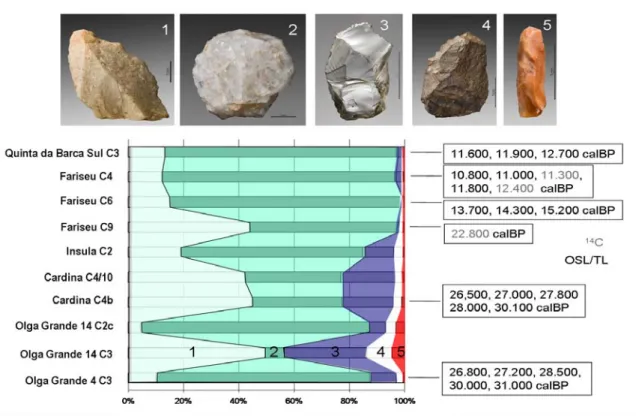
19020 ± 80 BP (22.879 CalBP) demonstrate the potential conservation of macro organic materials contemporaneous of the Last Glacial Maximum preserved by alluvial deposits. The radiometric results obtained at the 4 sites confirm the typological data and indicate a human presence at the sites in the 31,000-27,000 BP interval, during the LGM and again during the Late Glacial (Valladas et al. 2001, Mercier et al, 2001, Fig. 1).
Figure 1- Proportion of lithic raw material categories used in Upper Paleolithic sites of the Côa valley (photography J.P. Ruas).
The evidence from Fariseu site, where an engraved panel is covered by a sequence of stratified deposits containing evidence of human occupation dated by different means, allows a relation between rock art and other archaeological remains. The data demonstrate the execution and conservation of Paleolithic figures in the open air, and the discovery of a fragment of the engraved panel in layer
8 makes it possible to establish that it was engraved before its deposition, which is dated around 18.400 BP by OSL (Aubry and Sampaio, 2008b). The settlements detected, all at open air, are located along the nine last kilometers of the two margins of the schists of the valley and on the granitic rocks of the plateau, at more than 500 meters. The geomorphological factors
3 and condition for the differential
conservation of the archaeological record have been exposed in detail (Aubry et al. 2002, Aubry and Sampaio, 2008). The geomorphological condition allowing the conservation of archaeological record in thin-grained sediments were deposited by low-energy processes, accumulated in ledges and hollows circumscribed by granites outcropping on the plateau and on rock terraces of the lower part of the steep slope of the valley.
The lithic remains examined in this study were recovered at 3 sites: 9.775 pieces from Olga Grande level 3, 18.383 (Cardina level 4b), 28.213 (Cardina level 4. UA 10) and 6122 pieces from Fariseu, level 4). All remains were analyzed geological, in terms of texture and structure, mineralogical and paleontological content and technologically using the chaîne opératoire concept. These data was completed by a use wear analysis of a selected sample of retouched tools and blanks.
The first lithic assemblage considered was recovered on a 70 square meter area at Olga Grande 4, a site located on the granitic plateau corresponding to the planation surface of the western limit of Iberian Meseta (Aubry, 1998). The gravettian occupation of the level 3 of this Upper Palaeolithic sequence, underlined by an Upper Solutrean level yielding typical cantabrian shouldered points and Magdalenian lithic levels, has been dated by TL between 26.800 ± 1800 and 30.000 ± 2400 BP.
The two other assemblages, both attributed to final Gravettian on the base of truncated retouched bladelets, were recovered on the level 4b and
4/10 of Cardina I site. This settlement, the first Upper Paleolithic settlement detected in the Côa valley (Zilhão et al, 1995) preserves a stratification of several Upper Paleolithic and Bronze age occupations, deposited under a rock-terrace 20 meters above the modern level of the river. The base of the sequence yielding final Gravettian the diagnostic retouched bladelets, is dated between 26.500 ± 1800 and 30.100 ± 1500 BP (Mercier et al, 2001, Valladas et al., 2001, Mercier et al. 2001).
We compare these 3 gravettian lithic assemblages with the assemblage recovered in the final Magdalenian occupation level 4 of the Fariseu site, dated by TL between 10.800 ± 1700 and 11.800 ± 900 and by ASM on bone fragments between 9.830 ± 130 BP and 10.510 ± 40 BP (11.317 ± 222 and 12.164 ± CalBP, calibrated by the Calpal program). The use wear analysis of this material, in progress, cannot be included in this study, but we consider that a diachronical approach is meaningful to evaluate the reliability of the typo-technological data obtained for gravettian occupation of the same region.
2.2 Sicó massif record
The archaeological sites considered from this area are located south of Coimbra city, in the Meso-cenozoic western borderland of the Iberian Peninsula. A research project begun in 1991 has permitted to recognize Middle and Upper Paleolithic lithic assemblages preserved in occupation levels of caves and rock shelters formed in the middle Jurassic geological formations of the Sicó massif (Almeida et al. 2003, Aubry et al. 1994, Aubry
4 and Moura, 1994, 1995 Aubry et al.,
1997, 2001, 2008a). This limestone highland rising to less than 600 m and located 40 km east of the Atlantic, at the western belt of the Condeixa-Sicó-Alvaiázere system (Cunha, 1991). The Upper Paleolithic record is exclusively represented by cave and rock shelters sites formed in limestone. A relation with the existence of several erosion events and an increase of the alluvial sedimentation during medieval time can be proposed as an argument to explain the lake of open air settlement in this area, well represented in others region of central and northern Portugal (Zilhão, 1997, Aubry 2001 and 2002).
The cultural attribution, based on typological evidence, the ages obtained by absolute dating, the paleoenvironmental conditions inferred by the feature of sediment and soil formation and the disconformities, propose a correlative framework for the stratigraphical and archaeological sequence of 4 sites (Buraca Grande, Buraca Escura, Abrigo do vale dos Covões and Vale das Buracas) conserving upper Paleolithic occupation levels (Aubry et al, 2008a and 2008b). In this study we considered the technological data resulting of the study of the lithic assemblages recovered at Buraca Escura, located in a deeply incised Poio Novo valley formed in Middle Jurassic limestone, perpendicular to the major fault of the western border of the Condeixa-Sicò-Alvaízere massif (Cunha, 1991). This cave is located on the southern slope of the valley (Aubry et Moura, 1993; Aubry et al., 2001, Aubry et al., 2006). Excavation works revealed a Middle Paleolithic occupation. Fewer than 15
flaked stone pieces were recovered in two levels excavated over 12 m², all produced (but not in the cave) from Levallois, discoidal and bipolar cores, and with a hard hammer (Almeida et al., 2003). Animal bone accumulation in the geoarchaeological level 3, were related to carnivore activity, probably hyena, at the cave (Aubry et al., 2001). Locally, preserved of a main erosion event, final gravettian lithic and faunal remains are preserved. Lithics were analyzed in term of raw material supply, typo-technology and use wear analysis. Faunal remains were studied trough archaeozoology and the charcoal recovered trough anthracology (Aubry et al., 2001).
The second site included in the study of the Sicó Massif, is the Abrigo do Vale
dos Covões a rock shelter, located 15
Kilometers North. The site was tested during 2001 and excavated on 9m2 during 2004 (Aubry et al., 2008c, Gameiro et al. 2008). The almost 2 m thick stratigraphic sequence yield eight layers and technological and typological study revealed at least three different typological and technological groups of lithics. Petrographical and technological study was completed by a use-wear analysis on a sample of retouched tools and blanks.
3- Results
3.1 Raw material procurement
3.1.1.Côa valley lithic raw-materials supply
The study of lithic raw materials supply of the archaeological knapped assemblages in order to reconstruct sourcing, mobility and territories, was based on the systematic descriptions and comparisons of archaeological with
5 geological samples collected specifically
for this study, and both, taking into account the different scales of analysis (macroscopic and microscopic) (Mangado, 2002, 2004, Aubry et Mangado, 2006).
The geological survey of the region concerned allows us not only to establish the potential lithic resources available in the regional and local areas, but also to determine their position (primary or secondary), their accessibility; and many other parameters related to the raw material characterization such as their morphology and quantity. Macroscopical comparison between samples collected during field works and archaeological lithics makes it possible to establish a first assessment of resources used, but also not used. The data revealed that some regional lithic raw materials from the north of the Douro valley, in spite of suitable for knapping, were not used in Paleolithic
times. This is the case for the regional sources of spatially localized precambrian chert, and volcanic opal (Aubry, Mangado, 2006).
A classification of rocks comprising 24 categories has been proposed for the Côa Valley (Mangado, 2002, 2004, Aubry, Mangado 2003a, 2003b, 2006). At all sites and during the different periods of the Upper Paleolithic the lithic industries are essentially based on quartz and quartzite, and to a lesser degree on rock crystal and fine-grained quartz vein. These categories represent nearly 99% of the assemblages considered and of all the Côa Valley assemblages (Fig. 1). Quartz, quartzite and rock crystal could be obtained a few kilometres of the sites, and some other raw materials, like hydrothermal silicifications or “smoky” rock crystal, came from a regional area less than 50 km from the archaeological sites (Fig. 2).
Figure 2 - Geographic units defined by the origin of lithic raw material used during Upper Paleolithic of the Côa valley (photography J.P. Ruas).
6 Flint is not available in the regional
geological context where sedimentary rocks are absent. Nevertheless, flint from several geographical sources occurs systematically in all archaeological sites, during all the Upper Palaeolithic even though its percentage is always very low (Fig. 1 and 3 Aubry et al., 2004, 2002, 2003, Aubry and Mangado, 2003a, 2003b, 2006).
The determination of the origin of flint has been assessed by a preliminary
macroscopical examination complemented by a petrographical analysis (mineralogy, texture and fossils contents) of archaeological samples as well as geological ones, collected from the different sedimentary basins analyzed (Mangado, 2002 and 2004). The comparison between geological and archaeological samples allows us to confirm the use, during the Upper Paleolithic of the Côa Valley, of flint varieties coming from sedimentary environments located, at least, 150 km away from the sites (Fig. 3).
Figure 3 - Comparison of the origins of flint used in the Gravettian occupation of Olga Grande, level 3 and the final Magdalenian occupation of Fariseu, level 4.
3.1.2 Sico Massif lithic raw-material supply
Archaeological assemblages of the 2 site of the Sicó massif area were analyzed using the same protocol of
comparison between archaeological record and a geological reference base on a geological survey (Fig, 4, Aubry et al. 2001, Gameiro et al., 2008, Aubry et al. 2008c).
7
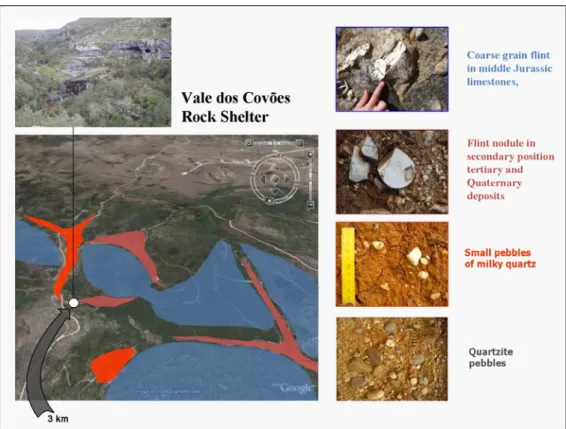
Figure 4 - Spatial distribution of siliceous raw materials categories, in primary and secondary position, around the Abrigo do Vale dos Covões shelter.
The raw material supply revealed the use of quartz and quartzite in both sites (Fig. 5), despite the existence of a local low quality flint available in primary position on middle Jurassic limestone or in secondary position, in tertiary or
quaternary detritical deposits, and the use of fine-grain flint of Upper Cretaceous and Upper Jurassic geological formations displaced from 20 to 40 kilometers (Aubry et al, 2001, Gameiro et al, 2008, Fig. 4 and 5).
Figure 5 - Proportion of lithic raw material categories used in the archaeological levels 1 to 8c of the Abrigo do Vale dos Covões shelter and the c2a level of Buraca Escura cave.
8
3.2 Lithic production sequence, tools and by-product
Lithic assemblages have been classified into technological classes of reduction sequences, from block, fragment of filonian siliceous rock, nodule, or pebble, in order to establish the production processes represented for each different raw material, their techniques and purposes and blank selection for retouched tools. An economical interpretation of the data is exposed here, based on the production sequences represented and absent, for each lithological category, as well as the reconstruction of techno-morphological objectives underlying the deliberate production of some flake blanks, not designed for retouch.
3.2.1 Lithic production of the Côa Valley assemblages
The occurrences of the different categories of local or regional raw materials during the Gravettian and final Magdalenian sites of the Côa Valley (Olga Grande 4, Cardina I and Fariseu) reveal a lower quartzite proportion during the final Magdalenian (Fig. 1, Quinta da Barca Sul, Fariseu level 4 and 6).
However, analysis and refitting of blocks and pebbles of local quartz and quartzite reveal that the production sequence is not always complete in the excavated areas.
In the assemblage of the level 3 of Olga
Grande 4, the local quartzite pebble
reduction sequences are represented by the flake production, using flat surfaces, and exploring the smaller axes of the volumes (Fig. 6).
9 Blanks were retouched in a very low
percentage to produce scrapers, notches or denticulates. Pebbles, blocks or cores from such production were reused as heat accumulators on the fire pits. The refitting show also the use of these blanks for knapping after the fracture obtained during the heating. Local quartz slabs and blocks were intensively used (the raw material with more representation in effective) for flake production and very few are retouched. However, the fragility and high coefficient of fragmentation of this kind of raw material during knapping
must be kept in mind when we try to interpret this data.
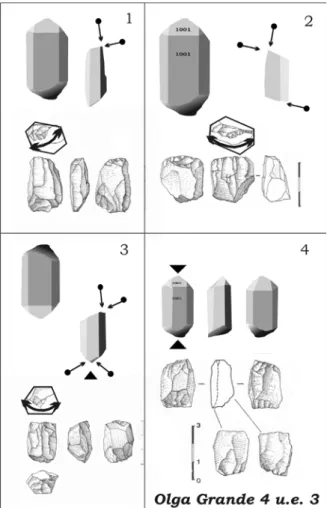
The third lithological category of the assemblage is the rock crystal. These translucent rock crystals (from 1 to 3 cm of diameter), larger than the rock crystal not detected during the survey, but probably available regionally, were used as blank for bladelet and small flakes production. Two distinct operative schemes are represented. The first one is a unidirectional production sequence using the longer axe and the intersection of the natural faces of the rock crystals (Fig. 7, nº1, 2, 3).
Figure 7- Reconstruction of the reduction sequence and technique of percussion used for the debitage of bladelets on rock crystal in the Olga Grande level 3 level.
10 A second operative scheme can be
reconstructed, from the stigmata observed on the products and cores, revealing an anvil bipolar percussion (Fig. 7, nº4). This reduction process was use on cores resulting of the first
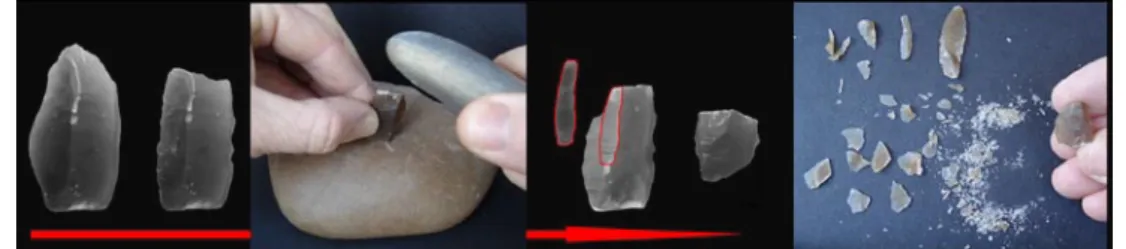
scheme or applied on the raw rock crystal. Experimentation revealed that this reduction sequence permits to produce some bladelets and to explore more intensively volume smaller than 1
cm (Fig. 8).
Figure 8 - Experimental production of bladelets and small flakes on flint, by anvil percussion.
The possible function of these pieces as intermediary pieces (“pièce esquillées” Le Brun Ricalens, 2006) cannot be entirely excluded, based on the technological data. However, the module, morphology and the exclusive used of fine-grained non local raw material argue in favor of the interpretation of these pieces as core for bladelet and small flakes production.
If few pieces produce by anvil percussion process were modified by marginal retouch, the analysis of the microlithic retouched tools discarded on the site show that the percussion with soft hammer modality of bladelet production is better represent on the blank of retouched bladelets and microgravettes in rock crystal.
The small amount of blanks and non microlithic retouched tools on flint, discarded in the level 3, corresponds to notches on small blades, fragments of tools broken during the use and by-products corresponding to the same processes used on rock crystal (Aubry et al, 2008c) .
At Olga Grande 4, refitting and effective of quartzite and quartz show that flakes production on these materials were not designated to be retouched. The rock crystal, collected on filonian sources, is the raw material preferentially used for the production on the site of the retouched bladelets and microgravettes and bladelet and small flakes productions attested by numerous by-products, on crystal and quartz. The bladelet and small flakes operative scheme and technique of percussion used on flint are similar, but a part of the reduction processes of the few retouched tools and broken retouched bladelet is absent, suggestion the replacement after projectile use by rock crystal microlithic tools.
At Cardina I, the UE 4b and 4/10, lithic assemblages are clearly dominated by the quartzite (Fig. 1), available locally in the Côa terraces. The reduction sequence on pebble of this raw material revealed the same intention to produce large, none or partially cortical flakes, extracted from an unique or more rarely two perpendicular flat cortical platform. The very low
11 frequency of retouched tool made from
this raw material, observed at Olga Grande 4 (as notches, denticulate, scrappers), can be also observed in these two series.
However, comparatively to the first gravettian lithic assemblage, the large variety of quartz used can reveal more diversified objectives. The module of
the scrappers made on milky quartz blanks compared to by products of the series of quartz clearly indicate that the supports were not produced on the excavated area. The fine-grained varieties of quartz and rock crystal were used for bladelet and small flakes production, by the same processes described to Olga Grande 4 (Fig. 9).
Figure 9 - Operative scheme for bladelet and small flakes production observed in the final Gravettian lithic assemblage of Cardina I site.
Though, these microlithic supports are poorly represented in the microlithic retouched tools discarded at the site and the hypothesis of the use of non retouched bladelet or small flakes arise. The flint is represented by extremely reduced cores and technological pieces that indicate the production of bladelets by soft hammer percussion on prismatic cores (Fig. 10, nº1) and predominantly by anvil bipolar percussion on flakes or fragmented tools (Fig. 10, nº2 and 3).
Figure 10 - Cardina I, level 4/10, 1: bladelets produced by soft hammer percussion, 2: Refitting of a bladelet on a core, produced by anvil percussion, 3: bladelet with the typical stigmata of anvil percussion.
12 The final Gravettian lithic remains of
Cardina I indicated that the production of short flakes on quartzite pebble was not designate to be retouched. The quartz varieties reduction sequence show a greater diversity of blanks, objectives and technical processes of production and arise the same question of non retouched bladelets, flakes blanks functionality. The flint reduction sequence is essentially represented by an anvil percussion production of bladelets and small flakes, not represented on the retouched microlithic tools discarded on the site. The Final Magdalenian lithic assemblage of Fariseu level 4, located on the Côa riversides, allows to approach the issue of quartz and quartzite economy, both available on the terrace and schist local outcrops for the milky filonian quartz. In this final Magdalenian lithic assemblage the quartz is dominating (Fig. 1). Two lithological categories were distinguished between a continuum of raw materials available on the schist and in alluvial deposits. Milky quartz is the more abundant variety.
Technological analysis, in progress (Gameiro, o.p) has revealed that some retouched tools made on cortical flakes produced from large quartz pebbles (more than 10 cm of diameter) were not produced on the site.
The blank of retouched tools made of quartz (scrappers, notches and denticulates) do not reveal a clear morphological pattern. The quartz cores recovered in the excavated surface are numerous and last negatives indicate the production of small flakes and bladelets blanks not
represented in the retouched tools sample.
The second lithological group is composed of quartzite, which is available few meters as pebbles on the Côa terraces. Only 10 retouched tools were isolated in this raw material. The bladelet tools were made in 3 varieties of flint available 150 kilometer at the South, in the terraces of the Tagus valley or 200 kilometers on the Cenomanian (Fig, 11, nº1) and Oxfordian formation of central Portugal, rock crystal, and regional filonian fine grain hydrothermal siliceous rocks (Fig. 11, nº2).
Figure 11 - Fariseu level 4, 1: retouched bladelet on Cenomanian flint, 2: Curved point out of a regional hydrothermal siliceous rock (photography J.P. Ruas).
The lithological diversity observed for each of these local and non local raw materials of the retouched bladelet tools and the bearing of typical fractures suggest a discard after their use as projectile implements. Some rock crystal cores also revealed a small bladelet production (less than 1 cm), not represented on the retouched tools
13 bladelet blanks. However, the closeness
of the Côa and a plausible alluvial erosion process affecting the smallest pieces must be considered to interpret this data.
Comparison of production processes observed on the gravettian series with Fariseu assemblage show a clear selection of quartz in relation to quartzite for the Magdalenian occupation, in spite of the local availability of both materials. Considering the erosion process the assemblage reveal the same discrepancy between the bladelet and small flakes reduction sequences attested on the local quartz and rock crystal and technique represented on retouched tools blanks.
3.2.2 Upper Paleolithic lithic
production of the Sicó massif
In order to be able to evaluate the impact of environmental lithic resources availability on the technical systems and tools categories we compared the data obtained for the Côa Valley with the series of the distinct levels of the Abrigo do vale dos Covões shelter and Buraca Escura cave,
both located in a geological environment bearing a poor quality flint, available in large amount, in primary or secondary position, at a distance of less than 100 meters of the two sites.
The final Gravettian lithic assemblables of level 2a, 2b and 2f of Buraca Escura were studied lithologicaly, technologically and object of one of the first use-wear analysis in Portugal (Aubry et al. 2001). The analysis show the discard of blades, bladelets and tools made in local and allochtonous flint from 30 kilometers from the south, core and by-products of milky quartz produce by anvil percussion and soft percussion processes.
The Vale dos Covões shelter comprises an Upper Paleolithic sequence preserved in layers 3 to 8b (Fig. 12, Aubry et al. 2007, 2008a ; Gameiro et al, 2008). The lithic assemblage recovered in layers 3 to 4 (and in secondary position in the uppermost levels 1 and 2) can be typologicaly and technological assigned to the Upper Magdalenian phase (Gameiro et al., 2008).
14
Figure 12 - Abrigo do Vale dos Covões, stratigraphical profile and a sample of retouched bladelets from the different levels.
Despite of Upper Magdalenian ages based on charcoal and bones samples for all the layers of the sequence, lithic assemblage of layers 5, 6, 7 shows typical microgravettes in association with a large diversity of backed bladelets (Aubry et al. 2006, 2008a and 2008b). Such kind and proportion of microlithic points is unknown in the other Portuguese sites and it was explained as the result of percolating processes after gravettian human occupations (Aubry et al., 2008a and 2008b).
Technological analysis of level 3 to 8 on progress by C. Gameiro, L. Klaric and T. Aubry revealed a production of the bladelets on carenated (level 3 and 4) and burin cores (5/7) made from flakes in local and allochtonous very fine-grained flint from sources distant of 30 kilometers. This process of reduction permits to explore intensively small flakes of flint. Few backed bladelets
made on quartz (available locally) are present in the series. However, the single prismatic core with bladelet negatives recovered during the excavation suggests that these microlithic tools were discarded during a replacement process and were produced elsewhere.
Despite the availability, less than 500 meters, of large nodules of a middle grain flint, no blade production is recorded on layers 1 to 7. Refitting of 56 pieces from the 220 lithic remains recovered at the top of the level 8c, reveal several bladelet production processes and a blade production on the local flint (J-2, Fig 13, Aubry et al., 2008b and 2008c).
15
Figure 13 - Abrigo do Vale dos covões, level 8c, bladelet-cores and refitting in the local flint.
3.3 Use-wear analysis
The models available so far for Upper Paleolithic stone tools consumption from specialized vs. residential occupations rely on archaeological assemblages mainly made of flint from Central and Eastern Europe. Taking into account that Portuguese Upper Palaeolithic lithic industries are highly composed of quartz, quartzite and rock crystal, and since the paleoenvironmental conditions are different from Central and Eastern Europe, a research project, financially supported by the Fundação para a Ciência e Tecnologia, was specifically designed to infer through use-wear analysis on human economical and social strategies during Upper Palaeolithic in Portugal.
Retouched and unretouched artifacts were analyzed under the Differential Interference Contrast microscope, since bright field microscopy proved inadequate to the composition and structure of non flint stone tools. The accuracy of this method, also known as Nomarski contrast, for use-wear studies on highly reflective materials, is highlighted in detail in these proceedings (see Igreja).
3.3.1 Previous work: use-wear analysis of Buraca Escura lithic assemblage
The use-wear analysis of a small sample of final gravettian lithic remains by H.Plisson revealed “ des émoussés sur les fronts de deux grattoirs, relative à l’action de raclage, et sur les tranchants d’un produit laminaire, relatifs à la découpe de peau. Les deux grattoirs portent une usure résiduelle car leur front a été modifiés après usage (retouche partielle et esquillement de la face ventrale). Des traces moins caractéristiques ont été observées sur le flanc latéral d’un burin qui a été ébréché sur les deux dièdres par une contrainte transversale sur matière dure, une lame porte une ébréchure relative á une éventuelle découpe de matière tendre et un pointe de type Vale Comprido porte un poli de découpe de matière carnée résistante (Aubry et al. 2001, p. 29)1.
1 “edge rounding on the front edges of two endscrapers produced by scraping motion, and on the edges of a laminary blank by cutting hide. The two endscrapers present
underdeveloped use-wear on the front edge which occurred after they have being used (partial retouch and scarring on the ventral side). Less typical use-wear was found on the dihedral sideedge of a burin, and scarring was noticed on the two dihedral related with transversal motion on hard materials, one blade presents edge scars resulting from cutting soft materials and one point type of
16
3.3.2 First results of the use-wear analysis of Abrigo do vale dos Covões, level 3, 4 sample
The analyzed material comprise 60 implements made on flint, quartz and quartzite: 17
bladelets, 8 blades, 1 burin, 3 retouched flakes, 20 unretouched flakes, 1 burin spall, 6 endscrapers, and 4 cores.
Vale Comprido shows polish from cutting animal resistant materials.
17 Motions and worked materials
Typology animal hard Wood
Flint Quartz Quartzite Rock crystal Total weathered preserved soft Total
Bladelets 12 3 - 2 17 10 7 - - - -Blades 7 1 - - 8 - 8 1 - - 1 Burins 1 - - - 1 - 1 - - - -Retouched flakes 3 - - - 3 - 3 1 - - 1 Unretouched flakes 13 6 1 - 20 - 20 2 - 1 3 Burin spall 1 - - - 1 - 1 - - - -Endscrapers 5 1 - - 6 - 6 4 1 - 5 Cores 3 - - 1 4 - 4 - - - -Total 45 11 1 3 60 10 50 8 1 1 10
Raw material State of preservation
TRANSVERSAL
Table 1 – Inventory of the analyzed material and use-wear results.
Only 10 artifacts show recognizable use-wear, related with animal and wood processing. One blade, three flakes and four endscrapers were used to scrape animal soft materials
(fig.14a). One endscraper presents evidence of hard materials scraping and one unretouched flake shows use-wear produced by wood scraping.
Figure 14 - a) Endscraper used to scrape animal soft materials (200x) ; b) retouched flake used to scrape wood (200x); c) animal soft materials scraping on unretouched flake (200x) ; d) retouched flake with edge rounding from scraping animal soft materials (100x).
3.3.3. Use-wear analysis of Cardina, level 4b and 4/10 sample
Two hundred and thirteen artifacts, made on flint, quartz, quartzite and rock crystal were analyzed: 99 bladelets, 36 blades, 51 flakes, 24
endscrapers and 3 cores. Among them, sixty-eight present weathered edges and surfaces by mechanical post-depositional phenomena. Use-wear was found on 14% of the material (n=32), related with cynegetic and processing activities (table 2).
18
Typology animal
Flint Quartz Rock crystal Quartzite Total weathered preserved soft wood hard soft hard Total
Bladelets 67 1 31 - 99 6 93 1 - - - 4 10 15 Blades 5 30 1 - 36 23 13 2 1 2 - - - 5 Flakes 3 26 2 20 51 18 33 3 1 - 2 2 - 8 Endscrapers - 24 - - 24 19 5 - - 4 - - - 4 Cores - 3 - - 3 2 1 - - - -Total 75 84 34 20 213 68 145 6 2 6 2 6 10 32
Raw material State of preservation animal
Motions and worked materials
TRANSVERSAL LONGITUDINAL PROJECTILE
Table 2 – Inventory of the material analyzed and use-wear results.
Among bladelets, 10 present fractures which morphology diagnoses projectile impact (Fisher et al., 1984) (Fig. 15).
Figure 15 - Projectile fractures on bladelets from Cardina I (30x).
Use-wear results testify the work of wood and animal matters (soft and hard) through transversal and longitudinal motions.
One bladelet shows evidence of scraping animal soft materials and three present use-wear related with longitudinal motion on animal hard materials.
Figure 16 - Bladelets used to longitudinal motions on animal hard materials (200x).
Two flakes made on quartzite present bone polish (scraping) (Fig. 17- a and c). Five flakes were used to scrape (n=3) (fig.17 – b) and to cut (n=2) animal soft materials. One flake was used to scrape wood. Blades present use-wear resulting from scraping motions on animal soft materials (n=2), wood (n=1) and on hard materials (n=2).
19
Figure 17 - a) Flake made on quartzite used to scrape bone ; b) edge rounding produced by animal soft materials scraping on quartzite flake ; c) bone polish (scraping) on quartzite flake (200x).
Among the endscrapers, four show use-wear related with hard materials scraping (fig.18).
Figure 18 - a) Striation from longitudinal motion; b, c, e) hard materials scraping; d) detail of the edge intensively scaled (200x).
3.3.3. Use-wear analysis of Olga Grande 4, level 3 sample
We have analyzed 83 implements on quartz, rock crystal and flint: 58 bladelets, 18 blades, 3 microburins, 1 denticulate, 1 notched piece, 1 burin spall and 1 truncated piece. Only 26 are well preserved and allow the recognition of use-wear on 11 artifacts (table 3).
20
Typology animal undet. animal wood
Flint Quartz Rock crystal Total weathered preserved soft hard soft Total
Bladelets 25 1 32 58 43 15 3 - 1 - 6 10 Blades - - 18 18 12 6 - 1 - 1 - 2 Microburins - - 3 3 - 3 - - - - - -Denticulates - - 1 1 - 1 - - - - - -Notched - - 1 1 1 - - - - - 1 1 Burin spall 1 - - 1 1 - 1 - - - - 1 Troncated - - 1 1 - 1 - - - - - -Total 26 1 56 83 57 26 4 1 1 1 7 14
Raw material State of preservation
Motions and worked materials LONGITUDINAL
TRANSVERSAL PROJECTILE
Table 3 – Inventory of the material analyzed and use-wear results.
Use-wear is mainly related with hunting and animal materials processing (soft and hard). Only one blade presents evidence of sawing wood. Six bladelets on rock crystal show impact fractures typical of projectile. Three were used to scrape animal soft materials (Fig. 19, a, b, d). One bladelet on rock crystal shows striation produced by a longitudinal motion (Fig. 19c). Evidence of scraped soft animal materials is observed on the burin spall which could be prior to the spall removal. One microburin show use-wear related with hard materials but the motion cannot be identified and another one was used to saw wood. The notched piece presents a projectile fracture.
Figure 19 - a, b, d) Bladelets used to scrape animal soft materials (200x) ; c) bladelet used in a longitudinal motion (200x); e) bladelet with projectile fracture (30x).
4. Conclusions
Either in short-term logistical sites occupation of the plateau (Aubry and Sampaio, 2003, Aubry and Mangado, 2006) or residential occupation of the valley bottom, the lithic assemblages of the Côa Valley is dominated by the production of flakes out of local quartz and quartzite which only seldom were retouched. Few endscrapers and notches made on these raw-materials were discarded in the Gravettian and Magdalenian occupations. Use-wear observed on these and on un-retouched blanks is underdeveloped revealing that lithics were used not intensively. The numerical importance of flake production on local coarse-grained raw materials of all the lithic series known in the region (Fig. 1), along with the use-wear data suggests an immediate use and abandonment of the raw or retouched edges.
All the sites feature by-products of the production of bladelets and small flakes out translucent quartz, rock crystal, regional fine grained filonian siliceous rocks and exogenous flints used for retouched bladelets manufacture. Soft hammer and anvil percussion are the two main reduction processes complementary used for this production during all Upper Paleolithic. However, the specific technological features of the products obtained by
21 the second process on exogenous fine
grained raw materials indicate they are under represented in the microlithic retouched tool category. This disparity suggests the use of un-retouched bladelet or small flakes produced by anvil percussion as hunting spear or/and knife microlithic components reminding to be demonstrate. Few retouched bladelets on rock crystal and flint from Cardina and Olga Grande 4 show impact fractures typical of projectile. However, this proportion is similar to the obtained from other Upper Paleolithic series since this kind of use-wear is not always recognizable on the archaeological record (Plisson, 1985; Keeley, 1988 ; Ibanez Estevez, Gonzalez Urquijo, 1996).
Despite the geological environment bearing flint nodule of the Sicó Massif series, quartz and quartzite were systematically used and regional sources of fine grained flint (15 to 50 km) preferentially used for retouched bladelet tool manufacture. This geographical range of raw material supply is similar to the area including the hydrothermal fine grained siliceous rocks used in the Côa Valley (Fig. 20). The lower quality of the local flint of the Sicó Massif cannot explain the systematic displacement of flint tools, blank and raw material during all Upper Paleolithic, also observed on the lithic assemblage located nearby good quality flint sources (Zilhão, 1997). Tool-lit displacements and a similar pattern and magnitude of the territories exploited seasonally, seem to be the most plausible explanation for this regional supply observed in Upper Paleolithic sites of Portugal. Blades made on flint from the Rio Maior area Portugal sources were only produced during Early Upper Paleolithic
(Zilhão, 1997), although the size of flint nodule allowed it and they were in fact used for the production of large blade during the Chalcolithic (Forenbaher, 1999).
At the open air occupations of Cardina, Olga Grande 4 and Fariseu, interpreted as the result of distinct activities, on the base of experimentation and spatial analysis of refitting of knapped and stone use for the construction of fire pits (Aubry and Sampaio, 2009) and short-term occupation conserved in rock shelter and cave of the Sicó massif, we observed the same dichotomy between bladelet and flake production. Moreover, the low frequency and variability of the use-wear observed on quartz and quartzite but also on flint, suggests a short-term production-use-discard sequence.
5. Bibliography
ALMEIDA, M., AUBRY, T., NEVES, M.J., MOURA, M.H. (2003) – Prospecção arqueológicas da margem norte do Baixo Mondego: problematização, metodologia e resultados preliminares. In: Actas da Iº jornada de Património e Arqueologia do Litoral centro. Estremadura Arqueológica, Porto de Mós, Maio e Junho-2001. p. 29-48. AUBRY, T., MOURA, H., ZILHÃO, J., (1994) - Dados preliminares sobre a organização estratigráfica da Buraca Grande do Vale do Poio Novo (Redinha). Memórias e Notícias, Publicações do Museu de Mineralogia e Geologia da Universidade de Coimbra. 1992, p. 119-132, 8 fig.
AUBRY, T., MOURA, M.H., (1994) - Paleolítico da Serra de Sicó. Actas do I° Congresso de Arqueologia Peninsular,
22 Porto 12-18 Outobro 1993, In:
Trabalhos da Sociedade Portuguesa de Antropologia e Etnologia, Tome 34,p. 43-60, 6 fig.
AUBRY, T., MOURA, M.H., (1995) - Nouvelles données sur les occupations paléolithiques de la Serra de Sico. Actas da 3° Reunião do Quaternário Ibérico, Coimbra, 27 Set.- 1° Out. 1993,p. 439-449, 10 fig.
AUBRY, T., FONTUGNE, M., MOURA, H. (1997). Les occupations de la grotte de Buraca Grande depuis le Paléolithique supérieur et les apports de la séquence Holocène à l´'étude de la transition Mésolithique/Néolithique au Portugal. Bulletin de la Société Préhistorique Française. Tome 94, nº2, p. 182-190. AUBRY, T., (1998) - Olga Grande 4 : uma sequência do Paleolítico superior no planalto entre o Rio Côa e a Ribeira de Aguiar. Revista Portuguesa de Arqueologia, volume 1, nº1, p. 5 – 26. AUBRY, T., (2001) – L’occupation de la basse vallée du Côa pendant le Paléolithique supérieur », in ZILHÃO J.,
AUBRY T., CARVALHO A. F. (Eds.), Les
premiers hommes modernes de la Péninsule Ibérique, Actes du colloque de la Commission VIII de l’Union International des Sciences Pré et Protohistoriques, Vila Nova de Foz Côa, 1998, Lisbonne, Trabalhos de Arqueologia, 17, p. 253-273.
AUBRY, T., (2002) – Le contexte archéologique de l’art paléolithique à l’air libre de la vallée du Côa », in SACCHI
D. (dir.), L’art paléolithique à l’air libre. Le paysage modifié par l’image, Actes du colloque GAEP-GEOPRÉ, 1999, Tautavel-Campône, p. 25-38.
AUBRY, T.; MANGADO-LLACH, X., (2003a) - Interprétation de l’approvisionnement en matières premières siliceuses sur les sites du Paléolithique supérieur de la vallée du Côa (Portugal) », in SURMELY F., C.,
DEMARS P.-Y., SERONIE-VIVIEN A. (DIR.), Les
matières premières lithiques en préhistoire, Actes de la Table ronde internationale d’Aurillac, 20-22 juin 2002, Aurillac (coll. Suppl. à Préhistoire du Sud-Ouest, 5), p. 27-40.
AUBRY, T., MANGADO LLACH, J. (2003b) – Modalidades de aprovisionamento em matérias-primas líticas nos sítios do Paleolítico superior do Vale do Côa: dos dados à interpretação. In: Paleoecologia Humana e Arqueociências, Um Programa Multidisciplinar para a Arqueologia sob a Tutela da Cultura. MATEUS, J.E. e MORENO-GARCIA M. eds. TRABALHOS DE ARQUEOLOGIA 29, p. 340-342.
AUBRY, T., MANGADO LLACH J., (2006) – The Côa Valley (Portugal). From lithic raw materials characterization to the reconstruction of settlement patterns during the Upper Palaeolithic. In: Céline Bressy, Ariane Burke, Pierre Chalard & Hélène Martin (dir.). Notions de territoire et de mobilité. Exemples de l’Europe et des premières nations en Amérique du Nord avant le contact européen. Actes de sessions présentées au Xº congrès annuel de l’E.A.A. (Lyon, 8-11-09-2004), ERAUL 116. p. 41-49. AUBRY, T., SAMPAIO J.D. (2003) – O Método das remontagens de vestígios líticos: aplicação ao nível de ocupação gravettense do sítio de Olga Grande 14 (Almendra, Vila Nova de Foz Côa). In:
Paleoecologia Humana e
23 Multidisciplinar para a Arqueologia sob
a Tutela da Cultura. MATEUS, J.E. e MORENO-GARCIA M. eds. TRABALHOS DE ARQUEOLOGIA 29,p 327-330. AUBRY, T., SAMPAIO, J.D. (2003b) – Remontagem de rochas termo-alteradas ; um meio de reconstrução dos modos de funcionamento de estructuras de combustão no sítio de Olga grande 4 (Almendra, Vila Nova de Foz Côa), In: Paleoecologia Humana e Arqueociências, Um Programa Multidisciplinar para a Arqueologia sob a Tutela da Cultura. MATEUS, J.E. e MORENO-GARCIA M. eds. TRABALHOS DE ARQUEOLOGIA 29, p. 331-335. AUBRY, T. ; ZILHÃO, J.; ALMEIDA F.; FONTUGNE, M, (1997) – Production d’armatures microlithiques pendant le Paléolithique supérieur et le Mésolithique au Portugal, in BALBIN R.,
BUENO P. (ÉD.), II Congreso de
Arqueologia Peninsular. Paleolitico y Epipaleolitico, Zamora, 24-27 septembre 1996, Zamora, éd. Fundacion Rei Afonso Henriques, p. 259-272.
AUBRY T., BRUGAL J.P., CHAUVIÈRE F.X., FIGUEIRAL I., MOURA M.H., PLISSON H., (2001) - Modalités d’occupation au Paléolithique supérieur dans la grotte de Buraca Escura (Redinha, Pombal, Portugal). Revista Portuguesa de Arqueologia, Volume 4, nº2, 2001, p. 19 - 46.
AUBRY, T.; MANGADO LLACH, X.; SAMPAIO, J. D.; SELLAMI, F., (2002) - Open-air rock-art, territories and modes of exploitation during the Upper Palaeolithic in the Côa Valley (Portugal) », Antiquity, 76, p. 62-76.
AUBRY T., CHAUVIERE F.X., MANGADO LLACH X., SAMPAIO J.D., (2003) – Constitution, territoires d’approvisionnement et fonction des sites du Paléolithique supérieur de la basse vallée du Côa. In: BAR S1122 2003: Perceived Landscapes and Built Environments The cultural geography of Late Paleolithic Eurasia. Acts of the XIVth UISPP Congress, University of Liège, Belgium, 2-8 September 2001. Colloques / Symposia 6.2 & 6.5 edited by S. A. Vasil'ev, O. Soffer and J. Kozlowski.
AUBRY T., MANGADO LLACH X., FULLOLA, J.M., ROSSEL L., SAMPAIO J.D. (2004) The raw material procurement at the Upper Palaeolithic settlements of the Côa Valley (Portugal); new data concerning modes of resource exploitation in Iberia. The Use of Living Space in Prehistory, papers from a session at the E.A.A. 6th Annual Meeting, Lisbon 10-17 September 2000, B.A.R. International Series 1224, p. 37-50.
AUBRY, T., ALMEIDA, M., NEVES, M.-J., (2006) - The Middle-to-Upper Palaeolithic transition in Portugal: An Aurignacian phase or not? Proceeding of the Symposium ”Towards a definition of the Aurignacian”, held in Lisbon, Portugal, June 25-30, 2002, O. Bar-Yosef O. e J. Zilhão (eds.). Trabalhos de Arqueologia; 45, p. 95-108.
AUBRY, T. ; LUÍS L. ; SAMPAIO J.D. (2007) Primeira datação absoluta para a arte paleolítica ao ar livre: os dados do Fariseu (Vila Nova de Foz Côa). Al-Madan, nº14, p. 48-52.
AUBRY, T., ALMEIDA, M., DIMUCCIO, L., CUNHA, L., NEVES, M.J., (2008a) - Archives géoarchéologiques des grottes
24 et abris sous roches du Massif de Sicó
(Portugal). In : Património geológico. Arqueológico e mineiro em regiões cársicas, Actas do Simpósio Ibero-Americano, Ed. J. BRANDÃO, C. CALADO, F. SÁ COUTO, Sociedade Española para a Defensa del Patromonio Geológico e Minero, Batalha 29-06/01-07-2007, p 239-251. AUBRY T., ALMEIDA M., DIMUCCIO L., GAMEIRO C., NEVES M.J., KLARIC L., (2008b) - Caractérisation et discontinuités des registres pédo-sédimentaires de l’occident péninsulaire entre 30.000 et 10.000 BP In : BAR S1831 2008: Proceedings of the XV World Congress UISPP (Lisbon, 4-9 September 2006) 21 Space and Time: Which Diachronies, which Synchronies, which Scales? / Typology vs Technology Proceedings of the XV UISPP World Congress (Lisbon, 4-9 September 2006) / Actes du XV Congrès Mondial (Lisbonne, 4-9 Septembre 2006) Vol. 21, Sessions C64 and C65. edited by Thierry Aubry, Francisco Almeida, Ana Cristina Araújo, Marc Tiffagom, p. 9-21. AUBRY T., NEVES, M.J.; ALMEIDA, M.; MANGADO-LLACH J. - (2008c) Modalidades de aprovisionamento en matérias-primas líticas no baixo Mondego durante o Holocénico: dados novos e revisão de séries arqueológicas. In Actas del IV Congreso del Neolítico Peninsular, Tomo 2, p. 258-255.
AUBRY, T.; SAMPAIO, J. (2008a) - Fariseu: Cronologia e interpretação funcional do sítio. In Santos, A. T.; Sampaio, J., ed. - Pré-história: Gestos intemporais (III Congresso de Arqueologia de Trás-os-Montes, Alto Douro e Beira Interior: Actas das
sessões; Vol. 1). Porto: ACDR de Freixo de Numão, p. 7-30.
AUBRY, T., SAMPAIO, J.D. (2008b) - Fariseu: new chronological evidence for open-air Palaeolithic art in the Côa valley (Portugal). Antiquity Vol 82 Issue
316 June 2008.
http://www.antiquity.ac.uk/ProjGall/au bry/index.html
AUBRY, T., ZILHÃO, J., ALMEIDA, F. (2008c) – A propos de la variabilité technique et culturelle de l’entité gravettienne au Portugal : bilan des dernières découvertes et perspectives de recherche. In : Actes de la Table Ronde «Entités régionales d’une paléoculture européenne : Le Gravettien», 04/2004 . PALEO – n° 19, p. 51-70.
BICHO, N. (2000) – Technological Change in the Final Upper Palaeolithic of Rio Maior. Tomar: Arkeos (8).
CUNHA, L. (1991) – As Serras Calcárias de Condeixa-Sicó-Alvaiázere. Estudo de Geomorfologia. Tese de Doutoramento da Universidade de Coimbra. I.N.I.C., Colecção de Geografia Física.
FISCHER, A.; VEMMING HANSEN, P.; RASSMUSSEN P. (1984) - Macro and Micro wear traces on lithic projectile points : experimental results and prehistoric examples, Journal of Danish Archaeology, t. 3, p. 19-46.
FORENBAHER, S. (1999). Production and Exchange of Bifacial Flaked Stone Artifacts during the Portuguese Chalcolithic. BAR International Series, S756.
GABRIEL, S. M. (2008) - Fauna mamalógica do sítio do Fariseu. In Santos, A. T. ; Sampaio, J., ed. - Pré-história: Gestos intemporais (III
25 Congresso de Arqueologia de
Trás-os-Montes, Alto Douro e Beira Interior: Actas das sessões; Vol. 1). Porto: ACDR de Freixo de Numão, p. 31-37.
GAMEIRO, C.; AUBRY, T.; ALMEIDA, F. (2008) - L’exploitation des matières premières lithiques au Magdalénien final en Estrémadure portugaise : données sur les sites de Lapa dos Coelhos et de l’Abri 1 de Vale dos Covões. In: BAR S1831 2008: Proceedings of the XV World Congress UISPP (Lisbon, 4-9 September 2006) 21 Space and Time: Which Diachronies, which Synchronies, which Scales? / Typology vs Technology Proceedings of the XV UISPP World Congress (Lisbon, 4-9 September 2006) / Actes du XV Congrès Mondial (Lisbonne, 4-9 Septembre 2006) Vol. 21, Sessions C64 and C65. edited by Thierry Aubry, Francisco Almeida, Ana Cristina Araújo, Marc Tiffagom, p. 57-67.
GAMEIRO C. (o.p) – Capítulo 5.1.4.2 Utensílios e suportes microlíticos do Magdalenense final no Vale do Côa: o exemplo da U.E. 4 do Fariseu. In: T. Aubry (ed) 200 Séculos da História do Vale do Côa: incursões na vida quotidiana dos caçadores-artistas do Paleolítico.
IBANEZ ESTEVEZ J.J., GONZALEZ URQUIJO J.E. (1996) – From tool use to site function. Use-wear analysis in some Final Upper Paleolithic sites in the Basque country, Oxford, British Archaeological Report – International Series, 201 p.
KEELEY L.H. (1988) – Lithic economy, style and use: a comparison of three Late Magdalenien sites, Lithic Technology, t. 17, p. 19-25.
LE BRUN-RICALENS, F., (2006) - Les pièces esquillées : état des connaissances après un siècle de reconnaissance », Paléo, 18, p. 95-114. MERCIER, N.; VALLADAS, H.; FROGET, L.; JORONS, J.-L.; REYSS, J.-L.; AUBRY, T. (2001) - Application de la méthode de la thermoluminescence à la datation des occupations paléolithiques de la vallée du Côa », in : ZILHÃO J.,AUBRY T.,
CARVALHO A. F. (Eds.), Les premiers
hommes modernes de la Péninsule Ibérique, Actes du colloque de la Commission VIII de l’Union International des Sciences Pré et Protohistoriques, Vila Nova de Foz Côa, 1998, Lisbonne, Trabalhos de Arqueologia, 17, p. 275-280.
PLISSON H. (1985) – Etude fonctionnelle d'outillages lithiques préhistoriques par l'analyse des micro-usures: recherche méthodologique et archéologique, Université Paris I, Thèse doctorat: Sciences humaines, 357 p. SELLAMI F. (2006) - Fariseu: first confirmed open-air paleolithic parietal art site in the Côa Valley (Portugal). Antiquity. York. 80 :310, http://antiquity.ac.uk/ProjGall/mercier /index.htm (citado em 25 de Setembro de 2006).
VALLADAS H., MERCIER N., FROGET L., JORONS J.L., REYSS J.L., AUBRY T. (2001) - TL Dating of Upper Paleolithic Sites in the Côa Valley (Portugal), Quaternary Science Reviews, vol. 20, nos. 5-9, p. 939-943.
ZILHÃO, J. (1997) - O Paleolítico superior da Estremadura Portuguesa, Lisbonne, éd. Colibri, 2 vol., 850 p.