1 INTRODUCTION
Thin-walled tubes with regular convex polygonal cross-sections (RCPS) are widely used in the construction industry, namely in towers and posts supporting light-ing equipment and overhead power lines. Although it is undeniable that the local (plate-type) buckling and post-buckling behaviour of hollow-section members (including RCPS members) is nowadays very well un-derstood (e.g. Timoshenko & Gere 1961 or Wittrick &
Curzon 1968), with the corresponding knowledge al-ready adequately reflected in the current design speci-fication worldwide, the same is not true as far as the distortional buckling and post-buckling behaviour of RCPS members is concerned.
In order to contribute towards bridging this gap, the authors carried out, in the last few years, an in-depth investigation aimed at characterising the struc-tural behaviour of RCPS tubular members taking ad-vantage of the unique modal decomposition features provided by Generalised Beam Theory (GBT see, e.g., Schardt 1989, Camotim et al. 2010a,b, Gonçalves
et al. 2010 or Gonçalves & Camotim 2012). Such in-vestigation (Gonçalves & Camotim 2013a,b,c and 2014) unveiled striking and surprising peculiar behavioural features, namely that RCPS members (i) may indeed be susceptible to cross-section distortion (in-plane and out-of-plane deformation), (ii) exhibit duplicate local and distortional buckling (as well as vibration) modes for a wide range of geometries with practical
interest, and (iii) are prone to the interaction between local and distortional buckling (nearly coincident lo-cal and distortional critilo-cal buckling loads). There-fore, their post-buckling behaviour is bound to be af-fected by local-distortional mode interaction effects and may also exhibit imperfection sensitivity.
This paper presents and discusses the available (pre-liminary) results of an ongoing numerical investigation on the elastic post-buckling behaviour and imperfec-tion sensitivity of RCPS tubes subjected to uniform compression and affected by local-distortional inter-action effects. The work is carried out in the context of the Research Fund for Coal and Steel (RFCS) pro-ject RFCS-2015-709892 “Overall-Slenderness Based Direct Design for Strength and Stability of Innovative Hollow Sections – HOLLOSSTAB”, which is funded by the European Commission.
The outline of the paper is as follows. Section 2 provides a brief review of the main features exhibit-ed by the bifurcation behaviour of RCPS columns, based on results obtained by means of a computation-ally efficient geometriccomputation-ally non-linear GBT formula-tion, specialised for such members. Section 3, devoted to the local and/or distortional post-buckling behaviour of RCPS columns, presents and discusses results ob-tained from refined ABAQUs (Simulia Inc. 2008) S4 shell finite element analyses and taking into account critical-mode initial geometric imperfections. Finally, Section 4 lists and highlights the most important find-ings of the work carried out.
On the post-bucking behaviour and imperfection sensitivity of regular
convex polygonal columns
R. Gonçalves
CERIS, ICIST and Departamento de Engenharia Civil,
Faculdade de Ciências e Tecnologia, Universidade NOVA de Lisboa, Caparica, Portugal
D. Camotim & André D. Martins
CERIS, ICIST, DECivil, Instituto Superior Técnico Universidade de Lisboa, Lisboa, Portugal
ABSTRACT: This paper presents and discusses numerical results concerning the elastic post-buckling behav-iour and imperfection sensitivity of regular convex polygonal cross-section (RCPS) tubes subjected to uniform compression (columns) and affected by the interaction between local and distortional buckling. As shown pre-viously by the authors, these tubes are characterised by duplicate bifurcation modes (either local or distortional) and, for some geometries, local and distortional buckling may occur simultaneously (local-distortional interaction). A particularly efficient Generalised Beam Theory (GBT) non-linear formulation, specialised for RCPS tubes and employed earlier to characterise their bifurcation behaviour, is used in this work to help pinpoint the occurrence of possible coupling phenomena. The post-buckling results presented and discussed concern columns with different ratios between the critical local and distortional buckling loads, and containing critical-mode initial geometrical im-perfections. They are obtained by means of ABAQUS shell finite element analyses and make it possible to draw a set of conclusions on the post-buckling behaviour of RCPS columns affected by local-distortional interaction.
2 BIFURCATION BEHAVIOR
Following previous work by the authors (Gonçalves
& Camotim 2013a,b,c, 2014), Figure 1 shows the nota-tion employed for the parameters defining the cross-section geometry (r, t, b, n) and the GBT discretisa-tion (m) for the calculadiscretisa-tion of local deformadiscretisa-tion modes. Furthermore, the following non-dimensional geomet-rical parameters are defined,
, , 2 1 t r r L (1)
where L is the column (tube) length. In all cases, the material parameters used are E=210 GPa and =0.3.
Figure 1. Regular convex polygonal section (RCPS) parameters.
Concerning the RCPS member GBT analysis, Gon-çalves & Camotim (2013a) showed that it is possible to use a GBT-based procedure much more efficient than that employed by the conventional GBT. In particular, the cross-section “deformation modes” are obtained very fast and the equilibrium equations become almost fully uncoupled. This stems from the rotational symmetry of the cross-section (of order n), leading to symmetric circu-lant and block-circucircu-lant GBT modal stiffness matrices.
Concerning the bifurcation of uniformly compressed RCPS tubes, the focus here is on the standard bench-mark problem of simply supported columns, for which sinusoidal modal amplitude functions constitute exact solutions, thus enabling to obtain semi-analytical so-lutions. This semi-analytical approach enables the ac-quisition of unique and in-depth information concern-ing the problem under scrutiny. For instance, the bifurcation stress associated with a buckling mode consisting of a single deformation mode k is given by
1 2 2 , 2 2 2 2 k k k k k k k k k b B a L D C L a X (2)where Bkk, Ckk, Dkk and Xkk are the GBT stiffness
co-efficients pertaining to mode k, and a is the buckling mode longitudinal half-wave number. The minimum buckling load and corresponding half-wave length are given by (Schardt 1994)
2 , 4 / . min , k k k k k k k k k k k k k b C B a L X B C D (3)For illustrative purposes, Figure 2(a) shows a typi-cal “signature curve” (thick line), providing the vari-ation of the critical bifurcvari-ation load with the normal-ised longitudinal half-wave length, as well as several individual mode solutions (thin lines). The figure also displays representative buckling mode shapes (for simplicity, only half of the columns are represented). These results show that, as the normalised longitudi-nal half-wave length (1/a) increases, the critical
buck-ling modes are either (i) local, (ii) distortional with 6 half-waves around the cross-section, (iii) distortional with 4 half-waves around the cross-section (which be-comes “flattened”( or (iv) global (flexural).
Figure 2(b) shows a remarkable (and surprising) result: as in the well-known case of flexural buckling, both local and distortional buckling modes also appear in pairs that share the same stiffness. It can be shown that (i) the critical local buckling mode is always dupli-cate for odd n and (ii) the critical distortional buckling
Figure 2. Simply supported compressed tubes (=0.3): (a) “sig-nature” curve, individual mode curves and buckling mode shapes, (b) first local (n=3) and second distortional (n=20) two-dimension buckling mode spaces, and (c) parameter ranges associated with local or distortional critical buckling.
mode is always duplicate for n>4. Naturally, a two-dimension (buckling mode) space is defined by each duplicate solution and any mode lying in such space constitutes a possible critical buckling mode. In particu-lar, Figure 2(b) shows the shapes of some of these modes for the first local (n=3) and second distortional (n=20) mode spaces, which are a function of the “rotation” occurring inside those spaces.
Finally, the graph in Figure 2(c) makes it possible to assess the 2 and n value ranges associated with
ei-ther local or distortional critical buckling. This graph was obtained for =0.3 and using Eq. (2) for each mode separately therefore, no mode interaction is taken into consideration (this approximation yields small errors, as explained in Gonçalves & Camotim 2013b). Note that (i) tubes with low 2 and high n
values buckle in distortional modes and (ii) the 2
value corresponding to the critical buckling mode nature transition increases exponentially with n.
The dashed lines n Figure 2(c) correspond to the Eurocode 3 limits separating class 3 and 4 (slender) internal compressed walls and circular tubes made of S460 steel grade (the grade yielding the lowest lim-its). According to the internal compressed wall crite-rion, a class 4 cross-section exhibiting a critical dis-tortional buckling mode is only possible for n>19 and 2>90, whereas a much lower 2 limit is obtained with
the circular tube criterion. Because the behaviour of a RCPS member should approach that of a circular tube as n increases, a smooth transition between the two criteria should take place this is not the case. Indeed, the difference between the two criteria seems to indi-cate that RCPS columns with moderate-to-high n val-ues may be of class 4 for n and 2 values below those
provided by the internal compressed wall criterion. 3 POST-BUCKLING BEHAVIOUR
3.1 Local
The post-buckling behaviour of RCPS columns buck-ling in local (plate-type) modes is addressed first. These buckling modes involve no column fold-line in-plane displacements and the walls buckle in modes similar to that exhibited by a simply supported plate, even if the critical buckling load is slightly higher for odd n, especially if n is small (Gonçalves & Camotim 2013b). The post-buckling behaviour associated with this type of buckling mode has been extensively studied in the past, for a wide variety of cross-section shapes. There-fore, it seems fair to expect the local post-buckling be-haviour of RCPS columns to be qualitatively similar to that exhibited by members with other cross-sections.
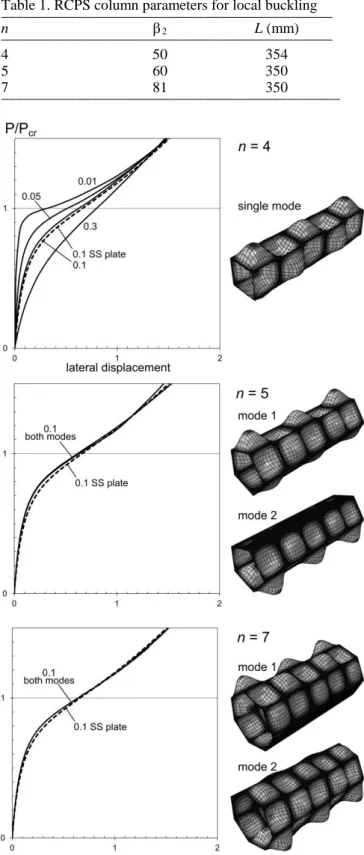
The equilibrium paths depicted in Figure 3 concern (i) RCPS columns with the geometries given in Table 1 and containing critical-mode initial geometrical imper-fections with various amplitudes and (ii) simply sup-ported plates with one imperfection. For the n=5,7 col-umns, the buckling modes are duplicate, as also shown in Figure 3. Using Figure 2, it is concluded that the
cross-section geometries defined by these parameters fall well inside the local buckling domain associated with class 4 cross-sections. The lengths L are equal to five times the buckling mode half-wave length. In each column, the bi-furcation loads obtained from the shell finite element and GBT analyses never differ by more than 1.3%.
The comparison between the two sets of equilibrium paths displayed in Figure 3, concerning (i) RCPS col-umns (critical-mode initial geometrical imperfections with various amplitudes the maximum total/in-plane Table 1. RCPS column parameters for local buckling
____________________________________________ n 2 L (mm) ____________________________________________ 4 50 354 5 60 350 7 81 350 _____________________________________________
Figure 3. Comparison between the local post-buckling equilibrium paths of RCPS columns with n=4,5,7 and simply supported plates with the same length (displacements in mm) (left); and correspond-ing RCPS column critical bucklcorrespond-ing mode shapes (right).
displacement) and (ii) simply supported plates (0.1mm initial imperfections confirms the expected similarity, which can be extended to any other column local post-buckling behaviour. It is also worth noting that the post-buckling behaviour of RCPS columns with odd
n values (n=5,7), which have duplicate local buck-ling modes, is not affected by this peculiar behavioural feature. Indeed, the equilibrium paths shown in the sec-ond and third plots of Figure 3 are virtually identical to that associated with a “single” buckling mode (n=4 in this case), irrespective of the imperfection shape adopted (corresponding to duplicate buckling modes).
Therefore, the above elastic local post-buckling equi-librium paths make it possible to conclude that, as ex-pected, RCPS columns are able to sustain applied loads much higher than the critical buckling value. Moreover, it is also logical to expect that the provisions for the de-sign against column local failures currently included in design specifications, namely the effective width and direct strength design approaches, should also provide safe, accurate and reliable local failure load estimates for RCPS columns.
3.2 Distortional
The RCPS column distortional post-buckling behav-iour is now addressed. Attention is focused on a col-umn geometry characterised by n=15, t=2mm, 2=25
and L=400mm, exhibiting a minimum critical distor-tionalbifurcationloadassociatedwithduplicatemodes (their shapes are displayed in Figure 4). As shown in Figure 2(c), this column geometry falls inside the dis-tortional bifurcation domain and has a class 4 cross-section according to the circular tube criterion. The dis-tortional bifurcation loads calculated by means of the shell finite element and GBT analyses are very close they differ by only 2.7%.
The equilibrium paths in Figure 4 concern columns containing initial geometrical imperfections with the shapes of each duplicate buckling mode and amplitudes (maximum total displacements, combining in-plane and out-of-plane components) equal to 0.01mm four col-umns are analysed. At this stage, note that the equilib-riumpathsmonitorapointcorrespondingapproximately to that exhibiting the maximum displacement at the col-lapse load. It is important to notice that the location of the maximum displacement may change with the applied load level, particularly at the advanced post-buckling stages. The observation of the post-buckling results presented in Figure 4 leads to the following remarks: (i) The equilibrium path pairs associated with
“posi-tive” and “nega“posi-tive” mode 1 and mode 2 initial im-perfections are practically coincident and symmetric up to lateral displacements close to 6mm Figure 4 showsdeformedconfigurationsofthecolumnwith “positive” mode 1 imperfections at the equilibrium states A and B (the former concerns the peak load). All equilibrium paths exhibit a slight negative con-cavity in the close vicinity of the bifurcation load
level, which is typically associated with symmetric unstable bifurcations therefore, it is just logical to expect a mild (critical-mode) imperfection sensitiv-ity of the column failure load.
(ii) Once the 6mm lateral displacement is reached, the picture changes drastically. Concerning the mode 2 equilibrium paths, the symmetry (with respect to the initial imperfection sign) is suddenly broken: while a very pronounced “snap-back” phenomenon occurs in the “positive” branch, only a moderate slope in-crease takes place in the “negative” one. The situa-tion is different for the mode 1 equilibrium paths: the symmetry is “more or less” kept, as similar well pronounced “snap-back” phenomena occur in both the “positive” and “negative” branches. However, it is not clear whether the above features are mechani-cally-based or not, as discussed in the next items. (iii) It is noted that, regardless of the initial imperfection,
the column deformed configuration pattern changes considerably at moderate-to-large displacements, namely once the lateral displacement threshold of approximately 6mm is reached. In the case of the columns having “positive” imperfections, it was observed that the equilibrium path splits into two branches at state B (see Figure 4) only the branch that is similar to its “negative” counterpart is shown in the plot. Each branch is associated with deformed configurations displaying two central local buckles
Figure 4. Distortional post-buckling equilibrium paths and critical buckling modes of RCPS columns with n=15, 2=25 and mode 1
and 2 imperfections (0.01mm amplitude); deformed configura-tions of the column with “positive” mode 1 imperfecconfigura-tions.
at one column side for the column with mode 1 imperfections, they are both depicted at the bottom of Figure 4. The above behavioural features “raise the suspicion” that a secondary bifurcation takes place at equilibrium state B (this should also apply tothe“negative” equilibrium paths) it may happen that the “snap-back” phenomena are just “switches” to (very close) bifurcated paths.
(iv) Another consequence of the column deformed con-figuration pattern change at moderate-to-large dis-placements is the fact the particular point monitored (where the displacement is measured) corresponds to various “deformed configuration locations” along the equilibrium paths. It is possible that this loca-tion change also causes the “unexpected” features exhibited by the equilibrium paths in Figure 4, namely the abrupt displacement increases/decreases. (v) To clarify the open questions identified/addressed in the previous items, and also to acquire depth in-sight on the distortional post-buckling mechanics, the authors have under way a GBT-based investiga-tion on this topic the GBT results modal nature should shed fresh light on this complex problem. (vi) At this stage, it is worth mentioning that the absence
of distortional post-critical strength observed in the RCPS columns contrasts significantly with the well-known moderate-to-high distortional post-buckling strength exhibited by the columns with lipped open cross-sections. Therefore, it may be argued that the post-buckling behaviours of the two column types merely share the designation “distortional”, as the underlying mechanics are rather different.
Figure 5 concerns columns with n=15 and 2=25
containing mode 1 and mode 2 initial imperfections with magnitudes 0.1, 0.2 and 0.5mm (since the above “unex-pected” asymmetries are not mechanically-based, it no longermakessense to distinguish between “positive” and “negative” initial imperfections) the purpose is to in-vestigate the influence of the imperfection magnitude. The observation of the results presented in this figure makes it possible to draw the following conclusions: (i) Despite the much higher imperfection magnitudes,
thevariousequilibriumpathsanddeformed configu-rations are qualitatively similar to those depicted in Figure 4 due to space limitations, no deformed configuration is shown. Moreover, the questions about the mechanics underlying the post-buckling behaviour at moderate-to-large displacements re-main open. However, note that the peak load occurs for small/moderate displacements.
(ii) Thepeak loads associated with the two imperfection shapes virtually coincide. In addition, as expected, the peak load decreases with the imperfection am-plitude(andoccursforlargerdisplacements). (iii) The equilibrium paths associated with mode 2
im-perfections exhibit the “unexpected features” men-tioned earlier prior to their mode 1 counterparts.
Figure 5. Distortional post-buckling equilibrium paths of RCPS columns with n=15, 2=25 and containing mode 1 and mode 2
imperfections with several magnitudes.
Consider now RCPS columns with n=11, t=2mm and 2=25 according to Figure 2(c), this column still
falls inside the distortional buckling region, although much closer to the local buckling one than the previous column. The duplicate critical buckling loads calculated with the shell model and GBT differ by only 2.2%. As in the previous column, the critical half-wave length is equal to 400mm (value obtained GBT).
Although this column is “located” fairly close to the local buckling region, note that the local buckling load, calculated by means of GBT, is still significantly higher than the distortional one (20.5%). Moreover, the cor-responding half-wave length equals30mm, which is not a divisor of 400mm. However, the local buckling mode of a 400mm long column exhibits multiple buckles and, thus, the bifurcation is virtually identical to that ob-tained with a multiple of 30mm.
The results presented in Figure 6 concern n=11 col-umns containing several initial imperfections (shapes and magnitudes) and correspond to those displayed earlier, in Figure 4. It is observed that the n=11 column results are very similar to their n=15 column counterparts, namely: (i) The 0.01mm equilibrium path exhibits the same
small negative curvature.
(ii) The same slight imperfection sensitivity of the col-umn peak load is evidenced.
(iii) At moderate-to-large displacements, the equilib-rium path descending branches change significantly and local buckles appear in the column deformed configurations.
It is still worth noting that, in the case of the equilib-rium path of the column containing a mode 1 0.01mm imperfection,theshellfiniteelementanalysisunveiled again, for a lateral displacement approximately equal to 6mm, asplit into two branches, each associated with the
Figure 6. Distortional post-buckling equilibrium paths of RCPS columns with n=11, 2=25 and containing mode 1 and mode 2
imperfections with several magnitudes.
appearance of a single local buckle at a mid-span cross-section, but with a different location – the corresponding column deformed configurations are depicted in the top right side of Figure 6. As for the column containing a mode 2 0.01mm imperfection, no branch split was de-tected and the most deformed configurations exhibit multiple local buckles at diametrically opposite walls see the third configuration on the right of Figure 6. The most deformed configuration of the column con-taining the mode 1 e=0.1mm imperfection also exhib-its local buckles at diametrically opposite walls, whereas itsmode2 counterpart has two closely spaced local buck-les appearing in a single wall. The latter deformed con-figuration is also observed for the two columns contain-ing a 0.2 mm imperfection (mode 1 and mode 2) they are not shown in Figure 6. Finally, the columns contain-ing 0.5mm exhibit either one (mode 1) or two (mode 2) local buckles, in both cases appearing in either a single ordiametricallyoppositewallsthesedeformed configu-rations are also not shown in Figure 6. It should be noted that these column deformed configurations resemble that caused by the so-called Brazier effect in circular tubes subjected to bending of course, in this case the RCPS flattening is due to compression and, thus, local buckles may appear in both sides of the flattened cross-section.
Table 2 shows the normalized peak loads obtained for
n=11 and n=15 columns with initial imperfections becausethepeakloadsareidentical for mode 1 andmode 2 imperfections with the same magnitude, only one value is given for each case. The similarity between the P/Pcr
values of the columns pairs with 0.01, 0.1 and 0.2mm imperfections is striking. Only the peak loads of the columnswith0.5mmimperfectionsdiffersignificantly the n=15 column P/Pcr value is much smaller thanits n=
11 counterpart (note that the latter column distortional andlocalcriticalbucklingloads are much closer). Table 2. Normalised distortional peak loads (P/Pcr). ____________________________________________ e (mm) n=11 n=15 ____________________________________________ 0.01 1.010 1.010 0.1 0.965 0.966 0.2 0.935 0.936 0.5 0.867 0.784 ____________________________________________ 3.3 Local-distortional boundary
The columns analysed previously exhibit critical (distor-tional) and second (local)bifurcationloads with differ-ences ranging from 20.5% and 38.1%. This section fo-cuses on columns with much closer distortional and local bifurcation loads, located in the vicinity of the boundary between local and distortional buckling in Figure 2(c). First, n=10columns are analysed in detail. For 2=24
and L=350mm, the column critical bifurcation load is distortional (duplicate mode) followed by a local one (single mode), which is only 8.7% apart. Thus, it is logi-cal to expect lologi-cal-distortional interaction effects stronger than before.TheresultsinFigure7 concern the post-buckling behaviour of columns with the above geome-try and containing the same type of initial imperfections considered for the columns analysed earlier. The obser-vation of these results prompts the following comments: (i) Firstly, the equilibrium paths are much “smoother”
than those obtained for the columns analysed previously, in the sense that that the equilibrium path descending branches exhibit no abrupt changes along the whole displacement range. (ii) For most initial imperfections, the column failure
mode (deformed configuration along the descend-ing branch followdescend-ing the peak load) combines a minute cross-section distortion with two local buck-les located in diametrically opposite walls see the first two deformed configurations in Figure 7. However, there are two exceptions, which concern the columns containing 0.5mm mode 1 or 0.2mm mode 2 imperfections their deformed configu-rations exhibit a single buckle in diametrically op-posite walls (see the bottom of Figure 7).
(iii) A slight imperfection sensitivity of the peak load is observed also for this column geometry. The normalised peak loads obtained for the various in-itial imperfections are given in Table 3. Since the peak loads associated with the two imperfection shapes are again virtually identical, only one value is given for each amplitude.
(iv) The comparison between the normalised peak loads given in Tables 2 and 3 shows that the imperfection sensitivity is marginally higher for the n=10 column
Figure 7. Post-buckling equilibrium paths of RCPS columns with n=10, 2=24 and containing mode 1 or mode 2 imperfections with
several magnitudes.
(slightly lower P/Pcr values). However, this does
not remain true for the largest imperfection ampli-tude (0.5mm): the n=10 column P/Pcr value falls
(in-between its n=11 and n=15 column counter-parts recall that the latter was unexpectedly low. (v) After comparing the post-buckling behaviours of
the n=10, n=11 and n=15 columns, it is concluded that they are qualitatively and quantitatively quite similar.Indeed,themostnoticeabledifference lies in Table 3. Normalized peak loads P/Pcr (2=24 and L=350mm).
_____________________________________________ e (mm) n=10 _____________________________________________ 0.01 1.010 0.1 0.964 0.2 0.931 0.5 0.858 _____________________________________________
the “smoothness” of the n=10 column equilibrium paths (no significant descending branch changes at moderate-to-large displacements). Thus, it seems fair to argue that the post-buckling behaviour of the
n=10 column is not meaningfully affected by local-distortional interaction effects it retains all the distinctive distortional features.
Finally, a column located “on the local side” of the local-distortional boundary (critical local bifurcation load) is analysed. The particular geometry considered corresponds to n=10, 2=27 and L=400mm, and is
associated with a critical local bifurcation load (single mode) that is 3.4% above its distortional (duplicate mode) counterpart. In spite of this small bifurcation load difference, note that the first 8 bifurcation loads are local, which means that the duplicate distortional modes corre-spond to the 9th and 10th bifurcation loads the shapes of
these 10 buckling modes are in the top of Figure 8. The equilibrium paths shown in the bottom of Figure 8 concern columns having (critical-mode) local initial
Figure 8. RCPS columns with n=10 and 2=27: first 10 buckling
modes, equilibrium paths of columns with several critical-mode imperfection magnitudes and deformed configuration at P/Pcr=1.5.
imperfections with the same amplitudes considered pre-viously: 0.01,0.1,0.2 and 0.5mm. For comparison pur-poses, the equilibrium path of a simply supported plate with a 0.1mm initial imperfection is also shown (dashed curve) note that this equilibrium path had already been shown in Figure 3. Figure 8 also includes a column deformed configuration corresponding to the highest ap-plied load level (P/Pcr=1.5) and is shared by the
col-umns with all the imperfection magnitudes note that all equilibrium paths have merged together at P/Pcr=1.5.
It can be readily observed that:
(i) Stable equilibrium paths are now obtained, which means that this column is not imperfection sensi-tive. Nevertheless, it should be noticed that these equilibrium paths are clearly “less stable” than their simply supported plate counterpart, which seems to indicate the presence of strength erosion stemming from local-distortional interaction effects.
(ii) Although no distortional deformations are can be readily detected (even if the applied load level ex-ceeds by far the distortional bifurcation load), their presence is felt through the reduced strength exhib-ited by the column (with respect to columns with a “pure” local post-buckling behaviour). The authors believe that a GBT-based analysis will unveil the presence of minute distortional deformations in the columndeformedconfiguration.Moreover,itwill bealsoworthobtainingpost-bucklingresultsof col-umns containing distortional initial imperfections. 4 CONCLUSION
This paper presented and discussed the available (pre-liminary) shell finite element results concerning an on-going numerical investigation on the elastic local, distor-tional and interactive (local-distordistor-tional) post-buckling behaviour of thin-walled columns with regular convex polygonal cross-sections (RCPS) the imperfection sen-sitivity of the column peak load was also addressed. Out of the various findings reported in this work, the fol-lowing ones deserve to be highlighted:
(i) Depending on the 2 and n values, either local or
distortional buckling may be critical see Figure 2(c). Columns with low 2 and high n buckle in
dis-tortional modes the 2 value associated with mode
nature transition increases exponentially with n. (ii) The column pure local post-buckling behaviour is
highly stable and virtually identical to that exhibited by simply supported plates.
(iii) The column pure distortional post-buckling behav-iour is slightly unstable and, thus, a small imperfec-tion sensitivity is exhibited by the peak load this distortional is very different from that of lipped open-section columns. Local deformations are visi-ble after the peak load is reached.
(iv) The post-buckling behaviour of columns with close local and distortional bifurcation loads is either
(iv1) quite similar to the pure distortional one (i.e.,
minute local-distortional interaction occurs how-ever, the post peak paths are smoother), for distor-tional critical buckling, or (iv2) visiblyaffected by
local-distortional interaction (sizeable post-critical strength/stiffness erosion), for local critical buckling even if no distortional deformations were spotted. Further work is currently under way to assess the various RCPS column post-buckling behaviours by means of geometrically non-linear GBT-based post-buckling analyses, which will enable acquiring much more in-depth knowledge about the underlying me-chanics, namely those associated with secondary bi-furcations and local-distortional interaction.
ACKNOWLEDGMENTS
The financial support of the European Commission, through the Research Fund for Coal and Steel project RFCS-2015-709892, “Overall-Slenderness Based Direct Design for Strength and Stability of Innovative Hollow Sections – HOLLOSSTAB”, is gratefully acknowledged. REFERENCES
Camotim D., Basaglia C., Bebiano R., Gonçalves R. & Silvestre N. 2010a. Latest developments in the GBT analysis of thin-walled steel structures. In E. Batista, P. Vellasco, L. Lima (eds.), Pro-ceedings of International Colloquium on Stability and Ductility of Steel Structures (SDSS’Rio 2010 – Rio de Janeiro, 8-10/9): 33-58 (Vol. 1).
Camotim D., Basaglia C., Silva N. & Silvestre N. 2010b. Numeri-cal analysis of thin-walled structures using Generalised Beam Theory (GBT): recent and future developments. In B. Topping et al. (eds.), Computational Technology Reviews: 315-354 (Vol. 1), Stirlingshire: Saxe-Coburg.
Gonçalves R., Ritto-Corrêa M. & Camotim D. 2010. A new ap-proach to the calculation of cross-section deformation modes in the framework of Generalized Beam Theory, Computational Mechanics 46(5): 759-781.
Gonçalves R. & Camotim D. 2012. Geometrically non-linear Generalised Beam Theory for elastoplastic thin-walled metal members, Thin-Walled Structures 51: 121-129.
Gonçalves R. & Camotim D. 2013a. On the behaviour of thin-walled steel regular polygonal tubular members, Thin-Walled Struc-tures 62: 191-205.
Gonçalves R. & Camotim D. 2013b. Elastic buckling of uniformly compressed thin-walled regular polygonal tubes, Thin-Walled Structures 71: 35-45.
Gonçalves R. & Camotim D. 2013c. Buckling behaviour of thin-walled regular polygonal tubes subjected to bending or torsion, Thin-Walled Structures 73: 185-197.
Gonçalves R. & Camotim D. 2014. The vibration behaviour of thin-walled regular polygonal tubes. Thin-Walled Structures 84: 177-188.
Schardt R. 1989. Verallgemeinerte Technische Biegetheorie. Berlin: Springer-Verlag.
SchardtR.1994.GeneralizedBeam Theory an adequate method for coupled stability problems. Thin-Walled Structures 19: 161-180. Simulia Inc. 2008. ABAQUS Standard (version 6.7-5).
Timoshenko S. & Gere J. 1961. Theory of Elastic Stability. New York: McGraw-Hill.
Wittrick W. & Curzon P. 1968. Local buckling of long polygonal tubes in combined compression and torsion. International Journal of Mechanical Sciences 10: 849-857.