Multidisciplinary approach to evaluate adequacy of protected areas in the Azores for the preservation of current levels of Biodiversity.
Isabel R. Amorim1,2 *, Paulo A.V. Borges2,3, Fernando Pereira2,3 & Robert K. Wayne1
1Department of Ecology and Evolutionary Biology, University of California, Los
Angeles, USA.
2Departmento de Ciências Agrárias, CITA-A, Terra Chã, Universidade dos Açores,
Portugal
3Grupo de Estudo do Património Espeleológico dos Açores (GESPEA). Açores,
Portugal.
* Correspondence: Isabel R. Amorim
Universidade dos Açores, Dep. de Ciências Agrárias, CITA-A 9701-851 Terra Chã , Angra do Heroísmo
Terceira-Açores-Portugal e-mail: [email protected]
Abstract:
Many of the endemic species that are found on islands have very restricted distributions and naturally small population sizes, being therefore highly susceptible to extinction. Arthropods are among the animal groups most severely affected by extinction on islands, and although they represent more than half of the Azorean terrestrial endemic species, they were not used to assess conservation priorities in the Azores. In this study we used a multidisciplinary approach, including field surveys, traditional taxonomy, molecular assays, and the speciose beetle genera Tarphius and
Trechus, to evaluate the adequacy of protected areas in the Azores in biodiversity
preservation. The data indicate that the area protected in the Azores is insufficient to guarantee the maintenance of species richness and genetic diversity of endemic
Tarphius and Trechus beetles. Because all Tarphius and Trechus populations had
exclusive haplotypes, and genetic variability within species is geographically structure, we argue that they should be treated as distinct conservation units and that the maximum number of populations should be protected in order to preserve current levels of biodiversity, and thus arrest the generalized trend of insular biodiversity decline.
1. Introduction
The volcanic archipelago of the Azores in the North Atlantic is the most remote of the Macaronesian Islands and a long period of evolution in isolation has led to the origin of many endemic species. However, the arrival of humans to the archipelago, more than 500 years ago, has shaped the original faunal and floral composition of these islands. The current biota composition is therefore the result of in loco evolution and anthropogenic activities, including the introduction of exotic species and the extinction of native species (Martins 1993, Silva & Smith 2004, Amorim 2005, Borges et al. 2006, Silva & Smith 2006, Borges et al. in press).
Many of the endemic species that are found on islands have very restricted distributions and naturally small population sizes, which make insular endemic species highly susceptible to extinction (Frankham et al. 2002, Gillespie & Roderick 2002, Whittaker & Fernández-Palacios 2007). Arthropods, particularly insects, are among the animal groups most severely affected by extinction on islands, and more than 3/4 of the insect species known to gone extinct in the last 300 years vanished from islands (Gillespie & Roderick 2002).
Arthropods have been the focus of much of the biological research undertaken in the Azores and, in fact, represent more than half of the terrestrial endemic species found in the archipelago (Borges et al. 2005a). Nevertheless, species of endemic arthropods were not used to assess conservation priorities in the Azores, and therefore were not taken into consideration when deciding the areas that should be granted protection (e.g., Nature Reserves, Natural Forest Reserves and NATURA 2000 sites).
In this study we used a multidisciplinary approach, including field surveys, traditional taxonomy and molecular assays, to evaluate how appropriate is the protected area in the Azores for the preservation of current levels of biodiversity. Beetles of the genera Tarphius (Coleoptera, Zopheridae) and Trechus (Coleoptera, Carabidae) which are among the most diverse insect genera found in the Azores (Borges et al. 2005a), and are therefore an important contribution to the total biodiversity of the archipelago, were chosen as the study organisms.
2. Methods
Field surveys
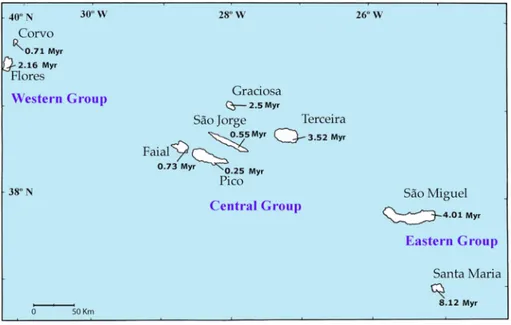
All islands Azorean islands (Fig.1), with the exception of Corvo, where no suitable habitat for the study beetle genera can be found, were sampled from 1999 to 2004.
Tarphius beetles were collected using three different methods: i) pitfall trapping,
ii) visual search in specific habitats, and iii) leaf litter collection. Pitfall traps were set up along a 150 m long and 5 m wide transect, and a total of 30 small plastic pitfalls were used per transect. Transects were run in three main habitat types found in the Azores: i) native Laurisilva forest (dominated by Juniperus brevifolia, Erica azorica,
Ilex perado ssp. azorica and/or Laurus azorica); ii) planted forests of Cryptomeria japonica (exotic), and iii) semi-natural grassland. Pitfall sampling took place over at
least 14 consecutive days and a total of 90 transects were set up in 16 Natural Forest Reserves on Flores, Faial, Pico, São Jorge, Terceira, São Miguel and Santa Maria islands in the scope of project BALA - Biodiversity of the Arthropods from the Laurisilva forest of the Azores (see Borges et al. 2005b, 2006). Visual searches were conducted both during the day and at night. Loose bark, decaying wood and dead arborescents of the endemic plant Euphorbia stygiana (which are known to harbor
Tarphius) were the main targets of the searching efforts. Leaf litter collection took place
in different habitats and Berlese funnels (Berlese 1904) were used to extract small invertebrates from the plant and soil material collected.
Collection of epigean forms of Trechus beetles was performed following the pitfall-transect methodology described above for Tarphius. Additionally, soil-dwelling arthropods were sampled by sifting soil and leaf litter (Gillerfors 1986), and by intensive visual searches in dark humid habitats. Pitfall traps and visual searches were used to sample cave populations of Trechus. Traps were set up along a 500 m transect extending from the cave entrance inwards. The sampling strategy included visiting a total of 49 lava tubes and volcanic pits, including all caves where Trechus have been recorded in the past. Traps were left in place for a minimum of seven days and up to a month. Intensive visual searches were also performed during pitfall traps set up and removal.
Pitfall traps were also set up in the Mesocavernous Shallow Stratum -MSS- (Borges 1993) on Terceira, Flores and São Jorge islands to investigate the presence of Trechus beetles.
Species affiliation was determined based on morphological characters and the number of individuals per species was recorded for all sampling localities. This
information was uploaded into the ATLANTIS data base for the Azores (Borges 2005)
and used to produce updated distribution maps of Tarphius and Trechus species in the Azores. The updated distributions per species per island were superimposed onto maps of protected areas in the Azores for each island where the species occurs to determine whether the distribution of the Azorean endemic species of Tarphius and Trechus is included in the archipelago’s protected areas.
Molecular assays
One to eight individuals per species and per location were used for DNA extraction. Total genomic DNA was extracted from each individual beetle using the DNeasy™ Tissue Kit (Qiagen).
Mitochondrial DNA (mtDNA) has been shown to be a useful marker to reconstruct phylogenetic relationships at a variety of taxonomic levels in insects and other taxa (Crozier et al. 1989, Simon et al. 1994, Avise 1994, Juan et al. 1995, Lunt et
al. 1996, Avise 2000). Namely, the mtDNA genes cytochrome oxidase I (COI) and
cytochrome oxidase II (COII) are particularly valuable to infer phylogeographic patterns within beetle species (Emerson et al. 1999, Stauffer et al. 1999, Emerson et al. 2000, Moya et al. 2004) and were used in this study to characterize populations of Azorean endemic Trechus and Tarphius beetle populations. DNA amplification of the target genes (a fragment of about 1,500 bp, comprising part of the COI gene, the leucine tRNA gene and the complete COII gene) was performed by PCR and the purified PCR products were cycle-sequenced in both directions with the PCR amplification primers and internal primers.
Sequences were collapsed to haplotypes with the program COLLAPSE 1.2 (Posada
1999) and analyzed using Maximum Parsimony (MP) and Bayesian Inference (BI)
methods. The program MODELTEST v. 3.07 (Posada & Crandall 1998) was used to
select the model of evolution that best explains the nucleotide variation in the sequence
data set, and the software PAUP* v. 4.0b10 (Swofford 2002) was used to generate MP
trees, while the Bayesian analyses were performed using MRBAYES v 3.1 (Huelsenbeck
& Ronquist 2001).
Analysis of molecular variance, AMOVA (Excoffier et al. 1992), was used to investigate genetic structure and the analyses were performed with the software
ARLEQUIN 2.000 (Schneider et al. 2000) assuming the model of sequence evolution
selected by MODELTEST.The basic grouping unit in all AMOVA designs was defined as
conspecific sequences that occur on a particular island. To investigate within island population structure of cave populations, i.e., if there is population structure associated with cave of origin, we used the two most wide spread cave Trechus species in the Azores, Trechus terceiranus from Terceira island and T. picoensis from Pico island. Due to the small number of mtDNA sequences generated per species per cave, AMOVA was not appropriate to test population structure. Instead, we calculated pairwise genetic distances between haplotypes, assuming the model of molecular
evolution (TrN+I+G) suggested by MODELTEST, and compare it to geographic
distances. To test if genetic distance between haplotypes is correlated to geographic distance between the caves where they are found, i.e., isolation by distance (Wright 1943), we compared genetic and geographic distances for individual haplotypes and mean pairwise genetic distances between groups of haplotypes from caves at different geographic distances. Pairwise genetic distance matrixes and pairwise geographic distance matrixes were compared using Mantel tests (Mantel 1967) in the program GENETIX v4.05 (Belkhir et al. 2004). The nonparametric statistical tests Kruskal-Wallis
and Mann-Whitney implemented in the statistical package SYSTAT 9® (SPSS Inc.,
Evanstan, IL, USA) were used to test the null hypothesis that the groups of haplotypes from caves at different geographic distances being compared had identical mean genetic distances.
3. Results
Field surveys
As part of project “BALA”, a total of 2,700 pitfall traps were set up in Natural Forest Reserves on Flores, Faial, Pico, São Jorge, Terceira, São Miguel and Santa Maria islands (see Borges et al. 2005b). Additionally, 1,660 pitfall traps were set up to collect live specimens: 240 pitfall traps set up on the surface (Flores, Terceira, Faial, Pico, Santa Maria and São Miguel islands), 40 in the MSS (Flores, Terceira and São Jorge), and 1,380 in the 49 lava tubes and volcanic pits visited (Faial, Pico, São Jorge, Terceira, Graciosa, São Miguel and Santa Maria islands).
With the exception of Graciosa and Faial islands, Tarphius specimens, assigned to eight species, were collected on all other surveyed islands. Tarphius were for the first time collected on São Jorge island (T. azoricus), the species T. acuminatus was for the first time collected on São Miguel island and the species T. depressus was for the first time collected on Pico and São Miguel islands. An updated map of Tarphius species distribution in the Azores is present in Figure 2.
No beetles of the genus Trechus were collected in the pitfall traps set up in the MSS, and the pitfalls set up on the surface were only successful in capturing Trechus on Terceira island (T. terrabravensis Borges, Serrano & Amorim; see Borges et al. 2004). In contrast, pitfall traps were very effective sampling cave fauna and Trechus were collected in 21 of the 49 lava tubes and volcanic pits surveyed. Specimens of Trechus beetles, representing eight species, were found on four of the eight islands surveyed, namely on Faial, Pico, Terceira and São Jorge islands. Several of the Trechus specimens collected belong to four species yet unknown to science: the surface-dwelling T.
terrabravensis, and the cave-dwelling species T. pereirai, T. oromii (Borges et al. 2004)
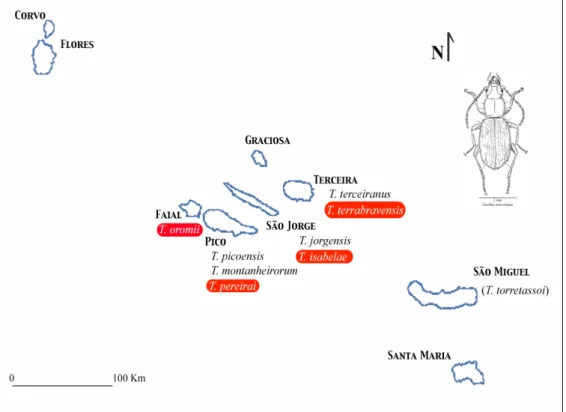
and T. isabelae (Borges et al. 2007). Moreover, several of the specimens collected represent first records, for example, Trechus were for the first time collected on Faial island (T. oromii Borges, Serrano & Amorim) and surface-dwelling Trechus were for the first time collected on Terceira island (T. terrabravensis Borges, Serrano & Amorim). An updated map of Trechus species distribution in the Azores is present in Figure 3.
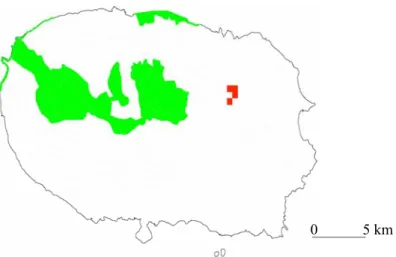
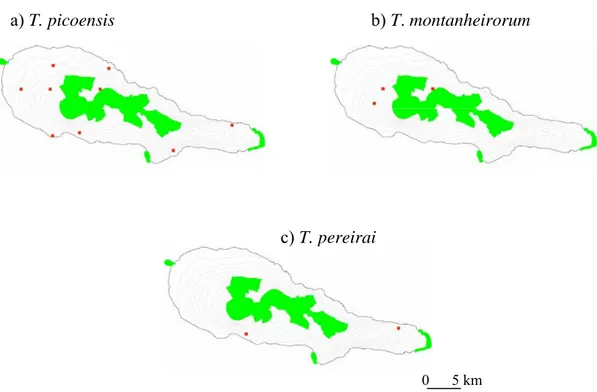
When the updated distributions of Tarphius and Trechus beetle species endemic to the Azores were mapped onto a map of the archipelago with all the terrestrial protected areas marked, species distributions in many instances fall outside the protected areas. The lack of overlap between populations/species distribution ranges and protected areas is in some cases complete. For example, the only area on Terceira island where Tarphius azoricus are known to occur is not protected (Fig. 4), neither are the sites on Santa Maria islands where Tarphius depressus have been collected (Fig. 5). However, the more striking cases involve single island endemics, i.e., species that are only known to exist on a particular island. All Trechus species found on Pico island, T.
jorgensis from São Jorge island, T. oromii from Faial island and three of the Tarphius
species found on Santa Maria island (T. rufonodulosus, T. serranoi and T. pomboi) are single island endemic species whose distribution range does not overlap with any protected areas (Fig.6, 7, 8 and 9, respectively).
Molecular assays
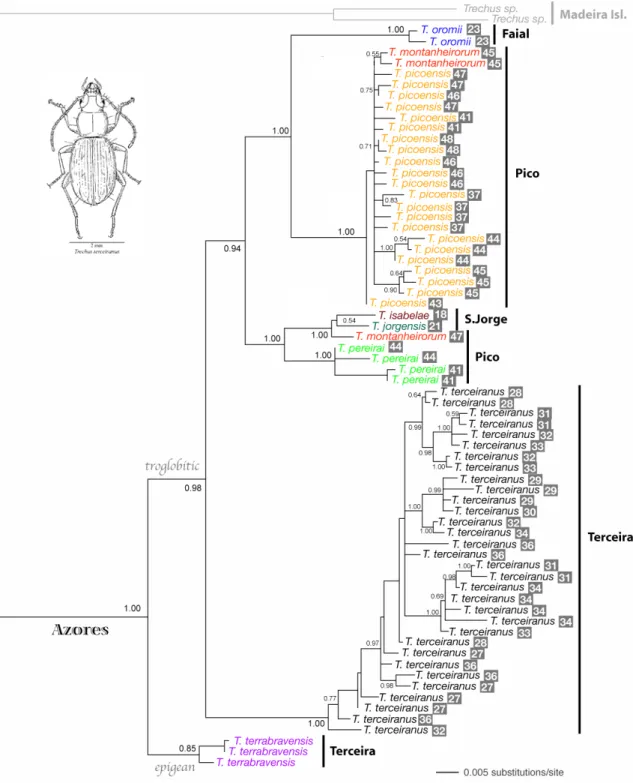
Sixty eight sequences were generated for seven species of Tarphius beetles collected in the Azores, corresponding to 56 haplotypes, and 76 sequences were generated for eight Azorean endemic species of Trechus beetles, corresponding to 68 haplotype (Fig. 10 and 11). With the exception of two Tarphius individuals from different species collected on the same collecting site in São Miguel island that had the same sequence, haplotypes were only shared by conspecific individuals collected in the same location. The phylogenetic reconstructions show that for the species of Tarphius that occur on multiple islands (T. tornvalli + T. azoricus, and T. depressus), populations of the same species found on different islands are genetically divergent (Fig. 10). For the cave Trechus haplotypes in particular, although the lack of a clear geographic structure of haplotypes according to cave of origin, the phylogenetic tree shows that distribution of haplotypes is not completely random with regard to cave affiliation (Fig. 11), as some haplotypes from the same lava tubes group together.
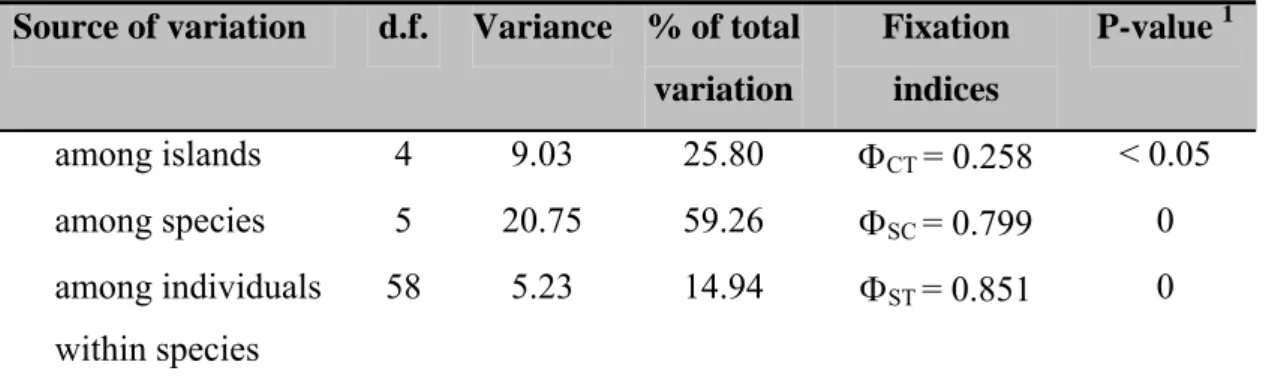
The analyses of molecular variance (AMOVA) for both genera suggested that most of the mtDNA variation found can be attributed to variability among species, (Table I and II). For the genus Tarphius, an appreciable proportion of the total variation (40.62%, Table I) separates populations of the same species found on different islands, and for the genus Trechus, 25.80% of the total variation (Table II) is due to haplotypic differences among islands.
For the cave species T. terceiranus and T. picoensis the Mantel tests performed for matrices of pairwise genetic and geographic distances between conspecific individual haplotypes showed in both cases a significant correlation between genetic distances and the distances between the caves where the haplotypes were found (Z= 90,514.34 and 43,311.03 respectively, P<0.05). The nonparametric statistical tests Kruskal-Wallis and Mann-Whitney tests revealed for both species that the average genetic distances between individuals from the same cave and individuals from different caves, and between individuals from caves at different distances are not the same (P<0.05). The statistical tests indicate that there is an association between genetic and geographic distance i.e., haplotypes from the same cave tend to be more closely related than haplotypes from different caves, which suggests a pattern of isolation by distance (Wright 1943, Slatkin 1993).
4. Discussion and Conclusions
It is now widely recognized that conservation of biodiversity requires urgent and effective measures (Frazee et al. 2003, Strange et al. 2006). The field surveys performed revealed that the range of many of the Tarphius and Trechus species endemic to the Azores is not encompassed by the current network of protected areas in the archipelago, which therefore raises conservation concerns.
The loss of genetic variability is one of the major concerns of any conservation/management program as it may jeopardize the ability of a population to adapt to a changing environment, and thus compromise its long-term evolutionary potential (Meffe & Carroll 1994, Reed & Frankham 2003). The molecular data revealed that all Tarphius and Trechus populations sampled in the Azores had exclusive haplotypes, and that genetic variability within species is geographically structure. Therefore, we suggest that those populations should be treated as distinct conservation units in order to avoid erosion of genetic diversity and to protect the processes that sustain it (Moritz 1994, Witting et al., 1994, Moritz 1995, Vane-Wright 1996, Fraser & Bernatchez 2001).
Habitat destruction caused by clearing of native vegetation, which has occurred at a particularly fast pace in the last century (Martins 1993, Borges et al. 2006, Borges
et al. in press), constitutes the most serious threat to Tarphius and Trechus beetles in the
Azores. Fragmentation of the natural forest, Laurisilva, to which both genera are intimately associated, may have a severe and irreversible effect on the genetic diversity of those beetle species, particularly for the low vagile Tarphius beetles. Trechus beetles in the Azores are mainly found in lava tubes and therefore this type of habitat deserves special attention. Because subterranean ecosystems are directly dependent on processes occurring above ground (Wilkens et al. 2000, Culver 2001), and the capacity of lava tubes to support life is related to the quality of the habitat found directly above them (Howarth 1983), the replacement of native and semi-native forest by pastures throughout the Azores (Martins 1993, Borges 1996, Borges et al. 2006, Borges et al. in press) is of concern for the sustainability of the subterranean ecosystems. Some of the caves in the Azores where Trechus are found are in protected areas (e.g., Montoso on São Jorge isl., Malha and Coelho on Terceira isl.) and a few have special protection status (Carvão and Natal on Terceira isl., and Torres on Pico isl.), but the majority of them are not under any kind of protection. This issue is of particular relevance because
five of the seven troglobitic species of Trechus endemic to the Azores are only found in non-protected caves. The most pressing examples include T. jorgensis and T. oromii, whose distribution is restricted to a single cave on São Jorge and Faial islands, respectively. Given the vulnerability of their habitat, most cave Trechus species that occur in the Azores are potentially endangered, and special conservation efforts should be allocated to preserve the integrity of lava tubes and volcanic pits in the archipelago. The presence of unique Trechus haplotypes in all caves sampled suggests that a conservation plan aimed at protecting the current levels of genetic diversity should include as many caves as possible on all of the islands where the beetles are found to prevent the loss of unique lineages.
Based on these results, a report was made to the Azorean Government suggesting the creation of new protected areas for Tarphius species, one in Fontinhas (Terceira island) to protect one population of Tarphius azoricus (see Fig. 4) and another one in Pico Alto (Santa Maria) to protect the unique known location for the species
Tarphius rufonodulosus, T. serranoi and T. pomboi and also a population of T. depressus. This site on Santa Maria island is also a hotspot of diversity in the Azores
(see Borges et al. 2005b). An official proposal to integrate those areas into IUCN categories has been produced, but unfortunately it may take a considerable amount of time before it is approved. Special management measures are therefore in need to be implemented as soon as possible. Concerning the cave habitats, the GESPEA group is currently working with the Azorean Government to create special conservation management measures for the most important Azorean caves.
In conclusion, field surveys and molecular data clearly indicate that the area protected in the Azores is insufficient to guarantee the maintenance of species richness and genetic diversity of Tarphius and Trechus beetles found in the archipelago. However, new opportunities are being created for the for the selection of new areas and implementation of management plans in this Atlantic archipelago.
Acknowledgments
This research has been funded by: FCT (BD 5016/95); project BALA, University of the Azores; Dep. of EEB, UCLA; Speleologic Society “Os
Figure 1. The archipelago of the Azores. Maximum geological age of each island in million year (Myr) as in França et al. 2003.
Figure 2. Updated distribution of the genus Tarphius in the Azores. Species that occur on multiple islands are color coded, yellow boxes indicate species that were collected for the first time on a particular island, and parentheses indicate unconfirmed occurrences. Typical morphology of the genus Tarphius is illustrated by a drawing of T. tornvalli (from Gillerfors, 1986).
Figure 3. Updated distribution of the genus Trechus in the Azores. Red labels indicate species new to science, and parentheses indicate unconfirmed occurrences. Typical morphology of the genus Trechus is illustrated by a drawing of T.
0 5 km
Figure 4. Distribution of Tarphius azoricus on Terceira island (red squares). Protected areas, including Nature Reserves, Natural Forest Reserves and NATURA 2000 sites (European Union network of nature conservation sites) are shaded green. ATLANTIS 2005.
0 5 km
Figure 5. Distribution of Tarphius depressus on Santa Maria island (red squares). Protected areas, including Nature Reserves, Natural Forest Reserves and NATURA 2000 sites (European Union network of nature conservation sites) are shaded green. ATLANTIS 2005.
a) T. picoensis b) T. montanheirorum
c) T. pereirai
0 5 km
Figure 6. Distribution of Trechus species endemic to Pico island (red squares): a) T.
picoensis, b) T. montanheirorum, and c) T. pereirai. Protected areas,
including Nature Reserves, Natural Forest Reserves and NATURA 2000 sites (European Union network of nature conservation sites) are shaded green. ATLANTIS 2005.
0 5 km
Figure 7. Distribution of Trechus jorgensis endemic to São Jorge island (red squares). Protected areas, including Nature Reserves, Natural Forest Reserves and NATURA 2000 sites (European Union network of nature conservation sites) are shaded green. ATLANTIS 2005.
0 2.5 km
Figure 8. Distribution of Trechus oromii endemic to Faial island (red squares). Protected areas, including Nature Reserves, Natural Forest Reserves and NATURA 2000 sites (European Union network of nature conservation sites) are shaded green. ATLANTIS 2005.
a) T. rufonodulosus
b) T. serranoi c) T. pomboi
0 5 km
Figure 9. Distribution of a) Tarphius rufonodulosus, b) T. serranoi and c) T. pomboi on Santa Maria island (red squares). Protected areas, including Nature Reserves, Natural Forest Reserves and NATURA 2000 sites (European Union network of nature conservation sites) are shaded green. ATLANTIS 2005.
BI tree
Nruns=2, 106 generations,
sample freq.= 50, burn-in=2.5x10⁵
Figure 10. Mitochondrial DNA phylogenetic reconstructions of Tarphius species endemic to the Azores: Bayesian Inference tree. Numbers on nodes represent clade credibility for nodes with a posterior probability value ≥ 0.70. Species are color coded.
BI tree
Nruns=2, 106 generations, sample freq.= 50, burn-in=2.5x10⁵
Figure 11. Mitochondrial DNA phylogenetic reconstructions of Trechus species endemic to the Azores: Bayesian Inference tree. Numbers on nodes represent clade credibility for nodes with a posterior probability value ≥ 0.70. Species are color coded. Numbers to the right of species name refer to the caves where beetles were collected.
Table I. Hierarchical analysis of molecular variance (AMOVA, Excoffier et al. 1992) among Tarphius haplotypes.
Source of variation d.f. Variance % of total variation
Fixation indices
P-value 1
With regional structure (grouping by island) among islands 5 0* 0*(-24.53) ΦCT = 0* 0.99 among species within islands 5 63.93 118.64 ΦSC = 0.953 0 among individuals within species 57 3.18 5.89 ΦST = 0.941 0 No regional structure (grouping by species) among species 5 34.72 54.39 ΦCT = 0.544 < 0.001 among populations within species 5 25.93 40.62 ΦSC = 0.891 0 among individuals within populations 57 3.18 4.99 ΦST = 0.950 0
1 – proportion of 106 permutations that show fixation index values ≥ than the observed value
* - negative values are presented as 0 d.f. – degrees of freedom
Table II. Hierarchical analysis of molecular variance (AMOVA, Excoffier et al. 1992) among Trechus haplotypes.
Source of variation d.f. Variance % of total variation Fixation indices P-value 1 among islands 4 9.03 25.80 ΦCT = 0.258 < 0.05 among species 5 20.75 59.26 ΦSC = 0.799 0 among individuals within species 58 5.23 14.94 ΦST = 0.851 0
1 – proportion of 106 permutations that show fixation index values ≥ than the observed value
* - negative values are presented as 0 d.f. – degrees of freedom
References
Amorim, IR (2005) Colonization and diversification on oceanic islands: forest Tarphius and cave dwelling Trechus beetles of the Azores. Ph.D. Dissertation, Dep. of Ecology and Evolutionary Biology, UCLA, USA.
Avise JC (1994) Molecular Markers, Natural History and Evolution. Chapman & Hall, New York.
Avise JC (2000) Phylogeography: the history of formation of species. Harvard University Press, London.
Belkhir K, Borsa P, Chikhi L, et al. (2004) GENETIX 4.05, logiciel sous Windows TM
pour la génétique des populations. Laboratoire Génome, Populations,
Interactions, CNRS UMR 5000, Université de Montpellier II, Montpellier (France).
Berlese A (1904) Apparecchio per raccogliere presto ed in gran numero piccoli artropodi. Redia 2, 85-89.
Borges PAV (1993) First records for the mesocavernous shallow stratum (M.S.S.) from the Azores. Mémoires de Biospéologie Tome XX, 49-53.
Borges PAV (1996) Conservation status of the Azorean lava tubes and pits.
Proceedings of the 7th International Symposium on Volcanospeleology, 15-23.
Borges PAV (2005) Introduction. In A list of the terrestrial fauna (Mollusca and
Arthropoda) and flora (Bryophyta, Pteridophyta and Spermatophyta) from the Azores (eds P.A.V. Borges, R. Cunha, R. Gabriel, A.M.F. Martins, L. Silva, &
V. Vieira). pp. 11-20, Direcção Regional de Ambiente and Universidade dos Açores, Horta, Angra do Heroísmo and Ponta Delgada.
Borges PAV, Serrano ARM, Amorim IR (2004) New species of cave-dwelling beetles (Coleoptera: Carabidae: Trechinae) from the Azores. Journal of Natural History
38, 1303-1313.
Borges PAV, Cunha R, Gabriel R, et al. (eds) (2005a) A list of the terrestrial fauna
(Mollusca and Arthropoda) and flora (Bryophyta, Pteridophyta and Spermatophyta) from the Azores. Direcção Regional de Ambiente and
Universidade dos Açores, Horta, Angra do Heroísmo and Ponta Delgada.
Borges PAV, Aguiar C, Amaral J, et al. (2005b) Ranking protected areas in the Azores using standardized sampling of soil epigean arthropods. Biodiversity and
Borges PAV, Lobo JM, Azevedo EB, et al. (2006) Invasibility and species richness of island endemic arthropods: a general model of endemic vs. exotic species.
Journal of Biogeography 33 (1), 169–187.
Borges PAV, Oromi P, Serrano ARM, et al. (2007) Biodiversity patterns of cavernicolous ground-beetles and their conservation status in the Azores, with the description of a new species: Trechus isabelae n. sp. (Coleoptera: Carabidae: Trechinae). Zootaxa 1478, 21-31.
Borges PAV, Azevedo EB, Borba A, et al. (in press). Ilhas Oceânicas. In. H.M Pereira et al. (Eds.) Portugal Millenium Ecosystem Assessment. Celta Editora.
Crozier RH, Crozier YC, Mackinlay AG (1989) The CO-I and CO-II region of honeybee mitochondrial DNA: Evidence for variation in insect mitochondrial evolutionary rates. Molecular Biology and Evolution 6, 399-412.
Culver DC (2001) Subterranean ecosystems. In: Encyclopaedia of Biodiversity (ed. Levin S), pp. 527-540. Academic Press, New York.
Emerson BC, Oromí P, Hewitt GM (1999) MtDNA phylogeography and recent intra-island diversification among Canary Island Calathus beetles. Molecular
Phylogenetics and Evolution 13, 149-158.
Emerson BC, Oromí P, Hewitt GM (2000) Colonization and diversification of the species Brachyderes rugatus (Coleoptera) on the Canary Islands: Evidence from mitochondrial DNA COII gene sequences. Evolution 54, 911-923.
Excoffier L, Smouse PE, Quattro JM (1992) Analysis of molecular variance inferred from metric distances among DNA haplotypes: Application to human mitochondrial DNA restriction data. Genetics 131, 479-491.
Frankham R, Ballou JD, Briscoe DA (2002) Introduction to Conservation Genetics. Cambridge University Press, Cambridge.
Fraser DJ, Bernatchez L (2001) Adaptive evolutionary conservation: towards a unified concept for defining conservation units. Molecular Ecology 10, 2741-2752. Frazee SR, Cowling RM, Pressey RL et al. (2003) Estimating the costs of conserving a
biodiversity hotspot a case-study of the Cape Floristic Region, South Africa.
Biological Conservation 112, 275-290
Gillerfors G (1986) Contribution to the Coleopterous fauna of the Azores. Boletim do
Museu Municipal do Funchal 38, 16-27.
Gillespie RG, Roderick GK (2002) Arthropods on islands: Colonization, speciation, and conservation. Annual Review of Entomology 47, 595-632.
Howarth FG (1983) Ecology of cave arthropods. Annual Review of Entomology 28, 365-389.
Huelsenbeck JP, Ronquist F (2001) MRBAYES: Bayesian inference of phylogeny.
Bioinformatics 17, 754-755.
Juan C, Oromí P, Hewitt GM (1995) Mitochondrial DNA phylogeny and sequential colonization of Canary Islands by darkling beetles of the genus Pimelia (Tenebrionidae). Proceedings of the Royal Society of London Series B
Biological Sciences 261, 173-180.
Lunt DH, Zhang D-X, Szymura JM, et al. (1996) The insect cytochrome oxidase I gene: Evolutionary patterns and conserved primers for phylogenetic studies. Insect
Molecular Biology 5, 153-165.
Machado A (1988) Two new cavernicolous species of the genus Trechus Clairv. From the Azores (Coleoptera, Carabidae). Bocagiana 119, 1-8.
Martins AMF (1993) The Azores - Westernmost Europe: Where evolution can be caught red-handed. Boletim do Museu Municipal do Funchal Sup. 2, 181-198. Meffe G, Carroll R (1994) Principles of Conservation Biology. Sinauer Associates, Inc.,
Sunderland, Mass.
Moritz C (1994) Defining 'evolutionary significant units' for conservation. Trends in
Ecology and Evolution 9, 373-375.
Moritz C (1995) Uses of molecular phylogenies for conservation. Philosophical
Transaction of the Royal Society of London. Series B: Biological Sciences. 349,
113-118.
Moya Ó, Contreras-Díaz HG, Oromí P, et al. (2004) Genetic structure, phylogeography and demography of two ground-beetle species endemic to the Tenerife laurel forest (Canary Islands). Molecular Ecology 13, 3153-3167.
Posada D (1999) Collapse. Department of Zoology, Brigham Young University, Provo, UT.
Posada D, Crandall KA (1998) MODELTEST: Testing the model of DNA substitution.
Bioinformatics (Oxford) 14, 817-818.
Reed DH, Frankham R (2003) Correlation between fitness and genetic diversity.
Conservation Biology 17, 230-237.
Schneider S, Roessli D, Excoffier L (2000) Arlequin ver. 2000: A software for
population genetics data analysis. Genetics and Biometry Laboratory,
Silva L, Smith CW (2004) A characterization of the non-indigenous flora of the Azores Archipelago. Biological Invasions 6, 193-204.
Silva L & Smith CW (2006) A quantitative approach to the study of non-indigenous plants: an example from the Azores Archipelago. Biodiversity and Conservation
15, 1661–1679
Simon C, Frati F, Beckenbach A, et al. (1994) Evolution, weighting, and phylogenetic utility of mitochondrial gene sequences and a compilation of conserved polymerase chain reaction primers. Annals of the Entomological Society of
America 87, 651-701.
Slatkin M (1993) Isolation by distance in equilibrium and non-equilibrium populations.
Evolution 47, 264-279.
Stauffer, Lakatos, Hewitt (1999) Phylogeography and postglacial colonization routes of
Ips typographus L. (Coleoptera, Scolytidae). Molecular Ecology 8, 763-773.
Strange N, Rahbek C, Jepsen JK et al. (2006) Using farmland prices to evaluate cost-efficiency of national versus regional reserve selection in Denmark . Biological
Conservation 128, 455-466.
Swofford DL (2002) PAUP*: phylogenetic analysis using parsimony (* and other
methods). Sinauer, Sunderland, Massachusetts, USA.
Vane-Wright RI (1996) Systematics and the conservation of biological diversity. Annals
of the Missouri Botanical Garden 83, 47-57.
Whittaker, RJ, Fernández-Palacios JM (2007) Island Biogeography – Ecology ,
Evolution and Conservation. Oxford University Press, Oxford..
Wilkens H, Culver DC, Humphreys WF (2000) Subterranean Ecosystems. Elsevier Science Publishers, Amsterdam.
Witting L, McCarthy MA, Loeschcke V (1994) Multi-species risk analysis, species evaluation and biodiversity conservation. EXS 68, 239-249.