M
ASTER OF
S
CIENCE IN
Actuarial Science
M
ASTERS
F
INAL
W
ORK
D
ISSERTATION
Social Security System Reform: The Case of Malawi
Dziwana Matilda Shawa
M
ASTER OF
S
CIENCE IN
Actuarial Science
M
ASTERS
F
INAL
W
ORK
D
ISSERTATION
Social Security System Reform: The Case of Malawi
Dziwana Matilda Shawa
S
UPERVISOR(
S):
Maria Teresa Medeiros Garcia
Abstract
This thesis examines the Malawi pension fund reform using an integrated simulation model. The aim is to explore why the Malawi government moved from Pay as you go (PAYG) system to define contribution (DC) system. Malawi is a relatively young country and its pension schemes are deficient in design, financing, execution and administration. Malawi has persistent macroeconomic fluctuations and an unstable financial sector that make effective pension fund management challenging. Also there are high inflation rates and politically motivated low-yield investment loans.
The thesis assumes that in Malawi an average person retires by 50 years and the maximum age of death is 70. The average starting wage ranges from 65,000-75,000 Mk. The contribution rate is 15% of payroll with a transaction cost of 5% of wages. The common investment strategy is a 50-50-0-0-0 approach, i.e. 50% of assets are allocated to bank deposits and government bonds respectively. In addition a risk return analysis is employed to test the portfolio riskiness. The test include the Sharpe ratio, the Jensen measure and the Treynor measure.
It was observed following the simulation tests that replacement rates are higher when retirement age rises to 60 or 65, but retiring at 50 had very low replacement rates. Meaning, pensioner can get favourable retirement income when he/she retires at 65 but this is a problem since life expectancy is 54 years. The portfolio risk test indicated very low results meaning low risks. This is as a result of allocating the funds in less risky assets i.e. government bonds which have low investments yield trickling down to low pensions.
To improve the current pension system, Malawi needs to redesign its pension system to tackle the life expectancy problem, diversify pension fund portfolios to achieve a high and stable return, and invest in the economy in order to have a stable macro-economy that can protect the real value of pension assets.
Resumo
Esta tese examina o fundo de pensão de reforma do Malawi usando um modelo de simulação integrada. O objetivo é explorar por que o governo do Malawi passou do sistema Pay as you go (repartição ) para um sistema de contribuição definida (capitalização). Malawi é um país relativamente jovem e os seus regimes de pensões são deficientes em design, financiamentos, execução e administração. Malawi tem flutuações macroeconômicas persistentes e um sector financeiro instável que fazem a gestão eficaz de fundos de pensões desafiante. Além disso, existem altas taxas de inflação e politicamente motivadas empréstimos de investimento de baixo rendimento .
A tese parte do princípio de que no Malawi uma pessoa média se aposenta aos 50 anos e de que a idade máxima de morte é de 70 . O salário médio inicial varia de 65,000-75,000 Mk. A taxa de contribuição é de 15% do salário, com um custo de transação de 5% dos salários. A estratégia comum de investimento é uma abordagem 50-50-0-0-0 , ou seja, 50% dos activos são alocados para os depósitos bancários e títulos do governo, respetivamente. Além disso, uma análise de retorno de risco é utilizada para testar o grau de risco da carteira. O teste inclui o índice de Sharpe, a medida Jensen e a medida Treynor .
Observou-se nos ensaios de simulação que as taxas de substituição são mais elevados quando a idade da reforma sobe para 60 ou 65 anos, mas se a reforma for aos 50 anos obtêm-se taxas de substituição muito baixas. Ou obtêm-seja, o pensionista pode obter uma pensão favorável quando se aposenta aos 65 anos , mas existe um problema, já que a expectativa média de vida é de 54 anos. O teste de risco da carteira dá resultados muito baixos indicando baixo risco. Este é o resultado da alocação dos recursos em ativos de menor risco, ou seja, títulos do governo, produzindo pensões baixas .
Para melhorar o actual sistema de pensões, Malawi precisa redesenhar o seu sistema de pensões para enfrentar o problema da expectativa de vida, diversificar carteiras dos fundos de pensões para conseguir um retorno alto e estável, e investir na economia, a fim de ter uma macroeconomia estável, que pode proteger o valor real dos ativos de pensões.
Acknowledgements
I would like to take this opportunity to thank God for guiding me during my Master degree program.
I express my outmost gratitude to my supervisor Maria Teresa Medeiros Garcia, for her tireless and indispensable guidance throughout this thesis preparation.
I am indebted to my Parents and my siblings for their support during my academic journey. I am deeply honoured and blessed for having you in my life.
Lastly my special thanks to all my friends and lecturers who guided me and helped me in completing my degree.
Acronyms and Abbreviations DB: Defined Benefit
DC: Defined Contribution Khs: Kenya Shilling MK: Malawi Kwacha
NSO: National Statistics Office PAYG: Pay As You Go
RBM: Reserve Bank of Malawi USD ($): United States Dollar
Glossary1
Accrual rate: The rate at which pension benefits builds up as member service is completed
in a defined benefit plan.
Accrued benefits: The amount of accumulated pension benefits of a pension plan member
on the basis of years of service.
Accumulated assets (Accumulation): The total value of assets accumulated in a pension
fund.
Active member: A pension plan member who is making contributions (and/or on behalf of
whom contributions are being made) and is accumulating assets.
Actuarial deficiency: In a situation when the actuarial value of a pension fund’s assets is less
than the actuarial liability, the measure of this value.
Annuity: A form of financial contract mostly sold by life insurance companies that
guarantees a fixed or variable payment of income benefit (monthly, quarterly, half-yearly, or yearly)for the life of a person(s) (the annuitant) or for a specified period of time. It is different than a life insurance contract which provides income to the beneficiary after the death of the insured. An annuity may be bought through instalments or as a single lump sum. Benefits may start immediately or at a pre-defined time in the future or at a specific age.
Annuity rate: The present value of a series of payments of unit value per period payable to
an individual that is calculated based on factors such as the mortality of the annuitant and the possible investment returns.
1From: OECD (2005) Private Pension: OECD Classification and Glossary; World Bank 1994, Averting the Old Age
Asset allocation/ Portfolio: The spread of fund investments among different investment
forms.
Asset manager/ Investment manager: The individual(s) or entity (ies) endowed with the
responsibility to physically invest the pension fund assets. Asset managers may also set out the investment strategy for a pension fund.
Beneficiary: An individual who is entitled to a benefit (including the plan member and
dependants).
Contribution: A payment made to a pension plan by a plan sponsor or a plan member.
Contribution rate: The amount (typically expressed as a percentage of the contribution
base) that is needed to be paid into the pension fund.
Contributory pension scheme: A pension scheme where both the employer and the
members have to pay into the scheme.
Deferred pension: A pension arrangement in which a portion of an employee’s income is
paid out at a date after which that income is actually earned.
Deferred retirement: A situation when an individual decides to retire later and draw the
pension benefits later than their normal retirement age.
Defined benefit (DB): Occupational plans other than defined contributions plans. DB plans
generally can be classified into one of three main types, “traditional”, “mixed” and “hybrid” plans.
“Traditional” DB plan: A DB plan where benefits are linked through a formula to the
“Hybrid” DB plan: A DB plan where benefits depend on a rate of return credited to
contributions, where this rate of return is either specified in the plan rules, independently of the actual return on any supporting assets (e.g. fixed, indexed to a market benchmark, tied to salary or profit growth, etc.), or is calculated with reference to the actual return of any supporting assets and a minimum return guarantee specified in the plan rules.
“Mixed” DB plans: DB plans that has two separate DB and DC components but which are
treated as part of the same plan.
Defined contribution (DC): Occupational pension plans under which the plan sponsor pays
fixed contributions and has no legal or constructive obligation to pay further contributions to an on-going plan in the event of unfavourable plan experience.
Dependant: An individual who is financially dependent on a (passive or active) member of a
pension scheme.
Early retirement: A situation when an individual decides to retire earlier later and draw the
pension benefits earlier than their normal retirement age.
Fund member: An individual who is either an active (working or contributing, and hence
actively accumulating assets) or passive (retired, and hence receiving benefits), or deferred
(Holding deferred benefits) participant in a pension plan.
Funded pension plans: Occupational or personal pension plans that accumulate dedicated
assets to cover the plan's liabilities.
Funding: The act of accumulating assets, in order to finance the pension plan.
Indexation: The method with which pension benefits are adjusted to take into account
Individual pension funds: A pension fund that comprises the assets of a single member and
his/her beneficiaries, usually in the form of an individual account.
Mandatory occupational pension plans: Participation in these plans is mandatory for
employers. Employers are obliged by law to participate in a pension plan. Employers must set up (and make contributions to) occupational pension plans which employees will normally be required to join. Where employers are obliged to offer an occupational pension plan, but the employees' membership is on a voluntary basis, these plans are also considered mandatory.
Mandatory personal pension plans: These are personal plans that individuals must join or
which are eligible to receive mandatory pension contributions. Individuals may be required to make pension contributions to a pension plan of their choice normally within a certain range of choices or to a specific pension plan.
Minimum pension/ benefit: The minimum level of pension benefits the plan pays out in all
circumstances.
Mortality table: A chart showing rate of death at each age. Unisex mortality table
Non-contributory pension scheme: A pension scheme where the members do not have to
pay into the scheme.
Normal retirement age: Age from which the individual is eligible for pension benefits.
Participant: Fund member
Pay-As-You-Go (PAYG) plan: Funded pension plans usually paid in the recurrent budget
of a nation/ firm.
Pension funds: The pool of assets forming an independent legal entity that are bought with
the contributions to a pension plan for the exclusive purpose of financing pension plan benefits. The plan/fund members have a legal or beneficial right or some other contractual claim against the assets of the pension fund. Pension funds take the form of either a special purpose entity with legal personality (such as a trust, foundation, or corporate entity) or a legally separated fund without legal personality managed by a dedicated provider (pension fund Management Company) or other financial institution on behalf of the plan/fund members.
Pension Benefit: Payment made to a pension fund member (or dependants) after retirement.
Pension fund administrator: The individual(s) ultimately responsible for the operation and
oversight of the pension fund.
Pension fund governance: The operation and oversight of a pension fund. The governing
body is responsible for administration, but may employ other specialists, such as actuaries, custodians, consultants, asset managers and advisers to carry out specific operational tasks
Or to advise the plan administration or governing body.
Pension contracts: Contracts that specify pension plans contributions to an undertaking in
exchange for which the pension plan benefits will be paid when the members reach a
specified retirement age or on earlier exit of members from the plan. Most countries limit the integration of pension plans only into pension funds, as the financial vehicle of the pension plan. Other countries also consider the pension insurance contract as the financial vehicle for pension plans.
Pension plan: A legally binding contract having an explicit retirement objective (or – in
or without a significant penalty unless the beneficiary is older than a legally defined retirement age). This contract may be part of a broader employment contract, it may be set forth in the plan rules or documents, or it may be required by law. In addition to having an explicit retirement objective, pension plans may offer additional benefits, such as disability, sickness, and survivors’ benefits.
Pension scheme: Pension funds /Pension plan
Pensionable age: Normal retirement age
Personal pension plans: Access to these plans does not have to be linked to an employment
relationship. The plans are established and administered directly by a pension fund or a financial institution acting as pension provider without any intervention of employers. Individuals independently purchase and select material aspects of the arrangements. The employer may nonetheless make contributions to personal pension plans. Some personal plans may have restricted membership.
Projected Benefit/Accumulated Pension Benefit: The actuarial present value of vested and
non-vested benefits attributed to the plan through the pension benefit formula for service rendered to that date based on employees’ future salary levels.
Public pension funds: Pension funds that are regulated under public sector law.
Public pension plans: Social security and similar statutory programmes administered by the
general government (that is central, state, and local governments, as well as other public sector bodies such as social security institutions). Public pension plans have been traditionally PAYG financed, but some OECD countries have partial funding of public pension liabilities or have replaced these plans by private pension plans.
Replacement rate: The ratio of an individual’s (or a given population’s) (average) pension
in a given time period and the (average) income in a given time period.
Underfunding: The situation when the value of a plan’s assets, are less than its liabilities,
thereby having an actuarial deficiency.
Voluntary contribution: An extra contribution paid in addition to the mandatory
contribution a member can pay to the pension fund in order to increase the future pension benefits.
Wage indexation: The method with which pension benefits are adjusted taking into account
Table of Contents
1. INTRODUCTION 1
2. LITERATURE REVIEW 4
2.1. Theoretical models and approach 4
2.1.1 Welfare economic theory of social security 4
2.1.2 Financial theory of Efficient Markets and Pension Savings 5
2.2Country pension profiles 6
2.2.1 South African Case 7
2.2.2 Chilean Case 8
2.2.3 Kenyan case 8
2.2.4 Nigerian Case 9
2.2.5 Chinese Case 10
3. THE FRAME WORK OF SOCIAL SECURITY SYSTEM IN MALAWI 11
3.1 Labour Force Structure 11
3.2 Pension Structure 11
3.2.1 The Public Pension Scheme: 11
3.2.2 Occupational Mandatory: 12
3.2.3 Malawi Social Cash Transfer Scheme: 12
3.2.4 Limitations of the old pension scheme 13
3.2.5 Pension Reforms 14
3.2.6 Structure of the Pension Reform Portfolio and its Financing Vehicle 15
3. 3 Methods and Data. 16
3.3.1 Research design 16 3.3.2 Methodology 16 3.3.2.1 Simulation Model 16 3.3.2.2 Returns 18 3.3.2.3 Risk 19 3.3.2.4 Performance Measures 19 3.3.2.4.1 Sharpe Ratio 19 3.3.2.4.2 Treynor Ratio 20 3.3.2.4.3 Jensen Measure 20 3.4 Data Collection 20
3.5 Data Analysis and Verification 21
3.6 Limitations of the study 22
4.1 Simulation Results in the Basic Model 23
4.2 Simulations Results for the Rest of the Portfolios 24
4.2.1 Simulation Results Portfolio 1 24
4.2.2 Simulation Results Portfolio 2 25
4.2.3 Simulation Results Portfolio 3 25
4.2.4 Simulation Results Portfolio 4 25
4.2.5 Simulation Results Portfolio 5 26
4.2.6 Simulation Results Portfolio 6 26
4.3 Conclusion of the Simulations 26
4.4 Results of the Pension Annuity Benefits 27
4.5 Risk Return Analysis Results 29
4.5.1 Analysis of Jensen, Sharpe ratio and Treynor ratios 31
4.7 Problems with the Portfolio Measures 31
5. CONCLUSIONS 33
References 36
Annex 1: List of Tables 39
Table I: Pension Fund deficit in Malawi 39
Table II: Malawi National Statistics 40
Table III: Population of Labour Force 41
Table IV: Private Pension Funds 41
Table V: Private Pension members 42
Table VI: Private Pension Contributions 42
Table VII: Private Pension Assets 42
Table VIII: Macroeconomic Returns 43
Table IX: Average salaries 2011/2012 Financial year 44
Table XI: Changes in Contribution rate, transaction rates and retirement age 45
Table XII: Annuity benefits 45
Table XIII: Changes in Contribution rate, transaction rates and retirement age
portfolio 1 45
Table XIV: Annuity benefits portfolio 1 46
Table XV: Changes in Contribution rate, transaction rates and retirement age
portfolio 2 46
Table XVII: Changes in Contribution rate, transaction rates and retirement age
portfolio 3 47
Table XVIII: Annuity benefits portfolio 3 47
Table XIX: Changes in Contribution rate, transaction rates and retirement age
Portfolio4 47
Table XX: Annuity benefits portfolio 4 48
Table XXI: Changes in Contribution rate, transaction rates and retirement age
portfolio 5 48
Table XXII: Annuity benefits portfolio 5 48
Table XXIII: Changes in Contribution rate, transaction rates and retirement age
portfolio 6 49
Table XXIV: Annuity benefits portfolio 6 49
Table XXV: Risk analysis of the portfolios 49
Annex 2: Figures 50
Figure 1: GDP Growth Rate 50
Figure 2: Pension Distribution 50
Figure 3: Returns on Investments 51
Figure 4: Returns on Global Investments 51
Figure 6: Replacement rate disbursements 52
Figure 7: Replacement rate disbursements portfolio 1 53
Figure 8: Replacement rate disbursements portfolio 2 54
Figure 9: Replacement rate disbursements portfolio 3 55
Figure 10: Replacement rate disbursements portfolio 4 56
Figure 11: Replacement rate disbursements portfolio 5 57
Figure 12: Replacement rate disbursements portfolio 6 58
Figure 13: Returns Distribution using Johnson SB 59
Portfolio 1: Bank deposits 59
Portfolio 2: Government bonds 59
Portfolio 3: T bills 60
Portfolio 4: Domestic Equity 61
Portfolio 5: Global Investments 61
Portfolio 6: Naive Portfolio 62
1
1.
INTRODUCTION
Pension schemes in most African nations; suffer from a series of significant weaknesses reflecting deficiencies in their design, financing and administration. Macroeconomic fluctuations, political interference and the instability of the financial sector negatively affect pension fund management. There is evidence of declining revenue from contributions due to unemployment and insolvency in the private sector as well as retrenchments and budgetary constraints in the public sector. The real value of reserves is eroded through high inflation rates and the channelling of resources into politically motivated low-yield investments and loans. It has become evident that the social security system is not able to provide adequate levels of income at old age. The reform of unsustainable pay-as-you-go (PAYG) pension systems can help reduce the fiscal burden that such schemes place on the population, and indeed avoid burdening future generations. Such concerns are greatest in countries with high levels of labour market informality, as is the case in developing countries in Africa and elsewhere (Stewart and Yermo. 2009). As a result most African nations have decided to reform their public pension system to private pension system. This move may not only provide income at old age but it may develop the capital markets, reduce government pension debt, and encourage financial investment and economic growth.
The current study focuses on the social security system reforms that occurred in Malawi since 2011. Malawi like many countries restructured its pension scheme from a public PAYG to a private mandatory Defined Contribution (DC) pension system with the aim of improving the deficiencies of its pension schemes. The aim is to invest the pension contributions in the capital market with the desire to improve the macroeconomic instability and government pension debt. Financial theory postulates that for an economy to experience macroeconomic stability it must invest in its economy. While this is beneficial to the economy, Welfare Economists argues that investing pension contributions in financial markets exposes the
2
pensioner to risks (Lange, 2010). The risks can occur when there is poor investment, and poor performance of the financial market. When a loss occurs, fund managers transfer the risks to pensioners who in return receive less than expected and sometimes nothing at all. This thesis aims at analysing the sustainability of the pension reform by examining the advantages and disadvantages of the reform.
Malawi has never conducted a comprehensive study on its pension systems and pension reform. This could be due to lack of knowledge, lack of data and lack of political will. This study aims to provide an understanding into the reasons why the Malawi government has decided to reform its pensions, how it will function and the challenges that it faced in the PAYG pension system. The purpose of this study is not to provide a complete survey of the reform, but to highlight the benefits, limitations, operations and expected performance of the reform in ensuring retirement income, reducing government pension debt and improving macroeconomic instability.
Malawi’s move from PAYG to private pension has been greatly influenced by its need to improve its economic performance, social welfare and its pension system that is financially unsustainable. McCarthy and Zheng (1996) point out that pension funds growth could be made more sustainable by increasing GDP, raising contribution rates or gradually reducing benefit rates. But the financial costs and social obstacles of those reform options must be assessed. Fully funded, privately managed pension schemes might be feasible. This study using an integrated simulation model will investigate the cost of supporting the pension reform, and the impact of different reform options and pension arrangements can bring positive economic growth. The goal is to identify the challenges the Malawi government will face in managing pension reform in the long run and whether the reforms are macro economically sound.
3
This thesis is organized as follows: Chapter 2 will provide a brief literature and empirical review discussing country case studies. The aim is to provide scientific rationale and study significance. Chapter 3 will include the pension framework, Methods and Data. This chapter will represent the empirical model that will be used to analyse the study, relating to the literature review. It will present data available that will be used in the analysis and how it was collected and sampling methods used. Chapter 4 will provide an analysis of the model and the data used with the help of graphs and tables. Lastly Chapter 5 will include the conclusion, contributions, limitations of the empirical study and suggestions for future research.
4
2. LITERATURE REVIEW
The following literature review considers the theoretical foundations of the study. In discussing the conceptual framework for the study it was necessary to review other similar studies and various theoretical models pertinent to this study. The review will be structured as follows: theoretical models & approaches and similar studies carried out in other countries namely: South Africa, Chile, Kenya, Nigeria and China.
2.1. Theoretical models and approach
This study on pension reforms was underpinned by various theories and approaches that together offer a holistic appraisal. There are many theories and approaches that can potentially guide this area of concern. This study focused on pension reforms in Malawi which is a developing country. Hence the theoretical paradigms adopted to deepen the understanding of the situation include: Welfare economic approach and Theory of Finance.
2.1.1 Welfare economic theory of social security
Lange (2010) states that welfare economic theory is concerned with the conditions which determine the total economic welfare of a community. It is concerned with how economies use policies to improve the wellbeing of its citizens. One way is by ensuring that citizens have financial security at old age and social protection. One of the policies an economy uses is social policy. Hill (1997) argues that social policy is concerned with housing, social security education and health. Social security can be grouped in three categories: contributory benefits, non-contributory benefits which are not means-tested but are contingent upon an individual being in a specific category like a child or disabled and lastly means tested benefits. Pension forms part of the social security that is contributory and it is imperative that the government should establish frame works in which they should operate. Barr (1993) suggests that government can achieve this by using two options. The first is the PAYG system where the government taxes its current workers and uses the proceeds to pay pensioners. The limitations are that, with time the aging community grows at
5
an exponentially high rate than the working generation. This in return puts a strain on the economy and the working generations end up suffering by paying high taxes while the retirees receive low pension benefits. In addition the PAYG is prone to high political interference especially in developing countries. To improve on this Barr, advocates for governments to increase the retirement age. This approach is however impractical for most developing economies since most of them have very low life expectancies. Secondly, Barr argues for a voluntary private pension, where the working generation contributes a fraction of their salary in a pension fund to fund their retirement. This is ideal for developing economies in that it reduces pressure on government pension expenses, increases economic stability through the fund’s investment and it is free of political-interference. Care however should be considered since the financial investments are subjected to financial risk and if pension benefits are not invested in profitable portfolios would lead to income loss. It is therefore important for government to pay attention to its pension system and ensure that its social security system is not eroded and that additional burden should not be placed on the state.
2.1.2 Financial theory of Efficient Markets and Pension Savings
Elton et al (2011) indicates that, efficient markets mean that security prices fully reflect all available information. All riskless investment in the efficient market must have a zero net present value at the time an investment is made. To decrease investing in risky portfolios financial theory argues that we must invest in portfolios with low standard deviation. Markowitz portfolio selection model suggest that this is achievable by diversifying investments and in return leads to portfolios with high expected returns and low standard deviation. It is assumed that investors will invest their saving only in portfolios with high expected returns. The aim is to earn high income in the future. Altman (2008) argues that as economies grow, the population grows with it. The older are living longer and the cost of supporting them is rising. If economies wish to reduce the substantial rise of elderly living in
6
poverty they must employ policies that focus on ensuring that individuals save more money while they are economically active.
The pension reform of Malawi thus aims at encouraging people to save more as they work. This is characterised by defined contribution. However for it to work members need an extensive knowledge of financial concepts especially risks associated with various asset classes. Members need to understand their risk profiles and savings behaviour. The financial out-come is that firms would offload their contingent liabilities and members would acquire investment risk. Secondly there is need to encourage employers to provide high contribution to occupational pensions. The third need is to spend more public money on pensions and pensioners. The second and third aforementioned needs are normally incorporated in PAYG. However in the case of Malawi, increasing pensions led to high taxes for current workers. Even with the increased taxes poor management of the pension fund led to misallocations of the proceeds. The Nation Online estimated that between 2005-2009, 3.5 thousand pensioners were unpaid. As previously mentioned another strategy would be encouraging individuals to stay in the labour force longer, which would lead to workers saving more before they retire. This is not ideal for Malawi since life expectancy is very low at a rate between 54.14- 55 years (figure 14).
2.2Country pension profiles
The countries that will be looked at are South Africa, Chile, Kenya, Nigeria and China. These countries have been chosen because; according to the World Bank and UNDP when they started their pension reforms, they had similar population structure to that of Malawi in that 50% or more of its citizens lived in rural areas and were poor (World Bank, 2010). Majority of the population were the youth and had high unemployment. They have experienced pension reforms in the past 20 years. Their GDP growth rate was less than 10% and inflation was higher than 4%. They experience similar social security problems i.e. high
7
unemployment, high income disparities, high birth & mortality rates and low wage levels (UNDP, 2013). Most of their pension system wasn’t adequate in providing income to the growing elderly population. They moved from a public PAYG system to a private DC and took similar approaches to reform their pension funds that Malawi is embarking on. Their Pension reform structure is similar to what Malawi is trying to do and in addition South Africa, Nigeria and China have taken a big role in providing experts in improving the pension system and investing in financial market in Malawi.
2.2.1 South African Case
In South African the pension system follow a three pillar regime just like that of Malawi, the first being old age pension, which is the main source of income for 75% of the elderly. The second pillar comprises of various pension designs which are associated with the formal sector employment in either private or public. Between1980-90 South Africa had PAYG pension system. Just like Malawi, South Africa’s pension policy was supply driven and served political ends. A qualitative study by the South African financial board in the 90s indicated that large numbers of elderly & pensioners lived in poverty and benefited little from the PAYG system that faced a lot of political inter-ference, corruption and mismanagement. The study recommended a reform from PAYG to a privately owned DC plan. This then produced an additional voluntary occupational pension system and voluntary personal savings arrangements. Barrientos and Sherloc (2008) in their study noted that the Pensions reforms in South Africa had a significant impact on reducing poverty among older people and their households over the years. Analysis of household poverty status between 2002 and 2008 shows a high incidence of movement in and out of poverty among the elderly at 43 per cent in a six-year period. Malawi should draw lessons from the South African phenomenon since the aim of the reform is to reduce poverty among pensioners.
8
2.2.2 Chilean Case
Between 1980 and 1981 the Chilean government introduced a pensions based on individual capital accounts i.e. the value of the pension depends on funds accumulated and the rate of return. The new regime considers three types of pensions: old age, disability and survivor pension. Just like the pension reform in Malawi, when an individual retires, he has two options: he can buy a life annuity from an insurance company with the accumulated funds or make scheduled monthly withdrawals from his account. Both nations’ aim is to reduce old age poverty. In 2006, a diagnosis of the Chilean system revealed that a significant portion of the population lacked sufficient funds to support themselves during old age. There were personal pension gaps, which are closely associated with informal sector and low paid jobs, they’re also associated with younger workers, married women and the self-employed. These gaps in coverage will lead to poverty and hardship for the elderly population and inflated future government welfare expenditure. To fix this the government introduced a Pension Reform Law No. 20,255 in 2008. The act indicated the self-employed should have mandatory contribution (Júaregui, 2010). Malawi just like Chile is an economy where 50% or more of its employees are the youth, 54 % of its population have low incomes (World Bank, 2012). Therefore Malawi can use some of the solutions employed by Chile as a guide in developing the pension reform. Malawi should expect that approximately after 25 years of implementation, the pension reform challenges experienced by Chile in 2006 might crop up and thus must be ready to solve them.
2.2.3 Kenyan case
Kenya in 2006 introduced voluntary membership and contributions with the aim of securing pension for the informal sector. The statutory contributions to the National Social Security Fund (NSSF) are set at 15%. The employee pays half and the other half is paid by the employer. A lump sum benefits can be given on retirement at or after age 50, earlier invalidity, on permanent emigration and to survivors on death of a member. In 2003 a study
9
was conducted to measure the effects of the new pension reform through portfolio weighting in land and property assets. It was noted that the level of contributors rose from 750,000 to 1 million which resulted in economic improvement. However the level of benefits outgo remained static at just over Ksh 2billion, reflecting a combination of a decrease in early withdrawals as well as the impact on benefit outgo of the lower allocation of interest to members’ individual accounts ( Raichura, 2008).
2.2.4 Nigerian Case
Dostal´s paper on Nigerian Pension Reform 2004-2010 analyses early results of the 2004 Nigerian pension reform. He pointed that in 2010, the pension system was privately managed and funded pension accounts covered around four million Nigerians in the country with a workforce of around 50 million people. The study focuses on shortcomings of the new system. The study demonstrates in a model calculation using GDP per capita and the development of financial markets as indexes in measuring the funded accounts performance. This measure was used because most of the contributions were invested in the financial market. This so far produced negative real returns for pension savers. Most crucially, the reform has failed to contribute to basic social security in old age for the majority of Nigerians employed in the informal sector. Placing these individual accounts in financial markets only increases public debt. Thus, agreeing with academic literature which offers no support for funded pensions in the context of developing countries with low GDP (Davis 1995, ch.11; Barr and Diamond 2008, 94-110, 159-73; Barr and Diamond 2009, 24-25). This should raise concern on the sustainability of the reform in Malawi. The mistake that the Nigerian government did was lack of portfolio diversification, lack of management accountability and pension savers had little knowledge of financial markets.
10
2.2.5 Chinese Case
Hu (2006) borrowed the model of McCarthy and Zheng (1996), Cairns (2003) and the OECD (2011, 2005), which used empirical simulation investigation of the impacts of several policy options. i.e. changes in contribution rates, alternative pension fund investments, changes in retirement ages and transaction costs. To study China´s move from the public pay as you go pension system which was basically catering to people in cities and towns to private sector managed pension. This was the case because pension contributions were invested in financial Markets by the private pension funds. Malawi is expected to employ the same strategy since the only way for pension savings to grow is to invest them in the Market. Hu found that increase in contribution rate would raise the replacement rate. Raising the retirement age led to an effective impact i.e. enhancing the replacement rate nearly 3 times, if the worker serves 10 more years. This policy, however, is likely to provoke resistance from the public, like in the UK (Turner 2005); therefore, if this option is considered, the increase should consider match demographic changes. The impacts of different transaction costs on the benefits are quite large as well. This was also the same in Malawi in 2010 when the pension bill was being discussed in parliament and the retirement age was increased from 55 to 60. This caused mass demonstrations to the point that the retirement age was then reduced to 50.
This study by making appropriate adjustments will borrow from the model used by Hu. This model is ideal for the study because: the study will use quantitative research methods to make simulation for future pensions Hu also used the same.
A similar methodology was used by OECD in 2011, 2005 and 2001, where they looked at how retirement benefits from mandatory public pensions change with different assumptions, e.g. level of individual earning and return on DC pensions. The model is flexible, easy and simple in that it used different assumption to calculate pension funds.
11
3. The Frame work of Social Security System in Malawi
3.1 Labour Force Structure
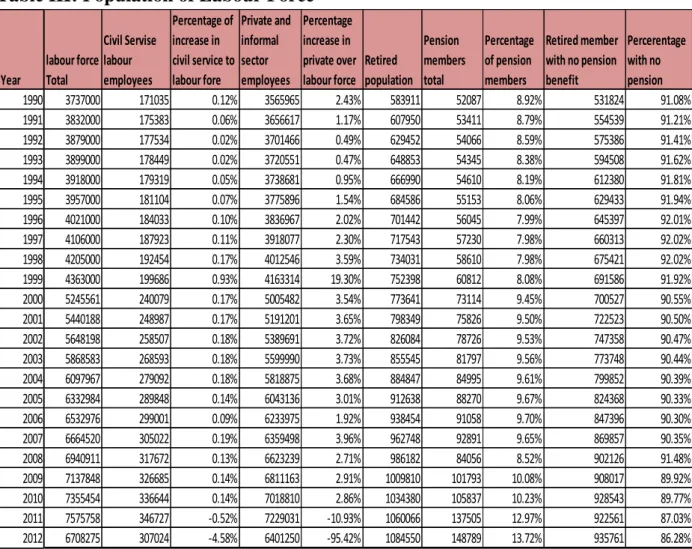
Malawi is a country with a population estimated at 15.38 million as of 2013 (Table II) with a labour force close to 6.71 million (table III). This labour force has gradually been rising from 3.7 million in 1990 to the current rate. The GDP per capita was estimated to be 918 PPP dollars (Table II). To provide an overview of the structure and recent performance of Malawi‘s economy, Table II shows the distribution of the main economic sectors and their growth rates. By far the largest sector is the agricultural sector accounting for 30% of GDP. This sector provides jobs to about 90% of the work force (86% of which are subsistence farmers). Most of these farmers are self-employed and do not see the importance of investing in a private pension. It is argued that most farmers perceive it as a waste of viable resources which can be diverted to the expansion of their business. This could be due to lack of knowledge, lack of government will and poor execution of pension schemes. This results in 90% of the retired population not having pension schemes (Table III). In this table it can be seen that in 1990 the percentage of retired population with no pension schemes is 91%. The rate slightly decreased in 2009 to 89% and 86% in 2012. This could be attributed to changes in pension regulations and increased political will.
3.2 Pension Structure
Malawi developed its first pension schemes in 1944 under the Malawi Public Service Regulations Act which was later reformed in 1991. With the guidance of this act Malawi developed 3 types of pension schemes which included:
3.2.1 The Public Pension Scheme:
This is a Civil Service Pension Scheme (CSPS) operated by the Government of Malawi. This is a non-contributory defined benefit (DB), pay-as-you-go (PAYG) system paid to employees at the mandatory retirement age of 60 and following 10 years of service or earlier following 20 years of service. Pensions are paid out of a consolidated fund, from recurrent expenditure.
12
The proportion is normally calculated on the basis of number of pensioners and pension arrears. The pension accrues at a rate of 1/360 of pensionable salary for each completed month of service. The final salary forms the base for calculating pensions. Tax deduction of 2% of total entitlements is levied on early retirees. The Retirement benefit comprised of lifetime pension and lump sum gratuity. The gratuity is paid at a minimum of 5 years in service. The retirement benefit comprised of 75% of total terminal accrued benefits, whereas gratuity consisted of the remaining 25%. In the fund two main contingencies are covered: old age and a death gratuity (Finmark, 2010).
3.2.2 Occupational Mandatory:
This is the second pension scheme that was supported by the Malawi Public Service Regulations Act. This scheme is offered voluntarily through privately managed occupational schemes. The pension schemes are registered with the Commissioner of Taxes of the Malawi Revenue Authority (Kazeze). It was estimated in 2010 that there were around 399 private pension funds offering both DB and defined contribution (DC) pension schemes with total assets of around MK35 billion ($250 million) or more (RBM, Malawi). These pension schemes were handled and managed by private pension administrators. Each used their own formula, contribution & transaction rates plus each had its own regulations.
3.2.3 Malawi Social Cash Transfer Scheme:
The third pension scheme was a pilot Social Cash Transfer Scheme (SCTS). This began in Mchinji District in 2006 and was later extended to 6 more districts by the end of 2008. By 2009 the scheme covered 14.5 thousand households of the elderly who received on average MK 1800 ($13) a month. This however was not sufficient since the total elderly population is approximated at 520 thousand (Finmark, 2010).
13
3.2.4 Limitations of the old pension scheme
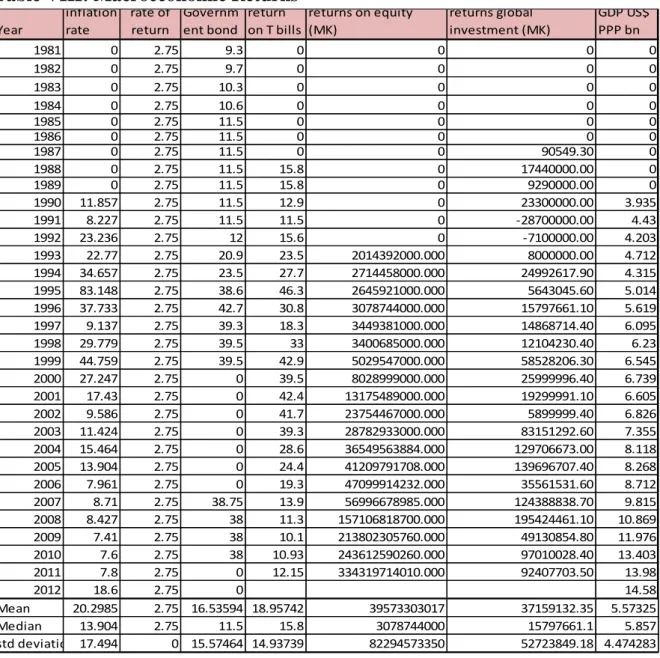
This public pension had two main problems. Firstly, decline in revenue contributions due to unemployment, retrenchments and budgetary constraints in the public sector. Secondly, the real value of the reserves has been eroded through high inflation rates and the channelling of resources into politically motivated low-yield investment and loans under the previous government. The amount of benefit payout had been rising over the years and this inflated government debt and caused a strain on the economy. Table I below shows the defined-benefit schemes for public sector employees were running high actuarial deficits and had accumulated substantial arrears in benefit payments. The highest deficit was of MK 3 billion in 2012/2013 financial year. Table II indicates how macro economically unstable the economy was with high government spending of MK 49 million ($147.5 thousand), low GDP of $5.7 billion, high inflation and negative balance of trade trends etc. Additionally Figure 1 brings into picture how GDP levels were fairing with the highest being 9.8 in 2009 and the lowest 3.3 in 2006. Instability of the financial sector also negatively affected pension fund management. Insolvency in the private sector as well as retrenchments and the real value of the reserves has been eroded through high inflation rates of up to 44.759% in 1999 (Table VIII). The real rate of return was highly negative during 1998-2004, as low as -25% for members' balances and somewhat less negative on fund assets (Dick & Mussa, 2010). The income ceilings applied in the calculation of pension contributions had not been adjusted regularly for inflation. Because of high inflation rates, the ceiling fell to the equivalent of US$20 in 2000. This resulted in very low, practically flat-rate contributions of only MK. 1,500 or US$4 per month to members' accounts. There was poor participation in the pension schemes in the all sectors namely the public sector, private sector and informal sector. Table III illustrates the distribution of the labour force how the number of pensioners in the civil service and private sector is unbalanced. The table shows that a large number of the labour force is employed in the private sector compared to the civil service. The main phenomenon
14
is that Malawi is an agricultural dependent country and 75% of the population is employed in the informal agricultural market. This has trickled down to a large percentage of retirees with no pension with the highest being in 1996 of 92.02%. This is a big challenge for Malawi. Figure II illustrates this issue better through a chart with the average percentages of retirees without pension at a high rate of 90%. This indicated inadequate management of pension fund operations and lack of pension regulations means most employees in the agricultural sector do not have proper pension coverage. Hence a reform was needed to help reduce the pension debt.
3.2.5 Pension Reforms
Pension reforms started to occur in 2004 when the basic wage rose by 100%. Pension accrual rate was then adjusted from 1/360 (3.3%) to two differing rates of 2.2% for senior staff and 2.5 % for junior staff. Prior to 2004, every employee was paid a lump sum gratuity and a reduced pension. The new system allowed employees to opt to get a full pension without gratuity or get a gratuity of up to 25% plus a reduced pension, but with interest of 4%. In 2009, this 4% discount rate was reduced to 2%. Pension benefits were adjusted to an inflation rate of 10%. The government revised the mandatory retiring age for Civil servants from 55 years to 60 years in 2006 (Finmark, 2010). However this did not solve the pension deficit problem. The participation level of individuals in pension systems was still erratic and government was still in pension debt.
By 2010 the government decided to move from a public PAYG to a private mandatory defined contribution pension scheme.
In 2011 Malawi pension act was established and it categorised pension into three basic pillars: a poverty prevention pillar where the Malawi Social Cash Transfer Scheme lies. A mandatory contribution pillar and a voluntary savings pillar where public and private employees can use. The act stipulates that, a National Pension fund (NPF) and a National
15
pension administrator (NPA) operating as independent bodies are to be established. Employees and employers can make mandatory contributions to the NPF and it will receive, monitor and disperse the pension benefits. The NPA will act as a regulatory board and controlling body of pension fund providers. The NPF will offer limited administration, investment, and other auxiliary services to private pension funds administrators and investment managers.
Pension schemes will be of defined contribution, defined benefit, or a hybrid of the two. Under the new law, all defined benefit schemes have to be fully funded. Currently all pension schemes are defined contribution.
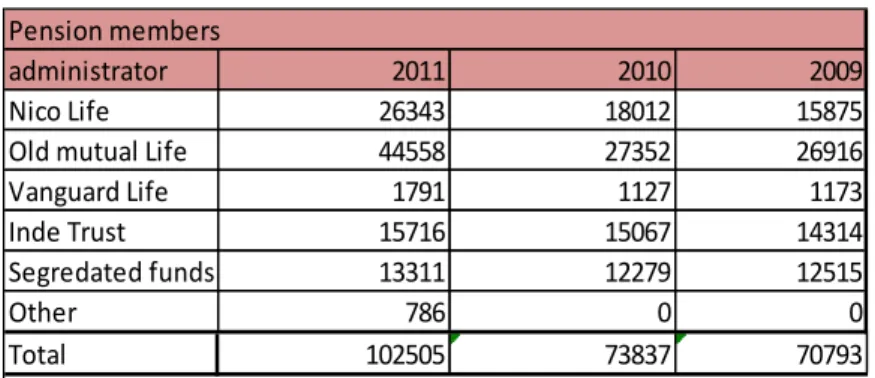
The act indicates that employer´s contribution would be 10% of the pensionable salary while the employee´s contribution is 5% of the pensionable salary. Employers with less than five employees and with a minimum annual income of less than MWK 120,000 (USD 300-500) are exempted. The retirement age is now 50 from 55 and the minimum years of service is now 20 from 25. On retirement, members may access 40% of their benefits as a lump sum while the rest should be used to buy an annuity or arrange a programmed withdrawal with a pension fund. There are approximately, 337,000 people in the Malawian civil service and around 30,000 retirees (Finmark Malawi, 2010). With the pension act in place pension funds have grown tremendously. Tables IV to VII provide a detailed outlook of private pension funds. In the figures 2011 saw an increase in pension funds of 55.6%, pension members increased by 39.9%, contributions by 47.3% and pension assets rose from Mk 59512.8 to Mk 67666.4
3.2.6 Structure of the Pension Reform Portfolio and its Financing Vehicle
The insurance industry plays an important role in the administration of pension fund investments in Malawi. Table IV shows the composition of those administrators with Old mutual life holding the highest value. Most of the government pension systems are also
16
expected to be managed by these firms. The capital market in Malawi is not well developed and it has been faced with poor economic performance, lack of sophistication and expertise. All pension funds are closed ended. The aim of the pension reform is to boost the economy and financial sector of Malawi, and with that in mind most fund managers are only willing to invest in portfolios that are considered to provide guaranteed return. Hence most portfolios are 50% bonds and 50% bank deposits and sometimes 100% bonds.
3. 3 Methods and Data
3.3.1 Research design
In this section, reports on the empirical simulation investigation of the impacts of several policy options on the pension system. The policy options include changes in contribution rates, alternative pension fund investments, changes in retirement ages and transaction costs. By employing a stochastic simulation technique, it is hoped to demonstrate the quantitative extent to which the changes in those variables impact on the pension benefits. The analysis is based on the purely funded model. In addition the study will examine the investment performance and risk measures associated with the investment portfolios using total returns. The aim is to calculate the profitability of the pension investment portfolio.
3.3.2 Methodology
3.3.2.1 Simulation Model
The model used is the same as the one used by Hu (2006), Cairns (2003) and McCarthy and Zheng (1996) and it is as follows:
] (1)
(2) In Equation 1, P is the balance of pension fund accumulation, C is the contribution rate, W income or wage, TC the transaction cost and r the annual rate of investment returns. A is the pension payment and ᴫ the inflation rate in Equation 2.
17
The study assumes a person starts working at the age of y1, retires at y2 and dies at y3, t and γ denote the time dimension. The average age a person starts working is assumed to be 22 in Malawi. A similar methodology was used by OECD (2005d), where they looked at how retirement benefits from mandatory public pensions change with different assumptions, e.g. level of individual earning and return on DC pensions. In addition, their simulation analysis included work relating to both DC and DB components (Hu 2006).
Equation 1 above mathematically describes the asset accumulation process of a person from the time he/she starts working at y1 to the time he/she finishes working at y2. Equation 2 is concerned with pension fund decumulation during the postretirement period from y2+1 to y3. We assume that pension payment is linked to inflation; therefore an inflation variable ᴫ is included into the equation. To be consistent with the fully funded nature of the pension scheme our model in the end year assumes a balance of pension assets should not be greater than zero and ideally equal to zero. Therefore the interest of pensioners is maximised if the account balance is zero, i.e. Py3 = 0 when the person dies. In order to derive the function of Py3in terms of variables we are interested in, we expand Equations 1 and 2, by undertaking the mathematical manipulations as follows:
Substituting t = y2 +1and t = y2 + 2 into Equation 2 respectively, we have
(3) (4) Substituting equation 3 into 4 we get the following:
(5)
18
Based on Equations 3 and 6 we can identify that both equations are a geometric series with the number of terms determined by time t. Therefore we write down equations of Pt when t =
y2 + 3 and t = y3 accordingly (7) (8)
If we set Equation 8 equal to zero and undertake some manipulation, the value of A could be calculated as follows:
(9) Given the value of A we can easily compute replacement rates by dividing A by wages of the year before retirement.
3.3.2.2 Returns
In the portfolio the returns are analysed using annual pension returns as follows:
The Market return is calculated in a similar way as follows:
The risk free rate for assets will be calculated using the RBM annual return data bank and using the formula Elton et al used in his book which is:
19 3.3.2.3 Risk
In order to understand the performance of investment portfolios, Modern portfolio theory argues that there is need to measure the risks associated with the portfolio returns. The theory points two risk measures and one diversification measure. These are:
Systematic Risk - These are market risks that cannot be diversified away. Interest rates,
recessions and wars are examples of systematic risks and it is measured by the beta of each scheme. This is calculated as indicated above.
Unsystematic Risk - Also known as "specific risk", this risk is specific to individual
investments and can be diversified away as you increase the number of investments in your portfolio. This is measured by standard deviation computed as
Diversification measure- portfolio diversification is important and it improves the
performance of a portfolio. This is measured through a coefficient of determination which is R².
3.3.2.4 Performance Measures 3.3.2.4.1 Sharpe Ratio
The Sharpe ratio characterizes how well the return of an asset compensates the investor for the risk taken. When comparing two assets versus a common benchmark, the one with a higher Sharpe ratio provides better return for the same risk. This is measured as the excess return (or risk premium) per unit of deviation in an investment asset or a trading strategy,
20
typically referred to as risk. This is computed as:
3.3.2.4.2 Treynor Ratio
This is the measurement of the returns earned in excess of that which could have been earned on an investment that has no diversifiable risk (e.g., Treasury Bills or a completely diversified portfolio), per each unit of market risk assumed. This is computed as:
3.3.2.4.3 Jensen Measure
This is a risk-adjusted performance measure that represents the average return on a portfolio over and above that predicted by the capital asset pricing model (CAPM), given the portfolio's beta and the average market return. Hence it measures the relationship between portfolio returns and its expected returns. This is computed as follows:
3.4 Data Collection
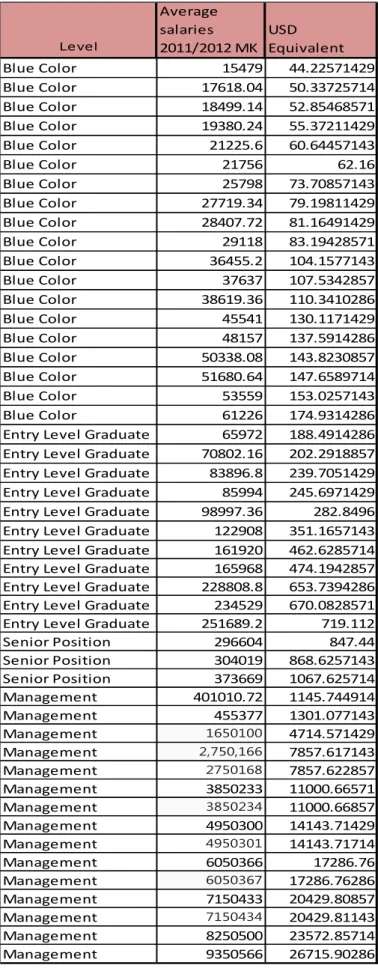
All data of asset returns, inflation rates and GDP are given in Table VIII. This simulation work, uses 5 different assets, i.e. bank deposits, government bonds, T bills, domestic equities and global investments. Regarding data source and observation period regarding inflation rates and Rates of returns on bank deposits were from RBM database (2013), Government bond yields from IMF, Returns on domestic equity from Malawi stock exchange. Returns on global investment were derived from returns on global equity yields and global bond yields with a 50-50 split, as in Davis (2002a, 2002b). Global returns were corrected by allowing for currency risk. Table IX provide wage averages for 2011/2012 obtained from ministry of labour and NSO.
21 3.5 Data Analysis and Verification
Looking at figure 3 domestic equities have been rising this is due to the persistent devaluation of the Malawi kwacha by the government. In figure 4 global investments are fluctuating and performing poorly. This can be attributed to the financial crisis. Wages (W) are defined as the annual real income after inflation rates are considered. The inflation rate is proxied by the consumer price index (CPI). The transaction cost (TC) is defined as a proportion of wages. In the paper, in order to assess the impacts of different rates of transaction costs on the contributions, we used 5%, 10% and 15% respectively. The rates are chosen based on the operations of the pension fund markets and the median rate of 10% is taken from the paper by (Whitehouse 2000) where administrative charges are compared across both OECD and developing countries. The contribution rates are assumed to be at the level of 10%, 15% and 20%. These contribution rates are used to determine how current pension system can perform if contribution rates change and the median rate is taken from the according to the requirements of the pension act. The study uses return data for seven different portfolios, which are constructed from our historical and simulated data series. Portfolio 1 refers to a portfolio consisting of bank deposits only, portfolio 2 government bonds only, portfolio 3 T bills only, portfolio 4 domestic stocks only and portfolio 5 global investments only. Portfolio 6 is a “naïve” portfolio with five types of assets allocated equally (20-20-20-20-20), i.e. bank deposits 20%, government bonds 20%, T bills 20%, domestic stocks 20% and global investment 20%. Portfolio 7 consists of 50% bank deposits and 50% government bonds2, which is consistent with pension fund investment practice in Malawi. In the simulation work, we assume that a representative person starts working at the age of 22 in 20113. 2011 is the year pension reform started. We also assume that the person maximum years to live is 2059
2
Malawi pension funds are heavily invested in bank deposits and government bonds. This is for two reasons. One is the investment mandate of pension funds where low risk assets are always recommended to be the main investment vehicles, the other is because of underdeveloped financial markets.
3
In Malawi a person usually starts school at 6 years old and attends primary for 8 years, then 4 years of high school and may continue to 4 years of university study and by the time they finish university they are usually 22 years old.
22
making the maximum age of death 70. Given that we only have data observations up to 2013, observations from 2013 to 2059 have to be simulated first. As for wages, the annual growth rate is estimated to be 3%. The simulation of inflation rates is based on the assumption that these rates are normally distributed; therefore we simulate the data from 2014 to 2059 by using the historical mean and standard deviation. The simulation of rate of returns on all seven portfolios are conducted in the same way as that in the inflation rates, i.e. using historical mean and standard deviation to simulate observations from 2014 to 2051. For the simulations, we used the full sample of these variables as shown in Table VIII. All simulations were programmed and conducted with R i386 3.0.1
3.6 Limitations of the study
The present study has the following limitations:
All the data used to determine the sustainability of the reform is simulated data because comprehensive data is not yet available. This means the future data might not necessarily be the same as the simulated data.
This study considered schemes with the same goal, risk profile and similar investments this may generate misleading results. Many of the pension plans favour T bill and bonds since they consider them risk free4.
The observed data doesn’t include effects of subscription and withdrawal commissions of portfolio’s return and in some years data is not available this present a problem in data consistency.
The study only looked at themes that are currently tradable. Meaning it ignored liquidated or absorbed funds. This may present sample bias.
4
Economic theory and macro finance favour government bonds and T bills arguing that they are AAA rated and are free of risk. However over the years a couple of governments have defaulted in bond payments e.g. Russia 1998 and Zimbabwe 2008 to date.
23
4.
Results and Analysis
In this chapter an analysis of the data employed will be described, with the aim of illustrating and condensing the data used. This section will report on all the policy options used and how the impact pension benefits. Before discussing the results a report on the benchmark will be presented first, which will serves as the basis of the Malawi pension. The assumption is that in Malawi an average person retires by 50 years and the maximum age of death is 70. The average starting wage ranges from 65,000-75,000 Mk. The contribution rate is 15% of payroll with a transaction cost of 5% of wages. The common investment strategy is a 50-50-0-0-0 approach, i.e. 50% of assets are allocated to bank deposits and government bonds respectively. In addition we will look at the deccummulation model by using market inflation and interest rates to determine the monthly benefits expected to be received upon retirement. Two scenarios will be in place. One is where a lump-sum of 40% is paid and 60% is paid to an annuity. The second is where a 100% is invested in a pension annuity. Also the risk return analysis will be used by looking at performance of the portfolio’s riskiness. The following test will be used to measure risks; the Sharpe ratio, the Jensen measure and the Treynor measure.
4.1 Simulation Results in the Basic Model
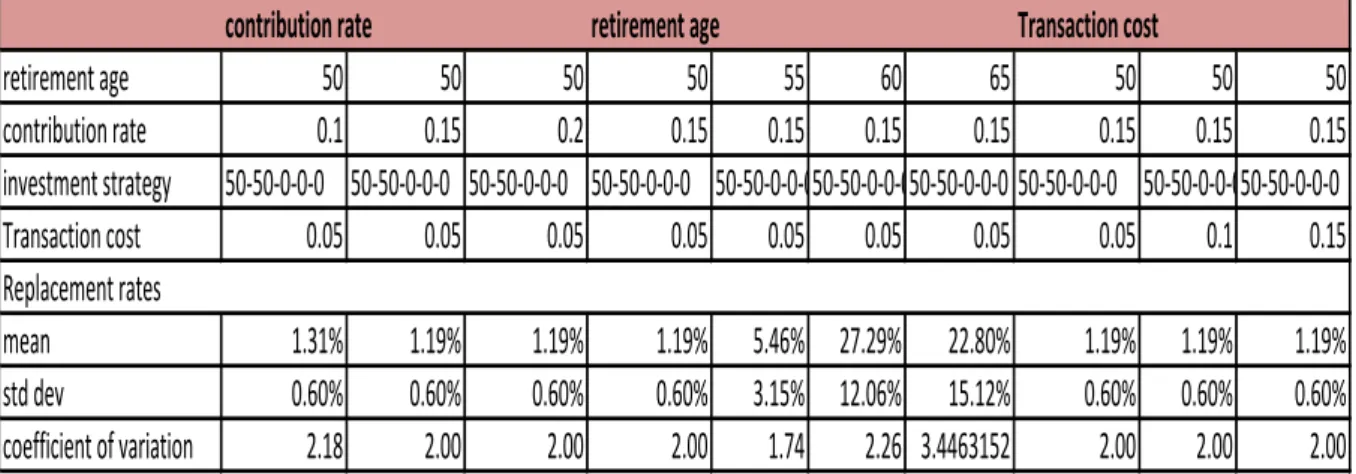
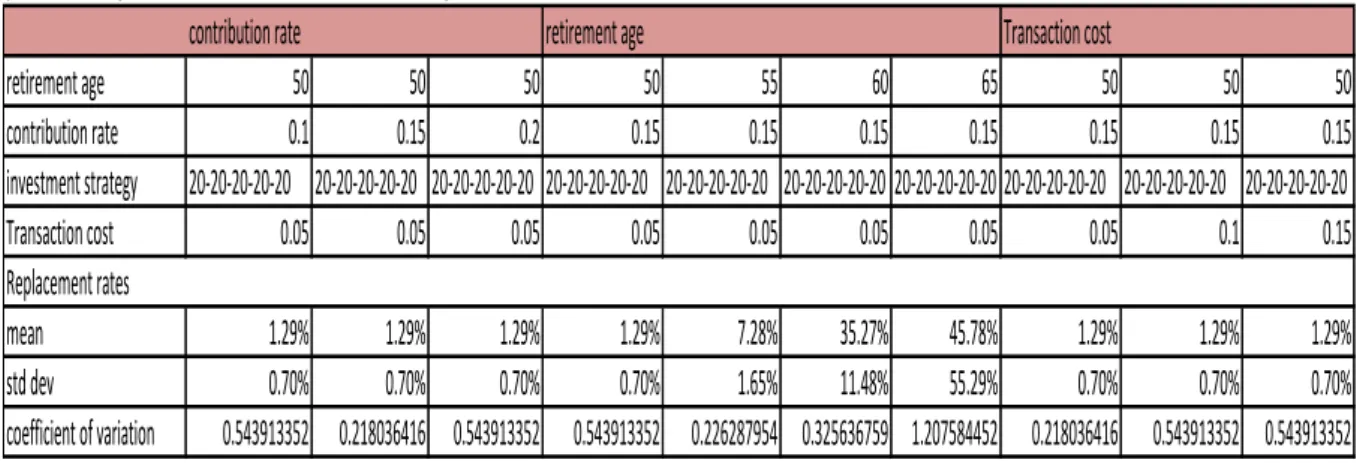
This is the model discussed above with 15% contribution and 50-50-0-0-0. Table XI gives the simulation results of replacement rates with the basic model. The mean of our simulated replacement rates is 1.31%, with a standard deviation at 0.6% when the contribution rate is 10%. When the contribution rate rises to 15% and 20% the replacement rates falls to 1.19% the replacement rate is low due to our assumptions that the 50% of the assets are allocated to banks and government assets. 1,000 replications are computed, since simulations generated random results by the computer, and thus we seek to obtain results as representative and/or accurate as possible. Despite the increase in contribution rates or transaction cost the replacement rate still is low. The only time the replacement rate is favourable is when the
24
retirement age rises and this is favourable at retirement ages 60 and 65 where we have replacement rates of 27.29% and 22.80% with standard deviations of 12.06% and 15.12% respectively. Figure 6 clearly shows the distribution and gives us a visual image of how dispersed the results are of the replacement rate. The 1.2% replacement rate found above is very low, and apparently not sufficient to support a typical retiree’s post-retirement life. The deccumulation also favours the same result showing that a retiree at age 50 will not get enough monthly benefits that are just $43.20 while a retiree at 65 is likely to get $1441. Table XII indicates the results.
4.2 Simulations Results for the Rest of the Portfolios
4.2.1 Simulation Results Portfolio 1
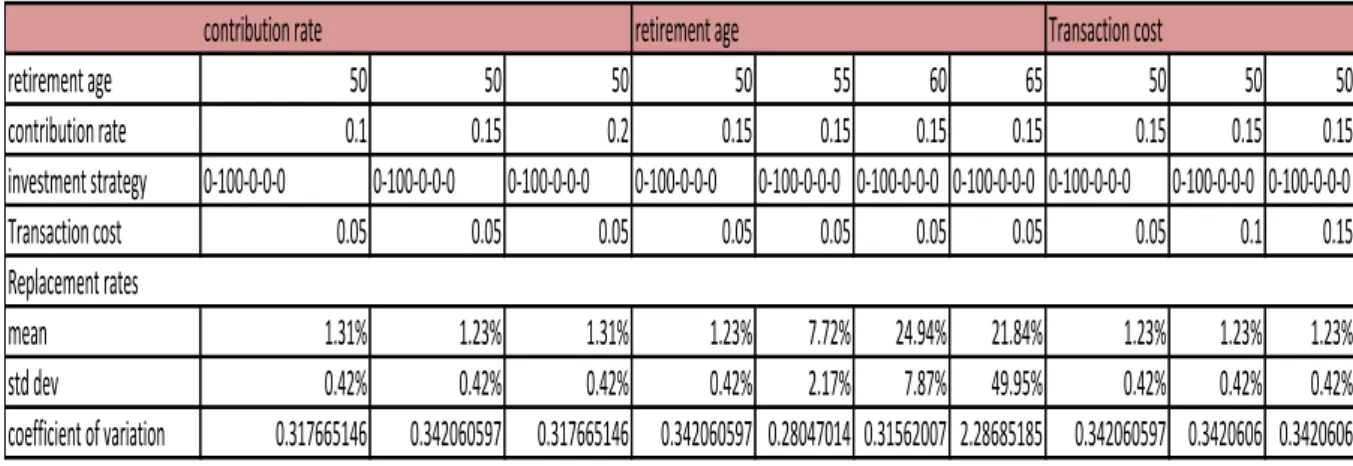
In this section we quantitatively measure the extent to which replacement rates respond to changes in three variables, i.e. the contribution rate, retirement age and transaction costs. In the first portfolio simulation, we change the contribution rates to a lower level at 10%, and a higher level at 20% respectively. The portfolio is still replicated the results of the 50-50-0-0-0 investment approach, i.e. 50% in bank deposits and 50% in bonds. The results indicated in Table XIII show that the replacement rate at 10% and 15% is just 1.26% with a coefficient of variation 2.155 and 2.229 respectively. While at 20% contribution rate the coefficient of variation is 2.229 with a replacement rate of 1.31%. As the retirement age changes to 55, 60 and 65 with contribution rate of 15%. The replacement rates rises to 7.37%, 33.62% and 45.78%, with corresponding coefficient of variation of 1.829, 1.607 and 0.694 respectively. Just like the basic model the replacement rates are higher at age 60 and 65. Figure 7 shows just how the replacement rates are distributed with most of the clustering at 0.0-0.1 and 0.3-0.5