Analyzing the Performance of an Institutional
Scientific Repository – A Case Study
Maria Eduarda Rodrigues
Instituto Politécnico de Castelo Branco – Escola Superior Agrária, Portugal; [email protected]
António Moitinho Rodrigues
Instituto Politécnico de Castelo Branco - Escola Superior Agrária/CERNAS, Portugal; [email protected]
Abstract
Scientific knowledge evolution is mainly based on an effective dissemina-tion of research results. The concept of Open Access gives us the theoreti-cal foundation of a model for accessing scientific knowledge, free from the constraints of traditional publishing and technologically supported by the Internet.
Institutional Repositories are information systems that allow preserving, storing and disseminating scientific knowledge produced in higher educa-tion and scientific research institueduca-tions. They increase the visibility and the citation level of the documents. They also contribute to minimizing negative aspects like plagiarism of content because documents are exposed to peers in real time.
As an alternative way to the traditional system of publishing scientific research content, repositories are developed in a cultural climate of great visibility lead-ing to an immediate critical evaluation by peers.
The Scientific Repository of the Polytechnic Institute of Castelo Branco – Por-tugal (RCIPCB) was created in 2009 but its official presentation took place in
January 2010. Its main purposes are promoting Open Access (OA), and preserv-ing and disseminatpreserv-ing the scientific knowledge produced at the Polytechnic Institute of Castelo Branco (IPCB). Using DSpace as a technological platform, RCIPCB is an institutional project supported by the president of the IPCB. Therefore, the present study was developed with the aim of analyzing the per-formance of RCIPCB considering the evolution and growth in terms of users, archiving and self-archiving, the number of published documents (scientific) versus deposited documents in 2010 and the heterogeneity among communi-ties/collections and its causes.
Data were collected in RCIPCB, in the 2010 scientific publication list of the institute and through a questionnaire survey distributed among the members of the community with most documents deposited and those of the commu-nity with the fewest documents.
For data collected in RCIPCB and in the publication list, average, standard deviation and counts were calculated. Data collected from questionnaires were analyzed with SPSS.
The results show that RCIPCB indicates an asymmetric growing dynam-ics. Nevertheless, it reflects the institutional organization, in the sense that the communities related to the older schools possess more documents than the communities related to more recent schools. Communities having higher numbers of deposited documents seem to have also higher levels of searches and downloads. Therefore, it increases significantly the visibility of the institu-tion and its researchers.
Concerning the 2010 scientific production when compared with the deposit level of the corresponding community, the results show that the number of documents deposited is much lower than the number of published docu-ments.
Data obtained from the questionnaire answers from the communities The School of Agriculture (ESACB) and The School of Applied Arts (ESART) suggest that the strategy of communication used by RCIPCB is correct because everybody knows about the Repository. However, that is not related to the number of documents deposited. They also suggest that the strategy is not efficient and it needs some improvements in order to become effective.
Considering the results it is clear that RCIPCB needs to have a mandatory depositing policy that might also be extended to user registration. Those factors would minimize both the heterogeneity and the asymmetric growth of communities and collections. Moreover, it would also decrease the dif-ference between scientific production and the corresponding deposit in RCIPCB.
Introduction
The evolution of scientific knowledge is based mostly on an effective diffu-sion of research results (Prosser, 2005; Duarte, Paiva, & Silva, 2007) by schol-arly communication.
New Information Technologies (NIT) and the Internet contributed largely to scholarly communication change, offering new and more flexible platforms for communication (Duarte, Paiva, & Silva, 2007; Marques, & Maio, 2007; Genoni, Merrick, & Wilson, 2006).
Open Access (OA) offers us the theoretical foundation for the dissemination of scientific knowledge, free from the severe constraints imposed by scientific content publishers (Rodrigues & Rodrigues, 2011; Vézina, 2006). Open Access is achieved by the “golden OA”, when authors publish in open access jour-nals and the “green OA”, related to institutional repositories (Harnad et al., 2008; Rodrigues, 2004; Saraiva & Rodrigues, 2010).
The present study aims to analyze the performance of the Scientific Repository of the Polytechnic Institute of Castelo Branco - Portugal (RCIPCB) which is an institutional repository. This will be analyzed in various dimensions, which seek to identify the main problems and list some solutions that can address the problems highlighted.
Institutional Repositories – Overview
According to Lynch (2003) an institutional repository “is a set of services that a university offers to the members of its community for the management and dissemination of digital materials created by the institution and its commu-nity members”.
Within the academic community, reputation is an important aspect that influences directly information production, dissemination and consump-tion. For some authors publishing in open access repositories may be seen as something that can affect seriously their reputation, because open access repositories contain much more than peer reviewed papers. They include also more informal documents (Grundman, 2009).
The Open Access movement advocates the free dissemination of all scientific literature, allowing all to read, download, copy and reference the full text of documents (Saraiva & Rodrigues, 2010).
In this context both thematic and institutional repositories have been set up. They establish free access to scientific knowledge (Frias & Travieso Rodriguez, 2008) since the publication in open access journals is not yet widespread. Some authors mention even that repositories are generally used to implement fast access to scientific knowledge (Batista & Ferreira, 2006). A repository is a system that provides an alternative to the tradi-tional system of scholarly publishing; institutradi-tional repositories are devel-oped in a climate of high visibility and public exposure, which allows their content to be critically evaluated by peers in real time (Marques & Maio, 2007).
Repositories stimulate scientific production in a competitive way, allowing its reuse, on a basis of sharing and collaboration awareness (Seonghee & Boryung, 2008).
There is also, through the repositories, a reduction of the spread of informa-tion/knowledge produced by researchers, since they bring together in a sin-gle location all scientific output produced by an institution and its researchers (Marques & Maio, 2007), contributing to a drastic reduction of time and publication costs. Some authors even consider that institutional repositories increase the efficiency of the publication process, contributing also to increas-ing the visibility of their institutions (Rodrigues, 2010; Saraiva & Rodrigues, 2010). At present, the WEB age, authors should provide their scientific pro-duction by placing it in their institutional repositories, without restrictions or limitations of any kind.
Some authors even argue that Institutional Repositories produce a higher return, and that they should therefore be encouraged, financed and released. Regardless of their electronic platform, institutional repositories gather doc-uments and metadata into a single system, and allow locating unequivo-cally a document in the context of scientific publishing through its unique identifier. These two features add value to institutional repositories, making them important mediators in the dissemination of scientific work process (Womack, 2002).
Institutional Repositories in Portugal – general aspects
In Portugal, Open Access is realized mostly through institutional reposi-tories. The number of Portuguese institutional repositories increased from 3 in 2007 to 35 in 2011 (UMIC, 2012). However, the development level dif-fers from institution to institution. There are differences not only in terms of institutions but also within the institutions where asymmetries are evi-dent in terms of communities and collections (Rodrigues & Rodrigues 2011; Saraiva & Rodrigues, 2010). The difficulties often stem from a low submis-sion rate and a lack of mandatory policies, which combined make it very difficult to both manage and maintain institutional repositories (Rodrigues, 2004).
The Scientific Repository of the Polytechnic Institute of Castelo Branco The Polytechnic Institute of Castelo Branco is a higher education insti-tution that includes six schools related to different scientific fields of study. The IPCB started with two schools: The ESACB and the School of Education (ESECB), both founded in the 1980s. In the 1990s the School of Management (ESGIN) and the School of Technology (ESTCB) and the ESART were founded. Finally, in 2002 The School of Health (ESALD) joined the IPCB.
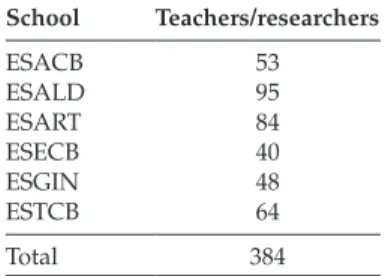
The IPCB has about 5,000 students distributed over graduation courses and master degree courses. Teaching staff/researchers are distributed as shown in Table 1:
Table 1: Number of IPCB’s teaching staff /researchers in the different schools.
School Teachers/researchers ESACB 53 ESALD 95 ESART 84 ESECB 40 ESGIN 48 ESTCB 64 Total 384
The Scientific Repository of the Polytechnic Institute of Castelo Branco – Portugal (RCIPCB) was created in 2009. Its official presentation took place in January 2010. Its main purposes are promoting OA, and preserving and dis-seminating the scientific knowledge produced at the Polytechnic Institute of Castelo Branco (IPCB). Using DSpace as a technological platform, RCIPCB is an institutional project supported by the presidency of the IPCB (Rodrigues & Rodrigues, 2011; Rodrigues, 2010).
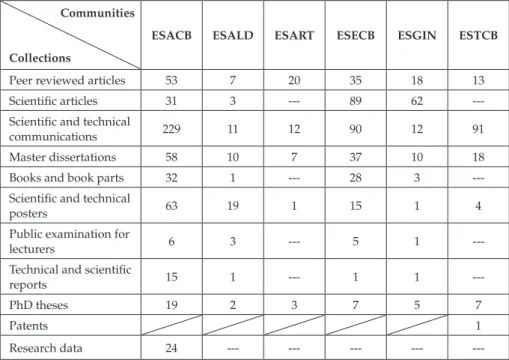
Table 2 shows the RCIPCB structure, which reflects the internal structure of IPCB, meaning that each community corresponds to a different school. The collections indicated are replicated for each community. The collections cor-respond to the different types of documents accepted by the repository. All the communities have 10 collections, except the ESTCB community, which has 11, because of the Patents collection. ESACB is the only community that has documents archived in the Research data collection.
Table 2: RCIPCB communities, collections and documents.
Communities Collections
ESACB ESALD ESART ESECB ESGIN ESTCB
Peer reviewed articles 53 7 20 35 18 13 Scientific articles 31 3 --- 89 62 ---Scientific and technical
communications 229 11 12 90 12 91
Master dissertations 58 10 7 37 10 18 Books and book parts 32 1 --- 28 3 ---Scientific and technical
posters 63 19 1 15 1 4
Public examination for
lecturers 6 3 --- 5 1
---Technical and scientific
reports 15 1 --- 1 1
---PhD theses 19 2 3 7 5 7
Patents 1
Research data 24 --- --- --- ---
RCIPCB aims to bring together all scientific documents produced at the IPCB by its professors and researchers in order to make them freely available to the scientific and academic community in general.
Methodology
The RCIPCB data with reference to November 2011 were collected at http://repositorio.ipcb.pt and were analyzed in order to verify the size of the corresponding communities and collections in terms of both number of docu-ments, and number of IPCB registered users.
To evaluate the relationship between the total number of documents pro-duced and the number of documents submitted to the repository, we consid-ered the ESACB community case, since this is the largest RCIPCB community. The scientific production in 2010 (papers, communications, books/book chapters, posters) was taken as a reference, comparing the documents pro-duced by the researchers with the documents actually deposited in RCIPCB until November 2011.
The ESART and the ESACB communities were used as examples to assess the individual knowledge of IPCB teaching staff/researchers about the RCIPCB. For this purpose, 40 questionnaires were randomly distributed among 20 ESACB teaching staff/researchers and 20 ESART teaching staff /researchers in July 2011. The surveys included 27 questions, namely about context data, data on their knowledge about the Open Access movement and the RCIPCB, about data submitting, archiving, use and importance of RCIPCB to the teach-ing staff/researcher and to the organization. At the end of the month 26 com-pleted questionnaires were collected, 19 from the ESACB community and 7 from the ESART community. The data collected from the questionnaires were analyzed with SPSS (average, standard deviation and Pearson Chi-square).
Results and Discussion
RCIPCB
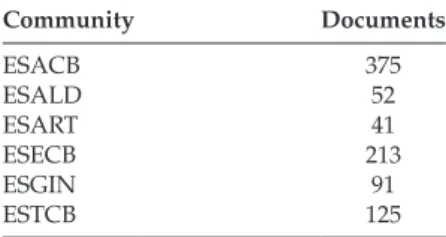
The ESACB Community showed the highest number of deposited docu-ments (375) while the ESART Community showed the fewest (41). One of the
reasons for such a difference might be related to how old the schools are. The older School, which is the ESACB Community, has more documents depos-ited than the more recent school, the ESART Community, and because of that the teaching staff/researchers of the older school might eventually have pub-lished more documents than the teaching staff/researchers from the more recent school (Table 3). Nevertheless there are other factors that might also
Table 3: Community documents.
Community Documents ESACB 375 ESALD 52 ESART 41 ESECB 213 ESGIN 91 ESTCB 125
Source: RCIPCB (until Nov. 2011)
Table 4: File form at ESACB and ESART communities.
Communities Total Nr. of Documents Archived documents Self-archived documents
ESACB 375 354 21
ESACB 41 34 7
Source: RCIPCB (until Nov. 2011)
contribute to this like the scientific fields or even the inadequacy of the exist-ing collections regardexist-ing the type of documents produced by teachexist-ing staff/ researchers from ESART, as musical scores, drawings and paintings, clothes and furniture.
Considering these two extreme cases of RCIPCB communities, we analyzed the number of deposited documents concerning the two file forms: archiving and self-archiving. Table 4 shows the results obtained for those two commu-nities. From the 416 documents filed at the ESACB and ESART communities, only 7% were self-archived (28 documents).
The results are similar to those found by Xia (2008), who refers that the authors are not very enthusiastic about self-archiving even though they are familiar with its practice.
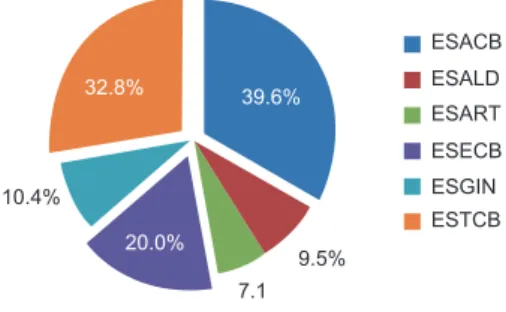
We also analyzed the data related to repository users. Comparing the number of RCIPCB registered users with the total number of teaching staff/research-ers per community (Table 1) we see that the ESACB, the ESECB and the ESTCB communities have more registered users than the ESALD, the ESART and the ESGIN communities (Figure 1). This confirms that the oldest schools have the highest number of registered RCIPCB users.
Fig. 1: RCIPCB registered users/community. (Source: RCIPCB (until Nov. 2011).
39.6% 32.8% 20.0% 10.4% 7.1 9.5% ESACB ESALD ESART ESECB ESGIN ESTCB
Figure 2, combined with the data from Table 3, demonstrates that a higher number of deposited documents leads to a higher number of downloads (R=0.91; P<0.05) and searches (R=0.99; P<0.01) which allows us to say that the visibility level was increased because of the higher number of deposited documents.
Scientific production/deposited documents
When comparing the 2010 scientific production by the researchers from the ESACB Community, with the number of those documents that have been deposited in RCIPCB, we verify that there was great heterogeneity in the number of deposited documents, ranging from 78.4% for the Scientific and technical communications collection to 23.8% for the Peer reviewed papers collection (Table 5).
Table 5: Scientific production versus deposited documents – ESACB Community.
ESACB Community Produced Deposited % deposited
Peer reviewed papers collection 21 5 23.8 Scientific/technical communications
collection 37 29 78.4
Books/book chapters 4 2 50.0
Posters 19 12 63.2
Total 81 48 59.3
The low rate obtained for the Peer reviewed papers collection (only 23.8% deposited on RCIPCB) might be related to the scientific journals’ copyright policy. This idea is also mentioned by Grundman (2009), who also adds the reputation factor. The total average percentage found for the documents that have not been deposited in RCIPCB, close to 40%, is a very high rate when considering the Repository goal. In our opinion this is due to the absence of a mandatory policy. That was also found by other other autors (Harnad et al., 2008; Grundman, 2009; Xia, 2008; Bankier & Perciali, 2008; Covey, 2011). Survey
Sample characterization – Context data
From the 40 questionnaires that were distributed to teaching staff/research-ers, we received 26 completed answers (65%), divided equally over both
Fig. 2: Downloads and searches by RCIPCB community (until Nov. 2011).
60000 50000 40000 30000 20000 10000
ESACB ESALD ESART
Total downloads 5417756287 26528 15575 7617 6417 2773830153 16144 15654 21958 18837 Total searches
ESECB ESGIN ESTCB 0
sexes. 19 out of 20 of the ESACB Community’s respondents (95%) completed the survey compared to only 7 (35%) of the ESART Community. The ages of respondents ranged from 31 to 40 years old (4, 15.4%) and more than 50 years old (10, 38.5%), with 12 (46.2% of respondents) aged between 40 and 50 years. The number of years the respondents had worked in the IPCB ranged from 6 to 20 years (12, 46.2%) to more than 20 years (14, 53.8%).
“Open Access” Movement
When asked about their knowledge of the Open Access Movement all the respondents reported having been aware of this movement either through the conferences organized by the IPCB (18, 69.2%), by searching the Internet (7, 26.9%), through the mass media (3, 11.5%), by e-mail (3, 11.5%) or through the library staff (3, 11.5%). All the respondents reported they were willing to put their scientific production in “open access repositories” and all but one, 25 out of 26 (96.2%) agreed in providing open access and full text of scientific literature in general.
Knowledge about RCIPCB
With regard to the knowledge about RCIPCB, 25 out of 26 (96.2%) of the respondents reported knowing RCIPCB. 16 out of the respondents (64%) indicated that they had been informed by internal promotion, 7 (28%) through conferences organized by the IPCB, 4 (16%) through the IPCB Office of Information, 3 (12%) through the RCIPCB Newsletter and 1 (4%) by col-leagues. Data suggest that the diffusion strategy used at IPCB is consistent with the objective.
Users and registration
Registration in the repository is mandatory in order to do self-archiving or to receive e-mail updates, for instance. Thus, when asked if they had regis-tered in RCIPCB, 15 (60%) of the respondents said they were regisregis-tered. Out of the 10 researchers (40%) who are not registered, 8 said that lack of time was the reason for not doing so and only 2 reported not knowing that they could register themselves in RCIPCB. 7 respondents indicated that they wished to register in RCIPCB in the future. Although these results indicate that the RCIPCB actions of disclosure have fulfilled the objectives, it is necessary to continue the dissemination and training activities to ensure the systematic growth of RCIPCB communities/collections. Other authors identified the same trends (Grundman, 2009; Frias, Travieso Rodriguez, 2008; Bankier, Perciali, 2008). As we combined the age of the respondents with the record in
the repository, we found that 83.3% of the respondents were aged between 41 and 50 years old, 70% of respondents were 51 or more years old and 50% of respondents were between 31 and 40 years old. Of the total respondents who reported having registered in RCIPCB (n = 15), 80% belong to the ESACB community. Considering the age, the data contradict some literature (Covey, 2011) that states that older researchers may not be as receptive to register in a repository.
Archiving documents
With regard to archiving of documents, 76% (n=19) of the respondents reported having their own papers filed in RCIPCB. Similar data are referred to by Swan & Brown, cited by Cassela (2010): 81%.
22 of the respondents (88%) said that they wanted to deposit more of their own documents in RCIPCB and 13 (52%) wanted to do it by self-archiving. However, 4 of these respondents reported that they also wanted to deposit documents in RCIPCB with the help of library staff. Of the respondents reporting that RCIPCB did not contain any of their own documents (6, 24%), 1/3 said that they wanted to deposit documents or authorize the respective filing on a voluntary basis. The low levels found for the parameters in this section of the questionnaire, may be related to the fact that there is not a man-datory policy.
Of the researchers who reported having documents deposited in RCIPCB (n = 19), 84.2% belong to the ESACB community. Of these 19 users, only 15 (78.9%) are registered in RCIPCB. Considering the values found, there seems to be more interest for RCIPCB in the ESACB community than in the ESART com-munity. Some authors mention that this could be related with the authors’ attitude (Xia & Sun, cited by Cassella, 2010).
Scientific publications
Concerning the information about scientific publication (n = 19 respondents), 13 (68.4%) of the respondents reported having from 1 to 5 documents depos-ited in RCIPCB, 5 (26.3%) from 11 to 20 documents and only 1 (5.3%) from 6 to 10 documents. The highest number of deposited documents (11–20 docu-ments) is associated with teaching staff/researchers who have worked for more than 20 years at the IPCB. That might be related to the fact that more documents were published by those researchers. We also found that in the ESART community nobody has submitted more than 5 documents (3).
The ESACB community shows deposited documents for all categories up to 20 documents (1 to 5 documents – 10; 6 to 10 documents – 1; 11 to 20 doc-uments – 5). This might be related to the age of these schools, considering that the ESACB community belongs to an older school than ESART. But this could also be related with the collections, considering the specificity of some outputs produced by teaching staff/researchers from ESART, like music for example.
Use of RCIPCB
Regarding the use of RCIPCB 40% of the respondents (10) reported not hav-ing accessed the RCIPCB. From the 15 respondents that accessed the reposi-tory (60%), 9 (36%) said that they usually did it once a week. The percentage of teaching staff/researchers that access the RCIPCB is the same in both com-munities, 57%.
RCIPCB using purposes
RCIPCB is an open access repository and everybody can use it. We found that 4 (40%) of the 10 teaching staff/researchers that mentioned that they were not registered in RCIPCB actually use it. Therefore, in order of importance, the main objectives for accessing RCIPCB were to search scientific informa-tion (13, 52%), consultainforma-tion of their own documents (5, 20%), access to full text (4, 16%), and query statistics (4, 16%). It should be noted that 60% (15) of the respondents said that they recommended the RCIPCB to their students to search specific subjects (60% of cases), to access documents of their own (33.3% of cases), to access other authors’ documents (33.3% of cases) and to download full text documents (26.7% of cases). In this section of the question-naire the respondents could give multiple answers.
Those figures are not very bad, taking into consideration that about 75% of researchers use Google as their first search option (Frias, Travieso Rodriguez, 2008).
The importance of RCIPCB
When asked about the importance of the RCIPCB, all the respondents said that it is very important for the IPCB.
Table 6 shows that, using a scale from 1 (unimportant) to 5 (extremely impor-tant), 52% of the respondents gave a score of 5 for the parameter “importance of the RCIPCB for assessing the IPCB” and 44% of respondents highlighted
the score 4 to the parameter “importance of RCIPCB in terms of dissemina-tion of their scientific producdissemina-tion as an author or co-author”.
In average the respondents rated with 4.44 (±0.651; P>0.05) the importance of the RCIPCB for assessing the IPCB and rated with 3.84 (±0.898; P>0.05) the importance of the RCIPCB in terms of the dissemination of their scien-tific production an as author or co-author. The responses obtained for these parameters are similar to the ones obtained by other authors (Grundman,
2009).
Conclusions
The results obtained show that the RCIPCB indicates an asymmetric grow-ing dynamics. Nevertheless, it reflects the institutional organization, in the sense that the communities related to the older schools have more documents than the communities related to more recent schools. Communities having a higher number of deposited documents have also higher levels of searches and downloads. This increases significantly the visibility of the institution and its researchers.
The scientific production in 2010, compared with the deposit level of the cor-responding community, shows that the number of documents deposited is much lower than the number of published documents. This might be related to the fact that the RCIPCB is still in its early days and also to the lack of a mandatory policy, which seems to be related also to the low levels of self-archiving.
Table 6: The importance of the RCIPCB.
Scale
Importance for
assessing the IPCB %
Importance for scientific production dissemination % 1 0 0,0 0 0,0 2 0 0,0 2 8,0 3 2 8,0 6 24,0 4 10 40,0 11 44,0 5 13 52,0 6 24,0
Data obtained from the questionnaire survey applied to the ESACB and ESART communities suggest that the strategy of communication used by the RCIPCB is correct because almost everybody knows about the Repository, but this appears to be poorly related to the number of documents deposited. This also shows that the strategy is not efficient and that some improvements are needed in order to become effective. There is still a considerable number of teaching staff/researchers who are not even registered in the RCIPCB but who intend to do it. They also consider that the RCIPCB is very important not only for the institution’s reputation but also for their individual reputation. Considering the results of the survey, it is clear that the RCIPCB needs to have a mandatory depositing policy that might also be extended to user reg-istration. We are convinced that this could minimize heterogeneity and asym-metric communities and collections growth, bridging scientific production and the corresponding deposit in the RCIPCB.
References
Bankier, J.G., & Perciali, I. (2008). The institutional repository rediscovered: what can a university do for open access publishing? Serials Review 34, 21–26. doi: 10.1016/j. serrev.2007.12.003.
Batista, A.A., & Ferreira, M. (2006). Conversas de repositórios. BJIS 0, 50–64. Cassela, M. (2010). Institutional repositories: an internal and external perspective on the value of IRs for researchers’ communities. Liber Quarterly 20, 210–225. URN:NBN:NL:UI:10-1-113593.
Covey, D.T. (2011). Recruiting content for the institutional repository: the barriers exceed the benefits. Journal of Digital Information 12. Retrieved May 6, 2012 from http://journals.tdl.org/jodi/article/view/2068.
Duarte, E.N., Paiva, S.B., & Silva, A.K.A. (2007). Gestão do conhecimento científico no contexto das bibliotecas universitárias. Cadernos BAD 2, 69–81.
Frias, J.A., Travieso Rodriguez, C. (2008). Impacto e implicación de los autores en el acceso abierto a la investigación en información y documentación en España: estudio exploratorio. BID 20. Retrieved May 6, 2012 from http://www.ub.edu/bid/20frias2.htm. Genoni, P., Merrick, H., & Willson, M.A. (2006). Scholarly communities, e-research literacy and the academic librarian. The Electronic Library 24, 734–746. doi:
Grundman, A.J. (2009). Increasing self-archiving of faculty publications in
institutional repositories. LIBR 287. Retrieved May 6, 2012 from http://eprints.rclis. org/handle/10760/13732#.T6YzHujdnAI.
Harnad, S., Brody, T., Vallières, L.C., Carr, L., Hitchcock, S., Gingras, Y., et al. (2008). The access/impact problem and the green and gold roads to open access: an update. Serials Review 34, 36–40. doi: 10.1016/j.serrev.2007.12.005.
Lynch, C. (2003). Institutional repositories: essential infrastructure for scholarship in the digital age. ARL Bimonthly Report 226, 1–7. Retrieved May 6, 2012 from http://www.arl.org/resources/pubs/br/br226/br226ir.shtml.
Marques, A.M.N., & Maio, S.R.S. (2007). Repositórios institucionais. Retrieved May 6, 2012 from http://repositoriosdigitais.web.simplesnet.pt/PDF’S/Artigo%20%20 Repositorios%20Institucionais.pdf.
Prosser, D. (2005). Open Access: the future of scholarly communication. Cadernos
BAD 1, 6–20.
Rodrigues, E. (2004) Acesso livre ao conhecimento científico: a mudança do sistema de comunicação da ciência e os profissionais de informação. Cadernos BAD 1, 24–35. Rodrigues, M.E. (2010). O repositório científico do Instituto Politécnico de Castelo Branco. Agroforum 18, 23–26.
Rodrigues, M.E., & Rodrigues, A.M. (2011). Analisando os primeiros 555 dias do Repositório Científico do Instituto Politécnico de Castelo Branco – Portugal. 2.º Congresso Luso-Brasileiro de Acesso Aberto, Rio de Janeiro, 23–25 Novembro. Retrieved May 6, 2012 from http://repositorio.ipcb.pt/handle/10400.11/983. Saraiva, R., & Rodrigues, E. (2010). Open access in Portugal. In L. Anglada & E. Abadal (Eds.), Open access in southern European countries (pp.83–99). Madrid: FECYT. Retrieved May 6, 2012 from http://www.accesoabierto.net/sites/accesoabierto.net/ files/OASouthEurope.pdf.
Seonghee, K., & Boryung, J. (2008). An analysis of faculty perceptions: attitudes towards knowledge sharing and collaboration in academic institution. Library and
Information Science Research 30, 282–290. doi: 10.1016/j.lisr.2008.04.003.
UMIC (2012) – Repositórios de acesso aberto. Retrieved May 14, 2012 from http://www. umic.pt/index.php?option=com_content&task=view&id=3079&Itemid=212. Vézina, K. (2006). Libre accès à la recherche scientifique: opinions et pratiques des chercheurs au Québec. Partnership : the Canadian Journal of Library and Information
Practice and Research 1 . Retrieved in November 2012 from http://journal.lib. uoguelph.ca/index.php/perj/article/view/103/170.
Womack, R. (2002). Information intermediaries and optimal information
distribution. Library and Information Science Research 24, 129–155. doi: 10.1016/S0740-8188(02)00109-3.
Xia, J. (2008). A comparison of subject and institutional repositories in self-archiving practices. The Journal of Academic Librarianship 34, 489–495. doi: 10.1016/j. acalib.2008.09.016.
Appendix 1 – Questionnaire
REPOSITÓRIO CIENTÍFICO DO IPCB – MAPEAMENTO
DE UTILIZAÇÃO
O presente questionário é anónimo e constitui o instrumento de recolha de dados para um estudo académico sobre o Repositório Científico do Instituto Politécnico de Castelo Branco (RCIPCB). A informação recolhida será tratada de forma confidencial.
Recomenda-se a leitura da totalidade do questionário antes de iniciar o seu preenchimento. A resposta à totalidade do questionário demora cerca de 3 minutos.
A sua colaboração é fundamental para o sucesso deste projecto pelo que se pede a maior sinceridade nas respostas.
DADOS DE CONTEXTO
Escola do IPCB em que desempenha funções:
ESACB__ ESART__
Sexo: M__/F__
Idade: <de 30__ De 31 a 40__ De 40 a 50__ >50__ Tempo de serviço no IPCB:
Até 5 anos__ De 6 a 10 anos__ De 11 a 20 anos__ >20 anos__
MOVIMENTO DE LIVRE ACESSO (OPEN ACCESS) AO
CONHECIMENTO CIENTÍFICO
Conhece__ Desconhece__
Se conhece, indique como teve conhecimento:
Meios de comunicação social__ Outro?__ Qual? _________________
Concorda com a disponibilização em acesso livre e texto integral da produção científica, em geral?
Sim__ Não__
Está disposto(a) a depositar a sua produção científica em Repositórios de acesso livre?
Sim__ Não__
REPOSITÓRIO CIENTÍFICO DO INSTITUTO
POLITÉC-NICO DE CASTELO BRANCO (RCIPCB)
Conhece o Repositório Científico do IPCB? Sim__ Não__ Se respondeu Sim, prossiga para a questão 3.2.
Se respondeu Não, a sua colaboração termina aqui. Muito obrigada.
Como teve conhecimento da existência do RCIPCB? (Assinale apenas uma opção)
Informação interna__ Gabinete de divulgação do IPCB__ Conferências do IPCB__ Newsletter do RCIPCB__
Comunicação social__ Colegas__
Outro?__Qual?________________________________________________
REGISTO DE UTILIZADOR NO RCIPCB
Está registado no RCIPCB? Sim__ Não__
Se respondeu Não na questão anterior indique as razões:
Desconhecimento__ Falta de tempo__ Falta de interesse__ Falta de vontade__ Não vê utilidade__ Outra ___Qual?____________ No futuro, pretende registar-se no RCIPCB? Sim__ Não__
ARQUIVO DE DOCUMENTOS NO RCIPCB
O RCIPCB contém documentos da sua autoria? Sim__ Não__ Se respondeu Sim prossiga para a questão n.º 5.3.
Se respondeu Não siga para a questão 5.2.
Tenciona depositar documentos ou autorizar o seu depósito, numa base de voluntariado? Sim __ Não__
Considera depositar mais documentos da sua autoria no RCIPCB?
Sim__ Não__
Se respondeu Sim à pergunta anterior indique de que maneira.
Auto-arquivo (autor/co-autor) ___ Arquivo (Bibliotecária) ___
INFORMAÇÃO SOBRE A PRODUÇÃO CIENTÍFICA
Quantos documentos de natureza científica da sua autoria ou co-autoria estão depositados em Repositórios Científicos?
De 1 a 5__ De 6 a 10__ De 11 a 20__ Mais de 20__ Desses documentos quantos integram o RCIPCB?_______
UTILIZAÇÃO DO RCIPCB
Costuma aceder ao RCIPCB? Sim__ Não__ Se respondeu Sim indique a frequência:
Diária__ 2 a 3 vezes/semana__ 1 vez/semana__ Não acede__ Se consulta o Repositório indique com que objectivos.
Pesquisar informação científica__ Aceder ao texto integral __ Consultar os próprios documentos__ Consultar as estatísticas __
Outros (Até um máximo de três) __________________________________ Costuma recomendar o RCIPCB aos seus alunos?
Sim__ Não__
Se respondeu Sim indique com que objectivos? Consulta de documentos da sua autoria__ Consulta de documentos de outros autores__ Download de documentos em texto integral__ Pesquisar assuntos específicos__
Outro ou outros (Até um máximo de três) ___________________________
IMPORTÂNCIA DO RCIPCB
Considera importante que o Instituto Politécnico de Castelo Branco possua Repositório de Documentos Científicos?
Sim___ Não___
Que importância, do ponto de vista da avaliação do IPCB, enquanto institu-ição produtora de conhecimento científico, atribui ao Repositório Científico do Instituto. (Utilize a escala indicada em que 1 corresponde a nenhuma e 5 a extremamente importante.)
1__ 2__ 3__ 4__ 5__
Que importância atribui ao Repositório em termos de divulgação da sua produção científica enquanto autor ou co-autor. (Utilize a escala indicada em que 1 corresponde a nenhuma e 5 a extremamente importante)
1__ 2__ 3__ 4__ 5__