THE JOWAL OF BIOUX~ICAL CHEMISTRY
0 1994 by The American Society for Biochemistry and Molecular Biology, Inc.
Vol. 269, No. 11, Issue of March 18, pp. 8052-8058, 1994 Printed in U.S.A.
ThioUDisulfide Formation Associated with the Redox Activity
of the
[Fe,S,] Cluster of
Desulfovibrio
gigas
Ferredoxin I1
'H
NMRAND
MOSSBAUER SPECTROSCOPICSTUDY*
(Received for publication, October 22, 1993, and in revised form, December 6, 1993) Anjos L. MacedoS, Isabel Mourals, Kristene
K.
Surerusnll, Vasilios Papaefthymiou**,Ming-Yih LiuSS, Jean LeGallSS, Eckard MuncM, and
Jose J.
G.
MouraSFrom the Vaculdade de Ci@ncias e Tecnologia, Universidade Nova de Lisboa, Quinta d a Torre, 2825 Monte da Caparica, Portugal, the 3Znstituto de Tecnologia Quimica e Biol6gica, U.N.L., Apartado 127, 2780 Oeiras, Portugal, the IDepartment of Chemistry, Carnegie Mellon University, Pittsburgh, Pennsylvania 15213, the **Department of Physics, Ioannina
University, Ioannina, Greece, and the $$Department of Biochemistry, University of Georgia, Athens, Georgia 30602
Desulfouibrio gigas ferredoxin 11 (FdII) is a small pro-
tein (a4 subunit structure as isolated;
M,
=
6400 per sub-unit; 6 cysteine residues) containing one Fe3S4 cluster
per a-subunit. The x-ray structure of FdII has revealed a
disulfide b"ge formed by Cys-18 and Cys-42 approxi-
mately 13 A away from the center of the cluster; more-
over, the x-ray structure indicates that Cys-11 forms a disulfide bridge with a methanethiol. In the oxidized
state, FdII,,, the 'H NMR spectra, exhibit four low-field
contact-shifted resonances at 29, 24, 18, and 15.5 ppm
whereas the reduced state, FdII, ( S = 21, yields two fea-
tures at +18.6 and -11 ppm. In the course of studying the
redox behavior of FdII, we have discovered a stable in-
termediate, FdIIint, that yields 'H resonances at 24,21.5,
21, and 14 ppm. This intermediate appears in the poten-
tial range where the cluster (E',,
-
-130 mv) is reducedfrom the [Fe3S4I1+ to the [Fe3S410 state. FdIIint is ob-
served during reductive titrations with dithionite or
hydrogenhydrogenase or after partial oxidation of
FdIIR by 2,6-dichlorophenolindophenol or air. Our stud-
ies show that a total of three electrons per a-subunit are
transferred to FdII. Our experiments demonstrate the
absence of a methanethiol-Cys-11 linkage in our prepa-
rations, and we propose that two of the three electrons
are used for the reduction of the disulfide bridge. Moss-
bauer (and EPR) studies show that the Fe3S4 cluster of
FdIIint is at the same oxidation level as FdII,,, but indi-
cate some changes in the exchange couplings among the
three ferric sites. Our data suggest that the differences
in the NMR and Mossbauer spectra of FdII,, and FdIIint
result from conformational changes attending the
breaking or formation of the disulfide bridge. The pre-
sent study suggests that experiments be undertaken to
explore an in vivo redox function for the disulfide
bridge.
The mesophilic bacterium Desulfovibrio gigas has two ferre- doxins that are different oligomeric forms of the same polypep- tide (1). Remarkably, the two oligomeric forms accommodate
tifica
*
This Grant CEN 650/90 (to work was supported J. by J. G. M.), Junta Nacional de Investigaqao Junta Nacional de Investigaqao Cien- Cientifica e Tecnol6gicdSTRDA Grant C/CEN 53812 (to J. J. G. M.), National Institutes of Health Grant GM-41482 (to J. L. G./J. J. G. M.), and National Science Foundation Grant DMB-9096231 (to E. M.). The costs of publication of this article were defrayed in part by the paymentof page charges. This article must therefore be hereby marked "adver-
tisement" in accordance with 18 U.S.C. Section 1734 solely to indicate this fact.
/I
Present address: Dept. of Chemistry, University of Wisconsin, Mil- waukee, WI 53201. Tel.: 414-229-2977; Fax: 414-229-5530.different iron-sulfur clusters. Under aerobic conditions, ferre- doxin I1 (FdII)' is isolated a s a tetramer with each subunit containing one Fe3S4 cluster. The cluster of ferredoxin I (FdI), on the other hand, is of the Fe4S4 type. The clusters of both proteins have been studied in two oxidation states; the [Fe3S4I1+zo cluster of FdII has a midpoint potential
E',,
= -130 mV (versus normal hydrogen electrode), whereas the [Fe4S412+J+ of FdI has Ef0 = -455 mV (as determined by EPR) (2). Recent measurements by square wave voltametry gave FdI(-450 mV) and FdII (-130 mV) (3).
FdII has been studied with a variety of spectroscopic tech- niques, including visible (11, magnetic circular dichroism (4), EPR (2, 5-81, NMR (9,
lo),
extended x-ray absorption fine structure (111, magnetic susceptibility (12), and Mossbauer spectroscopy (5, 13, 14). Moura et al. (5) demonstrated in 1982 that the Fe3S4 and Fe4S4 cluster forms can be interconverted with facility. Subsequently, the same groups demonstrated the formation of FdII-bound mixed metal clusters of the type MFe3S4 withM
= Co2+ (151, Zn2+ (16), Cd2+ (17), Ga3+ (18), and Ni2+ (18, 19).Mossbauer and EPR studies have delineated the electronic and magnetic properties of the Fe3S4 cluster (2,5-8,13,14). In the oxidized state, the three Fe3+ sites are antiferromagneti- cally coupled to yield a ground state with S = 1/2 cluster spin. This state exhibits the prominent g = 2.02 EPR signal which is the fingerprint for this cluster form. The three Fe3+ sites ex- hibit distinct magnetic hyperfine interactions but identical quadrupole splittings and isomer shifts (13). Mossbauer stud- ies have demonstrated that one electron is added t o the clus- ter's core in the presence of a suitable reductant (13, 14).
Although the magnetic properties of the oxidized, [Fe3S411+ cluster of FdII have been studied in some detail, the data give a conflicting picture. Bertrand and collaborators (6-8) have analyzed the EPR lineshapes and relaxation properties of FdII. Using an extension of the spin-coupling model introduced by Kent et al. (20) to include the zero field splittings of the Fe3+ ions, these investigators have concluded that the exchange cou- pling constants of the three Fe pairs are J = 40 cm-I (6,21,22). This conclusion has some support from MCD studies by Thom- son et al. (4) who reported that oxidized FdII has an excited s t a t e a t around 80 cm-l. In contrast, Day et al. (121, using the SQUID magnetization studies, and, more recently, Macedo et
al. (lo), analyzing the temperature dependence of contact- shifted 'H NMR resonances, have concluded that
J
? 200 cm".Our Mossbauer studies of oxidized FdII indicate that the mag-
The abbreviations used are: FdII, ferredoxin 11; FdI, ferredoxin I; 4PDS, 4,4'-dithiopyridine.
N MR an d Mossbauer Studies
on
netic hyperfine interactions of the three Fe3+ sites have sub- stantial anisotropies (see below). This is surprising since the A-values of high-spin ferric sites are generally isotropic. The observed anisotropies could be explained' by mixing of multi- plets by zero field splitting terms if J would have the magni- tude as proposed by Bertrand and co-workers (6, 21, 22)
Each subunit of FdII has 58 amino acids, including 6 cys- teines. The x-ray structure of oxidized FdII shows that t h e Fe3S4 cluster is bound to the polypeptide by Cys-8, Cys-14, and Cys-50. Cys-11, a potential fourth ligand to Fe4S4 or MFe3S4, is tilted away from the cluster toward the solvent. According to the interpretation of the x-ray diffraction studies, Cys-11 seems to be chemically modified, possibly by methanethiol. Interest- ingly, the remaining 2 cysteine residues, Cys-18 and Cys-42, form a disulfide bond (23). Thus, FdII has potentially two dis- ulfide bridges capable of undergoing redox reactions.
The oxidized Fe3S4 cluster of FdII yields four contact-shifted 'H resonances at 29, 24, 18, and 15.5 ppm. The temperature dependence for these resonances was recently studied in some detail, and the two most downfield shifted resonances were tentatively assigned to the methylene protons of Cys-50 (10). In the course of studying the NMR spectra of FdII through a redox cycle, we discovered, quite unexpectedly, a set of new contact- shifted resonances at intermediate reaction levels. The present study has been aimed at clarifying the origin of these reso- nances.
MATERIALS AND METHODS
D. gigas ferredoxin I and I1 samples were purified as previously
described (1). 4,4'-Dithiopyridine was purchased from Sigma (Cata-
logue No. D-8136). For NMR, EPR, and Mossbauer combined studies,
"Fe-enriched samples were obtained as indicated in Ref. 12. High-
resolution NMR spectra were recorded in the Fourier-transformed
mode with a Bruker CXP 300 spectrometer 1300 MHz) equipped with a n
Aspect 2000 computer and with a Bruker AMX 300 (300 MHz) spec-
trometer. Chemical shift values are quoted in parts per million relative to 3-trimethylsilyl-(2,2,3,3-2H,)propionate. Positive values refer to low- field shifts. UV/visible spectra were recorded on a Shimadzu UV-260 spectrophotometer. Mossbauer spectra were recorded on a constant ac- celeration spectrometer, and isomer shifts are quoted relative to iron metal a t room temperature.
NMR and Mossbauer Samples-For NMR measurements, the
samples were exchanged with 2HH,0/phosphate buffer, 50 mM, pH 7.6, using a n Amicon pressurized concentrator (Amicon membrane YMlOj
or concentratioddialysis in Centricons. Reduction was accomplished by
adding directly to the degassed NMR tube (argon atmosphere) aliquots of dithionite (in 2HH,0, pH 8.6). The sample was slowly reoxidized by introduction of controlled amounts of air using gas-tight Hamilton sy-
ringes. Addition of 2,6-dichlorophenolindophenol or poising the redox
potential using hydrogenhydrogenase were other methods used t o vary
the redox equilibrium.
After attainment of a stable redox potential, the "7Fe-enriched NMR samples were transferred under argon atmosphere to EPR tubes or
Mossbauer sample holders and immediately frozen. After recording the
EPR and Mossbauer spectra, the samples were transferred back to the
NMR tube and rerun in order t o check whether alterations had occurred during the transfer process.
In order to remove the (putative) methanethiol group bound t o Cys- 11, we prepared a native FdII sample (in 2H,0) and followed by NMR
the Fe,S, t o Fe,S, cluster conversion (performing several redox cycles:
reducing the sample with dithionite and reoxidizing with air). After
complete conversion, the sample was washed in a Centricon (Amicon
10,000 exclusion membrane) and treated with ferricyanide for recon-
version of the Fe,S, into the Fe,S, cluster state (5). The sample was
again exchanged into 'H20, and the 'H NMR spectrum was recorded,
Redox Titration a n d Electron Counting-An W/visible redox titra- tion was performed anaerobically with the dual objective t o evaluate the redox potential of the iron-sulfur cluster and to count the number of electrons the protein can accept. An optical cell was designed that enables direct reading of the redox potential using platinum and satu- rated calomel electrodes, and the redox potential was poised by adding
V. Papaefthymiou and E. Munck, unpublished results.
Desulfovibrio gigas Ferredoxin
11
8053
m R
B
32 28 24 20 16 12
Chemical Shift (ppm)
FIG. 1. Low-field region of the 300-MHz 'H NMR spectra of
D. gigas FdII at 303K. A, native sample, FdIIc,x, 1.5 mM, pH 7.6. B, dithionite-reduced sample, FdII,. C, air-reoxidized sample (one redox cycle). D, conversion of [Fe,S41 into [Fe,S,I after three redox cycles. anaerobically hydrogenhydrogenase-reduced methyl viologen through a gas-tight Hamilton syringe, while keeping the system under oxygen- free argon. The concentration of the methyl viologen solution was de- termined using the molar extinction coefficient of the reduced form ( E ~ ~ ) , n m = 13,600 cm") (24). A low concentration of dye mediators (1,Z-
naphthoquinone (E',, = 180 mV), phenazine methosulfate (E'(> = 80 mV), 1,4-naphthoquinone (E'" = 60 mVj, 5-hydroxy-l,4-naphthoquinone L E ' , )
= 30 mV), methylene blue ( E ' " = 11 mV), duroquinone ( E ' o = 5 mV), indigotetrasulfonate ( E ' ( ) = -46 mV), phenazine = -125 mV), 2-hy-
droxy-l,4-naphthoquinone ( E ' ( ) = -145 mV), anthraquinone-2-sulfonate
(E'" = -225 mV), phenosafranine (E'" = -225 mV), safranine (E'" = -284
mV), and benzyl viologen ( E ' o = -350 mV)j was added as indicated in
Ref. 3 to ensure rapid equilibration of the protein solution with the electrodes. Each mediator was added to 0.7 WM final concentration, with
protein a t 40 VM. The electrode system was calibrated with a quinhy- drone-saturated solution a t pH 7.0 (25).
Molecular Weight Determination-The molecular weights of oxidized
and reoxidized (after reduction with dithionite) FdII and FdI were de-
termined by high performance liquid chromatography with a G2000-SW
column. The following proteins were used as markers: Desulfouibrio
vulgaris flavodoxin (15 kDa), Desulfouibrio desulfuricans ATCC 27774 desulfoferredoxin (14 kDaj, D. gigas rubredoxin (6 kDa). The elution buffer was 0.3 M Tris-HC1, pH 7.610.5 M NaC1.
Detection of a Reduced Disulfide Bridge in FdIIR-FdIIR was ob-
tained by adding approximately 3 eq of hydrogenihydrogenase-reduced methyl viologen to FdIIc,x. The visible spectrum was checked in order to ensure that a very minor excess of the reductant was present. The reduced protein 10.028 m.v, in 0.05 M Tris-HC1, pH 7.6) was then titrated with 4,4'-dithiopyridine (1.21 mM) a t 25 "C until the absorbance a t 324 nm (due to the formation of 4-thiopyridone, E = 19, 800 M-' cm") no longer increased (28, 29).
RESULTS
FdI and FdII were initially distinguished by their chromato- graphic behavior and by the cluster type bound to the protein. FdII was considered to be a n a4 oligomer containing one Fe3S4 cluster per monomer, while FdI was thought to have a n cy3
structure with one Fe4S, cluster per monomer (1). As part of the current study we have re-examined the oligomeric states of the two ferredoxins. Thus, FdII is a tetramer after initial aero- bic purification but dissociates into a dimer upon reduction of the cluster and retaining a dimeric state after reoxidation. FdI is a dimer under all conditions employed for spectroscopic stud- ies.
N M R Studies-Since the cluster states of interest are para- magnetic, one can probe the cluster environments by observing contact-shifted 'H NMR resonances of the cysteine residues that are coordinated to the iron-sulfur clusters. Fig. 1 intro-
8054
NMR and Mossbauer Studies on
Desulfovibrio gigas Ferredoxin II
duces the relevant features of the 300-MHz 'H NMR spectra of FdII. The spectrum of oxidized FdII (FdIIo,) exhibits four well- resolved contact-shifted resonances at 29,24,18, and 15.5 ppm (10). Upon addition of dithionite, the Fe,S4 cluster is reduced to the [Fe3S41n oxidation state (FdIIR). For FdIIR, two resonances are observed outside the protein envelope: one a t low field (+18.5 ppm, Fig. 1B) and one a t high-field (-11 ppm, not shown); additionally, very broad resonances are detected a t very low-field (resonances not shown).
We have demonstrated previously that the iron-sulfur clus- ter of FdII undergoes facile and quantitative Fe3S4-Fe4S4 con- version ( 5 ) . Conversion into the Fe4S4 form does not necessarily require an external supply of iron. Thus, in the presence of dithionite, some clusters are destroyed and the Fe released is utilized by other molecules for formation of the Fe4S4 cluster. Unless the formation of Fe4S4 is suppressed with suitable che- lators such as EDTA, a substantial fraction of the molecules are converted into the Fe4S4 form during every redox cycle. For- mation of [Fe4S412+ cluster ( S = 0 ground state) is readily rec- ognized with NMR; this state exhibits two well defined reso- nances a t 17.5 and 16 ppm (26). The spectrum of Fig. 1C was obtained after one redox cycle (addition of a slight excess of dithionite followed by equilibration and reoxidation of the sample in air). The appearance of resonances a t 17.5 and 16 ppm indicates that a substantial fraction of the clusters has been converted in the [Fe4S412+ form. After a third redox cycle, the spectrum of Fig. 1D was obtained; clearly, the entire sample is now in the Fe4S4 form.
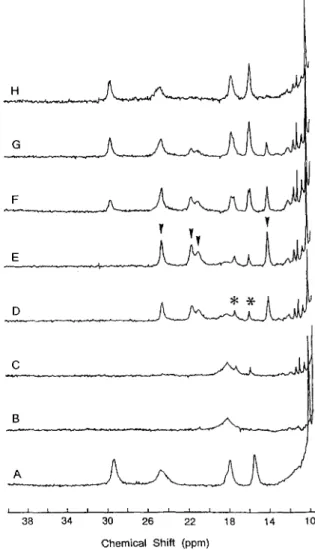
Fig. 2 shows a series of NMR spectra collected a t various stages of a redox cycle. ?)-ace B was obtained after anaerobic addition of dithionite to deoxygenated FdII,,. This sample was then reoxidized by admitting in six steps small amounts of air into the NMR tube until the final state of Fig. 2H was attained. It can be seen that a new set of four resonances at 24,21.5,21, and 14 ppm (arrows in Fig. 2 E ) appears and disappears during the reoxidation phase. At maximum (Fig. 2, E and F ) , the resonances attain approximately 60-70% of the intensity of the FdII,, resonances. During the latter phases of the oxidation (Fig. 2, F and G ) , the intermediate species is in slow exchange
equilibrium with FdIIc,x. The distribution of species is stable at each stage of the reoxidation; thus, unless more oxygen is added to the sample, the same spectrum is observed over a period of hours. Note that a small amount of [Fe4S412+ has been produced as witnessed by the appearance of weak resonances (marked by 'h) a t 17.5 and 16 ppm in Fig. 2, C-E. Closer inspec- tion of the trace in Fig. 2 0 shows that the intermediate species is also in slow equilibrium with FdIIR. Examination of the EPR spectra of the states of Fig. 2, E-H, revealed that the spectral intermediate yields an EPR spectrum, the g = 2.02 feature, indistinguishable from that of FdII,,. We will prove below with Mossbauer spectroscopy that the Fe& cluster of the spectral intermediate, FdIIinL, is in the same oxidation state as the cluster of FdII,,.
In order to test whether the formation of FdIIint depends on the nature of the oxidant, we have studied samples produced by oxidation of FdIIR with 2,6-dichlorophenolindophenol (Fig. 3B) or partial reduction of FdII,, with catalytic amounts of hydrog- enase under a hydrogen atmosphere (Fig. 3C); for the latter experiments, the solution potential was changed by variation of the partial pressure of the hydrogedargon mixture. For these experiments, the presence of mediator dyes was not required.
We have performed redox titrations to test whether the ap- pearance of FdIIint is associated with a redox process involving the disulfide bridge linking Cys-18 with Cys-42 or the bridge between Cys-11 with the putative methanethiol, recording the amplitude of the charge transfer band at 415 nm as a function of redox potential. For these studies we have monitored that an
1 ' I I I I I I I I I I I I I I
38 34 30 26 22 18 14 10
Chemical Shift (pprn)
FIG. 2. Low-field region of the 3Oo"Hz 'H NMR spectra of D.
gigas FdII at 303K. A, FdII,,. B , FdIIR a t pH = 8.6. C G , stepwise reoxidation by addition of small amounts of air. H , fully reoxidized sample. The (*I indicates the presence of a small amount of [Fe,S4l2+ obtained due t o cluster interconversion. The arrows in spectrum E in- dicate the four resonances that characterize the intermediate state, FdIIlnt.
equivalent amount of reducing agent was added by determin- ing optically the presence of hydrogefiydrogenase-reduced methyl viologen. The results are plotted in Fig. 4. Note that approximately three electrons per a-subunit are taken up when the potential is lowered from -50 mV to -200mV. It is known from Mossbauer spectroscopy and from electrochemical studies of other Fe3S4 ferredoxins that the Fe3S4 cluster is reduced by one electron (13, 14, 27). Thus, two electrons are taken up elsewhere, most likely for the reduction of a disulfide bridge.
We have considered the following four-state redox model.
SCHEME 1
In PI, the disulfide bridge is present and the cluster is in the state FdII,,. State P2 has the disulfide bridge reduced while the cluster remains in the oxidized state; this is the intermediate
NMR and Mossbauer Studies on Desulfovibrio gigas Ferredoxin
11
8055
32 28 24 20 16 12
Chemical Shift (pprn)
FIG. 3. Low-field region of the 3OO”Hz ‘H NMR spectra of D.
gigas FdII in the intermediate state obtained under different
experimental conditions. A , reduction with dithionite followed by partial reoxidation with air. A small amount of FdII, and some inter- converted [Fe,S,I2+ can be detected. B , reduction with dithionite fol- lowed by partial reoxidation with 2,6-dichlorophenolindophenol. The spectrum shows the presence of FdII,,, in equilibrium with FdIllnL. C,
partial reduction of Fdll,,, under hydrogenhydrogenase.
-350 -300 -250 -200 -150 -100 -50
E (mV)
tored by visible spectroscopy at 25 “C in 0.05 M Tris-HC1, pH 7.6.
FIG. 4. Redox titration with reduced methyl viologen moni- The graph indicates the percentage of cluster reduction as measured by the absorption changes a t 415 nm (0) as well as the number of methyl viologen equivalents consumed per monomer (*). The sample was al- lowed to equilibrate for 10-15 min between adjacent points. The solid
line is the theoretical curve (PI
+
P,) predicted by the four-state redox model, using a n Ess of -85 rnV and an EFd of -135 mV, while the dashed line gives the number of electrons consumed during the titration, 2P2+
P:s + 3P,.
FdIIint detected by NMR. The branches P2 + P4 a n d PI -> P,
would be monitored by the charge transfer band at 415 nm. The solid and dashed lines in Fig. 4 are curves computed for E’o,ss = -85 mV and E’0,fi-d = -135 mV. The value of EIO,Fd is in agreement with our earlier EPR titrations, E’o,Fd(EPR) = -130 mV (2, 3). The quoted standard potentials, assumed to be in- dependent, predict a maximum population for FdIIint, P2 = 63%, i n good agreement with the NMR data, P
-
60-70%. While the 415 nm absorbance change is well described by the simple model, the computed uptake of electrons is too high at potentials above -150 mV. Titrations with 5 times lower me- diator concentrations produced curves with kinks and shifts of up to 100 mV, suggesting that at lower mediator concentrations electrode equilibria were not established. Given the conforma- tional changes seen by NMR and by Mossbauer spectroscopy (see below), it is unlikely that the redox potential of FdII is the same in both branches of the four-state redox model. We have,therefore, considered interactions between the two redox cen- ters and have found that interaction potentials larger than 20 mV produce kinks in the theoretical curves which are not evi- dent in the experimental data. For the smaller potentials, the improvement in the quality of t h e fits was marginal. Since it is thus not entirely clear that the curves of Fig. 4 reflect true equilibrium conditions over the whole potential range (at
higher mediator concentrations the mediators interfere with the optical titration), we have not considered more sophisti- cated redox models. For the present purpose, the most impor- tant result is the observation that three electrons are taken up at potentials between -50 mV and -150 mV.
In order to test whether the disulfide bridge formed by Cys-18 a n d Cys-42 or t h e bridge between Cys-11 and the pu- tative methanethiol (as suggested by analysis of the x-ray structure (23)) is involved, we have performed the experiments described below based on the following information: two-di- mensional NMR studies (26) of the Fe4S, cluster in FdI show that all four irons are coordinated to Cys ligands ( 8 P-Cys proton resonances are observed); inspection of the x-ray struc- ture of FdII suggests that Cys-11 must be the ligand coordi- nated to the iron that is incorporated into the open cluster site when cluster conversion occurs; and molecular graphics simu- lations suggest that coordination of a cysteine from the remote Cys-18-Cys-42 pair would impose an awkward geometry. (If Cys-11 coordinates to the Fe4S4 cluster, the putative methane- thiol must have been liberated.) We attempted to remove the putative methanethiol by passing FdII after Fe3S4 Fe4S4
cluster conversion through a Sephadex column. This procedure was followed by reforming the Fells, cluster by ferricyanide treatment as described (5) and purification on a Sephadex col- umn. Subsequent NMR studies revealed spectra like those of Fig. 2. These experiments thus suggest that our FdII prepara- tion does not contain a Cys-11-methanethiol moiety.“ Instead, our experiments suggest that the two additional electrons are required to reduce the Cys-18-Cys-42 disulfide bridge.
In order to test this hypothesis, we have titrated FdII with the disulfide-forming reagent 4,4’-dithiopyridine. Reaction of this agent with two vicinal thiols can produce a disulfide bond, releasing 2 mol of 4-thiopyridone = 19,800 cm”) per
mol of 4,4’-dithiopyridine reacting (28, 29). Addition of 4,4’- dithiopyridine to FdII,,, did not produce detectable amounts of 4-thiopyridone, suggesting that the reagent does not react with Cys-11. We have observed that 4,4’-dithiopyridine reacts with reduced methyl viologen. Therefore, we have prepared reduced FdII samples by adding stoichiometric amounts of methyl vio- logen (3 reducing eq per protein monomer). We have observed t h a t a fraction of the FdII sample became reoxidized after ad- dition of 4,4’-dithiopyridine, up to 40-509, as judged by the optical absorption spectra. (This reoxidation is probably asso- ciated with a redistribution of the redox species as described in the proposed model.) Fig. 5 shows the result of 3 titrations with 4,4‘-dithiopyridine; as plotted, 100% of reaction corresponds to formation of 2 mol of 4-thiopyridone per mol of reduced FdII monomer after correcting for the presence of FdII,, (1 mol of 4,4‘-dithiopyridine can exchange with 2 mol of sulfhydryl to generate 2 mol of 4-thiopyridone and 1 mol of disulfide bridge). The data suggest formation of 1 mol of disulfide per mol of reduced FdII monomer. Optical spectra taken after completion of the titration and reoxidation gave no evidence for cluster destruction.
Mossbauer Studies-As discussed previously (131, the Moss- bauer spectra of FdII,, recorded at T > 50 K consist of one sharp
‘Molecular weight determination of Fdll with the electron spray method is incompatible with the presence of a methanethiol (J. Van Beeumen, B. Devries, A. L. Macedo, J. LeGall, I. Moura, and J. J. G. Moura, unpublished results).
8056
NMR and Mossbauer Studies on Desulfovibrio gigas Ferredoxin II
120 100 .- 80f
60 s 40 20 0 c Li
1 11-
0 0.5 1 1.5 2 2.5 3 equivalents of added 4-PDSsulfide bridge formed as determined by the absorbance due to FIG. 5. Plot of the percent of reaction (Le. the amount of di-
4-thiopyridone at 324 nm) versus the number of equivalents of
4,4’-dithiopyridlne added to FdIIR in three separate experi- ments.
doublet with quadrupole splitting, A E Q = 0.54 m d s , and iso-
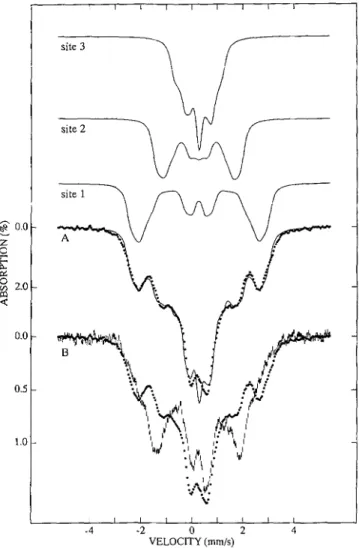
mer shift, 6 = 0.28 m d s (at 90 K), i.e. the three Fe sites experience the same electric hyperfine interactions. The mag- netic hyperfine interactions observed a t 4.2 K reveal, however, three distinguishable sites. Fig. 6A shows a spectrum of FdII, recorded at 4.2 K in a 45-mT field applied parallel to the ob- served y-radiation. We have studied the low temperature spec- tra in fields up to 8.0 T and analyzed the data with the S = 1/2 spin Hamiltonian
Ii
= pH.g.S+
2 ,
where i = 1,2,3 sums over the distinguishable sites and where all symbols have their conventional meanings. From extensive spectral simulations, we have obtained parameters that fit the entire data set reasonably well. Although we obtained this pa- rameter set already in 1987, we have not published our results, for a variety of reason^.^ However, for the present purpose, the theoretical spectra can serve to illuminate the differences be- tween FdII,, and FdIIint. The solid line drawn through the data of Fig. 6A is a fit to Equation 1; the contributions of the three sites are shown separately above the data.
We have studied three preparations of deuterated, 57Fe-en- riched FdII which were optimized with the aid of NMR to produce, by air oxidation of FdIIR, optimal concentrations of FdIIint. Each of the three samples contained four species. The spectra of the sample of Fig. 6B contained contributions of [Fe4S4I2+ (10%) and FdIIR (20%); by recording spectra under suitable conditions, these contributions were readily recog- nized and quantified. The spectra of FdII,, and FdIIint are more
MHz, -44 MHz), Az = (+13 MHz, +26 MHz, +26 MHz), and A3 = (-16 The simulations of Fig. 6 were generated with A, = (-28 MHz, -44 MHz, +4 MHz, +5 MHz). Guigliarelli et al. (21, 22) have proposed that the high-field tail of the g = 2.02 EPR signal results from mixing of the S = 3/2 multiplet into the S = 1/2 ground state by zero field splitting terms. This mixing depends on the ratios D J J , where the D, are the zero field splitting parameters of the Fe3+ sites. While mixing could move resonances to higher fields, explanation of the continuous EPR absorp- tion in the tail requires in addition that the D J J ratios are distributed. The A-tensor anisotropies deduced from the analysis of the Mossbauer spectra could be rationalized with suitable DJJ ratios. However, in the model of Guigliarelli et al. (21, 221, the A-tensors would be distributed a s well. A-tensor anisotropies as well as A-tensor distributions contrib- ute to the shapes of the Mossbauer spectra. It is very difficult to sepa- rate these contributions in the data analysis. Most importantly, how- ever, the conflicting reports of the magnitudes of the J-values need t o be reconciled.
I I 1 I I I I l l
I I I I I I I I I I
-4 -2 0 2 4
VELOCITY (mmls)
FIG. 6. Mossbauer spectra of 67Fe-enriched FdII from D. gigas
recorded at 4.2K in a 45-mT parallel applied field. A, spectrum of FdII,,. B , spectrum of FdII,,, (hash marks) prepared by subtracting contributions from FdIIR (20%), FdII,, (20%), and IFe,S,F FdI (10%) from the raw data. For comparison, the spectrum of FdII,, (full circles)
is plotted a s well. The solid line inA is a theoretical spectrum generated from Equation 1 with the following parameter set: g, = g, = g, = 2.0; site
1:
AE,
= 0.54 r n d s , r ) = 0.9,A, = -28 MHz,A, = -44 MHz,A, = -44 MHz, S = 0.28 m d s ; site 2:AE,
= 0.54 m d s , r ) = 1, A, = +13 MHz, A, = +26 MHz, A, = +26 MHz, 6 = 0.28 m d s ; site 3:AE,
= -0.54 m d s , r ) = 1.5, A, = -16 MHz, A, = +4 MHz, A, = +5 MHz, S = 0.28 r n d s .difficult to distinguish. However, by analyzing the spectra of the three preparations, with the view to produce the same spectral shapes for Fd1Iint, we have estimated that 20% of the clusters of the sample were in the state FdII,,. By subtracting the spectra of the listed “contaminants” from the raw data, we obtained the desired spectrum ( h a s h m a r k s ) of FdIIint (50% of
total iron in the sample) as shown in Fig. 6B. A comparison of the spectra of FdII,, (solid circles) and FdIIint ( h a s h m a r k s ) reveals differences in the spectra of sites 1 and 2; the spectra of site 3 lack resolution. One can readily recognize that the mag- netic splitting of site 1 has decreased while that of site 2 has increased. We will discuss this observation below in the frame- work of the spin-coupling model of Kent et al. (20) We have also examined the high temperature spectra of FdIIjnt; within the uncertainties, the quadrupole splittings and isomer shifts were found to be identical with those of FdII,,. This observation, together with the spectra of Fig. 6 B , proves that the Fe sites of FdIIint, like those of FdII,,, are high-spin Fe3+. Thus, the Fe3S4 clusters of FdII,, and FdIIint have the same core oxidation state.
NMR and Mossbauer Studies on Desulfovibrio gigas Ferredoxin
11
8057
DISCUSSION
We have demonstrated here with NMR and Mossbauer spec- troscopies that FdII passes through a stable intermediate state, FdIIint, in the course of a redox titration. The intermediate state exhibits four well-resolved contact-shifted protein reso- nances at 24, 21.5, 21, and 14 ppm and a 4.2K Mossbauer spectrum that is distinguishable from that of FdII,,. The Moss- bauer data demonstrate unambiguously that the iron sites of the clusters of FdIIint and FdII,, are in the same oxidation state. Redox titrations have revealed that approximately three electrons per a-subunit are taken up when the potential is lowered from -50 mV to -200 mV. One electron is accounted for by the reduction of the Fe3S4 c l ~ s t e r . ~ We propose t h a t t h e remaining two electrons are used to reduce the disulfide bond formed by Cys-18 a n d Cys-42. In this interpretation, the dif- ferences between the NMR and Mossbauer spectra of FdIIint a n d FdII,, reflect a change of the cluster environment when the disulfide linkage, approximately 13 A away from the center of
the cluster core, is broken. A pathway for transmitting the
change in the conformation of Cys-18 to the cluster is clearly indicated by inspection of the x-ray structure of FdII,, which shows that the carbonyl group of Cys-14 (a ligand to the clus- ter) is hydrogen-bonded to the NH group of Cys-18.”
Interestingly, square wave voltametric studies and redox ti- trations of FdI, the a , dimer containing an Fe4S4 cluster, do not reveal any redox activities at potentials above -350 m V t h e Fe4S4 cluster of FdI is reduced at a midpoint potential of E r o = -455 mV in a 1-electron reduction (2, 3). These observations suggest either that the FdI conformation does not allow the formation of a disulfide bridge or that redox activity is kineti- cally or structurally inhibited. Interestingly, Kissinger et al. (23) note in their perceptive analysis of t h e FdII,, structure that “Interconversion between the three-iron and four-iron
cluster would require a significant readjustment of the cysteine side-chain, and some adjustment of the main chain.” In biologi- cal systems, disulfides are either cleaved by pyridine nucleotide containing disulfide reductases, such as glutathione reductase, or by thiovdisulfide exchange reactions where the disulfide bond is transferred from one moiety to the other. Dithionite is a n exceedingly poor reductant of disulfides. Yet, the disulfide bridge of FdII is readily reduced by dithionite in the absence of mediators. This observation suggests that the reduction of t h e disulfide bridge is mediated by the Fe3S4 cluster which has a midpoint potential close t o t ha t of the thiovdisulfide couple.
As indicated above, the single crystals used for determina- tion of the x-ray structure contained FdII,, monomers (231, while our solution samples consist of dimers. It is thus conceiv- able that both clusters of the dimer participate in the reduction of a disulfide bridge. Kissinger et al. (23) have pointed out that the surface position of Cys-42 would make intermolecular dis- ulfide bonds possible during oligomer formation. Moreover, since Cys-11 is not coordinated to the Fe3S4 cluster, it is con- ceivable that it participates, as a reactant in the immediate vic.’nity of t h e Fe3S4 cluster, in the mechanism of the Cys-18- Cyi .42 disulfide bond formation. Clearly, site-directed mu-
tagenesis experiments could answer a variety of questions raised by the present study.
Kissinger et al. (23) have emphasized that t h e
D.
gigas FdIIthe cluster and be somehow accommodated in the ligand structure. This
One might consider that the other two electrons are also taken up by is unlikely because the Mossbauer spectra of reduced FdII and the
reduced Fe3S, cluster of ferredoxin from A. uinelandii ferredoxin are
essentially identical; for the latter protein, Burgess and co-workers (27) have shown that only one electron is taken up when the Fe& cluster is reduced.
‘
We are grateful t o Dr. J. B. Howard for alerting us t o this feature of the x-ray structure.folding pattern is remarkably similar to that of t h e 2[Fe4S4J ferredoxin from Peptococcus aerogenes. The disulfide bridge of FdII occurs in a region near the second Fe4S4 cluster of the I!
aerogenes ferredoxin. This has raised the question of whether the disulfide bridge in FdII is vestipal (23). The studies re- ported here show that the disulfide bridge undergoes facile redox reactions on the timescale (minutes) of the experiments reported here. Our observation suggests that redox activity involving Cys-18 a n d Cys-42 may be physiologically relevant. The observations described here may have additional signifi- cance in the light of recent findings (30-35) th at i n
D.
gigas flavodoxin and ferredoxin are not interchangeable and that FdII may have a function not yet fully understood.Finally, we wish to comment briefly on the difference be- tween the Mossbauer spectra of FdII,, and FdIIint. These dif- ferences can be illuminated with the aid of the spin-coupling model of Kent et al. (20) In this model, the exchange interac- tions between the iron pairs are described by the Hamiltonian
f l = JCS,
.S,
+
S ,
.S:, + S,.S,)+
dS,.S,+
&JS1.S,
(Eq. 2)where J1, = J , JZ3 = J(l
+
E), J I 3 = J(l+
E ’ ) , 0 < E < 314, and SI= S, = S3 = 5/2. Analysis of the Mossbauer spectra has sug- gested that E ’ << E. The two lowest multiplets have total spin S = 1/2. These are obtained by coupling S 2 a n d S S to an interme-
diate spin S‘ = 2 or 3, and then coupling S’ to SI to obtain the system spin S = 1/2. Since the Jij are assumed to be isotropic, the Hamiltonian of Equation 2 mixes only multiplets with the same spin. (There are only two
S
= 1/2 states.) The mixing of the two S = 1/2 states is described by one parameter, 0 < a < 1, which for E’ << E is given by a’ = (3/16)(~’/~)’. Analysis of the Mossbauer spectra of t h e Fe,S4 cluster of t h e ferredoxin fromAzotobacter vinelandii (20) has shown that a’ = 0.01, implying
that the ground state has essentially intermediate spin S’ = 2
( a = 0 ) . With the caveat that the cause of the magnetic anisotro-
pies of the ferric sites is not fully understood, comparison of t h e change of the splittings of sites 1 and 2 (the average A-value of site 3 is experimentally not well determined) suggests that a’
is slightly larger for FdIIjmt. Thus, the conformational changes sensed by NMR reflect in part a change in the E‘/E ratio.
Acknowledgments-We thank Dr. J. B. Howard for many stimulating discussions and P. N. Palma for support on molecular graphics meas- urements.
REFERENCES
1. Bruschi, M., Hatchikian, E. C., Le Gall, J., Moura, J. J . G., and Xavier, A. V. 11976) Biochim. Bio~hvs. , , Acta 449. 275-284
2. Cammack, R., Rao, K. K., Hall, D. O., Moura, J. J . G., Xavier,A. V., Bruschi, M., Le Gall, J . , Deville, A., and Gayda, J.-P. (1977) Biochim. Biophys. Acta 490, 3. Moreno, C., Macedo, A. L., Moura, I., LeGall, J., and Moura, J. J . G. (1993) J.
311-321
4. Thomson, A. J., Robinson, A. E., Johnson, M. K., Moura, J . J. G., Moura, I.,
Inorg. Biochem., in press
5 . Moura, J . J . G., Moura, I., Kent, T. A., Lipscomb, J. D., Huynh, B. H., LeGall, Xavier, A. V., and LeGall, J . (1981) Biochim. Biophys. Acta 670, 93-100
6. Gayda, J.-P., Bertrand, P., Theodule, F.-X., and Moura, J . J . G. (1982iJ. Chem.
J., Xavier, A. V., and Miinck, E. (1982) J . B i d . Chem. 257,6259-6267
Phys. 77, 3387-3391
7. Gayda, J. P., Bertrand, P., Guigliarelli, B., and Meyer, J. ( 1983 1 J . Chem. Phys.
8. Bertrand, P., Guigliarelli, B., Meyer, J., and Gayda, J.-P. (1984) Biochimie 66, 79, 5732-5733
77-79
9. Moura, J. J . G., Xavier, A. V., Bruschi, M., and Le Gall, J . 11977) Biochim.
10. Macedo, A. L., Moura, I., Moura, J. J . G., LeGall, J., and Huynh, B. H. (1993) Biophys. Acta 459, 278-289
11. Antonio, M. R., Averill, B. A,, Moura, I . , Moura, J . J . G., Orme-Johnson, W. H.,
Inorg. Chem. 32, 1101-1105
12. Day, E. P., Peterson, J., Bonvoisin, J. J., Moura, I., and Moura, J . J. G. 11988) Teo, B.-K., and Xavier, A. V. (1982) J. B i d . Chem. 257, 66466649
13. Huynh, B. H., Moura, J . J . G., Moura, I., Kent, T. A,, LeGall, J., Xavier, A. V.,
J . Biol. Chem. 263,3684-3689
14. Papaefthymiou, V., Girerd, J.-J., Moura, I., Moura, J. J. G.. and Miinck, E. and Miinck, E. (1980) J. B i d . Chem. 255, 3242-3244
15. Moura, I., Moura, J. J. G., Munck, E., Papaefthymiou, V , and LeGall, J. (1986) (1987) J . Am. Chem. Soc. 109, 4 7 0 3 4 7 1 0
8058
NMR and Mossbauer Studies on Desulfovibrio gigas Ferredoxin
I1
16. Surerus, K. K., Miinck, E., Moura, I., and Moura, J. J. G . (1987) J. Am. Chem. J . Am. Chem. Soc. 108,349-351
Soc. 109,3805-3807
17. Miinck, E., Papaefthymiou, V., Surerus, K. K., and Girerd, J.-J. (1988) in Metal
Clusters in Proteins (Que, L., Jr., eds) pp. 302-325, American Chemical Society, Washington, D. C.
18. Surerus, K. K. (1989) Mossbauer and Electron Paramagnetic Resonance Stud- ies of MFe& (M = Zn, Cd, Ga, Ni) and Fe& Clusters, Ph. D. thesis, University of Minnesota
19. Moreno, C., Macedo, A. L., Moura, I., Surerus, K. K., Miinck, E., LeGall, J., and Moura, J. J. G . (1991) Proceedings of the Third International Conference on
20. Kent, T. A,, Huynh, B. H., and Miinck, E. (1980) Proc. Natl. Acad. Sei. U. S . A. Molecular Biology of Hydrogenases Doia, July 29-August 1
77,65744576
21. Guigliarelli, B., Gayda, J. P., Bertrand, P., and More, C. (1986) Biochim. Bio- phys. Acta 871, 149-155
22. Guigliarelli, B., More, C., Bertrand, P., and Gayda, J. F! (1986) J . Chem. Phys.
85, 2774-2777
23. Kissinger, C. R., Sieker, L. C., Adman, E. T., and Jensen, L. H. (1991) J. Mol.
24. Mayhew, S. G . (1978) Eur. J . Biochem. 85,53&547
25. Clark, W. M. (1972) Oxidation-Reduction Potentials of Organic Systems, pp. 364-366, R. E. Kreiger Publishing Co., New York
26. Macedo, A. L., Palma, P. N., Moura, I., LeGall, J., Wray, V., and Moura, J. J. G .
(1993) Magnetic Res. Chem., in press
27. Iismaa, S. E., VAzquez, A. E., Jensen, G. M., Stephens, P. J., Butt, J. N., Armstrong, F. A,, and Burgess, B. K. (1991) J . Biol. Chem. 266, 21563-
28. Grassetti, D. R., and Murray, J. E , Jr . (1967) Arch. Biochem. Biophys. 119, 21571
29. Hunt, J., and Massey, V. (1992) J . Biol. Chem. 267, 21479-21485
4 1 4 9
30. LeGall, J . , DerVartanian, D. V., and Peck, H. D., Jr. (1979) Curt Top. Bioenerg.
31. LeGall, J., and Hatchikian, E. C. (1967) C. R. Acad. Sci. Paris 264,258&2583 32. Fauque, G., LeGall, J., and Barton, L. (1991) Variations in Autotrophic Life 33. Knight, E., and Hardy, R. W. F. (1966) J . B i d . Chem. 241,2752-2756
(Shively, J. M., and Barton, L. L., eds) pp. 271-337, Academic Press, London 34. Barton, L. L., and Peck, H. D., Jr. (1970) Bacteriol. Proc. 134
35. Chen, L., Liu, M. Y., and LeGall, J. (1993)Arch. Biochem. Biophys. 3 0 3 , 6 5 0 Biol. 219, 693-715