Build sustainable stakeholders’ interactions around Wine Tourism. A methodological approach for Douro region.
Josefina Salvado (*)
Rua de Santa Cruz, Nº 9, 3850-127 Albergaria-a-Velha
[email protected]
PhD in Tourism from the University of Aveiro. Postdoc scholar at UTAD –
University of Trás-os-Montes and Alto Douro – for the project “INNOVINE&WINE –
Vineyard and Wine Innovation Platform” and GOVCOPP (UA) researcher.
Veronika Joukes (
**)
UTAD/ECHS/DESG; CETRAD, Quinta de Prados, 5000-801 Vila Real
[email protected]
,
PhD in Social Sciences from the University of Trás-os-Montes and Alto Douro,
Portugal. Assistant Professor of the Tourism Bachelor at UTAD. As a full research
member of CETRAD working for the INNOVINE&WINE project. Department of
Economics, Sociology and Management of UTAD.
Acknowledgement: This research is part of the wider project INNOVINE&WINE – Vineyard and Wine Innovation Platform - Operation NORTE-01-0145-FEDER-000038, co-funded by the European and Structural Investment Funds (FEDER) and by Norte 2020 (Programa Operacional Regional do Norte 2014/2020 – Funding Reference: POCI-01-0145-FEDER-006971); and by European Structural and Investment Funds in the FEDER component, through the Operational Competitiveness and Internationalization Programme (COMPETE 2020) [Project No. 006971 (UID/SOC/04011); Funding Reference: POCI-01-0145-FEDER-006971]; and national funds, through the FCT – Portuguese Foundation for Science and Technology under the project UID/SOC/04011/2013.
Waiting Publication in
RT&D- Revista Turismo & Desenvolvimento Nº34
(Outubro/Novembro) 2020,
indexed to CAPES, Latindex, Dialnet, Scientific Indexing Services, EBSCO, CAB International, IndexCopernicus International, CIRET, Google Scholar e SCOPUS. ISSN: 1645-9261 |e-ISSN: 2182-1453
2
Build sustainable stakeholders’ interactions around Wine Tourism. A methodological approach for Douro region.
Abstract: Wine tourism represents a complex ecosystem, covering various fields of research, stakeholders’ interests, wine & food landscapes, territorial & cultural policies and business strategies. To enhance a sustainable rural wine tourism experience, all players must be synchronized with the territory development potentialities. The study focus on Douro territory (North of Portugal), the first wine region in the world to be demarcated and regulated (1756) and more recently, in 2001, due to its strong cultural identity, the Alto Douro Vinhateiro was classified by UNESCO as a World Heritage Site. This work started with a systematic literature review aiming to recognize different wine tourism sector angles and to identify best practices that could encourage responsible behaviour among all stakeholders to guarantee a balanced approach between business competitiveness and regional development. The survey revealed a suitable “Stakeholder Analysis (SA)” (Schmeer, 1999) whose guidelines we proposed to replicable for the Douro wine tourism sector. To assure a sustainable Douro Wine Tourism sector, all stakeholders must balance their own business goals and agendas with the territory development vision and adopt business cooperation strategies in order to generating benefits for all involved players.
3
1. Introduction
Wine is a significant business and an important food patrimony. When combined with tourism is viewed as a dominant/potential territorial development tool, integrating simultaneously the primary (agriculture), secondary (wine industry) and tertiary (tourism) sectors, emphasising the regional “touristic terroir” (Hall & Mitchell, 2002) uniqueness. The Wine Tourism is a complex ecosystem involving organizations’ networks stretching across numerous different spatial scales/industries/activities and connecting several types of stakeholders that combine different values, roles, interests, capabilities, practices, diversity of resources and ideas (Salvado, 2016).
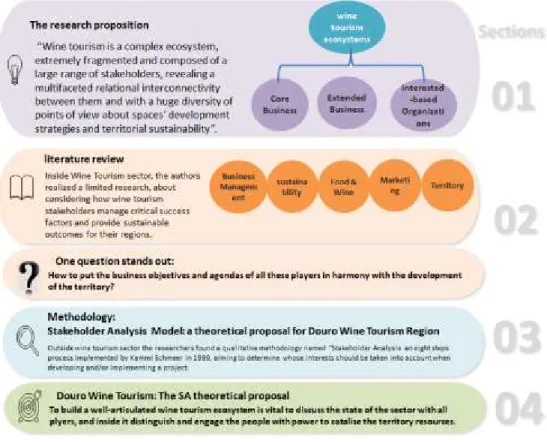
Starting from this framework, the article aims to seek a theoretical methodology to identity the Douro wine tourism key actors and find ways to assess their knowledge, interests, positions and alliances, allowing policymakers and business managers to interact more effectively with key stakeholders, in order to increase support/involvement for territory development. The research process is summarized on Figure 1, identifying the sections and main issues.
Figure 1 - Research process Source: Owned production
The authors did an extensive literature review (section 2) on wine tourism theories and they realized a limited research, about considering how wine tourism stakeholders manage
4
critical success factors and provide sustainable outcomes for their regions. The Turismo de Portugal (TP in future references) study noticed this reality (TP, 2014:11) revelling that only 57% of wine tourism companies had business relations with other non-core sectors, such as Tourism Recreation (30%), Travel agencies (29%), Hospitality (14%) and Restoration (12%). The affiliation with Institutional entities displayed 9%, mostly connected with Wine Routes (52%), Winemaking Regional Commissions (49%) and municipal players (45%). We advocate that in this complex ecosystem, all stakeholders gain from harmonizing their own business objectives with the development needs of the territory, applying value creation strategies in coopetition networks, as proposed by Salvado & Kastenholz (2017).
This review led the researchers to a qualitative methodology (Section 3) named “Stakeholder Analysis (“SA” in future references) an eight steps process implemented by Kammi Schmeer in 1999, on health reform in Ecuador and India, outside the tourism context, but an equally complex sector with regard to the number of players as in the wine tourism.
Following SA proceeding the INNOVINE&WINE1 project allowed us to reflect on this
theoretical model (Section 4), and best practice examples within and even outside a wine tourism context as well as to join information about de Douro region, in order to come up with practical solutions/proposals that can be implemented into the terrain in order to help the sector develop in a sustainable way.
In conclusion, to build a well-articulated wine tourism ecosystem of resources and actors, involving networks of organizations (that span different spatial and sectoral scales) and connecting various types of actors, (who have different values, roles, interests, skills, experiences, resources and ideas), it is vital to discuss the state of the sector with all partners and inside it, distinguishing and engaging the people with the power to significantly impact organization's health and territory sustainability.
2. Literature Review
Wine tourism represents a particular type of tourism, whose principal feature is given by the wine and the wine-production landscape. Morris and King (1997) reinforce this idea, referring the wine industry as one of a very few industries that is concentrated outside metropolitan areas, playing a vital role in regional development, employment generation, business growth, tourism and corporate investment. Getz (2000) maintains that wine tourism has the potential to provide a competitive advantage to regions with a grape and wine industry as well as to generate business for wineries and other related products, and can be a significant
1This research is part of the wider project INNOVINE&WINE – Vineyard and Wine Innovation Platform - Operation
NORTE-01-0145-FEDER-000038, co-funded by the European and Structural Investment Funds (FEDER) and by Norte 2020 (Programa Operacional Regional do Norte 2014/2020 – Funding Reference: POCI-01-0145-FEDER-006971); and by European Structural and Investment Funds in the FEDER component, through the Operational Competitiveness and Internationalization Programme (COMPETE 2020) [Project No. 006971 (UID/SOC/04011); Funding Reference: POCI-01-0145-FEDER-006971]; and national funds, through the FCT – Portuguese Foundation for Science and Technology under the project UID/SOC/04011/2013.
5
rural development factor, through the creation of jobs, the sale of local products, improvement of the regional tourism infrastructures and promotion of investment in multiple fields (Kastenholz & Figueiredo, 2014; Pellin & Vieira, 2015).
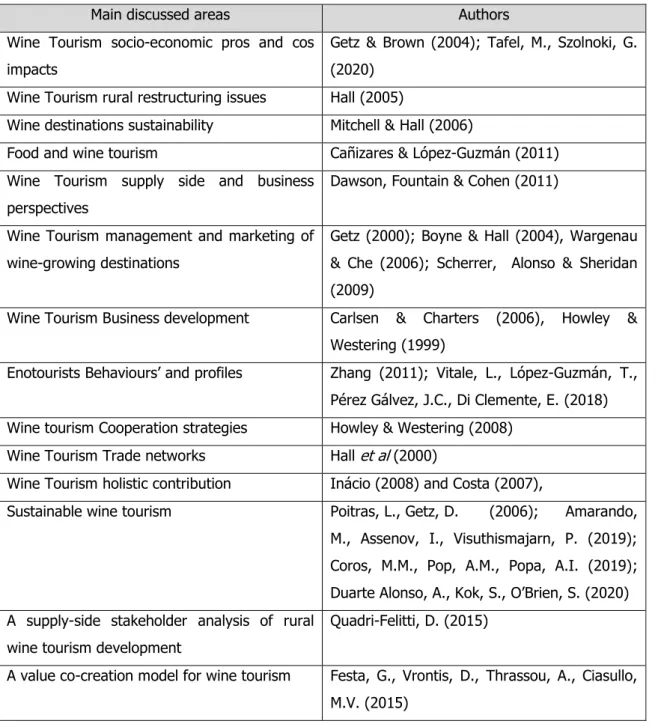
Hall et al. (2000) advocate that wine tourism has the potential to contribute to regional development in rural areas and has increased in importance in recent years. Simultaneously there is a perceived need to retain or attract people in many rural areas, especially those witnessing rural exodus because agriculture can no longer maintain the aspects of traditional rural lifestyles, nor high production rates, nor conserve the rural landscape (Eusébio, Kastenholz & Breda, 2016). Other (this is not an exhaustive list) researchers tried to answer the question “how to develop Enotourism?” giving us their perspectives, as in Table 1.
Table 1 – Wine Tourism theoretical perspectives
Main discussed areas Authors
Wine Tourism socio-economic pros and cos impacts
Getz & Brown (2004); Tafel, M., Szolnoki, G. (2020)
Wine Tourism rural restructuring issues Hall (2005)
Wine destinations sustainability Mitchell & Hall (2006)
Food and wine tourism Cañizares & López-Guzmán (2011)
Wine Tourism supply side and business perspectives
Dawson, Fountain & Cohen (2011)
Wine Tourism management and marketing of wine-growing destinations
Getz (2000); Boyne & Hall (2004), Wargenau & Che (2006); Scherrer, Alonso & Sheridan (2009)
Wine Tourism Business development Carlsen & Charters (2006), Howley & Westering (1999)
Enotourists Behaviours’ and profiles Zhang (2011); Vitale, L., López-Guzmán, T., Pérez Gálvez, J.C., Di Clemente, E. (2018) Wine tourism Cooperation strategies Howley & Westering (2008)
Wine Tourism Trade networks Hall et al (2000)
Wine Tourism holistic contribution Inácio (2008) and Costa (2007),
Sustainable wine tourism Poitras, L., Getz, D. (2006); Amarando,
M., Assenov, I., Visuthismajarn, P. (2019); Coros, M.M., Pop, A.M., Popa, A.I. (2019); Duarte Alonso, A., Kok, S., O’Brien, S. (2020) A supply-side stakeholder analysis of rural
wine tourism development
Quadri-Felitti, D. (2015)
A value co-creation model for wine tourism Festa, G., Vrontis, D., Thrassou, A., Ciasullo, M.V. (2015)
6
Opportunities and challenges in the contribution of wine routes to wine tourism
Festa, G., Shams, S.M.R., Metallo, G., Cuomo, M.T. (2020)
Source: Own production based on above authors
So, given the diversity of perspectives and a large range of players involved, we can consider the wine tourism as a complex ecosystem (Figure 2) as stated by Salvado & Kastenholz (2017).
Figure 2 - Wine Tourism Ecosystem Model Source: Salvado & Kastenholz (2017: 1927)
The success of this activity in rural areas depends firstly on “Wine Tourism Pillars” (Wine Culture, Territory/ Landscape and Tourism). Vineyard and wine are parts of territory cultural heritage, connected to history and it has been an essential element for economic, social and cultural development of different wine regions. The Wine Culture has grown as part of life, culture and diet since immemorial times. As a cultural symbol the wine importance has changed over time, moving from an imperative source of nutrition to a cultural complement to food and conviviality, compatible with a healthy lifestyle. Promoting the Wine Culture means authenticity to the origins, and a product strongly linked to gastronomy, taste pleasures and heritage.
All three elements combine a large range of different stakeholder’s, with diverse interests and support the creation of innovative products, activities and experiences (to get business competitiveness), that promote the discovery and interpretation of food patrimony landscape (to deliver authenticity) and catalyse business and regional development (to build sustainability).
7
The second level “Wine Tourism Core Business”, considered the blood of the business, involving a vital group of players: a) Wine Tourism Core Providers (Vineyards /Farms; Wineries/ Cellars Owners; Shops/tasting rooms/ wine museums); b) Distribution Channels (Tour Operators/ Travel Agencies/ DMC’s; OTA – Online Travel Agencies; wine distribution); c) Direct Suppliers: Wine Cluster; Gastronomy Cluster; Hospitality Cluster; Professional team; animation companies; tour guiding)
The third level “Wine Tourism Extended Business” includes the “extended enterprise”. According Dyer (2000), “extended enterprise” refers to a value chain in which the key players have created a set of collaboration processes that allow them to achieve virtual integration and work together as a blended team. Enlarging the view of the business supply chain is crucial to include a) Wine Tourism Direct Customers (customer Segmentation B to C); b) Wine Tourism indirect Customers (customer Segmentation B to B); c) Suppliers of Complementary regional products/services; d) Access (Transports, signage, accessibilities, …); e) Attractions (activities related with territory, food, joy and landscape; f) Wine Events (Wine workshops/seminars/wine tasting courses); g) Built/Man-made Attractions (Historical or cultural significance/ recreation, Galleries, Museums, Theatres, Theme Parks, Water Parks, Wildlife Parks, Zoos, Leisure Centres, Shopping Malls, Visitor Centres, …); h) Handicraft; i) Other Suppliers: TIC; Information and Welcome; Security; Visitor statistics.
The fourth level “Wine Tourism interest-based organizations” involves several stakeholders, such as: a) Local Communities (associations/ art companies); b) Social Environment (Demographic/ Professions/ Education); c) Government and legal Environment (Taxes, subventions, government, regulators); d) Research Insights (Universities, investigation centres); e) Coopetition entities (Investors, Trade Unions); f) Tourism entities (UNWTO, TP, Treaties, Regulations, Directives, Decisions, Recommendations, Opinion); g) Financial entities (Europe; Portugal); h) Other business ecosystem Stakeholders, such as opinion leaders, not directly involved in the business operations, but with a significant effect on the success of the business.
This wine tourism ecosystem model clearly shows the large number of stakeholders and the complementary among them. This concept can be seen from different perspectives: as any group or individual that may affect or be affected by the achievement of the organization's objectives (Freeman, 1984/1994), or as groups or individuals who have an interest in the organization’s activities and who have the capacity to influence it (Savage et al., 1991, and Bourne & Walker, 2005), or as those who control critical resources (Frooman, 1999), or as groups of consumers, suppliers, employees, government, legislators, local communities, competitors, interest groups, media and shareholders (Timur, 2005). Considering the vast array of players each one with private aims, ambitions, objectives, personal agendas, etc, the wine
8
tourism stakeholders should be seen as a win-win relationship ecosystem, linking the different players’ interests (Mitchell et al., 1997).
In Portugal, a holistic contribution to wine tourism knowledge with multidimensional impacts was provided by Costa (2007) and Inácio (2008), associating wine routes with cultural heritage and community participation, giving rise to a new logic of a more inclusive territorial development. This angle points out that wine tourism products need to have a local identity and a cultural heritage symbol, which could turn wine regions into strong wine tourism destination icons.
Due to the interdependence that exists between all these players, a successful implementation of an ecosystem-based management depends on the identification and understanding of different stakeholders, their practices, expectations and interests. This means that stakeholders cannot act independently and should consider taking into account other transversal activities and working towards the implementation of a common vision and development policies in order to achieve sustainable territorial development. To achieve an effective integration between business wineries’ interests, tourism objectives and regional development, all stakeholders must integrate national, regional/local policies and frameworks that recognize the sector as an important vehicle for managing the cultural, social and natural heritage; commit all stakeholders to sustainable development; introduce a sense of pride and responsibility to local communities regarding their identity and singular heritage values; promote regional planning, supported by a large, participative stakeholder group; promote quality tourism products and services that encourage responsible behaviour among all stakeholders; set priority projects for developing creative wine tourism products/services; identify strategic opportunities for economic growth and job creation inside the region; implement business and innovative plans that embrace sustainable wine tourism (Salvado & Kastenholz, 2017).
So, policymakers, company/destination managers and communities can use the stakeholder analysis (SA) to identify the key actors and to assess their knowledge, interests, positions, alliances, and importance to integrate their goals within territorial strategies. This allows these players to interact more effectively with wine tourism key actors and to increase support for a given regional development program.
3. Methodology
The research starting proposition considered “wine tourism is a complex ecosystem, extremely fragmented (Goeldner & Ritchie, 2006) and composed of a large range of stakeholders (Salvado, 2016), revealing a multifaceted relational interconnectivity among them and sharing a wide range of viewpoints on space development strategies and territorial sustainability”. The literature review led the researchers outside the tourism sector, to a
9
qualitative methodology named “Stakeholder Analysis (“SA” in future references) an eight steps process implemented by Kammi Schmeer in 1999, on health reform in Ecuador and India, but an equally complex sector with regard to the number of players as in Douro wine tourism.
The Stakeholder Analysis as a qualitative methodology and also a process can be replicated to the Douro wine tourism sector (Figure 3) helping policymakers and business managers to Build strong sustainable stakeholders’ interactions (i), through: strategic opportunities identification, players strong commitment, national/regional policies integration, a sense of pride introduction and stakeholders involvement, and Promote Wine Tourism as cultural heritage (ii) through: Safeguard of cultural patrimony, Stimulation of food heritage events, sponsoring food & drink experiences, locals involvement and creative traditions dynamics & 5 senses experiences.
Figure 3 – Wine Tourism Stakeholder Analysis Source: Own production based on Schmeer (1999)
Based on the above rational will be possible to better prepare all players to fulfil the eight Steps information: 1. Planning the SA process; 2. Defining the project guidelines; 3. Identifying wine tourism key stakeholders; 4. Adapting the project tools; 5. Collecting and recording the information; 6. Filling in the stakeholders’ table; 7. Analysing the stakeholders’ table, and 8 Using information, in a process of systematically assembly and evaluating
10
qualitative information to determine whose interests should be taken into account when developing and/or implementing a project.
So, Policymakers and managers can use the stakeholder analysis to identity the key actors and to assess their knowledge, agendas, positions, alliances, and importance related to the project, determining whose interests should be taken into account when the implementing time occurs. So, all enotourism stakeholders (individually and as a group) must understand their role and their mutual importance inside the ecosystem in order to develop the territory and promote the wine & food heritage, in order to guarantee themselves a more sustainable future in their region.
4. Douro Stakeholder Analysis Model: a theoretical proposal
The Douro Stakeholder Analysis is a process of systematically gathering and analysing qualitative information about Douro region, in order to build a strategic territory development consensus. The working group should identify the specific steps to be taken, the local regions where the process take place, build all interview materials, affect tasks to the research team and establish a timeline for the whole SA process. As a matter of fact we describe the research model we intend to propose implement in this region.
Each step will be introduced by a general description of what it is about and in a second part the Douro region specificities.
Step 1 - Planning the SA process:
This step starts with North of Portugal characterization (Figure 4) and Douro Region competitiveness (i) and Wine & Food Tourism as a cultural and regional development tool (ii). (i) Tourism is recognized as one of the key sectors of regional development in several countries and a major source of income, job and wealth creation. It also plays a crucial role in promoting the destination image and builds international perception of a country as well as it influences complementary domestic policies. With multidimensional impacts, the new tourism will be able to improve innovative structural processes of geographical change, build a significant social production, create more balanced redistribution of wealth, improve income and increase the population’s living conditions. Reinforcing the above idea and according the OECD “Tourism competitiveness for a destination is about the ability of the place to optimize its attractiveness for residents and non-residents, to deliver quality, innovative, and attractive (e.g. providing good value for money) tourism services to consumers and to gain market shares on the domestic and global market places, while ensuring that the available resources supporting tourism are used efficiently and in a sustainable way” (OECD, 2013:7).
11
Figure 4 - NUT II (North of Portugal Region) & NUT III Source: ccdr-n(2018)
For this study it was vital to start with a characterization on the North of Portugal territory in administrative and competitive terms. Therefor data of the CCDR-N (Northern Portugal Regional Coordination and Development Commission, 2018) were used, a public institution that aims at the integrated and sustainable development of the North Region of Portugal, thus contributing to the country’s competitiveness. According to the CCDR-N the North of Portugal (Figure 4) is composed of 86 municipalities, accounting with 3.6 million inhabitants, 54% of the national working population, and accounting with 17 billion € in exports.
Figure 5 - Douro Valley (North Portugal)
Source: https://www.cellartours.com/portugal/portuguese-wine-maps/douro-valley On the northeast of this region the “Douro”, is located along the International Douro river basin, surrounded by mountains that grant it geological and particular climatic characteristics as
12
a consequence of its rugged orography. It is divided into three sub-regions: Baixo Corgo, Cima Corgo and Douro Superior (Figure 5), producing in each one of them white, red and rosé wines, sparkling wines, liqueurs and still wine spirits with their own specificities. Over many centuries, “Douro” was a Port Wine symbol, inseparably linked to the Douro valley, called after the river that is born in Spain and flows into the Atlantic Ocean in Porto. Of the total volume of vines produced in the Demarcated wine Region of the Douro, around 50% is destined to the production of "Port wine", while the remaining volume is destined to the production of high quality wines that use the denomination of controlled origin “Douro” or "Douro Wine".
The "Port Wine" is distinguished from the common wines by its particular characteristics: a huge diversity of types each one surprising with a wealth and intensity of incomparable aromas and a very high persistence, both of aromas and of taste, besides a high alcohol content (generally between 19% and 22% vol.), in a wide range of "sweetness" and a great diversity of colours.
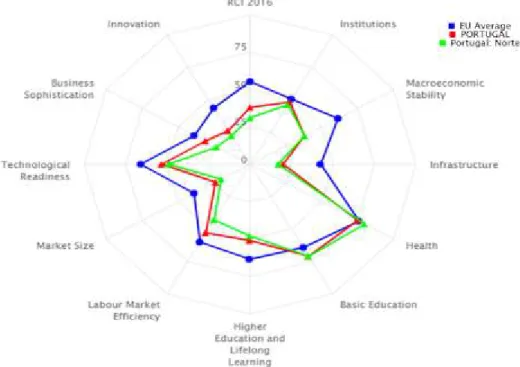
The northern region of Portugal (NUT II) which is Level II of the Nomenclature of Territorial Units for Statistical Purposes (NUTS), approved by the European Commission, will facilitate the comparison of the various 74 Regional Competitiveness Index (RCI) indicators, covering a wide range of issues including innovation, governance, transport and digital infrastructure, and measures of health and human capital. The RCI is the first measure providing a European perspective on the competitiveness of all NUTS 2 regions in the European Union (EU) and is described in different dimensions, (I) Basic, (II) Efficiency and (III) Innovation, allegedly linked: a good performer in the Innovation group is expected to also be a good performer in the Efficiency and the Basic groups as they are instrumental to increasing levels of competitiveness (RCI, 2016). With RCI it is possible to monitor and assess a regions’ development and compare it with other regions, in terms of GDP (Gross domestic product) per capita and stage of development. The regional dimension is important because most competitive factors are not equally distributed over space and many are influenced or even determined by regional and local policies.
The RCI basic dimensions include five pillars (1) Institutions, (2) Macroeconomic Stability, (3) Infrastructures, (4) Health, and (5) Quality of Primary and Secondary Education. The Efficiency Dimension includes three pillars (6) Higher Education, Training and Lifelong Learning, (7) Labour Market Efficiency, and (8) Market Size. The Innovation Dimension consists of three pillars: (9) Technological Readiness, (10) Business Sophistication and (11) Innovation. The EU regions are divided into ‘medium’, ‘intermediate’ and ‘high’ stages of development, classified according their regional GDP per head in PPP (purchasing power parity): the threshold which defines the medium level is a GDP per head below 75% of the EU average, which is also the threshold used by the European Commission for cohesion policy to identify regions eligible
13
for the Convergence Objective. Based on this methodology it is possible understand the regional competitiveness index of the North of Portugal.
The RCI of the North of Portugal (Figure 6) shows a 31.3 % global RCI 2016 score when compared with EU (100%) average rate and its rank position is 203/263. In terms of GDP the score of North Portugal is 64% and its rank position 216/263, placing the region in a low position when compared with other EU regions. Detailing the three main North region indicators: The “Basic Dimension” achieved a 192/263 rank position. The five pillars that contribute to this positioning indicator were: (1) Institutions (162/263), (2) Macroeconomic Stability (26/28), (3) Infrastructures (191/263), (4) Health (144/263), and (5) Quality of Primary and Secondary Education (10/28). The “Efficiency Dimension” revealed a 218/263 rank position. The three pillars that contribute to this positioning indicator were: (1) Higher Education & Training and Lifelong Learning (228/263), (2) Labour Market Efficiency (214/263), and (3) Market Size (182/263). The “Innovation Dimension” showed a 202/263 rank position. The three elements that contributed to this positioning indicator were: (1) Technological Readiness (189/263), (2) Business Sophistication (199/263) and (3) Innovation (200/263). (RCI, 2016). All these results give us a general idea about the “North” region’s strategic position, revealing its fragile competitiveness situation.
Figure 6- Regional Competitiveness Index (RCI) – Portugal (Norte) 2016 Source: own work, based on RCI 2016
The vineyards of the Demarcated Douro Region occupy 20% of the total wine producing area in Portugal, but almost all the wine produced is of DOP (Protected Denomination of Origin) quality
14
and therefore the Douro wine represent 51% of the Portuguese DOP wine production (Figure 7 & Table 2).
Figure 7 - Portuguese Wine Regions Characterization
Source: Own production based on IVV - Instituto da Vinha e do Vinho, I.P (2018) statistics. The Table 2 details the Figure 7 information, showing other Portuguese wine regions areas and production numbers.
Table 2 – Portuguese Wine Regions Characterization (detailed)
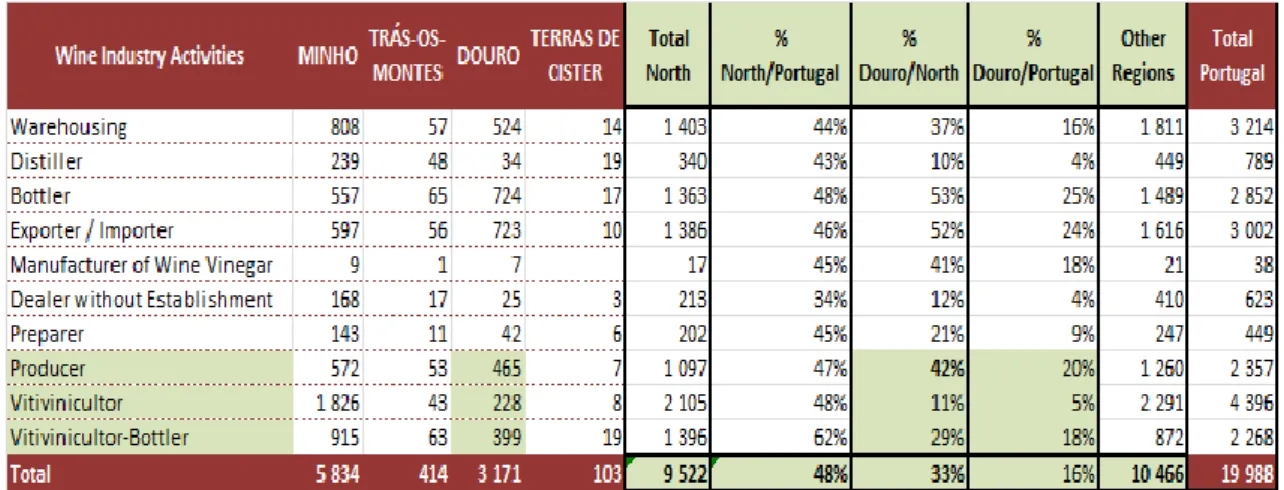
Source: Own production based on IVV - Instituto da Vinha e do Vinho, I.P. (2018) statistics. In the period 2017/2018 the Douro area produced 1,448,874 hectolitres (21.7%) of Port Wines and Douro Wines (red, white, rosés, and sparkling, fortified and late harvest wines). The wine industry involves 19988 Economic Agents in the Wine Sector (2016), divided in 10 activities such as: warehousing, distiller, bottler, exporter & importer, manufacturer of wine vinegar, dealer without establishment, preparer, producer, vitivinicultor, vitivinicultor-bottler.
The powerful North of Portugal wine industry represents 48% of the national economic agent’s numbers (with 52% for all other regions Centro, Área Metropolitana de Lisboa, Alentejo, and Algarve), and Douro region contributes with 16% (Table3). Analysing the Douro compared with
15
the North region in terms of economic agents, the significant 33% showed (with 42% wine producers; 53% Bottler; 52% Exporter/Importer). This strategic sector has the power to leverage the northern and the national economies.
Table 3 - Economic Agents in the Wine Sector (2018)
Source: Own production based on IVV - Instituto da Vinha e do Vinho, I.P. (2018) Economic agents statistics.
So we perceive the existence of a large number of players with different objectives, inside the wine industry to which we must add those related to wine tourism. According to the most recent study carried out by the national tourism board Turismo de Portugal, "Wine tourism in Portugal" (TP, 2014) which characterizes the supply and demand of the wine tourism industry, about 57% of the companies have partnerships with other private entrepreneurs, namely tourist entertainment companies and travel agencies. However, the companies prefer not to cooperate with public tourism responsible: 50% doesn’t work with the Regional Tourism Promotion Agencies, 38% doesn’t reach out to TP and 34% neither collaborates with the Regional Tourism Entities.
(ii) Another important issue is the cultural valorisation of wine & food heritage, being a great strategic tool to promote the wine-growing territory as a tourism destination. As Santos & Cunha (2008) refer, the strong association of local products to tourism serves as an identity reference and being relevant for local sustainability and development. For these authors, all stakeholders must understand the traditional culture, the local values, and people aspirations. According the World Food Travel Association Report (2019: 12) the “most benefit of food tourism is to attract more visitors”, “can benefit local residents, businesses, and visitors in a variety of ways” and also “can even play a larger role in society by bringing people together for a common goal”. This report showed that successful food tourism can also create cross-cultural connections between visitors and locals (95%), local agricultural producers (82%) and promoting peace between cultures (95%).
16
So, what kind of strategies must wine & food stakeholders use to mobilize the community in an innovative way, to solve potential internal conflicts and to find compensations for inequities produced by impending social and economic changes? How to reconcile private objectives and also territorial development, in a sustainable way? The answer might be obtained through a stakeholder analysis methodology.
With this methodological tool, we are able to discuss on wine tourism policies, arguing about their regional and specialized scientific knowledge needs, catalysing knowledge, and we’ll be able to produce practical innovative processes.
Step 2 – Defining the project guidelines: For a stakeholder analysis to be useful, it must be focused on a specific policy or issue. Search, Choose and Study the UNESCO, National, Regional and Sectorial Wine Tourism related Policies (Table 4).
Table 4 – Main Tourism related Policies
(i) UNESCO – United Nations Organization for Education, Science and Culture (ii) National: ENEI – National Strategy for Smart Specialisation
(iii) Regional: EREI – Regional Strategy for Smart Specialisation (iv) Sectorial: TURISMO 2020 – Five principles for one ambition Source: Own elaboration.
(i) UNESCO – United Nations Organization for Education, Science and Culture
UNESCO’s cultural activities strive for the safekeeping of cultural heritage, the stimulation of creation and creativity and the preservation of cultural entities and oral traditions. This entity has been promoting tangible and intangible heritage, particularly through the 2003 UNESCO Convention for Safeguarding Intangible Heritage2 and the 1972 UNESCO Convention
on Protection of World Cultural and Natural Heritage. Its aim is to contribute to the valorisation of the most relevant heritage in our history, giving people a sense of ownership of cultural heritage and its historical value. On the other hand, the 2005 UNESCO Convention, which came into force on 18th March 2007 and of which the EU is part, highlights that activities, goods and
cultural services have an economic and cultural nature, because they pass on identities, values and meanings and should not be treated as having only commercial value. The aim of this Convention was to strengthen international cooperation, including international coproduction and coding agreements and solidarity to favour the cultural expression of all countries and individuals. It is also stated that special attention should be given to the special circumstances and needs of various social groups, including people belonging to minority groups. Therefore, a support programme for the cultural and creative sectors should promote social diversity at an international level, according to the Convention.
17
(ii) National Smart Specialisation Strategy (ENEI)3
According to ENE’s vision for 2020, Portugal must consolidate or bring to the forefront its leadership in green economy, digital economy, and blue economy through the use and development of the advantages acquired in information and communication technologies and in new materials, and through sustainable exploitation of endogenous resources, such as the sea, forestry and minerals. Emphasis is given to major societal challenges such as climate change, risk mitigation, biodiversity, water, and ageing, in coordination with sectorial strategies (sea, energy, tourism, agro-food and forestry...). There is great potential for value differentiating endogenous resources with high added value, such as agro-food.
(iii) Regional Smart Specialization Strategy (EREI)4
This network encompasses Thematic Operational Programmes (5 regions: North, Centre, Lisbon, Alentejo and Algarve), Regional Operational Programmes in the Autonomous Regions (Azores and Madeira) and Rural Development Programmes, amongst others. As for the regions, there is integration between the RIS (Research and Innovation Strategy for Smart Specialization), the Regional Action Plan (RAP) and the Regional Operational Programme (ROP). There is a unique plan in each region designed according to the potential of the endogenous resources and infrastructures of the areas and the regional agents that they include. They aim to consolidate the regions as innovative spaces, mobilizing individual and collective potential.
(iv) Sectorial – Tourism Strategy 2027 5
Five principles harmoniously aligned to fulfil the ambition to transform Portugal into a more agile and dynamic tourist destination in Europe were defined for 2020: People, Freedom, Openness, Knowledge and Collaboration. The operational logic encompasses qualification (to grow more than the competition) and competitiveness (to be in the top 10 most competitive destinations in the world) ambitions for Portugal as a destination in the areas of sustainability, quality and competitiveness. On the other hand, the aim is an entrepreneurial, effectively managed destination linked to the world, and a destination that with its own stamp, whose promotion and commercialization strategies must arise from technical, not political, visions in order to achieve efficiency.
So, the research team wonders how they can contribute to foster an effective integration among policies, business wineries interests, tourism objectives and regional development inside the Douro region, in consonance with the all these directives.
3
https://www.portugal2020.pt/Portal2020/Media/Default/Docs/EstrategiasEInteligente/ENEI_Vers%C3%A3o%20final.pdf
4 EREI- Regional Smart Specialization Strategy in
https://www.portugal2020.pt/Portal2020/programas-operacionais-portugal2020-2
5 Turismo Portugal Estratégia Turismo 2027 in
18
Step 3 - Identifying key stakeholders: the research team develops a list of all possible stakeholders related to the policy/program. The range of stakeholders relevant to consider for analysis varies according to the complexity of the project area targeted. Stakeholders can be of any form, size and capacity, as showed in figure 1. The research team when studying stakeholders in an Enotourism ecosystem environment needs to pay more attention to managing all the specific groups: user groups, interest groups, beneficiaries, decision-makers, and those excluded from decision making. Groups can consist of many sub-groups which should be analysed separately, according to their interests and importance to the project. The stakeholder analysis also identifies “Key Stakeholders” namely actors who have significant impact on the project and its success. The working group should identify the specific steps to be taken, the local regions where the process takes place, build all interview materials, affect tasks and establish a timeline. To identify all wine & food tourism stakeholders the research team must interview the local players, classifying them by activity areas. This methodological tool will increase the discussion about wine & food tourism policies, arguing about the regional specialization and scientific knowledge it will also foster practical innovation processes. Thus a debate among managers, policy makers and stakeholders, will be encouraged, as they should search for a consensus regarding their actions. Once the stakeholders are chosen, they will be contacted and a database with the stakeholders’ names, addresses, and phone numbers will be filled out. The expected results will allow the identification of a diverse group of stakeholders, who share a constructive critical vision on the sector, generating feasible ideas and working plans for regional sustainability development. Thus, a list of priority stakeholders should be identified as wine tourism “Key Stakeholders” representing the Douro Wine Tourism Ecosystem. Step 4 - Adapting the tools: The research team will plan to interview the priority stakeholders identified to gain accurate information on their positions, interests, and ability to affect the project. Once the working group has chosen and defined key stakeholder characteristics, a standard questionnaire should be developed for interviewing stakeholders. The objective is to gain accurate information on their positions, interests, and their ability to influence the project. A list with the following items will be built: I.D. Number, Sector and Organization, Internal/External Interest, Alliances, Resources, Leadership, Position: Supports/Opposes/Neutral, Power and Policy Knowledge. The research team will find four major attributes to characterize the Stakeholder’s profile: the stakeholders’ position on the project; the level of influence (power) he attaches to the project area; the level of interest he has in the specific area of the project; and the group/alliance to which he belongs or can reasonably be associated with. The Douro stakeholders’ have the ability to block or promote a project/idea, join with others to form a coalition of support or opposition, and lead the direction/discussion of the project.
19
Step 5 - Collecting and recording the Information: The research team will interview the selected key stakeholders, collecting and recording the information. Several methods can be used to collect data in a comprehensive and efficient manner. A first method is to conduct interviews directly with the stakeholders involved in the studied area. Another method is to interview local experts who are knowledgeable in this field and are acquainted with the important groups and individuals involved in that area. Important tools in this phase are interviews, questionnaires and protocols. The results will show the complex relational interconnectivity between stakeholders within the Douro Enotourism Ecosystem.
Step 6 - Filling in the stakeholders’ table: The research Team will fill out a Stakeholder Table systematizing all the information obtained from interviews or questionnaires and develop a clear comparison among the different stakeholders, cataloguing and presenting in charts and/or matrices. To foster strategic responses, the Douro enotourism stakeholders could be categorized by their power and salient attributes, such as a) Promoters: Stakeholders who attach a high priority to the project policy and whose actions can have an impact on the implementation of the policy; b) Defenders: Stakeholders who attach a high priority to the project policy but whose actions cannot have an impact on the implementation of the policy; c) Latents: Stakeholders whose actions can affect the implementation of the project policy but who attach a low priority to this policy; d) Apathetics: Stakeholders whose actions cannot affect the implementation of the project policy and who attach a low priority to this policy. This task will provide answers about the complex relational interconnectivity among stakeholders within the enotourism ecosystem in the Douro region. The final result will be the construction of a map with salient interest and influence attributes. This matrix will provide a shorthand categorization and analysis of whether stakeholders will gain or lose from a proposed reform and whether they can significantly impact the process.
Step 7 - Analysing the stakeholder’s table: The research team will analyse Stakeholder’s Table, classifying the stakeholders according to three major attributes: Power - to influence the organization or project deliverables (coercive, financial or material, brand or image); Legitimacy – of the relationship & actions in terms of desirability, properness or appropriateness; and Urgency – of the requirements in terms of criticality and time sensitivity for the stakeholder. They will examine the position of all the stakeholders and measuring their potential support or opposition for the proposed project. It is reminded that these attributes will be identified through various data collection methods, including interviews with experts knowledgeable about the stakeholders or with the actual stakeholders directly. Based on the combination of these attributes, different priority levels can be assigned to the stakeholders. With this accurate analysis, the researchers will be able to divide the stakeholders into three groups: Group 1: Those who have leadership and high power (level 3); Group 2: Those who have leadership and medium power (level 2); Group 3: Those who do not have leadership but have high to medium
20
power (level 2 or 3). The Stakeholder’s Table enables a scenario-building process and discussion, helping task teams determine appropriate responsive strategies. It is also possible to reveal, and potentially assist in reducing the power imbalance among weaker groups and strategies may be tailored to address their concerns.
Step 8 - Using information: The research team will use the collected information to influence decision-making processes inside the Douro region and help to identify the best parties. The dissemination of stakeholder analysis will be done through specialized curses, conferences, regional seminars, national and international technical missions and a best practices manual. The research team will be able to help the Enotourism sector to build a common vision and mission. The authors suggest some of the following subjects: the commitment of all stakeholders to wine tourism sustainable development; the promotion of a sense of pride and responsibility inside local communities regarding their own heritage and cultural values; the strong involvement of a stakeholder board in the planning process; the promotion of quality tourism products and services that encourage responsible behaviour among all stakeholders; the creation of a balanced approach between wine tourism conservation and site-promotion; the identification of strategic opportunities for economic growth and job creation. With all this information, the research group will be able to identify the most powerful wine tourism clusters, develop potential key alliances, find opinion leaders inside each cluster, disseminate best practices and create a stakeholder map for the Douro region.
5. Conclusions
Wine & food as cultural products can be considered as a complex ecosystem based on policies, a well-articulated synthesis of players and values related to territory. In this context, stakeholders’ value-creation may be continuously improved, anchored on endogenous regional cultural resources, allowing an adequate integration of the primary (agriculture), secondary (wine industry) and tertiary (tourism) sectors. The Douro region can gain from the involvement of all territory players, adding value to the supply chain by promoting the involvement and hospitality of the local population and taking pride in their roots and secular practices.
After the stakeholder’s analysis model implementation inside the Douro region, it will be possible: to acquire an effective integration between business wineries interests, Wine & Food heritage and tourism development objectives; to obtain a strong commitment between all stakeholders to improve seriously sustainable wine & food tourism; to be able to integrate national, regional and local government policies and frameworks that recognize sustainable enotourism as an important vehicle for managing the cultural and natural heritage; to introduce a sense of pride and responsibility to local communities about their own identity and heritage sites; to engage all stakeholders in wine & food tourism planning; to provide enotourism stakeholders with the capacity and the tools to manage their wine business efficiently, responsibly and sustainably based on the local cultural context and needs; to promote quality
21
tourism products and services that encourage responsible behaviour and cooperation among all stakeholders; to set priority projects for developing wine & food tourism innovative products; to identify strategic opportunities for economic growth and job creation inside the Douro region.
Companies with innovative behaviour pursue product/ service differentiation, focus on cooperation strategies between stakeholders, emphasis on landscape heritage potential and are frequently reconciling internal objectives with new market/territory opportunities and environmental restrictions. This range of influence and importance creates challenges to measure competitiveness in a region. The tourism sector’s competitiveness is closely linked to its sustainability, giving rise to a new logic of development of the territories, in which natural, cultural and personal resources are not manipulated and exploited but valued and enriched.
Our main scientific concern (conducted to several limitations), showed that even a significant wine heritage and wine-producing, several countries (including Portugal) still lack a systemic vision. Future scientific research involving all other players and their talent constellations, are required. Specifically, the research must develop a scientific framework supportive of the relational perspective on wine tourism to aid all major stakeholders in understanding, designing, and developing a wine tourism structured system based on community talent-dominant logic.
Bibliographic References
Amarando, M., Assenov, I., Visuthismajarn, P. (2019). Sustainable wine tourism and vineyards' environmental consciousness in Thailand. African Journal of Hospitality, Tourism and Leisure 8(3)
Bourne, L., Walker, D. H. T. (2005). Visualizing and Mapping Stakeholder influence. Management Decision, N. 43, 1-20.
Boyne, S., & Hall, D. (2004). Place promotion through food and tourism: Rural branding and the role of websites. Place Branding, 1 (1), 80-92.
Cañizares, S., & López-Guzmán, T. (2011). Gastronomy as a tourism resource: profile of the culinary tourist. Current Issues in Tourism, 229-245.
Carlsen, J. & Charters, S. (Org.) (2004). Wine Tourism. (Special Issue), Journal of Wine Research (15, 1). Oxford: Carfax Publishing.
CCDR-N, (2018).Norte Portugal Regional Coordination and Development Commission (2018) in http://www.ccdr-n.pt/regiao-norte accessed in 10-10-2018.
Cellartours - Douro Valley Wine Region Map, in www.cellartours.com/portugal/portuguese-wine-maps/douro-valley. Access in 10-10-2018
Coros, M.M., Pop, A.M., Popa, A.I. (2019). Vineyards and wineries in Alba County, Romania towards sustainable business development. Sustainability (Switzerland) 11(15), 4036
Costa, A. (2007). O Enoturismo em Portugal: o caso das Rotas do Vinho. in Revista da Ciência da Administração – versão eletrónica, vol. 01, jan. / jun. 2007.
Dawson, D., Fountain, J., & Cohen, D. A. (2011). Seasonality and the Lifestyle “Conundrum”: An Analysis of Lifestyle Entrepreneurship in Wine Tourism Regions. Asia Pacific Journal of Tourism Research , 16 (5), 551-572.
Dyer, J., (2000). Collaborative Advantage: Winning through Extended Enterprise Supplier. Oxford University Press Networks.
22
Duarte Alonso, A., Kok, S., O’Brien, S. (2020). Sustainable wine tourism development through the lens of dynamic capabilities and entrepreneurial action: an exploratory four-region perspective. Tourism
Recreation Research
ENEI - Estratégia Nacional Especialização Inteligente at
https://www.portugal2020.pt/Portal2020/Media/Default/Docs/EstrategiasEInteligente/ENEI_Vers%C3%A3 o%20final.pdf (Accessed in 03-09-2018)
EREI - Estratégia Regional Especialização Inteligente at
http://www.portugal2020.pt/Portal2020/programas-operacionais-portugal2020-2 (Accessed in 03-09-2018) Eusébio, C., Kastenholz, E. & Breda, Z. (2016). Tourism and sustainable development of rural destinations, in Kastenholz, E., Carneiro, MJ., Eusébio, C. & E.Figueiredo (Eds). Meeting Challenges for rural tourism through co-creation of sustainable tourist experiences. Cambridge Scholars Publishing.
Festa, G., Shams, S.M.R., Metallo, G., Cuomo, M.T. (2020). Opportunities and challenges in the
contribution of wine routes to wine tourism in Italy – A stakeholders' perspective of development. Tourism Management Perspectives, 33,100585
Festa, G., Vrontis, D., Thrassou, A., Ciasullo, M.V. (2015). A value co-creation model for wine tourism . International Journal of Management Practice, 8(3), pp. 247-267
Freeman, R. E. (1984). Strategic management: A stakeholder approach. Boston: Pitman.
Freeman, R. E. (1994). The politics of stakeholder theory: Some future directions. Business Ethics Quarterly 4, 409-421.
Frooman, J. (1999). Stakeholder influence strategies. Academy of Management Journal, Vol. 24, Nº 2, 191-205.
Getz, D. (2000). Explore Wine Tourism: management, development & destinations. Cognizant Communication Corp
Getz, D., & Brown, G. (2004). Critical success factors for wine tourism regions: a demand analysis. Tourism Management, 27 (1), 146-158.
Getz, D., (2000). Explore Wine Tourism: management, development & destinations. Cognizant Communication Corp.
Goeldner, R. & Ritchie, B. (2006). Tourism: Principles, Practices, Philosophies. Hoboken (NJ), John Wiley & Sons, (10th ed.).
Hall, C. (2005). Tourism - Rethinking the Social Science of Mobility. Essex: Prentice Hall.
Hall, C. , Johnson, G., Cambourne, B., Macionis, N., Mitchell, R., Sharples, L. (2000). Wine tourism: an introduction in Wine Tourism Around the World –Development, management and markets.Butterworth-Heinemann. Oxford.
Hall, C. M. & Mitchell, R. D. (2002). The tourist terroir of New Zealand wine: the importance of region in the wine tourism experience. Food and Environment: Geographies of Taste, 69-91.
Hall, C., Johnson, G., Cambourne, B., Macionis, N., Mitchell, R., Sharples, L. (eds.) (2000). Wine tourism: an introduction in Wine Tourism Around the World –Development, management and markets.
ButterworthHeinemann. Oxford.
Howley & Westering (1999). Wine tourism in the United Kingdom. in Hall e tal (2000). Wine Tourism Around the World, – Development, management and markets. Oxford: Butterworth-Heinemann. pp. 175-189.
Howley, M. & Westering, J. (2008). Developing wine tourism: A case study of the attitude of English wine producers to wine tourism. Journal of Vacation Marketing , vol. 14, no. 1, pp. 87-95.
Inácio, A. (2008). O Enoturismo em Portugal: da “Cultura” do vinho ao vinho como cultura. Universidade de Lisboa, Faculdade de Letras. Departamento Geografia. Tese doutoramento.
IVV – Instituto da Vinha e do Vinho, (2018). Agentes Económicos no Sector Vitivinícola, in http://www.ivv.gov.pt/np4/360/ in (accessed in 7-05-2018).
IVV – Instituto da Vinha e do Vinho, (2018). Estatística \ Produção, in http://www.ivv.gov.pt/np4/36/ in (accessed in 7-05-2018).
23
http://www.ivv.gov.pt/np4/125/, (accessed in 7-05-2018).
Kastenholz, E., Figueiredo, E. (2014) - Rural tourism experiences – Land, sense and experience-scapes in quest of new tourist spaces and sustainable community development (Editorial Note). PASOS - Revista de Turismo y Patrimonio Cultural. Vol. 12, nº3, 511-514.
Mitchell, R. K., Agle, B. R., & Wood, D. J. (1997). Toward a theory of stakeholder identification and salience: Defining the principle of who and what really counts. Academy of Management Review, 22: 853-86, 99.
Mitchell, R., & Hall, C. M. (2006). Wine Tourism Research: The State of Play. Tourism Review International, 307-332.
Morris, R., & King, C., (1997). The celler door report: Margaret River region winery tourism research. Bunbury: Edith Cownan University.
OECD Tourism Papers (2013). Indicators for Measuring Competitiveness in Tourism. A guidance document, in
https://www.oecd.org/cfe/tourism/Indicators%20for%20Measuring%20Competitiveness%20in%20Touris m.pdf (Accessed in 10-12-2017).
Pellin, V., Vieira, A.C.P. (2015). Contributions of geographical indications for territorial strengthening in rural space: A case study in southern Brazil. Espacios, 36 (8).
Poitras, L., Getz, D. (2006). Sustainable wine tourism: The host community perspective. Journal of Sustainable Tourism, 14(5), pp. 425-448.
Quadri-Felitti, D. (2015). A supply-side stakeholder analysis of rural wine tourism development: The case of Lake Erie's Southern Shore. International Journal of Social Ecology and Sustainable Development, 6(2), pp. 74-89.
Regional Competitiveness Index (RCI) (2016). The EU Regional Competitiveness Index 2016. Coordination Paola Annoni, Lewis Dijkstra and Nadia Gargano,
(http://ec.europa.eu/regional_policy/en/information/maps/regional_competitiveness).
Salvado, J., & Kastenholz, E., (2017). Sustainable Wine Tourism Eco-systems through Co-opetition. RT&D- Revista Turismo e Desenvolvimento nº27-28 de 2017-Vol. 1 (p. 1917-1931), in
http://revistas.ua.pt/index.php/rtd/article/view/7338.
Salvado, J.O.M.G. (2016). Enotourism ecosystem: stakeholders´ coopetition model proposal. Tourism and Hospitality International Journal, 6(2), 77-93. In http://www.isce-turismo.com/revista-cientifica/volume-6--nmero-2-edio-especial.
Santos, N., e Cunha, L. (2008). Novas oportunidades para o espaço rural. Análise exploratória no Centro de Portugal. In N. Santos e A. Gama. Lazer. Da libertação do tempo à conquista das práticas. Coimbra: Imprensa da Universidade, pp. 209-225.
Savage, G. T., Nix, T. W., Whitehead, C. J., Blair, J. D. (1991). Strategies for assessing and managing organizational stakeholders. Academy of Management Executive, Vol. 5, Nº 2, 61-76.
Scherrer, P., Alonso, A., & Sheridan, L. (2009). Expanding the Destination Image: Wine Tourism in the Canary Islands. International Journal of Tourism Research, 451-463.
Schmeer, K., (1999). Guidelines for Conducting a Stakeholder Analysis. Bethesda, MD: Partnerships for Health Reform, Abt Associates Inc.
Schmeer, K., (1999). Guidelines for Conducting a Stakeholder Analysis. Bethesda, MD: Partnerships for Health Reform, Abt Associates Inc.
Tafel, M.C., Szolnoki, G. (2020). Relevance and challenges of wine tourism in Germany: a winery operators’ perspective. International Journal of Wine Business Research.
Timur, S. (2005). A network perspective of stakeholder relationships in sustainable urban tourism. Tese de Doutoramento em Filosofia. Calgary, Alberta: Haskayane School of Business.
TP-Turismo de Portugal (2014). Enoturismo em Portugal. In
http://www.turismodeportugal.pt/Portugu%C3%AAs/ProTurismo/competitividadeeinovacao/setoresdeativi dade/Documents/Carateriza%C3%A7%C3%A3o%20das%20Unidades%20de%20Enoturismo.pdf. TP-Turismo de Portugal, (2017). Estratégia Turismo 2027
24
(Accessed in 10-10-2018).
Turismo de Portugal, (2014). Caraterização das Unidades de Enoturismo (portugal) - Turismo Portugal. In http://www.turismodeportugal.pt/Portugu%C3%AAs/turismodeportugal/
publicacoes/Documents/enoturismo-Portugal-2014.pdf. (Accessed in 10-10-2018).
UNESCO, (2003). CONVENTION FOR THE SAFEGUARDING OF THE INTANGIBLE CULTURAL HERITAGE Paris, 17 October 2003MISC/2003/CLT/CH/14, in https://unesdoc.unesco.org/ark:/48223/pf0000132540. Vitale, L., López-Guzmán, T., Pérez Gálvez, J.C., Di Clemente, E. (2018). Profiling wine tourists: A comparison between rural and city Wine Festivals in Campania, Italy. African Journal of Hospitality, Tourism and Leisure 7(6).
Wargenau, A., & Che, D., (2006). Wine tourism development and marketing strategies in Southwest Michigan. in International Journal of Wine Marketing (18,1), U.K.: Emerald; 45-60.
World FoodTravel Association (2019). Stage of Food Travel Industry Report. In
https://worldfoodtravel.org/annual-food-travel-industry-report/, accessed in 10-11-2019.
Zhang, X. (2011). Research on the development of Wine Tourism Producuct based on the analysis of the wine tourist behavioral intentions. Artificial Intelligence, Management Science and Electronic Commerce (AIMSEC). 2nd International Conference (pp. 1439-1442).