Procedia - Social and Behavioral Sciences 186 ( 2015 ) 238 – 247
1877-0428 © 2015 The Authors. Published by Elsevier Ltd. This is an open access article under the CC BY-NC-ND license (http://creativecommons.org/licenses/by-nc-nd/4.0/).
Peer-review under responsibility of Academic World Education and Research Center doi: 10.1016/j.sbspro.2015.04.133
ScienceDirect
5th World Conference on Learning, Teaching and Educational Leadership, WCLTA 2014
Crossing Boundaries: Teacher Trainers and Science Curriculum
Implementation in East Timor
Ana Capelo
a*, Isabel Cabrita
a, Margarida Lucas
aaResearch Centre Didatics and Technology in Education of Trainers, Dept. of Education, Aveiro University, 3810-193 Aveiro, Portugal
Abstract
In-service teacher training is being implemented in East Timor in order to help Timorese teachers, who are ill-prepared to exploit new educational resources, as part of the restructuring of the secondary education curriculum in Portuguese. Such in-service teacher training has been implemented for all 14 disciplines, including the science and technology ones. Taking into account such issues, the purpose of the study is to i) characterize the Chemistry, Geology and Physics teacher training being implemented, using the new educational resources; ii) identify changes in the pedagogical practices of Timorese teachers resulting from such training and iii) identify possible constraints on quality pedagogical practice. The research paradigm adopted in this study is constructivist-interpretative, with the qualitative study as its organizing perspective. In conducting this study, semi-structured interviews were carried out with three Portuguese trainers at the beginning of 2014 and some training sessions were directly observed and audio recorded. Content analysis, guided by specific categories, was used to analyse the collected data. Findings show that the in-service teacher training developed in all of the three areas focused on subjects and teaching and learning methodologies regarding the new educational resources produced. The Timorese teachers have introduced some changes in pedagogical practices, such as group work and questioning. However, there is still much to do. The in-service teacher training needs to continue to support an appropriate use of these resources. It is also important to simultaneously focus on improvements in Timorese school infrastructures, and on the continuous training of Timorese trainers in the Portuguese language.
© 2015 The Authors. Published by Elsevier Ltd.
Peer-review under responsibility of Academic World Education and Research Center.
Keywords: East Timor; In-service teacher training; Secondary education curriculum; New educational resources; Pedagogical practices
* Ana Capelo. Tel.: (+351) 234 372431; fax: (+351) 234 370 219.
E-mail address: [email protected]
© 2015 The Authors. Published by Elsevier Ltd. This is an open access article under the CC BY-NC-ND license (http://creativecommons.org/licenses/by-nc-nd/4.0/).
1. Contextualization, problem statement and purpose of the study
East Timor, a young country shaped by past conflicts and war, has recently restructured the secondary school curriculum, through international collaboration with Portuguese institutions (IPAD, 2011), such as Aveiro University.
A team of researchers and curriculum developers from this university has been responsible for the design and development of curricular materials for 14 disciplines, specifically programs, textbooks for students and the corresponding teachers’ guides for the 10th, 11th and 12th grades (Albergaria-Almeida et al., 2012). At the same time, a group of Portuguese teachers recruited by the same university is implementing in-service teacher training for Timorese teachers. Later, these teachers will become trainers of other Timorese teachers.
Simultaneously, another team of researchers from the same university is implementing an evaluation project: “TIMOR – Evaluating the impact of restructuring the system of secondary education in East Timor – a study in the context of international cooperation”. This project relies mainly on a qualitative methodology, supported by several techniques – inquiry, observation and documentary analysis - and instruments of data collection – interviews, inventories, focus groups, audio and video recording, and observation sheets (Capelo & Cabrita, in press), some of which have been already applied to directors and district-level officials, Portuguese and Timorese trainers, and Timorese teachers and students.
The present study only focuses on the results of the semi-structured interviews that were carried out with three Portuguese trainers of the Physics, Geology and Chemistry area at the beginning of 2014, field notes obtained during direct observation and audio records of some training sessions in East Timor. By giving importance to the role of teacher trainers, this study corroborates the theoretical perspective of authors such as Norman (2005) and Montagnes (2010) that the continuous training of teachers is fundamental for the successful implementation of any curriculum reform. In the particular case of post-conflict countries, growing research shows the importance of international collaboration in the context of curricular innovation, above all through the implementation of continuous teacher training programs (IIEP-UNESCO, 2006). The implementation of these programs is essential because many teachers are not qualified to teach. As stated by Leu and Ginsburg (2011, p. 21) continuous training can help “teachers acquire or deepen their knowledge about the subject matter content, teaching skills, and assessment methods required to implement an existing or a new curriculum”.
Given the particular circumstances of East Timor, such training (in Portuguese) may be of value to Timorese teachers, who are ill-prepared to exploit the new curricular materials.
In this study, based on the voices of three Portuguese teacher trainers, we propose to:
x Characterize the Chemistry, Geology and Physics teacher training being implemented, using the new educational resources
x Identify changes in the pedagogical practices of the Timorese Physics, Geology and Chemistry teacher trainers, resulting from such training
x Identify possible constraints on quality pedagogical practice.
2. Research Methods
The methodology used in this study falls principally within a constructivist-interpretative paradigm, with the qualitative study as its organizing perspective (Creswell, 2003). In conducting this study, semi-structured interviews were carried out with three Portuguese trainers at the beginning of 2014 and some training sessions were directly observed and audio recorded, in addition to field notes being taken.
Data collected were submitted to content analysis (Bardin, 2002), by defining categories that emerged from the research questions and aims. The categories are the following: (1) characterization of the Physics, Geology and Chemistry teacher training regarding the new curricular plan and supporting materials used; (2) identification of any changes in the pedagogical practices of Timorese teachers resulting from such training and (3) identification of the possible constraints on quality pedagogical practice in terms of four boundary crossings:
x from the age-old teaching and learning experiences developed by Timorese teachers, as well as from their indigenous knowledge and world views, to the new teaching and learning strategies that the teacher training plans to implement;
x from the language which had been used in previous curricula to the new language that teacher trainers aim and need to promote (the Portuguese language);
x from teaching, by Timorese teachers, in subject areas other than those of Physics, Chemistry and Geology, to teaching now in new disciplinary areas;
x from continuous training which requires appropriate school conditions, to continuous training in inappropriate conditions, which implies readjustment of educational practices.
The latter defined category emerged from the theoretical perspective of Mulholland and Wallace (2003), which considers the participants (Timorese teachers, in our case) as crossing a boundary from one sub-culture (the in-service teacher training) into a new and different sub-culture (their teaching regarding the new curricular plan and supporting materials which are being implemented). From this perspective, we adopted the idea that the teacher needed to overcome various constraints (boundaries) to find a way of becoming a successful science teacher. Crossing boundaries, according to the same authors, does not necessarily mean that new cultures are adopted and existing cultures abandoned. Cultural differences need to be acknowledged and respected so that they can be taken into account in teaching and learning.
3. Findings
The Physics teacher trainer (PTT) is 36 years old. She holds a degree in Physics, in the areas of Meteorology and Oceanography, and a PhD in Physics. She has 4 years of experience teaching in Portugal and 1 year in São Tomé and Príncipe. She had not attended continuous teacher training courses and went to East Timor in 2012.
The Geology teacher trainer (GTT) is 36 years old and holds a degree in Biology and Geology education. She has 5 years of experience teaching in Portugal, has attended continuous teacher training courses and went to East Timor in late 2012.
The Chemistry teacher trainer (CTT) is 34 years old. He holds a degree in Chemistry and Physics education. He has 10 years of experience teaching in Portugal, has attended continuous teacher training courses and went to East Timor in 2012 introduce the paper, and put a nomenclature if necessary, in a box with the same font size as the rest of the paper. The paragraphs continue from here and are only separated by headings, subheadings, images and formulae. The section headings are arranged by numbers, bold and 10 pt. Here follows further instructions for authors.
3.1. Physics, Geology and Chemistry teacher training 3.1.1. Physics teacher training
All In 2012, the PTT conducted 4 training courses in Dili.
The 1st training course (starting on 30 July) lasted 5 days (25h in total, corresponding to about 5h per session).
This first course was intended to introduce and show the utility of the new curriculum plan, program, textbook, and teacher's guide to a group of Timorese teachers (1 from each district, with the exception of Dili, which had 2) and future trainers. The 2nd training course (from 6 to 17 August) lasted for 2 weeks (50h, corresponding to about 5 h per
session) and was given to 20 Timorese teachers. Because of the restricted number of hours for the training course, the sessions were based on exposure, exploitation of contents and some resolution of exercises. The third training course (from 8 October to 30 November) had about 3h for each training session and lasted 90h. In relation to the trainees, the PTT choose 7 of the trainees who had done the second course, and another who had been a trainer in Dili. The implemented strategies were the exploitation of the contents of the 10th grade textbook, resolution of
exercises, carrying out some activities to encourage practices of group work, and lesson planning based on the teacher's guide. In the 4th training course (from 3 to 15 December) Timorese teachers replicated the training (about 5
sessions) to other Timorese teachers in 4 regions (Dili, Baucau, Maliana and Same). In this last training course, the role of the PTT was to supervise the work of the trainers. Sometimes, this training had interruptions due to a lack of information for teachers, which led to the program starting late in some regions. It was cancelled in the first few days in Dili due to the intervention of trade unions.
offered to 6 of the 8 Timorese trainers who attended the training course held in 2012. Each session lasted 3 and there were 3 to 4 sessions a week. The PTT exploited the program, textbook and teacher's guide for the 11th year of
schooling, so as to prepare the Timorese teachers to provide training to their colleagues - teachers from other districts. Recognizing that the Timorese trainees lacked scientific knowledge and mastery of the Portuguese language, the PTT focused on exploitation of the textbook, analysing the units sequentially, with emphasis on doing exercises and experimental activities, writing a report for this, practical demonstrations, group work and oral presentations of the same. To use and show the potential of the teacher's guide, the PPT encouraged them to do their respective training plans gradually, with the incorporation of individual simulation and in pairs, and the solving of some activities which also appear in the teacher guide.
Earlier the same year (15 April to 31 July), the PTT gave pedagogical support to 4 of the 8 Physics teachers in schools in Dili. This training course was intended for teachers of Physics across the board, in order to help them to create new materials, prepare lessons, and clarify and interpret questions relating to the contents of the 10th grade; to
study possible new strategies to apply in the classroom under the local conditions; and to accompany their classes and help them in the context of the classroom without undermining their role as teachers. Aware of this, the PTT has attempted to create a kind of group work in the Physics area in private schools, involving students and teachers, in order to stimulate them to do experimental work. In addition, she has supervised 78 teachers in Dili, 5 days a week (about 6 hours per day) for a total of 168h.
Activities planned also included a supervision period (from 4 November to 14 December). Each session lasted 6h and there were 5 per week, with a total of 168 h of training. The goal was for each Timorese teacher to replicate the training received from Portuguese teachers, to other teachers in the districts. The training took place in Dili and was only for tenured teachers. There were 6 classes with a total of 78 graduates. Strategies were the same as those used in training given by the PTT although, as the PTT informed us, some teachers did not, at this point, act according to plan (they are still very attached to the expository method and doing exercises).
Sometimes there were interruptions in the sessions, caused once again by situations of destabilisation by the unions.
In 2014, the training course has been devoted to the analysis of the curricular plan and program of the 12th grade.
The other sessions have been dedicated to the analysis of the textbook, including the resolution of all the activities and exercises proposed therein, analysis of technical concepts and clarification of Portuguese vocabulary.
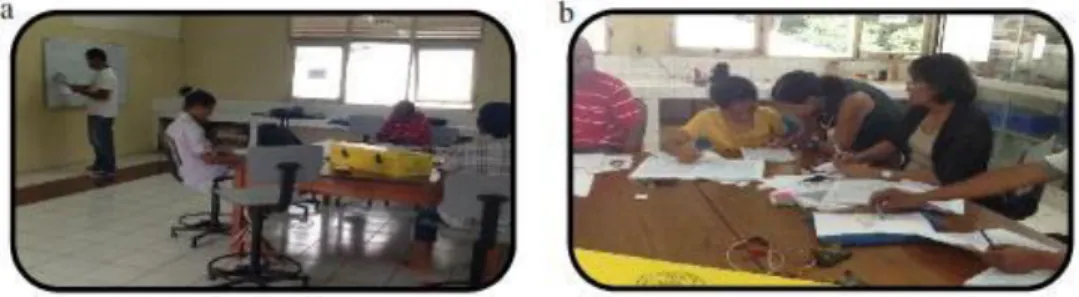
In one of the observed training sessions in Dili (14 May 2014), in one of the laboratories of National Institute for Teacher Training (INFORDEPE), a Timorese trainee was at the board to explain how an electrical circuit worked, while colleagues in pairs accompanied his explanation with the aid of the textbook (see Fig. 1 a). The same Timorese trainee spoke Portuguese correctly and with great confidence.
The PTT said that they had done their homework and that day she placed them in pairs to solve exercises relating to electrical circuits. As some trainees had difficulties with some exercises, they took the opportunity to build a few circuits. Afterwards, a member of each pair solved and explained the exercises on the board. The PTT was giving support to the Timorese teachers (see Fig. 1 b), confirming the resolution and highlighting some essential aspects.
3.1.2. Geology teacher training
In 2012 (from 8 October to 30 November) in Dili, the GTT gave a training course to 6 in-service teachers. None of the Timorese trainees had studies in Geology, as it is a new discipline in East Timor: the Timorese teachers who attended the course were from the Biology, Physics or Mathematics areas. Training sessions of 5 hours per day for the 1.5 months of the course focused on the 10th grade. The replication to other Timorese teachers did not occur because the trainer couldn’t get to the districts for logistical reasons. That year, the GTT begin by analyzing the program and due to a lack of time, she only chose some units of the program. She solved textbook exercises and activities with the trainees, but did not get them to do their respective training plans.
In 2013 (12 August to 18 October) in Dili, the GTT gave a training course and had the same trainees as 2012, plus 2 new ones. However, the number of trainees was reduced to 6 again because 2 of the original ones dropped out. She continued to give support with the 10th grade textbook but also helped those who were using the 11th grade
at that time. Moreover, she helped to prepare lessons and to clear up any doubts the trainees had.
In 2014, the training course was devoted to the analysis of the curricular plan, the program of the 12th grade and to the analysis of the textbook and resolution of the activities and exercises proposed in the textbook, including clarification of some technical concepts and of Portuguese vocabulary.
3.1.3. Chemistry teacher training
In 2012, the CTT started the training program in July and August with only 10 sessions. Following this, there was a replication of these sessions by trainees going to the districts and the CTT was responsible for replicating the course in Dili. In 2012 to comply with the entire 10th grade program, the CTT had to select the content.
The purpose of the first teacher training course (10 sessions) was to explain the new curriculum, the new program, the textbook and how to use a teacher's guide as it was a new instrument, and according to the CTT, the Timorese teachers were not yet prepared to link the various resources.
In 2012, for a group of 8 Timorese teachers, the CTT proposed individualized and group work. He said it was difficult to carry out the group work, and the questioning was also problematic: he reported that when asking questions in Portuguese, there was a silence as the trainees didn’t understand. However, in 2013, when his asking questions and reinforced them with a few words in Tetum, the trainees understood and answered readily.
The sessions after that, especially those they replicated in December 2012 and in 2013, were more focused on content because the CTT considered that the basic training of teachers was not sufficient to give a full response to the challenges of the program and textbook, since he thought that there was a gap in terms of the scientific knowledge Timorese teachers had. Thus, he first sought to exploit the Chemistry contents and then, wherever possible, he worked with them on the didactic element. He did not comply with all the contents of the 10th grade, because the course was very limited in time. In the early planning, the CTT always proposed successive amendments and adjustments, and in all of the sessions maintained an introductory path for contextualization: where content fits into the program, where it is in the textbook, what the teacher's guide tells us, what the objectives and purposes are for the student to learn and if they could work with the textbook in conjunction with the teacher' guide.
In 2013, the CTT started later and focused on the 11th grade, once again with a group of 8 trainees who were already chosen as teacher trainers, because they had been evaluated before and there were few Timorese teachers who were in a position to be a trainer. This course also took place in Dili.
In 2014, the training course was devoted to the analysis of the curricular plan, the program of the 12th grade, the analysis of the textbook, the resolution of the activities and exercises proposed in the textbook, the setting and correction of homework, and clarification of some technical concepts and Portuguese vocabulary. Sometimes, the CTT reinforced his speech with a few words in Tetum so that he could be better understood. Furthermore, he advised trainees that teachers needed to ask students to carry out activities that go beyond any exercise and he highlighted connections between some contents of the textbook and day-to-day situations. He went on to explore some contents by using didactic instruments such as the concept map.
The transcription of a work session with Timorese Chemistry teachers follows: As it was 13 May, only 2 trainees appeared. Later, another trainee arrived.
The CTT began by asking them to open the program at page 58 and 59, in order to see the skills that they needed to develop. There was a problem with the photocopies that the trainees had. A trainee read the contents aloud, and the teacher asked what the words which they considered difficult were. A trainee said: Metrology.
The CTT pointed out that there was a glossary in the book and asked the trainees to read the definition. He asked them to explain in their own words what they understood by metrology.
The Timorese teachers found this difficult.
The CTT helped: Metrology is the area dedicated to measurement and its representation. He reinforced his speech with a few words in Tetum.
The CTT said: Let's finish with correcting homework, a proposal which follows the suggestion on page 16 of the teacher's guide. He asked a trainee to read the proposal and asked everyone to indicate what the difficult words were. He pointed out that the teacher's guide had a variety of proposals and information that they (the trainees) could use, even to give tests to the students, because students do not have access to them.
The CTT said: There are many exercises to do. There's no time to deal with everything. I'll select some to solve here and you can solve the others at home. If you have any questions, then we can discuss them here, okay? A trainee did the exercise on the board and then the data were discussed in terms of the exact values, certain and uncertain.
The CTT observed how all the trainees did and discussed:
The response to the written exercise was put on the board and recorded in a notebook - the exact value is the value of test 3 because it is the value that most closely approximates the actual value.
The CTT took the opportunity to ask what the range of the instrument that could be used for volumetric measure would be and advised the trainees of the need for teachers to ask students to carry out activities that go beyond exercises.
The CTT said: Next week we’re going to the lab and we’re going to use the beakers to see the measurements on them. A trainee didn't understand where the expression "= 0.25/2" came from.
The CTT asked to see it in the book and drew a diagram on the board, taking the opportunity to talk about the meaning of the lower division.
The CTT said: You're going to have to explain this to other teachers. So, if you have any doubts, clarify them now.
He went on to say: Remember that last year the teachers raised many issues? And then you asked "Professor Pedro, help" and we had doubts in exercise 7?
The CTT spoke of fidelity and accuracy.
As the trainees had calculators in their phones, the CTT took the opportunity to ask them if they used the phone after leaving. They replied that they didn’t.
The CTT said: Give small and simple numbers because what’s important is reasoning, not mathematical calculations!
One of the trainees had difficulty with formulas and the CTT said: You could give students formulas, they wouldn't need to learn them by heart! The main point was to perceive them.
The CTT explained things, by registering them on the board, and constantly alerted trainees to didactic issues. The CTT said: The set introduces higher fidelity since your values are closer to each other.
Exercise 8 was read by one of the trainees.
A trainee didn't understand "a tenth". The CTT explained and repeated: When you find words, highlight them and register the page to check in the glossary, and then you can explain to colleagues and students.
The CTT went on to say: We can't solve all the exercises. Let's leave exercise 9 until you're all together, because it is a very important exercise. Don't forget to review: Deviation and error; precision and accuracy. Let's make a concept map. Remember what a concept map is? The CTT started drawing the diagram, explaining everything very slowly and calling on students to participate. Only two trainees said something.
The CTT asked them to open the school textbook on page 18 and asked a trainee to read. The trainees indicated the word "batch".
The CTT described a quantity and quality test for a large number of matches - take a sample of matchboxes and count the matches and burn them all. Then, he explored the permissible and admitted values. Last year a teacher bought products and tested them, and the first 3 failed. The CTT handed out products to the graduates and asked them to examine the labels. He argued that companies liked to add more sodium than indicated on the label in order to preserve the product, but that this was bad for your health and had to be controlled. The CTT announced that the following week they would do experiments with milk cartons.
3.2. Changes in the pedagogical practices of Timorese trainers resulting from teacher training 3.2.1. Changes in Physics practices
In the opinion of the PTT, two Timorese trainers were already beginning to use other sources of information. The Timorese trainers were also beginning to show some organization but it is necessary to continue working hard at organization, because most of them plan activities, such as experiments, but afterwards, they don't carry them out, with the exception of one trainee, who executed all the activities and some extra ones. Most Timorese trainers just did them when the PTT said they would be observed.
The PTT also reported that the Timorese trainers no longer dictated things, but readings usually still existed, or else they chose to write on the board for students to copy. Questioning has also already started to appear, since the PTT has seen two of her Timorese trainers put questions and let their learners put questions. Typical questions are: "Do you have any questions?” and “Is there any question you’d like to ask?".
3.2.2. Changes in Geology practices
The GTT reported that getting Timorese trainers to solve an exercise in 2012 was almost impossible. It was more in groups that they solved exercises, because at least one of them could help colleagues. In 2013, the GTT changed the practices, since Timorese trainers could individually solve some exercises and the lessons that they then gave to colleagues (who oversaw them) were more dynamic, less expository and with the promotion of questioning.
The GTT also said that in 2013 the Timorese trainers could better understand the questions and then think how to respond, and she also reported several improvements in graphics analysis and in three simple rules.
3.2.3. Changes in CTT practices
The CTT reported that, in the few lessons that he observed, he found a great evolution in the way the Timorese trainers questioned, both in the exercises produced and in the work with laboratory material.
However, Timorese teachers continued to have difficulties with some strategies for teaching and learning, such as in the performance of group work, if not practiced regularly. The CTT believes that the education system is still very conventional and expository, because, for example, teachers don't provide the student textbook, as they are afraid that students may ask about issues that they don't know how to respond to.
3.3. Identification of the possible constraints on quality pedagogical practice
3.3.1. From the age-old teaching and learning experiences to the new teaching and learning strategies The PTT overcoming old views
The PTT felt that there are a number of world views or experiences inherent in the old ways of teaching and learning of the Timorese trainers who offer resistance to change. There are still behaviors that exist and which are necessary to alter. For example, the Timorese trainers still want to use the textbook as the only source of knowledge, and want to keep it under lock and key, not giving it to students. In turn, in the replication of the training to other
teachers, most Timorese teachers do not feel comfortable being trained by colleagues. There's a lot of rivalry between trainers (Timorese teachers) and trainees (Timorese teachers). In this replication, they avoided changing their practices and introducing new activities for fear of failing, more in front of colleagues than students. Moreover, in matters involving understanding and reasoning, exposing their knowledge or involving joint content with another, the Timorese simply remain silent for fear of exposing their weaknesses.
Moreover, because of the value given to men in East Timor, the Timorese trainers replicating the courses feel pressurized to be more lenient with and less critical of the male trainees, for fear of reprisals. The PTT also sought to emphasize group activities and connect content of discipline with day-to-day situations, so that the Timorese trainers could appreciate the usefulness of this in their everyday life. She also sought to develop experimental activities using materials that are often recyclable, which made the experiments simpler to execute.
The GTT overcoming old views
The GTT felt that, in the case of the discipline of Geology, everything was new: a new subject matter and a language that the Timorese trainers did not feel comfortable with, so they offered some resistance. At the beginning, for example, the GTT put a question to them but they didn't respond because they weren't accustomed to having questions put to them. According to the GTT, Timorese trainers did not solve exercises because these required great autonomy and the trainees still didn't have this autonomy.
After 2012, however, they completely changed. Lastly, the GTT felt that at the beginning it was difficult for them to give lessons to each other, since they enjoyed being with each other a lot. Then with time, they understood that it was normal to make a mistake, and they all said things that didn't make much sense.
The CTT overcoming old views
The CTT felt that there are a number of practices inherent in the old ways of teaching and learning of the Timorese teachers who offer resistance to change. He felt that the old education system was very conventional and expository. He therefore had to teach and promote new ways of working, such as developing teamwork and making use of questioning.
3.3.2. From the language which had been used in previous curricula to the new language
The PTT often felt that there were problems in understanding the language used in the new resources. She felt, in particular, that the majority of the Timorese teachers have difficulty in speaking and understanding Portuguese, leading to difficulties in introducing some new methodologies and strategies regarding the use of the new resources.
The GTT noted that when she arrived in 2012, the Timorese teachers, who will be trainers of other teachers, didn’t understand the Portuguese language or the subject matter. Thus, only with the help of a Timorese teacher who translated what the PTT said into Tetum, did the remaining Timorese teachers understand. In 2013, the GTT noticed an evolution in the level of Portuguese. Nevertheless, she considers that the persisting difficulties for Timorese teachers with the Portuguese language, justifies the continuation of training of the Timorese in the Portuguese language.
The CTT believes that to achieve the goal of a Portuguese language education for all, the Portuguese trainers must have training in Tetum to get closer to their trainees. For the trainers (Portuguese and Timorese) to use the technical language which is included in the scientific program, textbook and teacher guide, it is important to increase the training of Timorese teachers in Portuguese, and the training of Portuguese trainers in Tetum to connect with them.
3.3.3. From other subject areas to teaching in new disciplinary areas
The PTT acknowledged that, in 2012, the frequent lack of Timorese teachers in a school led to allocating teachers from other areas to the discipline of Physics. However, in 2013, the Timorese teachers who had done the teacher training were genuine Physics teachers with scientific knowledge, interest, assiduity, capabilities in pedagogical support and knowledge of the Portuguese language.
On the other hand, as Geology is a new discipline, the GTT acknowledged that there were some limitations in terms of the time needed for training to progress, by virtue of Timorese trainees coming from other areas, such as Geology, Biology, Physics and Mathematics.
The CTT meanwhile recognized that, in the first series, of teacher training, many Timorese trainees were appointed by the District Directors, and they didn't have the appropriate criteria in terms of language and degree. In the second series, there was a concern to have Timorese teachers who were permanent teachers, with at least a degree, to get the most out of training.
3.3.4. From continuous training in appropriate school conditions, to training in inappropriate conditions
The PTT reported that, in most cases, the planning of the training was adjusted, depending on the needs and difficulties of the Timorese teachers, as well as according to the existing resources in the schools where they were given training. In General, the PTT considered that she did not have at her disposal the necessary and sufficient didactic resources for performing/training, particularly with regard to laboratory activities, but also in terms of bibliographic resources that could be used as a foundation. At the multimedia level, too, she recognized that the facilities weren’t great. The PTT has verified that there are situations where there aren’t enough books for everyone (many books are still in boxes, where the photocopies were too expensive for teachers, and where some state schools are very poor, both in facilities and features (the rooms are very small for large class sizes -about 90 to120 students; some rooms don’t have enough desks or chairs, or they are inappropriate for the ages of the students; there is little cleaning and some rooms do not have electric power; and in many cases there is no space for laboratories or materials). Private schools are substantially better at the level of resources but also have a distinct lack of materials. In the districts, the conditions are far worse in some cases.
The GTT reported that, in 2012, school conditions, both in terms of building infrastructure and available resources, generally affect the concentration and motivation of Timorese teachers. The GTT further reported that the state school where she gave training had no glass, in the windows, but only a few bars; the desks and chairs are for children and was uncomfortable; most rooms had a black, damaged board; there was no water, and the room was very dirty with a lot of garbage in it. Thus, she was limited in what she could do. The GTT said that in 2013 the training went better because she taught in the INFORDEPE. Here, the classroom had a whiteboard, projector and electricity, so she could exploit PowerPoint documentaries, which were very useful in terms of the trainees ' motivation. The GTT believes that the greater the diversity of resources, the greater the motivation. Logistically, she also found that it wasn’t easy to carry out study visits and travel to other parts of the district because there were one hundred or so teachers and it took hours to get transport.
When he started training, the CTT reported that he didn't have the essential conditions for the implementation of the new curriculum, since there was no state school in East Timor which had a lab. There were schools that had no light and the few that had a private laboratory had light, but none had water, which limited the performance of practical activities. Thus, the CTT felt the need to adjust the program to the reality and stated that the current conditions prevailing in East Timor are an obstacle to the appropriate development of activities, but he made every effort to carry out these activities.
4. Final Remarks
With the implementation of a new curriculum, together with the continuous training of Timorese teachers, Portuguese teacher trainers are faced with the necessity of implementing new strategies and methodologies of work. They need to help Timorese teachers to cross the boundaries between the old teaching of science and the new that is involved in this process of restructuring.
In general, in-service teacher training developed in all of the three areas (Physics, Geology and Chemistry) focused on subjects and teaching and learning methodologies regarding the new educational resources produced.
The Timorese trainers introduced some changes in pedagogical practices, such as group work and questioning. However, there is still much to do to contribute to the quality of education in East Timor. The in-service teacher training needs to continue to support an appropriate use of these resources. It is also important to simultaneously focus on improvements in Timorese school infrastructures, and on the continuous training of trainees in the Portuguese language.
Valuing the continuous training of teachers, it is possible to help Timorese teachers to reshape their conceptions about science and/or education in science, and therefore enable them to cross the boundaries between their cultures and the sciences (Aikenhead, 2009). However, as stated by several authors (e.g. Nicolai, 2009) it is important to point out that such crossing overs are a slow process.
To finish, the results obtained from this research study are useful not only for the team researchers of the project , mentioned in section 1, to provide feedback regarding the implementation of the new Physics, Geology and Chemistry curricular materials, but also for the stakeholders involved in future projects implemented in East Timor or in other developing countries.
Acknowledgements
This paper is a result of the FCT project “TIMOR – Evaluating the impact of restructuring the system of secondary education in East Timor – a study in the context of international cooperation” (PTDC/MHC-CED/5065/2012), funded under the COMPETE Program and subsidized by the Fundo Comunitário Europeu FEDER.
References
Aikenhead G. (2009). Educação científica para todos. Mangualde. Edições Pedago.
Albergaria-Almeida, P., Mariana M. & Lopes B. (2012). “Teacher Education in the context of international cooperation: the case of East Timor.” In Nicolay Popov, Charl Wolhuter, Bruno Leutwyler, Gillian Hilton, James Ogunleye and Patrícia Albergaria-Almeida (Eds.), Comparative
Education, Teacher Training, Education Policy, School Leadership and Social Inclusion, (pp. 91-98). Sofia: Bureau for Educational Services,
2013.
Bardin L. (2002). Análise de conteúdo. Lisboa: Edições 70.
Capelo A. & Cabrita I. (In press). In-service Teacher Training in the Use of New Curricular Materials: The particular case of East Timor. Journal
of the World Universities Forum. Common Ground Publisher.
Creswell, J.W. (2003). Research design: Qualitative, quantitative, and mixed methods approaches. (2nd ed.) Thousand Oaks: Sage
IPAD (Instituto Português de Apoio ao Desenvolvimento) (2010). Protocolo de cooperação entre o Instituto Português de Apoio ao Desenvolvimento, a Fundação Calouste Gulbenkian e o Ministério da Educação de Timor-Leste. Proposta de financiamento do projeto “Falar Português”- Restruturação curricular do ensino secundário geral em Timor-Leste. IPAD-Fundo da Língua Portuguesa.
Martins, I. P. (2013). Science Education in general secondary school in East-Timor: from research to cooperation. Journal of Science Education,
Special Issue , 14, 20-23.
Montagnes I.. (2000). Textbooks & learning materials 1990–1999: A Global Survey. Thematic study on teaching/learning environments. International Consultative Forum on Education for All (EFA. Assessment activities in preparation for the World Education Forum, Dakar, April 26-28, 2000. Retrieved from http://www.unesco.org/education/wef/en-docs/findings/bookfinal.pdf http://www.techknowlogia.org/TKL_active_pages2/Currentarticles/main.asp?IssueNumber=5&FileType=HTML&ArticleID=125 (accessed 1/07/2014).
Mulholland J. & Wallace J. (2003). Crossing borders: learning and teaching primary science in the pre-service to in-service transition.
International Journal Science Education, 25, nº 7, 879-898.
Nicolai, S. (2009). Opportunities for Change: Education Innovation and Reform During and After Conflict (Education in Emergencies and Reconstruction). UNESCO-IIEP.
Norman, P. (2005). Impact of Curriculum Reforms on some Teacher Education programs 2005. National Curriculum Reform Conference, Sustainable curriculum development – the PNG curriculum reform experience.