W R I G
O K N
P P R
A E S
ICS
1
2018
Instituto de Ciências Sociais da Uni
v
er
sidade de Lisboa - Labora
tório Associado
THE POLITICIZATION GAP
IN SOCIO-ECOLOGICAL
TRANSITIONS:
LESSONS FROM PORTUGAL
JOÃO MOURATO
2018
ICS O K N P P R
W R I G
A E S
COMISSÃO EDITORIAL
João Vasconcelos
(coordenação)Andrés Malamud
Annarita Gori
Filipa Vicente
João Mourato
Pedro Alcântara da Silva
Rui Costa Lopes
Vanessa Cunha
ISSN 2183-6930
The politicization gap in socio-ecological transitions:
lessons from Portugal
João Morais Mourato (a), Alexandra Bussler (b)
(a) Institute for Social Sciences, University of Lisbon,
Av. Professor Aníbal Bettencourt 9, PT - 1600-189 Lisbon, Portugal (b) Institute for Social Sciences, University of Lisbon,
Av. Professor Aníbal Bettencourt 9, PT - 1600-189 Lisbon, Portugal
⁎ Corresponding author.
ICS WORKING PAPERS 2018
Abstract
The multiple challenges of the Anthropocene set a new context for transformative social innovation towards a form of living and working based on the principles of sustainability. Community-based initiatives (CBIs), the most visible representatives of the latter, have started to appear worldwide and are increasingly perceived as a crucial actor in the socio-ecological transition towards sustainability. CBIs are receiving a growing attention from transdisciplinary academia. Yet, there remains a research blind spot on the transformative social innovation dynamics in Portugal. This paper addresses this gap by inquiring into Portugal’s CBI dynamics, appearance, buildup, reach and future transitional pathways. Having traversed a rapid and significant growth over the last decade, CBIs, their practices and discourses are still marginalised in Portugal’s public arenas. Therefore, this paper argues, Portuguese CBIs remain an untapped resource for socio-ecological transitions and institutional innovation in Portugal. We scrutinize why the latter falter to engage head-on with the public and political spheres and identify key contextual changes and premises that determine CBIs social innovation potential in Portugal: a) CBIs need to engage the existent institutional landscape and become politicized change actors in order to sit at key decision-making processes, and b) CBIs’ full potential is unlikely to bloom without favourable institutional frameworks and policy environments. This paper applies a value-based lens onto social transformation frameworks and engages in a wider theoretical debate on the role of niche actors, thereby adding to the existing literature on socio-ecological transitions. Based on an actor-, politics- and governance-centered approach, we ultimately inquire into Portugal’s CBI’s agency and how it can bring about wider structural change in a socio-ecological transitions.
Key words
ICS WORKING PAPERS 2018
Introduction
The current unsustainable relationship between humans and nature has all the signs of critically endangering planetary and human sustainability (Montoya et al., 2018; Steffen et al., 2015; Brown, 2017). Conceptually, the Anthropocene encapsulates this new epoch in which humankind as a collective force has become capable of irreversibly altering natural Earth cycles (Crutzen, 2002; Barry and Maslin, 2016; Steffen et al., 2007). Confronting this sets a new context for transformative social innovationtowards a form of living and working based on the principles of sustainability (Rickards, 2015; Olsson et al., 2017; Pel and Bauler, 2014). Here we look at social innovation, from a broader perspective, as efforts towards social change and policy reforms, understood as a three-sided process comprising: a) substance: addressing unmet social needs, b) process: changing social relations, and c) outcome: bringing about new institutional configurations (Pel and Bauer, 2014).
Consequently, there is a growing call for socio-ecological alternatives that radically transform our present actions and systems (Barry and Quilley, 2009; Jackson, 2009; Alexander and Rutherford, 2014). This has helped to fuel a substantial increase in the number and variety of community-based initiatives (CBIs) seenteking to create a socio-ecological transition towards planetary sustainability (Göpel, 2017). These niche spaces have been widely acknowledged as transition laboratories (cf. Geels and Shot, 2007; Pelling et al., 2008; Göpel, 2016), where transition can be described as the shift to a new social and ecological economy where humankind must rethink its place and relationship within nature and between present and future generations. The pathway to this transition may emerge via the rise of radical niche-innovations and new user practices and institutions fuelled by cultural and behavioural changes, with a larger role for civil society actors, social movements, and multi-level governance (Hof et al., n.d.; O’Riordan, 2014).
In fact, the mobilisation of the community has a significant track record up to present. The concept of community-based can be found discursively and empirically crisscrossing multiple agendas. From localism and local autonomy to nature conservation, circular economy or alternative ecosystem-service valuation discourses, the community has become an indispensable stakeholder worldwide (e.g. Hart and Milstein, 2003; Bohrmann et al., 2012). Furthermore, community-based innovation is increasingly perceived as key to tackle complex anthropogenic socio-ecological problems in the light of sustainability transitions (Anguelovski and Carmin, 2011; Frantzeskaki and Rok, 2018).
ICS WORKING PAPERS 2018
What is our contribution?
This paper builds on the hypothesis that CBIs remain an untapped resource for socio-ecological transitions and institutional innovation in Portugal. In fact, the scarce literature on Portuguese CBIs looks at them from a predominantly descriptive standpoint, thus lacking to reflect on crucial dynamics such as their structure, reach or possible future pathways. We aim to better understand why Portuguese CBIs seem reluctant to engage head-on with the public and political arenas as champions of a socio ecological-transition.
In hindsight, we focus on the key contextual changes that need to happen if CBIs are to fulfil their social innovation potential. On the one hand, they need to engage the existent institutional landscape and become politicized change actors in order to sit at key decision-making processes. On the other hand, CBIs’ full potential is unlikely to bloom without favourable institutional frameworks and policy environments. This implies local government’s acknowledgement of CBIs’ roles and achievements and willingness to share responsibilities as innovators and facilitators of socio-ecological transitions.
To do so, we look at CBIs with the lens of an actor-, politics- and governance-centered framework in order to inquire into how CBIs’ agency can lead to wider structural change in a sustainability transition and under which premises such impact can be reached. Thus, Chapter 1 begins with framing the CBI inquiry into the literature of socio-ecological transitions, with a particular focus on the role of niche actors. Chapter 2 contains a descriptive synthesis and subsequent functional analysis of the existing Portuguese CBIs based on existing research databases. In Chapter 3, we critically review their engagement in light of the wider theoretical debate on the role of niche actors in “transformations in the global sustainability literature” (cf. Patterson et al., 2017: 5). Chapter 4 forwards the reasons we believe are at the root of the continuing displacement of the sustainability discourse in Portugal, outlining what we perceive as CBIs’ own transformative pathways. Finally, Chapter 5 sets pathways for how to foster CBIs’ potential and indicates future research avenues.
ICS WORKING PAPERS 2018
1. The grassroots paradox
In this section we outline our conceptual framework of inquiry into CBIs against the backdrop of the existing literature on socio-ecological transitions that focuses on niche actors. Through our review, we justify the need to evolve how we look at niche level initiatives in light of socio-ecological transitions (Section 1.1.). Section 1.2. critically reviews the specific role of CBIs (as niche actors) in these transitions. We delimit the concept of “community-based” and guide the reader through selected transition models that forward explanations towards the scale up of practices and discourses towards transition pathways. We review the latter in view to specifically examine the linkages between the niche level and its external societal context.
1.1. Niche solutions for a super-wicked problem?
This section reviews multiple main strands of socio-ecological transition literature to frame the debate around the niche level as key change actors in such transitions. The promotion of a large-scale transition towards sustainability can be understood as a super wicked problem (cf. Lazarus, 2008; Levin et al., 2007). These have four key defining features (Levin et al., 2012):
● Time is running out;
● Those who cause the problem seek to provide a solution (i.e. governments perpetuate a dual behaviour promoting to some extent policy pathways towards sustainability while allowing its very causes [e.g. fossil fuels exploration] to persist);
● The central authority needed to address it is weak or non-existent (i.e. there are no global climate executive authorities);
● Partly as a result, policy responses discount future irrationally, rendering it impossible to secure policy coherence over time.
These four problems are symptoms of the policy process around sustainability where existent decision-making and governance solutions, available data, and institutional capacity all fall short of providing game-changing solutions to persistent problems. This issue may spring from an unsustainable path-dependency, insofar as present policy and institutional dynamics may inadvertently hinder the future delivery of any meaningful transition to sustainability policies. To avoid this, Levin et al. (2012) advocate a forward-looking perspective, aimed at setting incremental transition pathways towards sustainability, that in turn trigger a domino effect of behavioural changes, which gather support and outreach over time.
ICS WORKING PAPERS 2018
This complex issue of triggering a transformative path-dependency towards sustainability has had multiple echoes in the largely overlapping body of literature including socio-ecological technical transitions (Geels and Schot, 2007), transition management (Kemp et al., 2007; Rotmans and Loorbach, 2009), sustainability transitions (Markard et al., 2012; Smith et al., 2005) and more recently transformative social innovation theory (Haxeltine et al., 2017). A prominent concept for depicting the systemic multilevel interplay between different societal subsystems across space and time is Geels’ Multilevel Perspective (MLP) framework (Geels, 2011). This helps to identify causalities of influence between micro-level actors and macro-level structures that underlie large system change processes. Yet, it depends on quasi linear assumption of decision-making processes and misses inquiry into the political nature of the sustainability transition (cf. Patterson et al., 2017). Referring to Swyngedouw (2010; 2011), we can identify a similar risk for sustainability transition as he attributed to sustainability: namely, to turn it into a “rosy” global de-politicized “environmental consensus”. Yet, politics, policies and conflict are inherent to any social transformation shaping the extent to which any shift towards sustainability will ultimately be reached (Prugh et al., 2000; Avelino and Rotmans, 2009; O’Riordan, 2014).
Yet there is a growing perception that governments and international institutions are unable to provide the necessary solutions and subsequent leverage to trigger such transformation (Blühdorn, 2007; Swyngedouw, 2010; 2011).Any shift towards a fully sustainable way of living on Earth without critically endangering the intertwined ecosystems that represent the life support for humans and all other species will not easily be self-starting. We therefore need to determine who can be the catalysts of change, and how they can better exert their influence.
A significant body of literature (e.g. Geels and Shot, 2007; Olsson et al., 2006; Pelling et al., 2008; Smith et al., 2005; Göpel, 2016) has convincingly argued that socio-technical transformations originate mostly at the “niche or micro level, where small units or ‘situated groups’ experiment easily with alternative solutions, as long as the degree of interdependencies with overarching or neighbouring systems is not too strong” (Göpel, 2016: 22). Like Seyfang and Haxeltine (2012), we understand niches as protected spaces where alternative practices can form and develop, shielded from external system pressures, hosting actors and organisations who are free to pursue such place-based practices. A particularly visible niche dynamic is embodied in community-based initiatives (CBIs), who already foster complementary or alternative pathways to dominant development paradigms (c.f. Haxeltine et al., 2017; TESS, n.d.). As Göpel (2016: 45) and Minkoff (1997) observe, societal change often springs from alternative or radical socio-political movements that over time manage to gain momentum and mobilize enough critical mass to alter the status quo.
ICS WORKING PAPERS 2018
1.2 Examining the potential role of CBIs in wider socio-ecological change
Having justified niche actors in general as crucial pieces in the socio-ecological transitions puzzle, this section inquires into how transition scholarship approaches the role of CBIs as a specific niche actor. Therefore, we first delimit the concept of “community-based” and then then critically examine how CBIs and their external societal context intertwine.
The term community-based has a wide range of interpretations (McLeroy et al., 2003). A community is not a static, isolated group of people, rather a set of multidimensional, cross-scale, social-political units or networks (Carlsson, 2000). As communities are elusive and constantly changing over time (Berkes, 2004), it is fundamental to map the wide range of meanings and conceptualizations that the community-based prefix entails. To do so, we build on McLeroy et al.’s (2003) typology. In short, these authors outline a four tier classification where community can be understood as: a setting; a target; a resource, or an agent.
● As a setting, community is mainly understood as a geographical space that includes community institutions (e.g. schools, neighbourhoods, etc.), the physical setting where development interventions are implemented from the top down, and actors are perceived as a sum of community individuals. The formalisation and legalisation of informal housing hand in hand with public investments in community infrastructure (e.g. utilities, sanitary infrastructure etc.) could be an example for the latter.
● As a target, community represents a strategic focus of intervention, that addresses as an entity the whole community, or specific characteristics or groups within it. Target-based interventions are usually articulated with indicators and benchmarking practices (e.g. recycling, health or social well-being targets).
● As a resource, community translates into the providing of internal ‘capital’ such as knowledge, traditions or practices, which are valued and integrated in strategic common-ownership, participatory and local decision-making processes that are steered from outside the community (e.g. community-based nature conservation under national policy development programs). ● As an agent, community is defined as the inherent force underpinning adaptive, supportive and
developmental capacities mobilized via community institutions (e.g. families, informal networks etc.) in order to provide solutions to current community needs (e.g.community food distribution; neighbourhood homecare support).
The latter two interpretations, community as a resource and as an agent have had, over the last decades, a clear impact in terms of public policy design and implementation. The most widely used denomination seems to have become community-based development. However, a growing emphasis on community empowerment and agency, actively engaging its key stakeholders in policy design, resources co-management and projects co-implementation, has shifted the partnership and participation landscape, leading to a growing number of community-led, or community-driven development initiatives. These
ICS WORKING PAPERS 2018
definitions are yet to stabilize in the literature, and are largely used interchangeably. In our view, it is however relevant to allow a differentiation based on community self-mobilized agency to tackle key issues directly affecting them.
CBIs as Socio Ecological Transition Agents
In this line, academic attention has increasingly shifted its focus from technological dynamics to the role of societal aspects, such as actors, values, or governance solutions, in promoting societal change (cf. Seyfang and Haxeltine, 2012). ‘Grassroots innovations’, such as CBIs, have taken center stage in the analysis of the role of civil-society in governing such societal change. In line with Seyfang and Smith (2007), we define CBIs as community-based initiatives towards a socio-ecological transition to sustainability. CBIs that experiment with social innovation, sustainable technologies and methods (e.g. in the areas of transportation, waste, recycling, agriculture, consumption, energy, education (TESS, n.d.)) include the transition (town) movement, sharing circles, local exchange trading schemes (e.g. alternative currencies) or eco-villages (Hargreaves et al., 2013) and can either operate for profit, or not (TESS, n.d.). Despite the existence of other types of CBIs (cf. Mansuri and Rao, 2004: 4-5), we refer to them strictly as community-based initiatives focused on socio-ecological transitions towards sustainability.
In our quest as to whether CBIs embody a catalyst mobilizing role in societal change towards socio-ecological sustainability, we first break down the fundamental dynamics underpinning CBIs’ mobilization: guiding principles, key actors, motivations, and ultimately their willingness to engage with wider societal change processes. This endeavour is motivated by the acknowledged lack of precision in transition studies when it comes to distinguishing between different types and levels of actors (Avelino and Wittmayer, 2016: 628). To follow through, we build on Retolaza’s (2011) theory of change to create a framework on the core notion of value change underlying to societal transition towards sustainability (Figure 1). Value change, which often emerges in unplanned contexts and has unexpected rhythms and mechanisms of diffusion, is a multidimensional process (Mourato et al., 2018). We can identify four key dimensions here. There is a subjective dimension of individual change in terms of mindset, self-awareness and identity (e.g. when human experience alters concerns about animal welfare), subsequently underlying a wider objective transformation of relational interactions, habits and practices, materializing in, say, the adoption of vegetarian dietary habits. There is an intersubjective dimension concerning value change within CBIs, and how it influences the definition of a collective identity and subsequent patterns of collective action (e.g. vegetarians team up with like-minded others to creates a association promoting vegetarian values).
ICS WORKING PAPERS 2018
Figure 1 - Framing the Alternative adapted from Retolaza (2011: 7) (cf. Mourato et al. 2018: 98)
We argue that the cornerstone of a consequential societal value change springs from the structural interconnectedness between the subject, individually or within a collective, and its surrounding political and social environments (e.g. the vegetarian association actively engages with its surrounding via public activism, campaigning and eventually extending to political lobbying). The latter may trigger a structural shift if it evolves at an inter-objective dimension, to secure the institutionalization of change (e.g. the vegetarian association lobbies successfully the necessary policy and institutional changes and as a result, vegetarian meal choices are integrated in public canteens). A structural shift at the inter-objective dimension influences state action or the dominant system logic via both constitutional and legal frameworks and subsequent policies and polity. It has to be mentioned that the framework also allows to explore the recursive influence between the external social context (development models, governance, politics and social movements) and the inherent processes of value change. As an example, one could inquire into how the collective (social movements) can influence the subjective dimension of change.
ICS WORKING PAPERS 2018
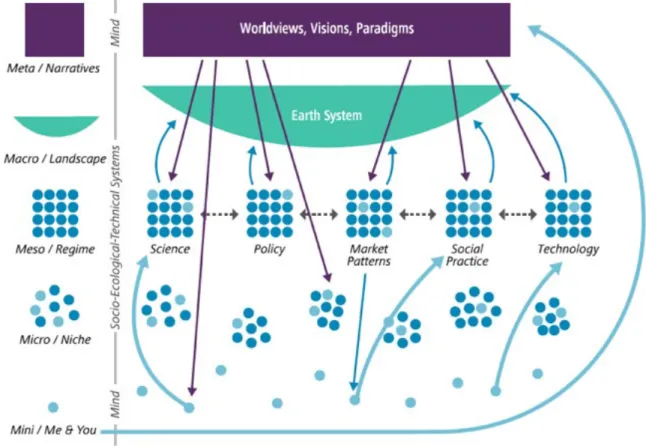
Similar reasoning as above can be applied to the transformative role of CBIs, as these can be potential sense-making actors who structure the unknown, creating narratives of value change and influencing discourse (Deborah, 2012), that may play a pivotal role in the redefinition of current unsustainability path-dependency, if they proactively engage with the objective and inter-objective dimensions of value change. CBIs’ role and positioning in wider dynamics of societal change is nevertheless far from consensual. Let us revisit Göpel’s emphasis on the interdependencies of the niche level with the neighboring system (Figure 2).
Figure 2: Mind-sets and multilevel interactions in societal transformations (Source: Göpel, 2016: 47)
Göpel (2016: 22) argues that the niche is a test tube for alternative forms of social organization, but only insofar as it doesn’t interact too heavily with the dominating system structures. This can be observed by the apparent isolation of the micro/niche level from the tightly interwoven, multilevel web of interactions between all other system parts (see Figure 2).
This argument is somewhat contradictory. We agree with Göpel’s rationale. Yet, if niche CBIs are to help trigger wider societal change, they need to make their ideas and practices visible, introduce them into the public debate, ultimately facilitating their wider societal acceptance (Henfrey and Penha-Lopes, 2018). In
ICS WORKING PAPERS 2018
fact, they must become politicized actors who actively engage with the dominant system, political and institutional status quo, even if it implicates an opening of the ‘protected niche space’ (cf. Seyfang and Haxeltine, 2012).
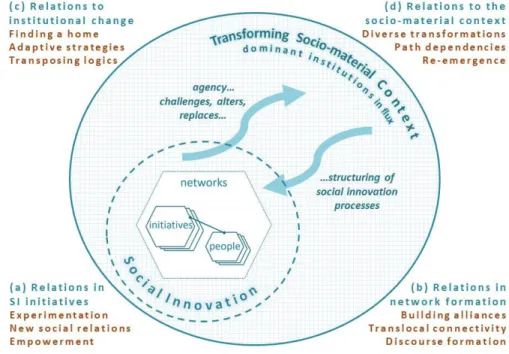
Furthermore, we must build on the assumption that there is a great pluralism and diversity of potential roles within niche level CBIs. For instance, a comparative study of 63 CBIs in Finland, Germany, Italy, Romania, Scotland, and Spain identified a set of internal (i.e. will to break the inherent unsustainable status quo; shared identity and values with participants) as well as external (i.e. the dominant system fails to satisfy socio-environmental needs and local empowerment; existence of a socio-political vacuum) factors that determined the motivation of their emergence. Interestingly, half the surveyed CBIs are offshoots of already existing ones. Regarding CBIs’ survival over time, factors such as their relation with governments and institutions or the adopted organizational structure turned out to matter (TESS, n.d.). Transition pathways are not sequential, linear processes of societal change and need continued flexibility and reflexivity “to adjust the policy mix to unexpected circumstances as the transition unfolds and new insights become available, again stressing the importance of considering the process of change as much as the outcome” (c.f. Hof et al., n.d.: 4). This recursive relational dynamics between CBIs and the social and material context is the cornerstone of Haxeltine et al.’s (2017) Transformative Social Innovation Theory (TSI theory - see Annex 2 in Appendix A for further details). The latter places CBIs, their actors and networks as a manifestation of social innovation, that “shape and are shaped by changing social relations and associated institutional dynamics” (Haxeltine et al., 2017: 9) in a reciprocal relationship (Figure 3).
ICS WORKING PAPERS 2018
Parallels can be drawn to the alternative framing diagram (cf. Figure 1) insofar as (a) equals the subjective dimension, (b) the intersubjective, (c) the inter-objective space. The add-on, (d), sets-up a contextual framework reflecting how CBIs are influenced by external historical developments and socio-material contexts.
In hindsight, (c) relations with institutional change echoes our argument by calling for greater politicization and active engagement with the status-quo. It emphasises that a coherent commitment to discourse formation around the need for specific changes to existing institutions, network formation, and finally reflexive advocacy, lobbying, and protesting in response to ongoing changes in circumstances, are determinant for setting the stage to challenge dominant institutions and institutional logics. In turn, this requires balancing the opposed forces of independence from versus accommodation in existing systems (e.g. social credit cooperatives have to find their place in the existing banking institutions framework, while balancing their values to transform the very same), as well as ‘institutional bricolage’, that is, using existing institutions and resources in novel ways, or even creating new ones (e.g. local currency or community-supported agriculture) (Haxeltine et al., 2017). In sum, the key issue is that CBIs need to engage with the existent institutional landscape and become politicized change actors in order to contribute positively to a wider societal transition.
In this section, we reviewed how transition literature analyses and frames the role of niche level actors towards societal transformation. We argued the potential of CBIs agency in forwarding a societal change agenda towards sustainability as sense-making actors able to trigger and upscale the underlying value change needed for such transitions. Finally, we carved out that CBIs’ relation with their external socio-material context is determinant for their degree of influence. Throughout Europe, research and literature have started to inquire into existing CBI landscapes. In Portugal, this is still an underexplored topic that section (2) begins to unpack.
ICS WORKING PAPERS 2018
2. Outlining Portugal’s CBI landscape
This section outlines the Portuguese CBI landscape and its inherent dynamics, building on a critical review of all available data. After a short introduction, section 2.1. depicts the available information on Portugal’s CBIs. Section 2.2. introduces Portugal’s CBI landscape, section 2.3. offers a critical analysis of the driving forces behind it, and section 2.4. summarizes its key feature and development challenges ahead.
Portugal in transition: brief outlook
Since the turn of the century, in particular after the financial crisis of 2007/8 and the introduction of the economic adjustment programme in 2010, CBIs in Portugal have increased substantially in number. Yet little is known about their make-up, reach, and rate of survival, or of their future potential as change actors towards socio-ecological transitions. We now address this gap as we identify and organize the available information on Portugal CBIs.
At the turn of the century, Portugal still had one of the lowest levels of social mobilization concerning any recognizable form of sustainability transition in Europe (Schmidt et al., 2006). Available data hints at a country-wide growth tendency of such community-based initiatives (CBIs) since 2010 (Marques Balsa et al., 2016), while it doesn’t allow for an accurate quantification of that increase. Nevertheless, transitions to sustainability remains largely absent in Portugal’s public debate (Baumgarten, 2017).
In effect, Portuguese CBIs still function outside the public realm, unable to influence the Portuguese political and environmental policy arena, and thus fail to trigger the wider socio-ecological change they advocate. This is problematic insofar as “for sustainability transitions to occur, the local level needs to be transcended so that innovations are able to diffuse“ (Hof et al., 2016: 2). Nevertheless, the socio-institutional landscape towards sustainability transitions in Portugal is changing, largely due to a growing number of action-research projects (e.g. ClimAdaPT.Local; Catalise; PROSEU ((see Annex 2 of Appendix A for a detailed description)) and community-led bottom-up initiatives (e.g. the CBIs Fruta Feia; Trokaki; Cooperativa Verde Perto (ibidem)). All of these focus on either leveraging or implementing sustainability in various contexts. This paper builds on the assumption that CBIs’ potential for socio-ecological transformation in Portugal is undervalued. Portuguese CBIs have rarely been analysed in academia, mostly from a predominantly descriptive standpoint, generating little reflection on their make-up, reach and possible future pathways.
2. 1. Scattered data
A thorough review of both international and national literature, academic and non-academic, including dissertations at the doctoral and master’s level, as well as bottom-up organized databases, highlights the scarcity of data on Portuguese CBIs. The large majority of research consists of single case studies that
ICS WORKING PAPERS 2018
cover only a residual number of these initiatives and tend to concentrate on the most well established and iconic, mostly the pioneers within the Portuguese CBI universe, such as the Tamera healing biotope. There are, to the best of our knowledge, only three exceptions which constitute our core data sources. The first one is CATALISE – a national research project that broke away from the prevailing single-case study approach, looked into Portuguese CBIs from an overarching perspective and attempted recognized organization. Second, there is Rede Convergir – the biggest national network hub for CBIs. Third, still in an embryonic development stage, there is ECOLISE, a European coalition bringing together national and international networks of CBIs, as well as organisations supporting community-led transition towards sustainability (see Annex 2 of Appendix A for a detailed description).
There is no exact account of how many CBIs exist in Portugal. Available information is highly fragmented both in source and structure, limiting possibilities for a systematic analysis of their location, size, objectives and underlying philosophy. This data scarcity may be due to the absence of a national network that aggregates and records all sustainability and societal transition CBIs. Our next best option was thus to review the existing three initial attempts.
CATALISE identified a total of 471 CBIs (2015/2016), contacted each individually and then carried out a detailed questionnaire on all 84 respondents (Marques Balsa et al., 2016: 33). Rede Convergir totaled 184 (2018) initiatives who voluntarily registered on their webpage, while ECOLISE identified 171 (2018) CBIs on their interactive map. However, the absence of coordination or cumulative effort between these different initiatives, which was not their objective, resulted in different identification and classification methods as Rede Convergir and ECOLISE’s interactive georeferenced maps illustrate.
CATALISE used subnational thematic networks (e.g. Social Development) and forums, including Rede Convergir, as data sources. They did so using wide-ranging classification categories that failed to help navigate CBIs’ high degree of heterogeneity (i.e. social intervention, economic project or environmental project). This lack of data organisation translated into a fragmented and non-user friendly database, which in turn might have hampered their final findings. For example, the overrepresentation of CBIs from specific thematic networks in CATALISE’s database might make some thematic areas appear falsely predominant (e.g. social economy, cf. Marques Balsa et al., 2016: 33), disguising the actual functional distribution on the ground. This, however, may spring from the desired emphasis of CATALISE’s funding body (i.e. F.C.Gulbenkian) on the social issues of CBIs. On the other hand, Rede Convergir is an actual bottom-up initiative, as mapped CBIs voluntarily and independently signed up and filled out their questionnaires to feature on the network’s webpage. The latter leads to the conclusion that Rede Convergir better reflects the actual active CBI landscape in Portugal. Nevertheless, it is possible that only a fragment of the real number of CBIs joined Rede Convergir, due to either unawareness of the existence of the network or a legitimate will to remain somewhat “off the grid”. Finally, ECOLISE seems to build their database on information from transnational and sub-national networks, such as the Transition network or Rede Convergir, which may justify the similar mapping outcomes.
ICS WORKING PAPERS 2018
In sum, the inherently different database construction along with the variable definition of CBIs used and their differing categorizing typologies limit any comparative analysis. We nonetheless believe that these data collection outcomes are worth a closer critical analysis, since these represent, to date, the only available aggregated information on Portuguese CBIs.
2.2. Introducing Portuguese CBIs
Portuguese CBIs’ main leitmotif is the acknowledgement of the shortcomings of the predominant contemporary socio-economic system, and the consequent need to foster local resilience and action in socio-ecological change. Sustainability, climate change, social inequality and vulnerability are the main thematic mobilization banners (Marques Balsa et al., 2016), whilst, surprisingly, the socio-economic crisis that sprang from 2009-2010 cannot be directly related to the CBIs’ rapid increase (Baumgarten, 2017). Despite these common drivers, a closer analysis reveals that CBIs have very specific and diverging action focuses, that range from earth and nature management to change in agricultural practices, health and well-being, culture and education, technology and construction, social organization, economy and finance, and so forth (Marques Balsa et al., 2016; Rede Convergir, n.d.). Concurrently, theme-wise, the classification categories among the three data sources (CATALISE, Rede Convergir and ECOLISE) diverge strongly. Yet, we can identify a small degree of overlap among the 10 typologies of CBIs between CATALISE and Rede Convergir (i.e. Permaculture, Transition or Economic and Finance). The remaining 7 categories do not have a directly identifiable correspondent in the other project. Furthermore, ECOLISE only offers a very narrow 4-type classification (see Annex 1 in Appendix A).
According to Rede Convergir (n.d.), most CBIs fall under the typologies of land management and agriculture (i.e. Permaculture, eco-villages, neo-rural settlements and urban gardening), and Transition initiatives. In turn, the majority of CBIs from CATALISE fit the typology of social intervention (i.e. education, formation/capacitation, employment creation and community development) (Marques Balsa et al., 2016). ECOLISE’s (n.d.) large majority (105) of CBIs falls under the typology of “Other” (ranging from education-, arts-, agriculture- to solidarity-related initiatives) followed by Permaculture (38).
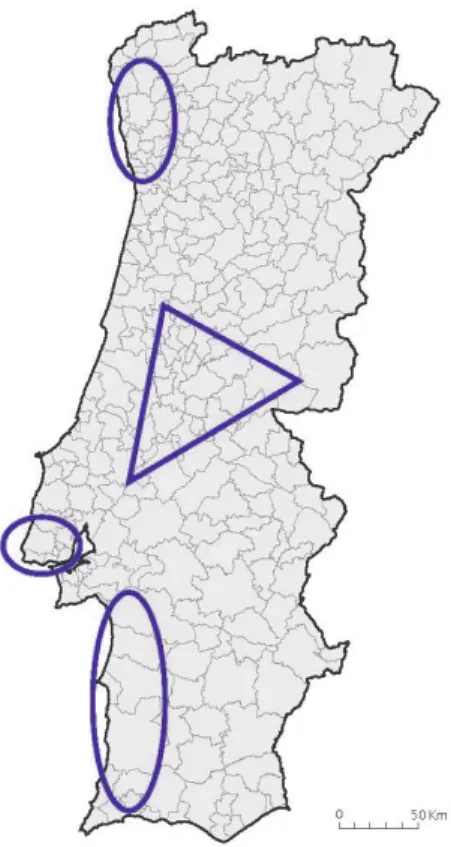
Geographically, combining the geo-spatial data from CATALISE, Rede Convergir and ECOLISE, four regional clusters can be identified: the Alentejo and Algarve coast (mainly eco-villages), the triangular area between Coimbra, Santarém and Castelo Branco (mainly eco-villages, transition and permaculture), Northwest Portugal (predominantly eco-villages and permaculture), and finally Lisbon’s Metropolitan Area, Sintra’s municipality in particular, with the major concentration of diverse types of incentives (see Figure 4).
ICS WORKING PAPERS 2018
Figure 4 - Regional CBI Geographical Clusters
2.3 Who is driving CBIs in Portugal?
In terms of longevity it is difficult to outline a clear picture: there seems to be a low survival rate after the first years of existence and most of the CBIs still seem to be in a development phase (cf. Marques Balsa et al., 2016; Baumgarten, 2017). We have no means to determine whether this implies CBIs’ “false start” that fails to transform into a proper initiative, if they simply take a long time to set up, or if they are transforming or even travelling across space or institutional settings. This fact is particularly relevant when we take into consideration the overall recent appearance and growth of the CBI phenomenon. In fact, the majority of these initiatives exist since 3 to 5 years, whilst only 25% exist since more than 7 years (cf. Marques Balsa et al., 2016:35).
It is therefore relevant to take a closer look into the actors driving the creation and management of Portuguese CBIs. CATALISE informs us that more than half the CBIs are founded by multiple persons — while it is left unclear how many people this actually involves—, the average of people taking part in their activities is around 1500 per year. Nevertheless, a critical scrutiny reveals a median of 108 and a mode of
ICS WORKING PAPERS 2018
only 10 (idem: 38; 42). This indicates a large disparity in the participation structure insofar that a small number of CBIs aggregate a lot of participants while the majority hosts a limited amount (i.e. around 10). A closer examination reveals that a large amount of initiatives are founded and steered by expatriates, especially in the rural areas (cf. Leal, 2014). This can be exemplified by the Tamera ecovillage and healing centre in the Alentejo region, the most prominent Portuguese CBI: the founders and the great majority of the around 170 permanent inhabitants are non-Portuguese, mostly from Austria, Germany and Switzerland, while the rest stems from other European or Western countries. Only seven members are native Portuguese (cf. Esteves, 2017).
CBIs are promoted by individuals with a significantly higher educational level than the average population, often belonging to the academic milieu (Marques Balsa et al., 2016: 80; see for example Campos et al., 2016). In this line, the managers of the projects Rede Convergir, CATALISE and ECOLISE all include members of the CCIAM research group of the Faculty of Sciences of Lisbon University (see Annex 2 of Appendix A for a detailed description). Accordingly, CATALISE's final report highlights key actors’ continuity as a determinant factor for the overall impact CBIs may have. And when fundamental roles concentrate in a limited number of individuals this risk of dependency increases (cf. TESS, n.d.).
Actors-wise, further identified challenges to CBI resilience include the capacity and willingness of its members to integrate in local culture and communities and participate in local governance (Rocha et al., 2016). This lack of local entrenchment, often preemptively desired by some CBIs that foster a more isolationist philosophy, is a crucial element to help us better understand the potential societal impact of CBIs as promoters of socio-ecological transitions towards sustainability.
2. 4. A highly fragmented landscape
CBIs in Portugal purpose to “repair” the deficiencies of the current socio-economic paradigm by rethinking and reinventing “development” via local action that embodies divergent (e.g. Eco-villages) or complementary (e.g. Transition movement) alternatives to the incumbent system. Divergent in the sense that these sit the farthest from mainstream perspectives and promote holistic and often detached alternative development solutions. Complementary in the sense of a gradual transformation of existing development perspectives and practices. The former attempts change from outside of the system while the latter works from within.
Their aim is to forward a new value system based on solidarity and social cohesion, community building, proximity (locality) and direct interaction, active involvement, citizenship, responsibility sharing, participative governance and self-management, in order to promote just and sustainable development
ICS WORKING PAPERS 2018
(cf. Santos et al., 2016; Rocha et al., 2016). Yet there is no CBI community per se in Portugal. We witness a non-networked set of initiatives largely in their embryonic development stage that mirror a plurality of agendas with a highly diversified thematic emphasis. All in all, these CBIs reflect a wide range of heterogeneous patterns of resilience and connection to local communities, strong dependence of leader-figures and scarce funding and scale-up solutions.
3. Wider change actors or isolated niche phenomena?
This section engages in a critical examination of the agency of CBIs in Portugal in order to conclude on their current and potential role in the promotion of a wider socio-ecological transition. In our view, this is of paramount importance since the majority of existing reviews, case studies and data analyses are driven by normative claims and idealism, that – although legitimate –, frequently downplay CBI’s internal and external limits or contradictions. Against the backdrop of Göpel’s (2016: 48) actors’ motivation rationale and the evidence explored in section 2, we conclude that there exists a structural difference amidst Portuguese CBIs with respect to their degree of proactive seeking to exit the ‘protected niche space’ (cf. Seyfang and Haxeltine, 2012). This builds directly on the discovery of Holsten et al. (n.d.: 14) that opinions of European CBIs towards “collaboration with public institutions are mixed: some members feel that they fill an institutional gap and hence complement public institutions; others fully abstain from such interactions. Third groups try to do a bit of both”.
In this light, despite a shared value framework and themes of intervention, we forward a bi-dimensional interpretation of CBIs in terms of their agency in Portugal: inward-looking and outward-looking. This innovative differentiation follows our interpretation of how CBIs engage mainstream systems in order to try to influence their evolution. In other words, we pursue a conceptual framework that allows the identification of the CBIs that can aspire to a direct role in the redefinition of existent sustainability actor-networks and policy design. This distinction is a fundamental step if we are to advocate for the proper policy environments where transformative CBIs can be empowered to make a difference.
3.1 Inward-looking niche
We identified a mismatch between some of CBIs’ discursive manifestos and their on the ground practices. Despite calls for wider societal transformation as a fundamental part of their leitmotif, multiple CBIs actively choose not to interact with the outer world because they believe that total autonomy and self-determination from the incumbent capitalistic system is a fundamental condition in order to exist, survive and thrive. These CBIs evolve with a closed member structure and with restricted interaction with local residents or institutions, based on allegedly cultural or institutional factors (e.g. resistance to change;
ICS WORKING PAPERS 2018
closed culture of local population; centralistic state behaviour; excessive procedure normalization; over-complicated rules for organisation formalization (Rocha et al., 2016)). This phenomenon of ‘unreflexive localism’ may derive from a perfectionist utopian vision of true sustainable local living based on a set of normative predetermined simplified ideas (cf. Dupuis and Goodman, 2005).
This segregationist stance often translates into mute coexistences between CBI actors and local communities. In hindsight, this desired withdrawal may seem a valid short-term solution to avoid conflict and secure the survival of the CBI, namely on initial settlement stages when CBIs’ values or lifestyle choices may bring about some cultural clash with local communities. However, in the long run, the denial of the politics of the local hinders cultural acceptation and the potential of CBIs’ development impacts (cf. Rocha et al., 2016). This risk of social exclusion and ‘ivory-tower thinking’, has already been signaled. Among others, Fernandes-Jesus et al. (2017: 1550) argues that there is for example an inherent difficulty in the Transition movement to engage beyond highly educated, “post-materialist progressive” individuals that have both resources and willingness (consciousness) to engage in environmental activism.
3.2 Outward-looking niche
There is a growing number of CBIs attributing fundamental significance to the pro-active promotion of local community engagement, involvement, and first and foremost knowledge exchange, networking and cooperation (even if only horizontal) as a basic condition to evolve (cf. Campos et al., 2016). These outward-looking CBIs believe in scale-up and transferability of social innovation practices within the wider context of socio-ecological transitions, but often don’t know how to do it or lack instrumental resources to achieve it (Santos et al., 2016).
Nevertheless, even now Portuguese CBIs seem to be, willingly or involuntarily, unable to unite efforts and network beyond their thematic identity or geographical proximity as analysed above. Despite their resilience (e.g. the Transition or the Permaculture network etc.), there is yet no evidence of a nation-wide CBI network effort, nor is there evidence (i.e. events, meetings, fora) of a relevant and persistent level of interaction between them.
It is nevertheless worth pointing out that a limited number of actors seem to be catalysing multiple initiatives throughout time (e.g. the CCIAM research group members). This multi-role effect (i.e. moving between science, CBIs and activism) may result from the engaged scholarship practiced by these academics, and the action-research projects that they develop (e.g. PLACARD, Adapt for Change, BASE (see Annex 2 of Appendix A for a detailed description)). Yet, these overlapping roles could potentiate a misrepresentation of the CBI dynamic and its resilience inducing the perception of a larger-than-is dynamic on the ground.
ICS WORKING PAPERS 2018
3.3 Hidden connections
Inward- and outward-looking CBIs may differ in the formalization and pursue of their relational strategies (i.e. isolation or networking). However, the interactions between them and the “outside world” already exist, and in some cases even reach a structural level. For example, the idyllic portrait of small and isolated self-sufficient eco-villages, theoretically independent (e.g. from energy, schooling or medical supply), is somewhat a fallacy: Sooner or later – often systematically, there will be interdependency bonds established with the incumbent system.
These interactions are, nevertheless, often guided by a self-justifying rationale of using the capitalistic system and its structures for the “good” – CBIs’ good –, which informs a predominantly instrumental relationship with the political and economic spheres, for instance in order to acquire sufficient funding for their development and survival. Take for instance Tamera: several of its members spend the summer months in Northern Europe working in temporary jobs in order to provide the sufficient funds for the project to survive over the rest of the year (Esteves, 2017). Similarly, Amoreiras Village Convergence Centre (ACC) in Odemira initially brought in six people with a one year work-contract while others arrived as volunteers, using their own financial resources hoping that the ACC would eventually create jobs. Yet, the latter was only possible for short-term periods, therefore most members had to find ways of earning money outside. This is another example of a CBI survival strategy that inadvertently strengthens its dependency on the overall socio-economic system whose change mobilized it in the first place. From a more orthodox standpoint, this instrumental interaction with the system may seem to compromise the “purity” of their founding values (Haxeltine et al., 2017: 10), such as locality, solidarity or equality, but it may also be perceived as much needed pragmatism to enable CBIs targets altogether.
We observe that the current Portuguese CBI landscape hosts multiple interpretational approaches in terms of implementation strategy, agency and interaction with public institutions and local communities. These range from isolationism to networking as a result of their heterogeneity. It seems that CBIs self-assess themselves as proactive, envisaging networking and knowledge transfer efforts as a stepping stone for the promotion of a wider socio-ecological transition. However, there is a crucial gap between their visions and actions, which we explore in the next section (4).
4. The politicization gap
Societal transition cannot be viewed decoupled from an analysis of the power dynamics at play when it comes to ‘regime change’. Transition’s power dynamics shift and realign along the way, triggered by “conflicts, power struggles, contestations, lobbying, coalition building, and bargaining” between the regime actors and the incumbent groups (Avelino and Wittmayer, 2016: 631). Thus, power can shift between actors or groups of actors. In this context, it is important to examine how CBIs access and exercise
ICS WORKING PAPERS 2018
power in transition processes and to which extent this power is shifted from the situated regime to these niche actors. In short, understanding this ‘power struggle’ is crucial for knowing if and how CBIs can fulfil their potential as game changers in wider transition initiatives towards sustainability. This section seeks to shed some light on the agency of the previously identified types of CBIs (section 3) in societal transition towards sustainability in Portugal.
Outward-looking CBIs (Section 3.2) believe their agency to have a role to play in the wider socio-ecological transition. However, the crucial scaling-up of their transformative practices is acknowledged as a highly complex issue. If the scale of this initiatives is too small, it will never constitute a truly visible and validated alternative to the growth-driven neoliberal capitalist system, unable to decolonize the predominant societal mindset and ultimately trigger a system change. Scaling-up is primarily not about growing in a literal sense, but about setting transition pathways. In other words, we are not referring to upscale in a quantitative sense (i.e. growing in numbers of members or initiatives), but as a process of gaining societal relevance and political power by CBIs turning into a visible political actor and their practices a viable alternative vis-à-vis the incumbent regime.
As Baumgarten (2017) noticed, CBIs’ practices and their sustainable transition discourses are still invisible in the Portuguese media, public or political arenas (i.e. outside their communities of practice). In fact, a large amount of CBIs monitored by CATALISE focus on the horizontal transferability of knowledge (i.e. replication and collaboration) instead of engaging in upscaling and organising their efforts in order to build up momentum for a bigger change (Rocha et al., 2016: 22). Therefore, CBIs’ development challenges include: replicating, delivering, and embedding (Hof et al., n.d.). In this sense, CBIs must learn how to better pool resources and capacities and articulate new and old ways of doing.
On a different note, CATALISE’s policy recommendations claim that CBI’s upscaling and transferability depend largely on the exterior context (e.g. cultural norms and practices) and on existing system and its structures (e.g. public policies, legislations, funding possibilities) (Rocha et al., 2016). However, acknowledgment alone makes little impact. Portuguese CBIs upscaling efforts need dedicated champions, knowledge and policy brokers, that focus specifically on enabling their interaction with the private and public economic, political and institutional spheres (i.e. polity and markets). The culture and value change (see section 1.2) underpinning socio-ecological transitions will not happen on its own. CBIs are perceived as being able to influence the former. However, in Portugal they are yet to fully embrace their agency forwarding the replication and scale-up of their practices, ideas, and values. This means that they have to actively seek to gain the political power needed in order to place transition among the public and political debates. However, this is hardly a consensual goal among Portuguese CBIs. Some fear “being co-opted, or being taken over by the corporate sector or higher-level governance, and are skeptical about the capacity of top-down policies to spark a real transition to a sustainable society on their own” (Hof et al., n.d.: 8).
ICS WORKING PAPERS 2018
5. Final remarks
In theory, CBIs have an undeniable potential positive role in leveraging socio-ecological transitions towards sustainability. CBIs potential importance is closely tied to the ability, or lack thereof, of the dominant system to respond to upcoming social and CC challenges. The degree of their influence on societal change, regardless of how sound the underpinning theoretical rationale might be, is nonetheless challenged as empirical data is collected and more detailed critical analysis settles in. Notwithstanding, we understand CBIs as highly context-dependent niche actors whose maximum impact cannot be achieved solely on their own merits, as the regime change challenges CBIs are facing are literally unsurmountable. This is not a dismissal of CBIs’ value and potential contribution, but rather a call for a reframing of how they ought to be perceived.
As it stands, we see three possible scenarios for CBIs’ future, independent of their physical location. The first, as undesirable as we may find it, is their steady atrophy and consequent extinction, as the key actors driving them forward either lose heart or run out of resources, in face of the resistance to change of the dominant regime. The second scenario is a bittersweet one where CBIs will linger on in somewhat similar variations of their current nature, nevertheless remaining solely a laboratory of social innovation alternative practices and simultaneously an untapped resource for wider societal change. The third scenario, the one we perceive as desirable, is that this CBI-related potential for social innovation is acknowledged enough for existing institutional structures to allow it in, either through the creation of specific CBI support structures or a simple adaptation of already existing policy solutions.
There are two major ways in which this third and last scenario can materialise. On the one hand, existing institutional infrastructures take the lead and act as a catalyst for the inclusion of CBI social innovation into the wider system. On the other, CBIs start to mobilise and claim to give their input towards a wider socio-ecological transition via the existing institutional infrastructure. As evidence shows, the first of these options seems at the current date unrealistic. The spotlight falls therefore on the second option. Thus, when we ponder its implications, the crucial issue becomes how CBIs can attain a greater role in leveraging a shift in those existing institutional infrastructures. In a nutshell, in the Portuguese case, we feel they must gain a political voice. And to do so, two key obstacles must be tackled head on.
Sociopolitical Visibility. Portuguese CBI landscape dynamics show that although CBIs have been gaining
ground in numbers and diversity, they remain largely invisible to the public eye. This mirrors their
dispersion and lack of networking and politicisation, which in turn prevents. Portuguese CBIs to fully
embrace their potential as active change actors in the sense of advancing the replication and scale-up of their practices, ideas, and values via turning into political and visible actors and societal champions for a socio-ecological transition towards sustainability. However, the latter is a recent societal dynamic that still has not taken root in Portugal. What we observe today are the first avant-garde efforts of collaboration, replication and embeddedness with a large room for potential yet to be explored. In this pioneering
ICS WORKING PAPERS 2018
context, our analysis of CBIs’ agency must lie on process rather than strictly outcome. To this effect, although Portuguese CBIs’ on-the-ground practices have had limited impact in changing current development paradigms, they may well have had multiple non-quantifiable or non immediately visible ones. These refer to spaces of social engagement and experimentation, lifestyle changes, awareness raising and so forth. Regardless of their yet embryonic nature, dismissing the latter would be unwise, as CBIs might represent the first stepping stone of a generation of practices that may evolve, through trial and error, into viable alternatives to the global dominating neoliberal growth-oriented development paradigm and its inherent multidimensional unsustainability.
Policy Role. In this line, CBIs are perfectly positioned to act as pathfinders of co-shaping processes, between social innovators and incumbent institutions, actively contesting the latter’s unsustainable development logic in the relevant political fora. CBIs are unlikely to achieve this without favourable institutional frameworks and policy environments. This implies that local governments must acknowledge CBIs’ roles and achievements and be willing to share responsibilities. Instead of acting solely as regulators, they must themselves become innovators and facilitators. CBIs can potentially contribute in multiple policy contexts. For example, they can help mitigate the lingering negative impacts of the 2007-08 economic crisis in sparsely populated areas or revitalise ageing territories in a growingly urbanized Europe. Particularly in deprived and growingly depopulated areas they can serve as a deterrent for a local break-down in social cohesion. Alternatively, CBIs are potential players for the local achievement of the 2030 Sustainable Development Goals that resources-strapped municipalities should consider. These are but a few examples.
Finally, we come full circle. Why is politicization necessary? As Avelino and Witmayer (2016) point out, sustainability transitions are not only about socio-technical transformation but also about socio-political change. Ultimately, long-lasting societal change doesn’t happen overnight and the necessary societal mobilisation will not occur without the politicisation of the socio-ecological transition agenda proper. Thus we believe that politicisation as a process is in itself an unexplored transition pathway that should develop alongside with current CBI practices in Portugal and elsewhere.
Conflict of Interest
The authors declare no conflict of interest. The opinions expressed herein are those of the authors and do not necessarily reflect the views of the Research Funding Programme of FCT (Fundação para a Ciência e Tecnologia - Portugal) nor of the University of Lisbon.
Acknowledgements
This work was supported by grant SFRH/BPD/73337/2010 from FCT (Fundação para a Ciência e Tecnologia - Portugal) awarded to the first author. We want to express our deepest gratitude to Tim O’Riordan
ICS WORKING PAPERS 2018
(University of East Anglia), Verónica Policarpo (Institute of Social Sciences - University of Lisbon), Gil Penha Lopes (Faculty of Sciences - University of Lisbon) and Lena Pfeifer (PIK - Potsdam Institute for Climate Impact Research) for their insightful comments on earlier versions of this paper. The final version is of our sole responsibility.
ICS WORKING PAPERS 2018
Appendix A
Annex 1: Comparative CBIs Classificatory Matrix
CATALISE
(typology) REDE CONVERGIR (type) ECOLISE (categories)
Permaculture Transition Towns Social Intervention Social Enterprise Economic Project Holistic Project Ecovillage/Community Environmental Project Holistic School Other Permaculture Transition
Community and Commons
Built Environment Culture and Education Economy and Finance Nature and Earth Management Tools and Technologies Health and Spiritual Well-being Other Permaculture Transition Initiatives Ecovillages Other Areas of intervention Education Formation / capacitation Community development Employment creation
Social and solidarity economy Agriculture/horticulture Stock farming Communication / dissemination Health Spirituality Bio-construction Renewable technologies Environmental questions Network development
Arts and culture
Areas of interest Education Alternative Economics Social tools Agriculture Stock farming Land / tools sharing
Health Spirituality Bio-construction Eco-technology Arts (no equivalent)
ICS WORKING PAPERS 2018
Annex 2: Listing of transition-related actors and actions
TSI related research and research projects
TSI
(Transformative social innovation)
TSI theory was informed by empirical findings of three major research projects on cross-country CBIs in Europe. These research projects are: TESS, PATHWAYS, ARTS and DRIFT.
→ TESS
(Towards European Societal Sustainability)
With the aim to explore the role of community-based initiatives (CBIs) in creating a sustainable, low-carbon Europe, led by the Potsdam Institute for Climate (PIK). http://www.tess-transition.eu/resources-2/ → PATHWAYS (Transition Pathways to sustainable low-carbon societies)
Led by the PBL Netherlands Environmental Assessment Agency and aiming at providing policy-makers and other key stakeholders with better insight in on-going and necessary transition pathways for key domains relevant for EU policy.
❖ https://www.pathways-project.nl/ → ARTS (Accelerating and Rescaling Transitions to Sustainability)
Led by DRIFT (Dutch Research Institute For Transitions) and committed to understanding the role and impact of transition initiatives in cities and examining the conditions that can aid accelerating change towards a sustainable low-carbon society.
http://acceleratingtransitions.eu/
Participative research projects
ClimAdaPT.Local
(Municipal strategies for Climate Change in Portugal)
Had the goal of starting in Portugal a continuous process leading to the elaboration of Municipal Strategies for Adaptation to Climate Change (Estratégias Municipais de Adaptação às Alterações Climáticas – EMAAC, in Portuguese) and its integration in municipal planning tools.
http://climadapt-local.pt/en/
CCIAM
(Climate Change Impacts Adaptation & Modelling)
Is a research group of the Faculty of Science of Lisbon university. Its research areas are climate change impact assessment, adaptation strategies and the development of downscaled climate scenarios, bringing together scientists from several disciplines who conduct trans-disciplinary research on both national and international level.
http://ce3c.ciencias.ulisboa.pt/team/CCI AM
BASE
(Bottom-up Climate Adaptation Strategies towards
a Sustainable Europe)
Addresses the need for research on sustainable climate adaptation strategies, which promote interactions between bottom-up and top-down assessments. Its intention is to evaluate the environmental, social and economic impacts, the costs and benefits, policy coherence and stakeholder perceptions of different climate adaptation pathways from an interdisciplinary perspective.
http://ce3c.ciencias.ulisboa.pt/research/ projects/ver.php?id=24
ICS WORKING PAPERS 2018
Adapt for Change
(Improve the success of reforestation in semi-arid areas: adaptation to climate change scenario)
With the goal to decrease the cost-benefit of reforestations through an innovative approach: - Developing a model that points which areas: i) may be easily and cheaply regenerated; ii) must be subject to assisted reforestation, with the support of different methods; iii) must be occupied by alternative activities because of the difficulty in reforestation.
http://ce3c.ciencias.ulisboa.pt/research/ projects/ver.php?id=42
PLACARD
(PLAtform for Climate Adaptation and Risk reDuction)
With the mission to be the recognised platform for dialogue, knowledge exchange and collaboration between the Climate Change Adaptation (CCA) and Disaster Risk Reduction (DRR) communities.
https://climate-adapt.eea.europa.eu/metadata/projects/p latform-for-climate-adaptation-and-risk-reduction
CBI databases for Portugal
CATALISE
(Capacitation for local transition and social innovation)
Was an interdisciplinary research project on socio-ecological experimentation towards participation in sustainable and integral local development. In a nutshell, this project aggregated and analysed available information on Portuguese CBIs from 10 subnational networks, who seem to work independently from each other and even have access to smaller networks beneath them. These are, for example, Fórum Cidadania & Território, ANIMAR – Associação Portuguesa para o Desenvolvimento Local, Rede de projetos apoiados pelo Portal da Economia Social Zoom da CASES or Rede Convergir. It is explained that they also drew on contacts from sub-networks with non-probability (exponential snowball) sampling, out of their direct control, to be able to reach out to all CBIs on the ground, since many of them are in fact not represented in networks (Marques and Balsa et al., 2016: 33).
http://ce3c.ciencias.ulisboa.pt/research/ projects/ver.php?id=25
Santos et al. (2015), Rocha et al. (2015) or Marques Balsa et al. (2016) for respective policy or research documents
Rede Convergir
(Convergence network) Is a hub website active since 2011 listing all currently operating CBIs in Portugal, including an event-calendar. It was initiated by several individuals active in both sustainability research or in CBIs on the ground, with the aim to create a network for sustainability initiatives.
www.redeconvergir.net/
Ecolise
(the European network for
community-led initiatives on climate change and sustainability)
Is a coalition of national and international networks of community-led initiatives on sustainability and climate change, as well as organisations that support a community-led transition to a resilient Europe.
http://www.ecolise.eu/
CBI examples in Portugal
Trokaki Is a local exchange trade system (LETS) that
englobes a market where goods, time and services can be transformed into credit that in turn can be exchanged into the other goods, time or services. It is mainly active in Lisbon
ICS WORKING PAPERS 2018
Verde Perto Is a local producers’ cooperative situated in the district of Santarém specialised in local food supply chains and local development via formation (e.g. permaculture), rural accommodation or volunteering activities
http://www.verdeperto.pt
Fruta Feia A volunteering-based consumption cooperative that engages in saving food from local farmers that does not correspond the market requirements in terms of shape. Currently, it has delegations in more than 8 cities in Portugal.
ICS WORKING PAPERS 2018