2018
UNIVERSIDADE DE LISBOA FACULDADE DE CIÊNCIAS
Small pelagics, predatory fish and seabirds: trophic and
behavioural interactions in a marine protected area in
Guinea-Bissau
Doutoramento em Biologia e Ecologia das Alterações Globais Especialidade em Biologia e Ecologia Tropical
Edna Rita de Freitas da Costa Correia
Tese orientada por: José Pedro Granadeiro
Paulo Catry
Documento especialmente elaborado para a obtenção do grau de doutor Departamento de Biologia Faculdade de Ciências
2018
UNIVERSIDADE DE LISBOA FACULDADE DE CIÊNCIAS
Small pelagics, predatory fish and seabirds: trophic and
behavioural interactions in a marine protected area in
Guinea-Bissau
Doutoramento em Biologia e Ecologia das Alterações Globais Especialidade em Biologia e Ecologia Tropical
Edna Rita de Freitas da Costa Correia
Tese orientada por: José Pedro Granadeiro
Paulo Catry
Júri: Presidente:
● Doutora Maria Manuela Gomes Coelho de Noronha Trancoso, Professora Catedrática e Membro do Conselho Científico da Faculdade de Ciências da Universidade de Lisboa Vogais:
● Doutor Vitor Hugo Rodrigues Paiva, Investigador Pós-doutoramento na Faculdade de Ciências e Tecnologia da Universidade de Coimbra
● Doutor Amadeu Mortágua Velho da Maia Soares, Professor Catedrático do Departamento de Biologia da Universidade de Aveiro
● Doutor Paulo Xavier Catry, Investigador Principal do ISPA – Instituto Universitário de Ciências Psicológicas, Sociais e da Vida
● Doutor Frederico José Oliveira de Almada, Investigador do ISPA – Instituto Universitário de Ciências Psicológicas, Sociais e da Vida
● Doutor Jorge Manuel Mestre Marques Palmeirim, Professor Associado com Agregação da Faculdade de Ciências da Universidade de Lisboa
Documento especialmente elaborado para a obtenção do grau de doutor
Fundação para a Ciência e a Tecnologia (FCT) – Bolsa de Doutoramento (PD/BD/52594/2014) MAVA Foundation through a project granted to IBAP (Guinea-Bissau) – “La recherche participative au service de la conservation de la biodiversité du Parc National Marin de João Vieira-Poilão (Archipel des Bijagós)”
Fundação para a Ciência e a Tecnologia (FCT) – Projecto do MARE (UID/MAR/04292/2013) Fundação para a Ciência e a Tecnologia (FCT) – Projecto do CESAM / FEDER, com pareceria PT2020 e Compete 2020 (UID/AMB/50017)
Departamento de Biologia Faculdade de Ciências
This study was funded by Fundação para a Ciência e a Tecnologia, through a PhD scholarship PD/BD/52594/2014 and supported by the MAVA Foundation through a project granted to IBAP (Guinea-Bissau) – “La recherche participative au service de la conservation de la biodiversité du Parc National Marin de João Vieira-Poilão (Archipel des Bijagós)”. Fundação para a Ciência e a Tecnologia provided additional financial support through the strategic project UID/MAR/04292/2013 granted to MARE, and UID/AMB/50017 granted to CESAM, together with the co-funding by FEDER, within the PT2020 Partnership agreement and Compete 2020.
Nota prévia
A presente tese apresenta artigos científicos já publicados, submetidos ou ou em preparação para publicação (capítulos 2 a 6), de acordo com o previsto no nº 2 do artigo 25º do Regulamento de Estudos de Pós-Graduação da Universidade de Lisboa, publicado no Diário da República, 2.ª série — N.º 57 — 23 de Março de 2015. Uma vez que estes trabalhos foram realizados em colaboração o candidato esclarece que participou integralmente na conceção dos trabalhos, obtenção dos dados, análise e discussão dos resultados, bem como na redação dos manuscritos.
Lisboa, Junho de 2018
“Crer é errar. Não crer de nada serve.” Ricardo Reis
i
ACKNOWLEDGMENTS
Mother and Father, I will be eternally grateful for your endless support. Thank you for always believing in me and for always encouraging me to go! I am lucky to have you as parents.
Paulo Catry, for accepting me in the group and giving me the opportunity to know Guinea-Bissau and work there. You have always encouraged me to be better and that, most of the time, was what made me move forward. Thank you for always being available to help, even when the time was short. For having been with me in the field. For being a good teacher. And for always being motivated with our work, which several times helped me to keep motivated too.
José Pedro Granadeiro thank you for accepting me in the group and for being my supervisor. For all the support and sympathy. For always being optimist and ready to help.
I would like to thank to my lifelong friends that with their support and friendship helped me during these last years. Camilo Carneiro for all the important help in the field and everywhere. For having always had patience with me and willingness to help. If at least the skies could always be calico. Filipa Reis and Reis family for being my second family, always ready to help. Tânia Sérgio and Diogo Sanches Pereira your friendship means the world to me! You are the hardest working people I know and yet always with time for us. You are really an example of strength, love and dedication and I am really lucky to have you as an inspiration in my life. Tânia for the endless talks that only we can have. Diogo for being patient with that! To Cátia Matos, my girl, thank you for all the talks and all the walks, to Stéphanie Ferreira and to Eduarda Moreira.
Miguel Lecoq thank you for all the support in Guinea-Bissau and for all the valuable advices. For showing me a Guinea-Bissau that otherwise I would not have opportunity to see and for making me feel in home there. For all the “espéicies” and for always being indeed my home where I had not! Maria Alho, for your help in the field, but most of all for your enthusiasm and endless will to work, to help and to learn. De volta duma fogueira tão linda! Also, to Saldanha Alho family, for all the generosity. Madalena Boto, thank you so much for all your unconditional help and friendship. Your kindness and support were more important than you can ever imagine. Thank you for the constant optimism and the joy you brought into my life. Our competition will last until the end of times!!
I would like to thank to the so many people that helped me in the field and laboratory. Joana Romero it was really nice and important to have you with me in the field. Pedro Ferandes, Carolina Bloise, Francisco Aguilar, Fernando Madeira, Raquel Marques, Manuel Sampaio. Girls from CIBIO/CTM, Patricia Ribeiro, Sofia Mourão, Susana Lopes, Joana Veríssimo, Filipa Martins and Pamela Puppo, for helping me whenever I needed and for making my stay there more enjoyable. Emanuel Dias, Diana Barão, Carolina Vieira and Silke Waap. Rui Rebelo for somehow making me feel welcome in the university. Mohamed Henriques for all the help in the field, in Bissau, in Dakar, in Lisbon, everywhere! António Araújo for being an inspiration and always ready to help. I still remember and appreciate some advices you gave me when I first met you.
Issuf Pape, Sene Mendes, Seco Leão, Armando Gomes, “my boys” in the field! Thank you for all the help. I have learned a lot with you and I was very lucky to have had you with me.
ii
I would like to acknowledge all the support given by the IBAP Direction, particularly Alfredo Simão da Silva, Justino Biai, Castro Barbosa, Quintino Tchantchalam. And to Aissa Regalla for all the help, fundamental for the success of the field missions. To the so many people that helped me in Guinea-Bissau: Hamilton Monteiro, Teddy Bossard, Claude Bossard, Jean Bossard, Vie, Malic Tendeng, Melchior. The Park Guards, Paulino and Ninada and the sailors Seco, Saido, Santinho, as well as so many Bijagós that contributed to this work.
To the EnForcados de Alcochete, for helping me in this journey. For the nice talks and knowledge exchange. And a special thanks to José Alves for helping me in some stressful moments! Filipe Ceia, for all the support. Luís Pascoal Silva, for encouraging me to have one good distraction during this PhD, for the cold coffee, for the new and the old species! Vanessa Mata, for all the help and for the great patience and ability to teach.
My family in general for the support, but particularly thanks to Luísa Correia, Paulo Correia, Ana Duarte, André Duarte, Ramiro Meireles, Helena Teixeira, Luísa Gaspar and Filipa Costa.
I am very happy to have found a place like Clube Nacional de Natação. It became the place where I was able to turn off my brain, and that really helped me throughout these years. Thanks to all my team colleagues and a special thanks to Daniel Silva.
I am grateful to the institutions that gave me financial and logistic support: FCT, MAVA Foundation, IBAP, CESAM, FCUL, MARE, ISPA Instituto Universitário, and CIBIO - UP.
I am truly grateful to everyone that helped me during these four years and contributed to the success of this work. I know I am very lucky to have participated in a project like this in such a special place.
iii
TABLE OF CONTENTS
ACKNOWLEDGMENTS i RESUMO vii ABSTRACT ix CHAPTER 1 1 General Introduction Geographic framework 3 Trophic interactions 4Previous research on our study area 6
Work goals 7
Papers presented 8
References 12
CHAPTER 2 17
Seasonal, lunar and diel variations in a coastal fish community assessed by beach seine in the Bijagós Archipelago, West Africa
Abstract 19
Introduction 20
Material and methods 21
Results 25 Discussion 32 Acknowledgements 38 References 38 Supplementary material 44 CHAPTER 3 51
Length-weight relationship of fish species from the Bijagós Archipelago, Guinea-Bissau
Abstract 53
Introduction 53
iv Results 55 Discussion 56 Acknowledgements 57 References 57 CHAPTER 4 59
Predatory pelagic fishes of the Bijagós Archipelago (Guinea-Bissau) show high overlap in diets dominated by sardinella
Abstract 61 Introduction 62 Methods 64 Results 68 Discussion 72 Acknowledgements 76 References 76 Supplementary material 81 CHAPTER 5 83
The diet of two opportunistic seabirds (Caspian and Royal Terns) confirms the importance of sardinella in West African coastal food webs
Abstract 85 Introduction 86 Methods 87 Results 91 Discussion 98 Acknowledgements 101 References 101 Supplementary material 106 CHAPTER 6 111
Trophic interactions between migratory seabirds, predatory fishes and small pelagics in West Africa
v Introduction 114 Methods 116 Results 122 Discussion 129 Acknowledgements 135 References 135 Supplementary material 142 CHAPTER 7 143 General Discussion
Small pelagic fish community 145
Diet and foraging behaviour of marine predators 146
Methods for diet studies 147
Ecosystem structure 148
Conservation implications 149
Future research 149
vii
RESUMO
A biodiversidade marinha tem sofrido rápidos e significativos declínios, sobretudo devido à sobrepesca e às alterações globais, o que tem afectado o funcionamento dos ecossistemas marinhos por todo o mundo. Conhecer as dinâmicas das redes tróficas é assim essencial para o desenvolvimento de acções eficientes para a gestão dos ecossistemas. Na África Ocidental, este conhecimento é ainda mais urgente, uma vez que muitas populações de stocks pesqueiros estão em colapso e as populações locais dependem grandemente da pesca e do peixe para sobreviver. A presente tese estuda as interacções tróficas da comunidade marinha do Arquipélago dos Bijagós, Guiné-Bissau. Os extensos mangais e zonas de vasa intertidal que este arquipélago continental contém, fazem dele uma área de extrema importância para uma variedade de espécies migradoras (e.g. tartarugas marinhas, aves limícolas), de espécies residentes (e.g. aves marinhas), e também como berçário de várias espécies de peixes. O seu grande valor em termos de biodiversidade levou os Bijagós a serem declarados Reserva Biosfera pela UNESCO em 1996 e sítio Ramsar em 2014. Ainda assim, poucos estudos foram realizados no seu ecossistema marinho.
Neste trabalho foram estudadas as variações entre estações, ciclos lunares e ciclos diários na comunidade dos pequenos peixes pelágicos costeiros do Arquipélago dos Bijagós. Para isso foram efectuadas pescas com rede de xávega de modo a cobrir ambas as épocas e em diferentes ilhas. Foi estudada a dieta e comportamento alimentar de predadores marinhos (peixes predadores e aves marinhas), com especial interesse nas associações facilitativas alimentares. Para o estudo da dieta foram usados métodos tradicionais, como a identificação macroscópica de restos de presas presentes nos conteúdos estomacais de peixes predadores ou nas egragópilas de aves marinhas nidificantes. Foram também usados métodos de next-generation sequencing aplicando DNA metabarcoding na identificação de presas nos dejectos de aves marinhas invernantes. Esta foi a primeira vez que este método foi usado para o estudo da dieta de aves marinhas migradoras nos seus locais de invernada. Foram também realizadas observações comportamentais de aves marinhas para o estudo dos seus hábitos alimentares. Devido à falta de estudos da relação comprimento-peso para determinados peixes, esta relação foi calculada para seis espécies. O presente estudo mostrou que o ecossistema marinho dos Bijagós é fortemente dominado por uma espécie de pequeno pelágico, a Sardinella maderensis. Esta espécie foi a mais abundante ao longo do ano e em todas as ilhas. Foi também a espécie mais frequente na dieta de todos os predadores marinhos estudados. Em relação ao comportamento alimentar facilitativo, as diferentes espécies de aves marinhas mostraram distintos graus de dependência destas associações, variando entre completamente independente a quase obrigatória. Os resultados sugerem que o uso de associações influencia a distribuição das aves marinhas e pode aumentar o seu sucesso alimentar. Os resultados globais deste trabalho indicam que o ecossistema marinho do Arquipélago dos Bijagós é do tipo wasp-waist, com a Sardinella maderensis como espécie de pequeno pelágico chave. Assim, para uma conservação eficiente do arquipélago, deve ser considerada uma abordagem de gestão ao nível do ecossistema. Diminuições das populações tanto de peixes predadores como de pequenos pelágicos são igualmente susceptíveis a influenciar a distribuição e sucesso alimentar das aves marinhas, com impacto na sua sobrevivência e sucesso reprodutor.
viii
Palavras-chave: Clupeidae, predadores marinhos, interacções tróficas, África Ocidental, Arquipélago dos Bijagós
ix
ABSTRACT
Rapid and significant declines in marine biodiversity, caused by overfishing and global changes, are affecting the functioning of marine ecosystems worldwide. Understanding food-web dynamics is essential for the development of efficient ecosystem management actions. In West Africa, knowledge of food-web dynamics is particularly urgent given that fish stocks are collapsing and fisheries sustain the livelihoods of a significant part of the human population.
This thesis addresses the trophic interactions of the marine community of the Bijagós Archipelago, Guinea-Bissau. The extensive mangroves and mudflats of this continental archipelago make it an important area for several migratory species (e.g. marine turtles, waders) and resident species (e.g. seabirds), as well as a nursery area for several fish species. The great biodiversity value of the Bijagós led it to be declared as UNESCO Biosphere Reserve in 1996 and a Ramsar site in 2014. Nevertheless, few studies have been conducted in its marine ecosystem.
Seasonal, lunar tidal and diel variations of the coastal small fish community of the Bijagós Archipelago were studied through beach seining along spatial and temporal scales. The diet and foraging behaviour of marine predators (predatory fishes and seabirds) was also studied, with particular interest in their facilitative feeding associations. Traditional methods were used for diet description, such as, the macroscopic identification of prey remains from stomach contents of predatory fish and pellets of breeding seabirds. We also used next-generation sequencing, employing DNA metabarcoding on the identification of prey in the droppings of wintering seabirds. This was the first time this method was used for studying the feeding ecology on migratory birds in their wintering quarters. Additionally, behavioural focal observations of seabirds were performed to investigate their feeding habits. Given the lack of previous descriptive studies, this work also focuses the particularities of length-weight relationships of six fish species.
The present study showed that the marine ecosystem of the Bijagós is strongly dominated by a small pelagic fish species, Sardinella maderensis. This species was the most abundant throughout the year as well as in all the islands, and the most frequent item in the diet of all marine predators. In regards to facilitative foraging, different species of seabirds showed distinctive degrees of reliance on associations, ranging from completely independent to near-obligatory. The results also suggest that the use of associations influences the distribution of seabird species and may enhance their foraging success. The overall findings presented here indicate that the marine ecosystem of the Bijagós Archipelago is a wasp-waist type, with Sardinella maderensis as the key small pelagic species, and that an ecosystem-based approach must be considered for the adequate management of the archipelago. Declines in populations of predatory fish and small pelagic fish are both likely to influence the distribution and foraging success of seabirds, with impacts on their survival and breeding success.
Keywords: Clupeidae, marine predators, trophic interactions, facilitative behaviour, West Africa, Bijagós Archipelago
1
CHAPTER 1
3
CHAPTER 1
General introduction
Drastic declines in biodiversity have been observed worldwide in recent years (e.g. Pereira et al. 2010, Butchart et al. 2014). In marine environments, biodiversity loss is rapidly affecting all taxa as well as the functioning of ecosystems (Cury et al. 2000, Tasker et al. 2000, Barbraud and Weimerskirch 2003, Myers and Worm 2003, Hutchings and Baum 2005). More than 80% of global fisheries are considered fully exploited, over-fished or depleted (FAO 2016). The depletion of resources caused by fisheries as well as by the effects of global changes is altering the dynamics of marine communities (Crespo and Dunn 2017).
Geographic framework
Tropical regions are prominently represented among the many important marine ecosystems experiencing disturbances even before their main components and interactions have been studied (Halpern et al. 2008, Stramma et al. 2008, Ferretti et al. 2010). The coast of Guinea-Bissau is an example of one of such regions, where the functioning of marine ecosystems is very poorly understood even though their relevance is internationally recognised (Dodman and Sá 2005, Campredon and Catry 2016).
Guinea-Bissau is located in the tropical Eastern Central Atlantic at the southern edge of one of the world’s major upwelling systems, the Canary Current. This system presents high plankton production, which supports high biodiversity and biomass of marine species, particularly pelagic fish (Longhurst and Pauly 1987, Bakun 1996). Guinea-Bissau is a small country highly dependent on its natural resources. Fisheries are one of its main economic activities (Lafrance 1994, Campredon and Cuq 2001) and fish is the main source of protein for the population (Dia and Bedingar 2001, Njock and Westlund 2010). Despite increasing fishing pressure caused by the depletion of resources in neighbouring countries, Guinea-Bissau still holds important and abundant
4
fish populations, in part due to governmental efforts for the conservation of marine biodiversity (Cuq 2001). The high relevance of Guinea-Bissau to marine resources is also strongly connected to its shallow coastal platform and the presence of a group of about 88 islands and islets, known as the Bijagós Archipelago.
The Bijagós islands form a continental archipelago that constitutes the only active deltaic archipelago on the Atlantic coast of Africa (Pennober 1999). It holds highly diverse habitats, such as extensive mangroves and mud flats that harbour substantial biodiversity, with global importance for the conservation of several species. The Bijagós support several migratory species that come from all over the world to breed here (e.g. marine turtles, Catry et al. 2009, Patrício et al. 2017) or to winter (e.g. waders and seabirds, Salvig et al. 1993, van Roomen et al. 2015), as well as for several resident species (e.g. seabirds, van Roomen et al. 2015). It is as well an important nursery area for several fish species (Arkhipov et al. 2015). The great biodiversity value of the archipelago led it to be declared as UNESCO Biosphere Reserve in 1996 and a Ramsar site in 2014. Due to its shallow waters and protected marine areas, the Bijagós are free from industrial fishing and represent one of the last refuges in West Africa for large predatory fishes. Still, artisanal fleets from neighbouring countries have been increasing in the archipelago with negative impacts for the local fish communities (Kaczynski and Fluharty 2002, Kyle 2009, Njock and Westlund 2010, Campredon and Catry 2016). A specific example of this pressure is the enduring illegal capture of sharks for their fins for the Asian market (Tous et al. 1998, Campredon and Cuq 2001, Binet et al. 2012). Therefore, the Bijagós Archipelago, due to its location and diversity of habitats, is unique in the world and represents an extremely important area for biodiversity conservation in a region that is being strongly damaged by global change and anthropogenic pressure (Alder and Sumaila 2004).
Trophic interactions
Knowledge of trophic interactions is required to understand food-web dynamics and develop ecosystem-based management approaches (Myers and Worm 2003, Frank et al. 2005, Behrenfeld
5
et al. 2006, Ferretti et al. 2010, Katsanevakis et al. 2011). Moreover, understanding the trophic interactions of dominant species give a broad view of the functioning of communities (Frank et al. 2005). Furthermore, information about the diet and foraging behaviour of the upper-trophic-level species on a food web may reflect the abundance and distribution of their prey, therefore indicating the state of the ecosystem (Sih et al. 1998, Petchey 2000, Duffy et al. 2007, Schmitz 2007). In marine ecosystems the predator-prey interactions of the upper-trophic-level predators, such as predatory fishes and seabirds, may be used as indicators to perceive such changes in the ecosystem (Furness and Camphuysen 1997). For several of these predators, their main food sources are small pelagic fishes. The latter play thus a crucial role in their distribution and abundance. Consequently, fluctuations in small pelagic populations may affect the structure and functioning of whole ecosystems (e.g. Cury et al. 2000, Shannon et al. 2000).
Alongside with predator-prey trophic interactions, predator-predator interactions also influence the functioning of ecosystems. One type of such trophic interactions is the association between aerial and subsurface marine predators. In these associations, subsurface predators push small pelagic fish toward the surface, making it available as prey for many seabird species (Clua and Grosvalet 2001). Such facilitative associations may influence the diet and foraging range of all predator species involved (Ballance and Pitman 1999, Veit and Harrison 2017). In tropical regions, where resources are more unevenly distributed and large predatory fishes are more abundant than in temperate and polar regions, facilitative associations are more frequent (Longhurst and Pauly 1987, Ballance and Pitman 1999, Veit and Harrison 2017) and seabirds seem to be more dependent on them (Ballance and Pitman 1999). To a large extent, the complex structure of many marine tropical ecosystems arises from a healthy community of subsurface predators associating with seabirds in a rather predictable way. Such networks of dependencies imply that declines in large subsurface predators (e.g. due to fisheries) have the potential to affect other members of the community.
6
Therefore, understanding the feeding habits and interactions of such important elements of marine ecosystems is crucial to determine the main conditions needed for their conservation.
Previous research on our study area
Little research has been conducted in the study area addressing the themes focused here. Concerning the fish community, the most abundant species belong to the Perciformes and Clupeiformes orders, from which Clupeidae, Gerreidae, Haemulidae and Mugilidae families stand out in abundance (Lafrance 1994, van der Veer et al. 1995). The species of fish that dominate the ecosystem seem to remain largely unchanged throughout the year and along the seasons (Lafrance 1994). The Bijagós Archipelago is known to support important numbers of terns, although recent detailed counts are lacking. Among the nesting seabirds in the archipelago, Royal (Thalasseus maximus) and Caspian (Hydroprogne caspia) terns are the most numerous, counting up to around 20 000 couples (Veen et al. 2008), which represents a significant part of the breeding populations of these species in West Africa (Wetlands International 2015; van Roomen et al. 2015). The Bijagós Archipelago is also recognized as an important wintering area for birds, holding, together with other coastal islands from Guinea-Bissau, one million Afro-Palearctic migratory shorebirds during this season (Veen et al. 2008). For seabird species (Laridae) in particular, wintering numbers were estimated in 1992/1993 to be c.a. 34 000 individuals in the archipelago (Dodman and Sá 2005). The most numerous species were the ones studied in this thesis: Little, Lesser Crested, Sandwich, Common and Black terns. Apart from one study on the foraging behaviour of three tern species (Sterninae), focusing mostly on food intake rates (Brenninkmeijer et al. 2002), no studies had been done in our study area concerning the diet or foraging behaviour of predatory fishes and seabirds. However, a recent study on the diet of nesting Royal and Caspian terns in Mauritania (West Africa), based on fish otoliths identification, showed Sparidae as the most frequent prey for Royal tern and Mugilidae and Gobiidae for Caspian tern (Veen et al. 2018).
7
Concerning the predatory fishes, few studies have addressed the foraging ecology of Crevalle jack (Caranx hippos), the West African Spanish mackerel (Scomberomorus tritor) and the Guinean barracuda (Sphyraena afra) in West Africa. However, it is known that Clupeiformes are important prey in the diet of jacks, mackerels and barracudas (Fagade and Olaniyan 1973, Kwei 1978, Akadje et al. 2013).
This thesis provides detailed and robust study on the diet of ten abundant marine predators in the Bijagós Archipelago. Furthermore, it is the first study using DNA metabarcoding techniques to describe the diet of migratory birds in their wintering quarters in a completely non-invasive way to the birds.
This thesis gives new insight into the dynamics of a marine community that, albeit protected, is understudied and located in a larger region facing unprecedented depletion of resources (Belhabib et al. 2016, Polidoro et al. 2017).
Work goals
The general objective of this work was to assess the ecological significance of the relationships between schooling pelagic fish and their fish and avian predators, with relevance for the management of a West African Marine Protected Area and the conservation of migratory seabirds. Fieldwork was performed mostly in the Bijagós Archipelago, Guinea-Bissau, from 2014 to 2016, covering two dry seasons (2014/2015 and 2015/2016) and two rainy seasons (2015 and 2016).
To achieve the overall goal, I developed a study approach to tackle three main objectives, which are the basis for the five chapters in this thesis:
1. Characterise the communities of small pelagic fishes, and their spatial and temporal variation.
8
3. Assess the factors responsible for variations in diet and foraging techniques of seabirds, with particular interest on feeding associations with predatory fish.
Papers presented
This thesis compiles a series of five papers (two published, one submitted and two manuscripts), each corresponding to a chapter (Chapters 2–6). These chapters are preceded by a general introduction to the topics focused in the papers (Chapter 1) and followed by a general discussion, where the most important findings are integrated and debated (Chapter 7).
Chapter 2
Edna Correia, José Pedro Granadeiro, Aissa Regalla, Paulo Catry. Seasonal, lunar and diel variations in a coastal fish community dominated by Sardinella maderensis in the Bijagós Archipelago, West Africa
In this chapter I described the dynamics of a coastal small pelagic fish community. In the Eastern Central Atlantic region, where my study took place, small pelagic fishes are the most important group for fisheries, constituting almost 50% of the landings (Failler 2014, FAO 2016). Nonetheless, despite its high importance in the region, and particularly in the Bijagós Archipelago, recent studies on marine communities of small pelagics are inexistent. This knowledge gap needed to be urgently addressed in the João Vieira and Poilão Marine National Park, as understanding the functioning of coastal marine ecosystems is fundamental for their management. In order to understand the dynamics of the coastal small pelagic community, I performed beach seine fishing in different islands and periods of the year.
9 Chapter 3
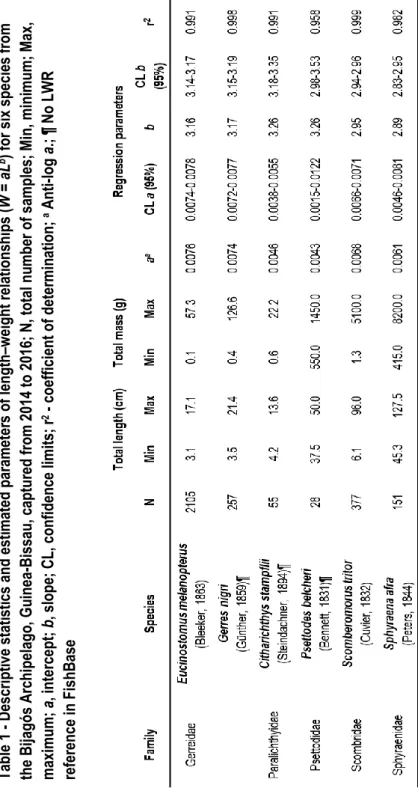
Edna Correia, José Pedro Granadeiro, Aissa Regalla, Paulo Catry (2018) Length-weight relationship of fish species from the Bijagos Archipelago, Guinea-Bissau. Journal of Applied Ichthyology. 34 (1): 177-179
In this chapter, I calculated the length–weight relationships for six fish species. For three of these fish species, this relationship was never reported before (Citharichthys stampflii, Gerres nigri and Psettodes belcheri) and for the other three species, I presented data from a wider range of sizes compared to previous reports (Eucinostomus melanopterus, Scomberomorus tritor and Sphyraena afra). Length–weight relationship data are relevant for the management of fish species as well as for fisheries. Such models enable the comparison of fish populations across space (i.e. different areas) or time (e.g. different seasons or years), and also provide information concerning variation in the overall structure of populations (Le Cren 1951, Ricker 1973, Froese 2006). In order to obtain this data, fishes were captured using three methods: angled from the beach or a boat; captured using beach seine with a mesh size ranging 0.5–1 cm; sampled with drift netting from a boat (mesh size 2 cm). Measurements and weight of different species are provided, and expand existing information available in Fishbase (Froese and Pauly 2018).
Chapter 4
Edna Correia, José Pedro Granadeiro, Aissa Regalla, Emanuel Dias, Amadeu Almeida, Paulo Catry (2017) Predatory pelagic fishes of the Bijagos Archipelago (Guinea-Bissau) show high overlap in diets dominated by sardinella. African Journal of Marine Science. 39 (4): 389-396 I studied the diet of the three most abundant pelagic predatory fishes of the Bijagós Archipelago: the Crevalle jack (Caranx hippos), the West African Spanish mackerel (Scomberomorus tritor) and the Guinean barracuda (Sphyraena afra). These species are important along the coast of West Africa, namely for recreational fisheries, attracting sports fishermen from abroad to Guinea-Bissau
10
(Campredon and Catry 2016), and thus contributing to the economy of the country (Dia and Bedingar 2001, Belhabib et al. 2016). Nonetheless studies on their diet are scarce (Fagade and Olaniyan 1973, Kwei 1978, Lafrance 1994). For this study fishes were angled from the beach or a boat, their stomach contents were collected and their prey remains macroscopically identified. The prey items were identified through comparison with a large reference collection of hard structures (i.e. otoliths, vertebrae and other diagnostic bones) representing a large variety of local species.
Chapter 5
Edna Correia, José Pedro Granadeiro, Aissa Regalla, Hamilton Monteiro, Paulo Catry (Submitted) The diet of two opportunistic seabirds (Caspian and Royal terns) confirms the importance of sardinella in West African coastal food webs
I studied the diet of the two most numerous breeding tern species: Caspian Tern (Hydroprogne caspia) and Royal Tern (Thalasseus maximus) in Guinea-Bissau. The two species are widespread breeders in the West African region with important numbers nesting in Guinea-Bissau. Nonetheless the diet of these two tern species is still poorly studied (Brenninkmeijer et al. 2002, van Roomen et al. 2015, Veen et al. 2018). I collected pellets - undigested and regurgitated prey components – from the breeding colonies and roosting sites of the two tern species. The prey items were identified using otoliths, vertebrae and other diagnostic bones, which also involved the collection of a large reference collection of fish hard structures representing most local species. I further compared two methods for quantifying the diet of both tern species, one based on the examination of all hard structures (e.g. otoliths, vertebrae, scales) and another one based only on otoliths, as their performances can vary substantially.
11 Chapter 6
Edna Correia, José Pedro Granadeiro, Vanessa A. Mata, Aissa Regalla, Paulo Catry. Trophic interactions between migratory seabirds, predatory fishes and small pelagics in West Africa Studies on the diet of the Afro-Palearctic populations of these species during their wintering season in West Africa are virtually inexistent, although understanding the wintering conditions experienced by migratory birds is essential for their conservation (Marra et al. 1998, Norris et al. 2004, Szostek and Becker 2015). I studied the diet and foraging behaviour of five of the most common wintering tern species in West Africa, Little (Sternula albifrons), Black (Chlidonias niger), Common (Sterna hirundo), Sandwich (Thalasseus sandvicensis) and Lesser Crested (Thalasseus bengalensis) Terns. Moreover, we studied the associations between these tern species and predatory fishes. This type of facilitative associations is expected to be more important in tropical regions than in temperate and polar ones, due to the former having its resources more unevenly distributed and a higher abundance of large predatory fishes (Longhurst and Pauly 1987, Ballance and Pitman 1999, Veit and Harrison 2017). Despite the importance of these feeding associations in shaping the distribution and abundance of both marine predators and prey, they have never been addressed in the tropical Atlantic. In order to study the diet and foraging behaviour of the wintering tern community in the Bijagós Archipelago, direct observation of foraging birds from the coast were performed. Furthermore, droppings of the birds from the beach roosts were collected to describe their diet using DNA metabarcoding techniques allowing the identification of prey in faeces. The fact that wintering seabirds roost together in multispecific groups makes it difficult to collect samples and know which species they belong to. With the genetic techniques used in the present work, it was possible to successfully overcome that hurdle in a completely non-invasive way to the birds, and obtain results with unprecedented detail about their diet.
12
References
Akadje C, Diaby M, Le Loc’h F (2013). Diet of the barracuda Sphyraena guachancho in Côte d’Ivoire (equatorial eastern Atlantic Ocean). Cybium 37: 285–293
Alder J, Sumaila UR (2004) Western Africa: A fish basket of Europe past and present. Journal of Environment and Development 13: 156-178
Arkhipov AG, Mamedov AA, Simonova TA, Shnar VN (2015) Species composition and features of ichthyoplankton distribution in the waters of Senegal and Guinea-Bissau. Journal of Ichthyology 55: 346–354
Bakun A (1996) Patterns in the Ocean: Ocean Processes and Marine Population Dynamics. University of California Sea Grant, San Diego, California, USA, in cooperation with Centro de Investigaciones Biologicas de Noroeste, La Paz, Baja California Sur, Mexico. 323 pp. Ballance LT, Pitman RL (1999) Foraging ecology of tropical seabirds. Proc22 IntOrnitholCongr,
Durban 2057–2071
Barbraud C, Weimerskirch H (2003) Climate and density shape population dynamics of a marine top predator. Proceedings of the Royal Society B: Biological Sciences 270:2111–2116 Behrenfeld MJ, O'Malley RT, Siegel DA, McClain CR, Sarmiento JL, Feldman GC, Milligan AJ,
Falkowski PG, Letelier RM, Boss ES (2006) Climate-driven trends in contemporary ocean productivity. Nature 444: 752-755
Belhabib D, Campredon P, Lazar N, Sumaila UR, Baye BC, Kane EA, Pauly D (2016) Best for pleasure, not for business: evaluating recreational marine fisheries in West Africa using unconventional sources of data. Palgrave Communications 2: 15050
Binet T, Failler P, Thorpe A (2012) Migration of senegalese fishers: a case for regional approach to management. Maritime Studies 11:1–14
Brenninkmeijer A, Stienen EWM, Klaassen M, Kersten M (2002) Feeding ecology of wintering terns in Guinea-Bissau. Ibis 144:602–613
Butchart SHM, Walpole M, Collen B, van Strien A, Scharlemann JPW, Almond REA, Baillie JEM, Bomhard B, Brown C, Bruno J, Carpenter KE, Carr GM, Chanson J, Chenery AM, Csirke J, Davidson NC, Dentener F, Foster M, Galli A, Galloway JN, Genovesi P, Gregory RD, Hockings M, Kapos V, Lamarque J-F, Watson R (2014) Global biodiversity: indicators of recent declines. Science 1164: 1164-1169
Campredon P, Catry P (2016) Bijagos Archipelago (Guinea-Bissau). In: Finlayson CM, Milton GR, Prentice R & Davidson NC (eds.) The Wetland Book. II. Distribution, Description and Conservation. Springer, Dordrecht, pp 276–284
Campredon P, Cuq F (2001) Artisanal fishing and coastal conservation in West Africa. Journal of Coastal Conservation 7:91–100
Catry P, Barbosa C, Paris B, Indjai B, Almeida A, Limoges B, Silva C, Pereira H (2009) Status, ecology, and conservation of sea turtles in Guinea- Bissau. Chelonian Conservation and
13 Biology 8: 150–160
Clua É, Grosvalet F (2001) Mixed-species feeding aggregation of dolphins, large tunas and seabirds in the Azores. Aquatic Living Resources 14: 11-18
Crespo GO, Dunn DC (2017) A review of the impacts of fisheries on open-ocean ecosystems. ICES Journal of Marine Science 74: 2283-2297
Cuq F (ed.) (2001) Un système d'information géographique pour l'aide à la gestion intégrée de l'archipel des Bijagos (Guinée-Bissau). Notice de la carte, constitution et ex- ploitation du SIG. Géosystèmes, Brest
Cury P, Bakun A, Crawford RJM, Jarre A, Quiñones RA, Shannon LJ, Verheye HM (2000) Small pelagics in upwelling systems: patterns of interaction and structural changes in “wasp-waist” ecosystems. ICES Journal of Marine Science 57:603–618
Dia AK, Bedingar T (2001) Fishing-sector support project. Appraisal report, Republic of Guinea Bissau. Bissau, Guinea-Bissau: African Development Fund.
Dodman T, Sá J (2005) Waterbird monitoring in the Bijagós Archipelago, Guinea-Bissau. Wetlands International, Dakar / Gabinete de Planificação Costeira / ODZH, Bissau
Duffy JE, Cardinale BJ, France KE, McIntyre PB, Thébault E, Loreau M (2007) The functional role of biodiversity in ecosystems: Incorporating trophic complexity. Ecology Letters 10: 522-538 Fagade SO, Olaniyan CIO (1973) The food and feeding interrelationship of the fishes in the Lagos
Lagoon. Journal of Fish Biology 5: 205–225.
Failler P (2014) Climate Variability and Food Security in Africa: The Case of Small Pelagic Fish in West Africa. Journal of Fisheries and Livestock Production 2: 1-11
FAO (Food and Agriculture Organization) (2016). The State of World Fisheries and Aquaculture 2016. Contributing to food security and nutrition for all. Rome. 200 pp.
Ferretti F, Worm B, Britten GL, Heithaus MR, Lotze HK (2010) Patterns and ecosystem consequences of shark declines in the ocean. Ecology Letters 13: 1055–1071
Frank KT, Petrie B, Choi JS, Leggett WC (2005) Trophic cascades in a formerly cod-dominated ecosystem. Science 308:1621–1623
Froese R (2006) Cube law, condition factor and weight–length relation- ships: History, meta- analysis and recommendations. Journal of Applied Ichthyology 22: 241–253
Froese R, Pauly D (Eds.) (2018) FishBase. World Wide Web electronic publication. URL: http://www.fishbase.org, version (05/2018)
Furness RW, Camphuysen CJ (1997) Seabirds as monitors of the marine environment. ICES Journal of Marine Science 54:726–737
Halpern BS, Walbridge S, Selkoe KA, Kappel CV, Micheli F, D’Agrosa C, Bruno JF, Casey KS, Ebert C, Fox HE, Fujita R, Heinemann D, Lenihan HS, Madin EMP, Perry MT, Selig ER,
14
Spalding M, Steneck R, Watson R (2008) A global map of human impact on marine ecosystems. Science 319: 948–952
Hutchings JA, Baum JK (2005) Measuring marine fishes biodiversity: temporal changes in abundance, life history and demography. Philosophical transactions of the Royal Society of London. Series B 360:315–38
Kaczynski VM, Fluharty DL (2002) European policies in West Africa: Who benefits from fisheries agreements? Marine Policy 26: 75–93
Katsanevakis S, Stelzenmüller V, South A, Sørensen TK, Jones PJS, Kerr S, Badalamenti F, Anagnostou C, Breen P, Chust G, D'Anna G, Duijn M, Filatova T, Fiorentino F, Hulsman H, Johnson K, Karageorgis AP, Kröncke I, Mirto S, Pipitone C, Portelli S, Qiu W, Reiss H, Sakellariou D, Salomidi M, van Hoof L, Vassilopoulou V, Fernández, TV, Vöge S, Weber A, Zenetos A, Ter Hofstede R (2011) Ecosystem--based marine spatial management: Review of concepts , policies , tools , and critical issues. Ocean and Coastal Management 54: 807-820
Kwei EA (1978) Food and spawning activity of Caranx hippos (L.) off the coast of Ghana. Journal of Natural History 12: 195–215
Kyle S (2009)The Macroeconomic context for trade in Guinea-Bissau, Working Paper, Department of Applied Economics and Management, Cornell University, Ithaca, New York 14853-7801 USA
Lafrance S (1994) Archipel des Bijagos ichtyofaune et éléments d’écologie marine. Bissau, Guinea-Bissau: CIPA (Centre of Applied Fisheries Research).
Le Cren ED (1951) The length- weight relationship and seasonal cycle in gonad weight and condition in the perch (Perca fluviatilis). Journal of Animal Ecology 20: 201–219.
Longhurst AR, Pauly D (1987) Ecology of Tropical Oceans. Academic Press, San Diego, CA Marra PP, Hobson KA, Holmes RT (1998) Linking winter and summer events in a migratory bird by
using stable-carbon isotopes. Science 282: 1884–1886
Myers RA, Worm B (2003) Rapid worldwide depletion of predatory fish communities. Nature 423: 280–283
Njock J-C, Westlund L (2010) Migration, resource management and global change: experiences from fishing communities in West and Central Africa. Marine Policy 34: 752-760
Norris DR, Marra PP, Kyser TK, Sherry TW, Ratcliffe LM (2004) Tropical winter habitat limits reproductive success on the temperate breeding grounds in a migratory bird. Proceedings of the Royal Society London B 271: 59–64
Patrício AR, Formia A, Barbosa C, Broderick AC, Bruford M, Carreras C, Catry P, Ciofi C, Regalla A, Godley J (2017) Dispersal of green turtles from Africa’s largest rookery assessed through genetic markers. Marine Ecology Progress Series 569:215–225
15
Bissau). BSc thesis, Université de Bretagne Occidentale, France
Pereira H M, Leadley PW, Proenca V, Alkemade R, Scharlemann JPW, Fernandez-Manjarres JF, Araujo MB, Balvanera P, Biggs R, Cheung WWL, Chini L, Cooper HD, Gilman EL, Guenette S, Hurtt GC, Huntington HP, Mace GM, Oberdorff T, Revenga C, Rodrigues P, Scholes RJ, Sumaila UR, Walpole M (2010) Scenarios for global biodiversity in the 21st century. Science 330: 1496-1501
Petchey OL (2000) Prey diversity, prey composition, and predator population dynamics in experimental microcosms. Journal of Animal Ecology 69: 874-882
Polidoro BA, Ralph GM, Strongin K, Harvey M, Carpenter K, Arnold R, Buchanan J, Camara KMA, Collette BB, Comeros-Raynal MT, De Bruyne G, Gon O, Harold AS, Harwell H, Hulley PA, Iwamoto T, Knudsen S, Lewembe JDD, Linardich C, Lindeman K, Monteiro V, Munroe T, Nunoo FKE, Pollock C, Poss S, Russell B, Sayer C, Sidibe A, Smith-Vaniz W, Stump E, Sylla M, Morais LTD, Vié JC, Williams A (2017) The status of marine biodiversity in the Eastern Central Atlantic (West and Central Africa). Aquatic Conservation: Marine and Freshwater Ecosystems 27: 1021–1034
Ricker WE (1973) Linear regressions in fisheries research. Journal of the Fisheries Research Board of Canada 30: 409–434
Salvig JC, Asbirk S, Kjeldsen JP, Rasmussen PAF (1994) Wintering waders in the Bijagós archipelago, Guinea-Bissau, 1992–1993. Ardea 82:137–41
Schmitz O (2007) Predator diversity and trophic interactions. Ecology 88: 2415-2426
Shannon LJ, Cury P, Jarre A (2000) Modelling effects of fishing in the Southern Benguela ecosystem. ICES Journal of Marine Science 57: 720–722
Sih A, Englund G, Wooster D (1998) Emergent impacts of multiple predators on prey. Trends in Ecology and Evolution 13: 350–355
Stramma L, Johnson GC, Sprintall J, Mohrholz V (2008) Expanding oxygen-minimum zones in the tropical oceans. Science 320: 655–658
Szostek KL, Becker PH (2015) Survival and local recruitment are driven by environmental carry-over effects from the wintering area in a migratory seabird. Oecologia 178: 643-657
Tasker ML, Camphuysen CJK, Cooper J, Garthe S, Montevecchi WA, Blaber SJM (2000) The impacts of fishing on marine birds. ICES Journal of Marine Science. 57: 531-547
Tous P, Ducrocq M, Bucal D, Feron E (1998) Shark populations are possibly under serious threat in the Bijagos archipelago (Biosphere Reserve), Guinea Bissau. West Africa. Shark News 10:4
van der Veer HW, Adriaans EJ, Bolle LJ, Dankers N, Malaba L, Fonseca DA, Witte JIJ (1995) Ecological observations on juvenile flatfish in a tropical estuary: Arquipélago dos Bijagós, Guinea-Bissau. Netherlands Journal of Sea Research 34: 221–228
16
waterbird populations in the East Atlantic Flyway. With special attention to flyway populations making use of the Wadden Sea. Programme Rich Wadden Sea, Leeuwarden, The Netherlands, Sovon, Nijmegen, The Netherlands, Wetlands International, Wageningen, The Netherlands, BirdLife International, Cambridge, United Kingdom &, Common Wadden Sea Secretariat, Wilhelmshaven, Germany
Veen J, Dallmeijer H, Diagana CH (2008) Monitoring colonial nesting birds along the West African Seaboard. Wetlands International
Veen J, Dallmeijer H, Veen T (2018) Selecting piscivorous bird species for monitoring environmental change in the Banc d'Arguin, Mauritania. Ardea 106: 5-18
Veit RR, Harrison NM (2017) Positive interactions among foraging seabirds, marine mammals and fishes and implications for their conservation. Frontiers in Ecology and Evolution 5: 21 Wetlands International. 2015. Waterbird Population Estimates. http://wpe.wetlands.org [accessed
17
CHAPTER 2
Seasonal, lunar and diel variations in a coastal fish community
assessed by beach seine in the Bijagós Archipelago, West Africa
Edna Correia, José Pedro Granadeiro, Aissa Regalla, Paulo Catry19
CHAPTER 2
Seasonal, lunar and diel variations in a coastal fish community assessed by
beach seine in the Bijagós Archipelago, West Africa
Abstract
In many marine ecosystems small pelagic fish exert a crucial role in controlling the dynamics of the community, mainly due to their high biomass at intermediate levels of the food web. We studied spatial, seasonal, lunar and diel variations in a coastal fish community from a marine protected area of the Bijagós Archipelago, Guinea-Bissau. Fish were sampled with 46 beach seine net sessions in 2015 and 2016. A total of 35 fish species of 25 families were captured. Fish abundance varied between years and seasons, with a higher abundance in the dry season, but not by lunar tide. Nonetheless, the community composition was broadly similar over the seasons, among islands and between lunar tides, with Clupeidae, Haemulidae and Gerreidae as the most abundant families. Sardinella maderensis highly dominated the captures throughout the year, with catches much higher than any other species. The differences in abundance between seasons and years may be related with movements to or from the shore due to feeding activity or to avoid predation, or else to differences in recruitment between years. There were no significant diel differences in species richness and diversity, although higher numbers of fish were captured during daytime. Mugilidae and Haemulidae were the most numerous families in nocturnal period captures which might be related to differences between species in inshore behaviour. For most species the majority of individuals captured were immature, which highlight the importance of the archipelago as nursery area for several fish species, important to support the offshore stocks of those fish species. These small pelagics, and particularly Sardinella maderensis, maintain several marine predators. Thus, the conservation of the small coastal pelagics of the Bijagós Archipelago may be key for the management of the Bijagós.
20
Keywords: beach seine, small pelagics, nursery, nearshore, Guinea-Bissau
Introduction
Small pelagic fish are essential to the functioning of marine ecosystems, connecting the lower and upper trophic levels in food webs worldwide (Rice 1995, Bakun 1996). Therefore, fluctuations in small pelagic populations may modify ecosystem structure and functioning (e.g. Cury et al. 2000, Shannon et al. 2000). Several small pelagics use coastal marine ecosystems in the near-shore as nursery grounds. Yet these ecosystems are among the most damaged by anthropogenic changes and one of the most vulnerable to future impacts of climate change (Harley et al. 2006, Martínez et al. 2007, Barbier et al. 2011, Sheaves et al. 2014).
Costal marine ecosystems, due to their dynamic structure, exhibit fluctuations in abundance and diversity of communities (Gibson 1993, Krumme 2009). This variability in number of individual may be the result of short-term migrations between different habitats for feeding, reproducing or to avoid predation and competition and are often influenced by lunar, diel and tidal cycles (e.g. Ferreira et al. 2001, Hitt et al. 2011, Krumme 2009). At a larger temporal scale, annual or seasonal migrations for feeding and spawning, may also contribute to fluctuations in coastal marine communities (Gibson et al. 1993).
In the Eastern Central Atlantic region small pelagics are the most important group for fisheries, constituting almost 50% of the landings (Failler 2014, FAO 2016). Most pelagic fish stocks are considered either fully exploited or overfished (FAO 2016). Moreover, this region is one of the most affected by illegal, unreported and unregulated fishing (Belhabib et al. 2015, Doumbouya et al. 2017, Intchama et al. 2018). Guinea-Bissau, located in the region, is strongly dependent on fisheries as one of its main economic activities (Lafrance 1994, Campredon and Cuq 2001, Belhabib et al. 2015). Fish is also the main protein source for the human population (Dia and Bedingar 2001). The Bijagós Archipelago, in particular, is recognized for its abundant fish resources
21
and considered a nursery area for several fish species (Lafrance 1994, Arkhipov et al. 2015, Campredon and Catry 2016). The archipelago is free from industrial fishing, representing a refuge for several fish species that are harvested in neighbouring countries (Polidoro et al. 2016). Fish communities at the Bijagós Archipelago are dominated by Clupeiformes and Perciformes (Lafrance 1994, van der Veer et al. 1995). The archipelago possibly holds some resident populations since most common species are present throughout the year, although few studies have addressed its coastal fish community and related seasonal variations (Lafrance 1994, van der Veer et al. 1995).
The marine ecosystem of Guinea-Bissau is influenced by the tropical climate with two distinct seasons. The dry season (November to May) is influenced by the Canary Current and the rainy season (June to October) by the Guinean Current (Pennober 1999). The effect of the currents along with the input of organic matter from rivers, results in a relatively high productivity in the marine coastal areas of Guinea-Bissau (Berrit and Rebert 1977, Longhurst 1983, Bakun 1996, Tandstad et al. 2014). The sea-surface temperature ranges from 26 to 30 °C and salinity from 36 to 30 ppt, in dry and rainy seasons respectively (Lafrance 1994).
The first objective of this study was to characterise the inshore pelagic fish community in a relatively undisturbed area of the Bijagós, part of a Marine Protected Area. Furthermore, we explored variations in species abundance between seasons (dry and rainy), lunar cycle (spring and neap tide), and diel periods (night and day) in the coastal fish community.
Material and methods Study area and sampling
Fieldwork was carried out in the João Vieira and Poilão Marine National Park (JVPMNP) in the southeast of the Bijagós Archipelago (Figure 1). The park covers 49,500 ha (of which only 5% are terrestrial) and comprises four main islands. The entire marine area of the JVPMNP is managed in regards to fishing activities, with two distinct zones. In Zone 1, located in the central part of the
22
JVPMNP and representing 19% of its total area, fishing is totally banned. In Zone 2, representing the remaining area of the park, some types of fishing nets, such as shark nets or all monofilament nets, are forbidden. Moreover, in Zone 2, access rights are reserved for members of the local community and fishing is only allowed in boats with motors up to 40c (IBAP 2007). Beach seine is not usually used for commercial or subsistence fishing in the park.
Figure 1 – Location of the six points where beach seine was performed between 2015 and 2016, dash line delimitates Bijagós Archipelago, solid line delimitates João Vieira and Poilão Marine National Park (JVPMNP)
All fishing operations were carried out using a beach seine. The net was 29.55 m in length and 1.70 m to 8.5 m in height (reaching the highest height in the central zone) with 1 cm mesh size. In the central area, it had an additional pyramid with a 1.5 m2 base and 1 m in height with 0.5 cm mesh
size (Figure 2).
Figure 2 – Scheme of the net used to perform beach seine in the João Vieira and Poilão Marine National Park from 2015 to 2016
23
Net setting started from the beach using a small boat to stretch the net perpendicular to shore, always keeping the two ropes from one end ashore secured by two people, reaching approximately 35 m from the shoreline. In the farthest point from the shore the depth was on average 2.45 m. The net was then drawn towards the shore so as to form a circumference. When the semi-circumference was formed two to three people on each end pulled the ropes in order to completely pull the net out from the water. This process represents one haul. We always performed four consecutive hauls approximately ten meters apart from each other. We considered each group of four hauls as one session. All samples were collected at high tide, and those obtained in the same session were pooled.
In every haul, we counted and weighted (to the nearest 0.1g) the total number of fishes by species. Furthermore, 50 random individuals from each species were measured (to the nearest 0.5 mm) and weighted (to the nearest 0.1 g). Rays (Chondrichthyes) were quickly measured on the beach and released alive and they were not weighted. Fishes were identified to the lowest possible taxonomic level following guides (Fischer et al. 1981, Schneider 1990, Paugy et al. 2003). We were not able to identify all Pomadasys specimens to the species level, and so we refer to them as Pomadasys sp. Nevertheless, we believe that most of the individuals should belong to Pomadasys jubelini as they were generally similar to the ones we could morphologically identify as Pomadasys jubelini. In the case of Mugilidae family, there were also some individuals that were only identified to the genus level.
Lunar and seasonal variation
Catches were carried out between February 2015 and September 2016. In order to explore the seasonal variation in the pelagic fish community we performed 27 sessions of beach seine in João Vieira Island between 2015 and 2016 (site 1, see Figure 1). We always fished on three consecutive days (except for one occasion when only one day was sampled, and another one when only two days were sampled due to unsuitable weather and sea conditions), (Table 1).
24
Table 1 - Number of sessions (N) by season and lunar tide of the beach seine performed in the João Vieira island from 2015 to 2016
N Season Lunar tide
9 Dry Neap
9 Spring
5 Rainy Neap
4 Spring
Spatial variation
In order to assess whether our main study site was representative of the whole marine park, or whether there was important spatial variation in the fish community, we sampled two different points of each of the three islands (João Vieira, Cavalos and Meio, Figure 2) in six consecutive days in January 2016.
Diel variation - day/night
We explored diel variation in the pelagic fish community by performing eight catches during both day and night periods, in João Vieira (site 1, see Figure 1), between January and March 2016.
Data analysis
The abundance of fishes corresponded to the total number of individuals captured in a session (four consecutive hauls), and the richness as the total number of species. For each species, we calculated the mean number of individuals caught per session. Their relative abundance was then calculated as a percentage of the mean of the total number of individuals captured per session. We further calculated, for each species, the mean total length and mean total mass of the individuals measured in João Vieira island between February 2015 and September 2016 at site 1 (Figure 1). To evaluate the diversity of the community, we calculated the Shannon–Wiener (H') diversity index and the Pielou’s evenness index (J), (Brower and Zar 1998) following the equations:
H' =−∑ pi ei log e pi; J = H’/ log(S);
25
where pi is the proportion of species i in relation to the total number of species; J is the Pielou’s evenness index. We tested the differences between lunar tides, islands and diel period on the diversity (Shannon-Wiener and Pielou’s evenness) and richness using ANOVAs. The abundance of individuals was tested accounting for species on one hand, and for lunar tides / islands or diel period on the other, using two-way ANOVAs. Concerning seasonal variations, we tested the effect of season and year on diversity and richness using two-way ANOVAs, and tested the effect of species, season and year on the abundance of individuals using three-way ANOVAs. Statistical analyses were carried out using the software R (R Core Team 2018).
Results
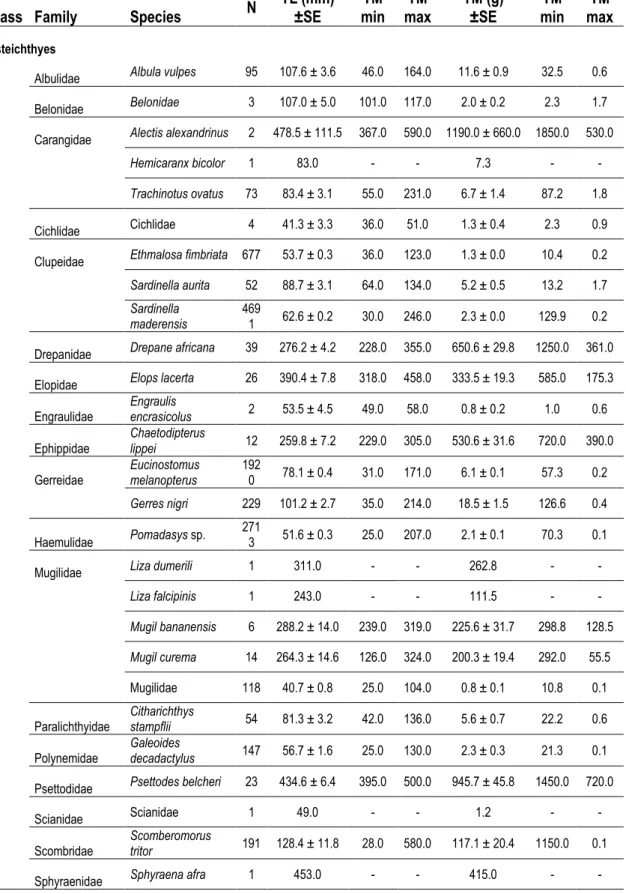
In total we captured 35 fish species from 25 families. The list of species with the respective threat status (IUCN 2017) is in Supplementary material (Table S1).
Lunar and seasonal variation
Sardinella maderensis accounted for more than 70% of the total of individuals captured in the dry season and c. 80% in the rainy season (Table 2), followed by Pomadasys sp.(19% in dry season and 3% in rainy season) and Eucinostomus melanopterus (8% in dry season and 10% in rainy season). Total mean mass of individuals by species and by season is presented in the Supplementary material, Table S2.
Concerning the variation between spring and neap tides, there were no differences in diversity (ANOVA: Shannon-Wiener diversity diversity - F 1, 25 = 0.28, P = 0.60), in evenness (Pielou’s
evenness F 1,25 = 2.00 x 10 -3, P = 0.97), or in species richness (ANOVA: F 1, 25 = 2.02, P = 0.17).
We tested for differences in the number of individuals captured among species and between spring and neap tides. There were significant differences in the abundance of individuals by species (two-way ANOVA F 30,239 = 5.62, P < 0.001) but not by tide (F 1, 239 = 1.33, P = 0.25). Also, there was no
26
significant interaction between species and tide (F 19, 239 = 0.39, P = 0.99). Therefore, data from
neap and spring tides were pooled for subsequent analyses.
There were no effect of season or year in Shannon-Wiener diversity (two-way ANOVA: season: F
1, 24 = 0.02, P = 0.90; year: F 1, 24 = 0.41, P = 0.53), that presented a mean of 0.92 ± 0.01 (SE).
There were also no significant effect of season or year differences in Pielou’s evenness (two-way ANOVA: season: F 1, 24 = 0.21, P = 0.65; year: F 1, 24 = 3.60, P = 0.07), that presented a total mean
of 0.40 ± 0.01 (SE). There was a significant effect of year and season on species richness (two-way ANOVA: season: F 1, 24 = 5.06, P = 0.03; year: F 1, 24 = 14.66, P < 0.001). The average species
richness per session was 10.74 ± 0.11 (SE). We tested the effect of species, season and year on the abundance of individuals captured (three-way ANOVA). All variables had a significant effect on the abundance of individuals, however the species was the most significant (species: F 30, 257 =
27
Table 2 - Mean of the total number (N) individuals captured (± standard error) and relative abundance (RA%) by species of the fishes captured during 19 sessions in the dry season and 9 sessions in the rainy season in João Vieira island from 2015 and 2016
Dry Rainy
Class Family Species N ± SE (%) RA N ± SE (%) RA Osteichthyes
Albulidae Albula vulpes 5.3 ± 3.3 0.2 - 0.0
Belonidae Belonidae - 0.0 0.3 ± 0.2 0.0
Carangidae Trachinotus ovatus 1.0 ± 0.46 0.0 5.6 ± 1.6 0.9
Alectis alexandrinus 0.1 ± 0.1 0.0 0.1 ± 0.1 0.0
Carangidae - 0.0 0.1 ± 0.1 0.0
Hemicaranx bicolor - 0.0 0.1 ± 0.1 0.0
Cichlidae Cichlidae 0.2 ± 0.2 0.0 - 0.0
Clupeidae Sardinella maderensis 1579.6 ± 359.1 70.6 515.2 ± 130.8 79.2 Ethmalosa fimbriata 32.1 ± 10.5 1.4 12.6 ± 6.6 1.9
Sardinella aurita 1.8 ± 1.2 0.1 2.1 ± 2.1 0.3
Drepanidae Drepane africana - 0.0 4.3 ± 0.7 0.7
Elopidae Elops lacerta 0.1 ± 0.1 0.0 2.4 ± 1.2 0.4
Engraulidae Engraulis encrasicolus 0.1 ± 0.1 0.0 0.1 ± 0.1 0.0 Ephippidae Chaetodipterus lippei 0.2 ± 0.2 0.0 0.9 ± 0.6 0.1 Gerreidae Eucinostomus melanopterus 162.7 ± 48.4 7.3 51.7 ± 7.8 7.9
Gerres nigri 7.3 ± 4.2 0.3 10.4 ± 3.2 1.6 Haemulidae Pomadasys sp. 423.4 ± 105.8 18.9 19.8 ± 4.4 3.0 Mugilidae Mugilidae 6.5 ± 3.7 0.3 0.3 ± 0.2 0.0 Mugil bananensis 0.2 ± 0.1 0.0 0.2 ± 0.2 0.0 Mugil curema 0.2 ± 0.1 0.0 1.1 ± 0.5 0.2 Mugil sp. 0.1 ± 0.1 0.0 - 0.0 Liza dumerili 0.1 ± 0.1 0.0 - 0.0 Liza falcipinis 0.1 ± 0.1 0.0 - 0.0 Liza sp. - 0.0 0.1 ± 0.1 0.0
Paralichthyidae Citharichthys stampflii 2.9 ± 0.5 0.1 0.1 ± 0.1 0.0 Polynemidae Galeoides decadactylus 1.1 ± 0.5 0.0 14.2 ± 4.0 2.2 Psettodidae Psettodes belcheri 1.1 ± 0.3 0.0 0.4 ± 0.2 0.1
Scianidae Scianidae - 0.0 0.1 ± 0.1 0.0
Scombridae Scomberomorus tritor 8.1 ± 3.4 0.4 6.4 ± 2.7 1.0
Sphyraenidae Sphyraena afra - 0.0 0.1 ± 0.1 0.0
Chondrichthyes
Dasyatidae Fontitrygon margarita/margaritella 2.2 ± 0.9 0.1 1.6 ± 1.1 0.2
Bathytoshia centroura 0.1 ± 0.1 0.0 - 0.0 Gymnuridae Gymnura sp. 0.1 ± 0.1 0.0 - 0.0 Gymnura micrura 0.1 ± 0.1 0.0 - 0.0 Rhinobatidae Rhinobatidae sp. 0.2 ± 0.2 0.0 - 0.0 Glaucostegus cemiculus 0.1 ± 0.1 0.0 0.2 ± 0.2 0.0 TOTAL 2236.7 ± 429.8 650.8 ± 142.8
28
We compared the total length between seasons and year for the three most captured families (Table 3; information on the total length and total mass of individuals of the remaining species are presented in Supplementary material, Table S3). We tested the effect of season (dry and rainy) and year (2015 and 2016) on total length with two-way ANOVAs for Sardinella maderensis,
Pomadasys sp, Eucinostomus melanopterus and Gerres nigri. The total length of Sardinella maderensis was significantly higher in rainy season (F 1, 4687 = 23.45, P < 0.001) and in 2016 (F 1, 4687 = 21.04, P < 0.001). Pomadasys sp. and Eucinostomus melanopterus were both significantly
larger during dry season (F 1, 2691 = 34.04, P < 0.001; F 1, 1916 = 109.13, P < 0.001, respectively) and
in 2015 (F 1, 2691 = 4.51, P = 0.03; F 1, 1916 = 63.57, P < 0.001, respectively). Gerres nigri individuals
were significantly larger during the rainy season (F 1, 225 = 7.20, P < 0.01), but no differences were
found between years (F 1, 225 = 0.01, P = 0.91).There was a significant interaction between year
and season on the total length of Sardinella maderensis, Pomadasys sp. and Eucinostomus
melanopterus (F 1, 4687 = 492.11, P < 0.001; F 1, 2691 = 258.60, P < 0.001; F 1, 1916 = 8.95, P < 0.01
respectively), but no for Gerres nigri (F 1, 225 = 0.28, P = 0.60).
Table 3 – Mean total length (TL) (mm) ± standard error by year and season for the most abundant species captured by beach seine in João Vieira, N – number of individuals measured
2015 2016
Dry Rainy Dry Rainy
Family Species N TL (mm) ± SE N TL (mm) ± SE N TL (mm) ± SE N TL (mm) ± SE
Clupeidae Sardinella maderensis 1920 59.08 ± 0.26 590 69.82 ± 0.62 872 68.13 ± 0.47 1309 60.96 ± 0.34 Gerreidae Eucinostomus melanopterus 1072 78.01 ± 0.46 204 87.60 ± 1.50 380 68.82 ± 1.00 264 84.53 ± 1.58 Gerreidae Gerres nigri 4 105.75 ± 8.73 30 109.17 ± 4.36 131 94.83 ± 4.23 64 110.13 ± 3.54 Haemulidae Pomadasys sp. 1872 51.72 ± 0.36 30 84.93 ± 5.35 663 52.70 ± 0.51 130 35.54 ± 1.03
Spatial variation
Sardinella maderensis and Pomadasys sp. accounted for more than 75% of the relative abundance in all three islands (Table 4). The diversity indexes and richness by island are presented in Table