MARIA TERESA VASCONCELOS DE MORAES SARMENTO LOPES
DISSERTATION SUBMITTED TO FACULDADE DE ENGENHARIA DA UNIVERSIDADE DO PORTO TO OBTAIN THE DOCTORAL DEGREE IN INDUSTRIAL ENGINEERING AND MANAGEMENT
DESIGNING MOBILE
SERVICE EXPERIENCES
FROM UNDERSTANDING AND CONCEPTUALIZING
TO PROTOTYPING THE CUSTOMER EXPERIENCE
II
Maria Teresa Vasconcelos de Moraes Sarmento Lopes
Dissertation submitted to Faculdade de Engenharia da Universidade do Porto
to obtain the Doctoral Degree in Industrial Engineering and Management
Advisors:
Professor Lia Patrício Professor José Bártolo
Abstract
An experience is a complex phenomenon. Nevertheless, it comprises every aspect of a service offering, from customer care quality to its usefulness, surrounding environ-ment, and reliability. Hence, it is a challenge to incorporate improved experiences into the ebullient context of mobile services. Service innovation requires new concepts, new approaches, and new techniques, by recognizing and taking advantages of the interactions between the customer and the service provider. Tackling mobile service experiences through a design thinking path contributes to New Service Development and is the main impulse for this study.
This research design is based on two pillars of knowledge: a behavioural-science para-digm to understand and evaluate customer experiences through different levels of de-tail; and a design-science paradigm to promote service research through practice. Ser-vice design research generates artefacts, methods and tools, thereby endorsing new concepts.
The research followed a design thinking approach with an application to the concep-tion of a mobile service for managing loyalty programs, actively taking part of the de-velopment process from exploration, ideation, reflection and implementation. Starting with an exploration stage, the understanding of customer experience was ascertained through a qualitative study along three phases of service adoption and a quantitative study. Fostering a holistic view of experience, this research identified service expe-rience factors (EF) and measured their impact on expeexpe-rience outcomes (EO) such as cognitive and emotional assessments. Through an Ideation stage, the research articu-lated these studies with an effective and practical action research, in the company, monitoring the service development across its different activities. The final reflection stage involved prototyping the service experience, contributing to the understanding of how experience is evaluated and particularly how experiences become more tangi-ble supporting the service design in the mobile context.
Resumo
Uma experiência é um fenómeno complexo. No entanto ela está em cada detalhe de uma oferta de serviço desde a assistência ao cliente à utilidade, ao contexto envolvente ou à confiança. Deste modo, incorporar melhores experiências no contexto emergente dos serviços móveis é um desafio necessário.
A inovação dos serviços requer novos conceitos, novas abordagens e novas técnicas reconhecendo e tirando partido da interacção entre o cliente e prestador de serviços. A experiencia com os serviços móveis integrada num processo de Design Thinking é o mote para o presente estudo.
A investigação assenta em dois pilares do conhecimento: no paradigma da ciência dos comportamentos - para compreender e avaliar a experiencia do cliente a vários níveis de detalhe - e no paradigma do design como ciência promovendo a investigação nos serviços através da prática. A investigação no design de serviços gera artefactos, mé-todos e ferramentas e desta forma novos conceitos.
Empregando o Design Thinking acompanhou-se a concepção de um serviço móvel de gestão de programas de fidelização. Assim, a investigação tomou parte activa no pro-cesso de desenvolvimento, na exploração, concepção, reflexão e implementação. Na fase de exploração, o estudo da experiência do cliente foi realizado com base num es-tudo qualitativo ao longo de três momentos da adopção do serviço, posteriormente confirmado num estudo quantitativo. Uma visão holística da experiencia foi construída com este processo identificando as percepções da experiência e medindo o seu im-pacto nos seus resul¬tados tais como reacções emocionais ou cognitivas. Na fase de concepção a investigação articulou estes estudos com uma efectiva e prática acção--investigação numa empresa de serviços móveis monitorizando o desenvolvimento do serviço através de diferentes activi¬dades. A fase final de reflexão implicou a prototi-pagem da experiência do serviço e contribuiu para compreender como a experiência de serviço é avaliada e particularmente como é que as experiências se podem tornar mais tangíveis apoiando o design de serviços no contexto móvel.
Resumé
Une expérience est un phénomène complexe. Cependant, elle est présente en touts les détails de la prestation de services, dès la qualité du traitement aux clients, à son utilité, à son contexte, et à sa fiabilité. Ainsi, intégrer l’amélioration des expériences dans le contexte effervescent des services mobiles est un défi. L’innovation des services exige de nouveaux concepts, de nouvelles approches et de nouvelles techniques, en recon-naissant et en tirant parti de l’interaction entre le client et le prestataire du service. L’envisagement des expériences des services mobiles à travers le ‘Design Thinking’ contribue pour le développement de Nouveaux Services et constitue la principale mo-tivation de cette étude.
Ce projet de recherche repose sur deux piliers de connaissance: le paradigme de la Sci-ence des Comportements pour comprendre et évaluer l’expériSci-ence du client à travers différents niveaux de détail, et un paradigme du Design en tant que Science en tant que moteur d’une investigation du service à partir de sa pratique. La recherche en Design de services génère des artefacts, des méthodes et des outils, et à travers de ceux-ci, elle génère de nouveaux concepts.
La recherche a suivit une approche révélant du ‘Design Thinking’ pour la conception d’un service mobile de gestion de programmes de fidélisation, en tenant part active au processus de développement de l’exploration, idéation, et la mise en œuvre. A partir d’une phase d’exploitation, la compréhension de l’expérience du client a été apurée au moyen d’une étude qualitative sur trois phases d’adoption du service et au moyen d’une étude quantitative. Favoriser une vision holistique de l’expérience a permit iden-tifier des facteurs de l’expérience du service et mesurer ces impacts sur les résultats de l’expérience tels que les évaluations cognitives et émotionnelles. À travers une étape d’Idéation la recherche a articulé ces études avec une action pratique et effective de recherche dans l’entreprise, surveillant le développement du service sur toutes ses dif-férentes activités. Le stade de réflexion finale a impliqué le prototypage de l’expérience du service, contribuant pour la compréhension de la façon dont l’expérience est évaluée et, particulièrement, comment les expériences deviennent plus tangibles de manière à constituer un soutien pour le service du design dans le contexte mobile.
VIII
1. Introduction
1.1.1. Challenges posed by Mobile Services Experiences 1.1.2. Challenges posed by Service Design Thinking 1.1.3. How this dissertation is structured 2. Conceptual Background
2.1. Customer experience 2.1.1. Experience levels
2.1.2. Conceptual model of customer experience 2.1.3. Experience Factors
2.1.4. Experience Outcomes
2.1.5. Customer experience in the mobile context 2.2. Designing Mobile Services
2.2.1. Service Design 2.2.2. Service Design process
2.2.3. Designing Services in the mobile context 2.2.4. Prototyping Experience
2.3. Conclusions of the conceptual background 3. Methodology
3.1. Integrating Design research with Social sciences 3.2. Research Design 4. Exploration 4.1. Qualitative Study 4.1.1. Sample design 4.1.2. Data collection 4.1.3. Data analysis
4.1.4. Qualitative study results – Mobile service experience factors 4.1.5. Summary of the qualitative study
4.2. Quantitative Study
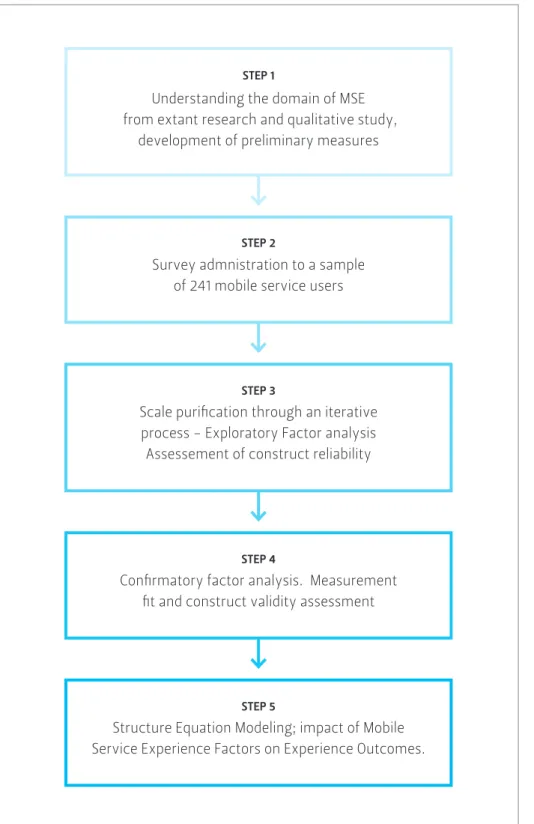
4.2.1. From the Conceptual Model to Structural equation modelling 4.2.2. Definition and domain of MSX and preliminary measures (step 1 and 2) 4.2.3. Scale purification through Exploratory Factor Analysis (step 3) 4.2.4. Confirmatory Factor Analysis (step 4)
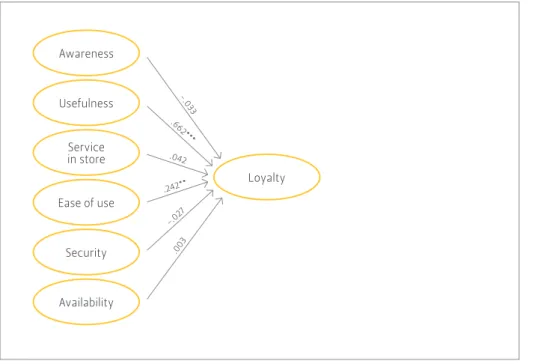
4.3. Structural Equation Model (step 5) 4.3.1. Implications of the quantitative study 4.4. Conclusion of Exploration Stage 5. Ideation
5.1. Incorporating experience along SD stages 5.2. Ideation results
5.2.1. First service design cycle for the first release 5.2.2. Second SD cycle with new version of MOBSERV 5.2.3. Third SD cycle
5.2.4. Fourth SD cycle MOBSERV 5.3. Conclusions of the Ideation stage
2 5 6 8 10 11 12 14 16 18 19 24 24 27 31 31 34 36 37 41 48 49 49 52 56 57 64 66 67 68 72 74 77 83 84 87 88 90 91 95 98 100 101 6. Reflection
6.1. Mobile Service Experience Prototyping 6.2. Experimental study
6.2.1. Experiment design 6.2.2. Pilot Test 6.2.3. Pilot Test Results 6.2.4. Final Experiment 6.2.5. Final Experiment Results
6.3. The EF addressed through prototyping the service 6.4. Conclusion of the Reflection stage
7. Research discussion and contributions 7.1. Design Research Contribution
7.2. Exploration - Understanding the Mobile Service Experience 7.2.1. The Qualitative study contributions
7.2.2. The Quantitative study contributions 7.3. Ideation contribution
7.4. Reflection Contributions - Mobile SXP 8. Conclusions and future research References Appendix A Appendix B Appendix C Appendix D Appendix E Appendix F Appendix G 108 109 112 113 117 119 120 120 125 126 128 130 131 131 132 133 136 138 142 152 156 160 164 168 172 174
X
One of the joys of completing a life project is to know that the journey was ex-traordinary and remember all the friends and family who helped and supported a longbut nevertheless fulfilling road. I am pleased to be able to do research work in Portugal, at a great university with an international level. As a Product De-signer, I knew that I would be able to express myself in several ways, and I would take advantages of my communication skills. Yet I would never be able to ac-complish this adventure without the assistance of many people:
I am thankful to my advisors, Professor Lia Patrício and Professor José Bárto-lo who provided constructive support. In particular to Professor Lia Patrício, I would like to express my candid gratitude for being not only a mentor but also a friend. I could not have asked for a better counsellor, being entrepreneurial, encouraging, and patient at all times.
Allow me a special acknowledgment to Cardmobili with particular attention to Eng. Helena Leite, as she was extremely supportive, letting me be part of the service development crew. To all her team members, who have dependably made Cardmobili a warm and cooperative place to work, thank you.
This thesis was also funded by Fundação da Ciência e Tecnologia which I would like to thank for their support. A design thinker’s personality, for better and for worse, is somehow adrift; but wonderful colleagues have surrounded me: An-dreia, Carla, Fabricio, Thais, Maria, Nelson, and Rui, have provided good mood, fun, new ideas, and much beyond work, we’ve become good friends. Neverthe-less, I would like to extend recognition to Industrial Engineering and Manage-ment, a great departManage-ment, with warm people. Thank you Marta for your friend-ship and our good conversations. To Luis and his apprentice Pedro, thank you for their generous support on the graphic design, as indeed they have improved the experience of reading this book.
To my dearest aunt Maria Amélia, tia Piki, I am deeply grateful, as I owe her end-less hours, which have guided my thoughts within this language that is not ours. I’ve inherited imagination from my mother and tenacity from my father, and to them: thank you. To my brothers and sisters, a hug the size of the world. Finally, I would not have the strength to contemplate this journey without my beloved Nuno. To him and to my dearest children João, Pedro and Maria, I dedicate this dissertation.
XII
CFA - Confirmatory Factor Analysis DT - Design Thinking
EF - Experience Factors EO - Experience Outcomes EFA - Exploratory Factor Analysis HCI - Human Computer Interaction
MOBSERV -the studied Mobile Service - Cardmobili MSX - Mobile Service Experience
NSD - New Service Development SD - Service Design
SEM - Structural Equation Model SXP - Service Experience Prototyping UXP - User Experience Prototyping SEB -Service Experience Blueprint SEM - Structural Equation Model UX - User Experience
In today’s established service economy people tend to pay more for experience and usage than for building and owning physical goods (IBM, 2007). Customer experience has increasingly gained more importance as they become crucial for differentiating and adding value to products and services. As such, designers have increasingly focused on integrating customer-centric experiences in ser-vice innovation (Ostrom et al., 2010).
After the challenges mentioned by D. Norman (2004), on using emotions through the Design discipline, many opportunities have appeared every time technology and its interfaces are the issue. Rich Gold(2006) on his vision about the world of creativity and innovation, claims “woe to the designer who forgoes the opinions, desires and needs of the users to rely only on his visions and dreams”;
For the present dissertation there is a design research standpoint that is impor-tant to assess and validate (Hevner et al., 2004). Design supports a problem-solving paradigm that continuously shifts perspective between design processes and designed artefacts (Laurel, 2003).
Designing for mobile service experience is challenging as it involves studying both experience and mobile service processes. But in spite of previous research on user experience requirements, designing for service experiences is still poor-ly understood (Evenson and Dubberpoor-ly, 2010, Battarbee and Koskinen, 2008, Zomerdijk and Voss, 2009).
Bill Mogridge, IDEO co-founder, (2007), went back to the routs and created a new perspective where Service Design (SD) starts precisely from the idea of a service offering, recalling the classic interaction of people with a smart device since the early days of telephone:
The telephone service is one that many of us take for granted, having used it everyday for most of our lives. But is it designed?
Figure 1 Telephone Services Manual switching, assisted by telephone operators. Portugal Telecom
The mobile phone is undoubtedly a powerful tool in connectivity and many other functions; it’s like a Swiss army knife (Ballard, 2007). It reaches much further than voice communication (R.S. Subramanya, 2007). Mahlke and Thüring(2007), in view of this context, explain that people prefer some mobile systems to others due to factors such as aesthetic qualities and emotional experiences that play an important role in addition to instrumental aspects.
The mobile service industry is an important area in the communications field, and Portugal is no exception. Portuguese mobile operators have been develop-ing product knowledge as well as builddevelop-ing their own labelled products, which has led to an additional increase on research investments. Another indicator of the above (RCM, 2007) is the consistent number of times that the country started to appear in scientific papers referring this topic. The Portuguese mobile phone services have reached 12.2 million subscribers with a penetration rate of 115.7 per cent (ANACOM, 2008).
Taking into account this structure and the multidisciplinarity of the subject, this dissertation considered the main theoretical backgrounds: Services, Service Ex-perience, Service Design and Mobile Interaction.
1.1.1. Challenges posed by Mobile Services Experiences
As a new world of opportunities for mobile services has emerged, one needs to identify the drivers of experience with personal communication devices and their services, supporting the co-creation value through the dedicated design of new particular and interactive applications, interfaces and its specific mobil-ity. Customer experiences have become increasingly important as well as chal-lenging too, differentiating and adding value to products and services. Value is co-created by customers through their interactions with service providers, as it used to be in the telephone operator’s time, resulting in a unique contextual outcome (Vargo and Lusch, 2004).
However, it is more challenging to create valuable service experiences when the company is not present. Mobile services require an awareness of all the mobility aspects with customer-journeys within self-service situations.
To design successful mobile services, it is crucial to understand these customer experiences while integrating viewpoints of designers and technology. To ac-complish this integration, it is important to identify experience attributes to which customers give more importance, incorporating them into service de-sign. Experience aspects, in this case, cannot be dissociated from the physi-cal, the technological contexts, the social environments or even the emotional sphere. As such, it is important to understand customer experiences from a ho-listic view, involving both cognitive and emotional assessments. While improv-ing core technologies, developers must also focus on providimprov-ing end users with a rich and satisfying Mobile Service Experience (MSX).
The phenomenon of mobile technologies for service provision is more than ever unavoidable but still misunderstood. Paraphrasing R. Gary Bridge, from Cisco Systems (Ostrom et al., 2010), three trends are contributing to this situation: more of what people want and need is embodied in digital content or managed by digital processes; mobility allows communications to be released from fixed times and devices, and data is deconstructed and reassembled in cloud comput-ing arrangements, enablcomput-ing cost-effective content delivery on any device, any-where, anytime (Ostrom et al., 2010). These are new challenges to New Service Development (NSD) as our knowledge of quality in services needs to be expand-ed (…) and services aren’t designexpand-ed correctly (Edvardsson and Olsson, 1996).
Figure 2 The experience with mobile services is complex and comprises numerous factors (Author)
Some research has been undertaken on mobile service experiences but further research is still needed (Verhoef et al., 2009, Edvardsson and Enquist, 2009, Patrício et al., 2004, Oulasvirtaa et al., 2011).
Building upon the existing methodologies for studying service mobile user expe-rience, this research aims to better understand the designed elements that affect user perceptions and to improve the methods for translating experiential fac-tors into design characteristics. Integrating frameworks from design, engineer-ing and services, the present study aims at tacklengineer-ing the ever-increasengineer-ing mobile consumer goals. This understanding is crucial to support conception, generation, and development of mobile services.
1.1.2. Challenges posed by Service Design Thinking
Service Design (SD) is an emerging research area, grounded in user-centred methods. Agencies, academics, industries and public service throughout the world now successfully apply SD methodologies in order to improve and create innovative services (King and Mager, 2009).
The challenge for design researchers is to inform managers of the capabilities and impacts of new technological artefacts. However, swift advances in tech-nology can invalidate research results before they are implemented effectively in the business environment or, just as importantly to managers, before ad-equate payback can be achieved by committing organizational resources to im-plementing those results (Hevner et al., 2004).
Nevertheless, SD is a timely and useful approach in the sense that it is a means to cover the multidisciplinary fields transversally. Design methodologies have to address the service changes on time and space, as they follow companies’ agendas. But being an emerging area of research, its methods for mobile ser-vices are still scarce.
Research Objectives
Having these challenges and opportunities in mind, the dissertation objectives are two-fold: First, the dissertation aims to better understand the customer ex-perience with mobile services and more specifically to identify the drivers of service experience that can then be used to design the services.
These objectives lead to the following research question:
• What are the drivers of mobile service experience (experience factors)
and how do they influence experience outcomes such as cognitive and emo-tional responses?
Second, the dissertation aims to improve service design methods to better in-corporate experience factors in the design of mobile services. This second pur-pose leads to the following research questions on what design practice is con-cerned with, more specifically:
•
How can EF be incorporated along the different phases of the project de-sign and implementation?
• How can mobile service experiences be prototyped?
The objectives and research questions provided the framework for the research design, which involved the application to a mobile service start-up company, referred to as MOBSERV. The research project has also actively helped the con-ception and implementation of this mobile service.
1.1.3. How this dissertation is structured
The present dissertation according to Figure 3 followed a design thinking (Zim-merman et al., 2007, Brown, 2008) approach and attained the proposed objec-tives, by cyclical working phases, exploration, ideation and reflection and it is organized into eight chapters. Chapter 2 begins by laying the theoretical foun-dations of the research, and looks at how experience is considered in literature from several multidisciplinary viewpoints. The conceptual background also cov-ers extant literature on designing for experience in mobile services.
Chapter 3 describes the research methodology starting by the integration of de-sign research with social science research. The research framework follows a Design Thinking (DT) process, as already mentioned. Therefore, this section in-cludes the research design and frames the conceptual model into three funda-mental parts of the DT process worked on in the present research: Exploration, Ideation and Reflection, as presented in Figure 3. Chapter 4 - Exploration - lays the investigation and understanding of characteristics that surround the mobile service experience. It joins and describes the qualitative and quantitative stud-ies that were made with mobile service customers throughout the MOBSERV development. Chapter 5 - Ideation - describes the constructive design research within the MOBSERV Company and the use of design creative methods to incor-porate MSX’s together and iteratively with MOBSERV developers’ team.
Chapter 6 - Reflection - assesses the evaluation of design, and assembles the EF and EO studied in the first place. This chapter also presents a new Experience Prototyping method, which was developed and tested through a set of experi-mental studies. Chapter 7 discusses the Research contributions and is followed by the final conclusions and future work in Chapter 8.
Yellow stands for experience, the object of study. Blue stands for exploration, involv-ing all the deeds in the way of understandinvolv-ing customer experience. In the explorative stage the field of study was defined giving inputs to the other stages. Green stands for ideation and the active process of incorporating experience in the service design. It was a generative stage in the sense that many future ideas were worked on. Finally, red combines prototyping experience methods. At this stage an experimental study was developed to evaluate the mobile service experience.
Similar to online services, mobile services can be viewed as another interface through which organisations interact and provide services to their customers.
Figure 3
Research Framework, making use of Design thinking methods (Zimmerman et al. 2007, Brown 2008) Exp lorat ion Id eation R e f ec t i on
Following Vargo and Lusch’s definition of service (2004), mobile services can be defined as the application of competences for the benefit of another party with the support of mobile technologies, supporting customer activities such as context aware information gathering (e.g. nearby restaurants), purchases (e.g. mobile payment and usage of promotions), among others.
Mobiles services can be created as standalone offerings, but they are frequently part of a multi-interface service that combines other interfaces such as web or face-to-face. However, mobile services are not simply another channel. Mobil-ity has a profound impact on service provision and customer experience, due to its ubiquity and constantly changing context, requiring further research. There-fore as the research adopts a service perspective, a broad conceptualization of customer is used, defined as a person or organization to whom the service is provided, whether that person or organization pays the service or not. As such, this broad definition of customer also encompasses users as defined in the In-teraction field. In the design field, the term client often refers to the organization who pays for the service design project, and which then provides the service to its customers or users. As we adopt a service perspective, this organization will be referred to as service provider (see Appendix G).
The better understanding of customer experience with mobile services has been a challenging target. The research aimed at improving mobile service design through an iterative incorporation of experience factors. This has, as well, insti-gated the need to the current SD approach profiting from improved experiences in the mobile offers.
To this aim, the literature review on customer experience assembles previous work for studying service experience drivers, and mobile service quality. Litera-ture review also covers design for services, design thinking process, and specific research on mobile services.
2.1. Customer experience concept
Since Pine and Gilmore (1998) supported that a new era of Experience Economy was starting, the concept of ‘experience’ has received increased attention and its focus has also evolved to a more multi-dimensional and holistic approach (Gentile et al., 2007). Even if fifteen years have passed, there are still some com-panies that simply wrap experiences around their traditional offerings in order to sell them better (Pine and Gilmore, 1998).
Experience has been described as “the internal and subjective response cus-tomers have to any direct or indirect contact with a company” (Meyer and Schwager, 2007). The term, as many other expressions within SD, travels be-tween marketing and interaction design vocabulary. Its regular appearance in literature reflects a transition to a different way of thinking, a change of para-digm characterized by some authors as a shift from object-centred design to experience-centred design, extremely relevant for the services matter (Buxton, 2007, Zomerdijk and Voss, 2011, Lockwood, 2010). This means to look beyond a limited definition of ‘use’ requirements to include the whole range of human experience in all its facets and scales (Meroni and Sangiorgi, 2011). These experi-ences “occur when a customer has any sensation or acquires knowledge from some level of interaction with the elements of a context created by the service provider” (Pullman and Gross, 2004).
The term “user experience” has a wide range of meanings, and no cohesive the-ory of experience exists for the service or interaction design communities. How-ever, there is great interest in the subject, and there have been initial efforts to create theories for the use of experience (Forlizzi, 2004).
A core aspect of product usability is service physical evidence.
‘Affordances’ (Gibson, 1979), as well as ‘Evidence’ (Shostack, 2001), can result in tangible touchpoints through which the customer can create his or her experi-ence. This ‘evidence’ helps to recognize and to instruct how the service should be understood (Schifferstein and Hekkert, 2008, Norman, 2008). Donald Nor-man advocates that service designers need to provide clues because people need something to understand the service, some sign of what it is for, what is happening, and what the alternative actions are.
According to Buchenau and Suri (2000), “the experience is a very dynamic, complex and subjective phenomenon. It depends on the perception of multiple sensory qualities of design, interpreted through filters relating to the contextual factors”. Experience has been a concern and a core topic with multidisciplinary approaches, but further research on service experience is still demanded (Stuart and Tax, 2004, Zomerdijk and Voss, 2011).
However when designing a particular service, many experience factors may have influence, even if the experiences cannot really be designed (Mager, 2008).
2.1.1. Experience levels
New Service Development (NSD) concerns all the activities involved in realizing new service opportunities, including SD. Innovative technology provides important oppor-tunities for new service development. In this contemporary service paradigm, value is co-created by customers through service interactions in a relational exchange. However, for SD, experience is still considered the least understood topic (Edvardsson et al., 2000, Mager, 2008, Zomerdijk and Voss, 2011, Vargo and Lusch, 2004, Patrício et al., 2008). The NSD process may depend on the type of service and involves careful planning of tangible and intangible service elements (Zomerdijk and Voss, 2011). Service experience encompasses a total experience, including search, purchase, con-sumption, and after-sale phases of experience, involving the arrangement of mul-tiple channels (Lockwood, 2010, Verhoef et al., 2009, Patrício et al., 2008). Beyond this temporal understanding, an experience is also a composite unit of a number of nuances.
The overall experience is, then, decomposed into several service experiences; these being the outcomes of the customer interactions for a specific service encounter and of the operations associated to it. Consequently, service systems should start to be thought of from a general spectrum and finish with specifications and details, with the goal of promoting value co-creation (Vargo and Lusch, 2004).
Patrício et al. (2011), advocate a multilevel understanding of customer experience in order to design the service offering. They suggest a layered approach to experience, that helps an increased perception of the subject towards the use of adequate tools in its design. Three hierarchical levels are therefore established: the value constellation, the service system, and the service encounters.
Following figure 4, each level has specific characteristics and portrays deeper service experience details:
The value constellation experience is the structure within which suppliers, partners and customers stay for a generic creation and fruition of experience (Normann and Ramírez, 1993). The roles and relationships among this constellation have influence in an overall service experience (e.g., value constellation involves the experiences as-sociated with a general intention like shopping on sales).
In the intermediate level, service experience is enhanced, according to the position-ing the company has in the customer value constellation. This includes the services offered and the links and partnerships with other organizations (Patrício et al., 2011).
Figure 4 Service Multilevel Experiences adapted on Patrício, Fisk et al. 2010 Val ue C ons tella tionE xperience M obi l e C on st el l a t i on E x p eri en c e Se r vice E ncounter Ex p e ri en ce
2.1.2. Conceptual model of customer experience
In spite of its complexity, in the past, research has not considered customer ex-perience as a separate construct. Instead researchers have focused on measur-ing customer satisfaction and service quality. For Wolfinbarger & Gilly (2003), “It is the customer’s total perception of the outcome which is the service, that forms the perception of quality and determines whether the customer is satis-fied or not. The main task of service development is to create the conditions for the right customer outcome.”
More recently, Verhoef et al. (2009) on this topic, advocate a total view of the ex-perience. These authors propose and build a conceptual model of customer expe-rience, and examine the need for management strategies to take these elements into account. They stress that the customer experience is holistic, covering cogni-tive, affeccogni-tive, social and physical responses to the service provider (Figure 5). Consequently, the service concept can be regarded in order to fit customer experi-ence requirements (Maglio et al., 2006). At this level, Patrício, Fisk et al. (2011), em-phasize the customer interface with several interaction contexts.(e.g., the mobile service experience to search promotions), The authors mention the importance of experience on how the different interfaces are grouped and how they are presented to the users.
According to Patrício, Fisk et al. (2011), the service encounter is the lower level, where experience is co-created through customer interactions at a given service interface for a service task, such as getting information on a promotional campaign through their own mobile phone. When thinking of experience, the customer journey and the several service encounters are important steps and a deeper understanding is de-manded for its use, reflecting the diversity of touchpoints.
This perception of the service experience reinforces the density and interest when designing for the service mobile context (Ling, 2004, Kakihara and Sorensen, 2001, Jones and Marsden, 2006). This perception of the service experience reinforces the density and interest when designing for the service mobile context (Ling 2004, Kaki-hara and Sorensen 2001, Jones and Marsden 2006).
Figure 5
Conceptual Model of Customer Experience Creation adapted from Verhoef 2008 Customer experience Experience factors Awarness Social Environment Service interface Retail Atmosphere Experience Outcomes Emotional Sensorial Attitudinal Behavioral
According to their definition, ”This experience is created not only by those ele-ments, which the retailer can control (e.g., service interface, retail atmosphere, assortment, price), but also by elements that are outside of the retailer’s control (e.g., influence of others, purpose of shopping)”.
Nevertheless, customer expectations are increasing specifically considering on-line businesses (Ding et al., 2011). Rather than interacting with employees in a physical space, customers interact with businesses in virtual spaces. Therefore these services offer unique capabilities with the online medium to provide in-teractivity and personalized experiences, content, increased product selection and information (Gentile et al., 2007). Bearing in mind the mobile services and the antecedents and outcomes of the customer experience, this new construct comprises aspects that need further research.
2.1.3. Experience Factors
Experience Factors, (EF’s) - can be defined as customer perceptions of service at-tributes such as usefulness, or social environment, that drive the customer ex-perience by generating exex-perience outcomes such as satisfaction or emotional responses (Carreira et al., 2013a, Patrício et al., 2008). EF’s can be used by design-ers to define the clues, affordances or signifidesign-ers that companies can orchestrate to collectively meet customer needs and expectations (Berry et al., 2002, Norman, 2008). EF’s are customers’ perceptions that can be reinterpreted by designers as experience requirements, guiding the design process.
Vargo and Lusch (2011), recommend EF’s, as important design elements “(…)largely focused on operant resources with which the firm is con-stantly striving to make better value propositions than its competitor.” In order to better define EF coverage and according to Verhoef’s model to as-certain a more holistic view of experience, the research theoretical background covered different EF dimensions.
The Service Atmosphere aims to provide good sensorial stimuli, such as sight, hearing, touch, smell and taste, thus arousing aesthetical pleasure, satisfac-tion, sense of beauty, adapted to the surrounding service interface (Mahlke and Thüring, 2007). Bitner (1992) coined the term serviscape to denote the environ-ment in which a service is realized and experience created. This author suggested that serviscape has three dimensions: ambient conditions such as temperature, air quality and noise; space function such as layout equipment and furnishings; and signs and symbols. Service Atmosphere tends to emphasize physical artefacts and environmental factors that affect customer behaviour.
The Social Environment derives from the service ability to enhance social self-concept (Sweeney and Soutar, 2001). The service promotes consumption together with other people and leads to the creation of a community or a tribe of fans. It can contribute to creating social identity, inducing either a sense of belonging or distinction from a social group (Vargo and Lusch, 2004).
The Service Interface is the physical or virtual collection of points of contact be-tween customer and the service provider to support the specific service activi-ties (Zomerdijk and Voss, 2009). It is the place where the service provider tries to
manage a relationship with a customer, whether through people, technology, or a combination of both (Rayport and Jaworski, 2004). In the field of HCI, interface is a tool and concept that refers to a point of interaction between components, and is applicable at the level of both hardware and software. Preece et al. (2006) describe interface types focused with function (e.g. to be intelligent, to be adaptative, and others focused on the interaction style (e.g. command graphical, multimedia). Ease-of-use is the “degree to which a person believes that using a particular sys-tem would be free from effort” (Davis, 1989b, Schifferstein and Hekkert, 2008), and has been pointed out as one of the main drivers of technology adoption. Ease-of-use can be broken down into efficiency, learnability and memorability (Preece et al., 2006). It is a usability factor and many authors are consistent on defending that ease-of-use may be a differentiator when designing technology-based ser-vices (Mahlke and Thüring, 2007, Candi, 2010, Norman, 2004),
The service Usefulness is also a key requirement (Davis, 1989a). It reports the ser-vice effectiveness and its recognized value (Gallouj and Weinstein, 1997). It is the ability to be used advantageously (Forlizzi, 2004), and can also be related opera-tions completeness. In HCI context it is, “ the degree to which a person believes that using a particular system would enhance his or her job performance” (Davis, 1989a). Usefulness has to do with a pragmatic component that includes, but is not fulfilled, by the concept of usability.
Some EF’s are not in direct control of the service provider, such as service social environment, although they are components of the service offer (Verhoef et al., 2009, Carreira et al., 2013a).
Recently, Helkkula (2011) reports that ‘service experience’ has been fairly mentioned and studied as a process-based, as an outcome-based or as a phenomenon. How-ever, it has been mainly studied from the customer point of view, and so there is still scarce investigation on experience drivers from the companies’ side. In fact, al-though earlier empirical studies have considered these EF’s to some extent, they do not study these aspects as part of a holistic view of the experience offered.
2.1.4. Experience Outcomes
Experience Outcomes (EO) represent the customer’s responses to all attributes of interaction towards the service (Carreira et al., 2013a), such as satisfaction or emotional responses. The EO’s can also be understood as an effect driven by EF’s, as mentioned by Verhoef (2009). These reactions are sensorial, cognitive, emotional or behavioural.
The cognitive outcomes of experience are extremely relevant as they are con-nected with thinking and awareness, the mental process and perceptions. Nor-man (2004) establishes perception levels. For this author it is only on a reflective level that consciousness of feelings, emotions, and cognition reside. At lower visceral and behavioural levels, there is only affect, but without interpretation. The perceived value, quality assessment and satisfaction are experience out-comes, again driven by EF’s. These cognitive EO’s are regularly identified in em-pirical research (Patrício et al., 2003, Dagger and O’Brien, 2010, Ding et al., 2009, Hayes, 1992, Voss et al., 1998).
Customer senses may be affected by the service atmosphere, as well. The physical environment, in which experience is created, is often considered a key variable influencing experience outcomes (Zomerdijk and Voss, 2009). Within technology-based services this sensorial impact is also crucial. Fenko, Otten, & Schifferstein (2010) suggest that sensorial descriptors depend on the period of technology usage. Actually, service interactions at different stages of usage determine which sensory modality dominates experience at each stage.
The Emotional Component is a key characteristic of the service centred on the user. Emotions have a full impact on service experience. Richins (1997) de-veloped a scale measuring emotions in consumer experience. This author rein-forces the importance of emotions on the sphere of consumer behaviour. It is an encouragement to loyalty, creating emotional connections through engaging, compelling, and consistent contexts (Patrício et al., 2003, Norman, 2004). The emotional dimension is referred to as “a resource for understanding and com-municating about what we experience” (Gentile et al., 2007). Emotions colour the experience and, more importantly, they determine how the experience will be remembered (Forlizzi, 2004, Pullman and Gross, 2004).
Researchers have been mainly focused on cognitive assessments, such as qual-ity and satisfaction with the service usage (Wolfinbarger and Gilly, 2003, Patrício et al., 2004). In spite of a recognizable effort to understand customer experience from a holistic perspective, few studies have addressed it empirically to iden-tify a comprehensive set of outcomes, involving cognitive, sensorial, social and emotional aspects.
2.1.5. Customer experience in the mobile context
There is an enormous growth of the mobile service market, raising the need, in this context, for a better understanding of the customer experience. Mobile technology inherently influences the context and temporality of these custom-ers (Buchenau and Suri, 2000).
According to Jones and Marsden (2006), mobile experience would concern a design’s message to the user - the way it makes him/her feel and act - and they state the need to extend that influence of interaction design beyond the tech-nology itself to the whole package: “The marketing, customer care, charging plans … the aim is to present the user with an experience that is solid, distinct, understandable, trustworthy and satisfying.” But then again, mobile custom-ers do not always recognize this message, they change their behaviours and they become co-producers of the service. Often they have responsibility for the delivery of the service itself and for their own satisfaction (Meuter et al., 2005). Mobile service delivery, even in situations of problem solving, may lead custom-ers to use their creativity.
Hence, the particular field of customer experience within the mobile context is dense and demanding. However, whether from HCI or service marketing re-search, studies on MSX concept are scarce, and studies that address the mobile service experience from a holistic perspective are still lacking (Tables 1-4). The mobile service EF’s in literature tables 1 and 2 represent the mobile custom-er pcustom-erceptions of scustom-ervice attributes such as usefulness. Designcustom-ers can assume these EF’s to guide the design process.
Table 1
Research related to mobile EF on HCI and Engineering
Mobile EFs Study
Usefulness Pagani,(2004) Bouwman, Bejar, and Nikou (2012) Oulasvirtaa, Wahlstro, and Ericsson.(2011)
Accessibility Pagani,(2004) Pagani,(2006)
Awareness, (Trialability, innovativeness) Rogers,(1995) Bouwman, Bejar, & Nikou (2012) Joo (2011) Nova et al. (2006)
Communication qualities; Pagani,(2004) Pagani,(2006) R.S. Subramanya (2007) Content suitability (e.g., functions provided) Pagani,(2004) Pagani,(2006) Jung, Persson and Blom (2005) Aesthetics/ Design/Image Pin Luarn(2005) Mahlke & Thüring,(2007)
Ease of use / Ease to learn / Usability Pagani,(2004) Mahlke & Thüring,(2007) R.S. Subramanya (2007) Jones and Marsden (2006) Theo Dunnewijk (2007) Kaasinen (2009) Nielsen and Budiu (2013) Sá and Carriço (2011)
Efficiency G. Peevers (2008)
Intent to adopt Lua, Yao, & Yu, (2005) Pagani,(2006) Kleijnen, Lievens, Ruyter, & Wetzels, (2009) Kaasinen,(2009) Smura, Kivi, & ̈yli,(2009)
Security/Privacy Pagani,(2004)
Social Environment Lua, Yao, & Yu, (2005)
System qualities (e.g., speed, network connectivity) Pagani,(2006) Mahlke & Thüring,(2007) Abebe (2009) CHAE, KIM, & RYU (2002) Jung, Persson & Blom (2005)
Time convenience Karapanos et al.(2009)
Table 2
Researches related to mobile EF on Services Marketing
Mobile EFs Study
Usefulness, Content suitability (e.g., functions provided) Wolfinbarger & Gilly, (2003) Kleijnen, Ruyter, & Wetzels, (2007)Methlie and Pedersen (2007) ..Nysveen, Pedersen, and Thorbjørnsen (2005)
Awareness, Trialability Meuter, Bitner, Ostrom, & Brown, (2005)
Aesthetics/ Design/Image Wolfinbarger & Gilly, (2003) Kleijnen, Ruyter, & Andreas-sen,(2005)
Ease of use / Ease to learn / Usability Wolfinbarger & Gilly, (2003) Kleijnen, Lievens, Ruyter, & Wet-zels, (2009) C. Lopez-Nicolas et al. (2008) Methlie and Ped-ersen (2007) Tojib and Tsarenko (2012)
Intent to adopt Herbjørn Nysveen, Pedersen, & Thorbjørnsen (2005) Pura,(2005) Kleijnen, Ruyter, & Wetzels, (2007) Kleijnen, Ruyter, & Andreas-sen,(2005) Vlachos & Vrechopoulos, (2008) Meuter, Bitner, Os-trom, & Brown, (2005)
Multi-channel offer Kleijnen, Ruyter, & Andreassen,(2005) Meuter, Bitner, Ostrom, & Brown, (2005), Patrício, Fisk, and Cunha (2008)
Security/Privacy Wolfinbarger & Gilly, (2003) Service Atmosphere Bitner (1992) Pullman & Gross,(2004)
Service interface Wolfinbarger & Gilly, (2003), Patrício, Cunha, and Fisk: (2008) Social Environment Kleijnen, Lievens, Ruyter, & Wetzels, (2009)
System qualities (e.g., speed, network connectivity) Methlie and Pedersen (2007)
Service design aims at orchestrating experiences that are functional, purpose-ful, engaging, compelling, and memorable (Nysveen et al., 2005a). But, being technology-based services, the mobile experience concept challenges the un-derstanding of aspects such as technology awareness or a self-service impact (Reinders et al., 2008, Meuter et al., 2005).
When thinking about the mobile context, the design of clues and stimuli should follow EF’s all along space and time. There is a demand to go beyond the confined and functionalistic understanding of mobility and to capture multiple dimen-sions of mobilisation of our social interaction (Kakihara and Sorensen, 2001), In Mobile HCI literature, aspects such as ease-of-use or usefulness of mobile technology have a major importance. Nonetheless, Pagani (2004) has studied awareness, accessibility, content and communication qualities as well as se-curity. The Technology Acceptance Model (TAM) considers the interaction with customers built on three experiential aspects: perceived value, perceived ease-of-use, and trust (Kaasinen, 2009). Actually, TAM has helped to examine the mediating role of perceived usefulness and perceived ease-of-use, their rela-tionships with information systems and the propensity to use. Therefore, studies have also used TAM as a starting point of analysis of EF’s on mobile services. From the service point of view there is some literature considering EF’s, often in view of usability aspects as well (Kleijnen et al., 2007, Methlie and Pedersen, 2007). In order to understand the determinants of adoption of mobile services, Pagani (2004) had also defined a hierarchy of importance, concerning the critical fac-tors influencing this stage based on the importance of ratings. However, the analysis of extant literature reveals that an empirical perspective of mobile EF’s, through all moments of the service process, is in need of further research. This is relevant because MSX dimensions might have different degrees of importance along the different stages of service adoption and therefore, it is necessary not only to clearly understand them, but also to evaluate when they may be more critical. These mobile customer experiences can be articulated with their inter-active effects, so companies can develop better strategies to foster customer loyalty behaviour (Helkkula, 2011).
Table 3
Research related to EO on HCI and Engineering
Mobile EO Category Study
Attitudinal Perceived value (e.g., innova-tiveness, Expressiveness)
Pagani,(2004) Kaasinen,(2009) Malhotra & Malhotra (2013) Lua, Yao, & Yu, (2005) Sterling &Zimmerman (2007) Satisfaction Smura, Kivi, & yli,(2009) R.S. Subramanya (2007) Perceived Quality Pagani,(2006) Mahlke & Thüring,(2007) Smura, Kivi, &
yli,(2009) Malhotra and Malhotra (2013) Behavioural Loyalty Pin Luarn(2005)
Positive Emotions Trust Pin Luarn(2005) Margharita Pagani,(2006) Mahlke & Thüring,(2007) Kaasinen,(2009) Chena & Katz,(2009) Confidence Hsu,(2008) Sterling & Zimmerman (2007)
Negative Emotions Risk Pagani,(2006) Mahlke & Thüring,(2007) Sensorial /Physiological Touch Mahlke & Thüring,(2007)
Table 4
Extant researches related to EO on Service Marketing
Mobile EO Category Study
Attitudinal Perceived value (e.g., innova-tiveness, Expressiveness)
Pura,(2005) Kleijnen, Ruyter, & Wetzels, (2007) Nysveen, Pedersen, & Helge Thorbjornsen, (2005) Zampou et al. (2012) Satisfaction Herbjørn Nysveen, Pedersen, & Thorbjørnsen(2005) G. Peevers
(2008) Kleijnen, Ruyter, & Andreassen,(2005) Vlachos & Vre-chopoulos, (2008) Tojib and Tsarenko (2012)
Quality Assessment Wolfinbarger & Gilly, (2003)Nysveen, Pedersen, & Helge Thor-bjornsen, (2005) Herbjørn Nysveen, Pedersen, & Thorbjørns-en(2005) G. Peevers (2008) Vlachos & Vrechopoulos, (2008) Behavioural Loyalty Nysveen, Pedersen, & Helge Thorbjornsen, (2005) Zampou
et al. (2012)
Trial Pura,(2005) Meuter, Bitner, Ostrom, & Brown, (2005) C. Lopez-Nicolas et al. (2008)
Positive Emotions Trust Pura,(2005) Zampou et al. (2012) Confidence Pura,(2005)
Enjoyment Herbjørn Nysveen, Pedersen, & Thorbjørnsen(2005) Nys-veen, Pedersen, & Helge Thorbjornsen, (2005) Pura,(2005) Tojib and Tsarenko (2012)
Negative Emotions Risk Pura,(2005) Meuter, Bitner, Ostrom, & Brown, (2005)
Fear Pura,(2005),
Some mobile services empirical studies have focused on the experience outcomes as cognitive assessments and other reactions driven by EF’s (see tables 3 and 4). Attitudes and the overall assessment of quality are the most studied aspects in both Mobile HCI and Marketing fields (Nysveen et al., 2005b, G. Peevers, 2008, Vlachos and Vrechopoulos, 2008, R.S. Subramanya, 2007, Smura et al., 2009a). The perceived value is also particularly studied. It is related with the end users and the relevance they feel through the subjective experience of their interaction with the mobile service and technology (Nysveen et al., 2005a). This value is the most mentioned and measured outcome for mobile offerings (Isomursua et al., 2011, Kaasinen, 2009, Pura, 2005).
Other studies have considered behavioural intentions, such as loyalty to consume mobile services (Nysveen et al., 2005b). Positive perceptions of the mobile ser-vice converge to behaviour of adoption and loyalty as final desired outcomes (Pin Luarn, 2005, Pura, 2005, Smura et al., 2009a).
Verhoef (2009) advocated the emotional outcomes to his model of customer ex-perience. This way, on mobile service literature, some authors have also made reference to this emotional dimension on measuring the impact of an overall ex-perience (Pura, 2005, Sandstrom et al., 2008). Their aim is to understand what the user looks at, feels and hears, while using a technology-based-service, and go beyond the concrete sensorial responses (Buchenau and Suri, 2000, Chena and Katz, 2009).
Methlie and Pedersen (2007) reinforce it, referring social norms and intrinsic mo-tives such as enjoyment, as important determinants of intention to use mobile services. These authors explain the existence of a normative pressure and expres-siveness, which can be different among genders.
The sociological dimensions, security and privacy are also important attributes for mobile services as they may act as inhibitors of trialability (Kleijnen et al., 2009, Lua et al., 2005, Meuter et al., 2005). Some authors also include in their outcome models the social dimensions, as a consequence of the rising social networks and the sense of image that have impact on adoption intentions (Nysveen et al., 2005b). Some studies recognize social explanations as a research gap, affecting the use surrounding mobile services, which can be of great relevance to improve mobile experiences (G. Peevers, 2008, Vlachos and Vrechopoulos, 2008).
Even if there have been some mobile service studies on the identification of service quality and on cognitive assessments, other elements are less studied. Research does not address the service as a whole, combining the sensorial, cognitive, emo-tional or behavioural reactions (Verhoef et al., 2009, Carreira et al., 2013a). These missing perspectives guide research to the necessity of listening to customers with multidisciplinary approaches, and leveraging technology to advance services as the theme of MSX suggests (Jones and Marsden, 2006).
2.2. Designing Mobile Services
Design for service experience was born from the interest in using design think-ing to create better products or services fulfilled by qualified events. The service designer does not create experiences but there is an interest for him/her to be present from the beginning and to involve users in the design process (Sand-strom et al., 2009, Edvardsson et al., 2006).
2.2.1. Service Design
In 1969 Herbert Simon gave his definition that design is the “transformation of existing conditions into preferred ones (1996). Three years later product designer Charles Eames gave his similar definition of “Design” -
A plan for arranging elements in such a way as to best accomplish a particular purpose. And, when asked about whether - Design was ephemeral, he answered - Some needs are ephemeral. Most designs are ephemeral, in (Ed Annink 2003).
Designing for experience was somehow implicit in a sense that it was meant for the ephemeral. Design always had a human centred process but in the late 90’s to many designers like Gui Bonsiepe (1999), the interface became a central concept of intervention, being responsible for the structural coupling of the user with the object of interaction. Action and environment turn out to be the focus of design. Following a change in the paradigm and moving away from visual symbols and things, designers and design theorists try to understand products inside the experience of human beings, making use of their social and cultural environments (Buchanan, 2001). Designers had on their hands a new discipli-nary area - “interaction design” - focusing on how human beings relate to other
human beings through the mediating influence of products (Buchanan, 2001). Along with digitization, there was a detachment from the linear Design Thinking (DT) process to reach a variety of numerous interests and user needs. Nowadays, design is a huge, largely worked concept. Many people defend DT as a valuable tool to address problems and issues that do not necessarily involve a manufac-tured product (Zimmerman et al., 2007). The radical innovation of meanings is presented as the major benefit when driven by Design (Verganti, 2009).
Service Design (SD) foundation starts with Shostack (2001). This author proposes an integrated design of material components (products) and immaterial com-ponents (services). He advocated a rational service design approach through a system of visual description - a service blueprint. His proposal was to represent and model the service in order to experiment and manage its innovation.
According to Lovelok (2001), service is
“an economic activity offered by a party to another, that would em-ploy time-based performances to bring about desired results in as-sets for which purchasers would have responsibility. In exchange for their money, time and effort, service customers would expect to ob-tain value from the access to goods, labour, professional skills, facili-ties, networks, and systems; but usually, they wouldn’t take owner-ship of any of the physical elements involved.”
Ben Reason, from Live|work (first SD consultancy firm), poetically described service as a natural system that has always been around and that is provid-ed in nature like rivers or atmosphere, living in a very symbiotic relationship (Moggridge, 2007).
Vargo and Lusch’s definition for services is the
“application of specialized competences (knowledge and skills) through deeds, processes, and performances for the benefit of an-other entity or the entity itself” (2004).
Other descriptions present services as activities or events that form an offering through an interaction between the customer, any mediating technology, and representatives of a service organization. Services are also defined as perfor-mances, choreographed interactions, created at the point of delivery, the visible
front-end of a process that co-produces value, utility, satisfaction and delight (Evenson and Dubberly, 2010).
Hence, a service has specific characteristics. It is intangible as it cannot be stowed in a drawer and it exists in time but is also perishable as its resources are assigned for delivery during a definite period in time so it cannot be consumed twice. A service is also inseparable from the service provider or their service consumers. The service is rendered and consumed during the same period of time; this is an attribute of simultaneity. Each service is unique. Even though the term “service” is common in interface design discourse, the co-created value between customers and service organizations is an outcome of an SD process (Holmlid, 2007),
Manzini (2003) describes a shift in design focus ‘… from designing (and sell-ing) physical products only, to designing (and sellsell-ing) a system of products and services which are jointly capable of fulfilling specific client demands, while re-orienting current unsustainable trends in production and consumption practic-es. SD therefore became the project of intangible experiences that reach people through many different touchpoints that happen over time.
Product design has contributed with a greater amount of tools from which SD has inherited several methods and techniques. Recently, new tools specifically for SD practice, have been able to face the higher level of complexity and to communicate also the immaterial aspects of the project, such as time and ex-perience (Tassi, 2009).
Today,
“Service designers visualize, formulate, and choreograph solutions to problems, they observe and interpret requirements and behav-ioural patterns and transform them into possible future services. Service design stands in a tradition of product and interface design, but essentially employs analytical and creative design methods and tools for service conception and offering”, (…)“Even if these fields of study are still primarily oriented around designing human-machine interfaces, parallels have emerged in theoretical and methodologi-cal development, in the search for factors to be noted and influenced when designing an experience, though experience cannot really be designed, only the conditions that lead to experience” (Mager, 2009).
SD is nowadays recognized in service management and design fields. It is a multi-disciplinary field as it links social, technological and cultural dimensions, and does not rely only on a technological understanding of the industrial artefact. SD com-bines the skills of understanding digital technologies with the ability to design the consumer experience (Lovlie, 2009). Therefore, it is described as a human-cen-tred approach as well. It entails understanding customers, different stakeholders and their contexts, and translating this understanding into the orchestration of the different service design elements (Evenson and Dubberly, 2010, Lovlie, 2009, Mager, 2008). By being human-centred, SD enhances the lives of people and helps organizations to better connect with their existing stakeholders, while dis-covering new opportunities to co-create value (Holmlid, 2007).
2.2.2. Service Design process
Guilford (1950) defined creativity within two types of thinking: divergent and convergent thinking - the divergent would be regarded by fluidity, flexibility and originality. A creative thinking was meant to produce original ideas - The origi-nality of ideas would be evaluated by the rarity of the solution. However, the merit of design comes about not only by the final solution but also by the rich-ness of its process.
DT has become a central topic in the contemporary design discourse: there is a demand to have designers involved in a big picture of socially innovative design, beyond the economic bottom line; design’s collaborative effort is spread among diverse participating stakeholders and competencies (Sangiorgi, 2011); designers are requested to put ideas to be envisioned (Bjögvinsson et al., 2012)
How designers think and proceed has raised interest from other disciplines, such as HCI and management. DT is now a discipline that uses designers’ sensibility and methods to match people’s needs, with what is technologically feasible and what a viable business strategy can convert into customer value and market opportunity (Burdek, 2006).
Tim Brown (2008) supports (…)
Design process results as hard work augmented by a creative hu-man-centred discovery process and followed by iterative cycles of prototyping, testing, and refinement.
Other authors support the design process is iterative and nonlinear since its differ-ent stages may be repeated several times before reaching a solution (Stickdorn et al., 2010, Kumar, 2012)
According to Donald Norman (2011), designers should afford users with appropriate conceptual models to deal with the complexity of products and services. As this au-thor settles, humans are always looking for explanations, always seeking to under-stand what is happening.
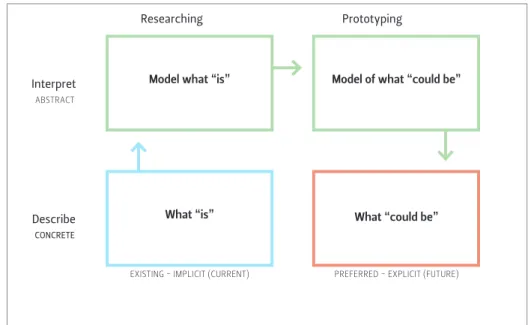
Design moves deeper into the human sciences, but the universal propositions of the behavioural and social sciences do not lead directly to the specific, to particular fea-tures of successful products (Buchanan, 2001). Therefore, they look for explanations on conceptual models, built for the understanding of their experiences (Norman, 2011). Like an extension to Guilford’s creative thinking, the Bridge Model (Figure 6) intended to bridge the gap between analysis and the synthesis - How design moves from a concrete problem to a preferred explicit solution (Dubberly et al., 2008).
The core of designers’ intervention is precisely, according to these authors, the way they move from the abstract to the concrete. Therefore, the bridge model intends to make the role of modelling in the DT approach more explicit. On one hand, by encour-aging team members to understand and agree on the elements of a system and how those elements interact with each other and the environment. On the other hand, by making the elements and interactions visible, they reduce the likelihood of overlook-ing differences in points of view, promotoverlook-ing multidisciplinary approaches.
Figure 6 The Bridge Model, (Dubberly, Evenson, and Robinson 2008) Interpret
Describe
EXISTING - IMPLICIT (CURRENT) PREFERRED - EXPLICIT (FUTURE)
Model what “is”
ABSTRACT
Model of what “could be”
What “could be”
CONCRETE
What “is”
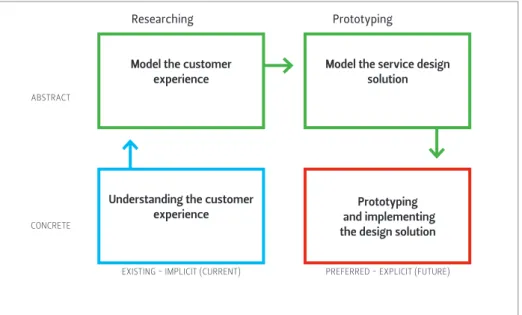
The bridge model can be adapted to service design (Patrício et al., 2013, Dubberly et al., 2008). From this perspective, the service design process starts with un-derstanding the customer experience in the current situation (Figure 7). Based on that understanding of customer experience, new preferred service solutions are modelled to provide an abstraction that helps focus on the most relevant service aspects and enable the design team members to ‘play’ as they explore and test new service solutions. Then design returns to the concrete world, converting models into prototypes before implementing the final solution (Koskinen et al., 2011).
Companies expect a service designer to help create ideas that better meet custom-ers’ needs and desires and create memorable experiences (Holmlid, 2009).
DT represents an approach to idea generation and problem solving that both de-signers and non dede-signers can develop and apply (Meroni and Sangiorgi, 2011). Service designers are focused on the systematic use of their methodologies (Lockwood, 2010). Their Human-centred practice is exploratory, generative and evaluative; so their methods result in outcomes of the service systems interac-tion (Brown, 2009, Mager, 2009).
Figure 7 The Bridge Model, adapted to Service Design, from Patrício and Fisk’s version (2012)
ABSTRACT
EXISTING - IMPLICIT (CURRENT) PREFERRED - EXPLICIT (FUTURE)
Model the customer experience
Model the service design solution
Prototyping and implementing the design solution
CONCRETE
Understanding the customer experience
Therefore, this DT process comprehends the above common stages: First there is Exploration to gain multiple perspectives on a problem - it involves insight - go out, observe and understand users and their actual experiences and their context, the service providers and their social practices; it entails studying the stakeholders who will be involved in the project, their behaviours and context, in a human-centred design approach. As suggested by Brown (2009), ideas are more likely to be trig-gered by observing the odd practices.
Therefore this stage is followed by Ideation, promoting enlightenment, developing new ideas that may lead to service solutions. At this stage, it is crucial to include all the main stakeholders and work with multidisciplinary teams (Patrício et al., 2013). Participants should be open to go through divergent and convergent ways of think-ing (Brown, 2009, Guilford, 1950). Ideation comprehends searchthink-ing for a broad set of opportunities but also deciding among alternatives to move forward.
Then, Reflection entails prototyping the service concepts previously created and testing them with potential users. Since services are intangible performances, pro-totyping is important so customers and the design team can have a more concrete idea of the service concept. Finally, Implementation leads to planning, implement-ing and reviewimplement-ing the changes necessary to put into practice the new service con-cept and offer it to customers (Brown, 2008, Patrício et al., 2013).
As mentioned, these stages involve an understanding of users and their context, service providers and social practices, as well as transforming this knowledge into the development of evidence and interaction through an iterative process (Rohrer et al., 2008). The Iterative role of this process has major importance in refining the concept with increasing fidelity and reflection (Brown, 2008). Although in practice this cyclical process tends to be flexible and pragmatic as well (Moggridge, 2007), SD is a research priority and can create a difference in the strategies of implement-ing technology-based services (Patrício et al., 2013). It can also provide an oppor-tunity to close the gap on a specific level of analysis and move forward through time to a next desired state, developing updated new features (Ostrom et al., 2010).
2.2.3 Designing Services in the mobile context
Designing for the mobile space is an unavoidable reality even if it might be com-plex. It is challenged by “The Carry Principle” based on the fact that the mobile phone or any personal related device is always with the user (Ballard, 2007). The Nielsen Group (2013) has published studies of mobile usability based on exten-sive empirical research around the world that reinforce the need for improved design in mobile interfaces.
When looking for literature on detailed design processes and practices, recom-mendations to service conception within these ever-changing contexts are scarce. However, designing services changed once technology enabled them to become ubiquitous. Moreover, the latest developments in mobile computing and contextually aware devices have given weight to a transition from the HCI’s early obsession with usability to the social and emotional impact services have, and their ability to improve people’s lives (Forlizzi et al., 2008, Norman, 2011). The notion of mobility brought an expanded perspective that goes beyond the functionalistic understanding of the term itself (Kakihara and Sorensen, 2001). Rohrer Evenson et al (2008) stressed that creating highly usable products, with great look and feel, would not be sufficient to sustain business growth, unless they meet customer requirements.
Achieving high levels of usefulness can actually disguise the importance of chal-lenges with improved experiences and desirability, since business success is still attainable. This way, designing mobile services implies an understanding and articulation with other channels of service delivery. Even the marketing field is only recently beginning to look at this channel as a service interface.
2.2.4. Prototyping Experience
Testing new products through a prototype is also a well-established practice in mobile HCI (Suri and Marsh, 2000). Mobile interface prototyping is important to reach the deep assessment of the look and feel, ascertaining how a mobile device feels in the hand of the user (Bolchini et al., 2009, Jones and Marsden, 2006, Lua et al., 2005).