
Enantioresolution, chiral recognition mechanisms and
binding of xanthone derivatives on immobilized human
serum albumin by liquid chromatography
Dissertation presented to the Faculdade de Farmácia da Universidade do Porto conducting to the Master’s degree in Pharmaceutical Chemistry.
Advisor:
Professora Doutora Carla Sofia Garcia Fernandes
(Professora Auxiliar da Faculdade de Farmácia da Universidade do Porto)
Co-advisor:
Professor Doutor Carlos Manuel Magalhães Afonso
(Professor Auxiliar com Agregação da Faculdade de Farmácia da Universidade do Porto)
III This work was developed in Laboratório de Química Orgânica e Farmacêutica, Departamento de Ciências Químicas, Faculdade de Farmácia da Universidade do Porto. This research was developed under the projects PTDC/ MAR-BIO/4694/2014 and PTDC/AAG-TEC/0739/2014 supported through national funds provided by Fundação da Ciência e Tecnologia (FCT/MCTES, PIDDAC) and European Regional Development Fund (ERDF) through the COMPETE – Programa Operacional Factores de Competitividade (POFC) programme (POCI‐01‐0145‐FEDER‐016790 and POCI-01-0145-FEDER-016793) and– Reforçar a Investigação, o Desenvolvimento Tecnológico e a Inovação (RIDTI, Project 3599 and 9471) in the framework of the programme PT2020, as well as Project No. POCI-01-0145-FEDER-028736, co-financed by COMPETE 2020, Portugal 2020 and the European Union through the ERDF, and by FCT through national funds, and CHIRALXANT-CESPU-2018.
V IN ACCORDANCE WITH THE APPLICABLE LAW, IT IS NOT ALLOWED TO
REPRODUCE ANY PART OF THIS THESIS.
DE ACORDO COM A LEGISLAÇÃO EM VIGOR, NÃO É PERMITIDA A REPRODUÇÃO DE QUALQUER PARTE DESTA DISSERTAÇÃO.
VI
VII
“All artificial bodies and all minerals have superposable images. Opposed to these are nearly all organic substances which play an important role in plant and animal life. These are asymmetric, and indeed have the kind of asymmetry in which the image is not superposable with the object.”
VIII
IX
author afforded a major contribution to the conceptual design and technical execution of the work and interpretation of the results included in this dissertation. Under the terms of the referred Decree-Law, is hereby declared that the following communications were prepared in the scope of this dissertation.
The results presented in this dissertation are part of the following scientific communications:
Poster Communications:
João Carmo; Carla Fernandes; Maria Elizabeth Tiritan; Carlos Afonso; Madalena M.M.
Pinto. Liquid chromatography enantioseparation of xanthone derivatives on a human serum
albumin stationary phase. 10º Encontro Nacional de Cromatografia (10 ENC), Bragança,
Portugal, December 04-06, 2017, PC-49 (Appendix A.).
João Carmo; Carla Fernandes; Maria Elizabeth Tiritan; Carlos Afonso; Madalena M.M.
Pinto. Enantioresolution of bioactive compounds on human serum albumin stationary
phase. Escola de Inverno de Farmácia, 3rd ed, Porto, Portugal, March 07-15, 2018
(Appendix B.).
Carla Fernandes; João Carmo; Andreia Palmeira; Maria Elizabeth Tiritan; Carlos Afonso; Madalena M.M. Pinto. Chiral carboxyxanthone derivatives: enantioselectivity studies in
binding interaction with human serum albumin. Italian-Spanish-Portuguese Joint Meeting in
Medicinal Chemistry, MedChemSicily2018, Palermo, Italy, July 17-20, 2018 (Appendix C.). Ye Zaw Phyo; João Carmo; Andreia Palmeira; Maria Elizabeth Tiritan; Carla Fernandes; Carlos Afonso; Anake Kijjoa; Madalena M.M. Pinto. Enantioresolution and docking studies
of xanthone derivatives on a human serum albumin stationary phase. 11th International
Symposium on Drug Analysis and 29th International Symposium on Pharmaceutical and
Biomedical Analysis, DA-PBA 2018, Leuven, Belgium, September 9-12, 2018, ID 254 (Appendix D.).
Oral Communications:
João Carmo; Carla Fernandes; Maria Elizabeth Tiritan; Carlos Afonso; Madalena M.M.
Pinto. Chiral recognition of xanthone derivatives on human serum albumin stationary phase:
effect of chromatographic conditions. 11th Meeting of Young Researchers of University of
X
João Carmo; Ye Zaw Phyo; Carla Fernandes; Maria Elizabeth Tiritan; Carlos Afonso;
Madalena M.M. Pinto. Enantioresolution, chiral recognition mechanisms and binding of
xanthone derivatives on immobilized human serum albumin by liquid chromatography. XXIV
Encontro Luso-Galego de Química (XXIV ELGQ); November 21-23, 2018 (Appendix F.).
XI objetivos da minha vida e muito desejado há largos anos. Queria aproveitar para agradecer a todos os que, de alguma forma, contribuíram para o desenvolvimento deste trabalho e têm estado presentes ao longo deste percurso.
Começo por dirigir o meu maior agradecimento à Professora Carla, a quem mais quero agradecer, todos os dias. Não tenho palavras para descrever o quão gratificante é poder trabalhar com alguém com tamanha sabedoria e dedicação, tão focada e tão extraordinária e pela oportunidade de integrar parte do seu trabalho. Um obrigado gigante pelo seu acompanhamento, pela motivação que me transmitiu, obrigado por tudo o que me ensinou, obrigado pela confiança que depositou em mim, obrigado pela paciência, obrigado pelo entusiamo com o meu trabalho. É uma orientadora exemplar e eu não podia ter tido mais sorte.
Ao Professor Carlos, que desde o início do desenvolvimento deste trabalho se mostrou totalmente disponível para qualquer esclarecimento e respondeu sempre às solicitações com apreço. Obrigado pelas suas palavras sábias e na altura em que as mais precisava de ouvir, obrigado por ter coorientado este trabalho.
Agradeço à Professora Doutora Madalena Pinto, diretora do Mestrado em Química Farmacêutica, pela dedicação como lida com os estudantes, investigadores e todo o grupo do LQOF. O mestrado correspondeu às minhas expectativas e foi sem dúvida uma mais-valia para o meu percurso académico e espero que para o meu percurso profissional, onde se tratam temáticas de elevado interesse científico e contactei com um corpo docente de excelência.
À Drª Sara Cravo pela disponibilidade demonstrada ao longo de toda a dissertação. Obrigado por me ensinar, compreender e ser incansável nas piores fases do desenrolar do trabalho experimental, obrigado pelo apoio desmedido e sem horários. Obrigado pela amizade e preocupação demonstradas ao longo deste ano.
À Liliana pelo apoio técnico, pela simpatia e principalmente pela amizade criada.
Aos meus colegas com quem tenho partilhado o laboratório, pela amizade, pelo companheirismo, palavras de apoio e por todos os momentos de descontração, obrigado. Ao meu amigo e parceiro de laboratório Ye Zaw Phyo, por todo o interesse e ajuda prestada, parte desta dissertação não seria possível sem a sua intervenção, foi responsável pelo desenvolvimento dos estudos de docking computacional, muito obrigado. À Daniela Loureiro, muito obrigado por seres incansável, obrigado por toda a ajuda e partilha que me permitiu evoluir pessoal e academicamente. Obrigado pelo carinho e amizade e pelas palavras de conforto. Obrigado pelo apoio nas horas de crise, pelas
XII
pausas, pela ajuda até de madrugada e obrigado por fazê-lo por mim, bem, e pelo sushi e Ben&Jerry’s!
Aos meus amigos, Xavier Cardoso, Carla Soares, José Miller, Bruno Martins, Márcia Teixeira, Andreia Castro, entre outros que não menciono o nome, mas que foram igualmente importantes, amigos que estiveram ao meu lado durante esta fase, pelo companheirismo, força, paciência e apoio nos momentos mais difíceis.
À Joyce, Francisca e Daniela um muito obrigado por tudo, companheiras desde o primeiro dia de mestrado, estes anos não teriam sido os mesmos sem vocês. Obrigado por todos os momentos de estudo, festa, descontração e sobretudo amizade. Foi um prazer conhecer-vos e será um prazer manter-vos por perto.
Tendo consciência que nesta estrada que é a vida, fica difícil viajar sozinho, atribuo um agradecimento especial aos meus pais, ao meu irmão e à minha cunhada, pelo apoio incondicional, incentivo, amizade e paciência demonstrados, por terem amortizado todos os obstáculos que ao longo deste percurso foram surgindo e por muitas vezes renunciarem aos vossos sonhos para que eu pudesse concretizar os meus.
Por fim, não me esquecendo de quem me dá muita alegria, dedico este trabalho à minha pequena, Eduarda!
Um MUITO OBRIGADO!
XIII which solutes are separated based on their affinity to the mobile phase and a stationary phase that is a biologically-related agent.
Human serum albumin (HSA), the most abundant protein in the blood, plays an important role in the transport of drugs, metabolites, and endogenous ligands. Binding to HSA controls the free and active concentration of a drug, provides a reservoir for a long duration of action, and affects drug absorption, metabolism, distribution, excretion and toxicology profile (ADMET), determining the overall pharmacological activity of a drug.
The interactions of drugs with HSA are often stereoselective, and information on these interactions can be valuable in the design and optimization of chiral separations. Another important aspect of these interactions is predicting how drugs may behave in the human body, understanding drug-drug interactions, and determining the optimum dosages that should be used with such agents for treating patients.
Chiral stationary phases based on human serum albumin (HSA-CSP) exhibit a broad chiral recognition and enantioselectivity for a variety of classes of analytes due to multiple binding sites in the HSA selector.
During the last few decades, there has been a widespread interest in oxygenated heterocyclic compounds, such as molecules with a xanthone scaffold, mainly taking in consideration their variety of biological activities. Among them, chiral derivatives of xanthones (CDXs) have interesting biological activities being, in some cases, dependent on the stereochemistry. Consequently, the development of improved and accurate methodologies to enantioresolve, and evaluate the enantiomeric purity of these compounds are necessary.
In this dissertation, a systematic study of enantioresolution of a library of CDXs, prepared “in house”, was successfully carried out using a commercially available HSA-CSP, namely CHIRALPAK® HSA.
The enantioseparations were explored using different mobile phases, under reversed-phase elution mode. Chromatographic conditions such as mobile reversed-phase pH, buffer type and ionic strength, type and content of organic modifiers and temperature were optimized. Herein, thirteen among thirty-one enantiomeric mixtures of CDXs were enantioseparated by liquid chromatography on HSA-CSP. The obtained results showed very high enantioselectivity and resolution, with α and RS ranging from 1.27 to 12.53 and from 0.90 to
6.41, respectively.
The binding to HSA of sixty-two enantiomers of CDXs has been determined by bioaffinity chromatography by measuring the retention times on an HSA-CSP using mobile phases
XIV
with different proportions of organic modifier, to allow the extrapolation to 100% aqueous buffer, and further calculation of compound bound percentage. In general, high affinity for HSA-CSP was observed, with bound percentage ranging from 79.02% to 99.99%.
Considering the importance of understanding the chiral recognition mechanisms associated with the chromatographic enantioresolution, computational studies by molecular docking were also carried out. Data regarding the CSP-CDX molecular conformations and interactions were retrieved. The docking calculations were in accordance with the experimental chromatographic parameters regarding enantioselectivity and enantiomer elution order, with a success rate of 77%.
Keywords: Chiral Derivatives of Xanthones; Liquid Chromatography; Chiral Recognition;
XV na qual os solutos são separados tendo como base a sua afinidade para a fase estacionária e para uma fase estacionária cujo seletor é constituído por uma molécula de origem biológica.
A albumina sérica humana (ASH) é a proteína mais abundante no sangue e desempenha um papel importante no transporte de fármacos, metabolitos e ligandos endógenos. A ligação dos fármacos à ASH controla a sua concentração livre e ativa, providencia uma reserva para uma longa duração de ação e afeta a absorção, o metabolismo, a distribuição, a excreção e o perfil toxicológico (ADMET), determinando a atividade farmacológica global de um fármaco.
As interações dos fármacos com a ASH são frequentemente estereosseletivas, sendo seu estudo valioso para a otimização de resoluções enantioméricas, prever o comportamento dos fármacos no organismo, assim como possíveis interações entre fármacos e determinar a dose ideal que deve ser administrada.
As fases estacionárias quirais baseadas em albumina sérica humana (FEQ-ASH), apresentam um amplo reconhecimento e capacidade enantiosseletiva para uma variedade de classes de analitos, devido aos múltiplos locais de ligação.
Nas últimas décadas, tem havido um crescente interesse em compostos heterocíclicos oxigenados, tais como moléculas contendo um núcleo xantónico, tendo em consideração a grande diversidade de atividades biológicas. Os derivados xantónicos quirais (DXQs) demonstraram atividades biológicas interessantes sendo, em alguns casos, dependentes da sua estereoquímica. Consequentemente, é necessário o desenvolvimento de metodologias para resolver e avaliar a pureza enantiomérica destes compostos quirais. Nesta dissertação, foi realizado um estudo sistemático de enantiorresolução de uma biblioteca de DXQs utilizando uma coluna comercial de FEQ-ASH, nomeadamente CHIRALPAK® HSA.
A separação enantiomérica destes compostos quirais foi otimizada usando diferentes fases móveis, em modo de eluição inversa. Condições cromatográficas como o pH da fase móvel, tipo de tampão e força iônica, natureza e proporção de modificador orgânico, e temperatura foram testadas. Treze das trinta e uma misturas enantioméricas de DXQs foram resolvidas na FEQ-ASH. Os resultados obtidos mostraram uma boa enantiosseletividade e resolução, com valores de α e RS variando de 1,27 a 12,53 e de 0,90 a 6,41, respetivamente.
A afinidade de sessenta e dois enantiómeros de DXQs para a ASH foi determinada por cromatografia de bioafinidade através dos tempos de retenção obtidos usando fases móveis com diferentes proporções de modificador orgânico. Estas medições permitiram o
XVI
cálculo da percentagem de ligação dos compostos, por regressão linear a 100% de solução tampão aquosa, com percentagens de ligação que variaram de 79,02% a 99,99%
Tendo em consideração a importância dos mecanismos de reconhecimento quiral associados à enantiorresolução cromatográfica, foram realizados estudos de química computacional por docking molecular. Os dados referentes às conformações e interações moleculares entre a FEQ e os enantiómeros dos DXQ foram analisados. Os valores obtidos foram concordantes com os dados cromatográficos experimentais, em relação à enantiosseletividade e à ordem de eluição dos enantiómeros, com uma taxa de sucesso de 77%.
Palavras-chave: Derivados Xantónicos Quirais; Cromatografia Líquida; Reconhecimento
XVII
Acknowledgements ……...XI
Abstract ………...XII
Resumo ……….……XV
Index ………...XVII Figure Index ...XIX
Scheme Index ...XXIII
Table Index ………....XXIII
Abbreviations and Symbols ...XXV
Outline of the dissertation ………...…XXVII
Chapter I – Introduction ………...1
1. Chirality: general concepts and importance ………..3
2. Enantiomeric resolution ………...5
3. Chiral stationary phases ………...6
4. Protein-based chiral stationary phases ………...6
5. Human serum albumin as stationary phase ………..8
6. Ligand-protein binding studies ………...9
7. Enantioresolution and chiral recognition studies on HSA-CSPs ………...12
8. Chiral derivatives of xanthones (CDXs) ………...14
Chapter II – AIMS ………...17
Chapter III – Experimental ……….21
1. Chemicals and reagents ………...23
2. Instrumentation and chromatographic conditions ……….23
3. Mobile Phases ………....23
4. Sample solutions ………..………..24
5. Chromatographic parameters ………..24
XVIII
Chapter IV – Results and discussion ………....27
1. Systematic enantioresolution of CDXs ………...31
1.1. Organic modifier selection ………...31
1.2. Buffer and pH selection ………..33
1.2.1. Ammonium acetate buffer ………..34
1.2.2. Sodium acetate buffer ……….37
1.2.3. Potassium phosphate buffer ………..……41
1.2.4. Sodium phosphate buffer ………...46
1.2.5. Summary ………...50
1.3. Optimizations to approach the physiological conditions ………52
1.3.1. Increase the mobile phase ionic strength ……….……….…...52
1.3.2. Increase of the mobile phase pH .………...………54
1.3.3. Change the organic modifier ……….…..57
1.3.4. Increase the system temperature ……….……….59
1.4. Best performance of CHIRALPAK® HSA column for enantioresolution of chiral derivatives of xanthones ………..………..…63
2. Elution order of CDXs ………65
3. Ligand-protein affinity studies ……….………..67
4. Computational docking studies ………73
Chapter V – Conclusions ……….……..77
Chapter VI – References ...81
Chapter VII – Appendixes ...99
Appendix A. ………101 Appendix B. ……….103 Appendix C. ……….105 Appendix D. ……….107 Appendix E. ……….109 Appendix F. ……….111 Appendix G. ……….…113 Appendix H. ……….…117
XIX
Figure 2 - Illustration summarizing the various ligand-binding sites on the structure of HSA.
Structure obtained from PDB ID 1AO6, in protein data bank of the Research Collaboratory for Structure Bioinformatics (http://www.rcbs.org/pdb/). ... 9
Figure 3 - “3-Point interaction” model [117]. The enantiomer on the left presents three
groups that match exactly three sites of the selector, while its mirror image, on the right, can interact with a maximum of two sites of the selector. ... 13
Figure 4 - Xanthone scaffold and numbering. ... 14 Figure 5 - Illustration of an enantiomeric separation chromatogram with the measurements
related to chromatographic parameters [154]. ... 25
Figure 6 - Chemical structures of enantiomeric mixtures of CDXs 1-31. ... 29 Figure 7 - Chromatograms for enantiomeric mixture X2ADF SR RS (30) on a CHIRALPAK®
HSA using different organic modifiers: EtOH, ACN, MeOH and 2-PrOH. Mobile phase, 10 mM ammonium acetate buffer/organic modifier (85:15 v/v); Flow rate, 0.9 mL/min.; Detection, 254 nm. ... 32
Figure 8 - Chromatogram of enantioresolution of enantiomeric mixture of CDX XEA 5 DES (19) on CHIRALPAK® HSA column. Conditions: Flow rate: 0.9 mL/min; Mobile Phase, 10
mM ammonium acetate at pH 5.0:ACN (78:22 v/v); Detection, 254 nm; temperature, 22 ± 2°C. ... 35
Figure 9 –Chromatogram of the enantioresolution of enantiomeric mixture of CDX XEGOL
5 (1) on the CHIRALPAK® HSA column; Conditions: mobile phase, 10 mM ammonium
acetate (pH 5.0):ACN (82:18 v/v); flow rate: 0.9 mL/min; detection, 254 nm; temperature, 22 ± 2°C. ... 35
Figure 10 - Chromatogram of enantioresolution of enantiomeric mixture of CDX XEA 5 DES
(19) on the CHIRALPAK® HSA column; Conditions: flow rate: 0.9 mL/min; mobile phase, 10
mM ammonium acetate (pH 7.0):ACN (78:22 v/v); detection, 254 nm; temperature, 22 ± 2°C. ... 36
Figure 12 - Chromatogram for enantioresolution of enantiomeric mixture XEA 5 4 FLU (20)
on CHIRALPAK® HSA column; Conditions: flow rate: 0.9 mL/min; mobile phase, 10 mM
sodium acetate (pH 5.0):ACN (78:22 v/v); detection, 254 nm; temperature, 22 ± 2°C. .... 38
Figure 13 - Chromatogram for enantioresolution of enantiomeric mixture of CDX XEGOL 5
(1) on CHIRALPAK® HSA column; Conditions: flow rate: 0.9 mL/min; mobile phase, 10 mM
sodium acetate (pH 7.0):ACN (80:20 v/v); detection, 254 nm; temperature, 22 ± 2°C. .... 39
Figure 14 –Chromatogram for enantioresolution of enantiomeric mixture of CDX XEA 5 3
MET (24), on CHIRALPAK® HSA column; Conditions: flow rate: 0.9 mL/min; mobile phase,
10 mM sodium acetate (pH 7.0):ACN (82:18 v/v); detection, 254 nm; temperature, 22 ± 2°C. ... 40
Figure 15 – Chromatogram for enantioresolution of enantiomeric mixture CDX XEA 5 4
XX
10 mM sodium acetate (pH 7.0):ACN (79:21 v/v); detection, 254 nm; temperature, 22 ± 2°C. ... 40
Figure 16 - Effect of mobile phase pH on retention factors and resolution of enantiomeric
mixtures XEA 5 (15), XEA 5 DES (19) and X2ADF 5 SR RS (27); Conditions: flow rate: 0.9 mL/min; mobile phase, 10 mM sodium acetate (pH 5.0 and 7.0): ACN= 79:21 (v/v). ... 41
Figure 17 - Chromatogram for enantioresolution of enantiomeric mixture CDX XEA DES
(18), on CHIRALPAK® HSA column; Conditions: flow rate: 0.9 mL/min; mobile phase, 10
mM potassium phosphate (pH 5.0):ACN (76:24 v/v); detection, 254 nm; temperature, 22 ± 2°C. ... 42
Figure 18 –Chromatogram for enantioresolution of enantiomeric mixture of CDX XEA 5
(15), on CHIRALPAK® HSA column; Conditions: flow rate: 0.9 mL/min; mobile phase, 10
mM potassium phosphate (pH 5.0):ACN (76:24 v/v); detection, 254 nm; temperature, 22 ± 2°C. ... 42
Figure 19 - Chromatogram for enantioresolution of enantiomeric mixture XEA 5 (15), on
CHIRALPAK® HSA column; Conditions: flow rate: 0.9 mL/min; mobile phase, 10 mM
potassium phosphate (pH 7.0):ACN (79:21 v/v); detection, 254 nm; temperature, 22 ± 2°C. ... 44
Figure 20 – Chromatogram for enantioresolution of enantiomeric mixture of CDX XEA 5 4
CLO (23), on CHIRALPAK® HSA column; Conditions: flow rate: 0.9 mL/min; mobile phase,
10 mM potassium phosphate (pH 7.0):ACN (78:22 v/v); detection, 254 nm; temperature, 22 ± 2°C. ... 44
Figure 21 – Chromatogram for enantioresolution of enantiomeric resolution of CDX X2ADF
5 SR RS (27), on CHIRALPAK® HSA column; Conditions: flow rate: 0.9 mL/min; mobile
phase, 10 mM potassium phosphate (pH 7.0):ACN (79:21 v/v); detection, 254 nm; temperature, 22 ± 2°C. ... 45
Figure 22 - Effect of mobile phase pH on retention factors and resolution of enantiomeric
mixtures XEGOL 5 (1), XEA 5 3 MET (24) and XEA 5 4 MET (25); Conditions: flow rate: 0.9 mL/min; mobile phase, 10 mM potassium phosphate (pH 5.0 and 7.0): ACN= 79:21 (v/v). ... 45
Figure 23 - Chromatogram for enantioresolution of enantiomeric mixture X2ADF 5 SR RS
(27) on the CHIRALPAK® HSA column; Conditions: flow rate: 0.9 mL/min; mobile phase, 10
mM sodium phosphate (pH 5.0):ACN (78:22 v/v); detection, 254 nm; temperature, 22 ± 2°C. ... 46
Figure 24 - Chromatogram for enantioresolution of enantiomeric mixture of CDX XEGOL 5
(1), on CHIRALPAK® HSA column; Conditions: flow rate: 0.9 mL/min; mobile phase, 10 mM
sodium phosphate (pH 7.0):ACN (80:20 v/v); detection, 254 nm; temperature, 22 ± 2°C. 48
Figure 25 - Effect of mobile phase pH on retention factors and resolution of enantiomeric
mixtures XEA 5 (15), XEA 5 DES (19) and XEA 5 4 FLU (20); Conditions: flow rate: 0.9 mL/min; mobile phase, 10 mM sodium phosphate (pH 5.0 and 7.0): ACN= 78:22 (v/v). .. 48
Figure 26 - Chromatograms on the enantioresolution of enantiomeric mixture of CDX XEA
4 CLO (22) on the CHIRALPAK® HSA column; Conditions: flow rate: 0.9 mL/min; mobile
phase, (A) 10 mM sodium phosphate (pH 5.0):ACN (80:20 v/v), (B) 10 mM sodium phosphate (pH 7.0):ACN (80:20 v/v); detection, 254 nm; temperature, 22 ± 2°C... 49
XXI 5.0 and 7.0): ACN;... 51
Figure 28 – (A) Effect of mobile phase proportion of ACN as organic modifier on retention
factors and resolution of enantiomeric mixture XEGOL 5 (1); Conditions: flow rate: 0.9 mL/min; mobile phase, 10 mM potassium phosphate at pH 7.0:ACN; detection, 254 nm; (B) Chromatograms for resolution of enantiomeric mixture XEGOL 5 (1) on CHIRALPAK® HSA
column using 16 (i), 18 (ii) and 20% (iii) ACN as organic modifier; Conditions: flow rate: 0.9 mL/min; mobile phase, 10 mM potassium phosphate at pH 7.0:ACN; detection, 254 nm; temperature, 22 ± 2°C. ... 51
Figure 29 - Chromatogram on the enantioresolution of enantiomeric mixture of CDX XEA
5 DES (19) on the CHIRALPAK® HSA column; Conditions: flow rate: 0.9 mL/min; mobile
phase, 67 mM potassium phosphate (pH 7.0):ACN (76:24 v/v); detection, 254 nm; temperature, 22 ± 2°C. ... 53
Figure 30 - Chromatogram on the enantioresolution of enantiomeric mixture of CDX XEA
5 (15) on the CHIRALPAK® HSA column; Conditions: flow rate: 0.9 mL/min; mobile phase,
67 mM potassium phosphate (pH 7.0):ACN (76:24 v/v); detection, 254 nm; temperature, 22 ± 2°C. ... 53
Figure 31 - Effect of mobile phase ionic strength on retention factors and resolution of
enantiomeric mixtures XEGOL 5 (1), XEA 5 3 MET (24) and XEA 5 4 MET (25); Conditions: flow rate: 0.9 mL/min; mobile phase, (10 or 67 mM) potassium phosphate (pH 7.0): ACN= 80:20 (v/v). ... 54
Figure 32 - Chromatogram on the enantioresolution of enantiomeric mixture of CDX XEA
DES (18) on the CHIRALPAK® HSA column; Conditions: flow rate: 0.9 mL/min; mobile
phase, 67 mM potassium phosphate (pH 7.4):ACN (78:22 v/v); detection, 254 nm; temperature, 22 ± 2°C. ... 55
Figure 33 - Chromatogram on the enantioresolution of enantiomeric mixture of CDX XEA
5 4 MET (25) on the CHIRALPAK® HSA column; Conditions: flow rate: 0.9 mL/min; mobile
phase, 67 mM potassium phosphate (pH 7.4):ACN (80:20 v/v); detection, 254 nm; temperature, 22 ± 2°C. ... 55
Figure 34 – Effect of mobile phase pH on retention factors and resolution of enantiomeric
mixtures XEA 5 (15), XEA 5 4 FLU (20) and XEA 5 4 CLO (23). Conditions: flow rate: 0.9 mL/min; mobile phase a), 67 mM potassium phosphate (pH 7.0 and 7.4): ACN (76:24 v/v); mobile phase b), 67 mM potassium phosphate (pH 7.0 and 7.4): ACN (79:21 v/v). ... 56
Figure 36 - Chromatogram forresolution of enantiomeric mixture of CDX XEVOL 5 (6) on
the CHIRALPAK® HSA column; Conditions: flow rate: 0.9 mL/min; mobile phase, 67 mM
potassium phosphate (pH 7.4):2-PrOH (75:25 v/v); detection, 254 nm; temperature, 22 ± 2°C. ... 58
Figure 37 - Chromatogram for resolution of enantiomeric mixture XEA 5 3 MET (24) on
CHIRALPAK® HSA column; Conditions: flow rate: 0.9 mL/min; mobile phase, 67 mM
potassium phosphate (pH 7.4):2-PrOH (75:25 v/v); detection, 254 nm; temperature, 22 ± 2°C. ... 58
XXII
Figure 38 - Chromatogram for resolution of enantiomeric mixture of CDX XEA DES (18) on
CHIRALPAK® HSA column; Conditions: flow rate: 0.9 mL/min; mobile phase, 67 mM
potassium phosphate (pH 7.4):ACN (78:22 v/v); detection, 254 nm; temperature, 37 ± 2°C. ... 60
Figure 39 - Effect of the temperature on retention factors and resolution of enantiomeric
mixtures XEGOL 5 (1), XEVOL 5 (6), XEA DES (18), XEA 5 DES (19), XEA 5 4 FLU (20) and XEA 5 4 CLO (23); Conditions: flow rate: 0.9 mL/min; mobile phase, 67 mM potassium phosphate (pH 7.4): ACN= 78:22 (v/v); temperature: 22°C ± 2°C and 37 ± 2°C. ... 60
Figure 40 - Chromatogram for resolution of enantiomeric mixture of CDX X2ADF 5 SR RS
(27) on the CHIRALPAK® HSA column; Conditions: flow rate: 0.9 mL/min; mobile phase, 67
mM potassium phosphate (pH 7.4):ACN (77:23 v/v); detection, 254 nm; temperature, 37 ± 2°C. ... 61
Figure 41 - Chromatogram on the enantioresolution of enantiomeric mixture of CDX XEVOL
5 (6) on the CHIRALPAK® HSA column; Conditions: flow rate: 0.9 mL/min; mobile phase,
67 mM potassium phosphate (pH 7.4):2-PrOH (80:20 v/v); detection, 254 nm; temperature, 37 ± 2°C. ... 62
Figure 42 - Chromatogram on the enantioresolution of enantiomeric mixture of CDX XEA
5 4 CLO (23) on the CHIRALPAK® HSA column; Conditions: flow rate: 0.9 mL/min; mobile
phase, 67 mM potassium phosphate (pH 7.4):2-PrOH (78:22 v/v); detection, 254 nm; temperature, 37 ± 2°C. ... 63
Figure 43 – Screening of CDXs enantiomers: number of enantiomers for each range of
bound percent (%b), values extrapolated for 100% aqueous buffer solution. ... 70
Figure 44 – Linear plotting of log k values of XEA 5 (R) (15) and XEA 4 MET (R) (17),
obtained with the CHIRALPAK® HSA column, against various concentrations of ACN in the mobile phase; Conditions: flow rate: 0.9 mL/min; mobile phase, 67 mM potassium phosphate (pH 7.4):ACN; detection, 254 nm; temperature, 37 ± 2°C. ... 71
Figure 45 – XEVOL 5 (6) (A), XEGOL 5 (1) (B), XEA 5 DES (19) (C), XEA 5 4 CLO (23)
(D), and XEA 1 (14) (E) enantiomers, docked on a HSA selector. Chiral selector is represented in green, blue and red sticks. (S) and (R) enantiomers are represented in with magenta and yellow sticks, respectively. ... 75
XXIII
Table Index
Table 1 - Examples of different stereoselective responses of chiral drugs in their biological
activity. ... 4
Table 2 – Different types of CSPs. ... 6 Table 3 - Protein-based CSPs, column tradenames and type of resolved racemates [38,
59]. ... 7
Table 4 - The best chromatographic data obtained for separation of enantiomeric mixtures
of CDXs 1-31, on CHIRALPAK® HSA, using 10 mM ammonium acetate at pH 5.0 as buffer.
... 34
Table 5 - The best chromatographic data obtained for the separation of enantiomeric
mixtures of CDXs on CHIRALPAK® HSA, using 10 mM ammonium acetate at pH 7.0 as
buffer. ... 36
Table 6 - The best chromatographic data obtained for separation of enantiomeric mixtures
of CDXs 1-31, on CHIRALPAK® HSA, using 10 mM sodium acetate (pH 5.0) as buffer. . 38
Table 7 - The best chromatographic data obtained for separation of enantiomeric mixtures
of CDXs 1-31, on CHIRALPAK® HSA, using 10 mM sodium acetate (pH 7.0) as buffer. . 39
Table 8 - The best chromatographic data obtained for separation of enantiomeric mixtures
of CDXs 1-31, on CHIRALPAK® HSA, using 10 mM potassium phosphate at pH 5.0 as
buffer. ... 41
Table 9 - The best chromatographic data obtained for separation of enantiomeric mixtures
of CDXs 1-31, on CHIRALPAK® HSA, using 10 mM potassium phosphate at pH 7.0 as
buffer. ... 43
Table 10 - The best chromatographic data obtained for separation of enantiomeric mixtures
of CDXs 1-31, on CHIRALPAK® HSA, using 10 mM sodium phosphate at pH 5.0 as buffer.
... 46
Table 11 - The best chromatographic data obtained for separation of enantiomeric mixtures
of CDXs 1-31, on CHIRALPAK® HSA, using 10 mM sodium phosphate at pH 7.0 as buffer.
... 47
Table 12 – Summary of baseline separations of enantiomeric mixtures of CDXs using
mobile phases with different buffer types and pH, and ACN as organic modifier, in variable proportions. ... 50
Table 13 - The best chromatographic data obtained for separation of enantiomeric mixture
of CDXs, on CHIRALPAK® HSA, using 67 mM potassium phosphate at pH 7.0 as buffer.
XXIV
Table 16 - The best chromatographic data obtained for separation of enantiomeric mixture
of CDXs, on CHIRALPAK® HSA, using 67 mM potassium phosphate at pH 7.4 as buffer.
... 54
Table 17 - The best chromatographic data obtained on separation of enantiomeric mixtures
of CDXs on CHIRALPAK® HSA, using mixtures of 67 mM potassium phosphatebuffer at pH
7.4 and 2-PrOH as mobile phase. ... 57
Table 18 - The best chromatographic data obtained for separation of enantiomeric mixtures
of CDXs using CHIRALPAK® HSA, using 67 mM potassium phosphate (pH 7.4) as buffer
and ACN as organic modifier, in mobile phase, at 37°C ± 2°C. ... 59
Table 19 - The best chromatographic data obtained on separation of enantiomeric mixtures
of CDXs using CHIRALPAK® HSA, using 67 mM potassium phosphate (pH 7.4) as buffer
and 2-PrOH as organic modifier, in mobile phase, at 37 ± 2°C. ... 62
Table 20 - The best chromatographic data obtained on CHIRALPAK® HSA column, under
reversed-phase elutions conditions, for the enantiomeric mixtures of CDXs. ... 64
Table 21 - Elution order and retention factor of CDXs enantiomers on CHIRALPAK® HSA,
using as mobile phase 67 mM potassium phosphate (pH 7.4):ACN (76:24 v/v), temperature of 22 ± 2°C, Flow rate 0.9 mL/min, detection UV 254nm. ... 65
Table 22 – Binding percentage (%b) values of CDXs, injected as single enantiomers on a
CHIRALPAK® HSA column, using different ACN proportions in mobile phase, calculated
based on k/(k+1) equation (1) and by extrapolation to 100% aqueous buffer. ... 68
Table 23 – Chromatographic data, docking scores of both enantiomers of CDXs on a
CHIRALPAK® HSA column and the energy difference between (S) and (R) or (S,R) and
(R,S) enantiomers. ... 73
Table 24 – Retention time (tR), retention factor (k) and binding percentage (%b) (calculated
based on k/(k+1) equation (1)) values of CDXs injected as single enantiomers for different ACN proportions, on a CHIRALPAK® HSA column, and extrapolation to 100% aqueous
XXV
µg Micrograms
µL Microliters
2-PrOH 2-Propanol
ACN Acetonitrile
AGP α1-acid glycoprotein
BSA Bovine Serum Albumin
CBB Chiral Building Block
CBH Cellobiohydrolase
CDX Chiral Derivative of Xanthone
CIIMAR Centro Interdisciplinar de Investigação Marinha e Ambiental
cm Centimeter
COX Cyclooxygenase
CSP Chiral Stationary Phase
CX Carboxyxanthone
EtOH Ethanol
HPAC High Performance Affinity Chromatography
HPLC High Performance Liquid Chromatography
HPLC-DAD High Performance Liquid Chromatography Diode Array Detector
HSA Human Serum Albumin
I.D. Inner Diameter
k Retention Factor
kcal.mol-1 Kilocalorie per mole
LC-MS Liquid Chromatography Mass Spectrometry
LQOF Laboratory of Organic and Pharmaceutical Chemistry
MeOH Methanol mg Milligram min Minute mM Millimolar MS Mass Spectrometry ng Nanogram OM Organic Modifier OVM Ovomucoid RS Resolution Factor t0 Dead Time
XXVI
TBTU O-(Benzotriazol-1-yl)-N,N,N’,N’-tetramethyluronium tetrafluoroborate
tR Retention Time
UPW Ultra-Pure Water
UV-Vis Ultraviolet - Visible
v/v Volume per Volume
XD Xanthone Derivative
XXVII This dissertation is divided into seven chapters:
I. Introduction
In this chapter, general concepts and importance of chirality are presented, as well as the methods for enantiomeric resolution. In addition, the different types of chiral stationary phases (CSPs) are described, giving more importance to protein-based CSPs, specifically human serum albumin (HSA). Affinity and chiral recognition studies are also discussed. The importance of xanthone derivatives, namely chiral derivatives of xanthones (CDXs) are also highlighted.
II. Aims
This chapter summarizes the main and secondary objectives of the present dissertation.
III. Experimental
The third chapter describes the experimental methodologies used in this work, including information about the chemicals, chromatographic instrumentation and conditions, mobile phases, sample preparation and chromatographic parameters used for liquid chromatographic analysis, as well as computational study.
IV. Results and Discussion
In this chapter, the results from the original work concerning the systematic study of enantioresolution of a library of CDXs and the affinity studies on a HSA-based column are described. The results of computational study by docking approach are also discussed.
V. Conclusions
This chapter sum up the general conclusions of the developed work, based on the proposal aims.
VI. References
All the references used as support for this dissertation are listed in this chapter. The databases used are also mentioned.
XXVIII
VII. Appendixes
Appendix A. – Abstract and Poster of 10º Encontro Nacional de Cromatografia (10 ENC),
December 04-06, 2017.
Appendix B. – Abstract and Poster of Escola de Inverno de Farmácia, 3rd ed, Porto,
Portugal, March 07-15, 2018.
Appendix C. – Abstract and Poster of Italian-Spanish-Portuguese Joint Meeting in
Medicinal Chemistry, MedChemSicily2018, July 17-20, 2018.
Appendix D. – Abstract and Poster of 29th International Symposium on Pharmaceutical and
Biomedical Analysis, DA-PBA 2018, September 9-12, 2018.
Appendix E. – Abstract of 11th Meeting of Young Researchers of University of Porto
(IJUP18), February 07-09, 2018.
Appendix F. – Abstract of XXIV Encontro Luso-Galego de Química (XXIV ELGQ),
November 21-23, 2018.
Appendix G. – Technical data sheet of CHIRALPAK® HSA provided by the column
manufacturer (Chiral Technologies, Daicel Group).
Appendix H. – Table 24 – Retention time (tR), retention factor (k) and binding percentage
(%b) (calculated based on k/(k+1) equation (1)) values of CDXs injected as single enantiomers for different ACN proportions, on a CHIRALPAK® HSA column, and
Chapter I
3
1. Chirality: general concepts and importance
One of the main characteristics of nature and features of the living world is its chirality [1]. Chirality is a fundamental property in analysis of three-dimensional shapes of molecules applied in the development of agrochemical, food, flavours, and to pursue new drug candidates to the pharmaceutical industry [2].
Molecules are termed chiral when they do not have a plane of symmetry, and exist in two enantiomeric forms, which are mirror images of each other and are non-superimposable in three dimensions [3]. Since the term chirality comes from the Greek cheir which means hand, the spatial relationship between two enantiomers is classically represented by the right and left hands [4] (Figure 1).
Generally, chiral molecules are characterized by the presence of one asymmetric center known as stereogenic center or stereocenter [3]. In fact, most chiral molecules present central chirality, with one or more stereogenic centers, usually sp3 (tetrahedral) carbon
atoms bonded to four different substituents (atoms or groups of atoms). In addition to carbon, nitrogen, phosphorus, sulphur, selenium and boron can also produce stereogenic centers [2]. Nevertheless, other types of chirality are considered, including planar, axial and helical chirality [2].
Chemically, enantiomers (Greek enantios = opposite, meros = part) have the same chemical formula and physicochemical properties when they are in an achiral environment, such as density, melting point, boiling point, among others. However, it is possible to distinguish between them when they interact with chiral systems, and by their optical activity [5]. In fact, the enantiomers rotate plane-polarized light in equal amounts but in opposite directions: one enantiomer rotates the light to clockwise (dextrorotatory) and the other to counterclockwise (levorotatory), referred by the symbols d or (+) and l or (-), respectively. This is consistent with absence of optical activity in racemic mixtures or racemates, i.e., equimolar mixtures of enantiomers [3].
Configuration is the term used to refer the spatial arrangement of the substituents around the stereogenic center, and the nomenclature Cahn-Ingold-Prelog is the most used system to distinguish enantiomers based on their configuration [6]. This system is based on the application of a set of priority rules, and subsequent assignment of (R) or (S) configurations. Accordingly, the configuration (R) is attributed when the order of priority of the groups follows the clockwise direction (from the Latin word rectus which means right), and the configuration (S) when the sequence follows the counterclockwise direction (from the Latin word sinister which means left) [6] (Figure 1).
4
Figure 1 - (S) and (R) enantiomers of lactic acid.
Biosystems comprise many chiral components such as proteins, nucleic acids, and sugars, tending to be highly stereoselective environments [7]. The individual enantiomers of drugs can interact differently with biomolecules and, consequently, may exhibit different pharmacodynamic, pharmacokinetic and toxicological properties [8-10].
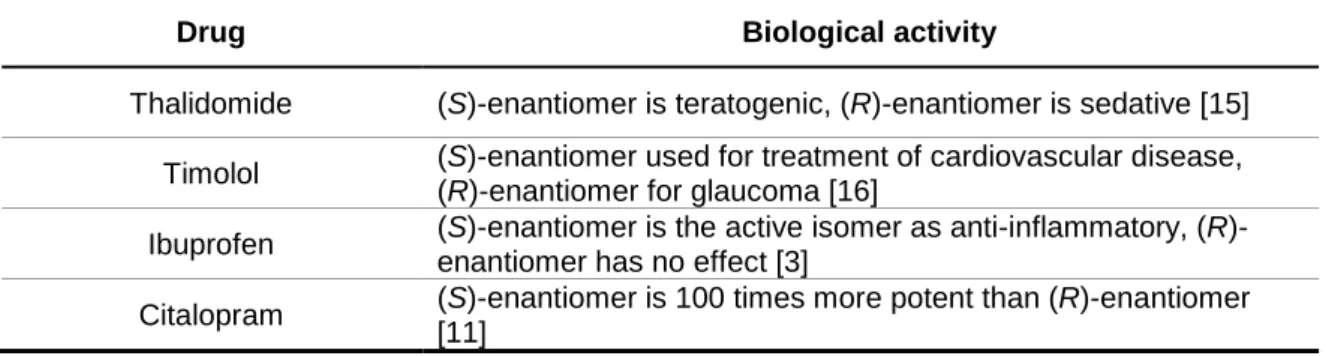
When one enantiomer is responsible for the biological activity of interest, the other could be inactive, possess lower activity, be an antagonist of the active enantiomer or have a different activity that could be desirable or undesirable [11-13]. Some examples illustrating stereoselective responses of chiral drugs are presented in Table 1.
For a specific biological activity, the enantiomer that most effectively establishes the interactions with the biological target is designated as eutomer. The less active enantiomer is the distomer, being the ratio between both called eudismic ratio [14].
Table 1 - Examples of different stereoselective responses of chiral drugs in their biological activity.
Drug Biological activity
Thalidomide (S)-enantiomer is teratogenic, (R)-enantiomer is sedative [15]
Timolol (S)-enantiomer used for treatment of cardiovascular disease, (R)-enantiomer for glaucoma [16]
Ibuprofen (S)-enantiomer is the active isomer as anti-inflammatory, (R)-enantiomer has no effect [3]
Citalopram (S)-enantiomer is 100 times more potent than (R)-enantiomer [11]
Many chiral drugs used in clinical practice were administered as racemates. However, this trend was changed mainly because of the regulatory requirements [17, 18]. In fact, the investigation and production of chiral drugs began to have real significance from new guidelines adopted since 1992, by the Food and Drug Administration (FDA), in U.S.A., present in a document entitled Policy Statement for the Development of New
5
Stereoisomeric Drugs [19]. In 1994, the European Committee for Proprietary Medical
Products (CPMP) also issued formal guidelines called Investigation of Chiral Active
Substances [20]. In addition to the regulatory requirements, also the advances in
enantioselective synthesis [21-24], enantiomeric resolution and analytic methodologies [25-27], as well as the “chiral switch” phenomena [28-30] contributed to the increasing development of enantiomerically pure drugs rather than racemates [31].
2. Enantiomeric resolution
The enantiomerically pure drugs can be obtained either by enantioselective synthesis of a desired enantiomer or by preparative resolution of a racemate or mixture of enantiomers [32].
Enantioselective synthesis is not so suitable in the early phases of drug discovery process, since large quantities of reagents or chiral raw material are required, and a large time is needed to perform the synthesis, and if both enantiomers are needed, it is necessary to develop two independent syntheses [33]. Enantiomeric resolution has the advantage to obtain both enantiomers with high enantiomeric purity essential for biological testing [34]. Several methods can be used for enantiomeric resolution purpose, including enzymatic resolution, electrophoresis, membranes, and chromatography [35, 36]. The separation of enantiomers can be carried out by indirect or direct methods [37]. The indirect method is based on the synthesis of a pair of diastereomers from the reaction of the racemate with an enantiomerically pure reagent, and further separation of the obtained diastereomers by conventional procedures. Then, the enantiomers can be recovered by overturn the derivatization procedure [38]. The direct method requires the formation of energetically distinct transient diastereomers, by interaction of enantiomers with a chiral selector. In liquid chromatography (LC) the chiral selector can be attached to a stationary phase or be a component of the mobile phase [39].
LC is often the first choice for enantioresolution showing several advantages, such as: (i) vast applicability; (ii) reproducibility, high speed and sensitivity; (iii) remarkable assay precision, with the possibility of coupling different complementary equipment’s. In fact, most industrial and academic laboratories are equipped with several LC apparatus. Nowadays, LC enantioresolution using chiral stationary phases (CSPs) is widely used for pharmacokinetic [40] and toxicity studies [41], preparative resolution of enantiomers [42], evaluation of enantiomeric purity [43], as well as environmental studies [44].
6
3. Chiral stationary phases
In the last 40 years, scientific and commercial interest in enantiomeric resolution using CSPs has been increasing [45]. There is a wide variety of commercially available CSPs for both analytical and preparative scales [46, 47]. CSPs are usually prepared from chiral molecules obtained from natural chiral pool or synthesized in a stereoselective form, being covalent bond or coated onto a chromatographic support [48]. Table 2 shows examples of different CSPs organized according to their source [46].
Table 2 – Different types of CSPs.
Chiral Stationary Phase Source
Pirkle-type Synthetic Ion-exchange-based Crown ether-based Polymer-based Protein-based Natural Polysaccharide-based Cyclodextrin-based Macrocyclic antibiotic-based Cinchona-based
Pirkle’s [49, 50], Okamoto’s [51, 52], Armstrong’s [53-56], Lindner’s [7, 57] and Hage’s [58] research groups were responsible for several studies describing the development and applicability of new CSPs for LC enantioselectivity studies.
4. Protein-based chiral stationary phases
The commercial and scientific interest on plasma proteins, enzymes, and other biomolecules as chiral selectors increased due to their ability of chiral recognition [59]. On their large surface, proteins present different binding sites which allow to multiple possibilities of intermolecular interactions with small molecules [60]. Therefore, it is not an easy task to predict retention and enantioselectivity using such CSPs [61]. When used as chiral selectors, proteins demonstrate enantioselectivity for a wide range of chiral compounds, including pharmaceutical compounds [62].
The first report demonstrating that a protein has different binding properties in a LC analysis was in 1973, for tryptophan resolution using bovine serum albumin (BSA) coupled to an agarose support [63]. After that, Allenmark [64], Haginaka [60], Hage [58, 65], and other groups have contributed to the development of several and exhaustive studies to assess the ability of various proteins to be used as chiral selectors, and also in biological assays.
7 Nevertheless, only a limited number of proteins are commercially available as CSPs (Table
3).
Table 3 - Protein-based CSPs, column tradenames and type of resolved racemates [38, 59].
Proteins Mr (kDa) Type of resolved racemates Column tradename
Serum albumin
Human (HSA) 67 Acidic and neutral CHIRAL-HSA®a
Bovine (BSA) 68 Acidic and neutral CHIRAL-BSA®a
α1-Acid glycoprotein (AGP) 44 Basic, neutral and acidic CHIRAL-AGP®a
Ovomucoid (OVM) 28 Basic, neutral and acidic Ultron ES-OVM®b
Cellobiohydrolases (CBH) 60-70 Basic and neutral CHIRAL-CBH®a
Avidin 68 Basic, neutral and acidic Bioptic AV-1®c
Pepsin 34.6 Basic and neutral Ultron ES-Pepsin®b
aChromTech Lda., Congelton, Cheshire, UK
bShinwa Chemical Industries Lda., Fushimi-ku, Kyoto, JP cGL Sciences Inc., Torrance, California, USA
α1-Acid glycoprotein (AGP) and ovomucoid (OVM) from chicken egg are mostly applied for resolution of a wide range of basic, acidic and neutral drugs [66-68]. Nevertheless, bovine serum albumin (BSA), human serum albumin (HSA) and cellobiohydrolase (CBH), as immobilized chiral selectors, are well documented for chromatographic enantioseparations and for binding studies [69-71]. Moreover, the retention and enantioselectivity obtained on immobilized proteins also reflect the binding behavior of native proteins [72].
In the immobilization process of proteins onto a chromatographic support, to obtain the LC columns, the main aim is to preserve their natural function, conformation and chiral discrimination. Accordingly, for preparation of this type of CSPs, several techniques were developed for physical adsorption as well as covalent binding of the proteins to the chromatographic support [73]. Silica-based materials, zirconia particles or polymeric materials can be used as chromatographic supports [74].
Variations on chromatographic conditions such as pH, buffer type and ionic strength of the mobile phase, type and proportions of organic modifiers (commonly isopropanol (2-PrOH) and acetonitrile (ACN)), charged additives and temperature are decisive to adjust retention times, enantioselectivity and resolution [70]. It was found that pH, temperature and organic modifier variations may quite differently affect reversible spatial conformation of the protein leading to changes of the number of available selective and non-selective binding sites [72]. For example, the presence and variation of organic modifiers and high temperatures respectively, may lead to a significant shortening of CSPs lifetime [75], although immobilized proteins are probably more stable than native proteins.
8
5. Human serum albumin as stationary phase
HSA is one of the most abundant plasma proteins being one of its main functions to act as drug transporter [76]. HSA assists in the transport, distribution, metabolism and facilitates transfer athwart organ-circulatory interfaces of several ligands, including fatty acids, amino acids, steroids, metals, and many pharmaceutical compounds [77]. HSA concentration in blood plasma is about 0.7 mM, its molecular weight is 67 kDa, isoelectric point around pH 5.9 and comprises a peptide chain consisting of 535 amino acids, mostly ionic such as glutamate and lysine [78].
Once systemic absorption is completed, most drugs experience some degree of reversible binding to HSA, thereby restricting their free and active concentration [79]. High affinity for plasma proteins (over 90%) may consequently be a benefit or a drawback for efficacy, depending on the drug and target [80]. Moreover, when two drugs are absorbed into the bloodstream the concentration of the free fraction can change because they may interact with each other and compete for the same albumin binding site, which brings the possibilities of contraindications or toxicity [79]. Additionally, the presence of a chiral drug as racemate could induce enantioselective binding, if both enantiomers have different binding affinity to the HSA [81]. Consequently, as an impact of stereoselective protein binding to albumin, not only the transport mechanism of both enantiomers will be affected but also, they may exhibit different pharmacodynamic, pharmacokinetic and toxicological properties [79].
Crystallographic data about the primary structure of HSA reveals that it has three homologous helical domains, namely I, II and III [82]. Individually, each domain is divided in two subdomains linked by a random coil, respectively A and B. Interdomain helices linked the terminal regions of sequential domains, namely IB to IIA and IIB to IIIA [82]. The nature of this structural organization provides a wide variety of ligand binding sites [78]. Most drugs and endogenous hormones interact with two major binding sites on HSA known, according to Sudlow’s nomenclature [83], as Sudlow’s site I (located in subdomain IIA), and Sudlow’s site II (located in subdomain IIIA), and also as warfarin–azapropazone (Site I) and indole– benzodiazepine sites (Site II). Site I is the highest-affinity binding site for, among others, anticoagulants (like warfarin) and NSAIDs (like phenylbutazone, indomethacin and salicylate) [84]. Site II is also a specific site for “profens” (like ibuprofen, fenoprofen, or ketoprofen), psychoactive drugs (like diazepam), and anesthetics (like halothane and propofol) [85] (Figure 2). Other minor bindings have also been proposed, including those that bind to bilirubin, digitoxin and tamoxifen [86].
9
Figure 2 - Illustration summarizing the various ligand-binding sites on the structure of HSA. Structure
obtained from PDB ID 1AO6, in protein data bank of the Research Collaboratory for Structure Bioinformatics (http://www.rcbs.org/pdb/).
However, a thorough understanding is needed to explain the variabilities that occurred in drug binding properties as consequence, for example, the presence of covalently or reversibly bound compounds that can alter the conformation of the binding sites [79], as well as expand the knowledge on stereospecific binding of chiral compounds.
6. Ligand-Protein binding studies
In the early stages of drug discovery, beyond the biological activity evaluation, each compound should also be evaluated and characterized by its lipophilicity, ionization, solubility, metabolic properties, and protein-binding properties. Although there are other
proteins in human blood plasma capable of binding drugs, HSA is the most abundant protein
[82] and, consequently, the most studied in high-performance affinity chromatography (HPAC) [87].
HPAC is a separation technique that has become increasingly important when working with biological samples and pharmaceutical agents. This chromatographic technique is based on the use of a biologically related agent as a stationary phase that selectively retain analytes or to study biological interactions. A great advantage of this technique is that only
Sudlow’s site I (subdomain IIA) warfarin phenylbutazone salicylate indomethacin Sudlow’s site II (subdomain IIIA) ibuprofen fenoprofen ketoprofen diazepam halothane propofol
10
a small amount of protein is required to carried out several studies because the same amount of immobilized protein (CSP) can be used for the experiments [88].
This technique is very useful and presents other advantages since it is coupled to an LC system, making the process automatic and reproducible, and with the possibility of working under near-physiological conditions (buffer pH, ionic strength and temperature). Additionally, being a CSP, it can be used to analyze the behavior of both enantiomers of an enantiomeric mixture in the same run [58, 65].
One disadvantage of this technique is related to the basis of its concept: the immobilization of the protein to a chromatographic support. The immobilization procedure can bring some changes comparatively to the protein in its soluble form, namely conformational changes, denaturation, steric hindrance at the binding sites, nonspecific binding by the support and anchor matrix, leading to the change of the retention time [89].
There are various approaches used for the immobilization process of HSA to a silica or monolithic chromatographic support which can counterbalance this disadvantage, namely covalent immobilization, biospecific adsorption, and entrapment [90].
Ligand-protein binding studies by HPAC can be achieved through two main outlines: zonal elution and frontal analysis [91].
In frontal analysis, a solution with a known concentration of an analyte is continuously injected into a column containing the immobilized protein and, as soon as the analyte binds to the protein, becomes saturated. At the detection, an increase of the absorbance (mAU) is observed as saturation occurs until the constants of association and dissociation change to an equilibrium, and the mAU stabilizes [92]. This equilibrium curve is known as a breakthrough curve and combining its start and end times, its average position and its format, it is possible to obtain relevant information about the number of binding sites or the strength and affinity of the binding. The major disadvantage of this technique is that a large amount of analyte is required, making it totally unfeasible in drug discovery [93].
On the contrary, zonal elution analysis uses a small amount of analyte injected into a column while the time elution of the analyte is monitored, like almost all analytical methods of chromatography, making it the most used due to its simplicity [94]. Several factors must be taking into account such as the type and proportion of organic modifier, temperature and the presence of charged additives or a displacement agent since they may affect the results. In this type of studies, the mobile phase is characterized by having a buffer that mimics the physiological conditions [95].
In zonal elution method, protein binding studies are performed by injecting a small amount of a compound of interest into the chromatographic system, and through analysis of its retention time the relative binding or percent binding can be achieved [96]. Several studies
11 have demonstrated a high concordance of this method compared to other techniques, such as ultrafiltration [97]. When an equilibrium is stablished, the retention factor (k) is equal to the number of moles or fraction of the ligand bound to the protein (b) divided by the number of moles or fraction of the free ligand (f) in the mobile phase (𝑘 = 𝑏/𝑓) [98]. Considering that the free or protein bound ligand fraction is equal to 1, the relative binding is calculated through the retention factor (k) by the following equation (1) [99]:
𝑏 = 𝑘/(1 + 𝑘) (1)
In addition, it should be kept in mind that the obtained results are dependent on the ratio between the amount of compound injected and the amount of protein immobilized on the column [100]. Consequently, two distinct situations can occur [65]: (i) small amount of compound injected into a large amount of protein; (ii) an excess of compound injected compared with the amount of protein entrapped in the chromatographic column; the second situation should be avoided. In the immobilization process of the selector, some molecules can lost their binding activity by the change of the conformation of its different binding sites [100]. For these reasons, the results from this type of study are only indicative, comparing with the binding results to the protein in solution form.
Displacement studies are most commonly used in zone elution by HPAC [91]. These studies are very useful knowing that an analyte will experience some binding competition to the protein by another agent. This technique consists in analyzing the retention of one or more injected analytes while a determined concentration of a presumed competitive agent present in the mobile phase passes through the column [91]. The competitor may interfere in the retention time of the analyte by different reasons: (i) competition between the injected analyte and the competitor for the same binding site (when the analyte and the competitor do not bind to any other site) [101]; (ii) competition between the injected analyte and the competitor for two types of binding sites [101]; (iii) competition between the injected analyte and the competitor agent for different binding site (allosteric competition) [102]; (iv) competition between the injected analyte and the competitor for the same binding site (when the competitor does not bind to any other site and the analyte binds to two) [79]; (v) competition between the injected analyte and the competitor for the same binding site (when the analyte does not bind to any other site and the competitor binds to two). The results of competition between single or multiple binding sites as well as allosteric competition are relatively simple to analyze using reciprocal plots, concentration of the competitive agent
12
From displacement studies, relevant information can be withdrawn regarding the site or multiple protein binding sites of a given analyte and, consequently, the binding force between each ligand-protein interaction. In competition studies, it is possible to determine whether other compounds bind to this same protein site as well as to obtain information about the type of interactions that may occur. In addition, with the constants of association of the competitive agent it is possible to establish quantitative structure-retention relationships [103].
In summary, additionally to the use of biologically-based CSPs on zone elution technique to study the relative binding of bioactive compounds to the protein [104], other kind of studies can be performed, including: displacement studies with the presence of a competitive agent [105], thermodynamic and variability studies of chromatographic conditions [106], quantitative structure-retention relationships studies [107], and enantioresolution of racemic mixtures [108].
7. Enantioresolution and chiral recognition studies on
HSA-CSPs
In the last years, several studies have shown that HSA-CSPs can be efficiently used for enantioseparation of chiral analytes, and that the chromatographic data may reflect their in
vivo binding to HSA [72, 75, 91, 101, 109]. Examples of chiral drugs that have been
enantioseparated and studied include benzodiazepines [110], coumarins (e.g., warfarin) [58, 65], NSAIDs (e.g., ibuprofen) [101], thyronine’s (e.g., thyroid hormones) [88, 111], tryptophan [106], among others [91, 112]. The referred examples include measurement of binding of analytes to HSA, equilibrium constants studies, number of binding sites which the analyte interact, rates of the interactions, as well as the effect of the chromatographic conditions on binding to HSA, for example, mobile phase composition or temperature. In the case of the influence of mobile phase, the variations of pH, ionic strength and type or proportion of organic modifier can be examined [113]. Chiral recognition properties of protein are dependent on the balance between electrostatic and hydrophobic interactions [114]. Both pH and ionic strength can bring conformational modifications to the protein structure itself, modify the interactions between the protein and analyte, and also influence the enantioselectivity [115]. Changes in the conformation of the molecule can also occur by the addition of organic modifiers to the mobile phase (never more than 40%) such as alcohols or ACN, thus leading to a decrease in the binding of the analytes to the protein [116]. This decrease in binding, caused by disturbance of interactions of non-polar nature, leads to a decrease in the width and tailing of the chromatogram peaks. Temperature
13 variation can also be a factor of study, to discover the thermodynamic constant of a particular analyte, to promote a decrease in the binding force and, consequently, a decrease in retention factor, or finally to set the temperature equal to the physiological [89].
Stereospecific recognition of chiral compounds is a significant issue in various aspects of chemistry and life sciences. Diverse intermolecular interactions namely ionic, ion-dipole or dipole–dipole, π-π, van der Waals, and hydrogen bond interactions can be established [117, 118]. Initially, strong or long-range interactions such as ionic are alleged to be involved on non-stereoselective binding. On the contrary, short-range directional interactions such as hydrogen bonds and π-π interactions would be responsible, in most cases, for stereoselective binding of HSA-CSP to analytes [119]. Furthermore, chiral recognition can be a result of steric hindrance factors from the spatial arrangement of the binding cavity of the selector. Thus, conformational change of the selector may also be considered. Moreover, the interactions can be attractive or repulsive [117].
In order to rationalize the observed stereoselective behavior of a chiral selector with an enantiomeric compound, such as a drug, Pirkle’s research group adapted a model to explain the chiral recognition mechanism called “3-point interaction” model (Figure 3) [120]. This model was previously proposed by Easson and Stedman [121] to justify the differences in pharmacodynamic activity observed between enantiomers, considering their different interactions with a crystallographic structure, such a protein.
Figure 3 - “3-Point interaction” model [117]. The enantiomer on the left presents three groups that
match exactly three sites of the selector, while its mirror image, on the right, can interact with a maximum of two sites of the selector.
This model stipulates that at least one of the enantiomers must undergo a minimum of three simultaneous interactions with the CSP, and that the overall interactions of the two enantiomers with the CSP must be energetically distinct. The predominant type of
![Table 3 - Protein-based CSPs, column tradenames and type of resolved racemates [38, 59].](https://thumb-eu.123doks.com/thumbv2/123dok_br/15959572.1099095/35.892.150.809.239.443/table-protein-based-csps-column-tradenames-resolved-racemates.webp)


