Can game theory be used to address PPP renegotiations?
A retrospective study of the of the Metronet - London Underground PPP
ByGregory Michael Kennedy [152111301]
Supervisors
Professor Ricardo Ferreira Reis, PhD Professor Joaquim Miranda Sarmento, PhD
Dissertation submitted in partial fulfilment of requirements for the degree of
MSc in Business Administration, at the Universidade Católica Portuguesa
i
Abstract of thesis entitled
“Can game theory be used to address PPP renegotiations? A retrospective study of the of the Metronet - London Underground PPP”
Submitted by
Gregory Michael Kennedy (152111301)
In partial fulfilment of requirements for the degree of MSc in Business Administration, at the Universidade Católica Portuguesa
June 2013
Public Private Partnerships (PPPs) have been introduced in many countries in order to increase the supply of public infrastructure services. The main criterion for implementing a PPP is that it will provide value for money. Often, however, these projects enter into financial distress which requires that they either be rescued or retendered. The cost of such a financial renegotiation can erode the value for money supposed to be created by the PPP. Due to the scale and complexity of these projects, the decision either to rescue or retender the project is not straightforward. We determine whether game theory can aid the decision making process in PPP renegotiation by applying a game theory model retrospectively to the failure of the Metronet - London Underground PPP. We study whether the model can be applied to a real PPP case, whether the application of this model would have changed the outcome of the case and, finally, whether and how the model can be used in future PPP renegotiations. We show that the model can be applied but that its parameters are not easy to quantify, that the model indicates that the outcome of our case was correct and, finally, that as long as the users of the model are prepared that it can be used in to aid decision making in future PPP decision making
ii
Table of Contents
Table of Contents ... ii Table of Figures ... iv List of Abbreviations ... v Acknowledgements ... vi 1 Introduction ... 1 2 Methodology ... 2 2.1 Introduction ... 2 2.2 Research Process ... 22.3 The Game Theory Model ... 3
2.4 Limitations... 5
3 Literature Review ... 6
3.1 Economy, Infrastructure and the Government ... 6
3.2 PPPs – Public Private Partnerships ... 6
3.3 Regulation and Procurement Contracts under Asymmetric Information ... 7
3.4 Renegotiation of PPP Contracts ... 8
3.5 Opportunistic Renegotiation... 9
3.6 Game Theory ... 10
3.7 Introduction to Game Theory ... 10
3.8 Solution Concepts in Game Theory ... 11
3.9 Nash Equilibrium ... 11
4 Problem Statement & Research Questions ... 12
5 Case Study ... 13
5.1 The Tube ... 13
5.2 Introduction ... 13
5.3 Design of the London Underground PPP ... 14
6 Results & Discussion ... 17
6.1 Metronet ... 17
6.2 Path the Game Took ... 17
6.3 Quantifying the values ... 18
iii
6.5 Determining the Nash Equilibrium ... 22
7 Conclusion ... 24
8 Bibliography ... 27
9 Appendix ... 30
9.1 Game Theory ... 30
9.2 Structure of the PPP ... 37
iv
Table of Figures
Figure 1 – Game Theory Model - Parameters ... 3
Figure 2 - Game Theory Model ... 3
Figure 3 - Infraco Shareholders ... 14
Figure 4 - Division of the London Underground ... 15
Figure 5 - Duration & Total Spending ... 15
Figure 6 - Payment Terms ... 15
Figure 7 - Infraco Funding ... 16
Figure 8 - Game Path... 17
Figure 9 - Parameters Quantified... 18
Figure 10 - Scenario 1 - Higher political cost rescue vs. retender... 20
Figure 11 - Scenario 2 - Higher political cost to retender vs. rescue ... 21
Figure 12 - Scenario 3 – No political cost ... 21
Figure 13 - Determining the Nash Equilibrium ... 22
Figure 14 - Sensitivity Analysis - n > m ... 23
Figure 15 – Prisoner Dilemma - Matrix Form ... 33
Figure 16 - Market Entry Game – Extensive Form ... 33
Figure 17 - Market Entry Game - Nash Equilibrium – Matrix From ... 35
v
List of Abbreviations
PPP Public-Private Partnership
OECD Organisation for Economic Co-Operation and Development PSC Public Sector Comparator
EIB European Investment Bank
EPEC European Public-Private Partnership Expertise Centre IMF International Monetary Fund
LUL London Underground Limited ISC Infrastructure Service Charge
vi
Acknowledgements
I have always been interested in the interactions between the public and private sectors. Nevertheless, by undertaking a thesis related to Public Private Partnerships (PPPs) I was stepping into unknown territory, I knew I would have a lot to learn before I could even define the research that I wanted to carry out. I attribute such a step to Universidade Católica Portuguesa who has given me the confidence, skills and opportunity to learn by taking on new challenges. I knew, however, that I would not be alone in this endeavor and that I would have the invaluable support of my thesis supervisors Professor Ricardo Ferreira Reis, PhD and Professor Joaquim Miranda Sarmento, PhD. Without their expert knowledge, inputs and motivation, this thesis would have not been possible. Finally, I would like to thank my family, back at home and here in Portugal, who have continually supported my academic, professional and personal goals. Without them, my past, current and future goals could not and cannot be achieved.
1
1 Introduction
Public Private Partnerships (PPPs) are becoming an increasingly popular way for government to undertake public infrastructure projects. In a PPP project, the private sector is expected to participate in the investment, the provision of services and receive significant risks from the government (EPEC, 2012, p. 5). The rational for implementing a PPP is that it will deliver more value for money than traditional public procurement methods; this is based on the widely held belief that the private sector is more efficient than the public sector (Laffont, et al., 2003, p. 2). Often, not long after the private firm is awarded the PPP contract, it enters financial distress, which calls for the PPP to be either rescued or retendered (Guasch, 2004, p. 83). The criterion for a PPP to be rescued is that it continues to provide greater value-for-money than other possible procurement methods (including the retendering of the PPP to another private party). The challenge for government is how to establish this criterion, especially, when large-scale and hugely complex projects are being considered.
We seek to address this issue by applying a game theory model retrospectively to a PPP case. The game theory model has been designed to analyse what happens when government renegotiates with a developer and the impact of the renegotiation on the PPP project (Ho, 2009, p. 281). We will apply the model to the failure of the Metronet - London Underground PPP project. This was a project intended to upgrade the Tube, valued at £15.7 billion, which failed just four years after operations began subsequent to Metronet (i.e. the developer) failing to secure a financial renegotiation of the project. Through applying the game theory model to the case we attempt to evaluate the practicality of using the game theory model, assess whether the application of this model would have changed the outcome of the financial renegotiation in our case, and finally, use these insights determine whether the game theory model can used in future decision making in PPP renegotiation.
The idea of applying game theory to PPP renegotiation was born in response to the frequency of PPP renegotiations and the lack of existing tools to aid decision making in this context. The author of the model used in this case, S. Ping Ho, has dominated the literature linking PPP renegotiations to game theory. However, his models have mainly been used as an intuitive way to illustrate and understand the dynamics of PPP renegotiation, and there is little or no evidence of their use in practice. Accordingly, our study aims to assess the practical implications of the model.
2
2 Methodology
2.1 Introduction
The aim of this thesis is to evaluate the insights game theory can deliver about the renegotiation and subsequent failure of the Metronet - London Underground PPP. In order to address this objective and subsequent research questions, a deductive approach was employed. A deductive approach was suited to the research goals of this paper as a large amount of literature already exists on the topics of PPP and Game Theory. Essentially, we began by considering the literature which had already been published and then attempted to add to this literature by identifying an area which hadn’t been covered in detail. This section of the thesis will first outline the research process which was undertaken, the model used for the analysis of the collected data, followed by the delimitations of this process. All sources used in this thesis were of a secondary nature.
2.2 Research Process
Initially, the key notions of Public Private Partnerships (PPPs), PPP Renegotiation and Game Theory were discussed in the literature review. All the literature concerning these topics was accessed via the services offered by Biblioteca Universitaria Joao Paulo II of Catolica Lisbon as well as trusted online databases such as OECD, IMF, and Google Scholar etc. After the review of the literature an opportunity to add to the literature was recognised; the application of game theory models to real PPP cases had not been widely developed in the existing literature. Thus, we decided to perform an analysis by applying a game theory model to a PPP case. To this extent, the literature review was structured so that the reader can acquire the basic knowledge needed to interpret the game theory model explored in this thesis.
An existing game theory model was identified during the preparation of the literature review. The game theory model was developed by S. Ping Ho in his paper Government Policy on PPP Financial
Issues: Bid Compensation and Financial Renegotiation (Ho, 2009, p. 267). The game theory model
was designed to analyse what happens when the government renegotiates with the private firm (developer) and the impact of the renegotiation on the PPP project (Ho, 2009, p. 281). After identifying an appropriate model; a case which could be analysed by this model was selected. The chosen case was the Metronet - London Underground PPP. This case was chosen due to its relevance to the problem statement of this thesis and the large amount of data which could be accessed. The
3 data for the case was published by trusted sources such as the National Audit Office, House of Commons Transport Committee, London Underground and the European Commission.
2.3 The Game Theory Model
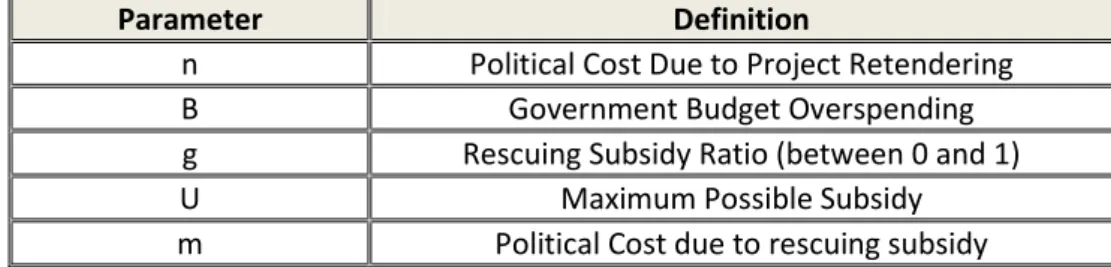
Figure 1 – Game Theory Model - Parameters
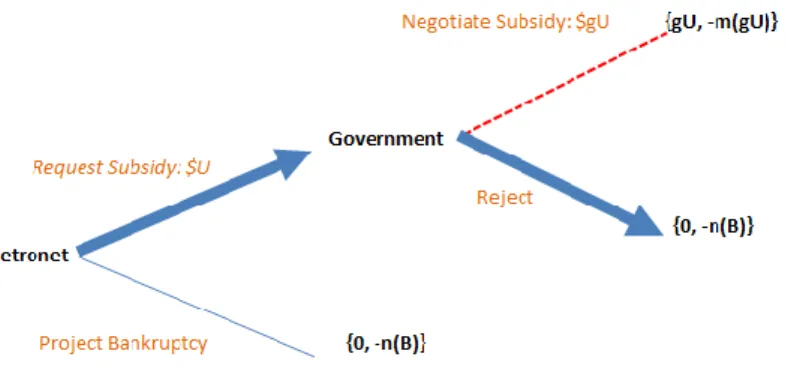
Figure 2 - Game Theory Model
The game theory model presented in Figure 2 is quite intuitive and does not require much background knowledge to be interpreted. The model consists of a dynamic game conveyed in the extensive form. The game starts with the developer, which will decide to bankrupt the project should the government not rescue the project via a subsidy. If the project goes bankrupt then the payoff of the developer is 0, as this is most likely to be the value of equity of a developer going into bankruptcy, and the payoff of the government is –n(B), the political cost of a failed project multiplied by the government budget overspending which is required to retender the project. Next, if the government agrees to negotiate a subsidy the payoff of the developer will be gU, a rescue subsidy ratio multiplied by the maximum possible subsidy. The payoff of the government will be –m(gU), the political cost of rescuing the project (m) multiplied by the negotiated subsidy (gU). If the government does agree to negotiate then the project goes bankrupt and is retendered.
Parameter Definition
n Political Cost Due to Project Retendering
B Government Budget Overspending
g Rescuing Subsidy Ratio (between 0 and 1)
U Maximum Possible Subsidy
4 In this game there are two Nash equilibriums; ‘rescue’ and ‘no rescue’1. The ‘rescue equilibrium’ occurs when n(B) – m(gU) 0. In other words, the government will only rescue the project, if the cost of doing so is lower than the cost of letting the project go bankrupt. The ‘no rescue’ equilibrium occurs when n(B) – m(gU) 0. In other words, the government will let the project go bankrupt, if the cost of doing so is less than rescuing the project. Here it is assumed that the game consists of complete information where n(B) and m(gU) are common knowledge. In reality, however, political costs are hard to quantify. Nonetheless, qualitative and quantitative implications on PPP policies and decision making can still be derived without knowing the exact functions of n(B) and m(gu) (Ho, 2009, p. 285).
From the game model S. Ping Ho determined some ‘governing principles’ which focus on the strategies that can reduce the likelihood of a renegotiation and improve the administration of PPPs. They are summarised as follows (Ho, 2009, pp. 292 - 295):
Governing principle 1: “Be well prepared for renegotiation problems, as it is impossible to rule
out the possibility of renegotiation and the ‘rescue’ equilibrium”
Governing principle 2: “The probability of reaching ‘rescue’ equilibrium should be minimised
and could be reduced by strategies that increase the political cost of over subsidisation and by reducing the developer replacing cost and justifiable subsidy”
Governing Principle 3: “During the renegotiation process, the government should try and settle
the rescuing subsidy at the least required subsidy to retender a project, and spend more effort on determining this value objectively and conveying such information to the developer, rather than on negotiation skills”
Governing Principle 4: “The government should determine a fair justifiable subsidy which
corresponds to the developers responsibilities and allocated risks specified in the contract” In order to conclude, above a summary of the model has been provided, for the full description and derivation of the model by S. Ping Ho in his paper Government Policy on PPP Financial Issues: Bid
Compensation and Financial Renegotiation (Ho, 2009, p. 267) should be consulted. Finally, the
validity of the model depends on all players being rational decision makers, the players within the game do not need to explicitly use game theory (Ho, 2009, p. 299).
1 S. Ping Ho further refined these equilibriums in his paper. For the purpose of this thesis, however, the refined versions have been deemed unnecessary.
5
2.4 Limitations
The published literature on Public Private Partnerships and Game theory is very broad. This thesis focuses on a specific Public Private Partnership project which is analysed using a game theory model, to this extent; we only included the literature which was considered relevant to this thesis. Given more resources, mainly time, the literature could have been developed in greater depth and other topics could have been explored.
The data collected for this thesis contained opinions, knowledge, assumptions and inferences made by the authors of the published data. Additionally, the data collected for this thesis was of a mainly qualitative nature; which means that our findings could have been unintentionally exposed to certain biases. Lastly, one of the players critical to the game theory model, the developer, did not publish any data, thus, their inputs could not be assessed.
Finally, the analysis of the case was performed using a game theory model which was not developed by the author of this thesis. The game theory model and all of the assumptions and principles which the creator of the model derived are assumed to be correct. Many of the parameters of the game theory model are difficult to quantify and were inferred. Thus, the results of the analysis could be exposed to the interpretation issues and biases.
6
3 Literature Review
3.1 Economy, Infrastructure and the Government
Infrastructure underpins any modern economy; roads, railroads, ports and telecommunications are prerequisites in order for an economy to operate and be efficient (Guasch, 2004, p. ix). The delivery of goods and services begins with the availability of infrastructure. In addition, the availability of infrastructure directly impacts productivity, cost, and competitiveness (Guasch, 2004, p. ix). As a consequence, policy decisions made by the government relating to the provision of infrastructure are of great importance to the health of an economy. Traditionally, the government has been the sole provider of infrastructure to the public. Or in other words, the government was the only investor in infrastructure projects destined for public use (Grimsey & Lewis, 2004, p. 19). According to Guasch, Laffont and Straub this model of investing in public infrastructure has been shown to be inefficient and that the private sector has been shown to create greater efficiencies at least in terms of productivity (Laffont, et al., 2003, p. 2). Stated in other words, the private sector (being more efficient) creates more value for money.
This has led to governments, dealing with budget constraints and pressure to invest public money more efficiently, increasingly to turn to the private sector to provide infrastructure for public use. Government procurement for infrastructure can take on several forms based on ownership, structure and risk; (1) Traditional – public sector retains 100% ownership and risk (2) PPPs - Public Private Partnerships (see next subsection), and (3) Privatisation - private sector retains 100% ownership and risk (World Bank, n.d.).
3.2 PPPs – Public Private Partnerships
Public Private Partnerships (PPPs) are becoming an increasingly popular way for a government to undertake public infrastructure projects. Although there is no universally agreed upon definition of a PPP in the literature, it can be defined as “long term alliances formed between the private sector and public bodies often with the aim of exploiting the private sector’s resources and expertise in the provision and delivery of public services” (Chinyio & Gameson, 2009, p. 3). The IMF provides a more general definition “public private partnerships (PPPs) involve private sector supply of infrastructure assets and services that have traditionally involve been provided by the government” (IMF, 2004, p. 3). What is clear from these definitions is that the private sector plays an important role in the provision and delivery of public services.
7 Principally, traditional government procurement usually involves the government investing in public infrastructure and providing services (thus bearing all the risks associated with the investment). In a PPP, on the other hand, the private sector is expected to participate in the investment, participate in the provision of services and receive significant risks from the government (thus the risks associated with the investment are born by both the public and private sector). PPPs are commonly used, but not only, for large scale projects such as the construction of new hospitals, roads and railways (IMF, 2004, p. 5). Theoretically speaking, a PPP arrangement can help solve many government investment and efficiency needs. To this extent, much of the literature surrounding PPPs has been focused on whether or not a PPP represents an off balance sheet investment and whether governments can actually obtain value for money via a PPP arrangement (Sarmento, 2010, p. 94).
3.3 Regulation and Procurement Contracts under Asymmetric Information
The government or its institutions face informational constraints which limit the control that they can exert when entering into a contract with a private firm (Laffont, 1993, p. 1). These information constraints are generally considered to be moral hazard and adverse selection. Moral hazard can be defined as “the risk that a party to a transaction has not entered into the contract in good faith, has provided misleading information about its assets, liabilities or credit capacity, or has an incentive to take unusual risk in a desperate attempt to earn a profit before the contract settles” (Investopedia, 2013). For example, in a PPP contract for railway construction, the private firm may seek to boost profits by using building materials which are not of the highest standard. The contract may not be complete enough to disallow this type of behaviour. On the other hand, adverse selection occurs when “the firm has more information than the regulator about some exogenous variables” (Laffont, 1993, p. 1). For instance, in the previous railway example, the private firm is highly likely to have more information about how much it will cost to construct the railway. This allows the private firm to extract a higher rent from the government than it would usually be able to if the government knew exactly what the private firms cost structure was.
Due to the presence of moral hazard and adverse selection the government will try and produce a detailed contract, which aims to limit the presence of asymmetric information, but due to legal costs among others, this approach can be expensive. Additionally, the contract will probably still be incomplete due to missing possible outcomes (Laffont, 1993, p. 3). Or in other words, you will not be able to see foresee everything that doesn’t go according to plan during the project. Lastly, in a PPP arrangement, transaction costs can be extremely large due to the high complexity of the infrastructure projects coupled with the long duration of the arrangement being negotiated.
8 (Laffont, 1993, p. 4). Basically, the more you more your try to mitigate the asymmetries of information and the risk of the project, the higher the transactions costs will be.
Principally, a Public Private Partnership can potentially deliver better value for money to the government; the introduction of private investment in the project can solve the governments’ investment need, but can also create large asymmetries of information which add another cost to procuring public infrastructure in this manner. Ultimately, procuring a public infrastructure project via a PPP should only be considered when the perceived efficiencies of this method are greater than the additional costs this procurement method involves.
3.4 Renegotiation of PPP Contracts
Due to the disadvantages discussed in the previous section along with other issues, in practice many PPP contracts are renegotiated. Guasch found that on average 30% of PPPs in Latin America are renegotiated with the highest incidences found in the water and sanitation sector (74.4%) followed by the sanitation sector (54.7%) (Guasch, 2004, p. 81). Additionally, the PPPs were renegotiated on average only after around two years after the PPP contract was signed (Guasch, 2004, p. 83). For a contract to be renegotiated something must be wrong with the original contract. A renegotiation happens when the original specifications of a contract are altered and the affected parties must negotiate a new bilateral agreement. Marques and Berg tell us that the renegotiation of a PPP contract represents a disappointing outcome. (Marques & Berg, 2010, p. 3). They explain that by the time a contract is renegotiated, the government has fewer negotiation options available than when they initially procured the project, this leaves the private firm with more “information on the implications of alternative contractual arrangements” (Marques & Berg, 2010, p. 3). Essentially, the private firm has more leverage to extract additional rents from the government than they had when they initially bid for the project. The legitimacy of the original contract can be diluted by the renegotiation process. For example, during the initial procurement phase other offers which might of not have needed to be renegotiated may have been rejected.
Guasch informs us of what options the government has available to it when a renegotiation is requested, if a PPP contract is not successfully renegotiated, the project can be discontinued or tendered out to a new partner, both of these options are costly (Guasch, 2004, p. 35). Additionally, allowing a PPP project to fail could also entail a large political cost for the government (Guasch, 2004, p. 38). Overall, there are two reasons for a PPP project to fail; contractual incompleteness and imperfect allocation of risks (Marques & Berg, 2010, p. 4). These failures arise due to “a very simplistic bidding process, inadequate specification of the terms and conditions for the operator,
9 incompetent oversight, and (in some cases) opportunistic behaviour by powerful international corporations” (Marques & Berg, 2010, p. 4). No project of such duration and complexity ever goes exactly to plan; but what is interesting to know, is whether the terms of the original contract were realistic and signed in good faith by both parties.
3.5 Opportunistic Renegotiation
Financial renegotiation is not always considered an option when the initial PPP contract is signed; however, if a project begins to experience distress, it is often desired (Ho, 2009, p. 280). Occasionally, a request for renegotiation can be just. For example, in a regulated market where a private firm is not free to set prices, deterioration in economic conditions can wipe out profits, as a result expected returns can no longer be achieved, in this case a renegotiation of the contract in order to make the firm profitable is rational (Guasch, 2004, p. 37). A problem arises when there is no prevailing deterioration in economic conditions and a renegotiation is being requested. In this situation, it must be considered whether the initial bid was realistic and / or were renegotiations expected when the initial bid was made. If the answer to the former is “no” and the latter is “yes” then we could be observing an opportunistic bidder. Ho tells us that “opportunistic bidders, in their proposal, will intentionally understate the possible risks involved or overstate the project profitability to outperform other bidders” (Ho, 2009, p. 280).
A properly designed competitive auction should ensure that the most efficient firm is awarded the proceeds of the auction. However, when bidders factor in the possibility of the contract being renegotiated at a later stage of the project then it is not necessarily the most efficient firm who is awarded the contract (Guasch, 2004, p. 35). Factoring in the possibility of a renegotiation changes the strategy and bids of the firms participating in the auction. When no renegotiation is considered then firms place their bids based on two factors, how efficiently they can provide the requested service coupled with their knowledge about the project being considered. However, when renegotiation is considered possible then two new factors are added to the equation. The first new factor is the bidding firms belief of how likely a renegotiation of the contract is, followed by how skilled they believe they are in renegotiating the contract (Guasch, 2004, p. 35). If these two new factors prove to be encouraging; they place an opportunistic bid. Subsequently, if they win the contract, they will attempt to renegotiate it as they know it cannot be honoured according to the original terms of the contract.
Opportunistic behaviour can be dissuaded; Marques and Berg inform us that opportunistic behaviour can be reduced by: introducing the possibility of renegotiation into the contract, including
10 clauses within the contract which penalise opportunistic behaviour, including within the contract the decision making process that will be adopted when a renegotiation is requested, allowing the awarding entity to terminate a contract early at an agreed cost and by making the winning bidder aware that their reputation can be affected should the original terms of the contract not be respected (Marques & Berg, 2010, p. 10). Once again, these additions to the contract do not mean that it will be complete but they set out rules surrounding the renegotiation process and deliver a more even playing field by reducing the asymmetries of information.
We have seen that although renegotiation is not usually an option included in the original contract, due to the high cost of abandoning a project or starting the procurement process from scratch, renegotiations actually do occur. Due to the presence of asymmetries of information, a contract may not be complete and that the renegotiation of the contract usually favours the private firm. Moreover, we have noted that there is a political cost associated to these projects; opportunistic bids may be accepted as the government wants to show the public that it has accepted the best offer (lowest cost or highest return) while the government is also likely to accept the demand for a renegotiation in order to save face by not allowing a project to fail. We have seen that mechanisms which can dissuade the request for renegotiation exist but cannot eliminate the eventuality of a renegotiation. The following section of the literature will look into the literature surrounding game theory and how it can be applied to the procurement of a PPP contract.
3.6 Game Theory
In this section of the literature review we offer only a description of the basics of game theory. For a full review of the literature surrounding game theory we invite you to refer to Appendix 10.1.
3.7 Introduction to Game Theory
Game theory has been applied across the social sciences in order to study the dynamics of the decision making process; it can be defined as “the study of mathematical models of conflict and cooperation between intelligent rational decision makers” (Myerson, 1997, p. 1). Game theory models analyse the interactions among interdependent agents with the aim of delivering insights into economic, political or social situations in which agents have different interests, goals or objectives (Myerson, 1997, p. 74). One of the main objectives when applying game theory is to discover the optimum strategy for approaching or resolving a problem. In the PPP process, this could be how the government can decide between rescuing or retendering a PPP project when financial renegotiation is requested by the developer. The optimum strategy, depending on the context in
11 which the theory is being applied, may consist of maximising profits, minimising risk or maximising the loss of the other parties. For example, in a PPP (Public Private Partnership) the government might aim to minimise the risk of the project while the private partner(s) might aim to maximise his or their profit.
3.8 Solution Concepts in Game Theory
Several solution concepts for solving games exist within game theory; Nash equilibrium, Pareto
Optimality, Strategic dominance, Maximin or Minimax, and Best response (Crandall, 2008, pp. 2-5).
The choice of which method to use depends on the preferences of the person analysing the game. Some methods focus on minimising your loss while others focus on maximising your gain. Furthermore, many of these methods are not without their flaws, so it is common practice to study a game by using several solution methods to complement each other, in this way the person analysing the game can choose the best strategy to pursue. Nevertheless, Ho affirms that the Nash equilibrium is one of the most important concepts in game theory (Ho, 2009, p. 270).
3.9 Nash Equilibrium
Gibbons informs us that a Nash Equilibrium is reached when each player’s predicted strategy is the best response to the strategies of the other players, and no player has an incentive to deviate from this equilibrium solution. Since no player wishes to deviate, such predictions are said to be “strategically stable” or “self-enforcing” (Gibbons, 1992, p. 8). Meaning, a Nash Equilibrium only exists when no player can benefit from changing their strategy.
12
4 Problem Statement & Research Questions
The aim of this literature review has been to provide the foundations of the study that will be conducted in this thesis. We have looked at the different literature concerning the renegotiation of a PPP contract as well as the ideas which underlie a game theory model. The literature review was designed to put the problem statement and research questions underlying this thesis into context. Through the review of the literature we found an opportunity to extend the theoretical foundation by adding to the literature which links the literature surrounding the renegotiation of PPP contracts to game theory. For the first time, we will perform a retrospective study on the Metronet – London
Underground PPP contract by applying a game theory model.
Problem statement: PPP renegotiation can determine whether a project is rescued, retendered or
bankrupted. Can governments use a game theory model to determine the best possible outcome for the tax payer? A retrospective study of the renegotiation and subsequent failure of the Metronet London Underground PPP.
Research questions:
1. Can a game theory model be applied retrospectively to the Metronet - London Underground case?
2. Did the London Underground or Metronet consider game theory during the renegotiation of the PPP contract? Would this have changed the outcome of the renegotiation?
3. What insights, if any, can a retrospective study using a game theory model deliver? Can game theory be used to influence future decision making in PPP renegotiation?
13
5 Case Study
5.1 The Tube
The London Underground, commonly known as the Tube, is a metro system serving large areas of London, England. The system consists of 11 lines, 402 km of track and 207 stations. On average there are 3.5 to 4 million passenger journeys a day. In 1863, it became the first underground railway in the world. The Tube has helped cement London’s status as a global city and is essential for the tourism and service industries alike (Transport for London, 2013).
5.2 Introduction
By the end of the 90s, there was growing concern about the severe underfunding the Tube had experienced over the past 60 years (European Commission, 2002, p. 5). The public was becoming less confident about the safety and efficiency of the system. Several accidents had already occurred on the Tube, for example, in 1987 there was a fire at Kings Cross Station which killed 31 people (BBC, 2012). Being the oldest metro system in the world, the Tube was not keeping up with international standards set by newer metro systems, for instance, old equipment such as a signal box installed in 1926 was still in use, hampering the efficiency of the system (Transport for London, 2013). In order to address these problems, the UK Government announced a modernisation program of the Tube which would be carried out by means of a PPP. This was intended to reverse the deterioration of the Tube and bring it back up to modern standards (European Commission, 2002, p. 5).
Even though the Tube was profitable, profits were not large enough to meet investment needs, what's more, short term funding from the government did not encourage the operator, London Underground Limited, to commit to long term modernisation projects. At the time of the announcement of the PPP, the under-investment was valued at £1.2 billion (European Commission, 2002, p. 5). A PPP seemed to be the solution which could solve the Tubes shortcomings.
The contracts to upgrade the Tube were won by two private consortiums; Metronet and Tube Lines. The consortiums were scheduled to work on the Tube over a 30 year period. The firms began work on the Tube in 2004, but by 2007, Metronet had already entered into administration after they could not realise their spending obligations (House of Commons Transport Committee, 2008, p. 5). By 2010, Tube Lines had also entered into administration under similar circumstances. To the great dismay of the public, by 2010, the PPP had completely failed, resulting in huge losses to the public
14 (House of Commons Library, 2012, p. 15). Several government lead inquires followed which heavily criticised Metronet & Tube Lines and to a limited extent the government.
5.3 Design of the London Underground PPP
After years of consultation, on the 7th February 2002, a PPP with the purpose of maintaining and improving the infrastructure of the Tube was officially approved by the government (National Audit Office, 2004, p. 1). The winning bids for the PPP were submitted by two private consortiums, Metronet and Tube Lines (see figure 7). The resulting deal between the operator of the tube and the private consortiums turned out to be very complex (National Audit Office, 2009, p. 11). This was a direct consequence of:
A. The scale of work needed to renovate the Tube B. An innovative output-based contract
C. Incomplete knowledge about the state of the existing infrastructure Figure 3 - Infraco Shareholders
Metronet Tube Lines
Bombardier WS Atkins EDF Energy Thames Water Balfour Beatty Amey Bechtel Jarvis Source: (European Commission, 2002)
Under the PPP, the previously fully publicly owned and run Tube was split into an operating company - London Underground Limited (LUL) - and three privately held consortiums – known as Infracos (see Appendix 10.2). London Underground Limited (LUL) would remain a public entity, which meant that the daily running of the Tube remained in public control. London Underground Limited would be responsible for operating the Tube and managing the Infracos, while, the Infracos would be responsible for maintaining, improving and upgrading the Tube (European Commission, 2002, p. 1).
The infrastructure requirements of each line of the Tube were different as for decades many lines of the Tube were run independent of one and other by private firms. This created a hectic network without any standardised components across all lines. So in order to allow work to be carried out on these lines in an efficient manner, the network was divided into three groups (JNP, BCV and SSL). This would allow the Infracos to carry out work more efficiently (see figure 4).
15 Figure 4 - Division of the London Underground
Detail Description
Separation of Lines 3 groups: JNP, BCV and SSL (see Appendix 10.2) # of Infracos One Infraco per group (a total of 3)
Metronet Responsible for BCV and SSL
Tube Lines Responsible for JNP
Source: (House of Commons Transport Committee, 2008, p. 3)
The large scale of the project coupled with decades of underinvestment meant that considerable investment in time and money was required to bring the Tube back up to standard (see figure 5). Figure 5 - Duration & Total Spending
Detail Description
Duration 30 year contracts
Total Spending (NPV) £15,700 million
Source: (National Audit Office, 2009, p. 4)
Unsurprisingly, a great part of the negotiations leading to the creation of the PPP surrounded how the Infracos were going to recover their investment. The PPP required the Infracos to finance the capital expenditures specified in the contract. The Infracos would recover these expenditures through an Infrastructure Service Charge (ISC). By the end of the negotiation process, very complex payment terms were agreed (see figure 6). The complexity of the payment terms was a result of LUL seeking to ensure safety standards and value for money. Moreover, there was great uncertainty about the cost of upgrading the underground, due to the fact that the condition of much of the infrastructure was unknown. Much of the infrastructure was located in difficult to access areas which made it very difficult to determine how much it would cost to renovate.
Figure 6 - Payment Terms
Detail Description
Infrastructure Service Charge (ISC)
ISC made by LUL to Infracos:
4 weekly payments over life of contract ISC adjusted according to performance
o Bonus for good performance o Penalty for bad performance ISC renegotiated every 7.5 years
o 1st
renegotiation after 7.5 years o 2nd renegotiation after 15 years o 3rd
renegotiation after 22.5 years ISC fixed for first 7.5 years
Source: (National Audit Office, 2009, p. 11)
The payments terms were part of an output based performance regime, the ISC was calculated based upon a pre-agreed notional amount, then adjusted according to 4 measures; capability,
16
availability, ambience and service point regime. If the Infracos exceeded the expected performance
level they would receive a bonus, if they fell short they would receive a penalty. In case of a disagreement between LUL and an Infraco, an Arbiter would be requested to determine the ISC that an economic and efficient Infraco should be paid (National Audit Office, 2009, p. 11).
The ISCs were to be renegotiated every 7.5 years so that if the Infraco performed economically and efficiently they could achieve a nominal return of 18 – 20 % a year. Due to the unknown condition of the infrastructure, the ISC payments would be adjusted throughout the life of the contract, varying according to the costs that an efficient and economic Infraco would incur (House of Commons Transport Committee, 2008, p. 10).
Metronet and Tube Lines were responsible for financing the upgrade of the Tube, accordingly, the PPP contract specified their capital structures and how much of their debt would be guaranteed by the government (see figure 7). The rest of the funding for the project would come from the ISC payments made by LUL to the Infracos.
Figure 7 - Infraco Funding
Detail Metronet Tube Lines
Funding (£m) Equity: 350 (12%)
Debt: 2,650 (88%)
Equity: 315 (15%) Debt: 1,800 (85%)
% of debt guaranteed 95% 95%
17
6 Results & Discussion
6.1 Metronet
We will now analyse the Metronet - London Underground PPP case by using the game theory model described in the Methodology. In order to provide an in depth analysis, only the failure of the Infraco known as Metronet will be discussed. This being said, the same analysis could be performed on the failure of the Tube Lines Infraco.
6.2 Path the Game Took
Figure 8 - Game Path
In March 2007, only four years after work began on the Tube, Metronet had already run into several difficulties. They were not completing upgrades on time or within the costs outlined in their bid. In October 2005, they informed the Arbiter and LUL that they were expecting to incur over £500 million in extra costs above which they had bid (National Audit Office, 2009, p. 15). The projected extra costs kept on rising for nearly two years without Metronet and LUL reaching an agreement on how to fund these extra costs. By early 2007, LUL publicly announced that they could not reach a settlement with Metronet and that the matter should be referred to the Arbiter (National Audit Office, 2009, p. 16). By this time, Metronet projected the overspending to be worth £1.8 billion and estimated that they would need their ISC payments to be increased by over £500 million over the next year as an interim measure to keep them afloat. In late June 2007, Metronet officially asked the Arbiter to determine the extra funding they should receive to cover the extra costs based on that an economic and efficient Infraco would receive (National Audit Office, 2009, p. 16). By July 2007, the Arbiter made a preliminary decision concerning the interim increase in the ISC payments. The Arbiter estimated that Metronet would only be eligible to receive an interim ISC increase of just over £100 million, this was considerably less than what they had requested (National Audit Office, 2009, p. 17).
18 At this point, the Arbiter had not yet concluded his review and had not yet determined how much extra funding Metronet should receive (vis-à-vis the projected overspending of £1.8 billion). By the end of July 2007, Metronet determined that based on the Arbiters estimate concerning the interim increase in ISC payments, that they would no longer be able to keep up with their spending obligations and subsequently entered into administration. By May 2008, the government failed to retender the Metronet Infraco to another private consortium. Consequently, the assets and liabilities of Metronet were transferred back into government control (National Audit Office, 2009, p. 5). Effectively, Metronet requested and negotiated a subsidy which was subsequently rejected by the government (see Figure 8).
6.3 Quantifying the values
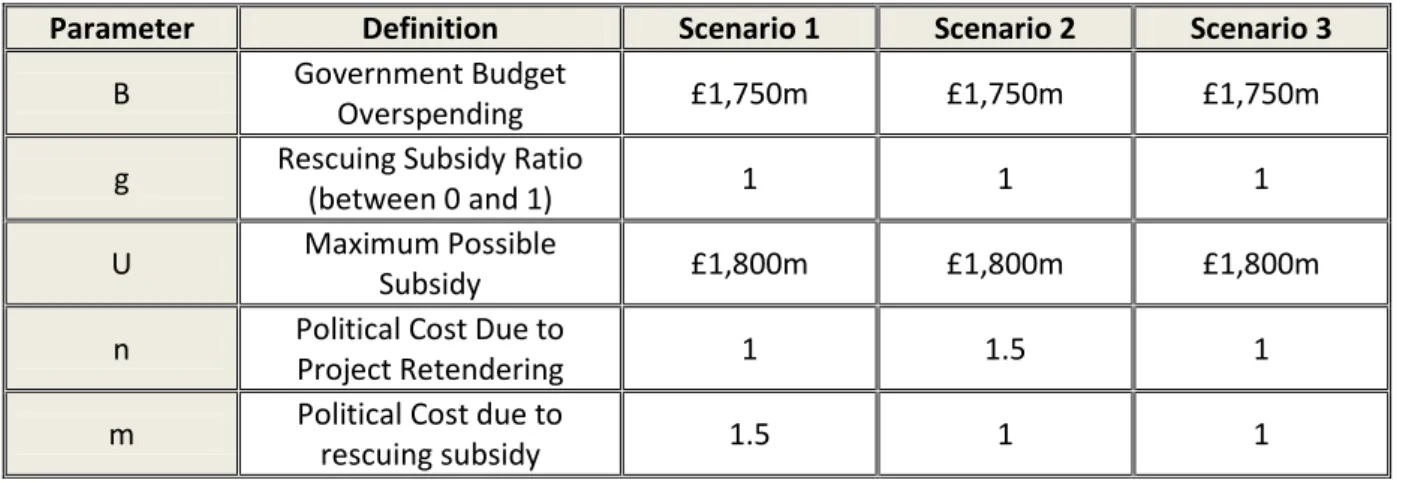
Figure 9 - Parameters Quantified
In order to quantify the payoffs of the game theory model we used a report from the National Audit Office entitled The failure of Metronet (National Audit Office, 2009), Ho’s paper (Ho, 2009) and Ho & Liu’s (Ho & Liu, 2004). The parameter, B, was the payment made to Metronet’s lenders as a result of the debt guarantee provided by the government. This payment would not have been made if Metronet had not entered into administration. The parameter, g, was assumed to be 1, as in this game the developer is not able to make a counter offer to the subsidy, U, being offered by the government. The parameter, U, was Metronet’s projected funding shortfall (see Appendix 10.3). For Metronet to continue as a going concern, the ISC payments made by LUL to Metronet would need to be increased to cover this amount. Finally, the parameters, n & m, were modeled according to the guidelines set out by Ho. They are functions of the political costs which act as a multiplier on the final payoff. In effect, the further a project goes over budget or the larger the requested subsidy, the higher the political costs are, thus, the higher the final payoff to either rescue or retender the
Parameter Definition Scenario 1 Scenario 2 Scenario 3
B Government Budget
Overspending £1,750m £1,750m £1,750m
g Rescuing Subsidy Ratio
(between 0 and 1) 1 1 1
U Maximum Possible
Subsidy £1,800m £1,800m £1,800m
n Political Cost Due to
Project Retendering 1 1.5 1
m Political Cost due to
19 project will be. We set boundaries for the political costs, allowing them to range from 0% to 100% of the final payoff.
Although there is a lot of information published about the failure of the Metronet Infraco, it was still very challenging to determine which figures or data correspond to the parameters that we were seeking to quantify. Essentially, no publications exist which explicitly tell you which values correspond to the parameters you wish to quantify. As a result, the decision of which quantities to use for each parameter depended on our own understanding of the case and the game theory model. Therefore, our own biases had the potential to affect the outcome of the game, making our findings less objective. In essence, if the same study was to be carried out by another party they might not reach the same conclusions as ours due to their selection of the parameters which are a prerequisite to solve the game. As a matter of fact, this finding opposes the assumption of this game which states that the parameters of the game are common knowledge to the developer and the government. In reality, this assumption does not seem plausible. This becomes more apparent when we consider the fact that our parameters were extracted from a report published several years after the collapse of Metronet. Due to a lack of concrete data available when renegotiation has been requested, it is hard to imagine how this model could be used reliably before or during the renegotiation process.
Naturally, the most challenging parameters to quantify were the political costs, n & m, as no standardized method to ascertain these costs exists. In order to compensate for this, we envisioned three possible scenarios for these costs which are based on the public’s support for the project at the time of the requested renegotiation process:
Scenario 1 - the political cost to rescue the project is higher than the political cost to retender
the project ( m > n )
Scenario 2 - the political cost to retender the project is higher than the political cost to rescue
the project ( n > m )
Scenario 3 - no political cost to either rescue or retender the project (n & m = 1)
The above scenarios are based on our assumption that political costs can vary due to considerations such as which political party is governing the country as well as how much public support exists behind the project. By providing different scenarios, we can analyse the impact that political costs will have on the equilibrium solution of the game.
20
6.4 Payoff Comparisons
We will now calculate and analyse the payoffs of the game by using the parameters which we quantified in the previous section. The payoffs according to the three scenarios will be shown. The focus here will be on the government’s payoff, as the developer (i.e. Metronet) will have the same payoff in all three scenarios. In order to understand the payoffs we can use the guidelines for the model set out in the methodology or simply our intuition. We know that the government will only choose to rescue the project if the cost of doing do is less than the cost to retender the project. The payoff for the government has been shown in red while the payoff for Metronet has been marked in blue. The payoffs are in millions of pounds (£m).
Figure 10 - Scenario 1 - Higher political cost rescue vs. retender
Scenario 1 - In this scenario the political cost to rescue the project is higher than the political cost to
retender the project (m > n). Or in other words, the public was more in favour of retendering the project than rescuing it. This scenario is well supported by publications made by the National Audit Office and established news outlets before and at the time of the request for renegotiation. At the outset of the planning of the project, there was uncertainty about whether the project would deliver value for money (i.e. PPP cost < Public Sector Comparators cost) (National Audit Office, 2000). In addition, in the year 2000, a new mayor of London, Ken Livingstone, was elected due to his opposition to the PPP project (BBC, 2000). A year later in 2001, the public witnessed the high profile collapse of Railtrack, a privatised company who controlled Britain’s rail infrastructure (BBC, 2001). This represented a huge embarrassment for the government. Clearly, even before the project began there was opposition to the PPP. Finally in 2007, Ken Livingstone, now in his second term of office as mayor and acting as the head of the LUL, announced publicly that he did not agree to Metronet’s requested subsidy. All of these factors combined, along with many others that have not been discussed, means that we deemed the political cost to rescue the project was larger than the political cost to retender the project. By eyeballing the payoffs we can see that the cost to rescue the
21 project (i.e. agreeing to the requested subsidy) is higher than the cost to retender the project (i.e. rejecting the requested subsidy).
Figure 11 - Scenario 2 - Higher political cost to retender vs. rescue
Scenario 2 - In this scenario the political cost to retender the project is higher than the political cost
to rescue the project (n > m). Or in other words, the public is more in favour of rescuing the project than retendering it. This scenario is not well supported by publications made before or at the time of the request for renegotiation. For this scenario to be realistic, it would have to be clear to the public that the PPP was performing well and was creating value for money. Essentially, the public would have to be confident that the private sector was doing a better job executing the project than the government could. Based on the evidence presented previously in Scenario 1, this scenario isn’t very credible. By looking at the payoffs we can see that the cost to rescue the project (i.e. agreeing to the requested subsidy) is lower than the cost to retender the project (i.e. rejecting the requested subsidy). This result is different to the result we observed under Scenario 1.
Figure 12 - Scenario 3 – No political cost
Scenario 3 - In this scenario there is no political cost to either rescue or retender the project. This
scenario can also be used to separate political considerations from the decision to rescue or retender the project. The payoffs show that the cost to rescue the project is larger than the cost to retender the project. This leads to a similar result which was observed in Scenario 1.
22
6.5 Determining the Nash Equilibrium
In order to find a solution to the game we have quantified the parameters and determined the consequent payoffs. So the question is, should the project have been rescued or retendered? In order to answer this question, we will calculate the Nash equilibrium. In the methodology we said that the ‘rescue equilibrium’ is reached when n(B) – m(gU) 0 and the ‘no rescue equilibrium’ is reached when n(B) – m(gU) 0. Effectively, the ‘rescue equilibrium’ ensues when the cost of rescuing the project is lower than the cost of retendering the project. Conversely the ‘no rescue equilibrium’ arises when the cost of retendering the project is lower than the cost of rescuing the project.
Figure 13 - Determining the Nash Equilibrium
Scenario m n n(B) – m(gU) Equilibrium
1. m > n 1.5 1 £-950m No Rescue
2. n > m 1 1.5 £825m Rescue
3. No political cost 1 1 £-50m No Rescue
The above table shows us what equilibrium solution would be reached according to each scenario. We can observe that we do not reach the same equilibrium solution in all three scenarios, which immediately implies that in this game political costs play a large role in the decision to either rescue or retender the project.
In the Metronet – London Underground PPP case the government made the decision to not agree with the requested subsidy. They decided instead to let Metronet go bankrupt and find a new private partner. Effectively they reached the ‘no rescue equilibrium’. This is the same equilibrium we reached under scenarios 1 & 3. Our analysis of the public’s mood towards the PPP at the time of the requested negotiation showed that it was not very likely that they supported the PPP project, thus we lend more credence to scenarios 1 & 3 and do not consider that scenario 2 is credible.
The model appears to show that the government made the right decision. Nonetheless, we need to be wary of the quality of our results as the political multipliers we chose in scenario 1 & 2 can appear to be arbitrary. Although scenarios 1 & 2 are logical in the sense that one would expect one of the political costs to be larger than the other, why did we choose a multiplier of 1 for one of the political costs and 1.5 for the other rather than 1.1 for one of the costs and 1.3 for the other? Would have this affected the equilibrium to rescue or retender the project? In order to address this issue, we will now perform a sensitivity analysis.
23 Figure 14 - Sensitivity Analysis - n > m
n n(B) m m(gU) n(B)-m(gU) Equilibrium
£m £m £m 1 1,750 1 1,800 -50 No Rescue 1.01 1,767.5 1 1,800 -32.5 No Rescue 1.02 1,785 1 1,800 -15 No Rescue 1.03 1,802.5 1 1,800 2.5 Rescue 1.04 1,820 1 1,800 20 Rescue
In order to begin our analysis we shall make several inferences from the three scenarios used to calculate the equilibrium of the game:
Under scenario 3, with no political costs, we reached the ‘no rescue equilibrium’ with a difference in payoffs of £50m. Since the parameters used in this model are likely to be estimations rather than certainties, we would argue that the difference in payoffs is so small considering the scale of the payoffs that no decision could be made using this scenario. This signifies that for a decision to be made, either, the political costs would need to be correctly estimated and applied or another decision making tool would need to be applied. In essence, this scenario does not provide any significant results.
Under scenario 1, it is obvious that as long as m > n that the ‘no rescue equilibrium’ will always be reached, so we have deemed that no further analysis is necessary.
We have established scenarios 1 & 3 would not benefit from more scrutiny where political costs are concerned. This is not the case for scenario 2, where more inspection is required. Essentially, we need to ask ourselves how much larger than, m, does, n, need to be in order to reach the ‘rescue equilibrium’? Figure 14, shows us that as soon as, n, is larger than, m, by a factor of 0.03 that the equilibrium reached changes. If the multipliers increases (ex. n=2 & m=1.94) the required difference grows to a factor of 0.06. Hence, the political cost to retender the project would only need to be slightly larger than the political cost to rescue the project in order for the rescue equilibrium to be reached. This finding provides greater support for scenario 2, however, we are not able to show that at the time of renegotiation that, n, was larger than, m. Thus, we conclude that, scenario 1 best represent the prevailing circumstances at the time of the request for renegotiation.
24
7 Conclusion
The request for the renegotiation of a PPP contract by developers is frequent and well-documented; it is considered an un-desirable outcome which can severely undermine the choice of a PPP as a procurement method. In effect, the government is charged with weighing the cost of rescuing the project against the cost of letting the developer go bankrupt and retendering the project. The main criteria for a PPP to be rescued, is that it continues to provide greater value-for-money than other possible procurement methods (including the retendering of the PPP to another private party). Our study set out to determine if a game theory model can be used in practice to establish if this criteria is present or not. We did this by a applying a game theory model retrospectively to a well-documented PPP failure and set out to answer the following research questions:
1. Can a game theory model be applied retrospectively to the Metronet - London Underground case?
2. Did the London Underground or Metronet consider game theory during the renegotiation of the PPP contract? Would this have changed the outcome of the renegotiation?
3. What insights, if any, can a retrospective study using a game theory model deliver? Can game theory be used to influence future decision making in PPP renegotiation?
In the first section of the conclusion we will answer the research questions, and then we will address the contributions we have made to the theoretical framework. We will end with suggestions for possible areas for future research.
1. Can a game theory model be applied retrospectively to the Metronet - London Underground case?
The short answer to this question is YES. The detailed answer is that although we successfully managed to apply the game theory model to the Metronet - London Underground case we did so knowing that the parameters we chose were susceptible to our own biases and that of the sources we used, thus, not completely objective. In essence, we relied heavily on reports published by the National Audit Office to determine some of the parameters used in this model. Unfortunately, Metronet did not publish the data required to conduct this study. So although the NAO is completely independent of government and trust worthy source, our results could have been improved if we had access to data published by Metronet. We do not believe, however, that our findings would have changed even if we had access to Metronet’s data. Finally, although we have shown that the game theory model can be applied retrospectively, we find that many of the parameters we used in this study would not have been necessarily available before or during the request for negotiation,
25 thus we cast doubt that this model can be reliably used when it is most needed (i.e. at the time of the request for renegotiation).
2. Did the London Underground or Metronet consider game theory during the renegotiation of the PPP contract? Would this have changed the outcome of the renegotiation?
Being a retrospective study we already knew the outcome of the project, through applying the game theory model we sought to determine if it was correct to let the project fail rather than rescuing it. Our findings show that the government was correct to reject the requested subsidy. We noted, however, that in our case the model was sensitive to our chosen political cost, especially when we considered that no political cost existed, in this scenario the resulting payoffs did not give us satisfactory results which leads us to believe that our game theory model should not be used in isolation when satisfactory results cannot be achieved. Other methods of reaching a decision should be employed in conjunction. Finally, we find no evidence that game theory was explicitly considered during the renegotiation process, however, the facts of the case lead us to believe that the intuition which lies behind the game theory model was clearly considered, which shows that the players of the game were rational and implicitly applied the model. Thus, the outcome of the case would have not changed if the game theory model was applied explicitly.
3. What insights, if any, can a retrospective study using a game theory model deliver? Can game theory be used to influence future decision making in PPP renegotiation?
The game theory model applied in this study is relatively new and was created in response to the well-document instances of PPP renegotiation. In theory, the model gives us a clear and concise basis on whether or not a project should be rescued. In practice, however, we find little evidence of its application by governments or PPP consortiums. We showed that the model can be retrospectively applied and that the intuition behind the model has been applied in our specific case. However, in order for the game theory model to be used in future decision making in PPP renegotiation, the users of the model need to keep constant track of the parameters, in this way they can have a clear understanding of what the consequences of a request for an extra subsidy would be. For example, in our case, all of the parties concerned took a long time to make a decision with regard to the requested subsidy, if the parameters of this model were known to them they could have come up with a decision much faster, and could have even predicted if a request for renegotiation would be made in the future.
26 Our contributions to the theoretical framework will now be assessed; by applying a game theory model specifically designed to address the problem of PPP renegotiations we assessed its practical merits. Although the model is theoretically sound, in the sense that it conceptualizes the problem of PPP renegotiation attractively, we have shown that its application to a real case is not so straightforward. In order for it to be used at the time a renegotiation is requested, the government must already know the required parameters, this means that as soon as the PPP contract is signed, the government must have a system in place to define and quantify the required parameters. This would involve them regularly scrutinizing their own costs as well of those of the developer. Considering the scale of recent PPP projects, such capabilities should already exist, they just need to be harnessed.
The findings of our thesis could benefit greatly from future research in the same area. Our first suggestion relates to the doubt we cast over the ability to use the game theory model at the time of the request for renegotiation. In order to address this issue, the model should be applied to a real life ongoing financial renegotiation of a PPP contract. This would probably require the researcher to work very closely with the players of the game. Such a research would hopefully determine whether or not the model represents a useful tool to be used in PPP renegotiation.
Our second suggestion relates to an opportunity to improve on the game theory model by adding a new variable to the payoffs of the developer; the cost of the loss of reputation. For example, the model assumes that the payoff of the developer, in case of bankruptcy, is 0, as the developer will likely not lose more than the equity they invested in the project, which approaches 0, as the project moves towards bankruptcy. However, we suggest that they will also suffer damages to their reputation, which means that they might not win future contracts from the government, which could represent a huge opportunity loss. Similarly, their reputation will also be affected when they request a renegotiation. For example, this could reveal that they are guilty of placing opportunistic bids which would affect their ability to win future government contracts. By including this new parameter the outcome of our study could have been different, and potentially, Metronet would have not attempted to renegotiate the contract in the first place for fear of loss of reputation.
27
8 Bibliography
Books & Journals
Chinyio, E. & Gameson, R., 2009. Private Finance Initiative in Use. In: A. Akintoye & M. Beck, eds.
Policy, Management and Finance of Public-Private Partnerships. Oxford: Blackwell Publishing, pp.
3-26.
Gibbons, R., 1992. Game Theory for Applied Economists. Princeton: Princeton University Press. Grimsey, D. & Lewis, M. K., 2004. Public Private Partnerships: The Worldwide Revolution in
Infrastructure Provision and Project Finance. Cheltenham: Edward Elgar Publishing Limited.
Guasch, L. J., 2004. Granting and Renegotiating Infrastructure Concessions: Doing it Right. Washington: The World Bank.
Hargreaves Heap, S. P. & Varoufakis, Y., 2004. Game Theory: A Critical Text. 2nd ed. London: Routledge.
Ho, S. P., 2009. Government Policy on PPP Financial Issues: Bid Compensation and Financial Renegotiation . In: A. Akintoye & M. Beck, eds. Policy, Management and Finance of Public-Private
Partnerships. Oxford: Blackwell Publishing Ltd, p. 497.
Ho, S. P. & Liu, L. Y., 2004. Analytical Model for Analyzing Construction Claims and Opportunistic Bidding. Journal of Construction Engineering and Management, 130(1), pp. 94-104.
Laffont, J.-J., 1993. A Theory of Incentives in Procurement and Regulation. Massachusetts: Massachusetts Institute of Technology.
Laffont, J.-J., Guasch, L. J. & Straub, S., 2003. Renegotiations of Concession Contracts in South
America, Washington: The World Bank.
Myerson, R. B., 1997. Game Theory: Analysis of Conflict. Cambridge: Harvard University Press. Nash, J., 1951. Non-Cooperative Games. Annals of Mathematics, 54(No. 2), pp. 286-295. Osborne , M. J. & Rubinstein, A., 1994. A Course in Game Theory. Massachusetts: MIT Press. Turocy, T. L. & Von Stengel, B., 2001. CDAM Research Report LSE-CDAM-2001-09, s.l.: Academic Press.
Papers & Reports
Brandenburger, A., 2007. Cooperative Game Theory: Characteristic Functions, Allocations, Marginal
Contribution, New York: Stern School of Business. New York University.
Crandall, J. W., 2008. www.mit.edu. [Online]
Available at: http://www.mit.edu/~jcrandal/16.499/GameTheoryBasics.pdf [Accessed 21 March 2013].