M. Aydın,
1,2A. Heitor Reis
2and António F. Miguel
21
Institute of Energy, Istanbul Technical University, 34469 Ayazaga Campus, Istanbul, Turkey
2
University of Évora, Physics Dept. and Évora Geophysics Centre, R. Romão Ramalho, 57, Evora, Portugal [email protected] [email protected] [email protected] http://www.cge.uevora.pt
Abstract
Heat transfer enhancement has been studied in recent years. In this paper we numerically study the influence of particles suspended in flows on heat transfer enhancement. We consider two flat horizontal parallel plates kept at the same temperature, where hot air with particles flows in between. High conductive and low conductive particles are assumed to accompany flow and conclusions are drawn for every numerical experiment.
Keywords: Convective, Heat transfer enhancement, Particles, CFD, Nusselt number
1 Introduction
Heat transfer from a system greatly depends on physical properties of the fluid including thermal conductivity, viscosity, density and heat capacity. Many techniques of heat transfer enhancement have been studied in recent years [1-3]. Among them, development of better performance heat transfer fluids has been a subject of numerous investigations. One of the ideas is to use particles dispersed in the fluid. Studies of effects of particles entrained in flows have been addressed recently [4,5]. However the effects of suspended particles on convection heat transfer have not received much attention yet. In the literature, such experiments were done for Couette flow mixed with solid particles [6]. Another experimental work pointed out that increasing the particle thermal conductivity caused the heat transfer coefficient to increase for forced convection in a plate channel [7]. Two dimensional simulation of gas-solid heat transfer in pneumatic conveying were also accomplished by using two- fluid model [8].
The present paper reports the results of a numerical study of forced convection heat transfer between two plates filled with particles. We study the influence of particles suspended in flows on heat transfer enhancement. We consider steady-state fluid flow between two flat horizontal parallel plates with both plates kept at the same temperature. Mono-disperse particles with low and high thermal conductivities injected at the entrance are entrained with the flow. Their effects on temperature field and convective heat transfer are determined from the flow field.
2 Model
Algebraic slip mixture model is used in this work. It models two phases (fluid and particles) by solving the momentum equation and continuity equation for the mixture, the volume fraction equation for the secondary phase, and an algebraic expression for the relative velocity [9].This model is especially recommended instead of a full multiphase model when there is a wide distribution of the particulate phase or when interphase laws are unknown or their reliability can be questioned. In this model it is assumed that all control volumes are filled with either a single phase or a combination of phases. The model does not allow for void regions where no phase of any type is present. Steady-state turbulent flows are considered. Airflow is assumed to be incompressible.
between the plates (inlet).The non-slip boundary conditions are set along the plates. The developed velocity profile is prescribed at the inlet while pressure outlet boundary conditions are set at the outlet. Both plates are held at the same temperature (300K). Flow enters the channel with constant temperature (350K)
Fig. 2 Grid of the domain
The grid with 3569 quadrilateral cells and 3896 nodes are found to be appropriate after several runs. Final form of the grid can be seen in Fig. 2. Reynolds number is calculated according to Re =
ρ
u
2L
/
μ
whereρ
is density of air, u is velocity at the inlet,μ
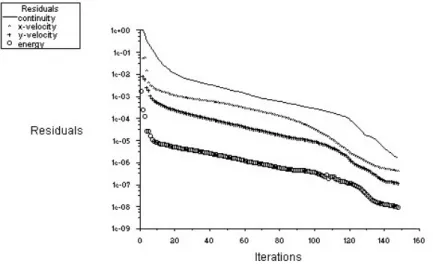
is the dynamic viscosity of air and 2L (2 m) is the gap between two plates.Solutions for laminar flow without particles converge rapidly. It takes around 150 iterations for Re =1000. Variations of residuals for continuity, two components of velocity and energy are shown in Fig. 3. Development of thermal boundary layer along the channel can be seen in Fig.4. The temperature profiles are plotted at three different locations on x-axis. This verifies that the code works well.
Fig. 4 Temperature development along the channel at x =1, 5 and 9 meters for Re=1000
Nusselt number is defined as:
L y
y
T
Nu
± =⎟⎟
⎠
⎞
⎜⎜
⎝
⎛
∂
∂
=
** (1)where non-dimensionalized temperature,
w w *
T
T
T
T
T
−
−
=
0 andL
y
y
*=
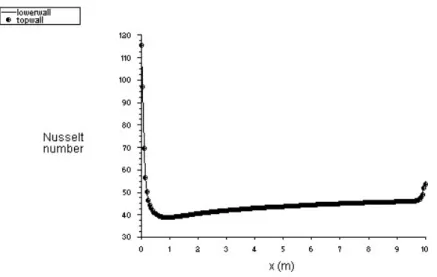
and T0 and Tw stand for temperatureof air at y=0 (central plane) and at the walls (y=L) (see Fig. 1). Fig. 5 shows variation of Nusselt number at upper and lower plates against x-axis. They are both on top of each other due to symmetry of thermal boundary layers on the plates. A sudden drop in Nu number at the leading edge of the plates may be associated with beginning of temperature boundary layer development.
Fig. 5 Variation of Nusselt number with x-axis for Re=1000 (-- lower plate, o top plate)
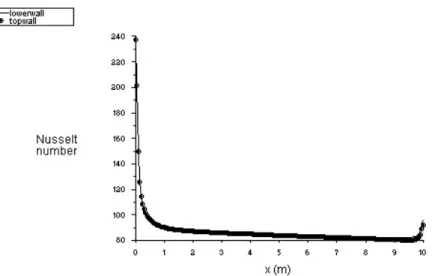
Fig. 6 Variation of Nusselt number with x-axis at Re=27000 (-- lower plate, o top plate)
At the inlet particles are injected through the flow. Coarse particles with density of 5 kg/m3 and a diameter of 10 μm are considered for all cases. Volume fraction, v=0.05 are also taken in all cases. Two kinds of particles, namely low conductive (k=0.0158W/mK) and high conductive (2 W/mK) particles are employed. The effect of low conductive particles on heat transfer is shown in Fig 7. A slight improvement on overall Nu number and a slope towards upstream of the flow can be noticeable. A sudden increase at the end of the plates is possibly due to exit effect.
Fig. 7 Effect of low conductive particles on variation of Nusselt number at Re=27000
Fig.8 shows the effect of high conductive particles on heat transfer. Increase in particles conductivity affected convective heat transfer more significantly.
Fig. 8 Effect of high conductive particles on variation of Nusselt number at Re=27000
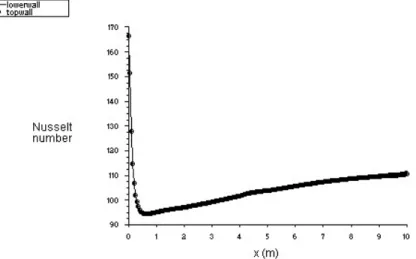
Next we consider flow at Re= 135000. Fig. 9 shows variation of Nusselt number for this Re number. Compared to Fig. 6, the positive effect of Re number on the convective heat transfer can be seen as an increase in Re number leads to a decrease in the boundary layer thickness.
Fig. 9 Variation of Nusselt number with x-axis at Re=135000 (-- lower plate, o top plate)
Figures 10 and 11 show the effect of low and high conductive particles on heat transfer. We see the similar pictures and better enhancement of convective heat transfer when high conductive particles are used.
Fig. 10 Effect of low conductive particles on variation of Nusselt number at Re=135000
Fig. 11 Effect of high conductive particles on variation of Nusselt number at Re=135000
Fig.12 shows contours of volume fraction of the particles inside the channel. Because of the gravity, particles fraction is slightly higher on lower plate.
Fig. 8 Contours of volume fraction of the particles at Re=135000 (k=2 W/mK, v=0.05)
4 Conclusions
A numerical study has been carried out on the flow and heat transfer behaviour of particles through two parallel plates in both laminar and turbulent flow conditions. In laminar flow regime, when particles are introduced, due to low velocities natural convection becomes significant. Since thermal instabilities and convection cells are observed, it is difficult to see particles effect. Addition of particles enhances heat transfer in turbulent flow regimes. Their effect on convective flows becomes more significant when high conductive particles are chosen to accompany the flow. This is true for both Re numbers. More work is clearly required to find out the effects of particles size, volume fraction and different thermal boundary conditions. Finally, although we consider perfectly a mixed two phases (air and particles) model, in practical, due to poor suspension stability, micron size particles may cause abrasion and clogging for narrow channels. This is especially true when their volumetric fraction is high and under humidities close to saturation. Therefore, using nano-particles may have potential to resolve these disadvantages
References
[1] Zimparov. Energy conservation through heat transfer enhancement techniques, Int. J. Energy Res. 26 (2002)
675-696.
[2] A. Bejan. Advanced Engineering Thermodynamics, Second Edition, New York, 1997, Wiley. [3] A. Bejan, Entropy Generation Minimization, CRC Press, Boca Raton, 1996.
[4] M. Aydin, G. Balik, A. F. Miguel and A. H. Reis. Some Features of Flow and Particle Transport in Porous Structures, Strojniski Vestnik J. of Mech Eng. 51(2005), 495-500.
[5] A. F. Miguel, M. Aydin, A. H. Reis. Indoor deposition and forced resuspension of respirable particles, Indoor
and Built Environment 14 (2005) 391-396.
[6] C.W. Sohn and M. M. Chen. Microconvective thermal conductivity in diperse two phase mixture as observed in a low velocity Couette flow experiment, J Heat Transfer 103 (1981) 47-51.
[7] P.X. Jiang , Z. Wang, Z.P. Ren, B.X. Wang. Experimental research of fluid flow and convection heat transfer in plate channels filled with glass or metallic particles, Exp. Thermal and Fluid Sc 20 (1999) 45-54.
[8] K. S. Rajan, B. Pitchumani, S.N. Srivastava, B. Mohanty. Two-dimensional simulation of gas-solid heat transfer in pneumatic conveying, Int J Heat Mass Transfer 50 (2007) 967-976.