See discussions, stats, and author profiles for this publication at: https://www.researchgate.net/publication/326732901
Are litterfall and litter decomposition processes indicators of forest
regeneration in the neotropics? Insights from a case study in the Brazilian
Amazon
Article in Forest Ecology and Management · December 2018
DOI: 10.1016/j.foreco.2018.07.020 CITATIONS 2 READS 103 5 authors, including:
Some of the authors of this publication are also working on these related projects:
Ecologia de paisagem - Vale do TaquariView project
Padrões de diversidade em Odonata (Insecta) no bioma PampaView project Marina Dalzochio
Universidade do Vale do Taquari - UNIVATES
27 PUBLICATIONS 111 CITATIONS SEE PROFILE
Màrio Gabriel Santiago Santos
Universidade de Trás-os-Montes e Alto Douro
59 PUBLICATIONS 407 CITATIONS SEE PROFILE
Reinaldo Cajaiba
Instituto Federal de Educação Ciência e Tecnologia do Maranhão (IFMA)
38 PUBLICATIONS 88 CITATIONS SEE PROFILE
All content following this page was uploaded by Reinaldo Cajaiba on 09 November 2018.
Contents lists available atScienceDirect
Forest Ecology and Management
journal homepage:www.elsevier.com/locate/foreco
Are litterfall and litter decomposition processes indicators of forest
regeneration in the neotropics? Insights from a case study in the Brazilian
Amazon
Wully Barreto da Silva
a, Eduardo Périco
a, Marina Schmidt Dalzochio
a, Mário Santos
b,c,
Reinaldo Lucas Cajaiba
b,c,⁎aUniversity of Taquari Valley, Laboratory of Ecology and Evolution, R. AvelinoTallini, 95900-000 Lajeado, RS, Brazil
bLaboratory of Applied Ecology, CITAB - Centre for the Research and Technology of Agro-Environment and Biological Sciences, University of Trás-os-Montes e Alto Douro,
5000-911 Vila Real, Portugal
cLaboratory of Ecology and Conservation, Federal Institute of Education, Science and Technology of Maranhão, R. Dep. Gastão Vieira, 1000, 65393-000 Buriticupu, MA,
Brazil
A R T I C L E I N F O
Keywords: Amazonia
Ecological restoration Land use change Litterfall Disturbance Succession
A B S T R A C T
Litterfall plays an important role in nutrient cycling and maintenance of soil fertility in terrestrial ecosystems.
We gauged the effects of anthropogenic impacts on the production, decomposition and seasonality of litterfall in
primary and secondary forests within a tropical landscape of the Brazilian Amazon. We hypothesized that leaf
litter quantity and quality would differ in line with forest disturbance and that these changes would translate
into dissimilar decomposition rates. If proved, these processes could be used as surrogates for indentifying the ecological status of forest habitats. The obtained results have shown that, in the study area litterfall is reduced and litter decomposition is braked in disturbed habitats when compared with primary and recovered secondary forests. Also, within similar climatic conditions, the litter production and decomposition rates begin to stabilize in mature secondary forests. Our results represent a useful contribution to understand the dynamics of the litterfall and litter decomposition processes in the neotropics. Both processes were correlated and sensitive to disturbance gradients and should used as forest recovery indicators in ecological monitoring and ecological restoration studies.
1. Introduction
Litterfall in forest ecosystems are composed of organic material, including leaves, twigs,flowers, fruits, bark, and other plant parts that have fallen to the forest floor (Celentano et al., 2011; Scoriza et al.,
2012; Camargo et al., 2015). This material functions primarily as a
route for the transfer of nutrients from vegetation to the soil, main-taining soil fertility which is essential for the sustainability of forest systems (Silver et al., 2014; Camargo et al., 2015; Erfani et al., 2017). In the Amazon region, litter is essential for the ecosystem functioning because of the low soil fertility and litter decomposition that allows for nutrient release from the plant biomass to the ecosystem (Martius et al.,
2004; Quesada et al., 2011; Almeida et al., 2015). Litter layer also acts
as a thermal insulator (microclimatic soil control) and water retainer. It mitigates erosive effects and has a significant effect on the hydrologic cycle, acting mainly as afilter and storing water from the atmosphere in
the soil (Caldeira et al., 2013). In addition to all the ecological services mentioned above, litter is also a shelter and habitat for oviposition and larval development for many invertebrate species in soil (Cajaiba et al.,
2017a) as well as an important feeding area and breeding grounds for
many other animals, including vertebrates (Paudel et al., 2015). Several biotic and abiotic factors affect litter production, such as vegetation type, altitude, latitude, precipitation, temperature, lumin-osity, relief, deciduousness, successional stage, water availability, and soil characteristics (Scoriza and Rodrigues, 2014; Holanda et al., 2017). Depending on the characteristics of each ecosystem, one factor may prevail over the others (Figueiredo Filho et al., 2003). Therefore, each soil type supports different plant species which are adapted to specific nutritional conditions. The factors affecting decomposition include substrate chemical composition, particularly the amount of leachate and water-soluble substances, environmental conditions such as tem-perature, precipitation, real evapotranspiration, humidity, aeration,
https://doi.org/10.1016/j.foreco.2018.07.020
Received 22 June 2018; Received in revised form 7 July 2018; Accepted 8 July 2018
⁎Corresponding author at: Laboratory of Ecology and Conservation, Federal Institute of Education, Science and Technology of Maranhão, R. Dep. GastãoVieira,
1000, 65393-000 Buriticupu, MA, Brazil.
E-mail address:[email protected](R.L. Cajaiba).
0378-1127/ © 2018 Elsevier B.V. All rights reserved.
and soil structure, as well as anatomical characteristics and energy le-vels (Silva et al., 2014; Pinto et al., 2016). Another factor to be con-sidered is the composition of the detritivore community and its affinity for the substrate.
Tropical forests play an important role in global nutrient cycling
(Lanuza et al., 2018). Although a vast amount of tropical forests has
been cleared (FAO, 2015) and their nutrient cycling services have been significantly disrupted (Lanuza et al., 2018), the cover of tropical sec-ondary forests has increased in some regions as a result of changing land uses (Aide et al., 2013; Chazdon, 2014). Moreover, there has been a dramatic increase in large-scale forest restoration (Chazdon et al.,
2017; Lanuza et al., 2018). Regenerating secondary forest is an
in-creasingly common forest type in the tropics, creating a patchy dis-tribution of disturbance histories and stand ages across the landscape
(Schilling et al., 2016). In conserved tropical forest ecosystems, there is
a continuous production of litter throughout the year (Werneck et al., 2001). The total amount of produced litter at different periods depends
on the type and composition of the studied vegetation (Schumacher
et al., 2011), the biotic and abiotic characteristics of the areas, and the
degree of disturbance and connectivity of the areas (Nascimento et al., 2015). Therefore, the contribution of litter in disturbed areas can be used as an indicator to evaluate the vegetation recovery process
(Nascimento et al., 2015). The vertical and horizontal structure of the
plant community and the species composition and distribution may also interfere with the litter distribution and production (Vidal et al., 2007). Thus, the litter can be classified as an environmental indicator because it responds to changes in the ecosystems through changes in its de-position processes (Gessner et al., 2010; Nascimento et al., 2015).
Our study examined the patterns of litterfall and litter decomposi-tion processes in primary and increasingly common disturbed sec-ondary forests in a landscape of the Brazilian Amazon. The following specific hypotheses were tested: (1) leaf litter quantity and quality decrease in line with forest disturbance; (2) these trends are highly correlated with litter decomposition rates; (3) forest disturbance gra-dients could be identified using litterfall production and litter decom-position processes. If proved, these hypotheses could support our main objective that is the use of litterfall and litter decomposition processes to assess the recovery status of secondary forests in the neotropics. 2. Material and methods
2.1. Study area
The study was developed in the municipality of Uruará, south-western Pará state, northern Brazil (−03°43′27″S; −53°44′8″W, Fig. S1). The region is located approximately 1000 km away from Belém, the capital of Pará state, and is crossed by the Transamazon Highway (official designation BR-230). Uruará was part of the Altamira PIC (Integrated Colonization Project), one of thefirst official settlements in the Amazon, created to resettle families from the south, southeast and northeast of Brazil (Perz and Walker, 2002).
Supplementary data associated with this article can be found, in the online version, athttps://doi.org/10.1016/j.foreco.2018.07.020.
Land cover is characterized by large deforested areas radiating from the main road (TransAmazon) to the feeder roads (travessões), and spreading westward over time from the area of initial settlement in the east. The area has unevenly distributed patches of high-fertility soils known as“terra roxa”. Extensive livestock production, exploitation of timber at a large scale (mostly illegal) and cacao production are the main agro-pastoral strategies, but are usually complemented by annual crops and horticulture. In some parts of the study area, sandy soils predominate and pasture and annual crop production are favoured (Cajaiba et al., 2017b).
The climate is characterized as hot-humid (Köppen’s classification), with annual average temperature and precipitation of 26 °C and 2000 mm respectively (Peel et al., 2007). The studied areas make up
representative habiats of the region, such as Primary Forest (PF); Sec-ondary Forest with 25, 15 and 5 years of regeneration (denominated of SF-25, SF-15 and SF-5, respectively). In each of the studied habitats, four areas were selected, thus totaling sixteen sampling areas (see Table S1 supplementary material, for details of the sampling effort).
2.2. Environmental conditions monitoring
In order to evaluate the environmental complexity of each study site (four per habitat and sixteen in total), an area of 10 m × 10 m (100 m2)
was delimited around each collector. The following parameters were measured: density, given by the average number of arboreal individuals with diameter at breast height (DBH) > 5 cm, measured with a mea-suring tape directly on the stem (1.3 m); canopy cover (through the following scales: 0–5%, 6–25%, 26–50%, 51–75%, 76–95% and 96–100%) measured with a convex spherical densitometer; pH of the soil, according to the Manual of soil analysis methods proposed by
Embrapa (1997).
The data of air temperature, pluvial precipitation, relative humidity (monthly average values) were provided by the Meteorological Station at Ceplac (Comissão Executiva do Plano da Lavoura Cacaueira). The meteorological data obtained for the study period confirm the classification of the climate of the region as being of Aw type of Köppen -tropical humid, presenting only two well defined seasons: rainy season, which starts in January until mid June; and dry season, starting in July through December. The total rainfall in the study period was 1912.65 mm. The highest values were recorded in the months of March (283.75 mm) and April (275.12 mm) and the lowest values, in the months of September (35.1 mm) and November (34.71 mm). The average value of the air temperature for the period was 25.09 °C. The highest average temperature occurred in September (28.5 °C) and the lowest in May (23.1 °C). Relative air humidity in the region remained above 57%, with November and December having the lowest values (57%) and April, the highest (98.01%) month (Fig. S2, Supplementary material).
2.3. Litterfall production
In each sampling area, 10 collectors made of 2 mm nylon mesh measuring 1.0 × 1.0 × 0.15 m, installed 30 cm above the soil surface were randomly distributed to avoid litter mass loss due to microbial activity. To avoid the edge effect, the collectors were installed at a minimum distance of 100 m from the edge. The litter was collected monthly, over a period of 12 months, from August 2016 to July 2017. Each sample collected was divided into fractions: leaves, thin branches (diameter≤ 2 cm), reproductive material (flowers, fruits and seeds) and residues (unidentified plant material and parts of animals and/or waste). The latter was excluded from the analysis because this fraction is composed of material from different origins and that cannot be identified (Vidal et al., 2007). In the laboratory, the materials were packed in paper bags and submitted to forced circulation at 65 °C for 72 h. Each fraction was weighed separately on a 0.001 g high precision digital scale to determine its contribution to total litterfall. The total production was obtained through the sum of the four fractions, which represents the monthly production of litter per collector. The annual production of litterfall was obtained through the sum of the monthly production of the collectors and was recorded in mg ha−1year−1to allow comparison with other studies (Almeida et al., 2015).
2.4. Litter decomposition
For estimating litter decomposition, portions of 10 g of leaves pre-viously dried in an oven at 65 °C until constant weight, were packed in litter bags with 1 mm2 mesh and measuring 20 × 20 cm and were
randomly distributed on the surface of the forestfloor, simulating the natural fall of the materials from which litter originates.
W.B. da Silva et al. Forest Ecology and Management 429 (2018) 189–197
The litter bags (28 per site study and 448, in total; see Table S1 supplementary material) were installed at the beginning of August and collected at 30, 60, 90, 120, 150, 180 and 210 days. At each period, four bags were removed in each settlement. After collection, the ma-terial contained in each decomposition bag was cleaned with a brush to remove soil particles and possible organisms attached to the leaves. Subsequently, the material was oven dried at 60 °C for 72 h and weighed to obtain the remaining mass.
2.5. Data analysis
Data was examined using univariate and multivariate two-tailed analyses. Data analyses were performed with the statistical program SPSS 17 for Windows and R v3.5.0 (RDevelopment Core Team, 2016) using the packages vegan (Oksanen et al., 2013) and glm2 (Marschner, 2011). Variables were tested for assumptions such as normality and homoscedasticity by inspecting residuals and using the Shapiro-Wilk test (Shapiro and Wilk, 1965).
2.6. Habitat-specific environmental conditions
We used One-way ANOVAs to gauge significant differences in en-vironmental conditions among the studied habitats. Tukey post hoc tests were applied to check for pair-wise differences (Sokal and Rohlf, 1995). Additionally, a Non Metric Multidimensional Scaling (NMDS) was applied to collapse similarities/differences in litterfall production (total and fractions) between the different habitats, so that they could be easily visualized and interpreted.
2.7. Habitat-specific litterfall production and seasonality
Two-way ANOVA, followed by pair-wise comparisons (Tukey's test,) was applied to verify possible interactions between litterfall production (total and fractions), habitats and seasons. Before applying the ANOVA, the normality of the data was verified by the Shapiro-Wilk test. 2.8. Influence of environmental conditions on litterfall production
A generalized linear model (GLM) analysis was used to determine the variation in litterfall production (response variable) attributable to the environmental conditions considered (explanatory variables, see please Measurement of environmental variables), and which of them sig-nificantly contributed to explain such responses. We assessed the fit of each candidate model using the Akaike information criteria (AIC) value
(Akaike, 1974; Hurvich and Tsai, 1989), by comparing all possible
combinations using the Akaike weights (AICwi,Anderson et al., 2000). The equation with the lowest AIC and highest adjusted R2was selected in order to reduce complexity in statistical model selection (e.g.Santos
et al., 2011). To deal with over-dispersion, we used the mean regression
function and the variance function from the Poisson generalized linear model, leaving the dispersion parameter unrestricted (quasi-Poisson). This strategy results in the same coefficient estimates as the standard Poisson model; however, inference is adjusted for over-dispersion
(O’Hara and Kotze, 2010). The tolerance values of explanatory
vari-ables were used to assess multicollinearity and remove redundant variables using Spearman's rho correlation coefficient (only predictors with correlation lower than 0.7, e.g.Elith et al., 2006).
2.9. Habitat-specific litter decomposition
The decomposition rate of the litter was quantified by means of mass loss measurements, with the following formula: Re% = (Po/ Pr) × 100, where, Re is the percentage of mass remaining; Po is the initial dry weight of the leaf; Pr is the remaining weight (or final weight) of the leaflet, observed at the end of each month of study.
After the calculation of the remaining mass over the period, the
decomposition constant k was calculated, according toThomas and
Asakawa (1993), according to the exponential model: Xt = Xo·e−kt,
where, Xt weight of the dry material remaining after t days; Xo is weight of the dry material placed in the bags at time zero (t = 0), and k is the decay constant (unit: year−1). Possible differences between decay rates were tested by analysis of covariance (ANCOVA), using habitat as covariate.
3. Results
3.1. Habitat-specific environmental conditions
The variables canopy cover, diameter at breast height and density were significantly different among all habitats, with higher values for primary forest - PF (P < 0.05). The secondary forest SF-5 (5 years of regeneration) was hotter and significantly different from PF and SF-25 (P < 0.05), but not significantly different when compared to SF-15 (P > 0.05). Relative air humidity was higher in PF and SF-15, while SF-5 was less humid (P < 0.05). There was no statistically significant difference between the habitats regarding monthly precipitation (P > 0.05). Regarding soil pH, SF-5 had more acidic soils, while PF had more alkaline soils (see Table S2, Supplementary material for asso-ciated variable differences between habitats).
3.2. Habitat-specific litterfall production and seasonality
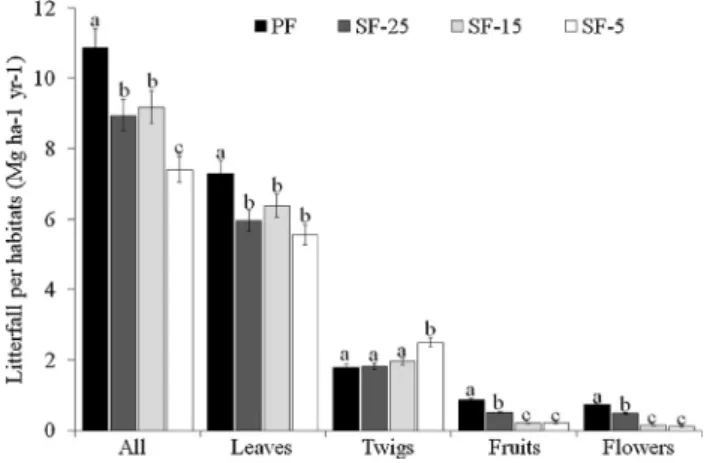
The average annual litterfall production of the four areas, for the period studied, was 9.095 mg ha−1 year−1. The total annual litter production was significantly different among the studied habitats (ANOVA, F3,957= 5.37, P < 0.0001). The primary forest - PF,
pre-sented higher annual production of litter (10.86 mg ha−1year−1), sig-nificantly higher than the other habitats (P < 0.0001). On the other hand, the secondary forest withfive years of regeneration (SF-5) pro-duced the smallest annual amount of litter (7.41 mg ha−1year−1) and was significantly lower in relation to the other habitats (P < 0.01). The total litter production in the secondary forests (SF-25 and SF-15) did not differ among themselves (P > 0.05) (Fig. 1) (see Material Suple-mentar, Table S3, for details of the associated diferences and Tukey post-hoc values).
The leaf fraction presented the highest contribution in total litter production in all studied habitats (annual average mg ha−1year−1, dp ± 0.944). ANOVA showed statistical difference in leaf production between the studied habitats (F3,957= 51.18, P < 0.001), being higher
Fig. 1. Barplot expressing the annual average litterfall production and fractions
per habitat. Error bars indicate 95% confidence intervals. The values followed
by the same letters are not significantly different according to Tukey test. PF, Primary Forest; SF-25, Secondary Forest (with 25 years of regeneration); SF-15, Secondary Forest (with 15 years of regeneration); SF-5, Secondary Forest (with 5 years of regeneration).
in PF (P < 0.01). Secondary forests did not show significant differ-ences in leaf production (P > 0.05) (Fig. 1). The second largest frac-tion that contributed to total litter producfrac-tion was the twigs (annual average of 2.11 mg ha−1year−1, dp ± 0.334), being statistically dif-ferent between the studied habitats (ANOVA, F3,957= 83.48,
P < 0.001). SF-5 was the habitat that presented the greatest con-tribution of twigs (P < 0.01). The other habiats did not differ (P > 0.05) (Fig. 1). Fruits andflowers were significantly different be-tween habitats (ANOVA, F3,184= 281.51, P < 0.05; F3,266= 164.49,
P < 0.05, respectively), with PF presenting higher values than the other habitats (P < 0.05) (Fig. 1) (see Material Suplementar, Table S3 for details of the associated diferences and Tukey post-hoc values). Regarding the annual litterfall production pattern (total and fractions), the NMDS results depicted significant similarities/differences between habitats: higher production of fruits andflowers in the primary forest
(PF) and later secondary forest (SF-25), and the higher production of forest twigs in the early stages of regeneration (SF-5) (Fig. 2).
The total deposition of litter and its fractions followed a seasonal pattern throughout the analyzed period. During the dry season (September to November) there was an increase in total litter produc-tion, strongly influenced by the increase in leaf and branch production, a pattern observed in all the studied habitats (Fig. 3andFig. 4). There was a statistically significant difference in the production of leaves and branches, with higher values in the drier months for all habitats (P < 0.05) (Fig. 3andFig. 4). Flowers and fruits were higher in rainy periods in all the environments studied. However, no statistically sig-nificant difference was observed (P > 0.05), with the exception of PF that presented higher biomass in the rainy season forflowers and fruits (P < 0.05) (Fig. 3andFig. 4).
3.3. Influence of environmental conditions on litterfall production The results of the generalized linear models (GLM) indicated that the total litterfall production and its fractions were explained by six variables: temperature, canopy cover, tree circumference, tree density, humidity and precipitation (Table 1). Total litterfall production was positively correlated with temperature and canopy cover and nega-tively correlated with humidity and tree circumference. Leaf fall was positively influenced by higher temperatures and negatively influenced by humidity. The production of twigs was influenced by the canopy cover. Canopy cover, tree density and precipitation were associated with an increase in fruit production, while the temperature negatively influenced the production of fruits (Table 1).
3.4. Habitat-specific litter decomposition
An exponential regression model adequately described decomposi-tion rates for all habitats studied, with R2values varying from 0.83 to
0.97 (Fig. 5, see model equations for all habitats in Table S4, supple-mentary material). The average litter decomposition rate for all habitats
Fig. 2. Non-metric multidimensional scaling (NMDS) showing the annual lit-terfall production pattern (total and fractions) grouped in accordance with the habitats. PF, Primary Forest; SF-25, Secondary Forest (with 25 years of re-generation); SF-15, Secondary Forest (with 15 years of rere-generation); SF-5, Secondary Forest (with 5 years of regeneration).
Fig. 3. Mean monthly litter fall and fraction per habitat. PF, Primary Forest; SF-25, Secondary Forest (with 25 years of regeneration); SF-15, Secondary Forest (with 15 years of regeneration); SF-5, Secondary Forest (with 5 years of regeneration).
W.B. da Silva et al. Forest Ecology and Management 429 (2018) 189–197
was approximately 55%. The most conserved habitats (PF and SF-25) attained highest rates of decomposition with (60% and 57%, respec-tively) (Fig. 5). The rate of decomposition was more intense in thefirst 60 days for all habitats (Fig. 5).
The habitat type had a significant effect on litter decomposition in the studied habitats (ANCOVA, F = 19.54, P < 0.01), and the process was hastened in PF in relation to disturbed habitats (SF-15 and SF-5,
P < 0.05). However, PF was not different from 25 (P > 0.05). SF-15 and SF-5 also did not differ among themselves in the decomposition rates (P > 0.05) (Fig. 5).
The average decomposition rate K obtained for the period was 0.35. However, each environment had different rates: PF (K = 0.49), SF-25 (K = 0.38), SF-15 (K = 0.28) e SF-5 (K = 0.26).
4. Discussion
4.1. Litterfall production and habitats
The known values of litterfall production for tropical forests ap-parently demonstrate the varied character of this process, which must be analysed by including the interaction of climatic, edaphic, biological factors, and successional stages of forests (Cianciaruso et al., 2006). This study found a higher production of leaves among the litter frac-tions, followed by twigs, reproductive parts and miscellaneous. These results were consistent with the pattern observed in most tropical for-ests (Sousa Neto et al., 2011; Dickow et al., 2012). The specific
se-paration of leaf fraction is of great importance as it can provide data on phenology, nutrition, and patterns of nutrient cycling system (Ferreira
et al., 2014). Leaves are one of the most important components of litter
and respond rapidly to climatic changes (Liu et al., 2004). On our study site, the proportion of leaf litterfall in relation to stems and re-productive structures was higher across all months. On the other hand, secondary forest with 5 years of regeneration presented a higher pro-duction of twigs. According toAlmeida et al. (2015), areas with low plant density have simple vertical and horizontal vegetation structure,
Fig. 4. Seasonal litterfall production (total and fractions) for the rainy season (corresponding january to june) and dry period (corresponding july to december) for all
the studied habitats. The values followed by the same letters are not significantly different according to Tukey test.
Table 1
Parameter values of the generalized linear models (GLM; selected by the highest Akaike weight and adjusted R2) used to determine of the variation in litterfall
production. Akaike Information Criteria (AIC), Akaike information criteria weights (AICw– values in parentheses), Adjusted R2(AdjR2), Variance ratio (F),
sig-nificance level (**P < 0.001,*P < 0.01). (T, Temperature; CC, Canopy cover; DBH, Diameter at breast height; D, Density; H, Humidity; P, Precipitation).
Equations AIC (AICw) AdjR2 F
Litterfall production
All = 27.051 + 0.207 * T + 0.314 * CC− 0.411 * DBH − 0.159 * H 51.932 (1.862) 0.74 28.01**
Leaves =−2.342 + 0.31 * T − 0.029 * H 17.443 (0.821) 0.62 44.13**
Twigs =−4.115 + 0.082 * CC 26.176 (0.516) 0.39 37.74*
Fruits = 37.214− 0.212 * T + 0.192 * CC + 0.501 * D + 0.092 * P 13.001 (0.759) 0.22 20.14*
Fig. 5. Percent of initial dry-mass remaining as a function of incubation period in litter. The decomposition equations of the exponential regression model for
all studied habitats are expressed in Table S4, supplementary material. PF:
Primary Forest; SF-25: Secondary Forest (25 years of regeneration); SF-15: Secondary Forest (15 years of regeneration); SF-5: Secondary Forest (5 years of regeneration).
affecting litterfall production. This simplification of forest structure allows greater wind speed within the forest, which can cause the fall of branches and leaves (Almeida et al., 2015). The effect of wind com-bined with low air humidity and high temperatures increases evapo-transpiration levels and accentuates the effects of water stress on lit-terfall production (Almeida et al., 2015). The number and density of mature trees in primary forests that regularly produce abundant flowers, fruits, and seeds during the year may result in a higher var-iation in reproductive parts compared to secondary forests. The higher litterfall in the primary forest compared to the secondary forests has corroborated our hypotheses that higher litterfall would be observed in the primary forest due to their superior biomass and closed canopy
(Werneck et al., 2001; Vidal et al., 2007). The higher biomass produced
in the primary forest may be associated with a high number of old and large tree species that present greater deposition of the leaf fraction, especially during the dry season. This process may be a response to water stress because abscission would reduce the water loss through transpiration (Londe et al., 2016).
Several factors affect the production of litterfall, such as succession stage, tree age, and dominant plant or tree species (Barlow et al., 2007;
Celentano et al., 2011). Quantitative changes in the litter layer affect
the population dynamics and community structure of soil animals that in turn affect the breakdown of organic matter and its incorporation into the soil (Sayer, 2006; Santos et al., 2008). In disturbed areas, the litterfall composition may have a great importance to understand eco-logical properties because the diversity of plant species is related to biomass production and availability of nutrients to the soil. Moreover, litterfall composition provides information regarding the relationships between living beings and the ecosystem (Ferreira et al., 2014). 4.2. Litterfall seasonality and environmental conditions
Litterfall may be affected by physical factors such as the mechanical action of wind and rain and plant physiological responses to environ-mental changes (Santiago and Mulkey, 2005; Valenti et al., 2008). On a regional scale, precipitation and temperature are the most important climatic factors controlling ecological processes (Liu et al., 2004) re-lated to the litterfall (Cianciaruso et al., 2006; Valenti et al., 2008). The pattern of temporal variation in litterfall production found in our study, with a peak in dry periods, has been recorded in most studies in the Amazon and other tropical regions (Barlow et al., 2007; Silva et al., 2011). Leaf aging, caused by photoinhibition, stomatal closure, and subsequent leaf overheating, might lead to leaf shedding at the end of the dry season (Sanches et al., 2009; Almeida et al., 2015). As a side effect, trees are prepared for the upcoming season of highest net pri-mary production. By contrast, the peaks during the rainy season are the result of strong winds and thunderstorms (Dawoe et al., 2010;
González-Rodríguez et al., 2011). This finding explains the observed
increase in peaks of branch and deposition inactivity during wet months.
The production pattern of the fractions that compose the litterfall, in relation to the dry and rainy period, corroborates several studies (Silva
et al., 2007; Sanches et al., 2008). The mechanical action of rain
(during rainy season) associated with wind may have contributed to an increase in the reproductive material of plants (flowers and fruits) in primary and late secondary forests and the highest number of twigs in the forest in the early stages of regeneration (Vendrami et al., 2012). The pattern observed for the reproductive material fraction may be related to the adaptation of many species to the local climatic season-ality. Flowering and/or fruiting occur at the end of the dry season and beginning of the rainy season when more favourable conditions for seed germination and seedling development are present (Muniz, 2008;
Almeida et al., 2015). In addition, forests in early stages of regeneration
have few species offlowering plants, probably because they have not reached reproductive age yet (Londe et al., 2016). The highest pro-duction of reproductive parts during the highest precipitation period
may emerge due to the increased investment of plants in reproduction because the environmental conditions are less limiting.Barlow et al.
(2007)found a higher production of fruit during the wet season in a
secondary forest in the Amazon.Sanches et al. (2009)examined data indicating that the fraction of reproductive parts (i.e. flowers) was observed only in the rainy season. The production pattern observed in the fraction the twigs, mainlyfine twigs, is possibly associated with the mechanical energy imposed by the wind during rains, allied to the weight gain of the twigs by watering, thus facilitating its fall and, consequently, increasing its production at the beginning of rains
(Martins and Rodrigues, 1999; Almeida et al., 2015). Drying and dying
of smaller branches during the dry season can also contribute to their fall at the beginning of the rainy season.
4.3. Litter decomposition, habitats and environmental conditions
The litter decomposition process has a fundamental role in the nu-trientflux to the soil (Patricio et al., 2012). Its significance increases in
degraded sites where the recovery of self-determining functions strengthens their existence (Horodecki and Jagodziński, 2017). In our study, the hypothesis that decomposition rates would differ between habitats was supported. Gradients of forest recovery/disturbance were associated with trends in decomposition. Primary forests and late ondary forests presented faster decomposition rates compared to sec-ondary forests at the initial regeneration stages. This result counteracts studies on tropical forest succession showing that environmental con-ditions for litter decomposition at the early successional phases were as favourable as those at the late successional phases (Xuluc-Tolosa et al.,
2003; Vasconcelos and Laurance, 2005). On the other hand, higher
temperatures and lower soil moisture in younger forests under a de-veloping canopy may contribute to slower decomposition rates (Martius
et al., 2004), which reinforce the hypothesis of higher soil moisture and
higher decomposition rate found in this study during the litterbag ex-position. According toUma et al. (2014), the processes of leaf decay are largely controlled by soil microorganisms and are, therefore, influenced by temperature, moisture, and pH.
The material exposed to decomposition showed a marked decrease in thefirst months (average of approximately 28% in the first 30 days), which might be expected due to the great contribution of organic matter to the total litterfall. Thisfinding can be attributed to favourable climatic conditions of the tropics (high temperature and humidity) for decomposition activity (Vendrami et al., 2012). At a regional scale with similar climatic conditions, litter decomposition rates are primarily controlled by litter quality (Pandey et al., 2007; Cornwell et al., 2008). In addition, leaf litter decomposition is a complex process affected by tree species, microclimate, and soil properties. Several authors in-dicated that the role of litter quality in enhancing decomposer activities is at least as important as abiotic factors (e.g. temperature and soil moisture) in tropical and temperate forests (Madritch and Cardinale,
2007; Cizungu et al., 2014; Veen et al., 2015). Tree species affect decay
dynamics by supplying litter of a specific quality and generating spe-cies-specific micro-environmental conditions. Weight loss during leaf decomposition can be divided into two phases: an initial rapid loss due to the leaching of soluble components in the litter such as sugars and proteins and a period of slower mass loss due to the breakdown of more recalcitrant components such as cellulose and lignin (Xu et al., 2004). 4.4. Litterfall and litter decomposition as indicators of forest recovery
Anthropogenic disturbance such as deforestation for monocultures, forestfires, forest fragmentation, selective cutting of timber affects soil and litter characteristics as well as biodiversity (Erfani et al., 2017). Thus, sustainable management requires a detailed understanding of the complex relationships between disturbance levels and ecosystem func-tioning indicators (Cajaiba et al., 2018). Litterfall is a useful indicator of productivity and ecological functions and has been used to monitor site
W.B. da Silva et al. Forest Ecology and Management 429 (2018) 189–197
productivity and nutrient cycling (Khanna et al., 2009). The monitoring protocol requires frequent visits to litterfall traps for at least an entire year in tropical forests (Martinelli et al., 2017). Careful analysis of non-foliar fractions can reveal valuable additional information and guide management and restoration actions (Londe et al., 2016). An example is the fruit that composes the fraction of reproductive litterfall: a large fraction of fruit may indicate the relationship between large vertebrates and seed dispersal (Ferreira et al., 2014). Moreover, the fall of twigs may be an indirect indicator of community maturity because young plants tend to lose smaller twigs (Londe et al., 2016). In fact, the NMDS analysis demonstrated that the recovery of forests is associated with higher production of fruits andflowers, while the dominance of twigs and branches indicated disturbance. These functional characteristics must be selected according to land use, soil characteristics, and en-vironmental circumstances (Cardoso et al., 2013; Erfani et al., 2017). In this way, understanding of litter dynamics in different stages of forest regeneration could be used as a proactive method to recommend re-storation practices for landowners and public agencies (Celentano et al.,
2011).
4.5. Implications for forest management and restoration in neotropical ecosystems
Secondary forests in the neotropics typically occur on land aban-doned after few years of cultivation because of the characteristic low soil fertility (Gómez-Acata et al., 2016; Tian et al., 2018). Neotropical forests have been drawing more attention due to increasing intensity of anthropogenic disturbance because they may act as buffer zones, ser-vice providers, and habitats for endangered species displaced from destroyed primary forests (Brearley et al., 2004). Although secondary forests may replace some important ecosystem functions such as nu-trient cycling and carbon storage (Ostertag et al., 2008), other attri-butes such as biodiversity may take a longer time to recover because they are highly depend on complex dispersion and habitat selection processes (e.g. Gardner et al., 2007; Barlow et al., 2007; Trumbore
et al., 2015). It is therefore vital to understand which functions and
services can be provided by secondary forests and to what extent eco-system functioning is restored during forest recovery and regeneration
(Lohbeck et al., 2015). This information will be fundamental to sustain
functions and services in future tropical forest landscapes dominated by anthropogenic habitats (Lohbeck et al., 2015). Strategies to implement forest recovery are particularly needed in the tropics, given the rate of landscape change (Lamb et al., 2005) and the need to maintain essential ecosystem functioning (Celentano et al., 2011).
5. Conclusion
The obtained results represent a useful contribution to understand the relevance the dynamics of the litterfall and litter decomposition under very complex and variable regional conditions. In general, our results have shown that in Amazonia (1) the decomposition of litter is slower in in more disturbed environments than late primary and sec-ondary forests, and (2) within similar climatic conditions, litterfall and litter decomposition rates begin to stabilize in 25-y-old secondary for-ests. However, previous studies have shown that not all nutrient cycling functions are restored in the long term (e.g. Martius et al., 2004). Therefore, litterfall and decomposition experiments in older secondary forests should be done to clarify if the effects of microclimatic patterns are consistent through the years. We consider the relation between these patterns and the potential effects of on decomposition under land-use change fundamental investigation. In addition, future work should also examine in detail the role of the diversity of decomposers (in-vertebrates, bacteria and fungi) for the magnitude and stability of litter decomposition in tropical forests. Nevertheless, since ecological in-tegrity of the studied ecosystems can be only partly assessed by litterfall indicators, our results should be complemented with information from
other indicators, interactions and interferences with precise applic-ability conditions. Despite the limitations inherent to a preliminary demonstration, the methodology proposed is applicable to other type of ecosystems affected by gradients of changes.
Acknowledgements
We thank the Lucas Paixão, Edielson Mendes, Ediones Santos, Sidicley Santos, Renato Cajaiba and Murilo Vieira for assistance in the field works. This research was supported by CAPES (Coordenação de Aperfeiçoamento de Pessoal de Nível Superior) through a Masters fel-lowship (to WBS), and by European Investment Funds by FEDER/ COMPETE/POCI–Operational Competitiveness and Internationalization Program, under Project POCI-01-0145-FEDER-006958 and National Funds by FCT - Portuguese Foundation for Science and Technology, under the project UID/AGR/04033/2013.
References
Aide, T.M., Clark, M.L., Grau, H.R., López-Carr, D., Levy, M.A., Redo, D., Bonilla-Moheno, M., Riner, G., Andrade-Núñez, M.J., Muñiz, M., 2013. Deforestation and reforestation of Latin America and the Caribbean (2001–2010). Biotropica 45, 262–271. Akaike, H., 1974. A new look at the statistical model identification. IEEE Trans. Autom.
Control 19, 716–723.
Almeida, E.J., Luizão, F., Rodrigues, D.J., 2015. Produção de serrapilheira emflorestas intactas e exploradas seletivamente no sul da Amazônia em função da área basal da vegetação e da densidade de plantas. Acta Amazônica 45, 157–166.
Anderson, D., Burnham, K., Thompson, W., 2000. Null hypothesis testing: problems, prevalence, and an alternative. J. Wildl. Manage. 64, 912–923.
Barlow, J., Gardner, T.A., Ferreira, L.V., Peres, C.A., 2007. Litter fall and decomposition in primary, secondary and plantation forests in the Brazilian Amazon. For. Ecol. Manage. 247, 91–97.
Brearley, F.Q., Prajadinata, S., Kidd, P.S., Proctor, J., Suriantata, 2004. Structure and floristics of an old secondary rain forest in Central Kalimantan, Indonesia, and a comparison with adjacent primary forest. For. Ecol. Manage. 195, 385–397. Cajaiba, R.L., Périco, E., Caron, E., Dalzochio, M.S., Silva, W.B., Santos, M., 2017a. Are
disturbance gradients in neotropical ecosystems detected using rove beetles? A case study in the Brazilian Amazon. For. Ecol. Manage. 405, 319–327.
Cajaiba, R.L., Périco, E., Da Silva, W.B., Vieira, T.B., Dalzochio, M.S., Bastos, R., Cabral, J.A., Santos, M., 2018. How informative is the response of Ground Beetles' (Coleoptera: Carabidae) assemblages to anthropogenic land use changes? Insights for ecological status assessments from a case study in the Neotropics. Sci. Total Environ. 636, 1219–1227.
Cajaiba, R.L., Périco, E., Dalzochio, M.S., Silva, W.B., Bastos, R., Cabral, J.A., Santos, M., 2017b. Does the composition of Scarabaeidae (Coleoptera) communities reflect the extent of land use changes in the Brazilian Amazon? Ecol. Ind. 74, 285–294. Caldeira, M.V.W., Silva, R.D., Kunz, S.R., Zorzanelli, J.P., Godinho, T.O., 2013. Biomassa
e nutrientes da serapilheira em diferentes coberturasflorestais. Comunicata Scientiae 4, 111–119.
Camargo, M., Giarrizzo, T., Jesus, A.J.S., 2015. Effect of seasonal flooding cycle on lit-terfall production in alluvial rainforest on the middle Xingu River (Amazon basin, Brazil). Br. J. Biol. 75, 250–256.
Cardoso, E.J., Vasconcellos, R.L., Bini, D., Miyauchi, M.Y., Santos, C.A., Alves, P.R., Paula, A.M., Nakatani, A.S., Pereira, J.M., Nogueira, M.A., 2013. Soil health: looking for suitable indicators. What should be considered to assess the effects of use and management on soil health? Scientia Agricola 70, 274–289.
Celentano, D., Zahawi, R.A., Finegan, B., Ostertag, R., Cole, R., Holl, K.D., 2011. Litterfall dynamics under different tropical forest restoration strategies in Costa Rica. Biotropica 43, 279–287.
Chazdon, R.L., 2014. Second Growth: The Promise of Tropical Forest Regeneration in an Age of Deforestation. University of Chicago Press, Chicago.
Chazdon, R.L., Brancalion, P.H., Lamb, D., Laestadius, L., Calmon, M., Kumar, C., 2017. A policy-driven knowledge agenda for global forest and landscape restoration. Conserv. Lett. 10, 125–132.
Cianciaruso, M.V., Pires, J.R., Delitti, W.C., Silva, E.P., 2006. Produção de serapilheira e decomposição do material foliar em um cerradão na Estação Ecológica de Jataí, município de Luiz Antônio, SP, Brasil. Acta Botânica Brasílica 20, 49–59. Cizungu, L., Staelens, J., Huygens, D., Walangululu, J., Muhindo, D., Cleemput, O., Boeck,
P., 2014. Litterfall and leaf litter decomposition in a central African tropical moun-tain forest and Eucalyptus plantation. For. Ecol. Manage. 326, 109–116.
Cornwell, W.K., Cornelissen, J.H.C., Amatangelo, K., Dorrepaal, E., Eviner, V.T., Godoy, O., Hobbie, S.E., Hoorens, B., Kurokawa, H., Pérez-Harguindeguy, N., Quested, H.M., Santiago, L.S., Wardle, D.A., Wright, I.J., Aerts, R., Allison, S.D., van Bodegom, P., Brovkin, V., Chatain, A., Callaghan, T.V., Díaz, S., Garnier, E., Gurvich, D.E., Kazakou, E., Klein, J.A., Read, J., Reich, P.B., Soudzilovskaia, N.A., Vaieretti, M.V., Westoby, M., 2008. Plant species traits are the predominant control on litter de-composition rates within biomes worldwide. Ecol. Lett. 11, 1065–1071. Dawoe, E.K., Isaac, M.E., Quashie-Sam, J., 2010. Litterfall and litter nutrient dynamics
under cocoa ecosystems in lowland humid Ghana. Plant Soil 330, 55–64. Dickow, K., Marques, R., Pinto, C.B., Höfer, H., 2012. Produção de serapilheira em
diferentes fases sucessionais de umafloresta subtropical secundária, em Antonina, PR. Cerne 18, 75–86.
Elith, J., Graham, C.H., Anderson, R.P., Ferrier, M., Dudik, S., Guisan, A., Hijmans, R.J., Huettmann, F., Leathwick, J.R., Lehmann, A., Li, J., Lohmann, L.G., Loiselle, B.A., Manion, G., Moritz, C., Nakamura, M., Nakazawa, Y., McCoverton, J., Peterson, A.T., Phillips, S.J., Richardson, K., Scachetti-Pereira, R., Schapire, R.E., Soberon, J., Williams, S., Wisz, M.S., Zimmermann, N.E., 2006. Novel methods improve of species' distributions from occurrence data. Ecography 29, 129–151.
Embrapa. Centro Nacional de Pesquisa de Solos (Rio de Janeiro, RJ), 1997. Manual de métodos de análise de solo/Centro Nacional de Pesquisa de Solos.– 2. ed. rev. atual. – Rio de Janeiro.
Erfani, M., Salmanmahiny, A., Danehkar, A., Etemad, V., 2017. Modeling of forest soil and litter health using disturbance and landscape heterogeneity indicators in northern Iran. J. Mountain Sci. 14, 1801–1813.
FAO, 2015. Evaluación de los recursos forestales mundiales: ¿Cómo estan cambiando los bosques del mundo? Food and Agriculture Organization, Rome, Italy.
Ferreira, M., Silva, J.L., Pereira, E., Lamano-Ferreira, A., 2014. Litter fall production and decomposition in a fragment of secondary Atlantic Forest of São Paulo, SP, south-eastern Brazil. Revista Árvore 38, 591–600.
Figueiredo Filho, A., Moraes, G.F., Schaaf, L.B., Figueiredo, D.J., 2003. Avaliação esta-cional da deposição de serapilheira em uma Floresta Ombrófila mista localizada no Sul do estado do Paraná. Ciência Florestal 13, 11–18.
Gardner, T.A., Barlow, J., Parry, L., Peres, C.A., 2007. Predicting the uncertain future of tropical forest species in a data vacuum. Biotropica 39, 25–30.
Gessner, M.O., Swan, C.M., Dang, C.K., McKie, B.G., Bardgett, R.D., Wall, D.H., Hättenschwiler, S., 2010. Diversity meets decomposition. Trends Ecol. Evol. 25, 372–380.
Gómez-Acata, E.S., Valencia-Becerril, I., Valenzuela-Encinas, C., Velásquez-Rodríguez, A.S., Navarro-Noya, Y.E., Montoya-Ciriaco, N., Suárez-Arriaga, M.C., Rojas-Valdez, A., Reyes-Reyes, B.G., Luna-Guido, M., Dendooven, L., 2016. Deforestation and cul-tivation with maize (Zea mays L.) has a profound effect on the bacterial community structure in soil. Land Degrad. Dev. 27, 1122–1130.
González-Rodríguez, H., Domínguez-Gómez, T.G., Cantú-Silva, I., Gómez-Meza, M.V., Ramírez-Lozano, R.G., Pando-Moreno, M., Fernández, C.J., 2011. Litterfall deposition and leaf litter nutrient return in different locations at Northeastern Mexico. Plant Ecol. 212, 1747–1757.
Holanda, A.C., Feliciano, A.P., Freire, F.J., Sousa, F.Q., Freire, S.R., Alves, A.R., 2017. Litter production and nutrients in area of Caatinga biome. Ciência Florestal 27, 621–633.
Horodecki, P., Jagodziński, A.M., 2017. Tree species effects on litter decomposition in pure stands on afforested postmining sites. For. Ecol. Manage. 406, 1–11. Hurvich, C., Tsai, C., 1989. Regression and time series model in small samples. Biometrika
76, 297–307.
Khanna, P.K., Fortmann, H., Meesenburg, H., Eichhorn, J., Meiwes, K.J., 2009. Biomass and Element Content of Foliage and Aboveground Litterfall on the Three Long-Term Experimental Beech Sites: Dynamics and Significance. In: Brumme, R., Khanna, P.K. (Eds.), Functioning and Management of European Beech Ecosystems. Ecological Studies, vol. 208. Springer, Berlin, Heidelberg.
Lamb, D., Erskine, P.D., Parrotta, J.A., 2005. Restoration of degraded tropical forest landscapes. Science 310, 1628–1632.
Lanuza, O., Casanoves, F., Zahawi, R.A., Celentano, D., Delgado, D., Holl, K., 2018. Litterfall and nutrient dynamics shift in tropical forest restoration sites after a decade of recovery. Biotropica 50, 491–498.
Liu, C., Westman, C.J., Berg, B., Kutsch, W., Wang, G.Z., Man, R., Ilvesniemi, H., 2004. Variation in litterfall-climate relationships between coniferous and broadleaf forests in Eurasia. Glob. Ecol. Biogeogr. 13, 105–114.
Lohbeck, M., Poorter, L., Martínez-Ramos, M., Bongers, F., 2015. Biomass is the main driver of changes in ecosystem process rates during tropical forest succession. Ecology 96, 1242–1252.
Londe, V., Sousa, H., Kozovits, A., 2016. Litterfall as an indicator of productivity and recovery of ecological functions in a rehabilitated riparian forest at Das Velhas River, southeast Brazil. Trop. Ecol. 57, 355–360.
Madritch, M.D., Cardinale, B.J., 2007. Impacts of tree species diversity on litter decom-position in northern temperate forests of Wisconsin, USA: a multi-site experiment along a latitudinal gradient. Plant Soil 292, 147–159.
Marschner, I.C., 2011. glm2:fitting generalized linear models with convergence pro-blems. R J. 3 (2), 12–15.
Martinelli, L.A., Lins, S.R., Santos-Silva, J.C., 2017. Fine litterfall in the Brazilian Atlantic Forest. Biotropica 49, 443–451.
Martins, S.V., Rodrigues, R.R., 1999. Produção de serapilheira em clareiras de uma floresta estacional semidecidual no município de Campinas, SP. Revista Brasileira de Botanica 22, 405–412.
Martius, C., Höfer, H., Garcia, M.V.B., Römbke, J., Hanagarth, W., 2004. Litter fall, litter stocks and decomposition rates in rain forest and agroforestry sites in central Amazonia. Nutr. Cycl. Agroecosyst. 68, 137–154.
Muniz, F.H., 2008. Padrões defloração e frutificação de árvores da Amazônia Maranhense. Acta Amazônica 38, 617–626.
Nascimento, L.S., Cerqueira, R.M., Henderson, B.R., 2015. Litterfall production in a fragment adjacent to a mining pit, Ribeirão Grande, SP. Revista Brasileira de Engenharia Agrícola e Ambiental 19, 892–897.
O’Hara, R.B., Kotze, D.J., 2010. Do not log-transform count data. Methods Ecol. Evol. 1, 118–122.
Oksanen, J., Blanchet, F.G., Kindt, R., Legendre, P., Minchin, P.R., O’Hara, R.B., Simpson, G.L., Solymos, R., 2013. Vegan: community ecology package.
Ostertag, R., Marín-Spiotta, E., Silver, W.L., Schulten, J., 2008. Litterfall and decom-position in relation to soil carbon pools along a secondary forest chronosequence in
Puerto Rico. Ecosystems 11, 701–714.
Pandey, R.R., Sharma, G., Tripathi, S.K., Singh, A.K., 2007. Litterfall, litter decomposition and nutrient dynamics in a subtropical natural oak forest and managed plantation in northeastern India. For. Ecol. Manage. 240, 96–104.
Patricio, M.S., Nunes, L.F., Pereira, E.L., 2012. Litterfall and litter decomposition in chestnut high forest stands in northern Portugal. For. Syst. 21, 259–271. Paudel, E., Dossa, G.G., Xu, J., Harrison, R.D., 2015. Litterfall and nutrient return along a
disturbance gradient in a tropical montane forest. For. Ecol. Manage. 353, 97–106. Peel, M.C., Finlayson, B.L., Mcmahon, T.A., 2007. Updated world map of the
Köppen-Geiger climate classification. Hydrol. Earth Syst. Sci. 11, 1633–1644.
Perz, S.G., Walker, R., 2002. Household life cycles and secondary forest cover among small farm colonists in the Amazon. World Dev. 30, 1009–1027.
Pinto, H.A., Barreto, P.B., Gama-Rodrigues, E.F., Oliveira, F., Paula, A., Amaral, A., 2016. Leaf litter decomposition in native forest, plantation of Pterogyne nitens and Eucalyptus urophylla in southwestern Bahia. Ciência Florestal 26, 1141–1153.
Quesada, C.A., Lloyd, J., Anderson, L.O., Fyllas, N.M., Schwarz, M., Czimczik, C.I., 2011. Soils of Amazonia with particular reference to the RAINFOR sites. Biogeosciences 8, 1415–1440.
R Development Core Team, 2016. R: A Language and Environment for Statistical Computing. R Foundation for Statistical Computing, Vienna.
Sanches, L., Valentini, C.M.A., Biudes, M.S., Nogueira, J.S., 2009. Dinâmica sazonal da produção e decomposição de serrapilheira emfloresta tropical de transição. Revista Brasileira de Engenharia Agrícola e Ambiental 13, 183–189.
Sanches, L., Valentini, C.M.A., Pinto Júnior, O.B., Nogueira, J.S., Vourlitis, G.L., Biudes, M.S., Silva, C., Bambi, P., Lobo, F., 2008. Seasonal and interannual litter dynamics of a tropical semideciduous forest of the southern Amazon Basin, Brazil. J. Geophys. Res. 113, 1–9.
Santiago, L.S., Mulkey, S.S., 2005. Leaf productivity along a precipitation gradient in lowland Panama: patterns from leaf to ecosystem. Struct. Funct. 19, 349–356. Santos, E., Franklin, E., Luizão, F., 2008. Litter manipulation and associated invertebrate
fauna in secondary forest, central Amazonia, Brazil. Acta Oecológica 34, 274–284. Santos, M., Freitas, R., Crespi, A.L., Hughes, S.J., Cabral, J.A., 2011. Predicting trends of
invasive plants richness using local socio-economic data: an application in North Portugal. Environ. Res. 11, 960–966.
Sayer, E., 2006. Using experimental manipulation to assess the roles of leaf litter in the functioning of forest ecosystems. Biol. Rev. 81, 1–31.
Schilling, E.M., Waring, B.G., Schilling, J.S., Powers, J.S., 2016. Forest composition modifies litter dynamics and decomposition in regenerating tropical dry forest. Oecologia 182, 287–297.
Schumacher, M.V., Trüby, P., Marafiga, J.M., Viera, M., Szymczak, D.A., 2011. Espécies predominantes na deposição de serapilheira em fragmento defloresta estacional decidual no Rio Grande do Sul. Ciência Florestal 21, 479–486.
Scoriza, R., Rodrigues, F.P., 2014. Influence of precipitation and air temperature in production of litterfall in stretch of seasonal forest. Floresta 44, 687–696. Scoriza, R.N., Pereira, M.G., Pereira, G.H., Machado, D.L., Silva, E.R., 2012. Métodos para
coleta e análise de serrapilheira aplicados à ciclagem de nutrientes. Floresta e Ambiente 2, 1–18.
Shapiro, S.S., Wilk, M.B., 1965. An analysis of variance test for normality (complete samples). Biometrika 52, 591–611.
Silva, A.L., Vasconcelos, S.S., Carvalho, C.R., Cordeiro, I.C., 2011. Litter dynamics and fine root production in Schizolobium parahyba var. amazonicum plantations and re-growth forest in Eastern Amazon. Plant Soil 347, 377–386.
Silva, C.J., Sanches, L., Bleich, M.E., Lobo, F.A., Nogueira, J.S., 2007. Produção de ser-rapilheira no Cerrado e Floresta de Transição Amazônia-Cerrado do Centro-Oeste Brasileiro. Acta Amazonica 37, 543–548.
Silva, H.F., Barreto, P.B., Sousa, G.T., Azevedo, G.B., Gama-Rodrigues, E., Oliveira, F.B., 2014. Decomposition of leaf litter in three forest ecosystems in Southwest Bahia State, Brazil. Revista Brasileira de Biocências 12, 164–172.
Silver, W.L., Hall, S.J., Gonzáles, G., 2014. Differential effects of canopy trimming and litter deposition on litterfall and nutrient dynamics in a wet subtropical forest. For. Ecol. Manage. 332, 47–55.
Sokal, R.R., Rohlf, F.J., 1995. Biometry: The Principles and Practice of Statistics in Biological Sciences. WH Free Company, New York, USA.
Sousa Neto, E., Carmo, J.B., Keller, M., Martins, S.C., Alves, L.F., Vieira, S.A., Piccolo, M.C., Camargo, P., Couto, H.T., Joly, C.A., Martinelli, L.A., 2011. Soil-atmosphere exchange of nitrous oxide, methane and carbon dioxide in a gradient of elevation in the coastal Brazilian Atlantic forest. Biogeosciences 8, 733–742.
Thomas, R.J., Asakawa, N.M., 1993. Decomposition of leaf litter from tropical forage grasses and legumes. Soil Biol. Biochem. 23, 1351–1361.
Tian, J., Hea, N., Kong, W., Feng, D.K., Greene, S.M., Wang, X., Zhou, J., Kuzyakov, Y., Yu, G., 2018. Deforestation decreases spatial turnover and alters the network inter-actions in soil bacterial communities. Soil Biol. Biochem. 123, 80–86.
Trumbore, S., Brando, P., Hartmann, H., 2015. Forest health and global change. Science 349, 814–818.
Uma, M., Saravanan, T.S., Rajendran, K., 2014. Growth, litterfall and litter decomposition of Casuarina equisetifolia in a semiarid zone. J. Trop. For. Sci. 26, 125–133. Valenti, M.W., Cianciaruso, M.V., Batalha, M.A., 2008. Seasonality of litterfall and leaf
decomposition in a Cerrado site. Braz. J. Biol. 68, 459–465.
Vasconcelos, H.L., Laurance, W.F., 2005. Influence of habitat, litter type, and soil in-vertebrates on leaf-litter decomposition in a fragmented Amazonian landscape. Oecologia 144, 456–462.
Veen, G.F., Sundqvist, M.K., Wardle, D.A., 2015. Environmental factors and traits that drive plant litter decomposition do not determine home-field advantage effects. Funct. Ecol. 29, 981–991.
Vendrami, J.L., Jurinitz, C.F., Castanho, C.T., Lorenzo, L., Oliveira, A.D., 2012. Produção de serrapilheira e decomposição foliar em fragmentosflorestais de diferentes fases
W.B. da Silva et al. Forest Ecology and Management 429 (2018) 189–197
sucessionais no Planalto Atlântico do estado de São Paulo, Brasil. Biota Neotropica 12, 136–143.
Vidal, M.M., Pivello, V.R., Meirelles, S.T., Metzger, J.P., 2007. Produção de serapilheira emfloresta Atlântica secundária numa paisagem fragmentada (Ibiúna, SP): Importância da borda e tamanho dos fragmentos. Revista Brasileia de Botânica 30, 521–532.
Werneck, M.S., Pedralli, G., Gieseke, L.F., 2001. Produção de serrapilheira em três trechos de umafloresta semidecidual com diferentes graus de perturbação na Estação
Ecológica de Tripuí, Ouro Preto, MG. Revista Brasileira de Botânica 24, 195–198. Xu, X., Hirata, E., Enoki, T., Tokashiki, Y., 2004. Leaf litter decomposition and nutrient
dynamics in a subtropical forest after typhoon disturbance. Plant Ecol. 173, 161–170. Xuluc-Tolosa, F.J., Vester, H.F.M., Ramirez-Marcial, N., Castellanos-Albores, J.,
Lawrence, D., 2003. Leaf litter decomposition of tree species in three successional phases of tropical dry secondary forest in Campeche, Mexico. For. Ecol. Manage. 174, 401–412.